We have a brand new updated website! Click here to check it out!

LETTER: Will the real Eber Phelps please stand up?


During the recent campaign for the 111th District, Kansas House of Representatives, Barb Wasinger outworked nine-term incumbent Eber Phelps to eke out the narrowest margin in Kansas House races this year – a mere 32 votes of more than 8,000 cast.

Such a close race wasn’t surprising, as one of the things Barb heard often going door to door was, “Eber is such a nice guy.” Indeed, Eber has had 18 years to cultivate this image. But his actions during, and after the campaign, have shown him to be anything but. One has to assume that given his dirty campaign tricks and attempts to steal this election, how well did voters really know him?

During the campaign, Barb said she would run a clean campaign, with no negativity towards her opponent. When she learned an outside group conducted a telephone message testing campaign, Barb found that some identified it as a “push poll” that portrayed Eber negatively, she called several groups in Topeka telling them to knock it off.

Eber took the exact opposite tack, with he and Ellis County Democrats never missing an opportunity to smear Barb or her family. Eber sent out mailers under the name of the Kansas Democratic Party, calling Barb unreliable and hypocritical, with one even showing Barb and her husband with a red “X” over their image. Since when did family members become targets in local races? He attacked her missing several meetings as a city and county commissioner, ignoring the fact she had undergone life-saving open heart surgery and took time to move her elderly mother across the country.

Eber took great pains to make sure his fingerprints weren’t on these mailers, but his Oct. 26 campaign finance disclosures show he reimbursed the Kansas Democratic Party $6,100 for this. Not the kind of thing a “nice guy” would do.

Once the election was completed, Eber demanded a recount. He got it, and saw his margin of loss grow by roughly 10 percent. This led him and the Democratic Party to begin bullying County Clerk Donna Maskus, herself a Democrat, accusing she and her staff of rejecting legal votes, counting illegal ones, and failing to conduct a lawful election and recount. Ellis County Republicans have full confidence in Mrs. Maskus to conduct fair and lawful elections, win or lose. Her own party disagrees, but only in races where they lose. Ellis County Democrats have thrown this career public servant under the bus, drove over her, and is now backing up to do it again. How’s that for a “nice guy?”

On Thursday, Dec. 6, Eber released a long letter to media conceding he lost the election, ignoring tradition and not calling Barb to congratulate her. In his letter, he wrote he had asked his supporters to “not contest the results.” Yet on Monday, Dec. 10, seven Ellis County Democrats including Janis Lee filed a civil suit against Barb Wasinger, alleging the County Clerk of botching the conduct and count of the election and demanding the judge overrule the will of Ellis County voters and declare Phelps the winner.

One wonders how hard Phelps really tried to get his supporters to “not contest the results?” If Eber was really the “nice guy” everyone says he is, he would prove his intent by filing a statement with the Court, asking that the suit be dismissed. Will Eber do this, or will his inaction force Barb to spend tens of thousands of dollars defending herself against a frivolous, nuisance lawsuit?

The election is over, and the voters of Ellis County want this nonsense to stop. Actions speak louder than words, Eber. Will the real Eber Phelps please stand up?

Dustin Roths, 
Chair, Ellis County Republicans
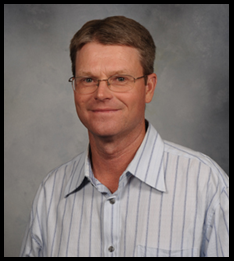
CAMPBELL: Grassroots ag technology association for producers

Stacy Campbell

The Kansas Ag Research & Technology Association (KARTA) is a grassroots association for producers, researchers, and agriculture industry leaders who share a common desire to keep up with trends in production agriculture.

KARTA is an organization of innovative people who share a common desire to learn more about production agriculture. The non-profit organization uses its revenues to provide grants to facilitate on-farm research projects and instructional workshops on the hardware and software necessary to conduct research trials. Their goal according to their web site is to keep our members and the agricultural industry on the forefront of new technology!

This conference is an applied workshop consolidating information about new and old technologies with a focus on supporting scientifically valid on-farm research efforts and increasing overall farm business profitability. The on-farm research is actually done by the farmers in this association and grant funds are allocated to the dues paying members, conducting on-farm research to help with defraying possible expenses. If grant money is received the recipient is expected to give a formal report at the conference on the results of the on-farm study.

The 22nd Annual Kansas Agricultural Technologies Conference will be held January 17-18, 2019 at the Courtyard by Marriott in Junction City, Kansas. This annual event brings hundreds of agricultural producers and industry leaders together for a two-day interactive workshop on the use of technology in the ever-changing agriculture industry. Those in attendance at the conference will hear presentations from dynamic speakers on a wide variety of topics dealing with precision agriculture. The two-day event also includes vendor displays, the KARTA Annual Meeting, research presentations from grant recipients, and an interactive evening discussion that is always an attendee favorite.

Anyone who signs up on or before December 31st can receive a $50 discount on their conference registration, which includes two days of meals and refreshments. The funds generated through the association dues and conference registrations are used to provide grants to facilitate on-farm research projects and instructional workshops on the hardware and software necessary to conduct agricultural research trials. There is also a subsidized student rate of $75 per person, catered to agricultural students at all of the state’s post-secondary educational institutions.

I have attended the conference and can say it is well worth the time and money. If you are a farmer that is interested or wants to go to the next level with precision agriculture technologies and applying them to your own farm for enhanced data collection, profitability or whatever the case may be, this conference and association may be a good fit. You could say it is a grass-roots group of farmers teaching and learning from each other’s trial and errors utilizing on-farm technology.

You can attend one or both days. To find out more about the Association, the upcoming conference and to register or to sign-up for their newsletter and even see some of the past on-farm research efforts and results go to https://www.karta-online.org

Stacy Campbell is Agriculture & Natural Resources Extension Agent for the Cottonwood Extension District .

LETTER: A political embarrassment

A friend quipped to me recently how he was slightly embarrassed to be a part of the Republican party. I said I understood and we moved on. Hopefully he understands me as I claim that I’m embarrassed to be part of the Democratic party.

While there are Democratic politicians in our nation’s capital worthy of criticism, they are not the cause of my current embarrassment. The source is the Ellis County Democratic Party.

The race for State Representative of the 111th District between incumbent Eber Phelps and challenger Barb Wasinger ended election night extremely close. 32 votes separated the candidates when the initial votes were counted. With an incredibly tight margin between the two, a recount was appropriate. After another day of counting votes, Wasinger was ahead 35 votes.

And, before we move on, let’s acknowledge that registered Republicans outnumber registered Democrats over 2:1 in our county. In fact, there are more registered Independent voters in Ellis County than Democrats. For Eber Phelps to have been only 35 votes shy of Wasinger, a candidate well-established in local politics, and to have served the district for 18 years says something about the idea-focused, rather than party-focused, nature of the electorate in the 111th.

Accepting a close loss tends to be more difficult than being blown out of the water. 35 votes is less than .2% of the 17,667* registered voters in Ellis County. With so few votes making the difference, could an extra three hours of knocking on doors changed the outcome? One more speaking engagement? A few extra phone calls encouraging supporters to get out the vote? Tiny changes in Phelps’s campaign could have made the difference.

However, since the recount, local Democratic leaders have decided to lay the blame on electronic voting machines.

Are the machines outdated? According to the Secretary of State’s office: yes.

Should concerns have been raised before the election? Absolutely.

To bring forth questions about the trustworthiness of voting machines only after your party’s candidate loses reeks of pettiness, only to be amplified by claiming you only seek the true will of the people.

When Phelps wrote a letter signifying he would abide by the 35 vote loss and asked his supporters to suspend any further action in order for Representative-elect Wasinger to focus on the coming legislative session, the matter seemed behind us all. The suit filed in hopes of an outside agency auditing the machines speaks to how a certain group of Phelps supporters truly feel about their candidate.

Just as Rep.-elect Wasinger should be focused on her coming role in Topeka and not a lawsuit, or trying to raise $20,000 for lawyer fees, Ellis County Democrats should be focused on the future instead of playing petty politics in a district that will have none of it.

In two years another election will take place for the 111th seat. With a Presidential election happening on the same ballot, voter-turnout will be even higher, giving an immediate edge to the Republican candidate. I suggest the Democratic party, my Democratic party, start finding a strong candidate and creating an even stronger campaign plan if they want a chance at winning the seat back.

*Unofficial number provided by the Office of the Secretary of State.

Zach Woolf, Hays

CLINKSCALES: Are you still ready for your journey?

Randy Clinkscales
Recently, I have been relating some lessons from a vacation my wife and I took this summer. We spent a couple weeks in the mountains of Colorado.

While there, we had a rotation of visitors. They included friends and family members.

I enjoy hiking. I have an old backpack that I keep packed for hikes. It includes a water bottle, water filtration system, compass, map, matches, and other survival items. During our stay in Colorado, one of my sons led a hike of some friends into the mountains. He “borrowed” my backpack, which was fine.

Several days later, I decided to go up a mountain trail. As I was about to start my hike, I put on my backpack, but it seemed strangely light. I discovered that the water filtration system, my jacket, and map were missing. Later, I had a talk with my son.

After our vacation to Colorado, I met with a family. In 2012, they set up an estate plan. When I met with them in November of 2018, their “estate plan” included a Tupperware container of documents.

What did I discover? Land and other assets were not in their trust (which would end up requiring a probate). They had children that helped them invest some of their money, but did not consider their estate plan in that process. As a result, the money in the investments was not properly titled in a trust, nor were the funds going where the family intended on their death. As I asked questions I kept getting blank looks from my clients and their family.

Keep in mind that in 2012 their plan was in order. Now they did not even know what they had. Part of the problem was things had been taken out; and other things were put in or intended to be put in.

And now, mom was sick; dad was burned out; they were trying to stay at home; and they wondered what to do next and whether they had what all they needed.

It was kind of like my backpack – originally it contained all the tools they needed to travel safely, or in the event of an emergency. But now my clients were lost; they looked in their “backpack” and did not know what was there, what should be there, and whether they had what they needed for their journey.
This is what happens many times: people set up a plan for a given trip. Then they deal with their family, accountant or investment person, creating changes. Or something happens that is a significant event (death, marriage, illness, etc.).

But those changes do not make it back into their plan or their plan is not adjusted as a result of those changes.

The result is their backpack is not ready for their journey.

What do you do? First, realize certain events may require changes to what is in your backpack; or may even require a brand new backpack.

Second, be careful with people that may modify what is in your backpack, without actually knowing what was in your backpack and what was intended to stay in your backpack. It could have a significant effect.

Third, review your backpack often (every year). Be sure it has in there what you think it has, and that it will take you on your journey.

I do not make these comments lightly. I know I have to look in my own “backpack” every so often. When do I do it? I usually do it at tax time. In addition, every couple years I ask my law partner to look over what is in my backpack to be sure I am not missing anything.

My law partner asks me some good questions: “Are there any family dynamics?” “Have you opened any new accounts?” “Can I look at your tax return to see what accounts you have?” You would be surprised how often she finds something that I need to fix. Usually it is a little thing, but it is something that by fixing it now makes it a lot cheaper later on.

Have someone look through your backpack with you. And do not let people take stuff out of your backpack without your knowledge and without your understanding the implications.

Randy Clinkscales of Clinkscales Elder Law Practice, PA, Hays, Kansas, is an elder care attorney, practicing in western Kansas. To contact him, please send an email to [email protected]. Disclaimer: The information in the column is for general information purposes and does not constitute legal advice. Each case is different and outcomes depend on the fact of each case and the then applicable law. For specific questions, you should contact a qualified attorney.

SCHLAGECK: Agriculture can do the job

John Schlageck writes for the Kansas Farm Bureau.

Agriculture continues to lose producers. No one will argue that point, but larger, more efficient producers are replacing those lost in this highly competitive industry.

While this is not necessarily a desirable trend, it is one that has continued for decades – maybe since the beginning of this profession. That said, it is also a trend that is not confined to agriculture but has affected nearly every sector of the U.S. and world economies.

Regardless of this ongoing change, care for the land and this critical resource continues to improve. Today’s farmers are increasing the amount of organic matter in their soil. With no-till and reduced tillage farming, farmers continue to build organic matter and improve the soil tilth. There is no reason to believe this practice will be discontinued.

Today’s modern farmer is not exhausting the land. Just the opposite is true.

Without question scarce water is always a concern, especially in Midwestern states where rainfall is limited, and people use plenty of it. Farmers constantly chart rainfall amounts and monitor weather conditions. In Kansas, agricultural producers are aware of changes in the Ogallala Aquifer.

Farmers are very much tuned into water and the conservation of this vital resource. Some are concerned about the potential of a long-term climate change.

Barring a major shift in our climate, crops will continue to be planted in western Kansas. Production could be less than now, but this land will be farmed and farmed wisely.

At the same time, the world’s population is exploding. Some say the greatest growth in the history of our world is underway.

World population is projected to reach 9.7 billion by 2050. The current world population of 7.3 billion is expected to reach 8.5 billion by 2030 and 11.2 billion in 2100. Most of these people will be born in the hungry parts of the world.

As a result, pressure on the world’s economic and natural resources for food will become intense. Such demand for food will mean opportunity for farming and ranching. It will also become critical for public/private enterprise to ramp up food production.

There is nothing to suggest yields will not keep up with population growth. Even countries with marginal soil and more severe climates than our own are growing crops today. We have better yield potential and better food value today and with new genetics and technologies coming on line, there is no reason to believe the world won’t be able to feed itself in the future.

American agriculture is up to the task. This country can continue producing for the world.

The United States farmer and rancher can compete with other nations, if they aren’t shackled by government regulations that cause production costs to soar and trade tariffs that continue to push some out of business.

Even the most efficient farmers in America can’t make it with regulatory restrictions. Any regulations must be science based and uniform across the board for producers around the world.

If there is a level playing field, where all producers have the same health and safety restrictions, U.S. agriculture will compete. Give farmers and ranchers the same opportunity, as others around the world and bountiful, wholesome food will continue.

Winston Churchill said many years ago, “Give us the tools and we will get the job done.” The same can be said for agriculture in this country.

John Schlageck is a leading commentator on agriculture and rural Kansas.

HAWVER: Thousands of state employees await Kelly policies

Martin Hawver
The Christmas season is here, and just as it is every year when a new, different-party governor takes office, state employees will wonder whether they’ll have jobs after the holidays—or Inauguration Day on Jan. 14, to be more precise.

OK, we can figure that by the time she takes the oath of office, and no longer has that “Gov.-elect” before her name, Laura Kelly will have replaced probably all or most of the 11 Cabinet secretaries appointed by either Gov. Sam Brownback or his successor, Gov. Jeff Colyer. That’s simple.

Oh, there may be some delays, but practically, if you are a Brownback/Colyer-knighted secretary, you might not want to go car-shopping this holiday season or might want to consider whether you’ll be able to afford move-ups from synthetic-to-wool or wool-to-cashmere sweaters for the spouse.

So far (up to this past weekend), Kelly has been quiet about the new Cabinet members she will appoint. She’s got a chief of staff to keep the names straight and sent a group of transition advisers to meet with those current secretaries to see just what they do, but there are no names written down that a reporter wouldn’t have to kick in a door or bust a window to see.

Oh, and those new Cabinet secretaries are going to get to hire their own chiefs of staff and assistants and public relations offices, which ought to take care of appreciation of campaign leaders and contributors as in all change-over election cycles.

But the real issue for the thousands of state employees who do the real work for the state and generally don’t have business cards and stationery is going to be what Kelly does in the way of Civil Service for state employees. Those Civil Service jobs are generally done behind counters where they hand out driver’s licenses or help the public with tax returns or in a frequently windowless back office make sure that Kansans get the services they pay taxes for.

Kansas has gone through the Republican-managed years with steady reductions in the number of Civil Service workers. That Civil Service is a protection for workers and most importantly protects their jobs as long as they are doing their assigned jobs. Do the job right, and under Civil Service, you can’t be fired because you have a bumper sticker on your car that is different than the stickers on the car of your politically appointed boss. Do the job right without Civil Service and you can be fired or not promoted with little or no performance issue.

The Brownback years offered pay raises for Civil Service workers who gave up those protections, including hearings during which a firing or being bypassed for an advancement can be challenged.

During the now-ending Republican administration, thousands of state workers who hadn’t seen raises in several years traded that job protection for raises of 2.5% for workers who changed from Civil Service to at-will employees. Not a bad deal if you were liked by your supervisor, but for those who wanted the basic protection of fair practices in employment matters, it essentially became an insurance premium in the form of lower wage to hold on to those protections.

Don’t look for those abandon-Civil-Service raises to continue. And, we’ll watch how the Kelly administration deals with basic job protections for workers who took the 2.5% raise-bait to see their job security based on whom they worked for, not the job they did.

We’re still waiting to see who become Cabinet secretaries under Kelly’s administration, but we’re also waiting to see what happens to the thousands of workers who park at the back of the lots farthest from the building…

Syndicated by Hawver News Company LLC of Topeka; Martin Hawver is publisher of Hawver’s Capitol Report—to learn more about this nonpartisan statewide political news service, visit the website at www.hawvernews.com

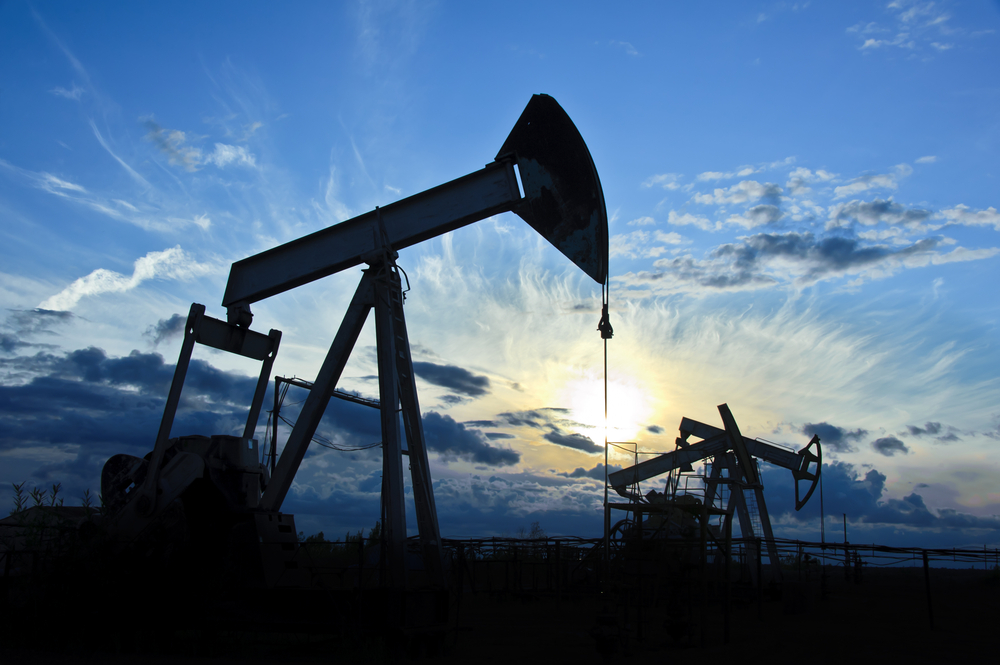
News From the Oil Patch, Dec. 11

By JOHN P. TRETBAR

Independent Oil & Gas Service reports a realignment of the drilling rig fleet in Kansas. There was an increase in Kansas drilling contractors working out of state last week, as well as an increase in the number of Kansas rigs shutdown or stacked.

The active rig count was slightly lower. In eastern Kansas, there are 12 rigs moving in, rigging up, drilling or relocating. That’s up one for the week. West of Wichita the count dropped to 35 active rigs, down two. Drilling is underway this week on one lease in Russell County.

Operators filed 28 permits for drilling at new locations across Kansas last week, including five in Barton County. There are 12 new permits in eastern Kansas and 16 west of Wichita. So far this year, we have 1,718 new drilling permits across Kansas. That’s 359 more permits than last year at this time, but five thousand less than the total by this time in 2014.

The Kansas Corporation Commission reported a total of 166 new intent-to-drill notices across Kansas during November. That’s up one from the month before, up 16 from a year earlier, but down more than 300 from the total in November of 2014. So far this year, operators filed 1,801 intents, just 24 more than last year at this time, but well behind the 6,814 intents filed through November of 2014. There were two new intents filed in Barton County, five in Ellis County, two in Russell County and three in Stafford County.

Independent Oil & Gas Service reports just 56 new well completions for the week across Kansas. In the western half of the state, there were 20 newly completed wells, but 11 of them were dry holes. Barton County added one completion last week. Russell County added two, although one of those was a dry hole. So far this year, operators have completed 1,486 wells. That’s 243 completions ahead of last year at this time, but nearly four thousand less than at this point back in 2014.

There was an increase in Kansas drilling contractors working out of state last week, as well as an increase in the number of Kansas rigs shutdown or stacked. Independent Oil & Gas Service said the active rig count was slightly lower. In eastern Kansas, there are 12 rigs moving in, rigging up, drilling or relocating. That’s up one for the week. West of Wichita the count dropped to 35 active rigs, down two. Drilling is underway this week on one lease in Russell County.

Baker Hughes reported 1,075 active rigs nationwide, down ten oil rigs but up nine rigs searching for natural gas. Oklahoma was down three and Texas down down two rigs for the week. New Mexico gained two rigs. Canada was down 13 rigs at 186.

OPEC and Russia have agreed to a deal to cut production to mop up a growing global oil supply glut. The Wall Street Journal said the deal would cut output by a collective 1.2 million barrels a day.

The Association of American Railroads reports another increase in oil-by-rail traffic. For the week ending November 24, more than 12-thousand tanker cars shipped petroleum across the U.S., an increase of 39.7% over last year at this time. The cumulative total for the year is 17% ahead of last year. Canada’s oil-by-rail figures increased 36% over last year to more than 11-thousand tanker cars. Canada is 21.5% ahead of last year’s cumulative total.

The government reported total U.S. crude oil production for September was up about 129-thousand barrels per day over the month before at 11.475 million barrels per day. That’s about 21% higher than the total in September of last year. Kansas production for September was 94-thousand barrels per day, down two-thousand barrels from the month before, and a thousand barrels per day lower than last September’s total.

The U.S. Energy Information Administration reported a slight increase in U.S. crude production last week to just under 11.7 million barrels per day. That’s nearly two million barrels per day more than last year at this time.

Crude oil imports averaged 7.2 million barrels per day last week, down by 943,000 barrels per day from the previous week. The four-week average is up 0.3% from last year at this time.

U.S. commercial crude oil inventories dropped by 7.3 million barrels and (at 443.2 million barrels) are about 6% above the five year average for this time of year.

Total motor gasoline inventories increased by 1.7 million barrels last week and are about 4% above the five year average for this time of year.

Mexico’s new president likened it to selling oranges and buying orange juice. The new government detailed plans Sunday to build an $8 billion oil refinery and to renovate six others as the oil-producing country attempts to lower its dependence on fuel imported from the U.S.

The U.S. Geological Survey announced the Permian Basin of Texas and New Mexico could hold much more oil and gas than once thought. The basin’s “Delaware Basin” could hold upwards of 46 billion barrels of oil and some 280 trillion cubic feet of gas, making it the largest continuous oil and gas resource ever assessed.

The Trump administration is moving forward with plans to open more public lands to oil and gas leases. They will allow waivers for drilling to encroach into the habitat of the endangered greater sage grouse. Earlier protections for the bird habitats affected millions of acres in the American West including parts of Kansas.

AAA: Kansas has fifth cheapest gas in America

Average Kansas gas price now $2.09, down 7 cents in past week and 40 cents lower in past month.

TOPEKA – Kansas motorists continue to get good news when they fill up their gas tanks. At $2.09/gallon, the Sunflower State’s average per-gallon gas price is now fifth cheapest in the nation. Kansas’ gas price has fallen 40 cents in the past 30 days, tied with Iowa and Nebraska for the largest monthly decline in
America.
“Kansans continue to see lower prices at the gas pumps,” said AAA Kansas spokesman Shawn Steward. “It certainly helps to have more money in your wallet for holiday shopping this time of year. Our gas prices across the state have been falling for about the past two months, and we are now down 8 percent from the $2.28 average from one year ago.”
Steward noted that three Kansas metro areas are among the Top 50 cheapest gas prices in America this week. Wichita, at $1.94/gallon, checked in with the third lowest gas prices among larger metro areas. Lawrence ($1.98) registered the 14th lowest price in the nation. Kansas City, Kan. ($2.04) is 41st lowest.
Of the 10 Kansas cities regularly highlighted by AAA Kansas (see chart below), all except Salina – which remained the same – experienced price declines in the past week. The largest price drops were seen in Kansas City, Kan. (-10 cents), Manhattan (-10), Topeka (-8) and Wichita (-8).
According to AAA Kansas, this week’s Kansas gas price extremes are:
HIGH: Elkhart (Morton County) – $2.67
LOW: Haysville (Sedgwick County) – $1.89
National Perspective
Today’s national gas price average of $2.42 is the lowest pump price of the year, a price point not seen since mid-December last year. The average sits at four cents cheaper than last week, 28-cents cheaper than last month and four cents less than last year. The last time the national average was cheaper on the week, month and year was during July 2017.
“Motorists are noticing a big difference as they fill-up at the gas pump this month,” said AAA Kansas’ Steward. “Month-over-month, gas price averages have dropped double digits for every state. For some in the Great Lakes and Central states (Iowa, Kansas, Nebraska and Missouri) state gas prices are as much as 40-cents less than they were in November. In some states, gas prices are nearing $2 per gallon – something that hasn’t been seen since December 2017.”
How low can gas prices go? AAA expects the national gas price average to drop as low as $2.40 by the end of the year due to cheaper crude oil prices. However, pump prices this cheap may not last into 2019. On Friday, the Organization of the Petroleum Exporting Countries (OPEC) announced that the cartel and non-OPEC members, including Russia, will reduce production by 1.2 million b/d for the first six months of the year. While the decision will help to reduce the high level of global crude supply, the move has the potential to increase oil and gas prices. Crude was up to $52.61 at the market close on Friday, while the week prior, crude was as cheap as $50/bbl.

Exploring Outdoors Kansas: Geese in the mud

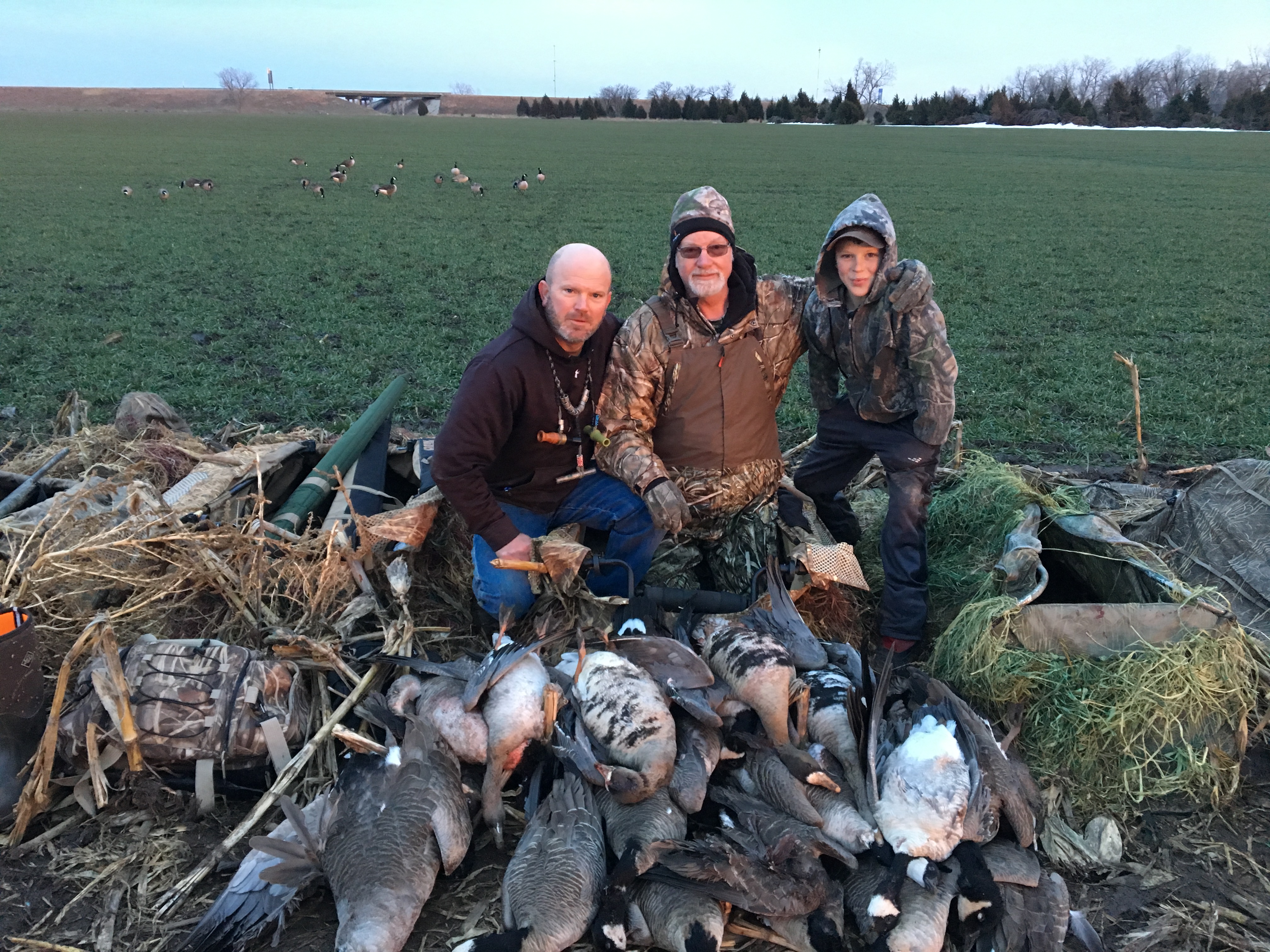
From left, Jason Austin, the author, Cael Austin with a nice afternoon’s harvest of geese

My love/hate relationship with mud is simple; I hate it when it’s muddy and love it when it’s not!

Usually here in Kansas the ground is dry enough or frozen enough this time of year that a vehicle can be driven most anywhere to set or to check traps, to retrieve a deer or to haul a trailer full of goose decoys to a blind. But it’s so wet right now I actually spent 20 minutes the other day with the farmer that farms all the land around our deer blind, asking where a 4 wheeler can be driven on his cropland to retrieve my wife’s deer if she was able to harvest one.

Steve Gilliland

My young trapping friend, along with his dad and little brother have been taking me goose hunting a couple times each season, but now he has gone to serve our country as a United States Marine.

Fortunately for me, his dad and brother still agree to put up with me in his absence, so Wednesday morning I got a call from his dad inviting me on an afternoon goose hunt.

McPherson Kansas is home to more large industry than most towns its size. Most of those big corporations have lakes at their facilities, so because of that and the amount of cropland all around McPherson and because Kansas is positioned in the central flyway, migrating geese pour into the McPherson area each season by the gazillions.

Our hunting spot was 80 acres or so tucked neatly between several of those big corporations and flanked across one end by interstate 135. The field was split about 50/50 into wheat and milo stalks. When we arrived at 3 PM as suggested, two of the hunters were already setup and the far end of the wheat field was literally covered with geese. These guys had hunted this location a couple days before and 3 PM seemed to be the witching hour, but today the geese had obviously failed to give us the memo concerning the change in their schedule.

The hunters already in place motioned for us to walk to them so we could get settled. We grabbed our gear, donned boots and began the trek across 250 yards of slimy, mucky, slippery mud mixed with milo stalks. The two hunters already there had their limit of 6 geese apiece, so we settled into layout blinds positioned at the edge of the stalks overlooking the wheat as one of the guys walked toward the huge blanket of geese, attempting to get them into the air for us to begin our harvest too. But again, the geese neglected to file their new flight plan with us and headed off in different directions.

For the next hour-and-a-half groups of several birds occasionally took a shine to the decoys and set their wings to glide in and say hello, only to be met by three hunters trying to put them into our freezers. By 5 PM all five of us had our limits and began to pack up. It took us each three trips back-and-forth through the mire to gather everything; the first trip carrying our gun & gear in one hand and as many geese as we could with the other hand, the second trip with as many geese as we could possibly haul with both hands and the last trip dragging and carrying blinds through the muck.

Back at my friend’s house, we cleaned geese on the tailgate of his truck using the headlights of my truck, and I headed home with zip lock bags of fresh goose breasts for the freezer. I rinsed them good with cold water and soaked them for twenty four hours in a cold water bath with vinegar and canning salt to help draw out any blood, then rinsed them again and layered them in freezer bags.

I’ll fix them by marinating them either sliced or whole in Italian dressing or buttermilk, topping them with bacon strips and grilling them. Wild goose breasts; yet another Kansas crop to harvest as you continue to Explore Kansas Outdoors!

Steve Gilliland, Inman, can be contacted by email at [email protected].

KRUG: Go green for the holidays

Donna Krug

Think about the bags full of trash that will be sitting by the curb waiting to be picked up the day after Christmas. It is a lot of waste and not very friendly to our environment. Here are some tips you can incorporate during this Christmas season to make your holiday a little greener for both the environment and your wallet.

  • Shop Local – When you buy your gifts and supplies locally whenever possible it reduces the cost of traveling out of town. By supporting local crafters and businesses it helps to stimulate the local economy.
  • Send E-Cards – For many of your family and friends, sending a card or invitation through e-mail may be an acceptable way to share holiday greetings. For those who still enjoy sending and receiving cards (like me), make sure to purchase cards made from recycled paper.
  • It’s a wrap – You’ve picked out the perfect gift. Now what? Consider a reusable bag or box to wrap the present. For paper options, try comics, maps, coloring pages, or wrapping made from recycled paper. Scarves or towels may also be used as gift wrap. When sending gifts, try to reuse shipping materials like padded envelopes, cartons, and packing peanuts. If the gift is staying local, avoid wrapping altogether. Hide the gift and send the recipient on a scavenger hunt to retrieve it. Utilize Christmas stockings. They are a favorite tradition so who not reuse year after year and fill with small gifts.
  • Entertaining – Entertaining can vary from an extended visit for out-of-town friends and family to a fancy one-night event. If the event requires entertaining a large group of people, turn the heat down before guests arrive. Lots of people in the house creates extra heat. Keep decorations to a minimum and consider using newsprint for table coverings. Add crayons to the table for entertainment for young guests.
  • Opt for products with minimal packaging – When grocery shopping, reduce the amount of processed food you buy and opt for fresh. Cooking from scratch will reduce your cost and increase the flavor and nutrition of your food. When buying other supplies or gifts, look for items with the least amount of packaging.
  • Conservative cooking – Be realistic about the amounts of food you buy and be creative with leftovers so food does not go to waste. Consider who will eat what and what portions are appropriate. Do not feel obligated to offer guests every appetizer and entrée under the sun. The holiday season is a time many people struggle with temptations and add extra pounds, so eliminating enticements may not be such a bad idea.
  • Dishing it out – It may mean extra work for you, but think about hosting the event with reusable dishes instead of disposable dishes. When washing up after the party, fully load the dishwasher to get the most out of the hot water. Put out separate bins for recyclables and label them so guests know where to toss their glass, plastic and aluminum.
  • Get creative with gift giving –  Gifts made with love can be particularly sweet. Knowing someone made a homemade gift adds a personal touch. Consider gifts of entertainment, endowment or a good deed. Look around your surroundings and see if there is something you have that you know someone would enjoy receiving.

I want to give credit to Nadine Sigle for sharing these tips when she was the Family and Consumer Science Agent in the Post Rock District. Now Nadine serves as a Community Vitality Specialist in Northwest Kansas.

Donna Krug is the Family and Consumer Science Agent and District Director for the Cottonwood Extension District. You may reach her at: (620)793-1910 or [email protected]

Now That’s Rural: Lona Duvall, Finney County

Ron Wilson is director of the Huck Boyd National Institute for Rural Development at Kansas State University.
By Ron Wilson
Huck Boyd National Institute for Rural Development

Where is the largest transloading facility in North America? Not New York, Chicago, Dallas or Atlanta. It is located in Garden City, Kansas. This project, along with a new dairy processing plant and more, are contributing to the growth and vitality of this part of rural Kansas.

Last week we learned about Lona Duvall, who worked to help bring the new milk processing plant to Garden City in September, 2017. Lona is president and CEO of Finney County Economic Development in Garden City. She grew up in the nearby rural community of Leoti, population 1,450 people. Now, that’s rural.

After college, Lona came to Garden City where she worked in banking. In 2010, she joined the Finney County Economic Development organization as its business retention director and was promoted to president in 2011.

Garden City has long been known as a center of the beef packing industry, but in 2000, the town’s big ConAgra beef packing plant was devastated in a fire. It never reopened, and one of Lona’s goals was to redevelop the area.

One day Lona was contacted by a couple of men from Wyoming. They informed her that they were working on a project and wanted to lease 10 acres along the railroad tracks in Garden City. She went to work to help them. They quickly learned they needed more space. In three days, they said to her, “Well, we need 50 acres and a railroad spur.” The project continued to grow.

The company was named Transportation Partners & Logistics, which specialized in intermodal port, truck, rail and distribution processes. The company’s first project in Garden City was to handle incoming wind turbine equipment. It was on a hard deadline.

“They had a unit train coming with this equipment in 19 days,” Lona said. It appeared impossible at first, but the city and county mobilized to make it happen. “I participated in four special meetings of the city council in five days.” With support from the city and county and KDOT, and with workers on the job day and night, 8,000 feet of railroad got built and the first train came on time in 19 days. The company was off and running, so to speak. TP&L’s transload facility is now 700 acres, the largest on the continent. It’s located at the site of the former ConAgra plant.

“It was a Godsend to get it redeveloped,” Lona said. The rapid success on this project also created positive momentum and a “can do” attitude in the community. “We showed what could happen when we work together,” she added.

Lona chairs the dairy committee for the western Kansas Rural Economic Development Alliance. She is also attuned to the concerns about future water supply for the region. Lona noted that the new, large dairies have closed loop systems so that waste water and nutrients are saved and reutilized.

“These dairymen care every bit as much about the environment as anyone,” Lona said. “There is no better steward than the man who works the land for his livelihood.”

The new dairy processing plant is remarkable in that it converts fluid milk to powdered milk, thus generating water for the community. It is a net gain for the community’s water supply. The powdered milk is being trucked to Kansas City and ultimately to the export market. This created an opportunity in the transportation sector. Mies and Sons Trucking Company was recruited to Garden City and located next to the dairy plant so as to provide the hauling service for powdered milk.

Such projects are beneficial to the community and the entire region, according to Lona.

“We take seriously that our success directly impacts all the rural communities around us,” Lona said. “When we discuss projects as Finney County Economic Development, we ask how this can benefit outlying counties,” she said.

For more information, see www.ficoedc.com.

Where is the biggest transloading facility in North America? Garden City, Kansas. We commend Lona Duvall and all those involved with Finney County Economic Development for making a difference with regional economic development. They are carrying a big load.

MARSHALL: Doctor’s Note Dec. 8

Dr. Roger Marshall, R-Great Bend, is the First District Kansas Congressman.

Friends,

This week our country lost a patriot and dedicated civil servant. President George H.W. Bush, from his service as a Navy pilot in 1941 to his time in the oval office, was a statesman through and through.

He was a gracious man, and his service to his country will never be forgotten. It has been a somber week on the Hill, but Laina and I were humbled to have the opportunity to pay our respects to President George H.W. Bush and attend his service in D.C. on Wednesday.

One thing this week reminded me is that when we pass, it is not where we stood on a particular issue that will be remembered. Rather, we will be remembered for how we treated others and how we made them feel. It is evident to any student of history that President Bush will be named among an exceptional class of statesmen who will be remembered for their character rather than their title.

Fighting for Farmers
China has long not played by the rules, and it’s about time that they start. They reject loads of sorghum and wheat for arbitrary reasons. For 14 years they’ve kept US beef out of their market for no reason, while they exceed their legal level of subsidies by $100 billion in support to their farmers.

I am hopeful that this 90 day period will allow us to restructure the way we trade with China and level the playing field.

But the real test will be what comes from these negotiations in the next 90 days, and if we can hold China accountable to an agreement. My track coach always used to say, “don’t tell me, show me,” and so far, we’ve gotten a lot of talk from China, but very little actual change.
I think the White House has heard our farmers loud and clear that, while they support holding China accountable, we need to be moving towards an agreement. Farm bankruptcies in Kansas are up a multiple of six just in the last three years. Farm country needs stability and certainty out of this trade agreement

Pentagon Community Partnership Program
This week Fort Riley and the City of Manhattan were honored at the 2018 Army Community Partnership Awards. Fort Riley’s partnership with the City of Manhattan was one of seven U.S. Army installations and neighboring communities that were awarded for their partnership that enhanced Army readiness, modernized Army processes, and improved business reform while building strong community relationships.
Fort Riley and the City of Manhattan received the award for their Intergovernmental Support Agreement for the bulk purchasing of road salt utilized during severe weather. Not only will this arrangement benefit the Flint Hills region, but will also save Fort Riley roughly $90,000 annually.

I was proud to attend the award ceremony at the Pentagon.

Meeting with Army Leaders
On Thursday, I addressed a group of Army Senior Sergeants Major who were visiting Capitol Hill as part of their professional military education. They traveled to D.C. to further understand the relationship between Congress and the Army and how that relationship translates into their current position.

It was my honor to discuss the role our office has in working with the military, and the way Congress works with military leadership to ensure they have the tools necessary for the US to remain strong and our citizens safe here at home and abroad. It’s important to also recognize these fine men and women and their decades of service. These are some of the best and brightest men and women when it comes to national security, generally taking 20 years of service to attain this rank.

The men and women I met with have been proven great leaders, and it was such a privilege to sit down with them and thank them for their service and discuss the significant opportunity they have in helping shape policy.

Honoring the Apollo 8 Mission
I also had the unique opportunity to meet and learn from some of my childhood heroes this week. The Cosmosphere, in Hutchinson, hosted NASA astronauts and mission control staff as part of its EarthRising Celebration, honoring the 50th Anniversary of the Apollo 8 Mission to the Moon. I had the distinct pleasure of helping to welcome NASA officials to Kansas and hear from them on the success and challenges of the Apollo 8 mission as well as celebrate the continued success of The Cosmosphere.

The Cosmosphere not only preserves NASA and space exploration history but works to spread the love of space and science to students across the state. The center recently received a federal grant to take its mission control consoles to Smithsonian affiliate museums, schools and Challenger centers through 2019 to allow students a hands-on learning opportunity and insight in the world of space exploration.

TUNE IN: Army v. Navy
Saturday, Army and Navy will face off in their 119th annual football game. The longstanding rivalry will start at 2:00 PM CT on CBS, and this year Army will be sporting the Big Red One patch. Army will be playing in uniforms that pay tribute to the WWI soldiers of the 1st Infantry Division, and I couldn’t be prouder to see the Big Red One displayed on the field.
Go Army, Beat Navy!

A Day That Shall Live In Infamy
As you know, Friday is the anniversary of the attack on Pearl Harbor. On December 7, 1941, the Japanese attacked the U.S. Naval Base at Pearl Harbor in Hawaii. On that day, 21 U.S. ships were sunk/severely damaged, over 188 U.S. aircraft destroyed, and most importantly we lost more than 2,400 American lives. Seventy-seven years later, we come together to honor those service members and civilians that lost their lives in the horrific attack on our nation.

To many, this devastating attack feels like yesterday.

Hunting season is in full swing
I was able to get a full day of hunting in with my son-in-law and a couple of my friends last weekend. Many of you know how much I love to hunt and fish, and it was great to be back in Kansas doing what I love best, enjoying the beautiful outdoors and putting down a record number of mallards.

Dr. Roger Marshall, R-Great Bend, is the 1st District Kansas congressman.

Wheat Scoop: Planted wheat acres down in Kansas

78c4d285-c4f2-40e8-b6ca-2791c1bec7b4.pngWheat acres in Kansas will likely be lower than last year, possibly reaching 100-year lows in the state. Last year’s 7.7 million planted acres were the third lowest in a century.
Abnormal weather patterns in October and November contributed to the decrease in acres planted. According to the Kansas Mesonet, there was record precipitation throughout the state in October and below average temperatures in November.
This has led to the state being essentially drought-free for the first time in years, but it also kept farmers out of the fields during fall harvest and wheat drilling time.
USDA’s National Agricultural Statistics Service reports that for the week ending December 2, 2018, topsoil moisture supplies rated 0 percent very short, 4 short, 76 adequate, and 20 surplus. Subsoil moisture supplies rated 0 percent very short, 6 short, 83 adequate, and 11 surplus. The U.S. Drought Monitor shows drought conditions in Kansas on November 27, 2018 of only 6.2% abnormally dry and 0.5% in moderate drought. None of the state is in severe drought or worse.
USDA/NASS also reports that fall harvest is mostly complete, with corn harvest at 96%, soybean harvest at 95% and grain sorghum harvest at 89%.
But, wheat should’ve been planted by the end of October in most areas of the state, and at that time, soybean harvest was only 63% complete and grain sorghum harvest was only 49% complete. This kept farmers from planting wheat behind soybeans in a common double-crop situation.
At the November 29 board meeting of the Kansas Association of Wheat Growers and Kansas Wheat Commission, farmer board members reported on wheat planted acreage in their areas this fall.
In West Central/Southwest Kansas, Rick Horton, who farms in Wichita and Kearney Counties, reported that the moisture profile in the area is good. While wheat acreage overall might be up a little in the area, traditional fallow acres are still down about the same as last year.
Ron Suppes, who farms in Lane County, reported that acres are down a little in his area, but some farmers were still trying to drill wheat at the end of November. He said that there is still some grain sorghum left to cut and that most of the wheat is emerged.
In Northwest Kansas, Brian Linin, who farms in Sherman County, reported that acres are similar to the past, and the wheat looks really good. He shared that there is uncharacteristic moisture in the area and the snow is just a boost to that moisture. He did share a concern about the likelihood of Wheat Streak Mosaic Virus in the area.
Chris Tanner, who farms in Norton County, estimates that fall harvest is only 60% complete in the county. He said wheat acres are down, but early planted wheat looks nice. He said farmers were still drilling wheat in the area as of the end of November.
In North Central Kansas, Mike McClellan, who farms in Rooks County, estimates that wheat acres are down 1/3 from last year. He said that farmers weren’t able to get many wheat acres in behind soybeans.
Mike Jordan, who farms in Mitchell County, agreed. He said most people would have had to stop harvesting fall crops to plant wheat, so he estimates acres will be down 25% in Mitchell County.
In Central Kansas, David Radenberg from Barton County reported that acres are also down in his area, and that grain sorghum harvest is not complete.
Doug Keesling, who farms in Rice County, agreed that acres are down in central Kansas, estimating a decrease of 5-15% from last year. He reported that most of the decrease came from acres that were to be planted behind soybeans, because farmers weren’t able to get their beans harvested and wheat planted.
Justin Knopf, who farms in Saline County, estimates acres planted will be only 60-70% of last year, mostly because they didn’t get planted behind soybeans.
Ken Wood, who farms in Dickenson County, estimates that acres are down 25-30%, stating that farmers gave up on planting wheat because of the poor weather conditions. All four central Kansas farmers reported that they are still finishing up soybean and grain sorghum harvest in the area.
In South Central Kansas, John Hildebrand, who farms in Stafford County, reported that the early planted wheat in the area doesn’t look very good, and that late planted wheat is not yet emerged. He said wheat acres are down, and there is still grain sorghum left to cut.
Scott Van Allen, who farms in Sedgwick and Summer Counties, reported that early planted wheat in his area looks nice, and the late planted is only 1/2″ tall. He said that there was no double crop wheat planted behind soybeans in his area, estimating that acres are down 5-10%. There are still soybeans and grain sorghum left to cut.
In Northeast Kansas, Jay Armstrong, who farms in Atchison County, reported that wheat looks good in his area and that acres are up a little over last year.
USDA’s National Agricultural Statistics Service reports that for the week ending December 2, 2018, winter wheat condition rated 3 percent very poor, 13 poor, 39 fair, 35 good, and 10 excellent. Winter wheat emerged was 89 percent.
K-State Research and Extension reports that leaf rust is causing problems for some wheat producers in Kansas this fall with reports of wide spread infections in volunteer wheat and the early planted fields in western and central regions of the state. They also report that the sudden, sharp drop in temperatures across Kansas observed in the early part of November 2018 could have different consequences to the wheat crop, varying from no impact to some injury in particular fields. This injury could depend on the amount of snow on the surface and the amount of moisture in the soil, which serves as a buffer against cold temperatures.
With all the wheat crop has already endured, we are still a couple weeks away from the beginning of winter, and the condition of the 2019 wheat crop will continue to evolve until harvest next summer. While planted acres are down overall, at least the crop has the opportunity to begin its fragile life with adequate moisture.
Copyright Eagle Radio | FCC Public Files | EEO Public File