We have a brand new updated website! Click here to check it out!

News From the Oil Patch, Nov. 27

By JOHN P. TRETBAR

Baker Hughes reported 1,079 active drilling rigs across the U.S. last week, a drop of three oil rigs. North Dakota and Texas were both down three, Louisiana was up four and New Mexico increased by three rigs. Oklahoma was down two rigs for the week. Canada reported 204 active rigs, up seven for the week. Independent Oil & Gas Service reported 15 active rigs in eastern Kansas, which is unchanged, and 33 west of Wichita, which is down one.

Operators filed 30 permits last week for drilling at new locations across Kansas, nine east of Wichita and 21 in Western Kansas, including two in Stafford County.

Independent Oil & Gas Service reported 45 new well completions last week, 1,396 so far this year. There were 11 in eastern Kansas and 34 west of Wichita. Three completed wells were reported in Barton County, two in Ellis County, and one each in Russell and Stafford counties.

The government said U.S. crude production continued to rise from record levels, last week topping 11.7 million barrels per day, an increase of four thousand barrels per day over the week before. The U.S. Energy Information Administration reported inventories increased by 4.9 million barrels, and are now about six percent above the five-year average for this time of year.

North Dakota reported another crude-production record in September, 1.36 million barrels per day according to preliminary numbers from the state. But officials say those numbers could go down over the next three months or so, because of low oil prices, and the state’s disappointing gas-capture efforts. The state has decided not to change the scheduled increases in gas capture goals, and instead offer flexibility to operators in their efforts to meet them.

A judge in Oklahoma denied a motion to dismiss an earthquake lawsuit against producers in Oklahoma, but refused to give the suit class-action status. The Journal-Record reports said some clients will have to refile if they want to proceed with their damage claims. Plaintiffs attorney Scott Poynter said he was pleased that the judge denied motions to dismiss the case, but said the potential plaintiffs in the class should file individual petitions soon if they want to protect their rights under statutes of limitations laws.

U.S. liquefied natural gas exports are booming, and some new export facilities are in the works. Cheniere Energy officially opened its $15 billion facility in Corpus Christi, Texas earlier this month. The company won’t say when the first cargoes will set sail, but Reuters reports an LNG vessel currently docked at the plant was expected to take its first cargo soon. Corpus Christi is the third big LNG export terminal to enter service in the lower 48 states.

In Texas producers are worried about infrastructure and personnel. More than a dozen top U.S. energy companies have pledged $100 million toward easing stresses on health care, education and civic infrastructure from the shale oil and gas boom in West Texas and New Mexico. Pioneer Natural Resources is spearheading an effort called the Permian Strategic Partnership. Company CEOs warn that if worker shortages, road problems, healthcare and housing aren’t address soon, Permian development could be stifled.

Some pipeline relief is in the works in North Dakota, but it will be over a year before it bears fruit. Phillips 66 and Bridger Pipeline announced plans for a new pipeline to send Bakken and Rockies crude oil to Texas. The firms announced a joint open season for the proposed Liberty Pipeline, which, if approved, could move some 350,000 barrels per day by the year 2020.

The Oklahoma Supreme Court sided with the state’s oil and gas industry in a dispute over what kinds of water can be transported through temporary lines the county permits in ditches along roadways. The high court said Kingfisher County may not issue rules against moving only drinking water, and not produced wastewater, through those ditches. The court agreed with the industry’s assertion that state law gives state regulators the exclusive authority to regulate oil and gas activities.

Alberta gives carbon-tax breaks to oil and gas drillers, and a tongue-lashing to the national government in Ottawa. Premier Rachel Notley announced her government in Alberta will add oil and gas drilling to a list of trade-exposed industries exempt from the province’s carbon tax. The move is expected to provide $750,000 to $1.5 million per year in relief to the drilling industry. Notley later criticized a fiscal report for underplaying Western Canada’s oil price crisis, blamed on insufficient pipeline capacity to take away a glut of crude trapped in Alberta.

The boom continues in New Mexico, where the State Land Office announced a record for its monthly oil and gas lease sale, generating This month’s sale represents the highest single-month yield in the agency’s history more than $43 million for public schools and other trust land beneficiaries. The previous record of just over $30 million was set in July of last year.

Regulators in Alaska say the state held another record-breaking lease auction for oil and gas rights. The Alaska Division of Oil and Gas received 159 bids totaling $28.1 million for properties on the North Slope, the foothills, and the Beaufort Sea.
HAWVER: State of the Kan. transportation plan will come into focus

Martin Hawver
Sometime later this week, we’ll see just what the Joint Legislative Transportation Vision Task Force comes up with for a new 10-year Kansas highway plan.

And, maybe we’ll also find out what happened to those 21 delayed modernization and expansion projects for the state’s highway system that were believed to be good ideas 10 years ago in the now near-expiration T-WORKS 10-year highway program that legislators and administrators touted a decade ago.

Yes, we’ll find out this week when that “vision task force” puts together most of a new highway and transportation plan that it will present to the Legislature sometime in January.

Remember that the near-ended T-WORKS plan was presented as a way to not only make the state’s roads better, more convenient and safer, but as a demonstration that representatives and senators had genuine clout in the Legislature by getting road projects in their districts, or near their districts, that their constituents would like.

Nothing quite like standing next to the governor, the local Chamber of Commerce officials, mayors, county commissioners and others when that ribbon was cut to make driving easier and safer for your local voters. Not quite like crowning a beauty queen, but politically, close.

That old T-WORKS is nearly over, and of course nobody’s forgotten those promised and then not delivered road projects.

Reason, of course, was that the now mostly repealed Gov. Sam Brownback tax cut program reduced state revenues so sharply that the state had to withhold more than a billion dollars in funds for those projects from the Kansas Department of Transportation. The governor and his allies called it “sweeps” of those highway funds, we’re supposing because “sweeping” sounds so much better than robbery.

The delayed projects include about 96 miles of modernization, ranging from wider and safer shoulders to flattening out hills and straightening curves so you can not only see where you are going, but so you can see the vehicles coming from the other direction. Safety stuff. Oh, and about 35 miles are road expansions, including four-lane expressway construction, making intersections safer and adding frontage roads so there are fewer cars slowing ahead of you as they pull off to get to a quick stop or hamburger stand or such.

Those delayed projects? Pretty evenly split between western and eastern Kansas, either side of US-81, which is the east/west dividing line of the state.

This time around, besides catching up, or not catching up on the projects that weren’t done, we’re going to see just where new money is planned to be spent in the upcoming decade.

And that’s where the issue comes down to legislators’ clout on the House and Senate floors. House members in their first year of a new term: What a good time to show that their constituents elected someone with genuine muscle? And Senate members who will be on the ballot about the time that the new highway program is to start, they’ll be measured by constituents on what they were able to bring to their home districts. Whether it’s four lanes or upgraded two lanes, or maybe just an off-ramp near the city center. Lots of options here.

But the key is that everyone wants better roads, faster roads, smoother roads, and they want everyone else in the state to pay for them…somehow.

Could be a motor fuel tax, could be provisions that prohibit that “sweeping” of funds from KDOT if the economy goes south, or it could be a battle between lowering the sales tax on groceries or getting that new or at least smoother road.

We’ll get a hint of how this may come out by week’s end.

Syndicated by Hawver News Company LLC of Topeka; Martin Hawver is publisher of Hawver’s Capitol Report—to learn more about this nonpartisan statewide political news service, visit the website at www.hawvernews.com

BOOR: Understanding your soil pH is critical

Alicia Boor
One of the issues that we have here in the area is that our soils are of a high pH. This can cause issues with nutrient uptake in plants, especially if their root systems have been compromised by drought. I have found an article from our Horticulture department that gives you some more information about what you can do if you have high pH soils to help your plants.
   

Though there are high pH soils in most parts of the state, alkaline soils tend to be more common in the central and western regions of Kansas. These high pH soils can cause problems for plants by reducing the availability of certain micronutrients. For example, most Kansas soils have more than adequate amounts of iron. However, a high pH can make iron unavailable resulting in a condition known as iron chlorosis as evidenced by light green leaves with darker green veins. Iron chlorosis reduces the health of plants by reducing photosynthesis. Lowering the pH of such soils will eliminate iron chlorosis.
   

Now would be a good time to have a soil test done to see if your pH is too high. If so, sulfur can be added either now or in the spring to lower the pH. Different textures of soil require different amounts. A sandy soil needs 1.0 to 1.5 pounds of sulfur per 100 square feet to reduce pH one point. A loam soil needs 1.5 – 2.0  pounds and clay needs 2.0 – 2.5 pounds to do the same. For example, if you wished to lower pH from 7.5 to 6.5 on a loam soil, you would need 1.5 – 2.0 pounds of sulfur per 100 square feet.
   

So, what pH do we shoot for? For most plants, a pH between 6.0 and 7.0 is preferred. Unfortunately, adding sulfur to lower pH is not as clear-cut a solution as we would like. Here are some other factors to keep in mind. 
   

Free calcium carbonate: Some soils have free calcium carbonate, actual particles of limestone mixed in the soil. These “calcareous” soils normally have a pH of 7.3 to 8.5, with 8.2 to 8.3 being most common. In order for us to lower the pH with sulfur, all free calcium carbonate must be neutralized first. A recent soil test showed 6.7 percent free calcium carbonate. One pound of sulfur is needed to neutralize three pounds of calcium carbonate. Assuming 80 pounds for a cubic foot of soil, you would need about 1.75 pounds of sulfur per square foot just to neutralize the free lime. Additional sulfur would be needed to lower pH. Adding this much sulfur to a soil at one time is not recommended.
   

Not all high pH soils are calcareous. Perform this simple test to see if your soil contains appreciable amounts of free lime. Apply one drop of vinegar to dry soil. A vigorous fizz usually means the soil contains at least 3 percent calcium carbonate. A mild fizz suggests a calcium carbonate of between 1 and 2 percent and a fizz that can only be heard suggests the soil has a calcium carbonate content less than 1 percent.
   

How sulfur works: Elemental sulfur does not lower pH directly. It must first be oxidized to the sulfate form with the result being sulfuric acid. The sulfuric acid produces hydrogen, which acidifies the soil and lowers pH. The oxidation takes place primarily through microbial activity.
   

Oxidation takes time: Microbial oxidation of elemental sulfur takes time and depends on:
    
– number of sulfur oxidizing bacteria present
    
– temperature (75-104 degrees optimum)
    
– moisture content of soil (too wet or too dry will slow down process)
     
– size of sulfur particles (the smaller the better)
   

A single sulfur application normally takes at least 2 years for most the sulfur to react and form sulfuric acid.

Alicia Boor is an Agriculture and Natural Resources agent in the Cottonwood District (which includes Barton and Ellis counties) for K-State Research and Extension. You can contact her by e-mail at [email protected] or calling 620-793-1910

Now That’s Rural: Western Kansas Rural Economic Development Alliance

Ron Wilson is director of the Huck Boyd National Institute for Rural Development at Kansas State University.

By RON WILSON
Huck Boyd National Institute for Rural Development

“Herd about Kansas?” I saw that phrase – with “heard” spelled “herd” as in a herd of cows – on a cap which displayed a picture of a cowherd. The cap was colored in black and white splotches like a Holstein milk cow. That cap is the type of eye-catching item which might have been used in the early 1990s to recruit dairies to western Kansas. This jointly-supported recruitment effort has not only sparked remarkable economic growth, it has been part of the spirit of regional cooperation.

In previous weeks, we’ve learned about leading dairymen in three different regions of the state. The dairy industry has grown significantly in this state, particularly in western Kansas.

In the early 1990s, community leaders in western Kansas recognized that there were opportunities to grow and attract the dairy industry. The Western Kansas Dairy Coalition was formed.

Joann Knight of Ford County Economic Development was involved at the beginning. “Dairies were getting squeezed out of California,” she said. The bountiful feed production and wide open spaces of western Kansas made this seem like a perfect location to relocate. Community leaders came together to jointly recruit to the region. By pooling their efforts, these communities could send one big, effective display to a trade show, for example, rather than having multiple communities send several small, ineffective ones.

Note that I just said that milk production was being `squeezed out’ of California and that the recruitment efforts should be `pooled.’ Isn’t that udderly funny? Okay, enough milk jokes.

Apart from the dairy industry, visionary leaders in western Kansas were concerned about the future of their communities and the region in general. Among those who saw the need to work together for mutual benefit were the late Steve Miller from Sunflower Electric Power Corporation; Carol Meyer, who was at the Chamber of Commerce in Garden City at the time; and Lyle Butler, then-president of the Dodge City Chamber of Commerce.

In May 1994, some 85 people attended a meeting to discuss the economic challenges of the region and to consider how a regional organization might help. They agreed to help plan a regional organization. This resulted in the western Kansas Rural Economic Development Alliance or wKREDA. wKREDA provided a unifying force for all of western Kansas.

Eventually, the dairy coalition came under the organizational umbrella of wKREDA, which helped organize the recruitment efforts.

For example, a wKREDA delegation went to the big dairy expo in Tulare, California and the New York farm show. This raised the visibility of western Kansas as a potential site for dairies to relocate.

Carol Meyer remembers being part of the dairy recruitment team. “Every week we went somewhere and met with dairy managers to learn about what they needed,” Carol said. Bankers and rural electric cooperatives agreed to put up funds to help the new dairies.

The effort worked. In 1994, the first dairies from California began to move to Kansas. At the New York farm show, wKREDA representatives met the McCarty family which would eventually relocate their dairy farm to Kansas also.

This was genuine rural economic development. The new dairies stimulated jobs, construction, growth in school enrollment, and other economic activity. The McCartys’ first Kansas dairy was located near the rural community of Rexford, population 232 people. Now, that’s rural.

Today wKREDA continues to work on dairy growth along with other issues benefitting western Kansas. For example, wKREDA provides economic and community development education for its members, builds relationships with various agencies and partners, and provides political representation to policymakers in Topeka and Washington. wKREDA represents 55 counties which have chosen to pool their resources for mutual benefit. Christy Hopkins, Greeley County economic development director, is the current president of wKREDA.

For more information, go to www.discoverwesternkansas.com.

Have you Herd about Kansas? We commend Carol Meyer, Christy Hopkins, and all those previously and currently involved with wKREDA for making a difference with dairy recruitment and regional cooperation. Working together, they were able to make themselves heard.

And there’s more. Growth in dairy production has led to value-added opportunities in dairy and other industries. We’ll learn about that next week.

INSIGHT KANSAS: How school choice works in Kansas

Mix, match, customize — the modern world is an array of choices that permeate many aspects of our daily lives.  Take for example public, PreK-12 school choices approved by the Kansas State Board of Education.  While not all options are listed here and not all are found in every school district, the choices include:

School systems.  Families may choose traditional neighborhood schools, the KSDE on-line school, experimental schools approved by KSDE, charter schools that report to a local school district or home schooling.

Dr. Sharon Hartin Iorio is Professor & Dean Emeritus at Wichita State University College of Education.

Programs within traditional schools. These include the high-rigor International Baccalaureate programs, advanced placement, programs for high-risk students, magnet schools that center on a specific content area such as engineering or the arts and technical, career-preparation programs.   

Public school partnerships. In this design school personnel work alongside university faculty and/or corporate employees.  These programs include dual (concurrent) enrollment where students’ classes count for both high school and college credit. In other programs students learn skills needed by future employers and participate in corporate-sponsored internships.

Public support of private schools. Kansas tax structure allows for individuals to donate up to $500,000 in any one year and be reimbursed with a 70 percent tax credit.  Low-income families, whose students are in low performing schools, may apply to a scholarship granting organization for a private school tuition state scholarship of around $2,300 per year.  About seven percent of Kansas students are eligible.  Currently 292 students are receiving scholarships and 78 percent of them attend religious schools.  Additionally, individual donors may draw up to $10,000 per year from their Kansas Learning Quest savings accounts for private school tuition for each of their K-12 students. 

Given the opportunities above, Kansas appears to enjoy a remarkably holistic approach to school choice. 

The term, school choice, carried a specific definition when it first appeared in the 1950s  once Nobel prize-winning economist Milton Friedman proposed vouchers totaling the sum of state funding for any individual student should be allowed for tuition at a private school of choice. 

Thus, public schools would be led to improve learning and, at the same time, become more efficient with finance.  Within a few years, the U.S. Supreme Court declared voucher systems in six Southern states unconstitutional thus effectively curtailing the voucher movement.

A resurgence in vouchers as part of school reform arose in the 1990s and currently 26 states allow some form of government-funded vouchers, often through tax credits, for specific groups such as foster-care, special needs or low income children.  However, since 2000, voucher referendums have been voted down in seven states. 

Some Kansas school reformers say vouchers or tax credits that go beyond the low income restrictions imposed for state scholarships would represent the best of Friedman’s intentions and fulfill Constitutional requirements.  They wish to increase the size and scope of tax credits.

Kansans must be careful not to conflate economics and education.  Milton Friedman’s ideas no longer influence America’s policies.  If substantially expanded, tax credits would divert public school funds to private schools, reduce public school funding and result in fewer Kansas tax dollars collected. 

More importantly, a sizable swing to tax credits could lead to extensive school privatization with governance by non-elected boards.  That result could fragment universal public education and the bond that holds together our society of diverse cultures, races and religions.  Kansas currently offers an abundance of school choice.  Reform and efficiency can happen without jeopardizing the public school system that embraces all Kansans.

Sharon Hartin Iorio is Professor and Dean Emerita of Wichita State University College of Education.

BELL: It pays to shop small in your community

Bell

By WAYNE BELL
U.S. Small Business Administration

The 2018 Holiday Season is rapidly approaching or already begun depending on your perspective. As we are finalizing menus and guest lists for Thanksgiving Day meals, maybe you are already thinking ahead about the friends and family you will be shopping with or for on that notorious biggest shopping weekend of the year. You might already be scouting Black Friday deals, making your plans to be efficient and get the most bang for your buck. But have you thought about how your local community can get the most bang for your buck?

Your community gets more return on your dollar when you shop small and local. Small businesses are the glue that holds our communities together. They create jobs and boost the economy. In fact two of every three new jobs are created by small business. How does that add up? In Kansas that amounts to 99.1 percent of all businesses are small and 51 percent of Kansans either own or are employed by small businesses.

During this holiday season, the U.S. Small Business Administration (SBA) hopes you will celebrate the more than 250,000 small businesses in Kansas that ignite our local economies and enrich our communities throughout the year by shopping and dining local and small on Small Business Saturday this November 24. What is Small Business Saturday? It is a day for each of us to acknowledge those businesses that deliver essential goods and services to our communities 365 days a year by shopping or dining with them while we are out and about in our communities, shopping, dining, or just enjoying a visit over a cup of coffee with family and friends.

Last year, Small Business Saturday generated approximately $12 billion in spending and four in ten American adults reporting having shopped or dined small on that day. Why did shoppers and diners make that kind of commitment last year? In Kansas 64 percent of survey respondents shared they enjoyed supporting their local communities and 48 percent said that staff and owners at independently-owned businesses often provide better customer service – and we all know how critical that can be to keep our spirits up and the holiday mood joyous during busy shopping days!

I encourage you to join me and more than 100 million Americans that will shop and dine small this Small Business Saturday, November 24. Show your support for the Kansas small businesses that keep us all going not only throughout the Holiday Season, but all year long. Be sure to share your great stories and where you’re shopping via social media using #ShopSmall. And from our whole SBA team in Wichita, we hope you have a safe and prosperous Holiday Season.

Wayne Bell is District Director of the Wichita District Office, U.S. Small Business Administration.

KRUG: Celebrate your family

Donna Krug
The saying, “A picture is worth 1000 words” is so true. In the case of our four grandchildren the texts and FaceTime minutes help us manage in between visits. Still nothing compares to actually seeing, hugging and interacting with the kids. As we enter the holiday season, families across the country hardly need a reminder that the week of Thanksgiving is designated as National Family Week.

National Family Week got its’ start in Canada and was adopted in the U.S. during the Regan administration. It embraces the premise that children live better lives when their families are strong, and families are strong when they live in communities that connect them to economic opportunities, social networks, and services. These “connections,” celebrated during National Family Week, include access to reliable transportation, employment opportunities, education, child care, housing, health care, and support from community networks and institutions.

When America’s diverse families and children are healthy, our nation prospers. That is why we hope everyone will take time during National Family Week to honor the connections that support and strengthen families year round.

I am reminded of parenting classes I have led in the past and the need to encourage families of all kinds to provide a nurturing and safe environment for their children. Putting struggles from the past behind them and starting fresh with new ideas to build self- esteem and good communication skills is a worthy goal.

We have an excellent resource titled, “100 Ways to Celebrate your Family.” If you feel like you need some fresh ideas to try out with your family, stop by for your free copy of this poster that is appropriate to share throughout the holiday season.

Something else I want to mention in my column space today is that the Cottonwood Extension District has a Family and Community Wellness position open. Our offices are in Great Bend and Hays and the primary location for this position will be the Hays office. The person in this position will provide programming related to: strengthening families and individuals, building community capacity, family and community health and wellness, and local volunteer development. Follow this link for more information and the application procedure: www.ksre.ksu.edu/jobs

Donna Krug is the Family & Consumer Science Agent and District Director for the Cottonwood Extension District. You may reach her at: [email protected] or (620)793-1910.

KNOLL: Miracles do happen

Les Knoll
Yup, miracles do happen. What better subject and proof than President Donald J. Trump.

Just maybe a higher power intervenes.

Miracle number one was Trump winning the presidency back in 2016. Miracle number two is his survival against all odds.

No president in this country’s history has been hated by more people and mostly just for who he is. It’s all about feelings and emotions. What Trump does to make America great again is meaningless to half this country. Conservatives and most Christians love the man, but the many other elements against him are overwhelming. Yet he survives.

Trump has survived a press that obviously has chosen not to be a free one. I concur with many others that most media “are enemies of the people.” Trying to tell us how to vote during elections against Trump with fake news, even lies, is not what is supposed to happen in a democracy.

Since day one, 95% of media is negative toward our president 95% of the time. Case in point, even small town newspapers like our local one, print the same horrific stuff that we read in the New York Times and Washington Post.

It defies logic for mainstream media to claim they are accurately reporting about our current president. If Trump is making America great again in a number of ways, and facts prove it, how is it that most news is negative? That in itself proves media is the enemy of Trump – and the people who voted for him. End of debate on that score.

From day one, Democrats in Congress vote against Trump on all issues. Now, following the election, along with being obstructionists, there is even more talk of subpoenas and impeachment. Dems will do anything and everything, obviously, to destroy this presidency.

No president has been under the microscope like this one. What Dems want to do to a Trump presidency rises to the level of one of the most outrageous and unconscionable agenda’s in American political history.

Media and their partner in crime the Democrat Party top the list of Trump’s enemies, but there are many more who want to take him out. Speaking of the Democrat Party, no other existing president has had to put up with a past president like Obama publicly chastising Trump on everything.

A partisan U. S. Department of Justice, in the tank for Hillary and Obama, created a Special Counsel with unheard of unlimited powers. Rush Limbaugh describes the Robert Mueller investigation as political prosecution of Trump. It’s an investigation looking for a crime simply because of dislike for Trump, with no evidence a crime has even been committed. Clearly a witch hunt.

Hard to believe, but there are Never Trumpers who are Republicans. I’m embarrassed to admit my own Arizona senators, that being Republicans John McCain and Jeff Flake, despised Trump and worked hard against him. Even Republican House Majority Leader Paul Ryan, half the time would not cooperate with Trump and a good case can be made that Ryan’s lack of good leadership in the House led to Dems taking over the majority, thus impeachment in the works.

Most, in and around D.C. are Democrats, as evidenced by Trump only getting 5% of their votes in 2016. Federal government workers are not pro Trump.

There is indisputable evidence our Department of Justice and Federal Bureau of Investigation unethically and illegally tried to prevent a Trump presidency. When that did not happen those agencies took measures to destroy his presidency. A miracle Trump survives.

For good measure, let me throw in to the mix, the fact that most of higher education is anti Trump and indoctrinating students to be liberals, not conservatives, consequently anti Trump. Social media like Facebook and Google are obviously anti conservative as well. Liberal Obama judges do everything they possibly can to obstruct Trump’s executive orders. The beat goes on and on!

The obstacles appear to be insurmountable but miracles, obviously, do happen. He survives!

Donald J. Trump will be one for history books like no other president.

Les Knoll lives in Victoria and Gilbert, Ariz.

LETTER: This race is over


The Ellis County Democrat Party has spent the last two weeks in an attempt to sow doubt and confusion into the electorate of the 111th House District. They have lowered themselves to investigating their own Democratic County Clerk, complained about the accuracy of our voting machines, and pushed conspiracy theories as to the handling of ballots.

If the Democrats had concerns about the integrity of the election or the competency of the office completing the process, they should have selected a different candidate two years ago to represent their party. We have no evidence that Donna Maskus has done anything but handle the election process professionally and lawfully. The only problem the Democrats seem to have is in losing. We wonder if Rep. Phelps would have any doubt about these results if he were holding a 35 vote lead?

The Ellis County Republican Party believes in the integrity of the election, and its leaders have taken the necessary steps to give us confidence that all votes have been counted accurately. We now ask that Eber Phelps and the Democrats concede this election result and forgo any further actions that will waste taxpayer money and place further doubt into the minds of the voters.

The desperation of their political leaders is showing in these attempts to undermine our newly elected State Representative before she is sworn into office. While all election losses are tough to handle, we expect more integrity and class from Rep. Phelps. It’s time for this fiasco to end. The people of the 111th district have chosen Barb Wasinger to be their Representative.

Ellis County Republican Party Leadership
Dustin Roths Chair
Sandy Werth Vice Chair

GASPER-O’BRIEN: So long, Lowen, until we meet again

Bob Lowen in the mid-1970s, at his desk in the office of Information Services at then Fort Hays Kansas State College. – Courtesy of the Reveille, FHSU’s yearbook.

Anyone who knew Bob Lowen surely has a story or two to tell about a special moment with him, whether at work or at play.

As we all gather with family and friends during this Thanksgiving season, I would like to give thanks for having the privilege of knowing Lowen.

After graduating from Emporia State, Lowen, who grew up in south-central Kansas, came to Fort Hays State University in the early 1960s to work as sports information director and an instructor of journalism. He later served as the director of Information Services, which later was changed to University Relations. An avid golfer himself, he also coached the Tiger golf team.

A humble man with the perfect voice for announcing, Lowen was just that – the Voice of the Tigers — as the public address announcer at FHSU basketball games for 25 years. He was easy to spot in a crowd, sporting a headful of silver hair into his 80s. His warm smile and twinkle in his eye made even a stranger feel welcome.

The Hays community was saddened last Friday when it learned that Lowen, 82, had died from complications following surgery at the Kansas Heart Hospital in Wichita.

Lowen retired from FHSU in 1998. Even in retirement, he was a faithful fan of the Black and Gold and still attended Tiger football and basketball games.

I will miss him. He was one of my first writing instructors at FHSU, my adviser, my mentor – and I admired him immensely. While considering writing a tribute to Lowen this week, I thought I probably couldn’t say it any better than I did 20-some years ago.

Following is a column from the mid-1990s about the Voice of the Tigers, written when I was working as sports editor of the Hays Daily News.

For those close to Lowen, may the memories of those days bring a smile to your face. For those never lucky enough to know him, here’s a glimpse of the man who meant so much to so many.


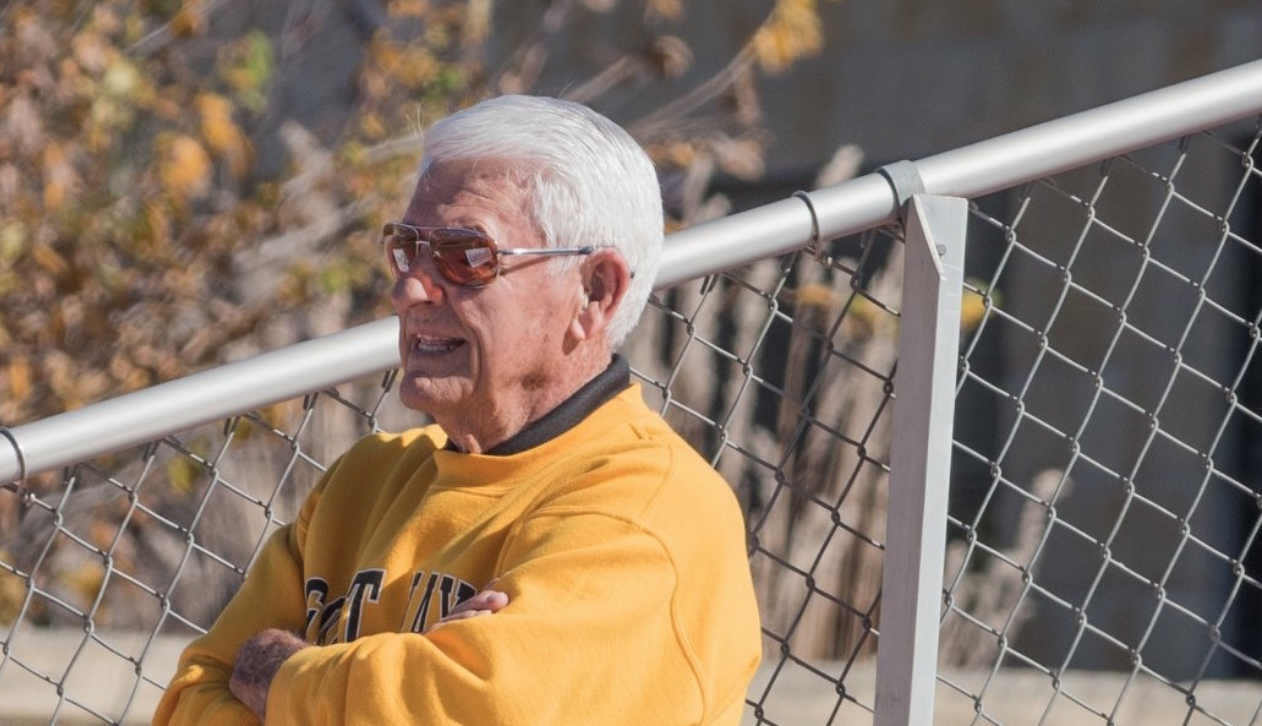
Bob Lowen watches the Tiger football team at a game this season. – Photo by Bob Duffy.

Lowen says so long

March 1, 1995, The Hays Daily News

The voice of the Tigers was speechless for just a moment Tuesday night.

Bob Lowen, the longtime public address announcer for Fort Hays State University men’s basketball games, was honored for 25 years of work at the microphone.

FHSU President Edward Hammond and Athletic Director Tom Spicer marched Lowen to midcourt of Gross Memorial Coliseum just before the game between Fort Hays State and New Mexico Highlands.

They presented a plaque to Lowen, who is retiring for his P.A. duties after this season.

Lower, normally a model of poise, was caught off guard with the presentation but quickly regained his composure and took his customary seat at the scorer’s table.

“Welcome to Gross Memorial Coliseum and Tiger basketball,” came a familiar voice over the speakers.

After Lowen introduced the opponent’s starting lineup, Tiger fans began clapping even before Lowen rang out those oh-so-familiar words.

“And nowwwww, the Tigers,” Lowen said, his voice rising with every word.

One by one, FHSU’s starters were announced, the final one the loudest.

“At forward, a six-five senior from Annapolis, Maryland, Dennnnis Edwarrrrds.”

The fans might not have know it, but Lowen had just set the tone for the game.

• Some things you take for granted.

One of those was Bob Lowen at the mic for Tiger home basketball games.

Almost since GMC opened in 1973, Lowen became known as the Voice of the Tigers.

He started announcing at Sheridan Coliseum in 1970 and shared P.A. duties in GMC for a couple of years before taking over the job solo in ’75.

Fans probably didn’t really think about how much information he was feeding them.

Listen closely to Lowen, and you would realize he was telling you who came into the game when, and for whom; who fouled, and how many fouls that player had; who scored, and quite often, who dished out the assist.

“A lot of times you go on the road, and you can barely hear the name of the kid who scored,” Lowen said. “Fans want to know what’s going on. Listen to me when the opponent scores a basket; you will hear his name.”

What fans might remember best about Lowen is the way he announced – and pronounced – the local players’ names.

The more syllables, the better.

Bob Lowen enjoyed life as a fan of the FHSU Tiger basketball teams even in retirement. – Photo by Bob Duffy.

One of his favorite names over the years was Cesar Fantauzzi, who played at FHSU during the 1980-81 season.

You didn’t need to know how to spell it.

Anyone associated with Tiger basketball knew who “Seee-zarrr Fan-tooozeee” was.

“You want to get the fans into the game,” Lowen said. “It was really fun trying to do that.”

Lowen has seen all kinds of coaches, including a few he was glad to see leave GMC.

“Some coaches are always picking on the officials for making ‘bad’ calls,” he said. “Just once, I think officials should have the privilege to say, ‘Coach, you’re really doing a lousy job of coaching. Get out of that zone and go man-to-man, and you’ll probably win the game.’

“Wouldn’t that be great?”

Lowen has seen all kinds of fans, too – ones who threw things on the floor, others who have hollered so loudly you couldn’t hear Lowen over the loudspeaker.

“I lose my cool when I see people act like fools at a ball game,” Lowen said. “Once, in Sheridan, I saw a referee get knocked out when someone threw something that hit him in the head.

Absolutely, holler and scream and get into the game, but don’t throw things on the floor.”

Lowen, director of FHSU’s University Relations, sure did enjoy this part-time gig.

“The more (the fans) got into it,” he said, “the more I got into it.”

All the way to the end.

At the conclusion of Tuesday’s game, Lowen said what he always says at the end of a game.

“Thank you for coming. Thank you for your enthusiasm. And please drive carefully.”

If the Tigers don’t play at home anymore this season – that won’t be determined until after this weekend’s conference tournaments – then Tuesday’s game will have been Lowen’s last behind the mic.

Lowen, who will turn 59 this year, wanted to get out of announcing while he was still in good health.

Lowen was a picture of health as he walked out of GMC Tuesday.

He stepped lightly as he walked beside his wife, Bev.

As Lowen went into the cold, wintry night, I couldn’t help but think, “Thank you for coming. Thank you for your enthusiasm. And please drive carefully.”


I read – and re-read – that last paragraph, over and over. It made me smile at the irony of its meaning.

Thank you for coming to Hays, Bob Lowen. Thank you for your enthusiasm. May you rest in peace.

~ Diane Gasper-O’Brien, a feature writer for University Relations and Marketing at Fort Hays State University, is an FHSU graduate who got her start in writing in the offices of FHSU Sports Information and Information Services.

Editor’s Note: Diane Gasper-O’Brien also has been the best feature writer in the state of Kansas for nearly a generation. Hays Post thanks her for sharing these and other memories with our readers. — Ron Fields

MASON: Bows at the ready, Tiger cellists conquer in the spirit of Carnegie

Dr. Tisa Mason
You know the old joke: How do you get to Carnegie Hall? Practice, practice, practice.

It is a great metaphor for the payoff of hard work and determination – strong characteristics of Fort Hays State University. I am so proud of how our faculty and staff stay focused and put in whatever effort is required to stay the course to see our students reach their level of success. We invest everything we have in our remarkable students, preparing them to excel throughout their lives and careers.

Amidst the multitude of illustrations of how we prepare our students, one recent example of the Carnegie Hall expression came to fruition both metaphorically and, well, literally!

It was Tuesday, Oct. 30, and the Russian String Orchestra was on its way to Fort Hays State as part of our Encore Performing Art Series. They arrived in the United States late Monday night, but without the cellists. Apparently, they missed their flight due to some unfortunate ticketing problem. As Ben Cline tells the story, flying with a cello is harder than flying with unhappy children!

Cline, chair of the Department of Music and Theatre, went on to share with me that there was a lot of concern and angst – a missing section of the orchestra, Cline said, is like missing your running backs or defensive line. How would the show go on? Of course the show must always go on – right? And after all, this is Fort Hays State University. Determined. Resilient. A deliverer.

As the evening unfolded, our music chair and our guest conductor put together a plan to save the concert. The orchestra was able to put together enough music for the first half of the concert without the cellos. But they had to have cellos to make the second half of the concert work. Cline had an idea.

Misha (the Russian conductor), invited Cline to select students to play with the orchestra on a piece the students had worked on in the past – a very difficult work that is 30 minutes long (yes, 30 minutes, one song). Cline contacted the students on Monday night and they jumped at the opportunity. Even though they felt unprepared, they were willing to take the risk because they had the opportunity to work with a professional chamber orchestra; indeed, a once in a lifetime moment!

Early Tuesday evening, immediately prior to the performance, the students (Natalie Thomas, Stockton; Clara Kachanes, Great Bend; Jayce Milburn, Arcadia; Tanner Callis, Hays; Megan Rayl, Littleton, Colo.; and Carl Rorstrom, Hays), together with Cline, rehearsed and then performed this 30-minute piece of music with the Russian String Orchestra – all in the same evening. The audience was delighted.

Indeed, it was extraordinary!

I join Professor Cline in saying how really proud we are of these students. In less than 24 hours they helped locate the music, practiced as much as they could, and with that Tiger resilience, did their very best. Their effort and results speak volumes to their commitment and their willingness to take a chance. I am equally proud of Ben Cline.

One of the students described the experience as like “going into battle.” The students were focused. They were prepared. They were practiced.

I, however, describe the evening of Oct. 30, 2018, as a moment in time when our Beach/Schmidt Performing Arts Center was magically transformed into Carnegie Hall.

AAA Kansas warns of driving dangers on ‘Drinksgiving’

Thanksgiving Eve Is Big Party Night For Students, Others, Home For The Holiday

WICHITA – The day of frenzied shopping that follows Thanksgiving is commonly referred to as Black Friday. But, in recent years, some have started referring to the night before Thanksgiving as ‘Blackout Wednesday’ or ‘Drinksgiving’ because of the heavy alcohol consumption or binge drinking done by college students and others, home for the holiday and reuniting with friends and family at bars, restaurants or homes.
According to the Kansas Department of Transportation (KDOT), the day before Thanksgiving sees more impairment-related crashes than any other day of the year. Those driving under the influence of alcohol or other drugs endanger not only themselves, but also others they share the road with – such as their passengers, other motorists and their passengers, bicyclists and pedestrians.
“While ‘Blackout Wednesday’ or ‘Drinksgiving’ may be clever ‘buzz’ words, there’s nothing clever about being buzzed or drunk and getting behind the wheel,” said Shawn Steward, spokesman for AAA Kansas. “Drivers also need to remember that prescription, over-the-counter medications and illegal drugs can impair the ability to drive safely, as well. Combining any of these drugs with alcohol can increase the impairment factor more.”
From 2012 to 2016, more than 800 people died nationwide in alcohol-impaired-driving crashes during the Thanksgiving holiday period (6:00 p.m. Wednesday to 5:59 a.m. Monday), making it the deadliest holiday on our roads, according to the National Highway Traffic Safety Administration (NHTSA).
During that same period in Kansas (2012-2016), over the 5-day Thanksgiving holiday, there were 188 alcohol-related crashes, resulting in 109 injuries and four fatalities.
On average, across Kansas, three persons are injured every day, and one person is killed every four days in alcohol/drug-related crashes. And the crashes tend to be more severe. Vehicle occupants in alcohol- or other drug-related crashes are more than 2.5 times more likely to be injured or killed than those involved in crashes where alcohol or other drugs were not a factor.
Each week across Kansas, more than 250 drivers are arrested for DUI (Driving Under the Influence). A DUI conviction will result in jail time, the suspension or revocation of driver’s license, a fine of $500 to $2,500, participation in an alcohol or other drug treatment program and, where alcohol is cited as a contributing factor, the purchase and installation of an ignition interlock device by the offender. This device requires the offender to blow into a device that measures blood alcohol concentration prior to starting the car. It’s embarrassing and a hassle.
The Kansas Highway Patrol, along with local law enforcement, will be increasing patrols to foster safe roadways during the busy Thanksgiving holiday travel week, with a special eye out for impaired drivers.
AAA Kansas is reminding anyone headed out Wednesday night or throughout the Thanksgiving holiday weekend and planning to drink:
  • Buzzed driving is drunk driving. Don’t risk it.
  • Make a plan ahead of time to have a sober, designated driver
  • If you don’t have a designated driver, call a friend or family member, taxi or car share service such as Uber or Lyft to get you home safely
  • Never let family or friends drive if they have had too much alcohol to drink
  • If you see a drunk driver on the road, contact law enforcement
“It is never OK to get behind the wheel of a vehicle when you are buzzed, drunk or otherwise impaired,” AAA Kansas’ Steward reiterated. “The risk of injury or death for yourself, passengers and others on the roads is not worth it, especially when there are other ways to get home safely. AAA Kansas wants everyone to safely enjoy the Thanksgiving holiday with their friends and family and not have to deal with a tragedy caused by impaired driving.”

HAWVER: Hineman could see opposition from right for leadership post

Martin Hawver

Almost eerily quiet; this Thanksgiving week the Statehouse is going to be nearly empty, no interim committees meeting to thrash out possible legislation for the upcoming session, not even freshly elected legislators likely to be wandering the halls wondering where their offices are going to be.

Of course, nobody has won anything until the State Canvass Board meets later this month to certify that those election results are official, that the county officials counted right, that the candidates who were named winners in their local courthouses get the final OK in the Kansas Secretary of State’s office.

But pending that Topeka stamp of approval, there are still going to be 125 members of the Kansas House, and at least 27 of them are new, or at least relatively new (some served earlier terms, quit or were defeated, and came back). Five of those new or relatively new faces are Democrats, 22 are Republicans. A recount out in Hays will determine if Rep. Eber Phelps, D-Hays, or Republican Barbara Wasinger, Hays, wins the vote, which could change the number of new faces.

If Wasinger wins, the ratio stays at the current 85 Republicans, 40 Democrats. If Phelps wins, that makes it 84 Republicans, 41 Democrats. Not a “blue wave” in the House of Representatives.

That eerie quiet in the Statehouse is going to be offset by what will be hot phone lines, emails and voice messages between House members who will be campaigning within their party for leadership offices.

Now, everyone knows that the big job, the most powerful job in the Kansas House, is the Speaker. He/she with the help of the House Majority Leader decide what is going to be debated, and when.

That top job appears to be locked up by current Speaker Ron Ryckman, R-Olathe, who doesn’t have any serious opposition for the post within his party.

House Minority Leader Jim Ward, D-Wichita, may see a scrap for his post, largely because it doesn’t appear that he’s been able to increase Democrat numbers in the chamber, which is considered a major responsibility.

Everything else? Well, look for a GOP scrap over the No. 2 job in the chamber, Majority Leader. It’s the Majority Leader, moderate Republican Rep. Don Hineman, R-Dighton, who is facing at least two conservative Republicans who hope to build on the shift to the right of the House GOP caucus.

Rep. Don Hineman, R-Dighton, 118th Dist.

It’s that under-the-sheets campaigning that will to a large degree determine whether Democrat Gov.-elect (now Senator) Laura Kelly, Topeka, gets much of her budget and legislative agenda approved.

And that, again, is where the leadership of the House becomes a key. That House leadership appoints members to committees which will not only come up with their own bills but hold hearings on Kelly-proposed bills.

Don’t like the Kelly bill? Just have the Majority Leader send it to a committee that will knock it down or amend it. That’s why the power to name Republican members of committees is almost thermonuclear. The House party breakdown means 23-member committees are 16 Republican/7 Democrat; 17-member committees are 12 Republican/5 Democrats, and so-on,

So how does a fresh-faced new legislator who doesn’t even know where all the Statehouse bathrooms are get a flashy committee assignment, say, Appropriations or Tax or Commerce or Federal and State Affairs? How about pledging to vote for a member of leadership, a little tradeoff and the first real use of a freshman’s power.

Democrats? They’ll make their own committee assignments, but not with the leverage that the Republican committee assignments carry.

Wonder what the upcoming session is going to look like? Wait for the leadership races to trickle down to committee assignments.

We’ll see…

Syndicated by Hawver News Company LLC of Topeka; Martin Hawver is publisher of Hawver’s Capitol Report—to learn more about this nonpartisan statewide political news service, visit the website at www.hawvernews.com

Copyright Eagle Radio | FCC Public Files | EEO Public File