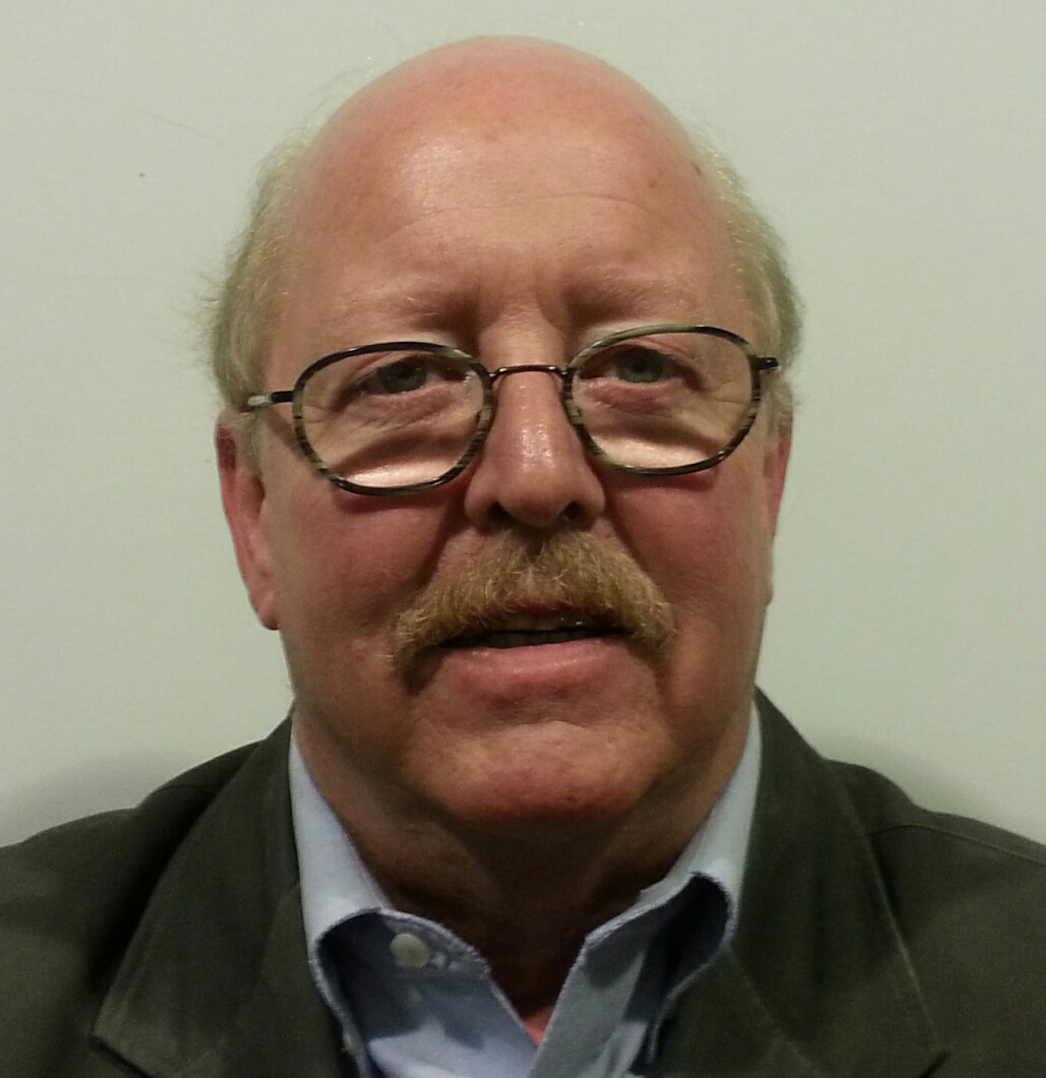
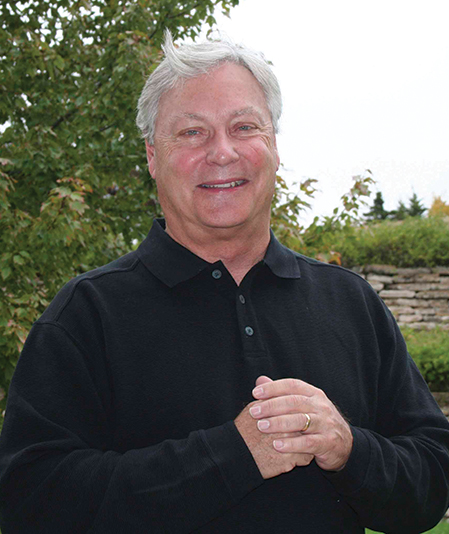
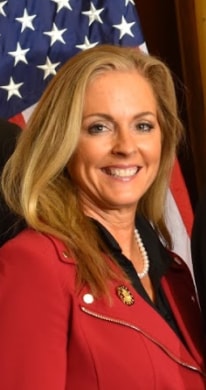
Dr. Roger Marshall, R-Great Bend, is the Kansas First District Congressman.
Friends,
This week I was honored to join KSU and Sen. Moran in welcoming our USDA Secretary Sonny Perdue to the wheat state. It is always great to have the leading voice on Ag in the White House meeting with Kansans.
While I wholeheartedly understand the tough times our producers have been up against, I know that Sec. Perdue, myself, and other Ag leaders are fighting hard in Washington to secure new markets, and see this Farm Bill to the finish line.
In other news, Friday the Department of Labor released the October jobs numbers. The economy added 250,000 jobs in October, up from 118,000 in September, and the unemployment rate came in at 3.7 percent, the lowest since 1969! The unemployment rate in Kansas has fallen by 0.8 percent to their lowest level since 1999.
There’s no denying that this Congress and Administration has unleashed this economy with our pro-growth policies. I am working around the clock to make sure our Farm economy also reaps these same economic benefits.
Lastly, I hope you all had a safe Halloween, trick or treating with your loved ones. My grandson surely enjoyed the candy and treats in their superhero costumes!
KSU welcomes USDA Sec. Perdue
It was a pleasure to welcome U.S. Agriculture Secretary Sonny Perdue back to Manhattan on Thursday as the featured speaker for the esteemed Kansas State University Landon Lecture Series.
Secretary Perdue shared the lessons and principals he learned growing up on a farm in Georgia, which included: stewardship and responsibility; trust and faith; and optimism. Today he uses those same guiding principals to serve our nation’s farmers and ranchers. In his lecture, he reiterated his commitment to making the USDA more user-friendly and effective to better serve its rural customers.
The USDA’s work has a significant impact on my district, for both farmers and the numerous rural communities across the Big First. I couldn’t be more proud of the work he has done and continues to do at the USDA.
Rolling back the red tape on our nursing homes
During my time as a physician in Great Bend, Kansas, I saw the struggles many skilled nursing facilities (SNFs) were facing due to illogical and burdensome regulations. One particular regulation has kept SNFs from training new Certified Nursing Assistants (CNAs) an already depleted workforce. This rule mandated if facility accumulates fines over $10,000, whether or not those fines had anything to do with their CNA training program, CNAs could not be trained there.
While it is absolutely important to monitor the quality of care for our loved ones in these nursing facilities, providing these practices with an adequate workforce is just as crucial for their safety and comfort. I am honored to have signed onto HR 6986, the Nursing Home Workforce Quality Act, that will update these regulations and ensure a strong CNA workforce in our assisted living facilities.
Dr. Roger Marshall, R-Great Bend, is the Kansas First District Congressman.
Alicia BoorBeginning Jan. 1, several packing plants will only purchase fed cattle from BQA (or Beef Quality Assurance) certified feedlots.
It is clear that consumers feel confident in the Beef Quality Assurance program and have driven this change. While further education though BQA always helps the beef industry, we do not want some of our producers to be caught off guard.
Online certification is always an option, however, some producers still prefer and in-person meeting. The Kansas Beef Council has planned and is offering a 2 night in-person training (and via online through zoom). This will give us the opportunity to reach multiple locations in a short amount of time to ensure producers that need BQA certification by the end of the year will have it.
The current dates that the KBC and KLA have set up are: November 5th: 7pm at the Meridian Center in Newton (In-Person), Zoom meeting at the same time in Emporia (Hosted by KLA staff) November 7th: 7pm at the High School in Washington (In-Person), Zoom meeting at the same time offered in Oberlin (Hosted by KLA staff)
If there is interest, I would be happy to host a Zoom meeting on November 7th at the Great Bend Extension Office at 7 pm. There would be no charge for this, but I do need RSVPs to see if there is enough interest for the remote location to be held.
Call 620-793-1910 or e-mail me at [email protected] to register by Monday November 5th for this meeting.
Alicia Boor is an Agriculture and Natural Resources agent in the Cottonwood District (which includes Barton and Ellis counties) for K-State Research and Extension. You can contact her by e-mail at [email protected] or calling 620-793-1910
As the 2018 elections approach, Greg Orman continues to do the citizens of Kansas a disservice with his dead-in-the water independent campaign. His floundering effort, with its treasurer resigning and endorsing Democrat Laura Kelly, is denying Kansas voters a clear referendum-like choice on whether to reject or embrace Sam Brownback’s policies.
Burdett Loomis, Professor, Political Science, College of Liberal Arts and Science, University of Kansas
To review, Brownback barely defeated House Minority Leader Paul Davis in 2014. Opinions differ as to why, but I see the wave of GOP outside money that washed over Kansas in support of endangered Senator Pat Roberts as nationalizing the entire election and helping Brownback eke out a victory. Indeed, approval for Brownback’s tax policies was already underwater in 2014, and it sank lower after the election.
In 2016, Brownback was not on the ballot, but many right-wing Republicans, who had supported his extensive, high-income-oriented tax cuts, proved vulnerable. A host of moderate Republicans and Democrats won enough seats to override Brownback’s 2017 veto of higher income taxes and then, in 2018, these legislators responded to the Kansas Supreme Court by passing a $500 million increase in school funding.
Score one (2014) for Brownback and one (2016) for his opponents. Nevertheless, neither election represented an actual referendum on Brownback and his policies, given his absence from the 2016 ballot and the Roberts factor in 2014. Moreover, with Brownback gone from the state and the introduction of independent Orman, the 2018 election will also constitute an imperfect referendum.
Regardless, Brownback’s legacy powerfully affects this contest for governor.
Most remarkable in 2018 is Kris Kobach’s complete embrace, and then some, of Brownback’s tax-cutting experiment, albeit with a few twists. He simultaneously argues that he will fund classroom education (by his definition) and rebuild our infrastructure, all through economic growth. That’s Brownback reincarnated.
As a social conservative, Kobach has moved father right than Brownback in advocating against non-existent voter fraud and beating the anti-immigrant drum as loud as he can.
In sum, Kobach has doubled-down on Brownback’s far-right record.
If this election posed a simple yes-no vote on Brownback’s legacy or Kobach’s policy positions, Kobach would likely lose. Instead, the 2018 governor’s race comes down to its candidates. Putting aside the minor independent candidate and the Libertarian, a straight-up contest between Republican Kobach and Democrat Laura Kelly would probably, even in red-state Kansas, elect the moderate Democrat, given Kobach’s apparent ceiling of 43 or 44 percent.
While not as flashy as Kobach (no machine gun trucks), Kelly may well be exactly the person to continue the progress of the last two legislative sessions, to say nothing of prudently addressing education, health care (expanding Medicaid), and infrastructure. A 14-year state senator, Kelly would bring a range of legislative experience not seen since the productive Bennett-Carlin-Hayden years, 1974-1990.
Enter the man behind door #3, independent Greg Orman, who turns the entire idea of a Brownback referendum on its head. If Orman, with his steady nine-percent support in the polls, siphons off enough votes, mostly from Kelly, the state could easily elect a minority-supported governor who has negative approval ratings and who supports the failed economic policies of Sam Brownback. That would be a travesty.
To paraphrase Sinclair Lewis, “It can happen here.” But it need not. As Orman supporters go to the polls, they should think twice, or three times, before wasting a vote that would allow the widely discredited views of Kobach and Brownback to prevail.
Burdett Loomis is an emeritus professor of political science at the University of Kansas.
I recently read that “fewer than 1% of our population works hard to divide us, to pit people against one another for their selfish aim.”
We have elections at our doorsteps. Much of the election advertisements are trying to pit us against each other.
It seems that each election the voter turnout is slight – generally less than 50% of the registered voters. Yet the vote decides who is going to govern us. That power to govern includes state and local taxation; education of our children; providing for our safety and our security; and creating laws and policies that will support or devastate our economy.
It includes the power to wage, or not to wage, war; to give and take away our freedoms; to control the very fabric of our day-to-day lives. Yet, we still have people who do not vote.
I remember a conversation with my grandparents from when I was young. My grandfather voted for one political party; my grandmother the other. They decided not to vote, under the excuse, “We just cancel each other out.” I really goes much beyond that.
I have an agenda when I vote. I want my rights and my clients’ rights to be protected. I want my clients not to worry about healthcare. I want there to be adequate and affordable health services for them.
I want them to have financial security. I want their businesses, farms, retirement, Social Security, and Medicare to be protected. I want them to be safe in their homes; I want them to be safe outside their homes.
I also want certain fundamental rights protected for those who may be of limited means or maybe of a minority group, as well as those who have a not so popular religion or lifestyle. I do not want mob rule to control us. I want to be sure that we have all the freedoms guaranteed by our Constitution and Bill of Rights – including free speech, the right to vote, privacy, and a free press.
So, that is my agenda. That is my test. Let me add something that my grandfather taught me – do not trust someone who continues to lie, no matter how big or small the lie. Walk away from that person. That too is part of my test of a candidate.
Create your own agenda, your own test. Yours may be a lot different than mine. That is fine. We will not cancel each other out, just please vote. Vote for the person that most matches your agenda. Vote for someone you trust; someone who has earned that trust. No candidate is perfect, but we cannot just give up by not voting.
Please vote your interests on Tuesday.
Randy Clinkscales of Clinkscales Elder Law Practice, PA, Hays, Kansas, is an elder care attorney, practicing in western Kansas. To contact him, please send an email to [email protected]. Disclaimer: The information in the column is for general information purposes and does not constitute legal advice. Each case is different and outcomes depend on the fact of each case and the then applicable law. For specific questions, you should contact a qualified attorney.
By MARK TALLMAN Kansas Association of School Boards
Kansas’ investment in public education has been growing much slower than total income of Kansas residents and spending on most personal goods and services since 2010, according to new data from the Bureau of Economic Analysis. (Link)
Mark Tallman
The decline occurred as Kansas per-pupil funding has fallen behind inflation and other states. There is a strong, positive correlation between education funding, educational attainment, higher state average income, and lower poverty rates. (See previous posts on funding and the link between education and economic prosperity.)
The BEA annually reports personal consumption expenditures by state, defined as “goods and services purchased by or on behalf of households and the net expenditures of nonprofit institutions serving households (NPISHs) by state of residence for the 50 states and the District of Columbia.” (These figures do not include increased funding for school districts beginning in 2017-18 because income and spending data is not yet available.)
KASB compared Kansas personal consumption expenditures with total Kansas personal income and total expenditures on K-12 education by Kansas school districts as reported by the Kansas State Department of Education.
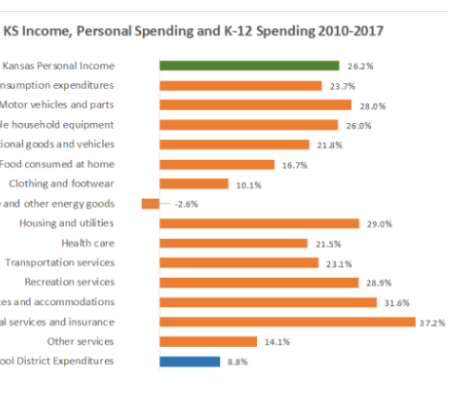
Between 2010 and 2017, Kansas personal income increased from $112.1 billion to $141.5 billion, or 26.2 percent. Personal consumption expenditures increased from $86.1 billion to $106.4 billion, a slightly lower rate of 23.7 percent.
Total school district expenditures increased from $5.5 billion to $6.1 billion, or 8.8 percent. School expenditures dropped from 5.0 percent of Kansas personal income in 2010 to 4.3 percent in 2017.
The 8.8 percent increase in K-12 expenditures between 2010 and 2017 was lower than any category of personal expenditures except for gasoline and other energy goods, which decreased 2.6 percent in 2010 and 2017.
Expenditures on Financial Service and Insurance (37.2 percent), Food Services and Accommodations – dining out and lodging (31.6 percent), Housing and Utilities (29.0 percent), Recreational Services (28.9 percent) and Motor Vehicles and Parts (28.0 percent) increased faster than Kansas personal income.
Expenditures on Furnishing and Household Equipment (26.0 percent), Transportation Services (23.1 percent), Recreation Goods and Vehicles (21.8 percent), Health Care Services (21.5 percent), Food and Beverages Consumed at Home (16.7 percent) and Clothing (10.1 percent) increased less than personal income but more than K-12 expenditures.
The amount of spending on K-12 educational also ranks low compared to major personal expenditure categories. Kansas spent $21.9 billion on Housing and Utilities in 2017, $18.7 billion on Health Care Services, $17.7 billion on Financial Services and Insurance, $10.1 billion on transportation services, vehicles and fuel, $8.7 billion on Food and Beverages at home, $7 billion on recreational goods and services and $6.3 billion on Food Services and Accommodations (dining out and lodging), compared to $6.1 billion on K-12 education. Only Clothing and Footwear, at $2.7 billion, was lower than school district spending.
This data indicates that Kansas expenditures on public education have actually been a declining share of total income by Kansas since 2010 and that other categories of expenditure have grown faster than education funding. In fact, that has been true as far back as 2000. Since 2000, K-12 expenditures increased 74.6 percent, personal consumption expenditures 78.6 percent and Kansas personal income 84.9 percent.
There would be no problem spending less on K-12 education and more on personal goods and services if Kansas were getting the education results they want and need, and/or if funding made no difference in educational results. However, Kansas education funding has fallen behind inflation and other states, as have Kansas average teacher salaries. Although Kansas ranks above average national and regionally in educational outcomes, other states have been increasing funding more and improving results faster.
To meet future employment needs and compete with other states, Kansas needs to graduate more students from high school and postsecondary education. The states with the highest educational outcomes tend to spend more per pupil than most states, already spend more than Kansas; and have higher personal income and lower poverty rates. If Kansas continues to spend less on K-12 education, it will ultimately mean less personal income to spend on everything else.
There is another impact of personal expenditure changes. Since 2000, spending on “goods” has increased by 56.1 percent and spending on “services” increased 92.5 percent. Because the Kansas sales tax is generally applied to goods and not to services, this shift in consumption from goods to services is one major reason state revenues have been growing more slowly, and why lowering state income tax rates and relying more heavily on consumption taxes that do not includes services will likely further reduce revenues for public services like K-12 education.
Definitions:
Total personal income is the income received by, or on behalf of, all persons from all sources: from participation as laborers in production, from owning a home or business, from the ownership of financial assets, and from government and business in the form of transfers; from domestic sources as well as the rest of world. It does not include realized or unrealized capital gains or losses.
Essentially, the difference between personal income and consumption expenditures is the total of taxes paid, personal interest payments and transfer payments to governmental programs such as social security, and personal savings.
Total K-12 expenditures is all spending by Kansas school districts, including state, federal and local funding. Most of this revenue is from taxes, but a portion is personal payments, such as lunch fees and charges for student materials and transportation.
Mark Tallman is Associate Executive Director for Advocacy for the Kansas Association of School Boards.
This is a critical year for the state of Kansas. No one can sit on the sidelines in this election. The stakes are too high. We’ve seen the devastation of the last eight years and we have to put the Brownback experiment behind us for good. That is one of the reasons I’m endorsing Senator Laura Kelly for Governor.
After much thought and analyzing this race and the candidates, I understand Greg Orman cannot win. While he may have something to offer the state of Kansas, this is not the year. This year, we must come together to support Laura Kelly.
I’ve been a registered Republican for over 50 years. I seldom vote for Democratic candidates, but in this race, I strongly support Laura Kelly. Senator Kelly has worked hard and knows state government and the budget front to back. She is well-prepared to be governor and to lead our state through challenging times.
After eight years of crisis, we cannot elect someone who wants to repeat the disasters of the past. Kris Kobach has promised to do just that – risking the future of our great state.
I met Laura years ago, when she led the Kansas Recreation and Park Association. She and I share a commitment to improving the quality of life in our communities – both urban and rural. We worked together many times over the years and she was always willing to work with anyone to solve problems. When she became a state senator, we collaborated on several projects and I knew she had the right priorities. She always puts our kids and families first and not politics.
Our state faces many challenges and I trust Senator Kelly to use her good common sense to help resolve complex issues. I’ve been a gun owner for 62 years. I’m a strong supporter of the 2nd Amendment and I’m voting for Laura Kelly. I trust her to support the 2nd Amendment and use common sense to promote safety against gun violence. I also know she is committed to protecting thousands of current and retired public servants who depend on our state retirement system which has been short-changed for nearly a decade.
Laura Kelly is the best choice to lead Kansas. She will bring Kansans together – regardless of political party – to get our state back on the right track. She will invest in our schools, highways and natural resources so our state and our people can have a bright future. I encourage Kansans to join me and vote for Laura Kelly for governor on November 6.
Former Kansas Gov. Mike Hayden
Editor’s Note: The deadline for submission of letters related to the November general election will be Nov. 1.
A recent news story in Kansas was headlined: “Kobach, Schwab Fuzzy on Voting Registration Access.”
It goes on to state that “both nearly two-term Kansas Secretary of State Kris Kobach and the Republican running to follow him in that job have mistakenly described ways to register to vote.”
Kobach is the current Secretary of State and Kansas’ chief elections officer. Schwab is running for Kobach’s job. And neither of them knows for sure how voter registration works in Kansas?
Brian McClendon does not seem fuzzy at all on the voter registration process in Kansas. Brian led the development of the nonpartisan online voter registration tool KSvotes.org. It can be used on a cell phone and takes less than 5 minutes. More than 24,000 eligible Kansas citizens have used it to register to vote in the last year and more than 19,000 Kansans used it to request an advanced ballot. Now that’s a candidate already doing the job of Kansas Secretary of State, which is more than can be said for the Kobach/Schwab partnership.
Brian is not a career politician. He’s a former Google vice president who famously made Kansas the center of Google Earth. He’ll bring the leadership of a businessman and the efficiency of his technological expertise to the Secretary of State’s office. His opponent Schwab wants to continue Kobach’s politics and we all know that’s been a mess.
It’s clear to me that the Google guy Brian BAM McClendon will be the best for Kansas.
Janis Lee
Hays
Editor’s Note: The deadline for submission of letters related to the November general election will be Nov. 1.
Eber Phelps has demonstrated that he is a strong supporter of all levels of education in Ellis County and all of western Kansas. During his two-year term in the Legislature, he was instrumental in solving the inherited fiscal problems that existed at the beginning of his term. Eber helped put the state on a fiscally sound budget and has left the state with a bright future.
Now that the state is in recovery, it is not the time to replace Eber Phelps, an experienced legislator with a demonstrated willingness to cooperate with moderates of both parties in Topeka. A vote for Eber Phelps is a vote for good education and sound economic policy. I urge you to vote for Eber Phelps.
Louis Caplan
Hays
Editor’s Note: The deadline for submission of letters related to the November general election will be Nov. 1.
Martin HawverWe’ve come to the point in the campaigns that political ad after political ad after political ad drag on long enough that there’s time to microwave popcorn and not miss the cop show on television.
Yes, and for those of you who have other things to think about during the commercials…one of those thoughts might just be what happens to the Kansas Legislature after the next federal census in 2020.
That’ll be the 24th national census, and it is designed to tell us what the population of the nation is, and where those people are located—and likely whether Kansas remains a four-congressional district state.
Is that official April 1, 2020, head count a little far off? Why think about it now? Well, if you live in one of those Kansas House or Senate districts out west, say, west of US-81, the north-south Interstate that is the dividing line between western Kansas and eastern Kansas, you might want to start thinking about it now.
It’ll be 2022 when the first statewide election occurs after the census, based on that federal census and where it says the people are. That’s the key data for reapportionment of Kansas House and Senate districts. Oh…and the state’s four congressional districts.
And that reapportionment is based on U.S. Census population data which the Legislature will spend more than a year dissecting into 40 Senate districts and 125 House districts, and, yes, those four Congressional districts.
What’s worth thinking about now ahead of that reapportionment? Probably for much of western Kansas it’s what the Republican Party efforts to further regulate immigration and the “close the border” talk has to do with populations out west of US-81.
Yes, it is western Kansas, with its agriculture and food processing industry that stands the best chance of seeing foreign workers not participating in the census or maybe misstating their legal citizenship for fear of deportation. Oh, and there are lots of foreign-born workers and their children in other parts of the state, too.
Now, the GOP and President Donald Trump make a decent case that immigrants should come across the border with Mexico legally. They ought to get the visas and such, and probably some clearly defined path to becoming a full United States citizen, with a stake in how this country is run, and the right to vote.
But this concentration on immigration, while a strong national political issue, will undoubtedly have some effect on head count in the census.
So, if the historic trend of adults and their children moving out of western Kansas is accelerated by federal immigration regulation that makes the census inaccurate, count on many who have come to this country and state for a better life to decide just not to participate.
And that means likely less census-counted population in parts of western Kansas, and by the time the Legislature has mapped out new House and Senate districts based on population, fewer state representatives and senators from areas where the population count is down.
That means fewer, and larger, Kansas House and Senate districts out west, and likely more districts in urban areas of eastern Kansas—Wichita, Topeka, and Missouri-bordered northeast Kansas counties.
Now, it’s based on population, and that’s fair, but it likely means less attention will be paid to western Kansas (except for highways) and more attention to population-heavy areas based on their representation in the House and Senate because the members of the House and Senate will be tilted toward urban areas—which, by the way, are easier to jerrymander based on voter political registration.
Something to think about during those commercials, isn’t it?
Syndicated by Hawver News Company LLC of Topeka; Martin Hawver is publisher of Hawver’s Capitol Report—to learn more about this nonpartisan statewide political news service, visit the website at www.hawvernews.com
John Schlageck writes for the Kansas Farm Bureau.As the 2018 election races toward the finish line on Nov.6, candidates from both parties have stooped to their old tricks of slinging mud, name calling and finger pointing at one another. Why can’t candidates do what’s right for this nation and focus on issues?
Instead, we are forced to put up with elected officials who pursue their own agendas, grow the government, do-nothing and engage in gridlock.
What Kansas and this nation sorely need is leadership and a willingness among all elected officials to work together for the good of this country.
What do you think the framers of our constitution and this republic would say about what’s going on in all three branches of government today?
What would Washington, Hamilton and Jefferson think about our way of conducting the nation’s business?
What would Kansas’s own favorite son, Dwight D. Eisenhower say about the way we’re conducting this country’s business today?
What about Frank Carlson, Alf Landon, Andy Schoeppel and other Kansas leaders of yesteryear think?
Profound?
Enlightening?
Telling?
Absolutely.
Where are the ideas for leading and uniting this great state and nation?
Isn’t that what they’re supposed to be doing?
Farmers, ranchers and businessmen cannot, and do not want to engage in the same game of blaming one party for the charade going on in Washington and among some of our own state leaders. This is a shared shame and a weakness that is ruining our state and nation.
In spite of claims to the contrary, taxes continue to increase. The only way for the tax-and-spend cycle to be broken is to hold candidates accountable. The citizenry of Kansas and this country must demand candidates clearly state their positions on the issues.
Today’s politicians and most of the candidates have become so adept at ducking the issues. They rival a young Muhammad Ali’s ability to float like a butterfly, always out of reach and accountability.
Not only do voters rarely have a chance to ask candidates questions, they have even less chance of receiving a worthwhile answer.
Some candidates also talk out of both sides of their mouth. They tell one gathering of voters one thing and others just the opposite.
They also barrage voters with wave after wave of rhetoric, hoping to obscure their real views. They’re not called politicians for nothing.
This year’s election is just around the corner. Whether we like what’s been happening in government or not, the mess we’re in remains our own.
It’s our system, and while it may appear broken, we still must vote. Past elections demonstrate rural voters can make a difference by their willingness to go to the polls.
Fiscal responsibility, a reduction in the size of government and increased productivity remain a sound prescription for this country’s economic troubles. The bigger problem of cooperation and compromise while working together for the good of this country must be addressed as well – if these remedies are to work.
Urge your friends, family and neighbors to cast their votes Nov. 6. Vote your heart, mind and the issues – not just party lines.
John Schlageck is a leading commentator on agriculture and rural Kansas.
My husband and I visited Hays recently and had planned to eat at Das Essen Hütte, as I couldn’t wait to taste food I’d stood in long lines for in my college days, many Octoberfests past.
Wow! It was even better than we’d expected!
I asked about and complimented the amazing, early photos depicting the Catharine farms and families of the owners, while we waited a short time for our sampler platters of 4 choices each. We were blown away by the delicious (and creeeamy!) entrees. I’d expected them to be somewhat identical, but they were, in fact, quite individual.
Why has it taken until recent years to have an authentic Volga German cuisine restaurant in its Motherland of Ellis County, Kansas? After being told of slow nights, we suggested delivering bierochs to FHSU campus and building a following with the nearby, but seemingly oblivious, students. Otherwise, I believe the locals will definitely come in time. It’s that good! Hays, please keep this Ellis County original by talking them up!
Laina MarshallYou probably don’t need a reminder that October is Breast Cancer Awareness Month; after all, pink ribbons are as abundant as hayrides this month. But it never hurts to refresh your understanding of the disease and share with your loved ones.
In the U.S., breast cancer is the most commonly diagnosed cancer amongst women in the U.S. (aside from skin cancer). An estimated 266,120 women (and 2,550 men) are expected to be diagnosed with invasive breast cancer in 2018, and nearly 41,000 women (480 men) will die of the disease. In Kansas alone, an estimated 2,290 women will be diagnosed this year with the disease. Fortunately, death rates are declining, and improvements in early detection and treatment are key.
If you’re a woman in your 20s or 30s, talk to your health care professional about Clinical Breast Exams (CBEs); if you have a family history of cancer, be sure to discuss other screening options. Screening saves lives by finding breast cancer earlier, when treatment may be more successful. Beginning at age 40, women should get a CBE and a mammogram annually. Your health care professional may recommend that you begin screening earlier, get screened more frequently or get magnetic resonance imaging (MRI) with your mammogram if you have a family history of the disease.
Although more expensive and not always covered by insurance, 3D mammograms have been found to be slightly better at detecting cancer and may reduce false positives (a result that suggests cancer is present when it really is not). Talk to your health care professional to see if your screening facility offers this technology and if this method is recommended for you.
Pay attention to your body. Talk with a health care professional if you experience a lump, hard knot or thickening in the breast; a lump under your arm; a change in the size or shape of a breast; nipple pain, tenderness or discharge, including bleeding; itchiness, scales, soreness or rash on a nipple; an inward or inverted nipple; a change in skin color and texture (dimpling, puckering or redness); or a breast that feels warm or swollen.
You can take steps to reduce your risk of breast cancer. If you drink alcohol, limit it to no more than one drink a day if you’re a woman or two drinks a day if you’re a man, exercise at least 30 minutes at least five days a week, maintain a healthy weight and don’t smoke. Breastfeeding may also reduce a woman’s risk of breast cancer. Take action now and make these healthy lifestyle choices to stop cancer before it starts. Learn more at www.preventcancer.org/breast.
Laina Marshaqll is the spouse of Representative Dr. Roger Marshall and a member of the Prevent Cancer Foundation’s Congressional Families Cancer Prevention Program. Statistics provided by the American Cancer Society and the Centers for Disease Control and Prevention.
Several Kansas drilling contractors returned to active status last week with 14 rigs moving from the “pending” to the “active”column. Independent Oil & Gas Service reports a 30% increase in the number of drilling rigs moving in, rigging up, drilling or relocating: 10 in eastern Kansas, up one, and 29 west of Wichita, up eight since the last report. Operators are about to spud on one lease in Barton County and one in Russell County. Nationally, Baker Hughes reported 1,068 active rigs, up one rig. Texas and Louisiana each dropped by three rigs while the counts in North Dakota and Alaska were up two. Canada reports 200 active rigs, up nine for the week.
Independent Oil & Gas Service reported 35 new well completions for the week, 14 in eastern Kansas and 21 west of Wichita. Two wells completed in Barton County and one in Stafford County are producing pay dirt. There were two dry holes completed in Ellis County. Operators have completed 1,253 wells so far this year, which is 172 more than last year at this time. By the end of October during the boom year of 2014, Kansas operators completed 4,881 wells.
Operators filed 24 permits for drilling at new locations across the state over the last week, 1,479 so far this year. Fourteen of the new permits last week were in Western Kansas, with one each in Ellis, Russell and Stafford Counties. Eleven permits were filed in the eastern half of the state last week.
Gasoline prices are dropping locally and across the U.S. On Monday, we found self-serve regular as cheap as $2.59 in Hays and in Great Bend. Triple A reports a statewide average of $2.616 across Kansas, which is about 20 cents less than the national average. At $2.818, the national average is down nearly six cents in the last month.
At CHS in McPherson, the going price for Kansas Common crude gained a quarter on Friday to end the week at $57.75/bbl, down $1.50 from the week before.
In just over a year, shippers around the world will be faced with new rules mandating cleaner marine fuels, a shift that could hit Russian companies particularly hard. Bloomberg reports that European and American refiners are well positioned to make the change to low-sulfur output. But Russian companies have reportedly done little to prepare. Analysts say they’ll be forced to sell their sulfur-rich fuel oil at an increasing discount. In 2020, the first year of the new rules, Russia stands to lose about $3.5 billion, more than one third of their fuel export revenue last year.
The U.S. Energy Information Administration reports modest growth in U.S. inventories last week, up 6.3 million barrels to 422.8 million, or about two percent above the five year average for this time of year.
U.S. crude production dipped slightly last week to 10.873 million barrels per day. Our four week average is slightly above 11 million barrels per day.
Kansas City Southern moved more than 13,000 carloads of fuel by rail from the U.S. to Mexico in the third quarter of this year, up from just over 5,000 train cars a year ago. The spike in oil-by-rail shipments continues across the US, with 11,955 rail cars hauling petroleum products last week, according to the Association of American Railroads. That’s up slightly (+172) from last week and a 17% increase over last year. The weekly average so far this year is up 15.5%. In Canada, the weekly average so far this year is nearly 19% higher than a year ago.
The Trump administration approved a company’s plan to drill for oil in the Arctic Ocean north of Alaska, which would mark the first oil production from federal waters in the Arctic. Hilcorp Energy hopes to build an artificial gravel island for its 9-acre drilling pad, near similar oil-and-gas producing islands situated in nearby state waters. The company says the play holds as much as 150 million barrels of oil and could produce up to 70,000 barrels per day.
The government will try again next spring with oil lease sales within endangered bird habitats in Montana and North Dakota, after a judge struck down the limits placed on public comments during the first go-round. The Bureau of Land Management says the sale planned for December will be moved back to next March, to allow for open public review periods.
The Texas businessman who called himself the “Frack Master” agreed to settle with the government for nearly $24 million and serve 12 years in federal prison. Christopher Faulkner entered guilty pleas to charges of securities fraud, money laundering and tax evasion in an $80 million scheme involving hundreds of investors nationwide. According to the complaint, Faulkner bought and then sold to investors working and royalty interest in oil and gas prospects in Kansas, Texas, Oklahoma, and North Dakota. Federal prosecutors say he deceived investors about expenses and production to finance a lavish personal lifestyle.
The petroleum industry is pouring tens of millions of dollars into a campaign to defeat a Washington state initiative which would impose a carbon fee on emissions from the state’s major polluters. BP America joins two other major refiners, Phillips 66 and Andeavor, offering seven-figure donations. The total is now $25.87 million, a state record.
The Intercontinental Exchange, or ICE, has launched its West Texas Intermediate pricing guide. The Houston Chronicle reports the move could make Houston the new hub for U.S. oil pricing, as it is based on volumes produced from the Permian Basin and delivered to Houston’s refining and export hub. The Permian pumps nearly one-third of U.S. production.
Russian media reports of promised production increases in Saudi Arabia sent crude prices tumbling Tuesday, a nearly five percent cascade by noon. The Nymex benchmark futures contract dropped $3.03 to $66.33/bbl, the lowest price for WTI since August. London Brent was down $3.29 to $76.54.
The Saudi Energy Minister reportedly said his country would increase crude production to 11 million barrels a day, up from 10.7 million barrels a day now. That would surpass current U.S. output of 10.89 million barrels per day. New production figures due from Washington on Wednesday. Russia currently leads the world with production of 11.36 million barrels per day.
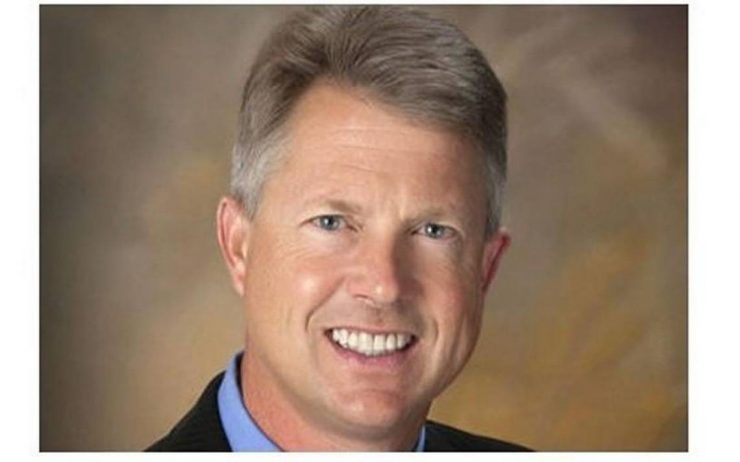

 Lastly, I hope you all had a safe Halloween, trick or treating with your loved ones. My grandson surely enjoyed the candy and treats in their superhero costumes!
 Secretary Perdue shared the lessons and principals he learned growing up on a farm in Georgia, which included: stewardship and responsibility; trust and faith; and optimism. Today he uses those same guiding principals to serve our nation’s farmers and ranchers. In his lecture, he reiterated his commitment to making the USDA more user-friendly and effective to better serve its rural customers.