Dr. Roger Marshall, R-Great Bend, is the First District Kansas Congressman.
Friends,
President Trump delivered on his promise to America’s farmers and to rural America. Building off of the year-round E-15 rule President Trump announced earlier this year, a new agreement between the USDA and EPA will not only work to expand renewable fuel volumes but bring transparency to the RINs process.
Under an agreement announced by the USDA and EPA, the two agencies will work together to expand biofuel requirements, including seeking comments on actions to ensure that more than 15 billion gallons of conventional ethanol be blended into the nation’s fuel supply beginning in 2020. The agencies will also confirm volume obligation for biomass-based diesel is met, including accounting for relief expected to be provided for small refineries.
Additionally, the EPA will continue to evaluate options for RIN market transparency and reform. And the USDA will look for opportunities to consider infrastructure projects to facilitate higher biofuel blends.
The renewable fuel industry is not only good for producers and consumers but good for Rural America and our environment. I applaud the work of President Trump and his administration to remove burdensome red tape and uphold the RFS.
Medicare Open Enrollment Tele-Town Hall Opportunities
It’s time to get ready for Medicare open enrollment. From October 15 to December 7, America’s seniors will have the opportunity to find a plan that best suits their needs. During this period, I will host three tele-town halls to connect seniors in the Big First with regional experts from the Centers for Medicare and Medicaid Services (CMS) to provide a general overview of 2020 options and answer questions.
Tele-Town Hall Dates: (conference call information to follow)
Wednesday, October 23, 2019 – 2:00 p.m.
Wednesday, November 13, 2019 – 10:00 a.m.
Wednesday, December 4, 2019 – 6:00 p.m.
For those that want to preview and compare 2020 health and drug plans, Click Here to get started with the newly updated Medicare Plan Finder.
NBAF Director Named
The United States Department of Agriculture announced the hiring of Dr. Alfonso Clavijo as the National Bio and Agro-Defense Facility’s first permanent director. Dr. Clavijo brings international experience in animal research and diagnostic work that will help the new, state-of-the-art facility achieve its goal of protecting U.S. agriculture and consumers through cutting-edge research and the development of vaccines and countermeasures.
Since taking office, I have been a champion of the NBAF facility in Manhattan, doing my part to ensure it has the resources needed to meet its mission of protecting animal health. Congratulations to Dr. Clavijo, and if you would like more information on the appointment, Click Here.
National Manufacturing Day
Kansas is home to over 2,500 manufacturing companies, from Fuller Brush in Great Bend to AGCO in Beloit. These companies play an important role in growing local economies, contributing over $25 billion to the state economy annually.
Kansas manufacturers are constantly innovating, helping to maintain U.S. global leadership in the industry. I’m proud of all of the great manufacturing companies in Kansas and am happy to honor them. Rural and Independent Innovators Conference The Kansas Small Business Development Center will be hosting one of their Rural & Independent Innovators Conferences (RIIC) at Fort Hays University on October 15th. These conferences are modeled around supporting Kansan entrepreneurs and innovators with information and education, with the goal of fostering connections and business opportunities.
Executive Director of Grow Hays, Doug Williams, will be the keynote speaker at this upcoming RIIC and will be speaking on “Growth Through Innovation.” There will also be presentations on business growth, market access, and raising capital. This is a great opportunity to network and learn, and I hope many of you have a chance to attend. Additional information, along with registration details, can be found on their websiteHere.
Department of Labor Fighting for Workers
U.S. Department of Labor recently announced an update to its rules related to overtime pay eligibility under the Fair Labor Standards Act.
This rule gives hard-working American employees a much-needed opportunity to earn overtime pay. President Trump and his administration recognize the changing workforce climate and worked hard to deliver a rule that will deliver more income and prosperity for American workers.
The current rule was issued in 2004, and set the standard qualified salary level at $455 per week, or around $23,600 annually. Starting in 2020, that threshold will be raised to around $35,000 annually, which means that an additional 1.3 million American workers will now be eligible for overtime pay.
President’s Award for Distinguished Public Service
I was named the recipient of the American College of Cardiology’s (ACC) 2019 President’s Award for Distinguished Public Service.
ACC, which represents over 52,000 cardiovascular health care professionals across the US, recognized my efforts to advance legislation to streamline prior authorization in the Medicare Advantage program, advise the Trump Administration on various quality and access issues, and to address surprise billing. Having worked as a doctor for 25 years before coming to Congress, it has long been a goal of mine to advocate for policy issues that would best serve patients.
I will be honored to receive this award in person at ACC’s legislative conference next month.
Dr. Roger Marshall, R-Great Bend, is the First District Kansas Congressman.
By Katharine Kosin, Kirsti Kenneth and Pierce McManus Freedom Forum Institute
Did you hear the one about the comedian who got fired from Saturday Night Livefor making offensive comments before he ever set foot on the show? It’s no joke.
Earlier this month, comedian Shane Gillis was hired and then promptly fired by the long-running sketch comedy show after his racist and homophobic comments from a year-old podcast came to light. Several comedians came to his defense, claiming that Gillis was a victim and that his firing exemplified an erosion of free speech in the United States of America. But does it?
This latest comedy controversy highlights the tricky intersection between our fundamental freedoms and cultural trends; it also reveals the messy collisions that can take place between opposing viewpoints. And it illustrates commonly held misunderstandings about what is and is not considered protected speech under the First Amendment.
For the record, being fired from Saturday Night Live — or any TV show for that matter — is not a First Amendment issue. The First Amendment only protects people in the United States from government censorship. Private companies are not bound by its restrictions. NBC was well within its rights to terminate Gillis’s employment.
More importantly, the First Amendment does not protect individuals from facing social repercussions for their offensive speech. If Gillis’s podcasts never saw the light of day, odds are that NBC wouldn’t have been in a position to fire him. Nonetheless, his comments were publicized and the sizable public outcry that followed — also protected by the First Amendment — undoubtedly influenced the network’s decision.
From our viewpoint, Gillis’s firing and the clashing opinions surrounding it does not mean that our right to free speech is in jeopardy. It’s quite the opposite, actually.
Our founders included the First Amendment in our Constitution because they recognized the importance of a free flow of ideas and information to democratic government and of protecting the rights of people whose views might be unpopular. If the government were to determine which speech is too offensive to be allowed, that could put them on a slippery slope. Bans on offensive speech might morph into bans on any speech that makes government leaders look bad or comes from political enemies. The First Amendment and the breadth of its protections never changed for that very reason.
But public tastes have changed over the years. Significantly. Popular comedic routines from decades passed are considered objectionable by today’s standards. Today, comedians who make women, minorities or LGBTQ individuals the butt of their jokes can expect that at least some of their audience will push back. In August, popular comedian Dave Chappelle was publicly denounced for jokes he featured in his latest Netflix special that poked fun at the alleged victims of R. Kelly and Michael Jackson and mocked members of the LGBTQ community.
Why has our standard for “what’s acceptable” changed? The evolution stems in large part from having more diverse voices involved in the conversation, with historically marginalized communities taking advantage of increased opportunities to exercise their First Amendment rights and pushing back against speech that denigrates them. The advent of the internet and social media has provided these previously underrepresented groups with new, open platforms to speak out, offer a new and different perspective and generate broader support.
If the history of comedy in America is any indication, this undoubtedly won’t be the last controversy. In many ways, we’re glad that’s the case. These debates push us to revisit our understanding of free speech and look for ways to navigate a complex culture, full of differing viewpoints and experiences. But that can only happen if we look past the surface-level attacks and assumptions. Free speech isn’t always funny, nor is it always easy to understand. And it will continue to breed conflict. But more speech for more people puts us on a trajectory toward a better society.
And whether you’re a comedian that pushes boundaries or a comedian that merely pushes buttons, don’t cry foul or “free speech” when people invoke their own right to free speech and start to push back vocally on your material. The joke is on you, because that’s how the First Amendment works.
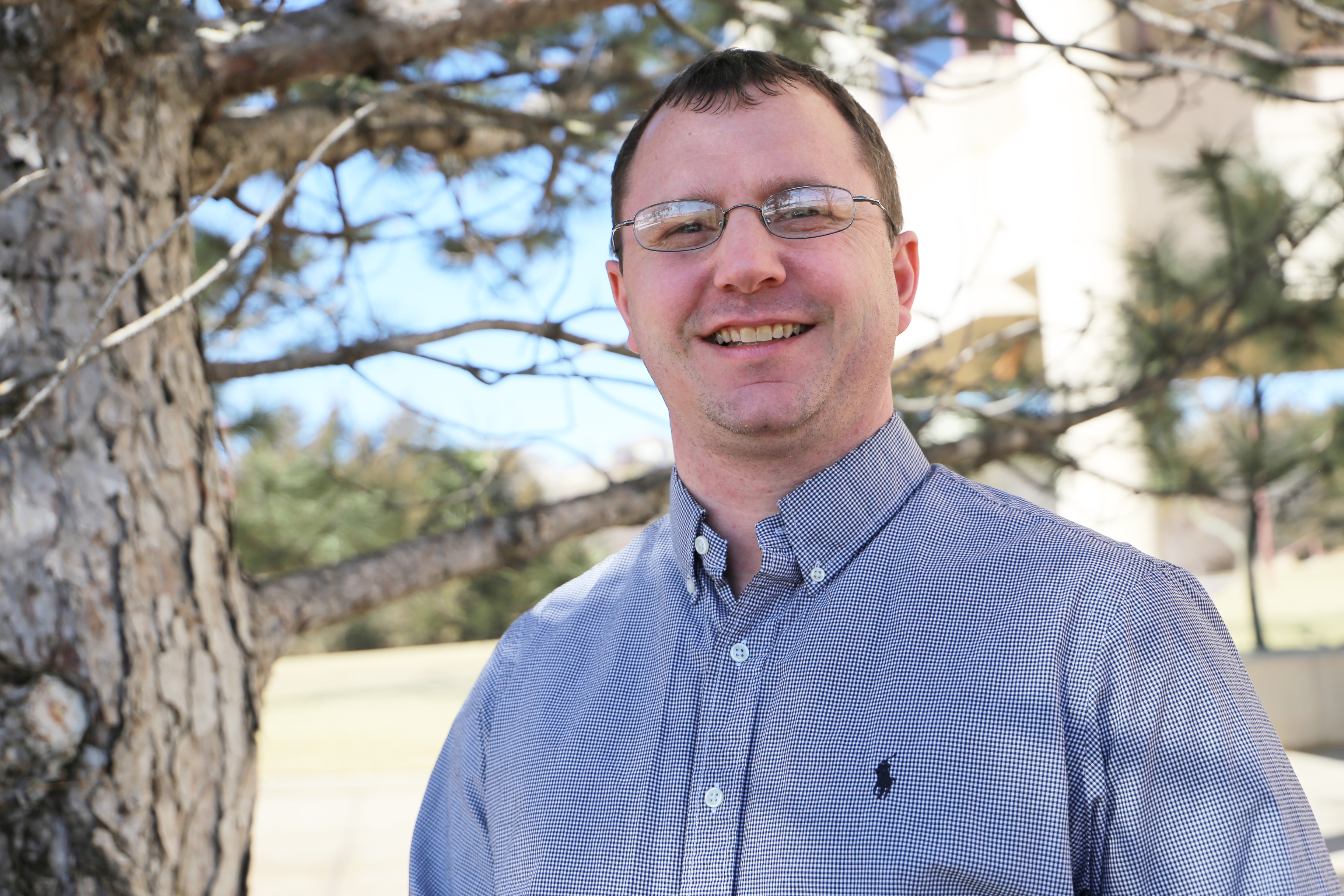
Ron Wilson is director of the Huck Boyd National Institute for Rural Development at Kansas State University.
By RON WILSON Huck Boyd National Institute for Rural Development
Would you like corn flakes for breakfast? Cows would like corn flakes for breakfast, too. Today we’ll learn about an innovative Kansas farm family that is utilizing a steam flaking technology to improve feed quality for their livestock operation and others around Kansas.
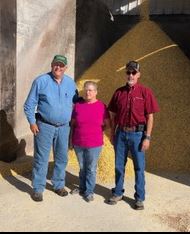
Phil and Sharron Knox farm in northwest Kansas. Phil is a native of the Brewster area. He went to Kansas State and majored in agricultural economics. While attending a Farm Bureau scholarship dinner, he met Sharron who was studying dietetics. The two married and began a long life together.
Phil went on to earn a master’s and Ph.D. in agricultural economics from the University of California at Berkeley, where Sharron earned her master’s in public health nutrition. She worked as a consulting nutritionist and Phil took a position as assistant professor at Colorado State before moving back to his family farm near Brewster.
Today, the family farming operation consists of no-till corn and wheat on 9,000 acres of which 1,800 acres are irrigated. They also have a 200 head cow and calf operation on 2,100 acres of pasture land. The cattle are finished, along with purchased calves, in a 2,500-head feed lot. The fed cattle are marketed through the Knox’s membership in U.S. Premium Beef.
Phil and Sharron Knox and Don Allen, AgSun manager
“You have to do things a little better, you have to change,” Phil said.
“He does research, he has ideas,” Sharron said. “I’m a detail person.”
One of Phil’s ideas was to improve the feed efficiency of his cattle feeding operation. “I talked to a friend who was working in feed technology,” Phil said. That led to the creation of a steam flaking enterprise in 2004.
Feed corn is converted into flakes by processing in a steam chamber. This breaks down the cell walls and gelatinizes the starch. The result has proven to be a highly desirable cattle feed. In fact, the feed worked so well that the Knoxes not only feed the flakes to their own cattle, they market the flakes to other feedlots and dairies in western Kansas.
The flaking business is known as AgSun LLC. The company’s flakes have been shown to be a better source of energy than rolled or ground corn because cattle digest and utilize the flakes better. For feeder cattle, the flakes allow up to a 15 percent improvement in energy values.
For dairy cattle, starch availability is also improved, giving cows a better source of energy. This produces more energy for more milk production.
AgSun LLC has the capacity to process 2.5 million bushels of corn a year, with one third of that coming from the Knox’s own production. Their son Daniel, an industrial engineering graduate of K-State, helped design the automated controls and programming for the equipment. It is a state-of-the-art, computer-operated facility. The production from the plant could feed up to 40,000 to 50,000 head per day.
“The staff at AgSun is hard-working, friendly and always willing to help us,” said one customer. “The flakes are the best quality for our cattle.”
Another customer commented: “The quality of the product is second to none and is always very consistent. AgSun produces what they advertise and they do things the right way the first time. Our production is always good with AgSun’s cornflakes in our ration. We appreciate their service.”
Sharron is a board member of the Northwest Kansas Farm Management Association. Phil has served on the Northwest Kansas Groundwater Management Board. They are members of Kansas Farm Bureau and Kansas Corn Growers.
“We felt called to do more,” Phil said. He also serves as the volunteer pastor at the local Lutheran church.
“We enjoy living here, it’s like a big family,” Sharron said. Brewster is a rural community with a population of 305 people. Now, that’s rural.
For more information about the steam flaking business, see www.agsunllc.com.
Would you like corn flakes for breakfast? So would your cattle. We commend Phil and Sharron Knox for making a difference with agricultural entrepreneurship. Corn flakes can help make a better breakfast, better beef, and better business.
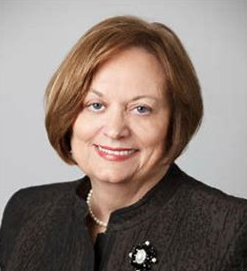
Dr. Sharon Hartin Iorio is Professor & Dean Emerita at Wichita State University College of Education.
“When an ir-re-sistible force, meets an old im-mov-able object like this, you can bet just as sure as you live, something’s got to give.” Johnny Mercer wrote it. Frank Sinatra sang it, and we all fell in love with its optimistic take on inevitability.
Today, the romantic 1950s lyrics evoke a circumstance Kansans may soon face. It’s the collision of a contemporary force with an immovable object and it’s set to happen when the irrepressible progress of early childhood education meets the politics of school funding affordability.
The result may soon be coming based on findings of a 2018, $4.5 million needs assessment grant.
The Preschool Development Grant Birth through (age) Five was awarded to the Kansas State Department of Education. The Children’s Cabinet and Trust Fund, the Department for Children and Families and the Department of Health and Environment are leading this work with KSDE.
The early childhood needs were assessed by a variety of methods including a listening tour, social media queries and interviews with parents, health-care providers, teachers, child-care workers and other groups who confirmed what many expected—uneven program coverage and quality.
Kansas’ youngest citizens currently are taught and cared for in a broad, loose network made up of home, charitable, paid-private and public resources. While the assessment did show many good outcomes across the state, two key findings revealed the sources of the concerns.
First, the findings showed that experiences of families with young children in Kansas are shaped by where they live. Not only did program and service delivery vary across the state but differences also existed from place to place within communities.
The second key finding was that some young children are growing up in families where health, social-emotional growth and basic learning needs are not being met. The research found seven potential issues may be causing this problem. Families with young children find entry to high-quality programs and services difficult to access or unavailable or hard to navigate across systems.
The research findings implied that the departments need to work together to address the remaining needs. These revolve around aligning the programs and services for efficiency and robust quality, increasing collaboration and coordination among the departments and addressing facilities and workforce needs. A vision statement that ties together the early childhood missions of the four departments will be formed. Increasing public/private partnerships also may be considered.
Getting the right balance between individual responsibilities (for families) and shared responsibility (from local, state and federal funding) is a complex challenge.
Even though much progress can be made, tightening systems and encouraging non-governmental funding cannot fully provide programs and services where none exist. As a result, the most important decisions for Kansans in the future will be the allocation of public resources for early childhood needs.
A National Scientific Council research report released in 2007 provided a powerful finding—responsible citizenship and lifetime productivity depend on the ability of government to invest wisely in our youngest citizens.
Effective early childhood policies will not eliminate all social inequalities or guarantee economic development. Nevertheless, when early childhood programs and services are provided in the lives of individual children, the well-being of both the young and the larger community is advanced.
Supported by research and backed by the public “something’s gotta give” to enable comprehensive, highest-quality early childhood initiatives in Kansas.
Dr. Sharon Hartin Iorio is Professor & Dean Emerita at Wichita State University College of Education.
Note: The big day is finally upon us — the Kirwin Sesquicentennial will be held this Saturday, Oct. 5, with the parade getting underway at 10 a.m. In recognition of that rare celebration, the Phillips County Review has been running original historical articles on the community.
Kirwin, Kansas, was born in fire. Literally. Founded in 1869, it was not until December 1870 that it was platted and the Kirwin Town Company formed.
Just months later a massive prairie fire swept over the community, destroying most of what little progress had been made in building the frontier settlement.
Rising from the ashes, for the next 20 years Kirwin became the most prominent town in northwest Kansas. During that time fire continued to be Kirwin’s constant nemesis, threatening it through accidents, acts of god, and the malice of man.
While prairie fires regularly swept around the outpost on plains, and accidents with lanterns, chimneys and fireworks caused damage to structures in town on a regular basis, it was the malice of man that caused the most destructive fire in the history of Kirwin, consuming the better part of the east side of the town square in 1888, as well as a portion of the south side.
Violent Political Conflict Explodes In Phillips County
Late that year prairie fires, while dangerous, were the least of Phillips County’s problems as “incendiaries” had been engaging in a campaign of destroying entire business districts in the late 1880s.
The same week as the most recent Kirwin prairie fire swept around Kirwin in October 1888, the main block of the Logan business district was destroyed in a large blaze. Occurring at the tail end of a very heated election season, the Logan outbreak took place the very same day as the Phillips County Union Labor political party convention, chaired by L.F. Fuller of Logan.
At the time it was widely believed to have been “incendiary” in origin, with fingers of accusation being pointed back and forth between Union Laborites, Republicans and Democrats. Incendiary was the term used back then for arson.
This fire came in the midst of considerable political strife taking place throughout Kansas generally and Phillips County in particular. “Kansas Populism,” as it was called, was spreading across the state and was being embraced by farmers, threatening the entrenched political power structure.
The Union Labor Party, an early form of the Populist Party, had been established in the American Midwest in 1887 and was a grassroots partnership of farmers and factory workers challenging both the Democratic Party and the Republican Party for the votes of disaffected blue collar workers politicized by industrial conflicts, low wages, low farm prices, and farm foreclosures.
The Union Labor Party was a successor organization to the National Farmers Alliance and Greenback Party movements of the 1870s and early-1880s. Both had been agrarian organizations whose goals mirrored those of the Farmer’s Grange, and evolved into the Union Labor Party by the late 1880s. After the 1888 election the Union Labor Party itself was absorbed into the broader Populist Party of the 1890s.
Establishing a nationwide platform of increasing grain prices, raising wages and reducing factory employee hours, Union Laborites were attacked by their political opponents as being “anarchists.” Despite this, they were very well organized in Phillips County in 1888, having a large county membership and formal party organizations in 24 out of the county’s 30 townships.
That same year there were at least eight Union Labor-supporting newspapers in the county and the surrounding area, including the Logan Freeman, the Athol People’s Friend, the Kensington Union Labor Trumpet, the Hill City Sun, the Phillipsburg Democrat, the Long Island Inter Ocean, the Almena Plaindealer and the Kirwin Independent.
The Union Labor leadership in Phillips County came from Logan, Kirwin, Marvin (Glade), Big Bend (Speed), Stuttgart, and Agra with the significant membership lists including surnames which would sound familiar to 21st-century residents.
And their county convention had just been held in Phillipsburg on October 10, 1888, with Logan burning that night.
This convention seemed to agitate the volatile local political situation in the lead up to the Logan fire, and the even larger one that was about to hit Kirwin.
Almost sensing a problem was heading towards Kirwin in the immediate aftermath of the Logan fire, the Kirwin Chief used the controversy to chime in regarding that town’s own vulnerability to fire–
“This was about the best business block in Logan, and will be a great loss to the town. We might say here that this is another reminder that Kirwin has no protection against fire.”
In the same issue of the newspaper and for the first time in all of its many months of pleas urging the creation of a fire defense infrastructure, the Chief even went so far as to urge its readers to buy fire insurance.
The Fuse Gets Lit
Matters finally came to a head when a major Union Labor rally was planned to be held at the Kirwin Opera House on Saturday, October 27, 1888, with the keynote speaker being Populist firebrand Sarah E.V. Emery, author of “Seven Financial Conspiracies.”
Republican politician–turned Greenbacker–turned Populist U.S. Congressman John Davis, Junction City, said of Emery’s publication, “In the year 1888, 50,000 copies of Mrs. Emery’s little book were showered among the people of Kansas. Under their fructifying influence the seeds of thought began to spring up in every heart. The rage of the enemy knew no bounds. Great lawyers and judges of courts wrote pamphlets and newspaper broadsides which were circulated by Republican committees and corporation newspapers as campaign documents. Smaller men called the little book ‘The Union Labor Bible.’ They cursed it in their speeches, tore it to pieces in the presence of their audiences, dashed it to the floor, spat upon it, trampled it under foot. All this but proved the rage of the lion that had been wounded, the pain of the whale that was pierced, or the bird that was hit.”
Philip Campbell
After the announcement of the Kirwin Union Labor rally was made there was a major pushback from opposing political forces. With Kirwin community leaders receiving at least two letters threatening the town’s destruction should it follow through on its plans, the event moved forward as scheduled.
On the appointed afternoon the rally got underway in the midst of a huge crowd. With Emery taking to the podium, the Kirwin Chief reported, “the Kirwin Opera House was packed to its utmost capacity. Mrs. Emery spoke for about one hour and a half, during which she spoke of the farmers being in debt. That their farms were mortgaged for all they were worth, that the people were reduced to poverty and that it had been brought about by class legislation.”
The Chief continued, “She attempted to show that leaders had entered into a conspiracy with the shylocks of Wall Street to allow the monopolists to obtain control of the finances of the country.”
With Emery blaming the Republican Party for this state of affairs, after she finished the G.O.P had a rebuttal speaker, Philip P. Campbell, Pittsburg, address the capacity crowd. At the time Campbell was a lawyer, but a decade later would be elected as Kansas’ Third District Representative to the United States Congress and serve in that role for two decades.
According to the Chief, “Mr. Campbell made a forcible though impromptu speech, and handled the unproven assertions and wild theories of his opponent in a merciless manner. He gave his hearers some logical facts about the relations of labor and capital; about the causes of hard times. He said that class legislation was not responsible for a failure of crops, and that it was impossible for farmers to flourish when the country was suffering from an almost total failure of crops. He then devoted some time to the wild theories in the little book of which Mrs. Emery was the inspired author.”
C J Lamb
As the town was still on edge from the afternoon’s excitement, that night the Union Laborites gathered for a second rally, with a lead-off speech by the party’s county chair, L.F. Fuller, Logan. Fuller had just arrived in Kirwin after having spent the day in Kensington, where another large Union Labor rally/Republican counter-rally had also been held.
With Emery following Fuller, also addressing this evening Kirwin rally was 39-year-old attorney and editor of the Kirwin Independent, Clayton “C.J.” Lamb. Lamb was one of seven men on the Phillips County Union Labor Central Committee, as well as one of six men on the State of Kansas Union Labor Central Committee.
While Lamb was in the midst of his speech, he was suddenly yanked from the podium, arrested, and taken to Phillipsburg in custody.
As the day’s controversies were echoing up and down the streets of Kirwin, Emery checked into the Commercial Hotel on East Main Street.
Then, just mere hours later, fire broke out in four different places on the east and south sides of the Kirwin Square. One of those primary points of ignition was in the back offices of C.J. Lamb’sKirwin Independent.
The Alarm is Sounded
The alarm for the Kirwin conflagration was sounded not long after midnight, Sunday morning, Oct. 28, 1888, with flames appearing simultaneously on the east and south sides of the square.
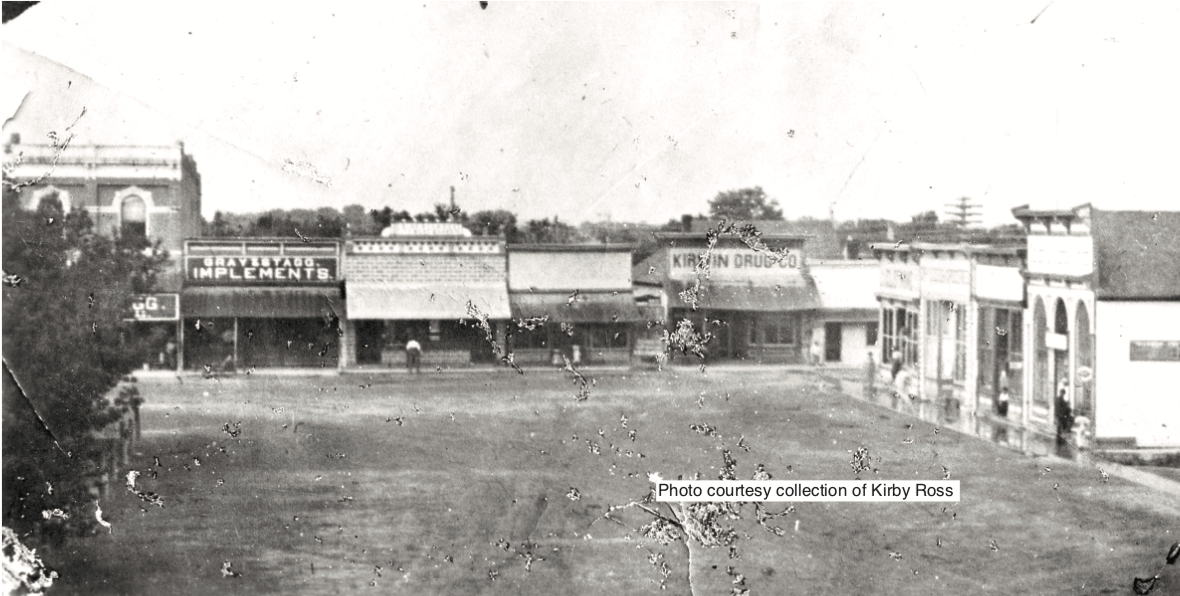
On the east side the block was anchored on its north by the brick First National Bank building (also known as the Kirwin State Bank) and on the far south by the home of R.I. Palmer, an owner of the Kirwin Chief. In between the bank and Palmer’s house were wall-to-wall adjoining wood frame buildings. Tinderboxes.
The fire on this side of the square was started in three places — at the rear of the Kirwin Independent newspaper, in Bradley’s Lumber Yard and in Noble’s Livery Stable, just north of Palmer’s home.
A fourth site on the south side of the square was also targeted by the incendiaries. This smaller block was anchored by C.C. Stone’s Clothing Store on its east, and Ingersoll’s, the largest mercantile store in Phillips County, on the west. In between was Streble’s building and a store owned by August Stockmann.
The fire on this side was started behind Stone’s place.
Kirwin had two newspapers at the time — the Chief, and the Independent. By morning it would have just one, with the Independent ceasing to exist.
The Great Fire Rages
A report in the Phillipsburg Democrat told the tale–
“The people of Kirwin were startled last Sunday morning about 1 o’clock, by hearing the cry, fire! The fire was seen to break out in four different places. It broke out on the south side of the square just behind Stone’s store. On the east side it broke out in Bradley & Co.’s lumber yard, and just behind C.J. Lamb’s printing office, and Noble’s livery barn. It is reported that a letter was written to a gentleman in Kirwin stating that Kirwin was doomed.”
Opera House
According to the reporting of the Chief—
“Early last Sunday morning one of the most destructive fires in the history of the city occurred. The alarm of fire was given and our drowsy citizens on going to their doors and windows were horror-stricken to find the entire southeast corner of the square was already in flames.
“It was only a few minutes before hundreds of willing hands were ready to do anything which was possible to check the flames, but with no available means of fighting the fire little could be done.
“The stores were opened as soon as it was found impossible to save them and goods were carried out into the street a safe distance from the fire and thus the damage was made as light as possible.
“Men, women and children worked like superhuman beings, some men doing more work in thirty minutes than they had done before in a whole year.
“The fire was evidently the work of incendiaries, though no positive clue has yet been obtained as to the parties who did the work.
“From the fact the fire was set in different places at the same time, there is no possibility of its being accidental.
“Several theories have been advanced and we hope in a short time the truth will have been ascertained.”
The Chief report continued, “A number of parties burnt out will erect brick buildings in the spring if they do not before.
“The noble ladies of Kirwin cannot be too highly commended for their bravery and noble work in saving property. Thousands of dollars were saved through their efforts.
“It is said there was less noise made than at any other fire on record. Some men slept within three blocks of the fire and did not know it until morning.”
The Damage
Totally destroyed on the east side were Stone’s Grocery (building owned by August Stockmann), Keckley Bros. Merchandise, George Noble Livery, Osborne & Co. Implement, Bradley Lumber, Bartlett Produce, Kimberly Produce, Camp Produce, the Kirwin Independent newspaper, Walker Furniture (building owned by August Stockmann), Oliver & Boddington Meat & Fur, Wilcox Barber Shop, Stockmann Mercantile, Troup’s Novelty Store, Taylor Notions (building owned by August Stockmann). The First National Bank building was damaged.
On the south side, Ingersoll & Co. was damaged, as was the Streble Building and another store owned by Stockmann. Stone Clothing was totally destroyed.
The Cause
There was ample evidence arson was involved, with the Phillipsburg Dispatch laying out the case that same week in a report stating–
“The cause of the fire will, we presume, always be a mystery, but was undoubtedly set on fire by some malicious persons.
“The fire was discovered in the Charles Hull building occupied by C.C. Stone, and in a few seconds, even before the fire had broken through this building, the second fire was discovered in or near the rear of C.J. Lamb’s printing office, and before these could have thrown out any sparks or sufficient heat to cause fire in other places, it was discovered that the inside of the livery barn, south of those already mentioned, was on fire.
Both the Dispatch and Democrat reported threatening letters being received prior to the blaze, with the Dispatch providing the most details–.
“It is reported Dr. R.H. Trusdle had received a letter before this fire occurred stating there was a move on foot to burn Phillipsburg and Kirwin. But he had failed to inform the city authorities as to this matter.
“If this letter had been made public the people would have doubtless been on the alert.”
In a special report just two days after the blaze the Topeka Daily Capital said–
“It is evident the fire was the work of incendiaries, but there is as yet no clue as to the perpetrator or perpetrators of the dastardly deed.
“One young lady, Miss Lizzie Bannister, the operator in the Central Telephone office, covered herself with glory by starting to mount a ladder with a pail of water to pour on the flames which were menacing the First National Bank. She was restrained from making the perilous ascent only by the interference of several gentlemen who held her back.
“A number of the parties will rebuild in a short time. Several of them will erect brick buildings.”
Who Set The Fire…And Why?
With different political factions accusing one another of starting the inferno, the only thing which was certain was that a major part of the economic base of the Kirwin community was destroyed.
The arrest of C.J. Lamb, and both the timing of the fire on the night of the rally and the fact one ignition site of the fire was in Lamb’s offices were all major issues of discussion.
Even the arrest prominently pitted one political party against the other. Kirwin’s C.J. Lamb was a noted Union Laborite, an attorney, and the publisher of the Kirwin Independent. The warrant under which Lamb had been taken into custody in the midst of making his speech had been issued against him by Lamb’s polar opposite — Phillipsburg’s George W. Stinson, a noted Republican, an attorney and former publisher of the Phillipsburg Herald.
The two men had been in conflict for some time, with it reaching a breaking point after Lamb reprinted a September 6, 1888 story from the Logan Republican reporting on Stinson being the father of an unborn child of Blanche Ford, the cousin of Stinson’s recently deceased wife.
The Republican article stated Stinson, upon finding out Ford was with child, left for parts unknown, resulting in Ford attempting suicide.
Stinson had a criminal libel warrant issued against Lamb for running the article (Stinson took no action against the Republican), with that warrant being held and then finally served two months later as Lamb was making his speech at the Union Labor rally in Kirwin.
However within a short time after the Kirwin conflagration Lamb turned the tables, as Stinson himself was arrested for bastardy, with the charges against Lamb being dismissed.
Miss Ford, being unmarried and pregnant, was afterward incarcerated and held as an inmate at the Phillips County Poor Farm.
This was all but a sideshow to the identification of the incendiaries setting Kirwin ablaze, with the finger-pointing first placing blame on Stinson for the mass destruction of a major part of the Kirwin business district.
As more information came to light the conflict between the Union Labor Party and the Republican Party was blamed and took center stage as being the real cause. And, as with any good political conflict, each side began blaming the other.
On November 1 the Cawker City Public Record reported on the carnage in Kirwin, noting “the fire is supposed to have been instigated by the anarchistic element which predominates in Phillips County.”
On November 1 the Phillipsburg Dispatch wrote–
“There are various rumors as to the cause of this fire; many think it the plot of an element of anarchy, now in private organization. Our citizens should be well guarded against these out-laws. A Kirwin gentleman was heard to say the day after the fire that if a Union Labor rally was held in Phillipsburg the city should put on twenty night watchmen or have the town burned.”
Also on November 1 the Logan Freeman, after first pointing out Lamb’s controversial Union Labor newspaper story on Stinson originated in a Republican newspaper, wrote–
“The arrest of Lamb for a libel committed in September and his arrest followed by the burning of his office together with 12 other buildings in Kirwin while he was absent, are coincidence that will bear study upon the part of thinking men all over the country. Look carefully at the ones who shout anarchy and you will see a true anarchist, or his pliant tool.”
In a separate article in that same issue, the Freeman observed–
“Next followed the arrest of C.J. Lamb, editor of the Union Labor paper. Lamb was taken to Phillipsburg and while away from home his office and everything in it, on which there was not one cent of insurance, was burned.
“This fire occurred on the night of Mrs. Emery’s meeting in Kirwin — breaking out at the same hour in the night as the Logan fire and in several places at once. The same identical howl about Union Labor men setting the fire was raised by the same class of men that raised the howl in Logan, and have been howling ‘anarchy’ for months past. What are they trying to cover up?
“Before the fire a leading Republican of Kirwin remarked to a man who was collecting a fund to pay expenses of the meeting to be held, asking if he was taking up a collection to buy rope to hang C.J. Lamb and others like him.
“They have no ground for talking as they do unless it is for the purpose of throwing suspicion on innocent parties in order to cover up their dirty work.
“Will the people aid these excrescences upon society to carry out their infernal schemes on election day?”
On November 2 the Cawker City Times referred to the debate going on regarding the Kirwin incendiary’s identity and motive, writing “It was supposed to be the work of political spite.”
Also on November 2, from the Winfield Weekly Visitor—
“The office of the Kirwin Independent, a Union Labor paper, was burned last week. It was the work of an incendiary.”
By November 9, almost two weeks after the fire, the Kansas City Gazette noted–
“The recent fire at Kirwin is now laid to Union Labor miscreants.”
More details became available on November 14, as the Concordia Kansas Kritic explored the “political spite” motive–
“And now worse than any comes the news from Kirwin. Mrs. Emery was billed to speak there. Prominent Republicans said she should not speak there, and if she did speak the town would suffer in consequence.
“She did speak, and in the midst of the meeting, the editor of the Kirwin Independent, C.J. Lamb, chairman of the Union Labor Congressional Committee, was arrested on an old trumped up charge of libel.
“He was taken to Phillipsburg, the county seat from where he did not get back until Sunday morning.
“During the night a fire broke out in different places and property was destroyed to the amount of $50,000.
“One of the places the fire was first discovered was in Mr. Lamb’s printing office which was then completely enveloped in flames.
“The fire is conceded by all to be the work of incendiaries. The cry of ‘anarchy’ was at once raised and an attempt made to fasten the crime on to the Union Labor men, until it was discovered that on Mr. Lamb’s property there was not one dollar of insurance, while a Republican, whose loss was about $5,000 carried insurance.
“Could circumstantial evidence be more conclusive? Not only will they resort to falsehood and the vilest slander but they will use dynamite and fire to defame the character of the men whose arguments they can not answer.”
The Kirwin Independent remained closed for a full year, before reopening under a new owner who espoused independent politics. Afterwards evolving the newspaper’s slant towards Republican, in 1902 it changed its name to the Kirwin Kansan, continuing operations until its October 1, 1942 issue — it’s Kirwin Old Settlers Day issue.
“This announcement comes at a time when many old timers plan to gather in Kirwin on Tuesday, October 6, 1942 to recall the past history of this splendid community,” the newspaper wrote. “We have made arrangements with the Phillips County Review to fulfill our subscription obligations. You will receive this splendid county paper for whatever period you have paid your subscription in advance.”
Within weeks of the big fire Clayton J. Lamb moved to Lawrence, Kansas, serving for a time as the associate editor of the Jeffersonian Gazette. Eventually ending up back in the state of his birth, Michigan, Lamb ran unsuccessfully as a Social Democrat for lieutenant governor there in 1900 and for governor in 1904. Lamb passed away in Glendale, California, in 1908.
Rebuilding — Again
Just as the town had done after the prairie fire swept over it in 1871, Kirwin immediately began rebuilding.
With most of the contents of the buildings having been saved by the townspeople during the 1888 destruction, within 72 hours of the fire most businesses had set up their operations at other points around the square.
Keckley Bros. Merchandise moved into the Traders Bank on the northeast part of the square — but not for long. Keckley’s store, being made of stone, was quickly repaired and reopened in the burnt district two weeks after the fire.
Oliver & Boddington Meat Market and Fur Buyers set up shop on the bandstand in the center of the town square, and within a week was boldly announced its continuing existence by advertising, “Oliver & Boddington will pay more for hides than any other shop in Phillips County.”
In short order they were moving into a store on the southwest side and proceeding as before.
While he rebuilt, August Stockmann moved into a Streble building near other properties he owned on East Main Street, before moving into the Downs Hardware & Implement building on the west side of the square.
Within a year Stockmann had constructed a new store, bigger and better than ever, putting up a grand seamless brick extension to the bank building back on the east side that would define Kirwin for over a century to come.
Walker Furniture moved into the Styles Building in the northwest square and made the best out of a bad situation — they held a fire sale, literally, just days after the conflagration.
“I am offering some furniture which was slightly damaged in the fire at Great Bargains,” Walker’s advertising said.
Troup’s moved into Barnard’s on the northeast square, with their sale ads shouting “Fire! Fire!! Great reduction in prices since the fire at the Troup Novelty Store.”
C.E. Bradley of Bradley Lumber, in a tight financial bind, sent out a plea asking his customers to whom he had extended credit to come to his aid.
“Having sustained a severe loss in the fire, I desire to say to the parties who are owing me that I need the money badly to start in business again and shall regard it as a great favor if you will call and settle at once. I expect to at once open up a lumber and coal yard in Kirwin and need what you owe me in order to do so.”
Ever the entrepreneur and seeing a business opportunity, three days after the disaster Kirwin insurance salesman and real estate agent W.J. Palmer was pressing other businesses in town to come to him and get their buildings insured against fire.
And eleven days after the Great Fire of Kirwin the Kirwin Chief was observing, “The Streble building which was badly damaged by the fire has been repaired this week.”
Led by Stockmann and his iconic new mercantile building, the entire east side was rebuilt with striking designs in either stone or brick. While one of those “new” buildings would burn in the 1950s, because of the materials used this time the fire didn’t spread and destroy the entire block.
The rest of those early buildings stood for many decades before every one of them, except for one minor structure, succumbed to old age.
They finally fell not because of fire, but because of time.
————————–
Article reprinted from Phillips County Review, with permission. The Phillips County Review has been named by the Kansas Press Association as being the state’s top newspaper in its circulation class for 2019, beating out over 180 other publications.
Editor and writer Kirby Ross, a past nominee for the Western Writers of America Spur Award and the National Cowboy Hall of Fame’s Western Heritage Award, has had two books of historical nonfiction published by major university presses. He has also personally won over 20 Kansas Press Association Awards of Excellence for his newspaper work over the past three years, including first place recognition for news reporting, news and writing excellence, feature writing, political and government reporting, editorial writing and news photography.
This week welcomed October and National Domestic Violence Awareness Month (DVAM). For many, you may stop reading right here, simply because you may think, “this issue does not pertain to me.” The truth is, it does pertain to you. Why? Because you are the friend, partner, brother, sister, mother, father, grandparent, co-worker, neighbor of someone who is a victim of domestic violence. One in four women and one in nine men will be the victim of domestic violence at some point in their lifetime, and, on average, three women are killed every day at the hands of a current or former intimate partner.
Domestic violence is one of society’s largest problems and it hides in plain sight. DVAM is an opportunity to deepen our understanding of these issues and share resources. Jana’s Campaign is a Hays-based national education and violence prevention organization with the single mission of reducing gender and relationship violence. This month, we are asking our community to learn 5 new things about domestic violence and share that information with those in your community.
Domestic violence is a serious issue in our country, state, and community. The only way we can create a culture that does not accept violence, is to become educated and then talk about it. We encourage you to get comfortable talking about the uncomfortable. You don’t have to be an expert to make a difference – you just have to be aware of the factors that can contribute to violence.
Jana’s Campaign has pledged to provide information on our social media accounts about the multiple forms domestic violence can take and the severity of the issue throughout the month of October. Please follow Jana’s Campaign on Facebook, Twitter, and Instagram to learn more.
In honor of the late Hays resident Jana Mackey and other victims and survivors of gender and relationship violence, Jana’s Campaign delivers comprehensive educational programming that prevents domestic and dating violence, sexual violence and stalking.
Kaiti Dinges Executive Director of Jana’s Campaign
As the calendar turns to October and a political circus fully envelops D.C., it’s important to remember there’s an election on the horizon that’s not the 2020 presidential referendum.
In November Kansans will head to the polls and cast ballots for school board members and city councilors. Voters also will have a say on borrowing money for new schools, increasing sales tax and other measures.
In short, November’s election is more consequential for the day-to-day lives of most Kansans than anything that happens in 2020. Not only are the stakes higher for your everyday living, your vote will likely have an outsized impact on the election.
For example, in my home county 65 percent of eligible voters cast 22,198 ballots in the 2016 general election. Fewer than 6,000 voters turned out for 2015’s local races. That increased slightly in 2017 to just over 8,000, which is still less than a quarter of registered voters. The smaller the turnout, the more heft your individual vote will carry.
Now’s the time to get registered and get educated. U.S. citizens living in Kansas who will turn 18 before Election Day must submit their registration applications to their county election officer by Oct. 15 to be eligible for the Nov. 5 election.
The Kansas Secretary of State’s website (www.sos.ks.gov/elections) provides a trove of information about how and where to register; lists of candidates and deadlines for in-person advance voting, Oct. 16-Nov. 4; applying for and returning advance ballots via mail by Oct. 29; and when mail ballots must be postmarked, Nov. 5, and received by the county election office, no later than three days after the election.
As for getting to know the candidates, I’ve always thought it’s much easier to do in local elections than at the state and federal level. There’s no party politics to sort through since all school boards and most municipal elections are nonpartisan. The candidates also tend to be less political and more service minded, especially considering most positions offer nothing or next to it in the way of compensation.
Plus, especially in small towns, you already know the candidates. You go to church together, sit next to each other at Friday night ball games and, possibly, went to school together. For those election seekers you may not be as familiar with, there are plenty of resources. Local newspapers and radio stations will provide standard coverage of candidates, civic groups will hold forums and the candidates often have websites or social media pages detailing their backgrounds and the issues important for them.
While all of those methods will certainly help inform your vote, the very best practice is to question candidates directly. Whether you are worried about taxes, spending, public safety or have some other concern, candidates’ answers are often illuminating of how they’ll govern. Be wary of anyone who refuses or deflects from direct, relevant inquiries. If they don’t provide straightforward answers when seeking your vote, how can you trust they’ll be responsive to your inquiries if they’re elected?
I know why local elections are less popular than state and federal contests. There’s less partisanship and rancor. It often seems like there’s less on the line, even though that couldn’t be further from the truth. No matter your politics, the system works best with an engaged and educated electorate.
I’ll be at the ballot box this November. I hope to see you there, too.
“Insight” is a weekly column published by Kansas Farm Bureau, the state’s largest farm organization whose mission is to strengthen agriculture and the lives of Kansans through advocacy, education and service.
Martin HawverIt’s starting to become apparent that Democrat Gov. Laura Kelly has devised a new tool to use to run the state that is essentially managed by a Republican-heavy Legislature.
Of course, Kansas government is basically run, its policies set, its benefits delivered by a majority of a quorum in legislative committees and a majority of members of the House and Senate.
Barring a veto (see last year’s two tax bills) which drives up the votes needed to override the governor, probably one of the most subtle tools is creation by a two- or three-page executive order which establishes “the Governor’s Council” on, well, whatever she wants.
In the first year of her administration, Kelly has made clear that she’s using that “Governor’s Council” to propose tax policy for the state and Medicaid expansion.
Now those councils are just advisory, they come up with policy for their assigned subjects and that policy is going to become the governor’s policy for the state.
Nope, it doesn’t get anything passed, but those council recommendations become a fence for the Kansas Legislature, setting boundaries for lawmakers’ actions. Approve most of whatever those “Governor’s Councils” propose, and it’s likely those bills will become law.
Get outside that fence, and the governor can veto a bill and cite—at length—that a specialized study group (and because a handful of Republicans is on those councils, she can refer to them as “nonpartisan”) considered and rejected those provisions.
Not a bad tactic.
Kelly’s first council, dealing with tax reform, has started its exhaustive look at Kansas tax policy, whom is taxed, what is taxed and what isn’t. It’s a big issue that will paint what tax changes produce…and what those changes may do to the state’s economy that most of us wouldn’t have thought of.
For example, continuing to under-fund the Kansas Department of Transportation doesn’t just take less money but it also is likely to damage the state’s economy through depreciating roads used for getting state products to out-of-state buyers, getting Kansans to their jobs, and even contributing to inadequate recreational bike trails to give cyclists a reason to stay in Kansas or come to Kansas to spend their lives.
Oh, and those roads that are now getting a little makeup with an inch or two of new asphalt and striping are actually deteriorating and will at some point require expensive rebuilding from the dirt to the road surface.
Now, does that sound like tax policy? No, but roads that are deteriorating faster than they are being preserved call for tax money to be spent.
And this week Kelly gives an introductory welcome to the Governor’s Council on Medicaid Expansion. That panel will, of course, propose expansion of Medicaid–we call it KanCare–and what that expansion should look like.
That’ll put some fences around the Legislature’s plans for expanding Medicaid which the House passed last session…and which the Senate never considered.
Look for the panel, of course, to deal with the social issues of caring for the health-care needs of the state’s poor, and then underline that expansion and accompanying federal funding with the possibility of more Kansas hospitals closing, jobs leaving small communities, and residents and workers leaving, too, with dire economic effects.
And look for the panel to disapprove legislative efforts to hinder that expansion through any number of provisions that would prohibit Kansans from becoming eligible for expanded Medicaid—like pre-existing conditions, or work requirements and such…
So, it’s just not the governor proposing tax and Medicaid plans, it’s a bipartisan council that helps draw fences around Medicaid legislation.
This governance by “council” might get interesting…
Syndicated by Hawver News Company LLC of Topeka; Martin Hawver is publisher of Hawver’s Capitol Report—to learn more about this nonpartisan statewide political news service, visit the website at www.hawvernews.com
I’m not a very opinionated man, but I do have a few annoyances. I try hard to keep these “pet peeves” on their leashes, but occasionally they break free.
Bad signs really irritate me; hard to read, too small, homemade looking, bad signs! For instance, a bad “for sale” sign might as well say” I really don’t want to sell this, but my wife won’t let it stay, so after you’ve read this sign, please just drive away.”
Speaking of bad signs, a major “pet peeve” of mine is trespassing and hunting without permission, and with the myriad of fall hunting seasons already underway, allow me to offer some pertinent information. I am a hunter and I have been a land owner, so I’ve been on both sides of this “fence” so to speak. Are you land owners and sportsmen aware that regulating trespassing and hunting on private property DOES NOT even require a “bad sign” but in fact, requires no sign at all?
In Kansas, law requires hunters to gain land owner permission even on unmarked property. Let me also note the difference between “hunting with permission only” and “hunting with WRITTEN permission only.” “Hunting with permission only” allows for any form of permission, written, verbal or over the phone, and requires the land owner’s signature on any ticket or formal complaint issued by the conservation officer. “Hunting with WRITTEN permission only” is satisfied only by permission in writing, and gives law enforcement personnel free rein to issue citations, and /or make arrests with no further authorization.
By the way, land owners, the fish and game dept. furnishes both the signs and permission slips, at no cost, for this type of posting. I’m sure we hunters have all seen the bright purple paint on fence posts and old tires along property lines. These purple markers along property boundaries also mean “hunting with WRITTEN permission only,” and corresponding compliance is required. The local conservation officer told me that trespassing violations are misdemeanors, so fines are determined and levied by the judge. A few years ago in McPherson County, the minimum was two hundred fifty dollars plus court costs of ninety-eight dollars, and could easily have run up to five hundred dollars depending on circumstances and the judge’s decision.
We hunt mostly deer and turkeys, and trap coyotes, raccoons and beavers. Lots of land owners, especially farmers, are willing to let respectful, responsible hunters help them control deer, turkey, predator and beaver populations on their land. In my assessment, there are very few reasons why hunting and trapping permission is denied. One is because the owner wants to reserve the privilege for themselves and their family. Another is because someone else has “beaten us to the punch.” There are also land owners who simply do not want game animals harvested. These are all legitimate reasons we hunters must respect. The explanation that makes me cringe is when a land owner denies hunting or trapping permission because of a bad experience with previous hunters or trappers. Trespassing, cut or broken-down fences, gates left open, muddy ruts in fields, indiscriminate shooting and other disrespectful actions toward the owner or his property; I’ve seen or experienced them all! Sadly, these actions by a few of our comrades adversely affect all hunters in the end.
Remember, NO SIGN of any kind is required to keep unwelcome hunters off your land, nor to have them prosecuted for trespassing! I was once denied permission to hunt deer during firearms season on a man’s property because years before he and his wife had dodged bullets whizzing through the trees as they attempted to cut firewood. Evidently the shooter had never before heard the sound a chainsaw makes…Continue to Explore Kansas Outdoors.
Steve Gilliland, Inman, can be contacted by email at [email protected].
Ron Wilson is director of the Huck Boyd National Institute for Rural Development at Kansas State University.By RON WILSON Huck Boyd National Institute for Rural Development
Who is the only native Kansan ever to be elected President or Vice President? (If you guessed Dwight D. Eisenhower, you would be wrong. Although Eisenhower claimed Abilene, Kansas as his home, he was born during his family’s brief stay in Texas.) Who is the first Native American Indian ever to be elected President or Vice President? The answer to that question is the same as the correct answer to the first one: Charles Curtis is the first native Kansan and first Native American Indian to be elected to the nation’s second-highest office. His life is an amazing example of how education and hard work created a rags-to-riches success story. Thanks to the Kansas Historical Society and the U.S. Senate website for this information.
Charles Curtis was born in north Topeka. His father was Orren Curtis and his mother was Ellen Pappan who was one-quarter Kaw Indian. Charles was the great-grandson of White Plume, a Kansa-Kaw chief who had offered assistance to the Lewis and Clark expedition. White Plume’s daughter married a French-Canadian trader, so Charles grew up speaking French and Kansa before he learned English.
His mother died in 1863 at about the time his father left to fight in the Civil War. Charles was raised by his grandparents at the Kaw Reservation near the rural community of Council Grove, population 2,051 people. Now, that’s rural.
Young Charley learned to ride Indian ponies bareback. He became a successful jockey. He was also the hero of a cross-country run to warn Topeka about upcoming Cheyenne Indian raids.
After his grandfather’s death in 1873, Charles was headed to Indian territory. His grandmother advised him to get a formal education instead. “I mounted my pony and with my belongings in a flour sack, returned to Topeka and school,” Curtis recounted. “No man or boy every received better advice, it was the turning point in my life.”
In Topeka, he attended school while living with his other grandmother, a strong-minded woman. It was said of her that “she regarded being a Methodist and a Republican as essential for anyone who expected to go to heaven.”
Charles did well in school and went on to study law, supporting himself by working as a custodian and driving a horse-drawn taxi. When he had no customers, he would stop under streetlamps to read his law books.
After being admitted to the bar, the young lawyer opened his own firm, invested in real estate, and married Anna Baird. He was elected Shawnee County Attorney. Known as a law-and-order prosecutor, he won an upset victory over Democrat and Populist opponents for a U.S. House seat in 1892.
Curtis rose through the ranks in Congress. He was elected to the Senate where he ultimately served as majority leader. A strong advocate of farmers, he sponsored numerous bills related to agriculture and to Indian affairs. He was a master tactician who built strong relationships with both the conservative and progressive wings of his party. One senator described Curtis as “a great reconciler, a walking political encyclopedia, and one of the best political poker players in America.”
At the 1928 Republican convention, Charles Curtis was nominated for Vice President with Herbert Hoover. They were elected in a landslide but defeated for re-election in 1932.
After his term concluded, Curtis practiced law in Washington and continued his interest in politics. He liked to tell audiences that he was “one eighth Kaw and one hundred percent Republican.”
Curtis died in 1936 and is buried next to his wife Anna in a Topeka cemetery. The Charles Curtis State Office Building in downtown Topeka is named in his honor.
When the Curtis gravesite was rededicated, Vice President Dick Cheney sent a letter lauding Curtis as a “champion of the farmer and an advocate for women’s suffrage” and as a strong supporter of legislation granting citizenship to Native Americans.
Who was the first native Kansan and Native American Indian to be elected Vice President? It was Charles Curtis, whose education and hard work would make a difference and transform his life. We can be proud to claim him as a Kansan.
Kansas Common crude at CHS in McPherson starts the week at $46.25 per barrel, after dropping fifty cents on Friday.
Independent Oil & Gas Service reports thirty new well-completions for the week. Eight of those were in eastern Kansas and 22 west of Wichita, including one in Barton County. So far this year, operators in Kansas have completed 1,028 wells. That’s down from the 1,141 reported at the end of the third quarter last year.
Operators have 16 new drilling permits across Kansas this week, 741 so far this year. That’s a little over half of the third-quarter total last year. There are eight new permits east of Wichita, and eight in Western Kansas, including one each in Ellis, Russell and Stafford counties.
The oil-patch in the U.S. continues its record-level production. On Wednesday, The Energy Information Administration reported the second-largest weekly production total ever, 12.472 million barrels per day for the week ending September 20. That’s up from the week before by nearly 50,000 barrels per day. The record of 12.5 million barrels per day was set August 23.
The Kansas Geological Survey has released updated production figures through June of this year, with a statewide total of 16.68 million barrels, or just over 92,000 barrels per day. Barton County operators pumped more than 816,000 barrels through June, while Ellis County produced 1.26 million barrels. In Russell County, total oil production through June was over 754,000 barrels. The total in Stafford County was nearly 437,000.
Activity in the Texas patch declined in the third quarter, according to a survey of energy executives by the Federal Reserve Bank of Dallas. The Houston Chronicle reports abundant crude supplies and slowing global demand led energy companies to pull rigs out of service and cut jobs.
Refineries imported about 6.4 million barrels per day of crude oil last week, down more than 600,000 barrels per day. The four-week average for U.S. imports is 13.1 percent less than the same four week period a year ago.
U.S. crude oil stockpiles increased last week by 2.4 million barrels. The government said that at 419.5 million barrels, inventories are rising but remain at the five-year average.
Independent Oil & Gas Service reports a slight increase in its weekly Kansas rig report. There are ten active rigs in the eastern half of the state, up one, and 29 west of Wichita, also up one. Drilling is underway at two wells in Barton County and one in Ellis County. Operators are preparing to spud new wells at one lease in Ellis County, one in Russell County and one in Stafford County.
Baker Hughes reported a big drop in its weekly Rotary Rig Count Friday. Across the U.S. there were 860 active rigs, down six oil rigs and down two seeking natural gas. The count in Texas dropped by five rigs.
Activity in the Texas patch declined in the third quarter, according to a survey of energy executives by the Federal Reserve Bank of Dallas. The Houston Chronicle reports abundant crude supplies and slowing global demand led energy companies to pull rigs out of service and cut jobs.
Oil-by-rail traffic dropped nearly ten percent in the latest weekly tally from the Association of American Railroads. Operators filled 11,862 rail tanker cars with petroleum and petroleum products during the week that ended September 21. As total freight-train traffic continues to decline, the oil-by-rail weekly total is down 9.7% from a year ago, marking the first such decline in recent memory. The cumulative, year-to-date total remains 17% above the same figure a year ago. Amid the railroad industry’s broad decline, only one freight category, chemicals, showed an increase over a year ago.
Another huge acquisition for Texas-based Energy Transfer is expected to dramatically increase the pipeline and processing company’s scale and connectivity. The company will buy SemGroup of Tulsa in a stock-cash-and debt deal valued at over five billion dollars. The announcement last week said both firms will continue to operate separately until early next year when the transaction closes.
A federal judge has blocked enforcement of some new laws in South Dakota that were passed with the aim of preventing disruptive demonstrations against the Keystone pipeline expansion. A lawsuit alleges that the law chills protected speech. In issuing a preliminary injunction halting several provisions of the legislation, U.S. District Judge Lawrence Piersol said the plaintiffs are likely to win most of their challenges.
Saudi Arabia has a new energy minister, and for the first time he’s a member of the royal family. Prince Abdulaziz bin Salman is the half-brother of Crown Prince Mohammed bin Salman and is the first member of the royal family to hold the job. In his first public appearance as minister, the prince signaled no radical change in Saudi oil policy.
(Official White House Photo by Joyce N. Bogohosian)
Friends,
Dr. Roger Marshall, R-Great Bend, is the First District Kansas Congressman.
Last Wednesday, I was honored to join President Trump, Prime Minister of Japan, Shinzo Abe, U.S. Trade Ambassador Robert Lighthizer, and others for the signing ceremony of a new trade agreement with Japan.
This agreement will be a major benefit to our beef, pork, wheat, sorghum, corn, ethanol, and other industries across Kansas. Among other important provisions, the deal will level the playing field for our farmers and ranchers by reducing tariffs and matching the competitive advantage currently benefiting countries involved in the Comprehensive and Progressive Trans-Pacific Partnership agreement. Specifically, the deal will cut tariffs on an additional $7.2 billion worth of agricultural goods sold to Japan.
The United States is already the top supplier of agricultural commodities to Japan, and the agreement signed today will further build on this great relationship. The agreement will allow producers across our state to continue doing what they do best – providing the highest quality, safest, and most affordable food, fiber, and fuel to our partners around the world.
R&T Hearing on AI
Last Tuesday afternoon, SST’s Research and Technology Subcommittee held a hearing on the impact of machine learning and artificial intelligence (AI) on workforce. AI presents unique opportunities for companies to become more efficient and streamlined, however the growth and adoption of these technologies also provides new job opportunities for the next generation. Ensuring that we have a skilled technical workforce has been a priority for Science Committee Republicans as well as the Trump Administration, as it is a vital component of US competitiveness and economic growth in the coming years.
Centura Health
Kansas was well represented at Centura Health’s meeting here in Washington. Centura Health, a Christian-run health system, has footprints in Kansas including St. Catherine Hospital in Garden City and the Bob Wilson Memorial Grant County Hospital in Ulysses. I’ve always praised mission-based health systems and how they give back to their communities. I shared with them my initiatives including my support for the 340B Drug Discount Program for rural hospitals and community health centers. These efforts would end surprise medical bills for patients, and help to reinvent rural health care in America.
Congressional Western Caucus Meeting
I joined fellow members of the Congressional Western Caucus to announce plans to modernize the Endangered Species Act (ESA). As an avid hunter and fisherman, I am dedicated to the preservation of wildlife for future generations. But with a meager 3 percent recovery rate since its inception more than 45 years ago, it’s clear the ESA must be updated. We need a plan that brings stakeholders, property owners, and local and state governments to the table when making habitat decisions to ensure species are delisted when desired population levels are met.
Talking Healthcare
I was honored to serve as the keynote speaker for the American Society of Clinical Oncology’s (ASCO) Advocacy Summit. ASCO is a national organization representing over 40,000 physicians and other health care professionals that treat patients with cancer. I was happy to share with them a physician’s perspective from Congress and the many ways I am working to help physicians help their patients. As part of the advocacy efforts, over 130 of their members from across the country – including Kansas – were in DC this week to advocate for legislation I coauthored that would make long overdue changes to prior authorization. The bill I authored is the first step towards getting patients what they need, when they need it. And nothing is more timely than treating a patient battling cancer.
Congrats to Senator Dole
Last Tuesday, President Trump appointed Senator Bob Dole to serve as a member of the Eisenhower Memorial Commission.
The Commission is working to build a national memorial to President and General Dwight D. Eisenhower here in Washington, D.C., honoring his legacy both as Supreme Allied Commander during WWII as well as his accomplishments as 34th President of the United States.
Construction of the Memorial began in 2017, and is scheduled to open on May 8, 2020 – the 75th Anniversary of V-E Day. Senator Dole joins Kansas Senator Pat Roberts on the Commission and adds a valuable voice to the project as it nears completion. More details about the Memorial and the Commission can be found Here.
AGC of Kansas
Associated General Contractors of Kansas came through the office on Tuesday to give an update on their “Build Up Kansas” initiative and discuss workforce development issues across the state. Through “Build Up Kansas,” AGC is building workforce development partnerships with community colleges, technical colleges, and universities across the state to expose students to careers in the construction and manufacturing industries, which will be facing workforce shortfalls over the next decade. It’s great to see industry leaders thinking creatively about how to address the workforce challenges of tomorrow.
You can learn more about what AGC is doing in Kansas to promote workforce development Here.
Medicare Open Enrollment
The annual Medicare Open Enrollment period runs from October 15th to December 7th this year. During Open Enrollment, Medicare beneficiaries have the opportunity to change the way they receive their Medicare benefits for the upcoming year. This is the only opportunity that beneficiaries can switch their Medicare drug plan, (part D) to one that better meets their coverage and financial needs, or change the way they receive their Medicare healthcare benefits.
For more information on Open Enrollment Click Here.
Dr. Roger Marshall, R-Great Bend, is the First District Kansas Congressman.
I am a guy. We guys are notorious for refusing to ask for help. I do not know if it is genetic, or learned. I strongly suspect the latter, but I am not so sure.
Once my wife, my then three young sons, and I were hiking near a swollen creek in Colorado. I do not remember if it was my youngest son or my middle son, but whichever one had already been in trouble with me for something he had done. So, he knew he was on the short end of the leash with me.
As we were hiking, I looked back. He was gone. I looked into the swollen water, and there he was struggling in the water, trying to grasp a branch to pull himself out of the rapids – and not saying a word. I immediately entered the water, grabbed him, and pulled him onto the bank.
I felt my heart was about to stop with fear of the thought he could have drowned. I asked him in a raised voice, “Why didn’t you call me?” He said, “I was afraid you would be mad.” I won the “Bad Parent of the Year” Award that year.
Recently, I spoke in Hays on dementia and Alzheimer’s. We had expected 10 people, and hoped for twenty. Instead, sixty people showed up – sixty people!
Sixty people were there concerned about dementia. Sixty people were seeking help; sixty people were looking for guidance.
My office is currently working with over 120 families that are facing dementia-related diseases. Their battles and courage are amazing, frightening and valiant – as well as heartbreaking and shocking.
People dealing with dementia type diseases many times suffer alone. They become overwhelmed. They lose their identity as a spouse, or as a son or daughter, and instead become a full time caregiver, ill prepared and ill equipped, working as a caregiver every moment they can. Many times the caregiver’s health will actually deteriorate faster than the person with dementia.
One point we made at our dementia workshop, a key point, is that if you are a caregiver, and if someone asked you if they can help – say YES. You may not know how they can help, yet. However, one day, you may think of a way that they will be able to help. You just need to give them a chance, and an idea how to help you.
It is hard to ask for help. Sometimes it is equally hard to accept it. Those dealing with dementia need a pool of people and resources who can help – even if it is just a little thing like picking up some groceries or relieving them for an hour. It may mean the caregiver gains a few moments of normalcy.
I learned an important lesson that day by the stream. I learned that my family and friends, no matter what goes on between us, need to know that they could always ask me for help; they can always feel free to reach out to me.
Year later, after the stream incident, one of my sons was involved in an accident in his antique car. He called me and told me of the accident. My first words, “Are you okay?” Later I heard him tell the story to his friends of that wreck, about our conversation, about how much that meant to him—that I was more concerned about his safety than the car. So, maybe after all, I learned a few lessons at that creek in Colorado.
When dealing with Alzheimer’s or dementia, or indeed facing a family crisis, do not be afraid to ask for help. And when help is offered, never say, “I do not need help. I am okay.” Save that offer of help for later on, and then use it. Asking or receiving help does not make you a bad person; it makes you a wise person, and you will even be a better caregiver.
And if you know someone who is dealing with dementia, don’t be afraid to offer your help, in any way you can. Just a little thing can be so helpful.
Plug: The Hays Alzheimer’s Walk is scheduled for October 5. I hope you will join the walk at Big Creek Crossing, 2918 Vine Street. Registration is at 9 AM, with events starting at 10 AM.
Randy Clinkscales of Clinkscales Elder Law Practice, PA, Hays, Kansas, is an elder care attorney, practicing in western Kansas. To contact him, please send an email to [email protected]. Disclaimer: The information in the column is for general information purposes and does not constitute legal advice. Each case is different and outcomes depend on the fact of each case and the then applicable law. For specific questions, you should contact a qualified attorney.

 NBAF Director Named
 National Manufacturing Day
 Rural and Independent Innovators Conference