Category: Editor’s Choice/Opinion
HAWVER: Moderate Republicans face endorsement dilemma

That rule is that nothing is ever forgotten. No nuance of just halltalk, or anything more substantive, passes into the ether here.
It was the moderate House Majority Leader Don Hineman, R-Dighton, who reminded — apparently on an e-mail that was circulated a little more widely than he’d have liked — that moderate incumbents and candidates for the House need to watch what they say in terms of endorsing candidates for other office.
The specific, of course, is that Republicans who aren’t fans of the party’s hard-right conservative gubernatorial nominee, Secretary of State Kris Kobach, ought to be quiet about it. Don’t criticize Kobach, don’t contribute to his challengers, and don’t cross a party line with support or even compliments leading up to the general election.
Oh, and it probably doesn’t make good campaign sense to endorse an opponent to your party’s gubernatorial candidate…just because there are Republicans out there who consider an attack on one Republican an attack on all Republicans.
Yes, the Kansas House now is largely conservative Republicans, with Democrats No. 2, and moderate Republicans, maybe 25, maybe 30 depending on the day, coming in No 3.
Now, those moderate Republicans are just plain old Republicans on most days in the Statehouse. There are simple budget decisions, there are simple bills that maybe everyone in the House will support. And there are bills and issues that Republicans support and Democrats oppose.
But then there are those philosophically partisan bills that split Republicans, or, conservative Republicans from moderate Republicans and the chamber’s Democrats. Think school finance, expanding Medicaid (KanCare, as we call the contractor-managed health-care system) and social welfare issues.
Practically, every candidate who has invested his/her or his/her contributors’ money and time to a campaign ought to be narrowly focused on winning the seat. Once the candidate gets to the House, his/her vote counts just like everyone else’s but if you don’t get elected, you are restricted to visitor areas in the Statehouse, where you can’t even holler from the gallery on a voice vote.
Sound a little too simple?
Well, it’s not if you happen to be a moderate Republican who wants to get elected based on your campaign promises and goals, not necessarily a party platform or links to anyone else on the ballot.
***
Not quite sure how this works on the doorstep, if a candidate is asked by the potential voter behind the screen door about others on the ballot and members of the candidate’s party.
Do you just say you haven’t met them yet, or that it doesn’t matter because you are going to represent the district to the best of your ability whomever winds up in the nice office on the 2nd floor of the Statehouse—the governor’s office.
Or, do you say that one of the nicer things about the electoral system is that votes are not made public?
***
If this all sounds a little nit-picky, you might recall that many House candidates are new to the whole political process and will be new to the Statehouse and will be those folks looking around to see where the nearest restroom is. Just the simple campaign on whatever issues a candidate thinks are important is about where the campaigning can stop.
***
Maybe it’s easier for Democrats who have a traditional Democratic candidate on the ballot and tend not to see as much intra-party squabbling in their House caucus meetings.
Syndicated by Hawver News Company LLC of Topeka; Martin Hawver is publisher of Hawver’s Capitol Report—to learn more about this nonpartisan statewide political news service, visit the website at www.hawvernews.com
Exploring Outdoors Kan.: Kansas Hawking Club kestrel box project

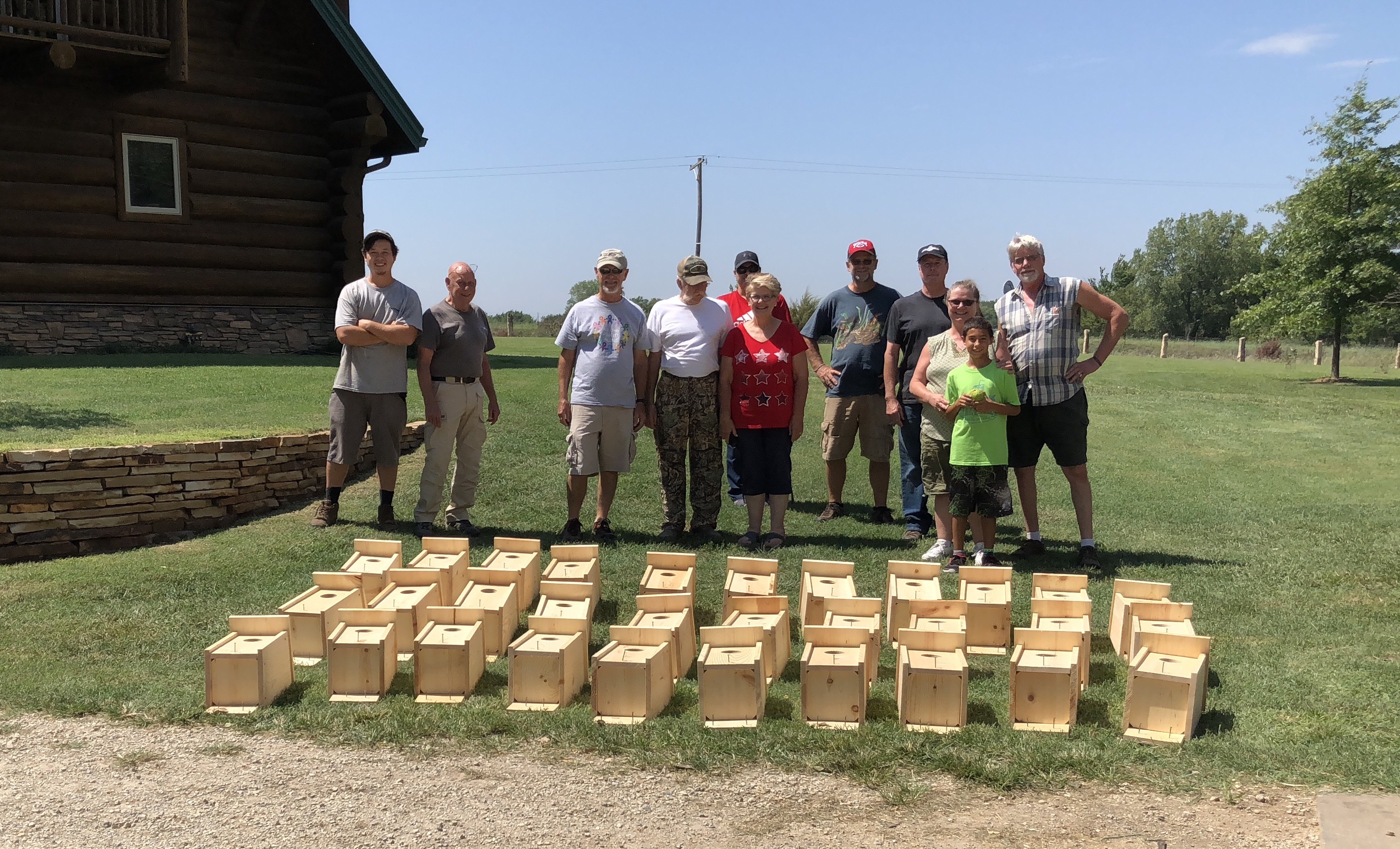
When we arrived at Tommy Kinch’s barn near Douglas, Kansas, it was already a beehive of activity. Tommy is an avid falconer and a member of the Kansas Hawking Club. Joyce and I and our grandson Jacob Friesen had come to help club members build Kestrel nest boxes. Tables were set up as work benches, and stacks of parts precut and prepared by Tommy and his wife Becky sat in neat, organized piles awaiting assembly. While Tommy oversaw the operation, Becky made a pizza run and the other nine of us worked together to build and assemble nest boxes.
Kestrels are Kansas’ smallest, most common and most colorful falcons. Often known as sparrow hawks, grasshopper hawks or house hawks, kestrels are about the size of a blue jay with pointed wings that span around 22 inches when mature. They are very colorful, with slate colored wings, bright rufus- orange back plumage, two black stripes across each check and a blue crown.

The Peregrine Fund was established in 1970 in response to dwindling peregrine falcon populations in the Northeastern US. In 1999 peregrines were removed from the endangered species list and the organization decided to apply its experience and understanding to other dwindling raptor populations internationally. In 2012, the Peregrine Fund launched the American Kestrel Partnership (AKP) in response to long-term declining kestrel populations. “The AKP is a network of citizens and professional scientists working together to better understand kestrels and to advance conservation and habitat practices that will boost American kestrel populations.” Although Kansas seems to have a stable population of kestrels, studies by the AKP show their numbers to be slightly on the decline in the central one-half of Kansas.
Kestrels can often be identified by their well-known hunting technique of hovering over open grass and prairie land looking for mice and large insects which are their main diet. They like open country with a few dead trees, lone bushes and fence posts. They like to be able to see their entire hunting domain from a single perch somewhere. They can also be identified by their habit of repeatedly “bobbing” their tails when perched high on a power pole or fence post. They are cavity nesters and can readily be attracted to nest boxes placed in the correct habitat. Tommy lives along a gravel road a few miles from the town of Douglas, KS, and a nest box 15 feet off the ground on a nearby power pole has been home to a Kestrel family for a couple years now.
Maria Ornelos, Senior Administrative Assistant with Kansas Dept of Wildlife, Parks and Tourism is in charge of all paperwork and administrative issues for the falconry program here in Kansas. Maria was there to help build nest boxes, and told me “I see it as an opportunity to become more informed about the sport of falconry so I’m better prepared to help with any issues involving the sport that come across my desk.”
Chris Ly from Overbrook, KS is the current president of the Kansas Hawking Club. Last year the club began an annual project of building kestrel nesting boxes in response to the American Kestrel Partnership’s desire to bolster kestrel numbers. Chris told me “Falconers are well known for being stalwart conservationists and this seemed like a good way to give back to the land. Kansas already has a good population of kestrels and we figured if we can increase the Kansas population even further, some birds will disperse into surrounding states.”
Tommy and Becky worked a whole day in their shop to have all the parts ready prior to last Sunday’s nest box assembly party. The boxes were taken home by everyone to be erected themselves or to be given away to others to put-up. A small bag of wood shavings for nesting material was included in each one, and the only maintenance necessary is to clean out each box after nesting season and place new nesting material inside. A couple coats of sealer will help the boxes weather better and last longer (1/2 linseed oil and 1/2 turpentine is suggested). Last year was the club’s first attempt at building these boxes and they built 15.
A friendly competition with the Oklahoma falconry club has developed, and this year the Kansas club produced 32 boxes, beating the reported Oklahoma clubs total of 30. By the way, these same nesting boxes can also attract screech owls if erected in a more wooded area. For more info about building and placing kestrel nest boxes and for the pattern used to make them, contact me at [email protected]. Continue to Explore Kansas Outdoors.
SCHLAGECK: Pride, history drive rural Osborne Co. community

Folks who inhabit tiny towns like Alton, population 98, remain viable because of civic pride and a willingness to give back to their community. For this little village, whose greatest claim to fame remains that of being the birthplace of Russell Stover, civic responsibility is just that – an old, established concept that compels people to work, play and live together in harmony.
Young people study so they can use this knowledge to better their community, school teachers volunteer outside the classroom and farm families donate their time and energy. These contributions help keep their communities moving steadily along like the parade entries in the recent “Summer Jubilee” in this north-central Kansas town.
Alton held its 34th celebration Aug. 25. The population increased 10 times as approximately 1,000 people participated in the day and a half long event. For many it was a homecoming. For others it was a chance to enjoy a good time.
“Our annual celebration affords us the opportunity to bring people of this community and the surrounding towns together,” says Deanna Roach, a lifetime native who farms with her husband, Stanley, south of Alton. “We’re proud of our heritage and we want people to know about it and continue to be a part of it.”
“Meet at the Crossroads” was the theme of this year’s celebration. Many people living in Alton today trace their families back to Bull City. Alton was originally called Bull City when two men, Gen. Bull and Mr. Earl decided the current town site was a good place to build a community. Seems they couldn’t decide whether to call it Bull City or Earlsville. They flipped a coin. Bull won.
A few years later a lady from Alton, Ill. came through and decided that the name, “Bull City” was vulgar. Just so happens there was a petition circulating at the time to bring a highway through Bull City.
This female bulldozer decided Alton would be a perfect name for the community. She midnight requisitioned the petition, clipped off the highway supporters’ names, pasted them on the petition she’d put together to rename Bull City and sent them in.
The rest is history – Bull City disappeared, and Alton remains.
While many of the families still have ties to Bull City, some also till the same soil the original settlers broke out of the prairie.
People who live here today, including Roach and her friends and neighbors, can identify with their ancestors’ early struggles and appreciate how they persevered with pride through both good times and bad to make their rural community a better place to live. Alton citizens rely on that same sense of community spirit to carry on where their ancestors left off.
The weekend event is filled with friends, fellowship and fun. Saturday morning began with a car show including a 1950, low-slung, cream-colored Mercury, an early Model T and a cherry ’56 Chevy Bel Air.
One of the biggest events of the day was the parade at 10:30. It lasted more than one hour. Eighty entries arrived to showboat before the crowd lining Alton’s Main Street.
Talk about a collection: antique farm tractors, a horse drawn buggy, the Bull City Rough Riders, fire engines, crop sprayers, the Osborne Junior and Senior High School Band and the Bull City Opry Company – something for everyone. The Massey family from Phillipsburg was named “Best Novelty” entry featuring a single-horse, two-seated buggy with two outriders on horseback by the judges – Homer Smuck, who lived and served as pastor at Mt. Ayr Friends Church south of Alton, Juno Ogle, Hays Daily News reporter and yours truly.
While many of the tractors had been restored to their one-time glory, some were original clanking relics. Each engine sounded unique sporting its own hum, roar, whine or pop. Everyone driving in the parade waved at the crowd.
Alton is a friendly town made up of hardworking, honest people. Many of the inhabitants and those from neighboring communities are farm and ranch families. Like their counterparts across the state, these livestock and grain producers are proud of their occupations and their communities.
“There were a lot of unsung heroes working behind the scenes to make our annual event a success,” Roach says. “There is a real sense of caring for others here. If our children are running around, we know about it. We focus on nurturing our young people. We want them to interact with the older folks and develop an understanding of their past.”
That said, the Alton Jubilee isn’t all serious stuff either. Old timers retold tales, people became reacquainted and conversations lasted well into the evening.
Back on Main Street, Osborne County Farm Bureau members passed out free watermelon. The line for barbecued brats and burgers stretched for nearly a block. And dessert, well let’s just say the ladies of Alton know how to bake a pie and top it with homemade ice cream.
The Alton Jubilee is an event people in this part of Kansas look forward to and will for years to come. Talk about a small world, while visiting with Wayne Brent, Alton native, I discovered a family thread that linked the two of us together.
Seems Brent was quite a basketball player in his day – the mid ‘50s. After we met and shook hands, he asked me if I had any relatives in Selden (small town in northwestern Kansas). I told him I did and that my dad’s older brother, Uncle Herman and all his clan, hailed from this small Sheridan County town.
“You know, I played against a Schlageck in ’57 when Alton played Selden,” Brent told me. “He was a big guy and he leaned on me the whole game. He was quite a ball player too.”
He also told me Alton won that post-season game and I told Brent that his opponent was my older cousin, Junior, named after my Uncle Herman.
If you travel through Kansas and take the time to visit with people, you often find that you know someone, that someone you meet also knows. It’s great to know you hail from a small town in Kansas, and that’s what the Alton Jubilee is all about.
John Schlageck, a Hoxie native, is a leading commentator on agriculture and rural Kansas.
SELZER: Flood insurance questions? Here’s who to call.

Kansans should know how to handle flood insurance questions following the Labor Day weekend weather events in central Kansas.
We at the Kansas Insurance Department (KID) can inform those affected by flooding about the steps needed to assist them.
Most typical homeowners and property insurance policies exclude damage from flood or rising water. If you have flood insurance through the National Flood Insurance Program (NFIP), there are steps to take.
Those who have NFIP insurance coverage under the Federal Emergency Management Administration should call their local insurance agents or companies first if they have questions or wish to submit claims.
The NFIP toll-free number is 1-800-427-4661. The federal agency suggests that Kansans have the following information available when they call:
- Name of the policyholder’s insurance company (the local insurance agent may write policies for more than one company).
- Policy number if available (call the number above if it isn’t available).
- The policyholder’s telephone number and email address.
For more information, visit www.floodsmart.gov.
Vehicle owners with potential auto claims should contact the individual’s insurance agent and company. KID does regulate vehicle insurance and can help answer questions regarding those claims. Call 1-800-432-2484 or go to www.ksinsurance.org.
The insurance department does not regulate the federal National Flood Insurance Program (NFIP). However, the KID Consumer Assistance Division can answer basic flood insurance questions and direct Kansans to the proper assistance.
Ken Selzer, CPA, is the Kansas Insurance Commissioner.
WINKEL: Rains causing mushroom growth

The rains we’ve received in our area of Kansas recently have resulted in the appearance of mushrooms in many a lawn and landscape. Although mushrooms can be eye-catching in size, shape and color, most of them are relatively harmless to plant life. Case-in-point is the fungus referred to as Fairy Ring. It is characterized by its arc-like or circular pattern of growth. This ring pattern is caused by the outward growth of mycelium from the fungus. The mycelium forms a dense, mat-like structure in the soil that decomposes organic material.
As the mycelium breaks down the organic matter, it releases nitrate into the soil, which in turn stimulates the growth of the grass at the outer portion of the ring. The result is a dark green appearance of the grass around the edge of the ring. Unfortunately, that same thick fungal mat formed by the fungus interferes with water infiltration. The fungus can also release certain byproducts that are toxic, leading to dieback of the grass close to the ring. Ergo, in some cases the ring is exhibited by a darker green color and in others, by a brown ring with the outside edge being darker green than the rest of the turf.
Fairy rings are difficult to control. You can sometimes eliminate the ring by digging to a depth of 6 to 12 inches and 12 inches wide on both sides of the ring, refilling the hole with non-infested soil. Or you can try to mask the symptoms by fertilizing the rest of the lawn so that it is as dark green as the ring. This, however, is not such a good idea because it tends to promote other turf problems. Commercially there are certain fungicides marketed that control fairy rings, but these products are not available to homeowners. See https://www.ksre.ksu.edu/bookstore/pubs/EP155.pdf for more info on these fungicides.
Some mushrooms in lawns are not associated with fairy rings. These could be mycorrhizal (symbiotic association with tree roots) or saprophytic (live on dead organic matter such as wood, etc.) types of fungus in the soil. Because some of these funguses are beneficial, you don’t really want to kill them. Besides, applying fungicide spray to the mushroom structures does very little good. Remember the mushroom is simply the fruiting body of the organism. Most of the actual fungus is below ground and not accessible to the chemical.
If mushrooms become bothersome, pick them and dispose of them as soon as they appear. If there are too many for that to be practical, mow them off. If possible, remove all sources of organic debris (i.e. old, dead roots) from the soil. Keep in mind that mushrooms tend to go away as the soil dries. Applying patience may be the best measure of control. FYI, some of the mushrooms in the lawn are edible, but others are poisonous. Never eat mushrooms unless you are absolutely sure of their identity.
Rip Winkel is the Horticulture agent in the Cottonwood District (Barton and Ellis Counties) for K-State Research and Extension. You can contact him by e-mail at [email protected] or calling either 785-682-9430, or 620-793-1910.
KNOLL: Witch hunt or not?

A sad state of affairs for America when mainstream news is totally partisan. “Mainstream” means what most of us are exposed to, unfortunately.
The editorial I reference implies the Robert Mueller Special Counsel investigation is not a witch hunt, even poking fun of Trump at the thought it might be. But obviously for those of us that are informed, if ever there was a witch hunt in our American justice system, this is it! The proof isn’t just extensive, it’s monumental. I can’t possibly cover all the bases in this letter, but enough to prove my point.
For starters, the city of Chicago is one of the most liberal cities in America. You can count on their largest newspaper to be anti Trump. In fact, the Tribune would choose bankruptcy over any support for our president on anything.
Liberalism is mostly about defending the indefensible. Mueller’s investigation out to destroy Trump, is indefensible. Nor is it defensible to claim Trump colluded with Russia or obstructed justice. There is no evidence. Actually, there is no reason for this Special Counsel to continue or even have existed in the first place.
The Special Council was created under false premises. To create an SC, a crime needs to be committed and named. None was named and no crime committed that anybody knows of at the time or even to date. The witch hunt begins in trying to “find” a crime against Trump, allowing Mueller to investigate anything. That whole procedure is unheard of in our justice system of the past. Lord knows what it is now!
Actually, our justice system has been stood on it’s head. It’s been compromised by the FBI and DOJ like never before in American history with hundreds of leftover Obama and Hillary loyalists in our government. Mueller is part of that whole scheme, clearly biased, and currently inventing things to make Trump look guilty of something — anything.
Because Mueller hasn’t been able to tie Trump to Russia collusion with any kind of evidence, he’s gone after Trump associates for the purpose of “insinuating” Trump did something wrong through association. Does the name Manafort come to mind, a man Mueller is destroying simply “implying or insinuating” he helped Trump collude. Other lives are being destroyed by Mueller in hopes of getting to Trump. The investigation is a fraud.
Mueller is down to his last evil scheme and that’s entrapment. He wants to interview Trump and catch him on a perjury charge for something like what he had for breakfast four months ago and now he says something else. The truth is Mueller is no longer after the truth. He’s on a perjury fishing expedition.
There’s no such thing as “equality under the law” in this entire fiasco. If there is, can somebody tell me why Mueller hires an army of lawyers, most of whom donated to the Hillary campaign. The witch hunt is all about taking down Trump because these people wanted Hillary to be president and that’s it in a nutshell. Had Hillary become president, all of the existing corruption that Mueller is part of would be swept under the rug making us no different than a third world country without laws.
Our chief investigator is connected at the hip to all the anti Trumpers in our government past and present. That includes former president Obama, poor loser Hillary, Comey, McCabe, Strzok, Brennan, Clapper, Lynch, Ohr, etc. And, the list goes on and on just as I can go on and on proving the witch hunt against our president.
When Hillary was Secretary of State, she and Obama, sold 20% of our uranium to Russia. Mueller, as FBI Director at the time, looked the other way as there was massive corruption taking place with bribes, money laundering, etc. In the process, the Clinton Foundation took in millions. Yup, from Russia. Bill Clinton was able to line his pockets as well.
If there is equal justice under the law (rather than a two tiered one) heads should roll on the Uranium One scandal, Hillary’s private email server, the Clinton Foundation raking in millions for pay to play, the fake dossier on Trump and many more related scandals. Mueller again looking the other way when there is incontrovertible evidence the real collusion occurs with Democrats and our justice system, not with Trump.
It defies logic for anybody to think Putin would collude with Trump to win the election when he had Hillary wrapped around his little finger. Like Obama, Putin knew Hillary wouldn’t do much about Russia’s invasion of Ukraine and Crimea. Those are just more examples the Trump/Russia collusion narrative is bogus. The Trump obstruction of justice narrative has no merit either.
Besides the Chicago Tribune wanting to destroy Trump, the Boston Globe organized some 350 other newspapers (apparently including the Hays newspaper) to write op-eds trashing Trump. If 80% of media is anti Trump and 95% of the time negative toward him, I think we can claim two witch hunts. Mueller’s Special Council is one and mainstream media is the other.
It’s obvious the witch hunts are pure unadulterated political ones. Truth is not an objective, nor even justice. We have a president making America great again in many ways especially with a booming economy yet he’s treated as a tyrant. Trump’s many accomplishments, never ever covered by media, deserve special treatment in some other letter.
Mueller, with the help of media, uses the Trump witch hunt to distract from and cover up the real crimes that are massive coming from all the leftists which the SC ignores. Real crimes don’t require a witch hunt Mr. Mueller.
Les Knoll lives in Victoria and Gilbert, Ariz.
INSIGHT KANSAS: Trump places rule of law on the ballot
Will the “Trump effect” carry Kris Kobach and Republican congressional candidates to victory this November?
Some commentators believe that an endorsement by President Donald Trump represents a powerful force in winning state and local elections, but the president’s mounting and careless disregard for the rule of law should nullify the Trump effect with Kansas voters.

Kris Kobach claims that Trump’s last-minute endorsement gave him the winning edge in the razor thin Republican primary race for governor. Sources in the Colyer campaign agree: “It was all Trump.”
Of course, there was little doubt about the president’s preference in that contest. Kobach had endorsed Trump early in the 2016 presidential campaign and was considered for a top job in the administration. Donald Trump, Jr., made two fund-raising trips to Kansas for Kobach this past year. Kobach campaign commercials prominently featured Trump.
Republican officials in Kansas certainly believe that Trump endorsements give their candidates a boost. National Committeeman Mark Kahrs contends, “Trump is very popular in the state.”
Kansas election results from 2016 back up this contention. Trump carried the state with 57 percent of the vote, a 20-point margin over Hillary Clinton. He carried every county except for Douglas and Wyandotte, with margins in 40 rural counties exceeding 80 percent of the vote.
That, however, was nearly two years ago. Kansans have since seen what it is like to have a loose cannon in the White House, one who mocks the rule of law with impunity.
Just last week, Michael Cohen, Trump’s long-time lawyer and fixer, pleaded guilty in federal court to eight felonies, including two in which he verified that he broke the law at the direction of candidate Trump. Those instances involved illegal payments in the closing months of the 2016 election of hush money to two women claiming affairs with Trump. Trump dismissed Cohen’s felonies as “tiny ones” or “not even crimes.”
Also last week, Trump’s former campaign manager, Paul Manafort, was convicted by jury in federal court of eight felonies involving financial fraud. Trump responded Manafort was “brave” and did not “break.”
Five close Trump associates have now been found guilty of serious felonies. Two more have been granted immunity in further investigations of wrong-doing.
Kobach responded to the convictions: “I’m very pleased and honored to be associated with President Trump.” In contrast, the silence of Republican congressional candidates has been deafening.
After a series of presidential taunts undermining professional law enforcement, U.S. Attorney General Jeff Sessions warned against politicizing the administration of justice: “While I am attorney general, the actions of the Department of Justice will not be improperly influenced by political considerations.” Trump tweeted in response with a list of political enemies he wants investigated.
Kobach’s own litigious antics mirror those of Trump in disregarding the rule of law. He wasted over seven years in state office pursuing specious claims of “pervasive” illegal voting and came up short—leaving a trail of courtroom defeats and contempt citations. Kobach was recently found in contempt of court for disregarding a federal court order and fined $26,000—which he wants Kansas taxpayers to pay. He was earlier fined for “patently misleading representations” in federal court.
Over the weekend the president unleashed another tweet storm again mocking Sessions and the Department of Justice while threatening to become personally involved in FBI investigations.
Trump has placed Kansans’ belief in the rule of law and professional law enforcement on the ballot this November. Any candidate who endorses Trump’s reckless disregard for the rule of law or remains silent should suffer the consequences.
H. Edward Flentje is professor emeritus at Wichita State University and served with Kansas Governors Bennett and Hayden.
MASON: Organized for success through inclusiveness, collaboration

I also know how blessed I am to be surrounded by so many talented colleagues. Indeed, nowhere else will you find a faculty and staff as dedicated and willing to give 150-percent effort to the FHSU mission. I rely on those talented colleagues to help shape university decisions both through formal and informal processes.
Essential to this work is a commitment to building a culture of trust, establishing clarity on how we define success, doing our best to make decisions based on knowledge rather than opinion, and creating nimble and well-defined processes (many voices with clarity regarding who is accountable for specific areas of decision making). These commitments help our university think and act strategically as we provide accessible, quality education to Kansas, the nation and the world.
As simple as those commitments may appear, to be successful, they require intentionality, focus, and practice. At Fort Hays State University, I work on a daily basis through four key groups to practice those commitments: President’s Roundtable, Executive Leadership Team, Senior Leadership Team, and Cabinet. Briefly, the purpose of each of these structures are as follows.
The President’s Roundtable consists of the presidents of the Faculty Senate, the University Support Staff Senate, and the Student Government Association. Besides me, these are the elected leaders of three primary elements of the university’s universe. Fort Hays State is so successful because we support each other and work together. In this group, we talk about our work, explain our priorities and share our perspectives. In this way, we create opportunities for collaboration and enhance our communication.
The Executive Leadership Team (the ELT) is the vice president for academic affairs, the vice president for administration and finance, the vice president for student affairs, and the president of the FHSU Foundation. This group brings together the executives responsible for leading the primary operational and financial divisions of the university. They serve in an advisory role to the president to help guide and shape the vision and strategy within which the larger university community can practice the innovation and creativity that makes the university great.
The Senior Leadership Team comprises the ELT plus the associate provost and the deans; the directors of university relations, athletics, alumni and governmental relations, and facilities planning; the chief information officer for technology; the general counsel; and the assistant vice president for student affairs and enrollment management.
The members of this group serve as consultants and coordinators for the executive team, widening the perspective of campus so that it includes both the trees and the forest. The experience ranges from academics and alumni to facilities and technology, giving leadership a view of how policy and strategy affects people throughout the university.
The Cabinet is the largest group with whom I meet regularly, and it has representatives from the broadest cross-section of the university population. Its membership includes the Roundtable, the ELT and the senior leadership as well as people who report to the vice presidents and the president of the faculty bargaining unit, the American Association of University Professors.
In this body we evaluate, discuss, create and shape the policies that guide work and life at Fort Hays State. We share information across campus and identify – and work to fill – gaps in our information and communication.
These four organizational structures are supplemented by a variety of other teams, committees and task forces that work across the university for the collective wellbeing of Fort Hays State. The people on these teams work tirelessly and deliberately to fulfill our mission by focusing on the core commitments of leadership – trust, clarity, knowledge-based decision making, and clearly-defined processes for making those decisions. Inevitably we face challenges, but we do so together, and we continue to press on and grow together.
The strength of mind and spirit, the innovation and the experimentation that are hallmarks of education at Fort Hays State are not accidents. They are the fruits of hard work in every area of the university.
I am truly fortunate to be surrounded by strong leaders who care deeply about one another and about our close-knit community; whose resolve is as firm and steady as our century-old limestone buildings; whose drive to achieve pushes students to be their best; and who understand that our students’ success is the community’s success, the region’s, the nation’s, the world’s, and ours.
NORLIN: Whose independence?

But, when it comes to voting, it takes a whole lotta thought to determine who’s really independent.
Ordinarily, the Kansas independent tradition of lettin’-em-alone and mindin’-your-own-business is an admirable trait. But this year’s gubernatorial race leaves no room for laissez-faire.
Like the guy dropped over the cliff, our original fall hurt not at all. Then came that Brownbackian sudden-stop, rude awakening at the bottom. The illusion of income-tax-free ,wild-west independence was revealed.
Now we’re wide awake, with a choice: Claw back up the cliff with Kelly, or drop into another Deep Ravine with the Raving, Ravenous Republican. A clear choice, right?
In a word, No. All this thanks to the “Independent” Oar-man, rowing us down the River, the so-called Independent, that is, the Independently Wealthy Businessman.
He’s Independent. You aren’t.
In Maine, people also have a reputation for independence. But Mainers have something we don’t. Ranked-choice voting. Under this system, they can vote for, say, a Green a Libertarian or an “Independent,” but without wasting their vote: if they don’t win, their ballot passes to whomever they marked second—in Kansas, say Laura Kelly. This opens up the system to a much wider range of views, while simultaneously encouraging people to be civil. Good deal.
But, while their system gives them a reasonable choice, ours doesn’t. So, are you listening, Independents?
The least independent (and responsible) thing you can do this November is vote for the “Independent” candidate.
Let him rag and rage on about how we’re all so dissatisfied, and both parties have sold us down the river, and he’s the savvy salesman with all the answers. This guy, who has spent not one day of his life in public office. This guy, whose miserable Don Quixote vote total will deny Kansans the right to choose the governor they want.
Independents, don’t vote for the Independent. Our Independence. Depends. On you.
David Norlin is Chairman of the Salina Planning Commission, former President of Salina Access TV, and a former College Director of Broadcasting and English Department Chair. He has twice run for Kansas State Office.
SCHLAGECK: Have another slice of cheese
What would a sweltering summer day be like without an occasional stop at the local ice cream parlor for a couple scoops?
Can you imagine eating piping hot chocolate cookies without a frosty glass of milk?
Imagine sipping a buttery glass of chardonnay without a couple of pieces of aged cheddar.

Every day in this great country of ours we can partake of these wholesome, nutritious dairy products; but if there were no dairy farmers, dairy cows or dairy industry, there would be none of these tasty treats.
Dairy products remain a major source of nutrients in our daily diets. If they’re not, they should be.
To find another source for the 300 milligrams of calcium found in either an eight-ounce glass of milk, a cup of yogurt or 1 ½ ounces of natural cheese, the average person would have to graze on eight cups of spinach, six cups of pinto beans or two and one-half cups of broccoli, according to the Midwest Dairy Association.
The primary nutrients found in milk and other dairy products are calcium, vitamins A and D, carbohydrates, phosphorus, magnesium, potassium, riboflavin and high-quality proteins.
U.S. dairy farmers provide an estimated $140 billion annually to this nation’s economy. Dairy farmers help sustain rural America. Even considering this nation’s continuing economic challenges, dairy farmers and companies are a lifeline to 900,000 jobs in this country.
Dairy is local. Dairy farm families are business owners. Every glass of milk and each dairy product produced by these family businesses brings vitality to local and state economies.
Kansas farms generate approximately $537 million in milk sales annually. In Kansas, the average dairy cow produces about seven gallons of milk per day. That’s more than 2,585 gallons of milk over the course of a typical year.
Growth in the Kansas dairy industry means economic growth and access to safe dairy products for local communities and the state. The Kansas ag growth dairy strategy has identified the expansion of the influence, presence and professional standing of the Kansas dairy industry as a priority.
This development has been fueled by the arrival of large-scale dairy operations, primarily in western Kansas. Milk production has doubled since 1994 and grown more than 25 percent in the last five years. There are now about 290 dairies in the state, milking 154,000 cows. It takes about 48 hours for milk to travel from the farm to the dairy case.
As in nearly every sector of the agricultural industry, the United States has more milk production than any other country in the world. This country has six major breeds of dairy cattle: Holstein, Jersey, Brown Swiss, Guernsey, Ayrshire and Milking Shorthorn.
Dairy cows begin producing milk after they calve, when they are about two years old. Most cows are milked twice a day in modern milking facilities that incorporate gentle machines attached and removed by dairy farmers.
Today, all milk sold in grocery stores is pasteurized during processing. During pasteurization, milk is briefly heated to a temperature high enough to destroy bacteria without affecting its flavor or food value.
Yes, since the first cow arrived in the Jamestown Colony back in 1611, America’s dairy farmers have been helping provide a healthy, nutritious food product. So, fill your glass with milk every day. Dip a couple scoops of vanilla ice cream on that piece of apple pie. Cut another slice of cheese for a summer snack. And give thanks to Kansas and America’s dairy farmers.
John Schlageck is a leading commentator on agriculture and rural Kansas. Born and raised on a diversified farm in northwestern Kansas, his writing reflects a lifetime of experience, knowledge and passion.
Dave Says: Impress them!

I just graduated from college recently. Is it a waste of time to apply for a job if you have a degree in the proper field, but no real work experience?
Daniel
Dear Daniel,
Absolutely not! The only sure-fire way to ensure you’ll miss out on a job is by not applying for the position.
Send a copy of your resumé to every job opportunity for which you have a reasonable chance of being hired. Then, when you get an interview, go in there with your head held high. Be articulate, enthusiastic, and carry yourself with purpose. Use your style, intelligence, education, and confidence to sell yourself and your ability to jump in, learn quickly, and get the job done.
I’ve met lots of people who say they have 20 years of experience. But in a lot of cases it’s more like one year of experience 20 times. That kind of “experience” is useless. I’ve also met many sharp, educated people without experience, but you can tell they’re the kind who will put their minds to work, think outside the box, and figure out a way to get the job done with excellence.
As an employer, if I’ve got a choice between the two, that’s the one I want on my team!
Dave Ramsey is CEO of Ramsey Solutions. He has authored seven best-selling books, including The Total Money Makeover. The Dave Ramsey Show is heard by more than 14 million listeners each week on 600 radio stations and multiple digital platforms. Follow Dave on the web at daveramsey.com and on Twitter at @DaveRamsey.
SCHROCK: Generation upon generation

A classic song from “Bye Bye Birdie” asks “Why can’t they be like we were, perfect in every way? What’s the matter with kids today?” If you read those lyrics with the tune in mind, you are definitely well on your way towards retirement. Most of today’s students not only do not recognize that parody of Elvis Presley, but they are also clueless about “My Fair Lady” and “West Side Story.”
Grieving over the young generation has a long history, going back to the Greeks and Romans. But the changes in culture are accelerating. The Zeitgeist or “spirit of the time” is changing more dramatically as technology, music and clothing styles evolve ever faster. So we classify students into generational groups.
The Silent Generation is the cohort of persons born before 1946 and after approximately 1928. They are now 72-90 years old. Most grew up in the Great Depression. They are frugal, hard-working and do not waste food. Surviving World War II produced loyalty. And the G.I. Bill provided returnees an education. They were optimistic and expected their children to live even better, just as they experienced a better life in post-War modernization.
The baby boomer generation was born between 1946 and 1964. Colleges and universities expanded—and in some cases overbuilt. A high school education came to be expected of most. Larger numbers attended college. From President Eisenhower through Kennedy, the Cold War was ever-present but the race to the moon inspired many Americans. A series of assassinations ended the optimism and SAT scores plummeted. Baby boomers are now in the midst of retiring.
Generation X or “Gen-X” was born between 1965 and 1976 (or some say 1961 to 1981). Unlike baby boomers, they are more likely to borrow money and are less certain that Social Security will be there when they retire. By this time, both parents had to work to maintain an average standard of living; thus many came home from school as “latchkey kids.” No longer sure that their future will be better than their past, they are portrayed as more pessimistic. Some pundits have labeled them the “slacker generation.”
Some describe a Generation Y or “Gen-Y” for those born between 1977 and 1984.
But the generation that came of age after the turn of the century were the “millennials.” Born from 1981 to 1996, they are now 22-37 years old. Millennials are the first generation to grow up with the internet and smart phones. Nearly half are still living at home with their parents. If they marry, it is usually later in life. For many millennial boys, videogame addiction resulted in higher school dropout rates and extensive lack of employment.
The young students attending college this fall are the first wave of “post-millennials” or Generation Z. They were born between the late 1990s through 2010. While many remain “technology-addicted,” they appear to be aware of how isolating digital media can be and prefer to communicate face-to-face.
For over two decades, Beloit College issued an annual “mindset list” that described to professors the experience base of this year’s first-year college students—it will end after this year as a Beloit College product. It helped professors understand that these new students have always had a “phone” in hand that was both videogame and library. They have always had Wikipedia available and used emojis, etc. And Prius had always been on the road, etc.
To the teacher, whether K–12 or university level, understanding how students’ experience base is changing is critical to effective teaching. To communicate clearly and correctly requires common experiences that provide common meaning. When the next generation no longer shares experiences that were common among prior students, a teacher has to seek common ground through classroom discussion and exchanges, provide labs and field trips, and attempt to supplement the experiences lost to students immersed in a virtual or evolving world.
As a child, I remember the news reporting the death of the last Civil War child-soldier, who had lived past 100. Today’s students would now think of World War I in the same way. Boy, do I feel old!
John Richard Schrock is a professor at Emporia State University.