In a significant legislative victory for Cold War Era veterans across Kansas and the Nation, President Trump signed a bill July 30 that declares the United States has been in a state of war since Dec. 7, 1941.
The American Legion sought the declaration as a way to honor approximately 1,600 U.S. servicemembers who were killed or wounded during previously undeclared periods of war.
The LEGION Act (Let Everyone Get Involved In Opportunities for National Service Act) also opens the door for approximately 6 million veterans to access American Legion programs and benefits for which they previously had not been eligible.
“Recognizing the service of these wartime veterans is the right thing do and it is long overdue,” National Commander Brett Reistad said.
“The families of those who were killed or wounded during these wartime acts should take pride in knowing that we recognize their sacrifice and service. Moreover, we are proud to welcome any of the six million living veterans from the previously unrecognized periods into our organization and call them ‘Legionnaires.’”
Now that the legislation has been signed, the American Legion’s eligibility criteria immediately changes from seven war eras to two: April 6, 1917, to Nov. 11, 1918, and Dec. 7, 1941 to a time later determined by the federal government. No other restrictions to American Legion membership are changed.
What does this mean to Cold War Era Veterans across Kansas? The American Legion Post near you is waiting with open arms. Come help us serve our communities veterans, children and first responders and show your community what a group of determined veterans can do to improve our community, state and nation.
Frederick (Rick) Miller American Legion, Department of Kansas PR Chair Olathe
Patrick R. Miller is an Assistant Professor of Political Science at the University of Kansas.To address prison overcrowding, Kansas must understand the racial disparities that exist in our system of mass incarceration, how they fuel our ballooning prison population, and potential remedies.
Our state prison population does not reflect the Kansas population on race. According to 2018 data from the Kansas Department of Corrections, 28% of our adult prisoners are African American, 12% Hispanic, 3% Native American, and 1% Asian. The 2010 Census shows that Kansas is 6% African American, 12% Hispanic, 1% Native American, and 3% Asian.
So, African Americans are represented in our prison population at nearly five times their share of the Kansas population, and Native Americans three times. Racial disparities also exist among juveniles in detention in Kansas, where 32% are black and 23% Hispanic.
Our prison population skews in other important ways, too. Among adult prisoners, 36% have less than a high school education. And 33% are diagnosed with a serious to severe mental illness, underscoring how prisons compensate for the decline of state psychiatric hospitals.
On race, the Bureau of Justice Statistics reports that the national imprisonment rate among black men has dropped by about 20% since 2000. Experts tie this to declining crime rates, shifts in drug enforcement toward opioids and meth, and criminal justice reform focused on urban communities. Consequently, as prison populations have declined in most states, the disparity in imprisonment between blacks and whites has shrunk, though not disappeared.
In Kansas, though our prison population has grown, African Americans have declined from 36% of the adult prison population in 2001, according to the Kansas Department of Corrections. That represents progress, though that decline has stagnated in recent years.
Nationally, Americans seem more aware of how racial disparities in prison are driven by differences in poverty and educational opportunities, drug laws and their enforcement, policing inequities, legal representation inequities, and sentencing disparities, among other factors.
But good data on Kansas are scarce. Challenge one in addressing the racial disparity in Kansas prisons is better studying and understanding how national factors that create this difference work specifically in Kansas.
Challenge two is policy. The upside to Kansas lagging other states on criminal justice reform is that we can learn from their experiences, though their approaches will not always fit well in Kansas.
Take Georgia. As the Atlanta Journal-Constitution reports, former Republican Governor Nathan Deal spearheaded bipartisan criminal justice reform measures, including “accountability courts” that provide prison alternatives for non-violent or mentally ill offenders and redefining what constitutes a “felony.” Though imperfect, Georgia has shrunk its prison population, cut the imprisonment rate of African Americans even more dramatically, and saved tens of millions of dollars.
Other states have tackled minimum mandatory sentencing, three strikes laws, indigent defense, and other factors that have exacerbated racial disparities in their respective prisons.
Challenge three is spine. Many reform advocates deemphasize race, perhaps thinking it makes the issue divisive. But avoiding hard truths serves no good. This leaves reform opponents as frequently the ones emphasizing race, often implicitly in their language or which violent offenders they cherry pick to mischaracterize reform proposals.
One column cannot adequately address this topic—especially policy complexities, moral justice, and the human impact. But to tackle this problem intelligently, we should not treat the issue as color blind when our prison crisis is inseparable from race.
Patrick R. Miller is an Associate Professor of Political Science at the University of Kansas.
As you bring in your round bales for winter storage and feeding, store them to minimize weather losses.
Hay stored outside will be damaged by rain, snow, wind, and ice this fall and winter.The average round bale loses about one fourth of its original nutrients during storage, but these losses can be reduced to less than 10 percent or so.Now, you may be better than average but let’s still look at ways to reduce spoilage by storing that valuable hay more carefully this year.
For instance, do you sometimes line up bales for easy access so the twine sides touch each other?Or do you stack your bales?If so, extra spoilage will occur where these bales touch because rain, snow, and ice will gather in spots where bales touch instead of running off.Round bales butted end-to-end, cigar-like, usually have less spoilage.
Does snow drift around your bales?Bales placed in east-west rows often have drifts on the south side.Hay close to fencelines or trees can get extra snow.As snow melts it soaks into bales or makes the ground muddy.Plus, the north side never gets any sun so it’s slow to dry.This year, line your bales up north-and-south and away from trees for fewer drifts and faster drying as sunlight and prevailing winds hit both sides of the row.
Most important is the bottom of your bales.Always put bales on higher, well-drained ground so water drains away from them.Keep them out of terrace bottoms or other low spots.If necessary, use crushed rock, railroad ties, or even pallets to elevate bales to keep the bottoms dry.This also will reduce problems getting to your hay or getting it moved due to snow drifts or mud.
Just a little pre-planning can save lots of hay and frustrations.
Alicia Boor is an Agriculture and Natural Resources agent in the Cottonwood District (which includes Barton and Ellis counties) for K-State Research and Extension. You can contact her by e-mail at [email protected] or calling 620-793-1910
By KIM BALDWIN McPherson County farmer and rancher
The other day Facebook reminded me that a year ago we kicked off our fall harvest season. I had posted a picture of the kids climbing into the combine with my husband, and then a picture of the four of us piled in the combine with smiles on our faces. It’s always an exciting day when we fire up the combines and move into the fields.
It means we have a crop to harvest. It also means adding many extra miles on my vehicle.
My mother-in-law and I will begin taking evening meals out to the field. I’ll begin reading books to my kids in the car while waiting for a combine to make its return to our side of the field. You might catch us some evenings driving slowly down a dirt road with our windows down blowing goodnight kisses to my husband because the kids won’t see him again until breakfast. It means driving out to a field and excitedly showing everyone when someone has lost a tooth, or celebrating being selected as the Star of the Day at school, or showing off the newest piece of art that was completed in class, or displaying a birthday card that arrived in the mail.
Yes, we spend a lot of time in the car this time of year. I’m always impressed the kids handle it so well. For them, it’s just a normal part of being a farm kid in the fall. After all, it is how they’ve spent every harvest since before they were even born.
Some days we’ll run home after school and change our clothes before heading out to the field, but more days than not, we go straight to where the crew is. It gives the kids extra time to ride alongside their dad or grandpa, to honk the combine’s horn, to “help” unload the grain by pushing buttons and pulling levers, or to just supervise the entire operation.
We try to keep a routine during harvest for the kids. Many evenings I’ll try to get them in the car and headed home before it’s dark. We’ll still have homework, bath time and stories before I put them to bed. But sometimes exceptions have to be made.
There are some evenings when the kids need extra daddy time, so I’ll ignore the setting sun or the time on the clock. Some days we’ll have to make a trip back out to a field after dark in our jammies because a little one needs to see their daddy one more time before bed and Facetime just isn’t cutting it.
Fall harvest will lead into wheat sowing followed by more fall harvest. The goal is to be completely done by Thanksgiving. Last year we went a few days past that.
Regardless of when the harvest is completed this year, you can bet my kiddos and I will have some quality time driving to and from fields this fall. We will be completing reading assignments while waiting for the crew to come to the edge of the field for a meal, enjoying the cool and crisp weather that will soon be here, and I’ll be snapping a picture every once in a while to document our trips out to the fields.
Yes, it’s the eve of fall harvest and we’re ready to begin this season.
“Insight” is a weekly column published by Kansas Farm Bureau, the state’s largest farm organization whose mission is to strengthen agriculture and the lives of Kansans through advocacy, education and service.
Dale Younker is a Soil Health Specialist with the USDA Natural Resources Conservation Service in Jetmore.
The western Kansas economy relies heavily on crops irrigated by the Ogallala Aquifer. These crops provide most of the grain and forage for ethanol plants and livestock operations including feedlots, dairies and hog operations in the region. Without this reliable source these industries will not stay in the area, and when they go other support industries will also leave.
To ensure a vital economy into the future now is the time to get serious about doing what needs to be done to stabilize the aquifer. If we continue to pump more water out then is what is being recharged, we are certain to see a declining economy in the very near future.
Like many other industries, technology in the irrigation field has advanced by leaps and bounds in just a few short years. Tools like soil moisture probes and plant sensors can be used to schedule proper and efficient irrigation applications. Subsurface drip and mobile drip systems significantly reduce evaporation rates and the amount of irrigation water needed to grow the crop.
But one of the issues we continue to struggle with is that many of our fields are just not in condition to infiltrate water. Decades of intensive tillage have destroyed the pore spaces the soil needs to take in water.
Many of the pore spaces are formed when the soil has good and stable soil aggregates. Aggregates are individual soil particles of sand, silt and clay that are bound together by root exudates and organic glues. Microbes that live in the soil, like bacteria, fungi, and other microorganisms, produce the organic glues. These microbes flourish in a healthy soil where fields are in a no-till system. Other pore spaces are created by earthworms and other macrofauna like centipedes, slugs and snails. Every time we disturb the soil, we basically destroy the habitat of these soil microbes. Tillage also physically destroys the soil aggregates by breaking them down into individual soil particles.
Maintaining a living root in the soil, as much as possible throughout the year, is also essential in maintaining the needed pore spaces in the soil. Living roots produce root exudates that help bind soil particles together into larger soil aggregates. Living plants provide a carbon source, which is food for the soil microbes, through the photosynthesis process. Decaying roots provide direct channels for water to infiltrate into the soil. Growing cover crops, between cash crops, is one way of maintaining a living root in the soil.
By incorporating some simple soil health practices, like no-till and cover crops, along with the other irrigation technology available, we can reduce our water use significantly. Which can help us get to where we are only pumping as much water out of the aquifer as is being recharged. This will ensure that water will be available for all water users in the region for generations to come.
For more information about this or other soil health practices you can contact me at [email protected] or any local NRCS office.
Dale Younker is a Soil Health Specialist with the Natural Resources Conservation Service in Jetmore.
We’re just a week away from the Governor’s Council on Tax Reform meeting in the Statehouse to consider ways to cut taxes. As lofty and nonpartisan as that title is, the real name could be “What Tax Cuts Will Get Us Elected or Re-elected.”
Yes, that’s what tax reform is. Finding the tax cuts that will get votes for you or your party and the way to do that is cutting the right taxes for the right voters and then telling them that you’ve done it in your upcoming campaign.
That’s why the “reforms” proposed by that council essentially turn into decisions on who gets what in the way of tax cuts. Corporations? Individuals? Grocery buyers? Property taxpayers?
That’s the real issue, though “reform” is a word that most of us like and which sounds noble. “Reform” can, in the Statehouse, be defined as finding what tax cuts will elect the most Republicans or Democrats in next year’s election when every Kansas House and Senate seat is up for election.
• • •
Now, it’s a little more complicated for Gov. Laura Kelly, who by executive order established that council. She, of course, has a government to run and that takes money and that means tax cuts…up to a point…but she needs to make sure the council leaves enough money in the State General Fund to keep the state, and its important programs, afloat. Nobody wants to be the governor of a state with no cash on hand.
• • •
So, what do we look for?
Most obvious is a recommendation from the council to the governor to reduce the 6.5% sales tax on groceries. But, remember the state’s sales tax is just the baseline. Local units of government put their own local sales taxes on those groceries, which is the reason that most food (and everything else) carries a sales tax of about 9%. But that council recommending cuts in local sales taxes isn’t a starter in the Legislature. So, the council probably ought to look at just state sales tax on groceries.
And then comes that word “reform” which may have some considering whether cutting the sales tax on bologna that poor people buy might be a little more noble than cutting the sales tax on steak and salmon that higher-income Kansans buy. Is that a “reform?”
Oh, and don’t forget that while cutting income taxes, possibly shuffling the break point between different rates, is also probably “reform” but it doesn’t show up before the election. A cut in rates on individual income taxes may show up as a few bucks a week in lower withholding from your paycheck but it’s not something that voters will see every time they drop into the grocery store for bread or soap or shampoo.
The sales tax? Those cuts could show up as early as…a couple weeks before the Aug. 4, 2020, primary election, and surely before the Nov. 3 general election.
That’s just one of those issues that can sound like “reform.”
Corporate income tax cuts? They can be sold to voters as ways to shore up employment and keep Kansas productive, but it’s not likely those corporate savings will trickle down very quickly to higher wages or more jobs and they can be portrayed in the elections as cuts for the wealthy business owners and executives. Nice crowd, probably good campaign contributors, but not a whole lot of votes in the executive offices…
Property tax cuts? That gets extremely complicated, and usually winds up with city, county and other local government coming to Topeka to battle over “separation of powers.”
Syndicated by Hawver News Company LLC of Topeka; Martin Hawver is publisher of Hawver’s Capitol Report—to learn more about this nonpartisan statewide political news service, visit the website at www.hawvernews.com
Jim Kammeyer remembers a dove hunt with his dad years ago when he was about fourteen. A small group on a father and son dove hunt had stopped along a pond to determine how to capture a dove someone had shot and dropped into the pond. A breeze was steadily blowing the downed bird out to sea where it would soon be lost if not retrieved.
Jim says his dad Roger strode up to a small willow tree growing near the water’s edge and with a couple shots from his shotgun toppled the tree into the pond near the floating dove. He grasped the tree and raked the dead bird to the bank where it could be added to the harvest. The rest of the group was left thinking “Why didn’t we think of that?” and the other kids turned to Jim and said “Your dad is so cool.”
Roger Kammeyer has always been known as a tinkerer and a problem solver. He grew up near, and never left the small farming community of Concordia, Missouri where he had been a barber, then a sales rep for a food brokerage company and finally a life insurance salesman before retiring in 1999.
In his early days as a barber, Kammeyer could often be found building fishing rods or designing and building his own fishing lures between haircuts. He is thought to have possibly invented the first “buzz-bait” top water lure used to catch bass, though he never pursued a patent. The spinner blade on that lure was fashioned from an old lunch box Kammeyer had found while scrounging for treasures at the dump. Aptly named the Lunch Box, many feel the lure will still out-fish commercial buzz baits available today.
Years back I penned a column called Man’s Best Friend in which I extolled the virtues of the five gallon bucket. To this day I’m convinced that no better and adaptable product than the five gallon bucket has ever been invented. Whether used as a seat for deer hunting, turkey hunting, or ice fishing, or picking vegetables from the garden, most garden projects and outdoor adventures somehow make use of man’s best friend, the five gallon bucket.
Sometime after his retirement, a friend gifted Kammeyer with a wooden stool that sat on top of a five gallon bucket and made it a nice rig to sit on when picking green beans. The seat of the stool was raised just enough higher than the lip of the bucket, leaving a handy opening to toss beans into the bucket below. The problem was it took two hands to carry the thing, one to carry the lid and the other to carry the bucket. Into Kammeyer’s shop it went, emerging later adapted so the stool fit upside down as a lid that snapped into the bucket, and the original Bucket Stool was born. Now made from durable plastic, the bucket stool sits on the bucket in four notches that allow it to spin silently around the bucket. With my 210 pound frame seated on one, it moved effortlessly and quietly around the top of the bucket, allowing me to face any direction I pleased. The Bucket Stool can then be turned upside down and snapped into the bucket to become a lid.
Roger got a patent on this invention, and built them in his garage for over ten years. Today the Kammeyer family’s business, RWK Solutions, LLC is located in Concordia, Missouri where the Kammeyers grew up and where they still live today. The Bucket Stools are manufactured there in Missouri too, in the good ol’ USA. Check out the stools on their website www.bucketsstool.com and find them for sale on Amazon and at other retailers. Kammeyer says that thanks to his Bucket Stool, he can still tinker in his shop, work in his garden and shorten the life of many fish…Continue to Explore Kansas Outdoors!
Steve Gilliland, Inman, can be contacted by email at [email protected].
It’s being labeled the single worst-ever sudden disruption to the international oil market ever, triggering a big spike in both oil prices and Middle East tensions. Coordinated attacks on facilities in Saudi Arabia knocked out roughly five percent of global crude-oil supply. Saudi Aramco lost half of its production in the attacks on two facilities. According to Bloomberg, Saudi Aramco is supplying its customers with stockpiles and is activating idle offshore fields, but it’s not clear how quickly they can make up the difference.
Crude futures prices skyrocketed on Monday, gaining more than ten percent by mid-morning. The Nymex benchmark contract was up $5.53 to $60.38 per barrel. London Brent gained more than six dollars to $66.49.
Kansas Common crude at CHS in McPherson starts the week at $45 per barrel. That price was posted before news broke from the Middle East.
EIA forecasts U.S. crude oil production will average 12.2 million barrels per day this year, an increase of 1.2 million barrels per day from last year’s average. The government now forecasts an increase of another million barrels next year to a predicted annual average of 13.2 million barrels per day in 2020. The agency notes national production growth is slowing down in the oil patch, which the government said was caused by flat crude prices and a slowdown in productivity growth at the well head.
In it’s monthly Short Term Energy Outlook, EIA forecasts West Texas Intermediate prices will lag behind the international benchmark by $5.50 per barrel next year to average about $56.50 a barrel. EIA predicts Brent spot prices will average $62 a barrel next year.
U.S. crude oil production increased slightly last week, to 12.398 million barrels per day, according to the U.S. Energy Information Administration. That’s the second-highest weekly tally ever from EIA and slightly more than 100-thousand barrels per day short of the record set last month.
U.S. crude oil imports averaged 6.7 million barrels per day last week, down by 180,000 barrels per day from the previous week. The four-week average is nearly 12% less than the same four-week period last year.
The government reported a drop in domestic crude oil inventories of nearly seven million barrels. In its weekly summary, EIA said U.S. stockpiles dropped to 416.1 million barrels, or about two percent below the five-year seasonal average.
Total motor gasoline inventories decreased by 0.7 million barrels last week and are about 3% above the five year average for this time of year.
Independent Oil & Gas Service reported a 21% increase in its weekly rig count, with eight active drilling rigs in eastern Kansas, up four, and 27 west of Wichita, which is up two for the week. Operators were about to spud one new well in Stafford County and another in Barton County. Drilling was underway on leases in Barton and Russell counties.
Operators received 27 permits for drilling at new locations last week, 11 in eastern Kansas and 16 in the western half of the state. Barton, Ellis and Stafford counties each report one new permit. There are 691 new drilling permits filed so far this year.
Independent Oil & Gas Service reports 14 new well completions across Kansas for the week, 993 so far this year. There were two newly-completed wells east of Wichita, and 12 in Western Kansas, including dry holes in Barton and Stafford counties.
Texas regulators report a continuing decline in that state’s oil and gas production, the second monthly drop in a row. The Railroad Commission of Texas reports total crude oil production in the Lone Star State dipped to 97.5 million barrels or 3.25 million barrels per day. That’s down nearly 300,000 barrels per day from May’s total, and more than half a million barrels per day below last year’s June production. The state’s production of natural gas and condensate were also lower for the month and year-over-year.
The flaring of natural gas in the Permian Basin of Texas and New Mexico dropped during the first quarter of this year, but will reach an all-time high in the second quarter. The research firm Rystad Energy reports January through March saw the first decline in the natural gas burned off at the well head in the Permian since 2017. Adjusted first-quarter totals show oil producers flared an average of 613 million cubic feet per day of natural gas. But preliminary numbers show another dramatic increase in flaring during the second quarter to about 663 million cubic feet per day.
The top oil producer in New Mexico is selling off nearly one billion dollars worth of non-core assets. Reuters reports Concho Resources plans to use the money to lower its debt and buyback shares. The company said in a statement that the narrow strip of about 100,000 acres lies on the border of Concho’s operations in the Delaware area of the Permian Basin. Spur Energy Partners will shell out $925 million for the package, which officials say produces about 25,000 barrels of oil equivalent per day.
The North Dakota Supreme Court will soon decide a dispute between the state and its largest oil producer in a fight over emissions. Continental Resources is fighting what it calls an overly strict interpretation of regulations by the Department of Environmental Quality. Lawyers for the Oklahoma-based shale producer argue that some “fugitive emissions” are unavoidable. They assert that compliance would require “leakless technology” which does not exist. According to reporting by the Bismarck Tribune, the dispute began a few years ago, when regulators started using optical gas imaging cameras to inspect production facilities. Continental filed the lawsuit in district court a year ago. But a judge rejected the lawsuit saying it belonged in federal court. The company is seeking to reverse the lower court decision and remand the case back for further proceedings.
BP’s decision to divest upstream and midstream assets in Alaska completes the UK super-major’s exit from the region after several divestitures there in recent years. The research firm Rystad Energy calls that part of BP’s strategic shift to tight-oil assets in the U.S. Prior to the sale, BP was the largest operator in Alaska. But, Hilcorp, currently the number-three Alaska operator, will pay $5.6 billion to acquire BP’s stake. The transaction includes BP Exploration’s oil and gas interests in Alaska, and BP Pipelines, which owns part of the Trans Alaska Pipeline System. The deal will make Hilcorp the state’s largest operator, with about sixty percent of the state’s total production. Rystad Energy’s head of upstream research reported significant potential for increased output from Prudhoe Bay, a massive but maturing play that was once once the world’s largest oil field by production.
A meme is an idea, thought or piece of information that is passed from generation to generation through imitation and behavioral replication. A meme can be life-changing for sure.
One I saw recently resonates with the work I do as an Extension Educator. It said, “If you do not make time for your wellness, you will be forced to make time for your illness.” That is a powerful statement and a perfect segway to the message I want to share during National Wellness Month.
At my recent Extension Agent update, a team of 5 educators had returned from a study trip to Greece. It was amazing to hear stories of their visit to a Blue Zone in Ikaria, Greece. There are five recognized Blue Zones in five locations around the world where a significant percentage of people live a healthful life into their 90’s and even 100. Through interviews and immersing themselves into the culture for a period of time, our team learned about nine healthy lifestyle habits shared by people who have lived the longest.
Down shift – Improve your overall wellness by finding a stress relieving strategy that works for you. Purpose – Wake up with purpose each day to add up to 7 years to your life. Plant slant – Put less meat and more plants on your plate. Wine @ 5 – Responsibly enjoy a glass of wine with good friends each day. Family first – Invest in spending time with family and add up to 6 years to your life. 80% rule – Eat mindfully and stop when 80% full. Move naturally – Find ways to move more! You’ll burn calories without thinking about it. Right tribe – Surround yourself with people who support positive behaviors. Belong – Belong to a faith-based community and attend services four times a month to add 4-14 years to your lifespan.
You will hear more about the Power 9 when the 2020 Walk KS program rolls around next March. But for now, let’s focus on making small changes. Don’t try to do the entire list in one week. Focus on one suggestion at a time. So, let’s talk about the first one – Down Shift. Find something that helps you relieve stress. Those of you who know me well can probably guess that a bike ride would be my first choice to relieve stress. Thankfully it has worked to bike commute to work on most days the past few years and that can provide 48 minutes of exercise into my day. Other stress relievers for me include sitting down and playing the piano for a few minutes whenever time allows, or hand stitching a quilting project.
Consider ways to make wellness a priority in your life in the weeks ahead!
Donna Krug is the Family & Consumer Science Agent and District Director for the Cottonwood Extension District. You may reach her at: (620)793-1910 or [email protected]
On Wednesday morning, I joined other Members of Congress on the steps of the Capitol in a moment of silence and prayer for those who perished on September 11, 2001. We also honored those first responders and troops who have fought and sacrificed since, and upheld the tradition of singing God Bless America. “One nation under God, indivisible…”
We will never forget.
WOTUS Rule Repealed
On Thursday, the Trump Administration announced the repeal of the Obama-era 2015 Waters of the United States (WOTUS) rule, bringing consistency and reliability back across all states.
This decision will scale back the federal government’s overreach of authority and restore longstanding and familiar Clean Water Act (CWA) regulations. The announcement is the first step of a two step process that will lead to a new definition of WOTUS that will limit the scope of waters regulated by the federal government.
For more information on the rulemaking process, repeal of the 2015 Rule, and the revised definition of WOTUS, click here.
Born-Alive Act Hearing
This week, I took part in a hearing on the Born-Alive Abortion Survivors Protection Act, which would protect babies born alive following an attempted abortion. As an OB-GYN who’s delivered over 5,000 babies, I never thought I’d be fighting harder to save babies’ lives in the halls of Congress than in the delivery room. I am appalled Nancy Pelosi and House Democrats have blocked a vote on this bill 80 times. To address this issue, I’m preparing to introduce new legislation which would provide funding to states ensuring abortion survivors receive appropriate health care. We must end infanticide. To see my questioning at the hearing, click here.
Honoring Fallen Soldiers Online
Recently, the VA announced the creation of the Veterans Legacy Memorial, the country’s first digital platform dedicated entirely to memory preservation for the millions of Veterans interred in VA national cemeteries. Each Veteran will have their own memorial page on a web-based platform, to provide a memorial that extends beyond the boundaries of a national cemetery. This a great use of 21st century technology to honor our Veterans for the rest of time.
For more information about the Veterans Legacy Memorial, click here.
American Cancer Society meeting
It was great to meet with Kansan patient advocates this week during the American Cancer Society’s Hill Day. Having worked with them over the past several years, I rely on them to provide me with updates on the value of basic medical research.
As a physician, I need innovative tools and medicine to help my patients and the National Institutes of Health (NIH) plays a vital role in basic medical research. To this end, I dedicate time each year advocating for robust funding to NIH. Another important topic we addressed was the need for palliative care and hospice education and training. H.R. 647, the Palliative Care and Hospice Education and Training Act, which was passed by the House last Congress, will award grants to improve the training of health professionals in palliative care. Additionally, it will enhance research in this field to build best practices for a more effective workforce.
K-State Leading On Agriculture Research
On Thursday, I met with Kansas State University’s Distinguished Professor of Agronomy, Dr. Charles Rice, was awarded the 2007 Nobel Peace Prize. Dr. Rice and I discussed my continued support for agricultural research funding.
We also discussed an announcement made earlier in the day by the U.S. Department of Agriculture awarding $77.8 million in research that will focus on sustaining a more abundant, nutritious, and accessible food supply. As part of this investment, eight land-grant universities, led by Kansas State University, will conduct projects aimed at integrating sustainable agricultural approaches covering the entire food production system. Over the next five years, this grant will fund up to ten faculty, twelve graduate students, and provide countless opportunities to undergraduates at K-State.
This project is part of a new program, Sustainable Agricultural Systems, within the National Institute of Food and Agriculture’s (NIFA) flagship competitive grants program, the Agriculture and Food Research Initiative (AFRI). For more information on these peer reviewed competitive grants, click here.
Growth Energy Fueling Growth Award
This week, I was honored to receive Growth Energy’s 2019 “Fueling Growth” Award presented by producers and supporters of the ethanol and biodiesel industries from across Kansas. As a co-chairman of the House Biofuels Caucus, I work with organizations like Growth Energy and their members in Kansas to help feed the world and fuel America in ways that achieve energy independence, improve economic well-being, and create a healthier environment for all Americans.
Kansas Electric Co-Op Meeting
It was great catching up with friends from the Kansas Electric Co-operatives, who were in town this week to discuss issues impacting co-ops across the state. We chatted about the ways that electric co-ops are partnering with regional and local partners to help with rural broadband deployment, utilizing some of the funds we included in last year’s Farm Bill.
We also discussed ways that electric co-ops are improving energy efficiency and including more environmentally friendly energy sources in their energy portfolios, such as solar and wind power.
Sunflower Electric from Hays was at the meeting, and I recently joined them as they broke ground on a new solar farm in southwest Kansas, two miles south of Johnson City.
Once completed it will be the largest solar farm in the state.
It’s great to hear how co-ops are innovating and using new technologies to improve service and drive down the costs for their customers.
Kansas Chamber of Commerce in D.C.
On Thursday morning, I met with the Kansas Chamber of Commerce, where I shared my thoughts on workforce development, health care, and trade. Across the state, industry leaders have been sharing concerns in retaining a qualified workforce, and are constantly looking for new partnerships to train the next generation to meet their growing demands. We also talked about my ideas to increase transparency, spur innovation, and increase consumerism as a way to drive down the overall cost of healthcare. Finally, we talked about trade and how agreements, such as USMCA, deliver wins for our farmers, ranchers, businesses and workers back home. It was great to spend the morning with them and I’m looking forward to continuing these conversations back in Kansas!
Dr. Roger Marshall, R-Great Bend, is the First District Congressman of Kansas.
Burdett Loomis, Professor, Political Science, College of Liberal Arts and Science, University of Kansas
It just stands there, all 13 floors, abandoned and alone. Once the hub of Kansas’s administrative activity, the Robert B. Docking Office Building is empty and orphaned, its previously vibrant departments now slimmed-down and parceled out to rented space and other cities.
In the late 1940s, the State Building Commission foresaw the need for a major office building that would house at least eleven agencies and boards. Docking (given its name by the Carlin Administration in 1987) was built between 1954 and 1957, at roughly the same time as the Kansas Turnpike, which has aged far more gracefully. In its day, Docking stood as a progressive architectural statement of a forward-looking Kansas, much like the Turnpike. When constructed, at a cost of $9 million, the massive office building was an investment in an expectant future, even before Kansas government began to expand dramatically in the 1960s and beyond.
Throughout the 20th Century, Docking served its purpose well, requiring occasional updating to its heating and cooling systems and eventually coming to sit atop a large energy/mechanical system that continues to serve eight buildings in the Capitol Complex, including the statehouse.
Photo courtesy Topeka Capital-Journal
Still, buildings do have life expectancies and require substantial modifications, especially in updating communications capacities and energy usage. By the early 2000s, Docking was aging, increasingly inefficient, and a home to unwanted pests. As often happens, making tough, expensive choices about refurbishing an older building led to deferred maintenance, time and again.
In short, by 2010, the state of the Docking building had ceased to exist as a “condition” and had become a “problem.” Enter Governor Sam Brownback. If Docking was a problem, he had a solution, one that fit tidily with his small-government philosophy.
He would empty out Docking, scattering a host of agencies to various other, privately owned buildings (in and out of Topeka) and eventually imploding the structure that stood for large and centralized government.
The first part of his plan has been implemented, often with expensive, long-term, hard-to-break leases, which likely benefit some of his supporters. But the real rub comes with the second part, the proposed demolition by implosion of Docking.
If the top 12 floors of Docking now stand largely vacant, beneath the building lie the heating and air-conditioning guts of the Capitol Complex. If this valuable system is to be retained, any Docking demolition must proceed in a highly expensive, brick-by-brick removal.
Just as Brownback really didn’t care about governing as he dispersed state agencies from Docking and simultaneously nudged thousands of civil servants out of their jobs, neither did he truly think through the consequences of emptying the building. Rather, Docking became the symbol for his attacks on government, even as his privatized “solutions” – from tax cuts to welfare reform (sic) to farmed-out Medicaid – failed, one after another.
So now, Governor Laura Kelly and the Legislature have difficult, expensive choices on their hands. Renovate Docking and work to break some of the sweetheart deals that the Brownback Administration made? Do a partial renovation? Level Docking, while retaining the HUAV system that serves core state buildings? Or build a new power facility and implode the current structure. All are expensive and require serious thought.
In its day, Docking was a progressive example of Modernist architecture. Now, despite some wonderful bones and historic significance, it stands as a graphic example of the costs of hollowing out government.
Burdett Loomis is an emeritus professor of political science at the University of Kansas.
By MARK TALLMAN Kansas Association of School Boards
Rising numbers of young children with severe behavioral, emotional and mental health needs and speech and language issues are driving up school district costs and worsening an already critical shortage of qualified staff and services.
That was the assessment of education leaders at three KASB workshops on the federal Individuals with Disabilities Education Act held in Topeka, Dodge City, and Salina at the end of August.
Mark Tallman is the executive director for advocacy for the Kansas Association of School Boards.
Chip Slaven, Chief Advocacy Officers for the National School Boards Association, spoke at the workshops on NSBA’s push to update and fully fund IDEA. He said Congress is considering “reauthorizing” – a review that can lead to major changes in legislation – the IDEA for the first time since 2004.
Kansas Senator Pat Roberts, a member of the Senate Health, Education Labor and Pensions Committee, has publicly backed the goal of increasing federal funding from the current 16 percent to 40 percent of special education costs.
Special education leaders say increased funding would allow them to provide better services to students and families through better staffing and reduce the drain on other school programs.
Growing demands, especially at early ages
The number of Kansas students receiving services under IDEA, including those in private schools, is increasing rapidly, up 20.3 percent from 2001 to 2018, according to federal reports. That is four times the rate of increase in all students in Kansas public school districts. Special education leaders say the biggest reason is the growing identification of young children with special needs.
The number of three-to-five-year-olds receiving special education in Kansas increased by over 4,000, or 52.3 percent, since 2001. That helps explain the growth in total special education enrollment, because once students are identified, they usually remain in the system.
Educators agree that part of the growth is due to stronger efforts to identify students with special needs earlier. With more districts providing all-day kindergarten and preschool programs, more students are enrolled and those with special needs can be spotted. Districts are also expected to seek out high need students before they enroll in kindergarten.
The biggest challenges are growing numbers of students with aggressive behaviors, who can’t regulate themselves, can’t interact with other students and may be dangerous to themselves and others and destroy school property; and those lacking in speech and language skills.
What educators are not sure about is why those numbers are growing so fast.
One theory is that too many young parents either haven’t been taught appropriate skills to raise children or are too stretched or stressed by work or other obligations to provide such care. Related is the suggestion that children who used to be raised by parents and grandparents are now in foster care, a system with substantial, well-documented problems.
A growing concern is “screen time;” that young children are given a phone or tablet to distract, occupy or amuse them at the expense of interaction with parents or peers, making them less prepared for interaction with other adults and children and less able to pay attention to a teacher. A classroom can put stress on children not used to being in a structured setting or struggling to meet higher academic goals before learning basics like socializing with others and toileting.
The high cost and limited availability of childcare is one reason many children have no experience outside their immediate home and family when they arrive at school, and lack language and social skills. Such students lag behind their peers from the beginning and often never catch up. As one school leader said, students can quickly “internalize” that they are “failures” and don’t believe they can learn.
The dwindling support for children and families from other providers, such as mental health providers, means problems become worse until the child arrives at school, which may be the only way a family can get assistance. As one special education administrator notes: “No matter how difficult the issues might be, the public school is the one place children can always legally go to.” Other providers don’t have to provide services without funding or can limit services to those who can pay. That leaves out many of the highest need cases – until the school steps in.
Rising toll on the staff and schools
School leaders say the growing demands on special education are straining programs that have long experienced a shortage of teachers. More students require more teachers. When they can’t be found, caseloads increase, leading to teacher frustration, burn-out and turnover. Parents are frustrated by the lack of consistency, which also hurts relationships between families and the school. Schools turn to using substitutes who may not have a full license and to paraprofessionals who don’t have training as teachers. Administrators say they do the best they can to meet student needs but could do better with better-trained staff.
A study released last year by the Kansas Division of Legislative Post Audit found that school districts would need to hire an additional 700 special education teachers and 2,600 other licensed professionals like speech pathologists to meet “best practices” guidelines. If that were done, districts could cut between 1,700 and 3,900 paraprofessional positions, but would still require more funding because licensed staff earn significantly more than unlicensed paras.
In addition to better services, district leaders say they are urgently concerned about students – especially those at very young ages – who are dangers to themselves, other students and staff. This may be due to uncontrolled anger, suicide and other self-harm, or potential violence against others like school shooting, each of which can be caused by depression, emotional disturbance or other mental illness.
To address these issues, schools are trying early identification, therapeutic preschools, one-on-one support, partnering with other agencies and providers and trying to build deeper relationships with student and families – all of which are promising but require personnel, training and funding. School leaders also acknowledge that other agencies, from community mental health to foster care, also face diminished resources and staff shortages, and may be in competition for the same people.
How more funding could help
When originally passed in 1975, Congress said it intended to cover 40 percent of special education costs required by the new law. Currently, federal funding only covers about 16 percent of costs. Kansas school districts receive over $100 million in federal aid for special education.
The state of Kansas also created a state aid program for special education, which according to state law should pay 92 percent of the “excess cost” of special education (the cost of special education after subtracting the “regular” cost of educating students with disabilities and federal aid). However, state aid has also been consistently below that target, currently covering an estimated 78.2 percent. Local school districts must make up for what federal and state aid doesn’t cover.
Special education leaders say additional funding would not immediately solve the special education teacher shortage, but it would allow districts to raise teacher salaries to attract and retain new people over time. It could also help districts assist individuals in paying for college to become special education teachers, and work to provide more mental health services and more family outreach.
More special education funding would also reduce the need to shift money from regular education programs. For example, because the state special education aid program is only funded at 78 percent of excess cost, rather than 92 percent as provided in state law, districts must shift over $110 million statewide from general state aid to special education.
The percentage of excess cost is based on the statewide total of special education costs compared to total state appropriations for special education aid. However, the funding is distributed to individual districts based on transportation costs, the number of teacher and paraprofessionals, and funding for very high-cost individual students. As a result, individual districts may receive more or less than the statewide percentage.
Ron Wilson is director of the Huck Boyd National Institute for Rural Development at Kansas State University.
By RON WILSON Huck Boyd National Institute for Rural Development
“Kansas: The Mushroom State.” No, mushrooms have not surpassed wheat or sunflowers as a leading product in Kansas. In fact, today we’ll meet the only certified and inspected mushroom grower in the state. He and his family are growing and marketing mushrooms and honey as healthy, tasty foods. Thanks to Doug and Linda Beech for this story idea.
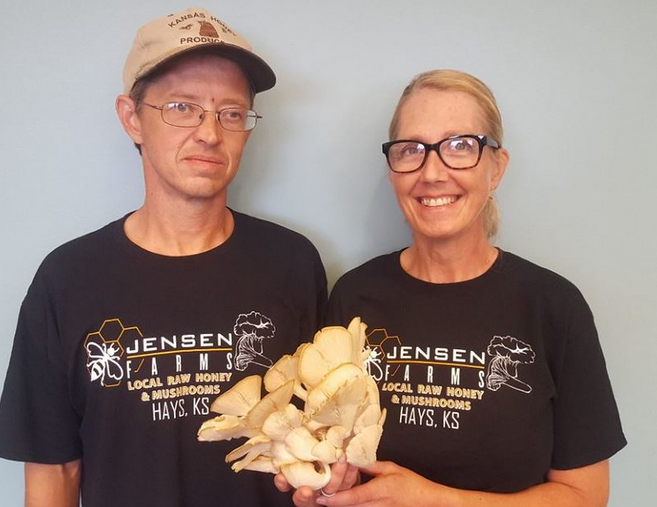
Mike and Amy Jensen are the owners of Jensen Farms and Professor’s Classic Sandwich Shop & More in Hays. Mike grew up on a farm northwest of Hays near the site of Yocemento. Amy grew up at Hays, came to K-State on a golf scholarship, and finished her degree at Fort Hays State. They met and married.
When he was a kid, Mike enjoyed hunting for morel mushrooms. Then he started growing mushrooms himself. His family also had a large garden but it needed pollination so they wanted bees. Mike and Amy met a farmer at Osborne who had a bunch of equipment for raising bees, and he gave it to them. They started raising bees along with the mushrooms, and it changed their perspective about healthy food.
In 2003, they bought the Professor’s restaurant in Hays and leased it for others to operate. Professor’s had been a long-time fixture in downtown Hays. As their honey production increased, the Jensens needed a storefront to serve as a retail outlet.
By 2017, Professor’s restaurant had closed so the Jensens reopened it as Professor’s Classic Sandwich Shop & More. They also got a permit to raise mushrooms in the basement below.
To produce mushrooms, they hand-pack long plastic sleeves with pasteurized straw and cottonseed hulls. Then they add mushroom spawn, seal the sleeves, and hang them straight down. “In three weeks, we’ll have mushrooms,” Mike said. A 10-pound sleeve will produce ten pounds of mushrooms, four times in a season.
Mike and Amy Jensen
Contrary to what some may think, these mushrooms are not grown in compost or manure. Mushrooms are so unusual that, when the Kansas Department of Agriculture food inspector came for an inspection, Mike had to walk him through the process.
The Jensens specialize in oyster mushrooms, but they also produce shiitake and lion’s mane mushrooms. For these, the growing process is slightly different. Shiitakes are grown on blocks which the Jensens create from wood pellets, water and flour. The blocks are sterilized before spawn is added and they are sealed for a subsequent harvest.
“Our mushrooms are medicinal as well as gourmet,” Mike said. Some believe these mushrooms have anti-cancer properties and can help with Alzheimer’s and Parkinson’s disease.
“Mushrooms can clean up the environment,” Amy said. They can absorb oil, for example.
The Jensens utilize their mushrooms and honey in their restaurant dishes as well as marketing the product directly. A diner can get a meal or buy raw honey and dried mushrooms or both.
The restaurant menu includes a mushroom taco burger and mushroom stir fry, for example. Each sandwich comes with a homemade honey cookie. Made-from-scratch honey lemonade is one of the drink offerings. There are no fried foods or sodas. “We use as much farm-to-table food as we can get,” Amy said. “We want people to know where their food comes from.”
The Jensens maintain 50 to 75 beehives each year. They live on the family farm northwest of Hays, near what was the community of Yocemento. Yocemento is now just a rural crossroads with only about five residents. Now, that’s rural.
The Jensens’ two kids were active in 4-H, and the family still manages the 4-H food stand during fair week. The family is environmentally sensitive, having recently decided to phase out Styrofoam packaging. “We want to be part of the solution,” Amy said.
Kansas: The Mushroom State. No, wheat or sunflowers are unlikely to be displaced by mushrooms in the state motto, but the Jensens are using mushrooms and honey to promote healthy eating. We commend Mike and Amy Jensen of Jensen Farms for making a difference with innovation in their products. I hope the positive results will mushroom.