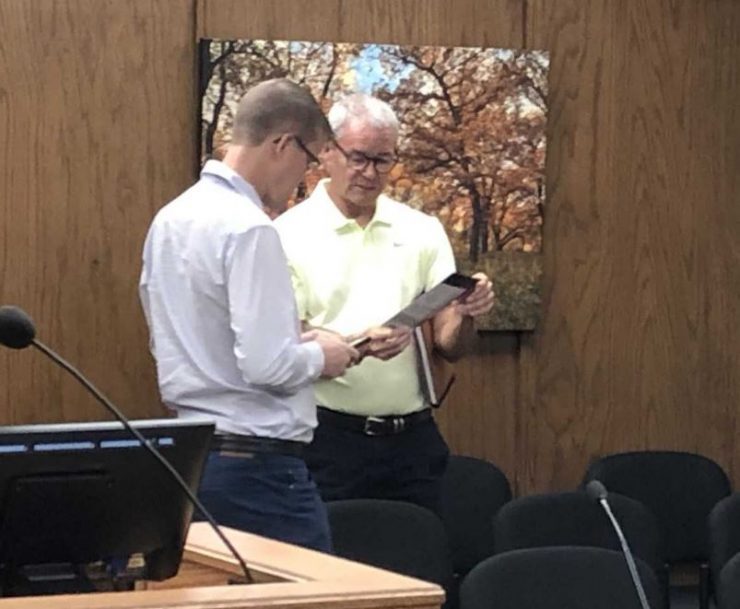
Doug Williams, Grow Hays exec. dir., listens as Hays City Manager Toby Dougherty talks about the city’s economic development budget.
By BECKY KISER Hays Post
The remainder of the economic development fund in the 2019 city of Hays budget will go to Grow Hays.
City commissioners Thursday night voted unanimously to allocate the remaining $42,500 to the Grow Hays, formerly known as the Ellis County Coalition for Economic Development.
At Vice-Mayor Sean Musil’s suggestion, the commission showed its intention last Thursday to turn the 2019 money over to Grow Hays plus the total economic development budget of $87,500 in 2020.
The total would be $130,000 to Grow Hays over the 2019/2020 budget cycle. Executive Director Doug Williams had requested $100,000 from the city in its 2020 budget, the first such request in two years.
Last night, Musil admitted he had considered voting against the motion to award the 2019 monies to Grow Hays.
“I’m absolutely for economic development and always have been. I think we need to step on the pedal and I think other people in the community need to also.
“I was a little taken aback at the total we’re going to give them for the next year and a half,” Musil acknowledged. “Since I’ve been on here [city commission] we’ve had many conversations with this group.
Vice mayor Shaun Musil talks with Williams following Thursday’s meeting. The city will fund Grow Hays with $130,000 through 2020.
“But this group has totally changed to what the city has asked and I truly think with Doug running the operation, they’re doing a great job,” Musil said.
Williams was hired in October 2018 as executive director of Grow Hays, after serving as interim director for six months.
Musil talked about attending a couple of the Pitch It sessions Grow Hays has recently hosted.
“They’re phenomenal. They have people from the community that have businesses in their garage or basement come in and tell what they have, and they’re rewarded with money to help them grow. I know the first one that won [Chroma Quilting] has a storefront now. That says a lot to me about Grow Hays.”
Musil also mentioned plans for a travel plaza to be built by a developer at Interstate 70 Exit 157 in Hays. “Hopefully, something soon is gonna happen.” He acknowledged the work of Toby Dougherty, city manager, on the project proposal.
Commissioner Eber Phelps thinks the time is right to “get aggressive about recruiting larger employers.”
“There’s been kind of an uncertainty out there the last few years where you didn’t see a lot of companies expanding or relocating,” Phelps said. “We’ve got a lot of good things going on in this area. I think it’s imperative right now that we have a strong economic development effort.
“I think the new director Doug Williams laid it on the line when he said ‘you either want to grow some business here or you don’t.’ I’m hoping we’re gonna answer that call.”
“Collaboration is really necessary,” pointed out Commissioner Sandy Jacobs, “and I know that Doug, and the city and the county are working together on a lot of these projects. Nobody is going to go out there and kill it on their own.”
Following the discussion and vote, the commission set a public hearing date of August 8, 2019 for the 2020 budget with the associated mill levy remaining at 25.000. Grow Hays would get the total economic development budget of $87,500.
Mayor Henry Schwaller was absent from the meeting.
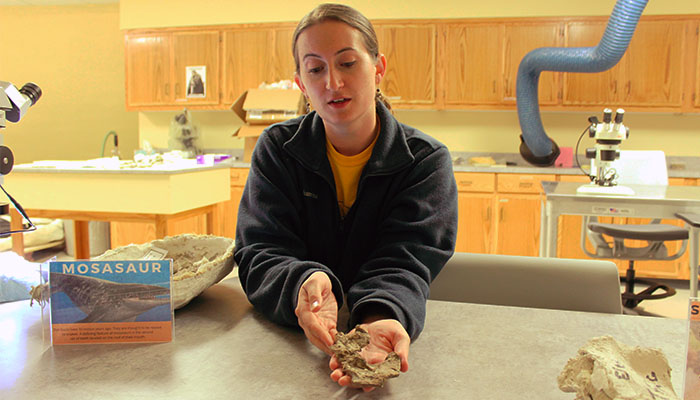
Christina Byrd, Sternberg collections manager, displays part of a mosasaur cranium she has been cleaning in the fossil preparation lab.
By CRISTINA JANNEY Hays Post
The Sternberg Museum has opened its backroom to show the public the transformation of fossils from the field to something that can enter the museum’s collection.
Christina Byrd, Sternberg collections manager, discusses the different stages fossils go through when they are being prepared for the collection.
A big part of this has been the opening of the newly renovated Dane G. Hansen Paleontology Center. In addition to new state-of-the-art equipment, the lab has windows through which museum visitors can see scientists working on fossils.
Christina Byrd, collections manager, is using the space to offer fossil identification at noon each Friday in July.
As there was no line waiting for Byrd’s services, I took my own “fossils” in for identification. I have been hunting crinoids with my dad in the gravel pits on my grandfather’s farm every since I can remember, so I dug into my box of rocks and fished out three promising specimens.
Two of my “fossils” weren’t fossils, Byrd said. They were just interesting rocks.
Byrd holds dental tools, which are used to clean fossils.
The one fossil was a mold of the inside of a clam. Byrd said although the shell of the clam was gone, sediment had likely deposited inside of the clam to form the mold.
Although I had not marked the fossil, based on the box I found it in, I think this came from the area below the Tuttle Creek Dam. Many fossils were found there after flooding washed away topsoil and rock in 1993.
Byrd said she enjoys the opportunity to interact with visitors thanks to new lab space.
“I think being able to interact with the scientist who is actually doing the work is so important,” she said. “I get stuck downstairs so often that I love the opportunity to come up and talk to everybody about the stuff I get to do everyday.”
Byrd shows a mosasaur skull that she has been cleaning in the prep lab.
The day I visited, she was working on a mosasaur skull. Mosasaurs were large aquatic reptiles that lived during the Cretaceous period from 100 million to 66 million years ago. They inhabited the inland see that covered Kansas at that time.
Byrd’s specimen on Friday was found in Gove County. Of the museum’s 21,000 catalog fossils, 14,000 of them were found in Kansas.
If you visit the lab, you can see the stages fossils move through as they are being prepared.
The fossil is first removed from the surrounding material and placed in a burlap and plaster cast for shipping. Once at the museum, the paleontologist has to remove the surrounding material.
My little clam fossil was pretty clean, probably because it was forcefully ripped out of the rock by a torrent of water. Not so for Byrd’s fossil. Her mosasaur skull was encased in a matrix.
The material surrounding the mosasaur skull was fairly soft, so Byrd was using dental tools to painstakingly clean the fossil. To add to the challenge, plant material had tried to grow into fossil.
Dinosaur fossils found in other areas of the U.S. can be located in much harder material. This can require pneumatic tools.
How long it takes to clean a fossil depends on its size and the material in which it was found. Some fossils can take years to prepare, Byrd said.
All of the paleontologists’ work is done under a microscope, but a monitor is mounted outside of the lab so visitors can see what the scientists are seeing.
“Because we do everything under a microscope, it is sometimes hard to see when someone is at the window because we are so focused. However, I can hear when they are interacting with that monitor,” Byrd said. “Because I hear a mom say, ‘Hey sweetie, see what she is working on there. You can actually see it up close there.’
“If I have the windows open I can say, ‘Hey, do you have any questions? Would you like to learn anymore about what is in here?’ Or kids will point and say, ‘What’s this?’ Having this larger window and broader space, people can see what is in here.”
All of the surrounding sediment materials cleaned from the fossils is saved. A specific researcher is using the material around the fossils to evaluate in what type of environment the animals lived.
“Once you have taken it all off, you have lost a specific detail of this bone’s history,” Byrd said. “It’s another clue. When you think about life, you have to think in the whole view. You can’t think in terms of just one animal. You have to think in the ecological view — the animals, the plants. What are the sediments telling us?
“Especially in the Western Interior Seaway since it was covered in water, the sediments can tell you a lot about what changes happened through time within those sediments. Did it get more course? Did it get finer? That can tell us different things about how water is moving throughout this area through that broad span of time that water covered the U.S.”
Microscopic creatures can be found in the sediment that also give clues to environment, such as temperature and salinity.
The original prep lab is now the histology lab. Scientists cut very thin slices of bone and grind them down to be viewed under a microscope.
Looking at the bone at the minute structural level can also gives clues about how the animals grew and what they ate. When reptiles experience a trauma, that can have arrested growth, which shows up in their bones.
Bone growth can also give researchers clues to the environment in which the animals lived, including water temperature and if the animal was warm- or cold-blooded.
One FSHU graduate student has been recently using histology to study the growth patterns of the Sternberg’s plesiosaur.
“You have all of these clues that confirm what scientists have been thinking of,” Byrd said. “It is just more evidence to support the case and give us a more solid understanding.
“We are taught to always question, but once you get enough information, we can say, ‘How much do we trust the current evidence? Test it again, see if we get the same results.’ If we continue to get the same results, then ‘OK that’s it.’ ”
You don’t have to have a fossil to visit the lab during the fossil ID ID time. You can just show up with questions. The event is free with admission.
If you have a question about a fossil and can’t make it on Fridays, check with the front desk or call the museum.
Erin Muirhead and Ryan Will rehearse their roles as Ariel and Prince Eric in the Hays Community Theatre’s production of Disney’s “The Little Mermaid.”
By CRISTINA JANNEY Hays Post
Theater goers will be able to enter the enchanting under sea world of Disney’s “The Little Mermaid” this weekend.
Erin Muirhead (Ariel) and Ryan Will (Prince Eric) dance during “The Little Mermaid.”
The Hays Community Theatre will present the story of a mermaid who falls in love with a human prince at 7 p.m. Thursday, Friday and Saturday at Beach/Schmidt Performing Arts Center.
Tickets are still available for all three shows and can be purchased through the HCT website or at the door if tickets are still available. Tickets are $25 for adults and $15 for children.
Cody Kreutzer, a recent FHSU graduate in theater, is making his directorial debut with HCT with “The Little Mermaid.”
Kreutzer directed at FHSU, but nothing on the scale of the 50-member cast of the “The Little Mermaid.”
Micheal Hernandez (Scuttle) shows off an object from the human world during “The Little Mermaid.”
Organizing a large all-volunteer cast and using rehearsal time wisely has been a challenge, he said.
Trying to costume a cast of sea creatures has also been a challenge, but he said he has had a wonderful costume and set design team who is bringing both the underwater and terrestrial worlds to life.
“We had to come up with a ship for all of the sailors and the big sea numbers and having something on stage during under the sea so its not just on stage. … It’s been difficult, but I think what we finally have and decided on is good.”
For those not familiar with the cartoon classic, “The Little Mermaid” is the story of Ariel (Erin Muirhead), King Triton’s (David Koshiol) youngest daughter, who wishes to pursue the human Prince Eric (Ryan Will) in the world above.
Haileigh Jacobs performs a number as Ursula in “The Little Mermaid.”
She bargains with the evil sea witch, Ursula (Haileigh Jacobs), to trade her tail for legs. But the bargain is not what it seems, and Ariel needs the help of her colorful friends, Flounder the fish (Addy Brull), Scuttle the seagull (Micheal Hernandez) and Sebastian the crab (Travis Grizzell) to restore order under the sea, according to the HCT website.
Muirhead, 19, a Hays High School grad and student at K-State, loved the Disney movie when she was a child.
“I think the biggest challenge for me is to take a character people know and make it my own,” she said.
She said she could relate to Ariel as a character who is forced to make difficult decisions and is trying to follow her dreams.
David Koshiol portrays King Triton in “The Little Mermaid.”
“I think everyone has had to make those decisions to follow their passion, and I hope I am doing that as well,” she said.
Muirhead went to high school with her leading man, Ryan Will.
“He is a close friend of mine. I think he is doing a great job, and it is great to work with him,” she said.
Will, 19, is a sophomore at FHSU majoring in psychology. This is his first HCT production, but he is no stranger to the stage. He played Quasimodo in the HHS production of “The Hunchback of Notre Dame” among pother productions. He also played Pepper in “Mama Mia” and Antonio in “The Marriage of Figaro” at FHSU.
Will said “The Little Mermaid” has been much more challenging than he anticipated from both musical and acting perspectives.
“At this point, I am excited to perform. I hope we can provide the community with an escape for a night or two,” he said. “I really think this is going to showcase a lot of people and the time and effort we put into it. I think it is going to be a good one.”
Erin Muirhead (Ariel) and Addy Brull (Flounder) are puzzled by a fork from the human world.
His favorite music from the performance is “If only,” a quartet during which Prince Eric weighs his options for the future.
Will had never seen Disney’s movie version of “The Little Mermaid” until just last weekend. He said he much preferred the stage version, which includes much more music.
Kretuzer said his favorite scene in the musical is a number in which Prince Eric teaches Ariel to dance, a sequence that is not in the movie.
“It is the first moment we see they could fall in love,” he said. “Just talking about it gives me chills. It is so beautiful. ‘Part of Your World’ is my favorite Disney song written, so when Erin (Ariel), sings ‘Part of Your World’ every night, I love it. It is so good.”
Kreutzer said he is proud of his cast.
Ariel’s sisters perform a dance number during “The Little Mermaid.”
“They are all working so hard,” he said. “We have rehearsals three hours a night, five nights a week. They are just excited to do it and excited to be here and excited for people to see it.”
Although many people might think “The Little Mermaid” is a production just for kids, Kreutzer said older audience members will enjoy the production as well. HCT not only has grand sets and costumes, but the production has humor adults will appreciate too, he said.
Kruetzer said he and the cast have had fun putting the show together.
“Part of it is for ourselves to make us feel good, but we also want people to see it because we want to bring them joy,” he said. “We want them to get as much joy out of seeing this as we have had putting it on.”
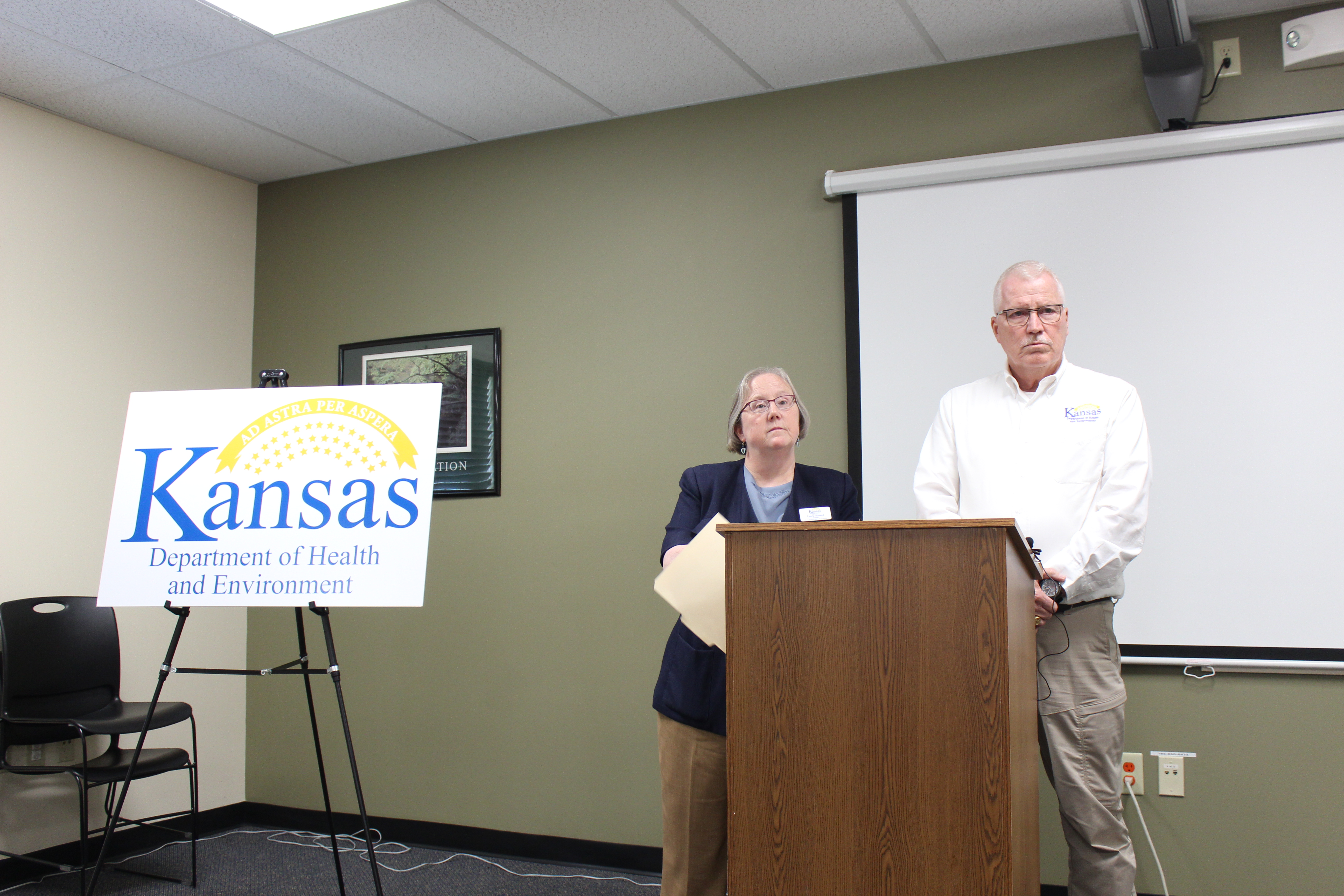
Department of Children and Families Sec. Laura Howard and Department of Health and Environment Sec. Lee Norman announce a KDHE employee who will process Medicaid applications will be located in the DCF office in Hays.
Kansas Department for Children and Families Secretary Laura Howard and Kansas Department of Health and Environment Secretary Dr. Lee Norman Monday announced at the Hays DCF office a new partnership that will locate KDHE employees in DCF offices.
KDHE is moving processing of Medicaid applications from a private contractor back under state control. It will take a year to completely make the transition. Eventually 350 once private employees will be employed by KDHE.
Thirty KDHE employees who will determine eligibility for Medicaid will now be located in 17 DCF offices across the state. One of these employees will be in the Hays DCF office. The Hays and Wichita offices will be the first to receive the KDHE employees as of this week.
Howard and Norman said in a press release that the move will foster collaboration around the KanCare application process for the elderly and people with disabilities. It is also designed to improve efficiencies and expand the reach of both agencies.
“This is just one way we want to bring a high-touch approach back for Kansas citizens,” Howard said during the press conference.
Norman said, “We’re pulling a bunch of these services back into the state to provide more customer service.”
Norman said in the press conference most Medicaid applications are being processed in the 45 days required by federal law. However, he said he hopes the changes will improve approval times beyond the federal standards.
“I’ve always believed that our DCF offices can be an important connection point for Kansans who need services,” Howard said in the news release. “This new partnership is a first step in providing a more efficient experience for those who need assistance with the complicated KanCare application process.”
“As an agency, we are continually looking for opportunities to collaborate and improve the stakeholder experience,” Norman said in a news release. “By co-locating, we are making good use of existing state office space and extending our reach across the state.”
Elderly and disabled KanCare applications are among the most complex. Under the new partnership, KDHE employees will initially spend most of their time processing home and community-based service applications.
“These complicated cases take a special approach,” Norman said. “You wouldn’t go to a family physician, necessarily, to have a brain tumor removed. You would go to someone who is highly specialized in that area. The population that Sec. Howard spelled out is a group that needs a specialist in that area. There is a fairly lengthy training process involved in that.”
The KDHE employees also will be available to work with DCF staff on complicated cases. Once the full transition is complete in mid-2020, it is expected that KDHE staff will be able to meet face to face with Kansans who need help navigating the KanCare application process.
“I believe this collaboration with DCF will result in positive outcomes for Kansans,” Norman said in the news release.
Norman said during the press conference Monday KDHE is also working to update technology to make the KanCare application process more efficient. He said the system is still requesting information through fax, and most people no longer use fax machines.
Other offices that will have KDHE employees include:
Kansas City and Overland Park in August
Emporia, Great Bend and Newton in September
Manhattan and Pittsburg in October
Atchison, Chanute and Salina in November
Dodge City, Garden City, Hutchinson and Liberal in December
Independence in Jan. 2020
As more KDHE staff are hired, the agencies plan to expand to other DCF offices that have available space.
“I’ve heard first hand from our workers how excited they are to have KDHE staff in the same office,” Howard said in the news release. “We know this is an important step in helping Kansans connect with services that are vital to their well-being.”
Parents receive free school supplies last year as part of the Backpack for Kids program. Photos courtesy of Backpack for Kids.
Deadline to register for the program is today
By CRISTINA JANNEY Hays Post
When Wendy’s 7-year-old daughter gets her new backpack and school supplies every summer, she is super excited.
“She get’s so excited,” her mother said. “Her eyes light up.”
Wendy is brought to tears. She tears up because she is humbled by the gift.
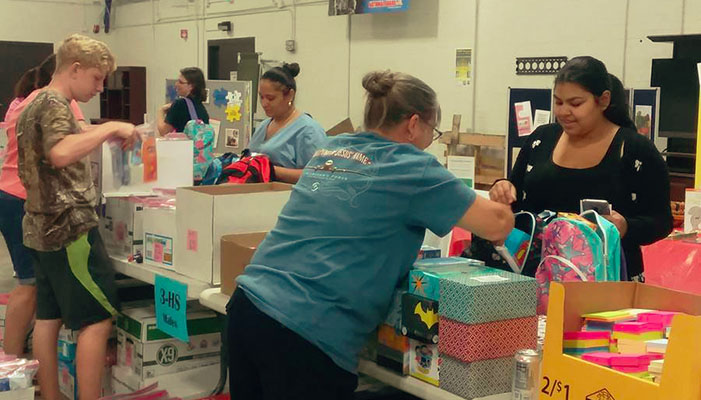
Volunteers pack items for the Backpack for Kids program. Donations are still need. See a list below.
Wendy’s daughter is one of about 650 children who annually receive new backpacks and school supplies from the Backpack for Kids program, which is sponsored by First Call for Help.
The deadline to register for the program is Monday.
Students entering grades pre-K through high school, who reside and attend school in Ellis County, are eligible to receive a free backpack filled with school supplies and a hygiene bag through the program.
The backpack distribution day is Thursday, Aug. 1, at the National Guard Armory, 200 Main St., Hays. Pick up your backpack between 7 a.m. and 6 p.m.
Wendy, a single mom, has been out of work because of medical issues. Child support from her daughter’s father is sporadic.
This will be the fourth year she has used the Backpack for Kids program.
A previous distribution day for Backpack for Kids. All of the items for the program are donated or purchased with monetary donations.
Wendy regularly delays or forgoes things for herself, like a haircut or clothes, to provide for her daughter.
When back to school rolls around, Wendy has to make choices. Does she buy school supplies? Buy her daughter shoes to replace the ones she has outgrown? Does she pay other bills?
“It is very humbling to go and ask for help,” she said. “I am humbled when she goes to get her backpack with the other kids. The community helps a lot. I usually get teary eyed. I am thankful to see that they are willing to help, so [my daughter] can go to school with a backpack instead of a pillowcase.
“I am so grateful. It takes a little worry off my shoulders, especially when I see her face and she is so excited.”
Wendy’s daughter, who is a student at Roosevelt Elementary School, has special needs. Not only has First Call helped the family, but so has the school. A program sends food home for her daughter on the weekends.
She also had help with some new clothes for her daughter.
“She went through a growth spurt,” Wendy said. “I kept thinking, ‘We can hold out.’ I got super teary when that happened.”
Wendy said her daughter loves going to school, and a new backpack and supplies is a great start to her school year.
Volunteers packing backpacks at First Call for Help. Between 600 and 650 Ellis County children receive new school supplies through the program each year.
“She is not a stranger to anyone,” Wendy said. “She is very loving and very active. She is very high energy. She is on a first-name basis with her principal. She has been so good with her. She moves at her own pace.”
Wendy said she thinks her daughter is learning important lessons through Backpacks for Kids.
“[She] knows it is not just mom and me,” Wendy said. “Everybody is in this together. We give back and volunteer when we can. I say a lot of prayers. I want to make sure I can give [my daughter] what I don’t have. I am grateful for the help. It think that program is awesome.”
Contact Project Coordinator Laura Shoaff at First Call For Help if you have questions or are interested in volunteering to fill backpacks or assist on distribution day.
The Backpack for Kids program takes donations year round.
Right now the program is low on the following items:
A hike in the solid waste fee for city of Hays customers has been postponed for a month.
City commissioners discussed the proposal at their work session Thursday night.
The Solid Waste Division, which performs refuse and recycling collections, compost operations, annual alley cleanup and tree disposal for customers, is funded by fees charged to Hays customers. It is now dipping into its reserve funds.
The $15.20 monthly fee has been in place since 2006.
Jesse Rohr, public works director, explained that expenses have gone up the past 13 years for fuel increases, higher hauling and sorting fees for recyclables, salaries, and higher tipping fees at the Ellis County landfill, up from $68 a ton to $75 a ton last year.
At the same time, revenues from recycling are down “mostly in the funds collected for the sale of paper/cardboard recyclables. Revenues have gone from over $63,000 in 2011 to less than $5,000 in 2018,” Rohr told commissioners.
Building the city’s own waste transfer station was considered, but that “didn’t cost out,” according to Toby Dougherty, city manager.
The city then looked at other contractual options, including a private hauler rather than Ellis County.
The five year contract offer is less than what the county charges, but there are “some potential negatives down the road that have not been fully ferreted out,” Dougherty told the commission.
“We went back to the county and asked them if they could give us a better deal and we haven’t had a formal response at this time.
“I told my counterpart we found a cheaper option but we understand the convenience of location [of the Ellis County Landfill]. Plus, there are other interactions at the landfill aside from the municipal waste. We have the tree limb disposal, we have the other stuff. It’s easier to do it at one spot,” Dougherty acknowledged.
City commissioners are unhappy with Ellis County’s delay. Rohr says his county counterpart has been aware of the city’s negotiation request since April.
“Here’s the problem,” said Mayor Henry Schwaller with a thump on the table.
“The county raised their rate on every taxpayer in this county without any notice last year. The city and every person living here had to bear the burden of that. When asked if they can get something together for us this year, they can’t do it. I’m going to vote for a private hauler.”
The city of Hays is the biggest customer at the Ellis County Landfill and 77% of its solid waste budget goes towards the tipping fees for trash collection.
“If we are no longer their customer, they will collapse,” Schwaller declared.
“I’m starting to feel a little bit held hostage,” said Commissioner Sandy Jacobs, “because of other things they will do for us thinking we won’t go to another source for this piece (municipal waste].”
Hays has the lowest solid waste rate among its peer cities in Kansas. Most cities do not provide an alley clean up or compost site, according to Rohr; Hays does.
Marvin Rupp, Solid Waste Div. superintendent and Kim Rupp, finance director, listen to Public Works Director Jess Rohr talk about a fee increase for Hays solid waste customers.
To close the gap in the solid waste fund, Rohr, Solid Waste Division Superintendent Marvin Rupp and Finance Director Kim Rupp came up with a five year plan for incremental increases in the solid waste fee, starting with a 15% hike beginning August 1.
Commissioners are concerned about the first big jump on top of water and sewer rates that have increased dramatically the past few years “as they needed to,” said Schwaller.
“People aren’t really looking at what their trash is costing them. What they’re looking at is their final bill. And my bill went from $43 a month to $61 a month. …”So we’re looking at this on top of that.”
Commissioners ultimately agreed to wait 30 days for a response from Ellis County.
They also discussed the possibility of eliminating the collection of plastic products for recycling due to a worldwide reduction in sales of recycled plastics.
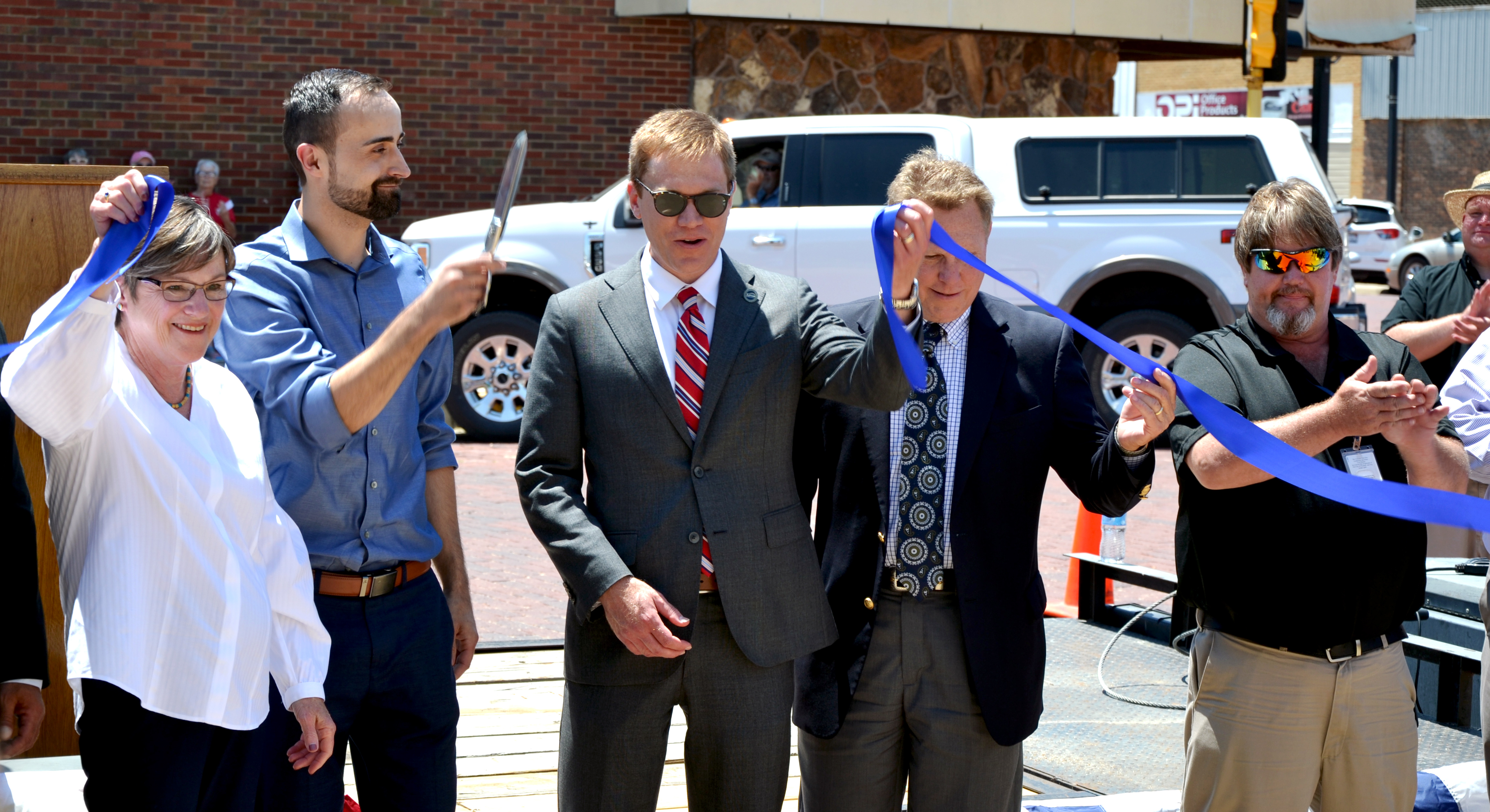
“To see it come to fruition is really, really exciting,” Kansas governor Laura Kelly told the large crowd that gathered in Cecil Bricker Park for the event.
She said it was her hope legislation allowing industrial hemp production in Kansas would lead to economic development like what is happening in Russell.
“(Producers) can further grow and prosper with the pursuit of new opportunities in value-added agriculture,” Kelly said. “Today’s event came about because our state is moving forward in creating another option for diversification for Kansas farmers.”
“We are excited to bring Mechanized Concepts to town to help our ag-related businesses and help the town grow,” said Aaron Steinert, Russell county commissioner. “It’s nice to bring something in that brings a different avenue of revenue to the city and the county and employees of Russell.”
The company has been working on getting the plant ready with teams from other locations, but now the local hiring process has started and limited production is beginning at a smaller building near the main facility using repurposed equipment.
“This is the start of the opening of the plant,” said Matt Colledge, Mechanized Concepts founder and CEO.
“We are ramping up right now to move into production,” he said, with a goal of being fully operational within two years.
Once the facility is fully operational Colledge expects to employ 200 people as they try to meet the demand for products.
“In five or 10 years out, that facility could ramp up to 900 jobs to be able to meet the demand that our merchandizing performers have shown, and independent studies have shown, as the industry grows,” he said.
Potential job creation has excited area residents that have seen job loss as oil production in the area has declined in recent years.
“It means a great deal to the community,” said Mike Parsons, staff member at Russell County Economic Development and CVB.
He hopes the plant will help retain younger residents that otherwise may leave the area after college.
“These guys are really working to bring the young people back, and I think that is an awesome step for our future,” Parsons said.
As exciting as the plant is locally, it may be just the beginning as industrial hemp production moves into a more fully realized crop in Kansas.
“Mechanized Concepts Kansas,” Kelly said, “stands ready to work with farmers that will be producing industrial hemp.”
“It will be rewarding to see the crop turned into products such as composite lumber, plywood, roofing tiles and shingles. At the same time this business is delivering new jobs and economic benefits right here in Russell,” she said.
While Kelly was hopeful rural development would occur with hemp production, the local community is what drew the company to Russell.
“Russell is a special place,” Colledge said. “When we came here, we knew right away that the people here are different, that they cared about their community.”
“We had five other states, five other locations that were pursuing us,” he said. “Honestly we had better offers at the table. Really the reason we came to Russell is because of the sense of community.”
That sense of community, he said makes Russell sacred.
A facility in the center of the U.S. allows for faster expansion as demand for industrial hemp increases, Colledge said, making Russell a prime location for the facility.
“That’s what we are doing, we are setting up Russell, Kansas, to be on the map for hemp. From education to seed, all the way up to a product,” he said.
While area producers continue adding sources of revenue to the farms, the facility is viewed as another piece of the ever-expanding amount of agricultural diversification happening throughout Kansas.
“Manufacturing and other value-added opportunities are vital to the Kansas agricultural industry,” Kelly said. “Industrial hemp is another promising addition in our state where our producers have a knack for learning about different crops and growing them successfully.”
“The potential is really unlimited,” said Rep. Ken Rahjes, R-Agra, 110th Dist. “What we have found agronomically, the best place to grow hemp is central Kansas.”
“I think today’s announcement is one that gives that extra boost to move forward.”
Rahjes pointed out as a new crop in Kanas, regulation and transportation concerns need to be fully ironed out. However, the crop should work well as another option for local producers just as canola and sunflowers have, he said.
“I really think the sky is the limit, and with the innovation of Kansas farmers, I think it is going to be very interesting and very exciting to see what happens over the next two, five and even 10 years,” he said.
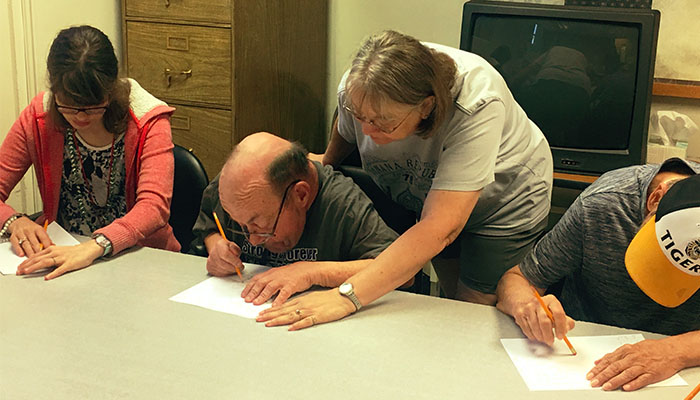
Nathan Young, lead paraprofessional at the Reed Development Center, aids a DSNWK client Wednesday,
Nathan Young works three jobs to support his family.
Even at full-time, he does not make enough at his job at Developmental Services of Northwest Kansas to get by. He also works another 16 hours per week aiding another disabled individual as well as a semi-professional gamer.
Young, lead paraprofessional at the Reed Development Center, works with lower-functioning individuals. He helps his clients with basic care like feeding themselves, toileting and keeping themselves clean.
He said he loves his job, but he wishes he was paid more.
“The thing I like the most is not just the smiles I get everyday with everyday interactions. I am able to help someone to the fullest of my abilities. It just brightens their heart,” Young said.
Young, 31, as a direct support professional, is not alone in his struggles to make ends meet. He is one of many workers at DSNWK who work physically and mentally demanding jobs for low wages.
Jerry Michaud, DSNWK president, said because of state-set reimbursement rates, the wages DSNWK can offer direct care workers is low. This, coupled with low unemployment in northwest Kansas, means it is difficult for DSNWK to recruit and retain employees. The agency constantly has vacancies.
DSNWK has about 345 employees across its 18-county coverage area. As of the end of June, DSNWK had 27 open positions — mostly direct support professionals.
The overall unemployment rate for DSNWK’s coverage area is 2.84 percent, which is very low.
“It means there are not a lot of individuals out there in the workforce, so that is one challenge right off the bat,” Michaud said. “It is a challenge in all our communities, so I think that is something all employers are up against.”
A direct support professional helps a DSNWK client. Direct support professionals are paid only $9 an hour.
How much DSNWK is reimbursed for caring for disabled individuals is complicated. The state assigns disabled individuals to a tier system based on their needs, and then the state reimburses DSNWK based on that tier system. DSNWK serves people on all tiers.
The bottom reimbursement rate is $7.68 per hour. Minimum wage is $7.25. DSNWK recently raised its direct support professional starting pay to $9 an hour.
Michaud acknowledges $9 is not a high wage, but DSNWK still has to make up the difference between $9 an hour and the state reimbursement.
“I will tell you that the rates that are paid don’t cover the cost,” Michaud said. “That is in part of why we approach our counties to help us to fill the gap.
“What we ought to be paying is something different,” he added. “That is part of the equation we haven’t even broached. What is a prevailing wage in this community versus the next community? That is where it become more complicated to try to figure out what that is.”
Turnover is directly tied to wage, Michaud said.
Turn over is high among direct care professionals because of the difficult work and low wages.
“How do you live on a $9 a hour wage?” he said. “Can you find housing? Can you pay for your housing on $9 an hour alone? I am saying these things knowing it is a hard reality.”
The answer, in Young’s case, is you don’t.
Not only is Young working extra jobs, he has also had to reach out for state assistance.
DSNWK offers health insurance benefits to its employees. Young is able to purchase health insurance for himself through DSNWK, but he can’t afford the family plan that would cover his children. They are covered by state insurance.
Young said turnover can be a problem. He sees fellow employees come and go. It is a tough job for not much pay. He said the people who stay are like him — committed to the people who they serve.
“I would like more pay,” he said. “It would definitely financially aid me, but it is not about the money there. I love seeing my friends every day. I know I work for them. They are so much fun to hang out with and help them grow.”
Turnover definitely has an effect on the quality of care that the people DSNWK serve receive.
DSNWK celebrates its 50th anniversary. File photo
“Let us assume for a moment that I am the person who receives services, let’s just say I require personal services — using the restroom, toileting, showering, and those kind of things,” Michaud said. “If you have new people coming and going all of the time, helping you in some of those most personal times, that would be hard. I can’t sugarcoat that.
“It really solidifies making a change or making a difference so we can slow that revolving door and have greater stability. That is why we are doing what we are doing.”
Not only does turnover have ramifications on care, constantly training new employees is costly and time-consuming.
“When you go through that process and a person stays for a month or a few months, that is not necessarily a good thing,” Michaud said.
DSNWK employs university students in Hays. Although those students might not leave due to wage, they usually eventually leave due to graduation.
DSNWK has a capital campaign to address in part some of its employment challenges. However, long-term, Michaud said the reimbursement rates for care need to increase in order to deal with the direct support professional pay issue.
Michaud said increases in reimbursement rates have not kept up with inflation and neither have wages. From 2008 until a couple of years ago, state reimbursement rates remained flat.
“As a state, we’ve got to find a way to have a realistic funding structure that is practical as far as the ability to hire, recruit and retain a workforce that can provide these vital services. I think the state understands this,” Michaud said.
The state has had to increase wages on the institutional side at facilities, including Larned State Hospital and Osawatomie.
On a related issue, the state has tried to reduce the number of disabled individuals waiting for Medicaid-funded services. There are 107 people on that list in DSNWK’s coverage area and more than 4,000 people on the list statewide.
The Legislature this spring allocated more funding to decrease two of the Medicaid waiting lists. One-hundred seven people were removed from the wait list statewide with that funding. Only one of those people was from northwest Kansas.
Although the state needs to reduce the waiting list, it also needs to address the wage issue., Michaud said. If more people come into the system without increasing wages, DSNWK and other agencies like it in the state will have capacity problems, he said.
DSNWK is taking steps internally to fill its need for employees. This includes recruiting employees human resources believe will feel fulfilled working with people and tapping untraditional markets, such as retirees.
The agency is also engaged in a capital campaign it hopes will partially address the wage gap, Michaud said.
But for every step forward, there seems to be a step back. Due to a budget shortfall in Ellis County, the county cut $25,000 in funding for the DSNWK and another $10,000 in funding from ACCESS, general transportation, which DSNWK manages.
The ACCESS cuts also mean a loss in KDOT matching funds. The total loss to the agency will be $57,000 for the coming budget year.
Michaud said the DSNWK has limited means to address those funding cuts, and it definitely does not help its struggle to increase wages.
For those interested in employment with DSNWK, you can visit its website. If you are interested in donating to DSNWK click here.
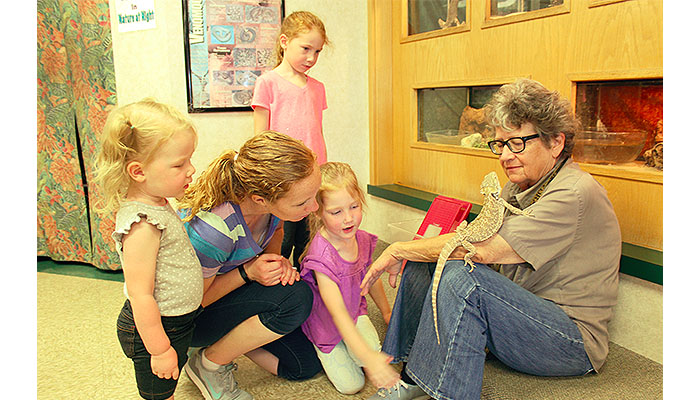
Alicia Gaede, naturalist, holdsKawaai, a Savannah water monitor, as a child looks on at the Meet the Animals event Friday at the Sternberg Museum.
By CRISTINA JANNEY Hays Post
The Sternberg Museum’s Discovery Room was abuzz on Friday with children ooh-ing and aww-ing.
Some cautiously approached Alicia Gaede, naturalist, and stroked African Savannah water monitor Kwaai’s head. Once Alicia or one of the children stroked just the right spot at his ears, Kwaai closed his eyes and flicked his tongue in apparent pleasure.
His name, Kwaai, means fierce, but he is very gentle for his carnivorous species. He eats insects and mice and even once popcorn chicken. He regularly dons a harness and accompanies Gaede on walks around the museum. He has also become a popular museum ambassador, participating in birthday parties and other public events.
“When people meet him, they can’t believe he acts so much like a dog,” she said. “He is our scaly puppy, and we have one downstairs that is our scaly cat. The one downstairs wants to be carried everywhere. If you make him angry, he will poop on you.”
Kwaai was someone’s pet. The owner could no longer take care of him, so Kwaai came to live at the Sternberg two years ago.
“He was here for a while, and we were just trying to make him healthy again,” Gaede said. “When I got this job here, I decided to make him able to be handled. It was really a fast turnaround, maybe two weeks when he was looking for people to be touched.
“He was interested to go for walks. He likes to take baths and curl up in a towel. He will sleep with you for hours curled up in a towel. It is like I am walking around with this really weird baby.”
Kwaai was accompanied Friday by Toothless, one of the museum’s chuckwallas.
Chuckwallas are native to the Arizona desert. Much smaller than the Savanah water monitor, Toothless easily fit in handler and volunteer Malachi Chance’s hand. Chance, 11, has been volunteering at the museum for seven years.
Chance ran into a little problem when Toothless climbed up his shoulder and into his hair, but Chance was able to extract him with hurting himself or the chuckwalla.
While humans secrete salt when they sweat, chuckwallas spit it out of their noses. Toothless’ roommate is Hiccup. Gaede said Hiccup is a little larger and may be a female. The chuckwallas will soon be getting three new roommates — Sonoran desert toads that recently came to the museum after being illegally trafficked.
The toads’ natural habitat is also the Arizona desert.
Thea Haugen, retired Sternberg naturalist, was showing off bearded dragon, Yoshi.
The dragon belongs to one of the museum staff members and is a frequent guest at museum programs.
Bearded dragons eat both vegetables and insects like crickets.
Thea Haugen, retired Sternberg naturalist, shows off bearded dragon Yoshi on Friday at the museum.
The reptiles’ visit was a part of the Meet the Animals program at the Sternberg. The program started in June is supposed to run through the end of July from 11 a.m. to noon each Friday. However, Gaede said the program has been so popular she might extend it into August, at least until school starts.
“A lot of kids are afraid of reptiles or amphibians,” she said. “It is different than seeing them behind glass. They are not moving a lot, and a lot of people think our animals are fake. So being able to meet them like this shows them that they are not quite as scary. … People are taught to be afraid of these things.
“I love that we can not only teach them about species, but about our animals individually, because reptiles, personally I believe, they can have personalities.”
People see a snake and they automatically think it is venomous, Gaede said. However, only a small portion of the snakes in Kansas are venomous.
The program is free with admission. New animals will be featured each Friday.
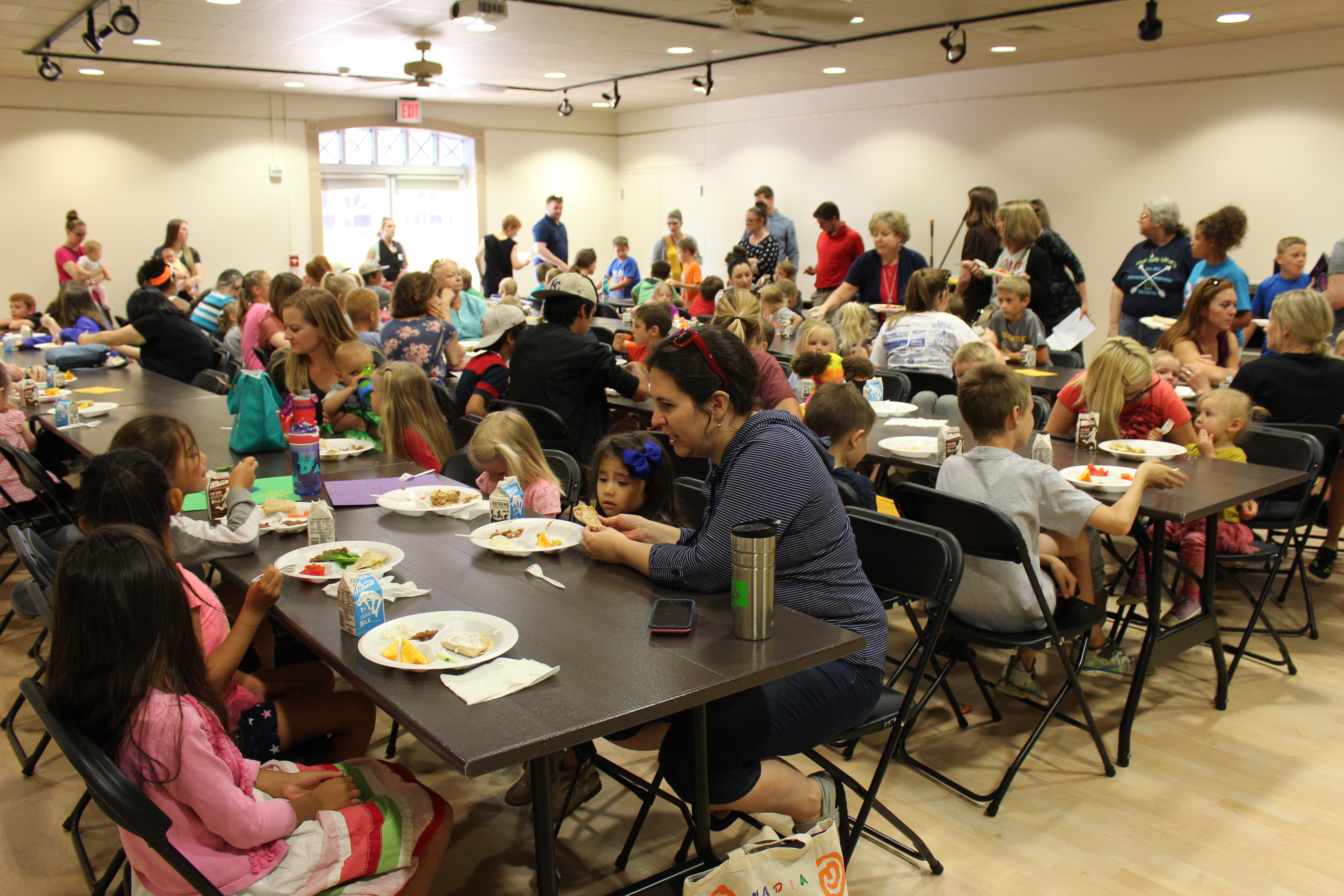
The Schmidt Gallery at the Hays Public Library fills with children and adults attending the Summer Lunch Program earlier this summer.
By CRISTINA JANNEY Hays Post
The USD 489 Summer Lunch Program has seen more than a 50 percent increase in the number of children it is serving this summer, and the director is attributing the jump to the new location at the Hays Public Library.
The program was moved to the library temporarily this summer because the Early Childhood Connections program, where the lunch program was formerly, is being moved to its newly renovated space on 13th Street.
Both Jessica Younker, USD 489 nutrition director, and Meagan Zampieri, children’s librarian, credited increases in attendance for both programs at least in part to the partnership between the lunch program and the library.
“It’s the same food and the same service. The only thing we have really changed is the location and the activities that are surrounding it,” Younker said.
In June last year, the summer lunch program averaged 128 children per day. In June this year, the program averaged 193 students per day. On its busiest day this summer, the program served 289 children.
Children 18 and younger can eat hot, healthy meals for free Mondays through Fridays at the Hays Public Library.
Any child 18 or younger eats free through the program. Adults pay a small fee to eat with children. The program has also fed more adults this summer — 350 meals last June and 434 this June.
USD 489 initiated an afternoon snack program in 2018. That program has seen a slight increase. Last year, the program served an average of 61 children per day, and this year it is serving an average of 68 children per day. Those snacks are also free for children.
Zampieri reported 1,000 more participants in programs at the library in the children’s department in June.
The library has added programming to coincide with the summer lunch program. It has offered a Astronaut Training Academy at 11 a.m. Lunch is served beginning at 11:30 a.m.
Children’s library programs at other times are also up, which Zampieri attributes in part to the hiring of a new early literacy coordinator, Sara Schoenthaler. Storytime is up a total headcount of about 200 children compared to last year, Zampieri said.
“I think the lunch absolutely helps,” Zampieri said. “I think the things we are bookending it with are big.”
The library had 46 children in for its alien parfait program this week.
“It’s hot. They are here already. If we can sneak in a little education in there, that is really exciting for us,” Zampieri said.
She said she also thought the library, which also has a new communications coordinator, Callie Kolacny, is also doing a better job of getting the word out about its programs.
“People who visit the library frequently post about the library and post about what we are doing, so they know they can come here and get work done and take care of their kids and give their kids some fun things to do,” Zampieri said.
The increases have caused some issues for both programs.
On a couple of days, the lunch program ran out of the hot meal entree. However, it always has peanut butter and jelly sandwiches in reserves, so no one ever goes away hungry.
Although the children’s department on the second flour of the library has the space to accommodate the increase in the number of visitors, the space could be used better, Zampieri said.
At certain times, the department could use more chairs and tables for children to play games. She said reconfiguring the spaces is something library officials are going to consider in its strategic planning.
Younker said the summer lunch program usually sees a significant decrease in participants in the month of July; however, she said participation has remained strong so far this month.
Although the partnership between library and the lunch program was initially supposed to only be temporary, both Younker and Zampieri said they would recommend the program remain at the library.
“In my mind, this partnership will continue for years to come,” Younker said.
If your child wants to eat
Hot meals will be served in the Schmidt Gallery from 11:30 a.m. to 1 p.m. Mondays through Fridays through Aug. 2. Adults can eat with children for $3.75 per meal. Children do not have to live in or attend USD 489 schools to participate. Click here for the July lunch menu.
Healthy snacks will be available free for children from 3:30 to 4:30 p.m. Mondays though Fridays in the children’s department on the second floor of the library. Click here for the July snack menu.
Library programs
To learn more about the HPL programs, visit the library website or call the children’s department at 785-625-9014.
While the investigators work to determine the cause of the accident, crews were working to clear the tracks and remove the overturned cars.
“We are investigating the accident,” said Raquel Espinoza, Union Pacific media representative. “At this point, we do not know what caused it, but we are certainly investigating to find out what could have contributed to this accident.”
According to Espinoza, the investigation could take weeks or months but she said she could confirm details of the derailment.
“I can confirm that four rail cars that were carrying alcohol derailed from a train near Allen and Ninth Street yesterday at around 5 p.m,” she said.
She also noted that containment of the tanks remained intact.
While there were no injuries to the public, a UP employee was treated and released for minor injuries, according to Espinoza.
While the investigation is ongoing, the cars are being removed in an effort to restore rail traffic.
“We do have crews working in the area right now and they are working to clear the area as well as make any repairs that need to be made,” Espinoza said.
“I have not determined what time the line will re-open for rail traffic.”
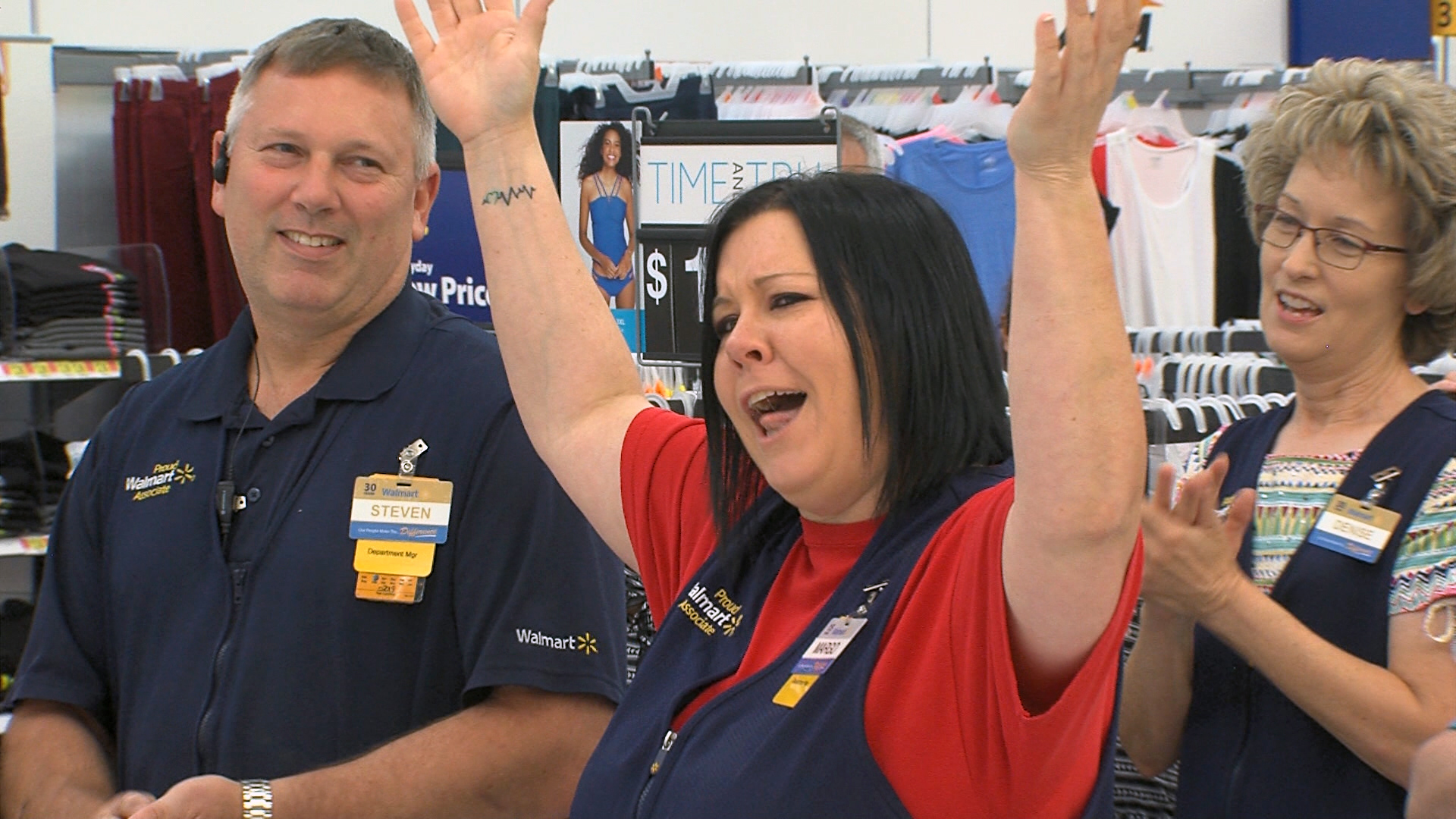
Walmart employees celebrate the completion of their store remodel Friday with members of the Hays Area Chamber of Commerce.
By BECKY KISER Hays Post
Although it took a week longer than expected, the remodel project of the Hays Walmart Supercenter still finished a week ahead of schedule.
A grand reopening ribbon cutting with the Hays Area Chamber of Commerce was held Friday morning.
Co-manager Tanya Whitter talked about some of the major improvements which started in the front store area with new entrance gates for customers.
New entry gates at both doors automatically open for customers.
“They automatically open when you come through,” Whitter explained. The store also has new security systems in the front end.
New signage fills the store walls as well as the different departments. The entire store floor has been retiled with new concrete pathways leading into the store.
New lighting in the produce department
New refrigeration coolers and cases line the grocery area. The produce department has new lighting which Whitter says ensures the fruits and vegetables look like the colors they actually are.
“It’s just a fresh look for the store,” she added, “not just what the customers see but also things the customers don’t see. There’s lot of changes and lots of improvements.”
Employees working the new 3 in 1 counter are cross-trained to help customers with gun purchases, the automotive center and the paint department.
There’s now a new “3 in 1” counter. “Our automotive department, our paint department, and sporting goods – for the gun sales – with brand new cases. It’s basically an all-in-one counter…making it convenient for the customers.” Employees working the 3-in 1 counter are cross-trained to help customers in all three departments.
Restrooms have been updated with a mothers’ room added in the back restroom for nursing privacy.
The 11-week project exceeded $5 million, according to Whitter. “It’s a huge financial investment in our store and we’ve also invested in training of our associates.”
Perhaps the most highly anticipated change is the addition of the OGP department, or Online Grocery Pickup, which opened July 5.
Ten parking spaces are reserved at the north end of Walmart for pickup of online orders.
“You’ve seen all the parking stalls outside for it. You can go online and order your groceries and show up, pick a time, and we bring them out to your car for you,” Whitter explained to the crowd. “It’s very fast, very convenient. It’s a free service that Walmart provides.” She believes it will be very successful for the store.
The Walmart app used to order groceries online can also be used by customers to determine if an item is in stock and its aisle location in the store.
Computer screens at the checkout counters have also been updated with touch screens.
“It’s remarkable how advanced things are now,” added Whitter.
Even the parking lot got a facelift with restriping of the parking stalls and new trash cans.
She and co-manager Adam Armstrong both made a point of thanking the Walmart employees and its customers.
“We ask our associates to do a lot of things every day and then we through a remodel on top of that. We asked them to do their job plus we turned their department upside down and moved it halfway across the store,” Armstrong said with a smile. “But our associates, in Walmart fashion, did an outstanding job.”
Because the store is open 24/7, the renovation work took place while people were shopping.
“Our customers put up with us for 11 weeks. It’s kind of like coming into your house after you’ve been gone for a week and somebody rearranges your furniture and you run into stuff,” quipped Armstrong. “You don’t know where things are.”
“But we should be good for at least another seven years now, I think. We won’t be moving things. Everything’s where it’s gonna be.”
A lot of departments were rearranged on the general merchandise side to make for a better shopping experience, according to Armstrong.
“The way things are laid out now – once people get used to it – should honestly make more sense as they shop throughout the store,” he said. “As an example, we put the bacon next to the eggs, which most people buy together.”
Sarah Meitner, Brent Kaiser and Kathy McAdoo accept a $10,000 donation from Hays Walmart for the Accessible Recreation Complex park project. They’re flanked by Co-Manager Adam Armstrong and Community Involvement Coordinator Dawn Malott.
During Friday’s celebration, the Walmart employees also presented a $10,000 donation through the Walmart Foundation to the Hays ARC park project for an accessible playground in Seven Hills Park.
The Hays Walmart store, which has nearly 300 employees, is among 10 in Kansas scheduled for renovations and improvements this year.
Walmart has been in Hays for 35 years.
The Supercenter has been in its current location, 4301 Vine, for 18 years. Prior to that it was in the Vine Street shopping center now occupied by Hobby Lobby, ACE Hardware and the former Hastings store.