Despite a downpour that cut the opening act short and had people running for cover, A Thousand Horses went on as planned Wednesday night on the first night of the Wild West Festival in Hays.
Area residents also enjoyed carnival rides as long as the sunshine held out Wednesday.
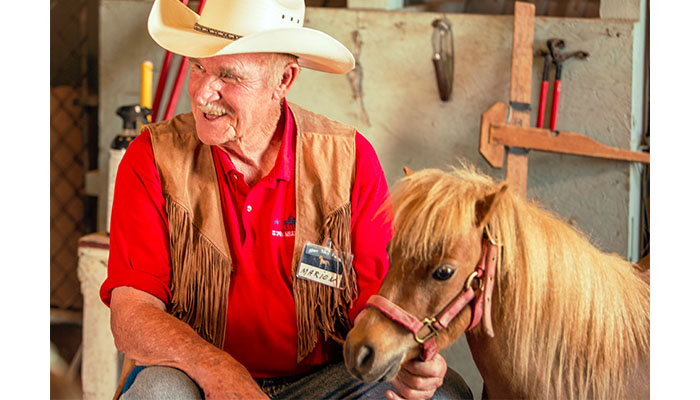
Marion Schmidt with one of his miniature horses during a tour at Blue Sky Ranch. Photo courtesy of Stanley Schmidt
By CRISTINA JANNEY Hays Post
After almost three decades, Marion and Donna Schmidt’s Blue Sky Ranch will be sold at auction Saturday.
The Schmidts’ miniature horse farm was host to thousands of visitors from the Hays area and even internationally. Marion Schmidt, a former teacher and Thomas More Prep-Marian coach, in all his endeavors on the farm tried to emphasis the importance of the bond between animals and humans, two of his children said in recent interviews with Hays Post.
The family collectively decided to sell the ranch after Marion died in August. Although the ranch will be in new hands, the family said Marion’s and Donna’s legacy will carry on in the horses they bred and the joy they brought to so many people in the tours they gave at Blue Sky.
Marion Schmidt as a child with members of his family on the family’s farm north of Hays. Photo courtesy of the Schmidt family
Garret Schmidt, Marion and Donna’s son, said his father’s love of horses was sparked at an early age. Marion Schmidt grew up on a farm 5 miles north of Hays where his family also had horses. He said his father also enjoyed teaching and coaching and interacting with young people.
“He kind of felt like his calling was the combination of the animals and the youth,” Garret said. “So what he decided to do was raise and breed championship miniature horses and put on what he called, ‘tours.’ ”
Marion Schmidt giving a cart ride drawn by a miniature horse at Blue Sky. Photo courtesy of Stanley Schmidt
Busloads of youngsters visited the ranch, and Marion gave an hour or two presentation about the horses and what it is like to take care of an animal. He hoped to educate children who grew up in the city and did not have contact with animals.
“What he found was that children who were maybe hyperactive — the energy kids — when they got out there and they got out there around the horses and were grooming the horses and petting the horse and in their presence, many times they would calm down,” Garret said. “They would focus on the horse, and it would relax them. A well-trained horse is a very relaxed animal.”
The Schmidts found the elderly also benefited from contact with the horses, and Marion also took horses into elderly residential facilities in Hays.
Marion and Donna from the time the horses were born spent hours with the horses getting them acquainted with human contact.
A Blue Sky visitor with one of the horses. Photo courtesy of Stanley Schmidt
“You have to gain that horse’s trust, and that is what he did from day one after these foals were born,” Garret said. “He would hold them, touch them, brush them, get them to understand that he could be trusted. So when the children came out and the horses were very calm, it would have a calming effect on them.”
Garret said this was one of the reasons the family decided to re-home the horses and sell the ranch. Although the family had help to feed and water the horses after Marion died, they did not have the ability to give the horses the one-on-one human contact they were used to.
Garret said he thought the best tours his dad had was his first tour.
Dan Johnson, one of Marion’s and Donna’s neighbors, was an expert on local history. He joined Marion on the tour and talked about Custer and Historic Fort Hays. Custer was known to take his men on excursions north of the fort, and it was believed based on historical accounts, Custer camped at what is now Blue Sky.
His children say Marion Schmidt loved introducing his horses to children. He made special time during tours at Blue Sky for children to pet the horses. Photo courtesy of Stanley Schmidt
“It was a beautiful day and a good turn out, and the people just really enjoyed the horses,” Garret said. “That is probably one of my fondest memories.”
Although Marion was the one who liked to speak and give the tours, Garret said his mother was an integral part of the ranch. She kept up the horses’ registration paperwork and dedicated many long hours to grooming the horses.
Pam Schmidt, Marion’s and Donna’s daughter, said Blue Sky was always a part of the larger family. Garret, a vet, handled the medical needs of the horses. Pam and her other two siblings helped with events, and all of the grandkids spent showed the miniatures at some point.
At its height, Blue Sky had about two dozen horses. To be classified as a miniature horse, the animal has to be 34 inches or less measured from the withers. The Schmidts’ horses were Class A, which is the smallest class of miniature horses. Garret said his dad dreamed of breeding a record small horse. Despite some very small foals, he never quite reached that record.
All of the horses were double registered with the two major miniature horses associations in the United States. In more recent years, the Schmidts had about eight to 10 horses in their stable.
Donna Schmidt, Marion’s wife, was also very involved with the horse and spent much time grooming the miniatures. Photo courtesy of Stanley Schmidt
“They were all kind of members of the family,” Pam said of the horses. “They were all very, very gentle. … In his talks and tours, Dad tried to help young people and adults have empathy for animals and understand how to care for animals and see what richness animals can bring into our lives by caring for an animal and training an animal.
“It was something that was very important to him,” she said. “We really did call him the ‘Horse Whisperer,’ because he really did have a bond with the animals and he really understood them.”
The Schmidts showed the horses in several categories, including halter, pleasure driving, and obstacle course and had several horses that achieved national champion status. Her father was able to train some of the horses so they responded to voice commands, Pam said.
She said she remembered being very touched during one particular tour.
Marion Schmidt in the ring with one of his miniature horses. Photo courtesy of Schmidt family
“One of the young horses who was still getting trained did everything perfectly in front of a tour. When my dad called him in, the horse came in and instead of reaching for grain or a reward, the horse put his head on my dad’s lap, just nuzzled up to him,” Pam said.
“It showed how much of a bond he had with them, how much trust all of the animals had in him. They knew they were safe. They knew they were cared for.”
Several of the horses have been re-homed to Allen and Brett Schmidt. Marion was Allen’s uncle, and Brett is Allen’s son. Allen and Brett are partners in Resurrection Vineyard, and they hope to include the horses and cart rides in wine tastings at the vineyard. Resurrection is located on the original Schmidt farm, where Marion grew up.
Brett also runs the intergenerational preschool at Via Christi and hopes to bring the children to the vineyard for visits with the horses. Brett and Allen are trying to get the horses settled in to their new home, but they also hope to breed the miniatures and continue the bloodline.
Allen Schmidt’s grandchildren: Travis, 6, and Tucker Schmidt, 4, and Lexi, 8, Makaely, 6 and Layla, 4, Clay with two of the miniature horses. Horses Cocoa Belle and Snow Princess will now make their home at Resurrection Vineyard. Photo by Cristina Janney
Several other horses were sold to area residents. The remaining two horses went to the ROARR program in Calgary, Canada. This program is similar to the Schmidts’ in that youth from metro areas as well as seniors are able to come to the ranch and spend therapeutic time with horses.
“We were very happy to place the final two at the facility, because that is exactly what dad would have wanted,” Garret said.
Garret said he hopes whoever buys the ranch will continue its legacy of promoting animal and human companionship.
Travis Schmidt, Allen Schmidt’s grandson, brushes Cocoa Belle at Resurrection Vineyard. Photo by Cristina Janney
“It doesn’t have to be somebody who wants to carry on the program, just somebody who enjoys the property and uses it for a purpose that promotes animal/human bond,” Garret said.
“I think that is one of the strongest things that dad wanted to promote — about how integral animals are in our lives. With more people being in the city and less in the country, fewer people are having the opportunity to be exposed to that bond. Anything along that would be wonderful. We don’t expect anyone to do it as well as dad. If they can enjoy the property as much as he did, then that’s enough.”
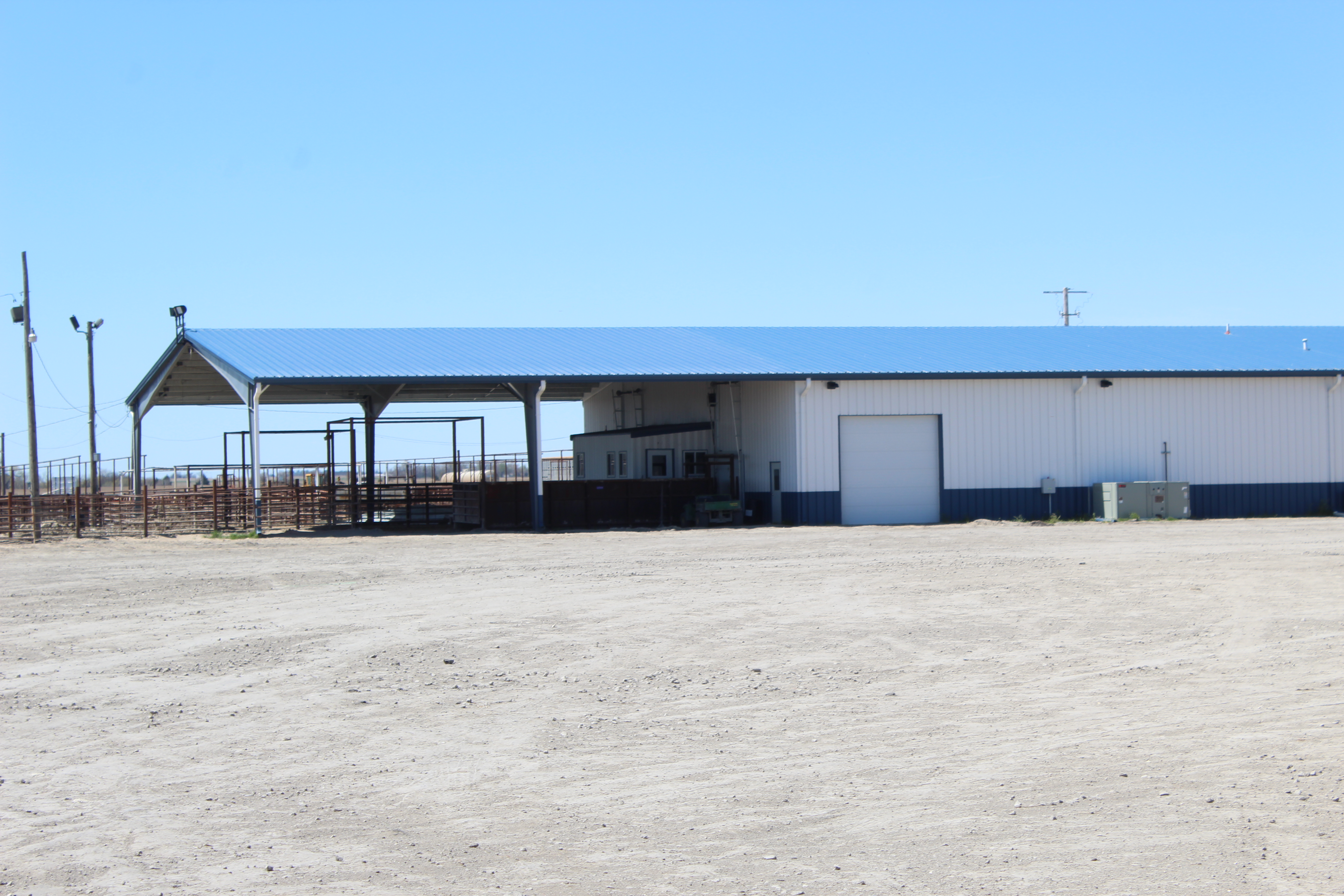
According to a report from the court trustee filed Friday, the total gross from the auction of the personal property and equipment from the bankruptcy auction was $405,682.
Almena Bank has the first lien on the real property, and second lien on the personal property and equipment.
TBK Bank has first lien on the personal property and equipment with the exception of four trucks and a skid loader, which had secured loans through other creditors. According to court records, TBK Bank is owed $227,238.
In court records, Almena Bank indicated Plainville Livestock Commission had defaulted on three loans with its bank totaling more than $3.49 million.
According to court documents, Plainville Livestock Commission debt is almost $14.5 million of which $3.7 million is secured debt. Landmark Bank of Manhattan is listed as an unsecured creditor with the commission owing $8 million.
Dozens of cattle producers were caught up in the Gillums’ alleged scheme after money that was supposed to be set aside to pay cattle sellers was transferred from a custodial account to the Plainville Livestock Auction’s operating account. The Almena Bank froze both accounts, which resulted in bounced checks amounting to tens of thousands of dollars per producer.
The court is holding about $900,000 from the frozen accounts at Almena Bank. The cattlemen’s case is moving through the bankruptcy court separately from the main bankruptcy. The next hearing on the cattlemen’s case is set for 10:30 a.m. July 11.
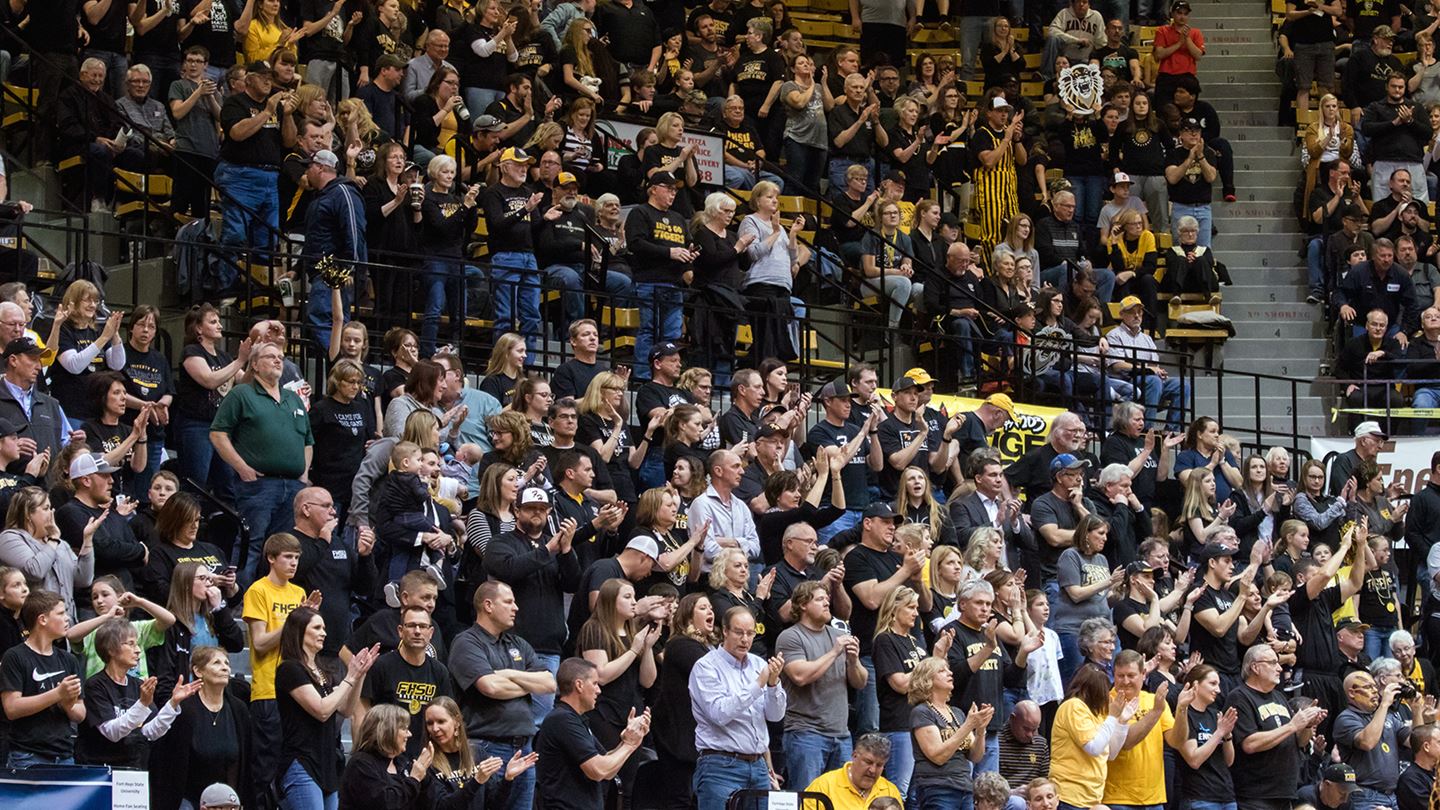
INDIANAPOLIS – The Fort Hays State women’s basketball team ranked second in NCAA Division II in attendance for the fifth consecutive season in 2018-19. An average of 2,518 Tiger fans filed through the gates at Gross Memorial Coliseum each night, setting a new program record. FHSU totaled 47,848 fans over its 19 home games last year, the second-highest total attendance in NCAA DII history.
A regular at the top of the attendance charts, Fort Hays State has now been in the top 10 in average attendance for 10 straight seasons. Included in those 10 years are eight seasons in the top five and six seasons in second place. Northern State topped the list for the 12th consecutive season in 2018-19, averaging 2,609 fans over 13 home dates.
The large crowds have helped Fort Hays State create one of the best home court advantages in the nation, as the Tigers have lost one or fewer home game each of the last seven seasons. FHSU is an astounding 109-6 inside the Coliseum during that span (.948 winning percentage). The Tigers were 18-1 at home a year ago, matching their program record with a 25-game home winning streak dating back to January 2018.
The Tigers regularly played in front of large crowds on the road as well, with seven other MIAA programs ranking in the top 20 in Division II. The MIAA was the top conference in attendance for the 11th-straight season, averaging 1,053 fans through 204 games to account for a grand total of 214,907. Last season was the sixth-straight year in which the Tigers have led the league in average home attendance.
The record-setting attendance would slot the Tigers just outside the top 50 among the 349 NCAA Division I programs sponsoring women’s basketball in 2018-19, outdrawing the likes of Kansas and Wichita State. FHSU would rank the top 15% of DI programs with 50 schools averaging a higher attendance.
Bob Taylor, field services specialist for the Kansas State School for the Blind works with a visually impaired student to launch a drone during an extended school year learning camp on the FHSU campus last week.
By JAMES BELL Hays Post
Last week, visually impaired students from across central and western Kansas traveled to Fort Hays State University for a weeklong extended school year camp that brought together learning, fun, and comradery with the goal of helping students become fully functioning members of society.
The camp was organized by the Kansas State School for the Blind, which brings instructors from across the state to help teach the students a variety of life skills.
“For a person who is visually impaired, there are additional skills they need to learn in order to be productive members of society,” said Anna Cyr, field services specialist, Kansas State School for the Blind.
The camp focused on nine areas of learning that a visually impaired person needs as they transition to adulthood including, independent living skills, assistive technology, compensatory skills, such as Braille and large print, recreation and leisure, orientation of mobility, and social skills.
“We have been doing a variety of activities all week to address all of those areas and increase these student’s skill so that they can continue to learn and grow both in school and in life,” Cyr said.
Students that participated in the camp ranged in ages from 10 to 16, an ideal age Cyr said for their first experiences away from home and to work on developing skills they will need as they move towards college or the workforce.
“They are learning a lot of life skills,” she said. “They also have the opportunity to interact with other students that are visually impaired,” Cyr said.
Along with practical skills learned, the students are also getting valuable time interacting with others who share their experiences.
“Especially in western Kansas, it is pretty common to have one student who is visually impaired in a school district, so it’s not very often that they have someone else who also uses a white cane, or also reads Braille, or uses the technology that they interact with on a daily basis,” Cyr said.
Abrienda, a second-year attendee of the camp, said she was having fun interacting with the other students and practicing different skills.
Bob Taylor, field services specialist for the Kansas State School for the Blind works with a visually impaired student to type with a braille input device during an extended school year learning camp on the FHSU campus last week.
“Basically it’s (an) extended school year. You get to learn different things that maybe your school doesn’t teach,” she said. “You get to learn how to do different things, while you are cooking, or while you are out and about.”
She also enjoyed working with the technology available during the camp that helps visually impaired students develop communication and navigation skills.
“Technology is a lot different than what other people have,” she said. “So that’s kind of a new experience.”
But while she enjoyed the learning aspects of camp, she was a particular fan of a more leisurely activity.
“My favorite part of camp so far would probably be the art, because we are learning how to weave and do other things,” she said. “It’s a really good experience.”
Bob Taylor, an education technologist who is another field services specialist for the Kansas State School for the Blind, worked with the students over the week to learn and use specialized technology that helps the students adapt to the larger world.
“If we can get the kids talking about this stuff and what the outcomes are, they can self-advocate,” Taylor said. “We are trying to go ahead and get a lot of these kids to not be afraid and to self-advocate.”
If the students learn to ask questions and develop basic skills with the technology, it will help them to branch out into other educational opportunities.
In particular, he uses the technology to teach navigation skills and as a fun motivational activity to help the students self-advocate, by asking making them ask for things to use the technology.
“If they can self-advocate they can do other things,” he said, “if they are interested.”
A visually impaired student puts together a specially designed learning toy during an extended school year learning camp on the Fort Hays State Campus last week.
During the camp, Taylor said he is often in awe of the abilities and experiences the students bring with them.
“The more I do this, the more I bring in,” Taylor said. “Actually the students are teaching me.”
During the camp, the students also traveled into the community visiting local shops, restaurants and the Sternberg Museum.
“A big initiative of the Kansas School for the Blind in the last five years and beyond is to bring more of our services out to the students in their home areas,” Cyr said.
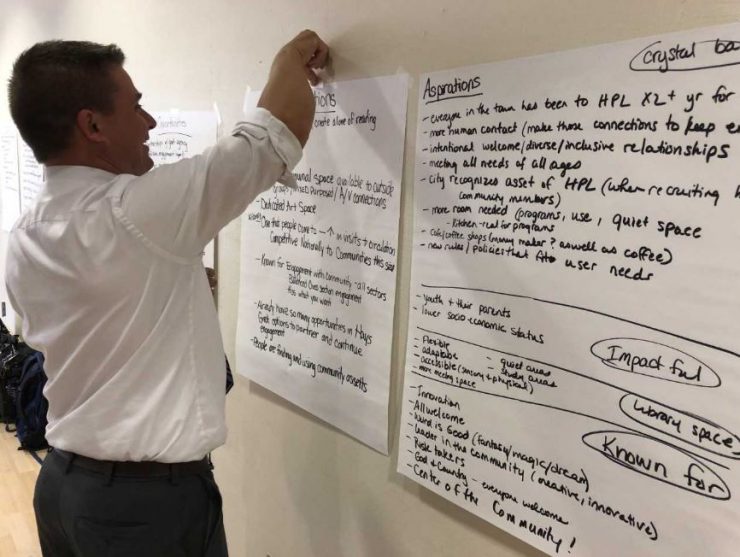
Brandon Hines, Hays Public Library director, tapes up a list of aspirations for the library generated during a recent stakeholders session.
By BECKY KISER Hays Post
More than 50 plus-sized sheets of information and ideas were taped to the walls of the Hays Public Library (HPL) meeting room following two library stakeholders meetings earlier this month.
Now director Brandon Hines and his library staff of 33 are awaiting compilation and analysis of the two public sessions led by Gail Santy, Central Kansas Library System (CKLS) executive director. CKLS is based in Great Bend.
“The purpose of the sessions is to solicit feedback and ideas about the role of the library in our community and to guide future priorities of the organization,” Hines told the 40 or so attendees at the beginning of each session. “Specifically, we are looking to establish goals and actions that will optimally benefit the community and uphold the mission and values of the Hays Public Library.”
CKLS consultants were at each table as facilitators, consolidating and then writing the answers from their groups to the questions asked by Santy.
Patty Collins, CKLS Youth Services Consultant listens to a stakeholder at her table as Celeste Lasich, First Presbyterian Church pastor, looks on.
Two of the consultants have ties to Hays. Patty Collins, CKLS Youth Services Consultant, and Christie Snyder, CKLS School Library Consultant, are both graduates of Fort Hays State University.
Santy guided them through “SOAR – Strengths, Opportunities, Aspirations, Results – What can we build on? What are our possible future opportunities? What do we care deeply about? How will be know we are succeeding?” The SOAR design comes from the Aspen Institute, an international nonprofit think tank founded in 1949 as a nonpartisan forum for values-based leadership and the exchange of ideas.
The questions in each category were created by the HPL staff and library board members early in the day prior to the public sessions. HPL staff members were also at each stakeholders table giving their input.
“We’re here to kind of push us through the end of our strategic planning process,” said Hines who was hired as HPL director last summer. He worked previously at HPL in charge of the children’s department, then left to be director at two other Kansas libraries.
“When I came on there was a lot of work that had been done around here but just quite hasn’t been executed on. So we made a one year action plan to finish up some of this work,” explained Hines. “We’ve really progressed well with that.”
The library is looking to the public and its patrons to help guide its future.
“We’re at the point now where we need to sit back and get some ideas, feedback on some of the changes we’ve already made and also on some of the work we want to do,” Hines said.
Part of the action plan is to remodel some areas of the library within the next couple of years. The current building was constructed in 1968; Hays Public Library opened in 1911.
The last major renovation was in 2004. “We know our needs for the space has changed quite a bit since then,” Hines told the group gathered around eight tables. “All this information we gather here today will help guide that.” He said the library intends to soon form a design committee to address space changes in the building.
Earlier this year the library completed its Mission, Vision, Values statement.
The information was at each table which Hines hoped would help “establish the right mindset” during the discussions.
“This is why you’re here,” Hines explained. “We need help with specific goals and outcomes and then specific actions we want to take or some ideas to get us to that point.”
Once the report and compiled data is returned by CKLS, it should give HPL a directional map for the next three years.
Santy urged the attendees to be candid. “We can’t move forward unless we know how you really feel.”
Margie Sheppard, CKLS Library Technology Consultant, listens to input from her group.
The groups spent an hour discussing questions including the greatest value the library provides to the community, key areas of untapped potential, the look of library space in 10 years and what excellence looks like.
Those offering their input in the afternoon session included representatives of USD 489 and TMP-Marian schools, the Hays Arts Council, churches, Northwest Kansas Area Agency on Aging, Downtown Hays Development Corporation, Friends of the Hays Public Library, and local residents.
After 60 minutes, the meeting room walls were covered with sheets listing each table’s ideas of strengths, opportunities, aspirations, and results.
Gail Santy, CKLS executive director, led the HPL stakeholders sessions.
Santy quickly read aloud each answer and suggestion.
Ideas included starting a bookmobile, more charging stations for personal electronic devices, more meeting space and areas redesigned for smaller groups, finding annex locations for programs already offered by the library, providing ESL (English as Second Language) interpreters, and getting more involved with the local governing bodies.
Then the stakeholders were invited to use sticky dots to vote anonymously for their top two priorities.
Pat Hill (left) wants to see smaller meeting places available at HPL.
Pat Hill feels the library should concentrate on books and literacy, and opportunities for children.
“We have a lot of good connections with Hays schools,” Hill noted.
She’s a member of Friends of the Library which operates the used book store in the library.
Hill is new to Hays, moving here from Michigan about 18 months ago.
“There’s a lot of things I didn’t realize the library does, and all the community participation,” she said, “but I can see we need to make a few improvements although we have a lot of strengths.
“We had a wonderful discussion at our table. I’m very proud of our library.”
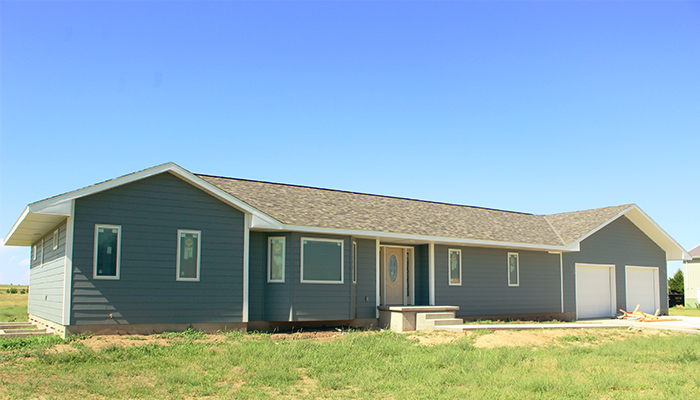
The Northwest Kansas Planning and Development Commission hopes to have this three-bedroom home at 1941 Leiker Road in Hays completed and listed within the next month.
By CRISTINA JANNEY Hays Post
The Northwest Kansas Planning and Development Commission has decided to discontinue a housing program that included purchasing homes from the NCK Tech building program.
The program has become too costly, said Randall Hrabe, Northwest Kansas Planning and Development Commission executive director.
The commission has purchased two homes from the program in Beloit, three from Hays and two from Goodland. The two homes that were built in Beloit have sold.
The commission has about 130 houses or duplexes across northwest Kansas as part of its housing program and thought buying the technical program houses would be cheaper than building the homes themselves, Hrabe said.
Of the homes from the Hays program, all three of the homes have yet to be sold. The homes located in Hays were finished in the spring of 2017 and 2018, but were only moved to their lots this April. Hrabe said the commission had difficulty finding lots and someone to move the homes in the Hays area.
This home at 1337 285th Ave. in Hays is also for sale.
Work is still being done on the two homes in Hays, but Hrabe said he hopes those homes will be finished and be able to be put on the market within the next month.
The three-bedroom homes are at 1337 285th Ave. and 1941 Leiker Road. The house on 285th Avenue is 1,500 square feet with a full basement and a double garage. The house on Leiker is is the 1,920 square feet, also with a full basement and a double-car garage. Both houses are located on 2 acres.
The house in WaKeeney is 1.920 square feet with a fully finished basement, a double-car garage, a full-length deck on the south side, stainless steel appliances installed and three bedrooms upstairs and two downstairs. It has city water and sewer and is on a paved street. It is located on four acres.
The commission also has a house in WaKeeney; however, it received more than $47,000 in damages during a major hail storm that hit that community in 2017. Repairs are still being made to that house.
The cabinets in the kitchen of the home the commission has for sale in WaKeeney are made of cherry wood.
The commission originally received funds from the Dane G. Hansen Foundation for the program. The plan for the project was to purchase the homes in the spring, move them over the summer and have them sold shortly after that. Then the money from the sale of one home could be invested in another technical school home the next spring.
“Just because it has taken us longer to get them moved, get them set … What we found out was that we are having to finance two years,” Hrabe said. “With three vo-techs, we are talking about $800,000 invested in these.”
Hrabe said the commission is having difficulty meeting the market demand.
Once the homes have been moved, placed on foundations, and sewer and HVAC installed, the commission has about $300,000 in each house. The City of Goodland gave the commission the lots on which the two vo-tech houses there were built, but the commission’s cost still ran about $250,000.
The exterior of the house the commission has for sale in WaKeeney at 10th and Josephine streets.
Hrabe said most entry-level homebuyers in northwest Kansas are looking to spend between $135,000 and $150,000. However, Hrabe noted the market in Hays is a little bit stronger.
“We, as a nonprofit, can’t continue to lose money on them,” Hrabe said of the houses.
The commission is not the only developer that is faced with the challenge of this gap. There is a demand for entry-level homes, but builders can’t construct the homes for what consumers are able to pay.
Hrabe said the commission is continuing to build duplexes and rentals in the region. This includes six new duplexes in Russell and a new tri-plex that was just finished in Grainfield. Hrabe said the hope is seniors will downsize into the smaller rental units, allowing families to purchase and move into existing housing stock.
Hrabe said anyone interested in purchasing the two homes in Hays or the home in WaKeeney can contact him at 785-421-2151 or [email protected].
Epworth Towers will begin a $7 million renovation of its 90-unit senior and low-income housing complex in July.
The complex, 2800 Augusta Lane, was built in 1980. Tax credits from the Kansas Housing Resources Corporation will allow for a top-down renovation of the building. Completion of the project is anticipated in October 2020.
The renovation will address mechanical and interior issues at the complex. This will include a new heating and air-conditioning system and mechanics for its elevator as well as new paint and decor for the common areas of the complex.
All of the apartments will be painted and receive new appliances, carpet and windows.
Debra Staab, Towers manager, said the complex provides clean, affordable housing, but the building is aging and needs updating. The Towers has made cosmetic upgrades to carpet and other aspects of the facilities over the years, but this will be the first major overhaul in the facility’s 40 years.
Staab gave the example of the windows, which are a crank style and do not function well during high Kansas winds.
In anticipation of the renovation, the Towers stopped renting to new tenants. As vacancies occurred, some tenants were moved to create a block of empty apartments in the southeast quarter of the complex where the renovations will begin. Once the apartments are completed, the Towers will move the tenants back into their original apartments.
Parking will remain the same for tenants during the renovation. Additional parking will be added as part of the project toward the end of the construction. The Towers office also is being enlarged.
Epworth Towers is a nonprofit entity for renters who are 62 or older or disabled and who meet income requirements. Rents are based on 30 percent of the renters’ adjusted incomes. Once the renovations are completed, the Towers will open rental applications again.
“Epworth Towers has a long history in the Hays community and is very excited to be able to complete these upgrades for the residents,” Staab said in a news release. “These improvements will allow Epworth Towers to continue to provide quality, affordable housing for many years to come.”
Staab said low-income housing is needed in Hays.
“We go specifically to the elderly and low-income,” she said. “They need to have places that are clean and in great condition. We needed to get the bones of the building up to standard. We never have a vacancy issue.”
Epworth Towers Inc. is working with Wichita developer Investment Resources Corp. and Accel Construction Co. to assist with the redevelopment.
The WKCAC serves 33 counties in western Kansas, including Ellis County. Although the WKAC has brick-and-mortar offices in Hays and five other Kansas cities, it does not have offices in many of the communities that it serves.
WKAC provides forensic interviews for children who authorities believe have been abused. The center can refer child survivors and their families for follow-up services. Some children return to the WKCAC for therapy services when needed.
The WKCAC already has a fleet of RVs that have been equipped to serve children and their families in the rural areas of its coverage area. The WKCAC Mobile Child Advocacy Center is the first mobile unit accredited in the nation.
The interview room of one of the WKCAC’s mobile unit. The back section of the mobile medical unit includes an exam room.
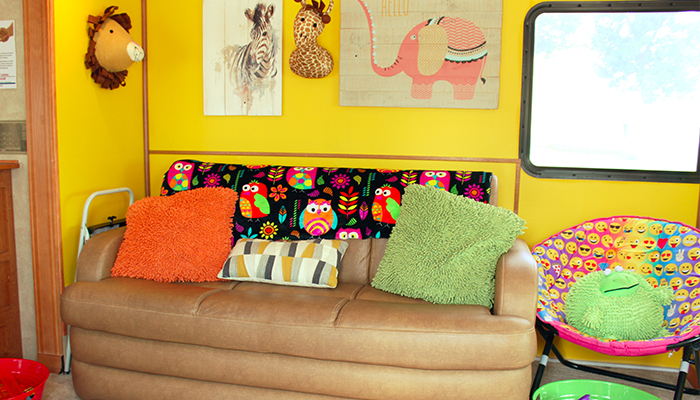
The new medical unit includes a family area, where children can meet center workers. These “family rooms” are decorated in bright colors with kid-friendly decor and equipped with toys to help children feel at ease, said Victoria Brady, forensic interview and child and family advocate.
In the rear of the RV where sleeping quarters would be, the RV has been outfitted with an exam room. Nurses affiliated with the WKCAC perform head-to-toe wellness exams for children in the unit.
“A lot of times that is healing for a kid to hear that their body is OK,” Brady said. “We find that is beneficial.”
The Department of Justice provided a Violence Against Women grant to support both the purchase of the mobile medical unit and the ongoing wellness exams.
The driver’s area of the mobile interview unit is equipped with screens and headsets so law enforcement officials, DCF officials and the county attorney can observe forensic interviews of children.
The medical unit can also be used for sexual assault exams. In some cases, the exams are used to collect evidence.
In some cases no injury is found, but Brady said that does not mean sexual abuse did not happen.
In addition to the new medical mobile unit, which went into service in April, the WKCAC also has mobile interview units and mobile therapy units.
The mobile interview units are outfitted similarly to the medical unit, however, instead of an exam room in the rear of the RV, there is an interview room. The interview room is equipped with cameras, so law enforcement officials, officials from the Department for Children and Families and the county attorney can listen and watch the interview from behind a curtain at the front of the RV.
One of the WKCAC’s mobile units.
“There is a TV screen, so they can monitor the child’s body language,” Brady said. … “when they are answering my questions, if they are hesitant.”
The therapy mobile units allow therapist to travel to the children in need of services. They can park at a school or other location, so the child has minimal disruption in his or her routine.
None of the mobile units are marked to give families more anonymity.
Throughout its coverage area, the WKCAC served more than 500 children last year. Brady estimated the majority of the children were served through mobile units.
“I think it is important because we live in such a rural area,” Brady said of the mobile unit fleet, “and not all the families that we see have the means to come to us physically, so we are able to come to them. Parents are more likely to participate in services when you actually come to them.”
Brady said using mobile units or one of the CAC brick-and-mortar centers, is much less traumatic than having to go to a police station for children to be interviewed about their abuse.
“All of our CACs are very bright and colorful, and even the mobile units are just a very kid friendly environment,” Brady said. “They are greeted by myself and an advocate and when the mobile medical unit goes out there is an advocate with the nurse.”
The WKCAC accepts specific donations for bags of gift items the children can take home with them. It also accepts donations of office supplies and has tasks that require volunteers.
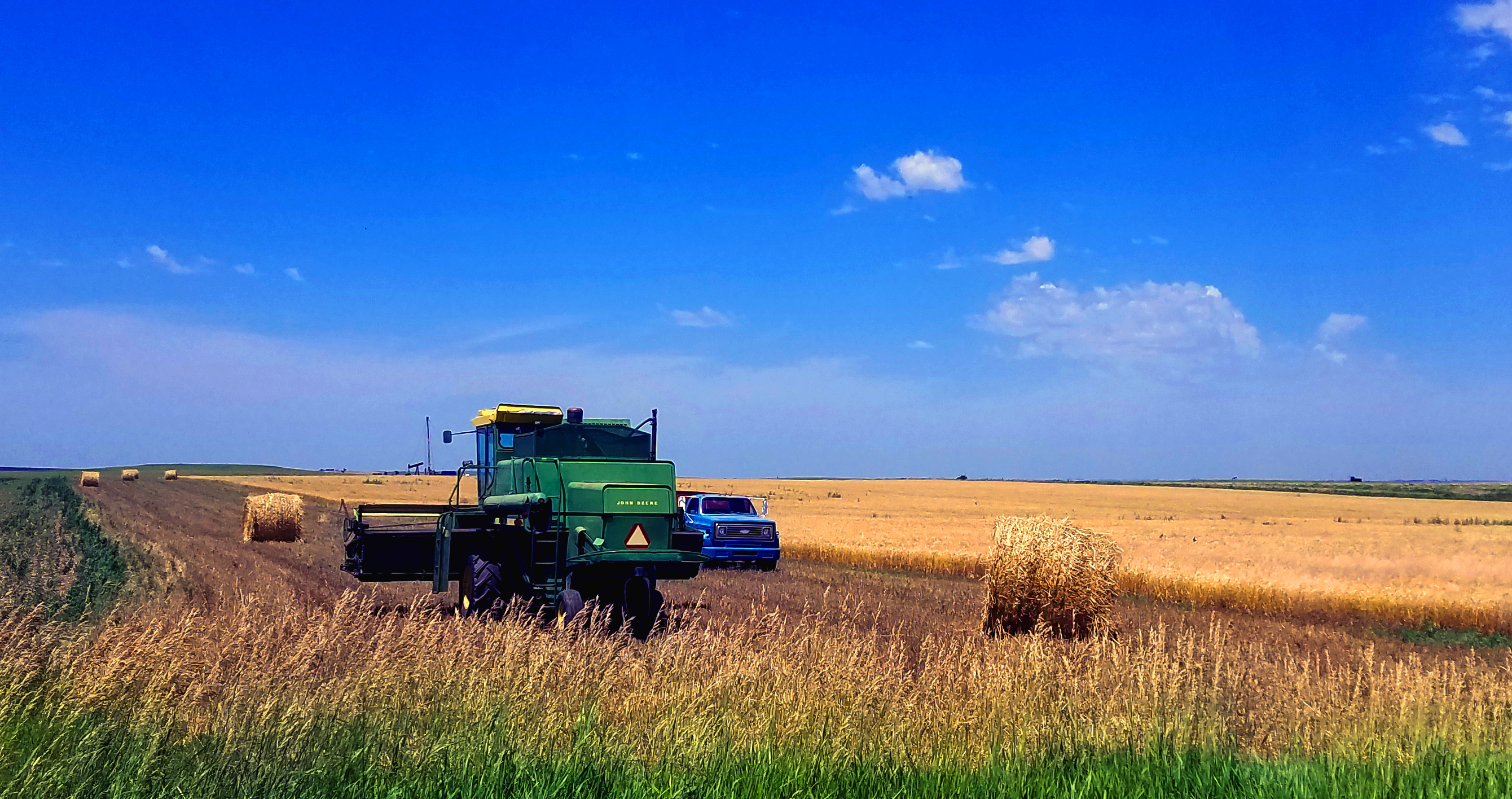
A combine and grain truck sit idle in a field south of Ellis on Wednesday afternoon as the winter wheat harvest in western Kansas gets off to a slow start.
By JAMES BELL Hays Post
Slowly but surely, the winter wheat harvest around Hays has begun, with early reports showing potentially high yields, due to recent cool and overcast weather following a mild winter.
Midland Marketing in Hays had two loads come in Tuesday night and three more Wednesday morning, according to Brian Witt, Hays coordinator at Midland Marketing.
“We are just getting started. There are only a few guys that can actually cut,” Witt said.
Grain that came to the elevator in Hays had been cut late Tuesday, according to Witt, with nothing being cut on Wednesday as rain threatened to hit Hays.
Through the day, however, rain would not materialize over the area — good news for farmers waiting for fields to dry from heavy spring rains.
But so far, wheat delivered into Hays is showing encouraging yields.
Moisture was running from 11.5 to 12.5, Witt said, with test weights in the lower 60s.
“Sixty-one has been the lowest I have seen so far,” Witt said, “which is really good.”
Protein tests are also on the low side at 10 to 10.5.
“The kernels currently look great,” Witt said.
The elevator in Yocemento was also reporting good wheat numbers, according to Clint Pfannenstiel, Yocemento coordinator at Midland Marketing.
“So far, we have had about 5,000 to 6,000 bushels come in,” he said.
“That wheat is testing 62 to 62.5 test weight,” he said, calling the yields “excellent.”
“Some of it could be 60-70 bushels an acre,” Pfannenstiel said. “It looks really good.”
While wheat is coming in around Hays, the harvest is not yet progressing to the south.
“South of Hays, around McCracken and Brownell, (we) did not take any grain,” Pfannenstiel said. “We are progressing quicker than they are south of here 20 or 30 miles.”
This year’s harvest has been delayed from normal, which is likely to push harvest completion into mid-July.
“Normally we say Father’s Day weekend is about an ideal consistent start,” Witt said. “Anything before or after that is either or late, at least in this area.”
The late start might be unusual, but likely welcome as the conditions that have delayed the harvest are also contributing to the exceptional results.
“The later your harvest is, the better your yield. The earlier it is, the more stress it has been through, or things have gone wrong so it dies off and doesn’t have as much growing period,” Witt said. “With cool weather and overcast skies, the wheat wasn’t drying down, which is actually good. … As far as increasing your yield, you get larger kernels. Everything generally produces better.”
Now with warm windy weather in the forecast for the weekend, both Witt and Pfannenstiel expect harvest to be in full swing by Monday at the latest.
“We want to get these couple of days of hot and windy,” Pfannenstiel said. “Another day or two of that and we will be going strong.”
While fields around Hays were generally spared from damaging storms during the spring, a few instances of crop loss were being reported in the area.
Witt said he heard reports about a strip south of Victoria where a few fields were lost, as well as a field or two southwest of Hays.
Pfannenstiel noted reports of some damage to the southwest as well.
“In that area, it was probably hit twice, with two different storms, probably 15 to 20 days apart,” Pfannenstiel said.
But it could have been much worse.
“We have been very fortunate considering how many storms we have had come through this year,” Witt said.
“We’re still open. It is not going to affect us. Come on out to the park.”
By CRISTINA JANNEY Hays Post
Although the Kansas Department of Transportation closed the bridge over the spillway at Cedar Bluff State Park on Wednesday, Park Ranger Kyle Burgoon said he did not think the closure would seriously affect the operations of the park.
He said Kansas Highway 147 will be closed over the dam and the spillway. However, park goers should be able to route around the closed section of the road to still reach the south side of the park via K-147 using chalk roads. The detour is about 10 miles one way.
The detour would route people east on U Road about 3 miles to 370th Road then south about 4 miles to Y Road and then back west another 2.5 miles to K-147.
The south side of the park can also be accessed via U.S. Highway 283 and Kansas Highway 4.
The road over the entire length of the dam will have to be closed, Burgoon said because there is no turnaround point on the dam.
The park is still expecting about 10,000 people over the Fourth of July holiday next week. All of the camping sites with utilities have been reserved, Burgoon said.
“Really, I would say have patience with it,” he said. “It may take a little bit longer to go from one side to the other, but in the long run, it is for everybody’s safety to basically get a brand-new bridge put in and it will last a lot longer.
“We’re still open. It is not going to affect us. Come on out to the park.”
Sport Haven is a convenience store, bait and marine shop at the north entrance of the Cedar Bluff State Park on K-147.
Sydney Parker, Sport Haven store clerk, said she is being optimistic about how the bridge closure will affect the store’s business. She said she thinks people will be able to route around the closed bridge, visit the business and enjoy the park.
“I know we are going to have a few unhappy campers, but once they spend some time here, it’ll get better,” Parker said.
Burgoon also urged people to not go around the barricades as the bridge at the spillway has been deemed unsafe.
Plans are being developed for an emergency bridge replacement project to be completed in 2020, according to KDOT.
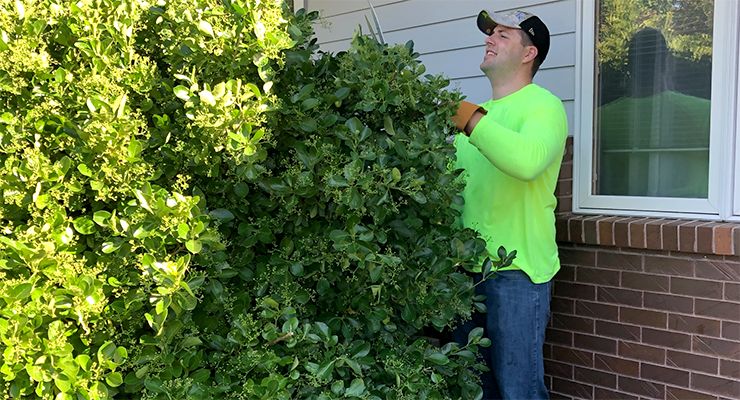
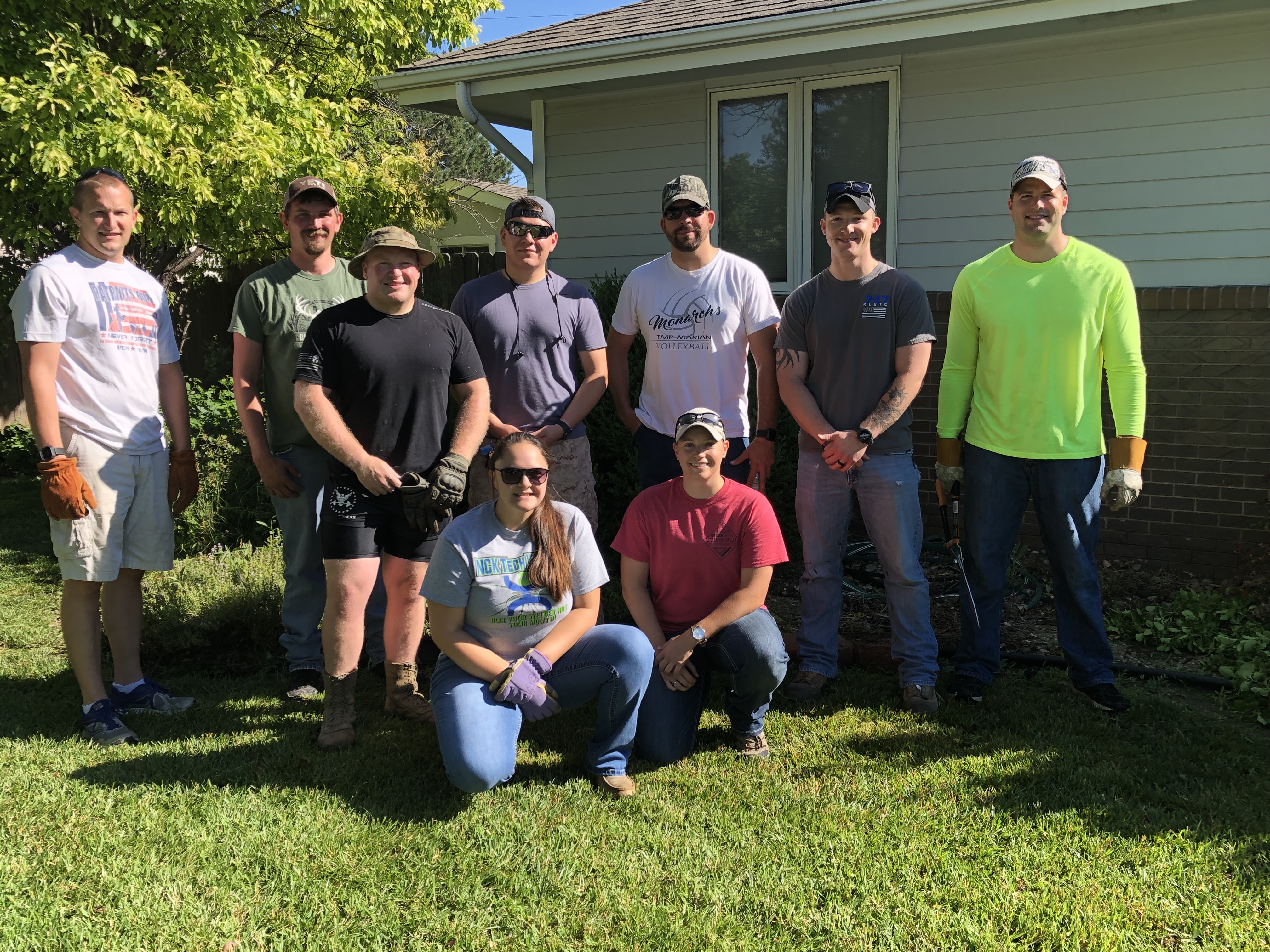
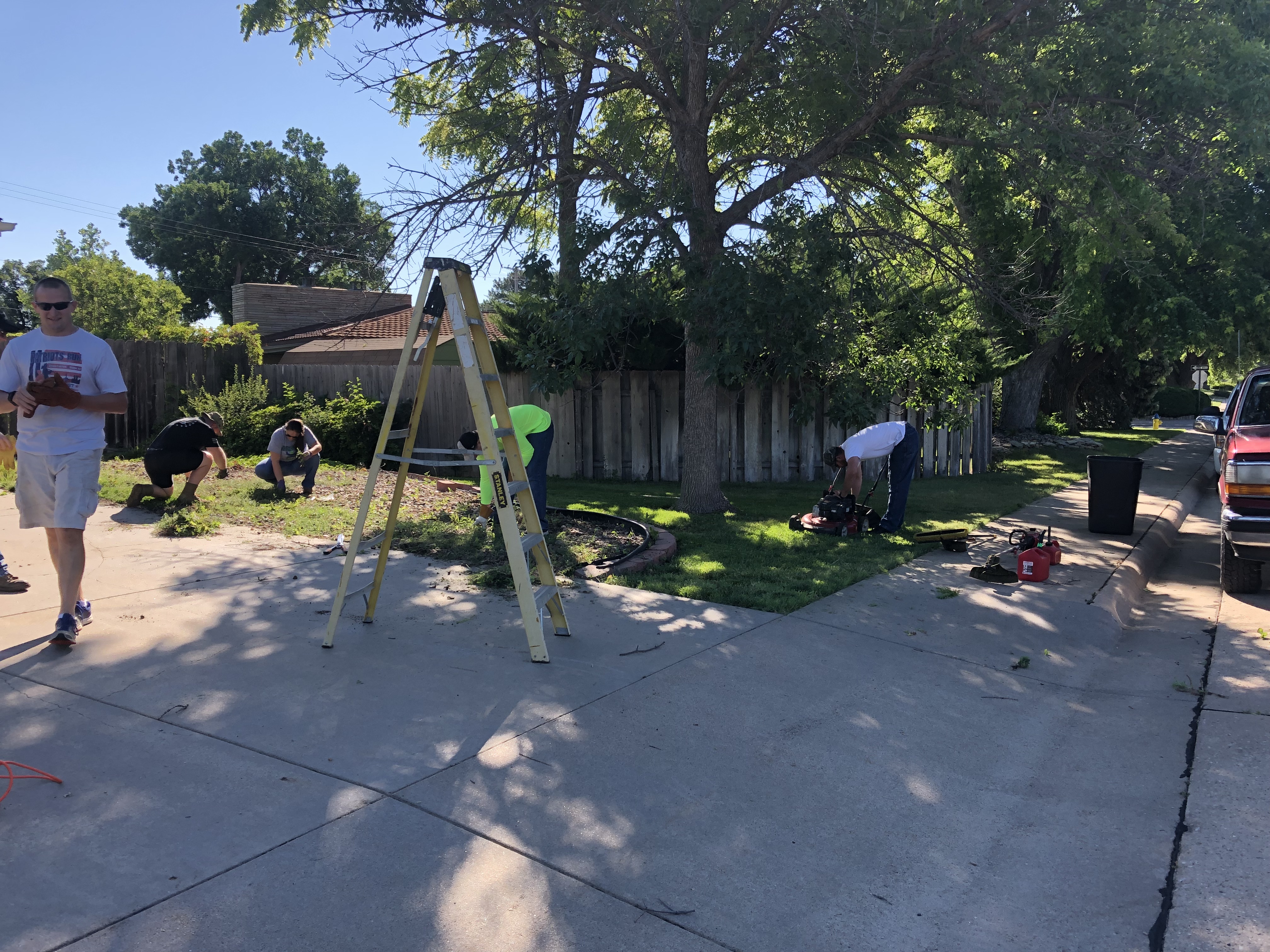
Hays Police Officer Ryan Blecha and the other members of his shift spent their day off doing lawn maintenance for 92-year-old Margaret Vine of Hays. (Back row L to R): Sgt. Brandon Hauptman, Dispatcher Josh Cooper, Ofc. Aaron Ewy, Ofc. Mackenzie Smith, Cpl. Vilaysing, Ofc. Ryan Blecha, Ofc. Scott Heimann (Kneeling) Dispatcher Alanna Hansen, Ofc. Samantha Nielsen
By BECKY KISER Hays Post
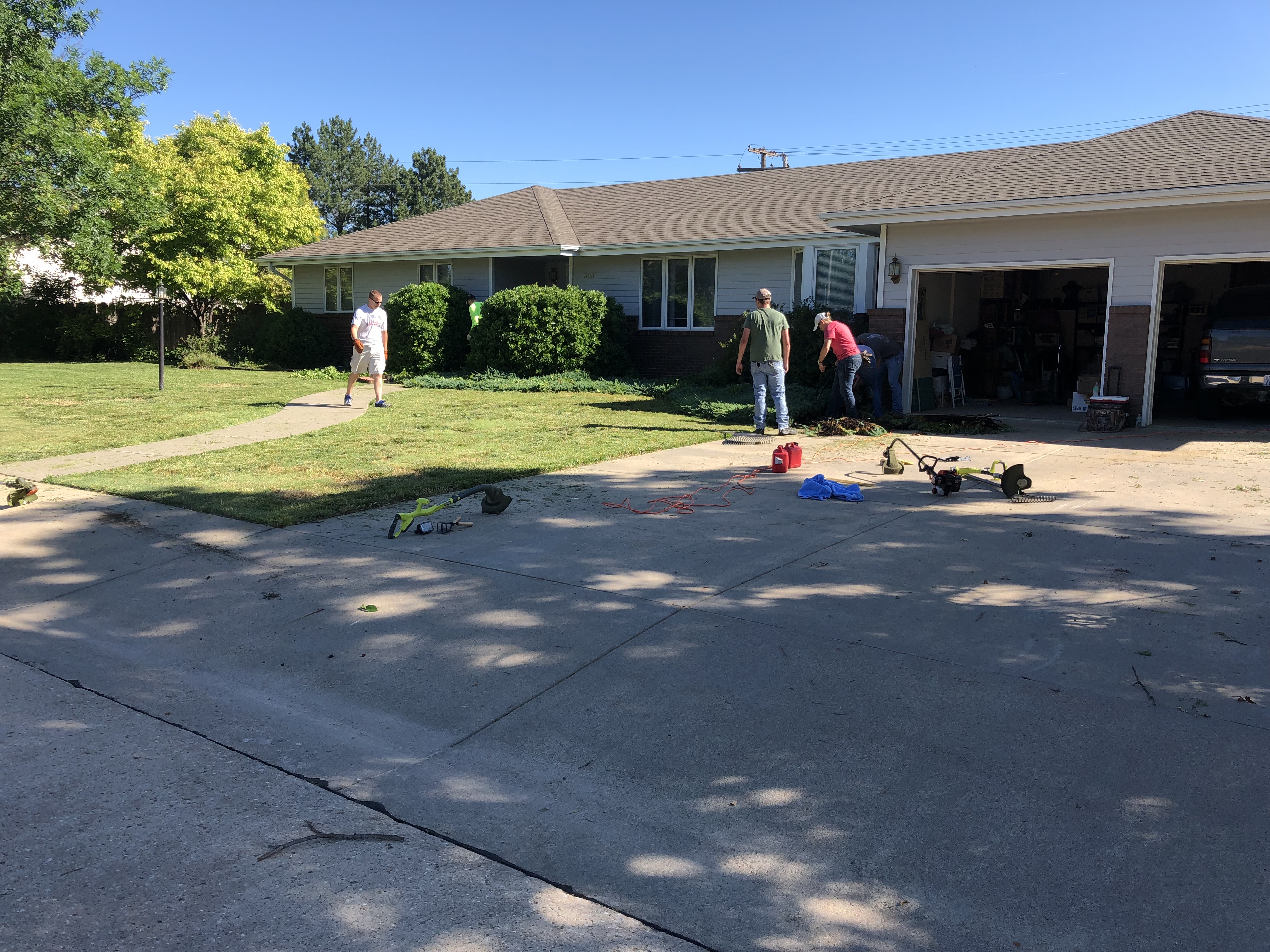
It was their day off, but the entire law enforcement shift that works with Hays Police Officer Ryan Blecha got together anyway.
All nine of them gathered at 9 a.m. to do major lawn maintenance at the home of 92-year-old Hays resident Margaret Vine.
“She really needed her lawn done,” Blecha said during a short break in the frenzy of activity Monday morning.
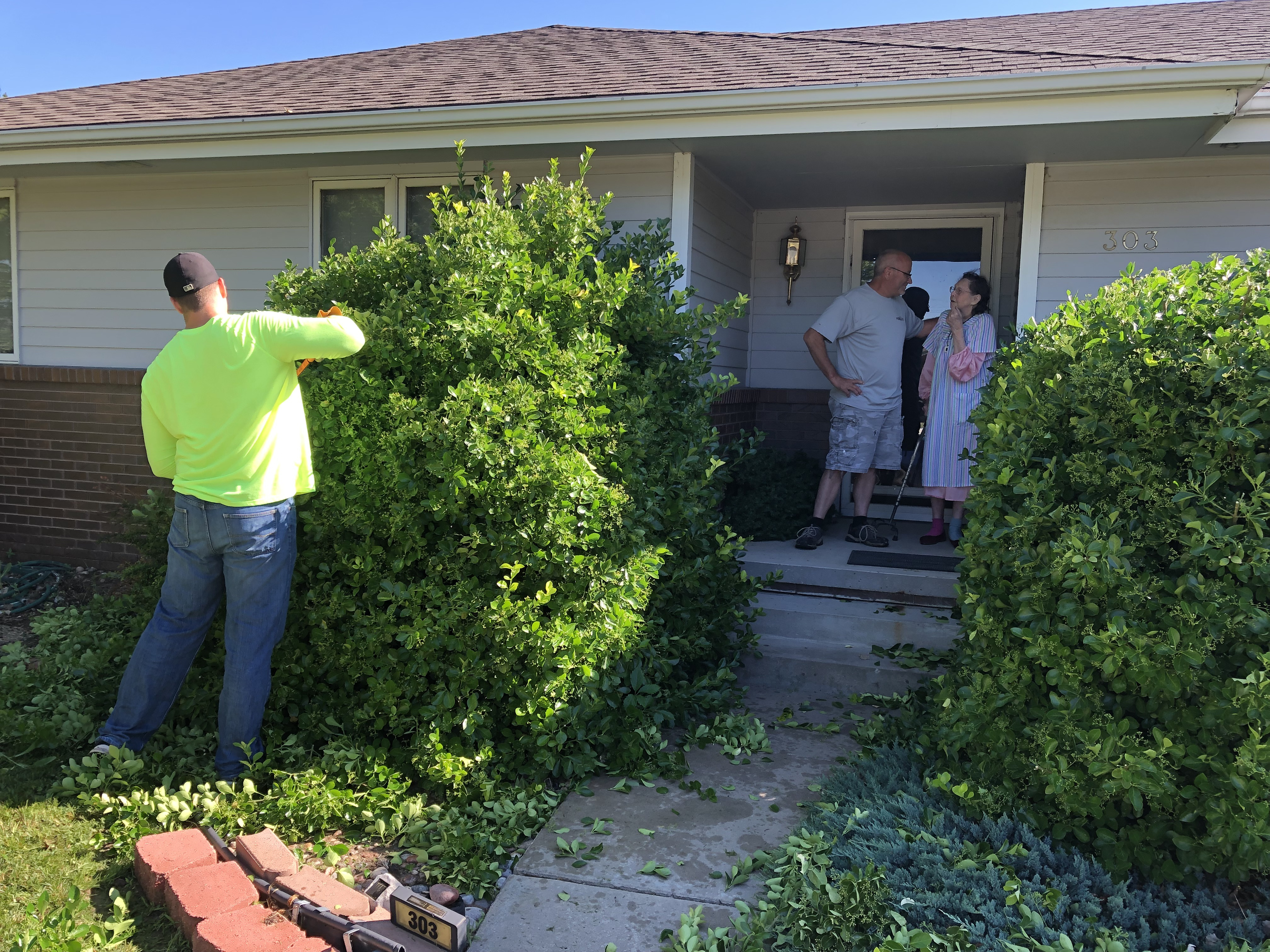
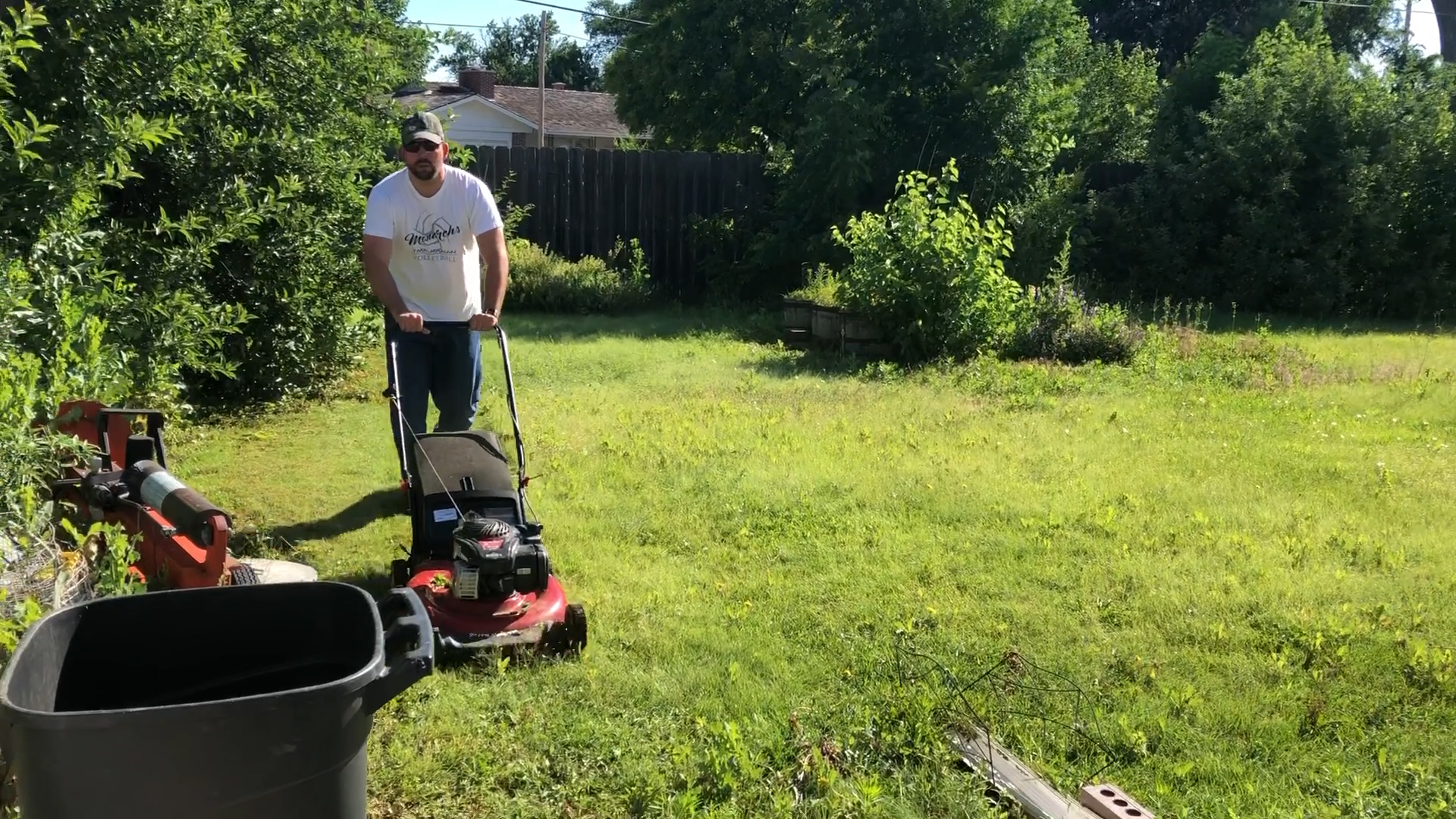
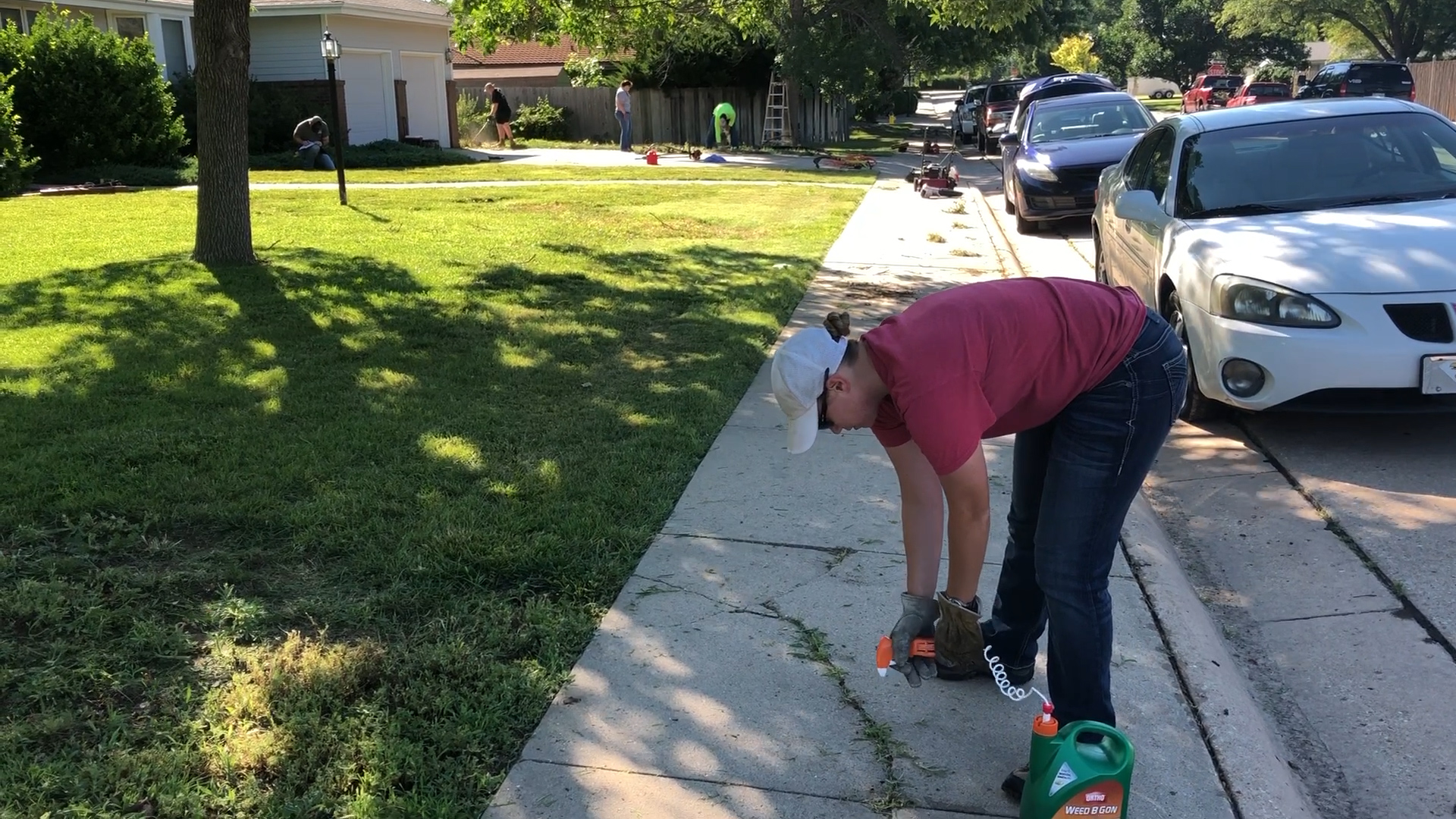
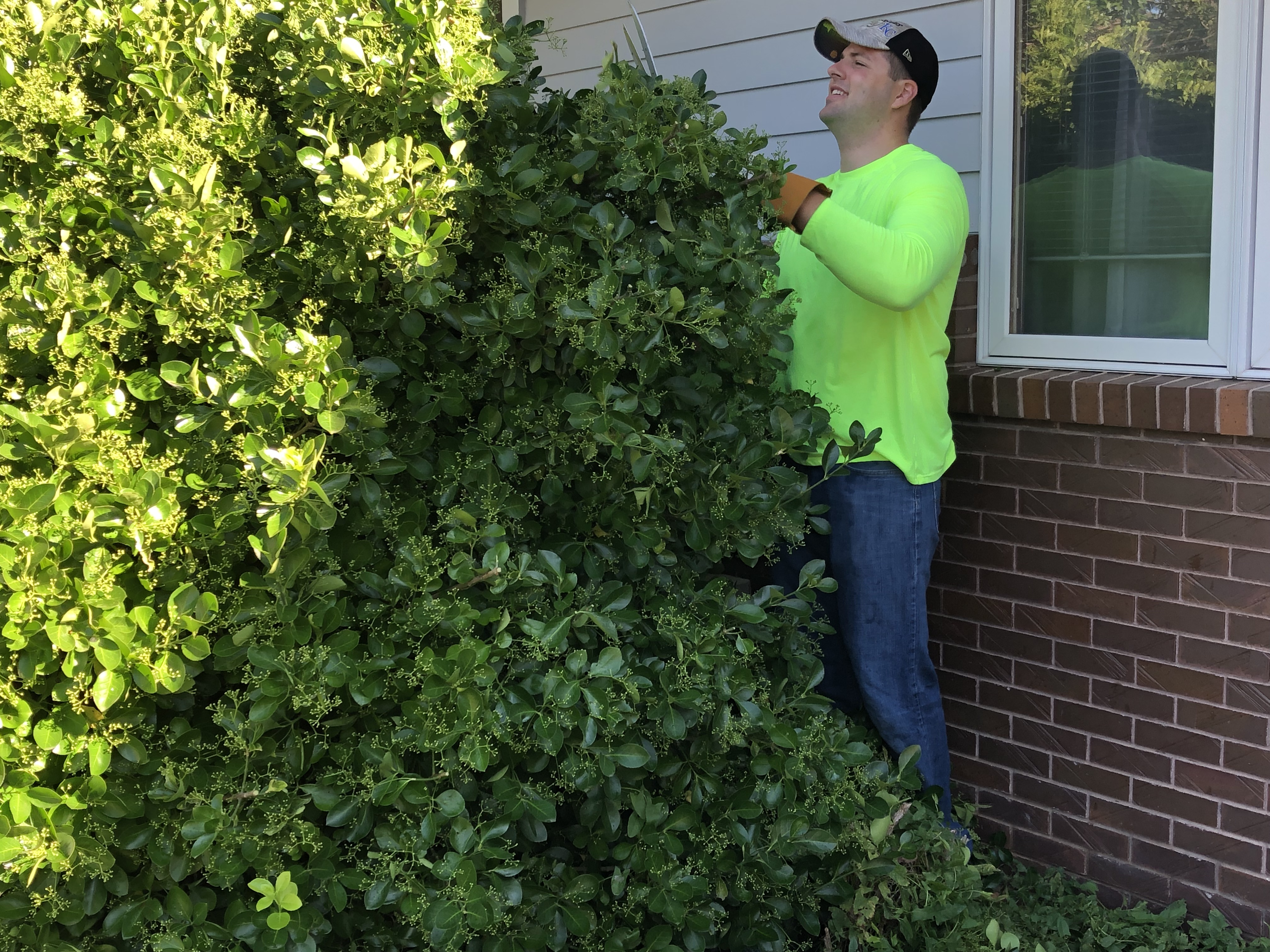
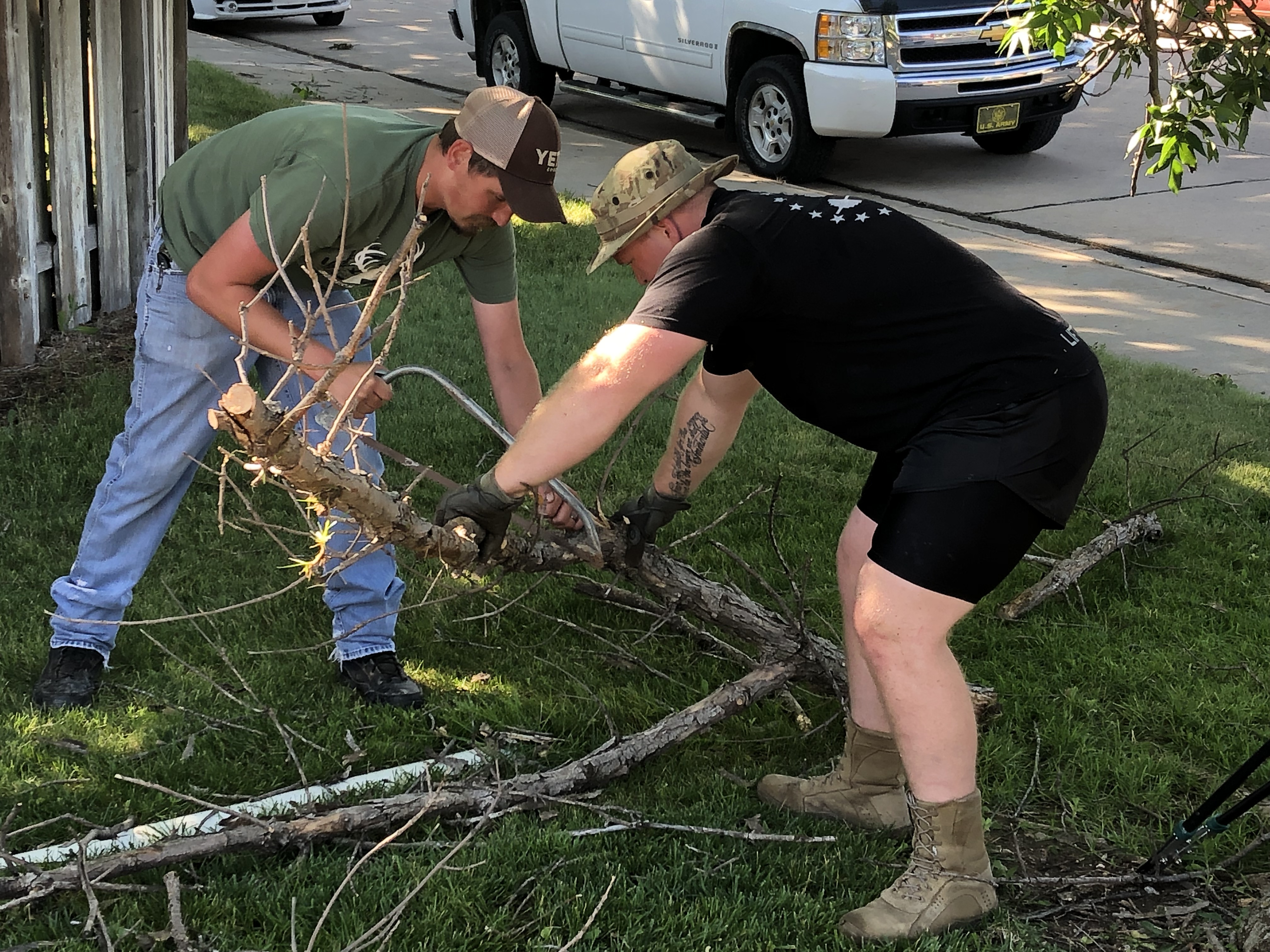
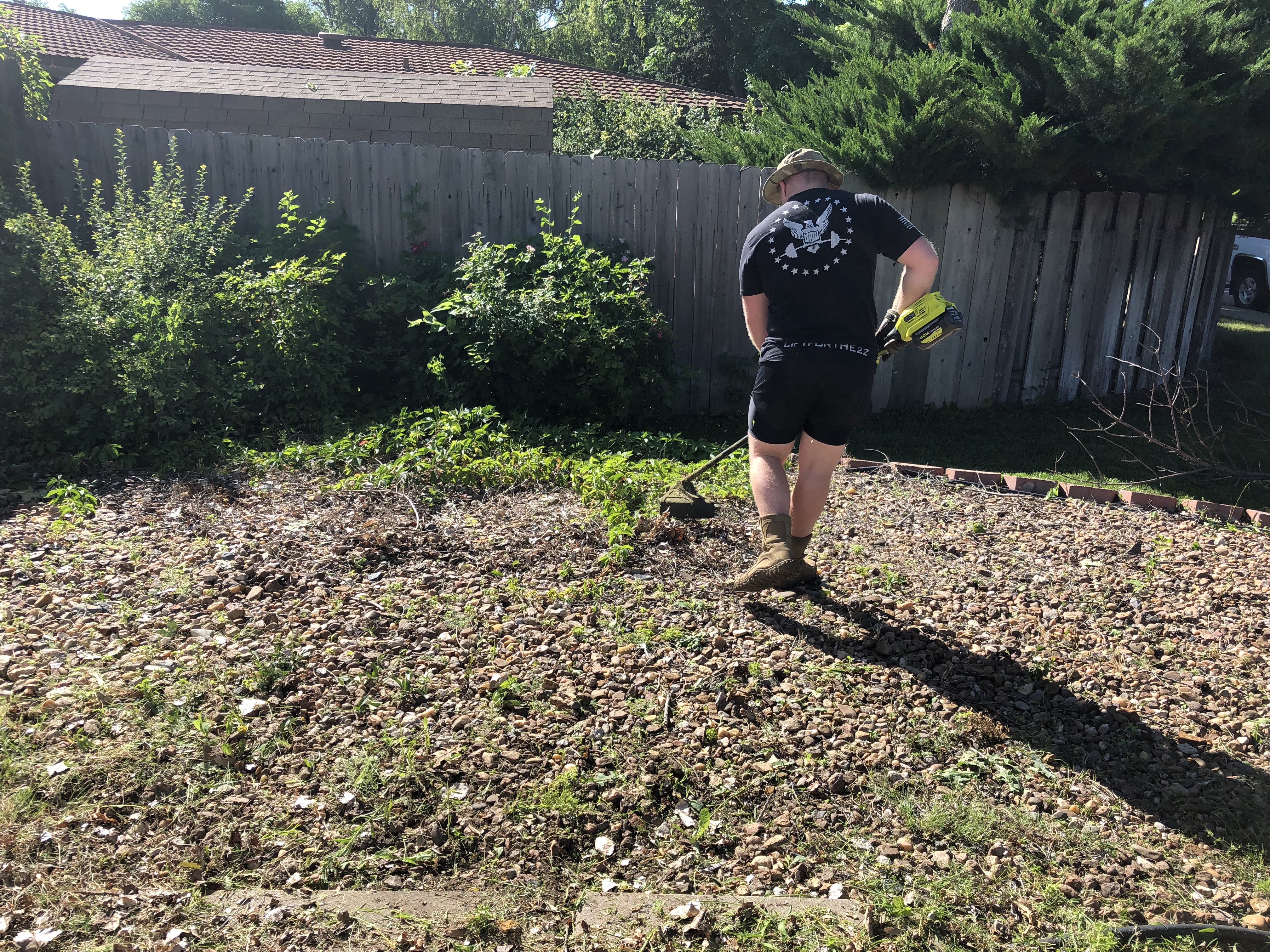
Nobody was in uniform. Instead the seven officers and two dispatchers were dressed in work clothes and boots, with yard and garden tools in hand as they clipped bushes, mowed grass, weeded, raked, and sawed dead tree limbs in Margaret’s large front and back yards.
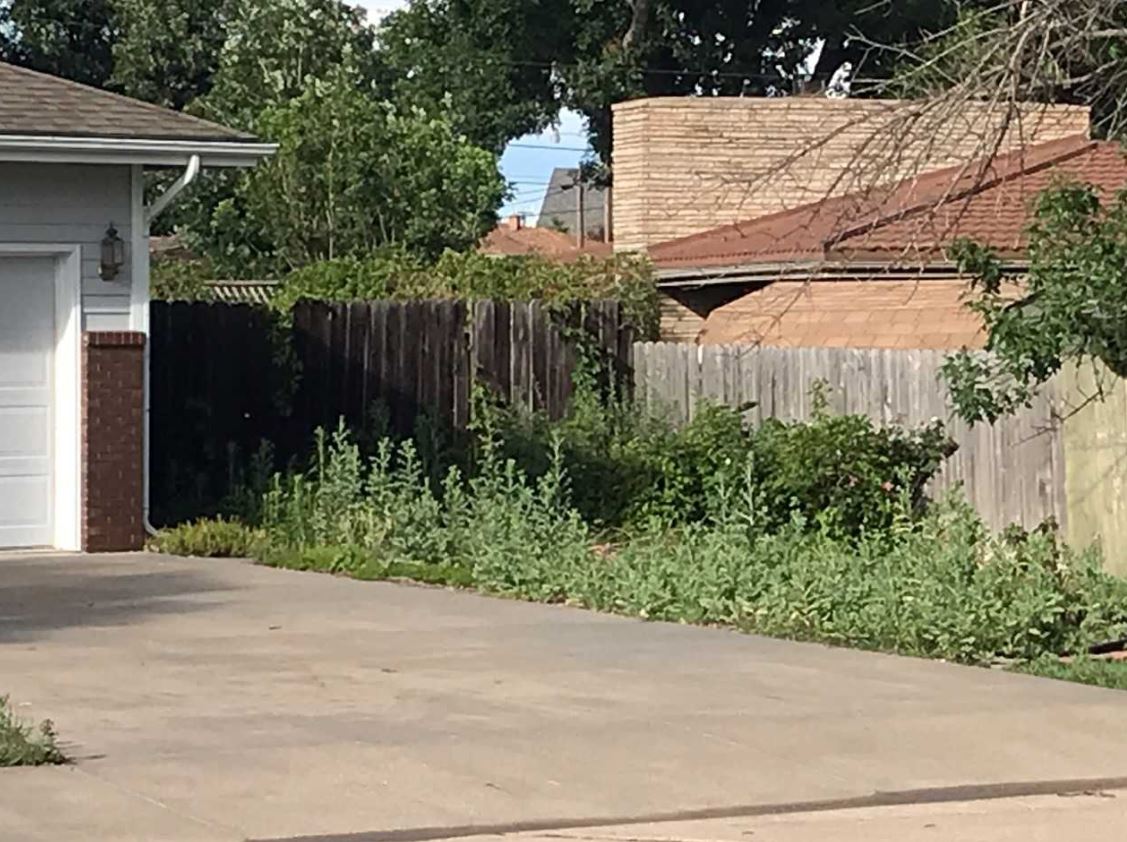
Blecha saw the overgrown front lawn and landscaping early Sunday morning during a patrol check at Vine’s house in the 300 block of West 25th. Hays Police were called by Vine’s granddaughter when she saw an unfamiliar vehicle and driver in front of their house.
Blecha responded to the call and made sure Vine and her granddaughter were safe. He left his business card with them.
“I saw the lawn was overgrown and didn’t want Margaret to have to worry about calling somebody or getting more help to do that,” he said.
A neighbor across the street, Dennis Budke, came over to check on Margaret when he saw the police car pull up. Budke told Blecha she has a lawn mowing service but “they don’t really do the deep stuff.”
Blecha also gave his business card to Budke, who “offered help with water and other power equipment.”
During a lull later in his Sunday shift, Blecha asked the other shift members if they’d be interested in helping him help Margaret.
“They all said yes,” Blecha said. “Basically, it was all put together in about 30 minutes on shift.”
The group brought their own lawn and garden tools, plus herbicides to kill the weeds. They filled their pickup beds with grass, leaves, bush clippings, weeds and dead tree limbs that were sawed off mature trees and hauled it all to the Ellis County Landfill.
Budke, whose son is a Kansas Highway Patrol trooper in Goodland, was also on hand during the lawn work, explaining to Margaret exactly what was going on.
When Blecha stepped up onto the porch to greet Margaret, she didn’t recognize him.
“Well, I have the card that nice young man left me last night on my table,” Margaret said slowly.
“And this is him,” Budke pointed to Blecha as he shook Margaret’s hand. “He’s just not in his uniform today.”
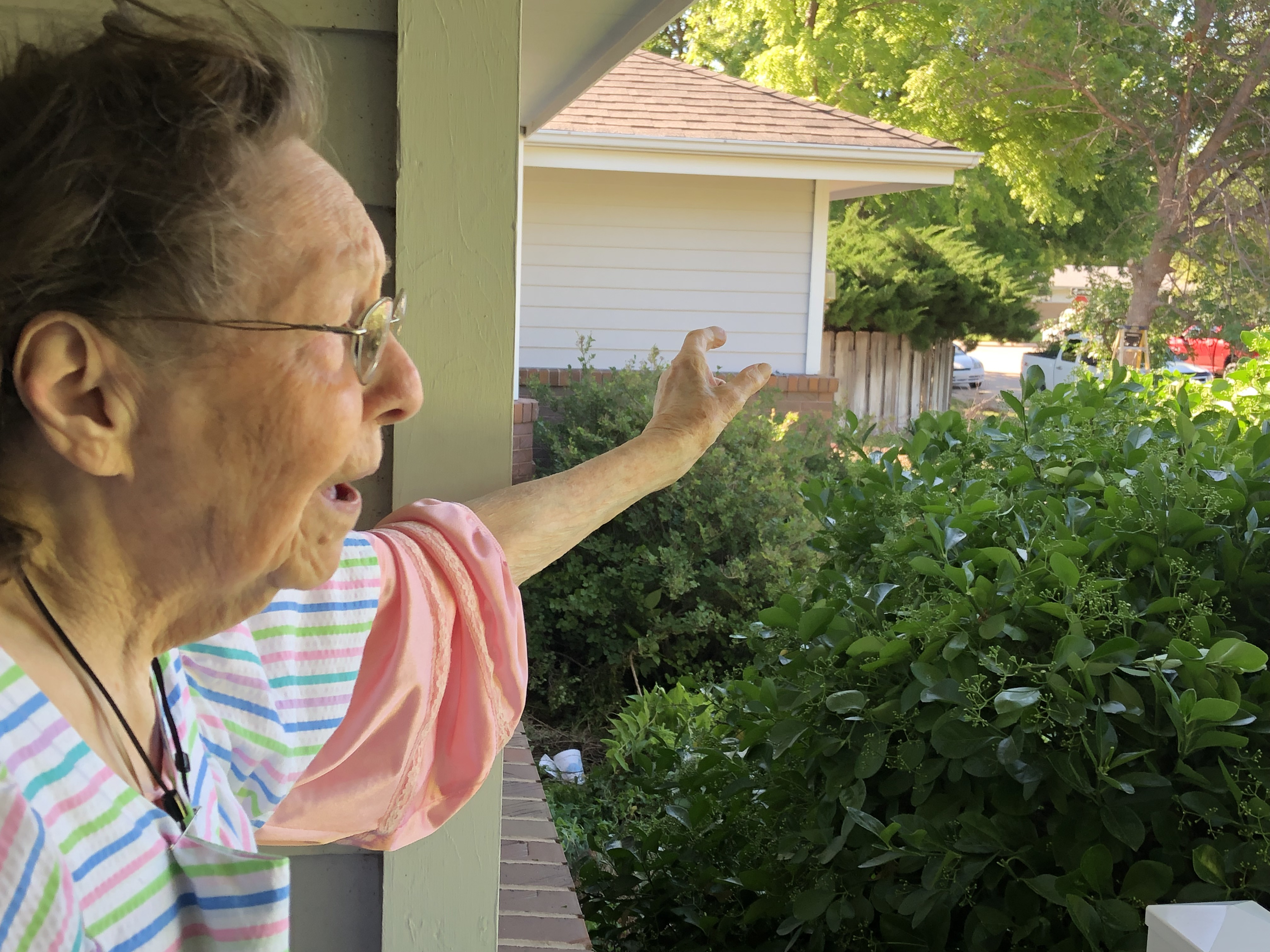
Margaret gasped a little as Budke explained everyone swarming over her property is a Hays police officer.
“Oh, they not only keep us safe, they do something like this,” Margaret smiled. “We have a wonderful community.”
The Hays police officers volunteering their time were:
Sgt. Brandon Hauptman
Cpl. David Vilaysing
Ofc. Samantha Nielsen
Ofc. Mackenzie Smith
Ofc. Scott Heimann
Ofc. Ryan Blecha
Trainee Ofc. Aaron Ewy
Dispatcher Josh Cooper
Dispatcher Alanna Hansen
A portion of Margaret Vine’s front yard prior to the cleanup by HPD officers. (Photo courtesy Dennis Budke)
An entire shift of Hays Police personnel volunteered on their day off to do lawn maintenance for 92-year-old resident Margaret Vine.
Dennis Budke talks to his neighbor Margaret Vine Monday morning about the Hays police officers working in her yard.
Margaret Vine had been worried about dead limbs on a mature tree in her front yard. They were removed by HPD volunteers.
A combine and grain truck sit idle in a field south of Ellis on Wednesday afternoon as the winter wheat harvest in western Kansas gets off to a slow start.
By JAMES BELL Hays Post
Slowly but surely, the winter wheat harvest around Hays has begun, with early reports showing potentially high yields, due to recent cool and overcast weather following a mild winter.
Midland Marketing in Hays had two loads come in Tuesday night and three more Wednesday morning, according to Brian Witt, Hays coordinator at Midland Marketing.
“We are just getting started. There are only a few guys that can actually cut,” Witt said.
Grain that came to the elevator in Hays had been cut late Tuesday, according to Witt, with nothing being cut on Wednesday as rain threatened to hit Hays.
Through the day, however, rain would not materialize over the area — good news for farmers waiting for fields to dry from heavy spring rains.
But so far, wheat delivered into Hays is showing encouraging yields.
Moisture was running from 11.5 to 12.5, Witt said, with test weights in the lower 60s.
“Sixty-one has been the lowest I have seen so far,” Witt said, “which is really good.”
Protein tests are also on the low side at 10 to 10.5.
“The kernels currently look great,” Witt said.
The elevator in Yocemento was also reporting good wheat numbers, according to Clint Pfannenstiel, Yocemento coordinator at Midland Marketing.
“So far, we have had about 5,000 to 6,000 bushels come in,” he said.
“That wheat is testing 62 to 62.5 test weight,” he said, calling the yields “excellent.”
“Some of it could be 60-70 bushels an acre,” Pfannenstiel said. “It looks really good.”
While wheat is coming in around Hays, the harvest is not yet progressing to the south.
“South of Hays, around McCracken and Brownell, (we) did not take any grain,” Pfannenstiel said. “We are progressing quicker than they are south of here 20 or 30 miles.”
This year’s harvest has been delayed from normal, which is likely to push harvest completion into mid-July.
“Normally we say Father’s Day weekend is about an ideal consistent start,” Witt said. “Anything before or after that is either or late, at least in this area.”
The late start might be unusual, but likely welcome as the conditions that have delayed the harvest are also contributing to the exceptional results.
“The later your harvest is, the better your yield. The earlier it is, the more stress it has been through, or things have gone wrong so it dies off and doesn’t have as much growing period,” Witt said. “With cool weather and overcast skies, the wheat wasn’t drying down, which is actually good. … As far as increasing your yield, you get larger kernels. Everything generally produces better.”
Now with warm windy weather in the forecast for the weekend, both Witt and Pfannenstiel expect harvest to be in full swing by Monday at the latest.
“We want to get these couple of days of hot and windy,” Pfannenstiel said. “Another day or two of that and we will be going strong.”
While fields around Hays were generally spared from damaging storms during the spring, a few instances of crop loss were being reported in the area.
Witt said he heard reports about a strip south of Victoria where a few fields were lost, as well as a field or two southwest of Hays.
Pfannenstiel noted reports of some damage to the southwest as well.
“In that area, it was probably hit twice, with two different storms, probably 15 to 20 days apart,” Pfannenstiel said.
But it could have been much worse.
“We have been very fortunate considering how many storms we have had come through this year,” Witt said.