Reports from school districts from Salina to Ellis have prompted schools in the area to issue alerts to students to be on the lookout for malicious activity and possible abduction attempts.
Ellis High School sent out a notice following an incident that occurred Friday.
“One of our middle school football players was approached and followed by a person in a gold van on their way to football practice. It was reported that the van had VEV Oil on the side and that the driver was an older gentleman with a beard and mohawk,” said Corey Burton, principal at Ellis High School, in a notice to students and parents in Ellis.
Reports have been filed with the Ellis Police Department, he said.
“Students and parents are reminded to always report suspicious activities as soon as possible to the Ellis Police Department and the USD 388. We would also like to encourage students to ride one of the district buses transporting students from EJH to the football field and Washington Grade School for practice,” Burton said.
A similar report occurred Friday in Russell, along with recent incidents in Salina and Holyrood, but it is unclear if those reports are related.
“We don’t know if these are connected,” said Ellis Police Chief Taft Yates, noting there have been differences in the reports from the other areas, including the vehicle description and the number of people involved.
The suspect’s description from Ellis apparently matches the description in a recent attempted abduction in Salina. Click HERE for that story from Salina Post.
While the incident is under investigation, Yates urges caution.
“We know nothing about them,” he said.
If something suspicious occurs he advises to keeping a safe distance and “please don’t wait to call law enforcement.”
For the time being, the Ellis police will have extra officers in the school area, Yates said.
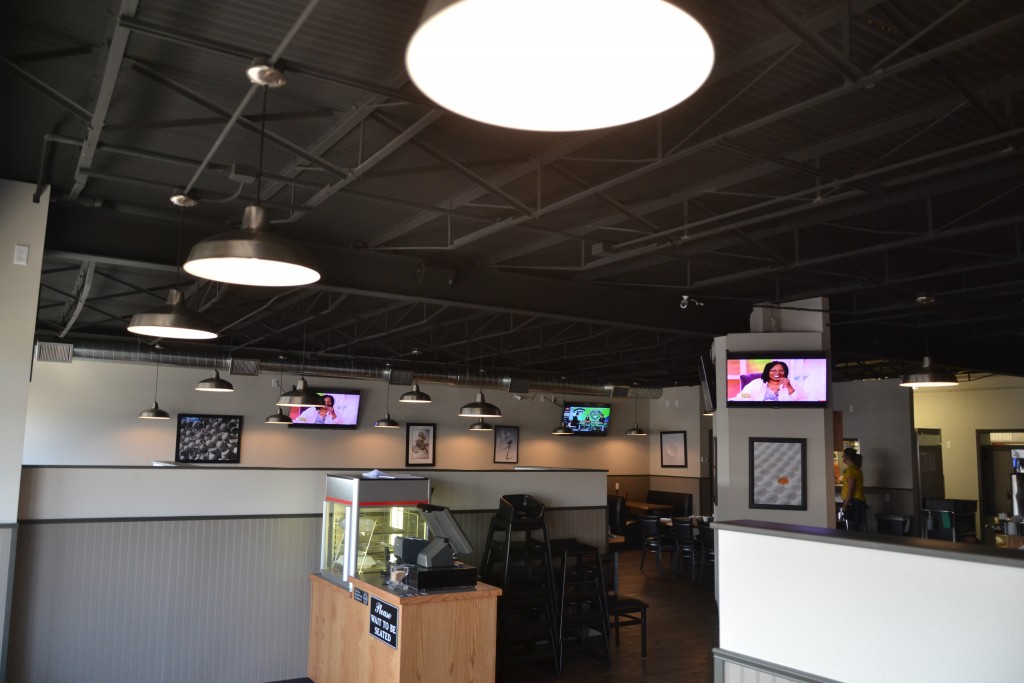
The Golden Griddle, 230 W. Ninth, has been open for three weeks and has already been a hit with locals, but what makes the new breakfast establishment stand out is not its food or service, but rather the family attitude that permeates through the staff.
For Hays residents, this attitude should be familiar, as the Griddle is an offshoot of the popular Golden Q bar and grill.
The goal of the Griddle is to be a “nice local restaurant that people can bring their families into,” said Brady Herman, general manager of the Q and the Griddle.
“We consider everybody here at the Q a little family and we do the same over there,” he said. “We want everyone to enjoy their experience that comes in, we also want our help and (wait staff) to have a good experience as well.”
When it comes down to it, Herman said the restaurant serves the public, and the staff has a goal to make a community establishment.
“It’s a win-win for everybody,” he said.
So far, business has been good for the new restaurant, but Herman said it can do better, with the last few weeks serving as a learning experience. The Griddle is Herman’s first with a full wait staff — meaning he is learning as business picks up, as well.
“I’ve gotten a lot of advice and a lot of pointers in the last two, three weeks,” he said, coming from the hiring of seasoned staff. “Luckily, we’ve had a really good front of house staff hired with some experience.”
Despite the ups and downs of opening any new restaurant, Herman said the last weeks have been going well — but living up to expectations set by the Golden Q isn’t easy.
“We’re gaining every week,” he said. “The hardest part I think is just getting everyone on the same page as far as cooking, learning the items, cooking the same way.”
Part of that process is making sure diners receive meals “as fresh as it can possibly be when it goes out.”
Even with the Griddle being part of the legacy of the Q in Hays, they are generally ran independently.
“We kept it separate,” Herman said. “Everyone started fresh, and I feel like we have a really good staff over (at the Q) now. Especially with school starting … I didn’t want to jeopardize that at all.”
And it shows. It’s hard to find a time when the Q isn’t busy. And if the Griddle experiences the same kind of popular support from the community, it is likely to succeed.
“We just rely on word of mouth. We obviously do a little bit of advertising, but we don’t feel like we need to force it a whole lot,” Herman said. “If we put out good food and give everyone a good experience, then that should generate the same thing as far as somebody asking where a good breakfast place is.”
The Griddle is open 6 to 11 a.m. daily, with hours until 1 p.m. Sundays.
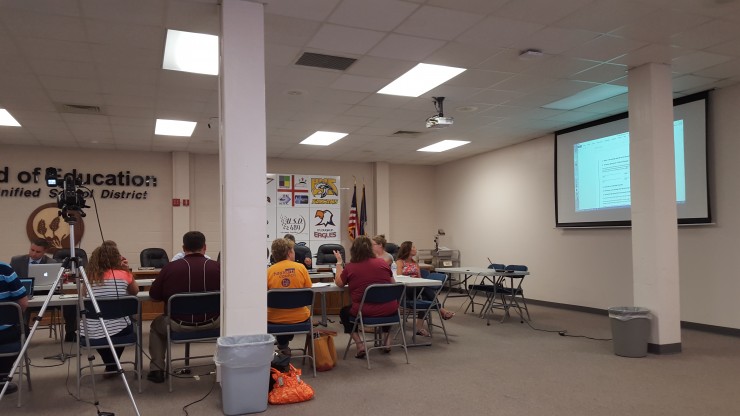
At Monday night’s work session, the Hays USD 489 discussed technology and a future bond measure in a short session.
The board first heard a brief technology update concerning the iPad rollout through the elementary and middle schools and saw the video being shown to students with proper usages tips for the equipment.
Sixty-five percent to 70 percent of K-2 grades have already been through the iPad rollout, and grades 2-8 are nearly complete, according to Marie Henderson, who presented the information to the board.
Following the information, board member Sarah Rankin asked about keyboard implementation for the iPad’s after two English teachers had asked about using the iPads for composition.
The district currently is in a wait-and-see mode as to whether the keyboards will be needed, but if it is decided later they are necessary, they can be made available.
“There is money available,” said Superintendent Dean Katt.
Teachers are now sending in app requests to the district for evaluation.
“Overall,” Katt said, “rollout has gone well.”
The board also discussed a potential bond issue to fund a series of building improvements throughout the district.
At this point, however, there is little that can move forward.
“We don’t really have any idea,” Katt said, in terms of how much money might be requested for a bond issue. At this time, the architectural firms handling the upgrade plans will be brought in to discuss where they are with the board to begin outlining a timeline for facility upgrades.
The board also looked at the results of the board retreat last week, with Katt suggesting there might be too many goals outlined to achieve measurable success for each.
“The things we have available we want to maximize,” Katt said.
Rankin suggested to prioritize the goals in order to make them more manageable rather than take some off the table. In response, Katt asked the board members to send to the administration each of their priorities to be looked at during the next board meeting.
The Hays USD 489 Board of Education will meet at 6:30 p.m. Monday in their first work session of the academic year in the Toepfer Board Room in the Rockwell Administration Center, 323 W. 12th.
The board will hear a technology update from Marie Henderson, who will share iPad usage information in the district’s elementary and middle schools.
The board will also continue discussions on a proposed bond issue — estimated to be in the $100 million range — that would be used to fund upgrades to the district’s facilities. The proposal has been floated by the district for several years and, in a previous meeting, the 2015-16 board heard from HTK architects on the district-wide upgrades.
The original plan, however, will need adjusted before the board can move forward as the closing of Washington Elementary last year has made significant changes to the plan necessary.
Click HERE for information gathered by the district’s Facilities Needs Committee, formed in 2012 for the purpose of recommending building upgrades throughout the district.
There’s a cute little way for governors to boost the state bank account by taking money that professionals pay into state regulatory agencies to, well, regulate certain professions.
The clever name: Fee sweeps.
The concept is that regulatory agencies or agencies that are specifically designed to do the public some good — say, making sure that workers can get worker compensation for workplace injuries — collect fees from those in the industry to make sure that injured workers can get treated, cared-for and rejoin the labor force. Sounds good.
Well, the fees that those regulatory agencies collect have been, for years, tapped by governors and lawmakers to bolster the state budget. That’s the “sweep” they talk about, sweeping those fee fund agencies’ money into the State General Fund, requiring those swept agencies to raise fees to make sure they can do what they are required by law to do.
So, if making sure worker compensation benefits are available is an important enough public service that the Legislature assigned an agency to do it—and allowed the Insurance Department to charge fees to those in the industry to be able to afford to do it—well, should the state siphon off those fees?
The fee-payers don’t think so.
Because those agencies which have been swept of money for a specific purpose have to raise fees to do what they have been created to do, the folks who pay those fees to those agencies see their fees go up.
Not hard to figure out…but the question is whether companies should pay higher fees because of that sweep. Doesn’t really sound right, does it?
Well, a district court essentially threw out a challenge of the sweeps, and last week the Kansas Supreme Court said, no, let’s take another look.
The high court said that just because those industry fees are sent to the state treasury—where all payments to the state are sent before they are parceled out to agencies—doesn’t necessarily make them “sweepable” by a low-on-cash state government.
And, the Supreme Court said that the regulated members of industries paying fee funds have standing to file a lawsuit demanding relief from those sweeps that cause higher fees.
The rehearing of the lawsuit is probably months away, but the issue is one that has some legislature-watchers intrigued.
If the governor or legislators can’t sweep that fee money, then where does the money for everything else in state government come from? Well, how about taxes?
Oops, nobody in the Statehouse likes that alternative.
Sweeping those fees just allows lawmakers to raise the money they need for state operations without having to use that three-letter word, and everyone who doesn’t pay higher fees to state agencies to make up for those sweeps doesn’t even notice. Could it be better for politicians? Not unless cash just fell out of the sky onto the Statehouse lawn.
The case is one that probably won’t make headlines, but if sweeping fee accounts means that there won’t be a general tax increase—or if legislators and the governor don’t reduce spending on something or other to get along without the sweep—the case might just change how business is done in the Statehouse.
Oh, and of course, there is the chance a decision might be that the state has to refund those swept fees—another little problem in a cash-tight state budget.
A little issue overall, but one that might inconvenience the Statehouse crowd.
Syndicated by Hawver News Co. of Topeka, Martin Hawver is publisher of Hawver’s Capitol Report. To learn more about this nonpartisan statewide political news service, visit www.hawvernews.com.
The Thomas More Prep-Marian school’s drama department is getting ready for the fall production, “The Sound of Music,” and a key first step – casting – has occurred and the roles have been announced.
The show will run Nov. 6, 7 and 8.
“The fall play and spring musical create diverse skill building for the students, such as stage acting and singing or playing instruments in the pit orchestra, makeup/hair, behind the scenes work building sets or painting design, and technology advancement in our state of the art sound and light booth,” according to their department webpage.
The department is headed by Travis Grizzell who has been at TMP since 2007 and Drama Director since 2009, directing students twice a year to produce a fall musical and a spring play.
The shows are open to the public and are performed at the Dreiling Theatre.
The full cast list for the “Sound of Music:”
Maria – Elly Lang
Mother Abbess – Dominique Rupp
Sister Berthe – Lauren Moeder
Sister Margaretta – Hannah Michaud
Sister Sophia – Lizzie Leiker
Capt. Von Trapp – John Drees
Franz the Butler – Ethan Rohr
Frau Schmidt the housekeeper – Katy Walters
Liesl – Anna Speno
Friedrich – Trae Megaffin
Louisa – Gracie Schmidt
Kurt – Jensen Brull
Brigitta – Madighan Norris
Marta – Natalie Loftus
Gretl – Jenna Brull
Rolf – Matthew Moeder
BaronessElsaSchraeder – Taylor Dinkel
Ursula/BaronessElberfeld – Laura Krug
Max – Justyce Briney
AdmiralVonSchreiber – Jagyrd Briney
BaronElberfeld/HerrZeller – Paul Brull
Neighbors/Nuns/Postulants/Contestants – Alison Helget, Taryn Rupp, Laura Casey, Taylor Drees,Allison Campbell, Kaitlyn Burd, Alexandra Herrman, Morgan Olmstead, Annie Wasinger, Hannah Trevethan, Isabel Peine, Joelle Pfannenstiel, Brooke Leiker
David Sanford, CEO of Wichita-based GraceMed, says health centers that serve Kansans who lack insurance or have trouble paying for health care are seeing growing demand for their services. CREDIT BRYAN THOMPSON / HEARTLAND HEALTH MONITOR
Health centers that serve Kansans who lack insurance or struggle to pay for primary health care are seeing no lack of demand for their services.
Rebecca Lewis was once among those Kansans. In 2011, the McPherson woman found herself working three part-time jobs and trying to complete a college degree. As a single mom with three young boys — then ages 8, 5 and 2 — it was hard to make ends meet.
“My earned income was under $10,000,” she says. “I was experiencing extreme survival mode. Every single day is a fight. So, plugging in everywhere I knew how and running my tail off every day. And it was always about the rent, and the lights, and transportation.”
Although her sons had health coverage through the Kansas Medicaid program, she found it challenging to find a doctor who would accept them as patients. She could have taken them to community health centers in Hutchinson or Salina, but those were 30 miles away. So Lewis did what a lot of people in her situation do.
“There were times that I would wait until later in the evening and take them to the emergency room when I knew that they needed antibiotics, because it was a better short-term choice for me and my children if I didn’t have to miss work or miss school and go out of town,” Lewis says.
Relying on the emergency room for health care is expensive and meant that her boys only saw a doctor when it was absolutely necessary. They missed a lot of the routine preventive care kids are supposed to get.
Lewis and others who couldn’t afford health care wondered why McPherson didn’t have its own clinic to serve uninsured and underinsured patients. Then a local committee studying ways to address poverty came up with a solution: partner with an existing federally funded health center to open a satellite clinic in McPherson.
Wichita-based GraceMed has agreed to do just that. As soon as a location in McPherson can be finalized, the committee plans to conduct a fund drive to raise the money to pay for the building and equipment.
“We will take over, in terms of providing the medical provider and the support staff to deliver that care,” says David Sanford, chief executive officer of GraceMed, a ministry of the United Methodist Church that operates 10 clinics serving 35,000 patients in the Wichita area.
“It’s just a great opportunity to bring clinical services to a community without repeating all of the administrative costs that would go into establishing an independent entity,” he says.
Sanford expects the clinic in McPherson to be sustainable for the long haul. That’s based on the assumption that 60 percent of the patients there will have some form of insurance, whether it’s private coverage, Medicare or Medicaid. Sanford says that target would be easier to meet if Kansas would expand Medicaid eligibility.
“Without Medicaid expansion, the state is making it even more difficult for people to access quality care,” he says. “They’re basically forcing them to get into the bad habit of going to the ER for non-emergency care. They’re forcing people to wait too long to come and be seen by a physician just because they don’t have the resource to do so.”
And people literally are dying because of it, according to Krista Postai, who runs the Community Health Center of Southeast Kansas. The Pittsburg-based organization operates 10 health centers that serve 40,000 patients in four counties in southeast Kansas — an area with some of the state’s least-healthy residents https://www.khi.org/news/article/southeast-kansas-counties-still-rank-low-for-health .
“Down in southeast Kansas, depending on what county you live in, you’re likely to die five or 10 years earlier than other Kansans,” Postai says. “The No. 1 reason for that is access to care, and that’s why every night when I go to bed I pray that Medicaid will expand someday.”
The Community Health Center of Southeast Kansas is among six Kansas health centers that will receive $4 million in federal funding to open new facilities https://bphc.hrsa.gov/programopportunities/fundingopportunities/NAP/0815awards/ks.html . Postai’s organization will use $475,000 to open a new health center in Parsons, replacing an all-volunteer clinic that had been open one afternoon a week.
The health centers are able to provide basic care for uninsured patients, Postai says. However, if uninsured patients need specialty care — like cancer treatment or a heart bypass — they may be out of luck.
“If they had Medicaid, I could refer them in to specialists,” Postai says. “But right now we are finding it almost impossible to find providers who will take patients who have no coverage.”
Currently, 45 percent of the patients at Postai’s clinics have no insurance. She estimates that figure would drop to 10 percent if Kansas expanded Medicaid.
There’s no end in sight to the demand, she says, as patient volume at the clinics has been growing around 18 percent each year.
Bryan Thompson is a reporter for Heartland Health Monitor, a news collaboration focusing on health issues and their impact in Missouri and Kansas.
Few things excite children like a race car and from 2 p.m. to 4 p.m. Saturday, at Hays Chevrolet, 2917 Vine St., children will get the opportunity to explore a race car as part of an event promoting RPM speedway and the Boy Scouts of America.
Steve Richardson, who is making the car available, drives the number 0 wing sprint car in races across the area.
“I got approached by the Boy Scouts of America to bring the race car out before the race tomorrow at RPM, let the kids interact with the race car a little bit,” Richardson said.
While the event is new this year, the hope is to stage other events in the future as the Sprints Car series returns to the area.
“This is our first year doing it, but we have plans to do it next year,” Richardson said.
Along with the car and promotional giveaways, including shirts and tickets to the Saturday race, members of the Boy Scouts will be on site to help build an interest in the local troop.
Scouts that attend will also be given tickets to the race.
Courtesy Ellis County Sheriff’s OfficeThe Ellis County Sheriff’s Office is seeking the public’s help in locating a 13-year-old runaway.
The sheriff’s department said in a news release Friday that Peyton Nicole White had run away from DCF care on Aug. 19.
“Despite having some contact with acquaintances through a Facebook account since Aug. 23, she has refused to return to her home in Catharine, Kansas,” the department reported.
She is believed to be in the Ellis, Osborne or Sedgwick county areas and is not considered to be in danger at this time.
Anyone with information is asked to contact the Ellis County Sheriff’s Office at (785) 625-1040.
Videos by Cooper Slough and Ricky Kerr – Hays Post
By DIANE GASPER O’BRIEN University Relations
Bjorn Kruse is disappointed his stay in America is going to be for just one college semester. It’s easy to see why he likes America — and specifically, Hays, America.
Just two weeks into the fall semester, Fort Hays State University students have had the opportunity to choose from an abundance of activities in which to participate.
Thursday was an eye opener for Kruse, a foreign exchange student from Germany who was among several hundred people marching from campus to downtown Hays as part of the third annual Core2Campus event.
“We don’t have big ceremonies like this back home,” said Kruse, an English. “International orientation, picnic, lots of things. It’s been a busy couple of weeks.”
Fort Hays State President Mirta M. Martin often refers to the university and the community of Hays as being one big family, which is exactly what organizers had in mind when Core2Campus began two years ago.
The event was started as a way of getting students downtown to become familiar with businesses and business owners there.
Major sponsors are FHSU, Downtown Hays Development Corp., Hays Convention and Visitors Bureau, and Eagle Communications, but 30 businesses participated in one way or another.
Students and faculty followed the Tiger marching band and cheerleaders from campus to downtown for an evening of eating and shopping and drawings for lots of prizes ranging from iPads and gift cards to a pair of airline tickets.
“This is our family,” Martin said as the large group gathered along 10th Street just north of the railroad tracks at the end of the march. “Fort Hays State University is a family, and this is your home. Welcome home, everybody!”
Story continues below
Several downtown businesses were open for people to browse and gather tickets for a drawing of numerous prizes. A free meal by Taco Shop was served in the Union Pacific Park at the corner of 10th and Main.
“I think it was a big success,” said Sara Bloom, executive director of DHDC. “It was really windy, but it wasn’t too hot, and it wasn’t raining. There was plenty of water available and enough food for everyone.”
Many students were new to the event such as freshmen Joey Harrington, Minneola, and Jake Tackett, Deerfield, who are roommates in Wiest Hall.
“We thought this was a good way to meet people,” Harrington said, “so we figured we might as well do it.”
Others were participating in their third Core2Campus, including a couple of FHSU juniors from Denver.
“It’s a fun social event, and it’s nice to get out of the house for a while,” Austin Foster said.
“I like to stay afterward to talk to business owners. It’s really interesting to hear their story,” said Lauren Solzman, adding that “it’s fun to get to help the freshmen get to know the downtown stores.”
Solzman said she didn’t know much about downtown Hays when she first came to town in 2013 until she participated in Core2Campus.
“Now, I shop at a lot of the stores down here,” she said.
Numbers participating in the event have increased each year. The first year, it was mainly FHSU students and faculty and staff in the march. Last year, the Hays Academy of Hair Design was added to the list. And this year, about 80 students and staff from the Hays campus of North Central Kansas Technical College joined in the fun.
“We’re pleased to be a part of this,” said Eric Burks, president of NCK Tech. “We’re pleased to be a part of this community.”
Len Melvin, co-owner of Hays Academy of Hair Design, agreed.
“A town this size to have three institutions like this is unbelievable,” said Melvin, a 2000 graduate of Fort Hays State who stayed in Hays to raise his family and run a business. “Three of our four owners are graduates of these three schools. Hays has great opportunities for students, a lot of options.”
Negotiations continued between the Hays National Education Association and the USD 489 Board of Education Thursday, but while initially it seemed the negotiations might stall, late meeting caucuses allowed the groups to come to an agreement over salaries and benefits – the last remaining pieces to be worked out.
Even after last week’s session that explained the lack of any funds to support vertical or horizontal pay increases, coming into Thursday’s meeting the HNEA at first remained insistent that movement take place, offering to give the board their desired four extra days of student contact days only if they received two years vertical pay movement and a horizontal step for teachers.
Further, the HNEA wanted higher dollars for teacher severance insurance packages.
The district currently has $130,000 remaining as a buffer, with $85,000 used if early retirement insurance and other benefits remain in place.
Despite the demand for pay increases, district negotiator Greg Schwartz informed both sides of current pay and benefits of the district compared to others across the state, explaining that even with teachers not moving up on the vertical pay scale, compensation throughout USD 489 is high compared to other state districts – with salary and benefits, Hays is in the top 5 percent of schools in the state.
After some debate, the HNEA team members and the board negotiators found agreement in a counter proposal from the HNEA team.
The final points both groups agreed on broke down like this:
• Teachers would get horizontal movement, the HNEA team agreed to last weeks BOE team’s staggered severance sick day accumulation with a change from $25 to $35 for each day accrued for payout with an 80 day cap, with current teachers grandfathered in as to not lose what was already guaranteed under the old plan, early retirement benefits available for 1 year with 7 years of payout and 2 years for 6, along with the other measure in which tentative agreements had already been reached.
• Both sides agreed that teachers that will no longer be able to take advantage of the early retirement insurance benefit, due to the change, would be otherwise compensated, likely in additional 401(3)b matched contributions, but details remain to be worked out if that is possible under the district’s plan.
Contract language will now be written and sent for both parties to review at a later date.
State employees and teachers should be celebrated. They provide valuable service in all parts of Kansas, yet have been on the receiving end of both low pay and disrespect, a direct result of the state’s financial crisis.
State leaders talk about employees as a problem, or as a cost that must be borne. Last fall, Speaker of the House Ray Merrick told the Wichita Eagle that “Government employees produce nothing. They’re a net consumer.”
Duane Goossen
Governor Brownback has not spoken quite as blatantly, but delivers the same message when he insists on only counting “private” jobs in Kansas to measure his economic experiment. “Public” jobs don’t seem to matter to the governor.
Along with the talk, lawmakers have cut away civil service protections, making the state workforce less professional and more subject to political allegiance, and eliminated due process rights for teachers.
Then consider pay. This is the seventh year in a row in which employees have not received any kind of cost-of-living or general pay increase. That perhaps was understandable when the state was mired in recession, but as our economy has recovered, Gov. Brownback has not even proposed an employee pay increase for the Legislature to consider.
Average Kansas teaching salaries have fallen almost to the bottom at 43rd in the nation last year.
Our statewide financial crisis prevents improvement. The Brownback income tax cuts routed Kansas’s budget without bringing any tangible economic benefits. Things became so unbalanced that the record tax increase passed by lawmakers in June barely allows the state to stay financially solvent, let alone address employee issues.
Last week, 38,000 state employees showed up for work. They engineered our roads and repaired bridges. Some inspected the food we eat. Social workers checked on children at risk for abuse and neglect. At state hospitals and prisons, many worked the night shift or put in overtime hours. Professors, cooks, and maintenance personnel geared up for a fresh contingent of students at universities. Highway patrol officers responded to accidents. Emergency management employees prepared to assist after the next tornado or flood.
In Kansas’s public schools more than 60,000 teachers, administrators, bus drivers, and staff took on a half million students who have a wide range of abilities and learning needs.
We should be glad all of those Kansans came to work, but we must change our approach to keep a vibrant state workforce. The recent Washington Post article, “Why Teachers Can’t Hotfoot it Out of Kansas Fast Enough” lays out why teachers are leaving. The U.S. is experiencing a national teacher shortage. Kansas will never successfully compete for teachers with an offer of low pay and with lawmakers who malign the profession.
The same thing is true in other parts of state government. The Topeka Capital Journal just reported on the staffing problems at state hospitals—for example, 189 out of 501 positions vacant at Osawatomie State Hospital. KAKE News did a story on similar vacancy problems rampant in the state prison system, a direct result of low pay. The prison system dropped age requirements, and now, for the first time, recruits 18-year-olds as prison guards to fill the void.
State employees and teachers understand the message being sent. If you knew that an employer never gave raises, suggested employees were just a financial drain, and routinely took away benefits and privileges, would you want to work for them?
Treating employees fairly is fundamental to good business practice and management. Making Kansas public employees bear the brunt of self-imposed financial problems will not serve the state’s future well.
Primary responsibility to set the tone and policies rests with the Brownback administration, but Kansas citizens should not look the other way. Especially as Labor Day approaches, be thankful for the dedicated state workers we have, and tell our leaders to fix state finances and quit dissing the employees.
Duane Goossen is a Senior Fellow at the Kansas Center for Economic Growth and formerly served 12 years as Kansas Budget Director.