A development group with plans to build a hotel north of Interstate 70 in Hays has a Dec. 12 public hearing date regarding creation of the Saffron West 43rd Community Improvement District.
Saffron Hospitality LLC has submitted a petition to create the CID, which was reviewed by the Hays City Commission during its work session Thursday.
A four-story, 42,000-square-foot Avid-IHG (Intercontinental/Holiday Inn) full-service hotel would be built on 2.1 acres south of Walmart at 208 W. 43rd.
With 79 rooms, “it’s a moderate-to-low (cost) extended-stay hotel,” Mayor Henry Schwaller said of the Avid brand. “It’s very clean, very sleek.
“It’s a welcome addition,” he added. “We don’t have anything quite like it.”
The estimated project cost is $7,046,870.
“The developer requests a 2 percent CID sales tax on the project site to fund certain project expenditures on a pay-as-you-go basis,” explained Kim Rupp, finance director.
The project’s annual taxable sales would be about $1.2 million, the developer has estimated, from which approximately $480,000 would be generated over the 20-year term of the CID.
“To be clear, these are not sales taxes that already exist. They are an additional sales tax on retail sales at the defined property,” Rupp added. “Basically, it’s something the landowner or the developer wishes to impose on themselves to help reimburse for items.”
Total CID eligible costs of the proposed project are $5,199.133.
If approved, the total sales tax within the new CID would be 10.25 percent, excluding the city’s transient guest tax.
Construction would begin immediately with a projected finish in December 2020.
If the CID is not approved, the developer has declared the project cannot go forward, according to Rupp.
Information submitted to Grow Hays and the city of Hays lists Srujan Vusi as manager of Saffron Hospitality, 3404 Vine.
The city commission has previously authorized CIDs for the Hilton Garden Inn, currently under construction west of Walmart; TownePlace Suites, 4001 General Hays; and Holiday Inn Express, 4650 Roth. All four hotels are north of I-70.
In other business, commissioners heard information about construction of a classroom in the Hays Fire Department’s new fire/rescue training facility south of the water reclamation and reuse facility.
The joint project will involve student designers and builders from Fort Hays State University as well as NCK Tech students who will plumb and install electricity for the building. Students from both colleges were in the audience and were thanked by the commission for their involvement.
The fire department will solicit bids for the purchase and installation of the HVAC system.
The commission approved moving forward with the classroom. Cost estimates are $45,000 to be funded from capital projects.
A 30-minute executive session was called at the end of the meeting to discuss property acquisition. No action was taken.
Maurice (Ben Pfannenstiel), center, meets Cogsworth (Hunter Flax), right, and Lumiere (Lane Werth), left, for the first time in Thomas More Prep-Marian’s production of “Beauty and the Beast.”
By CRISTINA JANNEY Hays Post
Belle (Madelyn Seiler) performs a solo in “Beauty and the Beast.”
A tale as old as time debuts tonight at Thomas More Prep-Marian’s Dreiling Theatre with the performance of Disney’s “Beauty and the Beast.”
Travis Grizzell, director, said this year’s fall musical has been so popular the school has added an extra performance. Show times will be at 7 p.m. Thursday, Friday and Saturday and 2 p.m. Sunday.
Madelyn Seiler, TMP-M sophomore, is playing the female lead of Belle. Grizzell said she has already had many years of experience in musical theater.
“I usually have singers who act or actors who sing, but she does both really well and has great stage instincts and is always prepared and well rehearsed,” he said. “She’s an amazing Belle!”
Mrs. Potts (Maggie Baalmann) and Chip (Avery Werth) take center stage in “Beauty and the Beast.”
Lucas Kraus, who is playing the Beast, unfortunately has had laryngitis. He practiced in costume with the cast on Tuesday night with Grizzell voicing his parts. He was off vocal rest just in time for the cast’s first performance for Holy Family Elementary on Wednesday.
“He’s done an amazing job of preparing, so I knew he’d be fine,” Grizzell said.
Grizzell added “There are plenty of scene stealers in this one. The enchanted objects, the vain villain, his lackey, the bumbling but golden-hearted father or the macabre asylum director … they’re all here.”
The Beast (Lucas Kraus) stares at his enchanted rose during the opening scene of “Beauty and the Beast.”
The tale of “Beauty and the Beast” is a fable. The story tells of a vain prince who is turned into the Beast. The spell can only be broken by someone finding true love in him, Grizzell explained.
A trip to see Salina Community Theatre’s performance of “Beauty and the Beast” might have finally been the inspiration for Grizzell to tackle such an ambitious project.
Gaston (Aakash Patel) threatens Lefou (Kooper Hudsonpillar) in “Beauty and the Beast.”
“I took my drama class to Salina Community Theatre’s production, and it definitely got my ideas going as far as set and costumes if we tackled it one day,” he said. “I look at about every show imaginable each year before picking one, and I kept coming back to B&B and could really start to see this group making it happen.”
Grizzell said costumes where one of the biggest challenges for this production.
Lumiere’s candles light up, and Cogsworth’s hands and gears spin. The school rented a few of the costumes, some of which have been used on Broadway. Grizzell’s wife, Pam, has been among the crew helping with costumes.
” ‘Beauty and the Beast’ is a show I’ve looked at for years and I finally gave in,” he said. “The costuming and set are major challenges, plus you’re up against a very well-known film and its iconic characters. Through very generous donations of time and money and talent, we’re in a position to pull it off, I think.”
Lumiere (Lane Werth) discusses Belle’s arrival with Babette (Morgan Olmstead)
Tickets can be ordered online by clicking here. Tickets can also be reserved by leaving a message at the Fine Arts Ticket Line: 785-621-5478. Tickets cost $8 each.
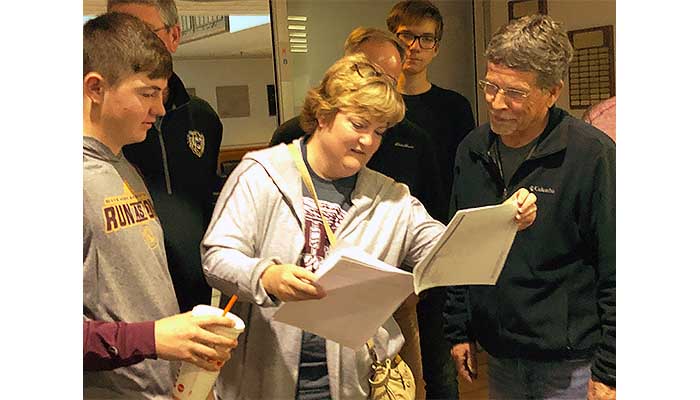
Tammy Wellbrock, center, and Craig Pallister, right, look at election results Tuesday night. Photos by Becky Kiser / Hays Post
By CRISTINA JANNEY Hays Post
Two incumbents on the Hays USD 489 school board are out, and four new faces were elected to seats during Tuesday night’s election.
The new board members will be facing a rewrite of the capital outlay budget, which is due back to the board and January, and strained relations with teachers. The board has yet to come to a contract agreement with the union.
Tammy Wellbrock, Allen Park, Craig Pallister and Lori Hertel all won seats on the Hays school board as the top four of nine candidates. Incumbents Luke Oborny and Paul Adams did not retain their seats. Incumbents Mandy Fox and Greg Schwartz chose not to run for re-election.
Wellbrock, a business owner, said she has a unique view of the economic impact schools have on the community and attributed that in part to her win.
“I think that is a distinctively different advantage that I’ve had over some of the other candidates,” she said, “in just being able to see where the school district kind of plays a factor in all of that— in the bigger scope of what our community needs and what is looking at in terms of progress.”
Wellbrock said her first goal as a newly elected official will be to learn more about her new post. She plans to attend the Kansas Association of School Boards training in January.
“It is not just me coming on. There are four of us,” she said. “I have to figure out what that group of people, this new group of seven, starting in January, what we need to accomplish.”
She acknowledged the school board is going to be facing some difficult issues come January, including infrastructure and teacher relations, but she said even in two months those are going to be evolving issues.
Wellbrock said she thinks there is a need for another attempt at a bond.
“There is a need to focus on the bond and what should or could that bond be,” she said, “but what makes a passible bond is different from a bond that is going to address needs. Those are two different conversations, and I think we are going to need to look at what makes a passible bond.
“What is needed, but is not necessarily going to be addressed at the bond level, is going to have to be discussed separately. The board is going to have to move forward as if there is not a bond.”
Allen Park, school board candidate, voted on Tuesday.
Allen Park, former Washington Elementary School principal, said he is appreciative of the vote of confidence from the community.
“I think if we all work together, we can make a difference,” he said. “We are going to need to pull the community together to accomplish what we need to — the whole entire community. We need to involve them, inform them and be very open and request their assistance to move our district forward.
“I think people in Hays care, and I think they want what is best for our kids, but I also think they want to be involved more.”
“We are going to need to prioritize what needs to be done,” he said. “The board is going to have to work together and cooperate and try to do what is best for kids.”
“I think it is going to take time to build that back,”he said. “Two years in a row — that really damages that relationship. That needs to be improved because that sets the culture, and if the teachers aren’t on board, it is hard to accomplish our board goals when we have that stress on our teachers.”
Craig Pallister, former Hays Middle School principal, also said building trust is going to be important for the board going forward.
“Several of the things that I mentioned during my campaign was building trust between the board and the teachers and all the staff because that is key because of where negotiations are right now,” he said.
“Also letting the people know in the community how good our school district is. We have an outstanding district with outstanding teachers and staff, and we need to get that information out. That is why I suggested maybe hiring a public relations person for the district, not only to talk about the good things that our district is doing, but also what our district needs are like our facilities.”
Lori Hertel reacts after her election to the USD 489 school board Tuesday night.
Pallister said the board needs to look at another bond issue, but issues such as leaking roofs and HVAC systems need to be addressed more immediately through capital outlay funds.
He said he thought the four candidates who were elected are all pro-public schools and should keep the district on track.
Hertel, a mental health professional, said she thought people believed she can make a difference and that was why she was elected.
“I think I have done that in this community on multiple occasions,” she said, “and I think people have known that about me. I think that I can do that over and over and over again and help children. I have a special feeling about children.”
She said she would like to turn the board to focusing on the children and the staff. She also said she was concerned about the inability of the teachers and the board to come to an agreement on a contract.
“I think that is not very good for the working relationship between the board and the employees,” she said. “I think the employees think the board is not looking at their needs. That may not be true, but I am sure that is how they feel.”
Hertel said the board is also going to need to study infrastructure needs and make sure the community is well informed about those needs. She said she thought the board needs to consider another bond attempt.
The new school board members will take their seats in January.
DISCLOSURE: Tammy Wellbrock is married to Gerard Wellbrock, Eagle Radio sports director. He is employed by Eagle Radio, which owns and operates Hays Post.
Three of four incumbents voted out of office, according to unofficial results
Here are the results of Tuesday’s most significant local races in Ellis County.
Results are unofficial until votes are canvassed by the Ellis County Commission. Unofficial winners are in bold.
Hays City Commission (three open seats) Nine of nine polling locations reporting
Advance voting totals included • Mason Ruder: 1,834 • Michael Berges: 1,802 • Ron Mellick, incumbent: 1,746
Ryan Rymer: 1,492
Henry Schwaller IV, incumbent: 1,413
Write-ins: 16
The top two vote-getters will each serve a four-year term while the third highest vote-getter will serve two years.
Hays USD 489 Board of Education (four open seats) Nine of nine polling locations reporting
Advance voting totals included • Tammy Wellbrock: 2,535 • Allen Park: 1,913 • Craig Pallister: 1,689 • Lori Ann Hertel: 1,317
Cole Engel: 1,228
Paul Adams, incumbent: 1,223
Luke Oborny, incumbent: 1,211
Alex Herman: 836
Jessica Ann Berg Moffitt: 522
Write-ins: 11
Check Hays Post on Wednesday for more on election results and reactions from candidates.
Ellis County voters are using new election equipment today with a return to paper ballots.
By BECKY KISER Hays Post
Voters in Hays were lined up and awaiting the opening of polling locations just before 7 a.m. Tuesday.
Balloting is underway statewide for city and school board elections.
Ellis County is using new voting equipment for the first time. It was first available to advance voters at the Ellis County Administrative Center.
In April, the Ellis County Commission approved the purchase from Election Systems & Software of Omaha, Neb.
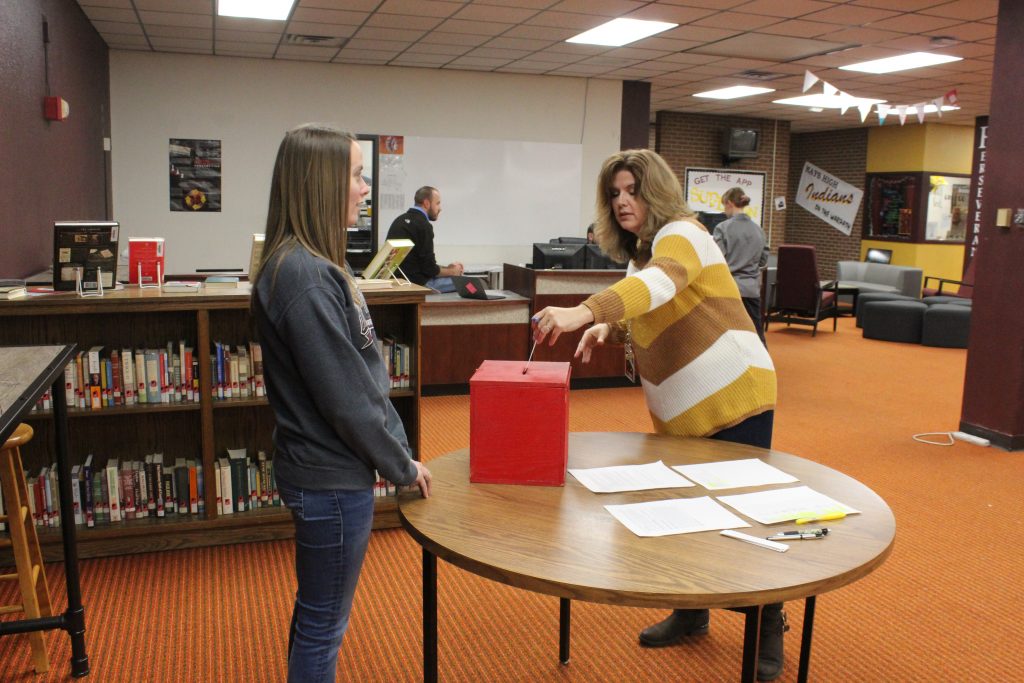
Paper ballots for Hays voters living in Ward 4, Precinct 5
Voters are seeing the return of paper ballots, now marked with a standard black ink pen. Previously, the entire balloting process was done electronically using touchscreen machines.
Once a voter is identified at their polling location check-in, they get a paper ballot specific to their ward and precinct.
Voters then sit down at a table with privacy sleeves and mark their ballot by completely filling in ovals with the provided pen.
Once people are finished voting, they feed their ballot into a scanner which tabulates each ballot and then drops it into secure bins.
Tom McClelland, poll worker at the Hays Recreation Center, explains the new ballot scanner/tabulator.
“This machine will read the ballot any of the four ways you can put it in there. It’ll go and it’ll count them,” explained Tom McClelland, a poll worker at the Hays Recreation Center. “From there, it drops into a basket on the bottom, under lock and key. If there’s ever any problem, with the votes like there was previously, they can always go back and open these boxes and count every one of them by hand.”
HRC poll worker Pat Lang said this morning she had no complaints from voters about the equipment change.
“It’s going fast here and it should be faster tonight when the polls close,” Lang said.
Each polling location has a designated runner who will take the printed ballot scanner information to the county administrative center in Hays just after 7 p.m. to be compiled. According to Lang, each polling location previously packed up the equipment and brought it and the ballots to the center at the same time. “It’s gonna be faster results,” she predicted.
A Hays voter feeds her completed ballot into the ballot scanner/tabulator which produces a paper tally that will be transported to the Ellis Co. Administrative Center. The actual ballots are dropped into locked bins.
The new machines allow Ellis County to comply with Kansas law requiring every county to complete an election audit.
In Ellis County there are four positions open on each of the school boards in Hays, Ellis and Victoria. Three seats are open on both the Hays city commission and Ellis city council as well as Ellis mayor and treasurer. All Kansans are voting on a constitutional amendment question regarding the census.
Five candidates are running for the three Hays city commission seats – Michael Berges, Ron Mellick, Mason Ruder, Ryan Rymer, and Henry Schwaller IV. The top two vote-getters will each serve a four-year term while the third highest vote-getter will serve two years.
There are nine people running for the four open positions on Hays USD 489 – Paul Adams, Cole Engel, Alex Herman, Lori Ann Hertel, Jessica Ann Berg Moffitt, Craig Pallister, Allen Park, Luke Oborny, and Tammy Wellbrock.
Polls close at 7 p.m.
Check Hays Post and Eagle Radio for election results and candidate reactions.
Dallas Haselhorst, founder of TreeTop Security, discusses cybersecurity at the Hays Public Library on Wednesday night as he wrapped up a series of sessions to mark Cybersecurity Month.
By CRISTINA JANNEY Hays Post
Your data is today’s gold.
Dallas Haselhorst, founder of TreeTop Security, discussed cybersecurity at the Hays Public Library on Wednesday night as he wrapped up a series of sessions to mark Cybersecurity Month.
“At the end of the day, there are a lot of people’s livelihoods that get affected adversely by getting hacked,” Haselhorst said.
Sixty percent of small business go out of business within six months of a major cyberattack, he said.
“That’s people’s jobs. That’s people feeding their families,” he said.
One misconception is that technology — anti-virus software or firewalls — will protect you from cyberattacks.
Attackers are going to go after wherever your business or home is weakest. If you are a business owner, Haselhorst suggested offering cybersecurity awareness training for your employees. At home, hackers will target the most vulnerable, too. That could be parents, kids or seniors.
“People say, ‘I don’t have anything that an attacker would possibly want,’ ” Haselhorst said. “That just couldn’t be further from the truth.”
Some of this information can include:
Credit card and financial information
Medical data and insurance information
Computer resources
Use or your email credentials
Medical data is seven times more valuable than credit card data, Haselhorst said. Credit card companies are getting exceptionally good at stopping fraud, he said. With medical data a scammer can perpetrate identity fraud, prescription fraud and insurance fraud.
You can change a credit card number, but you can’t change your Social Security number, Haselhorst noted.
Hackers can use your computer for nefarious purposes. They can use it to send ransomeware. They can use it as a jump point, which is when your computer is used to attack someone else.
“The FBI has unfortunately kicked down wrong doors before thinking someone has child pornography things on their computer,” he said.
Your email is tied to many other aspects in your life, such as resetting passwords on your bank account.
“If you think there is nothing on my computer,” he said, “there absolutely is in every single situation.”
Backups are one of the only guaranteed ways to get your information back from ransomware.
“In doing IT for the past 20-some years, one thing I can tell you is that I have seen time and time again somebody says, ‘We have backups. We have tons of backups.’ You go back and find they don’t have any backups and they haven’t been backing up for the last six months,” Haselhorst said.
Thirty-five percent of users never have backed up their data. Only 6 percent of users back up daily.
He also warned against leaving a USB drive or an external hard drive plugged into your computer. If your backup device is attached to your computer, it can be ransomwared too. Use the Cloud or disconnect your backup device.
Every day, 360,000 pieces of malware are released. Keep your devices updated. Most updates contain security updates. This includes operating systems on computers, tablets and cellphones.
Anti-virus software needs to be updated every few hours to keep up with the onslaught of malware. Browsers matter too. Haselhorst said Microsoft is no longer recommending using Internet Explorer.
Devices in the realm referred to as “the internet of things,” such as dog food feeders and surveillance systems, do not update automatically. Alexa, Google Home, a lot of the doorbells and thermostats do update automatically.
Passwords are still important to protecting your data. Don’t write down your passwords and stick them on your computer.
If you store passwords anywhere on your computer in a Word, Excel or Notepad document, these can be easily found by hackers.
You can use secure password managers, such as LastPass, KeePass and 1Password to keep your passwords safe. These applications will allow you to store all your passwords in one secure place. You unlock the program with one long password. The programs can also autofill passwords and usernames on your device.
If you use a password manager, you can use a different password for every account. If one account is compromised, that is the only data that is at risk. You can also use randomly generated passwords because you don’t have to remember them all.
“Everyone has heard about the breaches in the news. There is like a breach everyday. What happens is the systems get breached, and the hacker pulls down the password and username database,” Haselhorst said.
“What happens with that password and username data is you can get Gina’s email address and password and then I’m going to try it on Facebook. I’m going to try it on her bank account. I’m going to try it every single place I can think of that she might have an account for.”
Ninety-five percent of passwords are shared within their household. Fifth-nine percent of people use one password for all accounts.
Avoid using passwords that can easily associated with you. These include:
Address
Phone number
Pet name
Birthdate
Sports teams
Child’s name
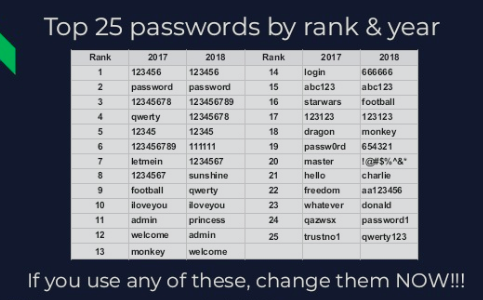
Haselhorst recommends passwords of 16 to 18 characters. Length is more effective than complexity. He suggested using password phrases, such as MysonwasbornNovember1995! versus P@ssw0rd.
Haselhorst discussed ways to keep you safe from malicious links. These included verifying the link, hovering over the link, giving it the sniff test and finally clicking if it passes all of the previous three tests.
You may receive an email from someone you know, but red flags could be in the subject line, strange wording, an odd signature or a strange link, especially those outside of the U.S. To hover, let your cursor rest on the link without clicking. This will show where the link is actually going to take you.
Hackers can have a link that says anything in the text of an email or text, but it may take you to a completely different site. If there are numbers in the URL instead of letters, don’t trust it, Haselhorst said.
Scammers will also try to use condensed links to hide where they are really taking you. You can use www.linkexpander.com to find the expanded address.
You can also receive links through SMS messages. Is the message expected and from someone you trust? You can “hover” on a tablet or cell phone with a prolonged press on the link.
Scammers will also use a sense of urgency both online and over the phone to get you to click on links or had over sensitive information. Companies like Apple and Microsoft are never going to call or email you personally, Haslehorst said, although scammers are using their names.
Ninety-two percent of all malware is delivered by email. Stop and think before you click on attachments. Are you expecting the email? Are you expecting the attachment? Don’t enable editing if macros have been disabled.
Scammers will also using “phishing” or “whaling” to create a targeted attack. Haselhorst gave the example of a scammer using the name of the CEO of a company to send an email to the CFO of a company asking him or her to set up an illegitimate vendor or account. The scammer then asks the CFO to deposit money in the bogus account.
When individuals are targeted, scammers might ask for gift or prepaid credit cards or financial information. Technical safeguards are not effective in stoping these scam.
“These are emails. This is text,” Haselhorst said. “There is nothing on the planet that is going to stop these things except who is sitting in a chair. Somebody is going to have to think about that.”
Robocalls continue to be an epidemic in this country. Remember scammers can make the number look like it is coming from your local area. If you have any question about who you are talking to, hang up and call back on a published number.
Other general security tips include use caution when attaching phones or other devices to your computer that could infect your computer with malware. Be careful of WiFi hotspots and avoid public computers.
Haselhorst also noted even trusted websites can be hacked and be hosting malware.
The director of the community mental health center for northwest Kansas is concerned the closure of acute care psychiatric beds in Hays will create a barrier to treatment in western Kansas.
Children in western Kansas will have to travel as much as four to five hours one way to receive in-patient acute care.
Walt Hill, High Plains Mental Health director, said the closure of the only beds in western Kansas was breaking a promise made when those services were privatized 10 years ago.
Andy Brown, commissioner for Behavioral Health Services for the Kanas Department for Disability Services, said the closure of the acute care beds in not ideal, but children in Kansas have been traveling long distances for decades to receive treatment.
KVC has cited changes in Centers for Medicaid and Medicare regulations and issues with the space it rents at the Hadley Center for the closure. However, Brown said the decision to close the beds with made by KVC and was based on finances.
The acute care beds at KVC Hospital-Hays were the only acute care beds for youth in western Kansas. These placements were short-term stays for youth who are dangerously suicidal, aggressive or have made threats to hurt others.
Youth from Hays and western Kansas are being placed as far away as Denver, Kansas City or Kearney, Neb. New acute care psychiatric beds just opened in Wichita. However, Hill said it was his understanding that all the beds in Wichita have not opened yet.
Hill said the transportation of the children is complicated, because some of these children are threatening to jump out of vehicles, which makes parents frightened to transport the kids so far.
Hill also expressed concern the barrier of distance from treatment might discourage caregivers from seeking treatment for children or delay them from seeking treatment for kids.
Placing children so far from home might also interfere with their treatment, Hill said.
“It will be harder to do the type of family care that is needed often when children are in a psychiatric hospital,” he said. “How can you work with the family when the child and the treatment team is in Kansas City or Denver or Kearney or Topeka as opposed to here, relatively close by?”
HPMH has a 20-county catchment basin in northwest Kansas and refers 180 youth per year to acute psychiatric treatment. KVC-Hays’ catchment area includes all of western Kansas. Hill said Garden City has already had to send youth to Kansas City.
KVC had operated both a psychiatric residential treatment facility and acute care beds out of the Hadley Center in Hays since 2010. KVC, a nonprofit, was awarded a contract to provide youth acute care when the state closed juvenile acute care beds at Larned State Hospital. Juvenile psychiatric care is now privatized across the state.
In 2017, Brown said KDADS was informed that CMS was no longer going to allow residential treatment and acute care treatment to operate under the same license.
During a Joint Legislative Budget hearing on Oct. 2, Brown said CMS rules had been in place for a number of years, but Brown said KDADS was enforcing the rule now “because I am aware of it now,” and KVC had operated despite these rules by the “Grace of God.”
In that hearing, Brown said one of the concerns about commingling residential and acute care children was acute care children had become aggressive in the past and hurt residential children. However, he said he did not know an exact number.
KVC said none of these incidents had occurred at KVC.
KDADS sent a letter to KVC in February saying it would have to split the residential and acute care programs by April 2019. It did so, but opted to close the acute care beds in October and announced it would convert those beds to residential beds in the near future.
In its announcement of the closing of the acute care beds, KVC said it needed $1 million in renovations to keep the acute care beds open and suggested “legislators could create a line item in the governor’s budget, similar to funding provided for adult state psychiatric hospitals, that would assist with overhead costs and KVC would be open to exploring that as a sustainable operation.”
Hays Post asked KVC what specific renovations were needed and why these infrastructure needs had not been an issue earlier.
KVC responded, “The Class 1 psychiatric residential treatment facility (PRTF) regulations allowed different parameters for a facility than what is required to operate a standalone acute unit. Standalone acute units have higher levels of requirements.Over the past 10 years, we have made continuous enhancements to the space we lease in the Hadley Center to remain within compliance with these regulations and provide a safe and therapeutic environment for the children we serve.”
Hill, in his testimony at the budget hearing, said he was told there was an issue with a ceiling in the area of the acute care facility that did not meet standards and could be a hanging hazard.
However, Brown in the budget hearing said, “It’s not a matter of accommodations. It’s a matter of finances.”
He went on to say later in the hearing, “You could put it in terms of billing, the amount coming into the facility to cover the cost of the care was not sufficient in the eyes of KVC, to continue the facility as a split facility.”
KVC in its response Hays Post said “KVC is not able to financially sustain a standalone acute hospital unit in the western region.”
Hays Post asked what factors made providing care in western Kansas unsustainable. The Post specifically asked about cost of staffing, Medicaid and Medicare reimbursement rates, and the possibility of the center not operating at capacity.
KVC avoided answering this question directly saying, “The dual license was an innovative and necessary way to meet the psychiatric needs of children in the less populated areas of rural and frontier western Kansas where census numbers tend to be lower. It provided flexibility to meet different levels of need in a way that was sustainable for nonprofit providers such as KVC Hospitals.”
KVC also was asked how much money would be required to provide a sustainable acute care facility in western Kansas, but KVC would not assign a number to this question.
Hays Post asked KVC about the issue of distance.
KVC responded “At KVC, we believe it is beneficial for children to receive treatment as close to their families and support systems as possible. This is why it has always been our intent to maintain the license we have held since 2010, allowing us to provide acute services to children from Hays and surrounding areas.
“To further that effort, we opened a new hospital in Wichita to expand access to acute services for families in southwestern Kansas, due to many of these counties being nearly equal distance to Hays and Wichita.”
Hill said if the private sector can’t sustain acute care beds in western Kansas, it is the responsibility and duty under the state constitution to provide them. He suggested reopening juvenile beds at Larned Stated Hospital. He said instead of giving $1 million to remodel the Hadley Center, he said he would rather that go to Larned.
“It has always been the role of the state to provide that safety net for adults and children in the state,” he said. “The community-based services have their role for those people who don’t need to be in a hospital. Some would say the constitution of the state requires the state to take care of the welfare of the folks at that kind of level and the safety of the communities.”
Hill was very involved in the process of privatization.
“When the beds were privatized some 10 years ago, the commitment was made that there would be beds to replace those state hospital beds in western Kansas. We spent a lot of time with policy makers and local legislators, the city, talking about that,” he said. “I was very involved in those discussions. What I understood was that there was a commitment and a promise when the beds at Larned were closed, we would keep beds in western Kansas in some form.”
In his phone interview with Hays Post on Friday, Brown said the state was interested in providing acute psychiatric services in western Kansas, but no plans were in the works to do so. He said the juvenile psychiatric services were privatized nine years ago, because it was not sustainable for the state to offer those services.
The state is working on other treatment options he hoped would help keep children out of acute care. This includes crisis lines, mobile crisis units, peer support networks for parents and families, screeners who could come into people homes and other programs through the Family First Preservation Act.
KVC has announced it intends to convert its acute-care beds to 50 PRTF beds. This type of treatment generally lasts 30 to 90 days and is for youth who have been stabilized.
Hill said he was pleased more PRFT beds will be coming online. Kansas has about 200 children on a waiting list for residential treatment with a wait time of about five months. When all the acute care beds in Wichita and residential beds in Hays become available, Hill said there should be a net increase in psychiatric beds for youth in the state.
However, Hill said residential care “is really not helpful in the kinds of situations we are talking about where a youngster is talking about hurting themselves or somebody else or just out of control.”
Hill said community mental health centers do all they can do to keep children out of acute care. However, he said some kids need to be in the hospital.
At the intersection of two unpaved roads about 12 miles north of Interstate 70 in Graham County, the unincorporated town is home to only one business – a drilling company.
Even the Post Office closed almost 100 years ago.
But a few residents have hung on and still call the town home, many are descendants of the original Volga German settlers who first came to the area in the late 1800s.
Now the townspeople will gather Monday to discuss the fate of one of the last reminders of times gone by — a Catholic church that was the heart of the area, a place where townsfolk would gather in celebration, worship and mourning.
Outside of a few special occasions, St. Anthony’s Church has been quiet since 1999, when the last regular mass was held. Since then, the townspeople have chipped in to help take care of the property, but time has not been kind to the 70-year-old building.
It is in desperate need of a new roof. Water has seeped into the walls, ceiling tiles have fallen to the ground and gaps have formed around the stained glass windows.
Meeting to discuss the future of St. Anthony will be 7 p.m. Monday at the church.
It was in 1895 the congregation formed that would build the original church, with names now common to the area such as Brungardt, Billinger, Wasinger and Knoll.
Construction started in 1909 on the first permanent church building after one of the original town settlers, Peter Rome, donated the land on which the church still stands. It was dedicated a little over a year later. A school and rectory stood nearby, home to the local priest and nuns who served as teachers.
In 1949 a new church would be built in the same location with many of the original adornments moved into the new sanctuary from the old.
The school still stands, although heavily damaged. The original rectory remains as well and is now home to Winnie Kingsbury after being auctioned off by the Diocese in 2010.
“It was a vibrant center to this whole area, and it centered around this church,” she said. “It was a faith-based community and the church was everything to them. … They poured their hearts and souls into making sure that they had beautiful spiritual places.”
The church, she said, stands as a testament to those early settlers and what they valued.
“This community was built on the faith of the Catholic Church and the Catholic religion,” Kingsbury said.
Even now, the streets retain the names of Catholic saints.
She said the hope of the community seems to be that at some point a priest would once again regularly return for mass and the Salina Diocese will work to preserve the building.
And an outpouring of support on social media shows interest in saving the building from families who combine their own personal histories into the story of St. Anthony’s and the town of St. Peter.
But many no longer live in the area, and the population of St. Peter is – like many in western Kansas – an aging one.
While she said everyone kicks in as much as they can, the building needs substantial work that will take significant time and money.
“I know everybody has the same feeling out here. They love that church, and they don’t want to see it go,” Kingsbury said.
But she is also a realist.
“At this point, I have to look at it as a beautiful historic building,” she said. “Everyone would love to have the church stay, but the last few years have been hard on it. It’s deteriorated greatly in the last two years.”
Despite the remoteness and the deteriorating building, Kingsbury said a steady flow of people still come to see the church.
She frequently hears their stories about the town and the church, but with fewer people living in the area, the burden of saving the building comes down to the handful who remain.
“It served a great purpose for many years, but there are not many people left,” said the Rev. Charles Steier, pastor at Christ the King church in WaKeeney and St. Michael in Collyer. “That’s a lot to ask a few people.”
The responsibility of maintenance of a church is solely on the parishioners. The Diocese does not allocate funding to buildings — either active or non-active, he said.
Steier has seen the outcome of many similar situations over the years, but generally, as distressing as it is, the best option is often to raze the building.
The concern is that, once a church building is sold, they often fall into further disrepair and become even more burdensome to area residents as they watch a beloved building crumble with no recourse.
He equated the situation to a loved one that becomes ill. The people around the person directly see the effects, but those from a distance might be in denial of how bad the situation has become.
“There is no easy solution,” Steier said.
Despite the outcome of Monday’s meeting, Kingsbury said she is glad the church is looking for definitive action and is grateful the bishop has taken steps to come to a resolution.
She met with Bishop Gerald Lee Vincke, who was appointed last year, when he personally visited the church.
“That has never happened to us before,” Kingsbury said. “That is a wonderful thing.”
Much like the faith the people that founded the St. Peter had in the church and the future of their little town, Kingsbury said she feels the diocese will make the right decision for the building.
“You have to trust that,” she said.
Meanwhile, she said, she hopes the meeting brings a large crowd so they can share their thoughts with the church leaders and all options can be heard.
The Rev. Peter O’Donnell, diocesan tribunal judge, will lead the meeting, scheduled to start at 7 p.m. Monday in the church.
The former Plainville Livestock Commission buildings and property sold in June, but the defunct livestock seller’s debuts have yet to be settled.
By CRISTINA JANNEY Hays Post
Ranchers waiting to receive funds from the now-closed Plainville Livestock Commission are still waiting for resolution.
Much of the commission’s property, including the real property in Plainville, was liquidated during an auction in late June. The commission’s bankruptcy case is still open, although it has been changed from a Chapter 11, which is a reorganization, to a Chapter 7, liquidation.
However, the adversary case filed by Almena Bank is still winding its way through the court system.
Dozens of cattle producers were caught up in the Gillums’ alleged scheme after money that was supposed to be set aside to pay cattle sellers was transferred from a custodial account to the Plainville Livestock Auction’s operating account. The Almena Bank froze both accounts, which resulted in bounced checks amounting to tens of thousands of dollars per producer.
The adversary case in federal court is seeking to determine how the $900,000 being held in trust by the court should be divided among livestock producers and creditors.
According to court documents dated Oct. 24, counsel are working on a settlement in the case. The records also said one of the claims might need to go to trial. The next status conference in the case is set for 10:30 a.m. Dec. 12.
Savannah Pfeifer, HHS senior and member of HHITA, drives an electric car during the HHITA open house last week.
By CRISTINA JANNEY Hays Post
Parents and family members got the chance to feel the pull of a corner and the grip of track during the Hays High electric car program open house last week.
The annual open house lets the students show off the cars to their loved ones and current and potential sponsors.
Last year, one of the Hays High Industrial Technology Association’s cars won the state championship, but with each year comes a new car and new challenges.
Quentin Rupp is a senior on the team and vice president of HHITA this year. He said the team’s state-winning car last year reached speeds of between 20 and 25 mph. This is in a vehicle that weighs less than 100 pounds. Drivers can weigh no more than 190 pounds. Weights are added during competition if drivers weigh less than 180 pounds.
The upper classmen get the first shot at racing. Students have to be at least 16 to race the cars. The students compete for most laps in an hour; ties are broken with the fastest lap.
The team’s most common challenges are flat tires or a chain popping off in the middle of the race, Rupp said.
The cars each have three tires, two batteries, a chain and motor. Each car is fabricated from scratch each year.
“We are always working on them, always improving them,” he said. “We try to build a new one every year to improve our ability, and then we get rid of the older ones, so we can keep getting better and better as we go on.”
The students weld their own frames. Leon’s Welding bends some of the metal for the students, but the rest of the metal work is done by students.
“I like working hands-on and welding,” said Rupp, who has been on the team since his freshman year, “so I have worked on fabricating a lot of these cars, and I just enjoy racing.”
He added, “It’s the speed and adrenaline that gets me going. It’s just fun to drive.”
Rupp said the team of about 30 students has had to up its game in the last couple of years as the competition has been getting tougher.
“Last year, we had to make some improvements to the car,” he said. “When they work and you win, it’s really fun.”
Rupp plans to take technical training to the next level after graduation by attending Dodge City Community College or NCK-Tech and pursuing a degree in welding. His dream is to own his own fabricating business.
Chris Dinkel, career technical education teacher, said the open house puts the students in the limelight.
He said the students can learn a variety of skills in the program that can be applied to careers after graduation. They learn design processes, materials and processes through construction, as well as electrical and mechanical skills.
“There are a lot of different technologies that can stir the students’ interests,” he said. “We try to use as many of those type of applications.
“[We] get the kids thinking about problem solving — how the car performs and about changing and manipulating that system in order to get it to preform at higher efficiency.”
Students who have aspirations to be in the industrial fields, such as welding and fabrication, work side by side in this program with students who want to go on to college to be mechanical or electrical engineers.
“There is nothing more inclusive than an electric car program where they can do the design process and complete the project, engineer it for a specific application and move into where their interests are,” Dinkel said.
Like other extracurricular activities, Dinkel said the electric car team builds character.
“We try to build the type of student and the type of person we want to see in society,” he said. “We do that by trying to put them around people that can [be] models …”
The program sprung from grants from the Green Energies Act in 1995. Although federal money has gone away, HHS has been able to sustain the program through local donations and sponsorships.
“This was just too good of stuff for kids not to be exposed to,” Dinkel said.
The program is in need of sponsors for this year. If you would like to be an electrical car sponsor, you can contact any of the students in HHITA, Dinkel or an administrator at HHS at 785-623-2600.
As an alternative to the traditional Halloween parade and class parties, Lincoln Elementary School this year had an afternoon of educational, but fun, games and activities.
Kerri Lacy, Lincoln principal, said the event kept parents from having the expense of buying Halloween costumes or excluding children whose families don’t celebrate Halloween.
Some of the activities the children participated in included, painting, Halloween yoga, slime making, minute-to-win it games, a Midwest Energy cash grab, a visit from the Sternberg Museum, snacks, crafts, face painting offered by the FHSU cheerleaders and a dance game.
A Hays teacher votes on her contract last year. This is the second year in a row the USD 489 school board and teachers have come to impasse in negotiations. Last year, negotiations were resolved through mediation. This year, the two groups have moved on to fact-finding. Hays Post file photo
By CRISTINA JANNEY Hays Post
After failing to come to a contract agreement during federal mediation, the Hays USD 489 school board and Hays NEA have moved on to a fact-finding process.
The compensation package, specifically health insurance is the stumbling block in the negotiations.
“The compensation package is the difficult issue,” Mike Walker, board president, said. “The board had proposed a compensation package addressing both a salary increase and an adjustment to the health benefits package. Hays NEA has stated that they would like to consider each item separately.”
Walker said the board wants to provide a total compensation package to teachers and staff that increases base salaries and addressed the benefit package.
“We hope to reach agreement on the total compensation package soon so that employees will have time review their salary increases and any adjustments to the health benefits package before open-enrollment the following year,” he said.
The district had proposed setting a specific amount it pays toward family plans instead of a percentage. It currently pays about 83 percent. The district proposed continuing to pay 100 percent for single plans.
The district proposed capping the amount the district pays for dependent plans at $1,000. Having a set amount the district pays for dependent insurance rather than a percentage would help the district in setting its annual budget, the board contends. The district proposed the change in the insurance take affect next year.
Kim Schneweis, Hays NEA board president, said Tuesday night via email the major issues keeping teachers from an agreement are health insurance and salary.
“Less than two years ago, the school board left the state employee’s Blue Cross & Blue Shield insurance plan and chose Aetna,” she said. “The school board said they would find a plan that was the same or better than our Blue Cross plan, but the new plans are worse. The school board wants to cap how much they pay toward health insurance, starting in the 2020-2021 school year.”
She continued, “The teachers have serious concerns about the new insurance plan, especially the $3,500 deductible. Our previous deductible was $1,000, so that was a 250 percent increase. Teachers are paying more out-of-pocket for their health care due to the large deductible.
“Some are neglecting health care because they cannot afford the $3,500 deductible up front. We hesitate to agree to a cap on the premium when we already had a recent and dramatic increase in deductible. We also see no reason to rush this decision because health insurance premiums for the district did not increase this year.”
On the issue of salary, Schneweis said the district has received $1.3 million in new money this year from Topeka.
“The governor and legislators passed this finance bill with the expressed intent to increase teacher salaries and classroom funding,” she said. “Kansas teacher salaries lag behind in our nation, ranking around No. 40. The salary proposals from our school board this year are not proportionate with the new money sent from Topeka.
“The school board won’t agree to salary increases for the 2019-2020 school year unless we agree to reducing our insurance benefit for 2020-2021. In a year the legislators moved a mountain to increase teacher salaries, we feel frustrated our school board isn’t willing to pass on our intended share.”
Schneweis said the teachers have offered numerous times to work with the school board to explore options for health insurance. She said the teachers support using a committee of all stakeholders to find the best option.
“Our last big insurance change was rushed and resulted in employees struggling with large increases in health care costs,” she said. “If we are going to consider changes to our insurance benefit, we do not want to rush the decision. We also do not want to negotiate insurance for the 2020-2021 school year, while we still have no contract for 2019-2020.”
Schneweis said she did not know how long the fact-finding process could take, but it could be lengthy. She added the delay in reaching a contract agreement is creating a hardship for teachers.
“Currently, 11 weeks into the school year, teachers still do not have a contract for this year, and do not know their salary for certain,” she said. “When the new finance bill was finally passed, teachers were optimistic things would improve, so we are disappointed that the school board wants to further reduce benefits. We certainly have teachers who spent money on college hours with the expectation they would move on the pay scale.”
Schneweis said she thought the district needs to improve pay and benefits to retain and attract quality teachers.
“It is a hardship for our current teachers, but the long-term effects on our district are hard to determine,” she said. “It’s hard to measure the effect of a promising new teacher choosing to go to another district or different career, or a seasoned professional retiring early due to stagnant pay.
“When we create hardships for our teachers, we create hardships for our students, because their working conditions are the student’s learning conditions. We want the best for our students. Teachers would rather be preparing for their students than rushing off to a second or third job. Students are at the center of everything we do, and they deserve well-rested teachers who feel appreciated and supported.”
This is the second year in the row the school board and teachers union have come to an impasse during negotiations.
Further attempts were made during mediation to end the impasse, but as that was not a public session, Walker said he did not wish to disclose that information at this time.
“The board hopes to end the impasse and the board and Hays NEA will agree on a total compensation package,” he said.
Walker also said he did not know how long the fact-finding process might make.
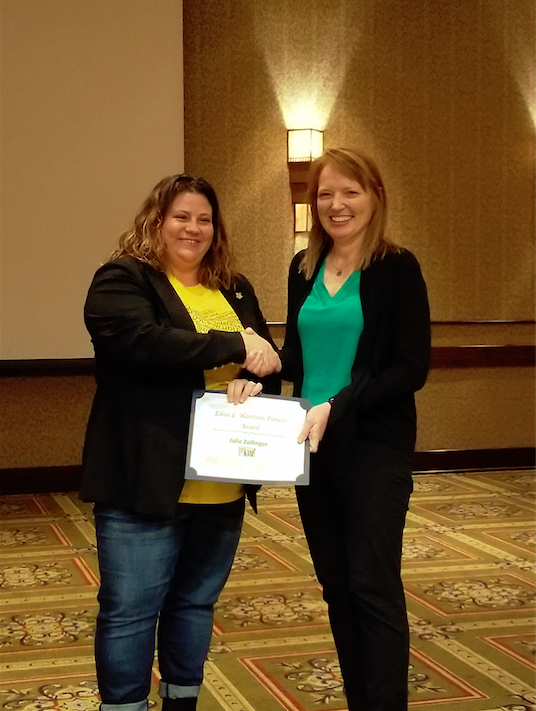
KASP President Jessica Medford congratulates 2019 Edna Harrison Pioneer Award winner Julie Zollinger from Hays USD 489 during the organization’s annual meeting Oct. 4 in Topeka.
By CRISTINA JANNEY Hays Post
Two school psychologists from the Hays West Central Kansas Special Education Coop were recently honored for being top in their field.
Julie Zollinger, HMS school psychologist, was recognized for her work to bring a program to HMS that seeks to identify youth suffering from depression.
Zollinger helped spearhead this program and was awarded the Edna Harrison Pioneer Award by the Kansas Association of School Psychologists.
The SOS program seeks to:
educate students about the link between mental illness and suicide
teach that suicide is, most often, a fatal response to a treatable disorder–depression
encourage individuals to seek help from adults
encourages students to seek help when they are concerned about themselves or a friend
The initial funding for program came from the USD 489 Foundation for Education Excellence. HMS Home and School and a donation from Golden Plains Credit Union helped support the program this year.
Students watch a video and receive a newsletter. To complete the session, they must fill out a depression screening and hand in a response card indicating if they are concerned about themselves or a friend.
During the pilot program, the organizers received several cards from students who were referred for further screening and treatment.
“We had a self report from a student who no one knew was actually struggling with depression. The student was very involved in school. Many teachers knew the student personally. Staff members knew the student,” Zollinger said. “The student reported to us, and the student was in significant crisis. That opened the door to say the student was having these symptoms. ‘I need to tell someone because this is not normal for me to be feeling this way.’
“The counselors and I have said it was so worth it for that one student, who was hiding it very well. The student was suffering in silence. This opened the door for the student to get help.”
Students are asked to write down on their exit cards who they see as trusted adults in their lives. Often those people are parents and other family members, but sometimes they are teachers.
“If we don’t know who that student is, we notify the teachers, ‘You have been identified as a trusted adult.’ They may have no idea who it is,” Zollinger said. “It could be a student in their class who doesn’t seem to engage or [the teacher may not] really think of themselves as a trusted adult, but they have touched one person.
“That’s why it is important to have the adults familiar with SOS — what to say or what to do if a kiddo comes up and says, ‘I don’t want to be here anymore. I want to kill myself.’ It’s scary. Giving teachers and parents the tools to respond to that is a huge part of suicide prevention.”
The next round of SOS classes for students will start on Nov. 5.
If the logistics go well with the eighth-grade class, school officials hope to roll out the program to the whole school, but the school needs more mental health providers to expand the program.
“It is much more challenging to do this for 230 eighth-graders versus our pilot program, which was about 70 students,” she said.
She said more work is needed on this program to make it a practical daily tool for middle school students. She is working with IT to refine the program.
She said she has seen an increase in awareness regarding mental health among young people and in schools. When she started as a school psychologist, schools did not talk about suicide, suicide prevention or self-harm.
“We knew it was happening, but as far as the reporting of self harm and self injury … And suicide, if someone died, adult or child died by suicide, it was not talked about,” Zollinger said.
Zollinger was humble about her accolades.
“I look at my job. I want to help kids and families and staff members be the best they can … I want them to get better—to reach out and get help,” she said.
She added, “I am being recognized for things I want to do anyway.”
Vickie Unruh
KASP President Jessica Medford congratulates 2019 Kansas School Psychologist of the Year Vickie Unruh from Hays USD 489 during the organization’s annual meeting Oct. 4 in Topeka.
Vickie Unruh, school psychologist for the district’s early childhood programs, was named School Psychologist of the Year by the KASP.
She has been a school psychologist for 29 years, 17 years of which have been with the Hays Coop.
Unruh said she decided to become a school psychologist while working as a paraeducator in college. She said she found a passion for working with the youngest children in the system.
“After working as a para, I really fell in love with special education and believed in the value of those services, and it lead into school psychology,” she said.
Unruh is usually the first person parents meet when their child is being considered for the special education program. She often screens children at about age 2-1/2 as they are getting ready to transfer out of their birth to 3 program.
She said parents can find it difficult to come to terms with the fact their child may have delays.
Kyle Carlin, assistant director of special education, in his nomination of Unruh for the award, commended her for the thoughtful and understanding manner she approaches parents.
Unruh said she tries to meet parents in an informal setting first, usually in their own home, before they have to go through the formal process of singing forms. She also evaluates the children in their homes if they have not started preschool yet.
“I try to talk about their strengths as well as their weaknesses,” she said, “and just to get to know them as a family and get to know that child.”
Unruh also co-coordinates the coop’s Autism Intervention Team, which is comprised of 10 members with varying specialties.
The teams offers behavioral, educational, instructional suggestion for the school teams to use with individual students on the autism spectrum. The team also offers screenings for autism.
Unruh thanked her administration team of Carlin and Coop Director Chris Hipp for their support and nomination.



 In other business, commissioners heard information about construction of a classroom in the Hays Fire Department’s new fire/rescue training facility south of the water reclamation and reuse facility.









 By JAMES BELL