We have a brand new updated website! Click here to check it out!

FHSU Ag Day not just for farmers

Katie Pelton, a FHSU graduate in ag business, shared chicks with students.

By CRISTINA JANNEY
Hays Post

The FHSU Ag Day on Thursday was not just an event for farmers, but had information about how everyone can relate to their environment and their food.

Alpha Gamma Rho, the FHSU ag fraternity, offered information about beef. The group offered pamphlets with beef recipes, a  display identifying the cuts of beef and a poster listing an A-to-Z of beef products. It is not just steaks.

Casey Jensen, senior in ag business, said visitors seemed to be the most surprised that a beef product is used in making toilet paper.

Jensen, who is from Courtland, hopes to rejoin the family cattle ranching business after graduation.

A popular stop in the quad was the chicken table, which was hosting chicks.

Students could learn about row crops, such as wheat, at FHSU’s annual ag day on Thursday.

Katie Pelton, a FHSU graduate in ag business, grew up raising chickens, ducks,  pigs, cattle, horses and other livestock on her parents’ farm in Colorado.

“I love agriculture, and I love advocating for agriculture,” she said.

Pelton was handing out candy — popular with the students. She noted items such as York Peppermint Patties or Three Musketeers contain eggs. Eggs are contained in may foods and eggs by themselves are a good source of protein.

Elissa Jensen, who is majoring in conservation ecology and natural resources, represented the FHSU Bee Club Thursday and was advocating for pollinators. The club gave away salvia plants, a nectar producing flower. The club has two hives on campus, which produced more than 60 pounds of honey last year.

Although bees sometimes are elusive, Jensen said the trees around campus are likely loaded with the insects at this time of year.

“Humans are the major factor behind the destruction of the bee population, sadly,” Jensen said.

Andrew Tucker, agronomy professor, exhibited ag technology, including a drone and sensor equipment that helps farmers better use their resources.

She encouraged people to plant bee-friendly flowers and if you spray your lawn or garden, try to do it in the early morning or evening when bees are less active. Also be mindful of the wind that can cause chemicals to drift.

Birds, bees and butterflies will also benefit from a water source, which can be as simply as a dog bowl set outside with a little bit of water in it.

Andrew Tucker, agronomy professor, was helping exhibit ag technology, including a drone and sensor equipment that helps farmers better use their resources.

A sensor attached to a drone can measure the photosynthetic capacity of crops. The drone is flown in a grid and creates a map with GPS coordinates. Areas that show up dark green are producing well, whereas light green, yellow or red areas are not producing as well. This allows farmers to adjust the amount of water or fertilizer they apply to certain portions of their crop.

“You use it where you need it. That way you are not concerned about getting nutrients in our groundwater supply that we don’t want there or have problems with runoff,” Tucker said. “It makes farmers more efficient and environmentally friendly.”

Companies flying surveys charge about $4 to $5 per acre, but a farmer can save an average of 25 pounds of nitrogen per acre. If the price of nitrogen is 40 cents per pound, that is a $10 savings per acre. That still amounts to a $5 to $6 per acre net savings for the producers.

Sigma Alpha, FHSU ag sorority, manned a display on farm safety.

Sigma Alpha, FHSU ag sorority, manned a display on farm safety. Common accidents on the farm are the result of grain bin entrapment and equipment rollovers.

“We are trying to talk about accidents and how to prevent them and overall safety on the farm,” said Jenna Berkgren of the sorority.

Between 2012 and 2017, 11 percent of all U.S. farms experienced an accident.

The Block and Bridle Club had a display that included cows and horse stomachs.

The Block and Bridle Club had a display illustrating cow and horse digestion. This included preserved specimens  of the livestocks’ multi-chamber stomachs. The students used yeast, sugar water and hay on a hot plate to exhibit the process in ruminant system.
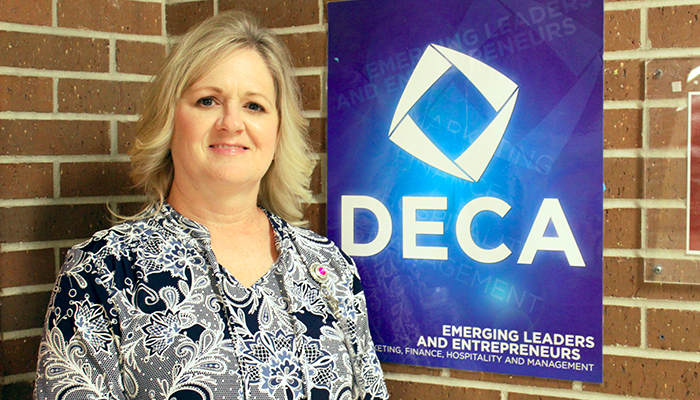


Teacher of the month: HHS DECA sponsor Prough: ‘Chase the cheetah’

Shaina Prough is celebrating her 25th year teaching in the Hays USD 489 school district. During her 21-year tenure as the DECA sponsor, students have raised tens of thousands of dollars for charity and completed dozens of community service projects.

By CRISTINA JANNEY
Hays Post

Shaina Prough, business teacher at Hays High School, is one of four generations of Hays teachers in her family.

Her grandmother taught in Hays and was present for the opening of the Felten Middle School. Her mother was a teacher. Her oldest daughter, Madison, a FHSU senior, is working in the USD 489 after-school program while she finishes her teaching degree.

“It is that whole lineage,”she said. “My grandma would be so proud,”

Shaina, 49, was nominated for the Hays Post Teacher of the Month Award by Madison.

Madison acknowledged her bias, but said she felt her mother deserved the award.

“She always goes above and beyond for her students and always puts them first,” Madison said. “She spends so much time in and outside of the classroom making sure she is prepared and can be the best teacher she can be for her students.

“I first-hand have seen all the hard work, sweat and maybe even tears that she puts in without ever thinking twice. She truly does touch the lives and hearts of so many people daily.”

Shaina Prough said she loved school as a child.

“I was that kid at the last day of school every year who would be sad because I wouldn’t be near my friends and near my teachers,” she said. “I loved coming to school, and I think I always knew that I would be a teacher somehow.”

She said she likes being able to start fresh with new students every year.

“That is the one thing about teaching,” she said. “We get do-overs. If we don’t like the way something turned out the last time we did it, we get to reinvent it for next year. Young people create an energy like none other.”

Prough is in her 25th year as a teacher in the Hays school district. She would have received her 25-year pin from the district on Friday, but she is in Orlando with 15 students for the DECA international competition.

Prough said she gets excited about watching her students compete on an international stage.

“Getting to watch those kids — their faces light up,” she said. “When we go to an arena that holds 20,000 people and that is the size of their whole community, it is a little overwhelming. They get to shine on that international level.”

Prough has been the adviser for HHS DECA for 21 years. During her time as a mentor, DECA has been active with Trick or Treat so Others Can Eat, raised money for the Ronald McDonald House Charities and organized public awareness campaigns about sexually transmitted diseases, mental health, relationship violence in cooperation with Jana’s Campaign, and school finance, among many other projects.

She said the project on school finance was challenging.

“That one was really interesting. We tried to educate a school population on how school funding and finance works, so they could hopefully not only be a voice by voting, but be aware and be able to communicate with people who make decisions about school finance on a local level,” Prough said.

This year, juniors Allison Hillebrand and Paige Polifka Denson chaired the Happiness Project. The focus was on helping students and faculty find ways to be happier.

“We were trying to create mental health awareness, as well — that it is OK to ask for help and where can you go to get help if you are feeling stressed, if your are feeling anxious, if you are feeling overwhelmed,” she said. “So we were really trying to bring to light that you are not alone if you have those feelings.”

The community service branch of HHS DECA , lead by two HHS students who are graduating in May, raised $65,000 for the Ronald McDonald House Charities last year.

“Those skills to be able to network, interact, organize, manage, lead — those are going to be able to serve them well in whatever career field they choose to go into,” Prough said.

Prough said she works with amazing students.

“Being able to see a little glimpse of where their future is going, that’s awesome,” she said. “Being a part of that is fun and exciting.”

Teaching in the business department, Prough said she is getting students ready for their futures.

“I feel those are skills that transfer on to adulthood,” she said. “Whether the student goes directly to the workforce or they chose to attend post-secondary training of some sort, whether it be a two-year program or a four-year program, I feel the skills that they gain in our business classes are those that are going to serve them for the rest of their lives.”

Prough said her biggest challenge is getting students to see the bigger picture — that what they are doing now will have effects on their future. She said she also struggles with keeping the kids motivated. She doesn’t want them to settle for the status quo.

“Mediocrity drives me crazy,” she said. “Don’t settle for what everybody else is doing. Don’t be normal, go above. I have this ‘Live with gazelle intensity and chase the cheetah,’ sign. I teach that in my personal finance class. Dave Ramsey talks about that. Don’t be the one being chased.”

🎥 Homeowners oppose 37th St. extension as part of roundabouts project

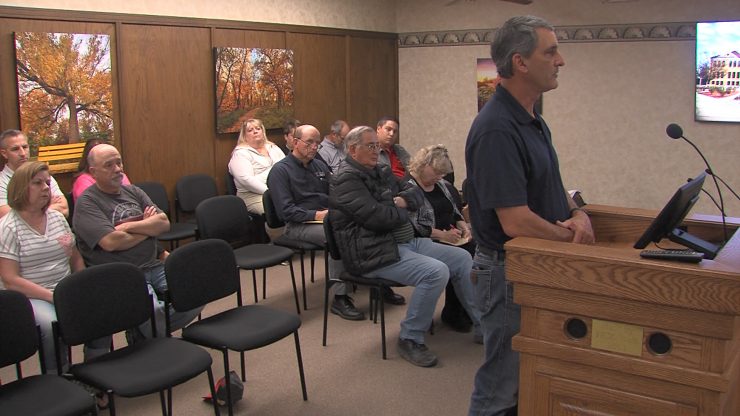
Several homeowners, including Terry Blide, who spoke to the Hays city commission Thu., oppose the proposed extension of 37th St. as part of the north Vine Street roundabout project.

By BECKY KISER
Hays Post

Before the Hays city commission voted 3-1 Thursday night to approve an engineering design supplement to the North Vine Street Corridor roundabouts project, two residents spoke during citizen comments against a portion of the project affecting 37th Street.

The $49,904.65 supplement agreement with WSP Engineers, Lenexa, includes the scope and fee for services related to right-of-way property acquisition. The original $396,895.26 engineering contract was approved May 25, 2018 with WSP. Both will be funded out of the Convention and Visitors Bureau contingency fund.

Four traffic roundabouts are to be constructed on Vine Street/U.S. Highway 183 at 32nd/33rd, 37th, 41st Streets, and a partial roundabout  at the eastbound exit ramp of Interstate 70.

A portion of the engineering contract for the Vine Street traffic roundabouts includes extension of 37th Street to the west. (Click to enlarge)

In addition, the corridor project calls for W. 37th to be extended west to the new development area and for W. 41st – the west frontage road – to be realigned to meet W. 37th further west than the existing intersection location. A new public street would be constructed south of the new intersection to maintain access to the existing gas station south of W. 37th.

Some nearby homeowners are concerned about increased traffic with the extension of 37th and the possibility of falling property values.

Bill Lovewell lives in the 100 block of W. 37th.

“It’s a safe neighborhood with slow traffic and my granddaughter can ride her bike there without worrying about every kind of vehicle coming through,” Lovewell told commissioners, “and I’ve put in thousands of dollars in improvements on my home.

“I have concerns about traffic and the fact my home is not going to be as valuable it is now. … Who wants to buy a house on our street if all that traffic is going to go through?”

Lovewell said he doesn’t have a problem with the roundabout but questions why 37th needs to be extended to the west.

“Every kind of vehicle in the world is going will coming down that street,” Lovewell believes.

Mayor Henry Schwaller noted the city commission has not taken action and has had only informal planning discussions about the project.

“One of the options that we are considering but has not yet been brought to public discussion is connecting 37th across from the old (Ambassador) motel property to Skyline Drive.

“We have not made a decision where that road will terminate because if it comes through the middle of the lot, it won’t be 37th or 38th. It would be in the middle, approximately where the alley is,” Schwaller explained. “So, there may be a consensus one way or the other, but we have not taken any formal action.”

He encouraged Lovewell and others in the audience to attend the commission meeting when the street extension is on the agenda for discussion. “We want you to be involved as we move forward.”

Terry Blide, another homeowner in the 100 block of W. 37th, asked commissioners to “please keep it a residential street, not a business street.”

Blide is worried semi-trucks will drive into his neighborhood. “You really think they’re going to mind those signs about ‘no traffic on 37th Street’?”

The full design of the roundabout project is not yet complete, according to city manager Toby Dougherty.

“We will listen to you before we move forward, I promise,” Schwaller added.

Vice-Mayor Shaun Musil said “I one hundred percent do not think 37th Street should be a direct-through street. I am for connecting to Skyline because I believe – I know – it’s going to grow north of 38th Street. Some of us here don’t agree, but I’d like to see it more of a “T” from left to right.”

Musil and Schwaller both said they had talked with concerned residents earlier Thursday.

“Nothing has been voted on,” Musil reiterated. “Nothing has been designed. I promise you there will be more information before anything will happen.

“I live very close where you guys live. … I personally agree with you.”

Later in the meeting Schwaller voted against the supplemental engineering contract. “I don’t support the project as designed,” he said, “so I didn’t want to spend the money this way.”

Commissioner Sandy Jacobs was absent from the meeting.

Plainville rallies around injured brothers; poker run set for Saturday

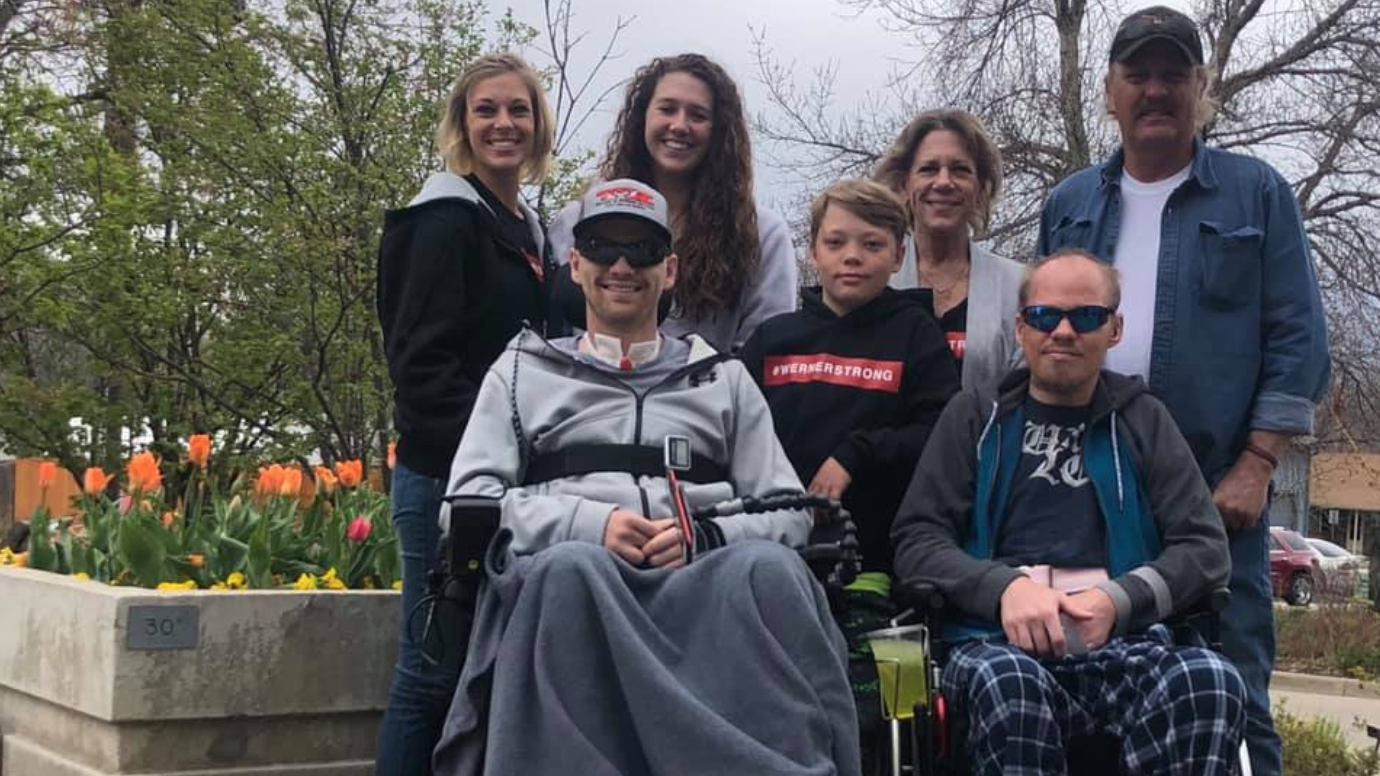
Heather Werner with Jeremy Werner, Kylee Shae and Brandon Werner at Craig Hospital. Courtesy photo

By CRISTINA JANNEY
Hays Post

The Plainville community has rallied around a local family who experience two tragedies in the matter of three months.

Plainville native Brandon Werner, the son of Rick and Karen Werner, was in a car accident near his home in Colorado. He was thrown about 90 feet from the vehicle and received a severe head injury, said family friend Rhonda Wolf. Brandon suffered two strokes, which left him partially paralyzed on his left side. He has also experienced difficulty with his speech.

Brandon, who is in his 30s, had no insurance, so his mother and father moved to Colorado to care for him.

Friends conducted a series of fundraisers for the family, including a soup supper that raised more than $7,700 in two hours.

“The Plainville community has been totally amazing,” Wolf said. “They sure come out like crazy to help their people.”

On March 23, Jeremy — Brandon’s younger brother — was in involved in a multiple motorcycle crash in Atlanta at the American Flat Track Races. He was paralyzed from the chest down. Jeremy is currently in rehab at Craig Hospital in Colorado, about an hour and a half from his brother.

The doctors are unsure of what Jeremy’s final prognosis will be.

He has a bruised spinal cord that has been labeled a “complete” injury. Spinal cord injuries take six months to a year to heal.

“He has regained stable sensation in his right ankle, so time will tell, but the family and community are hopeful,” said Kylee Shae, Jeremy’s girlfriend.

Jeremy works for Stahl Products in Plainville, and Wolf said the company has gone out of its way to help the family during this crisis.

Karen, a nurse, has had to take leave from her job to help care for her sons, Wolf said. Rick Werner works in the oilfield and has someone temporarily filling in for him.

Friends of the Werners are selling T-shirts and other items, proceeds of which are going to help the family. More information on these items can be found on the WernerStrong Facebook page.

On Saturday, the Free Tomorrow Motorcycle Club is sponsoring the Friends of the Werner Family Benefit Run. The poker run will begin at Westins in Stockton. Registration will be from noon to 1 p.m. Start time will be 1 p.m.

The first hand will cost $15. Additional hands will cost $5 each. The run will go from Westins in Stockton to Lucky Lady in Osborne to Roadside Park in Luray to Fossil Station in Russell and will end at the Burgers and Beer in Plainville. The special at the Burgers and Beer Saturday night will be prime rib.

All vehicles are welcome. Last vehicles need to be in by 5 p.m.

To make monetary donations, send them to Jeff Miller, 800 S. Broadway, Plainville, KS 67663. Make checks payable to Rick Werner.

For more information, contact Rusty at 785-302-0070 or Gary at 785-543-1874.

🎥 HAC Spring Art Walk celebrates diversity, 50th of Smoky Hill Exhibition

By CRISTINA JANNEY
Hays Post

The Hays Arts Council Spring Art Walk has no boundaries.

Brenda Meder, HAC executive director, said the walk has no boundaries in the types of art that will be displayed or performed and no boundaries of the types of people expressing themselves through their art. The Spring Art Walk will be 6:30 to 9:30 p.m. Friday.

The Spring Art Walk again will be anchored by the Smoky Hill Art Exhibition, which is celebrating its 50th year. The Smoky Hill is the longest, continuously running juried art show in the state of Kansas and is set annually at the Hays Arts Center, 112 E. 11th.

In honor of the 50th year, the show awarded more prize money than in any time in the past — $3,330, including a $750 prize given in honor of former Fort Hays State University art professor Skip Harwick to Mic Jilg, also a former FHSU art professor.

The show, which is open to any Kansas artist, is as diverse as ever, featuring photography, paintings, collage, block printing, ceramics, sculpture, stained glass and assemblages. The juror choose 73 pieces from more than 300 entries.

“It really sets a tone for how broad the scope of art is and how many different ways there are to be personally expressive and celebrate that creative voice and expression that you need to speak,” Meder said.

Mike Michaelis, CEO of Emprise Financial Corporation, juried the Smoky Hill Exhibition this year. He has assembled the largest collection of art by Kansas artists.

“I was certainly honored to have him lend his eye and his background  and his appreciation for the arts to this show.

“There was a lot of amazing work,” Meder said. “The juror could go so many different ways. He acknowledged that when he came to look at the work in its actuality after he had selected it from photos.”

The Spring Art Walk has 30 participating locations, many with more than one artist or visual art and performance art or music.

“I love the fact that our art walk really does truly represent this cross section of arts and artists in our community,” Meder said.

Styles Dance Centre will host Jana’s Campaign.

“People are using the power of the arts to give a voice to something else, to activate people for a cause and to create awareness,” Meder said. “Those are some of the ways that the arts are celebrated or utilized to bring voice, to bring awareness, to bring a visual presence to things that they are committed to working on through that project.”

The Hays Pubic Library is hosting The Collaborative Art Project with art made by FHSU students and DSNWK clients. FHSU professor Amy Schmierbach recently won an award for her work with the program.

See related story: Art sale to highlight ribbon cutting for collaborative effort between FHSU, DSNWK

See related story: FHSU professor honored at FATE conference

“It’s fabulous. It is another one of these collaborative projects that she has been partnering with DSNWK for a long time with some of her students and getting them acclimated and connected to a world where it is both creative and artistic but also service-oriented,” Meder said.

“It also facilitates others to bring whatever form of expression they are capable of, they are interested in pursuing to their lives whether they are adults with some sort of disabilities or the most professional of artists,” she added.

Meder also noted on the second floor of the library, the young adults department will display the costumes created from recycled material for their Trashion Show.

“The way the creative mind works is fabulous,” she said. “So many people have different ways in which they express that creative mind.

“When you can see how that diversity is represented in a community like ours, that is when you can really, truly appreciate the role of the arts in our community — the diversity of the ages bringing that expression, the diversity of backgrounds, ability whether that is physical or intellectual to their art creation. There are no boundaries, and I hope people will see that Friday night.”

Meder noted a number of locations on the art walk will be open early or late, especially some of those on campus or outside of the downtown core.

The Sternberg Museum of Natural History will have free admission between 4 and 6 p.m. to see “Art & the Animal,” the 58th Annual Exhibition of the Society of Animal Artists.

BriefSpace and Grow Hays have invited the community to their new space and will be open from 5:30 to 7:30 p.m.

“They are featuring the beautiful Kansas photography of Jessi Jacobs,” Meder said. “She is a very good photographer, and this is basically celebrating the visual majesty of Kansas.”

Three FHSU exhibits will also be opening early — “Introspective,” by BFA student Ashley Smith at the C.A.T.S. Gallery, Fatimah Alhazmy’s MFA exhibition at the Moss Thorns Gallery and the open studio exhibit at the FHSU Painting Lab in Rarick Hall.

Meder also wanted guests to enjoy the art walk’s music Friday, including the FHSU Jazz Ensemble from 6:30 to 7:30 p.m. at the Downtown Pavilion; jazz by Jim Pisano and William Flynn from 6:30 to 8:15 at Salon 1007 and 8:30 to 10:30 p.m. at Gella’s Diner; 80 Proof Alice from 8 to 10 p.m. at the Paisley Pear, Sunrise Biscuit at Breathe Coffee House; music by 809 Studio students at the 809 Studio; and the Community Acoustic Jam Session outside of the Ellis County Historical Society.

Meder encouraged street musicians to join the festivities. She said they could play outdoors as long as they don’t block the sidewalks.

Meder also encourages art lovers to come downtown and enjoy one of the Brick’s many restaurants or bars the night of the art walk.

“There are so many places in and around this downtown area that it can be truly an entire evening for you,” she said. “It is just such a wonderful celebration of who and what our community is whether you are a culinary artists at one of our restaurants or a visual artist or a performing artist or a poet and all of it you will find featured on the art walk.”

🎥 City looks at draft Parks Improvement Plan

A new high priority item on the proposed Hays Parks Improvement Plan is a shade structure for the bison herd in Frontier Park West.

By BECKY KISER
Hays Post

At the suggestion of Hays city commissioners, a policy has been drafted for determining priorities in park improvements as well as how matching funds from outside entities are considered.

The draft includes a new park amenities schedule created with the assistance of Jeff Boyle, director of parks. The total cost is approximately $3.35 million.

“We would anticipate updating that every year with high, medium and low priority projects,” City Manager Toby Dougherty told the commission last week. It would be adopted as part of the annual budget of the Parks Department after review by the commission.

Civic groups or other donors wishing to help fund a project would be steered to the high-priority replacement projects, according to Dougherty. Those items are what city staff believes to be the most pressing issues. Some are replacements, others are new pieces.

“I don’t want someone coming in and saying I want that shelter house and we expect you to do it this year,” said Commissioner Ron Mellick, “but that will be all in the schedule.”

Sandy Jacobs wondered what would happen if a group wanted to provide a 50% match for a project that is not on the high priority list comprised by the city. “Would you consider moving it up if they wanted to spend their money that year?” she asked Dougherty.

“It’s up to the commission,” Dougherty replied.

Aubel Bickle Park (Photo courtesy city of Hays)

A separate process would prioritize the projects in the city’s five-year Capital Improvement Plan (CIP).

If an entity wants to accelerate the creation of a high-priority project, there will be a 15% funding match required.

For medium-priority items, there is a 50% match required while low-priority items will required a 75% funding match.

If a proposed improvement is not on the Parks Amenities Schedule, a 100% funding match is required plus additional monies for a 10-year minimum of maintenance, operation, and depreciation costs.

Shaun Musil noted the high priority list included items noted as broken, portions needing replacement, washed out or in poor condition. There were also several new requests.

“I thought the whole object of this was to limit new requests,” Musil said. “Why would you have something like that at the very top?” he questioned Dougherty.

“More recently the commission said ‘we want to focus our efforts and new stuff on multi-use paths,'” Dougherty reminded commissioners. “So that’s a new request. That’s your priority, your request.

“Right now what we’re trying to stay away from is any more restrooms and $70,000 pieces of play equipment and things like that. You are going to see some new requests in here that we (city staff) that we think are valid.”

Dougherty pointed to the Parks Dept. parking lot as one example. Installing a paved lot to replace the dirt lot is listed as one high priority. Drainage mitigation and concrete parking in Frontier Park East is “also a new request but it’s solving a problem we’ve been dealing with for a lot of years.”

A shade structure for the city’s bison herd in Frontier Park West is also a new request on the high priority list.

“We have bison in the pen with relatively no shade and it’s hot and sunny here,” said Dougherty.

“It’s a new construction but it’s relatively cheap.”

Funding sources would vary. Some of the amenities are for parks sponsored by Hays civic groups. The Hays Aquatic Park has its own fund and budget as does the Fort Hays Municipal Golf Course, as well as the Parks Department.

Civic groups or other donors often come to Boyle and ask what is needed in the city’s parks.

“The whole intent is if somebody comes along with money we can try to steer them to the high priority items,” Dougherty added. “If somebody comes along with an idea that is not on the list, the commission can say ‘we appreciate it but it’s not on our priority list – either high, medium, or low – so therefore the burden is on you to come up with the money, and some money to take care of it.'”

Last year, a restroom was installed in Ekey Park, 19th and Holmes Road.  The Sunrise Rotary Club requested the city commission authorize the installation be moved up from 2020 to take advantage of a $10,000 grant the club received from the Dane G. Hansen Foundation, Logan.

“This looks great,” said Mayor Henry Schwaller. “It’s a huge step forward.”

The commission will consider adopting the Parks Improvement Policy at its April 25 meeting.

Water poster contest winners encourage ‘Do Your Part…Be Water Smart’

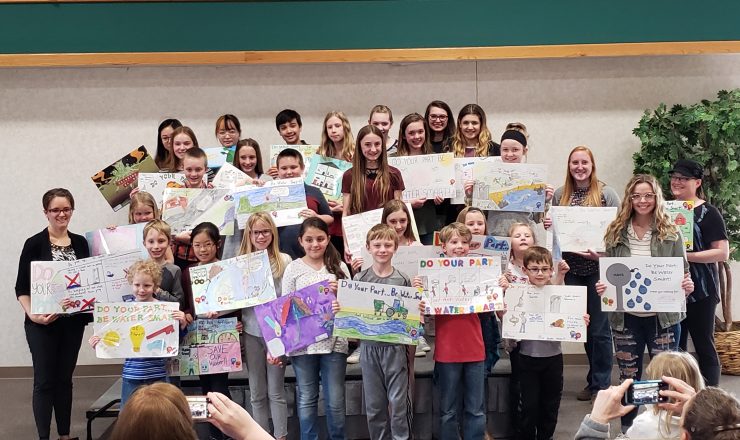
2019 water poster winners

By STACIE MINSON
KSU Watershed Specialist

On Tuesday, April 2, 2019, the KSU Watersheds and city of Hays Water Conservation Department, along with Hays City Commissioners, celebrated and recognized the 2019 Water Poster Contest at Sternberg Museum of Natural History. Over 140 entries were submitted this year using “Do Your Part…Be Water Smart” as the theme.

A total of 35 individuals were recognized for their creativity and talent in sharing the message of water conservation or water quality on posters.

Students drew images depicting how to conserve water by using rain barrels to water outside plants, fixing leaky faucets, taking short showers, replacing showerheads and toilets with high efficiency models, and turning off the water while brushing your teeth.

Students also used their artistic abilities to showcase the importance protecting our water supplies by picking up pet waste, reducing the use of fertilizers, herbicides and pesticides, and checking vehicles for leaks and then making the appropriate repairs and finally recycling or putting trash in its proper place.

First through third place poster winners in each age division (Pre-school thru Adult) received local Hays Chamber of Commerce Chamber Cheques during the awards presentation.

Stacie Minson, KSU Watershed Specialist, Holly Dickman, city of Hays Water Conservation Specialist, and Mayor Henry Schwaller IV, and Ron Mellick, Hays City Commissioner, presented the awards. The evening concluded with participants making ice cream sundaes and enjoying homemade decorated water drop sugar cookies.

Grade Placing Name School
Pre-K 1st Josiah Conner Conner Homeschool
2nd Emma Dickman Mrs. Sandy Henningson, Learning Lane Preschool
3rd Avalea Hill Mrs. Jayna Hill, Ebenezer Road Academy
K 1st No Entries
2nd
3rd
1st 1st Jadon Conner Conner Homeschool
2nd Niko Tsereteli Mrs. Kenda Leiker, SPARK
3rd Colt Raudis Mrs. Kenda Leiker, SPARK
2nd 1st Lily Dickman Mrs. Forinash, Wilson Elementary
2nd Thomas Schleicher Mrs. Kenda Leiker, SPARK
3rd Evie Dietz Mrs. Kenda Leiker, SPARK
3rd 1st Lena Smalley Mrs. Kenda Leiker, SPARK
2nd Carissa Sun Mrs. Kenda Leiker, SPARK
3rd Henry Deyo Mrs. Kenda Leiker, SPARK
4th 1st Joshua Conner Conner Homeschool
2nd Makayla Lewallen Mrs. Herl/Mrs. Oborny, O’Loughlin
3rd Sage Daves Mrs. Herl/Mrs. Oborny, O’Loughlin
5th 1st Delia Dixon Mrs. Angie Cook, SPARK
2nd Josiah Hill Mrs. Jayna Hill, Ebenezer Road Academy
3rd Dawson Ruder Mrs. Angie Cook, SPARK
6th 1st Aliyah Conner Conner Homeschool
2nd Keira Gray Mrs. Sherry Nelson, HMS
3rd Morgan Munsch Mrs. Sherry Nelson, HMS
7th 1st Gauge Horlick Mr. Nathan Purdue, HMS
2nd Mika Zimmerman Mrs. Jessica Schwien, HMS
3rd Hannah Klein Mrs. Jessica Schwien, HMS
8th 1st Leah Fletcher Mr. Nathan Purdue, HMS
2nd Callie Lane Mr. Nathan Purdue, HMS
3rd Taylor Depenbusch Mr. Nathan Purdue, HMS
More winners on 2nd page
OVERALL JR. HIGH WINNERS
Overall 1st Gauge Horlick Mr. Nathan Purdue, HMS
Jr. High 2nd Hannah Klein Mrs. Jessica Schwien, HMS
3rd Mika Zimmerman Mrs. Jessica Schwien, HMS
OVERALL HIGH SCHOOL WINNERS
1st Sugju Chai Sherri Matlock, KAMS
2nd Seoyun Jeong Sherri Matlock, KAMS
3rd None
OVERALL FHSU WINNERS
1st Baley Doggett Dr. Brittney Howell, FHSU
2nd Zoey Wallis Dr. Greer, FHSU
3rd Dallas Dixon Dr. Brittney Howell, FHSU
OVERALL ADULT DIVISION WINNERS
1st Erin Flax
2nd Kenda Leiker
3rd Jayna Hill

Be sure to stop by Tri-Central Office Supply on Friday, April 26 during the Hays Arts Council Spring Art Walk starting at 6:30 p.m.
Finally, a thank you and congratulations to all students and adults who took the time to share their “Do Your Part…Be Water Smart” message by creating and submitting posters in 2019.

Plainville economy trying to recover after two bankruptcies in a month

By CRISTINA JANNEY
Hays Post

PLAINVILLE — The bankruptcies of two significant businesses in Plainville in just over a month has rocked the local economy.

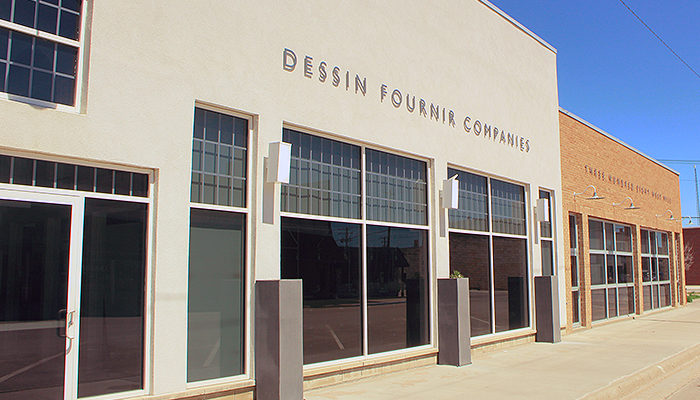
About 40 people in Plainville lost their jobs when the furniture company and its subsidiaries closed. At its height, Dessin Fournir employed more than 90 people in Plainville, which has a population of about 1,800.

In addition, multiple buildings belonging to Dessin Fournir’s owner Chuck Comeau and his companies are under foreclosure from several local banks.

Former Plainvile Livestock Commission building.

The Plainville Livestock Commission, a cattle market agent, filed for bankruptcy on March 1.

The market agent’s custodial bank account, which contained more than $900,000 that was meant to pay cattle sellers, has been frozen. More than 40 cattlemen had checks bounce.

The cattlemen expect to receive a significant portion of the funds they are owed; however, it could be months before they see any money due to the bankruptcy proceedings.

“I don’t want to minimize it. It will have a big impact,” said Roger Hrabe, director of Rooks County Economic Development. “This is not the first time.”

Schult Homes was a significant employer in Plainville. It closed its doors in 2008 after 40 years of operation in the community. The closing also threw a significant number of people out of work. However, Hrabe said the community was able to bounce back from that closure.

“Whatever becomes of this,” Hrabe said, “I think we will be able to come back from this somehow and create new jobs.”

Although Dessin Fournir has fallen on hard times, Hrabe said it was not because of its location in Plainville. He said Plainville still has quality employees and has shown that a multi-national company can operate in a rural area.

Plainville downtown.

According to the latest unemployment rates released Friday, Rooks County’s unemployment rate jumped 0.4 percent to 4.3 percent, which is the highest rate in western Kansas.

Dan Steffen of the Kansas Department of Commerce said, with low unemployment in nearby counties, he thought those laid off by the Dessin Fournir closure should be able to find jobs quickly.

Ellis County’s unemployment rate was up slightly in March to 2.7 percent, but that is still considered very low.

Kansas Workforce in Hays has programs that can help the displaced employees, and its communications department is working to put together a public announcement that will help direct unemployed workers to those services.

RELATED: Kan. Department of Commerce offers rapid response for Dessin Fournir employees

The foreclosures could mean that multiple buildings in Plainville could all go on the market at once, which is significant for a small community.

However, Hrabe said the buildings are in excellent condition and would be good locations for new business that might want to locate in Plainville.

Plainville has a population of about 1,800 people. Its population has been in steady decline since 1990.

In terms of the Livestock Commission, Hrabe said, “I think the effects of any of the ag issues due to crop failure or disaster is difficult. I don’t think it is on the same scale as events in Nebraska, but it is difficult when things like that do happen. In this case, hopefully, they will recover the money.”

Hrabe said the Livestock Commission bankruptcy has caused a trickle-down effect for the community and the entire region.

Because the cattlemen have not been paid, they are having difficultly paying their bills.

Roger McEowen, an Washburn law professor, spoke to cattlemen in Stockton last week about the bankruptcy process and noted there is a multiplier of three to four times in the community associated with this agriculture revenue. With almost $1 million owed to producers, that equals $3 million to $4 million that has been taken out of circulation in the local economy.

Doug Zillinger, representing the sixth district on the Kansas Farm Bureau board of directors, said many people in his district said they have been affected by the Plainville Livestock Commission bankruptcy. He attended the McEowen discussion in Stockton on April 12.

“As I listen to my community talk, we have producers that didn’t get paid, and they are turning around trying to figure out how to get bank loans without the income to produce to pay that loan off,” he said. “They are trying to figure out how to pay their local people, so the ripple effect on this thing is pretty astounding.”

Cattlemen who did not have checks bounced from the Plainville Livestock Commission are also being affected. A group of Graham County producers, who had been taking cattle to Plainville, took cattle to North Platte to sell. That travel increases fuel costs. The trip cost $700 per load.

Hays Post contacted a number of local businesses in Plainville about the economic fallout of the bankruptcies. Those who were willing to comment had mixed feelings on the bankruptcies.

A.J. Thomas, CEO of the Rooks County Health Center, said the hospital intends to proceed with its planned expansion. He noted the hospital draws from a greater area than just Plainville. The hospital is currently one of the largest employers in the county.

Adam Kosinski, owner of the French Press coffee shop in Plainville, said he is concerned about his young venture, but has not seen a significant decrease in business yet.

The French Press has only been open a year in Plainville. He said he has seen less traffic coming through town as fewer cattlemen are bringing their cattle to the market in Plainville. The cattle market remains open, but is being operated by a different market agent.

Larry Denning, owner of the B&B restaurant and bar, said the sales at the Livestock Commission brought in a lot customers. He said Comeaus were also regular customers.

“I don’t know what is going to happen,” he said. “It is hurting everybody.”

He said he thought some families would leave the community permanently because of the closing of the furniture manufacturer.

“Those people, the jobs they had, they are not going to find anything like that around here,” he said.

Despite people being out of work, Denning said he has had no one come in asking for a job and he continues to struggle to find employees for the restaurant.

🎥 Easter comes early at Hays Public Library

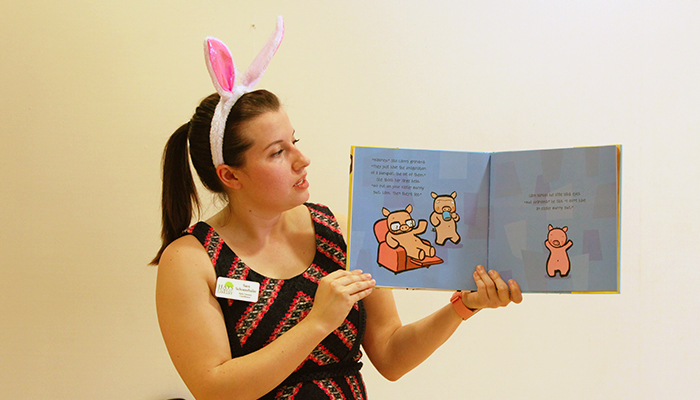
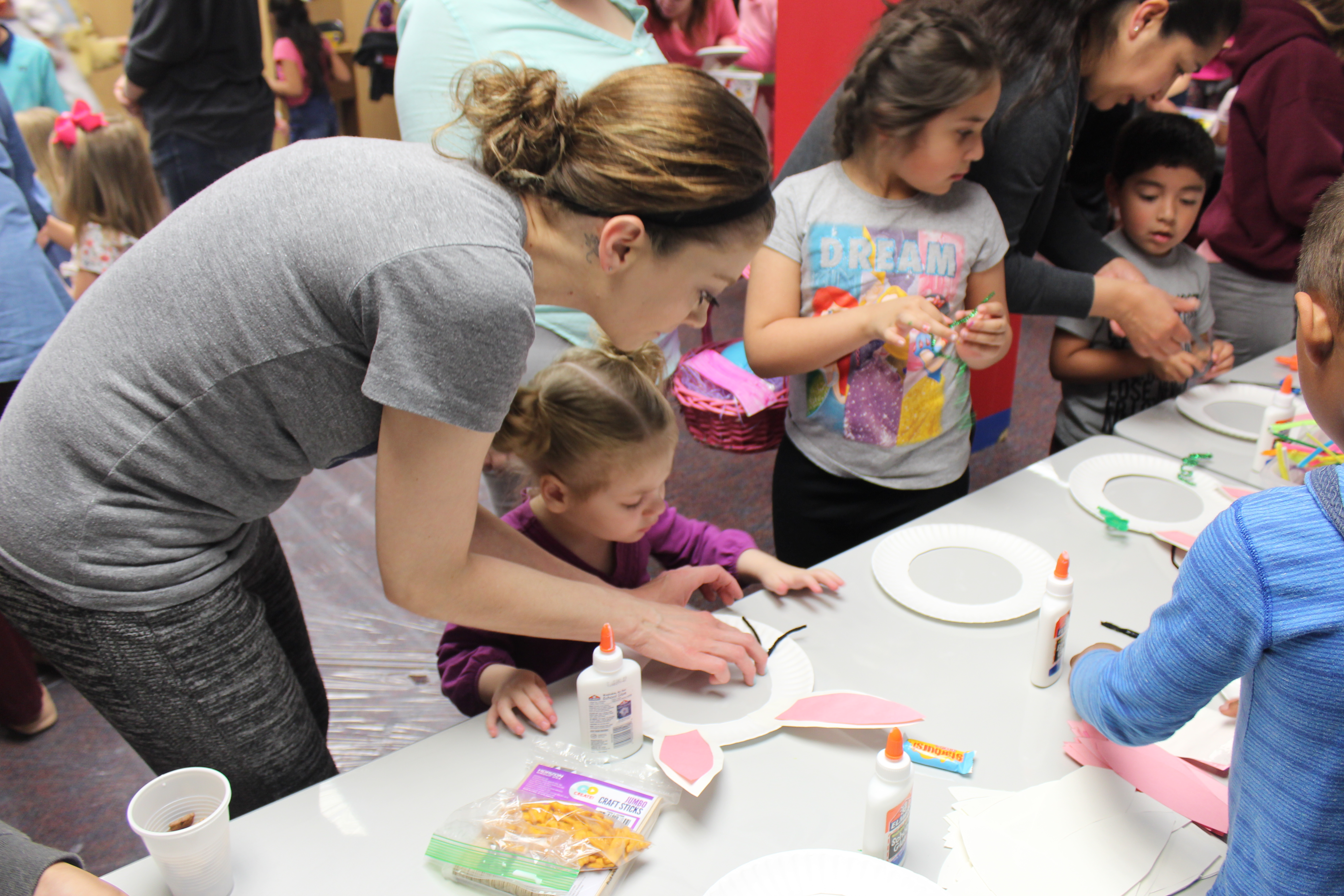
On Thursday, the Hays Public Library celebrated Easter early with story time, a visit form the Easter Bunny, Easter crafts and an Easter egg hunt.

The Easter egg hunt had about 200 eggs per age group. Library employees estimated about 200 children participated in the evening’s activities. All of the activities were free and open to the public.

3… 2… 1… Ellis Girl Scouts build rockets, learn STEM skills

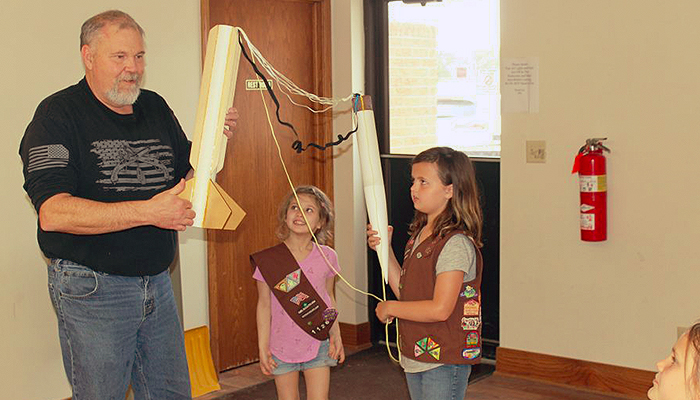
Derilynn Wells, 8, left, and, Jade Harmon, 9, right, hold a rocket as their Girl Scout Troop learns the parts of the rocket.

By CRISTINA JANNEY
Hays Post 

Steve Arthur, Ellis Public librarian, has been helping children build rockets for 10 years.

Among his latest students are members of Ellis Girl Scout Troop 11261, who willing be finishing DER Red Max rockets next week.

Arthur also works with 4-H youth and other community youngsters through the Ellis Recreation Commission in his Big Creek Rocketry program.

“What I hope they get out of it is a better appreciation of science,” Arthur said. “Some things they learn in school they can realize are hands on. They can get experience applying what they have learned in school. I hope this inspires them to study science and aerospace or engineering.”

Girl Scouts Jade Harmon, foreground, and Danielle Wells, 6, background, apply glue to pieces of their rockets. Photo courtesy of Steve Arthur.

Jade Harmon, 9, Brownie Scout from Ellis, is working on her second rocket with Arthur in Girl Scouts and has participated in the Ellis Rec rocketry class.

“I love building rockets, because we are able to construct something from scratch that can launch over 30 feet in the air,” she said. “I think it’s exciting to do STEM projects. We really challenge ourselves, and building rockets takes a lot of patience and focus. My dream is to one day become an astronaut, so rocketry helps achieve that dream!”

The girls are earning badges for their rocketry work. They also conducted experiments with water and learned about water conservation working on other STEM-related badges this school year.

Arthur pointed to current space missions as an example for the girls of the opportunities becoming available for women in space exploration.

Brownie Scouts Rylan Aschenbrenner, 8, foreground, and Amethyst Moses, 8, background, make measurements for their rockets. Photo courtesy of Steve Arthur.

Arthur talked about the planned all-women spacewalk at the International Space Station. American Anne McClain was pulled from the spacewalk at the last minute because the ISS did not have a spacesuit on board that would fit her.

Hoxie native Nick Hague made the walk instead.

“When I was a kid and I built rockets,” Arthur told the girls, “boys did this all of the time. There wasn’t any girls doing this. But things have changed. The same thing has happened with space.

“It used to be an all-boys thing. Not anymore. Because the girl who is up there, she almost walked in space and she would have been the first U.S. women to do a spacewalk ever.

“What does that tell you guys? … It means that you can do whatever you want. You don’t have to listen to other people tell you what they think you should do. If you want to walk in space, you can walk in space. Science is the only way you are going to get there. This is your first step into making your spacewalk.”

Amethyst Moses and Cheyenne Reed, 7, work together on rocket parts.

Arthur became interested in space watching the Apollo missions when he was a child. Astronauts were his heroes, and it was every kids’ dream to be an astronaut, he said. He also built rockets as a kid as did his sons.

One of his biggest thrills was seeing Apollo 13 astronauts Jim Lovell and Fred Haise, as well as Gene Kranz of Mission Control speak at Fort Hays State University in 2016.

“It was surreal for me,” he said. “They were incredible men.”

Although Arthur did have at least one of his rocketry students go on to study aerospace engineering, in most cases, he does not know what the impact of his students’ exposure to science and space will have.

“I hope, for the most part, the kids who actively participate in class, are the ones I impact. They may have never been exposed to this in any other way. I hope they pursue an interest in it.”

Derilynn Wells holds a rocket as Steve Arthur teaches the girls about rocket parts.

Arthur will offer a beginning rocketry class through the Ellis Recreation Commission Tuesday, May 21 and Wednesday, May 22 at the Ellis Public Library for third through sixth graders. Cost is $15 and includes materials and snacks. Class space is limited. You do not have to be from Ellis to enroll. Registration deadline is May 8.

Big Creek Rocketry will have a launch in June. The date will depend on weather conditions. Watch the Big Creek Rocketry Facebook page for a date. Children and adults are welcome to attend. There will be extra rockets available to launch if a child would like to launch their own rocket.

Enrollment for Girl Scouts is open for the fall. For more information on Girl Scouts or to join, see their website. Girls can also sign up starting May 1 for an extended membership for $35, and that will include access to summer camps and activities as well as membership for all of next school year. Financial assistance for memberships is available for families in need.

Note: Cristina Janney is a Girl Scout leader with Troop 11261. You can submit other community news to the Hays Post at [email protected].

🎥 City: Extra engineering contract ‘expected’ for roundabout project

Roundabouts right-of-ways

By BECKY KISER
Hays Post

A $50,000 supplement is expected to be added to the engineering design for the North Vine Street Corridor roundabout project.

Hays city commissioners Thursday night reviewed the addition to the May 25, 2018 contract for a little more than $396,000 with WSP engineers, Lenexa.

“Due to the uncertainty of the requirements for right of way and easement acquisition at the time, the original scope and fee did not include services related to right of way acquisition,” explained John Braun, the city’s project engineer. “Now that design has progressed to a point where the necessary right-of-way and easements have been defined, WSP has provided a supplement to the original agreement.”

Under the supplement agreement, WSP, assisted by Driggs Design, Hays, will provide an temporary and permanent overview maps, individual tract maps and legal description for each of the 35 tracts, temporary field staking of tracts and permanent monumentation of each, certificates of title, and any plan design changes that may result following right-of-way negotiations.

“This is not an unplanned supplement,” pointed out Commissioner James Meier. “This was planned and done so to save money in the long run.”

“We would have paid significantly more if we had done it upfront before the entire scope of the project was known,” confirmed Toby Dougherty, city manager.

According to Jacob Wood, assistant city manager, some of the right-of-way property acquisitions will be a few feet, while some will be a little larger. “It’s kind of everything around the edges of each roundabout that’s not included in the current right-of-way,” Wood explained.

Commissioners will vote on the supplemental engineering contract at their April 25 meeting.

The city received 30% of the roundabouts design plan last month and research is underway by an appraiser for the property that will be required.

In August, the city will have 90% of the design plan. By November, Braun expects the right-of-way acquisitions to be “all wrapped up with utility clearances out of the way.”

By the end of this year, the entire completed plan is scheduled to be submitted to the Kansas Department of Transportation (KDOT) for an anticipated April 2020 KDOT bid letting, allowing for construction to begin in June or July 2020.

Plans are to build two-lane traffic roundabouts on Vine Street at 32nd/33rd, 37th, and 41st Streets, plus a teardrop roundabout at the eastbound Interstate 70 exit ramp.

The total project is an estimated $9 million. Early last December, the city was awarded a $6 million federal grant for construction.

The remainder of the project cost will be paid through a two percent increase in the Transient Guest Tax (TGT). It went into effect Oct. 1, 2018, and is projected to raise $6.2 million over 20 years.

Nicodemus historian speaks on the role of black women, honored with DAR award

By CRISTINA JANNEY
Hays Post

African American girl from Nicodemus. Photo courtesy of the Nicodemus Historical Society.

Angela Bates, executive director of the Nicodemus Historical Society, gave a presentation Saturday in Hays on Nicodemus and the role of African American women through history.

Bates spoke to the Courtney-Spalding Chapter of the Daughters of the American Revolution.

She  is a descendant of the first settlers in Nicodemus, who came to Kansas in 1877. Nicodemus is the last and only remaining all-African American settlement west of the Mississippi. At its height, the community had about 600 residents, but the population declined after the railroad decided not to route through the town.

Bates has done extensive research on Nicodemus. In 2012, she published a book with more than 200 historical photos. It is still available in Nicodemus, which Bates was instrumental in getting declared a National Historic Site.

To understand African American culture today, Bates said you have to go back to the slave culture in the South.

“Women did not have choices during slavery,” Bates said.

African American women worked in the fields or in the master’s house. Women who were older or not as physically capable raised the children during the day. They referred to them as aunties or grannies.

This is why women or men that are family friends are often still referred to as aunts or uncles in black culture, even though they may be no blood relation. It is a term of respect, Bates said.

African American girl and resident of Nicodemus. Photo Courtesy of the Nicodemus Historical Society

Some of the slave children would be assigned to the master’s children. They would help take care of the children, empty their chamber pots, fan them, help them dress and maybe even play with them.
By the time the slave children were 12, they were assigned adult jobs.
“You did not have any control of what was going to happen to your kid,” Bates said. “If they wanted take the kid and take her to the house like in the movie ‘Queen’ after she had the child by her master, the master could say ‘I want the child to be raised in the house.’ ”

Bates said part of the psychology of controlling the slaves was divide and conquer. The slave owners fostered division between house and field slaves as well as division among light-colored slaves and darker-colored slaves.

Yet, any amount of African blood in a person in the South, no matter what their appearance, meant they were regarded as black.

“If you were dark and had kinky hair, you were considered less than a mixed blood that would have lighter complexion and more white features and straighter hair,” she said.

“So when Emancipation comes, the mixed bloods that were living in the house and some of them may be living in quarters, they are shunned on both sides of the fence. The full bloods have been taught to shun them because they think they are better, and that still has psychological effects on African Americans today. We have intraracial prejudice against each other along those same lines.”

Also after Emancipation, women begin to have choices not only about their own lives, but the rearing of their children.

Angela Bates, executive director of the Nicodemus Historical Society, gives a presentation Saturday in Hays to the Courtney-Spalding DAR chapter.

“Freedom affords you an opportunity to have a choice,” Bates said. “You can pick who you want to be married to. You can decide what your children’s names are going to be. Many people change their names right after Emancipation.”

In some cases, brothers chose different surnames. Bates gave the example in Nicodemus of the Wellingtons and Weltons. There were three brothers all Wellingtons, but one changed his name to Welton.

“If you were looking at genealogy or even the census, you would not know,” she said.

In another case, a woman was pregnant at the end of the Civil War and decided to give her child the surname Taylor, instead of the name of her plantation owner. There were brothers and sisters in that family as well who had a different surnames.

Freedom in Kansas meant choices, your children weren’t going to be sold away from you and it was an end to a violent life.

“Imagine you have a child and you love that child and you watch that child grow, and then he does something that he wasn’t supposed to do and he gets beat on the public pole,” Bates said. “You don’t have any choice, and they make you stand there and watch your child get beat.”

A new psychology took hold after African Americans were freed. Bates summed up with the phrase “We rear our daughters and we love our sons.”

Bates said African American women are very independent and opinionated.

“We had to be,” she said. “How can you depend on a man who you may have jumped the broom with, but he doesn’t have any control over himself? So how can I rely on him? Coming out of slavery, African American women relied on themselves. So in the culture we raise our daughters to be independent.”

Women also continued to rely on the “sisterhood,” friends and other women in their community, just as the women in slavery relied on the aunties and grannies to raise their children.

In a white society, black mothers felt sons, who might struggle to find jobs and face other prejudices, needed their support, Bates said.

“We are all suffering from post-slavery trauma,” Bates said referring to both white and black cultures.

Bates said the relationships between black and white women can still be strained.

“Back in the ’60s I would be called a Tom, an Uncle Tom,” she said. “That would be someone who embraced relations with white people. I have found just being a human being that people are people, no matter what. There are people who are black that I would not want to be around.”

Angela Bates receive the DAR Women in American History Award Saturday.

At the end of her presentation, Bates was honored with the DAR Women in American History Award for her work to preserve African American history.

Bates also serves as a speaker for the Kansas Humanities Speakers Bureau, who sponsored her talk Saturday. She is a member of the National Parks Conservation Association and the National Trust for Historic Preservation. Bates received the Kansas Sampler Foundation’s “We Can” award (1993), the Brown Foundation’s award for excellence (1994), the Outstanding Contributions award (1996) from the Kansas Humanities Council, the African-American Preservation Hero award (1996) from the National Trust for Historic Preservation, and the Woman of Distinction award (1997) from the Kansas Martin Luther King, Jr. Memorial Committee of Topeka for her work in preserving African American history, and, more recently, the 2012 Kansas Trail Blazer Award. (Bio information courtesy of the University of Kansas).

Learn more on Nicodemus from the Kansas Historical Society or the National Park Service.

Dessin Fournir, subsidiaries file for bankruptcy; Comeau properties foreclosed

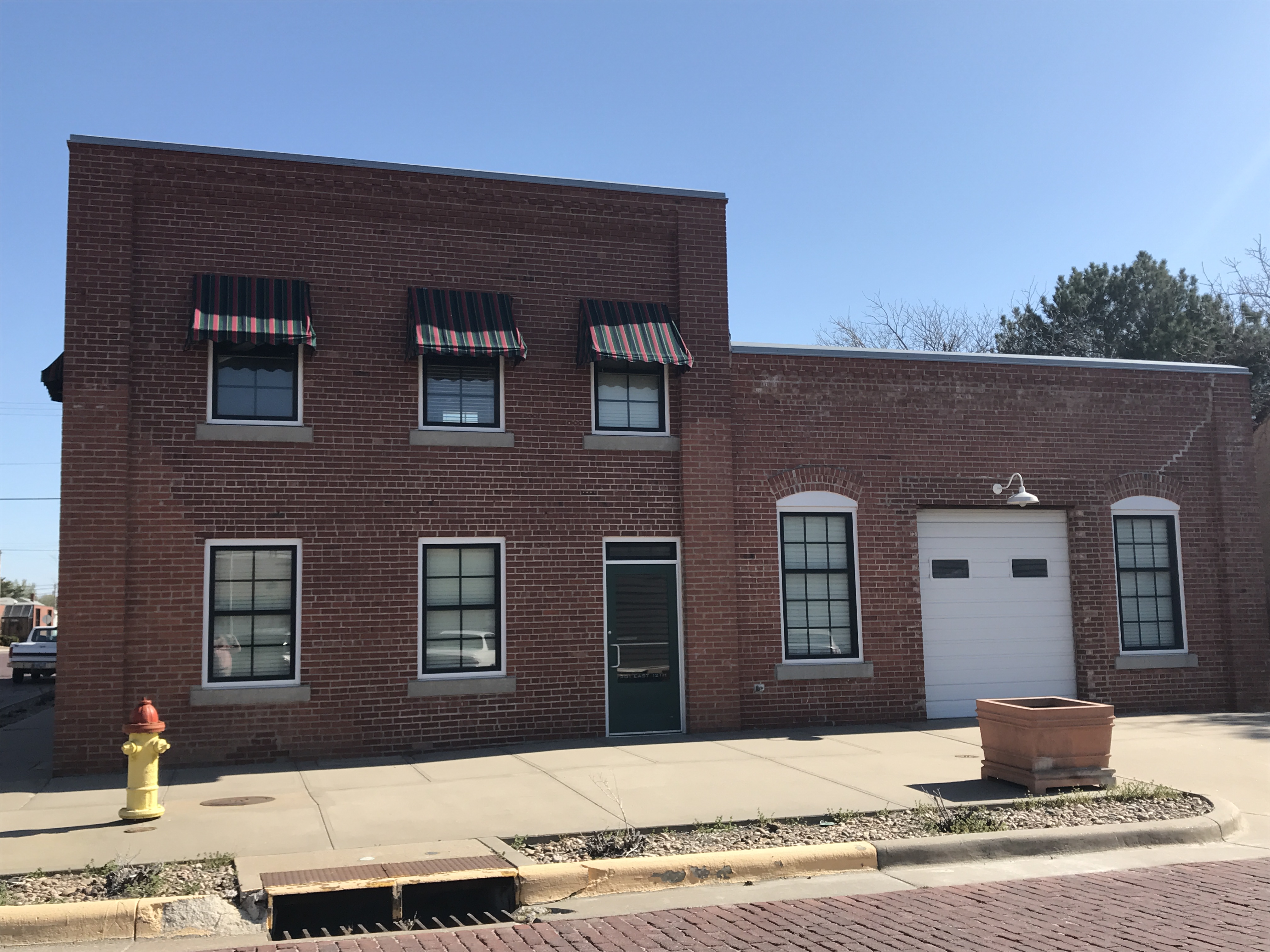
201 E. 12th St. in Hays, one of the Comeau properties foreclosed by Sunflower Bank.

All remaining employees at Plainville company laid off, attorney says

By CRISTINA JANNEY
Hays Post

After foreclosure filings on multiple buildings owned by Chuck Comeau and his subsidiaries, his luxury furniture company Dessin Fournir and 11 of its subsidiaries filed for Chapter 11 bankruptcy on April 8.

The company’s offices have closed, and all of its employees have been laid off, including those in Plainville, according to Edward Nazar, the attorney handling the bankruptcy.

At its height, Dessin Fournir employed more than 90 people in Comeau’s hometown of Plainville.

Nazar said Comeau is seeking to find a third-party buyer for the multiple divisions of his company. In the meantime, a meeting of creditors is set to convene, Nazar said.

“It was a very successful business,” Nazar said, “which had a reversal of fortune in 2008, and it struggled for the last 10 years to overcome the reduction in revenue and was regretfully forced to file a bankruptcy.”

The furniture manufacturer was listed in court documents to have more than 200 creditors locally, nationally and even internationally with a total liability of more than $13 million. Some of its subsidiaries had other creditors, including companies in the trade.

Some of main company’s creditors include the IRS, the Kansas Department of Revenue, the Rooks County Treasurer, Assurance Partners in Salina, designer Holly Hunt and singer Lionel Richie, who had a customer deposit of more than $15,000 with the company.

Dessin Fournir assets were listed as $6.6 million, $3.8 million of that is in inventory. The assets also includes Plainville properties at 308 and 310 W. Mill, 223 W. Mill, 211 W. Mill and 111 N. Jefferson.

The company is listed as owing more than $8.9 million in secured debt to three local banks, including $952,000 to Astra Bank, $7.5 million to Bank of Hays and $420,000 to Sunflower Bank.

Bank of Hays and Sunflower Bank filed for foreclosure on Comeau properties last year.

On March 26, District Court Judge Blake Bittel in a summary judgement ordered Comeau’s companies and other loan guarantors to pay Sunflower Bank a total of more than $420,000.

The companies included Oak Street Plaining Mill, Classic Cloth, Dessin Fournir, DFC Holding, C.S. Post, Liberty Group, plus individuals Chuck Comeau, Shirley Comeau, Christopher Mraz, Lenice Larson and Palmer Hargrave.

Properties listed in the foreclosure included 201 E. 12th St. in Hays, and Plainville properties 108 N. Main, 211 1/2 Mill, 205 N. Main, 317 W. Mill, 211 W. Mill, 221 W. Mill.

If the money for the bank loan is not paid in full, the properties involved were ordered to be sold in a sheriff’s sale.

The Bank of Hays also had a loan on Rooks County property worth $7.5 million.

Judge Bittel ruled Sunflower Bank’s interest in the case took priority over Bank of Hays’ loan.

The Kansas Center for Entrepreneurship also had a mortgage on a portion of the Rooks County properties, but the agency disclaimed any interest in the real estate in the foreclosure.

DFC Holdings listed the property at 311 S. Washington in Plainville in its real property asset list in the bankruptcy filings on April 8.

Business Home in a story published April 10 said Chuck Comeau sent a letter to clients last week saying, “I failed to understand the ‘right-sizing’ for our company after the recession, and instead thought we should try to maintain jobs.”

A call to the Attorney Ashley Comeau, who is representing her in-laws was not returned. Attorney for Sunflower Bank, Aaron Martin, said he could not comment on ongoing litigation.

Copyright Eagle Radio | FCC Public Files | EEO Public File