CAPE GIRARDEAU COUNTY, Mo. – With the assistance of the Cape Girardeau Police Department, the Kansas Bureau of Investigation (KBI) and the Norton County Sheriff’s Office made an arrest connected to the murder of Lori Shields.
Damien Shields -photo Cape Giradeau Co.
At approximately 4:20 p.m. on Monday, he was released from the Saint Francis Medical Center in Cape Girardeau, Mo., Damien L. Shields, 42, of Norton, was arrested for the first-degree murder of his wife, 38-year-old Lori Shields.
Shields was then booked into the Cape Girardeau County Jail.
—————
NORTON COUNTY– The Kansas Bureau of Investigation (KBI) and the Norton County Sheriff’s Office are currently investigating a homicide that occurred in rural Norton, Kan. on Sunday.
According to a media release from the KBI, preliminary information indicates that the Norton County Sheriff’s Office received information Sunday afternoon that a female victim was deceased at 16353 U.S. Highway 36, in Norton. At approximately 3:40 p.m., sheriff’s deputies responded to the residence where they discovered 38-year-old Lori Shields, of Norton, deceased inside.
A suspect connected to the case was identified, and KBI agents and sheriff’s deputies worked to try to locate him. On Monday, at approximately 2:40 a.m., the Cape Girardeau, Mo., Police Department responded to a report of person calling out for help from a hotel room. Once police arrived, they learned the man in the hotel room was being sought by Kansas authorities connected to this homicide case.
The man was taken to a hospital in Cape Girardeau to be treated for injuries that were likely self-inflicted. He remains hospitalized at this time.
According to a social media post by the Norton Telegram, Shields was the Eisenhower Elementary School secretary. USD Norton School District has canceled Monday classes and all activities.
The investigation is ongoing. Nothing further will be released at this time.
Tammy Wellbrock, HACC exec. dir., reads an audience question during a Saturday forum with area legislators Sen. Rick Billinger, and Reps. Barb Wasinger, Leonard Mastroni and Ken Rahjes.
Saturday morning in Hays, four area state legislators, all Republicans, all agreed there is “just not enough of the pie” to go around. Rep. Ken Rahjes (R-Agra), chairman of the Higher Education Budget Committee, said the “state is being held hostage by K-12 funding.”
“We have all these programs that need funded. We have all these folks that need. And simply raising taxes is not going to solve the problem. We fed that beast and it continues to grow,” Rahjes said.
Rep. Barb Wasinger (R-Hays) voted against the school funding bill, saying the extra money was not going to students and teachers.
Rahjes reluctantly voted in favor of the school finance bill. Hays Representative Barbara Wasinger voted against it.
She said she was looking for accountability in the bill, with more funding going into classrooms and for teacher salary increases.
“Did you see the new activity buses that Great Bend did? Paid a quarter of a million dollars for each one of them,” Wasinger said. “Russell used money that they got to build an AstroTurf football field. Last year, Shawnee raised their administrators’ salaries 13%. I have nothing against administrators, but why wasn’t that spent for teachers?
“Good teachers are leaving us because they’re not being paid enough. Let’s start giving them some money.
“I would have voted for the House bill even though it was still a lot of money. It put in accountability measures and put kids and teachers first, finally. It was voted down, and so I voted against the Senate bill that came over.”
Wasinger contends her vote was “not a vote against education.”
Most Senate Republicans lined up behind Kelly’s plan last month after the four school districts suing the state – Wichita, Hutchinson, Dodge City and Kansas City – initially supported it, then withdrew their endorsement and called for higher spending after the 2019-20 school year.
According to Sen. Rick Billinger (R-Goodland), those school districts now want nearly $900 million over the next four years.
“Our (total state) budget is at $7.7 billion and a little over $4 billion is K-12 funding,” Billinger said, “and I support K-12 and I voted for the $92 million. I had an explanation for my vote – we’re being held hostage.”
Western Kansas schools are not the problem, according to Rahjes, especially the small rural districts.
“Most of our administrators could be a substitute teacher one day and cook the meals. They’re the athletic director. They drive the bus, all for a lot less money than some of the bigger districts in the eastern part of the state.
“I believe school board members in this part of the world are very judicious with their money and they want to make wise investments.”
Now that the school finance package is passed, it will be defended in front of the Kansas Supreme Court.
Rahjes expects the court to rule it’s not enough money.
Then, he predicts, “you will see a constitutional amendment try to get into your hands the next election to take the Supreme Court out of the appropriations process.”
“I believe that folks are fed up.”
The Republican-controlled Legislature adjourned Friday for its annual spring break and will reconvene May 1 to work on the budget.
First Dist. Congressman Roger Marshall (R-Great Bend) spoke at Saturday’s legislative forum in Hays.
First District Congressman Roger Marshall (R-Great Bend) attended an early portion of the forum presented by the Hays Area Chamber of Commerce.
Marshall talked about the two issues he said are on the minds of Kansans and its biggest challenges – a lack of employees and the cost of health care.
FHSU took a chance by giving an injured football player a scholarship to continue his education. For that student, Tré Giles, the opportunity was life-changing.
Giles, 25, has traveled across the world and affected scores of lives, but the college education that made all that possible almost evaporated before he had settled in as a freshman.
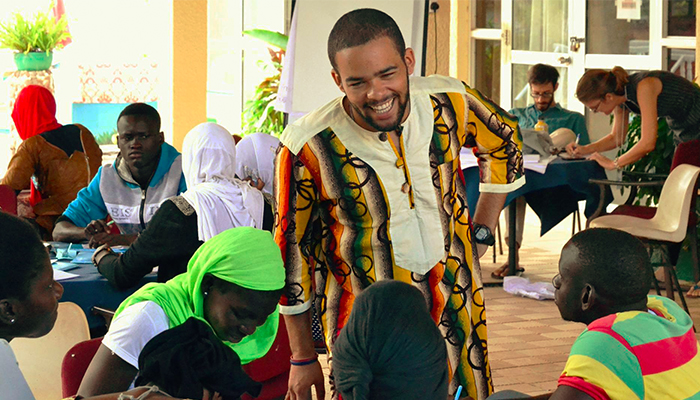
FHSU grad Tre´Giles is the youth minister for the CrossCurrent ministry at Celebrations Community Church in Hays.
Giles came to FHSU on a football scholarship. During football camp, he jumped up and his knee snapped. He tore three major ligaments in his knee, had reconstructive surgery and lost a lot of his muscle mass.
Football was no longer going to be an option.
Giles, a first-generation college student, grew up in Colorado Springs. It was just he and his mom, who worked 12-hour shifts at a local manufacturing plant to make ends meet. He described himself as a “knucklehead” in high school. It was about sports and meeting friends and that was it.
Stuck in Hays
“It honestly felt like I was stuck at Fort Hays out here at Hays,” he said. “I had one friend here that we came to Fort Hays together, but that was about it. It was a fresh new start in a place where everyone looked different than me. They talked different than me. That was the biggest culture shock I ever had in my life.”
Giles said the pace in Hays was a lot slower than back home. To fight boredom, he dug into his studies and looked for outlets to be involved on campus. He joined Black Student Union, the Management and Marketing Association, and Collegiate DECA.
However, without a football scholarship, Giles knew he did not have the money to continue his education.
“I was in the dorms and I remember getting a couple of letters in my mailbox saying I owed some absurd amount of money by this date otherwise you can’t continue your education. In my mind, my mom can’t come up with that kind of money and neither can I, so this was a cool run. I had an injury. I had fun while I was here and did good things and got good grades and got plugged in, but it’s not going to work. I pretty much had given it up.”
A second chance
When then Vice President of Student Affairs Dr. Tisa Mason found out Giles might have to leave school because of finances, she approached then-President Edward Hammond about finding scholarship money for Giles to stay.
“Our core values really get down to our personality characteristics of grit and determination, and that’s Tré. He works hard. He is determined. He’s positive. Not only did he come into a caring environment, but you know by his joy, he helps radiate that caring environment for every student faculty and staff that he meets,” Mason said.
She said she knew Giles was going to continue to make an impact on the world.
“I wanted him to enter that world with a Fort Hays degree,” she said.
Giles was working at the FHSU Union when Mason and Hammond approached him.
Giles during a study abroad experience in China.
“They pretty much just looked at me and said ‘We want you to know we have seen your investment in the campus and the groups, so just know you have a Presidential Scholarship. Your financial stuff is taken care of for this year,’ ” he said.
Giles said he broke down and cried.
“That is what kept me in Hays because in that moment, they empowered me to do things while I was here and stay here,” he said. “I developed a sense of loyalty to the community because of that moment.”
A turning point
Although Giles acknowledges there is a valid conversation ongoing in the U.S. about the necessity of students attending college, for him, college was a turning point in his life.
“College was not necessarily about the classes always or the piece of paper you get at the end,” he said. “To me, it was an opportunity to network and meet people. To me, it was an opportunity to get involved in organizations and other countries. Those opportunities would not have been in front of me if I wasn’t in college.
“I got to develop at a rapid pace and I was exposed to things that people from where I am from don’t really get exposed to because of this opportunity,” he said. “That taught me so much. It taught me how to lead people. It also taught me how to follow good leaders. It taught me how to empower others and to be empowered. It gave me a voice, and I realized that my voice means something and, in certain spheres, it is actually worth something. I don’t think I would have learned any of that if I had just gone back home or if I won’t have come to college.”
He said sticking it out in college changed everything.
Giles during a service trip as an undergrad to Guatemala.
Giles was a member of the Student Government Association and Global Leadership Project. He served on the board of Jana’s Campaign and worked with the United Nation’s Commission on the Status on Women during his tenure on that board.
During the Trayvon Martin trial, Giles organized a civil rights protest. He said the event was intense. A truck full of men attended the protest and broadcast racial slurs from a megaphone. Despite the tension, the protest was conducted peacefully.
Giles had opportunity to travel to major cities across the United States and complete an internship with the Cancer Society in Kansas City. He spent time in China in an exchange program and volunteered at an orphanage in Guatemala. After graduation, he served in the Peace Corps in Africa.
Mason said if students lives are not changed during their time at FHSU, there has been a failure in the partnership between the student and the university. Helping students build confidence so they interact professionally and socially is important.
“It is more about learning who you are,” Mason said. “You are unlocking that untapped potential, gaining that sense of clarity and confidence about how you interact with other business professionals. …
“When we talk about wanting to have an impact on the world, it is really a broad impact, not only being good but bringing more social capital to our communities and economic prosperity and making Kansans and our families much, much stronger.”
A change for his family
Giles attributed much of his success to his professors who empowered him to use his voice and be a leader, but also to his mom.
She told him, “Tré, we struggled when you were young and I was younger, but we did everything we could to put you in a position so you wouldn’t have to struggle and you could change the narrative for our family.”
“My mom put in all the groundwork and all the foundation to where all I had to do was step into it and be consistent and show up,” he said.
“We have this saying with me and my mom. We call it, ‘Keep it pushin’. That just means no matter what shows up — the obstacles, the crap and even the triumph and success — no matter what’s in your way — you keep moving forward, you ‘Keep it pushin’.’ ”
Giles with his mother at graduation.
When Giles graduated, they both realized the significance of the moment.
“There was that moment that this might change us forever — our whole family dynamic. It is amazing that my kids — her grandkids — will have an even better life than I have because we are taking steps in that direction hopefully for generations to come. I get to be the first catalyst, because of my mom, to change our family.”
Finding faith
Giles also experienced a pivotal change in his spiritual life during college. Giles is now the youth pastor for the CrossCurrernt Ministry at Celebration Community Church in Hays, but he was not a Christian when he entered college.
He began talking to instructor LeeAnn Brown about her Christian faith. Giles’ father was not part of his life growing up, and Braun realized Giles had never had a father figure other than coaches.
At the end of his sophomore year, she introduced him to Dr. Jeffrey Burnett, health and human performance professor and leader of the college Encounter ministry. Giles was skeptical at first. He thought Burnett just wanted to use his influence on campus to bring more students into the ministry.
“For so long, I had seen Christianity as this cookie-cutter, boring thing where people were fake and pathetic, but that was the first time I met a Christian who was real,” Giles said. “He said, ‘Yo, it ain’t no cookie-cutter thing. This is about love. This is about sacrifice. This is about a decision and choice you make every day, and I want to challenge you with that.'”
Burnett described Giles when they first met.
“Tré always had that huge personality that attracted so many to his presence. Now he came from a home which was full of love from a very caring mother but also came with some hurts and instability from others,” Burnett said. “So even though Tré had his huge personality, he was a young man that was searching for a place to belong and really didn’t have a clear direction.”
Giles started going to the Encounter meetings on Wednesday nights.
“After a while, the narrative of Jesus became something I couldn’t live without anymore, and I really believed in it,” Giles said. “It healed me of so much hurt and pain and enabled me to be such a better leader, just leading how I believe Christ leads. I don’t have to say I’m doing it like Christ does. I just demonstrate it.”
Giles speaking at Celebration Community Church.
Giles continued, “Seeing something real and genuine, it was like ‘I will sacrifice for you and I will love you and I will stop and I will see you and I will support you and I will take your hand and I will walk you through the mud and I will celebrate you when you do good.’ That was Christianity for me, and that is what it is now for me. I cling to it.”
Alone in my hut
Giles said his experience in the Peace Corps solidified his faith. He was posted in Gambia in West Africa in a predominantly Muslim culture. The country is one of the poorest in the world.
He was sent to a village of 2,000 people — the only foreigner and the only Christian in the village.
“It was that time when I sat in my hut every day with no electricity and no running water and I would open my Bible and I would pray and my faith became mine because no one else around me could help me,” he said.
The connection he felt to his Christian faith was enhanced by the beauty he saw in the Muslim faith, he said.
“They sacrificed for each other. They all prayed together. There was so much family. The little they had they would give. There was not a single person who was starving in this village. Everyone took care of everyone,” he said.
Even if he does not move people to Christ, he said he hopes he instills self-dignity in them.
“I take all of these experiences and mash them all together for one thing you hope becomes a message that you hope people want to join and support,” he said. “I am learning now how to use all of these stories and experiences I have had in my short life to impact people.”
Self doubt
Despite being a regular motivational speaker, Giles said his greatest struggle is self-doubt.
“My biggest challenge has always been to be gracious with myself and to believe in myself,” he said. “That is what I care about is encouraging others and teaching them how to believe in themselves. I think that is why it is such a burden on my heart to help other people care for themselves and believe in themselves and to do things because that is my own struggle. I think the thing that burdens [people] the most is the thing that they can impact the best. …
“There is something about seeing someone figure out they are really worth something that helps me understand that I am really worth something.”
Giles with his fiancé.
Giles is recently engaged and is looking forward to his wedding and someday being a dad. He said his No. 1 goal is to be the “dopest dad ever and coolest, most supportive and loving husband.”
He said he is happy with his job working with students at Celebration Community Church, but he wants to keep expanding his reach to more people.
He said even at CrossCurrent, he knows he can’t reach every young person, but he can equip other leaders, so the ministry can reach every child.
“Someday, I want to get involved with taking so many micro-influencers — people who don’t have a million followers, but they have a thousand or a hundred really solid good people with them — and equipping those type of people to make big change.
“That is my dream. Do I know what that is going to look like yet? No. I know I will have a solid marriage and a solid family. I will be plugged into a solid church forever regardless of where I live, and I know I will always be involved in my community, trying to make those dreams a reality. I think if I do these things, the way it will happen will figure itself out.”
He added, “If we do well enough today, and another today and another today, I just feel the future will take care of itself, because we cared about today.”
TOPEKA – The Kansas Department of Transportation has pledged to match $1 million in funding for road improvements in Ellis County’s Northwest Business Corridor, contingent on approval of a grant the county has made to the Dane G. Hansen Foundation, Logan.
“I appreciate the ongoing dialogue regarding the Northwest Business Corridor in Ellis County/’ Deputy Secretary of Transportation, Lindsey Douglas wrote. “Investments in the corridor will pay dividends by providing more efficient access to jobs…. Which will enhance freight connectivity and provide better access to regional markets and beyond.”
Rep. Barb Wasinger (R-Hays), 111th District, brought together a coalition of federal, state, county and city leaders in February to see the road first-hand, tour businesses whose operations are affected by the road, and asked all parties to work together for a solution.
Kansas Deputy Transportation Secretary Lindsey Douglas; Congressman Roger Marshall; Rep. Ken Rahjes; Sen. Rick Billinger, and Kansas Commerce Secretary David Toland
“I’d like to thank Congressman Marshall, Commerce Secretary Toland and Deputy Transportation Secretary Douglas, as well as Senator Billinger, Representative Rahjes, and our county and city commissioners for their work on this project,” Wasinger said.
“Commitment of these funds from the state, along with previously approved Ellis County funding, are moving this project forward. We’re hopeful the Dane G. Hansen Foundation will favorably consider the county’s grant application, and help make these improvements a reality.”
The Northwest Business Corridor, which includes 230th Avenue between 1-70 and Feedlot Road, as well as Feedlot Road from 230th Avenue to U.S. Highway 183, has long been eyed for improvements.
230th Avenue north of I-70
In particular, 230th Avenue is a narrow limestone road that sees hundreds of vehicles and heavy trucks daily, including traffic from Pertl Feeders, Hess Services, Midwest Energy and Ellis County Concrete.
Poor sight lines, drainage and erosion have made the road dangerous for the volume of traffic it serves.
Improvements along the corridor are also essential for a travel plaza planned for the area, and could help alleviate truck congestion once roundabouts on Vine Street are completed.
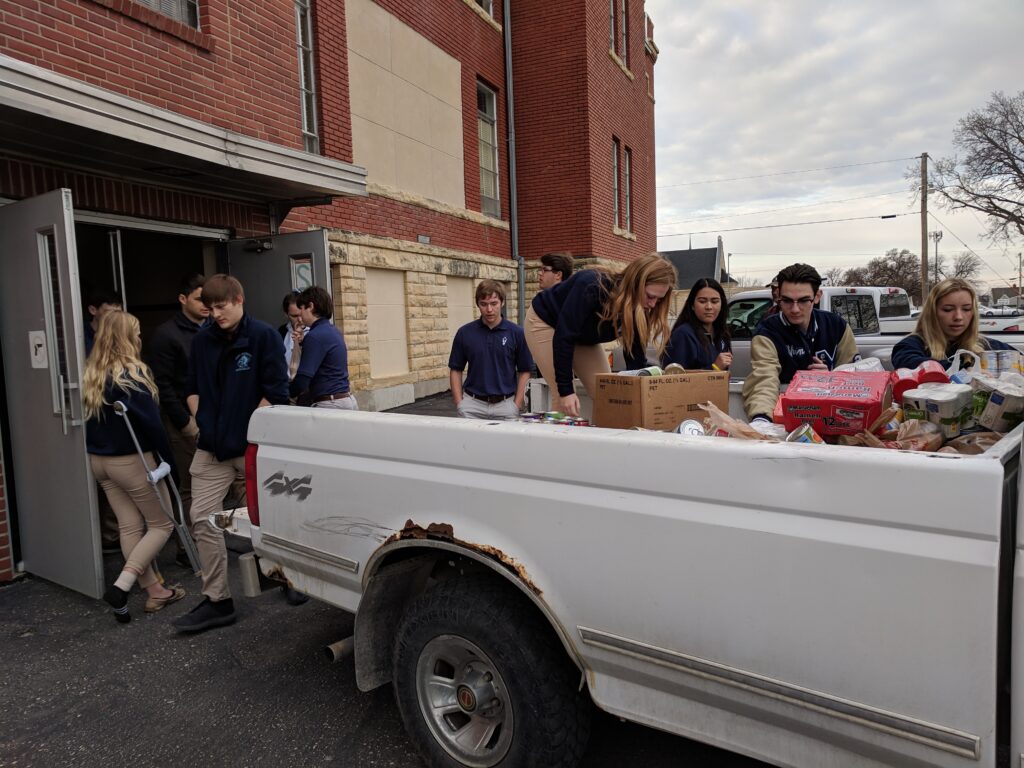
TMP juniors load donated food bound for the St. Joseph Food Pantry.
By CRISTINA JANNEY Hays Post
Food stacked in one of the classroom doors as part of Can Your Class food drive.
Thomas More Prep-Marian students this week completed the Can Your Class food drive, collecting 3,105 food items for the St. Joseph Food Bank.
Spanish teacher Melissa Pinkney came up for the idea for the drive. The students were challenged to bring enough food to fill up the doorway to their classrooms. The class that donated the largest amount of food earned a free class period with popcorn.
Pinkney said she was shocked by the students’ response to the challenge.
It was a tight competition, but Mr. Denton’s senior and sophomore English classes won the competition.
The junior class delivered and sorted the food for the pantry during its academy period.
“I know Renee Michaud at the food pantry was very thankful. When we brought the food, the room was quite bare,” Pinkney said.
Learning about service and charity are important aspects of the TMP education, Pinkney said.
TMP students sort donated food at the St. Joseph Food Pantry.
“I think for the younger generations, they have to experience the service. That helps them in their mind make connections to the community, but also TMP is about giving back,” she said. “That is one of our main goals is to teach about service and how important it is.”
“The only way to attack child abuse is to lift that veil of silence that has been over families.”
That was the message from Ellis County Attorney Tom Drees, who spoke during Tuesday’s listening session in Hays about sexual abuse by Catholic priests and Capuchin friars in Hays and throughout the Salina Diocese.
The meeting at St. Nicholas of Myra Church was hosted by Bishop Jerry Vincke along with Frs. Christopher Popravak and Joseph Mary Elder of the Denver Province of Capuchins.
Late last week, the Capuchins and the Salina Diocese released separate lists of clergy who have been investigated for “substantial” or “credible allegations” of sexual abuse of a minor.
“For so many years, children were not comfortable reporting,” Drees said in an interview following the meeting. “Children would report to their family. The family would not report it.
“Hopefully, this (meeting) will give parents, grandparents, aunts, uncles, cousins, friends the encouragement that when a child does tell you about a situation like this, you report it to law enforcement, let law enforcement properly investigate it and see what’s going on.”
Between July 2012 and March 4, 2019, the Ellis County Attorney’s office was notified by the Capuchins of seven possible sexual abuse cases involving more than one abuser.
Drees believes it’s “very good for persons who have been abused in the past to bring that information forward. Everyone is encouraged to report. … The local parish priest will help you report, and the diocese wants to hear from people.”
The Kansas statute of limitations is very specific.
“We have to know all the details to know whether a case is outside the limitations,” Drees said.
Many times, the crimes are reported years after the abuse, but the Kansas statute of limitations has changed over time.
“Today, if you have a rape or if you have a aggravated criminal sodomy, that would be unlimited. So that’s within a lifetime, if you find that out, you can prosecute it,” Drees explained to the audience.
But that’s a fairly recent change in state law. Previously, the statute of limitations was 10 years.
Other sexual violent crimes against children can be prosecuted until the victim turns age 18, or 28 if a suspect is identified through DNA. There are some exceptions, Drees noted.
The Kansas Bureau of Investigation launched its own inquiry in early February into alleged sexual abuse by clergy and is working with the Kansas Attorney General’s Office.
KBI agent Mark Kendrick, Colby, attended Tuesday’s meeting but would not comment on why he was there. Standing in the back of the church were several Hays and Ellis County law enforcement officers.
It’s unknown at this time whether reported cases will be referred back to local prosecutors or if the state will prosecute, according to Drees.
There are still an unknown number of unreported sexual abuse incidents.
“Statistically, you know that there are more cases out there,” said Drees.
“What we’re hearing about are people who are old enough and set enough in their careers and families, that they’re now willing to come forward.”
Drees noted sexual abuse is reported in areas other than the Catholic Church.
“All walks of life. All clergy, doctors and lawyers, teachers. Abuse transcends all occupations,” he said. “We have to give the young children and teenagers who have been abused to have the courage to come forward and report.”
Capuchins Joseph Mary Elder and Christopher Popravak, Ellis Co. Attorney Tom Drees, and Bishop Jerry Vincke listen in Hays Tuesday night to public comments about sexual abuse of minors by clergy of the Salina Diocese.
By BECKY KISER Hays Post
The pews in Hays’ St. Nicholas of Myra Catholic Church were nearly filled Tuesday evening as people gathered for a public listening session about substantiated allegations of clergy abuse of minor children in the Salina diocese.
Salina Bishop Jerry Vincke opened and closed the 90-minute session with prayers.
“We (the Catholic Church) messed up,” he said after the first remarks were made by an attendee.
Joining Vincke were Fr. Christopher Popravak, Provincial of the Denver Province of Capuchins, and Fr. Joseph Mary Elder, O.F.M.Cap., Director of Communications, Denver.
The Capuchins are a Catholic religious order with a strong presence within the Salina Diocese, particularly in the Hays and Victoria area.
Popravak opened with an apology.
Capuchins Elder and Popravak, Denver. Popravak previously taught at TMP Catholic School and served the St. Joseph parish in Hays.
“I’d like to offer my deepest apologies to everyone here for the harm some of our brothers have inflicted on the community. We Capuchins have always treasured people here in Ellis County.”
Popravak said he served in Hays at the then-Thomas More Prep Catholic high school for boys and the St. Joseph parish “many, many years ago.”
“This is very distressing for all of us about the abuse that occurred,” Popravak continued, “and I’m here to publicly ask for your forgiveness, and for your prayers, especially for those that suffered the abuse and the after-effects of the abuse.”
Late last week the Capuchins and the Salina Diocese released separate lists of clergy who have been investigated for “substantial” or “credible allegations” of sexual abuse of a minor.
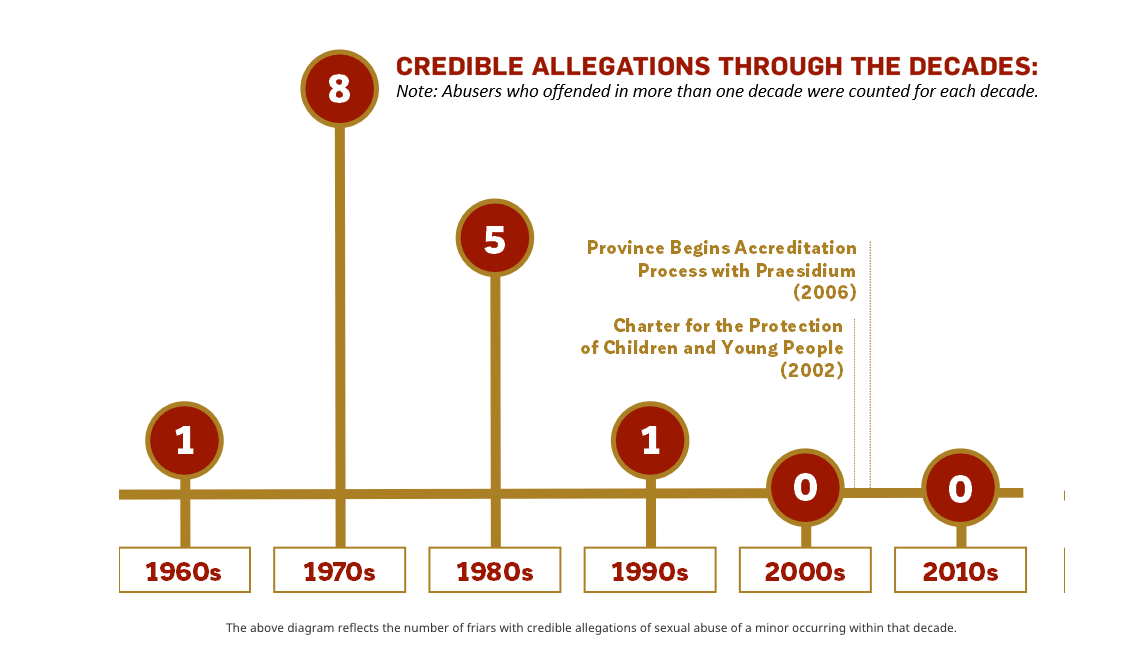
Thirteen Capuchin friars are listed. Of the 13, two are deceased and five have since left the order. None are in active ministry. Twelve of the 13 suspects had ties to Hays or Victoria.
The 13 listed clergy from the Salina Diocese served in more than 16 other northwest Kansas towns in various capacities.
Eleven of the clergy are deceased; two have been laicized – removed from the status of being a clergy member. The alleged abuses took place between 1907 and 2002, with most occurring in the 1960s and 1970s.
Bishop Vincke listens as Elmer tells his story of abuse by a Salina Diocese clergy member.
More than 20 people talked about the abuse allegations, including one gray-haired man who identified himself as Elmer saying he had been molested many years ago by one of the named clergy.
Elmer’s family did not believe it happened.
“I was told I was stupid, that I didn’t know what I was talking about, by my own mother,” Elmer recalled. The bishop at the time wrote a letter to Elmer saying “it was none of my business.”
“People are going through suicides. It’s tough,” Elmer said. He asked Bishop Vincke “how to forgive somebody.”
“It’s just incredibly tragic,” Vincke responded. “You’ll never forget.” After a long pause with his eyes cast down, Vincke looked up and thanked Elmer for sharing his story.
“I appreciate your courage for coming forward. I really admire you.” Vincke then offered a prayer for Elmer about his mistreatment. “Lord, fill him with your peace.”
Vincke said he has often heard from victims that they are not believed. “They and their parents are often also so embarrassed about what happened.”
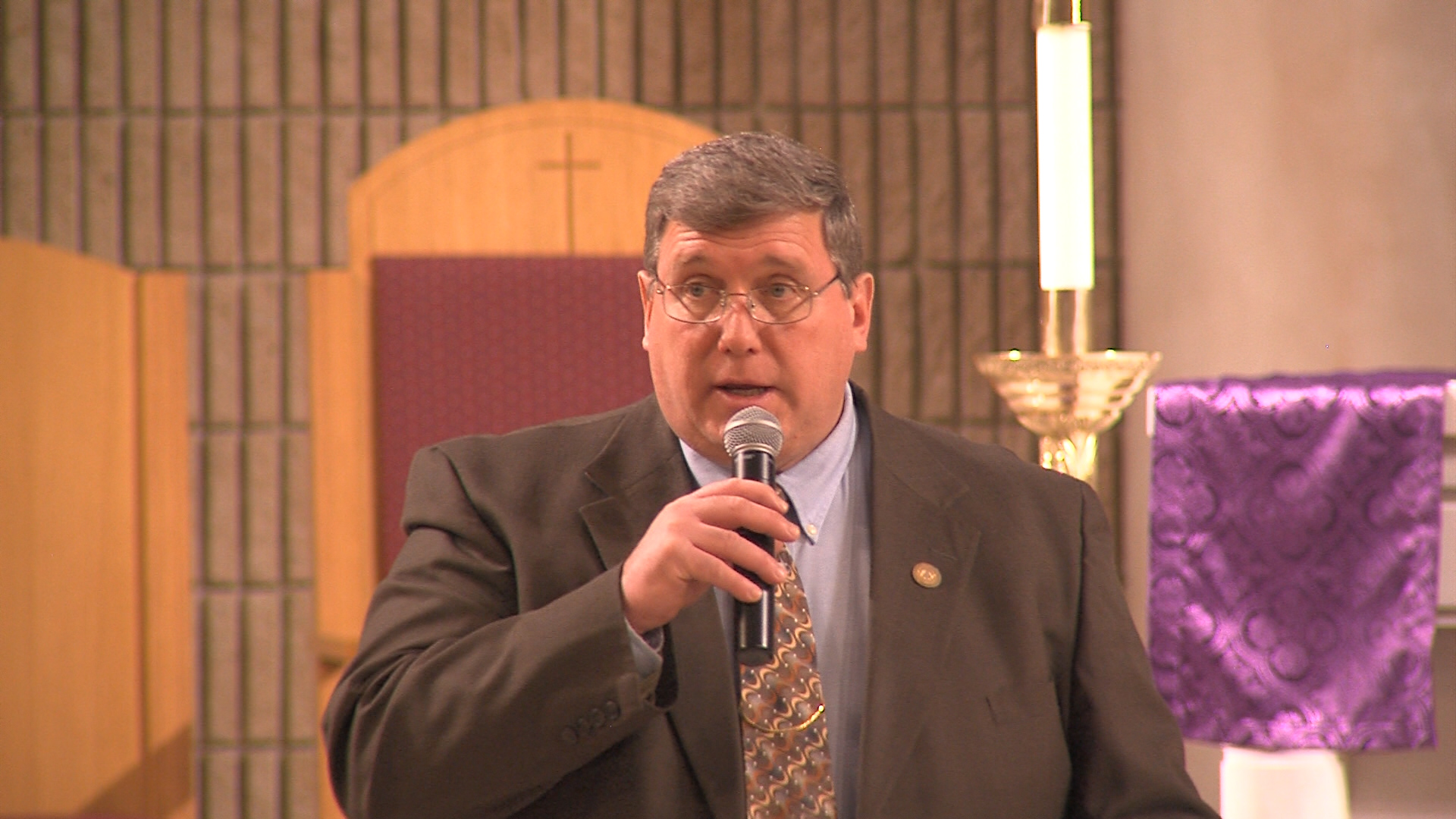
Ellis Co. Attorney Tom Drees
Encouraging children to report abuse and helping families to believe them is paramount to stopping sexual child abuse, Ellis County Attorney Tom Drees told the crowd.
Many times the crimes are reported years after the abuse and the Kansas statute of limitations has changed over time.
“Today, if you have a rape or if you have a aggravated criminal sodomy, that would be unlimited. So that’s within a lifetime, if you find that out, you can prosecute it,” explained Drees.
But that’s a fairly recent change in state law. Previously, the statute of limitations was 10 years.
Other sexual violent crimes against children can be prosecuted until the victim turns age 18, or 28 if a suspect is identified through DNA. There are some exceptions, Drees noted.
Rev. Ron Gilardi, who taught at Thomas More Prep-Marian High School in Hays, was charged in 2001 with criminal sodomy, indecent liberties with a child, and other sexual offenses of a male student who left the school in 1994.
A five-year statute of limitations existed at that time.
Although the charges were made beyond the five-year statute of limitations, “we were able to prosecute Gilardi because it was a repressed memory recall situation made with the victim’s psychologist.” The victim recalled the abuse during a counseling session in 1999.
Again, the statute of limitations has changed since then, and charges can only be filed in a repressed memory recall case until the victim turns 28.
Gilardi was subsequently removed from the ministry and is currently under supervision, according to the abuse report.
Bishop Vincke reads a statement from a Victoria man who said his female cousin was raped in the mid-1970s by one of the Capuchin friars on the abuse list.
Two audience members identified themselves as they talked about sexual abuse of the relatives by men on the list.
One man wanted to know why the identified priests and friars have not apologized for their sexual abuse of children.
“We have tried to contact them but got no response,” Bishop Vincke said. Gilardi is one of the two accused Diocesan clergy still living.
“They have not accepted responsibility for what they’ve done, I’m sorry to say,” added Fr. Popravak about the Capuchins.
“I think people are feeling there’s still a cover-up right now,” Vincke said in an interview after the meeting.
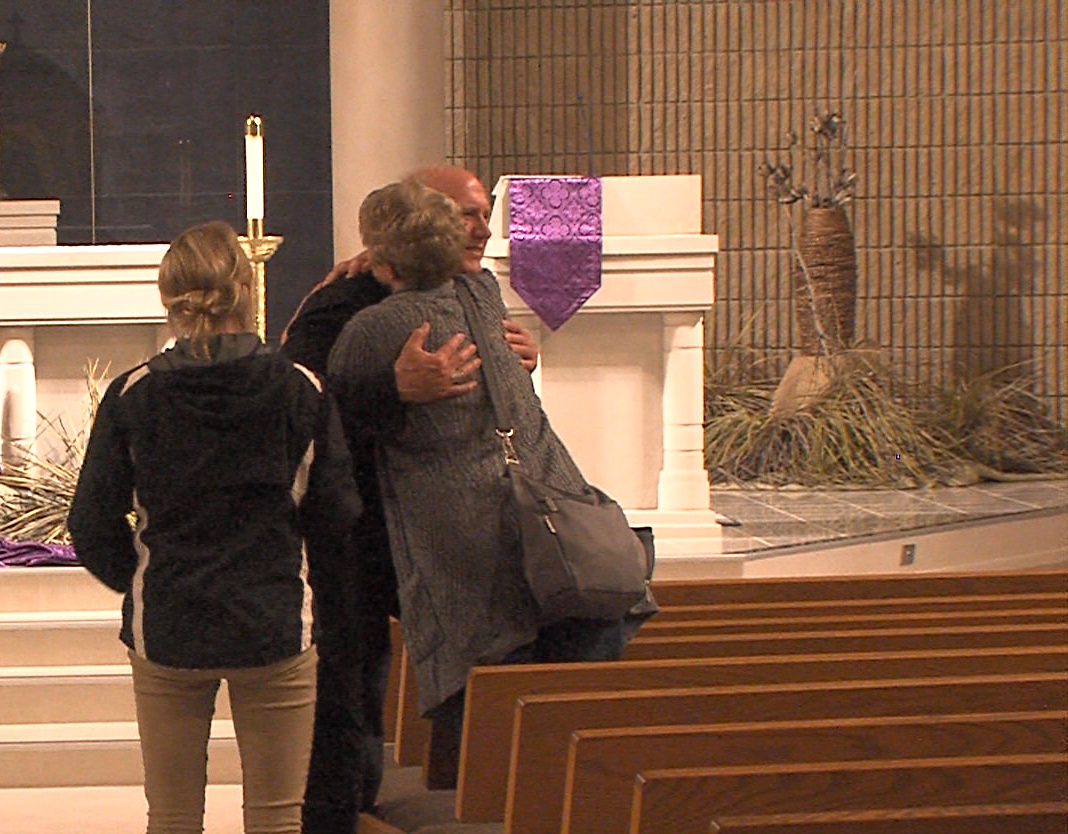
Bishop Vincke hugs a woman after Tuesday’s meeting in Hays’ St. Nicholas of Myra Church.
“There was a major cover-up many years ago,” Vincke acknowledged, “but I think we’ve corrected that and we’re not trying to cover up anything anymore.
“We’re trying to be open about everything that’s happened. All of our sins, we’re laying out for the people.”
Vincke also thinks the Catholic Church needs to do a better job of relating to the public what abuse has happened in the Church, when it happened, and what is now being done about it.
The bishop liked the suggestion from a man in the audience that the laity – people of faith distinct from the church – get more involved in the church.
“We’re doing that but I think we could use more of their incredible resources for the good of our church as well,” Vincke smiled.
One young woman at the meeting talked about the good memories of priests she has from attending Catholic schools.
“We have some great priests,” Vincke agreed, “doing incredible work and service for the people. And we have some great seminarians. They’re excited to get started. They know what happened in the Church but they want to be part of the solution. They really want to help.”
Addy Tritt, FHSU grad, stands in the Hays Payless with some of the shoes she bought for Nebraska flood victims.
By CRISTINA JANNEY Hays Post
A Hays woman recently bought out all the remaining shoes at the Hays Payless store — more than 200 pair — and donated them to flood victims in Nebraska.
The shoes were part of a flood relief shipment taken to farmers in Nebraska by FHSU’s agriculture sorority Sigma Alpha this weekend. The sorority accepted ag-related donations last week at Orscheln’s and Tractor Supply Co.
Addy Tritt, 25, a recent FHSU human resources graduate, said she felt the need to pay it forward with the shoe donation.
“I have been so blessed,” she said. “There have been so many great people in my life who have inspired me. I see so many horrible things in the news. So many people have helped me when I was down, I want to help if I can.”
Payless is going out of business, closing its stores and liquidating its assets. When the price on shoes at Hays’ Big Creek Crossing store were lowered to $1 per pair, Tritt approached Payless about buying all the shoes that were left.
She negotiated with Payless to buy its remaining 204 pair of shoes for $100. They included 162 pair of baby shoes, two pair of men’s shoes and the rest were women’s shoes. The cost of the shoes came out of Tritt’s own pocket.
The retail price of the shoes would have been more than $6,000.
Tritt is not a stranger to charity. She has also donated 66 bags of school supplies to Hays students, organized a baby clothes drive and has done two supply drives for the animal shelter.
Tritt said helping others is a part of her religious beliefs.
“I really feel I have been directed and guided to help people,” she said. “I think everything is a part of God’s plan. If you can do something for someone else, you need to find a way even if it is a pair of shoes.”
Although Tritt said she was saddened to see the destruction the flooding has left in Nebraska, she feels joy in helping others.
“I just hope this inspires other people to volunteer and donate if you have been blessed,” she said.
The Victoria High/Junior High School gym opened in January 1950.
By CRISTINA JANNEY Hays Post
VICTORIA — After 70 years on the same basketball court, Victoria High/Junior High School is closer to getting a new gym floor.
The current floor is the same one used when the VHS gym was opened in 1950. The floor has been sanded and resealed repeatedly.
The last time the floor was refinished, school authorities were told the floor was getting too thin and would not be abled to refinished again. It needed to be replaced. Basketball players have also complained of dead spots in the floor.
However, the school board has put off the project for several years, saying other capital projects needed to take priority.
The board suggested alumni and the community seek private funds for a new gym floor.
Over several years, alumni were able to raise about $26,000 toward the floor project, but it was still a far cry from the $72,000 or more the school needed to replace the floor.
Brenda Dreiling of Victoria and a group of other alumni and community members decided to throw a German dinner fundraiser to attempt to raise enough money to allow the project to move forward.
In a little more than a month, the group was able to put together the fundraiser. More than 1,000 tickets were sold to dinners on March 23 and 24. They also conducted a raffle with donated prized. Students sold tickets and were entered into a drawing for cash prizes. Volunteer Ethel Younger made more than 127 pounds of noodles. Children from the elementary school even helped the weekend of the dinner.
A VHS student draws a name of another student Friday. Three students won cash prizes for selling tickets for a German dinner fundraiser for the school’s new gym floor.
“When we came together in a joint effort, it was unbelievable what it produced,” Dreiling said.
The total for the fundraiser was announced during an assembly Friday at the school and names were drawn for the prizes for the students who sold tickets.
The dinner and raffle raised $35,194.18.
The gym floor project has been rebid because the last bids are now several years old. However, the fundraisers said they hoped they have now raised enough money the gym floor will be able to be replaced this summer.
Dylan Dronberger, VHS principal, said the school board is set to discuss the matter at its next meeting on Monday, April 8.
“It not only speaks to the care in the community, but the care and pride the community has in the school,” he said.
Other volunteers and donors on the project included:
Mark and Shannon Karst; Melissa Schmidt; Rose Ann Dreiling; Natasha Hammerschmidt; Jerry and Mary Brungardt; Kathy Kuhn; Warren’s Meat Market; Dave Pfeifer; school personnel; VFW; the boys basketball team; students and parents; community members who donated desserts; and Connie Windholz.
Rhiannon Cummin, was nominated as the March’s student Best of the Best by teacher Sondra Hickert.
Rhiannon Cummin, Learning Center student, is pursuing a dream to be a registered nurse by the time she is 20.
She was nominated as the March’s student Best of the Best by teacher Sondra Hickert.
“I often stand before the board of education at Learning Center graduations to emphasize the things that students overcome to graduate,” Hickert said. “Whether it is illness, loss of a family member or some other life issue, we like to accentuate the challenges that the graduates had to overcome. But tonight I introduce you to Rhiannon Cummin who is a student who couldn’t overcome.
“She couldn’t overcome her passionate desire to become a nurse at the earliest age possible. Rhiannon came to us less than a year ago, telling me she wanted to be a nurse. She wanted the option of working at her own pace because she is determined to be a working RN by the age of 20.”
She drives into Hays each day to attend the Learning Center. She pays for her own gas, earned from a part-time job she works in between her studies.
Hickert said Cummin has applied herself like no other student, completing her core courses for both her junior and senior years since August.
“She is a friend to every student who walks in the lab,” Hickert said.
By May Cummin will have completed 17 hours of concurrent college credit.
“She has traded working the drive-thru for answering call lights at her hometown nursing facility as a certified nurse aide,” Hickert said.
Cummin is poised to enter nursing school three months after graduating with her class in May 2020.
“Society, not just the health care industry, is fortunate to have a citizen like Rhiannon Cummin who is forging her future industriously and compassionately,” she said.
Eva Junk, Lincoln and Roosevelt counselor, was nominated by peers at Roosevelt for the staff Best of the Best award.
Eva Junk, Lincoln and Roosevelt counselor, was nominated by peers at Roosevelt for the staff Best of the Best award. Roosevelt Principal Paula Rice spoke on her behalf at Monday’s school board meeting.
“Eva is just one of those who goes above and beyond,” Rice said.
“Too many times in education, staff members are asked to take on additional duties to help fill in the gaps to continue to provide the best for students,” Rice said. “Our fantastic staff steps up and does this because of our love for our students.
“One shining example of this is our school counselor Eva Junk, who every year is asked to take on more and more roles and responsibilities. These roles and responsibilities are accepted by Eva with a nod of the head and a smile on her face and a ‘yes’ all the while continuing to excel in every aspect of her core performance. This is what sets her head and shoulders above so many others.”
Junk is responsible for more than 650 students and families. Rice said having responsibilities between two buildings pulls her in many directions each day. She visits classrooms, teaches lessons, sponsors two student councils, checks in weekly and daily with students who need counseling, and eats lunch with students.
Junk also has taken an active role in building leadership at both schools.
“Despite being surrounded by daily stressors, enough to make most people want to give up,” Rice said, “Eva continues to be a compassionate, listening ear for all who are in need to help shape our building into the happy, comforting and joyful place that it is. Eva deserves more than a modest pat on the back. For indeed, she is the Best of the Best.”
Jetta Smith, Fort Hays State University senior, spoke during “The Power of She” on bystander intervention in gender violence.
Jetta Smith, Fort Hays State University senior, organized an event Thursday on the FHSU campus, “The Power of She,” in which lecturers spoke on preventing gender violence, finding equality in the work world and encouraging women to be their best selves.
Smith, a communications major, is the reigning Miss Butler County and has logged more than 1,000 community service hours in the last year.
Her platform is to raise awareness of gender violence, especially through empowering bystanders to intervene.
Smith said the idea for the “Power of She” came to life after a very heated discussion over who was the best super hero. Smith insisted that it was the modern-day woman.
“The modern-day women has the ability to empower, encourage and enlighten millions of people around her,” she said. “So why do we as women silence ourselves and not use our ability to our full potential? I hope today when you leave this presentation you are enlightened, encouraged and empowered to speak up, to speak out and to know that your voice has power.”
A bystander can step in and prevent an act of gender violence from happening, can prevent an outcome as well as deal with an outcome, said Smith, who herself is a survivor of sexual assault.
Sixty-six percent of all violent crimes happen in front of a bystander, and bystanders are present during 29 percent of all acts of sexual violence.
“It can be something as simple as body language and you see something happening and you make eye contact from across the room, crossing your arms, changing your body language,” she said. “As a communication major, that was something that I took on instantly.”
A bystander can distract or interrupt, such as spilling a drink if you see someone in an uncomfortable situation with a person of the opposite sex.
“Choosing not to laugh at a joke … Intervention is not always about confrontation,” she said. “It can be the simplest things such as movement or body language or just saying, ‘Hey, that wasn’t funny.”
There are four stages of intervention: notice the event, interpret it as a problem, feel responsible for dealing with it and possessing the necessary skills to act.
Smith explained our personal biases may affect our choice to intervene. She described a recent video she watched on Facebook.
A man dressed in rags was lying in the street. No one stopped to help him. When the same man dressed in a suit re-enacted the scene, people rushed to his aid.
“Why are we afraid to step in when we know we can?” she wondered.
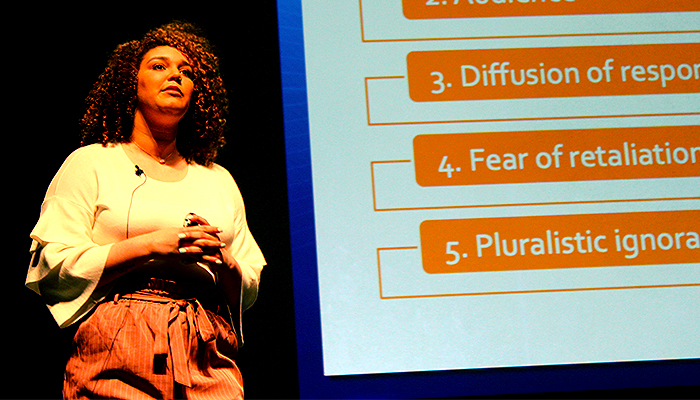
Smith said there are a variety of reasons people choose not to intervene. These can include social influence, audience, diffusion of responsibility, fear of retaliation, or ignorance. Some examples of this could be a fear you might not be thought of as cool; shyness or fear of bringing attention to yourself; and the rationalization that someone else will intervene.
Smith related an instance she wished had intervened during her first year at FHSU. She was at a bar and she noticed a young women who was being pressured by a man. She said she could tell by the woman’s body language she was definitely not interested, but he was overly interested.
“All I had to do was sit at that bar and turn, and say, ‘Girl, I haven’t seen you forever!’ I have never seen this girl in my life. All I have to do is that simple thing, give her hug, the guy gets the hint and he walks away,” Smith said.
All you need is your voice and your body to intervene.
“The Golden Rule is to only intervene when it is safe for you to do so,” she said. “If it is not safe and an emergency, dial 911, call campus security, call another friend over. That way it is not just you in a one-on-one intervention.”
When Smith was a freshman and a sophomore, she was a student athlete. She used her influence to promote parties or trips with her friends.
“When the situation flipped and I became a victim of sexual assault, I didn’t think my voice mattered any more,” she said. “I did know I had a voice. But in reality that same voice I was using to promote those parties and whether we were going to Hays or not was that same voice that could have been promoting that one in three women will be victims of sexual assault.”
Power of she in the workplace
Dr. April Park, associate professor, spoke on disparities between the genders in her field of psychology. Behind her is a picture of her with her mom.
Dr. April Park, associate professor, spoke on disparities between the genders in her field of psychology.
When Park came to the United States to study psychology, more than half of her classmates were women. However, that has not always been the case.
In 1970, only 20 percent of the PhD recipients were women. Now it is more than 70 percent. The trend has been a increase in white women, and, to a degree, minority women receiving doctorates in psychology.
Despite these increases, the profession has not seen a correlating increase in the number of women in tenure positions on college campuses or in leadership positions in the field.
At the lecturer level, there are more women, but those numbers decrease as you move up in the academic ranks. Less than 30 percent of full professors in psychology are women.
Among the American Psychological Association’ more than 130 presidents, there are only 11 women. Of those 11, eight of them have been elected in the past 10 years.
Pay gaps are also found in the field of psychology. At a two-year university as of 2010, female employees made 80 percent of what male employees earned.
“What was a little bit more disturbing to me was that trend wasn’t really reducing, but it was actually widening in the past years,” Park said.
She said the culture and tradition in the tenure process plays a role. The makeup of the tenure committees and the leaders in the departments tend to be men.
“Also if you think about the high demands of the job to reach a full professor rank and you think about the work that has to be done in the house, and if women can’t find a good and work life balance, that is going to put them at a disadvantage,” she said.
APA is recommending women advocate for gender wage equity, encourage policies for salary transparency and promote leadership skills in women.
One factor research has determined that contributes to lower pay for women was a lack of salary negotiation skills.
“When you first get a job, the base salary is going to be very important because all of the additional bonuses you get and incentives you get will be proportionate to the base salary,” Park said. “If you are not making an equitable base salary compared to a man, then you are going to have a hard time reducing that gap.”
Park said she also thinks having a mentoring system for women is important.
With her own students, she tries to encourage them, but also urges them to readily accept encouragement.
“The female students I work with are very, very strong, they are so extremely talented, but when I encourage them, ‘Hey you are doing a good job, just keep on doing that,’ a lot of times they will say, ‘I don’t think I did it enough or I don’t think I did it good enough.”
She also encourages students to get involved in organizations and take responsibility for their actions.
“But as you do so be very gracious to yourself and other people,” she said.
‘It’s your deal’
Dr. Teresa Clounch, FHSU assistant vice president of student affairs and compliance, spoke to a group Thursday on how she dealt with the death of her father.
Dr. Teresa Clounch, FHSU assistant vice president of student affairs and compliance, spoke to the group on the theme, “It may not be ideal, but it’s your deal.”
Clounch first gave this advice to a student who was asking for guidance about taking a job after graduation. The student was unsure if the job would be right for her.
Clounch found a few years later she was saying this to herself.
Only about a month after Clounch moved to Hays to take her position at FHSU in 2017, her father died.
“Understand while I was stricken with grief and thought someone who was such an integral part of my life, from whom I get my good looks and great sense of humor, has now left this world. Now I am in a new place, where people just barely know who Dr. TLC is. I go back into my mind when I think about that spring of 2013 when I told that student who was ready to graduate and step into a new chapter of her life, ‘This may not be ideal, but it is your deal.'”
She had to look at a world without her father in it.
“I looked for support from my family, my siblings, neighbors, my new colleagues her at Fort Hays State, my sorority sisters and everyone who was willing to provide me support,” she said.
Clounch said it was difficult for her to take support because she is a proud person.
“Yet, I knew at this point in time, at a new place and being four and half hours away from my family, while this was not ideal, it was my deal to work with,” she said.
She created a new support system.
“I also realized I needed to encourage others in this process,” she said. “I did that for my family; I did that for the friends who were near by. I did that for my colleagues because someone else had gone through what I was getting ready to go through.”
Holy Family teacher Tyler Haas poses in his classroom with some jerseys that were gifts from some of the athletes he has coached.
By CRISTINA JANNEY Hays Post
Tyler Haas tries to teach his students persistence.
Haas was a high jumper when he was in college at Fort Hays State University. During his sophomore year, he was facing some challenges and considering quitting the team. His father encouraged him to keep working.
Not only did Haas find success in his college career, being named twice all-conference, but today he is an assistant coach for jumping events at FHSU. He has worked with several nationally and internationally ranked athletes.
He said had he quit he would have missed that opportunity. He would have missed the opportunity to travel and meet people — and he would have missed an opportunity to do a job he now loves.
“What the key to happiness is may be not always be chasing a dream of making money,” he said. “It is maybe chasing something in which you can impact the most people. In 12 years, I have been able to work with numerous students and athletes, and it has been a great experience.”
Haas, a Hoxie native, has been teaching at Holy Family for 12 years. He currently teaches math and social studies to fifth and sixth graders.
“I say I’m going to go teach. I’m going to go coach. I never say I’m going to work, because I enjoy both of them so much,” he said.
Haas was named March’s Hays Post Teacher of the Month. He was nominated by parent Shanna Koster.
Koster said in her nomination that Haas is her daughter’s favorite teacher.
“She says that he is not only a math and social studies teacher, he teaches about life. He goes above and beyond by teaching our children the right thing to do in certain situations and normal daily life.
“He is genuinely in love with his job as a teacher. He makes an effort to get to know his students and makes learning fun for them.”
Koster said Haas encouraged her to praise her daughter for her hard work in class and expressed a true passion for his work.
“I do believe that teachers have the hardest job in the world,” she said. “I believe that Mr. Haas has left a mark on my child’s life forever. As she leaves elementary school to move to junior high, I believe he has taught her things she will remember for a lifetime. For that, I will never be able to thank him enough.”
Haas started out at FHSU as a radiology major, but going into to his junior year, he switched his major to teaching.
His mother was a teacher. She died of cancer between Haas’ fifth- and sixth-grade year in school.
“I always remembered how caring she was, and she always seemed to be happy to help other people,” he said. “I wanted to do something that genuinely made me happy. It was weird, because I didn’t see myself as a teacher, but it just kind of found me and so did coaching. I didn’t think I would do either one, but it is weird how you get shoved in the direction you should probably go in.”
The small Hoxie community rallied around Haas’ family after his mother died. He said, to a great extent, he was raised by his teachers and the community.
“That’s probably another reason I became a teacher is those people that affected me so much,” he said. “When your world is kind of upside down, you are going somewhere safe every day. People show that they care about you as a person. Teachers were pretty special for me. I cant imagine as a radiologist I would be able to pay those people back. I want to thank them somehow.”
One of his high school teachers, history teacher Olive Krannawitter, particularly stood out in his mind.
“He taught us a lot of life lessons. He taught us what happens if you need to change a tire. Things like that are still valuable to be today. Budgeting … and this was a history class, but he cared about where we would be in our 30s and down the road. The biggest thing was that we knew Mr. Krannawitter cared about us. I would say he was the greatest teacher I ever had.”
Haas said he tries to find those teachable moments in his own class.
He said challenging a student, who may be struggling, to work through a problem is maybe more important than the answer they come up with in the end.
“Letting them know it is OK to struggle and teaching them to persevere through that [is important], because down the road in 15 years, that is the most important lesson we teach them,” he said. “They might not remember how to get the area of a kite, but if they could persevere through that problem and find a solution, even if it is not there in the first three to five minutes of work, that is probably the more lasting lesson and is more important down the road.”
Because Haas works with college students as a coach, he sees the struggles young adults go through.
“Especially in their freshman year in college, a lot of them are essentially lost because they have never had to do things on their own. I see where they end up down the road,” he said. “Everybody is afraid of failure, but it is not a final outcome, and we all have to understand it is a part of the process of growing.”
Haas said he is always growing as a teacher and a person, but he said he can’t imagine doing anything else.
“Everyday I go home, and I am pretty happy at the end of the day,” he said. “You get one life, and you should really enjoy what you choose to do. That’s how you get fulfillment. I am just happy to do what I do.”
The Capuchin Franciscan Province of St. Conrad today released a list of names of friars with credible accusations of the sexual abuse of a minor or vulnerable adult. The list includes the names of 13 members or former members.
Of the 13, two are deceased and five have since left the order. None are in active ministry.
Of the 13, 12 had pastoral assignments in Hays or Victoria.
“As friars and followers of St. Francis of Assisi, our vocation is to serve as lesser brothers. Therefore, the abuse of a minor by someone in such a sacred position of trust is all the more egregious,” said Provincial Minister, Fr. Christopher Popravak, O.F.M.Cap, who commissioned the release. “I have personally met with numerous victims and can attest to the devastation wreaked upon their lives and those of their families. Though the words may ring hollow as many other Church leaders are voicing similar sentiments, I can only say that I am sorry from the depths of my heart.
“I have asked the friars of our Province to commit to serious penance and reparation on behalf of the misdeeds of our brothers and for the healing of victims. The results of the audit we are releasing today is only the first step in a new age of transparency. We are striving to be vigilant and have taken serious steps in the last fifteen years to ensure the careful and diligent screening of candidates to our way of life. We must persevere in our efforts to ensure that such a scandalous series of violations never occurs again.”
The 12 friars with Hays or Victoria connections included: Gregory Beyer, deceased; Benignus Scarry, who left the order in 2016; Felix Shinsky, who was removed from ministry/under supervision; Charles Wolfe, dismissed from order in 1987; Ron Gilardi, who was removed from ministry/under supervision; David Gottschalk, who was removed from ministry/under supervision; Julian Haas, who was removed from ministry/under supervision; Finian Meis, decased; Thaddeus Posey, deceased; and Matthew Gross, who was removed from ministry/under supervision.
The 13th friar listed, David Jones, was dismissed from the order in 1987. No pastoral assignments were released.
The territory of the St. Conrad Province, which was established in April 1977, comprises the States of Colorado, Kansas and Missouri and the Diocese of Belleville, Peoria and Springfield, each in the State of Illinois. The Province also has two houses outside of the Province territory in San Antonio.
The release followed an independent audit of the Province’s personnel files and other relevant documents by an outside group of qualified professionals.
The audit consisted of a review of the personnel and other files retained by the Province, including a total of 226 personnel files reviewed. Of note, the auditors also reviewed the five active Safety Plans of Capuchin members under supervision for credible allegations of abuse, consulted with the Provincial Minister and the Safe Environment Coordinator. Of note, no significant areas of concern were noted with supervision over and compliance with the Safety Plans. The auditors also found a marked increase and improvement in documentation regarding allegations and attention to issues related to training and sharing of information with the Province’s leadership team.
An allegation is deemed credible if an administrative investigation determines that in the opinion of the investigators it is more likely than not based on the facts presented that the alleged abuse occurred. Inclusion on this list does not imply that the allegations are true or that the accused member has been found guilty of a crime or is liable for civil claims. Every effort has been made to ensure the list is accurate. In most instances, the claims were made many years after the alleged abuse, making it difficult to conduct a complete investigation.
The list HERE is broken down into three categories: members with a single, credible accusation of the sexual abuse of a minor; members with more than one credible accusation of the sexual abuse of a minor; and, members with credible accusations of the sexual abuse of a vulnerable adult. All three categories include the individual’s name, birth date, current status, and former assignments.
All allegations of sexual abuse of a minor or vulnerable adult are reported to the appropriate authorities.
The full text of the “Audit of the Capuchin Province of Mid-America (aka Province of St. Conrad)” is available on the website at: www.capuchins.org/protecting-children
The Province encourages anyone who has been abused by a Capuchin member to contact the appropriate civil authorities and the Safe Environment Coordinator, Jason Faris, at 303-477-5436 or [email protected].