We have a brand new updated website! Click here to check it out!

🎥 Puerto Rican performer shares language, culture with students

By CRISTINA JANNEY
Hays Post

An HHS student wins a Spanish tongue twister contest.

Wednesday in Hays, Edgar Rene´ of Puerto Rico used song and dance to bring Spanish to life for students.

He performed for a group of area Spanish students at the 12th Street Auditorium. The students have spent the last several months listening to Spanish songs from Rene´’s performance.

Caitlin Leiker, Hays High School student, sang with the Rene´ and students from HHS performed a dance routine with the singer.

Rene´’s tour “Viviras 2018-2019” seeks to help students better their Spanish language skills, but learn about Hispanic culture. He also brings a message of positive self image to the students.

Rene´ told the students performing on this U.S. tour was the culmination of a dream for him.

“I am blessed and grateful that you gave me the opportunity to be here to share my music with you guys and my message,” he said.

Caitlin Leiker, HHS student, sings with the Edgar Rene´ during his performance for Spanish students on Wednesday.

He said he first knew he wanted to be a singer when he was a boy and was asked to sing the “The Star -Spangled Banner.” He is a native-Spanish speaker and was trying to sing the words in English. He forgot some of the words, but he said that performance made him fall in love with singing and music.

“I practiced and practiced, and I touched a lot of doors, and I saw a lot of doors close in my face,” he said.

He related an instance during this tour that helped him know he was following the right dream.

A student came up to him after a performance in Pennsylvania. Rene´ asked him if he wanted to have his picture taken with him. The boy said he had no cellphone to take the picture, so Rene’ used his own cellphone to snap the photo. The boy began to cry. He said no one had ever taken a picture with him. His mother was gone, and he did not have a good relationship with his dad.

A student plays maracas during the Edgar Rene´ performance.

The boy said he was near giving up — quitting on life. He said Rene´ had given him hope to go on and hope enough to try to build a relationship with his dad.

Rene´ said he had to excuse himself from the autograph session because he was crying.

He told the students that he hoped they would always choose viviras (living).

“That is why we are here” he said, “not only to sing and dance and have fun. We are here to say it is not over here. There is a purpose in your life. You guys are awesome. Every time you look at the mirror, you look at a beautiful person. You look at yourself, love you first, then you can [give] love to the people.”

He continued, “When we learn another language, we are more human. When we can understand others, we can understand their cultures and we allow others to understand us too.”

TMP, Larned High School, Trego High School and Quinter High School students also attended the performance.


Ground broken on new Creek Side Resort RV park in Hays

The Creek Side Resort RV park will have spots for 36 RVs with electric, water and sewer hookups, as well access to high-speed wifi.

By CRISTINA JANNEY
Hays Post

Creek Side Resort has broken ground on its new RV park and wedding venue one and a quarter miles south of Interstate 70, 157 exit on the 183 bypass.

The park will have spots for 36 RVs with electric, water and sewer hookups, as well access to high-speed wifi. In addition, the park will have a clubhouse with restrooms and men’s and women’s showers. Owner Aaron Dreher said he hopes to have the park open by Memorial Day weekend.

Once the RV spots are completed, Dreher plans to add three 12-by-24-foot cabins at the site. They will be equipped with sleeping lofts, restrooms with showers, and kitchens. He said he hopes to expand to 12 cabins at some point.

He plans to have an outdoor wedding and concert venue, which will hold up to 300 people, open by this fall on the same property. Dreher also owns the Diamond Luxury Party Buses and was originally looking for land to build a venue that would function with his party bus service.

He said he hopes to have a grand opening for the whole facility by late summer or early fall.

Dreher said he plans to rent the RV spots for $30 a night and the cabins for $65 to $75 per night. He is considering discounts on the cabins for long-term stays or rentals during the week.

The property is ringed by trees and bordered on two sides by Big Creek. Dreher said he thought the location is ideal, with the woodsy landscape and its proximity to I-70, the sports complex and RPM Speedway.

Once complete, the RV park will be only one of two in Hays. The next nearest RV parks are 30 miles to the east or west.

“When I got married, we had family asking for places to bring their RVs and their campers,” he said, “and there really wasn’t a good place to do that, so I decided to do my own.”

The property, which is on the west side of the the bypass, has been annexed into the city of Hays and will be on city water and sewer.

Dreher bought the property and the RV park plans from a group of owners who had intended to develop the property into an RV park, but never completed the project.

Dreher, who has a bachelor’s degree in construction from FHSU, tweaked the plans and is doing most of the labor on the project himself with some help from his brother-in-law on the weekends. His father-law-in is a draftsman and helped Dreher complete the final plans for the park.

For more information, see Creek Side Resort webpage at creeksidehays.com.

Hays school board in split vote approves purchase of iPads

By CRISTINA JANNEY
Hays Post

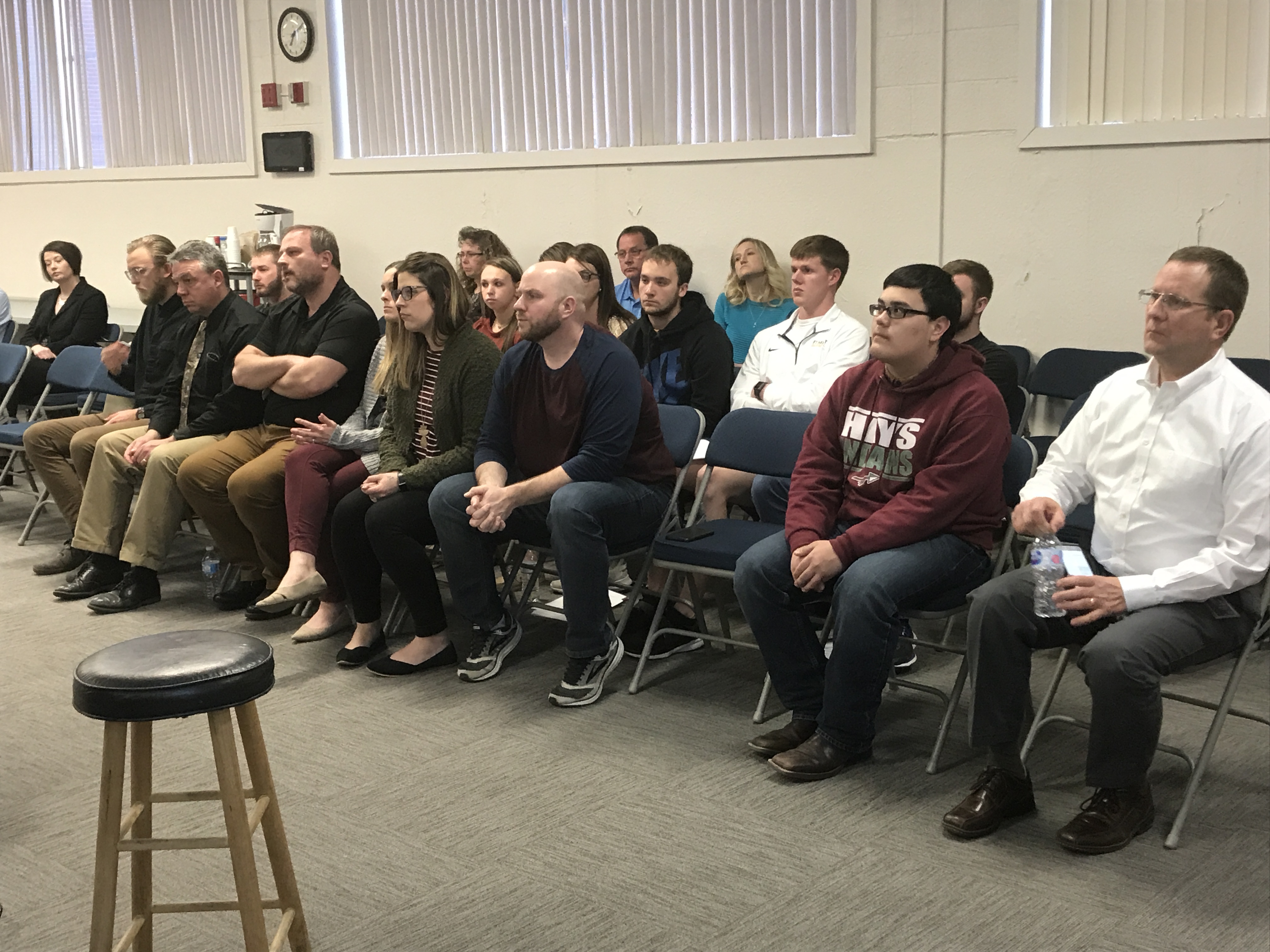
About a half dozen HMS teachers sit in the front row Monday night at the school board meeting ready to answer questions about the district’s purchase of iPads for the school.

The Hays USD 489 school board approved on a split vote Monday night the purchase of new iPads for Hays Middle School students.

The district will purchase 680 iPads and cases for $238,000.

Board members Lance Bickle and Greg Schwartz advocated for purchasing less expensive Chromebooks without touchscreen capability. The difference between buying devices with touchscreens was $40,000.

“At this point it is the process of this whole thing that frustrates me,” Bickle said. “We can absolutely get by without touchscreens without a doubt. Probably 90 percent of the other districts out there can get by without other touchscreens, but for some reason, we can’t here at USD 489. Those other districts also do it and save money, but again, we don’t seem to be able to do that.”

During the fall, the district Technology Committee conducted a Chromebook pilot study in which the Learning Center, and select HMS and elementary classes participated. After that study, the Technology Committee recommended purchasing iPads.

The district’s Technology Committee surveyed HMS teachers to determine how often they use the touchscreen function and how eliminating touchscreens would affect student learning.

Of the 36 teachers surveyed, 21 of the 36 said their students used the touchscreen function hourly. Thirty-one of 36 teachers said student learning would be negatively impacted by the elimination of touchscreens.

The teachers were then asked to elaborate on how the touchscreens were used in their classes. Many of them said the students took notes or completed assignments by writing or drawing using the touchscreen function. A group of HMS teachers as well as Principal Tom Albers attended the meeting so they could answer the board’s questions if necessary.

Bickle said he found many of the comments from the teachers who were surveyed perplexing, such as a comment which said it would be difficult for middle school students to take notes on paper and keep them organized.

“Seriously?” he said. “Have we really fallen that far that our kids can’t keep their notes in order now on paper and pencil?”

Bickle continued, “At the end of the day, it is frustrating because all of this shouldn’t be looked at now. It should have been looked at all the way along here, because it seems at the end of the day, the decision was made we are going to go with iPads and every one’s mind was made up that we’re going with iPads and we are going to find every reason we can to why we shouldn’t look at anything else.

“I can honestly say the thing that we have to look at as a board is, ‘Is this the most important place to be spending money?’ Right now, I can’t say that it honestly is. We have enough other things going on. We can’t even pass a bond. For me, it is awfully hard to go back and ask a community to support a bond when we can come up with money and spend more money than we need to get by.”

Schwartz said he was not happy with the bidding process on this technology purchase or other recent purchases.

“We go out and pick a brand and then we figure out how to make it fit,” he said. “Those aren’t good ways to save money. They are not sound ways to do this.”

Board member Paul Adams spoke in favor of the Technology Committee’s recommendation.

“I think we entrusted the Technology Committee with that. On our part we probably should have put a board member on there. I think it is something we may want to do in the future. I appreciate the effort and the work you put in. I think the fact is that you are closer to what the students do need and don’t. We are forming uniformed opinions often, whereas you are there at the classroom with them and may be closer to the research.”

Board member Mike Walker agreed the committee and teachers were closer to the students than the board. He also said he appreciated the committee had stayed within budget and was continuing with a four-year replacement rotation as the the board had requested.

“I respect your position and opinions,” he told the Technology Committee, “however, that doesn’t mean that next year we can’t change things up by putting a board member on the committee or have some more discussions about how the process goes on.”

The final vote was 4-3 with Schwartz, Bickle and Board President Mandy Fox voting against.

The new iPads should be ready for students to use this fall.

Next year, the district is scheduled to replace devices for grades three, four and five. Those students are also currently using iPads.

HALOS tries to break stigma, help loved ones overcome guilt after suicide

By CRISTINA JANNEY
Hays Post

Suicide is like a bomb going off in your life, one member of the Healing After Loss of Suicide grief support group said.

On a recent visit to a meeting of the Center for Life Experiences’s HALOS grief support group, some of the members talked about the emotional fallout from losing a loved one in this devastating way.

The members of the group respect the pain that the stigma often brings when the story of a loved one’s life is shared. They also respect each member’s need to tell their story, so they asked specific names not be shared.

In addition to stigma, guilt was a reoccurring theme.

One member lost her sister-in-law as a result of suicide four decades ago. The pain persists.

“At that time, and to a certain extent today, there is a stigma to suicide. You didn’t talk about it at all,” she said.

After her brother died four years ago, she started to attend the HALOS group and talk about her sister-in-law’s death.

“I am finally able to talk about it,” she said. “I couldn’t do it, because there was also guilt that ‘What did I do that lead her to do it?’

“It is hard to explain the things that you think of that might have led to it.”

Ann Leiker, CFLE executive director and group facilitator, said in that era there were no support groups and you were basically told you just had to get on with your life, not look back and not talk about it.

Another member’s daughter had taken her life. She was diagnosed with depression before she entered grade school and had struggled her whole life emotionally. Yet this HALOS member also talked about her shock at the death and the extreme guilt she felt when her daughter died.

She said she is still pained by how the people around her responded to her daughter’s death. She said they pretended like she never existed.

“It was like being ignored, and the pain was so acute and you are in shock at first when it happens,” she said. “You feel like you’re … I don’t know … a ghost walking through this world.”

As bad as that pain was, she still had to function, go to the grocery store and take care of her other children.

“It was as though I was a non-entity. The world didn’t seem real to me. It is such a profound loss, you can’t experience anything like that,” she said. “People don’t know what to say to you or how to act.”

A neighbor led her to the group.

“If I didn’t have this group to go to, I don’t know… When something like that happens, the guilt is so horrible. To this day, you could tell me over and over again, ‘It’s not your fault. It’s not your fault. You did everything you could,'” she said but her voice began to quiver and she began to cry. “But I know there was something there that I could have done.”

“There is no one when you come right down to it, even with the group. … You’re all alone. You’re just alone. There is that guilt to suicide. It is a profound loss for all of us. It is a different kind of death, and you don’t really want to experience it because you can’t get rid of it.”

Yet another member came to the group after many years of not being about to talk about her brother’s suicide. He died in the 1970s.

“It was discussed within family only, not outside. There was such a stigma with suicide,” she said. “And so my children and my nieces and nephews — they didn’t even know my brother or anything about him. Like she said. They act like they don’t even exist. Well, my brother existed. He was alive.

“I loved him, so I made an album for him my children and my nieces and nephews if they ever want to find out about their uncle. ”

She continued, “With suicide, there is no closure because you don’t know. You may think you know the reason and probably it might have been the straw that broke the camel’s back. But I think it is many little things that happen throughout their lives.”

For years, she had wanted to connect in some positive way with other people who had been affected by suicide. When she moved back to Hays in 2009, she saw an ad for HALOS on Channel 8. She has been with the group ever since.

She focuses on trying to celebrate her brother’s life and not his death.

“You don’t want your loved ones to be forgotten,” she said. “They existed and they deserved to have a life. One thing we do is share what they did throughout their lives. It’s a story, and we focus on the life.”

Nursing students were observing the group the night the Hays Post visited as they do regularly for CFLE groups.

The member addressed the nurses, “I want to tell you, as nursing students, if you come across anybody who has had suicide in their lives, don’t be afraid of them. They are just normal people. They just need a boost. Be there for them. They need an ear.”

A man and his wife began attending the group together after their son died. He said they continue to come back to the group because they can share their experiences.

“To talk to somebody who knows what you went through,” he said. “You can’t just go out here on the street and run into someone and talk to them. We have all been there. We have all had it happen. We can talk, and you don’t get funny looks or ugly faces.

“We just talk as friends. This basically become our second family. We talk to these people just like family.”

“There is no stigma in this room,” another member said. “We don’t judge.”

The woman who lost her daughter said, “There is a compassion here that we can’t get anywhere else, not even from our best friends, not even our family members. It is only the people who have had to live through it. It is not understandable to other people.”

The people in the group said the cliches many people use to try to comfort you after a death just don’t work. They don’t want to hear things, such as “They are in a better place” or “God won’t give you more than you can handle.”

People who are suffering in that way really need friends and family to anticipate needs, such as food, mowing the lawn, an hour of housework, listening or a simple hug.

“We need someone to listen,” she said. “We need to talk about that person. You have to let us miss that person and talk about that person.”

She said she really appreciated a fellow-support group member who came over and cleaned her bathroom. Another member of the community baked her family bread.

The woman who lost her brother said, “Suicide is something that needs to be talked about. It’s happening. It is in our society. It’s amongst our young ones, and we just need to talk about it honestly. Don’t be ashamed.”

The group also talked generally about the stigma associated with mental illness. Members agreed more resources need to be dedicated to assist people who suffer from mental illness. Western Kansas has the highest suicide rate in the state and that rate is climbing, yet because of its rural nature, accessing treatment for mental illness can be difficult, Leiker said.

HALOS is the only suicide grief support group west of Salina and only one of a half a dozen in the state.

Leiker said mental illness also needs to be decriminalized.

“Our societal approach to suicide needs to be rethought and reframed,” she said, “so people who are in so much pain the only solution they see is ending their lives are not re-traumatized by becoming a part of the legal and law-enforcement systems unless a crime is committed.

“Law enforcement are often the first responders to a suicide attempt and want to help the situation but are often short on available resources due to cutbacks in funding mental health at all levels. Everyone is trying, but we need more people available to help.”

When a suicidal person is reported to 911, they send the police and that person is sometimes taken to treatment in handcuffs.

The HALOS group is open to anyone. It is free, and all you have to do is show up to the group. Leiker and the Center for Life Experience also facilitates Healing Hearts, for those grieving the loss of a child; Healing After Loss, for those grieving the loss of adults; and the National Alliance on Mental Illness, which offers support groups for both people who suffer from mental illness and their families.

If you or someone you love is in immediate danger of suicide, call 911. For non-emergencies, you can contact High Plains Mental Health at 1-800-432-0333.

To learn more about HALOS, NAMI or any of the Center of Life Experience groups or programs, visit its website.

See related story: Center for Life Experience moves; same purpose remains

See related story: After tragic loss of their teen son, couple finds solace through Healing Hearts

See related story: Healing After Loss helps the grieving to repair, reconnect

Cover graphic courtesy CanStockPhoto.com

Healing After Loss helps the grieving to repair, reconnect

By CRISTINA JANNEY
Hays Post

Doreen Timken has suffered much loss in her life.

She shares some of those loses with the support group Healing After Loss at the Center for Life Experience in Hays. She is an example of how grief has no time limits — and neither does learning how to reconnect.

Her journey started in 1991. In December of that year, her daughter who had just graduated from high school the previous spring called and said, “I have some good news and some bad news. I’m pregnant, and I have acute leukemia.”

First, her daughter lost the baby.

In June, her dad died of lymphoma. In July, her husband was diagnosed with prostate cancer. In November, Timken lost her daughter to cancer.

Her husband died in 2007 also from cancer.

“I though I handled things pretty well,” she said, “Because sometimes God gives you things in multiples, so you don’t just concentrate on just one thing. I learned a lot about God through my daughter, because she was very, very brave.”

Then one day at work, she met Alan Scheuerman, who was already attending the Healing After Loss support group. He had lost his wife and, years earlier, a young son.

“We started talking, and we had some of the same types of losses,” she said. “I said, ‘I don’t think I need to go to a group. It’s been too long.’ I started to go to a group and discovered I never, ever dealt with my daughter’s death.

“Thank goodness for a great support group, a great facilitator. You are going to find that a lot of us have multiple losses here, and I think from here on out with the new organization, I think the word needs to get out more. … every time I come, as many years have past, I still learn something about myself because you still have to recreate yourself.

“Not only that, but you are helpful to others, and others kind of seek you out when they get in the same predicament. Before I had any losses, did I pay any attention to anybody else? No. it makes me feel really bad because I never knew what to say.”

The Center for Life Experience recently reorganized as a stand alone non-profit. It is now located in the Hadley Center. In addition to Healing After Loss, it also facilitates meetings for Healing Hearts, a grief support group for parents who have lost children; Healing After Loss of Suicide (HALOS); and the National Alliance on Mental Illness.

Doreen addressed nursing students who were attending a recent support group meeting to observe as part of their clinicals.

“I appreciate all of you going into nursing. I really do. It’s super. Don’t be afraid to talk to patients when you know there is no hope for them,” she said. “Don’t be afraid to talk to their families. You can be a lot of help for them.”

Scheuerman lost his 2-year-old son from spinal meningitis in 1981. As a parent, he blamed himself for the death and suffered for about 10 years with that loss.

“I really loathed myself,” he said. “My wife loved me dearly and helped me through that and her family did too, so I am very thankful for that.”

His wife died in 2008 of breast cancer.

“I didn’t want to take 10 years to heal the second time around. About two weeks after I put my wife in the ground, I came to this group and Ann (Leiker) was a great facilitator, and it was a great group. I was very thankful.”

Scheuerman has been attending the group ever since.

“I have been very thankful for all they have given me and shared with me,” he said.

Ken Windholz, FHSU psychology instructor, visited the group during a recent meeting. People who are grieving might suffer from depression. He said support groups help people who are grieving make social connections, and that can help them be more resilient.

Another group member, Mike, lost his wife to pancreatic cancer in 2008. He is close to his son who lives in Salina and they talk almost every day, but he said he didn’t know what do to do after his wife died.

“This was a lifeline for me,” he said of the support group. “Rather than sit in my house … alone … I came to this after I lost Jane. It’s been a godsend.”

Windholz shared the story of his journey through grief. About 12 years ago Windholz’s younger sister died of cancer. They had been close as kids, playing football together. Ken was the protector, getting his younger sister out of jams.

Windholz was there with her when she died on Christmas morning at her home. Winholdz’s two brothers came to L.A., where their sister was living. On the day of the funeral, his oldest brother had a heart attack at a hotel across town. He was rushed to a nearby hospital, but died within 45 minutes of arriving at the hospital.

“I wanted it to go away,” he said. “I wanted it to stop.”

“We got through it, but I shut down, and I stayed shut down for the longest time,” he said. “I stayed shut down for the most part because I felt, ‘God, I have had enough. I can’t do this anymore, so let’s close it off.’ ”

Two years after the loss of his sister and brother, his mother, with whom he was best friends, died of lung cancer. A year and a half ago, his other brother, who he idolized, also died of a heart attack.

When we develop a relationship with someone, our brains develop connections with that person. We respond to the sound of their voice, the smells that we associate with that person and the image of their face, Windholz explained.

When Windholz’s family was preparing for his brother’s funeral, the family was reviewing video footage to play at the funeral, and they found some footage of his dad. He said even though his dad had been dead for years, he made an instant connection with the sound of his father’s voice. After her husband died, Windholz’s sister-in-law kept her husband’s shirts, because the smell reminded her of him.

After someone dies, you have to come to accept a new reality without them. Even if you have prepared for that person’s death, that usually doesn’t prepare you for the emotional impact of the actual death, Windholz said. The part of your brain that is the thinking part of your brain and is making those preparations is separate from the emotional system in your brain and body that operates in the here and now.

Over time, the thinking part of your brain and the emotional parts of your brain come together to form acceptance.

“When we finally come to an acceptance, there seems to be a blending of the emotional circuit in the brain with this cognitive piece. They seem to balance.

“They say, ‘I know this is a reality.’ Some of you may have experienced that reality maybe a few months later or maybe a couple of years later, maybe quite some time later. You look around and say, ‘This is the new reality. I have been hoping, hoping, hoping. I have been waiting for them to come back through the door. I have been waiting for that voice. I have been waiting for that news that this isn’t the truth. That there is something wrong here. ‘Oh, I got it, this is the new reality.’ ”

He described himself as a 69-and-a-half-year-old orphan.

“I use that term because orphans by definition are disconnected and alone in their lives, and it is very, very common to feel left alone when we are in the mist of loss.”

Windholz said people in support groups have strong social brains. They are making new connections in support groups to help them move through their grief.

“There are other folks sitting at home who wouldn’t venture out to a group like this and are suffering for it,” he said, “because they are not ready or don’t know how to make that connection socially.”

When people become depressed whether as a result of a loss or genetic or biologic factors, changes in the brain can make it difficult to engage in the actions that are most likely to help ease the depression, Windholz said. This includes exercising, eating well, getting plenty of sleep and making social connections.

“Depression is this self-fulfilling prophecy,” he said. “If we are depressed, we stay depressed until we break that cycle in some way or another.”

The fact people attend support groups means they are willing to make a change and work to break the cycle of depression, he said.

“You had to fight through,” he said, “literally fight through the impulses to isolate and stay home and stay within.”

Everybody has their own way of grieving, he said.

“Everyone has their own way of repairing. Everyone has their own way of disconnecting and their own say. We each have our own say in when and how we reconnect if we choose to do that.

“Whatever the call, your brain will go along with it. It is that plastic. It is that malleable. It is that responsive. It may take a little work.”

He said he saw the value of the support group as a place to reach outside of yourself.

“I have something to give you, but I want what you can give me too,” he said.

To learn more about Healing After Loss or any of Center of Life Experience groups or programs, visit its website.

See related story: Center for Life Experience moves; same purpose remains

See related story: After tragic loss of their teen son, couple finds solace through Healing Hearts

Graphic courtesy CanStockPhoto.com

After tragic loss of their teen son, couple finds solace through Healing Hearts

By CRISTINA JANNEY
Hays Post

Neal Younger is trying to spread the word about a resources he said made all the difference to he and his wife when they lost their 16-year-old son, Cody.

Younger and his wife have been longtime members of the the Healing Hearts support group.

The Youngers joined Healing Hearts nine years ago when they lost their son, Cody, in a tragic car crash. Another teen in the car also died in the crash.

“Without this support group, I don’t know where my wife and I would be,” he said.

He said his faith, talking about Cody and talking to other people helped him get through the grief.

The Youngers joined the support group within a month of Cody’s death and have never left.

“We got to talk to people who have been in the group before us,” he said, “and it was soothing. We asked what they did — what they did in their grief as they went through the healing process. That helped us a lot and just talking about our son — not just forgetting and going on. …

“They are helping us, and now we are at the point where we are helping other people in the group who come in.”

Younger said being able to connect with other people who were experiencing the same type of loss was important. He said friends and family often have a difficult time approaching someone who has lost a child. They don’t know what to say or how to help.

When his son died, Younger said he and his wife talked to other support group members about what they wanted people to say to them as they grieved. They talked about things they did not want people to say.

“You are going to have people who are your best friends who are probably not going to be your best friends,” he said. “There will be strangers who will come up and say, ‘Did you not lose?’ … To us that was soothing. To have a stranger come (up to us), it felt like they do care.”

Younger said talking about his son really helped him and his wife through the grieving process.

Neal said his son was an ornery teenager. He loved to be outdoors and go hunting with his dad or go to the lake. In the last year before his death, Cody was following in his dad’s footsteps and becoming more involved in the farm.

“He was a good all-around kid,” he said. “I miss him … always.”

Younger acknowledged not everyone may feel comfortable talking about their deceased child.

“Everybody heals differently,” he said. “Everybody grieves differently.”

The Center for Life Experience sponsors three grief support groups — Healing Hearts for parents who have lost children, Healing After Loss of Suicide (HALOS) and Healing After Loss, which is a general grief support group.

The CLFE groups are true support groups. They are not facilitated by clinicians, but are made up of people with similar experiences.

Younger said he and his wife, who is on the CFLE board, both strongly believe the support groups need to stay in the community.

“(I want them to know) if they are struggling and not grieving to come to these groups. It would be very soothing. Everybody who is in there is in the same situation, so we can talk amongst each other and help them get through this.”

The Center for Life Experience was launched 18 years ago in the Hays First Presbyterian Church, with donor funds specified to benefit the community, not the church.

Last May, the Session of First Presbyterian determined it could no longer financially support CFLE.

In November CFLE became a stand-alone, community-based not-for-profit 501(c)(3) and in late December, CFLE moved to the second floor of the Hadley Center in downtown Hays.

Younger along with the CFLE board are seeking donations toward the long-term sustainability of the CFLE and its mission. Any donation amount is appreciated.

“All the merchants in Hays have been excellent,” Younger said. “I can’t believe it. I am just amazed how our community can kick in when needed.”

The CFLE support groups also provide an important resource for NCK Tech and FHSU students who observe the support groups as part of the their nursing or social work programs.

You can send donations to the CLFE at 205 E. Seventh, Ste. 251, Hays, KS 67601.

You can learn more about CFLE and its programs on its website.

See related story: Center for Life Experience moves; same purpose remains

Graphic courtesy CanStockPhoto.com

Sold-out ‘Steel Magnolias’ features Rebecca Grizzell’s HCT directing debut

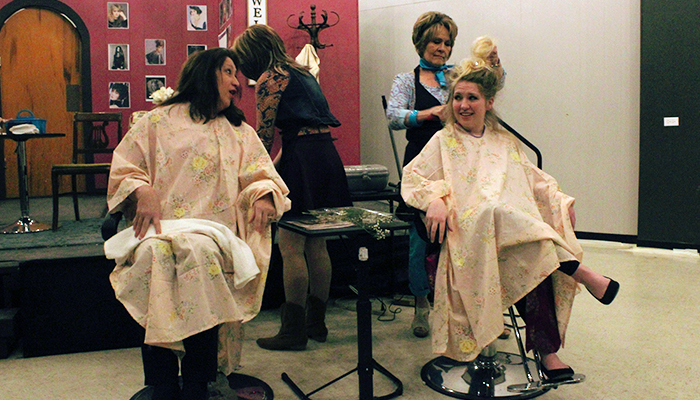
Jessica Morgan as Annelle Dupuy-Desoto styles M’Lynn Eatenton ‘s (Pam Grizzell) hair in the HCT production of “Steel Magnolias.”

By CRISTINA JANNEY
Hays Post

The Hays Community Theatre will be staging “Steel Magnolias” Friday and Saturday, but if you don’t already have tickets, you are out of luck. They are sold out.

Many fans may know the popular movie by the same name starring Sally Field and Julia Roberts.

Rebecca Grizzell is directing the HCT production assisted by TMP student Dylan Werth.

“This cast has done an amazing job taking the iconic characters from the movie and making them their own,” Grizzell said. “Each actor has spent so much time and effort getting to know and working on their character development. I am so proud to see these women grow as actors. The movie is so iconic, and the play version actually holds up to the hype of the movie. The play is almost word-for-word the same as the movie. However, it does not have the male characters that the movie has.”

M’Lynn and Truvy Latcherie (Brenda Meder) try to get Shelby Eatenton (Haileigh Jacobs) to drink orange juice during a diabetic emergency in the HCT production of “Steel Magnolias.”

The cast includes Jessica Morgan as Annelle Dupuy-Desoto, Brenda Meder as Truvy Jones, Lynelle Shubert as Clairee Belcher, Haileigh Jacobs as Shelby Eatenton-Latcherie, Pamela Grizzell as M’Lynn Eatenton and Nancy Selbe as Ouiser Boudreaux.

Grizzell talked about working with an all-female cast.

The benefits of the cast being all female is that the attention is never taken away from the female characters,” Grizzell said. “It allows the audience more time to learn and get to know the women in a way that the movie cannot provide.

“While watching the movie, you can almost completely forget about the character Clairee. In the play version, she is this strong and feisty woman who you cannot stop laughing with. The play does a wonderful job of showing true and genuine female friendships. Having a small, all-female cast was such a fun experience. It allowed us to just have fun with each other and girl talk on the side.”

Grizzell said Annelle is her favorite character in the play.

M’Lynn, Annelle Dupuy-Desoto (Jessica Morgan) and Clariee Belcher (Lynelle Shubert) all in Truvy’s beauty shop in “Steel Magnolias.”

“Annelle starts the production as an emotionally unstable woman who has just lost her man and owns little to nothing,” she said. “She’s very nervous and has no self confidence. Throughout the show, she discovers her love for God. She becomes a stronger woman and learns her self worth. Annelle was the character who always had a nervous laugh, but now she stands tall and has playful banters with the older women. She is the character that everyone should inspire to be.”

Grizzell, who herself struggled with strep throat during rehearsals, said the biggest challenges with this show were illnesses and recasting.

“Since we are a small cast and constantly close, we just passed the sickness around. Some days it was kind of like ‘OK, who is it today?'” she said.

Truvy had to be recast twice.

“Hugs and thank yous go Brenda Meder for stepping in just a few weeks before the show to play Truvy,” Grizzell said. “I am constantly so impressed and in awe of Brenda. She is the true definition of a professional. We are so grateful to her for saving us at the last minute and adding so much character to our production.”

Meder is no stranger to “Steel Magnolias.” She played M’Lynn 19 years ago.

This is Rebecca Grizzell’s first time directing for HCT, but she has acted and served in other roles for many other productions.

“Some of my favorite roles with HCT are Little Red Riding Hood in ‘Into the Woods’ and Fiona in ‘Shrek the Musical,’ ” she said. “I have done choreography for HCT a few times, including ‘The King and I’ and ‘Christmas Story.’ This is my first time directing for HCT, and it has been a whole new experience. I now have so much more respect for the people in our community who constantly volunteer to direct. It’s a ton of hard work, but in the end, so incredibly worth it.”

Rebecca said the best aspect of directing “Steel Magnolias” is the opportunity to work with her mother, Pamela Grizzell, who is playing M’lynn.

“I have worked with my mother on projects with HCT before, but never like this. Working with her has been the most special part of directing. She is a phenomenal woman and actress. We are constantly joking about how the relationship of Shelby and M’Lynn mirror that of our own.

“I don’t think we could have chosen a better M’lynn. She just fits that character so well. Every night she makes the crew tear up with her performance. Haileigh Jacobs plays our Shelby, and those two just have a natural chemistry with their characters. They really sell that they are family, and it’s like watching a snippet of my life with my mother. It’s beautiful.”

Next in HCT’s season line up is its summer musical of “The Little Mermaid,” directed by Cody Kreutzer, who Grizzell said is extremely talented. “Seussical Jr.” will be HCT’s children’s show. The Christmas show is “Fruitcakes.” If people would like to get involved with the community theater, they can visit the HCT website, https://www.hctks.com. You can also purchase tickets for future productions there.

Full cast list

Annelle Dupuy-Desoto——–Jessica Morgan

Truvy Jones———————Brenda Meder

Clairee Belcher—————–Lynelle Shubert

Shelby Eatenton-Latcherie—Haileigh Jacobs

M’Lynn Eatenton————–Pamela Grizzell

Ouiser Boudreaux————–Nancy Selbe

In case you want crew:

Director—————-Rebecca Grizzell

Assistant Director—-Dylan Werth

Stage Manager——–Bill Brown

Costume Design——The Cast

Costume Mistress—–Sharona Fonoble

Set Construction——Jerrett Leiker and Adam Conkey

Set Design————-Rebecca Grizzell, Dylan Werth, and Bill Brown

Lights and Sound——————–Bryan “Buzz” Snyder-Brown, Jayme Brown

From babies to behemoths, lecturer describes dinosaur growth

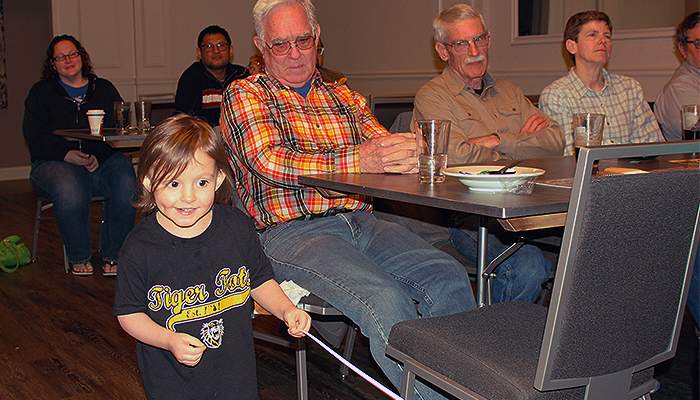
A little girl helps to measure the size of a dinosaur during Monday night’s FHSU Science Cafe lecture on dinosaur growth.

By CRISTINA JANNEY
Hays Post

Attendees at the monthly FHSU Science Cafe learned Monday night how an egg that could fit in a easter basket could grow into a gigantic dinosaur.

Cat Sartin, FHSU instructor of biological sciences, presented “The Bare Bones About Dinosaur Growth.”

Sartin’s research has focused on the growth patterns found in fossilized dinosaur bones. Sartin studied hadrosaurs, which were a family of dinosaurs that are commonly known as duck-billed dinosaurs. They were herbivores, which meant they ate plants, and among the most common dinosaurs living during the late Cretaceous Period.

Cat Sartin, FHSU instructor of biological sciences, presented “The Bare Bones About Dinosaur Growth” Monday night at The Venue.

Sartin choose the hadrosaurs in part because they lived in herds with individuals of varying ages.

The eggs of a hadrosaurs were about the size of a potato, but the adults grew to up to 20 feet long.

Even the titanosaurs that grew to be 120 feet long started out from an egg that is only about 18 inches long.

“If dinosaurs were up and running around today, we could go out and measure them. We could look at what they were eating. We could put trackers on them. It would be great, but they’re not around,” she said.

Although researches can look to modern birds and reptiles for clues to how dinosaurs may have lived and grown, these animals don’t grow to near the sizes the dinosaurs did.

“We can’t go out and study them because all we have are the bones, and they are not even really bones. They are fossils, which means the bone material has been largely replaced by rock, so it is just a snapshot in time for each individual animal,” Sartin said. “Fossils don’t grow. They don’t exhibit behavior.”

Sartin analyzed thin sections of hadrosaurs bones under a microscope to evaluate their texture. Young individuals have an open or lacy texture to their bones to allow for more blood vessels to feed the rapid growth of the bones. As an individual ages to equivalent of elementary school child, its bone structure has more order. The collagen fibers in the bone lay down in layers almost like plywood.

Skeletally mature individuals bones are the most organized. These individuals have osteons, which are bone canals. These structures are good at stopping stress fractures in older creatures.

“When you are young, you do a lot of stupid things. We all do. It’s OK. Across the animal kingdom, animals do a lot of stupid things and take a lot of risks. They need really strong bones for all the stupid things they do,” Sartin said.

“As you get older, you get into a routine. You are doing the same things over and over again whether you are a human or a dinosaur. That means you are more likely to have stress fractures from that repetitive motion. That is what this is helping to stop.”

The texture, however, will not tell the age of the animal.

Dinosaurs lay down lines in their bones called lines of arrested growth. These lines can be counted like tree rings to determine age. The amount the animal grew each year can also be estimated by the amount of bone between each line.

Researchers used captive populations of animals, such as alligators and king penguins, to determine what triggered the animals to lay down the rings. They suspected the rings were laid down annually.

They turned to a small primate, commonly called a mouse lemur, that they housed in a lab. They changed the mouse lemur’s light cycles to 18-hour days instead of 24-hour days. After 365 of these 18-hour light cycles, the mammal laid down a bone ring.

Specifically of the hadrosaurs, Sartin choose to focus on a group of eolambia fossil that were found in Utah at the site where a river likely flooded.

The curators who held the eolambia fossils were not all that excited to have Sartin slice up their specimens, so she found isolated  bone shafts that weren’t likely to be used for display in museums. She ended up with 20 some specimens to study.

By measuring the lines of arrested growth, Sartin determined these dinosaurs grew quickly for 10 to 12 years, and then their growth slowed.

“It makes good sense, because there are things out there that might want to eat you,” Sartin said, “and it might be helpful to grow a little quicker.”

From analyzing the texture of the bones, she also determined the group of individuals found in the Utah deposit were not skeletally mature. Sartin theorized that some of the teenage dinosaurs might be sexually mature and reproducing.

She also determined the first growth ring in the bones was fairly large, which meant they went from an egg the size of a baked potato to a middle schooler in one year.

Sartin again looked to modern animals to help her with her research. Ostriches go from an egg to a full-grown adult in 18 months.

“It is completely reasonable to think a little eolambia could go from a baked potato to yeah high in a year,” she said.

Eolambia did not have spikes or armor or plates for defenses, so growing quickly and living in herds were their defenses against predators.

Other herding herbivores have also shown similar rapid growth patterns.

Apatosaurus, which we used to know as brontosaurus, grew to adult size in 10 years. They had an average length of about 75 feet and weight of 16 to 22 tons. Most of the plant-eaters’ growth came in three years. Researchers are trying to determine how the animals could consume enough food to support that type of growth.

Theropods (meat-eating dinosaurs) also had quick growth spurts, but they were delaying their spurts to a little later in their youth.

“Theropods hang out as small little guys for the first three to five years of their lives. It is kind of cool and groovy to be little, and then they decide to go gangbusters and get really big, really quickly,” Sartin said.

Researches believe the meat eaters did not have to grow quickly for protection. This allowed them to learn hunting techniques from the adults in their family groups. They also may have been learning social cues from the others in their family groups or packs, Sartin said.

Based on these growth patterns and the family groups in which the meat-eaters’ fossils have been found, researchers believe the meat-eating dinosaurs parented their young, she said.


Ellis man charged with first-degree murder in Feb. 27 shooting

Thompson / HPD

By JONATHAN ZWEYGARDT
Hays Post

A 34-year-old Ellis man has been charged with premeditated first-degree murder in the fatal shooting of a Hays man last month.

According to Ellis County Attorney Tom Drees, Ryan Paul Thompson was charged Tuesday in Ellis County District Court with allegedly shooting 26-year-old Diego Gallaway on Feb. 27 in the 2700 block of Indian Trail.

Thompson is alleged to have shot Gallaway in the back of the head while having him in a chokehold, according to Drees.

If convicted, Thompson faces a minimum of 50 years in prison for intentional and premeditated first degree murder.

Thompson was also charged with possession of methamphetamine with the intent to distribute. He allegedly possessed 23.9 grams of the drug. If convicted, he would face between 92 and 144 months in prison.

He was also charged with criminal possession of a firearm by a convicted felon. Thompson allegedly possessed a .22 caliber handgun. He was previously convicted of aggravated endangerment of a child in Russell County in 2018.

At preliminary hearing will be scheduled at a later date. Thompson is being held in the Ellis County jail in lieu of $750,000 bond.

The filing of criminal charges are merely allegations of criminal wrongdoing, Drees said. The defendant maintains a presumption of innocence unless and until they are proven guilty in a court of law.

Tiger women come up short in Central Regional title game

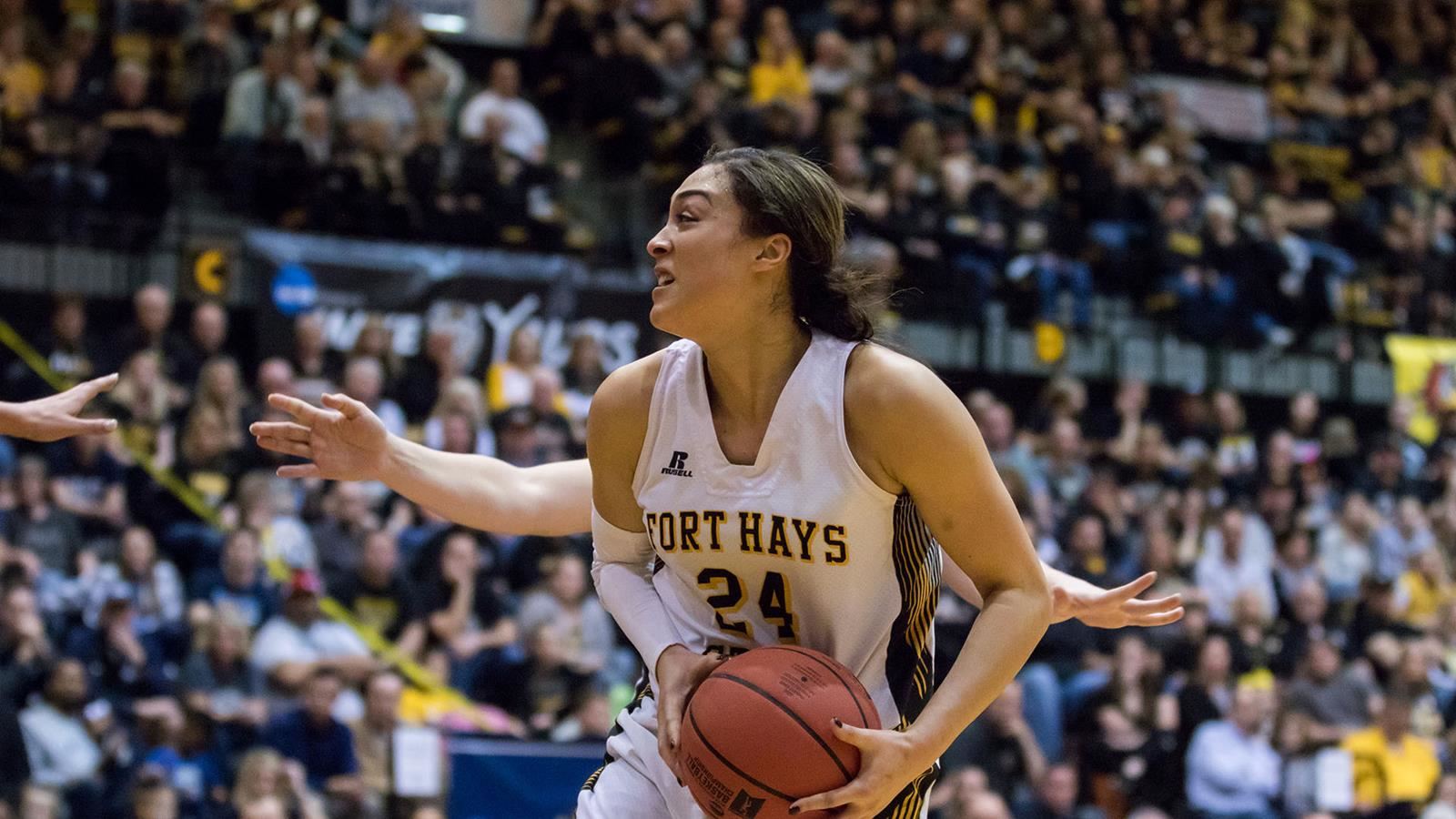
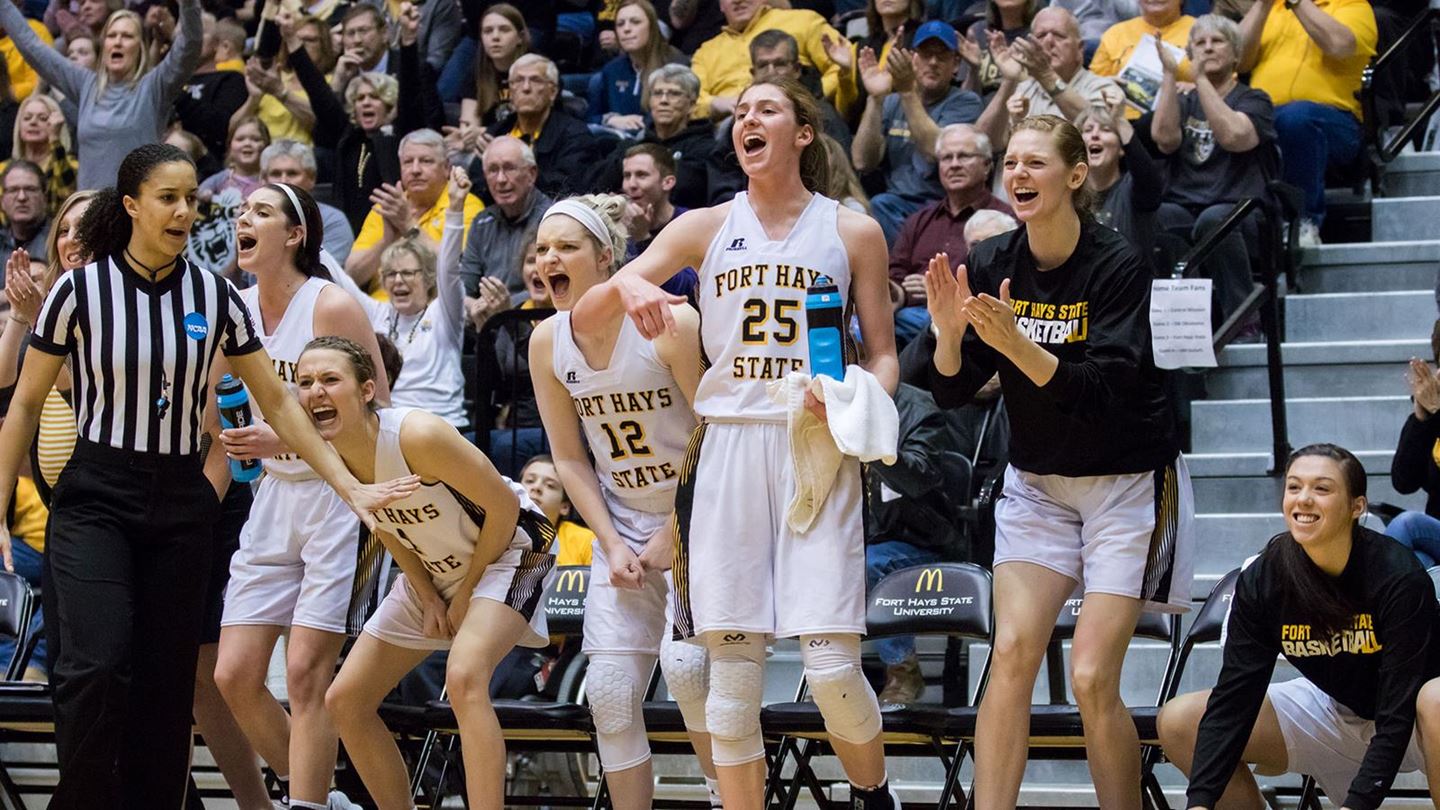
HAYS, Kan. – Southwestern Oklahoma State hit its first five field goal attempts of the game, jumped out to an early 14-point lead, and held off two strong rallies from Fort Hays State to claim the NCAA II Central Regional Championship 88-77 Monday night in front of a raucous crowd of over 5,000 at Gross Coliseum. Bulldogs senior guard and Great American Conference Player of the Year Hayden Priddy scored a game-high 32 points to lead the Bulldogs (33-1) to their first Elite Eight.

FHSU Postgame Press Conference

Game Highlights

A rough start to the game was too much for the Tigers (32-2) to overcome in the battle of Top 10 nationally ranked teams. FHSU started the game 0-of-7 from the field until a Maddie Mittie layup just over six minutes into the game snapped the cold spell. While the Tigers were struggling from the field, SWOSU built a 16-2 lead and eventually led by 10 at the end of the first quarter, 23-13.

After shooting 57.1 percent from the field in the opening frame, Southwestern Oklahoma went on a 12-4 run to open the second quarter and built the lead to 18 with 7:41 to play. The Tigers fought their way back with a frantic 25-8 run to cut the lead to one with 34 seconds remaining in the first half. SWOSU hit a pair of free throws and Kasey Kennett had a 3-pointer rim out at the horn to give the Lady Bulldogs a 45-42 halftime lead.

The Tigers pulled within a point two different times early in the third quarter and had a chance to take the lead but following a missed shot, Priddy hit a three-pointer to push the Lady Bulldogs lead to four. FHSU trimmed the lead to two twice after that, but SWOSU answered with an 8-0 run to go up 10. Priddy buried the Tigers in a deep hole once more by scoring the final seven points of the third quarter and pushing the lead out to 16 after three quarters.

Fort Hays State used a 13-3 run to trim a 17-point deficit to seven, but SWOSU ended the rally with a pair of free throws with three minutes to go. The Bulldogs pushed the lead back into double figures with 2:42 to play and it never dipped under 10 the rest of the way.

FHSU struggled to find their touch behind the arc, finishing 2-of-16 from 3-point range. They did out rebound the Lady Bulldogs by 15 including a 19-5 edge in offensive rebounds. However, 14 more attempts at the basket was not enough to get past the Bulldogs.

Tatyana Legette closed out her tremendous collegiate career with a hard-fought double-double performance of 19 points and 13 rebounds. She also had a team-high five assists. Belle Barbieri also had a double-double of 19 points and 10 rebounds. Legette and Barbieri were named to the Central Regional All-Tournament Team along with Priddy, Hailey Tucker, and Taber Beer of SWOSU. Tucker finished the night with a double-double of 14 points and 12 rebounds, while Beer was the regional semifinal hero that hit a buzzer-beating shot to lift SWOSU into the regional title game. Beer finished the championship game with eight points and three steals.

Whitney Randall was a big spark for the Tigers, scoring a career-high 20 points off the bench. Legette produced her 10th double-double of the season and 22nd of her career, finishing with 1,256 points and 865 rebounds at FHSU. Barbieri had her seventh double-double of the season and career in the championship game.

The 32 wins for FHSU is a new record for the program’s NCAA Division II era. The Tigers were MIAA regular season and conference tournament champs, the first MIAA team to accomplish that since Washburn in 2012. FHSU reached the NCAA regional finals for the second time in the last five years and in each of those seasons, won at least 30 games.

BLACK OUT THE COLISEUM: Tigers ready for run at regional title

FHSU Athletics / Allie Schweizer photo

The Fort Hays State women’s basketball team will play in an NCAA Division II regional title game for the second time in program history Monday (March 18) when the No. 3 Tigers take on seventh-ranked Southwestern Oklahoma State at 7 p.m. inside Gross Memorial Coliseum. The winner of Monday’s contest will advance to the 2019 NCAA Division II Women’s Basketball Championship Elite Eight, held in Columbus, Ohio beginning March 26.

Important Fan Information
Tickets: All seats are general admission for the regional tournament. Tickets cost $10 for adults and $5 for youth/students, with FHSU students admitted for FREE with a valid Tiger card.
Parking: The grass lot adjacent to Gross Memorial Coliseum will be OPEN today. Auxiliary parking will be also available at Lewis Field Stadium, on the south edge of the FHSU campus. Shuttles will run from Lewis Field to the Coliseum every 10 minutes beginning at 4 p.m. and continuing until the end of the final game of the night.
Tiger Pregame Party: The FHSU Alumni Office will host Tiger Spirit Parties before each Fort Hays State game this weekend inside the Eagle Communications Hall at the Robbins Center. Monday’s festivities are scheduled from 4-6 p.m. More information can be found here.
Black Out Gross Memorial Coliseum: Wear your black FHSU gear tonight as you cheer the Tigers on to victory!

It is the second time the Tigers have played in the Central Region championship game at home after earning the top seed in the 2015 regional tournament.

Both teams head into the contest 32-1 on the year, tied for the second-best winning percentage in the country.

This is the second year in a row that the Tigers have played Southwestern Oklahoma State in the Central Region tournament, with Fort Hays State knocking off the Lady Bulldogs in the opening round last March, 78-75.

That was the fourth meeting between the two schools in program history, with Fort Hays State coming away victorious in all four contests. The most recent Tiger victory before last season was a 57-53 win in 1990-91, when the teams met in the NAIA National Championship game.

The Tigers have won 25-straight home games dating back to last season, tied for the longest home winning streak in program history. FHSU has matched its record for wins at home in a single season this year with 18.

Southwestern Oklahoma State sports a high-octane offense that puts up 84.6 points per game, fifth-most in Division II. The Lady Bulldogs are led by last year’s Central Region player of the year Hailey Tucker and this year’s region player of the year Hayden Priddy. Tucker puts up 18.7 points per night and grabs 6.5 rebounds each game while Priddy is averaging 16.9 points, 3.4 assists, 3.5 rebounds and 2.2 steals per game. Bethany Franks grabs a team-high 8.9 rebounds while adding 9.1 points per game.

World Water Day at Sternberg promotes conservation

By CRISTINA JANNEY 
Hays Post

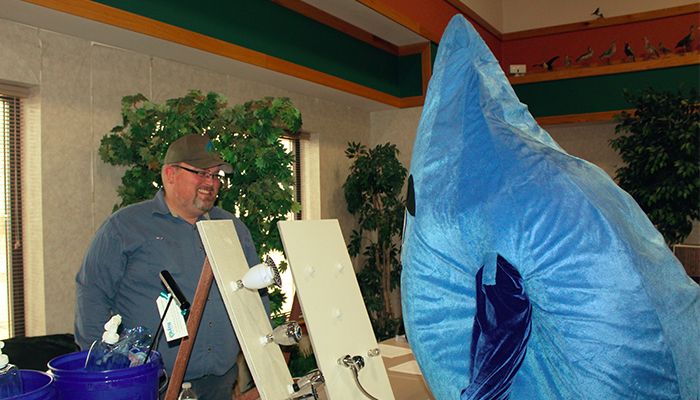
Left to right: Hattie, 3, Skyler, 5, and Summer, 8, Simpson of Hays use cereal and marshmallows to construct edible soil layers Thursday at the Water Fun Fest at the Sternberg Museum.

The Hays Water Resources Department hosted hundreds of children and their parents Thursday during the second-annual World Water Day Fun Fest at the Sternberg Museum of Natural History.

Attendees learned about low-flow shower heads, the water table, where to find water in the environment and how to prevent water pollution.

The Water Resources Department gave away shower timers and offered crafts and a coloring contest to remind children to conserve water. Water conservationists urge people to take a five-minute shower or less.

Free jar openers reminded water consumers to avoid sending fats, oils and greases down water drains, because they clog pipes.

Christine Albrecht helps her daughter, Lauren, 7, complete a water droplet craft at the World Water Day Fun Fest Thursday at the Sternberg Museum.

Jeff Crispin, Hays director of water resources, was also giving away toilet dye tabs. You place the tabs in your toilet tank, and if the dye shows up in the toilet water, you have a leak that needs to be fixed. About 1,500 of these packets will soon be going out to local students. You can also pick up packets for free at the city of Hays offices.

“We are trying to bring kids out and parents out to educate them about the importance of saving water and doing everything they can to save water at home, or anywhere for that matter, and how important water resources are,” Crispin said.

The youth and parents were also able to see a tower of 91 gallons of water jugs, which is representative of the per capita water usage of a Hays resident per day.

Crispin said Hays residents use less water than any other city in the state, but we still need to and can do better.

Holly Dickman, water conservation specialist, said the event has been a good opportunity to reach both children and adults with the messages of water quality and conservation.

A volunteer with the watershed district demonstrates how contaminants can make their way into the water table.

“From little on up, it is amazing when I do school programs how much those little kids who live here in Hays already know because they have heard it for awhile,” Dickman said. “Any time we can reiterate that it is best to conserve and it is best to be conscience of water usage and what we are doing with our water is a good thing.”

Stacie Minson, KSU watershed specialist, was also on hand to offer activities and demonstration centers based on water conversation. She said she was trying to educate kids about how dynamic their water system is.

The watershed had a display of different types of pollutants that can get into the watershed, including pet waste, herbicides, soil sediments, chemicals and fertilizers.

The children used cereal and marshmallows to build edible soil layers.

Water$mart Wally and others stand in front of a display of 91 gallon bottles, representing the per capita water usage of Hays residents each day.

“They eventually will become adults who have to pay the utility bills and have to make sure when they turn a faucet on they have a clean, safe water supply. ” Minson said of the children.

A.J. Hill, water plant operator, was available to inform attendees about some of the many rebate programs the city offers.

The city offers rebate programs for high-efficiency wash machines, low-flow toilets , turf conversion and preferred and acceptable trees. Local officials also offered information about xeriscaping, which uses native, drought tolerant plants to conserve water in landscaping.

You can learn more about water conservation, city rebate programs, water-smart landscaping and city water rules on the city of Hays website.


Producers try to recoup losses after Plainville Livestock Commission drains account

Farmer and rancher Dereck Stockman and his son August.

By CRISTINA JANNEY
Hays Post

Derek Stockman’s farming and ranching operation has been brought to a standstill. He sold 41 heifers at the Plainville Livestock Commission on Feb. 5, but his check for almost $37,000 bounced.

Stockman of Kirwin only recently expanded his farming operation into cattle. He is now unable to make his FSA loan payments, nor is he able to get his operating loan for the coming year guaranteed.

“The bills don’t stop coming in,” Stockman said.

Stockman is one of more than 40 livestock producers in the area that have been caught up in legal action and bankruptcy of Plainville Livestock Commission, operated by Tyler Gillum. This is just the latest in a series of financial problems and federal regulation violations faced by the market agency.

“Everybody says you’ll get your money, but I don’t know. When is that going to happen?” Stockman asked. “Are they going to pay my interest or are they going to give my commission back? I doubt it.”

In the meantime, Stockman is working with the FSA to get his loan payments deferred.

Although several producers said they had heard rumors there were problems at Plainville, Stockman said he was blindsided when he received his check back from the bank.

On Feb. 12, Almena Bank froze two of Plainville Livestock Auction’s bank accounts. When the bank froze the accounts, tens of thousands of dollars worth of checks Gillum had written to area ranchers who had recently sold cattle at the Plainville Livestock Commission bounced.

In court filings, the bank noted Plainville Livestock Commission transferred more than $916,000 from its custodial account into its general operating account the bank’s officers believed to cover overdrafts in the general operating account.

Almena Bank has filed an interpleader case, which is legal action that seeks to determine to whom the money that was transferred out of the custodial account belongs.

When a market agency sells livestock, the money collected from the buyers is supposed to be deposited in a custodial account until the sellers are paid. The funds collected during sale have to be deposited into the account by the next business day.

Regulations prohibit market agencies from using the proceeds from the sale of livestock sold on a commission basis for any purpose other than paying consignors the net proceeds from the sale of their livestock, after deducting the market’s lawful charges.

RELATED: Kan. Livestock Association issues advisory on Plainville Livestock Commission

This is not the first time Gillum’s operation had been caught with insufficient funds in his custodial account.

Plainville Livestock Commission was cited by federal court in 2012 and 2014 for not having sufficient funds in its custodial account.

On July 31, 2017, an analysis of Plainville’s custodial account showed Plainville had outstanding checks drawn on its custodial account in the amount of $9,641,594. The custodial account had a balance of $45,928 with proceeds receivable of $46,615, resulting in a custodial account shortage of $9,549,050.

Between March 2018 and May 2018, Gillum issued 33 insufficient funds checks from its custodial account totaling more than $1.25 million. The checks were paid, but were paid up to two weeks late, resulting in $1,500 in overdraft fees and $775 in returned item fees on the custodial account.

The U.S. Attorney filed filed another case another case in July 2018 in which it stated Plainville Livestock Commission failed on numerous occasions to maintain funds in its custodial account. Gillum was fined $117,750.

In addition to the interpleader case, Almena bank also attempted to foreclose on Gillum based on default of three loans totaling more than $3.49 million.

The bank alleged in court documents Gillum was trying to dispose of assets that he had designated as collateral on the loans.

Cattle on Stockman’s ranch.

The stockyard is still operating in Plainville as Heartland Regional Stockyards under a license held by Ll0yd and Judy Schneider. Hays Post tried to contact the Schneiders, but received no answer at the stockyard.

Plainville Livestock Commission filed for Chapter 11 bankruptcy on March 1. Chapter 11 is usually used to restructure debt and pay creditors off over time.

Gillum’s attorney in the bankruptcy case, Thomas Gilman of the Hinkel Law Firm in Wichita, said Gillum hopes to sell the assets of Plainville Livestock Commission as part of the Chapter 11 bankruptcy debt restructure.

Gilman said Almena Bank’s foreclosure case against Plainville will be stayed until the bankruptcy case is heard in U.S. District Court in Wichita. The hearing on that case is set for April 11.

The Hays Post reached out to the attorneys for the Almena Bank, but a phone call was not returned.

Gilman said he was unsure what the procedures will be for repayment of producers who were owed money from Plainville Livestock Commission’s custodial account. He said he is not representing him in that matter nor any matters pertaining to any potential complaints filed by the U.S. Attorney in regards to violations of USDA Packers and Stockyards regulations.

Calls to the USDA Packers and Stockyards Division were not returned.

The Hays Post posed several questions to the U.S. Attorney’s office. Its media representative said he was unable to answer questions about when producers might receive their money back or what process would be used in paying back producers for the bounced checks. The representative also did not know how the bankruptcy filing might affect the claims against the custodial account.

Attorneys for Almena Bank also did not return a phone call.

As a complex legal battle plays out in court, producers like Stockman and others owed money by the operation are trying to hang on.

Larry Dinkel, owner of Jim Mitten Trucking of Oakley, hauled cattle for Plainville Livestock Commission. He has already paid employees, but he can’t go on indefinitely without what he is owed.

In addition to being short of what he was owed from Gillum’s last sale, because of the scandal fewer producers are taking cattle to the stockyard under the new operators, which means lost business for his trucking company.

“We used to haul several loads in and out of there every week, and now I don’t haul anything in and out of there” he said, “because the customers are not going back.”

Dinkel blames, in part, federal regulators, who allowed Gillum to continue to operate despite repeated financial regulation violations.

“Had they done their job, none of us would be in this mess right now,” he said.

Stockman said he also hoped federal regulators would take action.

“I don’t think anyone should have to go through this,” he said. “We farmers go through enough trouble throughout the year to put in a full year’s work and not get paid for a full year’s work. It is nothing anyone should have to go through.

“It shouldn’t ever happen. Whoever is guilty, I feel they should make an example of him, so this doesn’t happen again.”

Click HERE for the U.S. Attorney complaint filed last year.

RELATED: Plainville Livestock Commission given suspension, assessed civil penalty

Copyright Eagle Radio | FCC Public Files | EEO Public File