We have a brand new updated website! Click here to check it out!

FHSU students urged to be wary when it comes to cyber security

By CRISTINA JANNEY
Hays Post 

“Trust no one. Trust no network.”

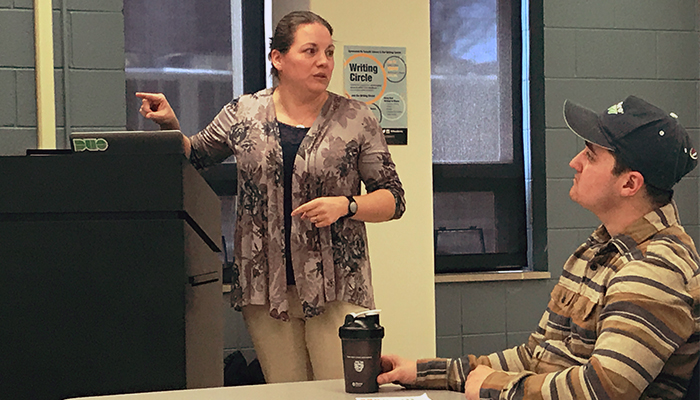
Jessica States, information security officer for Fort Hays State University, gives a lecture on cyber security on Wednesday at FHSU.

Jessica States, information security officer for Fort Hays State University, was trying to emphasize the prevalence of scams and phishing on the Internet.

She addressed a few of the issues students and faculty face during a Wednesday online security lecture sponsored by the American Democracy Project.

States focused on three main areas, including job scams, extortion and credential theft plus left her audience with a few general tips and resources for cyber security.

Job scams

FHSU students are consistently being targeted by job scams. The example States shares Wednesday resulted in a FHSU student losing about $2,000.

The student received a letter offering a job for which he would be paid in advance. The letter came from an .edu address from a person claiming to be a college professor. The student received and deposited several checks in his bank account. In the meantime, the scammer requested the student purchase gift cards and send him the redemption codes, so he could send a gift to his nephew.

By the time the bank a couple of weeks later had alerted the student the checks were fraudulent, the money on the gift cards had been spent.

States said students and other consumers fall prey to job scams because they don’t understand how the banking system works.

“So true or false? When you deposit a check or money order into your account, does your bank make sure it’s good before they put the money in your account?” States asked. “Most people think this is true. They think your bank verifies a check is good before they let you spend the money. This is false.”

States said  people assume because the check shows up as a memo line on their account, the bank has verified the authenticity of the check. This can take up to a couple of weeks, especially if your bank is trying to clear a check from an international bank.

Red flags in this email included a wage that seemed to be too good to be true — $450 per week for three hours of work.

“If it seems too good to be true, it probably is,” States said. “This is where, especially our younger students get caught. They think it is coming to my Fort Hays email address. It sounds really good. It talks about Fort Hays. It must be legitimate. If they would just take a second, pause and think about it, it is really too good to be true.”

No employers should ever ask you to buy gift cards or wire them money. Paying in advance is also suspicious.

Email addresses should not be trusted. Email accounts can be hacked or spoofed.

Check out the alleged employer, States said. You should be able to track down the person through LinkedIn and contact them through other means than the email address you have been given.

The scammer also attempted to get the student to use an alternate email address rather than the more secure university account, which circumvents the university’s firewalls

Extortion

On Monday, a university staff member received an extortion email. The email threatened to release an email containing embarrassing information about the staff member to all of their email contacts unless a $977 ransom was paid in bitcoin.

The subject was the person’s username and an old password, which made it appear more authentic.

There have been tons of data breaches in recent years, including Yahoo, eBay and Sony PlayStation, so it is very possible you have a current or old password out there on the dark web, States said.

“Scammers are going to use any personal information they have about you to make the scam seem more realistic,” States said.

States said she doubted the scammer had any compromising information on the person in question. Scammers prey on fear and a victim’s guilty conscience.

Fort Hays has never paid an extortion ransom, but States said she did not know about individuals.

If you are hit with an extortion attempt, don’t panic and don’t reply to the email. If you reply to the email, the scammer knows they have a legitimate email address.

If you are still using the password the scammer has noted in the email, change it immediately on all accounts it is being used on.

Mark the email as spam and delete it.

“It is basically free for them to send millions of emails,” States said. “The one statistic that I was looking at earlier, there are 100 million phishing emails that go out everyday. … Even if 99 percent of them are blocked, that would still be a million that would get through. That is a lot. Even if one person falls for it, they have just made $977 in bitcoin for very little work.”

A fake tech support scam that was circulating last year made the scammers an estimated $24 million in two months, States said.

Credential theft

On Monday, States said someone at the university reported being the subject of an attempted credential theft scam.

The attacker spoofed the From line to indicate it was coming from the user’s own email. The scammer was trying to get the recipient to enter his or her account username and password.

If you would have hovered over the link with your cursor, you would have seen it took you to an odd off-campus address, States said.

The email had some grammar mistakes, which should be a clue that it was a fake.

“The thing you have to remember, for people who especially English is not their first language, grammar mistakes are not a big indication of phishing,” States said. “While I do put some emphasis on that, it is not always the greatest tool to figure out it is phishing. Plus I have seen some official emails that came out that had some pretty glaring mistakes.”

Phishing messages can also come via text.

Scam signs

• Who is it from?

• Look at the Reply To. Is that different than the alleged sender? The scammer may have stolen an email address and is now trying to redirect you.

• Sense of urgency. Scammer may try to get you to act right away without being able to confirm information or think things through.

• Generic greetings

• Scammer is requesting a credit card number

• Hover over links, so you know where it is taking you.

• Be wary of attachments

• Is the sender who they say they are? If an email that is supposedly coming from a friend does not sound like that person, independently confirm the information in the email before taking action. Your friend may have been hacked.

Don’t

• Wire money to someone you don’t know

• Buy and provide people with codes for gift cards

• Trust Caller ID

• Trust email addresses. They can be faked.

Do

• Resist the urge to act immediately

• Check the story out

• Look at a URL before you click on it.

• Let unknown numbers go to voicemail

• Use strong, unique passwords

• Report phishing or scams to FHSU Tech Support, the police, and/or Google

• Enroll in two-factor authentication. This pairs something you know with something you have, such as a password with a cell phone or a hardware token that can receive a security code. FHSU faculty and staff are moving to this security process this week. It will be optional for FHSU students as of this summer.

Helpful links

Check to see if you have an account that has been comprised in a data breach, haveibeenpwned.com

Sign up for two-factor authentication, twofactorauth.org/

Phishing quiz, phishingquiz.withgoogle.com/

Cyber security tips, www.stopthinkconnect.org
 

🎥 Incoming Ellis superintendent sees staffing as a challenge

Corey Burton will become Ellis USD 388 superintendent July 1, 2019.

By BECKY KISER
Hays Post

Just days after coming home to Ellis on Jan. 17 from six months of treatment for leukemia in Kansas City, high school/jr. high principal Corey Burton interviewed for the position of Ellis USD 388 superintendent.

Burton was one of three finalists for the position, and the Ellis school board announced his selection Feb. 13.

While the other candidates toured the two schools, met with teachers, staff, students and the public, and interviewed in person with school board members, Burton made his interview statement via an online video which was made public.

Burton has been in a year-long battle with cancer. More than 1,500 #Burton Strong T-shirts were sold in a local fundraiser for his family’s expenses.

“We had all kinds of community support,” Burton said. “It was overwhelming, honestly.”

Burton has served the past 13 years as EHS principal and was a teacher for nine years before that. The moves have always been part of his career plan.

He will officially take the superintendent’s seat July 1 and is working now with the current superintendent, Bob Young, to prepare for the job change. Young is retiring at the end of the 2018-19 school year.

“We meet nearly every day and go over something that I’ll need to be dealing with over the next couple months. That’s probably the biggest thing, is familiarizing myself with everything that I’m gonna need to get done next year.

“It will be a learning process,” Burton acknowledged. “Just like your first year of teaching, just like your first year as an administrator, this first year as superintendent is going to be a learning process.”

Finances are a constant challenge for most Kansas school districts, although Ellis has been “pretty lucky with consistent student enrollment,” according to Burton. “The state was good to us last year and we look to be in the positive again this coming year.”

Staffing is what Burton believes will be one of the bigger challenges, not just for Ellis but all of western Kansas.

“Finding quality teachers, keeping quality teachers in the classroom, even finding the appropriate staff members,” all concern Burton.

“We’ve got some staff members that could retire in the next couple of years that aren’t just teachers. We’re going to have to fill those positions and some of them are going to be challenging to fill,” he said. “I think we’re going to have to be real proactive in trying to attract good people to those positions, both salary-wise and a pleasant, enjoyable work environment that people want to be in.”

Burton knows community support and that of parents is strong in Ellis.

“They understand the importance of education and we really get support from them … Our normal fall parent/teacher conference at the high school averages about 85 percent,” Burton said. “Most high schools would do back flips if they could get that kind of attendance in even just an open house.

“Our folks want to be involved. They want a good strong school system. They want their kids to be successful. It’s nice.”

You can watch more of Burton’s interview with Gary Shorman on the Eagle Community TV Forum the week of Feb. 25 on Eagle channels 14 and 614 at 6:30 p.m. and 10:30 p.m.

🎥 R9 Ranch Final Master Order promised by March 1; cities talk to governor

R9 Ranch, Edwards County

By BECKY KISER
Hays Post

The cities of Hays and Russell have been told a Final Master Order for the R9 Ranch water project will be completed by Friday, March 1.

If not, the cities will “turn up the heat,” and 40th District State Sen, Rick Billinger, R-Goodlandm plans to intervene, according to Hays Mayor Henry Schwaller.

The cities submitted applications to the state in June 2015 for development of the R9 Ranch in Edwards County as a long-term water supply for Hays and Russell.

In May 2018, the Kansas Department of Agriculture Division of Water Resources released a draft master order approving an application to convert water use on the city-owned property from agricultural to municipal.

Following a public hearing in Greensburg in June, DWR Chief Engineer David Barfield began preparing the Final Master Order.
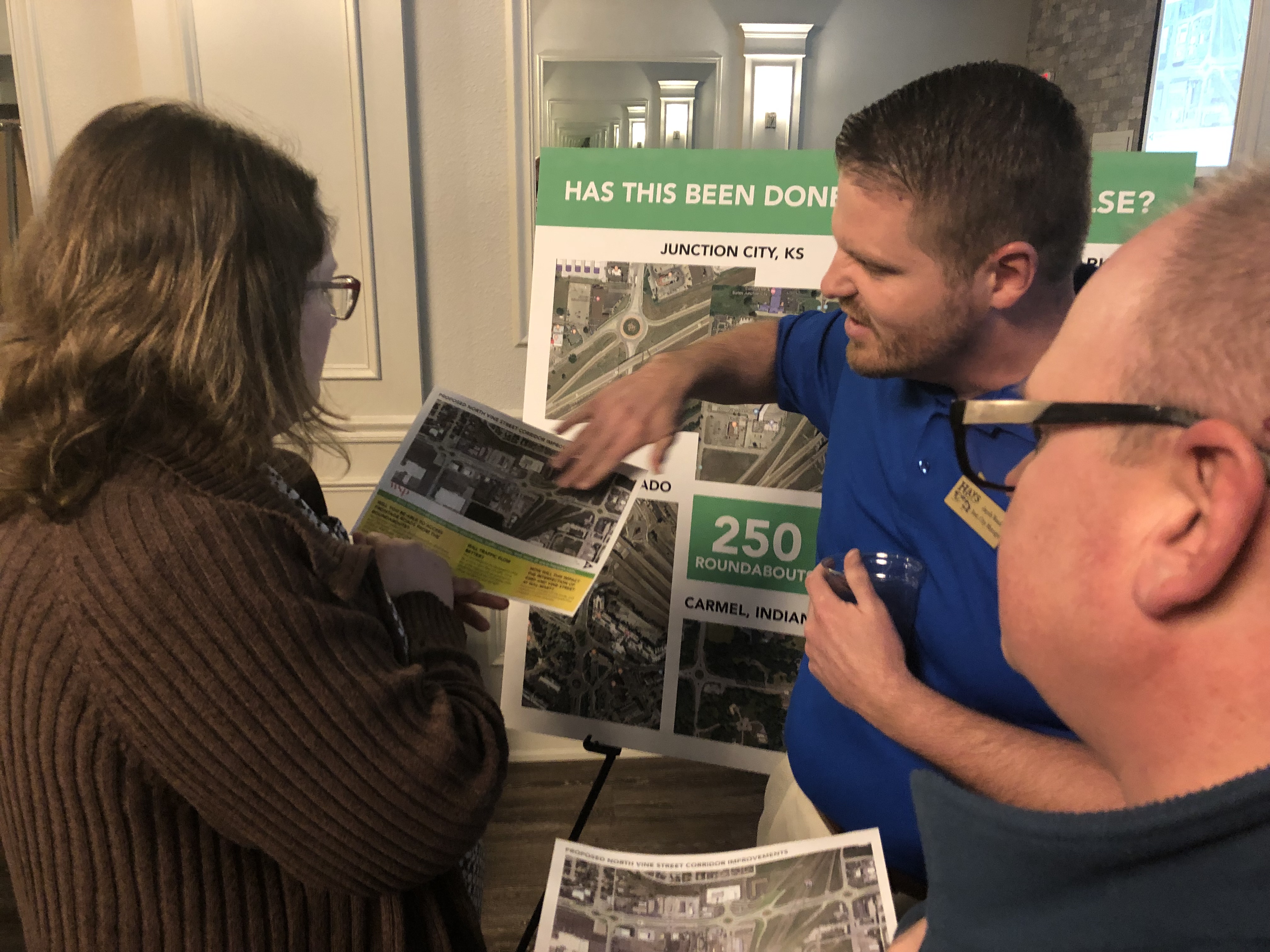
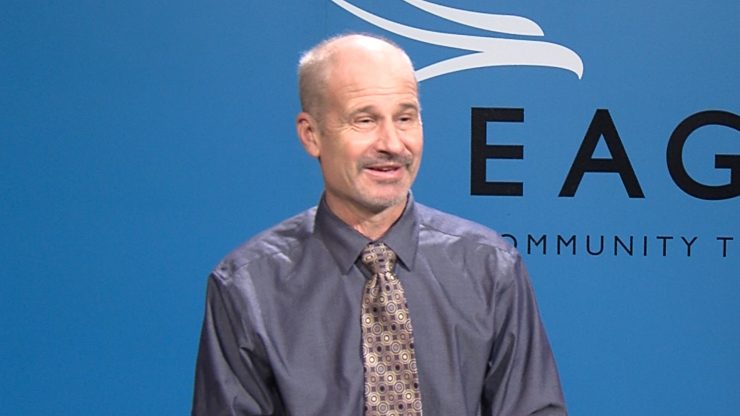
Hays Mayor Henry Schwaller updated the situation during a news conference Tuesday morning at the Hays Welcome Center after announcing last week the cities planned to increase pressure on the state to produce the order.

“We’ve had the input. The DWR has not released the document and there’s been considerable delay. We don’t know why,” he said.

Schwaller, along with Hays City Manager Toby Dougherty and Russell City Manager Jon Quinday, were in Topeka on Monday to visit with state officials about the plan status.

The trio met at the statehouse with newly elected Gov. Laura Kelly and Lt. Gov. Lynn Rogers.

“We had a very productive meeting with the governor,” Schwaller said, “quick and engaging. We shared our concerns, where we are in the process and the purpose of it.”

Both Kelly and Rogers are familiar with the project and Kansas water law, having served previously in the Kansas Legislature.

The group also met with Sen. Billinger and the new secretary of the Kansas Department of Wildlife, Parks and Tourism, Brad Loveless, the former conservation director of Westar Energy in eastern Kansas.

According to Schwaller, the last communication with DWR said the Final Master Order would be ready in two weeks. That information came Friday, Feb. 15.

“Sen. Billinger told us if we don’t have the Final Master Order by next Friday, he will personally go over and meet with the chief engineer of the Division of Water Resources,” he said.

Schwaller said Loveless, an avid hunter and fisherman, was not aware of the agreement with KDWPT to turn the 7,000 acre ranch into a walk-in hunting area as it’s returned to native grass.

“Because he’s new to the job, he didn’t know about this. He’s very excited. Loveless has actually seen the ranch when a friend took him there,” he said.

Melissa Dixon, Jeff Crispin, Jacob Wood, Toby Dougherty and John Braun listen to Hays Mayor Henry Schwaller Tuesday.

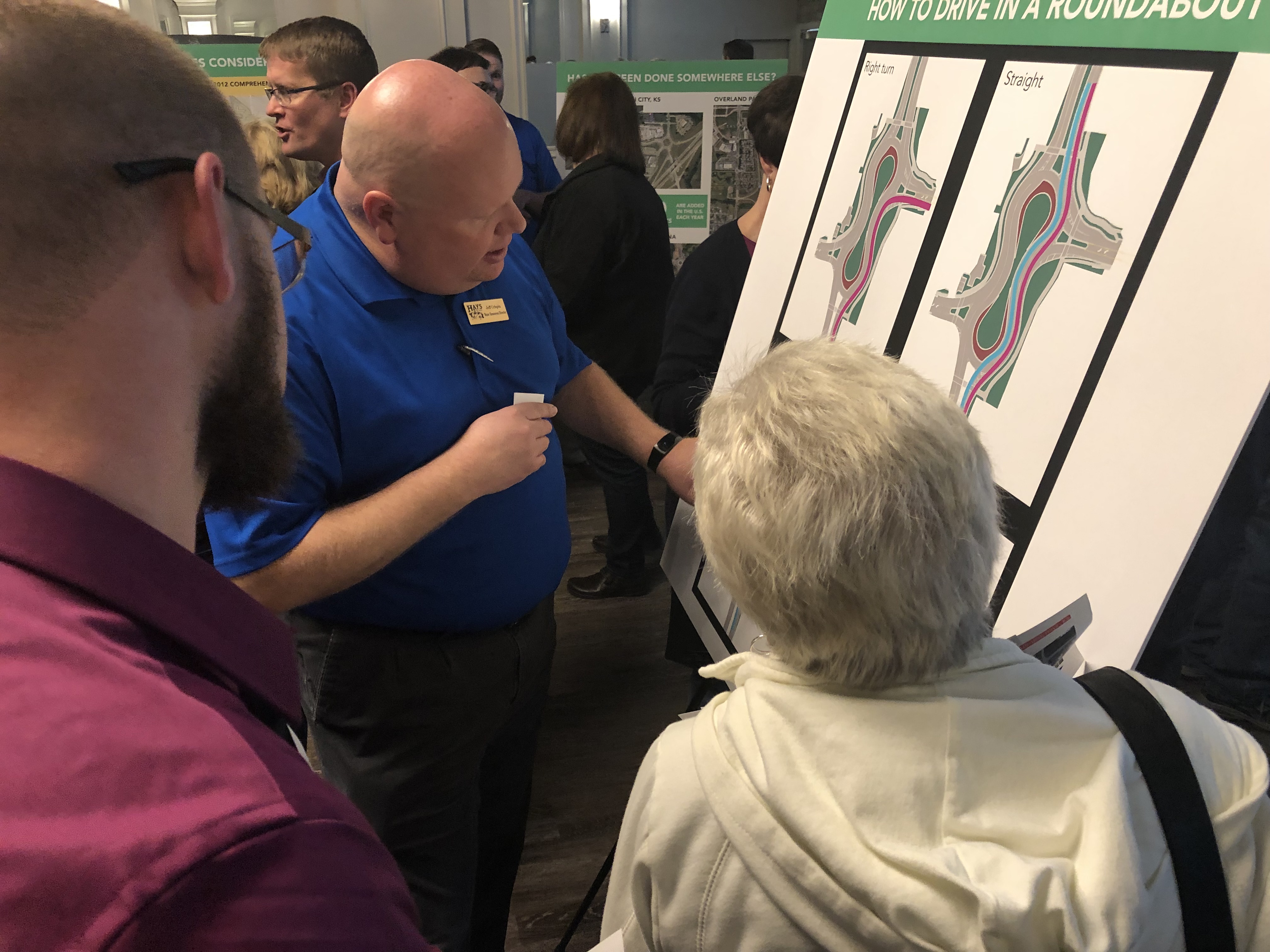
Dougherty also attended Tuesday’s news conference, along with Hays Water Resources Dir. Jeff Crispin, Project Manager John Braun, Assistant City Manager Jacob Wood and Convention and Visitors Bureau Executive Director Melissa Dixon.

“We’re going to keep the pressure on,” Schwaller added. “Commissioners are reaching out to other elected officials. We’re calling them. I’ll be sending letters.”

Hays employs a lobbyist for the R9 project, Sean Miller of Capitol Strategies LLC, who has been instructed to meet with the new Secretary of Agriculture, Mike Beam, Schwaller said. DWR, which issues the master orders, reports to the Kansas Department of Agriculture.

The cities of Hays and Russell are co-owners of the R9 Ranch. It was purchased in 1994 as a possible long-term solution to water needs for the towns.  Hays owns 82 percent of the ranch; Russell owns 18 percent.

There was an “outcry” in Edwards County at first about “outsiders coming in to buy water that was theirs,” Schwaller said. He believes most of that has died down.

“We’ve also agreed to a substantial amount of reduction in the water we would take from the ranch.”

When operating as a ranch/farm, nearly all of the R9’s 7,800 acre-feet of water rights were being used in irrigation. Hays and Russell have voluntarily agreed to pump only 4,800 acre-feet per year — a 30 percent reduction — which is what modeling by project engineer Black and Veatch has determined is a sustainable yield that is naturally replenished.

“By not pumping the full water right for irrigation to farm, we’ve already done all our neighbors a huge benefit. Water will still be running in the aquifer. We’re not going to take our full water right,” explained Schwaller.

R9 proposed municipal wells (Click to enlarge)

The wellfield is being reconfigured to optimally locate each water well and reduce the total number of wells. There are also now monitoring wells on the property.

“There are a couple of owners in the area that are concerned this might affect their water rights. It will not. They can still pump their full water rights that they’ve been doing.

“What we’ve been doing will sustain the entire aquifer in the area. The Groundwater Management District (GMD) No. 5  has not been concerned. We have endorsement from the Kansas Livestock Association. The  Kansas Farm Bureau has been neutral in the matter.”

Schwaller noted some recent objections have been raised by an outside group with a Utah engineer, but dismisses the research as having “no basis in Kansas water law. The outside concerns are out of left field and not scientific.”

The water would be moved from the Arkansas River Basin to the Smoky Hill River Basin in the Hays wellfield at Schoenchen. That would trigger the Kansas Water Transfer Act for the first time because the proposal is to move 2,000 acre-feet of water or more per year a distance of 35 miles or more from water basin to another.

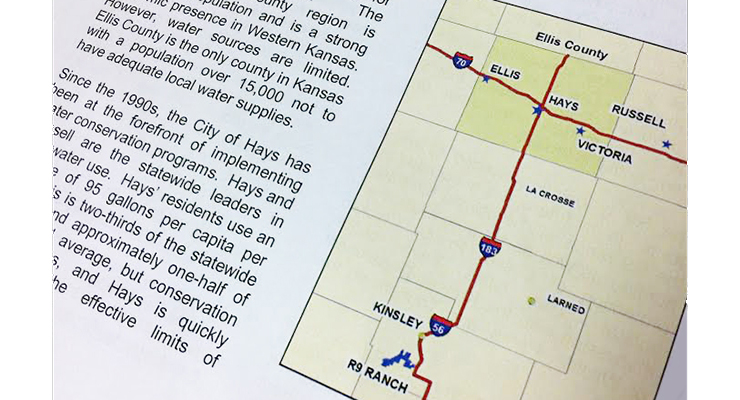
The R9 Ranch is south of Kinsley and 78 miles from Hays. Ellis, Victoria and La Crosse have expressed interest in purchasing some of the water for municipal use.

By state law, once the Final Master Order is issued, the Water Transfer Act will be triggered. The act still requires approval within 18 months from a three-person panel consisting of the Kansas Department of Health and Environment Secretary or the KDHE Director of the Division of Environment, the head of the Kansas Water Office, and the chief engineer of the KDA/DWR.

Schwaller describes the relationship between Hays and Russell and DWR Chief Engineer Barfield as “very good and productive.”

“We’ve gotten along well. … I think he just wants to do the best job and we appreciate that. We also appreciate that sometimes there’s a difference between getting something done and flourishes. We don’t need flourishes.  This is just a very simple document. He can sign it any time.”

The change applications from agricultural use to municipal use were filed in June 2015. The cities began the regulatory process in February 2014.

Schwaller said the cities would not make any concessions about the amount of water to be pumped.

“If we don’t have a Final Master Order in two weeks, there are other steps we can take, but we don’t want to go down that path. They would be very harsh and affect everyone in that basin.

“It’s important for the counties of Ellis, Russell and Rush that we have this water,” Schwaller stressed. “We are a $2 billion annual economy and an important part of northwest Kansas. If we do not have this water, we cannot continue to move forward.

“We’ve waited long enough and we’re ready to move.”

Hays voters approved a half-cent sales tax in 1998 dedicated to financing the $80 million project.

Fewer international students studying in U.S.; visa process can be tough

Yuchen Wang-Boswell of China with her husband, Korby Boswell, on the FHSU campus. The couple met as students.

By CRISTINA JANNEY
Hays Post

FHSU student Yuchen Wang-Boswell wanted to go home to visit her family during the summer of 2017, but President Donald Trump was in his first year in office, and the new administration was coming down hard on immigration with his newly instated travel ban.

Wang-Boswell was in the country legally on a student visa, but with nationalist sentiments running high, Fort Hays State University’s international student office advised Wang to stay in the States.

Wang-Boswell went three years between visits with her parents. She has since married an American and is embroiled in what she admits will likely be a prolonged and expensive process of applying for permanent residency in the United States.

She said she did not think Americans understood the complexity of the U.S. visa and immigration system or what it means to students or immigrants like herself.

Wang, who will graduate in May, said she thinks the perceived change in attitude toward foreigners in the United States has resulted in fewer students deciding to study in the United States.

Carol Solko-Olliff, FHSU director of international student services, said although FHSU has not seen a significant decrease in international student enrollment, nationwide universities are reporting a dip in international student enrollment. Some are attributing the decrease to election of President Trump.

Nationally, international student enrollment in the U.S. dropped by 6.6 percent during the 2017-18 school year, and universities and colleges reported further declines as of the fall of 2018.

The university can help international students prepare their VISA applications, but it has no control over whether those visas are granted. Solko-Olliff said the university has also seen an increase in the number of student visas that have been declined since Trump took office.

Kingsley Udenze, a FHSU student from Nigeria, is a graduate student in cyber security.

Both Wang-Boswell and Kingsley Udenze of Nigeria, were approved for their visas on their first attempts. However, Udenze said of the 20 people ahead of him the day he interviewed for his visa at the U.S. consulate, all 20 were denied. One friend applied five times for a student visa before he was accepted.

Only a fraction of the FHSU’s on-campus student body is international students — 4.5 percent. Most of the university’s international students come from China, but the college has 32 countries represented on campus.

The school’s cross-border program has an enrollment of about 3,500 students in China. The university also has international students who take courses online. Solko-Olliff said she predicted the number of international students taking online courses will increase.

“Some of the immigration rhetoric is for the border and people who are coming across who aren’t documented, and so sometimes I think our international students who are documented get blurred into that conversation,” Solko-Olliff said.

Wang-Boswell said although she encountered many friendly people in Hays, she had also experienced stereotypes.

“The other thing I personally feel people think about foreigners is ‘You are an immigrant. You don’t have value.’ They underestimate your value and abilities. They think you are poor and uneducated that is why you escaped your original country to come to the states,” she said.

The international students Hays Post spoke to said choosing to study at FHSU was highly influenced by the quality of the programs at the university.

Udenze, who is pursing a a degree in cyber security, said his program of study is not offered in Nigeria, yet he sees it as an emerging industry in his country. He said he appreciated FHSU’s efforts to make him feel at home on campus.

Affordability, cost of living and safety were other factors that led the students to choose to study at FHSU.

Despite a dip in international student attendance in the U.S., the number of FHSU domestic students wishing to study abroad has remained strong, Solk0-Olliff said. Just as the United States has become more selective in issuing visas for international students, U.S. students wishing to study internationally are seeing more stringent requirements for their visas, Solk0-Olliff said.

She said she thinks this has arisen from a heightened concern globally over terror threats. Students, as well as visiting faculty and researchers, are monitoring closely by the government. Information on the students and faculty are entered into a federal database.

Solko-Olliff said she thought it is unfortunate international students are having more difficulty coming to the United States to study because of the benefits they receive from the experience and what they offer to their fellow FHSU students and the Hays community.

“I think our campus is open and embraces international students. Obviously in a community, they bring cultural diversity to our campus and to our classrooms,” she said. “We are very rural, and it is very important for our domestic students to have that interaction with people from other backgrounds and countries and cultures. That is part of that liberal arts education.”

International students also engage residents in the Hays community through speaking engagements and visits to schools and community groups.

“I think they are ambassadors for their countries so we can learn more about misconceptions that Americans have, for instance about China or South Korea, about different countries. Then it helps our students to learn America is not that bad of a place.

“I think that exchange and interaction people have is so important to dispelling misconceptions, which is why it is disheartening students are having a difficult time coming to the U.S. to learn more about America but also educationally. When they go back to their countries and they are in government or leadership, they can rely back on their experience in the U.S., which hopefully was positive, and hopefully make change in their countries.”

Not only is the visa process time-consuming and complex, but it also can be expensive. Students also have to consider travel and living expenses once they are in the United States to study.

“They come to the U.S. They are coming for either two years or four years depending if they are undergraduate or graduate. They have two suitcases, so they can’t bring everything with them. They bring what they can and then they are going to buy the other things they need. Aside from the vast cultural diversity they bring to campuses, they bring a large economic impact to communities and, quite honestly, to the state of Kansas because they have to buy things when they come here.”

A round-trip ticket home to Nigeria costs about $3,000. As a result, Udenze hasn’t been home since he started his program at FHSU. He missed his sister’s wedding, the birth of her baby, and his brother’s wedding.

Wang-Boswell had not intended to stay in U.S. when she applied to study aboard. She intended to return to China, but after three years of dating, her husband, a classmate, he popped the question.

Wang-Boswell is set to graduate from FHSU in May. She said people assumed after she married, she automatically became a U.S. citizen. This is not the case. There are many steps she has to take. First, she has to apply to change her status from a student to a permanent resident, an application that could be denied.

The application packets is several inches thick and she and her husband, Korby, have hired an immigration attorney to help with the application process. She said she and her husband both have graduate degrees, but they still find the application difficult to understand. She said she feels lucky she and her husband have the means to pay the application fees and for an attorney.

“Think about those people who have limited resources and limited education or who do not have money, and they have to leave their original country and move to the States for their own safety. How are they going to get it done?” she said.

Her decision to remain in the United States with her husband has been a difficult one for her family in China. She is her parents’ only child. She also will be facing more time away from her parents as she can’t leave the country during the residency application process.

“I think my mom is pretty chill and flexible about it,” she said. “I remember one year after I studied here, she said, ‘I think you are happier and you are doing what you want to do,’ which is awesome. But my dad was closed-minded. At the beginning, it was hard for him to understand. He was, ‘Why? What is the point? You are far away from home. We can’t take care of you. You can’t see us regularly.’ I think eventually they understood, and now are happy for me, and they think I am happy, and I am valued.”

🎥 City of Hays debuts new website

IT Director Chad Ruder explains the city’s new website to Hays city commissioners Thu.

By BECKY KISER
Hays Post

A new website for the city of Hays went live last week.

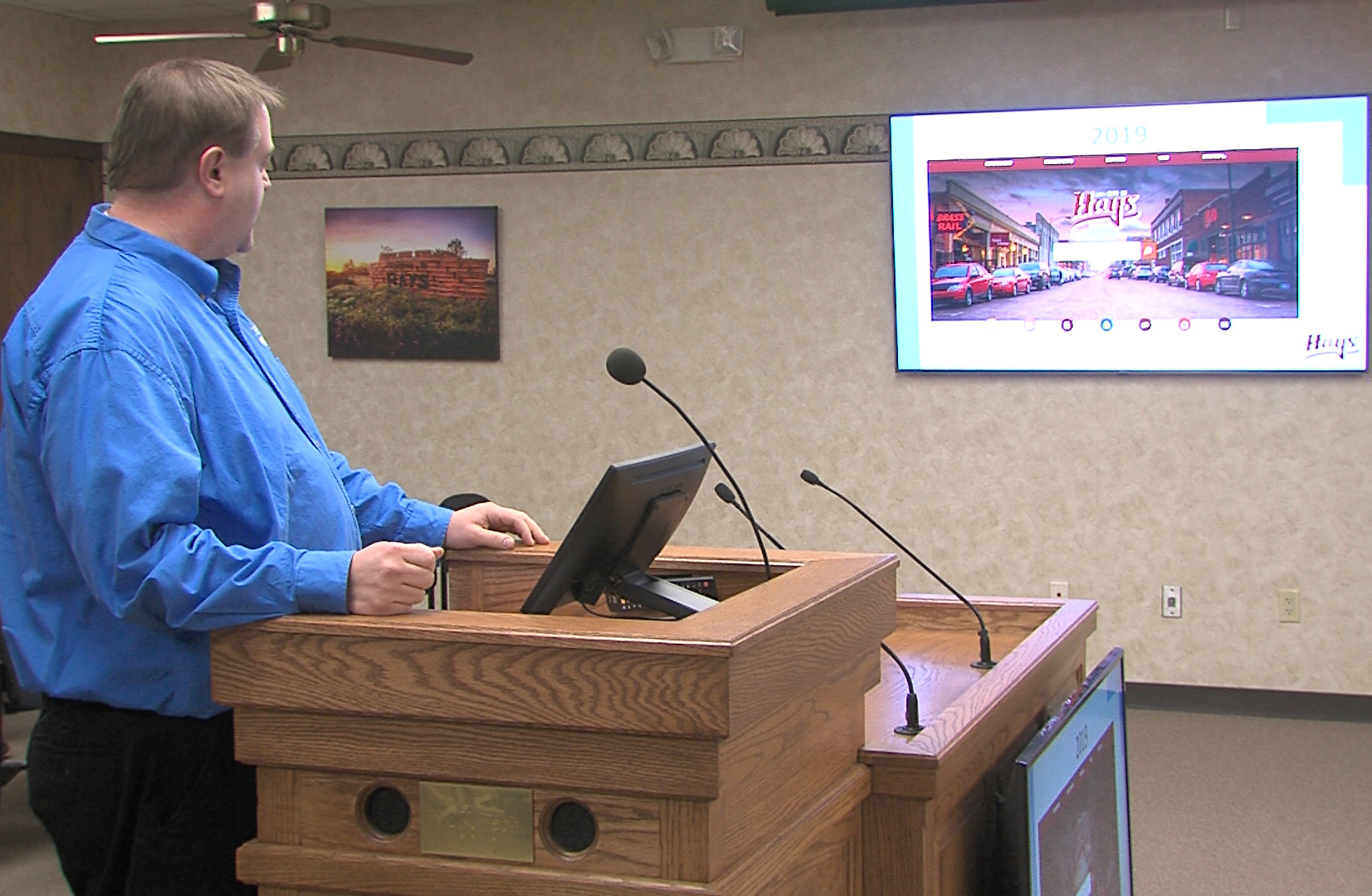
Information Technology Director Chad Ruder presented an overview of the update to the Hays City Commission at its meeting Thursday night.

Ruder was quick to credit Jessi Jacobs, the city’s website designer in the IT Department.

Home page of the city of Hays’ first website in 2001

Ruder first showed pictures of the website’s evolution. He was assigned to create the first website for Hays when he was hired late in 2000.

“This thing was top-shelf,” Ruder said tongue-in-cheek. “It had flashing lights for the police department. It had trees that waved for the parks department. It had scrolling marquees along the bottom.”

Commissioners could be heard laughing good-naturedly at Ruder’s description.

Jessi Jacobs, city of Hays webmaster

“Everything was great until wiser heads prevailed and they decided I needed to work on computers and they hired someone who had some design ability. That’s when Jessi Jacobs was hired,” Ruder said.

The website has gone through several iterations over the past 18 years, with newest design going live Monday.

Going from the original $300 piece of software to a modern system, Ruder said it’s no longer just the IT Department running the website.

“The departments themselves are going to take over maintenance of the website,” he said.

A committee of department representatives came up with two goals for the new design. The site should be informational and current, with an intuitive layout for contributors to easily navigate.

The IT Department also wanted to be able to track analytics, the site should to be ADA-compliant, and it should be easy to view on different sized screens.

Most important, Ruder said, is content management.

“IT will administer the back end and make sure everything works well, but the departments will take care of posting their information,” he said.

He gave an example of City Finance Director Kim Rupp being able to post audio of the city commission meeting “in his time frame, not ours. We’ve always done our best but when you have all the post requests coming to IT, it doesn’t always match their time frame.”

Departments also wanted the ability for a more specific “granular” information search on the website and to post forms.

The new website has more information about the city, which may mean the public can get their questions answered online and not have to make a phone call to a city office.

“We love to speak to the citizens but if there’s something that they can do — finding information quickly in the evening on their mobile device — that’s where we were looking,” Ruder said. “Citizens want current information, they want forms and calendars, they want city news and they want to pay their bills online.”

The new home page features mega-menus at the top. They’re based on government website design trends and research by the Hays IT Department of what people want.

“The ‘How Do I?’ is, in my opinion, the most important,” Ruder said. “It drops down and gives you options.”

Scrolling down the home page brings up City News, with two sections, News Flash and a carousel of important information. Currently, those topics are water conservation and the North Vine Street Improvement Project.

The new website has more than 200 pages.

Ruder pointed to the “Agenda Center,” as something “we’re very proud of.”

“Not only are agendas posted but later on you’ll be able to click on audio from the city commission meeting and access the minutes,” he said.

He showed a form created by the parks department for submitting a tree rebate request to the city.

“It’s so nice. It doesn’t matter what time of day,” Ruder noted. “Residents can do things at their own pace. The information is accurate because they type it in themselves, and the parks department receives it.”

One module of the website will replace the current Nixle notification system used by the city.

“Rather than a blanket opt-in, ‘Notify Me’ gives citizens the ability to sign up via text and email for unique things that catch their interest, such as public safety, road closures, and bid notifications,” Ruder said. There’s also an Emergency Alert as well as calendar events, any news flash, and any agendas for city boards.

“We feel we’re going to get more subscribers because people will get what they want to hear about,” he said.

Ruder told the commission the city will keep using Nixle for a short time as it transitions to the new “Notify Me” and advises residents of the change.

The Hays website address remains the same – www.haysusa.com.

Quinter’s Center Pivot Restaurant and Brewery debuts first craft brew

By CRISTINA JANNEY
Hays Post

QUINTER — The new Center Pivot Restaurant and Brewery in Quinter celebrated the first pull Saturday, Feb. 9, of its Cracked Pepper Cream Ale.

The restaurant opened Dec. 17, but brewer Steve Nicholson needed more time to perfect the brewery’s signature craft beer.

He said the inspiration for the ale came from something he had tasted years ago at a beer festival. Nicholson has been home brewing for 20 years, but this his first foray into commercial brewing.

He described the ale as smooth, low on the bittering hops with a golden color and cracked pepper added for seasoning.

“I went with a very easy-drinking style of beer and a unique flavor profile,” Nicholson said. “I put together the recipe in my home brewing efforts, and I am getting to be more comfortable with it in my commercial brewing efforts.”

Seven other craft beers from across the state will be on tap, plus more in cans and bottles.

The Cracked Pepper Cream Ale will be available only at the brewery at Quinter, and at this point, the Center Pivot is not offering growlers.

Brewer Steve Nicholson stirring a batch of the Center Pivot’s signature Cracked Pepper Cream Ale.

The launch of the ale proved popular, Nicholson said. The brewery sold out of its first 13-gallon batch. However, more will be available this week.

The restaurant serves comfort food — burger and fries, steaks and a buffet Thursday through Sunday. The restaurant also offers a full salad bar and desserts, such as homemade cinnamon rolls.

The Center Pivot fills a void in the community not only for a restaurant, but for a gathering space. Attendance was dwindling at the Quinter Senior Center, so the center moved to a smaller building, which opened up its former location, 300 Main, for the Pivot.

The investors spent six months remodeling the building, which had been a restaurant in the 1970s. They used barn wood and concrete floors to give the space a rustic feel.

Since the Center Pivot opened, it has hosted meetings and parties.

“It has been a blessing to have this facility in Quinter at this time,” Nicholson said.

The restaurant hopes to pull diners and beer enthusiasts from a variety of areas, including locals, interstate travelers and those who might see the Center Pivot as a northwest Kansas destination.

“We appreciate all of the help and support the community has given us to get open and be open to this point,” Nicholson said. “I hope we can continue to serve the greater portion of northwest Kansas and anyone else who comes through our neighborhood.”

The ceremonial ‘first pull’ of Cracked Pepper Cream Ale was auctioned at the Gove County Community Foundation’s 50/50 Match Gala in November. The winning bid at the silent auction was Dixie Nicholson, who is pictured here.

Other partners in Center Pivot include Nicholson’s wife, Ericka; Rhonda and Lance Coburn; and Roger and Carrie Ringer.

The Center Pivot kitchen is open 11 a.m. to 8 p.m. Mondays, Tuesdays and Thursdays through Saturdays; and 11 a.m. to 2 p.m. Sundays for a buffet. The bar opens at 8 p.m. and closing varies depending on business.

Follow the Center Point on Facebook for more information on beer and food specials.

Residents try to repopulate Nicodemus with tiny home project

Workers put in plumbing for the tiny homes in Nicodemus.

By CRISTINA JANNEY
Hays Post

Residents of Nicodemus are trying to repopulate the historical African American community with the construction of tiny homes.

JohnElla Holmes, a Nicodemus resident and township trustee, is spearheading the effort.

Holmes’ ancestors lived in Nicodemus, and she moved back to the community in 2015 after her retirement.

Nicodemus was founded in 1877 by African Americans moving west during the Reconstruction. It is the only remaining African American settlement west of the Mississippi and is registered as a National Historic Site.

Holmes remembers as a child coming home to Nicodemus during the summer for festivals and seeing aunts, uncles and cousins. She said living in Nicodemus has meant everything to here.

“My whole life I have wanted to come back because there is so much pride in being a descendant of original settlers. I can trace my lineage back to my great-great grandparents who came to Kansas. I know the plantation they came from. Not many people know that and can say that, but I can.”

Workers pour foundations for the tiny homes in Nicodemus.

Holmes wants to share that history and pride with others.

The community received a $120,000 grant from the Dane G. Hansen Foundation and a CY PRES grant toward the project. The project also has been supported through other grants as well as private funds.

The project has 11 families and individuals on a list for the homes.

Three tiny homes are now in process and a family located a single-wide trailer in Nicodemus as a part of the repopulation project. The community hopes for a total of seven tiny homes in its first phase of development.

Foundations for three homes have been poured. Portions of the tiny homes have been preconstructed by the Sturdi-Bilt company in Hutchinson, but workers need a break in the weather to begin installing the homes on their foundations in Nicodemus, Holmes said. Move-in dates for the homes are going to depend on weather, but the homes should only take a couple of months to finish once they are on their foundations.

The tiny homes are only about 500 square feet, but will be move-in ready each with a kitchen, bathroom and sleeping loft.

A worker works on the foundation for a tiny home in Nicodemus.

One of the tiny homes is being built for a person who is disabled. Instead of sleeping loft, that home will have a built-in Murphy bed.

Each home is expected to cost about $38,000 to $40,000.

Holmes said she was surprised at the number of people interested in the project, not only the tiny homes but family homes. Organizers did not anticipate developing two- and three-bedroom homes until the third phase of the project, but there is interest in that housing now, Holmes said.

One family is living in Hill City until they can be accommodated in Nicodemus.

At its height between the late 1870s and 1890s, 700 people lived in the community. However, that number declined when the community failed to attract the railroad.

When Holmes moved to Nicodemus in 2015, the community had only 15 residents. Today, the community has 37 residents and is growing.

Although Holmes said she did not think the community would ever get back to 700 residents, she said she thought 150 to 200 residents was within reach.

“I am totally optimistic,” Holmes said. “There is a huge interest. If we could get in and remodel some of the homes or refurbish them, we could fill them today with people who want to move back to the community. They want a simpler life. They want to get back into agriculture. They want to have their own gardens. They want the security and safety of living in a nice place where they can get a good education and go to school in Hill City.

“Once we can get our infrastructure fixed and our water system fixed and complete roads and the platting of the land there in Nicodemus, I really see us growing.”

Infrastructure is proving a challenge. The water and sewer system has not been upgraded in 40 years. The original community also was not platted correctly, and some homes are sitting in alleys.

Holmes said she would like to give Colonial Williamsburg a run for its money by having residents regularly dress in period costumes and share Nicodemus’ history.

The historical society, which is led by Angela Bates, already has a cooperative agreement with the park system. They have descendants who are community interpreters and share the history of the community.

“Nine out of 10 people or nine and half people, when they hear the history from those young women, it just blows their minds,” Holmes said. “There is not much to speak about, but once they hear the history, they hear the pride and the ground swell of what was going on, they understand why we would be so prideful of this small … almost ghost town.”

Holmes also hopes to entice businesses to move to Nicodemus through the repopulation project. The community’s church, 1st Missionary Baptist, also has a new pastor and 40 regular attendees.

Anyone interested in moving to Nicodemus may contact Holmes at 785-236-9014 or [email protected]

Nicodemus has will have its 3rd annual Chautauqua at 1 p.m. May 25. More information on the 142nd Annual Emancipation Celebration July 25-28 can be found at www.nicodemushomecoming.org.

To learn more about Nicodemus or for details on planning a visit to the historic sites, visit the Nicodemus National Historical website.

🎥 ‘It’s time we get it done’; City frustrated with delays in R9 Ranch water project

By BECKY KISER
Hays Post

Nearly four years ago, the cities of Hays and Russell filed applications with the state of Kansas requesting the transfer of water from their jointly-owned R9 Ranch in Edwards County to Hays in Ellis County.

They’re still waiting.

At the end of Thursday night’s Hays city commission meeting, Mayor Henry Schwaller read a brief historical statement about the project to acquire a long term water supply. He acknowledged “the process is long.”

The Water Transfer Act, which takes water from one water basin to another, has never been triggered in Kansas.

Schwaller said the city has had a good working relationship with the Division of Water Resources (DWR), part of the Department of Agriculture. DWR is the state agency that will issue the final Master Order to allow the use of the water.

“To make this relationship work out, Hays and Russell went so far as to reduce the amount of water, called consumptive yield, that we would use from the R9 Ranch, far below what the state statutes allow,” Schwaller said, “with the promise this would speed up the process of approval.

“Unfortunately, it has not.”

Schwaller said the cities “will continue to work over the next three months with our representatives in Topeka and state officials to make this project happen.”

Each of the other Hays commissioners chimed in with their support of Schwaller’s statement.

“It’s beyond time for the state to step up to the plate, cross the t’s, dot the i’s and finish this,” said Commissioner James Meier.

“It’s my personal opinion that we have been treated quite differently from anybody else who would have filed a change order application. Some of that is justified because we knew there would be a transfer process at the end of this, but the vast majority of it, quite unfairly.”

In Feb. 2018, during Meier’s tenure as mayor, he and City Manager Toby Dougherty met with then newly-elected governor Jeff Colyer in Topeka, after Meier complained publicly about Colyer not meeting with the city when he was in his home town of Hays on the day he was sworn into office.

The next month, Meier announced he had received a communication from the governor’s office indicating the Master Change Order should be finished in May, 2018.

Kansas now has a new governor, Laura Kelly and a new Secretary of Agriculture, Mike Beam.

“Very frustrating,” agreed Commissioner Ron Mellick. “We’ve been getting promises that haven’t been met.

“As a commission we’re going to start pushing a little harder. It’s not about playing nice. It’s about elected and appointed officials doing what they’re supposed to do.”

Sandy Jacobs is the shortest-serving city commissioner –  two years – and said the water situation is the “only issue and frustration for me. It’s not been dealt with by me as long as it has by every other commissioner on this panel today.

“We’ve done everything we’re supposed to do,” Jacobs stressed. “We have a city manager that’s led us through the process that knows more about water and what’s going on in the state of Kansas than about anybody.

“It’s time we get it done.”

Vice-mayor Shaun Musil pointed out the water project is “not only for Hays, but our neighbors and western Kansas.

“We need western Kansas to grow and if we don’t get this soon, it’s going to hurt for a long time. I hope the mayor continues to push on this.”

The communities of Ellis, Victoria and La Crosse have supported the project and may become potential purchasers of the water in the future.

Following a public hearing in Greensburg last June, DWR Chief Engineer David Barfield began preparing the Master Order.

“The order is actually written,” Schwaller said after Thursday’s city commission meeting. “He is putting in the facts and bullet points he thinks are important that he got from that meeting before issuing it.”

According to Schwaller, the city was told the order would be completed before Christmas.

“There’ve been some friendly communications, some confusing communications. We do continue to stay in touch with the Division of Water Resources but we’re not gaining any ground.”

“Our communities in the region need the R9 Ranch in order to remain economically viable,” Schwaller said.

“This will be the largest project in our cities’ history and we are very concerned about the delay in issuing that Master Order.”

Schwaller added that he hopes to have some new information about the project status on Tuesday.

An archive of the city of Hays/R9 Ranch Water Right Changes and Water Transfer Application is available on the KDA/DWR website.

City commission to vote on bids for 2019 street maintenance

By BECKY KISER
Hays Post

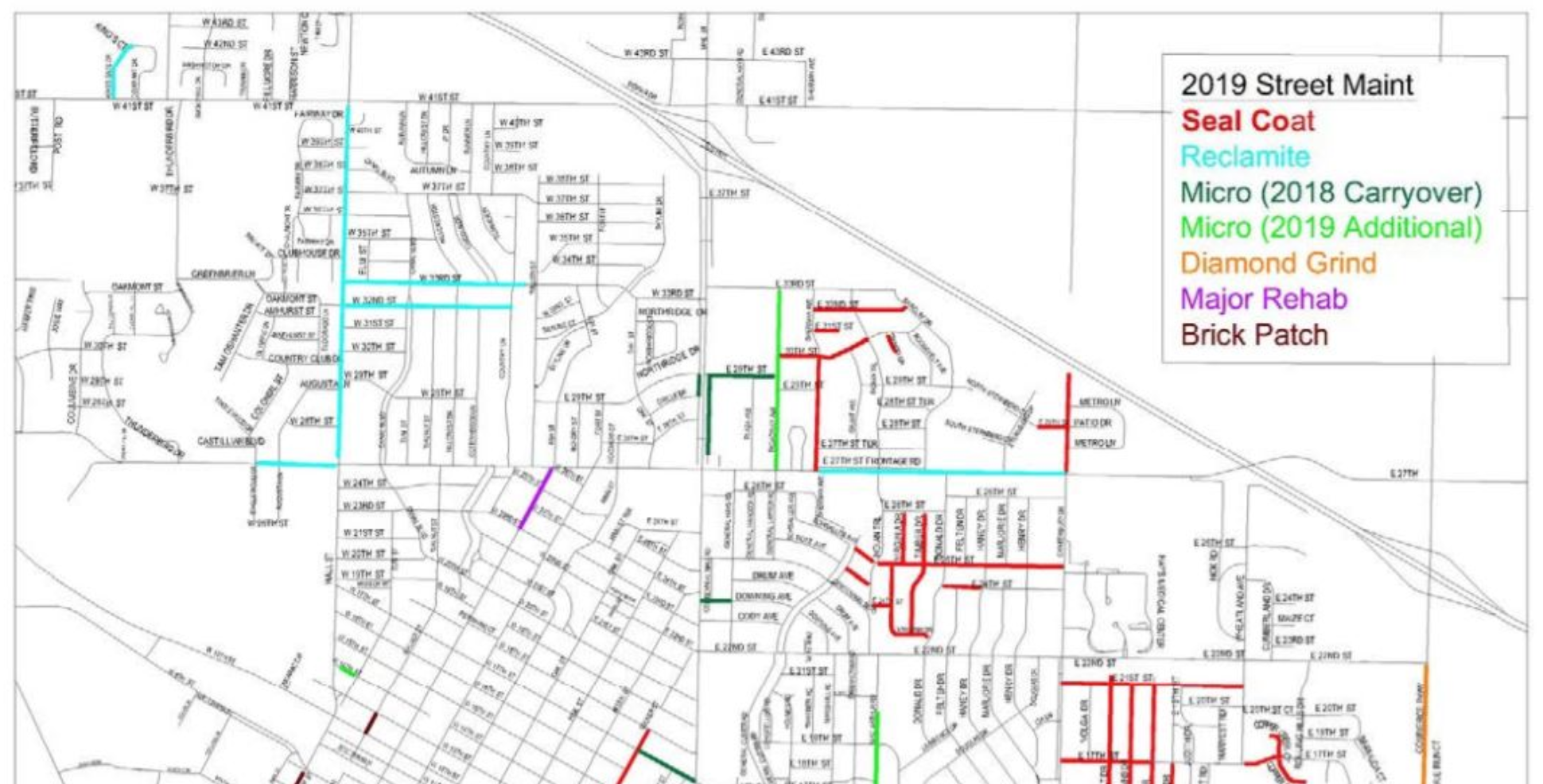
City commissioners will vote Thursday night on the proposed bid awards for the 2019 Street Maintenance program.

The recommendations from city staff total $774,456.39, which would be funded out of Special Highway.

• Circle C Paving and Construction, LLC in the amount of $153,535.20 for Seal Coat
• Proseal Inc. in the amount of $84,466.84 for Asphalt Rejuvenator
• Vance Brothers, Inc. in the amount of $71,159.05 for Micro-Surfacing
• J Corp., Inc. in the amount of $100,566.30 for Curb and Brick Repair
• J Corp., Inc. in the amount of $189,229.00 for Ash Street Major Rehab
• J Corp., Inc. in the amount of $175,500.00 for concrete shoulders

Other agenda items include annexation of property at Highway 183 Bypass and West 33rd Street owned by Robert and Sondra Swift. The couple has plans for an RV park on the land.

Commissioners will also consider approving a 3.0% pay increase of the base salary for City Manager Toby Dougherty and will recognize employee promotions and new hires.

Chad Ruder, IT director, will review the layout and efficiencies of the city’s new website design.

The complete meeting agenda is available here.

The meeting begins at 6:30 p.m. in Hays City Hall, 1507 Vine.


Q&A with incoming Ellis Superintendent Corey Burton

Hays Post

Corey Burton

The USD 388 Board of Education Wednesday announced the selection of Corey Burton, as the new superintendent.

Burton will take the reins on July 1 after the retirement of Robert Young at the end of the 2018-19 school year.

Burton is currently serving as the Ellis JH/SH principal and has done so for 13 years. 

Previously, Burton served as principal at Hillsboro Middle School and as district curriculum coordinator for USD 410 for three years and, prior to that position, he also served in Hillsboro High School as a business/computer teacher for from 1994-2003.

Q & A

Why did you want to be superintendent at Ellis?

My family and I truly enjoy living in the Ellis community and being a part of the Ellis school system. I knew that one day I wanted to be a school superintendent, and I am very happy that I will get that opportunity while staying in the community we love.

 Are there any goals you have as the new superintendent?

I believe that we have a great teaching staff and excellent school system. My hope is to continue this tradition by working with staff, students, parents and the community to ensure we continue to meet our students’ needs.  

What do you think the Ellis school district is doing well right now?

Providing our students (PK-12) a high quality caring learning environment. 

What do you see as some of the challenges the district is facing and how would you address those challenges?

As with any western Kansas school district, I see maintaining a quality staff as a challenge. We will need to work together to ensure our staff has competitive wages and a positive work environment. We will need to be proactive in recruiting high quality staff members.

 What are some of things you will take from working at the Jr./Sr. high into working in the superintendent position?

 Serving in the role of Jr./Sr. high school principal for 13 years, I feel I have a pretty good understanding on how our district runs and functions.  I think this will make my transition into my new role much easier. 

Do you think you have good relations with teachers, how would you improve those relationships?

I do feel that I already have a good working relationship with most of the staff.  I look forward to visiting with each of them to learn more about what I can do in my new role to help them in their position. 

You seem to have a very positive relationship with community members, how have you built that and how do intend to maintain that?

I believe that the community knows that I care about kids and that I am committed to my job.  I don’t see this changing as I move into my new role.

🎥 Large turnout for city’s roundabout open house

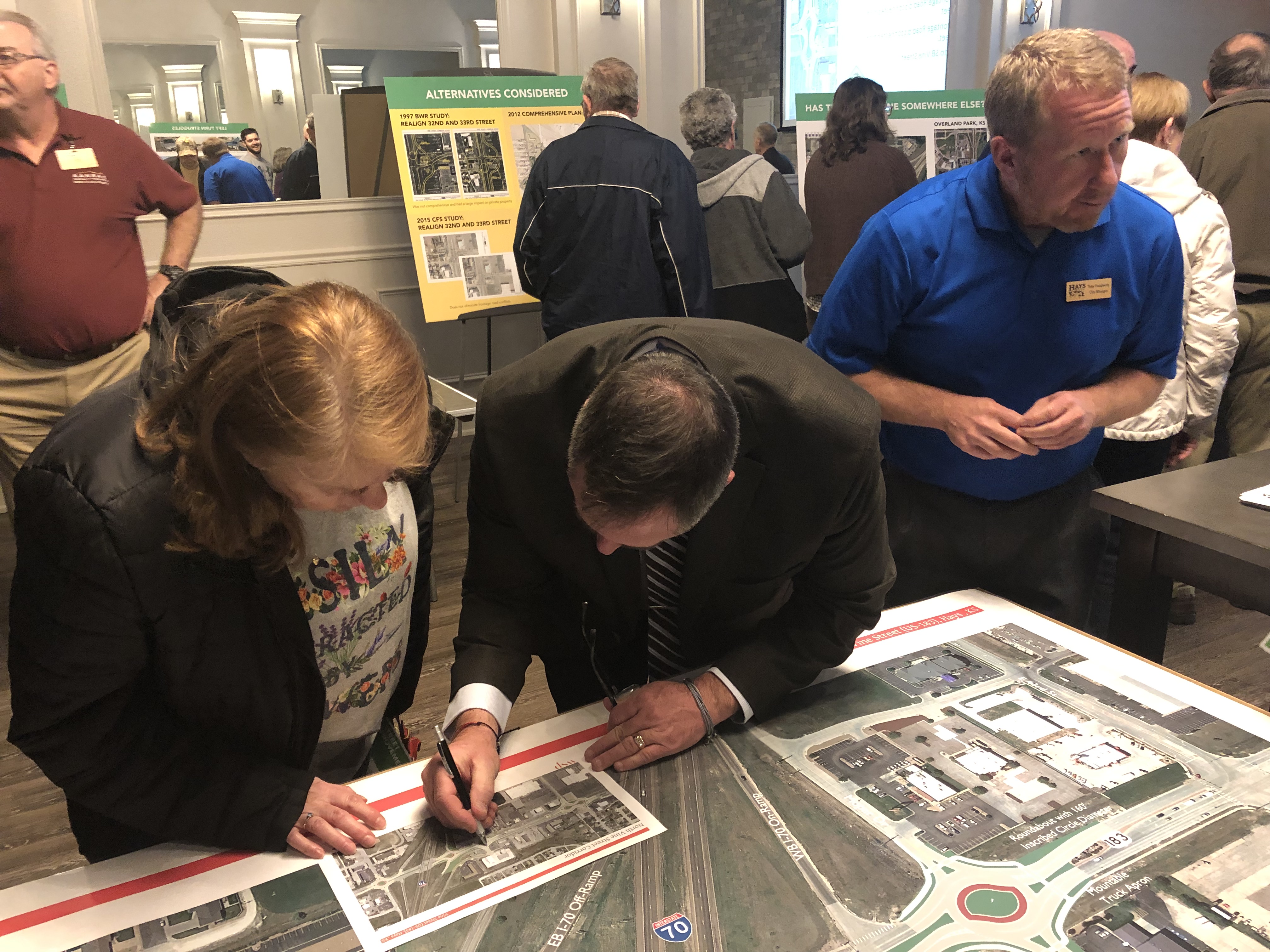
The city of Hays hosted an information session Tuesday night about the proposed North Vine Street Corridor Improvement Project.

By BECKY KISER
Hays Post

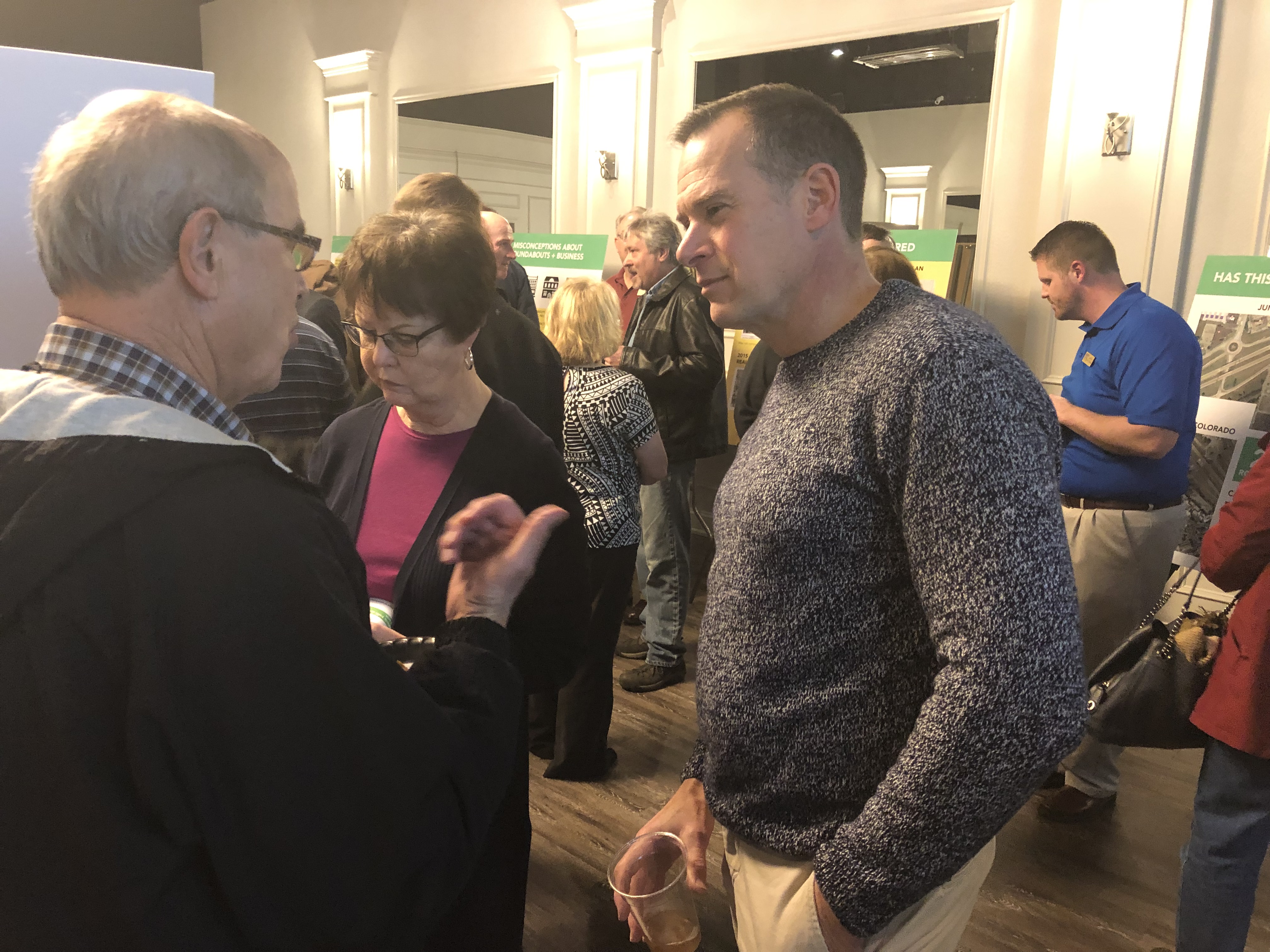
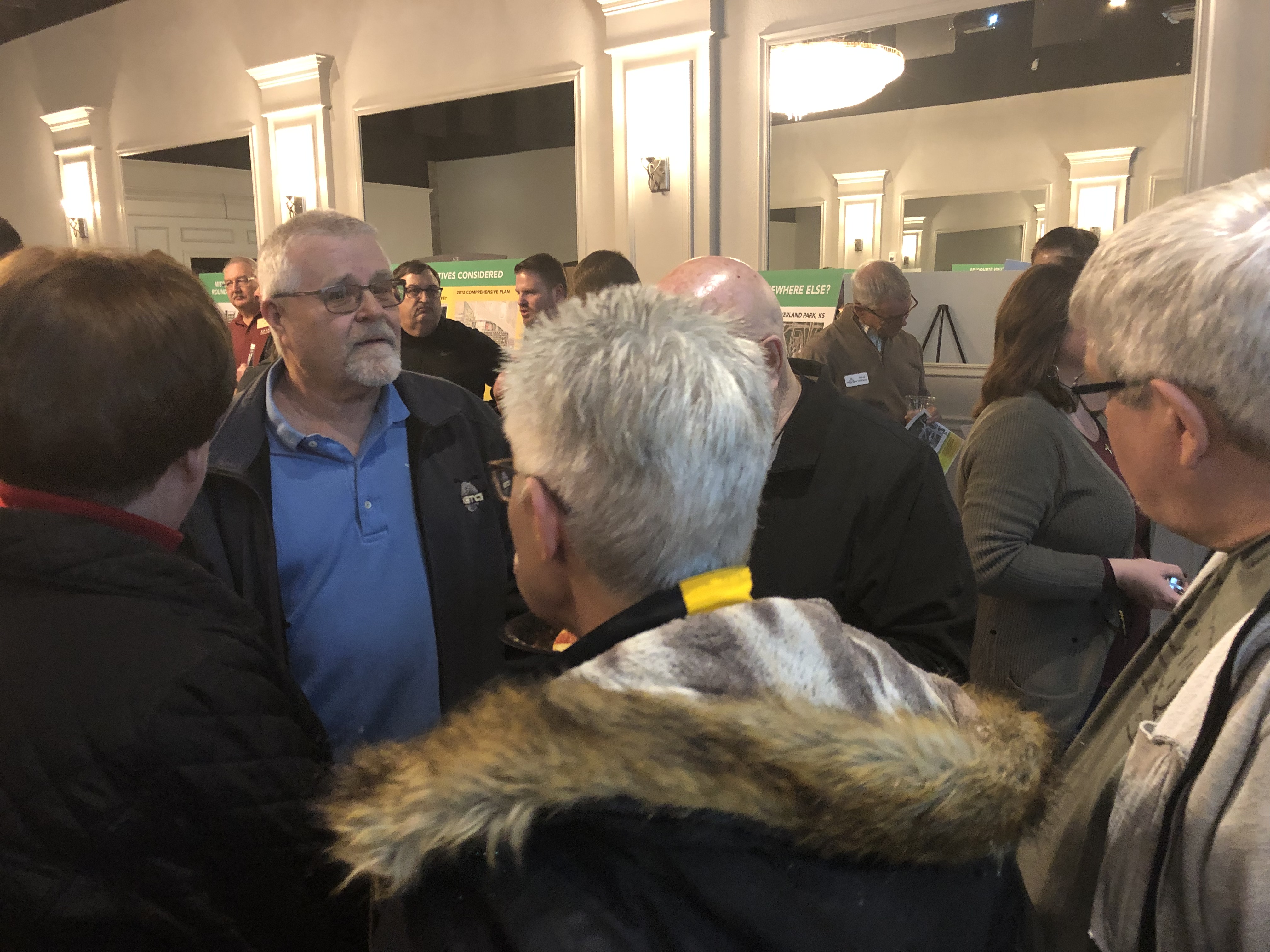
Within the first 15 minutes, 80 people gathered Tuesday night for the city of Hays’ open house to see the design concept for four proposed traffic roundabouts on north Vine Street.

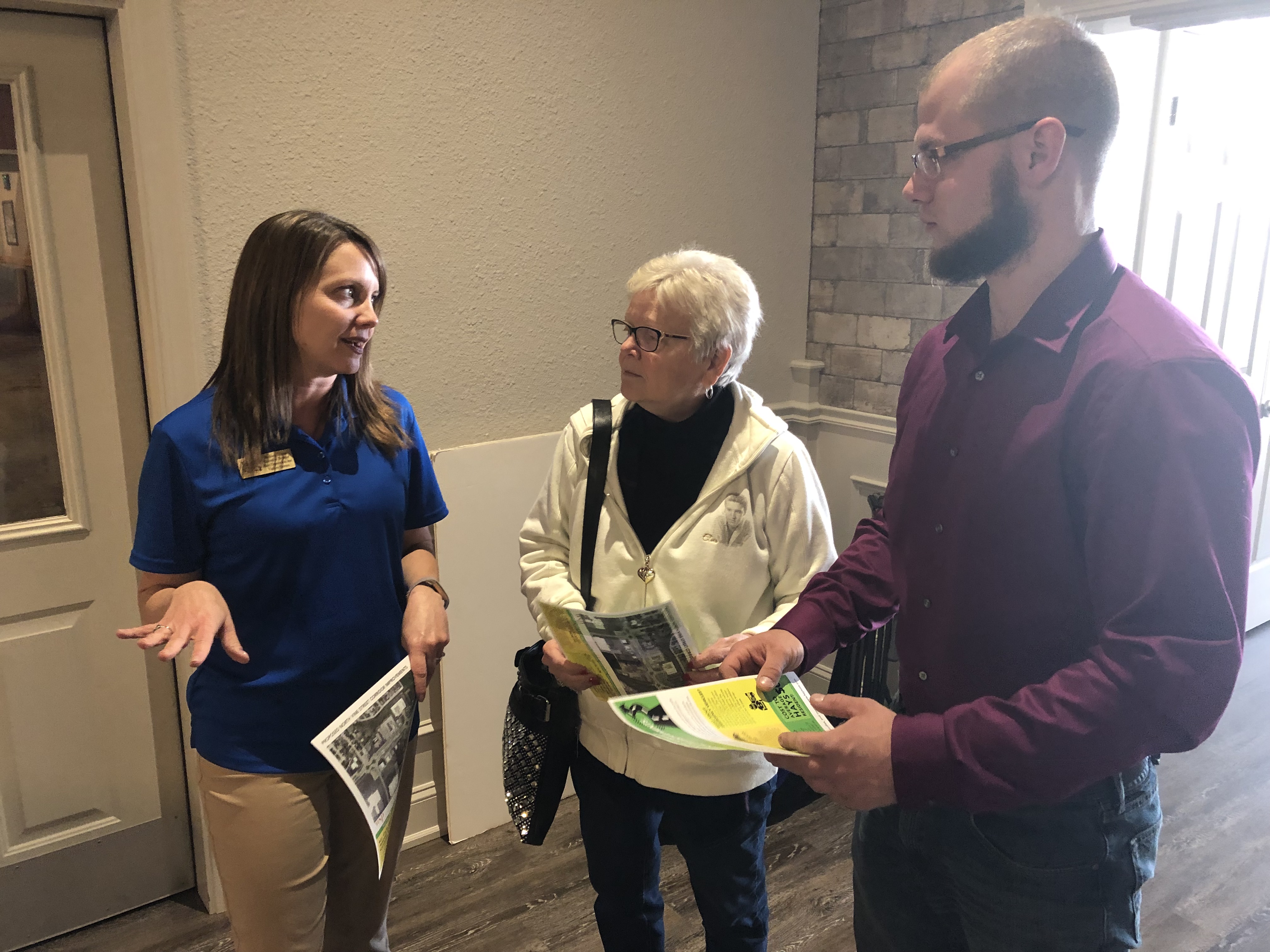
They were greeted — and counted — by Melissa Dixon, executive director of the Hays Convention and Visitors Bureau.

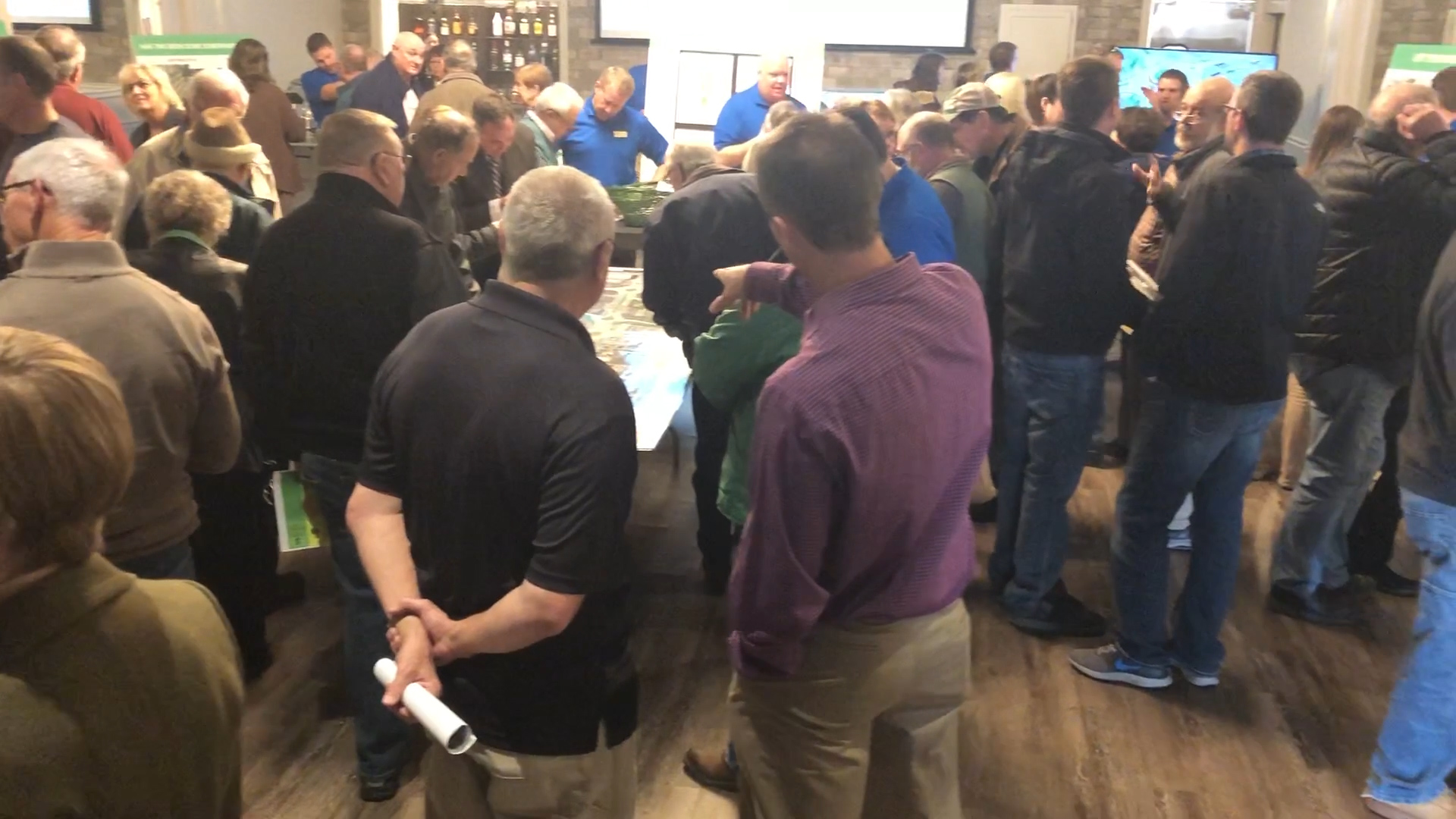
More than 200 people attended the two-hour event at The Venue in Thirsty’s Bar & Grill, where city staff, wearing bright blue polo shirts, were on hand along with project engineers from WSP and the Kansas Department of Transportation to answer questions from the public.

“I was hoping for a good turnout,” said James Meier, city commissioner, “but this is better than I expected.” Meier, who favors the roundabouts, said he hoped the information “alleviates some fears” residents might have.

Mayor Henry Schwaller said he talked to more people opposed to the project than in favor of it.

“This gives everyone a chance to see what the project will probably look like and how it works. This is a design. It’s not been approved,” he said.

Schwaller has said previously he is a “roundabout skeptic.”

He agreed the situation at 32nd and 33rd streets creates the most dangerous intersection in the city and “something has to be done.” Schwaller also sees a problem at 37th Street, where the former Ambassador Hotel was located.

“We can’t put a stoplight there. The Kansas Department of Transportation won’t allow us that,” he said.

The rest of the proposed project is too big to work, Schwaller said, “particularly for visitors coming from out of town. Getting through that gauntlet can be pretty daunting.”

Still, Schwaller concedes the city commission will “go for what the majority wants.”

RELATED: Hays Post conducted two polls, one on HaysPost.com and the other on Facebook, asking the public for their opinion of the proposed north Vine Street improvements.

The city is still waiting for final design on the project. Preliminary design is expected to be completed in March with a final design in November, according to John Braun, the city’s project manager. Bid opening would begin in April 2020 with construction planned to start in June 2020. The work is scheduled to be finished in November 2021.

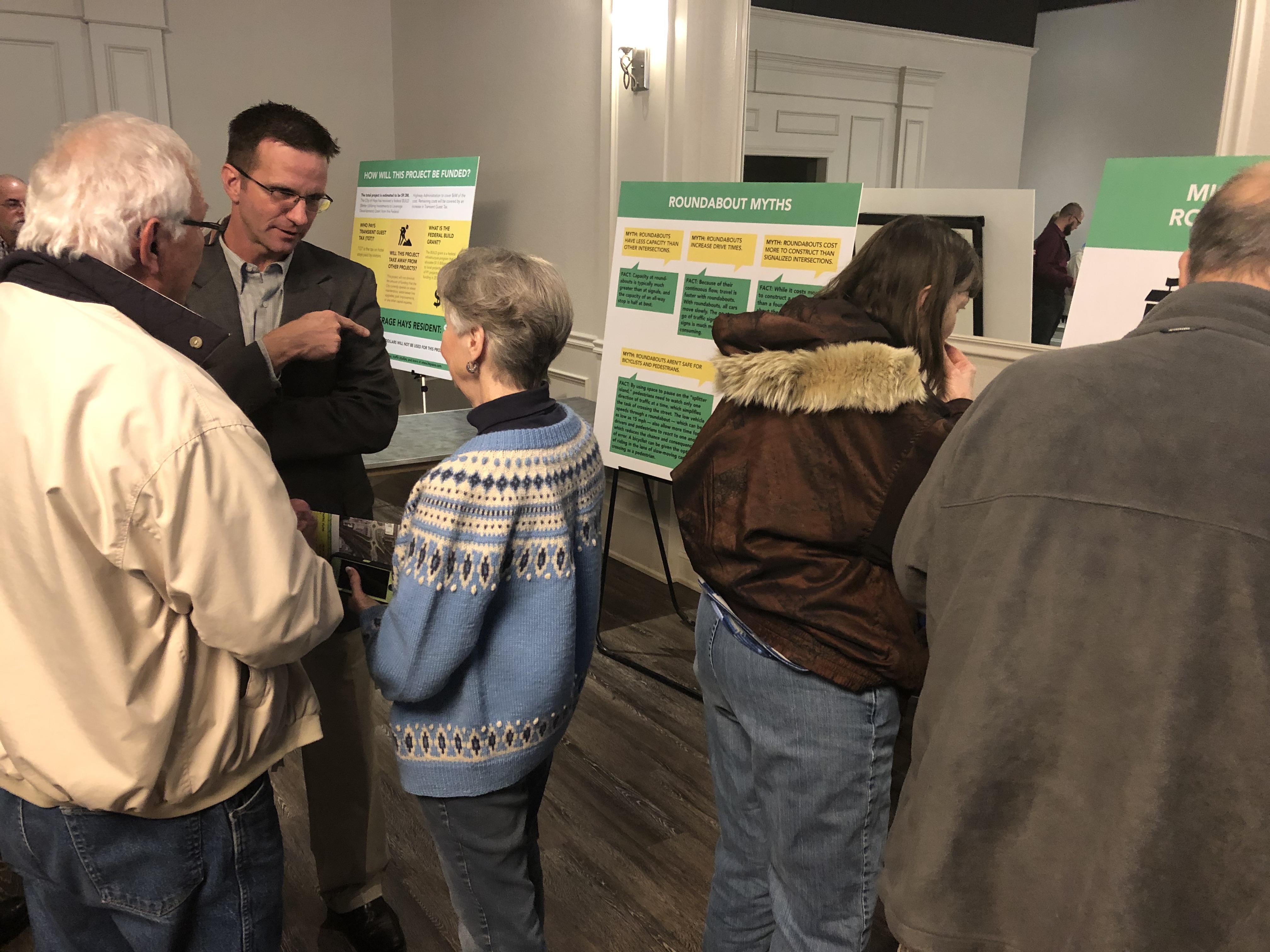
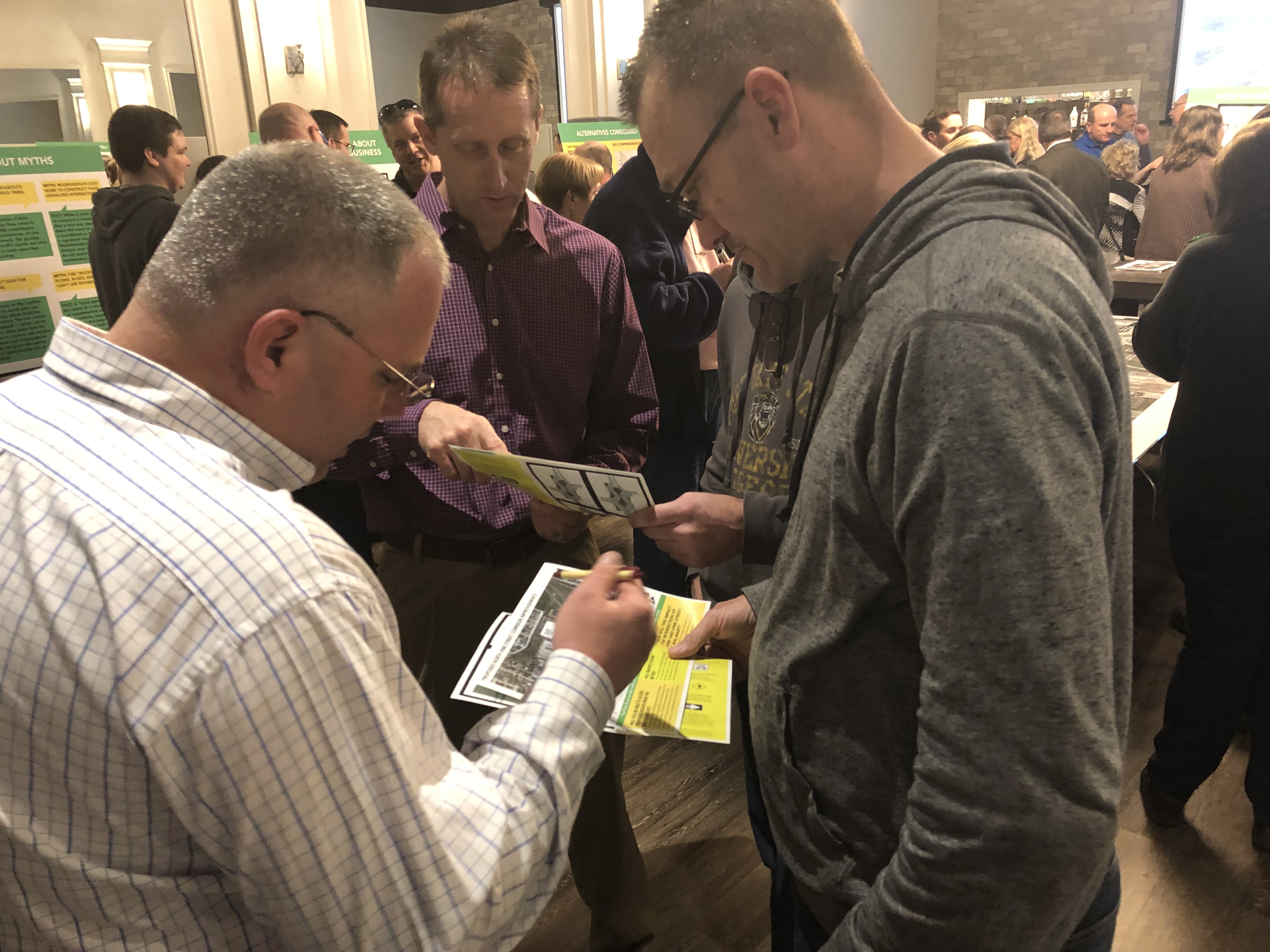
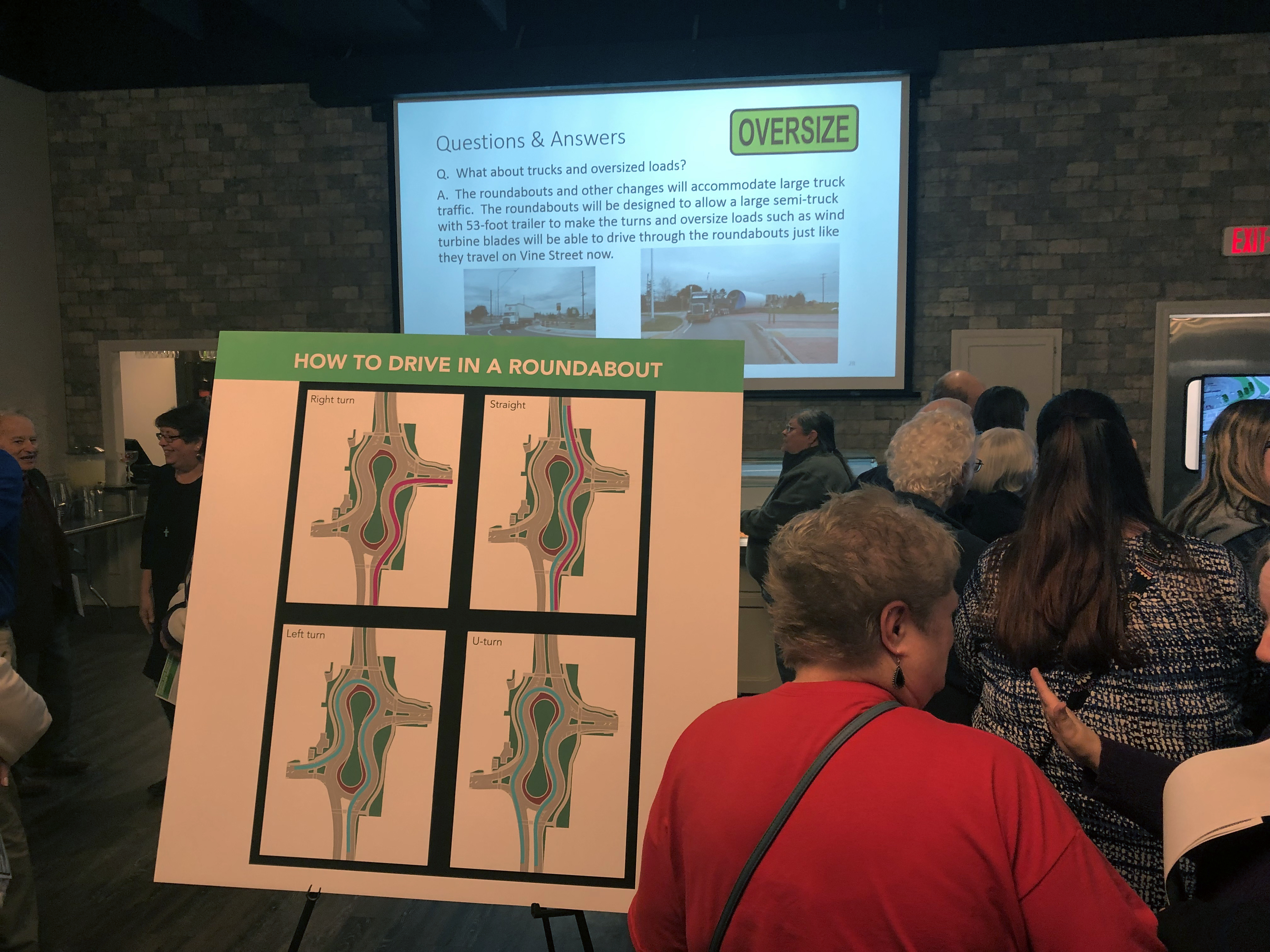
The conversation was non-stop in the meeting room. Posters depicting often-asked questions and the answers were set up on easels around the room perimeter. One poster showed four previous design plans to improve safety which were all rejected.

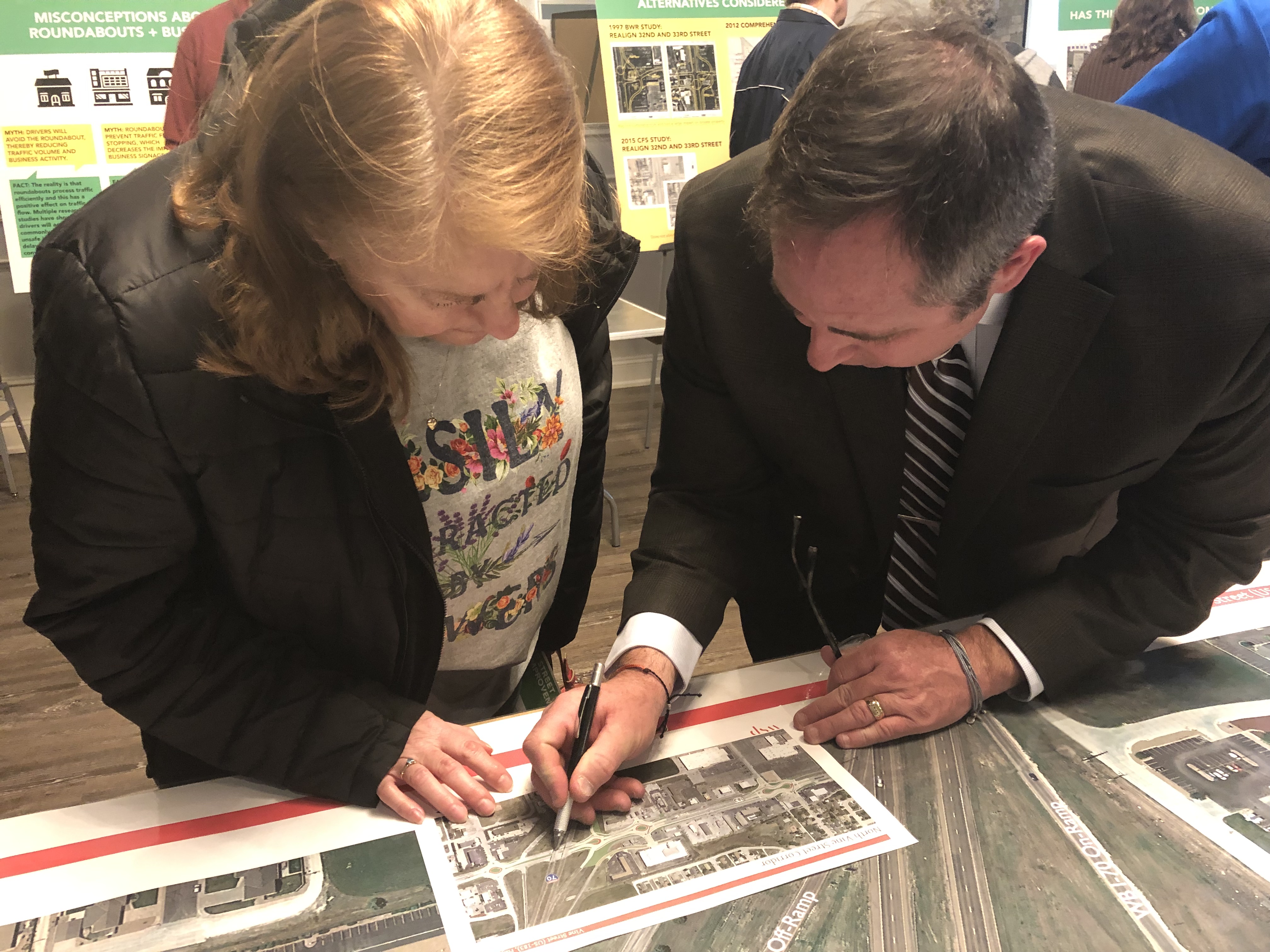
An oversized map of the Vine Street traffic corridor design between 32nd and 41st streets was laid out on a table in the middle of the room. People crowded around it the entire evening, pointing to specific areas with their questions. Staff and engineers used dry erase markers on the map to illustrate their points.

(Click to enlarge)

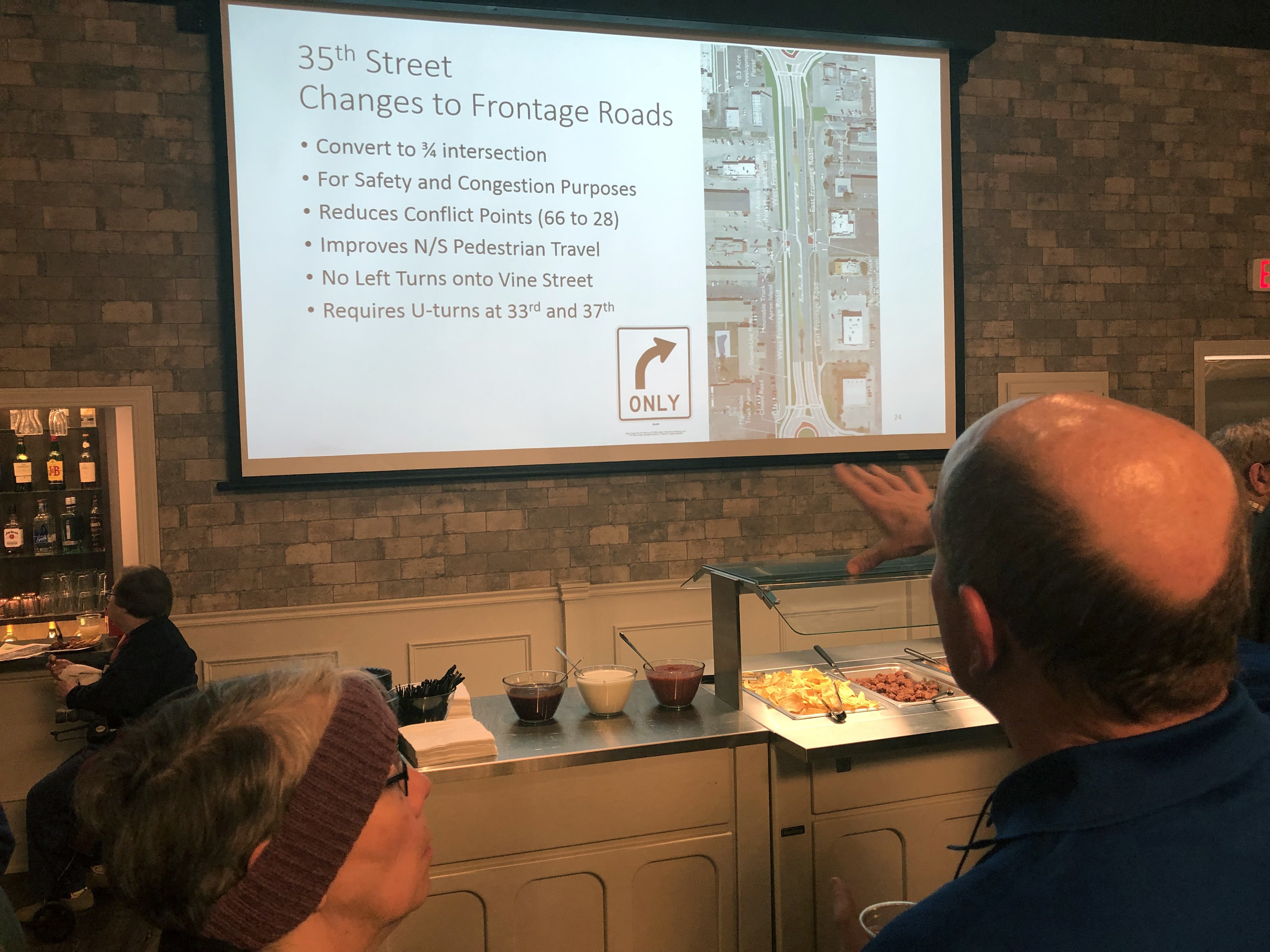
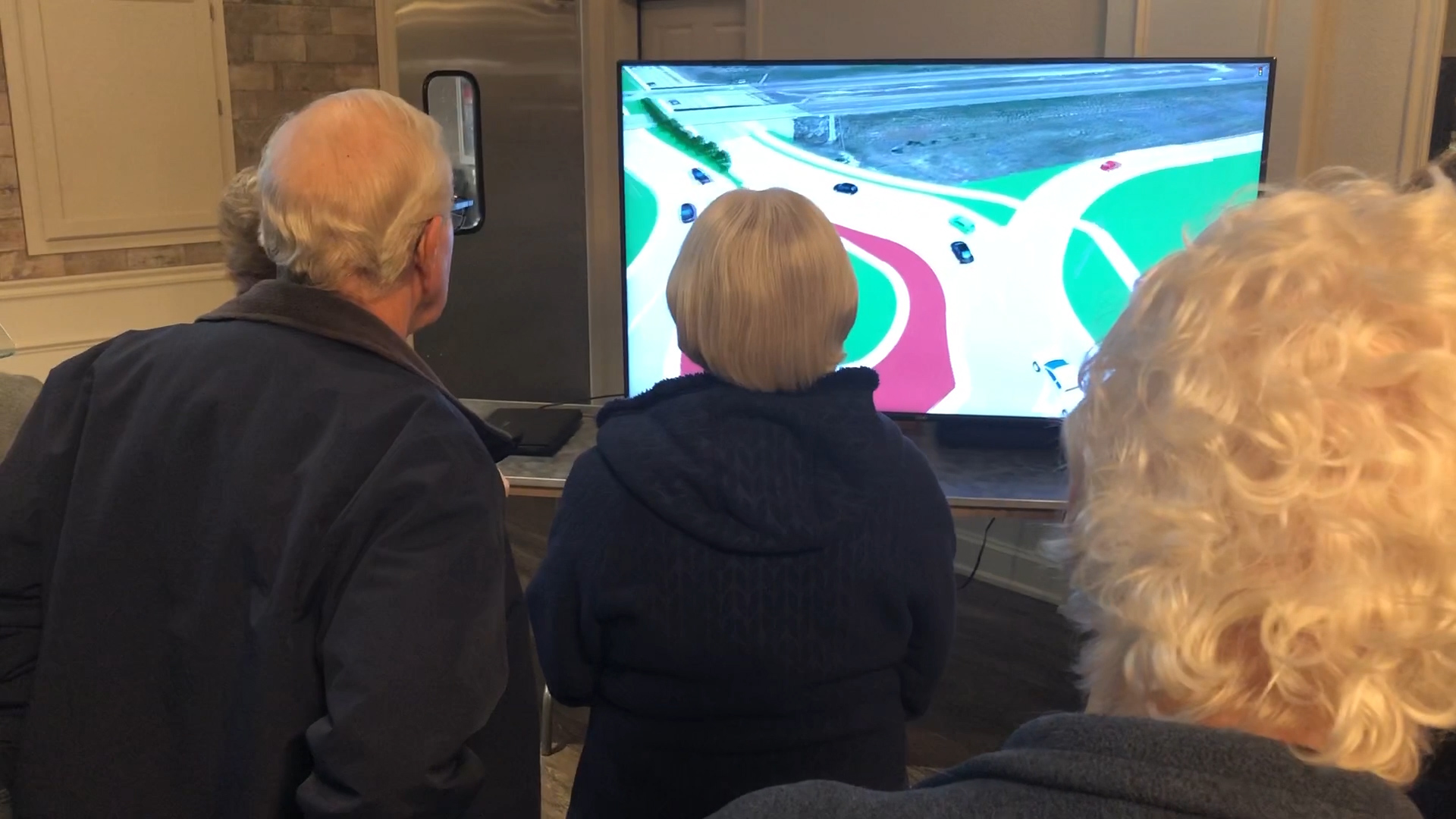
A large-screen TV continuously played the simulated corridor traffic flow through the roundabouts at 32nd/33rd, 37th, 41st and the westbound Interstate 70 exit ramp.

The simulation, created by Jay Aber, senior traffic engineer at WSP Engineers, Lenexa, uses a four-year study of Hays traffic in the corridor.

Another video screen scrolled through questions and answers with graphics showing examples of the changes.

Marcie Pray lives in Victoria and works in downtown Hays. She’s driven through traffic roundabouts in bigger cities.

“I think it’s becoming an accepted thing although it’s very intimidating to us drivers who are little older,” Pray said with a laugh. “You gotta know which lane you’re getting into and how to get around to where you’re trying to get at.”

She described the open house as “overwhelming but informative.”

A simulation of traffic flowing through proposed Hays roundabouts.

“But I think the best was the video. That was tremendous.  First of all, I didn’t realize it was actually Hays video, and that really shone the light. And seeing the traffic flow was really helpful,” Pray said.

Aber answered several questions about how semis would get through a roundabout.

“U.S. 183 is a really important freight corridor. The highway is Vine Street itself. Obviously you have a lot of regular trucking. You also have a lot of oversize loads, including wind turbine towers and blades.

“One of the early requirements for this project was that two semi-trucks could drive side by side through the entire corridor,” said Aber.

“It’s also designed for the wind turbine blades specifically because they’re roughly the length of of two and half semi-trucks together. The wheels track really far outside of any kind of typical truck.

“So we also designed it so that a wind turbine blade on a 180-foot long truck can drive through  the corridor without needing to stop traffic or to stop and use any special rear-wheel turning.”

Even though the proposed $9.3 million project would be funded by a $6 million federal grant and a dedicated 20-year 2 percent increase in the transient guest tax, 77-year-old Tom McClelland believes it’s “a waste of money.”

“I wish I was 35, 40 years younger. I’d buy a piece of property close and buy wrecker trucks because I think there’s gonna be a lot of them (wrecks),” the retired McClelland said. “All the people that are for this are telling me that’s not gonna happen, that there’ll be minor crashes. No T-bone wrecks but I can see a lot of side-swiping.”

Hays Police Chief Don Scheibler

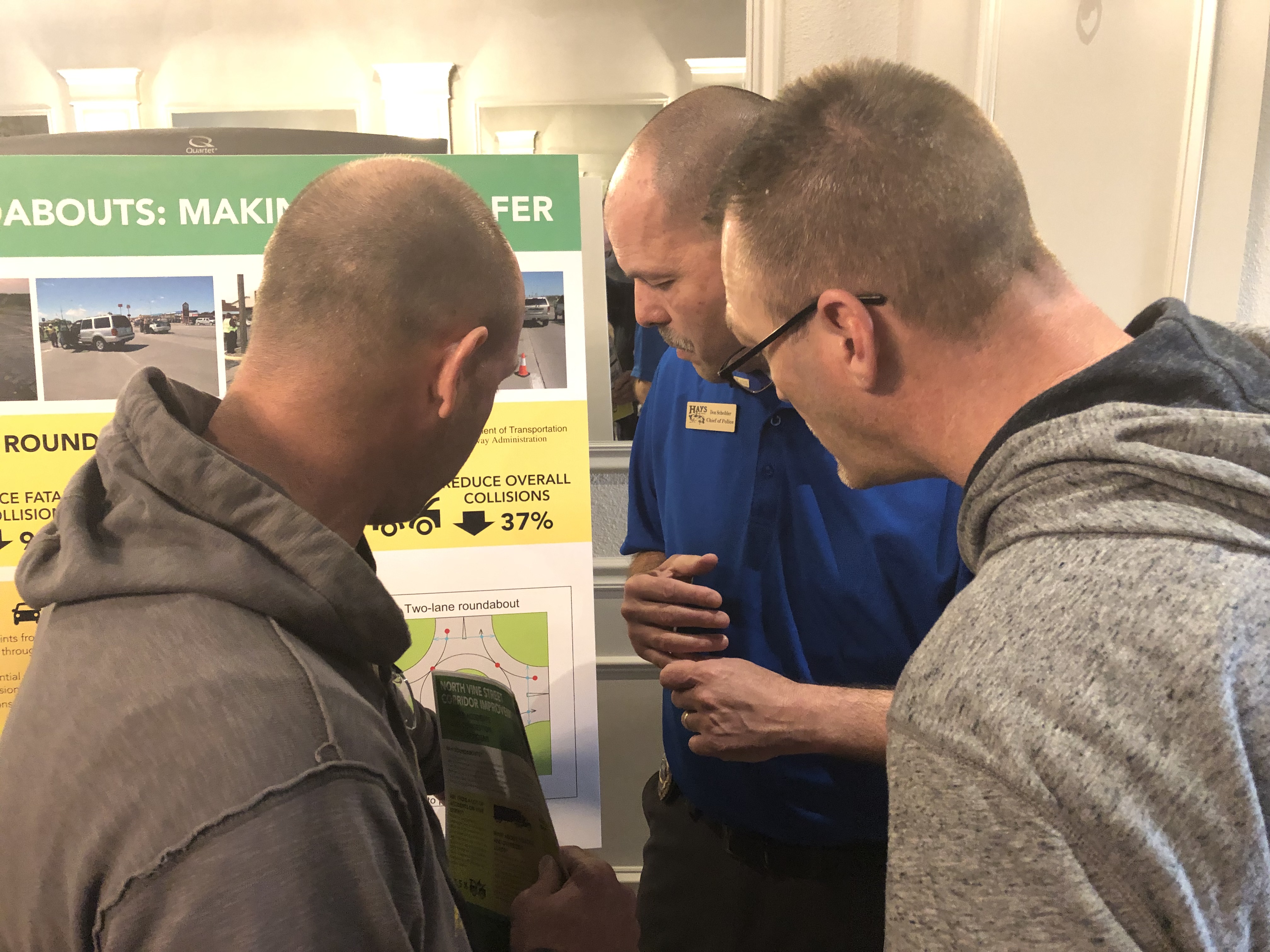
Hays Police Chief Don Scheibler talked about roundabout safety to the crowd, using statistics from the U.S. Department of Transportation.

According to the Federal Highway Administration, roundabouts reduce fatality collisions by 90 percent and injury collisions by 75 percent. Overall collisions in a traffic roundabout are reduced by 37 percent.

The roundabouts would reduce the current number of vehicle conflict points from 32 to 8. Scheibler prefers to call them “contact points.”

“The current configuration really encourages aggressive driving through this area on Vine,” Scheibler said. “To make it through all the traffic lights, you have to speed.”

Scheibler also pointed out the driving speed in a roundabout is reduced. “Somebody may be going 40 miles an hour right now on Vine. That’ll be slowed down to about 25 miles an hour.”

The four-year traffic study of the Vine Street corridor from 32nd to 41st showed there were 124 vehicle accidents; 119 of those occurred in intersections.

With the elimination of traffic signals by the roundabouts at 32nd/33rd and the I-70 ramps, the potential of head-on and T-bone collisions typical in signaled intersections, are also eliminated. Vehicle crashes are more likely to be side-swipes at much lower speeds, Scheibler explained.

The project design is also safer for pedestrians, reducing conflict points from 24 to 8.

Existing frontage roads would be disconnected from 32nd and 37th. Frontage roads will only have access to Vine at 35th, which will be changed to a 3/4 intersection. That would allow right and left turns from Vine but only right turns onto Vine.

Attendees were given handouts and copies of the poster boards to take home for further study.

Pray is somewhat sure the roundabouts would be a positive addition to Hays. “I think it is. It’s just going to take a learning curve to accept it.”

The traffic simulation video and copies of the poster handouts are available on the city’s website www.haysusa.com.

🎥 New Sternberg paleo fossil prep lab is a ‘crossroad’

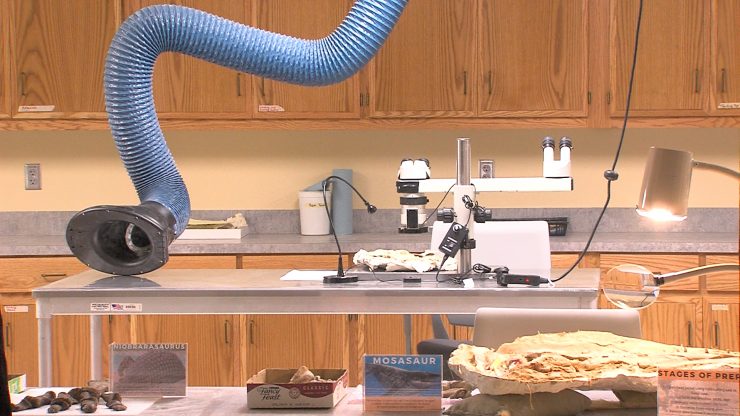
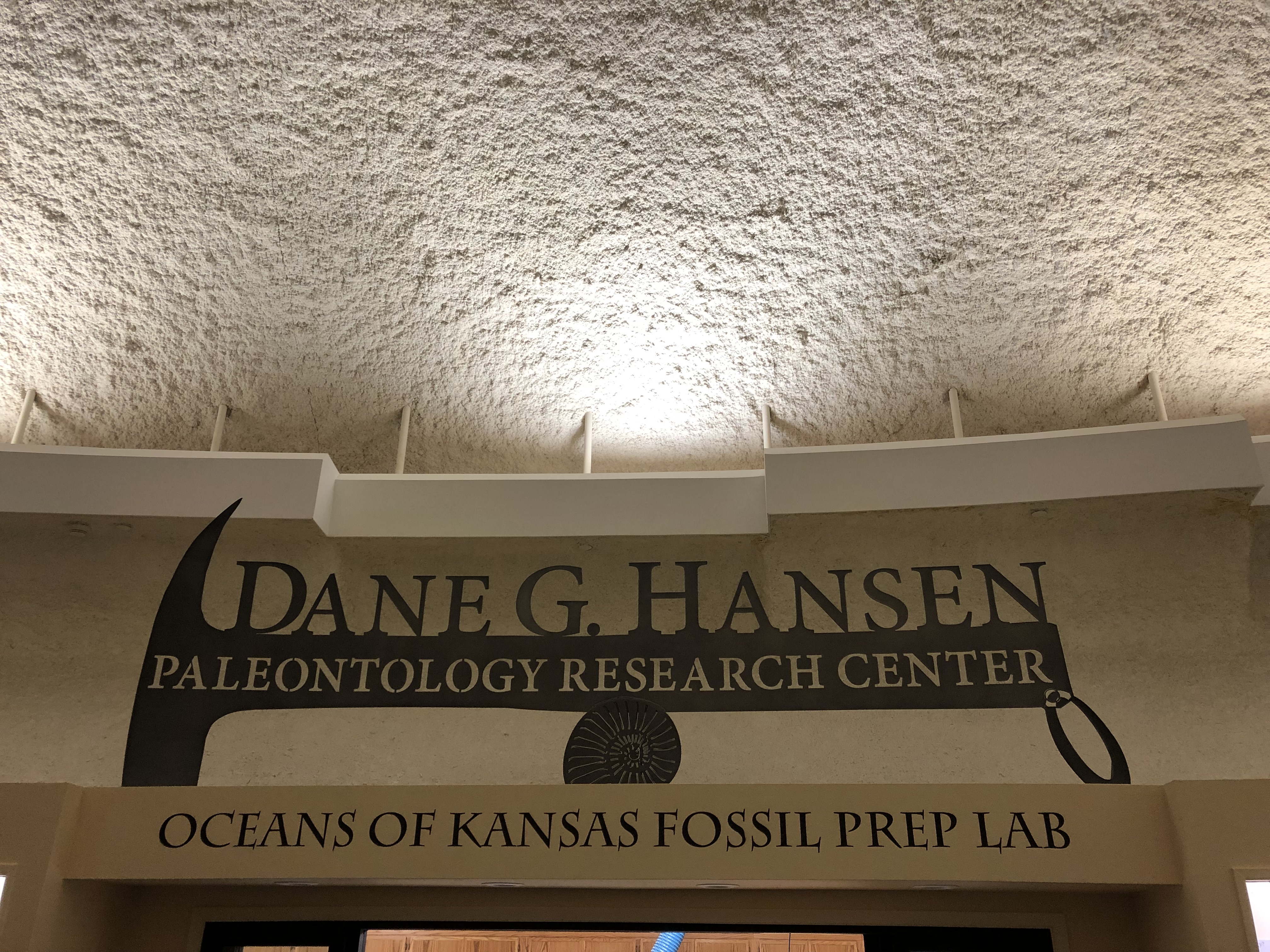
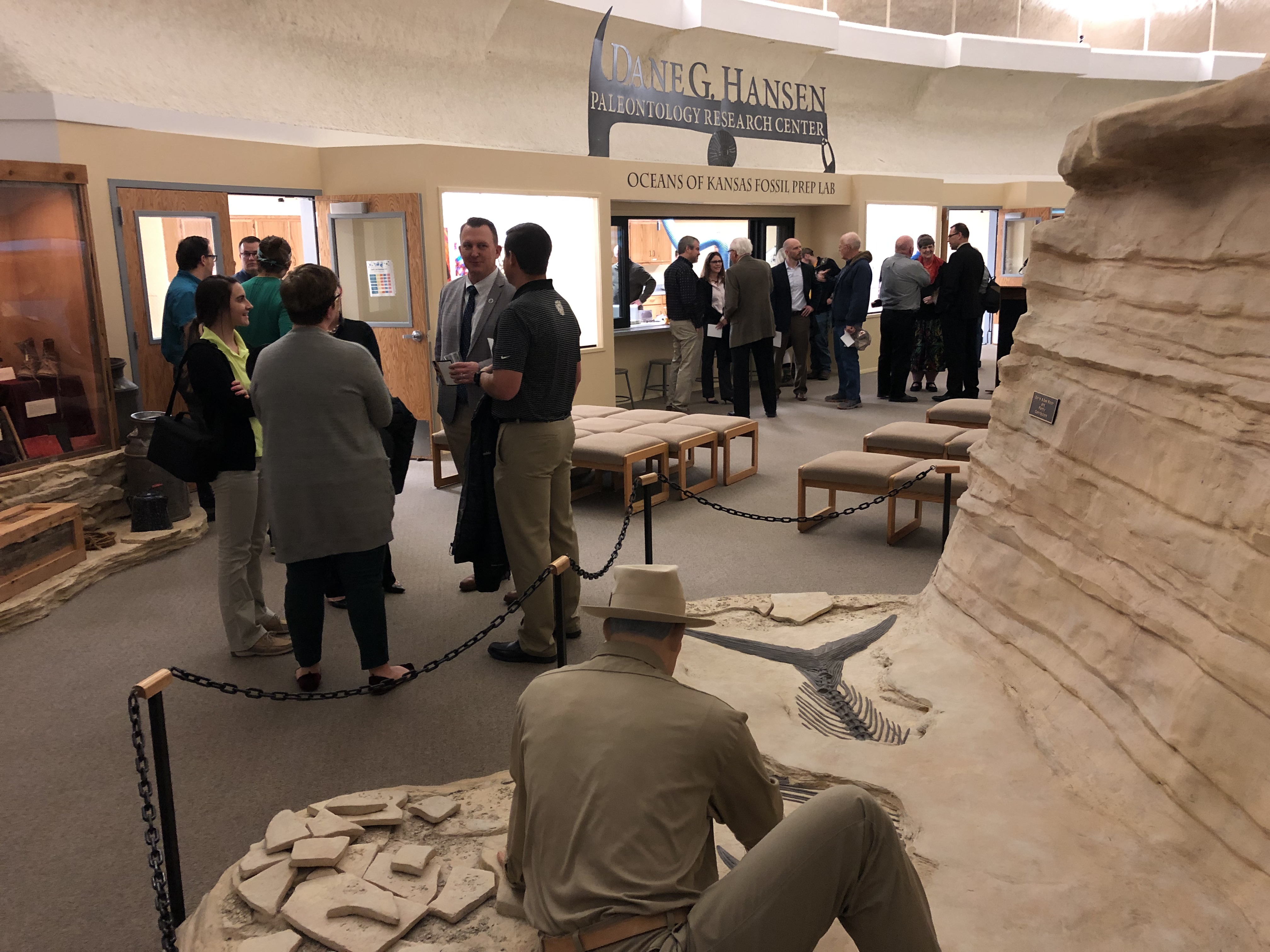
A representation of Hays paleontologist George Sternberg overlooks the new Dane G. Hansen Paleontology Research Center/Oceans of Kansas Fossil Prep Lab in the FHSU Sternberg Museum of Natural History.

By BECKY KISER
Hays Post

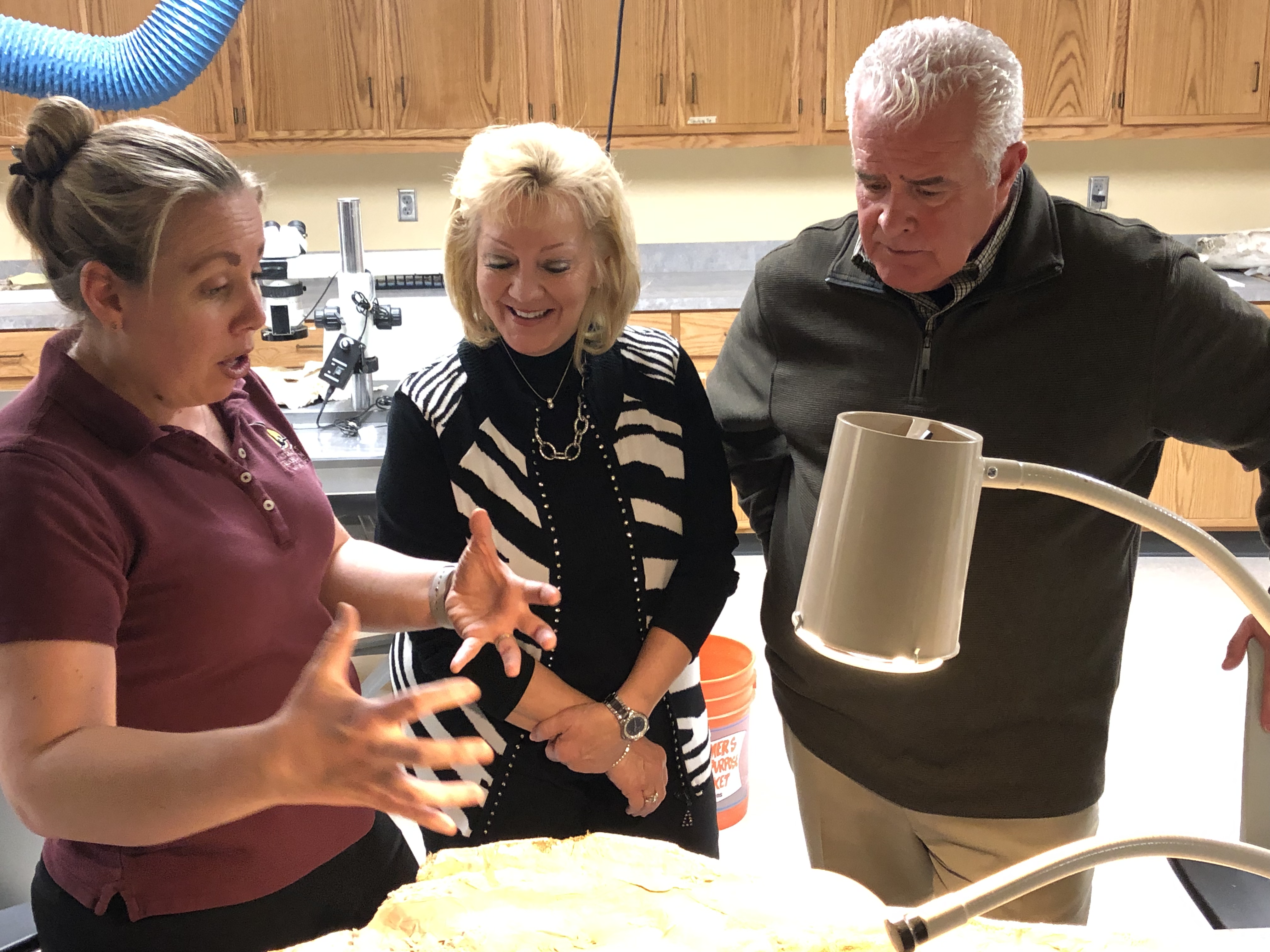
The new paleo lab at the Fort Hays State University Sternberg Museum of Natural History is now open thanks in part to the mother of Dr. Laura E. Wilson, curator of paleontology.

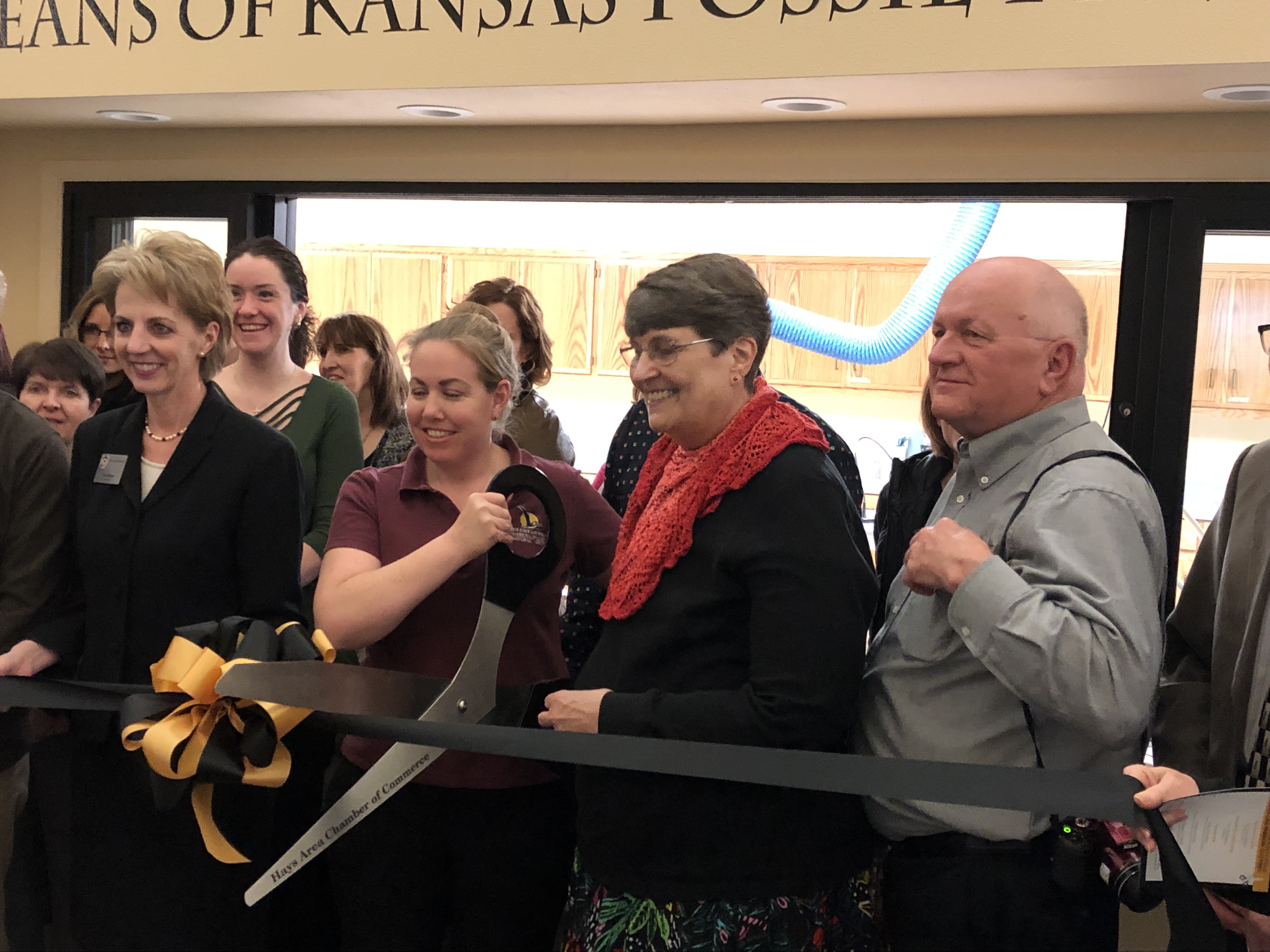
During Monday’s ribbon cutting ceremony with the Hays Area Chamber of Commerce, Wilson told the crowd it was one of her goals when she started at the Sternberg six years ago to modernize and expand the prep lab and research lab facilities.

“This is really important to our central mission in terms of a crossroads between research, collections, exhibits and education,” said Wilson.

As an academic, Wilson knows how to apply for grants for research and data-driven projects. But she did not have any experience in finding funding for infrastructure renovation.

“I knew we had to take a different path. So, thanks to my very Southern mother who taught me from a young age how to host a party, we came up with the idea of throwing a gala.”

In spring 2016, a gala for interested patrons kicked off a fundraising campaign. Another spring gala was held in 2017 and the initial capital was raised for the project.

“That got the ball rolling for being able to apply to the Dane G. Hansen Foundation for a matching grant.”

Soon after that, Mike and Pam Everhart came forward with “a very generous donation that helped us realize our goals were not only attainable but in a reasonable time frame, like my lifetime,” joked Wilson.

The Everharts are an important part of western Kansas paleontology and Western Interior Seaway paleontology.

The couple have been collecting fossils in the area for decades and donating them to the Sternberg Museum.

“The Everharts are number three on the list of most specimens collected and put into the museum,” director Dr. Reese Barrick said. “They are number two behind only George Sternberg for the number of fossils from the Western Interior Seaway that are here in the Sternberg Museum of Natural History.”

Mike Everhart is a museum adjunct curator and author of “Oceans of Kansas” which highlights discoveries made in Kansas by George Sternberg and other paleontologists in the state.

“I’m always amazed in telling groups about the ocean that covered this state for millions of years,” Everhart said. They give me this blank look like ‘we’re in the middle of the Midwestern desert here. What ocean?’ But when you start really looking at the discoveries that have been made in Kansas and the fossils that occur naturally – some of the best in the world – it’s pretty apparent that Kansas has not always been high and dry.”

The new “Oceans of Kansas Fossil Prep Lab” is named for the Everharts. It’s part of the new work area called the “Dane G. Hansen Paleontology Research Center.”

“Mike and Pam Everhart are among the most influential paleontologists in the country on the Western Interior Seaway and some of the most influential people in science in the state of Kansas,” added Barrick.

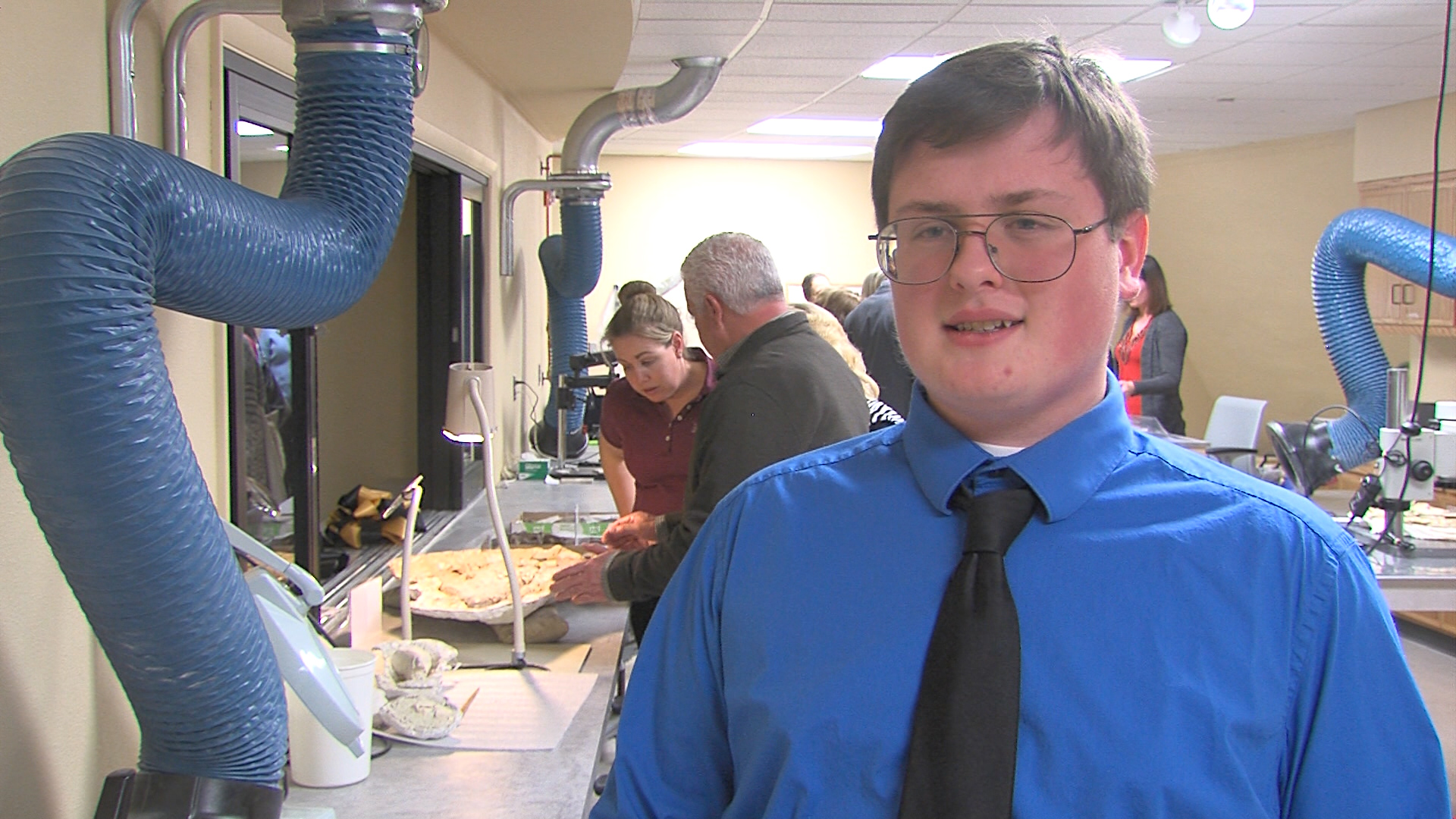
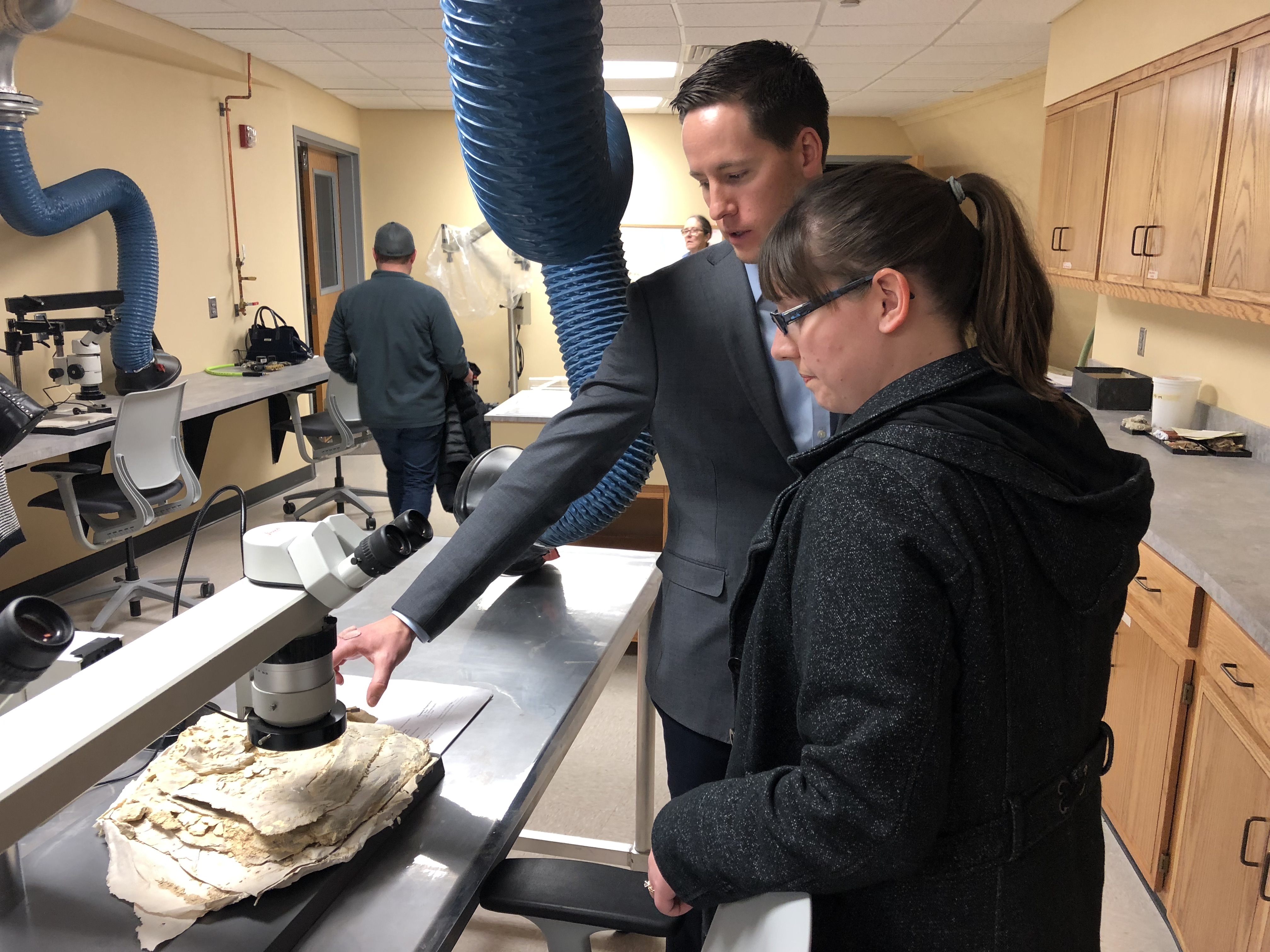
Kaiden O’Dell, a freshman geosciences major from Salina, is one of the first five FHSU students who have been training in the lab.

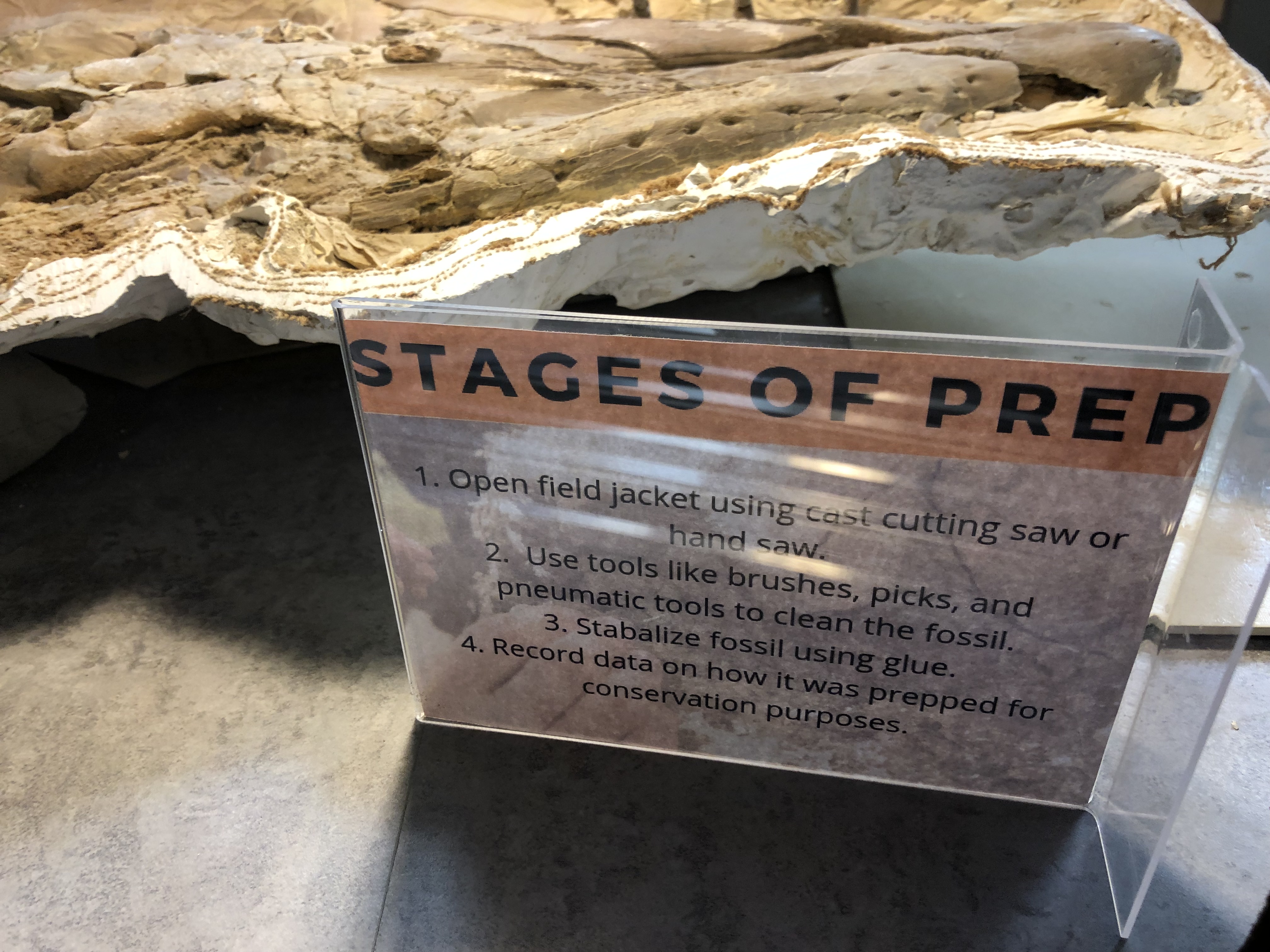
“Prep work is a large part of paleontology,” said O’Dell. “It’s not just getting the fossils out of the ground. It’s making sure you don’t break them once they do get out of the ground. We’re learning how to preserve them so you can do research later.”

Being selected to the first student team for training is a dream come true for O’Dell.

“Every little kid likes dinosaurs and my parents bought me a dinosaur encyclopedia. It had real stories about what they would be doing back then,” O’Dell recalled. “Later we came to visit the Sternberg Museum. I saw these amazing and beautiful fossils of fish and giant lizards that were in Kansas. I think it sparked something in me that’s never died since.”

Dr. Tisa Mason, FHSU president, described the advanced paleo lab as a “gateway to fascination, inquisition and science.”

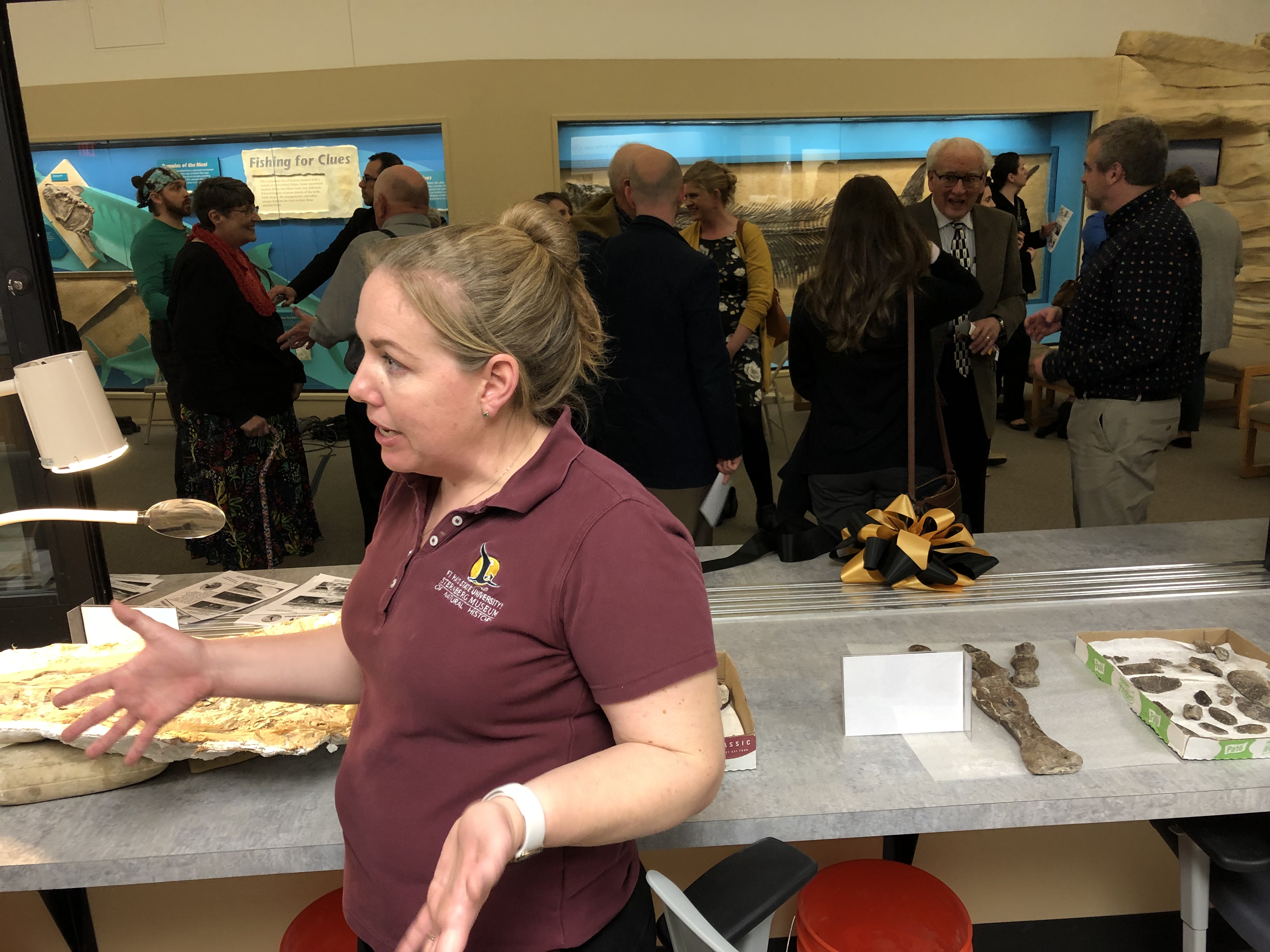
The wide lab windows open to allow workers to explain their hands-on processes to people touring the museum.

In April, Sternberg Museum will host the annual meeting of the Association for Materials and Methods in Paleontology whose members come from across the United States and Canada.

Ellis Snowball Royalty class winners announced

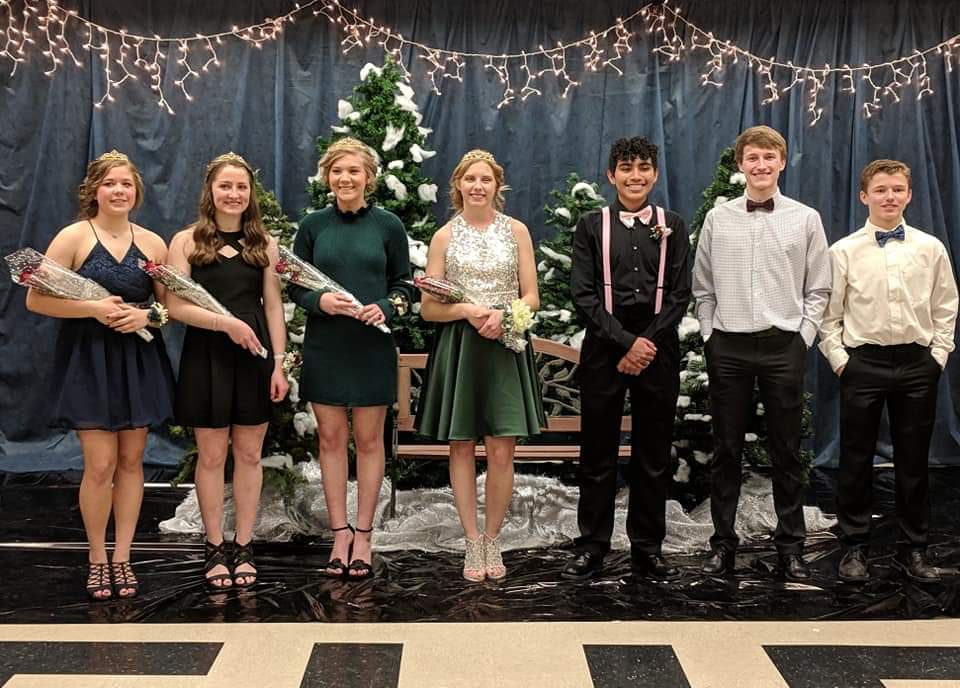
Ellis High School had its annual KAY Snowball Dance on Saturday.

The Snowball Royalty class winners are as follows:

Freshman Queen, Lakyn Fischer, daughter of DJ and Julie Fischer; Sophomore Queen, Grace Eck, daughter of Mark and Sarah Eck; Junior Queen, Breonna North, daughter of Travis and Ava North; Senior Queen, Cameryn Kinderknecht, daughter of Tim and Rhonda Kinderknecht; Junior King, John Gamez, son of Domingo and Martha Gamez; Sophomore King, Brady Frickey, son of Brad and Stacy Frickey; and Freshman King, Tyson Jimenez, son of Javi and Jessica Jimenez.

Copyright Eagle Radio | FCC Public Files | EEO Public File