Current Hays Superintendent John Thissen resigned in October, citing personal reasons. He will serve the remainder of his contract, which ends June 30.
Oak Park Medical Complex
The board will see plans Monday for renovations for the Oak Park Medical Complex.
The board purchased the property, which it plans to use to house the Early Child Connections program. The program is now housed in the former Washington school, which the district will close and has sold.
The Washington building was purchased by a developer to be renovated into low-income housing.
The school board purchased the Oak Park Complex for $2 million. It received a $1.47 million federal grant to renovate the facility. HaysMed, which was the primary owner of the complex, also donated $500,000 toward the renovation project.
The federal grant money must be used by June 30. The school district hopes to have the renovated space open for fall classes.
Driver’s education fees
The board is set to vote on a change in driver’s education fees. The program is doing well and has a significant reserve. The recommendation is to reduce the fees by $25 to $225 for district students and $275 for non-district students. Administration has recommended to keep summer school fees the same as they were last year.
In other business:
• The board is set to vote on contracts for Shanna Dinkel, assistant superintendent, and Chris Hipp, director of special education, for the 2019-20 school year.
• Thissen will share the district-wide KESA educator, student and parent survey results with the board.
• Keith Hall, interim director of finance, will share the five-year Capital Outlay Resolution with the board.
• The board will consider the approval of negotiating agents for the 2019- 20 school year contract.
For 140 individuals with intellectual disabilities, Friday night was their Night to Shine.
Night to Shine is a program made possible in part by the Tim Tebow Foundation. The event gives a prom-like experience for community members 14 and older who have intellectual disabilities.
Hays’ 2019 Night to Shine was conducted at Celebration Community Church.
Organizer Brent Kaiser said about 140 guests were invited to the event and about 400 volunteers joined in to make the event possible.
With loved ones and friends watching, the event was expected to draw about 800 people.
The guests were cheered as they walked a red carpet, then were honored and photographed during a promenade. The guests had dinner with a volunteer “buddy” before ending the evening with a dance and activities.
WAKEENEY — Just after 2 p.m. Friday, a call was received by Trego County Communications that flames were coming out of Trego County Rural Fire Station One.
WaKeeney City Fire Department crews were dispatched to the building, located on the west edge of WaKeeney.
All four fire vehicles were able to be cleared from the building. Both WaKeeney City and Trego County Fire department personnel were on hand to fight the fire. Crews were on scene until after 6 p.m. The building is a total loss, along with all the gear and equipment located in the building.
Western Cooperative Electric Association, WaKeeney, offered to provide housing for the fire vehicles and will allow the department use of a building. Many offers were received by citizens in the area, but Western Co-op had a building large enough to house all equipment.
Trego County Rural Fire Chief Chad Mann said that is a sad day for Trego County Rural firefighters after losing their home station. However, the department will continue to respond to fires and continue rescue on wrecks thanks to the generosity of Western Coop Electric. The department is humbled by all the offers of gear and help from area fire departments.
The State Fire Marshal was called to the scene and the cause of the fire is under investigation.
Check Hays Post for more as details become available.
Dylan Werth as Theodore Laurence in Hays Community Theatre’s presentation of “Little Women.” File photo
By CRISTINA JANNEY Hays Post
If you have been to a Thomas More Prep-Marian or Hays Community Theatre performance in the last four years, you have probably seen Dylan Werth.
Werth’s extensive involvement in local theater has helped him land a $15,000 per year, four-year scholarship to Sterling College.
Werth, 18, a senior at TMP, signed with Sterling College on Wednesday for the scholarship, which is a combination of a music, theater and dean’s academic award.
Werth had been looking at larger public schools, including Fort Hays State University, but Werth, who is also a state champion in improvised duet acting, attended a forensics workshop at Sterling last spring.
“I just fell in love with the place. I think the first thing that got me was that it was a good time of year because it looked beautiful. It was the people there. They were so nice, and I genuinely felt like they cared about the people. It was like ‘You are here. You are in the arts. We like you already.’ We could leave everything at the door and just have fun.”
TMP student Dylan Werth with his parents as he signs for a theater scholarship at Sterling College. Courtesy photo
Werth started with HCT’s performance of “Shrek,” and has been involved with every show TMP and HCT has staged since.
Some of Werth’s more notable roles in the last few years included Jack in TMP’s production of “Into the Woods,” Will in TMP’s “Oklahoma!” and Theodore Laurence in HCT’s “Little Women.”
He was nominated for a theater Jester award for his portrayal of Jack in “In the Woods.”
“It’s a passion,” he said. “It’s what I like to do.”
Werth’s favorite part was Will in TMP’s “Oklahoma!”
“It was very consuming on all parts and all surfaces,” he said. “I had to sing, act and dance and all of that. I helped a lot backstage too with teaching choreography and with the set and props. I liked that best because I got to take all that in and learn all those different areas I haven’t before.”
He said his favorite show was “Into the Woods.”
“The music is amazing, There was no sad part about him,” he said of his character Jack. “He wasn’t happy, but he was too stupid he couldn’t be sad because he didn’t know what was going on. He was always in that la la land stage. That was fun to have fun with and be creative.”
This semester Werth is in three shows as well as participating in forensics at TMP.
He is an assistant director on HCT’s upcoming performance of “Steel Magnolias.” He is Ryan, a suspect, in HCT’s Feb. 15 and 16 show, “Murder Can be Habit Forming.” He will be Tony Kirby, the son of a business mogul, in TMP’s spring comedy “You Can’t Take it With You.”
“My mom always tells me ‘Don’t spread yourself too thin or work yourself to death,'” he said. “But if I am doing what I love, I don’t count it as work. Sure it is work, but I don’t count it as so hectic and time-consuming. I would want to be here anyway.”
When he graduates college, Werth hopes to land a job in live theater.
“I just want to go somewhere and get paid to do what I love,” he said.
He said he would choose live theater over TV or film.
“Nothing else can take it,” he said. “You don’t know what is going to happen when you do live theater. Sure you can practice and practice, but you can’t account for everything. I think that bring a sort of charm to live theater.”
Werth said theater allows you to experience different times and places.
“I think that is why I like theater so much, because you get to travel without moving.”
Werth said Travis Grizzell, TMP drama teacher and active HCT member, has been a role model for him in the last several years.
Werth is in Grizzell’s forensics class. He competes in duet acting and improvised duet acting. Werth and his partner’s piece for duet acting is a selection from a musical comedy, “The Big Bang.” It tells the tale of the history of civilization through campy song and dance.
“It is fun to do. We laugh a lot, and we are being weird characters,” he said.
He said he prefers comedy.
“There is something relaxing about a good comedy,” he said, “to watch them just laugh. Laughter is the best medicine.”
You can buy tickets now to see Dylan in HCT’s “Murder Can be Habit Forming.” Click here to access the HCT webpage for tickets. HCT’s “Steel Magnolias” is set for March 22-24. Tickets will also be available on the HCT website.
Watch the TMP website for more information on “You Can’t Take it With You.” Performance dates are April 12, 13 and 14.
Horses that emerge from a tangle of roots, bright bugs made of fused glass and dancers frozen in time by a single shutter click all will come together in a single show that opens Friday at the Hays Arts Center.
The main gallery is featuring “Intermittent Musings,” a career retrospect of glass and mixed media art from Stan Detrixhe. The Founders gallery will host “Unwrapping Life,” mixed media carving and ceramics by Terri Horner. Also featured will be “In Motion, Dance photography by Michael Strong.”
The opening reception for all three exhibits will be from 7 to 9 p.m. Friday at the Hays Arts Council.
Stan Detrixhe
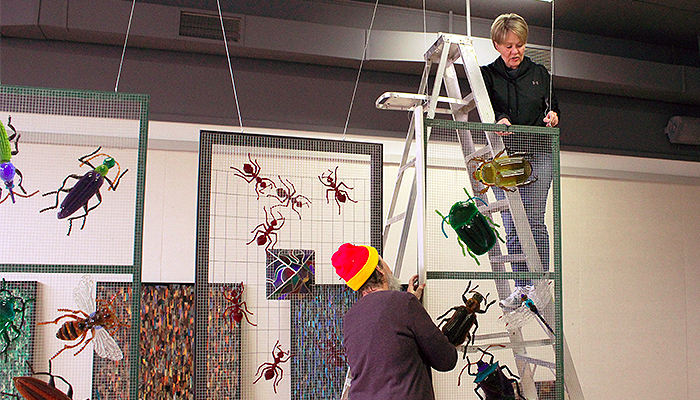
Stan Detrixhe installing an art piece for an exhibit at the Hays Arts Center.
Detrixhe, 66, works in a variety of media including fused glass, reverse painted glass, oil and collage.
Detrixhe is a a Hays native, but studied at San Diego State before moving back to Kansas. He started working with in glass in 1983 when he working as a designer for High Plains Stained Glass. The company designed and repaired stained glass windows. Although there is not as much demand for it today, Detrixhe still offers commercial stained glass work as well.
One of the larger pieces of glass work in the exhibit includes several wire panes featuring bugs.
Detrixhe said he chose the subject because he saw them as a challenge.
“What is an extreme example of what you could do with fusing and still have it hold up?” he said. “So I thought of all the little legs on the insects coming off as being very, very delicate, and then the middles of the insects are very, very strong. I was trying to determine if those two things were compatible.”
Advances have been made in fused glass, but when Detrixhe started there were issues with compatibility in different colors of fused glass. One color of glass can solidify before another, which will cause the glass to crack.
A fused glass insect by Stan Detrixhe.
All the insects in this piece of artwork were modeled after actual insects. Detrixhe researched the anatomy and features of the insects as he was creating the pieces.
Another challenge for Detrixhe is painting reversed glass. As the name implies, all of the painting has to be done in reverse on the back of the piece of glass. He said he likes the effect that is achieved in the final product. As light hits the front of the finished pieces, it makes the color seem even brighter than the original paint.
Detrixhe has several large collage pieces in this exhibit. Some are abstract and others look more like a traditional paintings.
He created abstract brown, blue and green collage pieces by chance. He started snipping pieces out of magazines and gluing them on a background, and it just kept getting bigger until it was several feet tall. A second piece followed. The third green piece in the series he created from digitized images.
He said even if he is going to create a finished piece in another medium, such as oil or glass, he likes to use collage to create a first impression of what the finished piece will look like.
Two oil paintings will make a reappearance in this exhibit from a former Hays downtown bar. The bar used to be in the basement of what is now Coldwell Banker Executive Realty, 1001 Main. The paintings were donated to the HAC when the bar closed.
Terri Horner
Terri Horner of Great Bend with two of her art pieces that will be on exhibit at the Hays Arts Center.
Horner, 61, Great Bend, is a cosmetologist by trade, but went back to school and earned her bachelor’s degree in art from Fort Hays State University in 2009.
Although Horner’s formal education came later in life, she has always loved art and drawing. Today she is a sculpture. Her favorite media is wood, and she often uses cedar.
“Wood and stone are particularly nice because you uncover what is in there,” she said. “What I see I can bring to light for someone else to see that they might not otherwise find in there.”
Horner gave several examples. A piece that was chosen for the 2018 Smoky Hill Art Exhibition at the HAC depicts horses carved from the roots of a hydrangea bush. The roots were a gift from a friend’s garden. Horner said she turned the root around and around and upside down, but all she could see were the heads of horses in the tangled wood.
A horse sculpture by Terri Horner.
A thin sculpture of a women was inspired by a knot that Horner imagined as the women’s hair. In yet another piece depicting Eve, the nape of the woman’s neck, her hair and the curvature of her face were all determined by the grain that was naturally in the wood.
“The fact that I like three-dimensional work and it’s more comfortable to me, I think is because I have worked on a 3-D pallet my entire life working on hair,” she said, “because that is an art in and of itself.”‘
Another piece was inspired by her in-laws, Ralph and Edna Horner. The wood sculpture features a faded, ghostly image of the couple when they were young. A cast of their hands is in an opening in the wood below. On the back of the piece is inscribed a excerpt from a love letter Ralph wrote to Edna when he was stationed in Africa during World War II. He worked as mechanic in the Army Air Corps. They wrote to each other every day.
“I really wanted to honor them in a sense, because No. 1 they were awesome people,” Horner said. “They were just the kindest, sweetest people ever. They were also so in love. Dad died in ’93, and they were every bit in love at that moment as the day they met. They were such an inspiration and an example.”
The hydrangea roots from which Terri Horner carved her horse sculpture.
Several of the pieces in “Unwrapping Life” also depict animals, such as a lion, monkey, giraffe and elephant in wood and polar bears in Italian ice alabaster.
“I have just always been an animal lover or that’s just what’s there,” she said.
Horner is branching off in new directions. She is working on an independent study at Barton Community College in ceramics. Although it was not ready for this show, she hopes to be able to show that work soon.
Michael Strong
Mike Strong started shooting photos in the 1967 when he took a photojournalism class in college. That was the only photo class he took, but he had found his passion.
He couldn’t find a job as a photographer right out of college. He kept finding jobs for reporters, so he became a photographer who wrote. Today he is primarily a dance and performance photographer. Strong formerly lived in Kansas City, but is now living in Hays.
Photo b Michael Strong
His exhibition “In Motion: Dance Photography by Michael Strong,” shows examples from years of perfecting the art of photographing the movement and emotion of dance.
“It never, never stops for me,” he said of the dance photography. “This is always perfection. I am always perfecting. There is nothing else as interesting or exciting for me because there are always changes in moves.”
Strong said he didn’t really understand dance photography nor was he any good at it until he took tap lessons. He started to see new aspects in his photography and better understand the timing that goes into dance after he started to dance.
“I didn’t know what it was, but I knew my pictures were different from the normal newspaper people who came in, who clearly didn’t see what they were looking at,” he said. “To see something, you have to know something. To know something, you have to do something.”
American Youth Ballet (AYB) dress rehearsal #1 in Polsky Theater Wed 5 p.m. May 10, 2018 for performances May 12 and 13. Photo by Mike Strong.
When Strong is going to photograph a performance, he starts attending rehearsals as soon as possible. He makes notes about the timing of the movements.
When he shoots, he does not use continuous shooting. Every image is captured with a single click of the shutter. He said this has forced him to choose his shots more carefully and perfect his timing. Several photos in the exhibit will include consecutive frames of a single subject to show how this techniques shapes Strong’s photography.
Strong also shoots with an ultra-wide angel lens. This allows him to be very close to his subjects, but still capture a broader image.
“For me, this is about perfecting and never quite getting there,” Strong said of his photography, “but always staying on an edge. I have a tell I have for myself. If I find myself thinking it is too easy, I stop because it means that I am not paying attention. I start doing a quick little inventory of where I am at in the dance. I do a quick little inventory of all the setting on my camera. That puts me back in the mood. You have to be on edge in some way, shape or form.”
Photo by Mike Strong
He never shoots a posed shot. They are all images made in the moment.
“I call these my transitive [shots] like a transitive verb. You know you need an object that comes after it,” he said. “These are transitive in the sense they are coming from somewhere and going to somewhere rather than just jumping up and boom there you are.”
Although Strong started shooting ballroom dancing, today he photographs the American Youth Ballet, University of Kansas dance and University of Missouri Kansas City dance as well as other events and companies.
A teardrop partial roundabout has been added to the eastbound I-70 off ramp for the North Vine Street corridor traffic improvements. (Click to enlarge)
By BECKY KISER Hays Post
A fourth major traffic element has been added to the plan for improvements to the Hays North Vine Street corridor between 32nd and 41st Streets.
The project has been in development the past 12 months by the city’s consultant, WSP Engineers of Lenexa, the Kansas Department of Transportation (KDOT) and city staff.
“Our engineers [WSP] hired another engineering firm to do an independent review of the whole plan just to make sure we got another set of eyes on it,” said Jacob Wood, assistant city manager.
The nationwide firm Kittelson & Associates specializes in transportation projects.
“One of the things that they recommended was that we put in what we’re calling the ‘teardrop’ on the south side of I-70.
“It’s not a full roundabout but what it will allow is traffic going eastbound to pull off of the interstate, go through the tear drop, and go directly north,” Wood explained.
“The old plan would have had them going south, and coming around the roundabout and then going north. This will make it a bit easier to come off the interstate and go north, if they want to do that.”
Traffic studies and modeling determined the teardrop would alleviate some of the congestion at the 37th Street roundabout.
“We looked at doing [a teardrop] on the north side of I-70 but there’s really not enough room to do it between the interstate and the intersection. So [westbound traffic] will still have to pull off the interstate and go north through the roundabout to then head south on Vine.”
Plans are to build two-lane traffic roundabouts at 32nd/33rd, 37th, and 41st Streets, plus the teardrop at the eastbound I-70 exit ramp.
Adding the teardrop increases the total project cost from an estimated $7.6 million to approximately $9 million.
In early December the city was awarded a $6 million federal grant from the Department of Transportation for the Better Utilizing Investments to Leverage Development (BUILD) Grant program for the North Vine Street Corridor Project construction.
The remainder of the project cost will be paid through a two percent increase in the Transient Guest Tax (TGT). It went into effect Oct. 1 and is projected to raise $6.2 million over 20 years.
On January 9 city staff attended a meeting in Topeka with representatives from the Federal Highway Administration (FHWA) and KDOT to discuss how the project is to be administered. KDOT will act as the pass-through agency in letting the bids and managing the project.
“We’ve had conference calls with them, both KDOT and Federal Highways, and will continue to do that as part of the process as it goes forward.
“Anytime you do a project of this magnitude on a state highway at the intersection of an interstate, you’re going to have those players involved anyway. But they’ll probably be a little bit more involved this go around [due to] the federal money.
Wood says the concept plan is now “pretty well refined.”
The city has been meeting with business owners along Vine Street throughout the corridor.
“We’ve been having conversations and, actually, some of those have resulted in changes to the plan. Those guys that work on Vine have the operator-level kind of knowledge that maybe city staff and engineers don’t see.
“For the most part, the meetings have been positive.”
The city will host a public meeting and open house Tue., Feb. 12, 5:30-7:30 p.m., at The Venue at Thirsty’s Brew Pub & Grill, 2704 Vine. Information will be presented about Vine Street corridor improvements, including the proposed roundabout solutions. Detailed models of proposed changes will be on display to show the capabilities of roundabouts and how they improve safety for vehicles and pedestrians.
“We’ll see if there’s any feedback that may require adjusting or tweaking the plan, and we’ll still be able to do that. But we’ll really start kicking on the design pretty heavy after next week.”
Utilizing the federal funds required a slight shift in the work timeline.
Design will continue until October or November. Once the design plan is finalized and approved, bids will be let with a construction start expected in the summer of 2020.
“It’s a long road and there are a lot of regulatory requirements, which we would have to deal with regardless of whether we got the federal dollars,” Wood added.
Wind turbines are thought of as environment-friendly sources of energy, but for bats, they are a death trap.
Amanda Adams, instructor of biology at Fort Hays State University, talked to a capacity crowd Monday night about the plight of the bats during a FHSU Science Cafe presentation titled “Bats: The Rock Stars of the Night.”
Adams said bats are being killed by the millions by wind turbines.
Curious creatures, the bats are drawn to the turbines, where they are either struck or killed by a low pressure field that surrounds the turbines.
“When you go out and you are driving and you think ‘How majestic,’ in my head I think ‘It is a death count,’ ” Adams said. “It’s really awful.”
Amanda Adams, instructor of biology at FHSU talks about the diversity of bats at a Science Cafe lecture on Monday.
Researchers are trying to develop deterrents that will keep bats away from the turbines. They have investigated using sound to dissuade the creatures from approaching the turbines, but that has not been effective.
A type of fungus found in caves is also killing some species of bats by the millions. White-nose syndrome first appeared in U.S. caves in 2006. It has proven to be 99 percent fatal to bats in the caves were the fungus has been found.
Although researches have found chemicals that could kill the fungus, conversationists are concerned about the effect spraying would have on soil quality, Adams said.
Although bats are often confused with rodents, they are in a completely different mammalian group. They also live very different lives. Rodents have short lives and reproduce quickly. However, bats may only have one young per year, and can live anywhere from six to 20 years. The oldest bat on record lived to be 45.
Because bats’ reproduction is slower than rodents, killing a bat has a much greater impact on the bat population. They are also slower to rebound from environmental disasters, such as the white-nose disease.
A quarter of all mammal species are bats with 1,300 species. They live on all continents except Antartica. Sixteen species of bats are found in Kansas — eight in Ellis County.
“That is the reason why I am in love with them. The incredible diversity of bats that are out there makes it really fun to study them and learn about them, because they are always doing something weird and breaking rules and you can never make a generalization about bats,” Adams said.
Bats in that diversity have some incredible adaptations. California’s spotted bats can hear the footsteps of a cricket on the ground. Common vampire bats have specialized heat sensors in their nose that allow them to locate blood-rich areas in the skin of their prey.
A species of bats that lives in the tropics make their own tents out of banana leaves and then they “cuddle” together like a hand full of cotton balls.
A Central American species has suction cups on its wrists. This helps the bats stick inside leaves at night when they rest.
The largest bat in the world is the flying fox and has a wing span of 6 feet. The smallest bat is called the bumblebee bat, which weighs less than a penny and could fit on the tip of your thumb. Both of these bats overlap range in the Philippines.
All the bats that live in North America are insect eaters. Depending on species, bats prey on insects both from the ground and catch flying insects, such as moths, in mid-air.
Adams talks to a capacity crowd at the Science Cafe Monday night at The Venue in Hays.
Some bats are carnivores. They eat frogs, fish, birds, reptiles and rodents. Some species that eat frogs have an special adaptation to let them know they have preyed upon a poisonous frog before they eat it.
Sanguivores or vampire bats have all kinds of incredible adaptations to consume blood, Adams said.
Common vampire bats can run along the ground. They land on the ground and climb up their prey, such as a cow or goat. They make a very small incision in the animal’s skin. An anti-coagulant in their saliva helps keep the animal’s blood flowing while they “daintly and gently” lap up about a tablespoon of blood with a curled tongue, Adams explained.
The bat’s metabolism is so specialized they can’t skip a single night of feeding or they will die.
Bats are essential to the environments in which they live. Bats save U.S. farmers $23 billion annually in pesticide costs and reduce crop damage. Many bats eat their weight in insects each night.
They are helping regrow the Latin American rainforests. Up to 95 percent of “pioneer plants” in cleared land come from seeds dispersed by bats.
If you like tequila, you can thank bats for that too. Bats pollinate more than 500 species of plants, including the agave plant from which tequila is made.
Conservations are urging agave growers to become more bat friendly. Typically, agave is harvested for tequila before it blooms. This cuts off a food source for the bats and results in inbreeding of the agave plants.
Some growers are allowing at least some of their agave plants to flower to help the bats and promote biodiversity in their crops. When you are at the liquor store, look for bat-friendly stickers on tequila bottles.
Adams’ recent research has centered around echolocation. She has conducted research in which she has tried to determine how bats echolocate in groups. This line of research has indicated that bats use jamming avoidance. When they are in groups, they mutually suppress their signals in essence making fewer sounds to avoid conflict with other bats.
Bats will also shift their call on the sound spectrum to differentiate their signals from the bats around them.
The sounds bats use for echolocation is at a much higher frequency than can be heard by humans. However, in addition, to using sound to find objects and prey in low light, bats also use lower frequency sound, some of which humans may be able to hear, as social calls.
If you find a bat, don’t touch it. If you must move it, use gloves or a towel. Adams said she will not rescue you from the bats, but she will come rescue a bat from you. Call 979-393-2062.
The next Science Cafe will be at 7 p.m. March 18 at The Venue at Thirsty’s, 2704 Vine St., Hays. Cat Sartin, FHSU instructor of biological sciences, will present “The Bare Bones About Dinosaur Growth.” The lecture is free and open to the public.
With the third wettest year just locked into the Hays record books, and the Kansas Water Office declaring the entire state drought free for the first time since June 2017, water conservation may be the furthest thing from your mind.
But smart water use is always at the forefront of daily life in western Kansas, where drought is a persistent threat.
Of the 34 Kansas counties that have a population of more than 15,000 people, 33 counties either sit atop a major aquifer or are east of Highway 81/Interstate 135 where there is reliable surface water flow.
Ellis County is that 34th county and does not have an adequate local water supply.
A conservation plan was implemented in 1992. In 1994, the R9 Ranch in Edwards County was purchased by the cities of Hays and Russell as a regional longterm water supply source. In 2015, Hays city commissioners voted to begin pursuing the regulatory process to move the water it owns, along with Russell, from the R9 north to the Schoenchen water wellfield south of Hays.
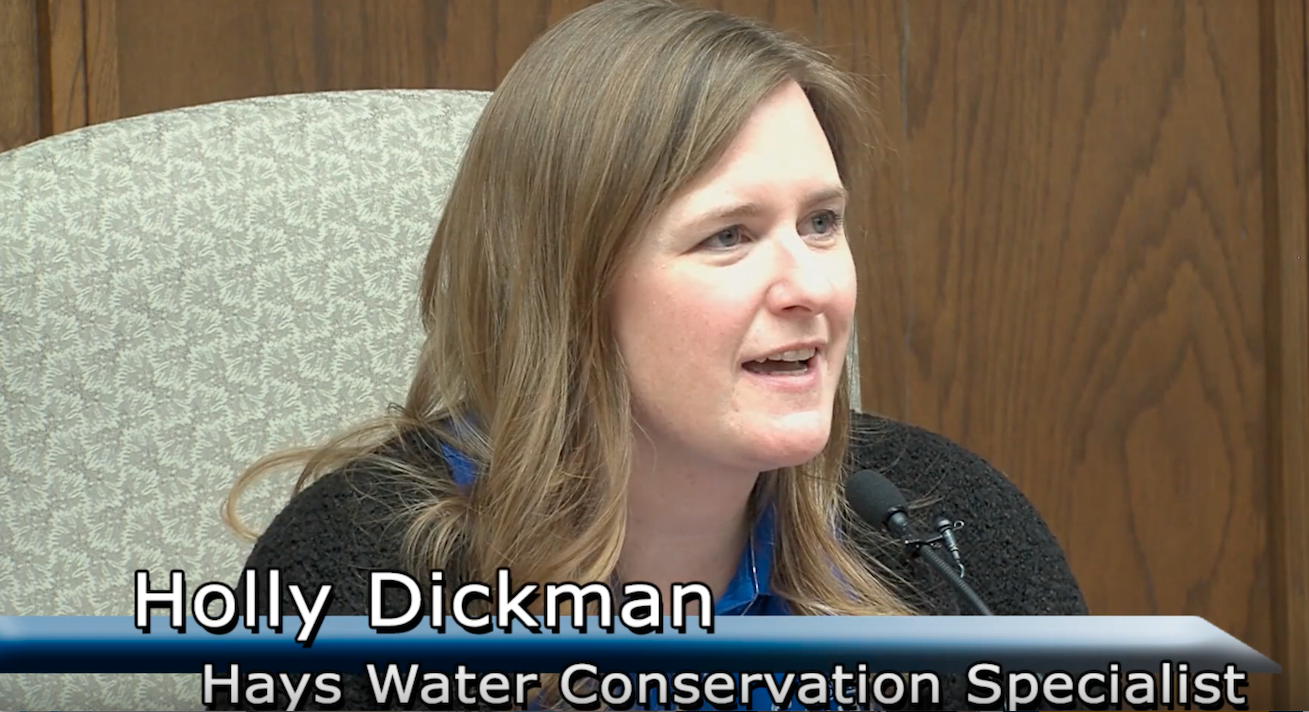
The city of Hays continues to offer water conservation rebates and giveaway programs for residents and businesses, as Holly Dickman, water conservation specialist, explains.
High Efficiency Toilet Rebate Program – Rebates from $50 to $150 are available for replacing an old inefficient toilet with a new high efficient model. The fewer gallons used per flush (GPF) the higher the rebate.
High Efficient Clothes Washer Rebate Program – $100 rebate available for replacing an old washing machine with a high efficiency model with an integrated water factor (IWF) of 3.7 or less to qualify.
Efficient Showerheads and Faucet Aerators – Available at City Hall Finance Office, 1507 Main; Aerators are free. Seven types of shower heads with 3 models free with exchange of old showerhead and 4 models can be purchased for $5 with exchange of old showerhead.
Turf Conversion Rebate – Up to $1,500 per property available for converting cool season turf (i.e. tall fescue or Kentucky bluegrass) to warm season turf (i.e. buffalograss or bermudagrass) or water conserving landscaping; Pre- and post-inspections required to qualify.
“Don’t wait to the next drought,” Dickman encouraged property owners. “Take advantage of the good soil moisture we have now to convert to a more drought tolerant landscaping in the coming growing season.”
Girl Scout Troop 11268 Hays practices for booth sales. Pictured are Allison Werth, Adalynn Wilkie, Alexis Bickle, Brooklynn Dinkel, Kayden Eaton, Anna Kuhn and Lynsi Kanak-McGrath.
Girls Scouts from the area converged Friday on Celebration Community Church for their annual Cookie Kickoff.
Cookies go on sale Saturday, Feb. 9 and the sale will run through March 17. Cost of cookies are $4 per box.
The event included girls from Service Unit 74, which includes Ellis, Trego, Ness, Russell and Gove counties. More than 90 girls pre-registered for the event.
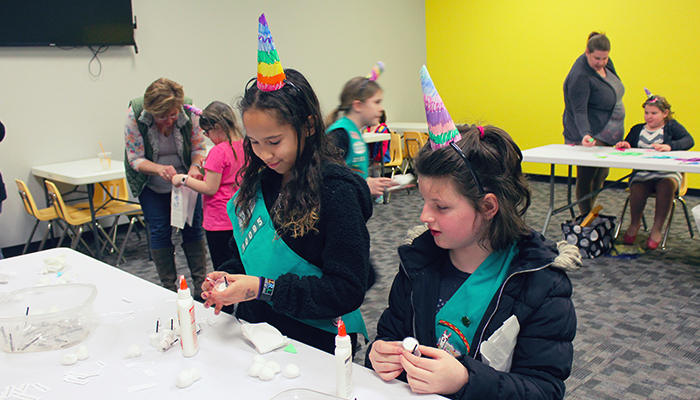
The girls sampled Girl Scout cookies, decorated their own cookies, practiced their selling skills, made crafts, snapped pictures at photo booths and played games.
This year’s mascot for the cookie sale is Sparkles the Narwhal. For those of you who don’t know what a narwhal is, it is an Arctic whale with a large horn. The narwhal and its horn have been cited by many as the creature from which the unicorn legend sprung.
Junior Scouts Delilah Meyeres and Lisa Dible, 10 of Troop 10095, color narwhal horns at the Cookie Kickoff Friday.
In honor of the cookie mascot, girls at the kickoff colored and wore their own narwhal horns.
Junior Scouts Jordan Flavin and Arianna Ayarza, both 10 of Troop 10095, said they hope to use the money they raised from their cookie sales to go to camp this summer.
The girls earn Cookie Credits through cookie sales they can use for Scout activities.
Girl Scout Troop 11268 said they had already been to several camps this year, including the first part of three-part campout in Ellis, a Halloween camp and Cookie Camp in Scott City. The Juniors hope to raise enough money through cookie sales to go on a trip together this summer.
GSUSA
Cookie sale dates
The Cookie Sale runs Feb. 9 – March 17
Cookie Booth sales will be throughout the entire sale.
How to find cookies
Looking for a local Girl Scout to buy cookies from? Just enter your zip code at kansasgirlscouts.org or call our Cookie Hotline at 888-686-MINT (6468). You can also download the free, official Girl Scout Cookie Finder mobile app for iPhone, Android and other mobile devices. (Yep, there’s an app for that!)
S’mores cookie is returning in the 2019 cookie lineup
This year, Girl Scouts is celebrating a tasty new way to support young female entrepreneurs with a recently debuted Girl Scout Cookie added to the 2019 Cookie Lineup: Caramel Chocolate Chip, which joins classics like the Thin Mints, Caramel deLites and Shortbread varieties. Caramel Chocolate Chip features rich caramel, semisweet chocolate chips, and a hint of sea salt in a chewy gluten-free cookie. The new cookie is offered in select Girl Scout council markets only for as long as supplies last. We still have eight other cookie favorites to choose from: Thin Mints, Caramel deLites, Peanut Butter Patties, Shortbreads, Lemonades, Peanut Butter Sandwiches, and Thanks-A-Lots.
A second century of Girl Scout cookies
In 2019, we celebrate the 102nd anniversary of the first-known instance of Girl Scouts selling cookies and learning the basic skills they needed to be leaders in business, managing their own finances and gaining self-sufficiency and confidence handling money.
So how did it all begin? It started in 1917 in Muskogee, Oklahoma, when the Mistletoe Girl Scout troop there did what Girl Scouts everywhere do: They had a great idea, got together, and took action to make it a reality. They decided to fund their projects by selling homemade cookies, and the idea spread!
The 5 skills
Daisy Scouts Georgia Olson and Harper Leiker, both 5 of Hays, decorate their narwhal horns Friday.
When girls participate in the Girl Scout Cookie Program, the largest girl-led business in the world, they get more than new adventures. They develop important life skills—goal setting, decision making, money management, people skills, and business ethics—that will set them up for success!
For 102 years, Girl Scouts have used cookie earnings to build leaders who make a positive impact on our world. Girl Scout Cookies not only help girls earn money for fun, educational activities and community service projects, they also help transform girls into G.I.R.L.s (Go-getters, Innovators, Risk-takers and Leaders) as they learn essential life skills. There’s no doubt: American society is better because of the girls who have taken part in the Cookie Program.
Price of cookies
Each package of Girl Scout Cookies costs $4. Yes, there are Girl Scout Cookie lookalikes out there, but it’s important to keep in mind that when you buy a box of cookies from a Girl Scout in our council, all of the money stays in Kansas and supports local programs for local girls. Along with earning money for their troop, girls are also earning Cookie Credits they can spend on exciting Girl Scout programs and activities, camps, troop trips, travel, signing up for another year of Girl Scouts, and even on merchandise in our Girl Scout Shops.
How the cookie revenue benefits girls
Brownie Scout Giannna, 8 and Daisy Scout Aria, 6, Haselhorst of Hays are handed cookie samples by volunteer Becca Wilkie as their mother Dacia looks on.
After paying the baker, all of the money earned from cookie sales stays within Girl Scouts of Kansas Heartland and in Kansas. Since the Cookie Sale is the girls’ primary fundraiser, the proceeds are helping girls and their troops pay for things like their first camp experience, a special trip or event, and even community service projects — girls invest their own Cookie Sale proceeds right back into the community. Cookie revenue also supports our council’s programs and services (girl programs, volunteer training, financial assistance for girls, facility operations, and program resources).
Digital cookie
Digital Cookie sales allow Girl Scouts to reach customers with their own personalized webpage on a secure system emphasizing girl safety. Girl Scouts and their families are instructed to share the link to their sale page with a close network of friends and family, rather than the general public, for safety reasons. This is a great option for family and friends who do not live nearby.
Digital Cookie does not replace the traditional Girl Scout Cookie Program – it enhances it. It is another way for Girl Scouts to sell cookies, alongside the traditional sales techniques like door-to-door sales and booth sales. Digital Cookie simply adds another learning component to the Girl Scout Cookie Program that will be relevant in today’s world. They can go to abcsmartcookies.com to access the page and send eCards to family and friends, with a secure link. Customers pay online with a credit card, and cookies are shipped directly to their home or place of business. Online customers can choose any quantity of cookies for direct shipment this year, plus the cost of shipping.
Cookie Share Program: Supporting members of the military and local charities
Sparkles the Narwhal
For customers who’ve already purchased enough cookies for themselves or cannot eat cookies, the Cookie Share Program is a great option. Cookie Sale customers can simply buy a package of cookies and opt to donate it or “share” it with servicemen and women, including those serving overseas; their families; and local charities like the Kansas Food Bank and Catholic Charities. The cost is the same as a package of cookies – just $4. Local businesses can also participate in the Cookie Share matching program, and match the number of Cookie Shares purchased by kind Kansans.
Since the Cookie Share Program started in 2010, Girl Scouts of Kansas Heartland has distributed more than 158,772 packages of cookies, including 19,000 “Cookie Shares” in 2018. To share cookies with a local charity or send a sweet reminder of home to our servicemen and women, just ask your local Girl Scout about the Cookie Share Program or call (888) 686-MINT.
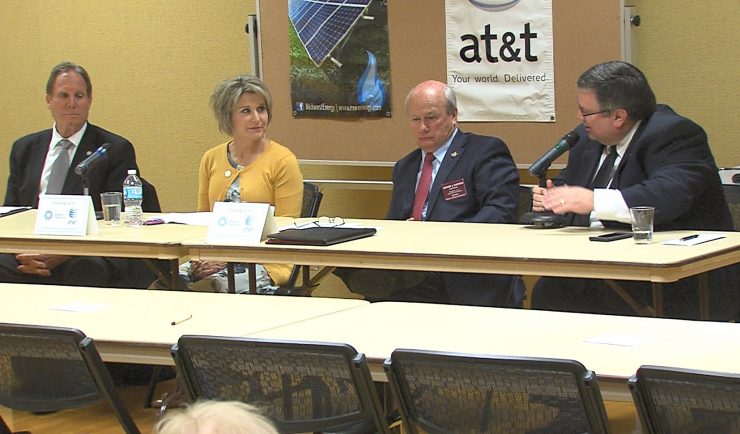
Sen. Rick Billinger (R-Goodland), Rep. Barb Wasinger (R-Hays), Rep. Leonard Mastroni (R-La Crosse) and Rep. Ken Rahjes (R-Agra) at Saturday’s legislative coffee in Hays.
By BECKY KISER Hays Post
The first 2019 legislative coffee hosted by the Hays Area Chamber of Commerce Saturday morning was the first-ever for 111th Dist. Rep. Barb Wasinger, R-Hays. She was elected in November, defeating incumbent Eber Phelps, D-Hays, and resigned her seat on the Ellis County Commission.
“It’s been a long time since I’ve was a freshman,” Wasinger joked with the 35 or so attendees in the Fort Hays State University Black and Gold Room.
Rounding out the legislative panel were 100th Dist. Rep. Ken Rahjes, R-Agra, who had to leave early to attend a family funeral, 117th Dist. Rep. Leonard Mastroni, R-La Crosse, and 40th Dist. Sen. Rick Billinger, R-Goodland.
Rahjes announced he is the new chairman of the Higher Education Budget Committee. Presidents of the universities, colleges and technical schools in Kansas, including FHSU’s Dr. Tia Mason who was in the audience, will appear this week and next in front of the Appropriations Committee.
Following opening remarks, the first question from the audience was whether the legislators would support Gov. Laura Kelly’s proposed $9 million increase to higher education funding.
“We’re focusing and trying to make good investments in higher education,” Rahjes said, noting Friday’s news that Kansas collected $49 million less in taxes than expected in January. The decrease broke a 19-month streak of better-than-anticipated tax collections.
“My first goal as chairman is make sure we at least have what the governor has recommended,” Rahjes replied. “In talking with leadership, I think there are some opportunities to enhance that in some form. I will fight for an increase, absolutely, but I think we need to be cautious and not have a false sense of security that we have a lot of extra money.
“We have been told, and in discussions, this may be the year for increases,” he added. “To get the full increase of what the cut was years ago, it won’t happen. Nobody’s going to be made whole from those, I don’t believe.”
“We’ve got a pie of money and everyone wants a piece of it,” said Wasinger. “As you’ve heard, we’re having [financial] problems with transportation, corrections, the foster care system and we need to pay back KPERS (Kansas Public Employees Retirement System). We need to be as equitable as we can possibly be.”
Billinger went into detail about the “money pie.”
“We have an ending balance of about $900 million. Over $100 million of that was a skipped KPERS payment, $317 million was borrowed from the PMIB (Pooled Money Investment Board), $300 million of that continues to be swept from KDOT (Kansas Dept. of Transportation),” he explained.
“I think it’s a little premature to say we would do any amount for higher ed or other areas. We have a lot of challenges.
“This first year we’re probably going to be okay money-wise, but going forward, we’ve gotta be very careful.”
The legislators were also asked about the Democratic governor’s proposal to reamortize, or refinance, KPERS to keep future state contributions to the pension fund manageable.
Billinger is among 18 Republican senators who’ve co-sponsored Senate Bill 9. It would put $115 million into KPERS this fiscal year to make up for previous contribution delays authorized by former Gov. Sam Brownback and the GOP-controlled Legislature.
According to Billinger, the Senate will vote on the bill Monday.
“We skipped a KPERS payment in 2016 when finances were tight and the legislature promised we would pay it back in 2018 with interest. It still wasn’t very clear where the revenues were and we didn’t make the payment then.
“It costs us $630,000 a month not to pay this payment,” said Billinger.
“We’ve been focusing on this since 2011, when I first came to Topeka. We had one of the worst state-funded pension plans in the country. It was on the verge of bankruptcy.
“We have put $5.1 billion into this since 2011. And now we’re talking about reamortizing. The latest figures I’ve seen is that would cost us $7.4 billion by pushing this down the road.”
Billinger recalled Gov. Brownback talked about amortization two years ago. “The costs are just not doable.”
“A Republican legislature shut down a Republican governor,” added Rahjes. “It’s not political. It’s called being fiscally responsible.”
Mastroni said he’s talked to a lot of other state representatives and there is “huge support” for KPERS. “I think there’s only about 10 years left to get this paid off,” said Mastroni, “and I’d really hate to see the reamortization kick in for 30 years, ’cause that’ll leave $7.4 billion for our grandchildren [to pay] and that’s just plain wrong.”
Wasinger agreed.
“KPERS was refinanced in 1993 with a 40-year term. We’re actually at the last 15 years of paying off that loan,” Wasinger said. “We’re just getting to the point where we’re starting to pay off all the principal. It’s important that we finish this.”
“If this Senate bill passes Monday, and it goes through the House and the governor signs it, it’ll be the first time in 25 years that we’ve hit the actual required contribution,” Billinger said.
There are more than 311,000 current and former public employees whose financial retirement plans are managed by KPERS, according to the KPERS website.
The second HACC legislative coffee, sponsored by Midwest Energy and AT&T, will be held at 8:30 a.m., Sat. April 6 in the FHSU Memorial Union Stouffer Lounge. There is no charge to attend.
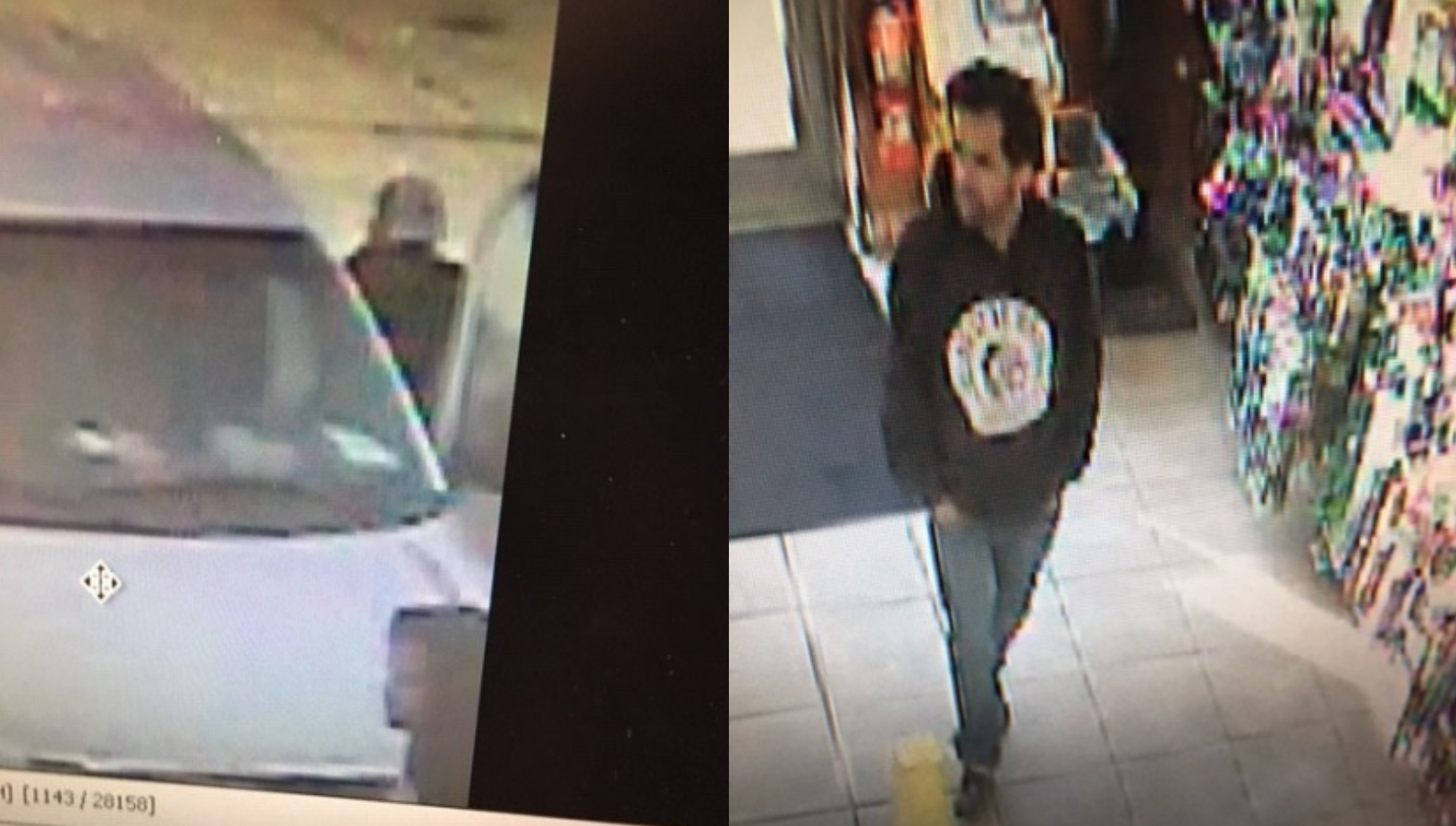
Wanted sexual assault suspect, Tre M. Carrasco was observed getting into the below silver pickup at 10:08 a.m. Sunday at a Colby gas station. The pickup was observed leaving the truck stop heading south toward Interstate 70.
The photograph is of Tre Carrasco at the gas station and he was wearing a hoodie that says “HUSTLE” on the front of it.
Carrasco is to be considered armed and dangerous. If anyone has information on the whereabouts of Tre Carrasco please contact the Hays Police Department at (785) 625-1011. Carrasco is innocent until proven guilty in a court of law.
At 5:42 a.m. Sunday, the Hays Police Department received a report that a female had been sexually assaulted in the 400 block of west 7th Street in Hays, according to a media release.
The suspect has been identified as 23-year-old Tre Miekale Carrasco. He is described as a light skinned black male who is 5-foot-8 tall, weighs 173 pounds, has brown eyes, and black curly hair that is in a short afro. Carrasco may have facial hair and be wearing a red shirt.
Carrasco should be considered armed and dangerous.
Carrasco reportedly stole a 2011 four-door navy blue Chevy Malibu with tinted windows from the scene which has since been located.
Carrasco has three previous convictions that include aggravated sexual battery and aggravated battery, according to the Kansas Department of Corrections.
If anyone has information on the whereabouts of Tre Carrasco, contact the Hays Police Department at (785) 625-1011.
When a busload of passengers is stranded by a blizzard in upstate New York at the St. Mary’s Convent, all of the Marys must be wary.
While a group of nuns are waiting out a snowstorm in their convent, a radio broadcast alerts them of the murder of a waitress at a nearby diner. The murderer is targeting women named Mary — the name of all the nuns and two passengers on the bus.
Guests at Hays Community Theatre’s latest murder mystery and dinner theater “Murder Can Be Habit Forming” have to guess if the killer is among the convent guests before another Mary gets whacked.
As the story unfolds, two more passengers are added to the potential list of victims. One passenger is a flamboyant actress whose TV character is named Mary and another is a retired school teacher who was formerly a nun named Mary.
Potential suspects include the college professor, the newspaper columnist who doesn’t like to see his name in print, and the bus driver.
Police detective Patrick McDougal was also on the bus and takes charge of solving the case.
“Providing as many laughs as chills, ‘Murder Can Be Habit Forming’ is a lighthearted mystery comedy that reveals the very human side of the nuns as they attempt to stay one step ahead of a killer,” the HCT website said.
Shows are at 7 p.m, Friday, Feb. 15, and Saturday, Feb. 16, at the HCT venue, 121 E. Eighth. Doors open at 6:30 p.m. Tickets are $20 each. The meal is being catered both nights by Hickok’s Steakhouse. A pork tenderloin dinner will be served Friday night, and a spaghetti dinner will be served Saturday night.
The meal includes water, tea and coffee. Other drinks will be available for purchase. Tickets must be purchased in advance. Click here to purchase tickets online.
Cheryl Glassman, director, directed the play years ago while she was with the theater program at TMP-Marian. She said the play never gets old and still makes her laugh.
“It is a great story line, and I sit out here and laugh,” she said. “It is very funny, and I miss lines sometimes because there are so many funny lines. It is really cool to watch more and more and get more out of it. It is just a really good show.”
Glassman said the play’s cast of 15 is fairly large for a winter production.
“It is always a challenge to get everyone here, because we are all working people and we come from so many different directions in life,” she said. “Everyone here works. Our youngest people are high school aged, and our oldest cast member is 72, so quite an age range.”
She said the cast has brought together people with varying levels of stage experience.
“We have people who have never been in a show before, who are in this show and have evolved into these awesome characters,” she said. “It really gives me goosebumps when I think about it. You see people who are really shy and timid, and once they start getting into their characters and understand what is needed to portray that person, you don’t even realize it is that person on stage anymore. For me, that is the best part — watching them evolve.”
The Hays Community Theatre is trying to offer more shows in its new venue on Eighth Street.
“It is basically because we want to get more people involved and have more for the community to enjoy and do versatile things that are different,” Glassman said. “Some people might want to go to this type of show but others might like that type of show.”
She said HCT will still utilize other venues for other productions like their big summer show.
“For this type of show it is perfect,” she said of their venue on Eighth Street. “We have people who come from all different directions who help us with the set. When I first walked in here, we were all sitting around a table, then I walk in and there is all this stuff up here.”
HCT will also perform the play a week after they wrap up in Hays at a fundraiser for a group in Great Bend.
Kansans are paying more for electricity than other states, according to a recent report from the Kansas Corporation Commission.
However, Hays-area customers who receive power from Midwest Energy pay more favorable rates than customers served by the state’s largest power provider, Evergy. Evergy was formed by the merger of Westar and Kansas City Power and Light last year.
“Midwest Energy’s electric rates are competitive statewide, with investor-owned utilities and against the average for co-ops in Kansas. Against electric co-ops in Kansas, our rates on average were 19 percent below those of the average Kansas cooperative,” said Mike Morley, director of corporate communications for Midwest Energy.
Between June 2016 and June 2017, monthly bills based on average residential consumption of 916 kWh were $121.40, while the national average was $120.56. An equivalent Midwest Energy bill would have been $105.52. These numbers were calculated without taxes.
Special interest groups, especially business and industry, are calling for a legislative review of electric rates in the state, saying the high rates are making it difficult for them to stay competitive.
“We are ahead of our peers in providing renewable energy, meeting federal and state environmental regulations and ensure our transmission system is modernized and reliable,” Caisley said in the press release. “Our prices are competitive with the national average. As utilities in neighboring states continue to invest in their infrastructure, they are asking to increase prices to recover those investments.”
Several of the factors that have resulted in an increase in power rates for Evergy customers are not affecting Midwest Energy.
In its report, the KCC noted installation of emissions-reducing equipment at coal-fueled power plants was one factor that led to utility rate increases.
Midwest Energy was not directly affected by the changes at the coal-fired plants, Morley said. Although Midwest Energy purchases power from Evergy, which has coal-fired power plants, Midwest Energy does so via long-term energy supply contracts, and the costs of any environmental upgrades are contained in those contract prices.
Both Evergy and Midwest Energy have seen the cost effects of improving infrastructure to accommodate the use of wind energy. In 2008 Midwest Energy signed a purchased power agreement to purchase 49 MW of wind energy from the Smoky Hill Wind Farm. In 2017 Midwest Energy signed a purchased power agreement for an additional 57 Megawatts from the Kingman Wind Farm As a result, roughly one-third of its electricity comes from Kansas wind.
Transmission charges for Midwest Energy have outpaced inflation, increasing from .0033 cents per kWh in 2009 to .0088 cents per kWh in 2018.
Morley said transmission charges are hard to compare between utilities because of differences in how they are applied to customers’ bills.
Regulation
Morley said he thought the Kansas regulators can take action to keep Kansas electric rates low.
Morley said he would like to see the Legislature address utility property taxes.
Utilities have real property assessed at a rate of 33 percent in Kansas, which is higher than agriculture (30 percent), commercial/industrial (25 percent) and residential (11.5 percent).In 2018, Midwest Energy paid $8.2 million in property taxes to 43 counties, and those costs flow back to the customer.
Morley also said he would like to see out-of-state power customers pay a greater share of infrastructure costs when power is exported out of state. Midwest Energy has spent tens of millions of dollars over the last decade upgrading and improving its transmission system to allow wind interconnections, even though most of that electricity is sold to far-away markets, Morley said.
Historically, one-third of those costs have been spread regionally through the Southwest Power Pool, with Midwest Energy customers picking up two-thirds of those costs. Discussion is taking place at the Southwest Power Pool to revise that cost-sharing formula and make these transmission projects less costly to local customers.
“One other idea worth considering might be some type of excise tax or fee on wind energy that’s exported out of the state,” he said. “Having that fee offset utility property taxes would directly benefit electric customers, who have had to pay the majority of the cost of building these transmission ‘highways’ for that wind energy to leave the state.”
Smaller utilities have challenges
Despite lower rates, Midwest Energy does have its own challenges. A high ratio of residential customers puts Midwest Energy at a disadvantage when it comes to rates.
“Generally speaking, the more large commercial customers a utility serves, the more positive effect on rates,” Morley said. “This is because large commercial loads (factories, manufacturing) are the most economical to serve, as they have a high “load factor” – they consume a lot of electricity at a consistently steady rate over time.”
Midwest Energy’s customer breakdown is below.
Residential:59.8 percent of meters; 21 percent of kWh sales Small commercial and oil:34.9 percent of meters; 47 percent of kWh sales Large commercial: .1 percent of meters; 27 percent of kWh sales Irrigation: 5.2 percent of meters; 5 percent of kWh sales
Customer density is another factor. Utilities in more urban areas often have customers-per-mile ratios of 25 or more, Morley said.Midwest Energy has 4.4 customers per mile of line.All other factors equal, lower customer densities mean higher rates.
Although Hays benefits from lower electric rates, it needs other resources to bring new businesses into the region.
“Our commercial and industrial rates are competitive with those throughout the region,” Morley said. “While there are many challenges in recruiting industrial customers to the region (labor force availability and housing are often cited, as are proximity to markets), we work hard to minimize costs, keeping our rates as low as possible and competitive within the region.”
Change in rate structure
In 2018, Midwest Energy requested a change in rate structure, but it should result in a $0 increase in revenue for the utility.
Midwest Energy bought its W system from Westar in 2003. M system customers were often paying more for electricity than W system customers. The rate structure changes bring rates between the two systems closer together over three years.
The changes also simplify rate designs. For years, Midwest Energy had “inclining block rates” during the summer months. As usage moved up through the blocks, your per-kWh rates would also increase. The new rates bring a lower, year-round per kWh rate for all customers.
If you are interesting in better understanding your residential bill, click here. You can also see a Q & A about the change in the rate structure by clicking here.
“I can only speak for Midwest Energy, but generally speaking, we predict rates to be fairly stable in the intermediate term (next three years), with modest rate increases approximating inflation over the next 10 years.We will examine all opportunities to control costs and keep rates affordable,” Morley said.