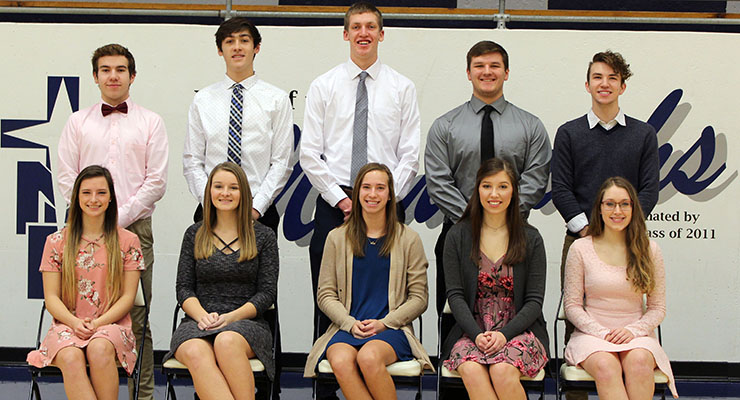
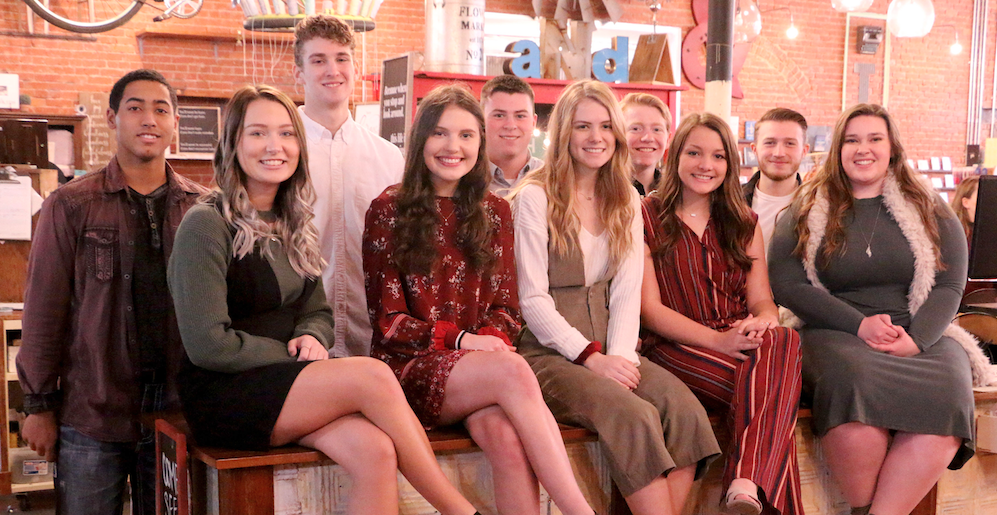
Thomas More Prep-Marian has announced the 2019 Sweetheart candidates. The crowning will be Friday at halftime of the boys basketball game.
The candidates are pictured from left: Hunter Jacobs is the son of Francis and Stephanie Jacobs and Kiara Urban is the daughter of Steve and Brenda Urban. Jack Johnson is the son of Stacy and Jennifer Johnson and Emma Pope is the daughter of Jason and Dr. Michelle Pope. Jared Mayers is the son of Stan and Pam Mayers and Julia Werth is the daughter of Darin Werth and Julie ’96 (Richmeier) and Jason Robben. Kaleb Hagans is the son of Ryan and Stephanie Hagans and Emily Schulte is the daughter of Matthew and Anne 84′ (Wierman) Schulte. Dylan Werth is the son of Darin Werth and Julie ’96 (Richmeier) and Jason Robben and Alexandra Herrman is the daughter of Troy and Tina Herrman.
Rebecca Whitmer, Wilson fourth-grade teacher, nominated her student Brandon Dague for the January Best of the Best Award.
By CRISTINA JANNEY Hays Post
Rebecca Whitmer, Wilson fourth-grade teacher, nominated her student Brandon Dague for the January Best of the Best Award because of his kindness to his fellow students.
Whitmer focuses on one positive character trait each month. On Mondays Whitmer presents the students a quote about that trait. On Tuesdays, the students set goals around the trait. On Wednesdays, they read aloud pieces that have that trait as the theme. On Thursdays, they have class discussion, and, on Fridays, the students do shout-outs to students and staff who exhibit that trait.
During the month of December, the class’s trait was kindness.
Dague‘s goal for the week was to write students in his class positive notes. On his own time, he wrote personalized, uplifting notes to his classmates. He came in early the next morning and delivered the notes.
He revised his goal and decided to write everyone in the class positive notes. He wrote another round of notes that night.
“As he was dispersing the notes on the desks, he brought one to me as well,” Whitmer said. “It put such a smile on my face and started my day on such a bright note.
“As I watched his classmates come in and go through their arrival procedures and they started reading theses notes, the smiles that I saw just meant so much and warmed my heart. Just being able to start the day off on that positive note because of Brandon was incredible.
“I think the best part was that he perpetuated that cycle of kindness we had been talking about, and some of the other students who had received the notes decided they were going to start to write kind notes to their classmates as well.”
Whitmer said she was happy to have Dague in her class this year. She emphasized the importance of a positive classroom.
“He is so friendly. He is very polite,” Whitmer said. “He will go above and beyond for anyone. He is someone who lifts people up. If we share success, he is the first person to congratulate them. If he sees someone sitting by themselves, he will go up and try to include them as well.”
Dague also works hard in school, she said.
“He comes to school ready to learn and do his best, gives his best effort and keeps pushing himself every day,”she said.
Mackenzie Flinn
Krysten Linenberger, Munjor Early Childhood Connections lead teacher, nominated Mackenzie Flinn, assistant teacher, for the staff Best of the Best Award.
Krysten Linenberger, Munjor Early Childhood Connections lead teacher, nominated Mackenzie Flinn, assistant teacher for the staff Best of the Best Award.
Linenberger said of Flinn, “She is always smiling when she comes in. She always stays calm when working with all kids, which is really hard with toddlers. She jumps in and does what is needed from helping kids one on one to taking over a group setting if I am needing to leave.
“She always asks if anything else is needed to be done. If I ask her to do anything, she does it quickly and with a smile on her face. She gets along with everyone in the classroom and makes the classroom run very smoothly.”
Downtown Hays Development Corp. is selling more tickets and will offer more beer than ever for its fourth-annual Brews on the Bricks Craft Beer Festival on May 4.
“We are super excited because every year this festival continues to surprise us and change and evolve,” said Sara Bloom, DHDC executive director. “Four years ago, we were thrilled when the tickets sold out in four hours. And then we were completely caught off guard the next year when they sold out in 15 minutes. Now they are selling out closer to four minutes.”
There will be 2,000 tickets available, of which 250 will be VIP tickets.
Tickets go on sale Friday, Feb. 1.
Ticket sale times and locations are below:
• 7 a.m., Downtown Visitors Center, 1200 Main, Suite 102 (The DHDC office will open at 5 a.m. to start handing out numbers, but you must be back in line at 6:45 a.m. to purchase your tickets.) Two hundred general admission tickets and 50 VIP tickets will be available at this time.
• 8 a.m., online sales at www.downtownhays.com. The remaining 200 VIP tickets and 1,250 general admission tickets will go on sale.
• 5 p.m., Gella’s Diner and Lb. Brewing Co., 117 E. 11th. 150 general admission tickets for sale.
• 5 p.m., Defiance Brewery, 2050 East U.S. 40. 150 general admission tickets for sale.
Both breweries will be handing out numbers for ticket purchases. People can purchase and enjoy a brew while they wait for tickets to go on sale, Bloom said.
There will be a total four-ticket purchase limit per person, per location.
Ticket prices are:
• VIP, $80 in office, $85 online
• General admission, $40 in office, $45 online
General admission tickets get you in from 2 to 5 p.m. and a small sampling glass. You can try samples from 50 breweries this year. Brewers usually bring two to four beers each.
VIP ticket holders get in early at 12:30 p.m. They receive a small sampling glass as well as a full-size commemorative beer mug.
The event also hosts food trucks and food vendors that will provide samples.
“It is pretty special to be VIP,” Bloom said, “because instead of fighting 2,000 people, we only let about 250 to 300 in. It is a very nice, intimate part of the event. You get to enjoy the food pairings along with the brews that are there at the event.”
The Home Brew Competition is coming back for the third year. VIP ticket holders are the only ones who get to sample the home brews. The Home Brew tent will be moved to the west side of 10th Street, so VIP ticket holders won’t have to cross Main Street.
The event will be judged by the experts on Friday night, so the VIP ticket holders can sample from the winners on Saturday. Brews goers will still be able to vote for a People Choice winner on Saturday.
Bloom talked about other changes in the event this year.
Because the date has bee moved to May 4, which is also known as Star Wars Day, DHDC will sell a limited number of Star Wars-themed Brews T-shirts. Green T-shirts will feature Yoda, and a black T-shirts will feature Darth Vader.
May 4 is also National Home Brewer Day. To her knowledge, there are no other craft brew festivals in the area on that date, Bloom said. The later date hopefully will be more convenient for the brewers and warmer than last year’s event.
Bloom explained why the event is important to DHDC and downtown Hays.
Further information on the event is available on DHDC website, including forms if you are a brewer or food vendor who wishes to attend or company who wishes to sponsor the event. The DHDC is also always looking for volunteers.
Eagle Communications, which owns and operates the Hays Post, is the Golden Stein Sponsor for this event.
The Hays USD 489 school board Monday night heard a summary of projects from its architect and construction manager that could be the district’s next bond issue.
DLR Group along with Nabholz Construction presented a list of projects totaling $29.4 million that would include finishing air conditioning projects at the Hays High School, expanding the cafeteria at Hays Middle School and renovating Roosevelt Elementary School to accommodate five sections of each grade.
Roosevelt now holds three sections of each grade. The expansion would allow the district to close Lincoln Elementary School, which is one of the oldest schools in the district and has had serious infrastructure problems in recent years.
Some work on the HHS HVAC system has already been finished with capital improvement funds, but an additional $6.7 million is needed to complete the work.
The HMS cafeteria was built to hold about 450 children, but is now accommodating about 700 students. Expansion of the cafeteria would cost $1.3 million.
The HMS cafeteria was built to hold about 450 children, but is now accommodating about 700 students. Expansion of the cafeteria would cost $1.3 million.
The suggested renovation and expansion at Roosevelt would cost about $21.3 million and include new classrooms, an expanded cafeteria to meet the needs of the increased student population and a new gym that would serve as a storm shelter. Roosevelt does not currently have a storm shelter.
Existing classrooms would be renovated, the HVAC system improved and some exterior improvements would be made.
The entrance of the school would be relocated to the new addition. This would allow for separate lanes for car and bus drop off.
“Roosevelt, it really had the best assets. The one issue it did have was that it didn’t have a storm shelter, and we are solving that,” said Amber Beverlin, principal senior architect DLR Group. “It had great classroom spaces. The classrooms that are there now are perfect size. We can build on all the great things this building already has.”
The Roosevelt project would take 16 to 18 months to complete.
Dustin Avey, senior vice president Piper Jaffray, presented options for 10-, 15- and 20-year financing. He noted the district would pay less in interest under a shorter term, but the taxpayer would pay a higher per moth tax for a 10-year versus 15-year bond.
The district would pay $5 million more in interest by increasing the bond term from 1o year to 15 years.
The cost per month on a $150,000 home for a 10-year bond would be $16.32, $12 per month for a 15-year bond and $10.06 for a 20-year bond.
The mill levy would be 11.35 mills for a 10-year bond, 8.35 mills for a 15-year bond and 7 mills for a 20-year bond.
The bond amount would include design and bond fees, and costs for furnishing the renovated spaces.
The board members asked the presenters questions, but did not discuss the merits of the proposal nor did they vote on moving the proposal forward.
The district would not need approval from the state to move forward with a bond vote. Beverlin said if the board wished to pursue the proposal, they would only need to notify the county clerk of its desire to call a special election. This requires 60 days notice. Beverlin recommended a mail-in ballot.
Hays has had two failed bond issues in the last three years. A $78.5-million bond failed in November 2017, and a $94-million bond failed in June 2016.
A parent addressed the board about his daughter being bullied at Lincoln Elementary School. He said someone at the school was supposed to contact him about his concerns, but no one called him. Board members expressed concern about the issue and directed Superintendent John Thissen to take the parent’s information and follow up on his concerns.
Check presentation
Edward Herrman on behalf of the HaysMed University of Kansas Health System presents a check for $500,000 to USD 489 for renovations to the former Oak Park Medical Complex.
The school district recently purchased the former Oak Park Medical Complex, which it plans to renovate for use by Early Childhood Connections.
HaysMed had a majority interest in the complex and Monday donated $500,000 of the $2 million purchase price back to the school district to be used for renovations. The district has also received a $1.47 million federal grant for renovations.
Superintendent search
Gary Sechrist, field specialist for the Kansas Association of School Boards, provided the superintendent applicant information to the board during an executive session. Current Superintendent John Thissen has resigned. He will serve out his contract, which ends June 30.
At the next board meeting, the board is scheduled to vote on the administrative contracts for Shanna Dinkel, assistant superintendent, and Chris Hipp, director of special education, for the 2019-2020 school year.
Teacher negotiations
Board member Pauls Adams also asked the board to consider moving to interest-based bargaining with teachers. Thissen said he would contact the Hays NEA to see if they were interested in the change. The issue will be discussed at a future meeting.
Tariff wars, low commodity prices, weather and isolation all take their toll on farmers and rural residents who depend on the agriculture economy.
Those stresses are starting to show in some alarming statistics in northwest Kansas.
Between 2014 and 2017, the suicide rate in the 20 northwest counties served by High Plains Mental Health increased by 64 percent. In addition, a Centers for Disease Control study released in July 2016 reported farmers, fisherman and forestry workers as a group had the highest suicide rate of any occupation in the U.S.
High Plains Mental Health is trying to reach out to this affected population through new printed materials, telemedicine services and Mental Health First Aid training.
The suicide rates are not just getting attention from community mental health professionals.
Sen. Jerry Moran, R-Kan., championed the Farmers First Act, part of the most recent Farm Bill. The act establishes helplines and suicide prevention training for farm advocates, and re-establishes the Farm and Ranch Stress Assistance Network through state departments of agriculture, state Extension services and nonprofits.
“We don’t know completely,” David Anderson, High Plains director of clinical services, said when asked why he thought the number of suicides had jumped. “I think we believe certainly the farm economy plays a role in that. It may be that they are being more accurately counted. There was certainly a time, because of the stigma around suicide, that corners, particularly in small communities, there was some desire to not attach a suicide to a what might have been called an accidental death.”
Brenda Seaman, High Plains assistant clinical director, comes from a farm family. She says she sees farmers facing many circumstances that are out of their control.
“What other profession do you have where you certainly don’t know what the commodity price will be for the product that you are making every year?” she said. “It could be $15 soybeans. It could be $6 soybeans. You don’t know when you plant them.”
If the price is good, that usually means other growers have had catastrophic crop loss due to weather. Regardless of the price of the commodity, the input prices go up every year.
“The weather is out of your control,” Seaman continued. “The overall political environment is out of your control, so now there is tariffs and trade wars. These are not predictable.”
Seaman said communities and loved ones should also remember those families whose livings depend on agriculture, because when the ag economy is down, they suffer too.
Farming is not an easy profession to walk away from when you are one of multiple generations who have lived on and worked a piece of land, Anderson said. There is an emotional attachment to the land.
“It is not just the economy of ‘Can you make this work?'” he said,” but it is the pressure of generations. This has been in the family for a long period of time. You don’t want to be the person who ends up losing that land or the farm.”
Technology is requiring fewer people to operate farms and farms are consolidating.
“My wife’s family farm is out near Collyer,” Anderson said. “Thirty years ago, there used to be several family farms in that area. Now there aren’t.
“More of the land is rented. Instead of a community of families in the area who relied on each other and helped each other, there may be more isolation. We know that across populations that is one of the factors that increases depression, anxiety and the risk for suicide.”
Population loss in rural Kansas counties is only projected to increase, further worsening isolation and leading to the lose of vital services for rural families, including local schools, hospitals and grocery stores.
Stigma is a serious impediment for farmers to receive help in a mental health crisis, Anderson said. They consider themselves independent, resilient and self-reliant, and it can be difficult for them to admit they need help.
Although rates are on the rise in Kansas for women, suicides in Kansas were highest among white men, age 25 to 64. During the farm crisis in the 1980s, Anderson said mental health workers were encouraged to try reach out to farm wives to reach men in farming communities that may be at risk.
High Plains is implementing a similar strategy today by putting information and resources in the hands of people who interact with farmers and their families the most.
A new brochure titled “Hope in the Heartland” is being made available to extension agents, rural bankers and grain elevators.
Kaley Connor, High Plains marketing director, said local county governments have reached out to the agency for Mental Health First Aid training courses for their employees. The 8-hour course helps to prepare people to help individuals who are experiencing a mental health crisis.
“A lot of what we are doing with the pamphlet and Mental Health First Aid is trying to raise awareness and break down the stigma surrounding mental health services — that it is OK to reach out for help if you are struggling, that mental illness is a real illness and it needs to be taken seriously. It is not a sign of weakness if you need to reach out to somebody.”
Farmers’ and ranchers’ schedules are also often not conducive for out-patient therapy visits. However, telemedicine, satellite clinics, and partnerships with rural hospitals and clinics are making mental health care increasingly accessible for rural residents.
The vast majority of clients are seen in the community on an outpatient basis, Anderson said. If a person who is suffering from depression or suicidal thoughts can ensure their safety, they will likely not be admitted to a hospital. Even those who do receive in-patient treatment for depression usually have very short stays.
If you or someone you know is at immediate risk of suicide, call 911. Call High Plains at 1-800-432-0333 to get started with a mental health screening or to access crisis services, which are available 24/7 with a qualified mental health professional.
High Plains also offers a sliding-fee scale for services based on income.
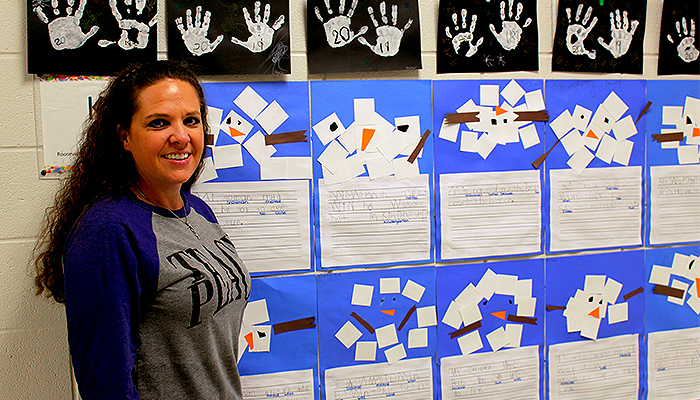
Heidi Wamser, Roosevelt kindergarten teacher, stands outside of her class in front of her students’ hand prints and melted snowmen art.
Editor’s note: This month’s Hays Post Teacher of the Month was awarded a special prize. Heidi Wamser, Roosevelt kindergarten teacher, will be the honorary game captain at the Harlem Globetrotters game Feb. 5 at Gross Memorial Coliseum.
By CRISTINA JANNEY Hays Post
When you walk into a classroom full of students who love you and are all excited to be at school, it is an easy place to be, said Heidi Wamser, Roosevelt kindergarten teacher.
Wamser is in her 19th year of teaching kindergarten, all of which have been in Hays USD 489 schools.
She was nominated to be January’s Hays Post Teacher of the Month by parent Brandi VonLintel.
“Throughout every parent’s journey in their child’s education, many of us are lucky to have teachers like Mrs. Wamser,” VonLintel wrote in her nomination. “She taught my child four years ago and still has left an imprint on him to this day.
“Helping in her classroom throughout his year with her, I saw exactly what every child got to experience while in her care. She has the ability to inspire, ignite imagination and truly care about her students — going above and beyond to provide extra activities and special treats throughout the year.”
VonLintel continued, “I cannot thank her enough for helping instill the love of learning in my child, and I know without a doubt that she will continue to do this for all of her classroom children throughout her career.”
Wamser said she loves teaching kindergarten because of the kids.
“The biggest thing is that they still love every minute of being at school,” she said. “They love each other. They love their school. They love their teacher.
“Plus the math gets super harder as you get older, and I am not good at math,” Wamser joked.
Wamser said her favorite part of teaching the littlest students is when they learn something new.
“I think the best is the light in their eyes and the moment they actually figure something out they have been working so hard on,” she said. “You can literally see the light bulb go on by the smile on their face or you can see their shoulders aren’t hung anymore.
“I always try to tell them, ‘Look what you did! Look what you figured out!’ So that they know this was on you. This is not me. It wasn’t me who figured it out. You did. You are 5 or 6 and you read that book or you wrote that story or you did that math problem. I don’t think you see that kind of joy and love in classroom work at the upper grades as much.”
Wamser comes from a family of teachers. Both her father and mother were teachers. Her mother taught for more than 30 years at Munjor and then at Wilson Elementary School.
“I saw the work she put in,” Wamser said. “She was a first-grade teacher and then switched to second grade. Weekends, nights, holidays — she was always at school. I knew that it was going to be a difficult profession, but yet so rewarding in the end.”
Wasmer said she has seen that reward in her career. She has the opportunity to touch the lives of the 23 children in her class seven hours per day for 10 months out of the year.
“Everyone’s profession is important,” she said. “One couldn’t do something without another. But when you think about it, lawyers couldn’t be lawyers without a teacher. Doctors won’t be doctors without a teacher. A teacher has to touch every single person’s life. No matter what their outcome is as a job or profession, they are influenced by a teacher all the time. It is a pretty powerful position to be in.
“People who teach are amazing individuals. It is a lot when you sit down and think about it.”
She takes that position of power seriously. She described kindergarten as the children’s ground floor. She builds on that ground floor through positive reinforcement, teamwork and success.
When a child accomplishes a task, Wamser encourages the child to share the accomplishment with his or her friends.
“For instance if Legos was in groups this week and someone created their snowmobile, we show the entire class. Everyone gives that child a round of applause and we take their picture and we post it — so parents can see and their friends can see. It becomes an important thing, and it drives them in the end to create again. When they have another group like that, they are more apt to work hard to see if they can get to that point again.”
One of Wamser’s great honors in her teaching career was teaching both of her daughters. During school hours, the girls had to address their mother as Mrs. Wamser, but it was still “Mom” at home. The children in her class didn’t figure out until January when her oldest daughter’s birthday rolled around the two were related. The children in her youngest daughter’s class didn’t figure out the relationship until almost spring break when the class started talking about last names.
“Not treating them differently was tricky, because I am Mom, but yet being able to see everything that they were experiencing at a kindergarten level because I was the teacher, that was pretty amazing,” she said.
In January, Wamser focuses lessons on Martin Luther King Jr. and the holiday that celebrates his birthday. She wears a “Teach Peace” T-shirt and the children participate in an activity involving eggs. This activity provoked one of her favorite teaching memories.
Wamser brings in eggs that are brown, white, speckled and sometimes blue. The children talk about how the exteriors of the eggs look very different. She then asks the children what they think the eggs will look like on the inside. Most of think the eggs will look very different on the inside. She cracks the eggs and all of the eggs look the same on the inside.
She has the children look at their skin and hair. They notice that they all look a little different.
One year, Wamser had a boy in her class whose father was from Africa and had dark skin. When the children compared skin, it was if for the first time he realized that his was different.
“At 5 years old, it took 87 days for him to figure out, ‘I’m different on the outside,’ but in kindergarten you can make them believe they are all the same. They are all 5 and 6 years old. They all look the same. They all feel the same. …
“Then all of the other kids were,’So, who cares that you look different on the outside?’ By that time we had opened up all the different eggs, and the kids said, ‘But you are the same on the inside. You’re our friend, and that makes you like everybody else.’ I tear up, because they are so innocent and so lovingly blind to the fact people are different. What point do they change and become nasty to each other? Everyone needs to see that lesson from a 5 and 6 year old’s eyes — to see, ‘No, everybody’s the same.’ ”
She said she walks away from instances like that and thinks, “Thanks for teaching me something today.”
Wamser tries to end each day with a moment of love and reassurance. Each child can opt for a handshake, high five or a hug as they leave her class.
“I feel they walk out with something positive even if it has been a really cruddy day or something happened. So the next day they are still going to know that Mrs. Wamser is still going to love you. She is still going to be right here at the door. Sometimes the most normal part of a child’s life is that seven hours they are at school in the day.”
A unanimous vote to approve a rezoning request in east Hays was preceded by discussion among city commissioners Thursday night about rezoning procedures and notifications to the public.
The request had already been approved by the Hays Area Planning Commission during a public hearing Dec. 17, 2018.
Luke Oborny lives at 1720 Wheatland Ave. His home is near the property at the southeast corner of 22nd and Wheatland that was approved for rezoning from neighborhood to commercial.
Luke Oborny wants Wheatland Avenue to remain a Neighborhood zone.
Oborny said he feels the requirement for notification of property owners within 200 feet of the rezoning request “isn’t very far” and should be increased. “We would like Wheatland Avenue to remain residential.”
Speaking to the city commissioners before they voted, Oborny said he and his wife Kristy were not notified of the public hearing by the planning commission and felt they should have been contacted.
Mayor Henry Schwaller noted the planning commission is a legally separate entity from the Hays city commission.
“We can’t tell them what to do but they could consider a bigger notification area,” Schwaller said.
“They can,” confirmed John Bird, city attorney. “That makes sense to me,” added Schwaller. “[Oborny’s] house is not very far away.”
“The process doesn’t feel right or transparent,” Oborny added. He was also concerned about the variety of commercial operations allowed in the requested C-2 Commercial General District zoning. “What does it leave out?”
According to the city’s Unified Development Code (UDC), C-2 zoning includes 28 allowable businesses, from offices and group day cares to drinking establishments and gas stations.
“This lot would not be appropriate for most of these uses, but some of them, yes. Regardless of our business tonight, would we want to revisit this in a future discussion and change the zoning groups?,” Schwaller asked the commission.
“We’re not supposed to know what’s going to go there but they’re seeking this so they can operate a business.”
Jesse Rohr, public works director, told the commission all property owners within 200 feet of the subject property were notified of the Planning Commission public hearing, as required by state statute.
Property to the north, south and east is zoned residential, including general, single family and duplex, and multi-family.
The property across Wheatland Street to the west is zoned C-2 and is the site of the Kansas Dept. of Children and Families building.
Commissioner Sandy Jacobs said she appreciated the Obornys coming to the meeting with their concerns.
“It seems to me the use that’s being requested is pretty complementary for that area given the fact that North Central Kansas Technical College is across the street and the hospital is across the street,” Jacobs pointed out. Both institutions are on the north side of 22nd Street.
(Click to enlarge)
“Since C-2 zoning is across the street (west to Canterbury) and as you go east to the other end of 22nd to Bruckner’s, it feels right to me for that whole thing,” she said, adding she’s also in favor of any future discussion about zoning.
“A lot of the things in C-2 can be eliminated because of this lot size,” noted Commissioner Ron Mellick.
“The letter of the law was followed,” said Commissioner James Meier, “but Mr. Oborny feels like it wasn’t above board, perhaps.
“… I do think that we need to be very cognizant of being completely above board and giving everybody notice. I understand the 200-foot rule or notification comes from the state statute, but I agree there’s no reason why we can’t give more notice.”
Indian Call candidates for Hays High School have been selected. The king and queen will be announced between the girls and boys basketball games on Feb. 8.
2019 Hays High Indian Call candidates: Front row – Alyssa Underwood, Hannah McGuire, Madyson Flax, Brittany Pflaum, Hannah Harman. Back row – Tradgon McCrae, Cade Swayne, Jack Fort, Johnny Fuller, Jacob Maska.
A new rocket-powered ice cream truck might bring you ice cream from the moon someday if some ambitious entrepreneurs from Wilson Elementary have anything to say about it.
Hays High DECA students are celebrating entrepreneurship this week with an elementary student product build and a speaker.
DECA at Wilson
Cassidy Prough, HHS DECA student, discusses the rocket-powered ice cream truck that Wilson students Ben Zeller and Braxton Delzeit have created for their entrepreneurship project.
With the aid of DECA students, the first-grade students drew their creations Wednesday. On Friday, they will build the products out of Legos, present to the class and explain where they would sell their products.
One group of Wilson students created a rocket-powered ice cream truck that would sell alien ice cream.
Another group drew pictures of cherry, strawberry and other food-shaped inflatables for swimming pools.
Another group developed their own Fortnite characters, while two other groups drew images of various designs for jets and airplanes.
“We are trying to promote entrepreneurship around the community,” Madelyn Waddell, junior DECA student, said. “We wanted to use Legos for the kids to express their creativity. We picked the first graders because they are in the middle of learning how to add up money and learning how to use their creativity to put it on paper or build it somehow.”
Although the cost of the students’ projects were supposed to be limited to $5, the students differed greatly on how much they thought their products should sell for.
One group of students who designed jets thought their planes should cost between $100 and $900.
Whereas the students who designed the Fortnite characters thought their in-game purchases should cost “$2,000 billion.”
On Wednesday, the HHS students also read the first graders a book about a person who was struggling to sell lemonade.
Former DECA student returns to HHS for speech
Allyson Werth, a former HHS DECA student and recent FHSU grad, speaks to Hays High students on Wednesday.
Also on Wednesday, HHS students were invited to hear Allyson Werth, a former HHS DECA student and recent FHSU grad, talk about her Farmhouse Crafts business.
Werth started her wooden sign business when she was still in college in 2016. She bought a commercial vinyl cutting machine from her father-in-law.
This allowed her to create custom signs for business windows, wooden signs and door mats. She also offers DIY workshops.
Her signs start at about $35 each. Because all of the signs are custom designs, she requires payment in advance.
Although she has sold to people of all ages and genders, she determined her target market was women between 20 to 50 living in the U.S. She has primarily marketed through word-of-mouth and social media, including Facebook and Instagram. She does giveaways through Facebook posts. She also offers coupons to returning customers.
“More than 50 percent of my customers are return customers, so it is very important that my customers are happy and satisfied with the work that I have given them,” she said.
She said community involvement is important. This helps her grow her customer base through personal interactions. She also gets advice from national social groups of other entrepreneurs and crafters.
In 2018, she launched on Etsy and shipped to 15 states. However, the additional cost and labor involved with handling Etsy orders led her to closing that account at the beginning of this year.
Since graduation, Werth has taken a full-time job in addition to her craft business. She said orders tend not to be stable in her business, which makes it difficult for her to rely on that as a sole source of income.
A home business takes a lot of self-discipline, but Werth said she enjoys being able to set her own hours, learn from her business and take on new challenges.
She also said she received a great deal of satisfaction knowing people enjoy her designs and are pleased with her work.
One of her goals is to start a website for her business this year.
“I always tell people to follow your dreams,” she said. “People are always going to say you are never going to make it in the real world having a business, so that is when you need to weed out that negativity and tell people you are going to make it. It may take awhile. You are not going to be a $100,000 company in a day. It is going to take years and years to build your experience before you get to where you want to be.”
“Many business owners say they are never where they want to be. They are always learning and growing to build their business.”
The theme of this year’s campaign is Passion to Paycheck. The co-chairs of the campaign are Hays High DECA members Brooke Denning, Cassidy Prough and Madelyn Waddell.
DECA prepares emerging leaders and entrepreneurs for careers in marketing, finance, hospitality and management in high schools and colleges around the globe. There are 215,000 members worldwide.
Hays High DECA is active in the community by organizing and conducting the annual Trick or Treat So Others Can Eat Food Drive, supporting and raising funds for Ronald McDonald House Charities of Wichita, and conducting various public relations campaigns as well as various related marketing projects. Hays High DECA members also compete at a state and international level.
A HHS DECA student works with Wilson Elementary first graders Jan Pulido-Ortiz, Noah DeBey, Ella Giebler and Carter Carlisle to create a new product that they could build and sell.Two Hays High DECA students read to first graders Wednesday at Wilson Elementary School.Ella Giebler, first grader, colors her product during a DECA project at Wilson Elementary School.
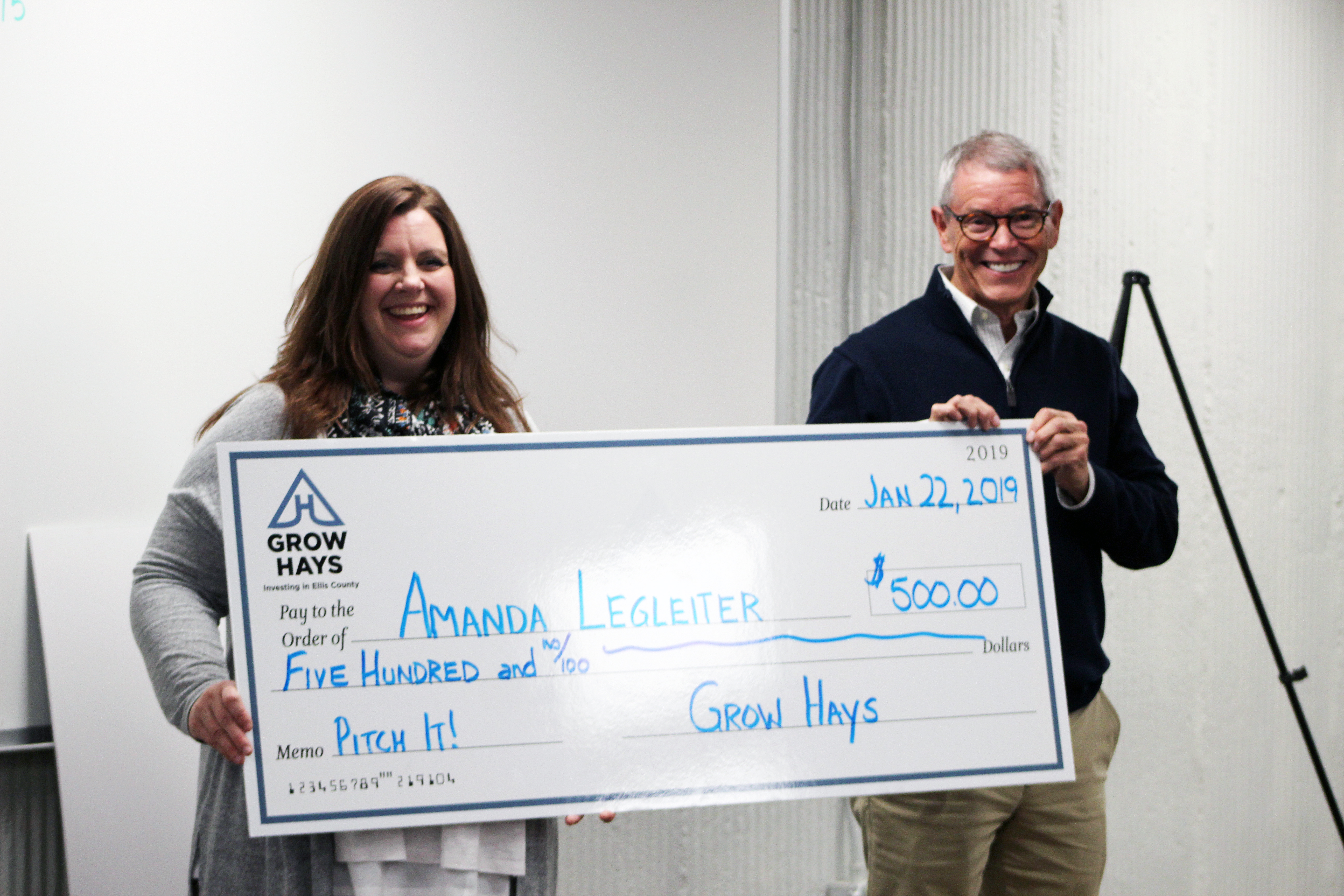
Amanda Legleiter, owner of Chroma Quilting, was the winner of first Grow Hays Pitch It challenge Tuesday night.
By CRISTINA JANNEY Hays Post
Grow Hays hosted its first “Shark Tank”-style Pitch It session Tuesday night at BriefSpace.
Competitors proposed a diverse range of products and services. A Fort Hays State University student proposed an app that could alert you to gunshots in the area. Another young man proposed building fire starters that use a chemical reaction. Other presenters included an art therapy nonprofit, a quilter, a service to help people increase their credit scores and a entrepreneur with his own line of vape juice.
Each presenter had five minutes to pitch with three minutes for questions from the judges. The winner went home with a $500 cash prize.
Chroma Quilting
Amanda Legleiter, owner of Chroma Quilting, was the winner of the challenge and took home the prize money. She hopes to move her business out of her basement and into a Hays storefront.
Legleiter uses a long-arm quilter to create throws, T-shirt quilts and complete other projects. She also would like to offer quilting classes. In the local market, Legleiter said she found there were long wait times at current quilting business and a large number of long-arm quilters retiring from the industry.
She said by creating more visibility she hopes to increase her client base.
SafetEaves
Hayden Hutchison
Hayden Hutchison, a Fort Hays State University student, proposed an app that would alert the user of a gunshot in the area.
The app is based on similar technology marketed by ShotSpotter, which is being used in neighborhoods by law enforcement to detect gunshots and increase response times.
Hutchison said gunshots have a unique audio fingerprint that is distinguishable from other similar sounds that might cause a false alert, such as the sound of a gunshot on a TV.
“It would give users time to take precautions and get to a safe environment,” Hutchison said.
The personal security market is growing and is expected to be about $29 billion by 2022. He said he and his partners plan to market the app on a subscription basis.
Hutchison and his partners are looking for a software engineer to help develop the app.
Surtr fire starter
Surtr fire starter
Parker Holterman pitched his Surtr fire starter. The device ejects and ignites a petroleum pellet with a single motion. Unlike other devices that only create sparks and require the user to tend kindling, the Surtr pellets remain lit in all weather conditions for several minutes. The device holds four replaceable pellets.
He has a patent on the device, but has yet to manufacture any of the devices.
Holterman has a company in Wichita that can manufacture the devices and a source for the fuel. His initial investment would depend on what type of quantity discount he could secure for his initial order.
The fire starter market in 2018 was worth $38 million and camping is on an upward trend.
Angels and Umbrellas
Mitch Lindeman of Norton wants to start a nonprofit called Angels and Umbrellas to offer arts instruction to people who suffer from mental illness.
Lindeman himself is a recovering addict and has mental illness. He said art and music has been instrumental in his recovery and he would like to offer that to others who have similar problems.
Mitch Lindeman
When he was in rehab, he played a piano in the center’s music room. Soon people were asking him for lessons. This inspired him to reach out to others through the arts.
“Our mission is to teach members coping skills through expressing themselves through art, music, poetry and creative thinking and to focus on the positive side of these illnesses and change the way we look at mental health,” he said.
Lindeman said he wanted to open a storefront with spaces for art, woodworking, music and other creative endeavors. He also wanted to launch a website that would allow people to share their creations and positive actions in their communities. He said he already has volunteers willing to teach arts courses. The non-profit would sell art projects its to help offset costs.
He has taken the first steps to creating his non-profit, but still needs to file paperwork with the federal government to become a 501(c)3.
Credit Repair Services
Robert Readle
Robert Readle, a local real estate agent, said he wanted to address the increasing problem of people with low credit scores.
A low credit score can affect the ability to obtain a mortgage and other types of credit. It can also affect interest rates.
“So many people underestimate what is going to take to fix this,” he said.
He said it can take months to get problems corrected and it is not a do-it-yourself project.
“Credit bureaus don’t make money by taking your call and fixing what is wrong on the report. They make money collecting data and reselling it, so you are really a thorn in their side. If you don’t know what you are doing, you can really mess it up,” he said.
Although there are some large national companies that offer similar services, Readle said he thought there was a niche for a local business who could offer a personal face-to-face touch.
He said he sees a couple of levels of service, including initial credit repair then a credit monitoring service. Software is available to aid in this type of work, but Readle said he needs a qualified partner, as he already works a full-time job.
“It would benefit our community with higher home ownership and less month-to month costs in budgets by lower interest rates on their loans,” he said.
Hazy Dayz Vapes
Donavan Rogers
Donavan Rogers is seeking a $50,000 investment to open his own vape shop in Hays — Hazy Dayz Vapes.
He has his own vape blend, Throat Punch Vape Juice. He would like to open a storefront in Hays from which he could wholesale or retail Throat Punch as well as sell other vape juices.
He told the group he already has the licenses in place to sell vape juices, but needs between $25,000 and $30,000 to order inventory.
The vape industry is booming, going from $4.2 billion in sales four years ago to $22.4 billion in sales today.
He told the judges his business plan projected he would be able to turn a profit within the first month and he saw room for growth regionally.
One of the judges asked about health concerns associated with vaping. Rogers used vaping to stop smoking and said he feels he is healthier than when he was a smoker.
Doug Williams, Grow Hays director, said he would like to have at least three more Pitch It events this year.
Corrected 12:55 p.m. Thursday, Jan. 24 for the spelling of Hayden Hutchison’s name.
“Megalodon: The largest shark that ever lived” will have a walk-in replica of the massive shark that stretched to 60 feet and weighed an estimated 72 tons.
The exhibit is set to open to the public on Saturday, Feb. 2. The museum will have a members-only opening from 7 to 9 p.m. Friday, Feb. 1. The traveling exhibit is set to be at the Sternberg through Labor Day.
Megalodon are believed to have lived 23 million to 2.6 million years ago. Despite myths and legends perpetuated by movies like last summer’s “Meg,” the megalodon is long extinct.
As with modern sharks, megalodon bodies were primarily comprised of cartilage. All that remains of these giants today is their teeth, which could grow to seven inches. Megalodon were on the scene after the inland sea that covered Kansas vanished. However, fossil teeth can still be found in the Carolinas.
Visitors touch megalodon shark teeth at the “Megalodon: The largest shark that ever lived” exhibit. The traveling exhibit will open at the Sternberg on Feb. 2. (Courtesy photo)
Portions of the exhibit will allow people to look and touch megalodon teeth as well as view the progression of the shark’s jaw size as they grew from 30 feet to their full 60 feet.
Scientists believe megalodon preyed upon whales. Tooth marks have been found in fossilized whale bones.
Scientists are divided about the relationship between megalodon and modern sharks. Some scientists believe the megalodon are related to modern great white sharks and makos. However, others believe the megalodon evolved into another shark species that is also now extinct.
Visitors to the exhibit will also learn about modern sharks, their habitats and prey.
Darrah Steffen, Sternberg public relations assistant, said she thinks Americans’ fascination with sharks is born out of fear. However, she said it is important to dispel myths and create awareness to protect modern sharks in the wild.
“I think it is important to bring awareness even if we are in the middle of the United States,” she said. “Because you don’t want people to fear [sharks] if they ever come in contact with them.”
A boy stands inside the mouth of a life-size sculpture of a megalodon shark. (Courtesy photo)
Rachel Unruh, marketing intern, noted sharks are not the mindless killing machines as they have been portrayed. Sharks are calculated hunters and humans are not their typical prey.
“It is fear to fascination,” she said of the exhibit.
The exhibit was created by the University of Florida.
They weren’t quite ready in time for the Christmas rush, but Melissa Dixon isn’t worried. The executive director of the Hays Convention and Visitors Bureau (CVB) says the demand is year round.
The Hays Welcome Center, 2700 Vine, is now selling post cards depicting iconic views of people and places in and near Hays.
“The idea came from some of the visitors to the Welcome Center that have been asking for Hays postcards, and we didn’t have any,” said Dixon. “And I thought that was crazy. How can the Welcome Center not have postcards for our guests?
“We have a good collection of photography and found a few new pieces that we wanted to showcase.”
A golden-ripe wheat field with an approaching summer thunderstorm. A dilapidated barn with wind turbines visible in the distance. Rodeo action. Colorful aerial fireworks at the Wild West Fest. The Hays bison herd.
(Photo by Jessi Jacobs)
Some of the photos were taken by Jessi Jacobs, the city’s website designer in the IT Department.
“On the side, she does work for the state tourism department and Jessi graciously allowed us to use some of her beautiful imagery for some of these postcards.”
The postcards will be placed in welcome bags distributed to groups that come to Hays. The tote bag includes a visitor’s guide, a city map, a logoed pen, and now, one of the new Hays postcards will also be tucked in.
The cards are 50 cents each and sold via a new Square® point-of-sale system.
“We will not have cash in the building, so it will be credit or debit card only to make everything easy.”
The CVB is also selling Hays t-shirts, sizes small through 3XL, featuring the new Hays logo.
“We had some made for giveaways and the response was so positive that we have ordered at least two more batches since.”
The t-shirts will be included in gift bags given to VIPs who are in Hays and are now also available for purchase.
The postcards and t-shirts come from local vendors.
“We try to use local as much as we can,” Dixon said. “Northwestern Printers was able to take care of all the postcards for us. They just turned out beautifully.”
It was very difficult to pick just 9 images to feature on the postcards, according to Dixon. “And then, the Ellis County Historical Society came back with some beautiful historic images so I know we’re going to have to do a second printing. We may have to buy a second rack to display historical postcards,” she added with a smile.
Some of the historic images were shared on the CVB Facebook page and they got a great response, she said.
Most of the people the CVB interacts with are guests to the city.
“They’re coming in off the interstate. They’re asking for road conditions, weather conditions, what the attractions are and what they can do while in town.”
Local residents also seek out the CVB.
“Maybe they’re putting on a 5K or maybe they’ve got a group coming in to Fort Hays State University and they need help with their registration tables or name tags or their welcome bags. We also take care of things like that.”
A boxed set of Hays-themed note cards may also be purchased for $5. Previously, they had been utilized only for internal use and by Hays city commissioners.
Dixon hopes to expand the variety of Hays-themed items for sale in the Welcome Center to include magnets and small souvenirs.
“We absolutely want people who have a great experience here to be able to take that home with them and share that with others.”
Caleb, 7, Chloe and Julie Robben learn about the Arctic food web during the Sternberg Museum Darwin Day.
By CRISTINA JANNEY
Hays Post
Visitors took advantage of a free admission at the Sternberg Museum of History on Sunday to learn more about predator and prey relationships.
Staff and volunteers shared museum specimens with guests and talked about how different creatures integrate into to complex food webs.
David Levering, camps manager, and Chase Shelburne, curatorial assistant, discussed the food web in western Kansas and how energy moves through the food web.
The major source of energy is sunlight, which plants use for photosynthesis to grow leaves, seeds and berries.
“In insects and small mammals and small birds eating those plant products, they grow their bodies and sustain themselves, but then they will be frequently eaten by predators,”Levering said. “So what we will see is lots of little animals that eat those plant products and then fewer animals that eat other animals because there is less and less energy and it can’t keep as many alive.”
You might see hundreds of mice in fields, but only a few hawks or foxes, he said.
Primary consumers or plant eaters in Kansas can include cottontail rabbits, prairie dogs or cotton rats.
Kimberly and Gage, 6, Pfanenstiel of Victoria learn about the western Kansas food web at Sternberg’s Darwin Day.
“Then we have a lot of these snakes and lizards, which form a strange section in a trophic area. Like I mentioned they can eat a lot animals that are on the food web, and they can be eaten by some of the animals on the same level. And then of course they are prey for bigger animals like our shrikes and hawks and some owls. We have tons of snake species — some of which eat each other as well.”
Birds of prey have adaptions such as a hooked beaks to better eat their prey. Least weasels change color from a brownish grey to white during the winter months.
Evolution and adaptation is a constant weapons race that is in a perpetual tie.
Trevor Williams, Fort Hays State University graduate student in geoscience, gave the example of a crab trying to eat a shellfish. The shellfish grow thicker shells with more defensive spikes to keep the crabs from eating them. The crabs grow bigger claws to better crack the shells.
Williams said it is like “Alice in Wonderland” when Alice is in the Red Queen’s castle. She is running as fast as she can, but it as if she is standing still.
Faythe, 8, Madison, 8, Evelyn, 4, and Jace, 1, Stropes of Ellis learn about adaptations of crabs and shellfish at the Sternberg Darwin Days.
“That is a way to explain what is going on in the evolutionary arms race,” he said. “Every species is evolving in response to other species. That includes both predators and prey and competition, so it is trying to get any edge it can. When everyone else is doing the same thing, everyone is stuck in one place. They call that the Red Queen’s Hypothesis.”
Another example is rattlesnakes and squirrels. Over time squirrels have developed a tolerance to snakes’ venom. The snakes with the strongest venom are the ones that eat. As a result the snakes’ venom grows stronger with successive generations.
Amber Michels, FHSU graduate students in geoscience, discussed the arctic food web, which is supported by the tiny phytoplankton and krill.
When the sun is up from March to September, there are large plankton blooms. Baleen whales only feed on the tiny krill, so they constantly move from the Arctic to the Antarctic in search of food. Arctic birds, such as terns, puffins and loons, eat fish that eat the krill. Freshwater fish in the arctic have a type of anti-freeze that keeps them from freezing.
Julie Robben said the event was an opportunity for her family to get out of the house after so much cold weather.
“We wanted to learn lots about animals and science,” Caleb Robben, 7, said.




 Downtown Hays Development Corp. is selling more tickets and will offer more beer than ever for its fourth-annual Brews on the Bricks Craft Beer Festival on May 4.

 Dustin Avey, senior vice president Piper Jaffray, presented options for 10-, 15- and 20-year financing. He noted the district would pay less in interest under a shorter term, but the taxpayer would pay a higher per moth tax for a 10-year versus 15-year bond.









 “We are trying to promote entrepreneurship around the community,” Madelyn Waddell, junior DECA student, said. “We wanted to use Legos for the kids to express their creativity. We picked the first graders because they are in the middle of learning how to add up money and learning how to use their creativity to put it on paper or build it somehow.”