“Megalodon: The largest shark that ever lived” will have a walk-in replica of the massive shark that stretched to 60 feet and weighed an estimated 72 tons.
The exhibit is set to open to the public on Saturday, Feb. 2. The museum will have a members-only opening from 7 to 9 p.m. Friday, Feb. 1. The traveling exhibit is set to be at the Sternberg through Labor Day.
Megalodon are believed to have lived 23 million to 2.6 million years ago. Despite myths and legends perpetuated by movies like last summer’s “Meg,” the megalodon is long extinct.
As with modern sharks, megalodon bodies were primarily comprised of cartilage. All that remains of these giants today is their teeth, which could grow to seven inches. Megalodon were on the scene after the inland sea that covered Kansas vanished. However, fossil teeth can still be found in the Carolinas.
Visitors touch megalodon shark teeth at the “Megalodon: The largest shark that ever lived” exhibit. The traveling exhibit will open at the Sternberg on Feb. 2. (Courtesy photo)
Portions of the exhibit will allow people to look and touch megalodon teeth as well as view the progression of the shark’s jaw size as they grew from 30 feet to their full 60 feet.
Scientists believe megalodon preyed upon whales. Tooth marks have been found in fossilized whale bones.
Scientists are divided about the relationship between megalodon and modern sharks. Some scientists believe the megalodon are related to modern great white sharks and makos. However, others believe the megalodon evolved into another shark species that is also now extinct.
Visitors to the exhibit will also learn about modern sharks, their habitats and prey.
Darrah Steffen, Sternberg public relations assistant, said she thinks Americans’ fascination with sharks is born out of fear. However, she said it is important to dispel myths and create awareness to protect modern sharks in the wild.
“I think it is important to bring awareness even if we are in the middle of the United States,” she said. “Because you don’t want people to fear [sharks] if they ever come in contact with them.”
A boy stands inside the mouth of a life-size sculpture of a megalodon shark. (Courtesy photo)
Rachel Unruh, marketing intern, noted sharks are not the mindless killing machines as they have been portrayed. Sharks are calculated hunters and humans are not their typical prey.
“It is fear to fascination,” she said of the exhibit.
The exhibit was created by the University of Florida.
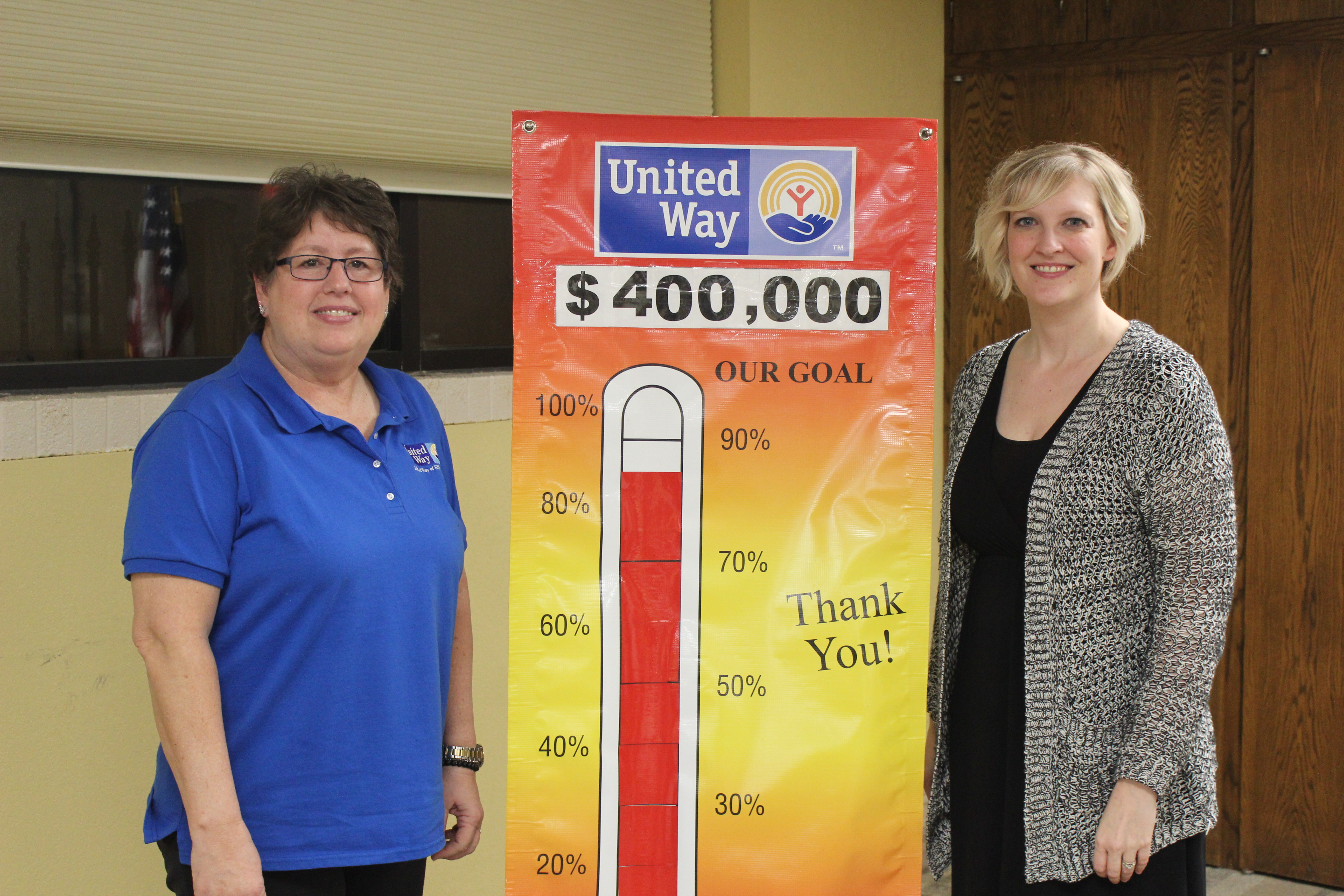
Despite early predictions the United Way of Ellis County would end its campaign well below goal, it announced Thursday night at a Hays Area Chamber of Commerce After Hours that it was 86 percent to goal.
The agency extended its campaign from the end of December to the end of January and has now raised $347,000 of its $400,000 goal.
Sherry Dryden, United Way executive director, said the organization’s Pacesettter companies stepped up and were able to raise more money for the organization. One of these Pacesetters was Midwest Energy, which co-sponsored the after hours and presented a check for $47,000 to United Way Thursday night on behalf of its employees.
“Our Pacesetter companies really stepped up,” she said. “They are always there for us. They are our foundation. They are always joining us in betterment for Ellis County.”
The United Way would like to at least reach the $395,000 mark that it reached last year, so none of the United Way’s partner agencies would have to experience cuts.
“We are very excited to get to 86 percent,” she said. “Our campaign ends at the end of January, so we are hoping in these next two weeks we can get the last 14 percent. We are definitely still taking donations.”
If more funds can’t be raised, United Way will have to cut funding to its partner agencies, but not as much as when United Way feared it might if it only reached 40 percent to 60 percent to goal, Dryden said.
Several factors contributed to United Way’s struggle to make goal this year, Dryden said. Among these were changes in the tax laws, retirements at some of the Pacesetter companies and the local economy.
Last year, United Way supported local programs at 15 partner agencies.
These included the American Red Cross, Big Brother Big Sisters, Cancer Council of Ellis County, Catholic Charities, Center for Life Experiences, Cerebral Palsy Research Foundation, Court Appointed Special Advocates, Developmental Services of Northwest Kansas, Early Childhood Connections, First Call for Help, Hays Area Children’s Center, Options, Parents and Children Together, Salvation Army and Western Kansas Association on the Concerns for the Disabled.
Each agency has to meet guidelines and standards to receive funds.
“This is not what the United Way needs,” Dryden said, “this is what our communities in Ellis County need. This is what individuals and families need. They need your help to make it through whatever crisis or struggles they are dealing with at this time. When the 15 agencies that are partners with the United Way have touched one in four people in Ellis County, you never know when it may be you that needs help.”
You can still donate to the campaign. You can do so online, call United Way at 785-628-8281, send checks to P.O. Box 367, Hays, KS 67601 or make a donation or pledge in person at the United Way office at the Hadley Center, 205 E. Seventh St., Ste. 111, Hays.
Although this year’s campaign drive will end Jan. 31, the United Way accepts donations year-round.
Dryden said the United Way will be re-evaluating several of its events in the coming year and looking for better ways to engage donors. Look for information on new events to be released at a latter date. United Way has just completed a strategic plan and will implementing some of those processes in the coming year.
Within a month, the United Way also hopes to launch a website that will connect local volunteers with nonprofits that need help.
“Thank you to everyone who has given,” Dryden said. “And thank you to everyone in Ellis County who helps their neighbor, their friend, their co-worker, their family member because no matter how you give, monetarily or in person, it is important to know that you give.”
An analysis of retail business in Hays by Retail Strategies was presented to the city commission Thursday.
By BECKY KISER Hays Post
“There’s a lot of potential here,” according to Clay Craft, portfolio director of Retail Strategies, Birmingham, Alabama.
That was the tag line on the final slide Craft presented to Hays city commissioners Thursday night in an update from the national firm hired in March 2018 to provide a retail recruitment and retention program for the city.
Craft said he likes to joke the company is the “Match.com of retail.”
“The pitch to locate in a town must be very specific to what that retailer is looking for,” he told the commission. Retail Strategies focuses on recruitment of national retailers which may also help draw smaller businesses to a town. The company is currently in contact with 9,703 retailers, according to Craft.
The 45-minute presentation about Hays was jam-packed with data, information, analytics, and the status of the town’s retail sector.
Customized trade area for Hays (Click to enlarge)
Commissioners saw a catchment map indicating most shoppers come to Hays from an area to the northwest of the city. The compilation is from mobile data collection.
Tracked in the retail corridor were Walmart Supercenter, Big Creek Crossing, Home Depot, and Hobby Lobby from Nov. 2017 to Nov. 2018.
“Big Creek Crossing has the most spread out area drawing people to Hays,” Craft reported.
“Even more than Walmart?,” asked Vice-Mayor Henry Schwaller, who was surprised.
Craft explained that Walmart has more competition. There are more Walmart stores in the area than there are shopping malls similar to Big Creek Crossing.
Most shoppers come to Hays from an area northwest of the city. (Click to enlarge)
Commissioners also learned millennials are driving retail, and mobile platforms are very important in their shopping habits.
Although e-commerce is growing, demographic data from groups Retail Strategies works with finds 78 percent of consumers still prefer “bricks and mortar” shopping – buying in stores. “They like to touch things. They want to want to try on that coat before they buy it.”
Commissioners asked about tweaking the data to answer other questions.
Shaun Musil noted he has a lot of customers from the Scott City area in southwest Kansas visit his downtown business the Paisley Pear and Wine Bistro. “Do you guys have the ability to find out what they’re coming to Hays for?,” Musil asked.
When Musil asks his southwest Kansas customers why they came to Hays, “99 percent of the time it’s because of Fort Hays State University or the hospital.”
Mayor James Meier, a pharmacist who works for HaysMed, wondered how many people are coming to Hays for a doctor’s appointment and then doing their retail shopping. He also works for other pharmacies in towns within the Hays retail trade area.
“It never ceases to amaze me when I ask why somebody why they picked the doctor that they picked, that they pick it based on what other stores they can go to when they go to their doctor’s appointment,” Meier related.
(Click to enlarge)
Over the past year, Retail Strategies has been identified potential zones for retail recruitment in Hays.
A map filled with green dots represented “a slice of some of the properties we’ve inventoried. We added a bunch more today and took some away, so it’s a static document of a living, breathing tool we use. We’ve got attributes and information collected on all these properties.”
Craft spoke of just a few properties Retail Strategies is currently working on, including Big Creek Crossing, the former Hastings store, Tebo Village where Pasta Jay’s restaurant closed last month, the site of the former Ambassador Hotel, property the city has optioned to buy at 93 acres at the northeast corner of 27th Street and Commerce Parkway north of Interstate 70, and the former Carlos O’Kelly’s restaurant.
(Click to enlarge)
Retailers opened about 14,000 stores in 2018. Craft said 2019 store expansion plans are becoming increasingly food-based with a lot of growth in discount grocery. Specialty food —fast casual and organic grocery are becoming mainstream.
Once all the numbers are crunched, the resulting top four categories for retail recruitment to Hays are restaurants, specialty grocery, apparel, and sporting goods.
“The retail gaps help inform us but it is not the end all be all,” Craft cautioned. “None of this information is end all be all because commercial real estate is so nuanced.”
And that’s why Retail Strategies does three-year contracts with cities, Craft said, with the strategy updated annually.
“Retail is not going away. Retail is complicated and it takes 18 to 36 months to close a deal.”
Hays currently has a one-year contract with Retail Strategies at a cost of $50,000 with the option to renew for two additional years at $45,000 each year.
At the end of Thursday’s work session, City Manager Toby Dougherty requested a 15-minute executive session which included the two representatives of Retail Strategies.
ELLIS COUNTY —Law enforcement authorities are investigating two individuals in connection with a report of the shots fired call at Walmart in Hays.
Lipe photo Ellis Co.Lipe -photo Ellis Co.
Just before 7p.m. police dispatch received multiple calls of shots being fired inside the Walmart store, 4301 Vine Street in Hays, according to a media release.
Officers responded to Walmart for an active shooter situation. Upon their arrival people were running from the store. Eye-witnesses identified two suspects as being involved in the shooting incident. Officers quickly apprehended the suspects identified as Linda J. Lipe 45, and Phillip L. Lipe, 68, both from Norcatur, Kansas.
Customers and employees were evacuated and waiting outside of the Hays Walmart store Wednesday evening
Walmart was closed while the scene was processed and the building was searched.
The investigation has determined there was only one bullet discharged from a pistol owned by the Lipes, and that the gun went off after it was accidentally dropped on the floor. The discharged bullet did not injure anyone.
Phillip and Linda Lipe were arrested on the following charges: criminal use of a weapon, endangerment, unlawful discharge of a firearm within city limits, interference with a law enforcement officer, possession of methamphetamine, possession of marijuana, and possession of drug paraphernalia. They were booked into the Ellis County Jail.
HAYS POST
Update: The Hays Police Department posted the following on its Facebook page as of about 8:30 p.m. Wednesday night.
The Walmart store has been cleared and there is no further danger to the community. The scene has been released by law enforcement and the store is now open for business. The initial investigation indicates that one shot was fired inside the store and that it was an accidental discharge. There were no injuries. Two people remain in custody and are held for weapon and drug violations. The Hays Police Department would like to thank the City of Hays Communication Center, Ellis County Sheriff’s Office, Kanas Highway Patrol, Fort Hays State University Police Department, Hays Fire Department, and the Ellis County EMS for their professional response to this incident. Their service and assistance was greatly appreciated.
——
Update: 8:20 p.m. Wednesday, Jan. 16 from the Hays Police Department:
At 6:48 p.m., Wednesday, January 16, 2019, there were multiple reports of gunshots and people running from the Hays Walmart store. The Hays Police Dept, Kansas Highway Patrol, Fort Hays State University Police Department, and Ellis County Sheriff’s Office responded. Two people have been detained with no injuries. The scene is now secure. Walmart is closed while the crime scene is processed and the store cleared. The public is asked to please avoid the area. The investigation is ongoing.
——–
Update: 7:45 p.m. Wednesday, Jan. 16
Morris and Danielle Esprit of Houston, Texas, were shopping in the Hays Walmart in the automotive section Wednesday night when a firearm was discharged.
They did not see the firearm or the person who fired it, but they did hear the shot.
Danielle said she thought someone had dropped something.
Morris said he realized the sound was a gunshot but noticed no one was running or seemed frightened.
He estimated within about 10 or 15 minutes the store was evacuated.
Morris, who is a truck driver, said the couple was on the road and just stopped in Hays to pick up supplies. They were waiting outside the store, hoping it would reopen soon so they could purchase the items they needed.
——–
Evacuated customers and employees stand outside of the Hays Walmart store Wednesday night.
Update: 7:33 p.m. Wednesday, Jan. 16.
Law enforcement officials are at the scene at the Hays Walmart investigating the discharge of a firearm.
Employees who had been evacuated from the building said that a woman had accidentally discharged a firearm inside of the store.
Officers were still investigating the scene as of 7:30 p.m. Employees were allowed to reenter the building, but the store remained closed. Officers said they did not know when the store would be able to reopen. The parking lot entranced are being blocked by officers, and shoppers are urged to stay away until officers can conclude their investigation.
——
Numerous law enforcement officers and emergency responders are on the scene at the Hays Walmart, 4301 Vine, responding to a report of multiple gun shots at 6:48 p.m.
Authorities are asking people to stay away from the store and its parking lot.
At this time, the situation has been downgraded, although the Special Situation Response Team is gathered nearby at Great Clips.
Hays Post has a reporter on the scene and will have updates as soon as they are available.
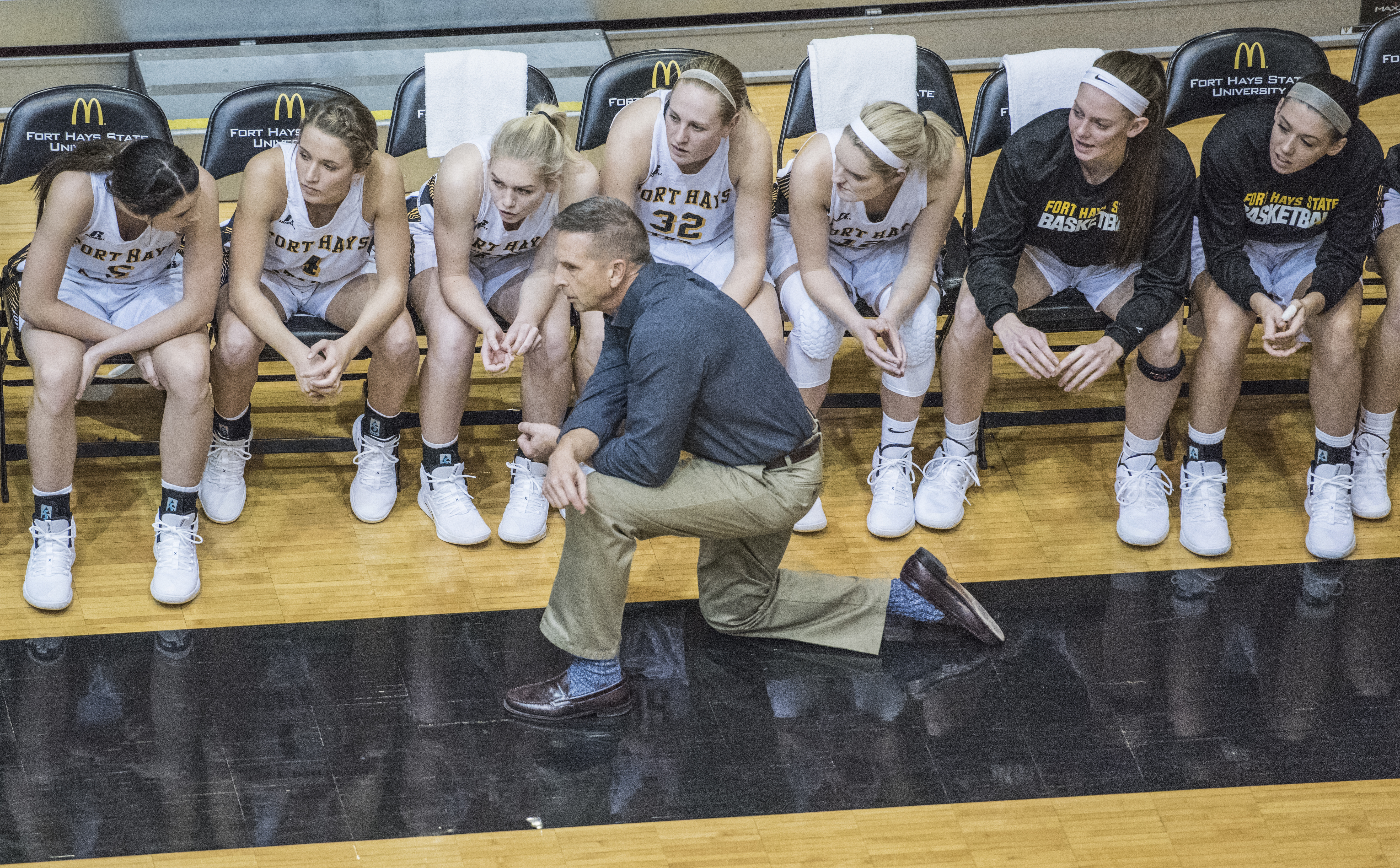
Coach Tony Hobson, left, discusses strategy with his assistant coach, Talia Kahrs, center, and graduate assistant Paige Lunsford, right. Photo by Ryan Prickett
By DIANE GASPER-O’BRIEN FHSU University Relations and Marketing
By Diane Gasper-O’Brien
University Relations and Marketing
HAYS, Kan. –
Fans of Fort Hays State University women’s basketball won’t see Tony Hobson smile much on the sidelines.
On the court, Hobson is as intense as they come. He doesn’t often take a seat beside his assistant coaches, and when he does, he doesn’t stay sitting long. He paces back and forth past the Tigers’ bench with a look of total concentration on his face.
FHSU Athletic Director Curtis Hammeke did get a smile out of his record-setting women’s basketball coach last Thursday when they met at midcourt before the Tigers’ game with Northeastern State (Okla.).
Hammeke – along with Dr. Helen Miles, former women’s basketball coach, and Dr. Tisa Mason, president of FHSU – presented Hobson with a basketball imprinted with Hobson’s latest accomplishment: setting a new career coaching record for the FHSU women’s basketball program.
Coach Tony Hobson diagrams a play for his team during a timeout. Photo by Ryan Prickett
Even then, Hobson seemed a little antsy and appeared relieved to get back to his team’s bench – partly because he doesn’t like calling attention to himself and partly because he and the Tigers had a game to win.
That fierce passion for the game of basketball has paid off in a big way for Hobson and the Tigers.
FHSU, undefeated and the top ranked team in all of NCAA Division II in the D2SIDA media poll, heads into this week’s road games with MIAA intrastate rivals Emporia State (Wednesday) and Washburn (Saturday) with a 15-0 record.
It’s the best start to a season in the history of the Tiger women’s program, which is on pace to set a lot of new marks this season.
One of those came on a road trip earlier this month.
In a Jan. 3 victory over defending national champion Central Missouri on the Jennies’ home floor, Hobson tied Miles for the most career coaching victories at Fort Hays State. Two days later, the Tigers beat Southwest Baptist (Mo.) to give Hobson his 218th victory at FHSU midway through his 11th season in Hays. Miles was 217-154 from 1971-86.
Hobson (now 220-92 at FHSU) shrugs his shoulders while talking about the record that has brought him a lot of praise since the turn of the new year, including a loud ovation at the pregame presentation on Jan. 10.
“All those things are nice, and I don’t want to make light of it because those things are important to the history of the program,” he said. “To get records like this, you have to have a good solid program and have to sustain it. That’s a good thing.”
Then the normally serious Hobson said something that made him smile.
“What it took to get the record is more important,” he said.
What it took to get that record was a lot of hard work through his first nine seasons that has seen Hobson elevate Tiger women’s basketball to new heights.
FHSU won the NAIA national championship with a 34-2 record in 1990-91, then moved to NCAA Division II the next year.
The Tiger program was anything but lean over the next couple of decades, with just one losing season.
But when Hobson joined the Black and Gold in 2008, FHSU women’s basketball got a new spark.
A former standout athlete himself, Hobson had made a name for himself at Hastings College while guiding the Broncos to three NAIA national championships and a 211-40 overall record in seven years.
Before that, Hobson had played and coached at Barton Community College in Great Bend, Hammeke’s hometown.
“I’d known about Tony for a long time, and I knew of his strong work ethic,” Hammeke said.
Hobson also was impressed with Hammeke.
“I knew Fort Hays State’s athletic director was a really solid person,” Hobson said. “He was honest with me, and that’s so important. You have to feel comfortable with who you work with.”
Hammeke definitely was comfortable with Hobson.
“He’s a good recruiter and an excellent basketball coach,” Hammeke said. “We thought he was the right one for the job.”
Was he ever.
Fort Hays State University women’s basketball coach Tony Hobson and his players watch action on the court during a home game earlier this season. Photo by Bob Duffy
It didn’t take Hobson long to make a successful jump from NAIA to NCAA.
After a 39-43 record during Hobson’s first three years, the Tigers have strung together seven consecutive 20-win seasons. They are just six wins away from making that eight in a row. Before Hobson, FHSU posted only eight 20-win seasons in nearly 40 years.
The Tigers are also in the running for finishing near or at the top of the MIAA and making a fourth NCAA tournament appearance in five years.
Hobson points to the addition of two standout players – 6-foot guard Katelyn Edwards and 6-4 center Kate Lehman – during the 2011-12 season in helping get the program over the hump.
Edwards, who was from Crete, Neb., had transferred to FHSU after one year at the University of South Dakota, and Lehman joined the Tigers after a stellar high school career in Newton. Both went on to earn all-conference honors every year for the Tigers, and Lehman finished as the second-leading scorer and top rebounder in FHSU women’s history during her All-American senior year when the Tigers advanced to the top 16 of the playoffs.
“Then it was game on,” Hobson said.
Hobson learned early on at FHSU that the Hays area community likes watching good, competitive basketball.
“People want a winner,” he said. “If you give them something good to watch, they will come.”
Consequently, the Tiger women’s program has ranked second in the nation in attendance for NCAA D-II the past four years with an average of more than 2,000 fans per game.
Even though students have not yet returned to campus for the second semester, more than 2,200 fans showed up for Thursday’s game.
Gradually through the years, Hobson started to notice a shift in the recruiting landscape, too.
“I had a lot of players from Nebraska early on, because I couldn’t recruit against Emporia State and Washburn,” he said.
Hobson paused, an ever-so-slight smile crossing his face.
“It’s not like that anymore,” he said.
Hobson and the Tigers have enjoyed a bumper crop of top-notch recruits the past few years, so much so that this year’s team is so deep that bench players lead the team in various categories on any given night. Six different players have led the Tigers in scoring. No one averages more than about 12 points a game, but six players average at least eight points a game, and the team puts up more than 80 points per contest.
“We’re pretty deep at every position,” he said. “You always have plenty of players. Do you always have plenty of players who can play at the level you need them to? This year, we do.”
Two or three of FHSU’s starters surely could score more, but the Tigers have bought into the team-first philosophy.
“We’ve had the most unselfish group of people I’ve ever been around,” Hobson said. “They sacrifice for each other for the good of the team; they all play their role. They want to win.”
Assembling that type of team starts long before the first tipoff in November.
“A lot of it is recruiting the right type of kids – high character kids,” Hobson said. “We do a better job of accomplishing that than some. Those type of kids are easier to get the point across to.”
Now, the Tigers’ roster features the daughter of a Division I coach and a former D-I player.
Sophomore Madison Mittie, part of that super-sub group for Fort Hays State, is the daughter of Kansas State University head coach Jeff Mittie, one of the winningest active coaches in NCAA Division I with more than 500 career wins.
“I’d never coached a college coach’s daughter,” Hobson said. “When you have a coach take a look at your program and think ‘That’s a good program for my daughter to be in,’ that’s an ultimate compliment when parents feel good about their daughter being in your program.”
Junior Lanie Page, a former prep standout from Wamego whose dad was the coach for the Raiders, had decided to concentrate on academics when she stepped away from the K-State basketball program two years ago.
But senior Tatyana Legette, who knew Page from high school all-star games, talked Page into visiting FHSU.
When Page was in Hays for an FHSU football game in the fall of 2017, she watched a Tiger basketball practice, and she immediately liked what she saw.
“Coach is a lot like my dad in his coaching style and just his personality, honestly,” she said. “He cares about his team a lot and would do anything for them, but he also knows when to be tough and when to push us so that we can see what we’re capable of.”
Talia Kahrs, Hobson’s top assistant coach, agreed.
Kahrs played for Hobson at Hastings, then followed him to Fort Hays State. Following her playing career, Kahrs served as a student assistant for the Tigers for a season, then became Hobson’s head assistant in 2012.
Kahrs said she has learned a lot from Hobson after so many years of being around him on the court. One thing has never changed.
“He just likes to win,” Kahrs said. “Losing is not an option.”
Hobson admitted he is not happy with losing but does accept getting beat by a better team.
“We could play a really good game, and if someone plays better, they’re going to beat you,” he said. “Losing is playing less than what you are capable of, and that bothers me. Losing is different than getting beat.”
Kahrs is well aware of what her job is.
“I think I do a good job of balancing him out,” she said. “I’m more mellow, so I’m the calm to his intensity.”
That intensity barometer will raise a notch or two this week when the Tigers take to the road for those two huge road games.
Saturday’s men’s and women’s games with Washburn have been selected for this week’s D-II Basketball Showcase, with the featured games beginning at 1 p.m. (women’s) and 3 p.m. in Lee Arena in Topeka.
But for now, Hobson is concentrating on Wednesday’s contest with Emporia State.
“People live too much in the past or too much in the future,” he said. “You can’t dwell on last year, or the last game even. And you can’t look too far ahead.”
Victories this week would help keep alive No. 1 on the Tigers’ long-term list of goals for this year – “MIAA champs.”
The final goal on that list is “to host and win regionals.”
“That means you have to be the No. 1 team in the region,” he said, “and that’s 42 teams.”
“We set our goals pretty high,” admitted Hobson, who then broke one of his own rules of looking ahead.
“We’d like to make the elite eight and give it a run,” he said.
Now, that would make a lot of people smile, including Hobson.
OPG is the owner of the Stonepost Apartments in Hays. Matt Gillam, OPG vice president of development, said his company has been looking at Hays for further low-income housing development for some time. Stonepost currently has a waiting list of 80 people.
The contract with OPG stipulates only $5,000 down for the property and a 365-day window in which to close. The contract is also contingent on the company being able to secure low-income housing tax credits for the property.
OPG will also be applying for historical status for the former school, which was built in 1926. The company hopes to receive additional historic preservation funding.
The property sits in a Neighborhood Revitalization District as well. It would go back on the tax roles, but it would qualify for a rebate on taxes for the increase in the value of the property for 10 years.
The district will be able to continue to use the building until the contract is finalized.
Application for 2019 low-income tax credits is in February, so Gillam said he needed to know from the board Monday if the contract was going to be approved.
Board member Lance Bickle said he thought the sale might be a good idea, but he was concerned about the short time frame in which to make a decision.
Board member Mike Walker echoed these concerns.
“I have a concern about the time frame, and I wish down payment was more than $5,000, but I am in favor of the project. I think you did a good of presenting it, and you have a good track record,” Walker said.
Board member Paul Adams was also concerned about the small down payment and potential delay in closing the contract. However, he said he appreciated OPG was going to preserve the historic nature of the building and acknowledged additional affordable housing was needed in the community.
Sophia Rose Young pointed to a report earlier in the evening that indicated about a third of students at Wilson Elementary received free and reduced-cost lunches. She said low-income housing would serve the district’s student population.
Turn-Key Properties also made an offer to purchase the property with the hopes of turning the former school into apartments. However, their offer was $200,000. No one from Turn-Key was present at the meeting Monday night.
The board approve the contract on a split vote, 5-1-1 with Bickle voting against and Greg Schwartz abstaining.
The Hays Regional Airport will be receiving more funds for improvements from the Federal Aviation Administration, thanks to record boardings in the 2018.
More than 12,000 passengers flew out of the airport last year.
Ovid Seifers, airport manager, said the April addition of SkyWest flights to Chicago’s O’Hare International Airport was the reason for the increase. Flights to Denver were also up slightly.
This included a record month in December, Seifers said. The airport last reached 10,000 boardings in 2011 and 2012.
Since the airport exceeded 10,000 departures in 2018, it is eligible for $1 million in FFA Airport Improvement Funds in 2020. The airport barely missed the 10,000 mark last year, but a loophole will allow the airport to still receive the $1 million in FFA funding in 2019, Seifers said.
Airports that have less than 10,000 travelers receive only $150,000 annually.
The airport has a five-year improvement plan. 2019 improvements include apron and drainage improvements, concrete repair and the purchase of a new snow plow and spreader.
In 2020, the airport plans to replace lighting on the crosswind runway. The runway is currently lit by and an in-ground system that is 20 years old. Because the equipment is buried, it is more susceptible to damage from animals and the elements.
The wiring for the new system will be housed in conduits to protect it and the transformer will be above ground, which will make them easier to maintain. The lights themselves will likely be transitioned to LEDs from incandescent.
Seifers said he thought 2019 will see a slight increase in travelers, although not as significant as in 2018 when the Chicago flights were added.
“I think the City of Hays and its flying community has actively sought better service here,” he said. “They have good service here with SkyWest. The fact that you can go to Denver and O’Hare with one stop to O’Hare in Salina briefly for 30 minutes is great for a community of this size. It doesn’t happen everywhere.”
SkyWest began serving Hays passengers in 2014 with flights to Denver with 50-passenger jets.
The city of Hays in cooperation with SkyWest is offering fares to Chicago and Denver for $89 one way. Flights must be booked by Feb. 26 for flights through May 22. Flights must be booked 14 days in advance. See the airport website for more information.
Because of the federal government shutdown, Hays resident Kathay Johnson is in a holding pattern as she and her husband try to purchase a new home.
The women Kathay and her husband are buying their home from had bought the house through a Rural Development program. The seller needs to clear the sale through that federal department before it can be completed, but the department is closed.
“We have agreed on everything else,” Johnson said. “We are just hanging out waiting until everything opens back up. It is super, super annoying and bad timing.”
The Johnsons moved to Hays in the fall from Boulder County, Colorado, with the express desire to purchase their first home.
“It is a huge reason why we came out here,” she said. “We got to the point where we were really excited. We were like, ‘Wow, it is actually going to happen. We’re going to do it.’ And now we are just sitting here watching the news everyday, waiting for this stuff to end.”
While they are waiting for this final paperwork to go through, they are living with relatives in Hays and have most of their possessions in storage.
Johnson’s husband is an artist and all of his supplies are storage. His work is at a standstill until they can get moved into the new house, which is currently sitting vacant.
Johnson said she is very thankful her family is letting them longer than anticipated.
“We are kind of cramped, and I am sure they would like their house back at some point,” she said.
Despite her frustration, Johnson said she still sees herself as lucky. She has a friend who lives in Kansas City and is federal employee who is currently furloughed without pay.
“If there was a good answer for it,” she said of the shutdown, “we wouldn’t be in this situation. But [Congress] is still getting paid. It would be nice if they weren’t still getting paid, then it would be fixed much faster. I get why we are halted.”
The Rural Development housing program is a division of the U.S. Department of Agriculture, which has been shuttered by the shutdown. No one answered when Hays Post called the Hays office.
The USDA posted the following message on its website.
The shutdown has not closed all federal services locally. Some employees are working without pay and funding for other departments was passed before the shutdown.
The Hays Regional Airport has both full- and part-time TSA employees on staff to screen boarding passengers.
Those employees are working, although without pay.
The closest office for the Department of Housing and Urban Development in Kansas City is closed because of the shutdown. However, Kathy Nelson, executive director of the Hays Housing Authority, said payments for Section 8 housing have been funded through February.
If the shutdown goes beyond February, Nelson said she did not know what the status of funding might be. She said the local housing authority has not had any questions from program participants yet, but she said she had concerns about funding if the shutdown would extend past February.
The U.S. Corps of Engineers is a federally funded. However, its budget is under the Department of Defense. Congress approved that budget before the shutdown. All operations at Wilson Lake and Kanopolis lakes are proceeding as normal, said Dan Hays, operations project manager at Wilson and Kanopolis lakes.
“Although it is somewhat comforting for us, our thoughts go out to federal partners who have not been so fortunate,” Hays said.
John Pyle, veterans service representative, said veterans have been able to receive services and benefits.
“There have been no issues,” he said. “Everything is being processed. Veterans are still able to go VA clinics. They are still able to file claims. I have not heard of any veterans who are not receiving their disability benefits.”
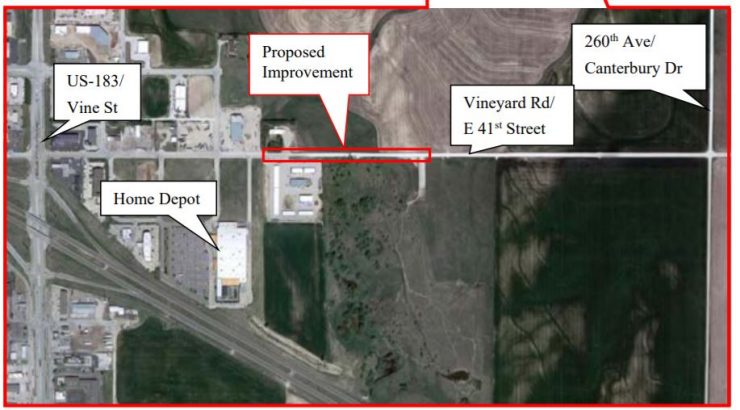
Hays Mayor James Meier Thursday voted against improvements to East 41st Street from Home Depot east to Vineyard Park, calling it a “road to nowhere” and a “project in search of a problem.”
Commissioner Ron Mellick voted with the majority for the improvements, which include grading, pavement, storm sewer and waterline. The low bid of $629,133.50 was from Paul-Wertenberger Construction, Hays, and was less than the engineer’s estimate.
“I look at this as a ‘bridge to somewhere,’ ” Mellick countered. “You can’t develop on either side of the actual road. I think this is a bridge out to where a developer can afford to put in housing or even commercial.”
Meier clarified in discussion that he respects those who intended to vote for the project but pointed out over the past few years the commission has discussed whether development or infrastructure should come first.
“It seems to me that through those conversations we’ve come to the clear conclusion that putting in streets, water and sewer does not give us development,” Meier said. “That’s exactly what we’re doing here, spending money on infrastructure in the hope that something will develop and there’s absolutely no evidence to show that’s going to happen.”
Vice Mayor Henry Schwaller recalled the Phase II development “has been planned since the beginning when we entered into the agreement with Home Depot and the developer.”
“Our goal then as it is now was to connect Vine Street to Commerce Parkway,” Schwaller said. “This isn’t a ‘road to nowhere’ because it is our intention to see growth happen to the north and particularly to the east, and that’s why we took an option on a piece of ground at the other [east] end of this road.”
“I think we were making a statement when we purchased an option on that property,” agreed Commissioner Sandy Jacobs, “and I would love to see that street go all the way from Vine Street to Commerce Parkway. Having the ability now with the funds from the TDD money is a very good way to do this.”
Finance Director Kim Rupp reviewed the financing plan for the Home Depot Transportation Development District (TDD).
Projects for Phases I and II totaling $4.4 million were approved in 2004 by a TDD ordinance and a 3/4-cent sales tax was enacted April 1, 2005, both for a maximum 22 years. The city then issued $1.77 million in TDD sales tax bonds to finance Phase I.
The TDD tax outperformed projections allowing the Phase I bonds to be called early and completed in January 2018. It was determined the 3/4-cent TDD sales tax could continue until March 2027 to fund a portion of Phase II improvements.
The Home Depot Transportation Development District currently includes Home Depot, IHOP, Hampton Inn, Town Place Suites by Marriott, JT Travel Plaza, Taco Grande, and an undeveloped area for 47,000 square feet of retail space.
According to Rupp, the TDD has collected a total of $2,730,214 over the last 163 months, averaging $247,000 annually the past three years.
“We project TDD sales tax revenue to increase to $282,000 per year. Based on these provisions, we agree the current annual TDD sales tax collections would support debt service, whether a bond issue or repayment of city idle funds.”
Rupp told the commission he recommended financing with city idle funds as it would save bond issuance costs and provide for interest income to the city.
“I appreciate your recommendation on the idle funds,” said Jacobs, a retired banker. “I’m glad you analyzed it all the way around. That savings of $13,500 means a lot.”
Commissioners also voted 4-1 to adopt a resolution authorizing the improvements and providing for payment of costs.
This is the first time in years the Kansas Legislature will be entering the session without a budget deficit to battle.
Instead of looking for cuts or ways to increase revenue, local legislators said they will be looking at tax relief.
They also said they hope to give attention to programs that have suffered during the budget struggles, including KPERS and transportation.
Billinger
Taxes
Sen. Rick Billinger, R-Goodland, in a recent interview for Eagle TV’s Forum, said he would like to see a “decoupling” of state income taxes from federal income taxes.
As a result of Congress increasing the standard deduction on federal income taxes, many filing Kansas tax returns would no longer be able to itemize.
This would mean about a $40 million increase in tax revenue for the state of Kansas.
Billinger said he believed even if small businesses or individuals claimed a standard deduction on their federal taxes, they should be able to itemize their state taxes, which would put a portion of that $40 million back into the hands of taxpayers. Billinger said he would like to see this changes made retroactive for 2018.
Several local legislators said they also would consider reducing or eliminating the state sales tax on food, a campaign promise of Gov.-elect Laura Kelly.
Rep. Ken Rahjes, R-Agra, who is a member of the Taxation Committee, said he thought there was a firm resolution among legislators this year to not raise taxes. He said he would support a reduction in the sales tax on food, but he did not think it would be eliminated.
Rahjes
“I think we need to have a realistic look at where our dollars are,” he said. “Our economy in our area is still very much challenged in agriculture and oil production. Once we get those things back in, the economy will be a little stronger. If you look at the overall economy, it is doing well, but it could do better.”
Just as Billinger, Rahjes said he supports legislation that would address the changes in the federal tax code and send back money to the working Kansans.
Budget
Rep. Troy Waymaster, R-Bunker Hill, has been reappointed as chairman of the House Appropriations Committee.
“As far as the budget, my main goal is to do some corrective strategy and basically realigning our budget,” he said. “We have done some work on that in the last couple of years since I have been chairman, but there is still some of what I would call creative accounting techniques being used — mainly transfers not going to the Kansas Department of Transportation. There are some things we need to strategically correct with the state budget.”
In terms of transportation, Rahjes said he would specifically like to see KDOT put a priority on a project to widen and straighten Kansas Highway 383 in Norton and Phillips counties. That project has been on the KDOT project list for some time and has become a safety issue, Rahjes said.
The state is heading into the session with about a $900 million surplus, but Waymaster said the state needs to meet the obligations it already has before spending that money on new programs.
Those obligations include KPERS as well as increasing funding to the K-12 education by $90 million to satisfy a ruling by the Kansas Supreme Court in the ongoing school funding lawsuit.
Waymaster
Waymaster said he sees some additional funds coming into the Kansas coffers due to a U.S. Supreme Court decision that will allow states to collect sales tax on online purchases and another Supreme Court ruling that has legalized sports betting. However, he said he did not think either one of the changes will be significant revenue producers.
Waymaster said he did not think the Legislature would eliminate the sales tax on food, as that tax generates $300 million to $340 million in state revenue annually.
Medicaid expansion
Gov.-elect Kelly said during her campaign that she would support Medicaid expansion, but some Republicans still oppose that measure, including Waymaster and Rahjes.
Although the federal government pays 90 percent of Medicaid expansion, both House members expressed concerns about how the state would pay for the other 10 percent, about $30 million to $80 million annually. The legislators also said they were concerned the federal government might decrease its contribution for Medicaid expansion in the future, leaving the state with a larger bill.
Billinger, however, said many of the state’s rural hospitals would benefit from Medicaid expansion.
“As long as there is a work component in it and it is revenue neutral, I am good with it,” Billinger said. “I think it is something we should look at.”
Hemp
Legislation was passed last session that created a test program for cultivation of industrial hemp in Kansas. The federal Farm Bill further opened opportunities for growers nationwide by declaring industrial hemp a farm commodity. However, local legislators noted changes would have to be made to the state legislation to conform to the Farm Bill.
They hoped this corrective action could be made in time for the beginning of the hemp growing season in April.
Economic Development
Waymaster said he hopes to reintroduce a version of the Ad Astra Jobs Act, which he sponsored in 2017. The legislation would create a tax incentive program for businesses to move into rural communities and create jobs.
“What it has done is cause people to not pick up their phones anymore,” Rahjes said. “Everybody is screening their calls.”
Freshman Rep. Barb Wasinger, R-Hays, was contacted for this story, but said she would be better able to comment on the issues after she has been in Topeka for a few weeks.
The Hays Public Library has expanded a program that seeks to make reading more accessible to the public.
Five new Little Free Library locations were added in Hays in November in cooperation with the Hays Parks Department.
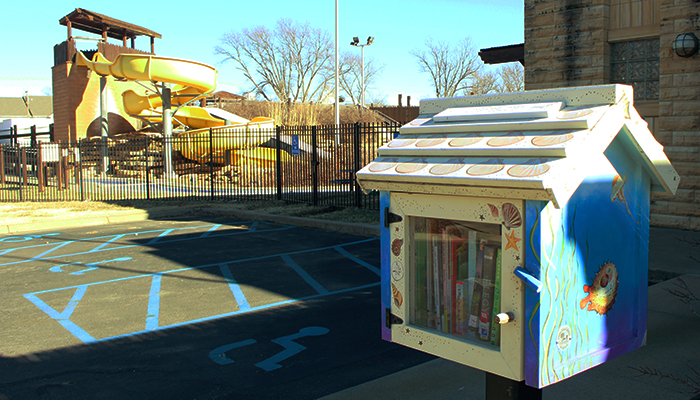
The libraries are boxes on posts located at seven Hays parks locations and one near the Victoria swimming pool.
The idea behind the boxes is “Take a book, leave a book.” Each box is stocked with books that can be taken without cost and without a need to check out the books from the library. If you like the book, it is yours to keep, said Samantha Gill, HPL adult services manager.
The library uses donated books or books taken out of circulation at the library to fill the boxes. However, the program encourages readers to also leave books they no longer need or want for other people to take from the boxes. If you don’t have a book to leave, that is OK too.
“Right now at our library we are trying to make sure that we get outside of our four walls,” Gill said. “People don’t need to feel that it is necessary to come to our physical building to get books. We are trying to figure out different ways to get books into people’s hands outside of the building who might not be able to make it to the library.”
Although the Little Free Libraries generally see less use in winter as people are using parks less, the Little Free Libraries have proved popular in the summer and warmer months.
“There have been days that I have filled up the Little Free Library at the Aquatic Park and then that evening I drive by and it is completely empty.”
Children have waited in lines for books, when they saw the library van pull up to the Little Free Libraries, Gill said.
Although the Little Free Libraries are also stocked with both adult and young adult books, the most popular books in the program have been children’s books.
Reading is very important to children’s development and shown to be a predictor of future success in school. Keeping books in the home is a key part of that process, Gill said.
All seven Little Free Libraries in Hays have individuals or groups who have adopted the libraries and help make sure the boxes are kept stocked with books. During the winter, the boxes are usually checked a couple of times of month, but during the summer, the Gill urges her volunteers to check the boxes at least once a week.
All of the boxes were hand painted. Nicole Thibodeau, local artist and library employee, painted all of the boxes except the box at the dog park, which was painted by Rebecca Grizzell.
“I think it is a fun, innovative way to get books into the hands of people who might not be able to come to the library or who are at the park and want just to browse and see what we have to offer,” Gill said. “We are really proud of it. Maybe in the future, we will add another one here or there, but for now we are really happy with the success of this project.”
A complete list of the Free Little Library locations in Hays is listed below. See a map of the locations by clicking here.
If you have additional questions about the program, you can contact the library at 785-625-9014.
Hays Aquatic Park, Fourth and Main
Seven Hills Park, 33rd and Hillcrest
Hays Dog Park, Highway 183 By-pass
Frontier Park, Highway 183 By-pass
Aubel-Bickle Park, 30th and Sherman
Ekey Park, 19th and Holmes Road
Kiwanis Park, 17th and Harvest Avenue
Chuck and Shirley Comeau and their holding company are involved in two multimillion foreclosure proceedings involving 27 pieces of property in Hays and Plainville for non-payment of the loans.
Eighteen of those properties are in downtown Hays and another nine are in Plainville.
The foreclosure actions have been filed by Bank of Hays and Sunflower Bank.
The Comeaus took out a $7.5 million loan in September 2013 and a $949,000 loan in December 2016 from the Bank of Hays.
DFC holdings still owes more than $7.5 million on the loans as of Dec. 15.
Payment had not been on the loans with Bank of Hays since July 11, 2018, according to court filings.
The Oak Street Planing Mill, also a Comeau company, took out mortgages for $350,000 in February 2004, $315,000 in April 2005 and $1.1 million in March 2007.
As of February 23, 2018, Sunflower Bank was still owed about $450,000.
Dessin Fournir, the Comeau’s furniture company in Plainville, was named as a party in both of the foreclosure filings, but its headquarters building, 308 Mill St., Plainville was not.
Ashley Comeau spoke on behalf of Dessin Fournir and said the company did not want to comment at this time. However, she noted this was not a hostile litigation with Bank of Hays.
Attorneys for both banks declined comment on the pending litigation.
The Hays locations listed in the foreclosures included multiple properties that were currently being occupied by businesses.
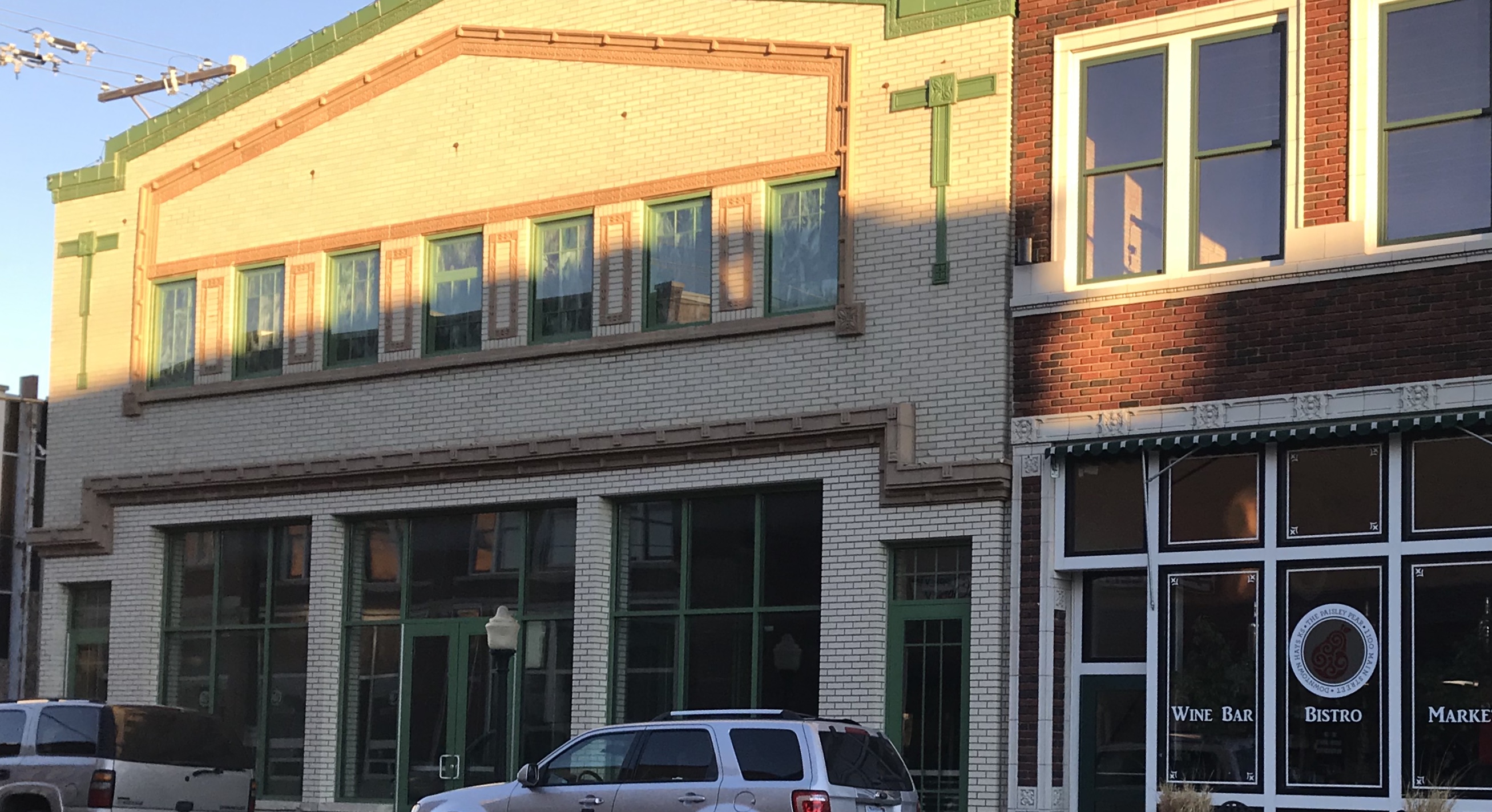
Shaun Musil rents 1100 Main St. for the Paisley Pear, a wine bar and bistro.
“We are doing business as normal,” Musil said. “I can’t control what is going on with the building. At this time, I’m not too concerned about it.”
Norman Keller worked for the Comeaus for more than 21 years at C.S. Post before he and his wife, Sandy, opened Regeena’s Flowers and Events at 1013 Main St. in a building owned by the Comeaus.
He said he was not concerned about his business. If the building is purchased by another owner, he said he would work with that owner.
Other Hays properties listed in the foreclosure include, 803 Fort St., 811 Fort St., 1008 Main (occupied by Bluetique), 1011 Main St. (occupied by Bella Luna and Simply Charmed), 106 W. 11th St., 1102 Main St. (former Strand Theatre), 1107 Main St., 1109 and 1111 Main St. (occupied by Couture for Men and Women), 106 W. 12th St., 719 Main St., 1108 Main St., 121 E. 11th St., 1012 Main St. (occupied by Something Blue), 110 W. 11th St. and 201 E. 12th St.
The Bank of Hays foreclosure also includes the Comeau home at 400 S. Jefferson in Plainville and 108 N. Main, Plainville.
Roger Hrabe, director of Rooks County Economic Development, said the Comeaus and Dessin Fourinir have been huge contributors to the local economy and one of the largest employers in the community.
“It has been tremendous,” Hrabe said of the Dessin Fournir, “Not only have they employed a good number of people, they have good employees and they are very involved in the community. Leadership Kansas has been one of the many groups to come through and tour the facility. The fact that an enterprise can do this in a small community, people take notice of that. If it can be done here, it can be done anywhere.”
Sunflower Bank has filed for a summary judgement against Oak Street Planing Mill, the Comeaus and their co-defendants. A hearing was held on Dec. 17 in Ellis County District Court before Judge Blake Bittel. Bittel is currently reviewing the case and is set to release his decision before the end of the month.
According court records, the defendants paid their October 2017 payment late at which the bank accelerated the loan.
That case involves Plainville properties, including 108 N. Main, 211 1/2 Mill, 205 N. Main, 317 W. Mill, 311 S. Washington, 211 W. Mill and 221 W. Mill.
Others listed in the Sunflower Bank case include DFC Holdings, DFC Corp., Classic Cloth, Palmer Hargrave, C.S. Post, Christopher Mraz, Lenice Larson and Liberty Group.
The Kansas Center of Entrepreneurship is listed in both foreclosure filings because it had a mortgage on property owned by DFC Corp. for $500,000.
Emprise Bank, Golden Belt Bank and Wilson State Bank were also listed on mortgages on tracts that were listed on the Bank of Hays filings.
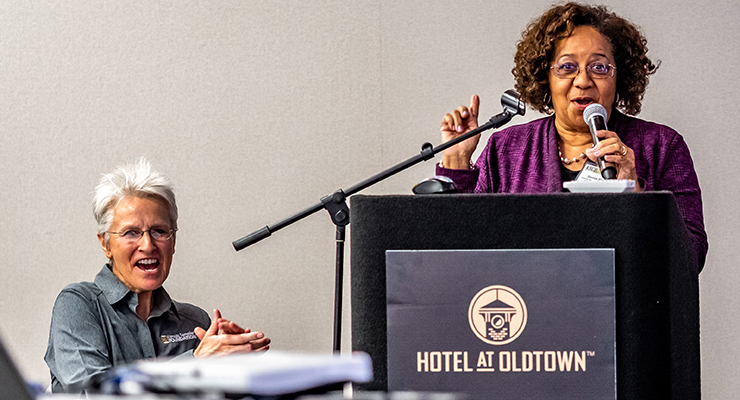
Mary Hendrickson, University of Missouri Sociologist, spoke about community wealth and how local and regional food systems can boost the local economy and create resilience.
By TOM PARKER Kansas Rural Center
“That’s the thing about rural Kansas,” Corie Brown wrote. “No one lives there, not anymore.”
The Los Angeles author’s assessment on rural Kansas in particular and Kansans in general was the outcome of an odyssey across the state for an online article published in April 2018. Its title, “Rural Kansas is Dying: I Drove 1,800 Miles to Find Out Why,” set the stage for her thesis.
She interviewed farmers, university professors, politicians, local food system supporters and farm group leaders about the state’s rural population and community decline and what could be done to mitigate it. She found little hope in their responses.
While many felt some of her conclusions were accurate, many who were interviewed felt disappointed that she did not place more emphasis on the efforts being made to address the problems and challenges rural communities and farmers face. They ended up feeling used, and none more so than Marci Penner, who had recommended many of the locations and people for the interview.
As director of the Kansas Sampler Foundation and co-author of “The Kansas Guidebook for Explorers,” Penner has traversed the state countless times and talked with the same people Brown had, yet her assessment was totally the opposite.
Marci Penner, Sampler Foundation, facilitated a panel discussion. Donna McClish, Wichita, spoke about her mobile farmers market work.
“I feel very differently,” she said. “I’m not some Pollyanna who thinks we’re doing great, because we have many issues. There are reasons why it has changed over the years, and reasons why some towns aren’t thriving. But because of the people in this room,” she told a conference crowd last November, “I have confidence that we can create a new rural, a new paradigm, of what we want rural to be.”
Penner offered her upbeat perspective in “What’s Right about Kansas Farms, Food and Communities,” a panel discussion at the Kansas Rural Center’s annual Food and Farm Conference, held mid-November in Wichita, Kansas. Panelists were Luke Mahin, director of Republic County Economic Development and board member of the North Central Kansas Food Council; Debbie Beardon, Market Manager and secretary of the Allen County Farmers’ Market Board and founding member of the Core Leadership Team for Allen County Growing Rural Opportunity Works Food and Farm Council; Donna Pearson McClish, founder and director of Common Ground Producers and Growers, Inc.; Steve Swaffar, Executive Director of No-Till on the Plains; and Ed Reznicek, General Manager for Central Plains Organic Farmers Association. Keynote speaker Mary Hendrickson, a rural sociologist at the University of Missouri at Columbia, also offered insights about how rural communities can build social, financial, natural and cultural capital to address the changes facing rural America.
Luke Mahin, who was one of Brown’s sources, was puzzled at how few of the positive endeavors he mentioned made it into her article. While it’s true that Republic County has lost population, down from a high of 19,000 in 1890 to 4,700, by embracing economic development and investing in new technologies, the county offers more opportunities for entrepreneurs, small businesses and Internet-based businesses than most rural counties, he said.
Similar benefits apply to agriculture. Farmers are innovating and adapting new technologies, and there’s a lot of talk about pushing agriculture forward. “There’s no better time to come back to a rural area because of the flexibility it offers and the quality of life,” Mahin said. “Access to technology has leveraged all that.”
Several panelists felt that though Brown’s article highlighted the perils of commodity farming, it didn’t go far enough to recognize alternative methods farmers are using to go forward. Swaffar sees agricultural conservation practices reversing many of the ecological damages caused by conventional farming, and injecting hope among the state’s farmers.
Panelists at the KRC conference addressed “What is right about Kansas?” Left to right: Ed Reznicek, Steve Swaffar, Donna McClish, Debbie Beardon, Marci Penner and Luke Mahin.
“The folks I work with are very excited about dirt, though we don’t call it that anymore,” he said. “It’s soil. And soil is more than a growing medium—it’s a living organism.” Five years ago, he said, you wouldn’t have heard the term ‘soil health,’ but now it’s mainstream. Why? Because it turns farmers into biologists, and biologists are excited to see the soil come alive. For farmers, that translates into reducing input costs and being able to grow more than just wheat and corn and sorghum.
“Now that they see the capabilities, they’re thinking well beyond traditional commodity crops,” Swaffar said. “We’re seeing changes in the soil and in communities.”
For McClish, food and food production are the driving forces of rural sustainability, and nowhere are they more critical than in food deserts like rural Wichita and surrounding communities. Common Ground Producers and Growers began in 2014 after a friend asked McClish to provide fresh vegetables and produce to a low-income senior center where people had difficulty getting to the farmers’ markets. When other centers got word of it, they asked to be included. The company now serves 33 sites and several rural counties surrounding Wichita, through a network of growers and producers, and continues to expand. “Our motto is, ‘all are fed, no one is hungry,’” she said.
The experience taught her that food is an economic stabilizer and could contribute to the expansion and resurgence of family farms. “Rural Kansas can rebound,” McClish said. “We do good with adversity. We’re all looking at the same problems but we have different ways of solving them. Food is the basis of relationships. We can make this work together.”
Beardon also lives in a food desert in Southeast Kansas, and knows firsthand the importance of food for community growth. After a local farmers’ market folded, Beardon spearheaded a campaign to restructure the market. In the spring of 2010 it reopened with more than 60 vendors, 27 of whom were there for the entire season.
Beardon also worked with the county commissioners and the residents of Moran to purchase their grocery store, which now serves customers for 30 miles around. “There are needs out there beyond our imagination, and as an individual you may not think you can do a lot,” Beardon said. “Keep your ears to the ground and find out who else is interested, put your heads together and just start walking.”
Cooperatives like the Central Plains Organic Farmers Association (formerly Kansas Organic Producers) embrace a different approach by cooperatively marketing certified organic grains, Reznicek said. It is a system that resists corporate capitalism for a system that is ecologically sound, economically viable and socially just. “Because of its social goals and purpose, cooperatives represent a form of social economy, which is a much broader-based economy than the commodity and financially-driven market economy,” he said.
Public schools are one example of successful social economies. They function outside of market support with an unusual level of harmony, he said. The electrification of rural Kansas was another. Farmers contributed their time and machinery to set poles and string lines to reduce the indebtedness cooperatives would have to pay to electrical companies. The same model could be used again.
“That history is worth looking into,” Reznicek said. “The future of healthy rural communities is cooperative.”
To turn the tide of rural depopulation and economic decline, Hendrickson said in her keynote speech preceding the panel, communities are going to have to think creatively and to both identify and invest in capital—financial, social, natural, human, cultural and political. Of critical importance is resilience, the capacity of a system to absorb shocks and bounce back.
“There are different ways of thinking about what makes a community wealthy, but most mean the same thing—ownership, control, lasting livelihoods,” she said. “We need to put all the capitals together to make our food and farming systems resilient to shocks.”
Hendrickson compared the changes facing rural America to the changes farmers face with climate change. “It’s been weird, weird weather, but we’re in something we’ve never experienced before,” she said.
After asking people to identify what makes their community livable, the answers largely centered on its people. “People are engaged in a community and the dedication to its quality of life,” Hendrickson said. “This has to be measured, but nobody measures it. We don’t have a happiness scale, though that might be more important than the gross domestic product.”
Then again, maybe there is a happiness scale that can be measured in those who, in spite of the challenges and difficulties of living in rural Kansas, not only choose to stay, but strive to make them better. If so, Penner wants to be included in that group.
“If you’re rural by choice, I want to be in your tribe,” she said. “We can repurpose these small towns with the things you’re doing. This team we have can really make a difference for our communities to be livable, lovable, visitable, workable, with better health care and broadband, big things, but we have big hearts. And I want to thank Corie Brown for writing that article. I love getting fired up.”
Tom Parker is a freelance writer and photographer from Blue Rapids, Ks. who prepared this article for the Kansas Rural Center.



 Despite early predictions the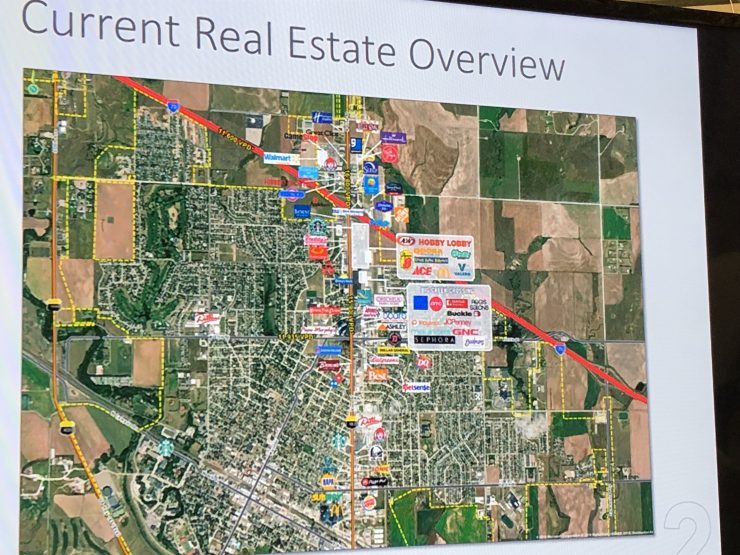















 The
The