We have a brand new updated website! Click here to check it out!

Outgoing Ellis Public Works director shares water concerns with current, potential council members

By JAMES BELL
Hays Post

ELLIS — Before the regular meeting of the Ellis City Council last week, outgoing Director of Public Works Alan Scheuerman shared with current and potential council members a summary of issues the council will be facing.

Among the issued presented was the continued presence of higher-than-allowed total trihalomethanes, commonly referred to as TTHM, in the water system.

“We do have a TTHM problem, and it’s getting worse,” Scheuerman said.

Trihalomethanes are a byproduct of chlorine interacting with organic material in the water supply and refers to a group of chemicals that include chloroform, bromodichloromethane, dibromochloromethane and bromoform.

The Kansas Department of Health and Environment, following the guidance of the Environmental Protection Agency, mandates TTHM levels under 80 parts per billion in public water supplies.

“We are coming in at 89 and 100, which brought our (running annual average) up to 89 and, unless we can come up with a much lower number – like a 40 in December, we’re going to have another one above 80,” Scheuerman said.

The highest TTHM average in Ellis last year was reported as 73, according to the KDHE consumer confidence report, meaning even with the current high levels the risk to the public is low.

Standard warnings from the EPA for consumers with water high in TTHM indicate health problems only occur after years of ingestion.

“This is not an emergency,” the EPA said in the standard letter to consumers that have high TTHM levels. “If it had been, you would have been notified immediately. Some people who drink water containing trihalomethane in excess of the (maximum contaminant levels) over many years may experience problems with their liver, kidneys or central nervous system, and may have an increased risk of getting cancer.”

Scheuerman said he believes the high TTHM levels are due to bromide leaching into the water system from organic materials while the amount of water in the city water wells is higher than normal.

“When it starts coming in at every test scheduled, which is every quarter, my guess is that the state is going to require us to take some kind of change or alteration to improve that,” he said.

Last year, 27 water systems in Kansas were found to have TTHM over the statutory limit – resulting in 55 violations, and Scheuerman, noting another city in western Kansas is currently facing similar issues.

The city is working with outside companies to find a cost-effective solution that can be worked into the city’s water plan.

Those companies will meet with the council in the future to address the issue, Scheuerman said, warning that if a solution is not found to alleviate the problem, the state could force the city into action.

Iron manganese treatment is a potential option and is likely the most cost-effective as it would only add another chemical feed into the system and the treatment is already used for inflow water, Scheuerman said.

“The other option we could do is a (reverse osmosis) system, which is extremely expensive,” he said. “We are not looking to do that method if at all possible.”

Mayor David McDaniel said at a recent governmental meeting he spoke with agents from two engineering firms that work with the city and was informed they are nearing a solution that would not require the reverse osmosis system.

As the city searches for other water sources, Scheuerman said, adding water into the system might also dilute the TTHM in the water under mandated levels and KDHE grants could cover up to one-third of the cost of adding another source of water to the system if that is used as the TTHM solution.

“There are multiple options there, but the city also needs to keep moving forward, because the state does not like you to sit on your laurels and say ‘We’ve got the water, we’ve got the land, but we are just going to sit there and look at it for the next 10 years,’ ” Scheuerman said. “They want to see you do something with it, which means you are probably going to have to spend some dollars.”

An engineering estimate totaled $3.7 million to $4.25 million two years ago that would secure another water source, including land and construction costs.

Scheuerman said the city could also try to partner with a rural water district to bring in water at a lower cost than securing new wells.


It’s not just what is going out, but what is coming in


Another issue that the council will face in the future will be water entering the sewer system rather than what comes from the taps, Scheuerman told the group, from damaged roads and storm drains.

“If you look at where the most damage is occurring, (it) is underneath the sewer and storm drains,” he said, noting water is infiltrating the sewer system under roadways and sections of roads in several areas of town.

“It’s getting worse,” Scheuerman said, noting repairs and maintenance need to be kept in mind when the council is lining up capital improvement projects.

Current council member Martin LaBarge agreed.

“Sometime, somehow, those streets are going to have to be fixed, because they are getting worse,” he said.

“On Washington Street, it is quite visible,” Scheuerman said. “You can see parts of the street are dropping and part of that is due to the tile breaking and water infiltrating down, going into those openings and taking dirt with it.”

He also noted one storm drain line has already collapsed.

“I know it is collapsing because there is no pipe left underneath there,” Scheuerman said. “We can’t get the sewer machine through it. If you can’t get a 2-inch sewer machine to ream that line, I guarantee … it was collapsed.”

He warned the council that funding is needed to address the problem, and other cities often have a fund specifically for storm drain maintenance, something he has recommended to the council in the past.

“If you have a major break, where you have to redo a section of storm drains, you have set no funding aside for that purpose,” Scheuerman said.

In those situations, the only solution is using tax dollars if no funds are available, which would take away from street repair funds.

“It will come back to haunt you because it will get worse,” Scheuerman said.

He suggests the new council begin accumulating a capital improvement fund to help those kinds of repairs.

“Your cost to repair will continue to rise,” Scheuerman said.

Repair funds, he told the group, are mandated by law to be separated and recommended the council re-evaluate the 2 percent water bill increase that was voted down this year to be used for maintenance.

“With these types of dollar amounts that you are going to need to keep your water safe and usable, I suggest that you reconsider about that 2 percent,” Scheuerman said.

“I think with the kind of dollar amount that you need to continue to put into your water system you can probably not afford to let that drop,” he said. “An annual 2-percent increase is a lot easier to swallow for a lot of people … than a $20 change 10 years from now.”


NW Kansas economic outlook predicts slow growth, increased wages in tight labor market

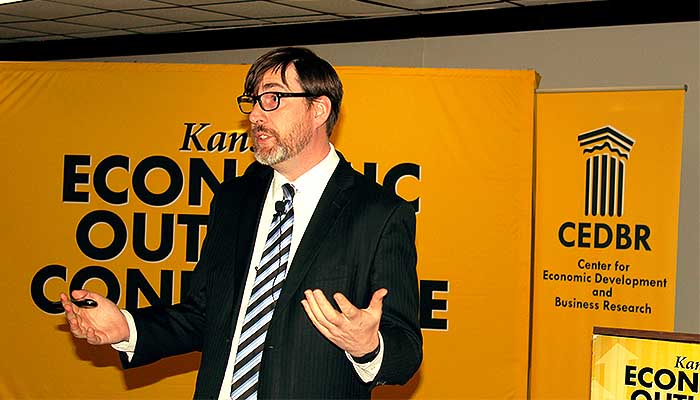
Jeremy Hill, director of the Center for Economic Development and Business Research at Wichita State University, speaks to the Hays Regional Economic Outlook Conference Thursday in Hays.

By CRISTINA JANNEY
Hays Post

A recession is not imminent and northwest Kansas is expected to experience slow growth in the next year, according to panelists at the Hays Regional Economic Outlook Conference.

During the conference Thursday in Hays, Jeremy Hill, director of the Center for Economic Development and Business Research at Wichita State University, said the labor market will remain tight, but that tight labor market is also driving up wages for employees.

Unemployment in northwest Kansas still remains extremely low.

The ag and oil industries have both seen hits in the last three years. Ag product demand is being affected by the trade war, but income in that sector was up largely because of government and crop insurance payments.

“Farmers don’t want government payments,” he said. “You don’t know what to plan for.”

He compared the payments to farmers wearing oxygen masks.

“You feel good because you have an oxygen mask. I’ll take this cash, but does a farmer really want an oxygen mask?” Hill said. “Absolutely not. They want to go out and deal with the real market the way it is and have an understandable market where they can say right up and down and this is what is going on.”

For several years, the government sector experienced cuts, Hill said. However, now the sector is seeing increases, especially in its largest subgroup, which is school districts.

“I think labor markets are working pretty darn well,” Hill said.

Ellis County saw a dip in employment in 2015 and 2016 when oil prices fell sharply. However, the employment rate has increased the last two years.

Ellis County accounts for 21 percent of the population in northwest Kansas, 25 percent of the employment and 28 percent of retail sales.

Surveys of employers indicate they anticipate they will be hiring in the next year. Hill said a high demand exists for top-quality, skilled employees. Companies are finding themselves paying higher wages for B- and C-level employees, he said.

Northwest Kansas employers are finding themselves paying workers more to keep from losing them to other regions of the state.

Hill said the region is seeing more what he called “job hoppers.”

“[The business panel] said, ‘Yeah we had low-skill workers who would just jump for just a $1 more or a few cents more or they thought it would be a better company. They are just moving really quickly,'” he said. “This year they are saying that they are even having some middle-skill people who are job hoppers that are moving from one to the next to the next.”

He added, “In this area, if you are not thinking about that wage, you better be thinking about that wage or someone is going to get up and leave for a couple dollars more or just the promise of a better job somewhere else.”

Rising wages are not good for profit margins, but they are good for the economy as it puts more cash in consumers’ hands.

However, Hill said Kansas is experiencing a lack of confidence from investors. Even investors inside the state are wanting to invest outside of the state because they can get better returns.

Kansas has had a four-year decline in taxable retail sales as more items are purchased online. Ellis County’s retail sales peaked in 2013 and are flat in 2019.

Kansas has had a shift in the state to more middle income and low-come jobs. Purchasing power also has an affect on taxable retail sales.

Migration continues to be out of rural areas into metro areas. Almost all of the population growth in Kansas in 2018 was in Johnson County. This means labor is also moving out of rural areas.

Hill finally looked at possible factors on the horizon that could lead to a recession.

“Economic expansions do not die of old age,” he said. “We could grow forever potentially, and there are countries I mentioned earlier that grow, grow, grow. What causes recession is something out there that causes it. The problem is that it is never something that we are thinking about.”

He said he did not think it would be Brexit or trade wars.

“Companies in Kansas are hedging the risk,” he said. “I’ve talked to quite a few businesses that have just stopped exporting because they just didn’t want to deal with it anymore.”

He thought labor markets should also not affect the economy.

Some business owners said cyber attack or cyber warfare could bring on a recession.

Farm debt and bankruptcies and oil prices could be factors, as well, he said.

Some economists have been concerned interest rates being lower on long-term bonds than short-term bonds could spark a recession. This has happened in the past.

However, Hill noted international trade is so dependent on the American dollar, global entities are still buying U.S. Treasury notes despite the reversal in the interest rates.

Kansas businesses for the coming year are realistically optimist that the economy will be stable or have slow growth. Estimates are for about .6 percent growth in Kansas, with the state adding almost 9,000 jobs, Hill said. Wages are expected to expand, but retail taxable sales are expected to decline.

Teacher of the Month: Wagoner teaches students they have a voice

Kathy Wagoner, HHS English teacher, stands next to one of the inspirational posters in her classroom. It reads in part, “I can’t control anyone else, but I can control myself.”

By CRISTINA JANNEY
Hays Post

In an era when social media is king, Kathy Wagoner is trying to get kids to understand the power of the written word.

According to one of her students, she has been able to do that.

“Mrs. Wagoner is the only teacher I’ve ever had that has made me excited to write a five-page paper, ” Abbey Oborny, a senior at Hays High School, said in her nomination for Wagoner for Hays Post Teacher of the Month. 

“The way she teaches also keeps me wanting to learn more,” Oborny said. “We read a couple poems recently and were going over the theme and the meaning of them, and the way Mrs.Wagoner taught us to analyze them was amazing.

“I can see now easily the meanings of stories, why the author uses the literary devices that they use and how important writing is. I’ve actually used this new skill while listening to songs and it has made me realize how many metaphors and parallel structures the songs contain.”

Wagoner said she engages her students by “showing them they have a voice and they have control of their mind and the way they want to present themselves … showing them the power of the language and the power of punctuation.”

She tries to urge them to be more confident in experimenting with writing styles.

“I tell them in this class, right away, they are not writing for themselves, they are writing for the readers,” she said. “You need to make sure you communicate what you want them to feel and think.”

Wagoner said she gets along great with kids, but the first thing you need to know about young adults is you need to respect them.

“Just because they haven’t had the experiences I’ve had in life doesn’t mean their opinions don’t matter,” she said.

Wagoner does some writing herself. She was written quite a bit of poetry. She started a novel but said there is never time to work on her own project.

Wagoner, 58, has been a teacher for 28 years, all at Hays High.

Growing up in Oskaloosa, a town of 1,000, north of Lawrence, she said knew she wanted to teach by the third grade.

“It was in my blood,” she said. “I always wanted to do it.”

She received her bachelor’s of science in Education with distinction from the University of Kansas in 1990. She received her master’s degree in English from FHSU in 1999. In 2000, she passed the boards to receive a 10-year license as a National Board Certified teacher in Adolescence and Young Adulthood/English Language Arts. She renewed that license in 2010 and was just notified of her latest renewal, which will be good through 2030.

“I appreciate how [the kids] keep my mind young,” she said.

Wagoner said she was a little intimidated her first year at HHS as it was so much larger than what she grew up with—a rural school of 120 students.

“But when I got in the classroom, there were still just 25 kids,” she said. “Within the classroom, you are creating your own environment — style of family. That’s how I looked at it, so I wasn’t overwhelmed by everything.”

After her students leave her classes and graduate, she said she hopes they have “the confidence to tackle any issue or opportunity that they run across — that they can verbally and in writing communicate with others.”

Wagoner said social media is changing her students and making that more difficult.

“They just don’t want to read,” she said. “They don’t understand the power of the written word. They need to be able to read in order to be sure they are not being manipulated by others, and they can truly go after the opportunities that they desire. Without the ability to comprehend what you read, they are doing themselves an injustice.”

She continued, “Nowadays with the technology that is available to them. The instant gratification and how they seek it — I wouldn’t say all of them — but patience has been put on a back burner. Tolerance of others seems to be on a back burner because it is more about self-gratification. The social media gives them that.

“My students tell me, ‘I don’t want to spend 15 minutes reading a book or 20 minutes.’ One of my students said to me the other day, ‘Why do you have to make it so hard?’ I said, ‘All I want you to do is think. How is that hard?’ ”

Wagoner said it is a challenge finding books the students desire to read and will also challenge them.

Students want escape fiction. It is easy to read, ttakes you out of the environment, and you don’t have to think to read it. If you give them literary fiction, they have to ponder what they are reading, Wagoner said.

“It makes them think about the human condition,” she said, “and sometimes they don’t like to think about that.

“You always hear that, ‘I am one person. What am I supposed to do about it?’ ” she said. “Then you can use social media and show how one person can change the way people think. There are benefits along with the issues.”

Wagoner will admit that teaching English is not all about English.

“No matter what content area you’re teaching, when you are teaching high school, you are teaching the whole person,” she said.

Her students see this too, as Oborny’s nomination shows.

Most importantly while teaching all of us thousands of things (and never complaining about it) she inspires me to be a better person,” she said, “to have a more positive outlook and as her board says every day, ‘be present,’ which according to her means to be fully there, to live in the moment, and to keep your attention on the right things.”

Wagoner is also mentoring up-and-coming teachers. Last month’s Hays Post Teacher of the Month, Jaici Simon, Hay Middle School English teacher said Wagoner has been a role model for her.

“It warms you and humbles you at the same time,” Wagoner said. “I felt very humbled after I read that article. Then I thanked God and said, ‘You’ve set me on the right path.’ I ask Him all of the time to make sure that I am doing what you want me to do in the classroom to help these kids grow and be where they need in their lives.”

TMP-M cancer survivor honored at football game

Sophia Linenberger with her family before the TMP game Thursday night. Photos by Cristina Janney / Hays Post

Hays Post 

Sophia Linenberger, a sophomore at Thomas More Prep-Marian, was honored by the Thomas More Prep-Marian football team prior to their game against Ellsworth on Thursday night. 

Linenberger was diagnosed in January of this year, with Ewings Sarcoma Cancer.

The football players gave Linenbeger yellow roses as they ran on the field. She also participated in the coin toss.

Sophia’s family wrote the following statement that was read by the announcer during the opening ceremony at the game:

“Sophia Linenberger, a sophomore at TMP-Marian was diagnosed in January of this year, with Ewings Sarcoma Cancer. She has undergone six weeks, five days a week of radiation.

“Along with this, she has undergone three surgeries. She has had chemotherapy in Kansas City at Children’s Mercy Hospital each week since her diagnosis in January. Sophia has two more rounds of chemotherapy.

“Along with her and her family, tonight we want to announce to our Monarch Family, that Sophia is now in remission.

“After she finishes her remaining two weeks of chemotherapy, she will have a PET scan and a CT scan. If all goes well, she will then have the removal of her port surgery. She will be continuously and cautiously monitored with check-ups.

“She will also begin physical therapy to strengthen her legs to bring back her mobility to walk again.

“We would like to thank you for the cards, care packages, gift cards, donations, and above all, the continuous prayers. A special thank you to the Hays community and our TMP family. We ask that you continue to keep her in your prayers, as she still has a long way to go, before she will be fully recovered. God Bless and Go Monarchs! Sophia Strong.

“A special thank you of gratitude to Head TMP Football Coach, Jay Harris and the Thomas More Prep-Marian football team for the surprise of presenting Sophia with a yellow rose from each football player and every coach, to help her get through her last chemotherapy treatments.  

“A special thank you to TMP’s Mr. James Harris, we are humbled for all that he has done for Sophia and our family. 

“It was also a great honor for Sophia to be a part of the coin flipping for tonight’s game.”

Makey Makey me a monster at Ellis Public Library

Taylor McClung applies zombie makeup to her sister Chloe McClung, 13, during the Makey Makey Monday at the Ellis Public Library. Chloe plans to dress as 11 from “Stranger Things” for Halloween this year.

By CRISTINA JANNEY

Hays Post

Chloe McClung, 13, in her Zombie makeup.

ELLIS — Makeup Artist Taylor McClung visited the Ellis Public Library on Monday to give kids tips on creating monster makeup during its regular Makey Makey Monday event.

McClung, a cosmologist at Body and Soul, said she taught herself to create realistic-looking wounds and scary zombie makeup by watching YouTube videos and practicing on her younger sisters.

McClung and the kids laid down a base using tissue paper and latex makeup. Flesh-tone base was added to the latex and tissue layer to mimic skin.

They made tears in the latex/tissue layer and added dark red makeup to make the areas appear like wounds. Some of the participants also added oatmeal for more texture.

Makey Makey Monday is a new program at the Ellis Public Library. The sessions, which are aimed at children, have been focused on art or science. Some other events have included a Model Make ‘N’ Take and robot art.

The next Makey Makey Monday will be in November and be Lego themed. A date has not yet been set.


Elijah Wagoner, 7, paints zombie makeup on his arm on Monday. He said he plans to be a skeleton Grim Reaper for Halloween.
Amethyst Moses, 8, Ogallah, dabs latex on her mother Brenda’s hand during Makey Makey Monday at the EPL on Monday.
Steve Arthur, EPL librarian, paints zombie makeup on his hand on Monday.

Women in business say they didn’t all set out to be their own bosses

Second from left, Lisa Kisner, founder of Lisa’s Custom Interiors; Bonnie Pfannenstiel, owner of PoPt! Gourmet Popcorn; Kiley Rupp, founder of Body and Soul Day Spa; Deanna Doerfler, owner of Doerfler’s Harley Davidson; and Tammy Wellbrock, founder of Girl Twin Solutions, answered questions on the FHSU campus Tuesday in honor of Women Entrepreneurship Week. Sarah Wasinger, far left, director of the Hays Area Chamber of Commerce, moderated the panel.

By CRISTINA JANNEY 
Hays Post

Although several of the women on FHSU’s “Women in Business” panel on Tuesday said they did not set out to be entrepreneurs, all of them now own their own business.

Deanna Doerfler, owner of Doerfler’s Harley Davidson; Lisa Kisner, founder of Lisa’s Custom Interiors; Bonnie Pfannenstiel, owner of PoPt! Gourmet Popcorn; Kiley Rupp, founder of Body and Soul Day Spa; and Tammy Wellbrock, founder of Girl Twin Solutions, answered questions on the campus in honor of Women Entrepreneurship Week.

Being your own boss

Kisner’s business celebrated its five-year anniversary in June. Although Kisner has long had a passion for interior design, she  worked for other people for 10 years before taking the leap to being her own boss.

“I was kind of at a crossroads as what to do next,” she said. “There are not a lot of design businesses here in town, so I had to make a decision. I am so passionate about interior design and I knew I couldn’t give that up. I didn’t want to move, so I decided to take the leap to go out on my own.”

Pfannenstiel was a licensed physical therapist before she started PoPt!. She also ran her own real estate business in Phoenix before moving back to Hays. Pfannenstiel started PoPt! in 2014. It was supposed to be a part-time job, but has grown into a business in its own 1,600-square-foot brick-and-mortar store and processing area. She hopes to double the business’ building footprint within the next two years.

Kiley Rupp answers a question as Bonnie Pfannenstiel, left, and Deanna Doerfler look on.

Rupp has been in the cosmetology industry for about 13 years and was the manager of Body and Soul Day Spa before taking ownership in May.

Doerfler and her husband, Brian, purchased the Harley Davidson dealership from Brian’s father and uncle in 1993.

“It was difficult at first,” she said, “because we had an older generation that was leaving. Harley was on a huge growth pattern at that time, and we had lots of changes.”

At that time, an owner had to be in the building 70 percent of the time.

Doerfler is not college educated. She had ridden dirt bikes as a kid but was not a street rider at the time she started with Brian in the business.

“There was a Harley University, and I probably went to every class and I absorbed everything that I possibly could,” she said.

Wellbrock founded her company, Girl Twin Solutions three months ago after working as the director of the Hays Area Chamber of Commerce for eight years.

“The entrepreneurial spirit was certainly part of me because I grew up the daughter of a farmer,” she said, “and I saw my dad have all the good and the bad that comes with being self-employed. I knew that was in my heart.”

Wellbrock came to Hays to study at FHSU.

“I would like to echo the fact that I’m probably more of a student today and learning more and doing more research than I ever did when I was a student,” she said. “Your learning doesn’t stop when you leave these walls.”

‘I was a job gypsy’

From left Sarah Wasinger Lisa Kisner and Bonnie Pfannenstiel.

The panelists were asked what inspired and motivated them to start their businesses.

Kisner said she was passionate about interior design, but she knew she needed to do her research before setting out on her own. She spent six months doing research. She also told the audience, which was comprised of many students, she wished she had taken more business classes in college.

Pfannenstiel was helping her husband, Russ, find speciality products to be featured in the remodeled 27th and Vine Cerv’s. He brought back some popcorn samples from market, but Bonnie was not impressed. Pfannenstiel said she considered herself a “job gypsy” and was looking for something to do.

“I thought, ‘I will pop popcorn for a couple of days and put it in your stores,’ ” she said.

She found someone from Texas to train her in the popcorn business, but he was using a retail model. Pfannenstiel wanted to be able to wholesale the popcorn.

“I was going to do this part-time and not have any employees and you don’t realize what is about to happen with your life five years later,” she said.

Rupp comes from a long line of entrepreneurs. Her grandparents owned hotels, and her parents owned an ag and lawn business in Nebraska.

“Growing up, I was sure that was something that I was sure I didn’t want to do,” she said. “But looking back, each new job was preparing me for this journey I am on now.”

She said when the opportunity came to purchase the spa, she realized she had the opportunity to make changes in her industry.

Doerfler said she saw an opportunity to grow and modernize the business. When she and her husband took over the Harley shop, they were still using paper tickets.

“The marketing side had me really excited,” she said. “I was in a man’s world, and not every man in the motorcycle world accepts women.”

Doerfler said she wanted to open up the biking world to women, beyond just riding on the back of a bike.

“After I started riding and got to know some of these other women who were coming in the shop who were just kind of along with their husband or friends, I thought it would be so cool if all these women I knew just through my retail experience from them walking in the doors and talking to me knew each other.

“I knew I could sell the sport, the brand and everything if they could get to know one another, because relationships in the motorcycle industry are the key to keep people riding.”

She started an annual four-day women’s ride. The ride has continued for 16 years and today mother/daughter pairs are joining the group.

Wellbrock said she had a desire to start a new project.

“I need the whole scene to change,” she said, “and the people around me. I desire a lot of variety in my professional career.”

She said she loved the Chamber industry and loved Hays.

“To reinvent yourself, some people then will take that same position and just choose another community,” Wellbrock said. “The community wasn’t going to be able to change for me, so I needed to change the scope of the job.”

What’s in a name?

FHSU students and community members will the panel audience.

The panelists were then asked about what lessons they have learned that would have been beneficial to them when they first opened their businesses.

Pfannenstiel said she wished she would had done a little more research on the community before she started her business. PoPt! had a lot of naysayers in the beginning, but she ended up having a lot more community support than she imagined, she said.

Rupp said recruiting and retaining a quality team who sees your vision as you do has been important to her business. She urged new business owners to not be afraid to ask questions and ask for help.

Doerfler urged entrepreneurs to have a doable succession plan. Harley requires the Doerflers to have an updated plan on file.

Building strong managers is important in succession planning, and Doerfler admitted she could have been much better at that in her business.

Wellbrock said some of the best advice she received was in developing her business’ name. She considered naming her business Tammy Wellbrock Consulting, but she was told no one will buy Tammy Wellbrock. She thought about what made her stand out, and that was that she had a twin brother. She is the girl twin.

Wellbrock did not have to have a business plan, because she wasn’t approaching a bank for a loan, but she did one anyway. She said the best thing she ever did was develop her own business plan with the help of the Small Business Development Center.

Kisner said the best advice she could give was not let you emotions make your decisions.

“When you are getting started, it is really important to take the time to do your research,” she said. “Contact people that know more than you. … It is really easy to get really excited and jump on a decision, and it can affect everything.”

Electric bikes to a unicorn

Rupp said she has focused on learning more about the community and staying involved with current events.

Doerfler said Harley is having challenging with an aging demographic. They also have a desire to keep manufacturing in the United States.

The average age of a Harley owner is 40 to 50 years old.

Harley is trying to realign themselves to be more appealing to younger riders. One of the tools it is using to do this is a Jumpstart platform. You can put a bike on it and a non-rider can learn how to run through the gears.

Appealing to new riders has also included making lighter, more affordable bikes and introducing electric bicycles for children and adults.

“Given those challenging times, it’s still exciting times,” she said. “I think we are engaging another world. Obviously, technology is affecting every industry. It is challenging for any car or motorcycling manufacturer right now. We can’t change fast enough, is what I always say.”

Wellbrock said she is asking businesses, “What is your pain? What is keeping you up at night.”

She is using those answers to develop content.

Kisner said, “If I don’t stay up with the trends, my business would not exist. What I have to do in interior design must always be up with the current trends.”

She spends a lot of time going to design expos and talking to her wholesalers about what kind of trends they are seeing in their sales.

Kisner said she also tries to keep up-to-date with technology. She is using virtual reality to show her clients what their spaces are going to look like when they are finished.

Pfannenstiel said, “PoPt! is a niche retail brick-and-mortar store in a decade where brick and mortar is going away. When I tell people we are looking to expand our business to a bigger building, they look at me like ‘Are you sure?’

“The great thing about PoPt! is that my business is not a franchise. I can do what I want. It is like spin the wheel everyday and where is the dart going to end?”

The older generation likes the popcorn and nostalgic candy. The kids like the candy. The 20- and 30-year-olds bring their kids in to get candy, and they buy too, she said.

“Basically this business is your imagination is your limitation and Pinterest,” Pfannenstiel said.

PoPt! just introduced its new mascot — Poppy the Unicorn. Pfannenstiel hopes to use the mascot to expand the business into special events and birthday parties.

🎥 Housing, wages dominate city commission candidate forum

Dr. Jay Steinmetz and Dr. Wendy Rohleder-Sook, FHSU Dept. of Political Science, at Tuesday’s forum with Hays city commission candidates Michael Berges, Ron Mellick, Mason Ruder, Ryan Rymer and Henry Schwaller IV.

By BECKY KISER
Hays Post

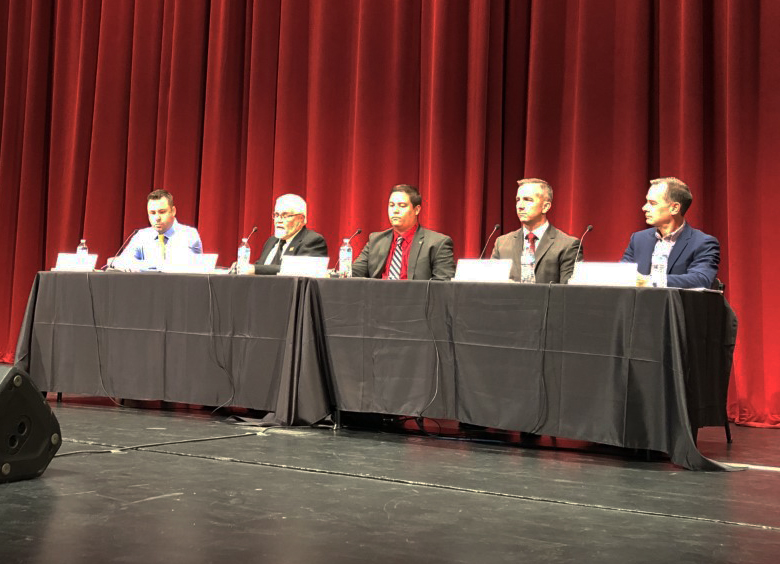
The five men running for three open positions on the Hays City Commission agreed on two things during their 90-minute public forum Tuesday night in Fort Hays State University’s Beach Schmidt Performing Arts Center.

Incumbents Ron Mellick and Henry Schwaller IV, along with newcomers Michael Berges, Mason Ruder and Ryan Rymer all said they love the community of Hays and want to give back to the town and its residents by serving on the city commission.

Each candidate also declared the need for affordable housing to be a top concern.

Written questions from the audience of about 75 people were read by Dr. Jay Steinmetz, FHSU political science assistant professor.

One of the first questions asked the candidates to name the biggest problem facing the city and how they would fix it.

Their answers varied but each included a mention of affordable housing.

Ruder, the Ellis County Environmental Planning Supervisor, grew up in Hays. Like many young people, he left for awhile to live and work in a bigger city – Kansas City. Then Ruder returned to Hays start a family.

“Our biggest issue we need to tackle is finding ways to retain young people in Hays. Affordable, moderately-priced housing is part of that,” Ruder said, “and working with developers, realtors, Grow Hays.

“We have a bunch of resources available to us to bring in some of these potentially new developments to let the students and the younger people plant roots right here in town.”

Ruder said he struggled to find a house in his price range but “got lucky with what I found. It was a difficult, difficult process.”

He also believes the city should help sustain local businesses and encourage entrepreneurship to help support the economy and retain young residents.

Rymer, an ER nurse at Russell Regional Hospital, told the audience he had done a “search of homes in Hays looking at middle-income housing, which to me was about $200,000 on down to about $150,000 for entry-level folks. I only found two that had been made in the last 20 years.

“If we are to remain competitive and attractive for young people to move to and, when they get done with college here, to not want to leave, we have to look for ways to make housing more economically affordable.

“The city’s parks, with the upcoming addition of the accessible recreation complex, and our blossoming Main Street are amazing, so we’ve got to do other things to help accommodate” people in Hays, Rymer said.

“I’m going to turn the question around and ask what’s the biggest opportunity for Hays,” said Berges, a financial advisor.

Although he sees a lot of opportunities for people living in Hays no matter their stage of life, “we have a kind of wage stagnation with very little opportunity for growth which comes down to a greater problem in affordable housing.”

Berges estimates 80 percent of Hays residents are spending 30 percent of their income on housing, whether rent or mortgage, and says “that’s not affordable housing.”

It’s also not unusual for those raising a family in Hays to be spending another 20 to 30 percent of their income on daycare, according to Berges.

He suggested leaning on Grow Hays and similar organizations to attract higher-paying jobs to town.

The two incumbents approached concerns about affordable housing a little differently.

Schwaller owns more than 150 properties in Hays as president of  Henry Schwaller and Associates. He is also a management instructor at FHSU.

“If we’re going to continue to grow, we’re going to have to invest in the fundamentals,” said Schwaller.

“We’re going to have to retain and grow existing businesses and encourage startups. We have to build houses for the people who work here. We’re going to have to make sure we’re creating jobs that are high-skill and high-wage.”

Schwaller pointed out the many employable FHSU and NCK Tech College graduates who “can find jobs that fit right into our economy, and that is a spot we are missing.”

Mellick, a self-employed floor covering installer, referenced the declining population of western Kansas, saying “we need them. They rely on us for services and we rely on them for shopping.”

The city’s general fund is financed primarily by a half-cent retail sales tax.

“I do believe affordable housing would keep a lot of people in our community and in western Kansas,” Mellick said.

“But land prices here in Hays are so high you can’t have affordable housing because affordable housing starts with affordable land prices.”

According to Mellick, the city has many areas that could be developed “but to get those land prices down so we can put in affordable housing is going to be very, very difficult.”

A perennial topic of debate in Hays is traffic roundabouts and their inclusion in the North Vine Street Corridor Improvement Project.

Berges, Ruder and Rymer all said they understand the increased safety and driving convenience but question the roundabouts’ locations in the proposed design.

Schwaller has previously expressed his opposition to the configuration as presented to the city commission. Mellick continues to support the project.

Each candidate stressed the importance of fostering a good relationship between the governing bodies of Hays and Ellis County.

As a county employee, Ruder often works with city department heads.

“We’re currently working on redesigning the Extra Territorial Jurisdiction (three-mile zone) around Hays to better suit both the county and the city,” Ruder noted.

Mellick and Schwaller talked about the currently shared services and resources between Hays and Ellis County including law enforcement, emergency medical service, a mutual aid fire agreement and fire training and occasional roadwork.

The city has also written letters of support for the Northwest Business Corridor, proposed improvements to 230th Avenue and Feedlot Road to complete the U.S. 183 bypass around Hays.

“We have an open dialogue,” Mellick said, “and will keep the lines of communication open.”

Although there are many opportunities to work together, “the county is working on getting ahold of their budget and figuring out their revenue sources for the future,” Schwaller said. “Because they’re focused on that, it’d be difficult for us to says let’s work on this together.”

Ellis County residents will vote on a proposed sales tax increase in April. If approved, the city of Hays would receive a portion of the sales tax revenue.

“As Hays goes, Ellis County goes,” Berges said.  “I know Victoria and Ellis residents don’t want to hear that.”

Acknowledging that the county’s budget work comes first, Berges added “it is important that we work with our county commissioners and our county employees from a city level.”

“We are just one city in the county,” Rymer said, “and we owe it to the citizens of our county to be able to assist it and augment it in any way possible. We’re all in this together.”

Rymer and Ruder both believe joint commission meetings should be conducted for large projects such as the Northwest Business Corridor.  In light of the county’s budget difficulties, Ruder also suggested the city should consider providing financial support to the project.

“It’s going to be a good thing for the city in the long run,” said Ruder.

The audience also asked questions about downtown Hays revitalization, subsidizing Safe Ride, recycling, and long-term water supply problems and solutions.

In their closing statements, each candidate encouraged Hays residents to vote in the Nov. 5 election. Advance voting began Monday.

The top two city commission candidates will serve for four years, while the third-place vote-getter will serve for two years.

Tuesday’s forum was organized by the FHSU Student Government Association, American Democracy Project, the Department of Political Science and Tiger Media Network along with the Hays Area Chamber of Commerce and the Docking Institute of Public Affairs.

Chrysler Boyhood Home balances budget by closing over winter months

Museum board president assures the city council it will reopen in the spring

By JAMES BELL
Hays Post

ELLIS — In an effort to alleviate continued budget woes, the Walter P. Chrysler Boyhood Home and Museum Board of Directors has decided to close over the winter — but assured the Ellis City Council that the closure is temporary.

“The rumor that the house is closing is just a rumor,” Gordon Solomon, museum board president, told the council at Monday’s regular meeting. “We want to ensure everyone that it is not permanently closing. It will be open in the spring.”

The move became necessary as the museum was unable to break even and was using reserve funds to pay staff over the slower winter months.

“We have been struggling, budget-wise for a couple of years now,” Solomon said. “By doing the closure, we should be able to close out the budget this year about equal.

“Like most people, we have to learn to live within our means,” he said.

He acknowledged the council was funding the museum as much as possible, but ultimately the savings made by closing was needed to put the budget on track.

“Our goal is to just meet budget and we realize the city can’t increase what you are already doing to assist the home,” Solomon said.

During the meeting, he said attendance over the winter months is low, so the impact on tourism would be minimal.

As an example, Solomon said total admissions and sales for the museum in January and February of this year was only $82.35 — while wages and payroll taxes equaled $1,404.

With those numbers, he said, “Obviously we are not meeting budget, even with your assistance.”

While the board was actively seeking solutions to balance the budget over the summer, museum employees gave notice to the board they would be leaving on Sept. 6, spurring the board to make a decision at a special meeting on Aug. 29.

“As a board, we decided that we would stay closed through the remainder of September and then we proposed to the board to mirror the schedule of the Ellis Railroad Museum,” Solomon said. “Our intent in the future is to open in March and close at the end of September.”

In January, he said the board would begin looking for a new employee.

Even with the budget concerns alleviated, for the time being, Solomon said the board is still actively seeking ideas to bring more people to the museum, including continuing to strengthen the partnership with the Ellis Railroad Museum.

“That’s our goal. We want to try to mirror each other and support each other,” Solomon said.

This would continue the trend of the two museums operating in a similar manner to one another.

“We tried to structure them the same — hours, fees, everything,” Ellis Mayor David McDaniel said.

Solomon said the board is also looking at a discounted rated for visitors who go to both museums, or offering a discount to people visiting the Ellis Lakeside Campground.

“There is a lot of people coming to town that obviously don’t visit,” Solomon said, noting the large influx of people at the campground, even while museum attendance is low.

People in the emptying parts of rural Kan.: ‘We’re not going to let them die’

Chris Neal / For the Kansas News Service

BY JIM MCLEAN
Kansas News Service

COURTLAND, Kansas — Rural Kansas has a storied past, but decades of population decline stand poised to turn many once-vibrant places into ghost towns.

The struggle for survival reveals itself in emptied Main Streets, shuttered factories and tired-looking neighborhoods dominated by houses built before World War II.

An exodus that started more than 100 years ago and gained momentum during the Great Depression has now thinned the population of most of the state’s 105 counties to fewer than 10 people per square mile.

“Quite a few counties peaked in the 1890 Census in terms of total population and have never recovered,” said Kansas historian Virgil Dean.

At 2%, Kansas’ population growth rate lags far behind the nation’s 6%. And it’s uneven. Most of it is concentrated in the state’s urban areas — Kansas City, Wichita, Lawrence, Topeka and Manhattan. A forecast by researchers at Wichita State University projects growth in less than a fifth of the state’s counties over the next 50 years.

Still, Kansans fighting the trends cling to a different vision. They insist that population isn’t the only measure of a livable community.

Credit Chris Neal / For the Kansas News Service

“Rural Kansas is going to survive,” said state Republican Rep. Ken Rahjes from Agra in north-central Kansas. “We have that sense of pride in our communities. We’re not going to let them die.”

It will take more than defiance to save them, said journalist Corie Brown, a native Kansan whose career has taken her to newsrooms across the country. She recently returned to write a magazine article: “Rural Kansas is dying. I drove 1,800 miles to find out why.”

“As I’m driving around to these small towns, I realized there’s no one here,” Brown told the Kansas News Service.

Brown’s April 2018 article painted a stark picture of decline.

“The small towns that epitomize America’s heartland are cut off from the rest of the world by miles and miles of grain, casualties of a vast commodity agriculture system that has less and less use for living, breathing farmers,” Brown wrote.

Dramatic changes in agriculture hollowed out rural Kansas, Brown argues. Specifically, she blames the decades-long trend towards bigger farms that yield ever more abundant crops of wheat, corn and soybeans. Those bountiful harvests often don’t return a breakeven price to farmers forced into debt to buy land and the sophisticated machinery needed to work more acres with fewer people.

“That image — abundance at the center of a depopulated landscape — sums up the reality of rural Kansas,” Brown wrote. “It masks a harder truth: Kansas’s plentiful grain crop has come at the expense of nearly everything else.”

The move toward bigger farms run by fewer farmers — along with other changes in the economy — threatens the existence of towns that sprouted up to support larger family operations and to supply workers for railroads, mines and homegrown manufacturers.

But like the economic factors that forced railroads to consolidate and sent many of America’s factory jobs to foreign shores, those driving change in the ag sector can’t be reversed, said John Leatherman, an agriculture economist at Kansas State University.

“There are economic forces at play,” he said, “that we can’t make go away.”

It’s not realistic, he said, to “turn back the clock” to a time when smaller family farms dominated the rural landscape.

Credit Celia Llopis-Jepsen

“That is going backward in time and that is not what happens in life,” he said.

Luke Mahin merely wants to slow the pace of decline. He hopes to give those fighting to save rural communities a chance to experiment with new strategies.

“I see more energy now, more coordinated effort,” said Mahin. At age 28, he returned to his hometown of Courtland, population 285, to run Republic County’s economic development organization.

Communities that competed against each other for generations, Mahin said, now join forces in desperate attempts to revitalize entire regions. They want to make them more inviting to people looking to return to their rural roots — particularly young people.

“We want to connect those dots for people who are looking for housing, looking for resources to start their business,” he said. “We know there’s more people out there who want to come back than we have opportunities for.”

It’s a tough sell. Measures of net migration typically rank Kansas in the bottom teir of states. One shows it losing 25- to 29-year-olds faster than any other state.

Still, Mahin and others working to stem the depopulation tide may soon get help from two new state initiatives. One launched by Democratic Gov. Laura Kelly, the other by the Kansas Legislature.

Credit Chris Neal / For the Kansas News Service

Soon after taking office in January, Kelly created the Office of Rural Prosperity in the Kansas Department of Commerce and put her lieutenant governor, Lynn Rogers, in charge.

Rogers crisscrossed the state over the summer on what he called a “rural prosperity listening tour.” He’s now working on a set of policy recommendations aimed at helping rural communities tackle some of their biggest challenges — spotty access to the internet, crumbling infrastructure, financially stressed hospitals and a shortage of affordable, modern housing.

“Now,” Rogers said, “we have to do something.”

This is the first in a series of stories investigating the decline in rural Kansas and efforts to reverse it. The next story looks into the role that changes in the farm economy have played in that decline.

Support for this season of “My Fellow Kansans” was provided by the United Methodist Health Ministry Fund, working to improve the health and wholeness of Kansans since 1986 through funding innovative ideas and sparking conversations in the health community. Learn more at healthfund.org.

Jim McLean is the senior correspondent for the Kansas News Service, a collaboration of KCUR, Kansas Public Radio, KMUW and High Plains Public Radio covering health, education and politics. You can reach him on Twitter @jmcleanks or email [email protected].

🎥 National memorial hosted by Plainville honors post-9/11 fallen military

By BECKY KISER
Hays Post

“The Gold Star families have liked this stop in Plainville the best.”

Nola Fritz, Gold Star mom and display manager

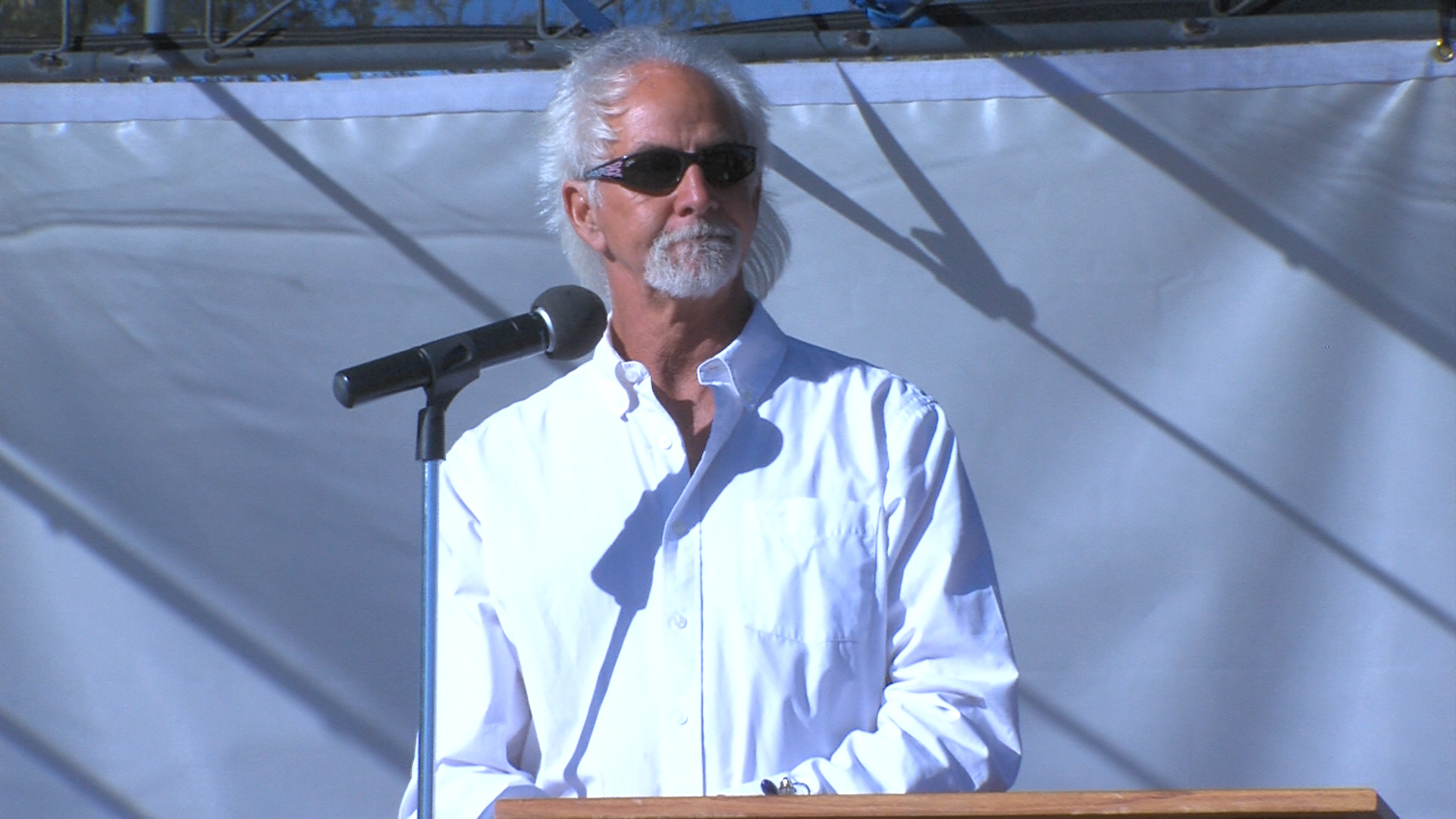
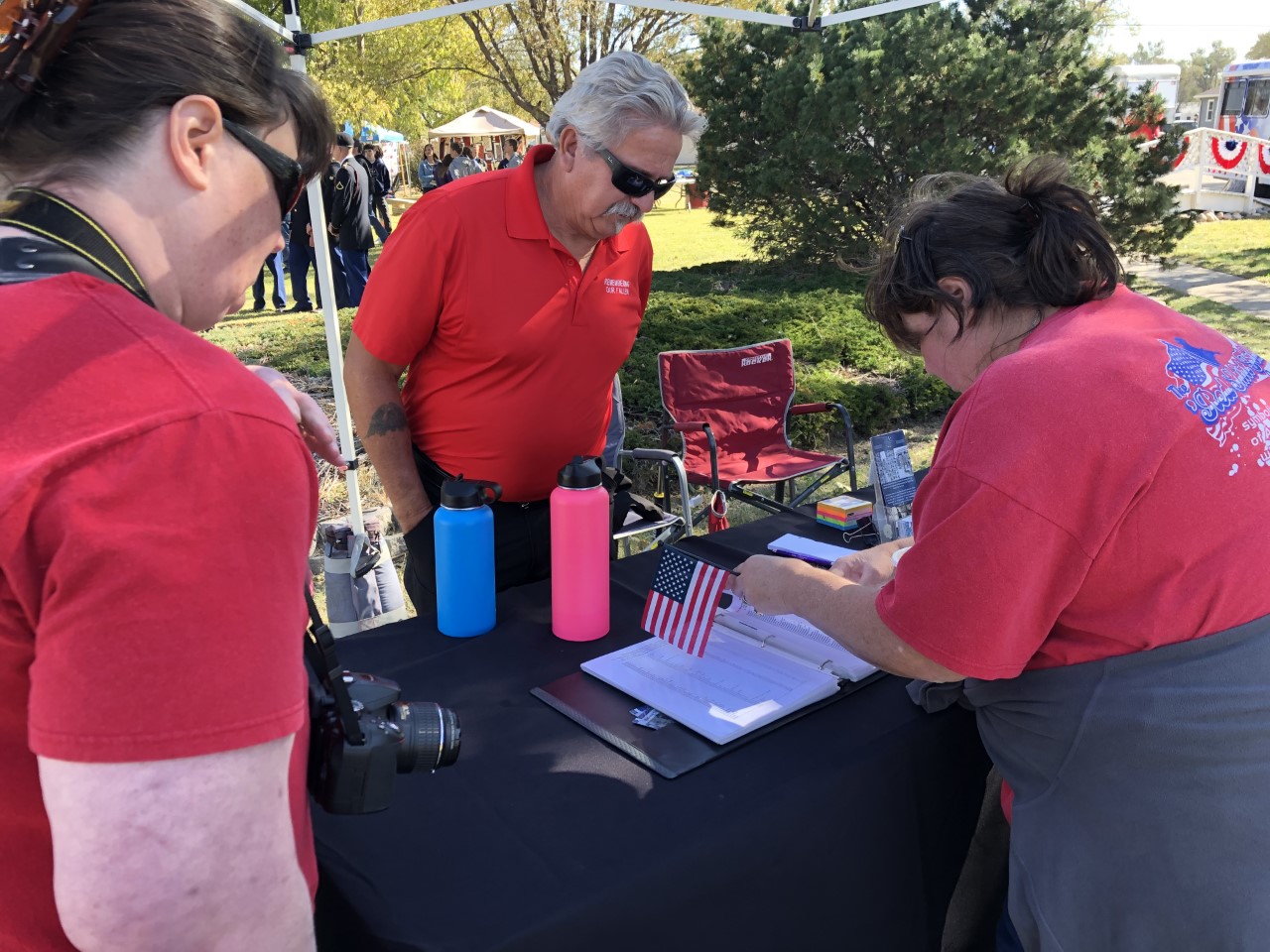
Nola Fritz, a Gold Star mother from Verdon, Nebraska, heaped praise on the small town and residents of Rooks County following Friday morning’s opening ceremony of “Remembering Our Fallen.”

The national traveling display is in honor and memory of  military personnel who died in the line of duty, in training, and as a result of PTSD (post-traumatic stress disorder) since 9/11.

Also participating in the ceremony were Brigadier General David Weishaar, Kansas National Guard,  and Col. Thomas O’Connor, Jr., Fort Riley, who  dined privately afterwards with the Gold Star families and other dignitaries.

“We must always remember the genesis of freedom that we enjoy today as Americans, is rooted in these heroes and their sacrifice,” said O’Connor, Jr. “It is my commitment that we will honor and remember your loved ones as we are doing here today,” added Weishaar.

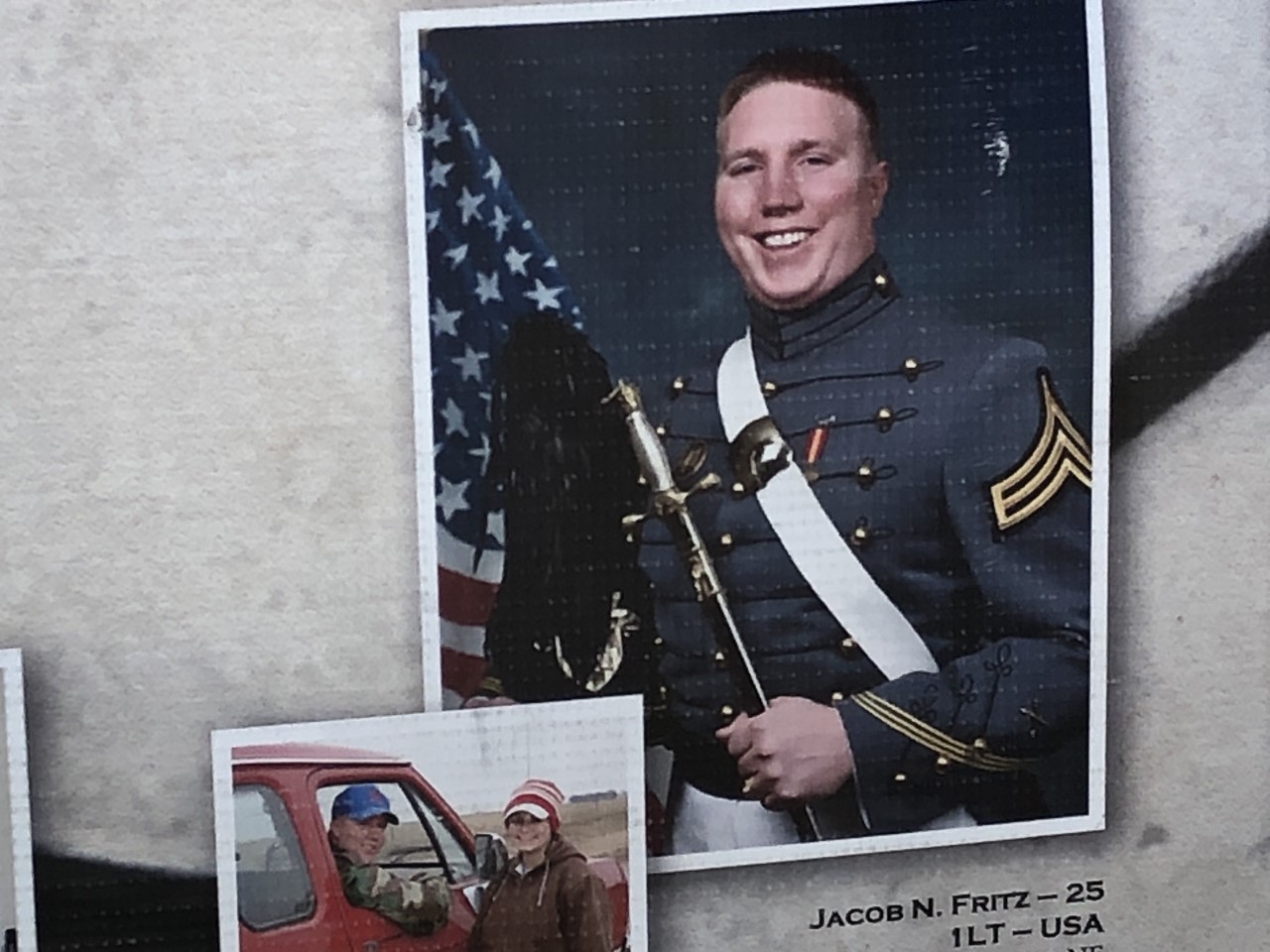
Fritz manages and travels with the basketball court-sized pictorial display. Her oldest son, First Lt. Jacob Fritz, 25, and a West Point graduate, was executed while an Iraq POW on Jan. 20, 2007.

What was most appreciated by the Gold Star families, Fritz said, is the pen pal correspondence started between them and students of all ages in Rooks County.

Plainville Ambassador Sheila Hachmeister, event organizer

Some of the communication was email and some of it was in a hand-written letter.

“They all got to connect with a class and they had the chance to meet the class today and take a picture with them,” said Sheila Hachmeister, a Plainville Ambassador member who chaired the weekend event.

“We’ve got a lot of people from the eastern part of the state. A couple who now lives in Ohio flew in to meet their class. Another soldier’s family flew in from North Carolina. Although they are Kansas families, we’ve kind of had them from all over.”

The Rooks County students also made red, white and blue fabric wreaths that decorated the main stage for the attending Gold Star families to take home. Another 70 wreaths will go to Kansas families whose sons and daughters are also on the towers.

None of the K-12 students was alive on 9/11.

“They’ve seen some clips on TV,” said Leona Breeden, a social studies teacher at Plainville Grade School. She explains to her 4th, 5th and 6th graders where she was on that fateful day – teaching in Hoxie.

“I talk about it in terms of what we did as a school then,” Breeden said, “and then we talk about the fact that these are real places and real people they hear of on the news that the U.S. is trying to help.”

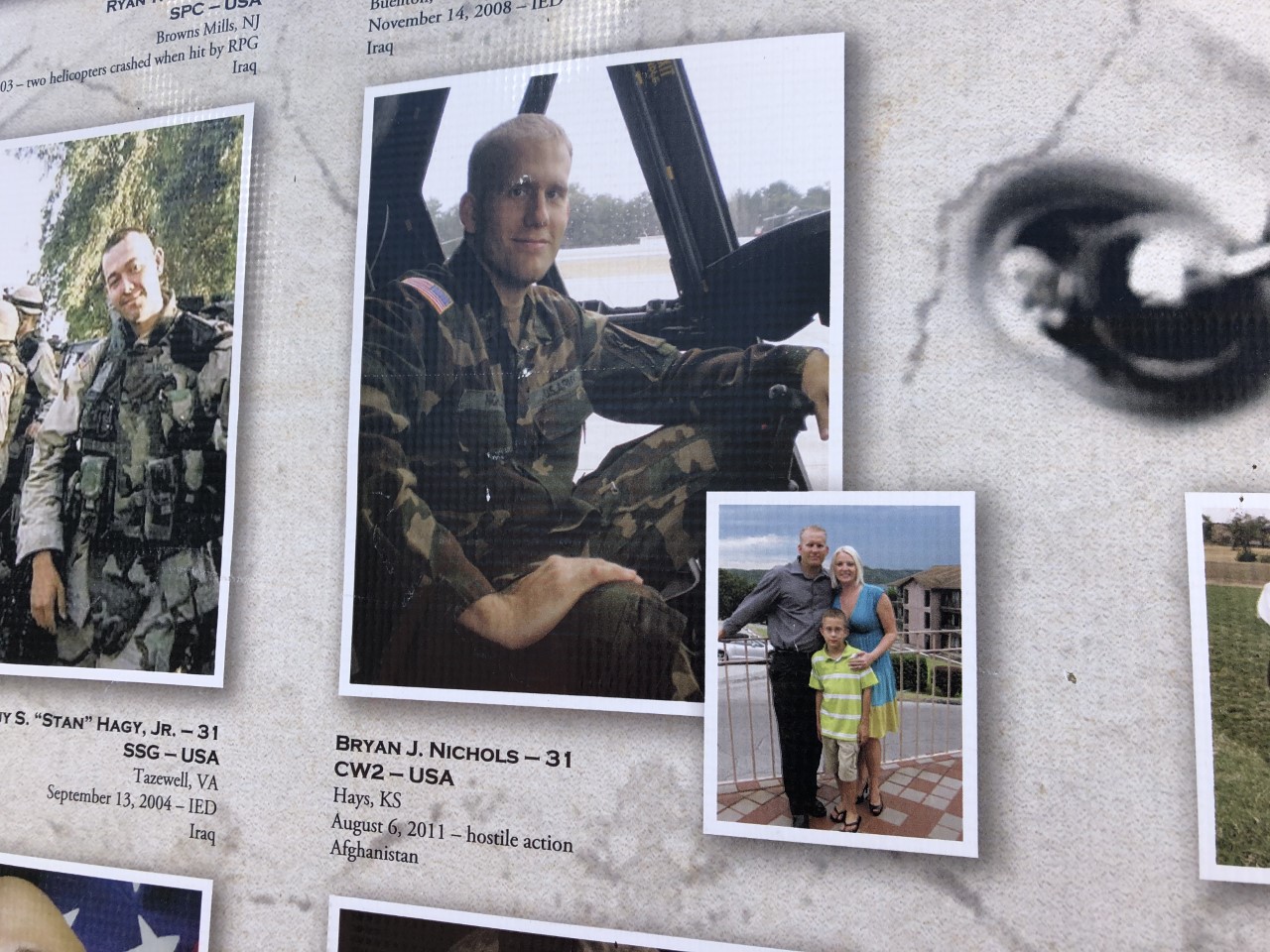
Breeden’s 6th grade class was pen pals with the parents of Hays native Bryan Nichols. Jerry and Cindy Nichols now live in Palco. Jerry is a Vietnam veteran.

Leona Breeden, Plainville teacher and Gold Star family

“Ironically enough, I lost my nephew in Afghanistan, so he is also on these towers,” Breeden said, “and they are both pictured on the exact same tower, my nephew and Bryan.”

“We think there was some divine intervention there maybe that we got chosen to be his pen pal family.”

Bryan Nichols, 31, a 1998 graduate of Thomas More Prep-Marian High School, was killed August 6, 2011, one of 30 American troops who died in Afghanistan when their  Chinook helicopter was shot down.

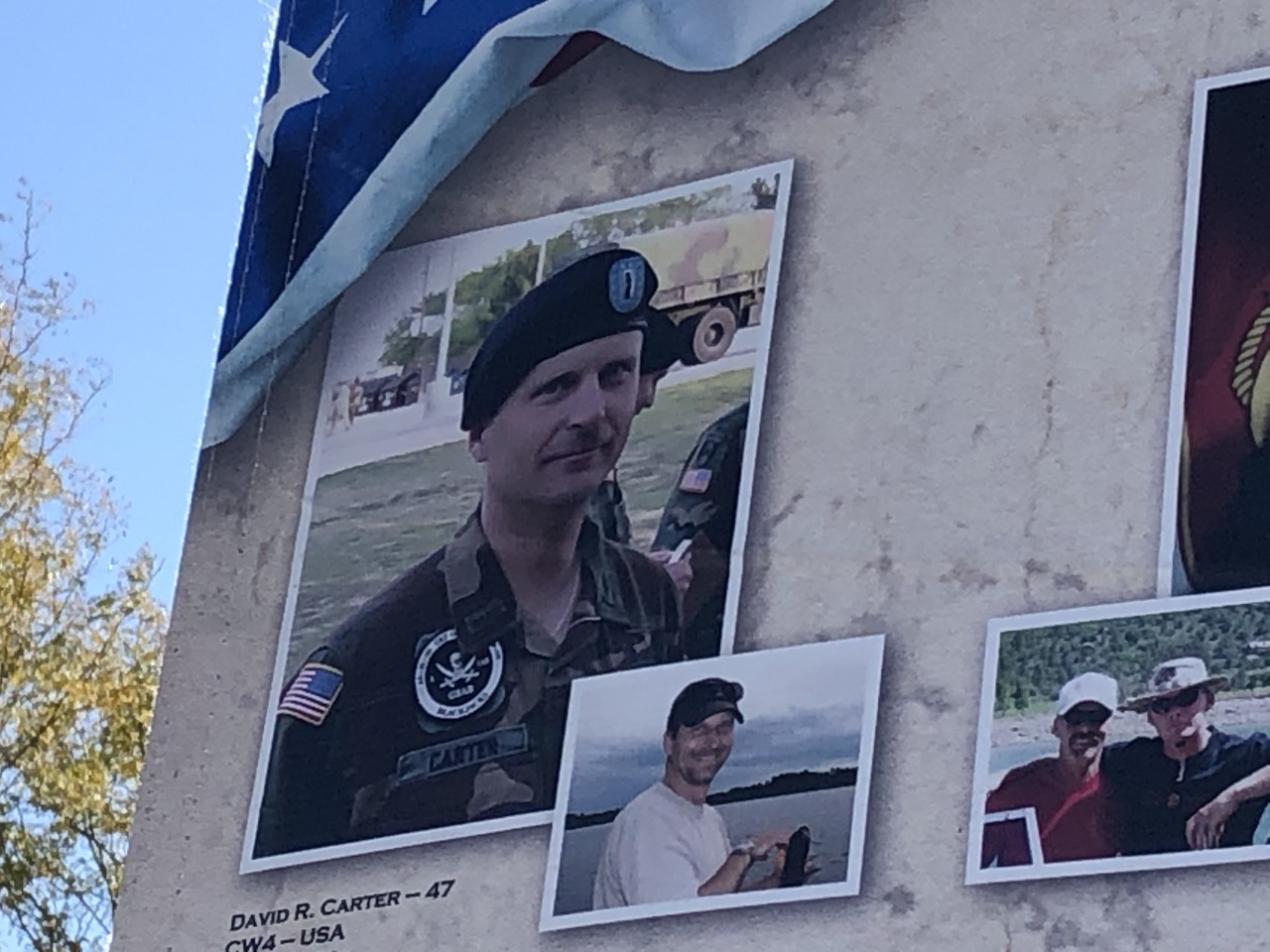
Also aboard the helicopter was Dave Carter, 47, a 1982 graduate of Hays High School whose family is now in Colorado.

The Nichols have been interviewed numerous time by the media about their son and his mission.

Jerry and Cindy Nichols, Palco, parents of Bryan Nichols who was killed in 2011.

“Cindy and I have a direct connection through Bryan as well as the other people that were lost on the same mission that day,” said Jerry Nichols. “It’s just very emotional being here and seeing the magnitude of people who lost their lives in defense of 9/11.”

The Nichols met with a Kansas City family Friday whose son served with Bryan.

“We kind of keep in touch with those members that were with Bryan, especially his crew area,” said Cindy. “But this is amazing community outpouring. I didn’t realize it could be this big.”

“Since the declaration of ‘The War on Terror,’ we’ve lost almost 7,000 heroes,” Fritz reminded the crowd in Andreson Memorial Park, “and there will be more. We currently have on the towers 70 percent of those that voluntarily gave their life for freedom.”

Plainville High School sophomore Benjamin Hansen reads names on the towers.

Plainville High School sophomore, Benjamin Hansen is 16 years old. He was one of  many local volunteers reading the more than 5,000 names currently listed on the pictorial towers.

He admits he was a little nervous when he took his turn at the podium, but “this whole experience and seeing all these pictures and those names and reading more about them on there” has helped make it real.

The ‘war on terrorism’ has been discussed in a couple of Hansen’s classes.

“It’s just surprising that happened here,” he says of the airplane terrorist attacks in New York City, at the Pentagon and a field in Shanksville, Penn. 18 years ago. “And think of all those security measures that have changed.” Now Hansen understands why.

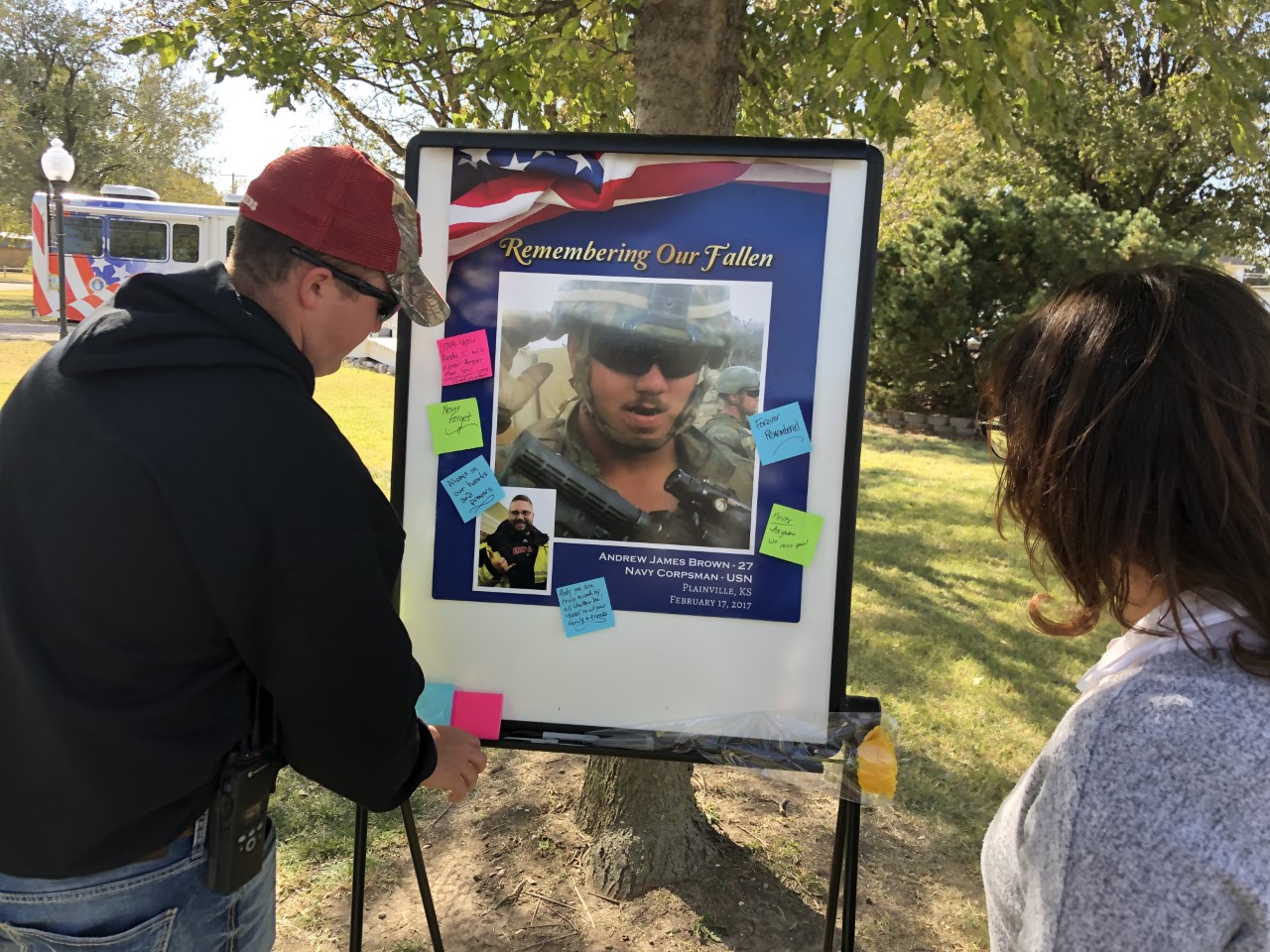
Two Plainville residents have also died, both as a result of PTSD.  Navy corpsman Andy Brown, 27, died Feb. 17, 2017. Lynn Pfaff was part of the 388th Medical Logistics unit of the Army Reserves. She died Feb. 16, 2019.

“I think people are shocked when they walk up to the towers,” said  Hachmeister. “They’re very visual. They’re going to punch you in the face.”

Each person is shown wearing their military uniform in a formal picture. A second inset picture shows them in an informal setting, with family or enjoying a favorite hobby.

“We want them to be remembered because that’s how we keep them alive,” Hachmeister said.

Sheila and her husband Ken Hachmeister of rural Natoma have two sons serving in the military. Jared is a 2017 graduate of the U.S. Naval Academy currently stationed in Pensacola. Seth is currently a West Point cadet at the U.S. Military Academy.

The Hachmeisters were in Philadelphia for the Army-Navy football game this last fall and happened to walk past the display at Independence National Park, on which they quickly found the picture of Bryan Nichols.

Hachmeister approached Fritz and asked how to get it to Plainville, a town with a population of just 1,500 people.

Nearly a year later, the memorial display and its entourage were escorted Thursday into Plainville by the American Legion Riders Chapter 173, Hays.

During her speech Friday, Hachmeister thanked all the Rooks County residents and many others who pulled together to host the event.

The memorial remained open 24/7 until the closing ceremony Sunday afternoon.

The Plainville stop was the first in Kansas (west of Kansas City) for the national display. It made its debut at the steps of the Lincoln Memorial in Washington, D.C. in the fall of 2017 and has so far traveled to 29 states.

Logan Business Machines to open location in Hays

By JAMES BELL
Hays Post

After expanding their trade area, Topeka-based Logan Business Machines is set to open a location in Hays in the next few weeks at Oak Plaza, 107 E. 27th.

The company primarily sells, services and supplies Sharp, Lexmark and HP printers, but also sells LED interactive displays and will offer marketing material printing in their newest location.

The Hays location will be the third for the third-generation, family-owned and operated business that began in 1972.

“This territory with Sharp became available and so we put in for it and got it — so really Hays is going to be our connection back to Abilene, Salina, Junction City and sometimes Manhattan,” said Chris Martin, LBM executive vice president and partner.

The Hays location will allow the company to provided faster service to areas where it already operated and will allow expansion west.

“It was kind of playing connect the dots with Hays,” Martin said of the expansion that will allow the company to provide service to Hays, Russell and as far west as Colby.

He said the company looked at Hays for around six months before deciding to open the location but believes it will be a good fit.

“We love it. We think Hays is growing,” Martin said.

He is also pleased with the location picked in Hays. After looking a locations in various areas of town, he said after speaking with the owner of Oak Plaza he was sold.

“She has a vision of this strip mall to become more than it is now and our company is all about being a part of change and helping the community,” Martin said. “It’s a great location, just off Vine.”

The majority of LBM clients are business to business, so Martin said he does not expect a lot of foot traffic, but having a location for looking at and testing equipment is important for business owners to make decisions on their equipment.

“For most small to medium businesses, the copy machine is a pretty good investment,” he said. “We want them to touch it and feel it and bring in some jobs where we can print their jobs off of the machine they are looking at and get them completely comfortable with the machine being able to fit into their environment. That’s really why we do this. We feel that helps small businesses a lot,” Martin said.

This location will also be a production facility where customers can print blueprints and do plotter printing along with standard walk-in printing.

They also plan to print marketing materials at some point in the future as well.

“Just about anything you can put your name on,” Martin said.

The location will open with a few employees, but Martin said he hopes to be fully staffed with a team of six in 18 to 24 months as the business grows.

While the Hays storefront is still being completed, he said they are already servicing clients and hopes to have the location open for customers soon. A Nov. 21 ribbon cutting with the Hays Area Chamber of Commerce is planned.

HPD Honor Guard demonstrates department’s dedication and professionalism

After years of planning, Hays Police Department Honor Guard makes debut during FHSU Homecoming

By JAMES BELL
Hays Post

A longtime goal of Hays Police Department Chief Don Scheibler came to fruition last weekend with the debut of the HPD Honor Guard during Fort Hays State University’s Homecoming festivities.

“One of my goals early on was to set up an honor guard,” Scheibler said, who took over the department in 2011.

After years of planning, funding was budgeted in 2018 by the City of Hays.

“When we decided to do this, we needed it funded properly,” Scheibler said. “Both the city manager and the city commission have been very supportive.”

Once funding was secured, Scheibler looked to honor guards across the state that could help train the HPD members and found the Topeka Police Department had exactly what he was looking for.

Members of the Topeka honor guard then came to Hays to work with the Hays members to train them for their duties.

“It prepared them – whether it be a funeral, folding a flag, posting the colors at a banquet, or marching in a parade, whatever it may be,” Scheibler said.

But training will be ongoing.

“A lot of people don’t realize unless they have been in the military or such, the number of hours and investment it takes. It looks simple, it looks sharp, but everything from the timing to the physical toll, these guys have put forth the effort,” said HPD Lt. Tim Greenwood, who oversees the guard.

During continued training, teamwork becomes even more important.

“There is a lot of critiques,” Greenwood said. “The instructor will show you how to do it and then you emulate what the instructor is doing and then you also accept criticism and critique. They help each other, they critique each other, that’s where the teamwork comes in.”

The training includes everything from movement speed to attention to detail, he said and makes the duties look seamless.

“All of those little details that nobody ever notices from the stands or the seats they work on to make sure that you don’t notice it,” Greenwood said. “When it is done right, it looks good and dignified.”

Weekly training will be directed by the honor guard coordinator Officer Mackenzie Smith.

“He’s taken that leadership role to heart and is doing a great job with it,” Scheibler said. “They have been working hard, training hard and now is their opportunity for them to start putting themselves on show.”

While leading parades and posting colors will highlight the department, a significant and important part of the honor guard is much more solemn.

“It runs the full gamut from what you will see this weekend, leading parades and posting the colors at games to awards banquets, posting the colors, and also the solemn duties of laying to rest – whether it be officers in the line of duty or retirees — they have a tremendous sense of honor and dignity, attention to detail and it’s sort of a unique role or being that person that everyone is watching, but representing something bigger than themselves,” Greenwood said before the debut.

“We’re talking about professions where men and women have raised their hand and taken an oath to stand on the wall and protect their country or their community, and they recognize the importance of paying respects to those who have agreed to do that,” Scheibler said.

The guard is made up of volunteers from the department and is another way the department can show its professionalism in a positive way, Schiebler said, but the importance of the honor guard really hit the members as they put their training into practice and put on the uniform.

“In law enforcement, in general, you have to behave and conduct yourselves in a professional manner, and in an ethical manner, and with integrity at all times,” Scheibler said. “But you put that honor guard uniform on, you step up your game.”
“I think it’s a huge showing of respect, and there is a huge sense of service before self in law enforcement,” Greenwood said. “This is just one aspect in which we show respect for those that came before us and those that are yet to come and doing it dignified and professional and courteous manner.”

Downtown Hays business owners buy Comeau properties

By CRISTINA JANNEY
Hays Post

A sheriff’s sale of Hays downtown properties ended Friday morning with smiles and hugs as several business owners gained ownership of the buildings in which their businesses are located.

Bank of Hays, Sunflower Bank and Golden Belt Bank were granted foreclosures on multiple properties owned by Chuck Comeau and his holding companies last year.

Comeau’s furniture manufacturing company in Plainville, Dessin Fournir, filed for Chapter 11 bankruptcy in April. However, that bankruptcy was dismissed when a judge determined the companies in question did not have enough assets for a reorganization. Comeau tried to find a buyer for the companies without success.

1100 Main St.

Heather and Shaun Musil won the bid at $211,001 for 1100 Main, which houses their business, The Paisley Pear.

“We’re thrilled,” said Heather Musil. “We are thrilled that the owners all get to keep their buildings and the businesses will continue as normal.”

Shaun added,” We can concentrate on what we do best.”

Sarah Cearley won the bids for two storefronts in which her businesses, Simply Charmed and Bella Luna, are located. She was the high bidder at $75,001 for 1011 Main and $70,001 for 106 W. 11th.

“I am just excited and fortunate that we were able to purchase with no competition,” she said. “We look forward to continuing to be a part of downtown for many more years to come.”

1011 and 1013 Main St.

Norman Keller and his wife purchased 1013 Main for a bid of $140,001. The building is home to Regeena’s Flowers & Events. Keller said they were ecstatic and relieved.

The historic George Philip Hardware building, 719 Main, was purchased by Wes Rathbun for $207,001.

Sara Bloom, Downtown Hays Development Corp. director, said, “This is a great day for downtown. The building sales bring opportunities, but it also ensured that our business owners who are so successful already will get to stay in their building and continue their success and help grow and bring our downtown into the future.”

Other properties that sold included:

803 Fort St. — $37,100 to Leroy Riedl

811 Fort St. — $14,000 to Dan and Bob Meckenstock

1008 Main St.— $100,000 to Bank of Hays

1102 Main St. $120,00 to Bank of Hays

1108 Main St. — $5,001 to Leroy Riedl

121 E. 11th St. — $91,000 to Robert E. Schmidt Foundation

1012 Main St. — $70,000 to Bank of Hays

The 2018 taxes on the properties were paid, but the new owners will need to pay the 2019 taxes.

Seven Comeau properties already sold at sheriff’s sale in August.

RELATED STORY: Dessin Fournir properties set for sheriff’s sale; bankruptcy case dismissed

RELATED STORY: Comeau discusses fall of Dessin Fournir

RELATED: Plainville economy trying to recover after two bankruptcies in a month

Copyright Eagle Radio | FCC Public Files | EEO Public File