The Hays Sportsmen Club recently concluded its fall leagues, but the club and its facilities have brought in thousands of shooters since it was founded 41 years ago.
The Sportsmen Club brings in about 150 to 160 shooters twice a year for spring and fall shooting leagues. The shooters are coming from surrounding communities, such as Russell, WaKeeney and Downs, and as far away as McPherson and Concordia.
The shooters and their families dine and shop in Hays, which is a boon to the local economy, said Kevin Campbell, club president.
Registered shoots bring in smaller crowds, but are two-day events and bring in participants from all over Kansas and out of state.
The club has extensive facilities that are used by club’s 300 members, as well as the public, law enforcement, Fort Hays State University and youth.
The club has seven trap fields, two skeet fields, the ability to throw five stand targets, pistol and rifle ranges, 12 camper hookups, and two clubhouses with heating and air conditioning that are also used for
functions of other organizations.
On the third Saturday of August, the club sponsors an annual Youth Outdoor Sports event, which includes the Bass Anglers, archery, paintball and skeet. The event hosts about 175 children annually.
4-Hers practice weekly at the club.
The Fort Hays State Shooting Club practices at the club twice a week and just brought home a national title.
During the team’s three-day invitational at the club in September, 135 individuals represented nine colleges. Club members estimated just the college shoot shot two and half tons of lead.
Pheasants Forever just had their annual kickoff for Pheasant season at the club on Nov. 9.
The law enforcement range has been used by the Hays Police Department, Ellis Police Department, Victoria Police Department, Ellis County Sheriff’s Department, Kansas Bureau of Investigation, Kansas Wildlife and Parks and Tourism, and Kansas Highway Patrol.
If you are not a club member, the club is open to the public from 4:30 p.m. until dark Mondays.
By providing a safe, legal place to shoot, the club prevents vandalism in the county. If people can shoot legally at the club, they are less likely to shoot up county road signs.
Stan Newell, who is on the club’s board of directors, has been shooting since he was young.
“It can be individual, but it is also a team competition,” he said. “You are competing against each other, but you are trying to shoot better than you did the last time. It is just fun.”
Campbell said, “It is similar to any other activity like golf. Once you do it, you kind of get involved in it and you stick with. I have been there since 1984.”
He said the club has grown significantly in its 41-year history. When Campbell started at the club, their leagues had about eight teams. This season, the club had 31 teams in the league.
The membership fee for the club is $125 per year. League fees are $60 per person per season.
The club’s quarterly meeting is coming up at 7 p.m. Tuesday, Nov. 20. The club’s Christmas potluck is set for 6:30 p.m. Tuesday, Dec. 18 at the clubhouse.
For more information about the club or its facilities see its website, follow the club on Facebook or call Campbell at 785 650-7656.
High Plains Mental Health Center is reaching new clients and reducing stigma by serving patients through integrated care in medical clinics.
David Anderson, High Plains director of clinical services, said no stand-alone clinics should ever been built. Integrated care is where we should have been all along.
“The truth is, this agency has been around for 54 years,” he said. “If we could go back knowing what we know now, we won’t tell them to build a mental health center by itself. The separation of mental health and physical health is really artificial. We would say to them we should be in primary care settings and schools.
“That would reduce the stigma and have us providing and intervening where people are. We would be working hand-in-hand with the people we should be working with instead of where we are now, which is separate from them. It has taken us a half century to figure this out.”
Between 30 percent to 50 percent of primary care doctors’ patients also have mental health issues. Only about 49 percent of people who are referred to a mental health provider follow-up. The median time a person waits to access mental health care is 10 years.
However, about 80 percent of people see their primary care physician at least once a year.
Amy Bird
Anderson said some people, especially in small communities, may not want to be seen going into a stand-alone mental health center.
High Plain has started to offer a service known as side-by-side care, in which a therapist see clients in a medical clinic.
“The advantage is it reduces stigma because people can come, sit in a primary care clinic and get called in the back like everybody else. There is no differentiating why they are there,” he said.
If the a physician suggests a patient see a therapist for depression or anxiety, and that person is right down the hall, it can be easier to accept the help, said Amy Bird, integrated care/outpatient specialist.
Bird started seeing clients at the Hays Family Medicine in July. She sees clients there two days a week, and at the Phillips County Medical Clinic one day a week.
Bird said she has seen a decrease in stigma through her work in the side-by-side model.
“My clients really appreciate being in their primary care setting,” Bird said, “where a lot of times they have going for years so it is comfortable for them.”
Another significant advantage is Bird is able to coordinate care with the primary care providers.
“Through releases of information, we can talk about how the clients are doing,” Bird said. “Providers can let me know if they are concerned about some things. I can let them know if there are other concerns, so we are really treating the whole person instead of just looking at the mental health aspect or the physical aspect.”
Sessions may not be just for people who would be typically diagnosed with a major mental illness.
Almost any chronic medical condition is going to come with added stress, Bird said. A client may have issues with sleeping, anxiety or depression as a result. People often have to make big lifestyle changes to deal with chronic illnesses, and the therapist can help the client set goals and find coping strategies to handle the stress.
Bird’s sessions in the medical clinics are usually shorter, usually 30 minutes, rather than the full-hour therapy session at the mental health center. They are also more targeted and goal specific.
She helps her clients work on relaxation techniques to improve sleep or set goals to become more physically active.
At one time, a doctor might have prescribed medication for a patient who was having trouble sleeping, Anderson said.
“More and more if there is an opportunity for them to do behavioral work and talk to them about their sleep habits, they do that,” he said. “When do they go to bed? Do they go to bed at the same time? Are they avoiding any kind of alcohol or caffeine late at night? Are they using their electronics — all of the things that can disrupt a person’s sleep?”
Primary-care physicians have welcomed the change, Anderson said.
He said one doctor caught a therapist as the therapist was leaving a clinic and asked her what she had done to help his patient with her diabetes. He said it had never been under better control.
“The answer is that we haven’t done anything with her diabetes, but we got her depression under control,” Anderson said. “Once her depression was under control, she could do the things he wanted her to do to control her diabetes.”
Bird said integrated care is about care of the whole person.
“We know that mental health problem can affect physical problems, and physical problems can affect people’s mental health,” she said. “One of the things I want to emphasize is that we know a lot people are much more likely go to their doctor’s first even when it is a mental health problem rather than coming here.
“The other thing we know about treating mental health problems is that early intervention, just like physical problems, is key. When people go there and they have someone they can access in a place where they are comfortable, we know we are going to get better outcomes and ultimately they are not going to struggle so much down the road,” Bird added.
Colorado has been using integrated care models for some time. Anderson attended a panel discussion with primary care physicians on the model in Colorado, and one of the doctors compared it to a garage door opener.
“Before you had one, you didn’t really think you needed it and you just got by,” he said. “Then you find this and suddenly you go, ‘Why was I doing my work without having this?’ Like a garage door opener, once you have it, you don’t ever want to go back to not having one.”
High Plains has a 20-county catchment area. It covers 19,000 square miles and about 100,000 people. The agency has six full-time offices. In the other 14 counties, there are outreach offices in health clinics, hospitals or health departments. Therapists visit those outreach clinics for traditional mental health care one day a week, but therapists are not interacting with primary care physicians as they are in the side-by-side model. Many of these locations also have access to psychiatrists or therapists through telemedicine.
Anderson said in the future there will be an increase in use of the side-by-side model and mental health professionals working more closely with primary care physicians.
Bird trained at Cherokee Health Systems in Knoxville, Tenn., which is a fully integrated health care model. At the location, mental and physical health is handled by the same team. Everyone who is being screened for physical health is also screened for mental health — and vice versa. Electronic medical records are co-mingled. Mental health and physical health service providers all dress the same so they are indistinguishable.
Anderson said this fully integrated model is where High Plains would like to be.
In the current side-by-side model, the clients who see Bird for mental health care are High Plains clients, and the two entities do not share electronic medical records. However, Anderson said he hopes that someday will change.
For more information about High Plains and its services, call 1-800-432-0333. If you are having a mental health emergency, call 911.
Stephen Kuhl, High Plains Mental Health IT director, tests a telemedicine terminal at the Schwaller Center in Hays.
By CRISTINA JANNEY Hays Post
Kansas just this year passed legislation to open more opportunities for telemedicine in the state, but High Plains Mental Health Center has been offering the service for almost 20 years.
Technology associated with service has greatly improved over the years and so has the center’s reach using the tech.
High Plains has 50 telemedicine interfaces at its branch offices and in medical clinics, emergency rooms and jails. Ellis County has a telemedicine unit in the court for mental health court, and High Plains is also connected to Larned State Hospital through the system.
In the last 12 months, High Plains has seen 3,500 clients for 4,500 visits via telemedicine.
“We have come to expect pretty quick access to things, and this is really a way to keep up,” Walter Hill, High Plains executive director, said. “If we order light bulbs from Amazon, they are here in two days as opposed to having to wait. We as culture, our expectations of access have increased. That is not bad. …
“Health care needs to be more responsive, and this is one of the tools that allows us to do that.”
High Plains covers a 20-county catchment area, which is about 19,000 square miles and covers about 100,000 people.
Before the advent of telemedicine technology, High Plains struggled to get therapists and psychiatrists to the far reaches of its coverage area. Today, for example in Sharon Springs, High Plains has a telemedicine unit in the rural health center.
When therapists physically had to travel to remote offices, the clients were limited to one therapist and scheduling only on the day the therapist was in town. Telemedicine increases provider choice and can increase the frequency a therapist can see a client.
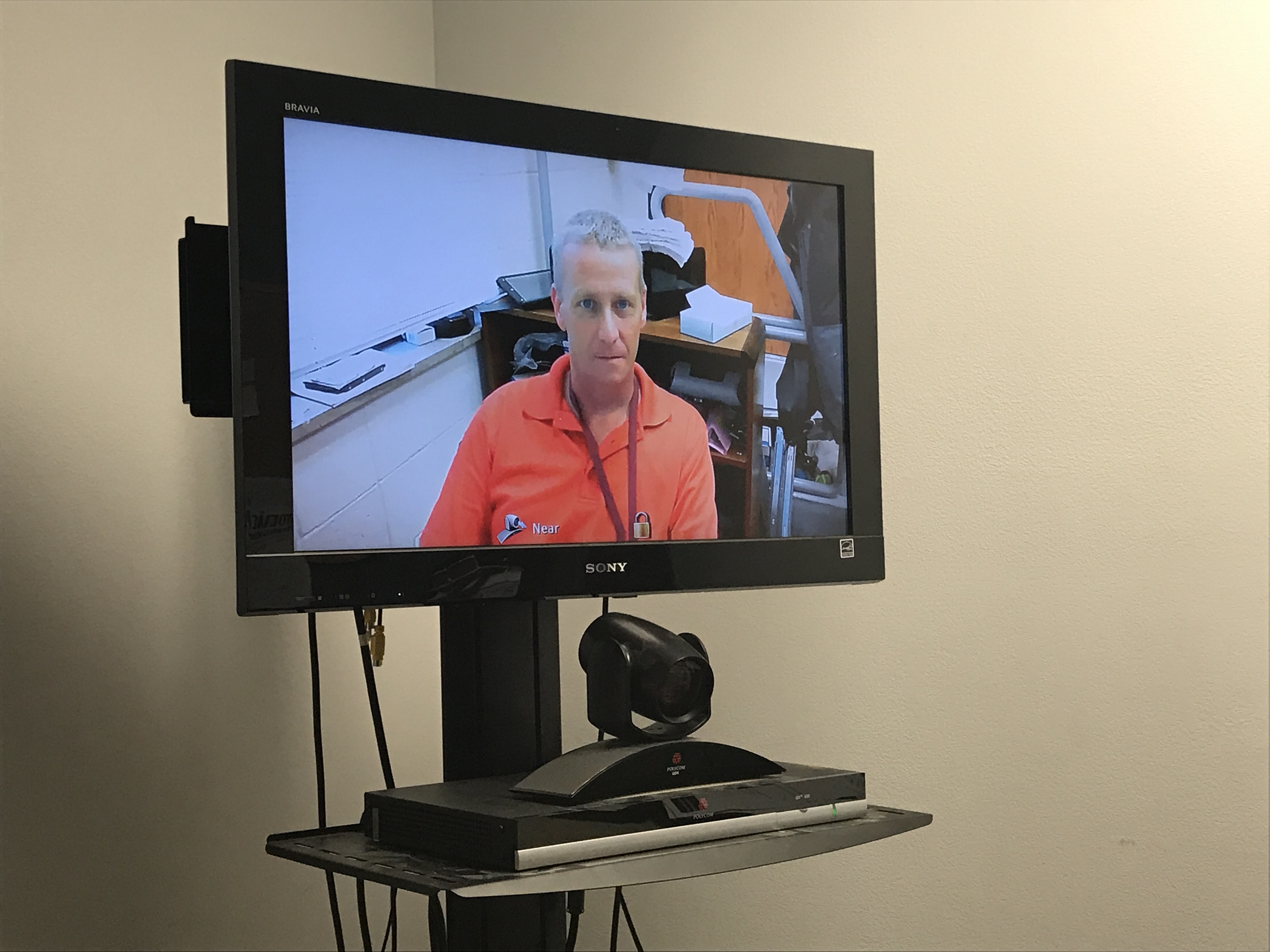
Walter Hill, High Plains executive director, interacts through the telemedicine system.
The system involves cameras and television screens on both ends of the teleconference. The psychiatrist or therapist conducts a medication check or therapy session just as they would in a face-face session. If a client is seeing a psychiatrist through telemedicine at a branch office, a nurse on site would record vitals and relay them to the doctor.
Hill said nothing is lost in the video format, and research has born out telemedicine mental health is as effective as in-person services.
The telemedicine system reduces the time a client has to wait to be seen by a provider, especially in a crisis.
On-call clinicians do evaluations at night through emergency rooms or jails. HaysMed has a telemedicine unit on a cart that can be wheeled directly to a patient’s bedside.
High Plains contracts with a provider that also works with other community mental health centers across the state to provide 24/7 coverage for these types of evaluations. These contractors specialize in emergency mental health, just as a ER doctor would have a speciality in emergency medicine. High Plains has IT staff available 24/7 in case work is needed on the system.
“In the middle of the night, if someone was say in Goodland at the hospital or the police station, we would have to send a therapist from Colby,” Hill said. “If there was a patient at Norton and the on-call therapist was in Osborne, they would have to drive from Osborne to Norton, which often in the middle of the night would take two hours or more to get there. [Telemedicine] is relatively instantaneous.”
Reducing drive time is more cost efficient and helps the mental health center in recruiting staff. The system also saves drive and wait time for law enforcement officers who are either responding to a mental health emergency or dealing with an inmate who is being evaluated.
Telemedicine is still an emerging field, Hill said. In the future, telemedicine may allow more clinicians to work from their homes and someday even patients be seen from their homes. High Plains has looked at adding a part-time psychiatrist who lives in Texas and works from home.
“The whole nature of health care is being decentralized,” Hill said. “Telemedicine and Smartphone apps are the two big changes that are going to happen to health care and mental health. People can take more control of their services on their PC at home or in their smartphone app.”
For more information about High Plains and its services, call 1-800-432-0333. If you are having a mental health emergency, call 911.
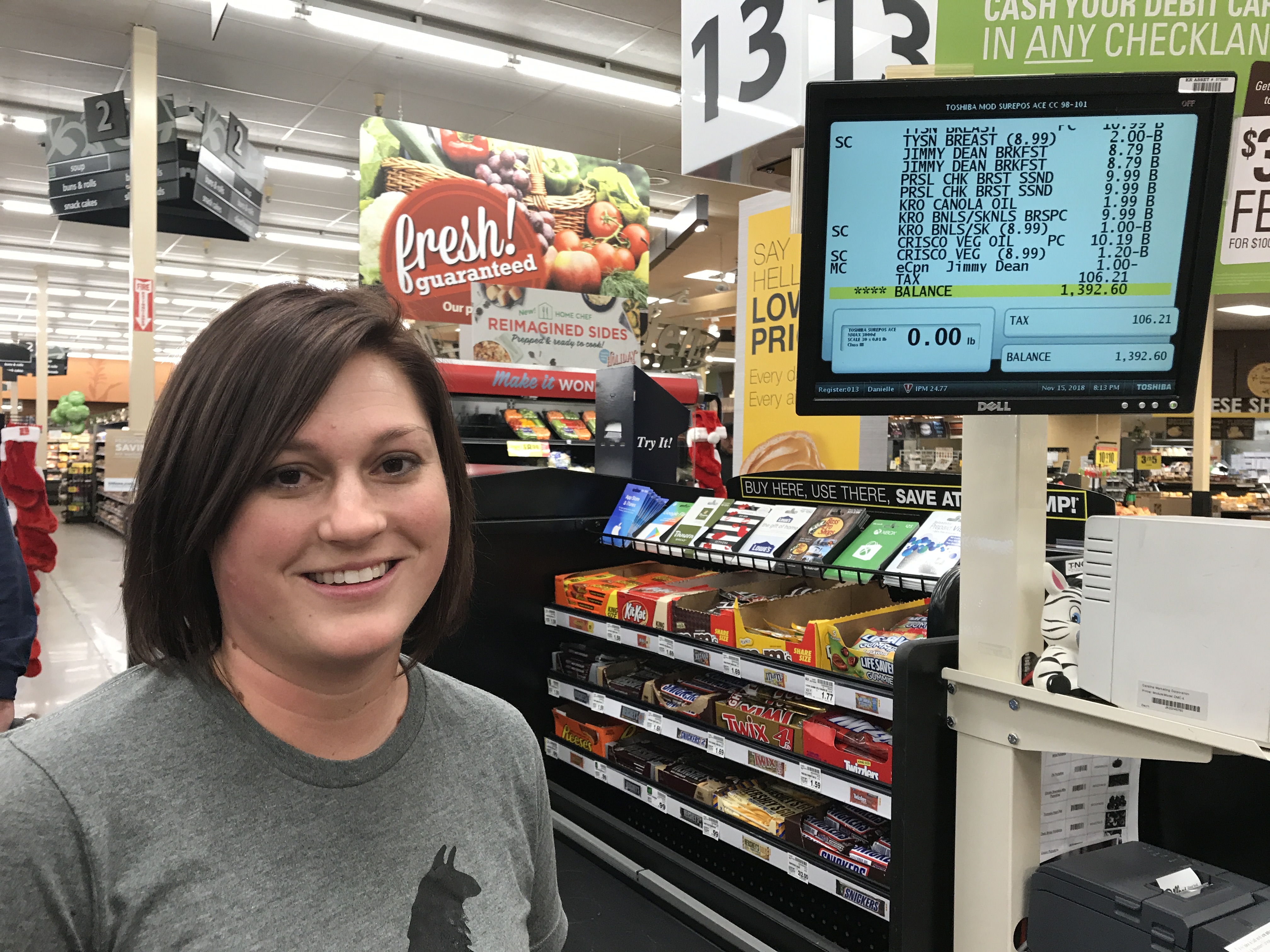
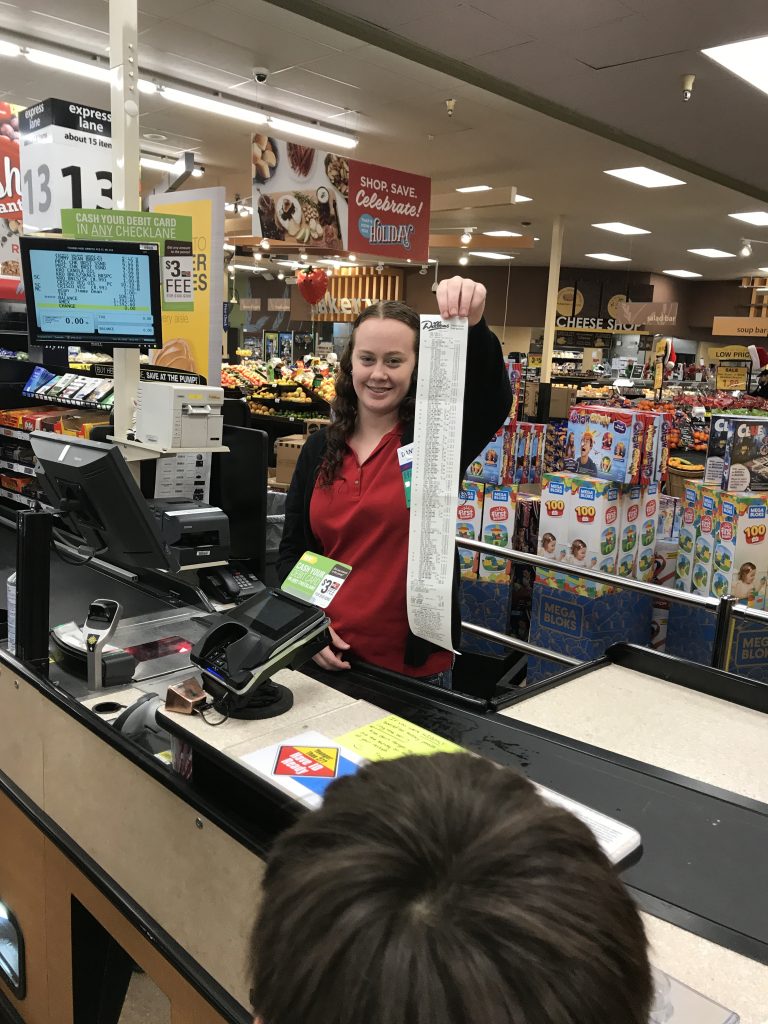
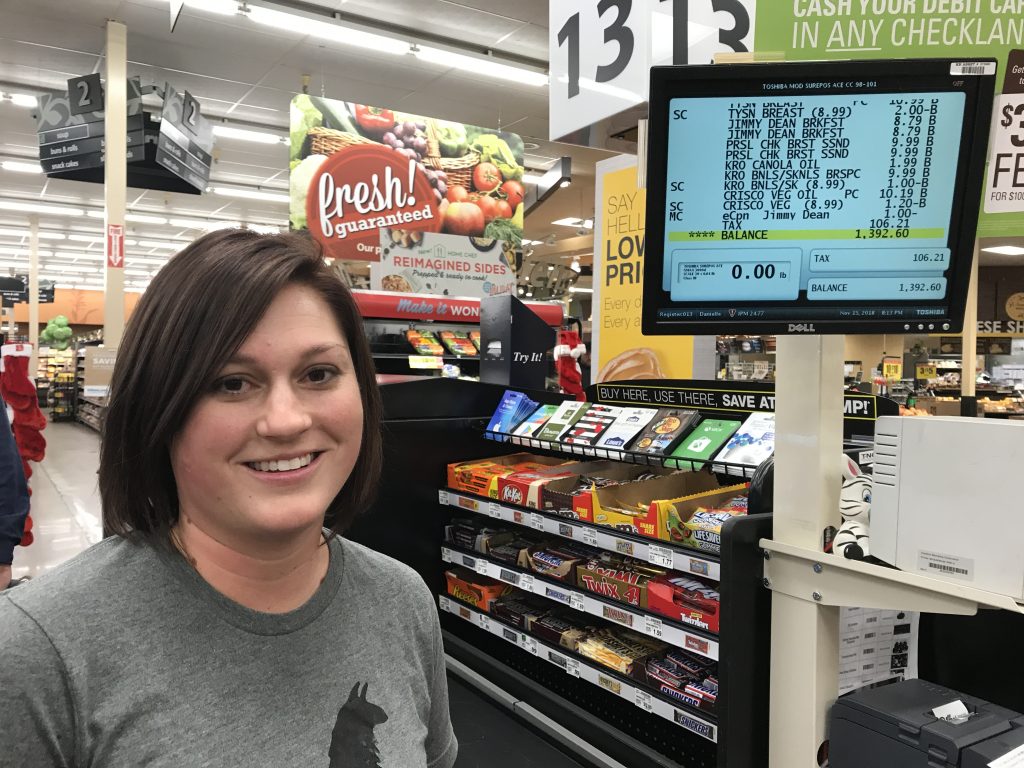
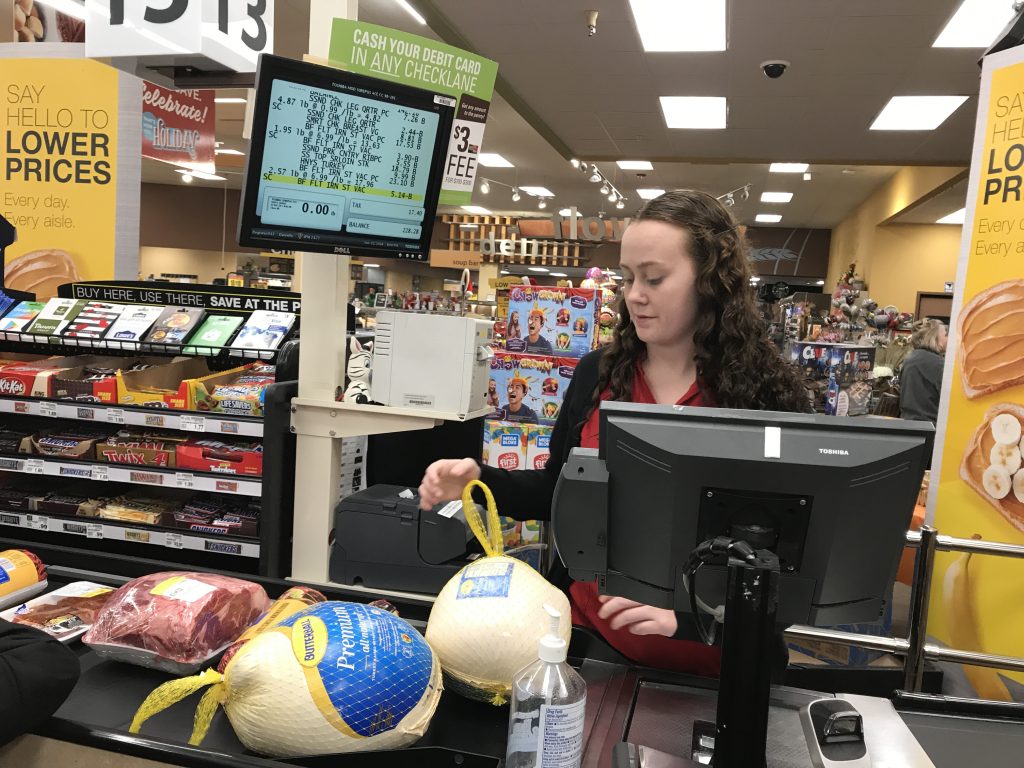
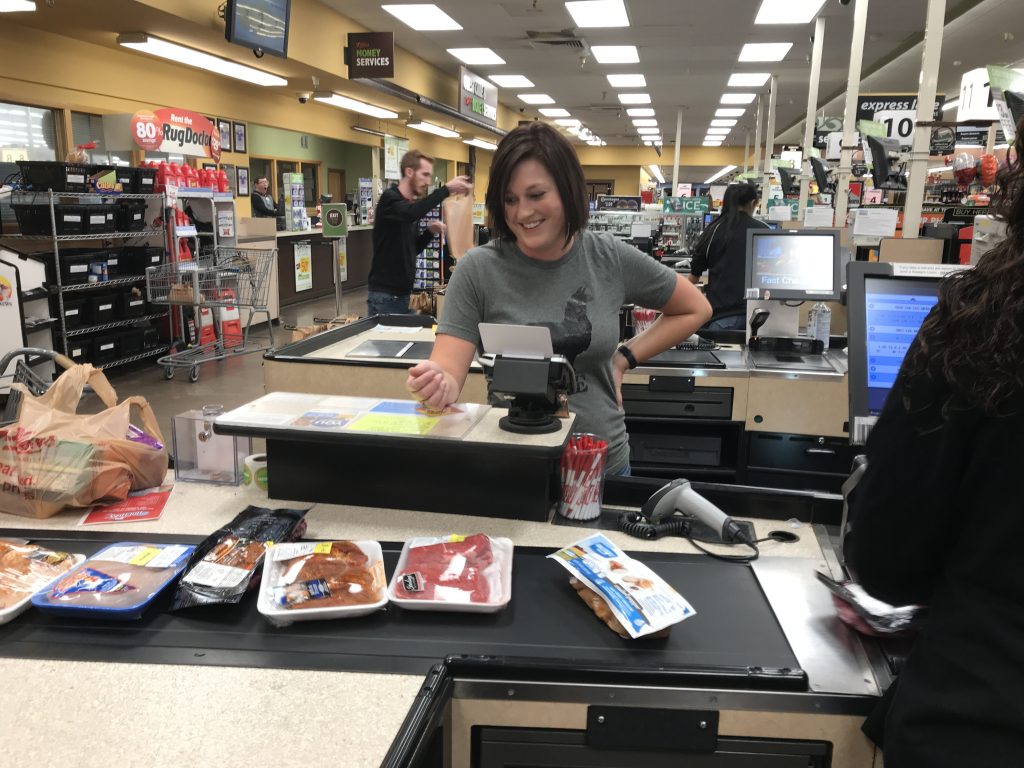
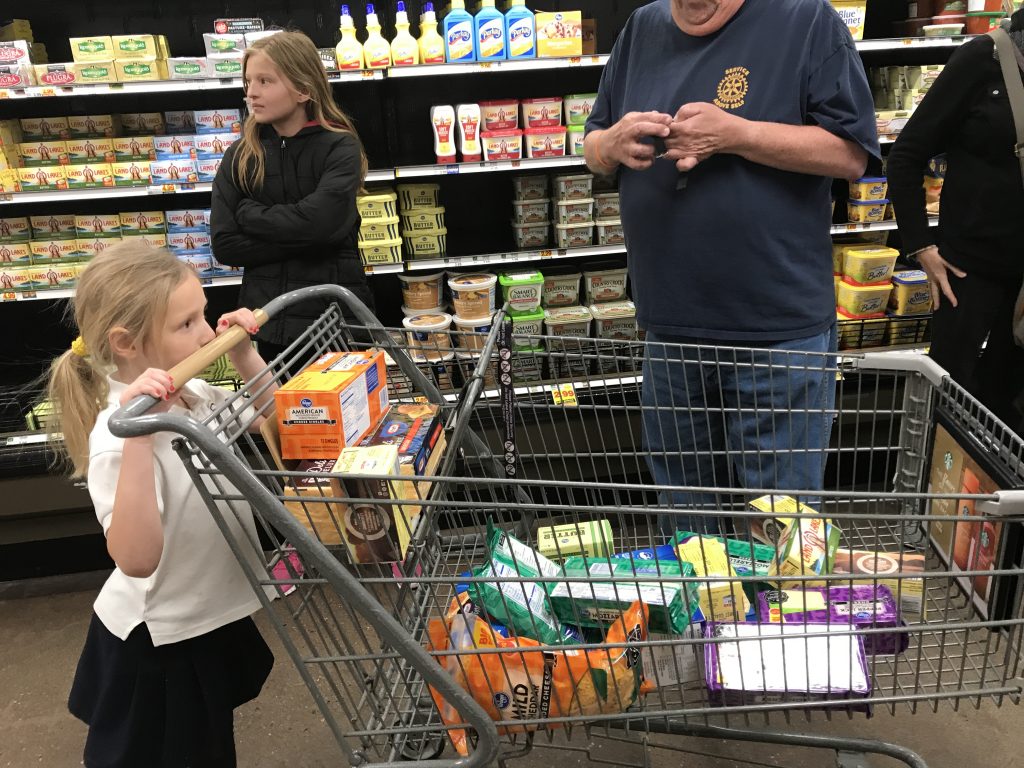
Melissa Pinkney, a Spanish teacher at Thomas More Prep-Marian, ran the annual Sunrise Rotary Grocery Grab on Thursday night at Dillons.
Her father, Mark Bieker, was the winner, but he let Melissa run for both he and his wife and Melissa’s family.
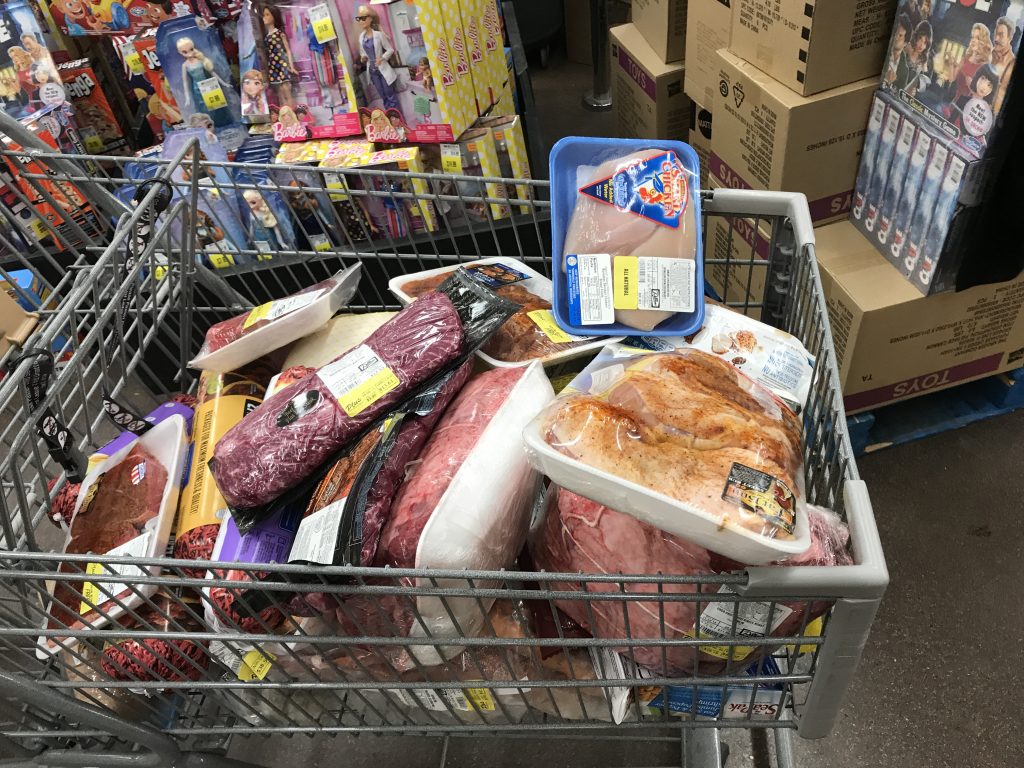
The run is five minutes long. It includes one minute in the meat department with a limit of two items each in that department and five items each in the other departments. Cosmetics and pharmaceuticals were excluded.
Pickney was able to bag a whopping $1,392.60 in groceries. Among her haul were two turkeys for the holidays, a ham, crab legs, prime rib, lobster tails, olive oil, boxes of coffee and plenty of corn dogs for the kids.
Pickney said she scoped out the store before her run. She was looking for items in bulk that her family could store or freeze. Although she had a plan, she found herself picking up some items on impulse. She also intended to hit the cereal aisle and missed that entirely.
“I am smiling and happy now, but I was nervous before,” she said.
Melissa and her husband, Jeff, live in Hays and have three children.
Once the grocery bill was paid, Sunrise Rotary earned about $1,000 on the fundraiser. The money will go toward a new restroom project Sunrise Rotary is working in cooperation with the City of Hays at Ekey Park.
“Our small club, just 18 members, works hard to raise funds for the park and our global mission of eradicating polio from the face of the Earth,” Larry Dreiling, club president, said.
Mandy Scott, Dillons operations assistant manager, said “We take pride in our community and participating in community events like this. We are more than happy to be a part of anything the community wants us to do.”
Republican Barb Wasinger, center, and others wait for Ellis County canvass results on Thursday night.
Hays Post
Republican Barb Wasinger collected just over 50 percent of the vote in the race for the 111th Kansas House of Representatives District and defeated incumbent Democrat Eber Phelps by just 32 votes.
According to the final vote totals presented Thursday at the election canvass Wasinger received 4,342 while Phelps got 4,310.
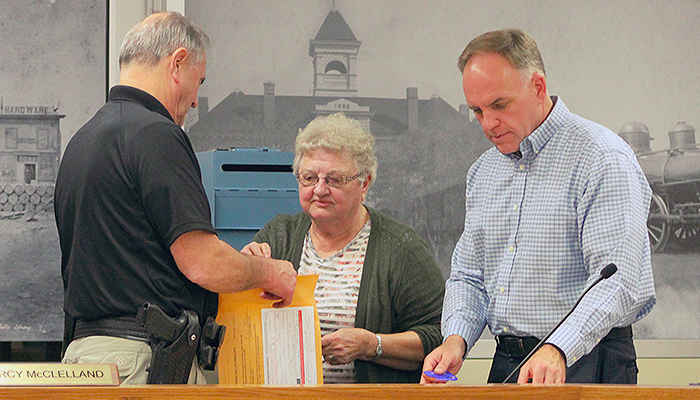
Hays Attorney John Bird served as a representative for Eber Phelps Thursday and submitted a request for a full recount. Phelps was not present at the election canvass.
Ellis County Clerk Donna Maskus answers a question for attorney John Bird, who was representing Democrat Eber Phelps.
Election official Donna Maskus said they will have five days to complete the recount and expect to complete it on Tuesday.
High Plains Mental Health announced last week that it will expand services at the Schwaller Crisis Center to people who are uninsured.
The four-bed center, which is located in Hays, serves as a mental health crisis center for High Plains’ 20-county catchment area.
In the past, the center has provided care to Medicaid and private-pay clients. An increase in state funding allowed High Plains to expand its care to individuals who are homeless and experiencing a mental health crisis. State funding had been cut by almost a third in the last six to eight years, Walter Hill, High Plains executive director, said. Some of that funding has been restored.
The center provides 24/7 care as a voluntary alternative to hospitalization.
A sitting area at High Plains Mental Health’s Schwaller Center. The center provides 24/7 crisis care in a home-like setting.
Although crisis centers similar Schwaller are opening in metro areas such as Kansas City and Wichita, the Schwaller Center opened in 2002. The center opened after the in-patient hospital unit in Hays closed in the same year.
The center is a half-way point between outpatient treatment and hospitalization.
“There’s a gap between coming in once or twice a week or every couple of weeks versus going to a state hospital where it is locked and people stay overnight and see a psychiatrist,” Hill said.
Since the center opened, it has diverted 6,000 admissions away from Larned State Hospital and allowed people to find support locally. The center has also been used as transition between the hospital and home.
The center provides many of the same services as a hospital, such as access to a psychiatrist and therapy. However, it offers care in a home-like setting. The center has four private bedrooms, a community kitchen and dining room, as well as laundry facilities. The average stay at the center is three to five days.
Individuals receive support to cope with stressful circumstances, strengthen coping skills, improve sleep and manage daily life skills. They make meals with the staff or with the other individuals staying at the center. The staff may help individuals with life skills, such as managing money, and the staff can help connect the individuals with community resources to use when they leave the center.
Some clients are paired with case workers who help them access resources to look for a job, find a place to live or apply for health care.
Hill said individuals who stay at the center do a lot of work on goals on managing their symptoms. They create kits with reminders of how they can better cope with symptoms and stressors.
“It has reminders about those things so they can pull those reminders out about how do I deal with a situation when I am feeling so depressed or so anxious. How do I calm myself down? So it is really teaching self-help skills. It is probably the most important activity,” he said.
Dealing with your time and handling loneliness can be a significant problem for people who suffer from mental illness, and staff help clients with strategies to cope with those issues. Having the center in the community also means clients are closer to friends and family who can come visit during the individual’s stay.
“People still feel like they have a lifeline to pull themselves back into being on their own,” Hill said. “Sometimes going into the hospital increases their feelings of hopelessness and helplessness because they are so far away in a much different environment in a locked environment. This is not a locked environment like it would be at a state hospital.”
The clients receive medication reviews and work with the staff to create plans for transitioning back to independent living.
Sometimes people’s ability to cope gets worn down and having a place where those stresses are reduced is needed, Hill said.
“One of the key issues is [this is] a safe place where we can help them learn to deal with issues in their lives that are kind of coming in on them,” he said.
“Usually mental health issues at that level of severity are a combination of getting things rebalanced and then learning to deal with those things in life once things are stabilized in your nervous system so you are less depressed and you are thinking more clearly and are less anxious,” Hill continued.
High Plains covers 19,000 square miles and a population of about 100,000 people. Sometimes there is a waiting list for the center and people have to go to the hospital instead of using the center. However, Hill said there are no plans to expand the program. At this point, space and funding would be barriers, he said.
The Schwaller Center was named for Julia Schwaller, who was one of the founding members of the High Plains board.
For more information about High Plains and its services, call 1-800-432-0333. If you are having a mental health emergency, call 911.
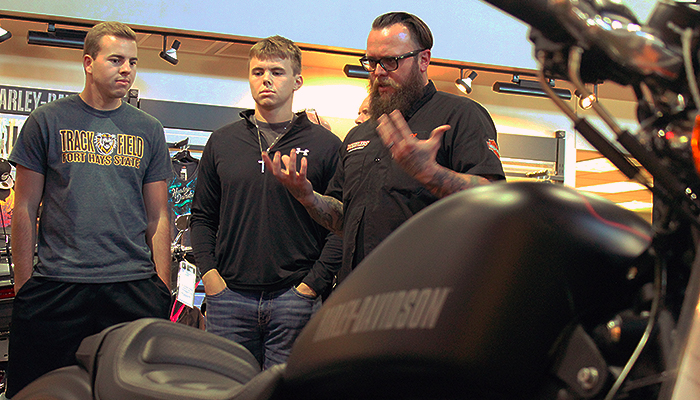
B.J. Rupp, Doerflers’ Harley-Davidson sales associate, talks to Tigers Motorcycle Club members about bikes during a recent visit to the store.
By CRISTINA JANNEY Hays Post
Some Fort Hays State University faculty are hoping to pass on their love of the open road to students in the newly formed Tigers Motorcycle Club.
Sponsor for the group, Dennis King, FHSU assistant vice president of student affairs, has been riding for years and has a large collection of bikes.
He said the joy of riding is all about the experience of the ride.
“You see, smell and feel things that you just don’t when you are in a vehicle,” he said. “You are much more aware of your surroundings. When you do ride, you are much more in touch with the road — when you are taking a curve, going around a turn.
B.J. Rupp, Doerflers’ Harley-Davidson sales associate, talks to a Tigers Motorcycle Club member about bikes during a recent visit to the store.
“You can be going 60 miles an hour on a windy day, and the wind is behind you and it is like you’re standing still. You can be going 60 miles an hour and it is just an awesome surreal feeling. … It’s just the thrill of the ride.”
King has a Suzuki, Yamaha, a few Hondas and a Harley, but his favorite bike is a 2005 Triumph America.
“It was one of those that I snuck down to Wichita and bought, and then called home and said, ‘Hey, I bought this bike.’ Depending on the reaction, I was going to come home or not come home,” he said.
Turning a wrench, King said has been his midlife crisis. Ten years ago he couldn’t do anything with a motor. King and a friend work on bikes for a hobby, and that is how he has built up his collection.
“Each bike is unique. Each brand is unique, and each one is a thrill to ride,” he said.
The club already has 18 members in its first semester, but they hope to grow.
The goal of the club, King said, is safe rides and educating young people about maintenance and safety. King hopes to grow the club to the point where they can have regular rides and attend area bike events together.
A FHSU faculty member talks to Tessa Stump, junior in animal science and agribusiness, about a bike during a recent club tour of Doerflers’ Harley-Davidson.
The group recently took a tour of Doerflers’ Harley-Davidson in Hays.
Club President Austin Krejdl, senior in agribusiness, only has a moped right now, but he is saving up for a motorcycle.
“I really like being on two-wheels,” he said. “I like being out on the open road. It is relaxing too after a long day to go on a ride.”
Tessa Stump, junior in animal science and agribusiness, also has dreamed of having her own bike ever since she rode her dad’s Screaming Eagle Harley.
She grew up around horses in Funk, Nebraska, and compared riding a bike to riding a horse.
“I love the fact that I can be on the open road and just enjoy it,” she said, “so it is kind of more peaceful for me.”
Even though Stump doesn’t have her own bike yet, she said she has enjoyed the club.
“It gives me one day out of my week to go out and do something I actually enjoy,” she said.
The club is open to FHSU students, faculty and staff. You can sign up for the club by logging onto to your TigerLink account and searching for Tigers Motorcycle Club.
“I’m just one of roughly 400 members, men and women who compose VFW Post 9076 here in Hays. Our post is a great group. We have several heroes among us. In fact, some of them are here in the first few rows. But I want to make clear that I do not consider myself one of them.”
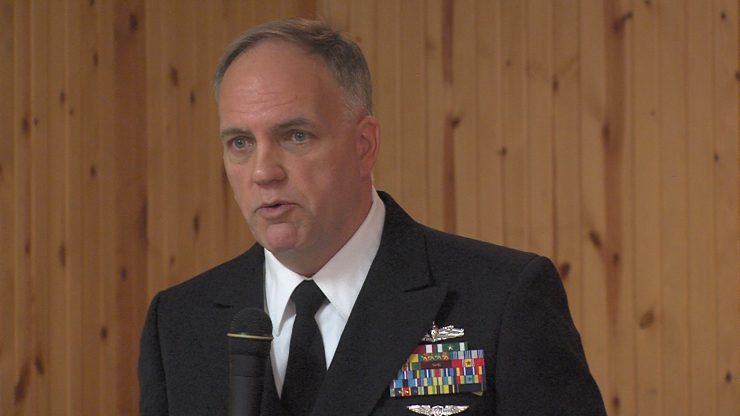
That was how retired Hays Lt. Commander Mike Morley, who served in the U.S. Navy for 23 years, introduced himself to the crowd gathered Saturday for the annual Hays VFW Veterans Day observation.
As the program’s featured speaker, Morley, who is communications coordinator for Midwest Energy, focused on what he called “my heroes, invisible veterans.”
He started with a reflection back to the devastation of World War I in which 20 million people were killed on all sides.
“Twenty-one million were wounded. And that’s significant because it was the first war where more men came home injured, surviving their combat wounds, than dying from them,” Morley noted.
There were horrific physical injuries. But other injuries were not so obvious.
“For example, shell shock. That’s a polite term for what we call today PTSD (Post Traumatic Stress Disorder). Or nerve and brain damage from widespread use of chemical weapons.
Flag-raising ceremony Saturday at the Hays VFW
“H. G. Wells famously wrote that World War I will be ‘the war that will end war’ because a rerun would be just to horrific to contemplate. Of course, we know things didn’t turn out that way.”
Morley recalled the wars since then, several other smaller actions and places today where troops are fighting in small numbers.
“In the 100 years since the end of World War I, November 11th, 1918, tens of millions of men and women have worn the uniform of their country and all of them to a greater or lesser degree, have been changed forever by that experience.”
Life is just a little bit different for those invisible men and women who made it home, just like those in World War I, he said, whether they served in combat or not.
Morley talked about his friend Brian. “He doesn’t have any ships or places named after him, but his sacrifice is every bit as real as those who do.”
The two met 26 years ago as young sailors. Brian was from Texas; Morley was from Topeka, Kansas.
“We had three things in common: a love of heavy metal music, a love of Japanese beer and a curiosity about amateur boxing.”
One evening after work the two put on sparring gloves. “It wasn’t pretty,” Morley said with a wry grin.
Morley was knocked down in about 40 seconds. Brian had neglected to mention he was a Texas high school Golden Gloves boxer. Rather than rub it in, Brian taught Morley how to improve his boxing skills.
They kept in touch over the years by email and Facebook.
While Morley stayed on active duty, Brian went inactive and into the Navy Reserve, moving to Manhattan, Kansas, and taking a job at Fort Riley to raise his family.
Brian volunteered for his first combat deployment to Afghanistan in 2008. While on patrol with a Marine squad, a teenage boy approached them with a smile, said hello in English, and then detonated the explosive vest he was wearing.
The bomber was killed instantly. The blast scattered the Americans who suffered various injuries, including lost limbs and eyes. Brian was sent into a wall, knocked unconscious and shattered three vertebrae in his back.
After a long convalescence stateside, Brian received the Purple Heart and re-enlisted in the Navy Reserves.
“I was stunned when he volunteered for a second tour,” Morley recalled.
This time, Brian’s base was hit several times by Taliban rocket attacks. During a nighttime attack, Brian fell from his bunk, hitting his head hard on a metal table. He was knocked unconscious and re-injured his back.
His tour was again cut short and he was sent home to recover.
Brian’s wife reported something was different after that event; his normally happy-go-lucky personality had changed. “He became short-tempered, suspicious. His mood swings at work became more pronounced and he couldn’t deal with stress very well,” she said.
Brian ended up losing his job at Fort Riley.
His medical care was also different the second time. Instead of the long inpatient stay at National Naval Medical Center in Bethesda, Maryland, he received after his first injury, Morley said, “Brian was given cursory outpatient treatments at the VA [hospital] in Topeka.”
Brian was on 26 prescription medications in 2010, according to his wife. He was taking anti-psychotics, anxiety drugs, sleeping pills, stimulants and pain pills, all at the same time.
The VA twice scheduled and canceled the back surgery Brian needed for permanent pain relief. There was a surgeon shortage and more severely injured veterans took priority.
“So Brian was simply given more and stronger pills, and the chemical mix made him more and more unpredictable.”
In July 2011, when Brian’s mood swings were at their highest, his wife and children moved out.
“For seven months, Brian rarely left the house, only for food, doctor’s appointments and to pick up prescriptions. His Facebook posts had gone from fun and edgy to being an incoherent mix of statements and paranoid rants.”
On Feb. 11, 2012, Brian received a mail-order prescription for 90 pain pills, double the dosage of an earlier prescription.
That evening he took 10 of the new pills along with the cocktail mix of his regular meds.
When Brian didn’t show up for his son’s track meet the next afternoon, his son went by the house and found him on the basement couch.
The chief petty officer was just 39 years old.
“Ironically, Brian was not among the 22 veterans who would take their own lives that day, or the next day, or every day since,” Morley said.
Brian left no note. His death was declared “respiratory arrest by accidental overdose.”
“He died as he lived his last few years, as an invisible veteran,” said Morley of his longtime friend.
Brian’s story is not unique.
“This country, its VA system, and dozens of non-profit groups have bent over backwards to ease the transition for severely [physically] disabled combat vets. These guys are true heroes,” Morley declared, “and they really deserve to be cared for as such.
“But for the thousands and thousands of invisible veterans whose injuries are less obvious or poorly documented, they fall through the cracks trying to navigate a system that wasn’t designed for them, and this is not new.”
There are Vietnam War Agent Orange vets with cancer, veterans with Gulf War Syndrome, and more recently, veterans suffering from traumatic brain injuries from non-fatal blasts or severe PTSD from events they’ve experienced but can’t unsee.
“They suffer in silence for years on end, hoping and praying that a slow-moving bureaucracy will someday validate or at least acknowledge that they are now different from before they served.
“So H.G. Wells was dead wrong when he predicted an end to war a hundred years ago,” Morley declared.
“Today, we’re in a war against faceless, nameless terrorists with no end in sight, which means we are continuing to make these invisible veterans.
“As we pause today to remember the veterans we’ve lost, let us also remember those we still have with us, especially the invisible ones. Let us vow to never again minimize their service or minimize their symptoms. Instead, let’s embrace them and their families with dignity, compassion, and most of all, understanding,” he concluded.
Morley’s speech was met with a standing ovation by the audience, filled with veterans, family and friends.
Veterans who are members of the Hays Senior Center and the Hays VFW Honor Guard were honored Friday.
By BECKY KISER Hays Post
Don Bickle and Harold Kraus
The Hays Senior Center honored its members who are veterans with a patriotic program and lunch Friday.
Men who served in World War II, the Korean War, and the Vietnam War were escorted to their seats of honor at the front of the room as their service branch and years of service were read. They were members of the Army, Navy, Marines and Air Force.
Also honored were three visiting veterans, Don Bickle, Harold Kraus, and Leo Knoll.
Navy veteran Bickle served in 1945 in WWI and again in the Korean War in 1950. Kraus was also in the Navy, serving from 1951-1960 in the Korean War and what’s known as the “Cold War.”
“I flew over some beautiful places during the Cold War, and later took my wife to see those countries as a tourist,” Kraus said during lunch with his wife Virginia beside him.
Knoll served in the Army from 1963 to 1966.
All the honorees were given a small U.S. flag and bright red fabric poppy to wear as the group posed for pictures.
The event was an early observation of Veterans Day, originally called Armistice Day.
In 1918, World War I ended on the 11th hour of the 11th day of the 11th month with a signed armistice declaring the “war to end all wars” was finally over. The next year, the U.S. declared Nov. 11th Armistice Day in memory of the men and women involved in WWI.
Many soldiers were buried in Flanders Field, site of a bloody WWI battle in Belgium. Poppies thrived in the battle-scarred soil strewn with rubble, which provided lime deposits and made the soil rich. The site became a stark contrast of white crosses and vibrant red poppies.
Nancy Augustine
“Today, the poppy represents all the people who died in the service of their country,” explained Nancy Augustine, monthly activity coordinator for the center.
The Hays VFW Post 9076 Honor Guard posted the colors and patriotic music was song by the Victoria trio “Trilogy,” comprised of brothers Jerry and Leroy Schmidtberger and a brother-in-law, Rick Rupp.
Several tables were filled with pictures and memories of servicemen from Hays and Ellis County.
Food server Angela Moxter, who also helped escort the honorees, provided pictures of her father, Robert H. Meyer, a Pearl Harbor survivor. Meyer served in the Navy from 1939 to 1945.
Meyer is first seen in a large, black and white group picture of sailors in Pearl Harbor, Hawaii. The photo was taken Nov. 30, 1941, one week before the Dec. 7 bombing that spurred the United States to enter World War II.
A second, color picture shows Meyer in his Pearl Harbor survivor cap attending a military remembrance ceremony.
Meyer died two years ago.
Nancy Augustine
Angela Moxter hands a flag to Norman Giebler, USN 1956-58.
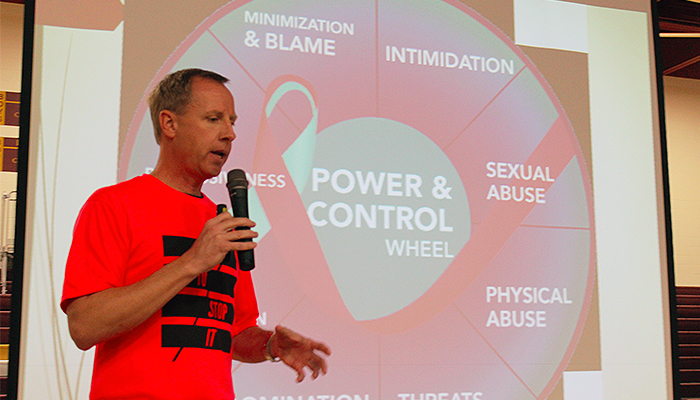
During an assembly at Hays High on Wednesday, speaker Russ Tuttle tells students how predators control their victims.
By CRISTINA JANNEY Hays Post
Russ Tuttle told students at Hays High School on Wednesday he wanted to remember just one thing — cola cockroach.
Tuttle grew up in India. On one particularly hot and miserable day, he bought two Thumbs Up colas from a street vendor. He was so hot, miserable and dripping with sweat that he chugged the first cola.
To his horror, a cockroach had been bottled inside the beverage and now was stuck to the roof of his mouth.
He told HHS students he never heaved so badly in his life.
His point to the students was social media is like sweet, fizzy cola. A little of it is OK. Too much is bad for you, and there can be lurking inside cockroaches ready to take advantage of you.
In his BeAlert program, Tuttle noted human trafficking is not something that just happens in the Third World.
At least 100,000 children in America are taken of advantage of in the sex industry each year. Three of four of those young victims are trafficked online.
“I am here as an adult male to tell you guys there are people who want to harm students,” he said
Youth put on social media their dislikes and their desires everyday. Cockroaches, the bad guys, use that to take advantage of students, Tuttle said.
Tuttle acknowledged the disconnect between youth and adults. He explained that simply. Brains in humans don’t fully develop until on average a person is 25 years old. The thinking part of your brain, the prefrontal cortex, is the last part of the brain to fully develop,
HHS students fill out surveys after the Russ Tuttle presentation on Wednesday.
“You are in high school, so right now I want you to understand something, this is not a slam,” Tuttle said. “It is not a put down. It is not a derogatory comment, but right now you turn to your neighbor on the left and your right and with your best compassion and empathy, look them in the eyes and tell them, ‘You are just a half brain.’ ”
Tuttle said adults need to understand students make mistakes because they were half-brain formed decisions. He then turned back to the students.
“When you feel like no one understands you and you feel like you don’t have a trusted adult you can talk to about something, online is not the place to go,” he said.
Teens often feel lonely and isolated because they look at social media and compare their weaknesses to others strengths. Teenage suicide is up 20 percent in American in the last six years.
In Tuttle’s daughter’s high school, two students killed themselves in the same weekend. One was a boy, and the other was a girl. They were in different grades and did not know each other. Both were expressing on social media they were lonely, isolated and depressed.
“There were students in my daughter’s school that were responding to these students saying, ‘I think you should end your life,’ ” he said.
He said students need to take responsibility for their own actions and the care of others.
Tuttle said he was becoming increasingly distressed about students falling into controlling relationships as young as elementary school.
Recently during a presentation at a small Kansas school, a seventh-grade girl came up to Tuttle after his presentation and said a fifth-grade boy had started harassing her when she was in the fourth grade. He began threatening her. In the fourth grade, he convinced her that she needed to take her clothes off, take a “hot pic” and send it to him.
“She is now in seventh grade, and she comes to me and says, ‘How did you know my story?’ I don’t know your story. I don’t know you. She said, ‘Everything you just talked about unpacked for me. That is my life. How did you know?’ I said these are the patterns when people control others in a relationship,” Tuttle said.
This young girl in the seventh grade was suicidal. She was cutting herself.
“This is not a rare story for me,” he said. “She got in a controlling relationship, and now, in the seventh grade, all the images that had been taken and used against her — she had over 100 men trolling her, catfishing her, harassing her through social media.”
This kind of manipulation does not only happen to girls, Tuttle said.
“I don’t want you to live in fear,” he said. “I want you to be wise.”
Predators use video games, such as Minecraft and Fortnite to prey on boys. Twenty-three men were arrested out of Kansas who were recruiting boys using Fortnite.
Boys are getting naked pictures from who they think is a girl, but it is really coming from a predator. The predator, posing as a young girl, convinces the boy to send naked photos of himself. The predator offers to meet. The boy goes thinking he is meeting the girl, and there is the predator.
Unfortunately, once these “hot pics” are out there, they are usually passed on. If you receive a pic of a teen who is undressed, and you pass it on, by federal law, you are a child pornographer. One in five pornographic images is of a child.
“You are only a safe online as your stupidest friend,” he said.
Jesse Logan, 18, trusted her boyfriend, so when he said, “If you really love me, you would take your clothes off and send me a hot pic.”
She did, he broke up with her and started passing the image along. Her parents found her hanging dead from suicide in her room.
Eighty-eight percent of the time once these photos are sent, they go semi-viral, which means they are seen by at least 1,200 people.
If someone approaches you online and you don’t know them or they try to harass you, Tuttle said you should block that person, save the information and report it to a trusted adult. This can help police put predators in jail.
“I recently encountered a 12-year-old girl who had saved the online exploitation she had been going through,” Tuttle said. She was 12 years old. She thought she was talking to a 14-year-old boy for several months. It turned out it was a 57-year-old man in Philadelphia, who had 14 others girls he was doing the same thing with. Because she saved the information, that guy is in jail today.”
Tuttle shared the story of a young woman who became a victim of sex trafficking. At 10, she was a star softball player. At 12, she fell into a manipulative relationship through social media with who she thought was a 14-year-old boy. When she met him, he was actually a 21-year-old-man. At 12, that man raped her, and he used all the images he took of that event against her.
Three weeks before her 18th birthday, she was sold against her will. The predators used alcohol and drugs to control her. On her 22nd birthday, she was in ICU with only 5 percent heart function.
“This is the result of what her life did to her,” he said. “This is the impact of porn on real people. This is the impact of controlling relationships — to take someone to a place where they are willing to exploit a young student through social media to get them to go to the depths of horrific horror they never thought they would go to.”
“I am asking you to be half brains searching for cockroaches when you are online to keep each other safe,” Tuttle said.
Tuttle ended the presentation by leading the students in the cola cockroach chant: “Not in my life. Not in my school. Not in my future. Cola Cockroach.”
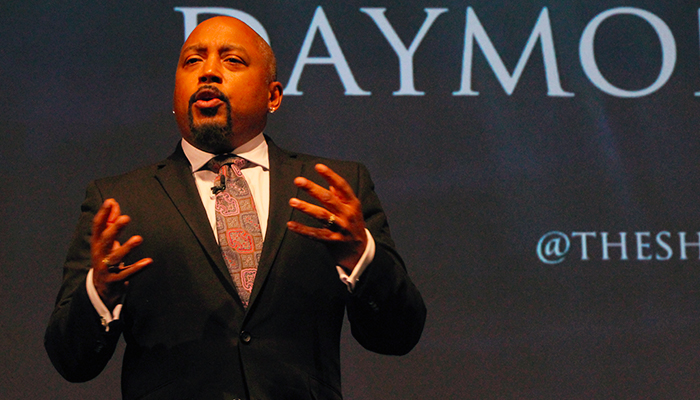
“Shark Tank” star and FUBU founder Daymond John speaks at Fort Hays State University Wednesday night.
By CRISTINA JANNEY Hays Post
Daymond John, the creator of FUBU and star of ABC’s “Shark Tank” told a packed crowd at Fort Hays State University on Wednesday the story of how he rose from a waiter at Red Lobster to the CEO of a $6 billion company.
In 2013, President Barack Obama appointed John a Presidential Ambassador for Global Entrepreneurship, a position focused on promoting the power and importance of entrepreneurship on a global scale. “Shark Tank” has won four Emmy Awards. John is also the author of the books, “The Power of Broke” and “Rise and Grind.”
John, 49, grew up in the Hollis neighborhood of Queens. His parents divorced when he was 10. He was raised by his mother who worked three jobs to put food on the table. At times, the family did not have electricity or gas, because they had no money to pay the bills.
“I didn’t want to see my mother work that hard,” he said. “Who would want to see their mother work that hard?”
John started working before he finished high school to help support his family. His first job was standing outside handing out flyers for the local mall for $2.25 an hour.
As he put his money into the family cookie jar for bills, his mother told him, “Responsibility is something that is taken, it is not given. You know that, and you will be successful.”
As John was growing up in Queens, there were two kinds of people who he saw driving fancy cars, drug dealers and the new hip hop artists.
Hip hop gave a voice to his generation. They would pull the power cords out of the street lights to play music and maybe 100 kids would dance in the streets until 3 a.m.
In 1986, John attended a hip hop concert in Philadelphia with a crowd of 18,000 people. The kids at that concert where wearing a uniform — the same Adidas or Reebok shoes as the rappers. This was a time before cellphones and the Internet.
“I was thinking, ‘Who sent the memo?’ ” he said.
“Every single one of us has a time where we come to a decision in our lives,” John said. “Mine came to me in 1 second, and I went from black-and-white to Technicolor.”
Set goals
He started to set goals, which he says is the first in his key SHARK points to success. He wanted to find a way to make money off of hip hop. He wanted to meet Michael Jackson, Muhammad Ali and attend a Prince concert.
He knew he wanted to be a part of the hip hop culture, but he had no musical talent. He was also working as a waiter at Red Lobster to make ends meet. He thought, “There has to be a better way.”
FUBU started humbly in 1989 when John’s mother taught him how to sew so he could make wool ski hats similar to one he had seen a local rapper wear. He sold the hats for $10 each, making $800 in an hour.
Unfortunately, he was so excited as he drove home that he rear-ended another car. He had to pay all his newly won earnings to fix the other person’s car.
His mother urged him to take stock of his personal assets. John, who never attended college and was dyslexic, started to bring in friends to build his business who had skills he did not.
Spokesperson
He and his friends created screen-printed T-shirts and sold them in local stores on consignment.
He went to 300 local stores in New York and New Jersey and offered to paint their front metal security gates with the FUBU logo and words “authorized dealer.” Not all of these stores were clothing stores. It could be a Chinese food restaurant, but the signs gained him premium ad space that was visible during the morning and evening rush hours. Some of these painted gates are still visible today. He estimates that spray paint campaign earned him $3 million in free advertising.
He then took 10 FUBU shirts and convinced local rap stars to wear them in videos. He didn’t have the inventory to give the shirts to the rappers, so after they were used in the videos, he took the shirts back and gave them to other rappers to wear. He later concluded he had received $15 million in free advertising by doing that.
Finally he enlisted the help of Queens rapper LL Cool J to serve as a spokesperson for the product. LL Cool J had just been picked up to star in the show “In the House.”
He was fielding contract requests from big-name clothing companies to endorse their products, so he was initially reluctant to allow young John and his friends to use him in any advertising. He finally relented and allowed John to take a single photo of him wearing a FUBU shirt.
Homework
After doing some research, he determined all of the big clothing retailers gathered annually in Las Vegas for the MAGIC trade show. They couldn’t afford a booth at the show, nor could they get tickets to get into the show. They set up their clothing in a hotel room and snuck into the trade show armed with flyers of LL Cool J wearing the FUBU shirt.
They came home from the show with $300,000 in orders, but had no way to produce that much inventory. John sought capital, but was turned down by 27 banks.
His mother agreed to mortgage their home for $100,000, and John turned their house into a manufacturing hub for FUBU.
But the money ran out before the stores paid off their orders. The family was in danger of losing the house. He scrapped up $2,000 from working shifts at Red Lobster, and his mother used that money to put an ad in the New York Times looking for capital.
Based on the ad, Samsung Textiles reached out and offered the cash needed to keep FUBU going.
Samsung wanted the brand to make $5 million in three years in order for FUBU to pay back their investment. John’s company took off and did $30 million in three months.
Amor
Things started to happen for John. His dreams were coming true. He met Michael Jackson. He had the opportunity to work with Muhammad Ali. He played air guitar on stage with Prince.
However, he was losing touch with things that were important to him — his wife and his two young daughters.
His wife was from the neighborhood just like John, and she could not relate to her new rich neighbors. She also felt separated from her friends back in Queens. John was spending a lot of time away from home and even out of the country.
She finally left and took the girls with her. John realized he needed to find a balance between work and home.
Remember you are the brand
In 2009, Mark Burnett came calling for John to be a part of “Shark Tank.” He told Burnett he had to honor an obligation to appear on the Kardashians. Burnett would not allow this, so John initially turned him down. He said he had to keep his prior obligation. The Kardashians canceled his appearance, so that freed him up to do “Shark Tank.”
On “Shark Tank,” he said he invests in people, not products. He reminded young people in the crowd to be careful of what they post on social media. He said he has rejected applications from otherwise qualified candidates for jobs at his company based on their posts on social media.
Keep swimming
Before closing his speech, John related his story of battling cancer. He had a tumor removed from his thyroid in 2017.
He encouraged the audience to love and really embrace life. He said the last thing he thought of before he went under anesthesia was his youngest daughter.
“I really felt like I was put on the planet for her,” he said.
He urged others to stay on top of their health screenings. His cancer was caught early, and he is cancer free today.
Among his customers have been NBA and NFL players and Tiger Woods’ caddy. Pat’s has even shipped to the White House.
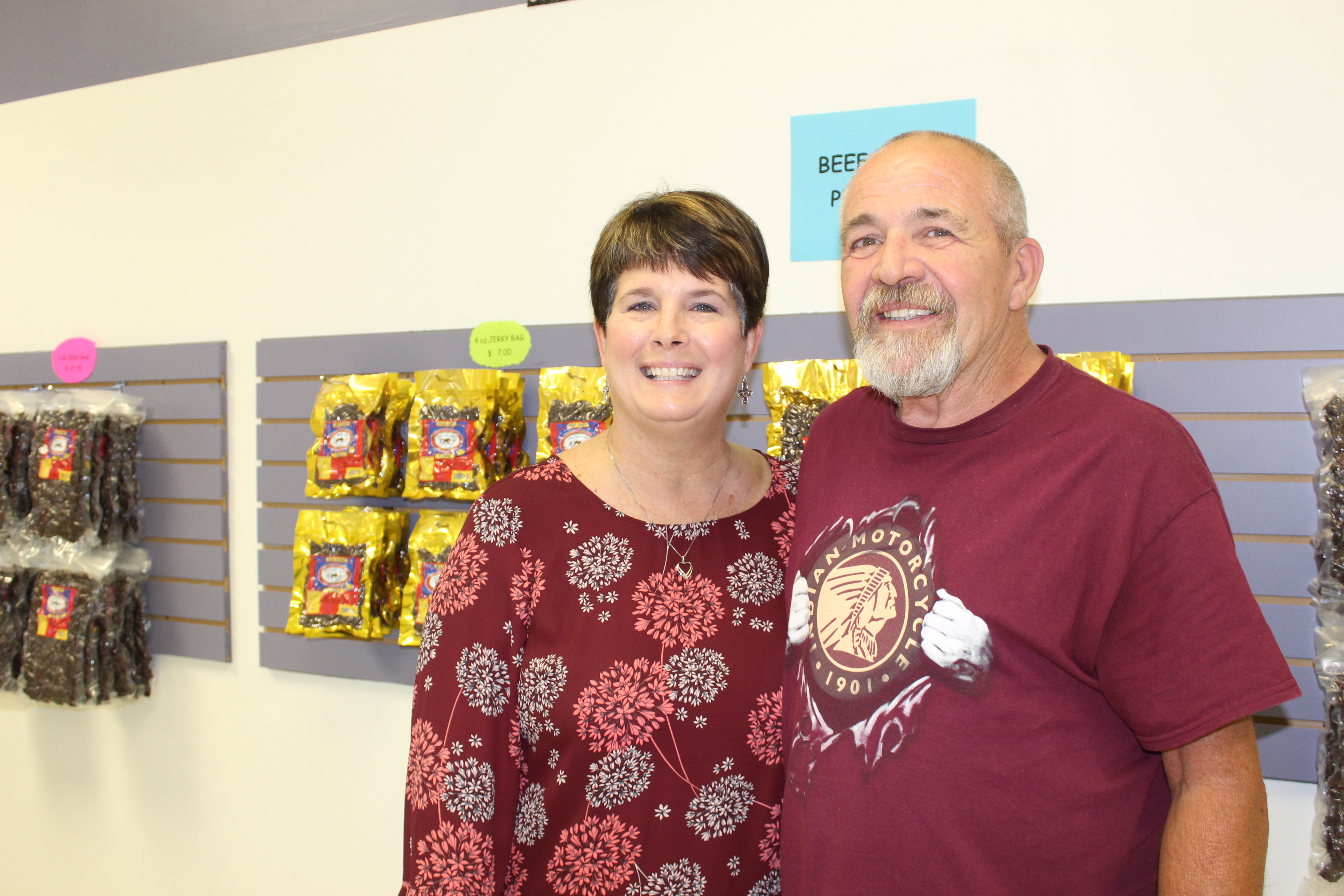
Despite a healthy online business, the majority of Pat’s business is walk-in traffic to the tiny store at the front of business’ commercial kitchen on U.S. 183 in Liebenthal.
“We have a lot of customers from Hays who like our jerky, and they would buy more of it if they didn’t have to go down south to get it,” he said.
The new Pat’s Beef Jerky store in Hays also sells homemade noodles and seasonings.
You still will be able to buy Pat’s Jerky in your favorite locations, including the Liebenthal plant and Cervs and Southside Convenience in Hays.
The new store in Hays will carry everything the store in Liebenthal carries. This includes several flavors of jerky, beef sticks, summer sausage, bologna, sausage, Hot Mama’s Pickled Sausages, spices, homemade noodles and cheese.
All of the beef products are made in Liebenthal.
Pat’s will have a hot dog roller, so you can pick up one of their own homemade hot links or polish sausage for lunch or dinner along with a cold beverage, chips or a candy bar.
The Carvers are considering bringing in other Kansas-made products, such as cookie dough and pies.
The store will carry premade gift-baskets all year round. You can also have a basket especially made for the holidays. The baskets will start at about $25. You can also pick up Pat’s sweatshirts or “Got Jerky” T-shirts.
Eventually, the Carvers plan to move shipping for their operation to Hays. This will allow the staff in Liebenthal to concentrate on making products.
Pat said he prides himself on keeping his inventory fresh, so he doesn’t keep a large inventory on the shelf. If you are planning a large order, he urged you to call ahead.
The Carvers are planning a grand opening the weekend after Thanksgiving — Friday, Nov. 23, and Saturday, Nov. 24. The store is planning discounts and a prize drawing.
“If they haven’t tried our product, now is the time to stop in and try it out,” Pat said.


 The club has extensive facilities that are used by club’s 300 members, as well as the public, law enforcement, Fort Hays State University and youth.
 The law enforcement range has been used by the Hays Police Department, Ellis Police Department, Victoria Police Department, Ellis County Sheriff’s Department, Kansas Bureau of Investigation, Kansas Wildlife and Parks and Tourism, and Kansas Highway Patrol.