We have a brand new updated website! Click here to check it out!

Hays Superintendent Thissen cites personal reasons for resignation

By CRISTINA JANNEY
Hays Post

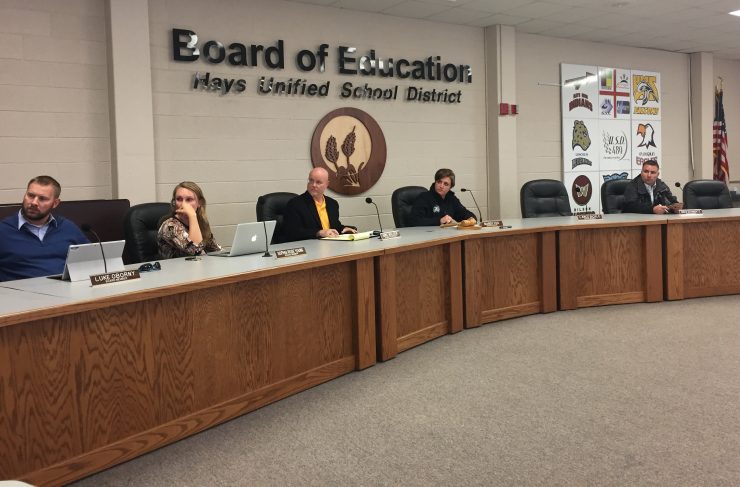
In an interview with Hays Post on Thursday, Hays USD 489 Superintendent John Thissen said he resigned last week due to personal reasons.

Thissen presented his letter of resignation to the board Friday, Oct. 19. A letter went out to staff on Sunday. Thissen’s resignation was accepted in the personnel transactions at Monday’s school board meeting.

He will be serving out the remainder of his current contract, which ends June 30.

Thissen said he entered his resignation now because he wanted the school board to have ample time to find a replacement. The early notification should give the school board a broader applicant pool, he noted.

“I can tell you that a lot has happened on a personal level in the last two or three years,” Thissen said.

Thissen underwent treatment for Hodgkin’s lymphoma in his first semester as superintendent in 2016 and said he is still struggling with some of long-term effects of his chemotherapy.

His wife has not be able to find a job in Hays as the couple had hoped. Therefore, she is still living in Herington.

“Being apart for this length of time has been very challenging,” Thissen said.

In addition, both of his parents have had recent health issues, and he said he wanted to be closer to his parents to help them.

“All of this is happening and is going on with me trying to make it work with me feeling pretty isolated out here in Hays when all of the family is two to three hours east of here,” he said. “I had committed. I just finally decided I must live and work closer to where my family is.”

Thissen, 56, said he has not found a new job and has not ruled out the possibility of retirement.

Thissen said he hopes people will not associate his resignation with some of the challenges facing the district, including an impasse in teacher negotiations, acquisition of new property for a new home for the Early Childhood Connections projects and two failed bond attempts.

“That’s the job,” Thissen said. “Being a superintendent of schools, you have to deal with those particular issues.”

Thissen did say he regretted not being able to unite the school board.

“I feel in the last two and half years that I have been here, the one the thing I really have failed at for sure is a team,” he said. “My job is to make a team of the board of education. I would say that isn’t the case.

“I don’t feel bad about not passing bond issues, because that happens. I don’t feel bad about even negotiations, because that happens. Those are things you work through, but one thing I think is really part of my job is to create a team effort.”

The board has been split on its most recent facilities project, the purchase and remodel of the Oak Park Medical Complex. The board was also unable to come to a consensus on a third bond attempt, and in a split vote, postponed any further discussion on a future bond until next year.

The district had failed bond attempts in 2016 and 2017.

Thissen said he still hopes the ECC project at the Oak Park Medical Complex will be completed. The district is in a protest period on the financing. If the district passes that hurdle, renovations are to be completed by the end of June.

“I would hope to be able to say in June this project … even people who are against may look at it and go, ‘Wow. OK, this was good.’ I am very hopeful with that,” he said.

Thissen said he hoped in a few years, the community could look back at the decision to end negotiations with the custodians’ union, SEIU, and consider it favorably. He also hoped the process and information gathered during the failed bond votes will help his replacement with a future bond election.

“I have never been in a community that has welcomed me to a job as openly as Hays has,” Thissen said. “My leaving is not something that has been lightly thought about. Unfortunately, it is one that events in my personal life in the last two and a half years have not fallen in line with what my intentions were.”

Board member Sophia Rose Young wrote after Monday’s meeting, “John has been a great leader for USD 489. I had hoped to serve the district alongside him for my full four years on the board, but I understand his desire to move forward, and I wish him the best of health. He is committed to serving this district and community wholeheartedly for the rest of the school year.”

Board President Mandy Fox said at the school board meeting Monday she did not want to comment on Thissen’s resignation. She had not returned questions in a follow-up email as of publication of this story.

Ellis County fire crews conduct joint training

Submitted

Saturday morning, Oct. 20, all the fire departments in Ellis County came together and performed their annual mutual aid training.

Thirty-three firefighters from the Ellis County, Victoria, Ellis, and Hays fire departments attended the training.

This training brings all fire departments together while working in a training environment to test skills, operational plans and equipment. This year’s drill was conducted southwest of Hays.

The exercise included a property owner burning down an abandoned structure while fire departments were on scene. The fire departments protected multiple buildings, or “exposures,” surrounding the fire building from receiving any damage.

Firefighters tested their skills with city structural fire engines to start a draft. This includes setting up 3,500-gallon drop-tanks next to the fire trucks, filling the tanks from the water tenders and having the fire trucks suck water out of the tanks to fight the fire.

This was tested and timed for reference as there are no fire hydrants outside city limits. Water was also shuttled on-scene from a local farm pond to refill the drop-tanks.

This larger training event is conducted once a year, and this year it was the Ellis County Fire Departments year to plan and host the event. Next year, the Victoria Fire Department will host the training event.

Although this larger mutual-aid training happens only once a year, there are multiple  other events where local fire departments train together on other items.

Historic Trego County one-room school restored to former glory

By CRISTINA JANNEY
Hays Post

The restored Wilcox School during its dedication on Sunday.

As you crest over a small hill on south U.S. Highway 283 in Trego County, a small limestone building pops out of a wild sea of golden grass and auburn milo.

For years the one-room structure known as the Wilcox School was left to decay and was overrun by rodents and spiders.

But with the help of some dedicated history lovers and a donation of the building by the Harm Schneider family, Wilcox School has been restored. It was placed on the National Register of Historic Places in May 2006. The building was dedicated Sunday to Harm Schneider’s memory.

The school was built of Niobrara limestone, quarried on the banks of the Smoky Hill River, in 1886 and was used as a school until 1949.

A historic photo of the Wilcox School. Courtesy photo

The stone for the building was likely quarried by hand and moved to the building site by horse-drawn wagon. A stone with the original construction date is still a part of the building, although it is mostly obscured today by an entrance that was added to the building a later date.

Also still remaining is more than a century of student graffiti. Students carved their initials or names along with dates into the relatively soft limestone along the front entrance and portions of the outside walls.

The school was named for the Wilcox family, whose farm was the closest to the school. The school had no running water, so water had to be brought in by students from the nearby farm every day that school was in session.

Raymond Mai, 94, attended Wilcox school through the eighth-grade when he had to leave school to go to work. He said school lessons stuck to the basics of reading, writing and arithmetic.

The unrestored interior of the Wilcox School.

He remembered playing baseball and a game called handy over. In handy over, a child would throw a ball over the school house. They would run to the other side of the school and tag someone from the opposite team. The tagged person had to join the taggers team.

When Mai was asked about rules in the one-room school house, he laughed.

“You better behave, or you’ll get it when you get home,” he said.

Mai lived on a farm two and half miles south of the school along the Smoky Hill River. He and his 12 siblings did farm chores in the morning before school, such as milking cows and feeding chickens, so they sometimes got a ride to school. However, they walked home in the afternoon.

Mai, who has lived in Trego County all of life, said he was pleased to see the school restored.

“It really makes me feel good,” he said,” because it is being taken care of after all this while.”

Graffiti carved in the entrance to the Wilcox School including one signature dated 1901.

In addition to being used as a school, the Wilcox building was used as a community center where church services were conducted as well as literary programs and quilting bees. It was a voting location and draft registration site.  

During World War II, families at the school made mattresses for rural families out of surplus cotton donated by the federal government.

Vernon Schneider’s father bought and owned the land on which the Wilcox School now stands. His family donated the building to the Smoky Valley Scenic Byway Committee, which cleared the way for it to be restored. Four generations of the Schneider family were present at a dedication ceremony on Sunday.

Vernon said he remembers going to Sunday school in the Wilcox school between the ages of about 5 to 7 during the mid-1940s. He said even then the building was starting to show its age.

He said seeing the building dedicated Sunday was a great honor for him and his family.

An interpretive panel that has been installed into one of the Wilcox School’s windows.

In 1965 the Hi-Plains Gravel Grinders Motorcycle Club purchased the building for their club house. After the Gravel Grinders moved out, the school house sat in disrepair for several decades until the Smoky Valley Scenic Byway Committee began their efforts to preserve the school. 

Although the Smoky Valley Scenic Byway was designated 15 years, it was never dedicated. Cathy Albert, director of WaKeeney Travel & Tourism and Smoky Valley Scenic Byway, took a moment during the school dedication to honor the byway.

The byway makes a 60-mile U-shape. Going west it goes from Ogallah south on U.S. Highway 147 to Brownell and then west on U.S. 4 to Ransom and north on U.S. 283 to WaKeeney. The Wilcox school is 15 miles south of WaKeeney on U.S. 283. This historic Zion Lutheran Church and cemetery and byway marker can also be found on the U.S. 283 stretch of the byway.

The Butterfield Overland Despatch, which was established in 1865, crosses the byway in two locations. One of those crossings is marked with a limestone marker near Cedar Bluff Reservoir. The trail from Fort Leavenworth to Denver was the shortest, but was also considered the most dangerous because it crossed Native American hunting grounds.

The date the school was built is carved into one of the original school stones.

During the spring through the early fall, the U.S. 283 section of the byway is a spectacular location to view native Kansas wildflowers. Volunteers reseeded the byway with native plants when U.S. 283 was reconstructed in the early 2000s.

Interpretive panels in the windows of the school discuss the school’s history as well as aspects of the flora and fauna along the byway. One window was left open so people could look inside the building, which has not been restored. It was the hope that if people could see there was nothing of value in the historic school, this would deter break-ins and vandals.

The restoration of the school was made possible by grants the byway committee received from the Heritage Trust Fund Grants through the Kansas Historical Society. The first grant was received in 2011 to restore the stonework and the roof. Metzker Restoration of Ness City reset the foundation and replaced some of the damaged stones, repaired the brick chimney and put a new roof on the school.

A vest owned by one of the Gravel Grinders. The club owned the school and used for a club house during the 1960s.

The second grant, which was received in 2015, was used to restore the windows, door, fascia, and soffit. Schamber Historic Preservation LLC of Damar built new windows and replaced the front door, fascia, and soffit earlier this year.

Len Schamber, preservationist, said Wilcox school was very dingy and dark when he and his brother began work on the building.

“All I saw was a dream,” he said. “All I saw was something beautiful in the end.”

He said he hoped the building interior could be restored to the point the building could be used at least occasionally by local community groups so the building would not fall into disrepair again.

“Don’t let it die, folks. Don’t let it die,” he said. “It is a beautiful thing, and it’s wow, 1886. That’s pretty awesome — been here, still here. Thank you for letting us be a part of it.”

Corrected 6:06 p.m. Friday Nov. 2, 2108:A former student of Wilcox school came forward showing historical documents that indicated the school was open until 1949 instead of the date previously listed in this story. The Wilcox school became a part of the District 14 at the end of 1947 school year, but remained open until the conclusion of the spring 1949 term.

School board member questions Oak Park project contract

By CRISTINA JANNEY

Hays Post

The Hays USD 489 school board heard an update on the Oak Park building project Monday night. This included questions about the ownership of the property.

The district plans to buy the Oak Park Medical Plaza on 13th Street and remodel it for use by the Early Childhood program. The district has received a $1.47 million federal grant to remodel the building.

Board member Lance Bickle said he had received multiple communications about the ownership of the property.

The complex has five owners. Four of the owners have signed off on the contract with the district. HaysMed owns the largest portion of the property.

The fifth portion of the property is under contract for sale. The person who has the contract on the property and not the present owner signed the contract with the school district.

Bickle questioned this.

“To me that would be like me putting my house on the market and having it scheduled to close next year and the person that was going to do it goes ahead and sells it when they don’t even own it yet,” Bickle said.

Board attorney Bill Jeter said there would be a simultaneous closing on the property when the time came.

The current owner would sell their unit to the party who is under contract to buy the property, and then the new owner would sell the property to the school district.

“If it doesn’t, then we have an issue with title and it’s not going to happen,” Jeter said.

The board heard a timeline for the project at the meeting. The district approved $2 million in financing for the purchase of the building on Oct. 15. The district will pay back the lease-purchase agreement $216,000 per year for 10 years.

Because the lease-purchase agreement is more than $100,000 per year, a 30-day protest period is required. That protest period will end on Nov. 25. If a protest petition is signed by 5 percent or more of the school district voters, the issue would have to go to a public vote.

The district only has until the end of June to use the federal grant funds. If a protest is successful, the project would have to be scrapped because the public vote would delay the project to the point the district would not be able to complete the renovation by the deadline for the federal grant.

If the district passes the protest period hurdle, work on the renovations would begin in January, be finished in June and classes would start at the new building in August.

🎥 Chief: Proposed new uniforms ‘better benefit officers working the street’

Hays Police Department, 1957

By BECKY KISER
Hays Post

The Hays Police Department has worn the same style uniform since 1950, a dark navy shirt and pink-tan pants.

It’s recently become difficult to purchase the pants from the supplier in the same color and material, according to Chief Don Scheibler.

HPD uniforms 2018

“The Hays Police uniform is no longer uniform,” Scheibler told Hays city commissioners last week.

The uniforms are also uncomfortable, hot in the summer, cold in the winter, and not very durable, Scheibler added.

“The current belt system also puts all the weight on the officer’s hips, causing lower back problems.”

HPD has budgeted $46,500 in 2018 to purchase a new style of uniform for all officers.

An employee committee evaluated several uniform brands and is recommending Blauer which comes with a removable outer-ballistic vest carrier system, as well as a high gloss leather duty belt.

Scheibler thanked the committee for its work, saying the officers are “excited” about the new uniforms which he described as “professional, and a traditional dark navy made of a durable poly-wool blend.”

A suspension system in the vest is designed to take its weight off the officer’s hips and put it on the shoulders, reducing back injuries.  “This will hopefully help reduce workman’s comp costs, officers being on short-term disability and long-term health problems for the officers,” Scheibler pointed out.

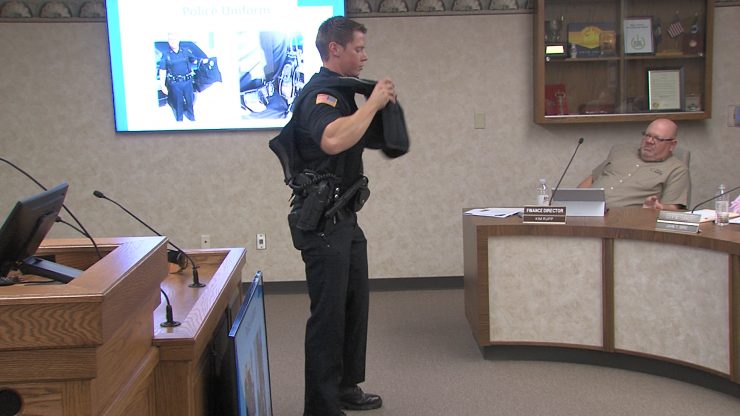
HPD Ofc. Dakota Reece shows city commissioners the proposed high gloss leather duty belt.

The vest is easily removed when an officer is working at a desk. “I can probably get it on or off in 15 seconds,” said Ofc. Dakota Reece, who modeled the proposed uniform.

The new style pants have six pockets which allow more storage for the officer when on the street. Long sleeve shirts will also be ordered for cooler seasons.

“Very sharp looking,” said Commissioner Sandy Jacob.

The Topeka police department utilizes the same Blauer uniform, and has been very pleased with its durability, Scheibler said.

“In 60 years, fabrics have changed, times have changed, and police didn’t carry all this equipment,” Vice-Mayor Henry Schwaller noted.

Chief Scheibler agreed. “In 1993, that short time ago when I started, a revolver and a couple of speed loaders were all we had. This is truly a better benefit for officers working the street.”

The commission will vote on the recommended uniform purchase at the Oct. 25 meeting.

Saddle up for the season: FHSU Rodeo 2018-19

Bailey McCaughey, Eads, Colo., junior, practices breakaway roping with Assistant Coach Ross Russell. Photo by Makenna Allen

By MAKENNA ALLEN
Fort Hays State University

Gates clang and metal clatters as clods of dirt spatter against the rails. The humid fall air is penetrated only by the whinnies of horses tied to trailers. At Fort Hays State University, these sights and sounds can mean but one thing: It’s rodeo season.

Indeed, the rodeo team’s practices are well underway and the student athletes are learning the ropes and routine of daily life as a part of the Fort Hays State University Rodeo Team. New students and returning athletes alike are prepared to jump in, ready to learn from Head Coach Bronc Rumford and Assistant Coach Ross Russell.

“This is my first year,” said Coldwater junior and team roper Tanner Kay. “I’ve always grown up around rodeo, so when I came here I decided to try it out.”

Other new team members, like breakaway roper Larae Boaldin, Garden City junior, are transfer students from other schools where they also rodeoed.

“Through rodeo, being on the team at Garden, I knew Hays had a program and I contacted Bronc,” Boaldin said.

Even returning team members are looking to expand their knowledge when it comes to rodeo and life.

“Spending time with Bronc and Ross, the coaches, has been such an important part in my life, especially learning from Bronc about rodeo and about life in general,” said team roper Zeke Hall, Peyton, Colo., senior.

The coaches also hold a variety of goals for the team.

“We are expecting some qualifiers to the College National Finals, personal improvement each week, and a team GPA of 3.0 to name a few,” Rumford said.

The goal of academic achievement allows the program’s benefits to extend beyond success in the arena. Indeed, managing time in order to fit practice and rodeos into a busy student schedule requires students to develop a sense of balance and the ability to prioritize necessary tasks.

“Balancing schoolwork and rodeo, I struggled at first because you want to spend as much time as you can out here, roping and competing and trying to get better,” Hall said. “It can sometimes take away from schoolwork, so just staying focused and making sure my priorities are in the right place and just taking care of business.”

Boaldin also strives towards success in academics.

“It’s definitely difficult, but I just make sure I’m home at a good time to do my homework but I make sure that I get to practice every day,” Boaldin said.

Outside of these practical skills, being a member of the team holds even more value for students. For them, rodeo is a chance to form new relationships that develop during long hauls to rodeos and during overnight stays in small hotel rooms.

“Really, it’s a way to meet new people and have some fun,” said calf roper and team roper Colton Wagner, Paola junior.

Even as this family atmosphere begins to form, the coaches hope for success within the arena.

“This year we’re really young, so we’re going to try to build them up,” Russell said. “Next year would be a stretch to win a national championship but here in the next three or four years, we’re going to have a chance.”

This fall season provides multiple opportunities to work towards these goals as the team has already competed at Colby Community College, Southeastern State University, and Oklahoma State University.

Rumford highlights the successes so far of Coleman Kirby, Richfield senior, in bull riding and Travis Booth, Castle Rock, Colo., junior, in steer wrestling. Barrel racer Roxanna Clawson, Great Bend junior, finished as one of the top 15 competitors at two rodeos this season.

The team looks to continue this success into their final rodeo of the fall season through the National Intercollegiate Rodeo Association. The rodeo at Northwestern Oklahoma State University is scheduled for Oct. 25 in Alva, Oklahoma.

As the team travels out of state, members seek support from sponsors and donors to help build the program and to help the team find success in the upcoming season.

“That’s everything to our rodeo – sponsors. We get very little money from anybody else. It’s the town that we rely on to be able to have a rodeo,” Russell said.

Rumford stresses how sponsors have made it possible for students to discover and ultimately realize their dreams. For Hall, this is possibly the most important role of the rodeo club in students’ lives.

“It’s taught me that anything is possible. Before I came here, I didn’t really rope or anything,” Hall said. “It’s just taught me that if you have something in mind that you want to do, if you have a goal, if you have a dream, then just put your head down and go do it and believe in yourself.”

Makenna Allen, Littleton, Colo., freshman, is majoring in information networking and telecommunications at Fort Hays State University.

🎥 Health insurance cost for city of Hays to decrease

By BECKY KISER
Hays Post

The city of Hays is anticipating a decrease in the 2019 premium for employees’ health insurance.

Erin Giebler, human resources director, told city commissioners Thursday night the high deductible plan is the most popular.

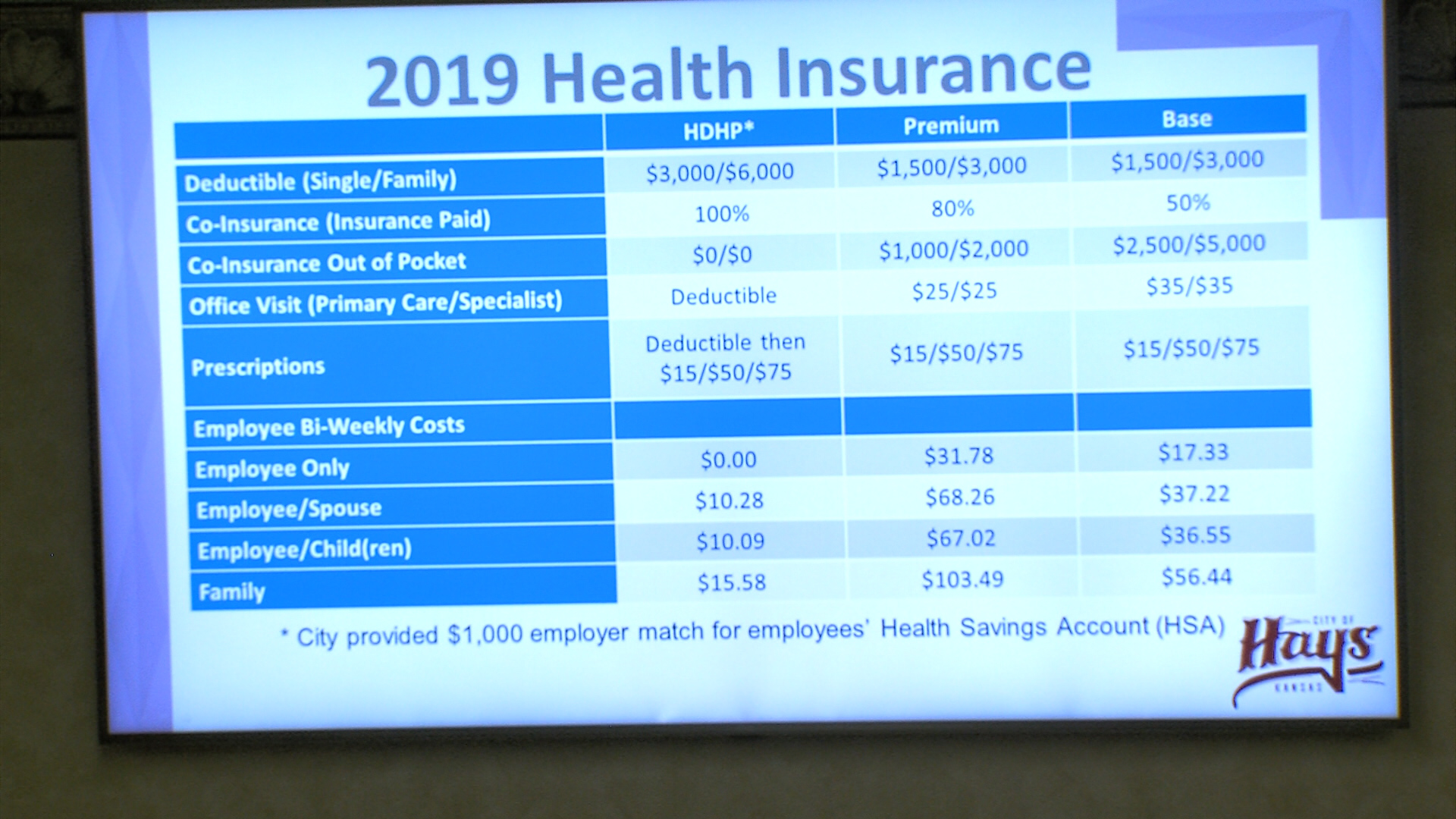
The city switched to Blue Cross Blue Shield of Kansas in 2017 which offers three plans. “Really, it was our employees that came back to us saying ‘we want this high deductible plan back,'” Giebler said.

For the first time, employees were required to pay a portion of the premiums in order to keep health costs within the budget.

The city kept the same plan in 2018 and added up to a $700 match for employees’ Health Savings Accounts.

“We got our renewals and it’s working out for us. We’re actually seeing a 2.46% decrease compared to last year. If you take out the costs our employees will be paying, the cost to the city is $161,414,” reported Giebler.

Thanks to the premium decrease, Giebler said staff is recommending an increase to the 2019 Health Savings Account (HSA) contribution to $1,000 each, an estimated additional $120,000.

“I will point out the total cost of the premium plus the HSA contribution being recommended is still lower than the 2018 proposal,” Giebler added.

Commissioners thanked Giebler and the Employee Benefit Committee for their work on the renewal plan.

“We also have to thank our employees for keeping their health benefits in line,” added Commissioner Ron Mellick. “We want to take care of our employees but they’re helping themselves on this. That’s great.”

Mayor James Meier also noted the estimate for the Hays Public Library employee health plan is going down almost 20 percent.

“I think they had a different mixture of ages in their employees this year than they’ve had in the past,” Meier explained, “and that accounted for a lot of that decrease.

The commission will vote on the renewal at the Oct. 25 meeting.

Abuse survivor hopes to gain freedom with service dog

By CRISTINA JANNEY
Hays Post

Kathylea Wolf did something this week she doesn’t do very often — she smiled.

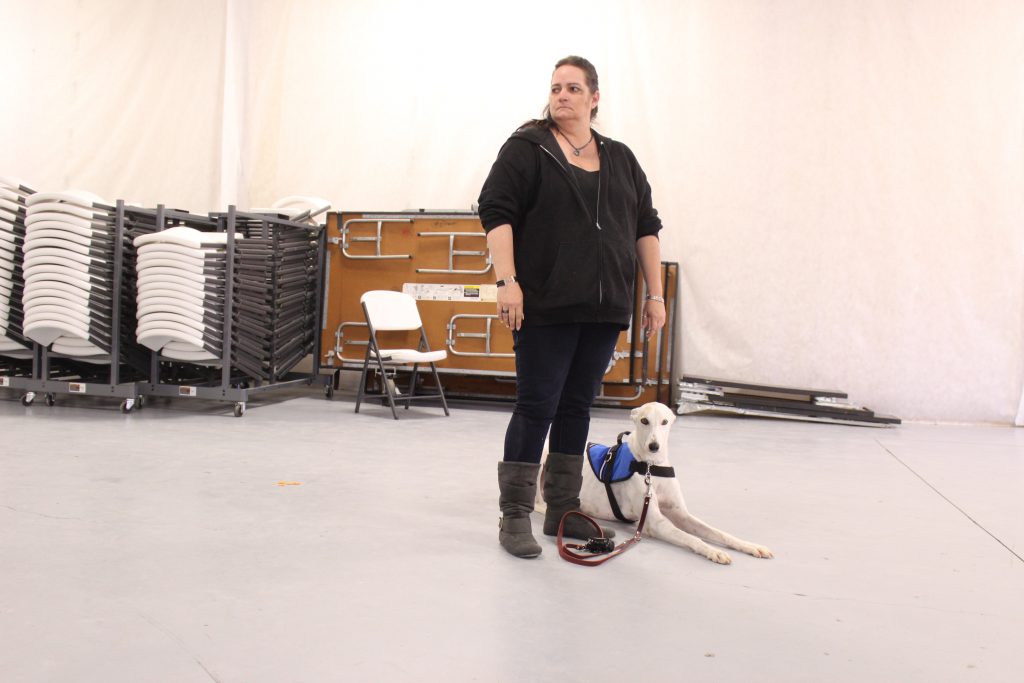
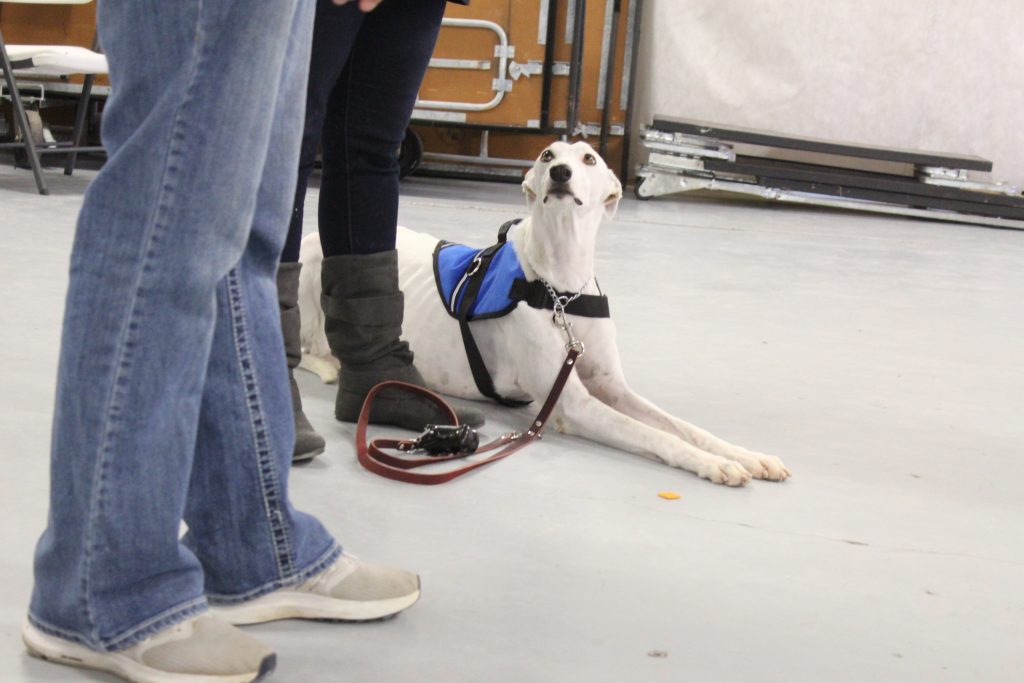
As she praised her new service dog, Jade, she ran her hand along Jade’s silky white coat and a toothy grin spread over her face.

This week has been a week of big steps for Kathylea.

She has PTSD and severe anxiety disorder and has spent years confined to her small Hays apartment except to go to doctor’s appointments and brief trips to the grocery store. Wolf is the survivor of childhood physical and sexual abuse and also escaped from a violent relationship with her ex-husband.

Even those trips to the store and doctor can be excruciating. She looks around corners and carefully plots her way through aisles to have the least human contact possible. She has memorized stores so she can spend the least amount of time in them. If she hears a couple fighting, she freezes and goes numb. She starts saying she is sorry repeatedly even though she is not involved in the fight. She becomes terrified if she hears a child screaming.

She has been dreaming for years of receiving a service dog to help her break the cycle of fear and panic that keeps her housebound.

Learn more about Kathylea’s story here: Abuse survivor trapped inside house by fear seeks funds for service dog

This week she took the first big step to escaping her prison of fear. Kathylea left the safety of her home to travel to the nonprofit CARES in Concordia to train with a greyhound — Jade.

The first two days of her training were difficult. She was not used to being away from her apartment where she feels safe.

“I have had a hard time being away from home in the hotel and around people,” she said, “but Jade is making me feel more comfortable and safer.”

She said she could feel her confidence growing with Jade by her side.

“I went to McDonald’s with Jade the other night to get something to eat,” Kathylea said. “I stayed for 10 minutes by myself and was able to eat. Normally, I wouldn’t be able to stay. It’s little successes.”

Kathylea has struggled with sleep for years. She wakes up in the middle of the night with night terrors and has been known to injure herself in her sleep. It is her hope that Jade will eventually be able to wake her from her night terrors.

“I woke up with a night terror last night, but Jade was there, and I was able to get right back to sleep,” she said.

On the third day of training, Kathylea, who suffers from vertigo, got dizzy and fell. She then started to have a panic attack. As CARES staff came to her aid, Jade went into action. She came right to Kathylea’s side. Panic attacks can be very disorienting, and Jade is trained to go into protection mode and alert Kathylea to any dangers if she has an attack.

The dogs CARES train for PTSD sufferers also can help provide stability and security in effort to prevent anxiety attacks. When a dog senses its owner is feeling anxiety, the dog  make a move called “Going to 6.”

Sarah Holbert, CARES CEO, gave the example of a person standing in line at a grocery store. The dog would move to the person’s rear to be a physical barrier between the owner and other people.

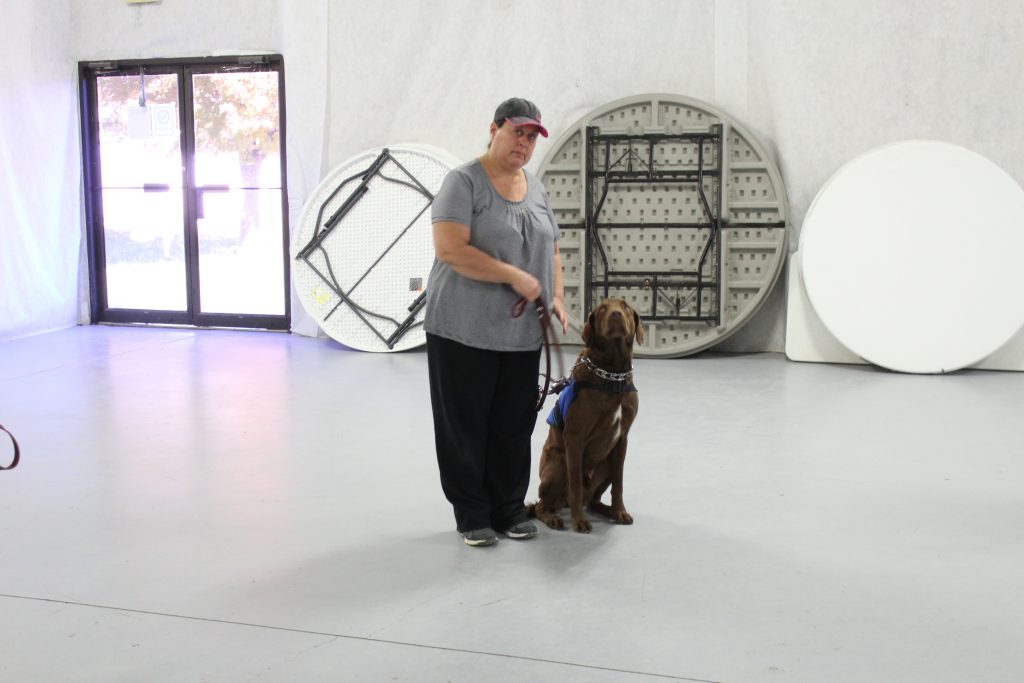
CARES has worked with many veterans who have had PTSD in its 25 years. For someone who has PTSD, the dog provides something more than comfort. For many PTSD sufferers like Kathylea, a dog is difference between being incapacitated and being able to go out in the world and function normally. She said the dogs are not aggressive. It is passive protection.

Kathylea is very easily startled by load noises. During a break in her class, a young child shrieked in the back of the room. Kathylea said, “Jade, hug.” The dog nestled into her chest. Kathylea was visibly shaken, but she didn’t have a panic attack and was able to continue with her conversation.

CARES has placed more than 1,500 in 44 states and seven foreign countries in the 25 years. People in Kathylea’s class came from as far away as Alaska, Hawaii and Maine to train with their dogs.

The week-long CARES training is intense.

“They have to learn everything about their dogs,” Holbert said, “because they have never met their dogs before. It is coming to Kansas, and it is like Christmas in October.”

The new owners learn to groom the dogs, how their dogs are trained, basic obedience, manners in public and home, and the specific skills the dogs have been trained for their new owner.

Kathylea’s dog was trained to help her with her PTSD, but other service dogs in her class were trained to alert for high or low blood sugar for children who had diabetes, help people with physical disabilities and aid people with developmental disabilities. Dogs can also be trained to alert to seizures.

Holbert said the dogs not only can help people be more independent, but they can save lives. She gave the example of a diabetic alert dog in action.

“You just heard that dad talking about the dog alerting and the medical device had not gone off yet,” Holbert said. “The dog was alerting before the medical device was working, and we hear that all of the time. It is very definitely life-saving for so many people.”

She continued with a story about a veteran.

“Carrie, who helped me do the demonstration of the ‘go to’ and ‘go find’ is a Canadian veteran. She will tell you her dog saved her life, just from the standpoint of being able to go out into public and to go back to work and to live the life she wants to live.”

Holbert explained that there are three types of trained helping dogs — guide dogs for people who are visually impaired, signal dogs for the hearing impaired and service dogs for all other disabilities.

The dogs go through a rigorous selection and training progress. They use a variety of breeds. CARES breeds its own Labrador and golden retrievers, but breeders donate other dogs, such as Newfoundlands, poodles and a German shepherds.

Not all dogs have suitable temperaments to be service dogs. Once the dogs are selected, they train 24/7 with inmates in several prison across the country, including Ellsworth Correctional Facility and the federal prison at Leavenworth. Finally, the dogs come back to CARES to train specifically for the skills they will need to help their new owners.

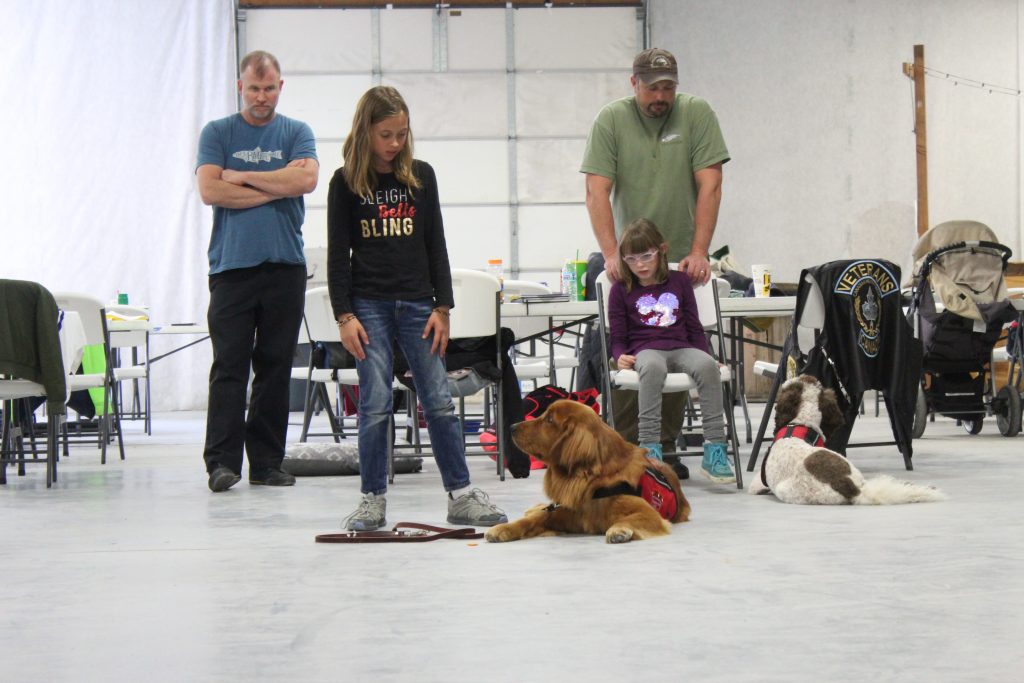
In addition to lectures and demonstrations by instructors, the new owners did hands-on practice with their dogs. They practiced retrieval commands as well as commands such as “Leave it.” The dogs walked with their owners in a circle and the dogs had to ignore food that had been left on the floor.

The dogs and their owners also traveled to Salina Central Mall for a public access test. The dogs have to show they have a superior level of behavior in public, and the owners can control the dogs in public.

Holbert said service dogs are different from emotional support animals in that they have been trained and certified. Emotional support animals, although are required by law to be allowed in certain federal housing programs, are not trained.

Holbert stressed other rules the public needs to know about service dogs, including how to approach a person with a service dog in public. You should not pet a service dog. That dog is working, and petting the animal could distract it from its work, Holbert said.

“The first thing is to recognize the person,” she said. “If they are in a position where you are not interfering with the work, you can recognize the dog and what a nice dog it is. Never pet the dog without asking. Never interfere with the work of the dog without asking because if the dog is going to alert to diabetes, a seizure or a panic attack, that dog needs to do its job.”

For some children who have autism or people with PTSD, interacting with people in a positive way through their dogs can be a benefit, Holbert said. However, people need to be respectful when they do it, she said.

Kathylea said she wants to continue taking steps forward.

“I want to take a walk around the park behind my house,” she said. “I want to go to a restaurant by myself without having to count the cars in the parking lot. I want to be able to go somewhere without just shaking.”

Because of her severe anxiety, Kathylea has to be on medication. She said she would like to reach a point where she could reduce or stop some of that medication.

“I would like to be able to go somewhere without taking (my medication) and waiting an hour before I go out,” she said.

Kathylea knows she has a long way to go, but as she gently smoothed back Jade’s ears and rested her palm on her head, again she smiled.

Kathylea, who is on a fixed income, raised money through a GoFundMe account to pay for her meals and hotel during her training.

CARES maintains a foundation that helps defray the cost of training the dogs. The national average cost for a service dog is $18,000. Holbert said donations are always welcome to support the program. They can be sent to CARES, P.O. Box 314, Concordia, KS 66901. Learn more information about CARES through its website, call 800-498-1077 or email [email protected].

UPDATE Aggravated burglary suspect captured after high-speed pursuit

UPDATE: 6:20 p.m. Friday.

According to Hays Police Chief Don Scheibler, the aggravated battery suspect who was the subject of a Friday manhunt in Hays has been apprehended.

Scheibler told Hays Post the suspect — Larry Wayne Shifflet, 42 — was involved in an accident in Ellsworth County after a pursuit. He was unsure if Shifflet had been hospitalized, but said he was in custody.

Scheibler also said police believe the couple in question had been involved in burglaries “all across the country.”

Check Hays Post for more as details become available.

—————

Original story

HPD

The Hays Police Department is looking for an aggravated burglary suspect.

Earlier Friday, two people were at a house that was burglarized. The female that was involved has been arrested and their vehicle has been impounded. Police are looking for the male suspect, who has been identified as Larry Wayne Shifflett, according to the HPD.

Larry Wayne Shifflet, 42 years old, 150 – 180 lbs

Shifflet is not from Kansas, and the HPD believes he is still at large in Hays on foot. Shifflett could be armed, so do not approach him. Please lock your home and vehicle doors.

If you have information regarding the whereabouts of Shifflett, contact the Hays Police Department Dispatch at (785) 625-1011.

Check Hays Post for more as details become available.

Take from Walgreens parking lot Friday afternoon. Submitted photo

Artists incorporate pieces of prairie into ‘Of the Earth’ exhibit

By CRISTINA JANNEY
Hays Post

Two area artists will bring nature to art lovers during the exhibit of “Of the Earth,” which opens tonight at the Hays Arts Center.

Russell artist Angela Muller will exhibit her abstract canvas pieces made from materials from the Kansas prairie. Ellsworth artist Barbara Jo Stevens creates natural form ceramic vessels that are mounted on found wood.

Angela Muller

Muller said the materials that go into her art are more important than the images themselves.

“All my paintings are very structural and sculptural,” she said. “They all start out with a very thick texture, which is ground stone, mostly marble and then I add limestone and soil to it so those earth elements are embedded in the texture.”

As she builds the painting, she adds earthen elements from around the world, but many from the Kansas prairie. This includes top soil, limestone, sandstone, gypsum and flint. She grinds the local stone with a mortar and pestle. She uses rain water mixed with acrylic paint for her pigment.

“I also like to smudge the paintings with cedar and grasses from the earth, so the spirit of those plants also go into the paintings,” she said. “Then the last earth element I often use is grass — prairie grass. I will often go out and cut that by hand and use that in the texture of the paintings so the appearance of the grass is in the texture.”

She also collects wheat kernels after harvest and incorporates those into the texture of her paintings.

“I think if you look at the grassland we live in, some of the harshest conditions are found on the prairie,” she said. “We have extreme drought and extreme temperature variations, very hot, very cold, strong winds. It is very tough for nature to thrive here, but despite those things, nature does thrive and survive.

“I think looking at the examples of nature gives us hope and examples of how we can thrive and prosper here too.”

She said her goal is to layer as many parts of the prairie into to her paintings so the essence of the plains shines through.

Muller grew up in Russell, but moved away and lived on the East Coast for 17 years.

“I had a real visceral disconnection from the earth,” she said. “It bothered me because I couldn’t see the storms coming and see the sun setting on the horizon. There was a real disconnect, so when I moved back to Kansas eight years ago, I kind of saw the prairie with a new set of eyes.

“I saw there were great teachers in thunderstorms and cold moons and cottonwoods with spring in the breeze. And I wanted to paint that and capture that essence.”

Muller said she feels people in Kansas are connected to the earth in ways others aren’t.

“Because we live and depend on the earth here,” she said, “I think we have a special connection to it, and that certainly speaks for me. Kansas and growing up on the prairie makes us appreciate the earth and be closer to it.”

Barbara Jo Stevens

Stevens gleaned inspiration from Native American pottery, yet she said her artwork is an original reflection of her own soul.

Stevens was the head of the Cloud County Community College Art Department. When she taught Art Appreciation, she would bring in a shard of Native American pottery.

“I would ask the student to hold it and really and feel and look at it and not just take it and pass it to the next person, because it was 1,000 years old,” she said. “It is amazing to me that clay survives everything that the elements and people give it. It may get cracked or broken, but it survives.”

Stevens of Downs said she always felt like she was connected to those ancient women who made the pottery.
“Ancient pottery was made by mothers and wives, doing what they could to take care of their families every day. That’s who I am,” she said. “Here 1,000 years later, here is another women of the same spirit, the same creative abilities, doing the same thing. That just fascinated me. With all our modern technology, there is such a connection, and I think it comes out in my work.”

Stevens’ pieces are hand-built instead of thrown on a wheel. This allows here to create vessels with very thin walls, which gives the impression of the pieces being very fragile, just as our lives are tenuous.

“Last of all, I hope there is a spirit there,” she said, “from what I am feeling when I make the piece that some of that stays with it. And when people come in and see it, they can feel some of that personality as well as my spirituality that goes into the pot.”

Most of Stevens’ vessels are mounted on pieces of wood. Since she was a girl she enjoyed walking among the hedge trees her grandfather planted to harvest for fence posts.

“I found out in the third grade that it wasn’t even a woods and burst into tears in the middle of class. I was so sure my daddy had a magical forest for me,” she giggled.

The wood mountings harkened back to the treasures she picked up when she went on walks in her woods. As her friends and family learned she was collecting found wood for art pieces, it became a community project.

“Somewhere along the line that evolved not consciously, I don’t believe, but it evolved into trying to make them look like you are on a walk in the woods and you just stumble across this treasure that has become a part of the forest,” Stevens said.

Stevens said she hoped her pieces will help exhibit-goers connect to the prairie.

“I want them to feel there is a connection with God, a connection with God’s good Earth and with people of the past … with the ancient ones. I want them to remember there is something more in this world than just the material things, and I hope my pieces bring about that feeling and gives them a sense of calm and peace,” she said.

The opening reception for “Of the Earth” will be 7 to 9 tonight at the Hays Arts Center. It will be preceded by a members-only HAC annual meeting at 6:30 p.m.

“Of the Earth” will be on display at the HAC through Nov. 27.

In addition to the opening of “Of the Earth,” Friday, the HAC will also host a book signing for “Pegasus Dan and the Little Owl” written by Hays artist Nicole Thibodeau and illustrated by Robert Joy.

Thibodeau received her BA in Studio Art from Bethany College in Lindsborg and her MFA from Fort Hays State University.


Halloween Express helps customers with haunting needs

By CRISTINA JANNEY
Hays Post

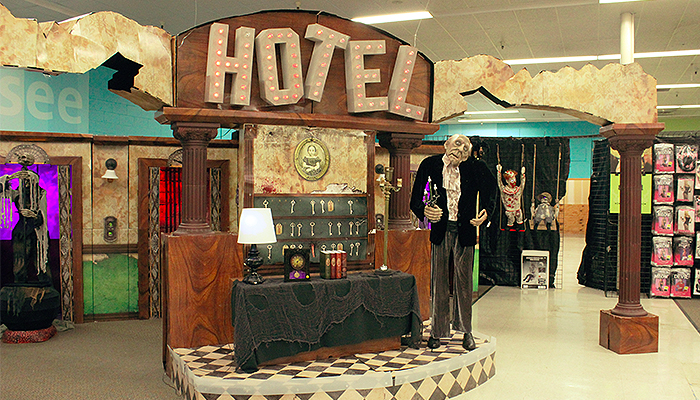
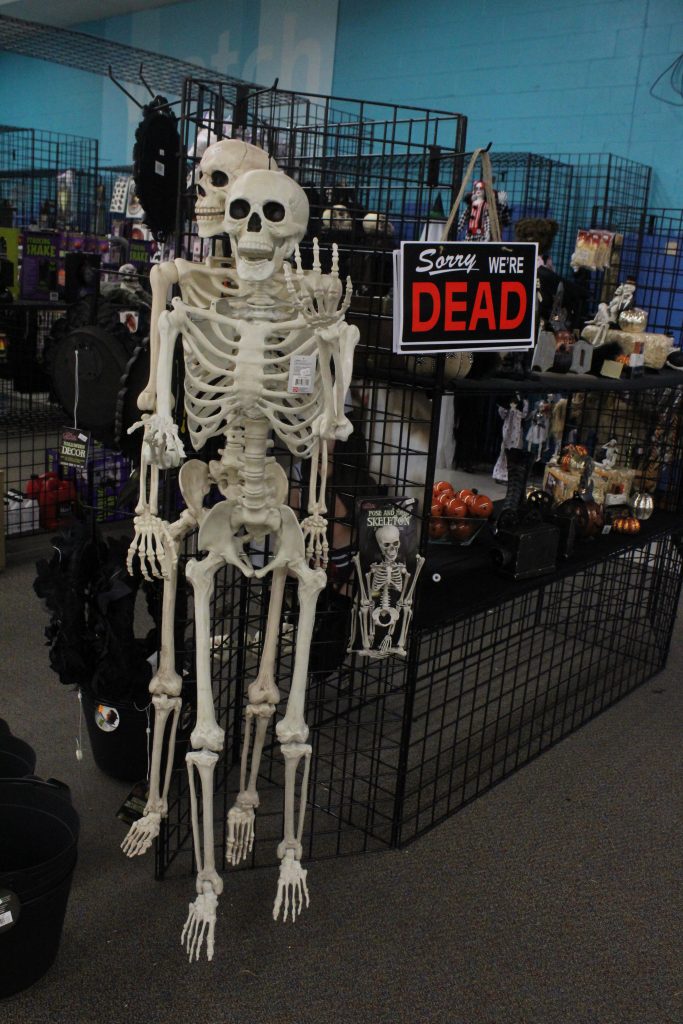
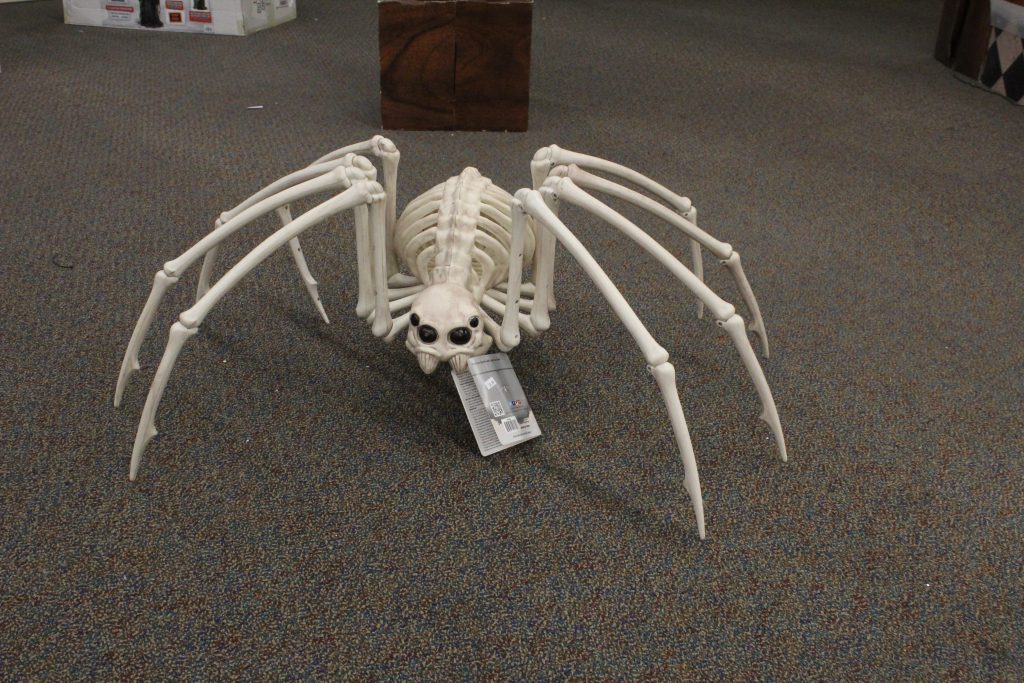
Halloween Express is back again this year in Hays to help you with all your haunting and ghoulish holiday needs.

The pop-up store is in the former Hastings Building next to Hobby Lobby on Vine Street. The store is brought to you again this year by Kearsten and Mike Koerner of Hays.

“We thought it was a really cool idea,” Mike Koerner said. “Hays is a college community, and there are a lot of great communities around Hays that will support the economy in Hays. We thought this would be a fun store to have.”

Kearsten said, “I love it. I love Halloween. There was a need for it in Hays. There are lots of places that sell Christmas decorations. … Other than Walmart, where are you going to get this kind of stuff? We cover everything. We don’t just have a few costumes.”

Koerners are local owners, so the money spent at the store stays in the community.

Animatronics are popular this year, and customers are buying the pieces for indoor and outdoor use.

Kearsten said one customer rearranged all her furniture in her living room so she could have her Halloween animatronics inside. Kearsten said the women wanted to enjoy them without fear they might get stolen.

One of the more popular displays is a talking slim man, an example of which is front and center at the entrance to the store.

“What we do is try to find things that are hot, scary movies for the season and try to carry merchandise that wraps around that,” Mike said.

The movie “The Nun,” has inspired nun costumes. The store has also been selling a lot of items for Renaissance costumes, which Mike Koerner said he thought was inspired by movies and TV series set in that time period.

Michael Myers from “Halloween” has also been a hot seller.

The store doesn’t just carry the scary stuff. Harry Potter is always a hit.

The store, which has more than 5,000 square feet of space, carries youth sizes down to toddlers and adults sizes for both men and women. These include plus sizes.

The store also has a create-a-costume section where you can piece together your own costume from a wide array of accessories, masks and imitation weapons.

Because Halloween Express is a seasonal store, they have very limited ability to restock items. Kearsten urged people to shop sooner rather than later to have the best selection. The store has already started to sell out of some popular items.

Mike Koerner said the store has had a lot of support from Hays and the surrounding communities.

“It is great to see a lot of these little communities driving into Hays to see the store,” he said. “We get people from Plainville, Stockton, Phillipsburg, WaKeeney, Ness City, Russell. We get a lot of people from out of town on the weekends.”

The next nearest Halloween Express franchise is in Kansas City.

Halloween Express is open 11 a.m. to 8 p.m. Tuesdays through Saturdays and noon to 6 p.m. on Sundays. The store may extend hours closer to Halloween, but it will only be open until Oct. 31.

Mike Koerner is an employee of Eagle Communications, which owns and operates the Hays Post.

Wasinger, Phelps spar on taxes, Medicaid, education

By CRISTINA JANNEY
Hays Post

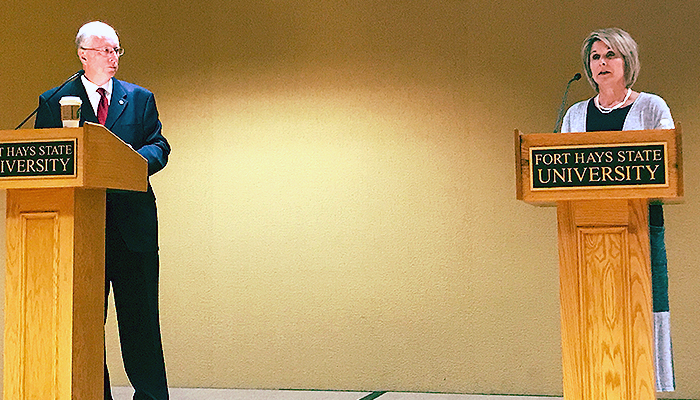
Democrat Eber Phelps and challenger Republican Barbara Wasinger for the 111th District House seat sparred Tuesday night on issues including Medicaid expansion, taxes and education funding.

They debated at the Fort Hays State University Memorial Union in a forum sponsored by the Student Governing Association. Moderators were Jay Steinmetz and Wendy Rohleder-Sook, both assistant professors of political science.

Both Wasinger, a current Ellis Count commissioner, and Phelps, an 18-year veteran in the Kansas House, agreed the biggest challenge the state is facing is the budget.

“We need to stop taking money from KDOT and KPERS,” Wasinger said. “We need to start repayment on that. We need to stop speculative spending and start living within the actual revenue figures the state has. A common-sense approach to spending taxpayers dollars is always important, and more government isn’t always the answer.”

Phelps said everything revolves around the budget.

“Because without the money, you are not going to be able to fund programs or agencies or whatever the case may be,” he said. “We got back on track and had some fiscal responsibility restored in Topeka. So as we enter this 2019 session, obviously the focus is on the budget. We need to again practice the fiscal responsibility that we did in the last two years and also keep up with our funding of schools.”

The candidates were asked about how they would promote economic development in the state.

Gov. Sam Brownback tried to enhance economic development through his tax plan, but Phelps said it had the opposite effect.

“I look at funding education as economic development,” he said.

He noted many people in the city of Hays are employed by K-12 as well as post-secondary education, including FHSU, NCK Tech and Hays Academy of Hair Design.

“That is 2,500 people who are being paid wages, they are paying taxes, they are buying homes, they are buying cars and so forth. That really adds to our economic development in the community,” Phelps said.

He also supported Medicaid expansion and investment in agriculture and ag research, specifically noting the K-State ag research facility in Hays, as means of economic development.

Wasinger said northwest Kansas has a very low unemployment rate and needs to look at workforce issues. This includes housing as well as quality of life issues.

“We need to think outside of the box to solve these problems, just as Osborne has done as they built houses for companies coming into Osborne with the help of grants, local businesses and banks,” she said.

“We need to keep from putting on any new taxes on individuals and remove some burdensome regulations from small businesses to make it easier for them to get into the marketplace.”

When asked about Medicaid expansion, Wasinger said she thought the KanCare system should be fixed, but noted expanding Medicaid would be costly — about $56 million to add 150,000 people, assuming the federal government continues to reimburse at 90 percent.

“Work requirements would also be essential to any expansion and would ease the unemployment issues in the state,” she said.

Phelps noted he voted in favor of Medicaid expansion in the Legislature in the past, including in 2017, when an expansion bill passed in both houses, but was vetoed by Gov. Brownback.

By not expanding Medicaid, the state has forfeited $2.9 billion. He said the state probably would not have had the education lawsuit or other budget problems had it accepted the Medicaid money.

Phelps said he doubted the negative rhetoric about expansion. Thirty-four states have expanded the Medicaid program. He gave Michigan as an example of a state that was able to come up with the 10 percent to pay for the state share.

“I don’t buy into the fact that we can’t sustain it because it is too expensive,” he said.

When asked about education, Phelps said Kansas had some of the best test scores in the nation in 2009 before funding cuts were initiated. By repealing the Brownback tax cuts, the Legislature was able to reinvest in education and send an additional $525 million to schools over the next five years. As revenue continues to be above expectations, the additional dollars required by the Supreme Court should be able to be added.

However, he said work still needs to be done.

Kansas teachers are No. 40 of the 50 states for pay.

“We are now, I think, in a position right now we can start attracting those young people to stay here and teach,” he said.

Wasinger said it is vital to show the additional funding goes to classrooms and teacher salaries.

“Shawnee raised its administrators’ salaries by 13 percent. Russell built a $1.5 million sports complex,” she said. “I would like to see more accountability for additional funding. If adequate means raising reading comprehension, test scores and teacher salaries, I’m in.”

A member of the audience submitted a question on transportation.

Phelps said now that the state has revenue flowing again, transportation can be funded again.

“That was one of my suggestions for economic development in our state,” he said. “Instead of borrowing money from the comprehensive plan, actually build things and put people to work.”

Wasinger said she would vote to stop taking money out of KPERS and KDOT for the general fund.

“The first job of a government is to provide security and safety for their resident and take care of their residents. You can’t get a police officer to a person’s house or anywhere or fire truck if the roads aren’t good,” she said.

Wasinger and Phelps were both asked about term limits. Wasinger said she thought they are absolutely necessary. Phelps said it is up to the people to set term limits for their elected officials through their votes.

“Politicians being there too long is a little like leftovers,” she said. “Sometimes it is time to get them changed and clean them out.”

Phelps said, “We have term limits. It is called an election. I stand before the people in this district every two years and let them make the decision. All over the state, we have legislators doing that, and we have Congressmen doing that — standing before the people.

“I am very proud of my record. I have nothing to hide. I am not ashamed that I am in my 18th year in the Legislature. I feel these last two years we made some great progress.”

The candidates were asked what they thought of gubernatorial candidate Kris Kobach’s idea to decrease taxes if he is elected to office.

Phelps said he did not agree with that plan.

“The Secretary of State if elected wants to go back and do an identical plan that Gov. Brownback had. We have all seen how disastrous that was. You have no idea how close the state was to bankruptcy. We saw two or three bond downgrades. The debt was doubled. We cut education. We cut higher education.”

He said he favored cutting taxes on food. Kansas has one of the highest tax rates on food in the nation.

“That is a tax cut that I believe would affect everyone in this room and everyone in this district and everyone in this state as opposed to doing a similar thing that Gov. Brownback did, which benefited a few and harmed many,” Phelps said.

Wasinger said, “I don’t support anything being done with taxes at this time, certainly not raising new taxes. I think the biggest thing we need to concentrate on is the regulations we impose on businesses that make it less attractive to locate in Kansas. I think that is where we need to be concentrating.”

ECC Oak Park project moving forward

USD 489 board members approved financing and a lease/purchase resolution for the ECC project Monday.

By BECKY KISER
Hays Post

The Hays USD 489 school board voted Monday night in special session to move forward with financing and a lease-purchase resolution for the Oak Park Medical Complex.

The building at 2501 E. 13th would be renovated for the Early Childhood Connections and Head Start programs currently housed in the former Washington and Munjor schools.

Superintendent John Thissen said he was “pleased” with the four local bids.

“It was nice to get the bid The Bank of Hays has provided, which was 3.49 (percent). We were identifying the best way to handle it was semi-annual payments. But it’d be about $216,000 is what would be spent a year,” Thissen explained.

The total amount financed by the low bid would be $2,159,478.68 over 10 years.

The lease-purchase resolution must be published in the newspaper for two weeks and then allows for a 30-day protest period, which could lead to a public vote.

According to Thissen, the five owners in the medical complex have already signed contracts to lease the building.

Board members Greg Schwartz and Sophia Rose Young voted against the financing; Schwartz also voted against the lease-purchase resolution citing concerns about where the building purchase that would serve just 150 students fits into a long-range facilities plan.

Board member Lance Bickle was absent.

Last week school the board voted to accept a $1.473 million federal grant which can only be used for the ECC Oak Park project.

Copyright Eagle Radio | FCC Public Files | EEO Public File