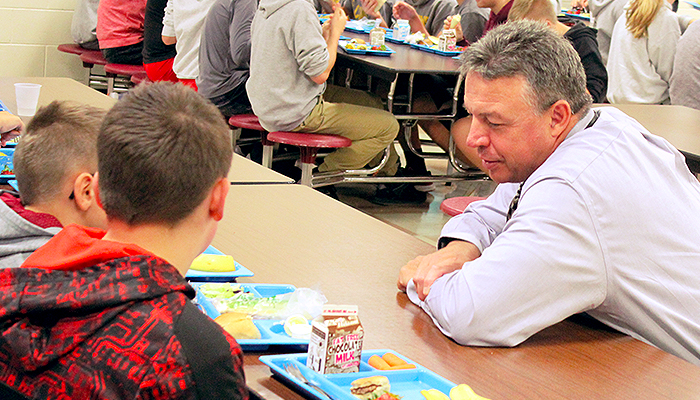
HMS Principal Tom Albers leans in to talk to students on Monday. He said relationships are important in his new role as principal at the middle school.
By CRISTINA JANNEY Hays Post
Tom Albers became a teacher because of the relationships he built in high school sitting around the local convenience store, drinking pops and talking with his friends
“We had 17 senior boys. We weren’t always together. When we were, that wasn’t always the best thing. It wasn’t bad, but we were ornery,” Albers laughed. “You always had someone you could hang out with. The good news is that you didn’t have video games, so you were always doing things together.”
After 16 years as an assistant principal at Hays High School, Albers took over as at Hays Middle School. He replaces longtime HMS Principal Craig Pallister, who retired in the spring.
He said he wants to bring that feeling of belonging he felt as a senior in high school to his new students at Hays Middle School.
“My reason for being a teacher was that I loved high school so much. I loved the whole part of it,” he said. “I want to be part of that. I want to be part of that experience, and I want kids to have that experience that they just love being in school. I guess the reason I did [become a teacher] is that I didn’t want to let go of that feeling or memory.”
Albers, a Fort Hays State University grad, is in his 31st year as an educator. He spent 13 years in Pratt as a high school math teacher and coach and a year at Pittsburg High School as an assistant principal, before taking the assistant principal job in Hays to be closer to family.
Albers tries to bring that feeling of togetherness to his role as an administrator.
HMS Principal Tom Albers talks to students during lunch on Monday.
“It is important to know that people care. If they see me right off the bat in the morning, and they see that I am excited, maybe that brings excitement to them.”
He said he tries to show his staff he cares as well.
“I try to show our staff that they are very, very important. I am a servant to them, and I care about them. Hopefully, that translates to them doing the same thing to our students. I see that. We have a very caring staff.”
HMS and HHS are very fortunate to have a quality teacher pool and that is reflected in the education and school experience the students receive, he said.
“Kids need to come to school, knowing its a place for them, regardless what they do. It’s not just athletics. There is something for every kid we want them to be part of,” Albers said. “Music is important. Art is important. For us here, robotics is important. It doesn’t matter what it is, we just want kids to [feel like they belong].
“I have told some kids, it is just that they are a part of something. They may just be watching a ballgame, but they get to be in that HMS community and have the feeling of need and the feeling of being part of something.
“We want them here and to be excited. That is what my mission is. I want kids to come to school and say, ‘Man, I love being at school.’ That is not always easy to do anymore with everything that is out there distraction wise.”
Being a part of something bigger than themselves can help protect children from some of the many dangers they face in the world today, such as drugs, alcohol and predators, Albers said. Part of the growing process from sixth to eighth grade is helping the students learn to make positive decisions for themselves.
He said seeing kids grow is still his favorite aspect of being an educator.
“I think if you would ask any educator, it would be the relationship with the kids, seeing the kids grow, seeing the ah-ha moments,” he said. “For me it is also the staff, making connection with the staff, watching them grow and how they nurture our school. We are only as good as our staff.”
The rise of social media has created new challenges for educators and parents, said Albers who has five children ranging in age from a fourth-grader to a 24-year-old. He said he is not sure the kids today are having the face-to-face interactions he did with his high school friends, because they are interacting through social media.
“I don’t see a difference in kids, but I see a difference in what they have been exposed to and what they have to bring to the table,” he said.
With children in all three levels of Hays schools, Albers is kept busy with family obligations.
“I see all three levels and how it works together,” he said.
Albers said he is still learning the HMS system after spending so many years at HHS, but he said the staff at the middle school has been very helpful.
Albers has reached out to other parents at HMS and is seeking their input on how to make improvements.
“I always want us to grow, and find ways to make us better,” he said.
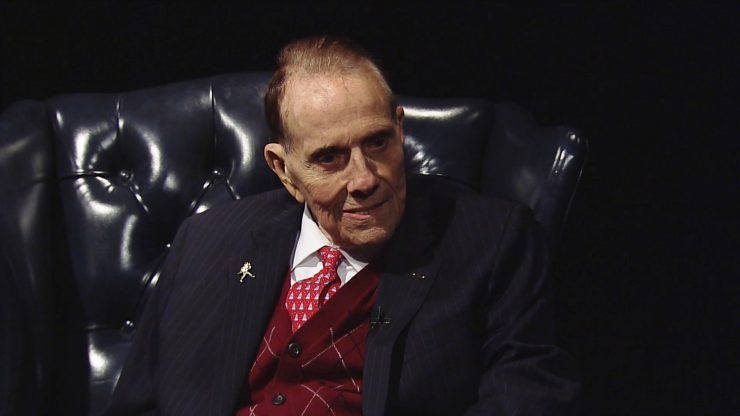
Former U.S. Sen. Bob Dole (R-Russell, KS) (Courtesy KTWU)
By BECKY KISER Hays Post
“Washburn provided me with a firm foundation to set my sights on great things. For my generation, which had won a war then create a better future back home, Washburn gave us that new start through education.”
That’s the quote on a plaque adorning the new bronze statue celebrating the lifetime achievements of Senator Bob Dole that was unveiled Friday, Sept. 28, at Washburn University in Topeka, where the Russell native earned two degrees after serving in World War II.
Dole developed a worldwide reputation for public service, holding elected positions in the Kansas House of Representatives, as Russell County attorney, and as U.S. congressman before spending nearly 30 years as U.S. senator.
In an interview with KTWU-TV, the 95-year-old said he wishes more young people would get politically involved. “Whether they’re Democrats, Republicans, Independent, I wish they would take an interest in what’s happening.”
Dole also sees a need for more bipartisanship in today’s Congress.
“We could certainly use some bipartisanship in the United States Senate now. About all they do is scream at each other and as a result they don’t get lot done,” Dole concluded.
“When I was the Republican leader (of the Senate), we had a good group of Republicans. I had many friends on the Democratic side and so we were able to get things done.
“We need to find some way the Democrats and the Republicans today can sit down together and work out a compromise. You can’t compromise everything but most everything you can,” said Dole.
In his long career of public service, Dole says one of his most remarkable memories is “rescuing Society Security.”
“I worked with Senator Patrick Patrick Moynihan, a Democrat (from New York) and we were able to in fact rescue Society Security.”
Dole also notes his leadership in the Americans with Disabilities Act (ADA) which became law in 1990. As a wounded World War II veteran who never fully regained use of his right arm, Dole was an advocate for the disabled throughout his career and a major supporter of ADA.
Dole, 95, says he’s surprised he’s lived so long.
“I’ve had a great life. I’ve had a few bumps in the road, but overall, I can’t complain. Never did complain.”
Asked for advice for today’s young Americans, Dole acknowledged “it’s tough when you’re in your early 20s. But my view was if you study hard and get your education, then you’re on your way to probably a better life.
“I’m a proud Kansan and I want to thank Kansans for all the support they gave me for the 36 years I was in Congress, and Washburn. They really gave me a life.”
Dole and KHP Trooper Tod (Courtesy Trooper Tod)
Dole and his wife Elizabeth were in Russell Saturday evening for dinner with family and friends.
They were escorted by Kansas Highway Patrol Technical Trooper Tod Hileman of Hays.
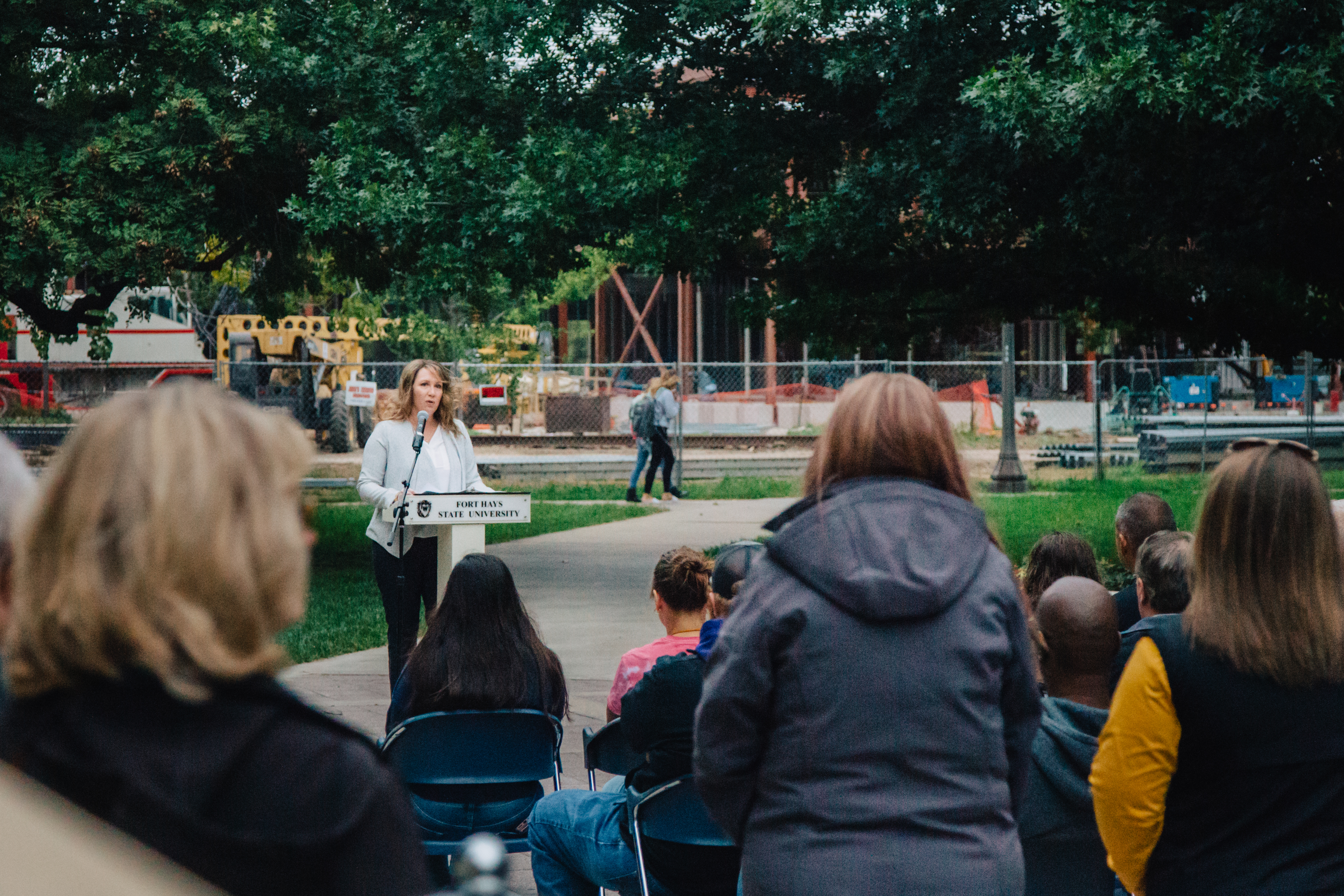
Karrie Simpson Voth, chair of the Department of Art and Design at Fort Hays State University, speaks to a crowd of people gathered Friday morning for a construction preview of the new art and design building. PHOTO by Kelsey Stremel
By DIANE GASPER-O’BRIEN FHSU University Relations and Marketing
Karrie Simpson Voth has been dreaming for 15 years of watching students create and learn in a new, state-of-the-art space.
The reality is unfolding right before her very eyes is sometimes hard to grasp.
“I’m hopefully optimistic, and I kept telling Dr. (Paul) Faber it’s going to happen,” said Simpson Voth, chair of the art and design department at Fort Hays State University. “Now I can see it, and I enjoy looking at it every day. It’s like Christmas in September.”
On a breezy, chilly morning Friday, Simpson Voth got her first chance to publicly show off the new art and design building going up on the site of the former Davis Hall.
With the noise from construction equipment behind them, Simpson Voth joined an art and design student and FHSU President Tisa Mason in speaking on the northeast patio of the Memorial Union at a preview of the new building – part of the activities of Homecoming 2018.
Construction on the two-story, 43,000-square-foot facility began last summer and is scheduled for completion in summer 2019, in time for the 2019-20 school year. The facility will be home to all Department of Art and Design programs, with the exception of the sculpture program, which is housed in the CAT.
The building features two separate sections thats are connected by a two-story commons area that will allow students to gather outside the classroom for “collaboration, study sessions and brainstorming,” Simpson Voth said. An 1,800-square-foot addition will provide space for storage and art collections.
The art and design department currently is housed in cramped quarters in Rarick Hall.
MaKinlie Hennes, a senior graphic design student from Downs, said she is excited for the opportunities the new facility will offer students. She will graduate in May and won’t get the opportunity to study, work and create in the new building. However, she said the new space will just be an extension to an already excellent department.
“If there is one thing that I hope to accomplish before I graduate, it would be to bring awareness to this amazing department,” she said, “and to educate others on how this university, these professors and the graphic design program changed my life.”
Hennes said she will be forever grateful for the support system she has received at Fort Hays State, and she knows that the environment created on first floor Rarick Hall – the current home of the Art and Design department – will be carried on to the new building.
“The new space will unite classes, create greater opportunities for collaboration among the arts and provide students with advantages that previous classes never received,” Hennes said.
“This new building will have state of the art facilities that will take creation to a whole new level.”
The facility will provide numerous lab spaces for the various art and design programs as well as department office space, a multi-purpose lab, computers, classrooms, woodshed, studios, commons area and a ceramics kiln yard.
A major theme throughout the building is glass.
“With this new design, we are breaking out of the traditional four walls and surrounding ourselves with glass, which will allow art and color to spill into the hallways and natural light into our classroom,” said Simpson Voth, in her 20th year at Fort Hays State. “This new building is going to take what we do as artists, designers, students, faculty and programs to a whole new level of excellence.”
Mason agreed that surroundings can make a difference in the quality of learning.
“It is well documented that place matters,” she said. “There is a strong connection between students’ quality of effort and the quality of facilities and opportunities that make that effort worthwhile. Indeed, this new building creates spaces for engagement and learning – spaces that honor our mission and propel us forward in preparing our students to succeed as educators, leaders and artists.”
The new building will connect to the 5,000-square-foot former power plant, which will be renovated to provide gallery space. It will be named the Moss-Thorns Gallery in honor of former department chairs Joel Moss and John Thorns.
“At the heart of everything is people,” Mason said. “We cannot adequately celebrate this day without expressing our deep gratitude to all those who have built both the program and the buildings – old and new.”
Simpson Voth said that “every day, the first floor of Rarick Hall is alive and buzzing with creativity, innovation and inspiration,” and those same positive characteristics will be carried to the new building.
“Our future home is a place where dreams will come alive, grow and develop,” Simpson Voth said, “and will eventually go out into the world, carrying the name of Fort Hays State University with them wherever they land.”
“That is what I call success,” she said. “This new building is going to be a game changer.”
There are numerous naming opportunities for the new art and design facility. Mason thanked Joseph and Jodi Boeckner, Nate and Sara Meder, and Dolores Borgstadter as the first donors to name spaces in the new building. Donations for those spaces are part of the Journey Campaign through the FHSU Foundation, which can be contacted at 785-628-5620 or [email protected].
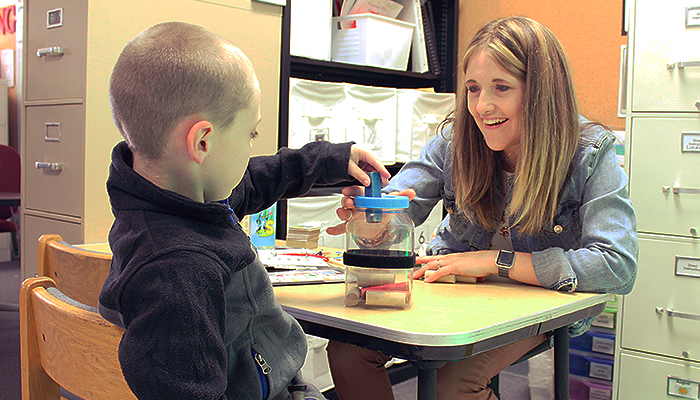
Lindy McDaniel, special education student, helps kindergartener Ryder McCormick with a lesson.
By CRISTINA JANNEY Hays Post
When teacher Lindy McDaniel brought the STAR program to Roosevelt Elementary School two years ago, she created a new family for her special education students.
She did not know at that time this tight-knit group of students, teachers, paras and parents would be struck with tragedy so soon.
Last year, a second-grader in the program, Kaylee, died unexpectedly. McDaniel said some of the children in the STAR program have fragile health, but it was a blow to all the children and adults who knew the student.
Danielle Scott, the girl’s aunt, said Lindy stepped up to not only comfort her students, but the little girl’s family.
“When my niece passed unexpectedly, she was right there to hug us and the STAR family,” Scott said. “Lindy went above and beyond to give my sister little treasurers from the classroom that Kaylee loved so much.”
McDaniel also included the family in special events for the STAR program.
All the children in the STAR class, as well as the general education second-grade students, painted ceramic stars for a special Christmas tree. McDaniel painted a larger star in Kaylee’s favorite colors. She invited Kaylee’s family to see Kaylee’s tree and the winter wonderland put together by the STAR students.
“Lindy, along with the staff in the STAR room spend countless hours planning and coordinating activities for the STAR students, and I forever have a special place in my heart for the STAR room, students and staff,” Scott said. “The STAR program wouldn’t be what it is without all of the staff, but especially Lindy for the love she shows for every student day in and day out.”
For this reason, Scott nominated McDaniel for Hays Post’s Teacher of the Month award.
When McDaniel heard it had been a member of Kaylee’s family who nominated her for Teacher of the Month, tears filed her eyes. She said the death brought the STAR children, staff and parents together as a family.
“You just want to give them the best they have in the time they are with us,” McDaniel said.
Although she said the death was difficult for all who knew Kaylee, she said she thought it brought out the best in her students.
“I have always thought of our kids knowing more than they could ever communicate because a lot of our kids our nonverbal,” McDaniel said. “And it was so intriguing to me how much they could sense the sadness of their staff and the sadness of the kids in the family. One little friend that is fairly nonverbal when the grandparents came to visit our program a couple days after, she knew immediately to give the grandpa a hug.
“It made me realize and continue to know these kids — they’re smart. They have a lot to offer us, and we can learn a lot from them.”
A memorial was set up in Kaylee’s name, and an equipment shed was donated to STAR in her honor. The STAR children watched the shed being put in by remote video and then helped paint it.
STAR stands for Systematic Teaching with Adaptations and Reinforcement. The teachers in the STAR rooms work to integrate their students into general education classrooms as much as possible. However, they have a safe place to be if they need more support.
The program at Roosevelt has grown from 14 to 34 students in just its third year.
The program encompasses four rooms. The first of which is academic.
The students in the program work at their own pace, and the program takes into account the students may be motivated in varying ways, McDaniel explained. A student who has autism is not going to be motivated by social interactions, such as recess. In fact, social interactions may cause them anxiety. One of the program’s students enjoys animals, so when the student has accomplished his task, they allow him to play with toy puppies.
“Because we have those opportunities for him to be reinforced by things he is interested in, he is going to work that much harder at building those reading skills to get to have time with his puppies or to get to have that music time for other kids,” McDaniel said.
The program has a social skills room that is more play based. The STAR program serves children pre-K through fifth-grade, but some of the students are developmentally pre-school age or toddlers. Play-based learning includes stations such as art or blocks.
A third room addresses life skills. This includes family-style lunch for children who need it. They can work on language skills, such as asking for more to eat, or motor skills, such as holding utensils.
The last room is STAR community, and each student has his or her own desk. They work in this room at in-seat desk behavior and other skills they would use in a general education classroom.
“I love getting to see that child who maybe wasn’t successful in a general setting get the interventions and supports they need to become successful. Getting that really close relationship with families to provide that to our kids is pretty awesome. In a general ed situation, you don’t necessarily get to know your families on this scale of how close we are in this program.”
McDaniel shows compassion to all the students at Roosevelt. During the Hays Post interview, she stopped for a moment to comfort a student who was upset. The girl began to cry, so she gently guided her to her mother, a fellow staff member.
She stopped on another day to comfort a young boy in the STAR program who was upset. She talked to him softly, encouraged him, and let him pick some lotion to smell and rub on his hands to calm and sooth him. The tears faded quickly, and he went on to his next assignment.
McDaniel, 37, has been teaching for 15 years. She took some time away from USD 489, where she started her career, to work for State Department to support children with autism and other disabilities. During that time she was exposed to different learning models, including STAR.
She decided the travel for that job was resulting in too much time away from her family. When she came back to the Hays district, an opportunity opened up in special education. She eventually was able to pitch STAR to district administrators.
The program has been highly successful and even garnered a visit from Kansas Education Commissioner Randy Watson.
McDaniel, a Quinter native and FHSU grad, said she would like to see the STAR program used across buildings in the district. She said using adaptations and reinforcement does not have to be reserved for students who have significant challenges.
“The commissioner of education came to visit our program last year, and his vision for the state of Kansas is that all kids can,” she said. “All kids should be a part of something bigger than themselves and get to learn with others in a way that suits them.
“If we have students that want to be teachers, they can come in and help teach our STAR kids or just different ways to help every kid feel a part of the building and feel like they have something to offer to a bigger community than just their classroom or themselves.”
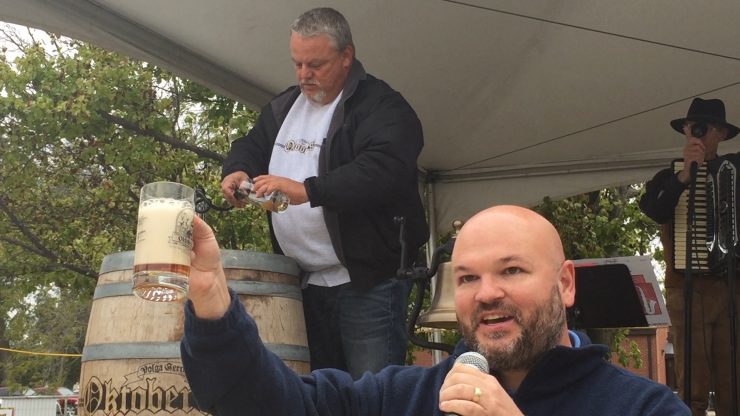
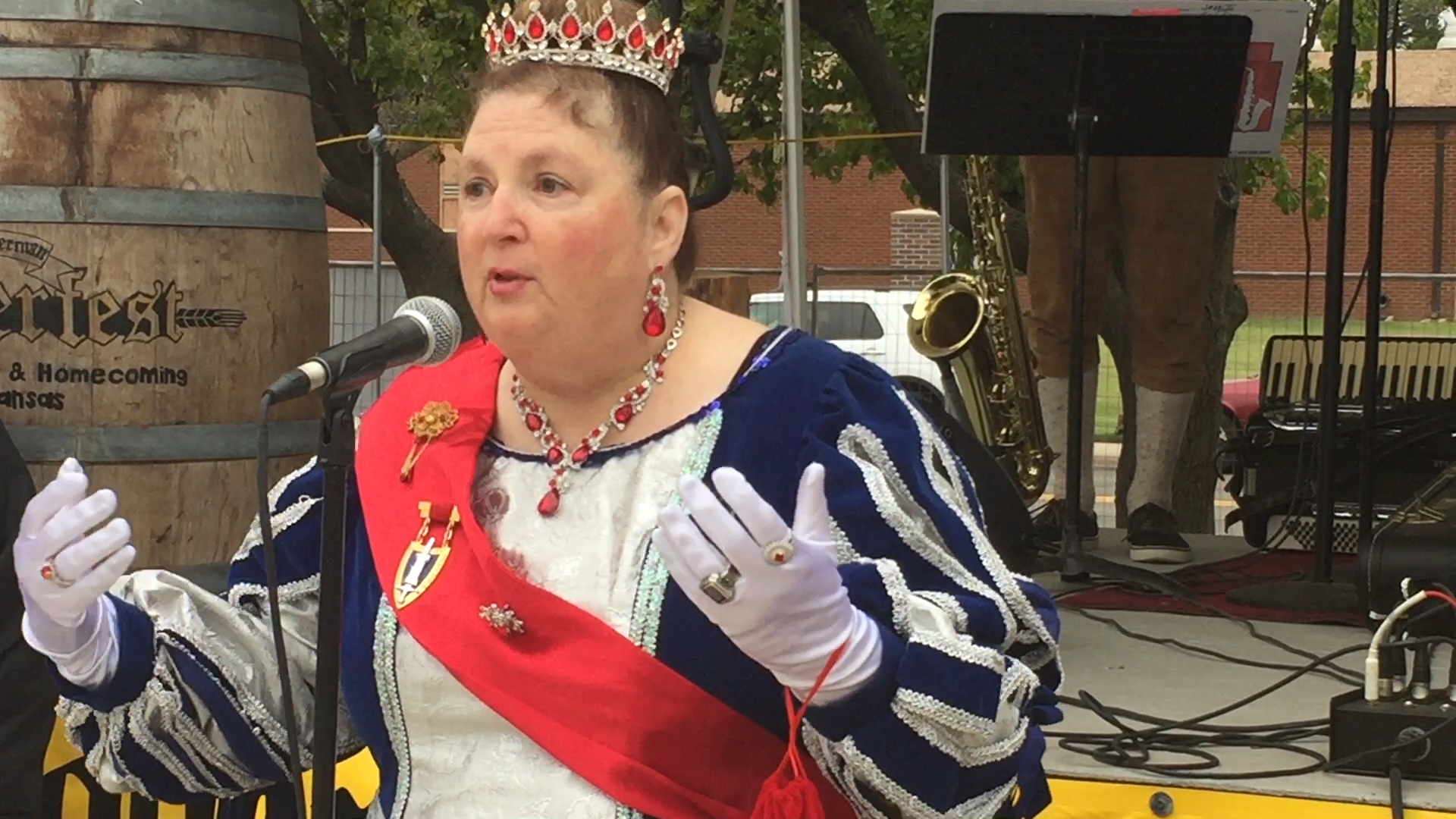
Hays Mayor James Meier toasts the Oktoberfest 2018 crowd late Friday morning.
By BECKY KISER Hays Post
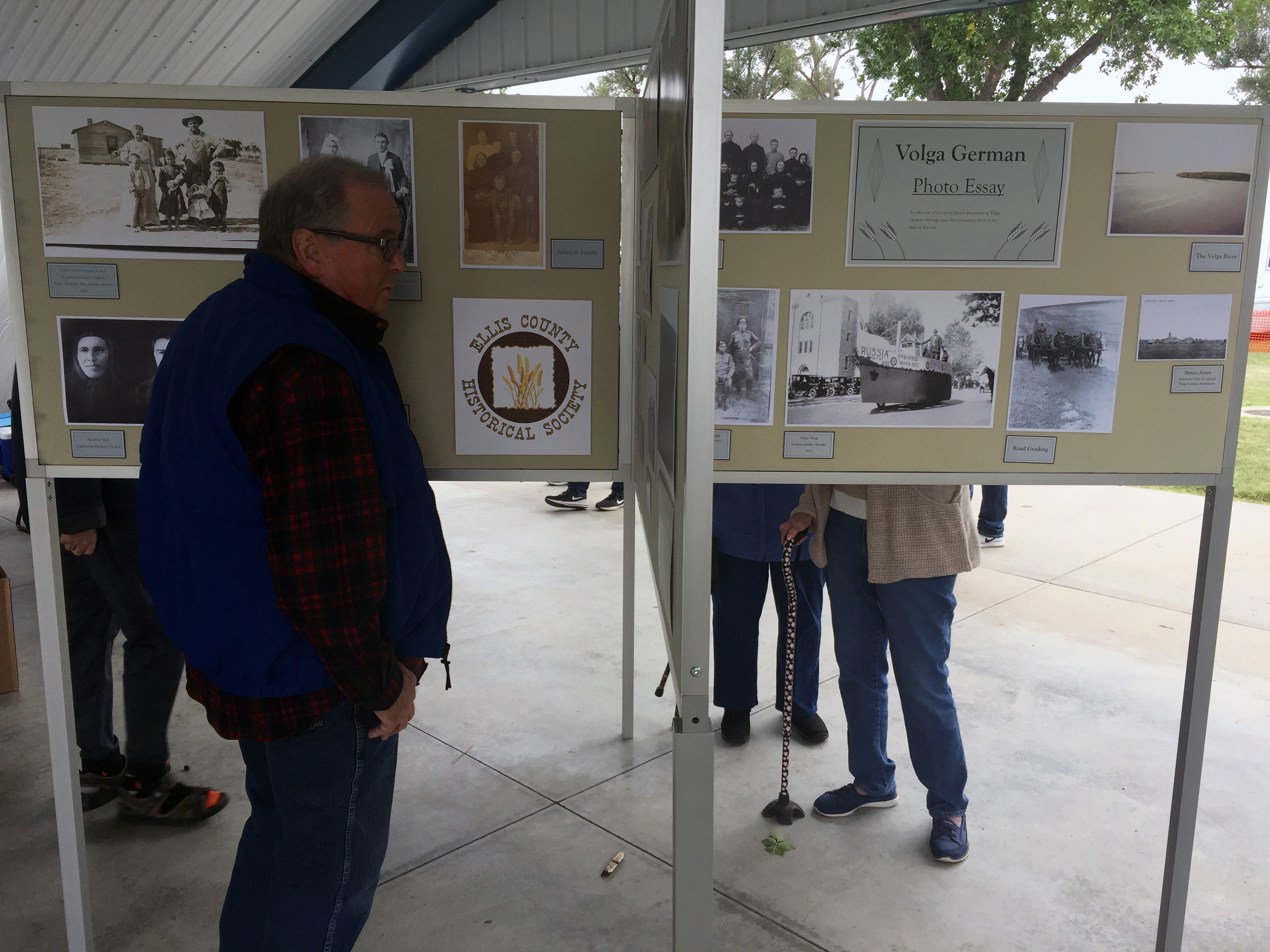
The Volga German Society of Ellis County and Rush County, the Sunflower Chapter of the American Historical Society of Germans from Russia, and the Ellis County Historical Society welcomed revelers to the 2018 Hays Oktoberfest on a cool Friday.
The weather forecast called for an overcast sky with the temperature to reach only to the low 50s. Preparations in Municipal Park for the 46th annual event were done under much warmer conditions and a sunny sky as Thursday’s high was 83 degrees.
In greeting the crowd, Ellis County Commissioner Dean Haselhorst, who was attending his 36th Oktoberfest, said “I don’t think the weather is ever the same from one year to the next. I can remember a 100 degree temperature day with a dust storm to the south of us, and one year it was 20 degrees with blowing snow, drizzle and freezing rain.”
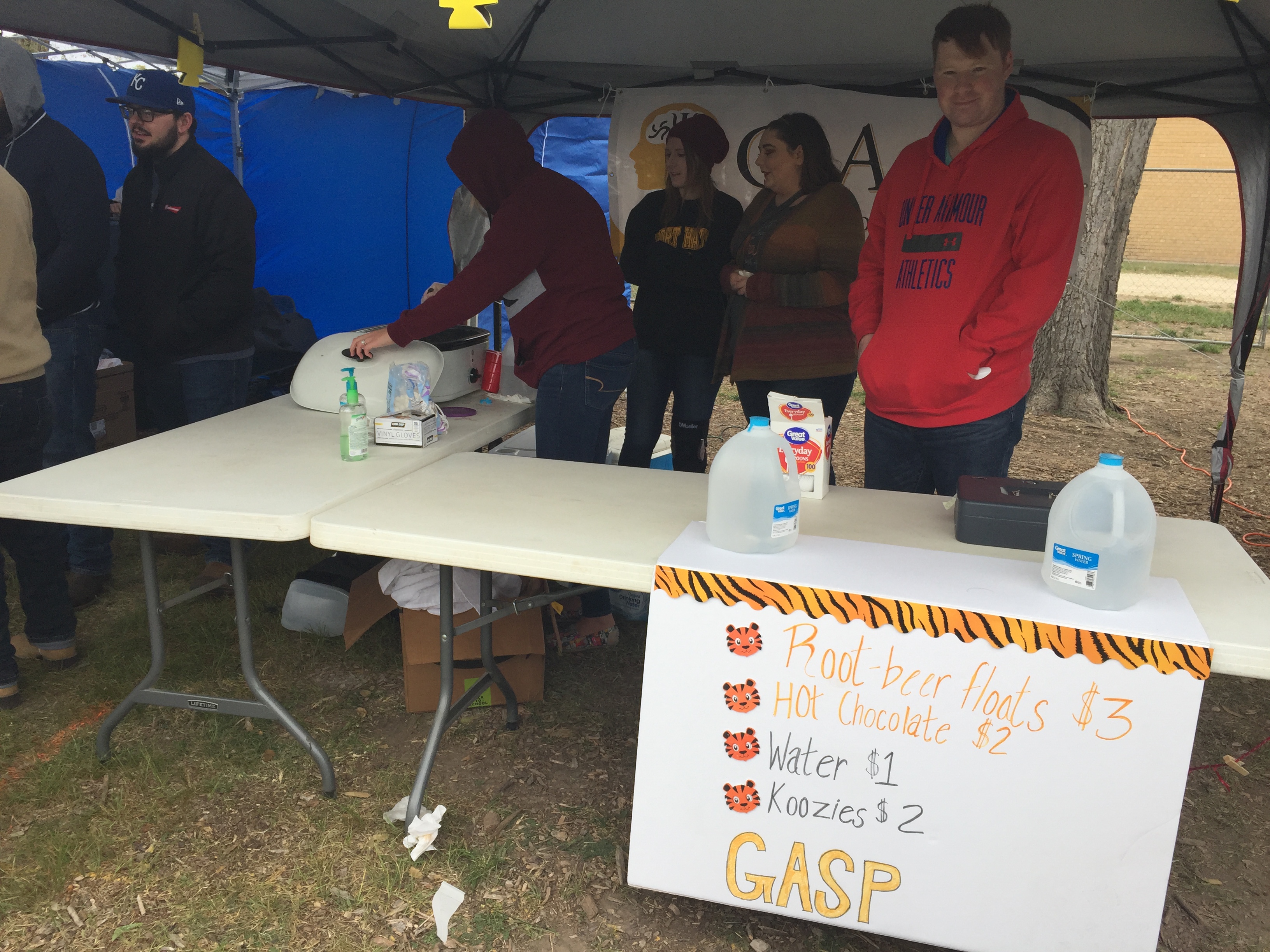
FHSU GASP students sold more hot chocolate than root beer floats.
The hot chocolate was selling much faster than the root beer floats, according to the Fort Hays State University students manning the booth for the Graduate Association of Students in Psychology.
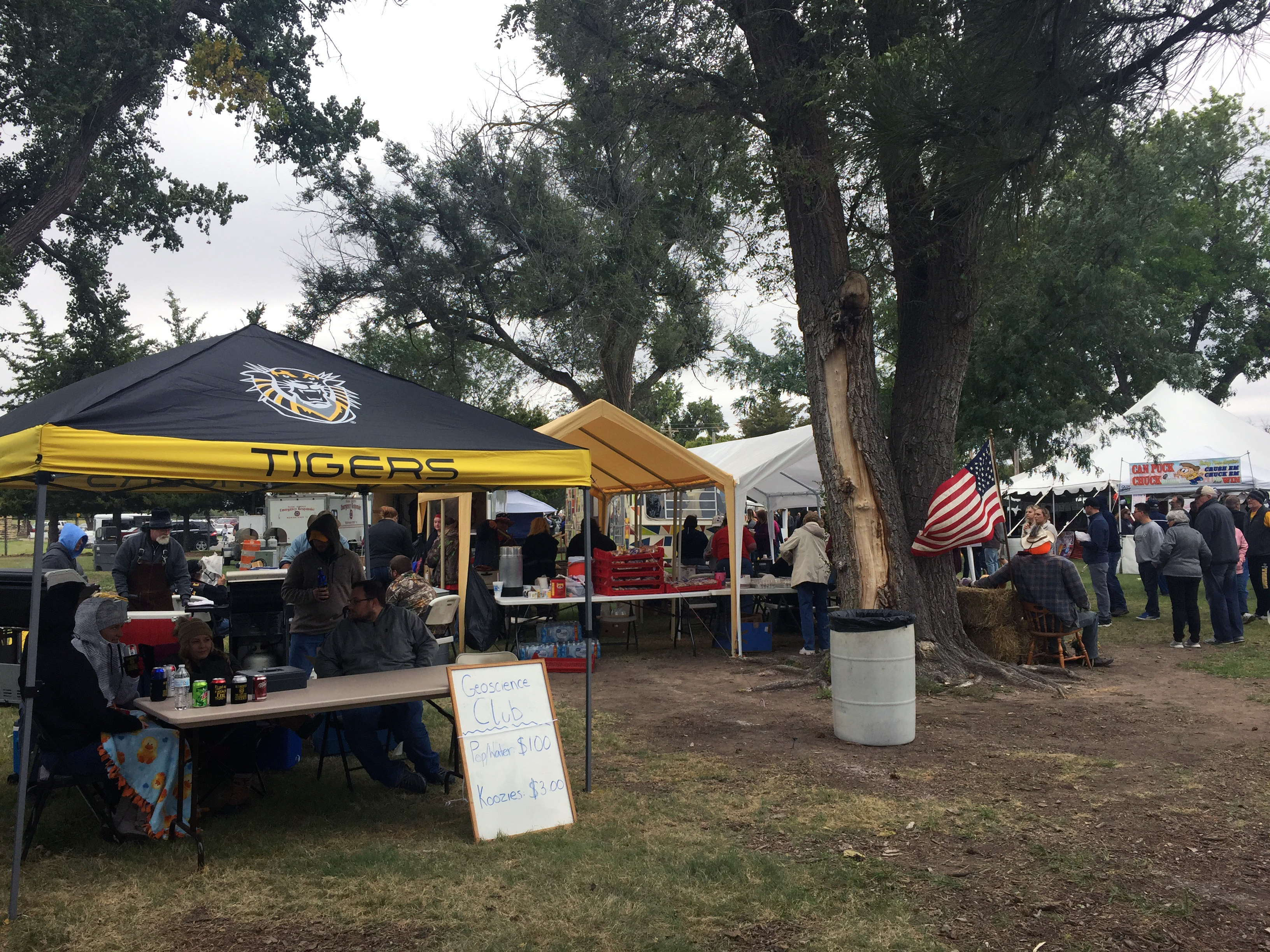
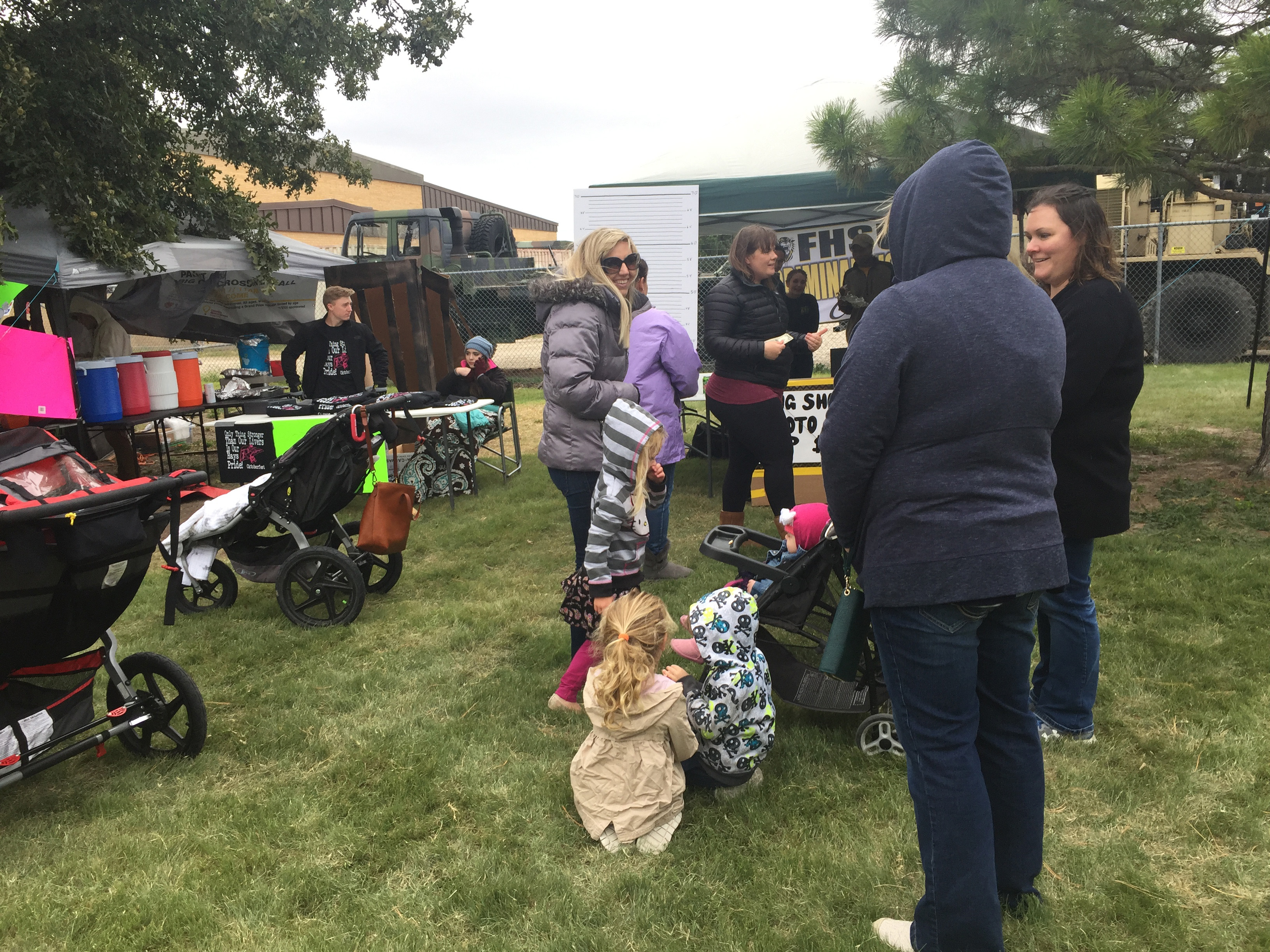
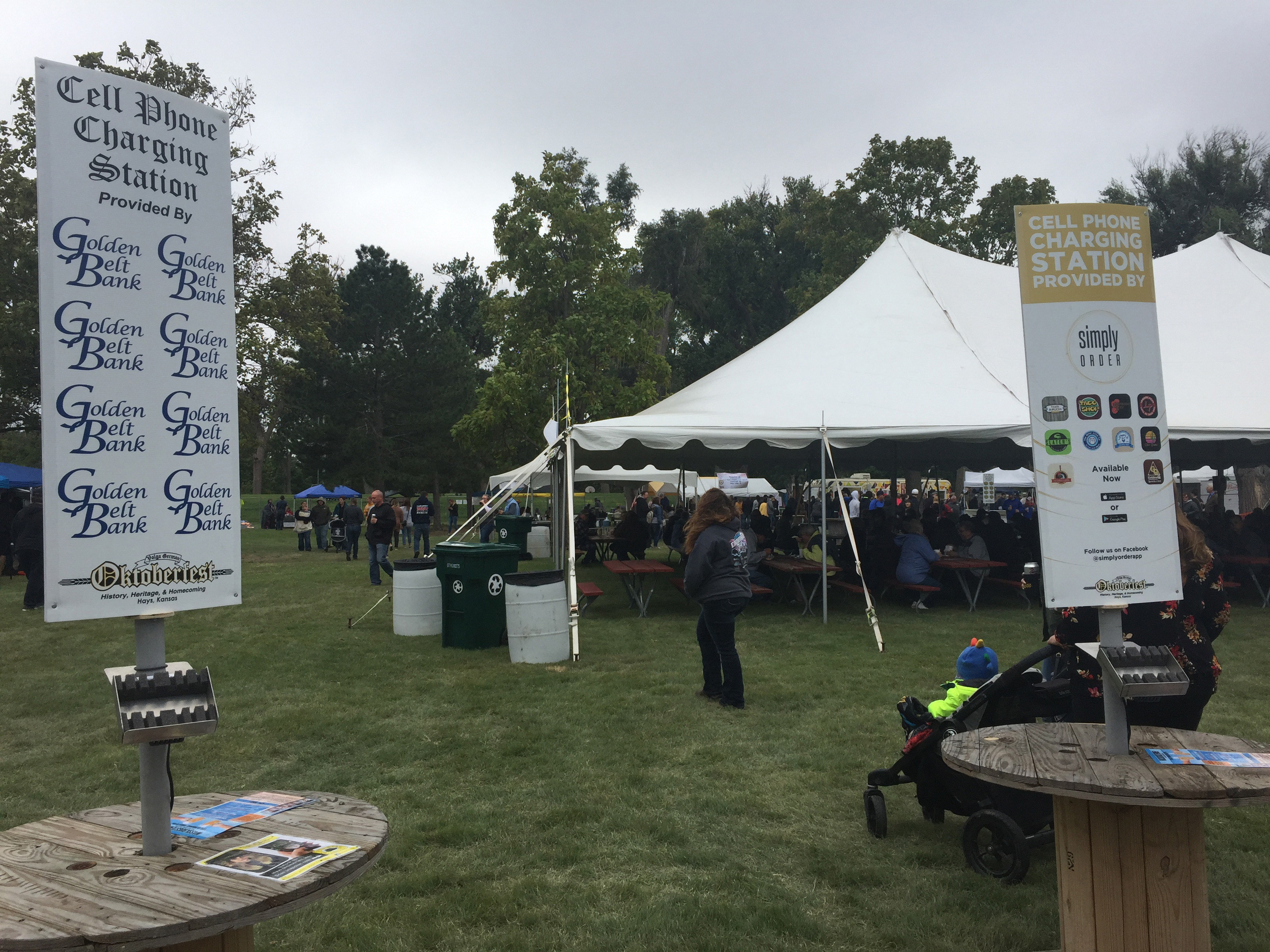
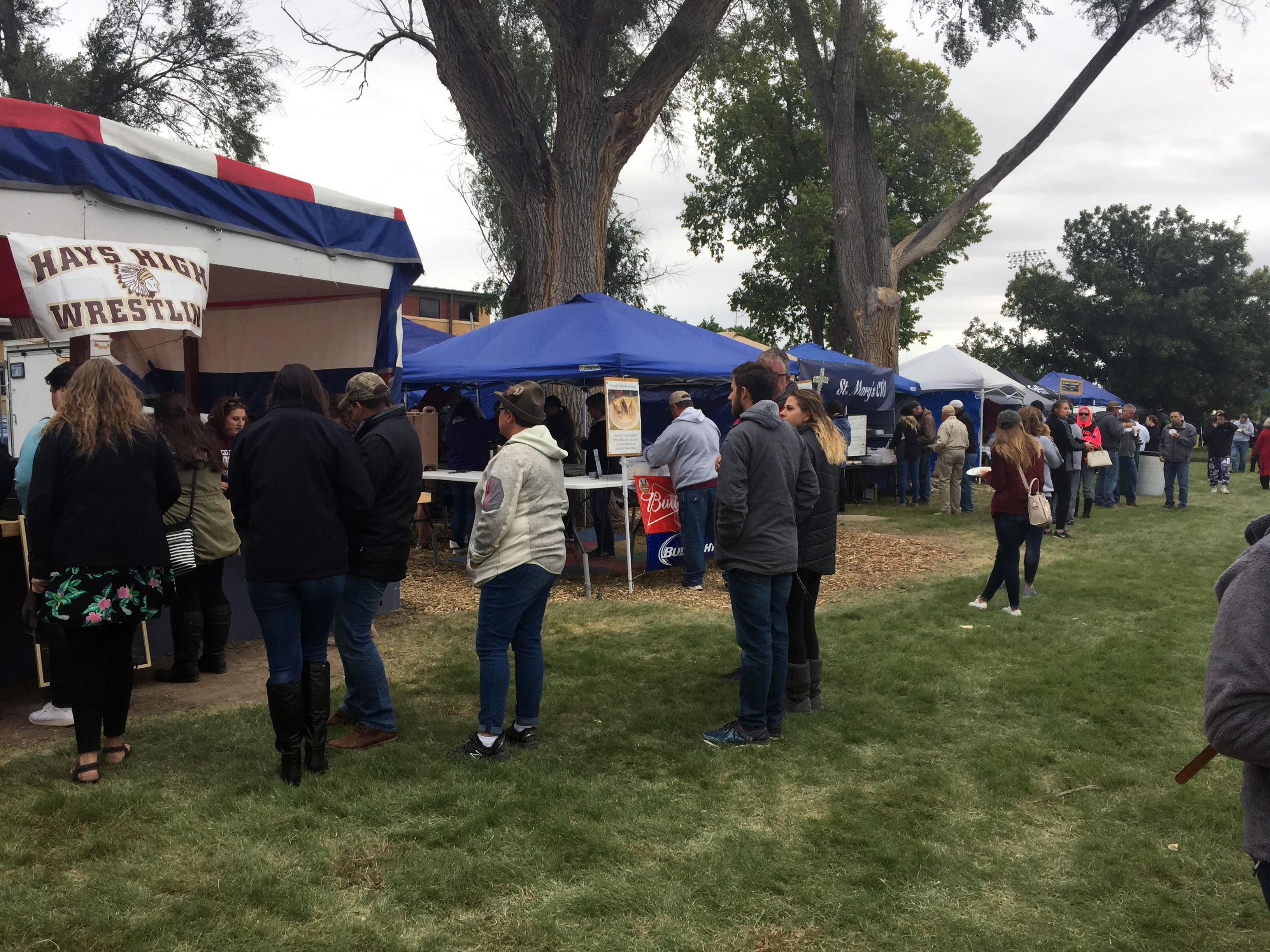
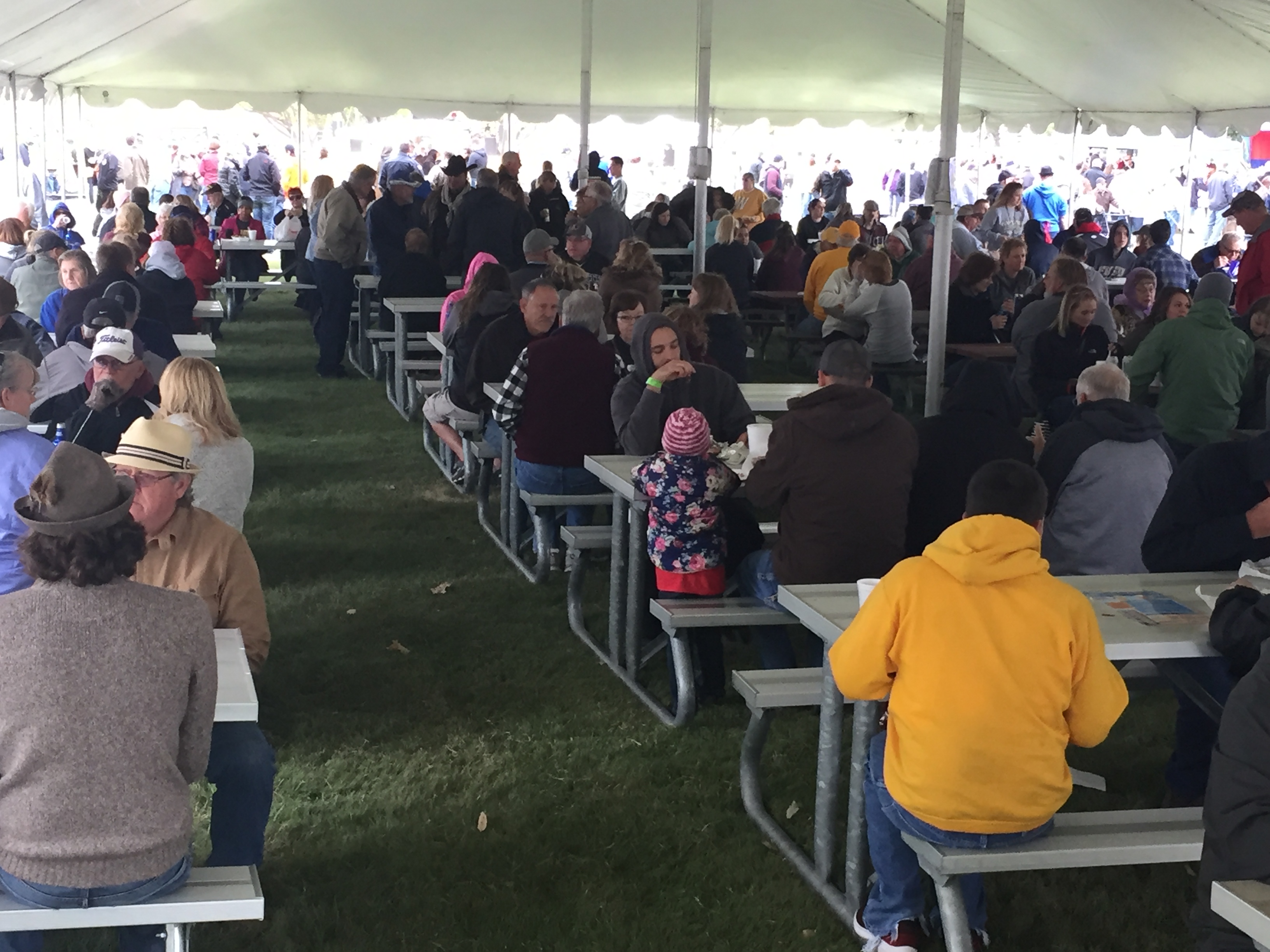
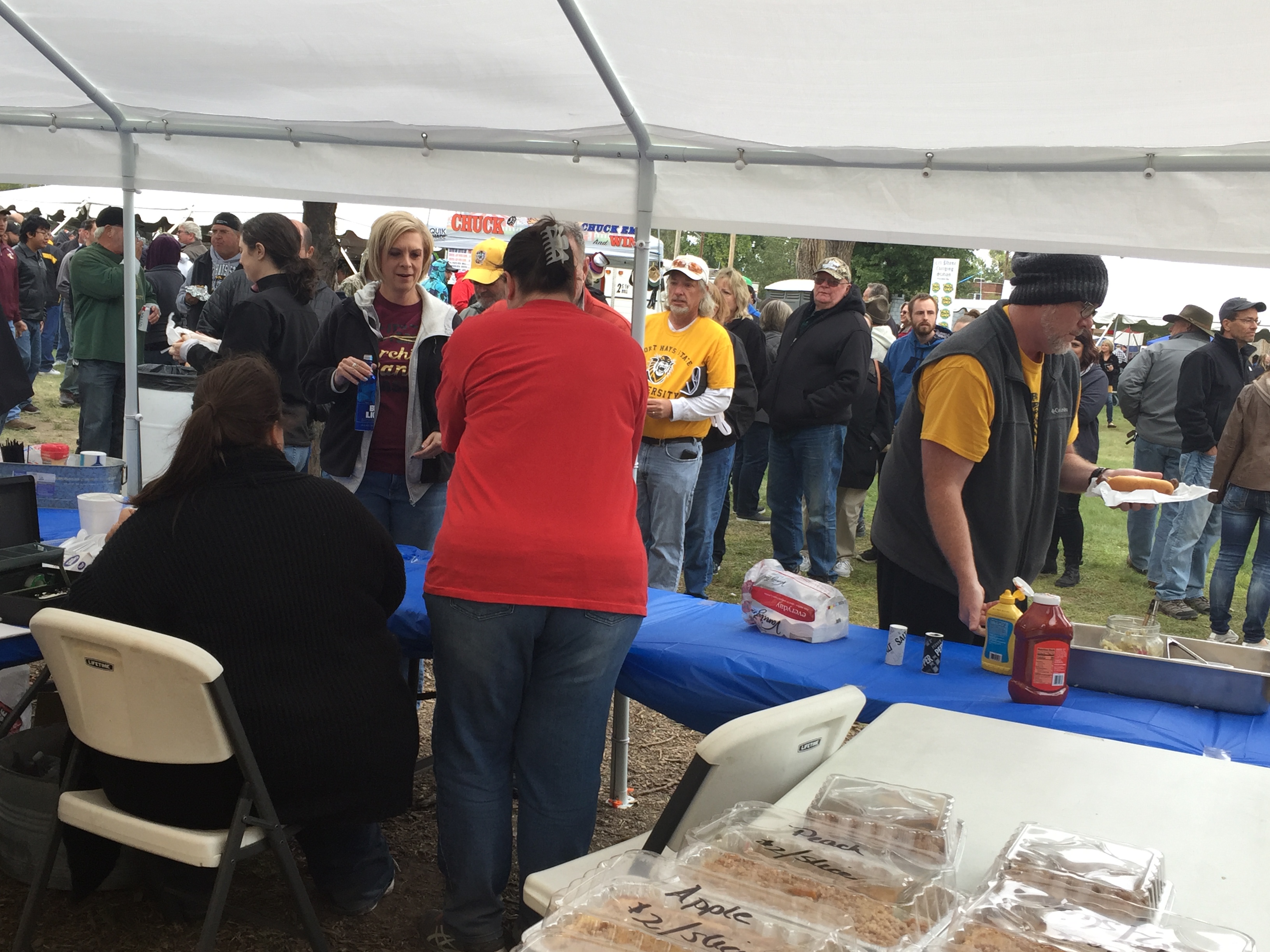
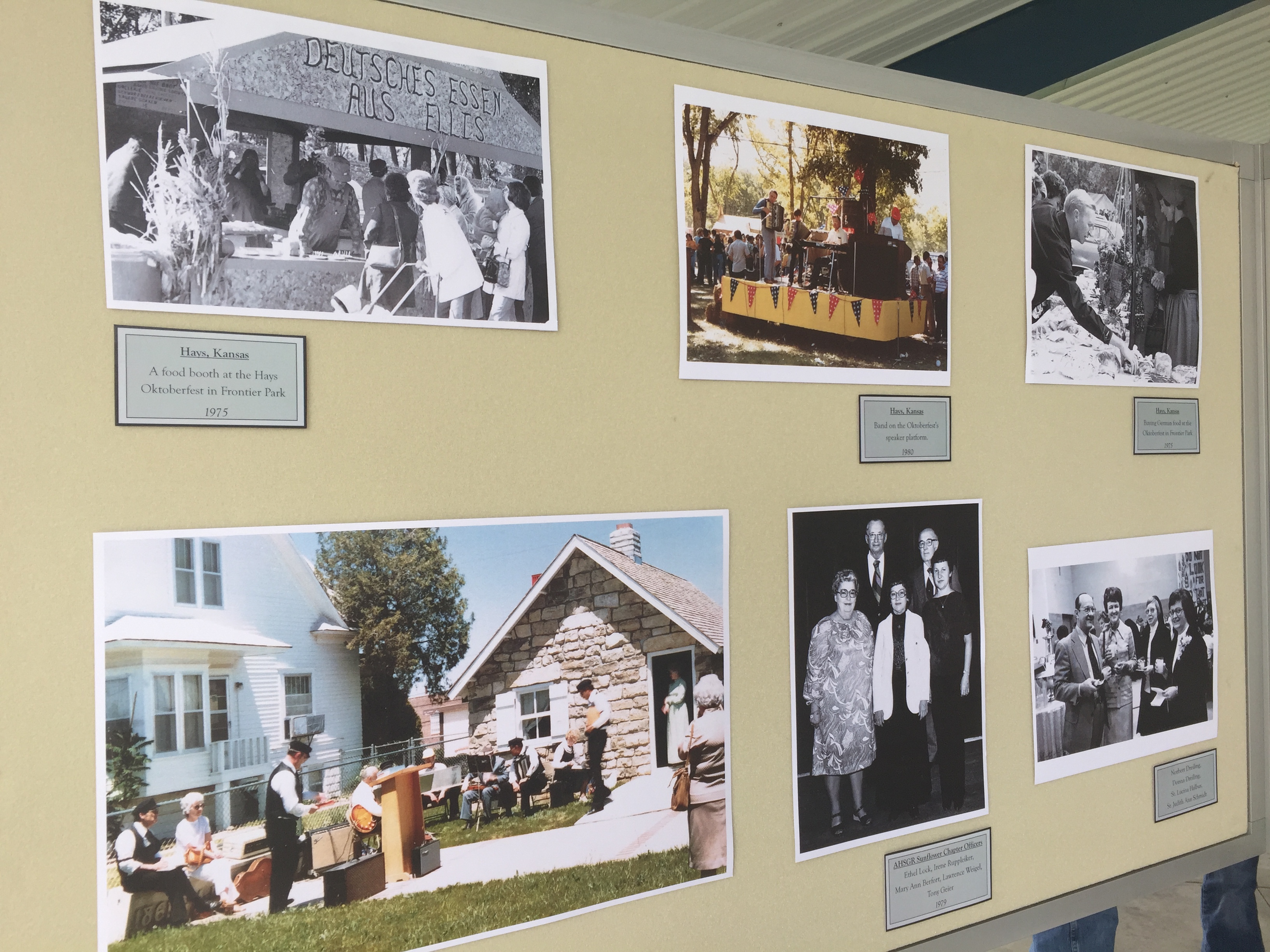
Thirty FHSU organizations and 19 community groups, filled the festival ground with booths selling everything from homemade traditional German foods and beer to “everything bacon,” tacos, collectible T-shirts, steins and koozies, and crafts.
The cool temperature didn’t keep away the crowd.
The opening ceremony and official tapping of the keg by Hays Mayor James Meier, was emceed by Mike Cooper of Eagle Communications and included greetings from Nick Werth, president of the Volga German Society.
“We want everybody to really enjoy your day. We couldn’t do it without all of our great sponsors and participants,” Werth stressed.
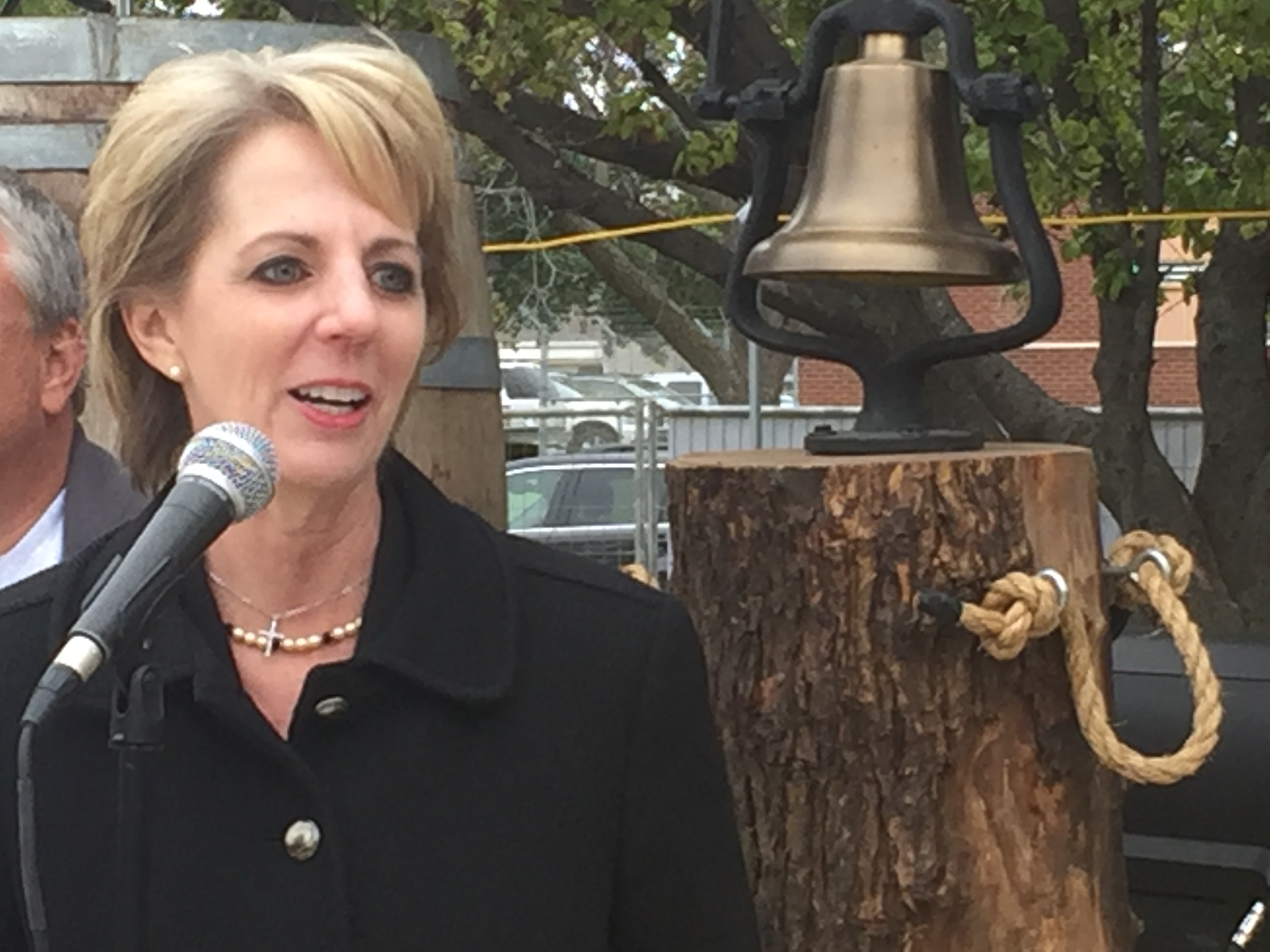
Dr. Tisa Mason, FHSU president
He recognized several people for their involvement and contributions, including graphic artist Mary Ridgway, a FHSU employee who has designed the Oktoberfest logos for many years.
Oktoberfest is held on Fort Hays State University Homecoming weekend. This was the eighth Oktoberfest for newly installed President Tisa Mason who preciously served FHSU as vice president for student affairs.
“Home is not the university. It’s the community,” she told the crowd, adding that this is the 46th year Fort Hays State has partnered with the Volga German Society for the celebration, which also funds an annual student scholarship.
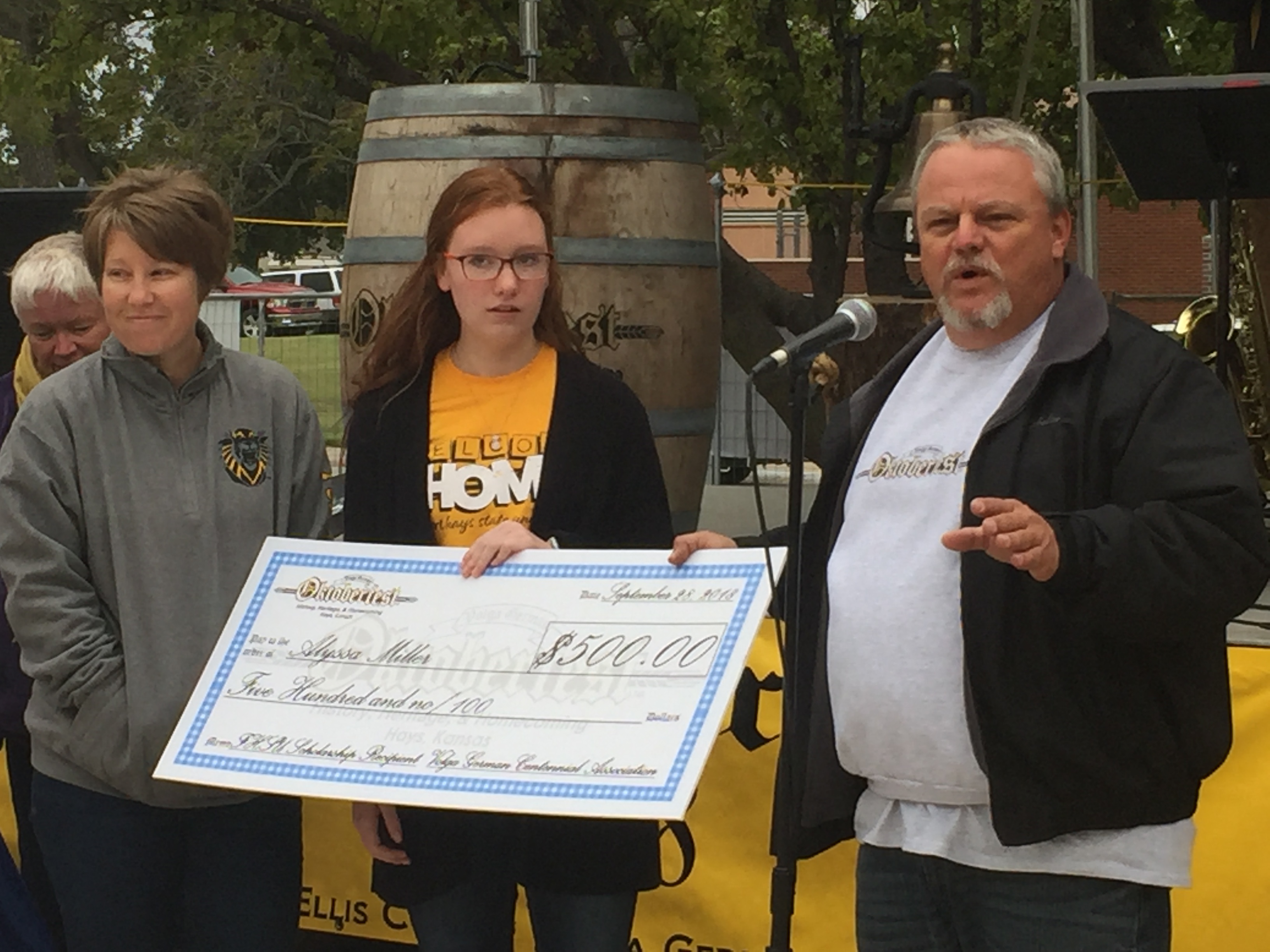
FHSU student Alyssa Miller received a $500 scholarship from the Volga German Society.
This year’s $500 award went to Alyssa Miller, Holdrege, Nebraska, who is of Volga German descent.
Werth and NCK Tech president Eric Burks announced a second annual scholarship will awarded to students at the technical college beginning in February.
Hays Oktoberfest promotes the rich heritage of the Volga German and Bukovina Germans who settled in Ellis County, Kansas. It also celebrates the history of early settlers in Ellis County, which was created in 1867.
Following a prayer and blessing from Fr. Reggie Urban, Volga German Society Dialect Historian Tom Haas gave tribute to those settlers.
Starting his remarks in German, Haas translated them into English as he went along.
“Today we certainly don’t want to forget our ancestors who came to America. Because of their efforts, we are here today,” Haas said.
“They came here with a purpose, the first purpose being to be free. The very first thing that they did was build a church in their own communities.” Last weekend, the 100th anniversary of Holy Cross Catholic Church was celebrated in Pfeifer.
Two FHSU exchange students from western Germany were introduced during the opening ceremony. Katherine Ermisch, Bochum, and Janine Gebhard, Gladbeck, are both studying English.
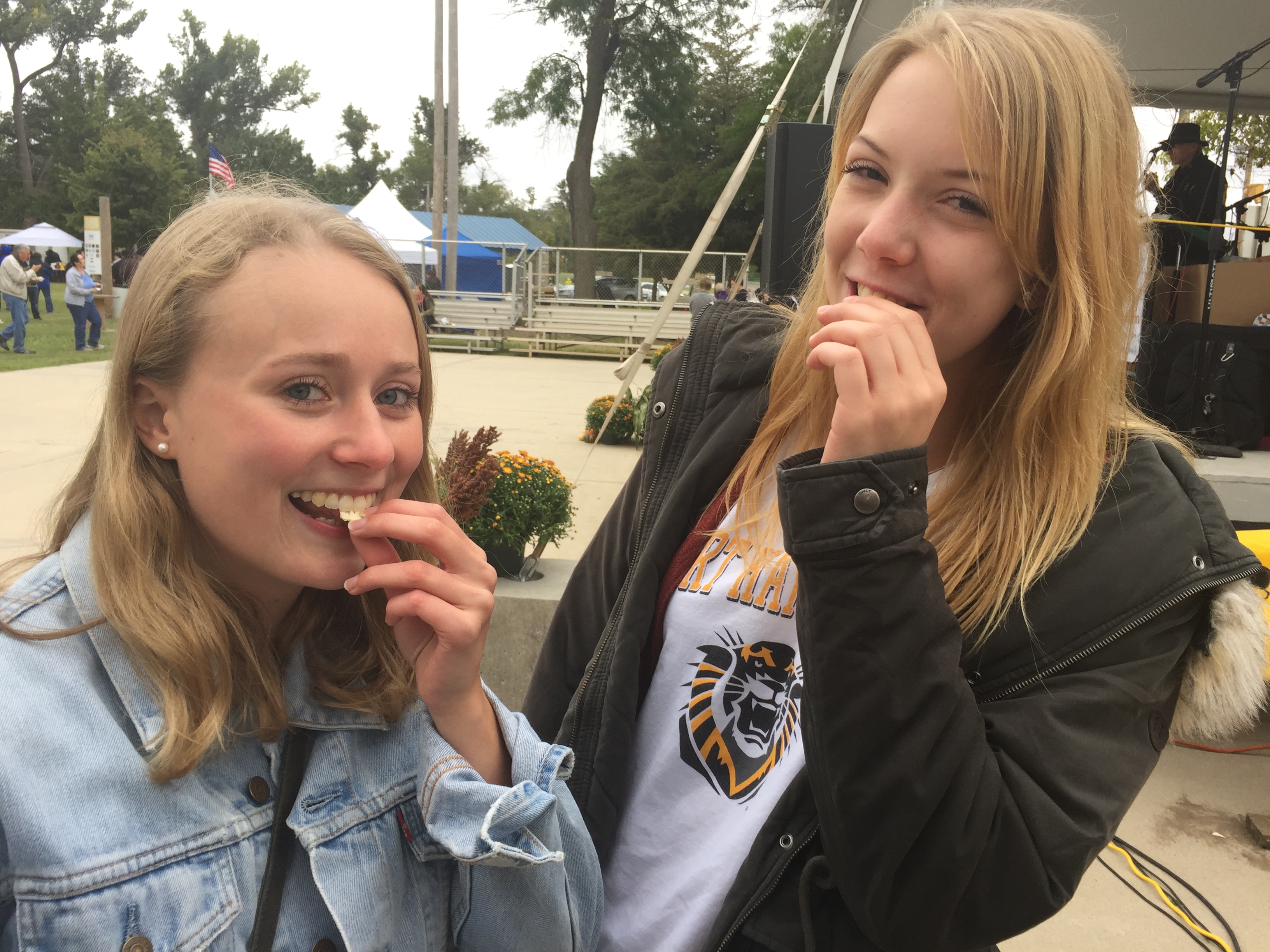
FHSU exchange students from German Kathrin Ermisch and Janine Gebhard taste the
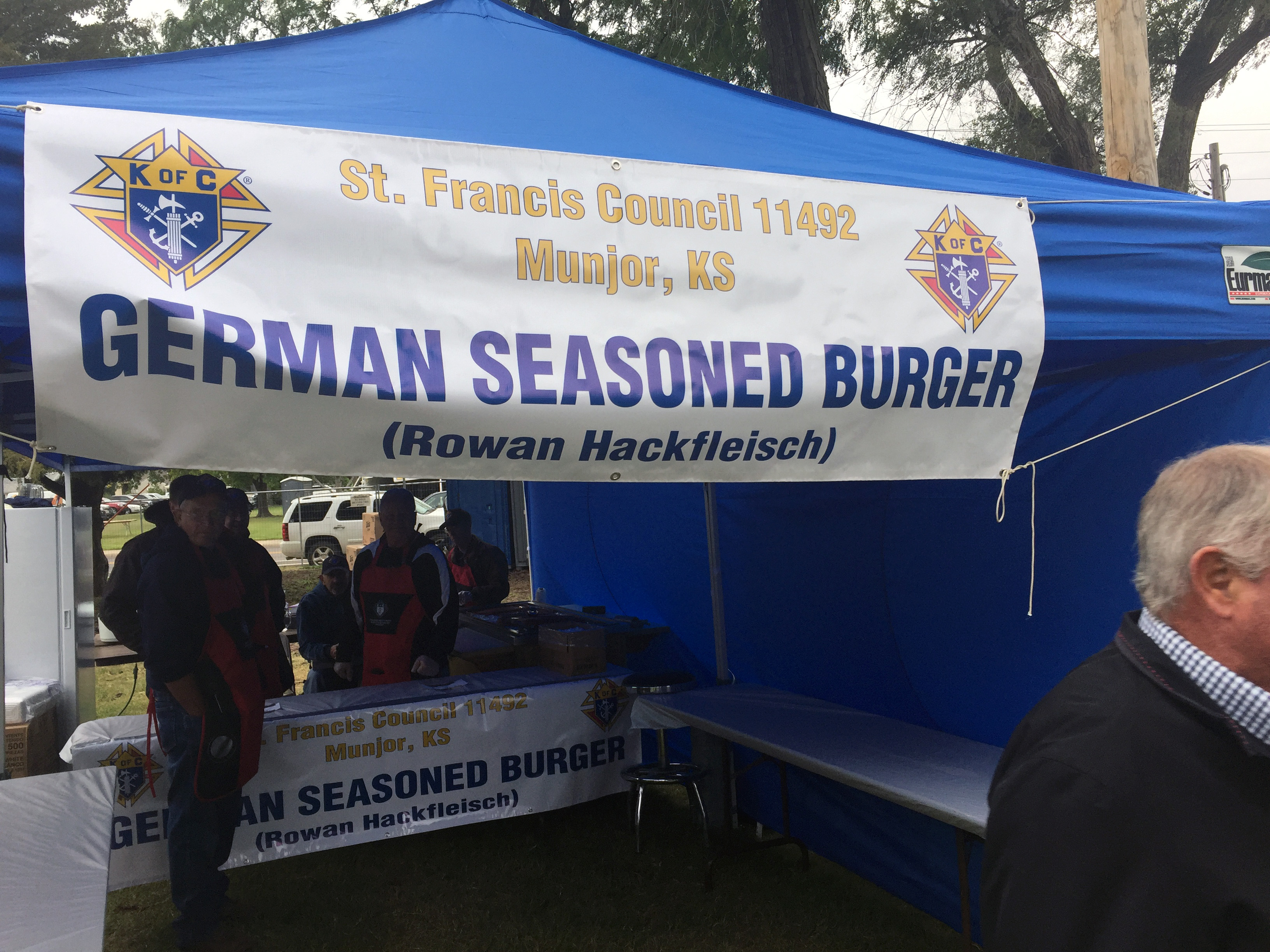
They were happy to hear the polka music performed by the Joe Dolezal band, which they said was just what they would enjoy at an Oktoberfest in Germany. Both women gave a thumbs-up to the Rowan Hackfleisch (German season burger) prepared by the Munjor Knights of Columbus. They said it compares to their own Mett, a hearty breakfast bread topped by raw pork or beef with raw onions added. There are no seasonings in Mett and the pair say they like the local delicacy, commonly called “rawburger,” much better.
“We were told there’s no Wienerschnitzel sold here but we can really recommend the season meat over there. It’s really good,” Gebhard told the audience. “Thank you for having us and Prosit,” wished Ermisch.
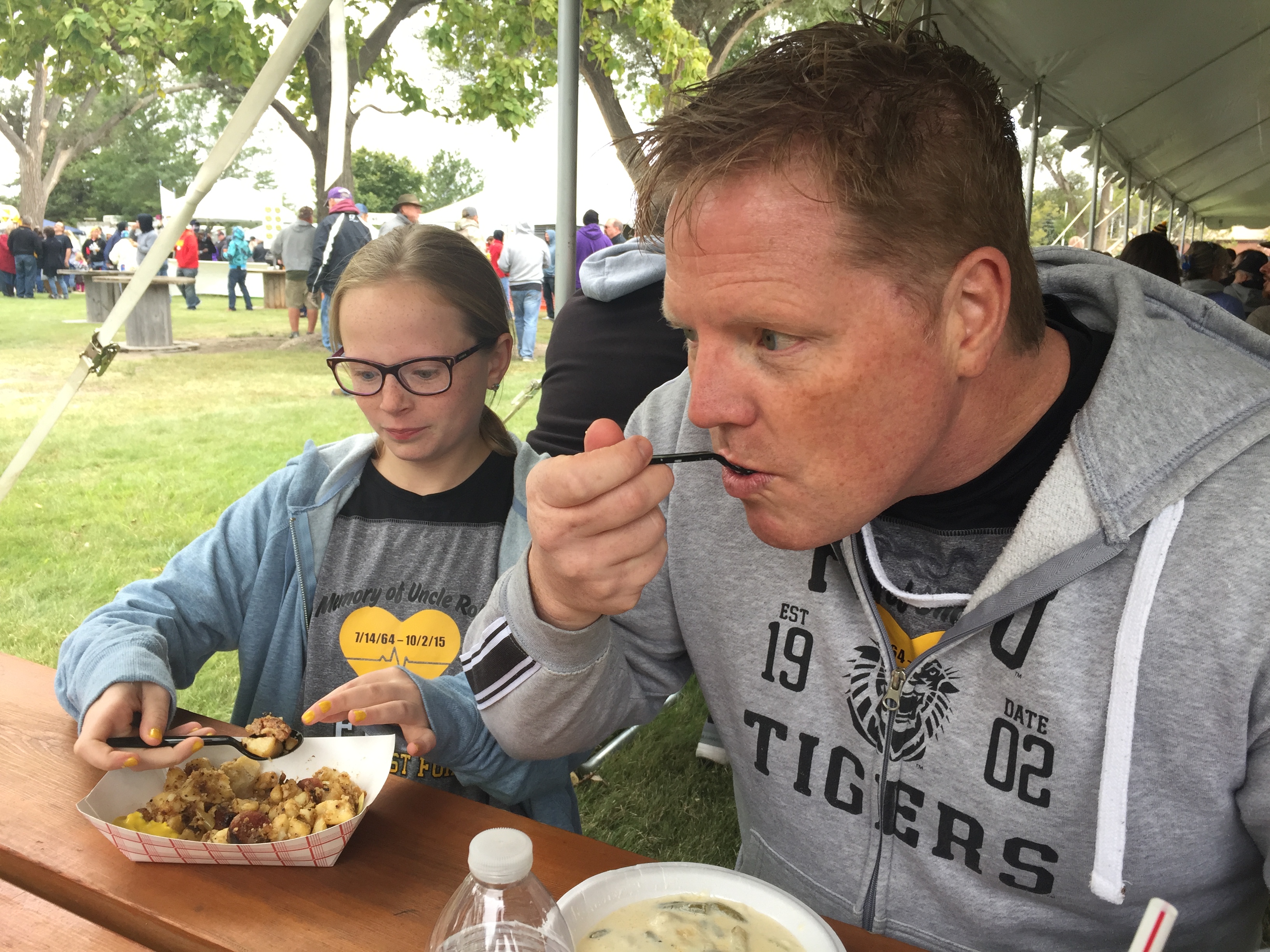
Also enjoying the local flavors were dad and daughter Roger and Mikala Barnhart, St. George.
Mikala Barnhart, 11, and her dad Roger Barnhart, St. George
Roger, a 1995 FHSU graduate, chose green bean dumpling soup, while Mikala, 11, declared the soup “too creamy” and instead went for the fried dumplings and sausage.
The Barnhart family will participate in Saturday morning’s FHSU Homecoming 5K race, in honor of Roger’s brother Robert, a ’94 FHSU alum, who died three years ago on the day of Oktoberfest.
One of the duties of Hays Mayor James Meier toasts the Oktoberfest 2018 crowd late Friday morning.
FHSU exchange students from Germany Kathrin Ermisch and Janine Gebhard taste the
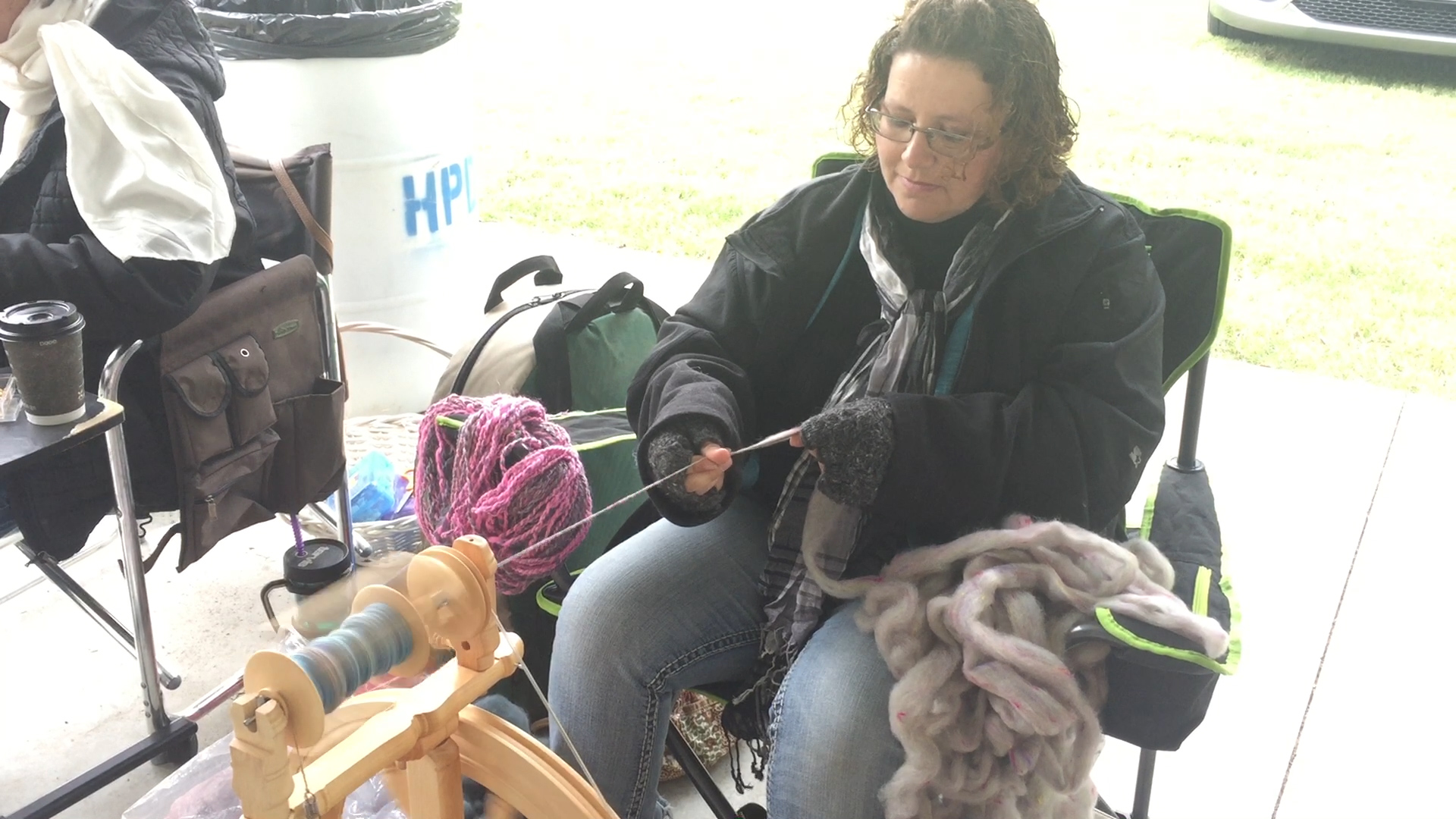
Mindy Lamont, Phillipsburg, spins alpaca and merino wool into yarn.
“Catherine the Great” greets her former subjects from the Volga River area of Russia.
Brats made by the Ellis grocery store
300 pounds of rawburger
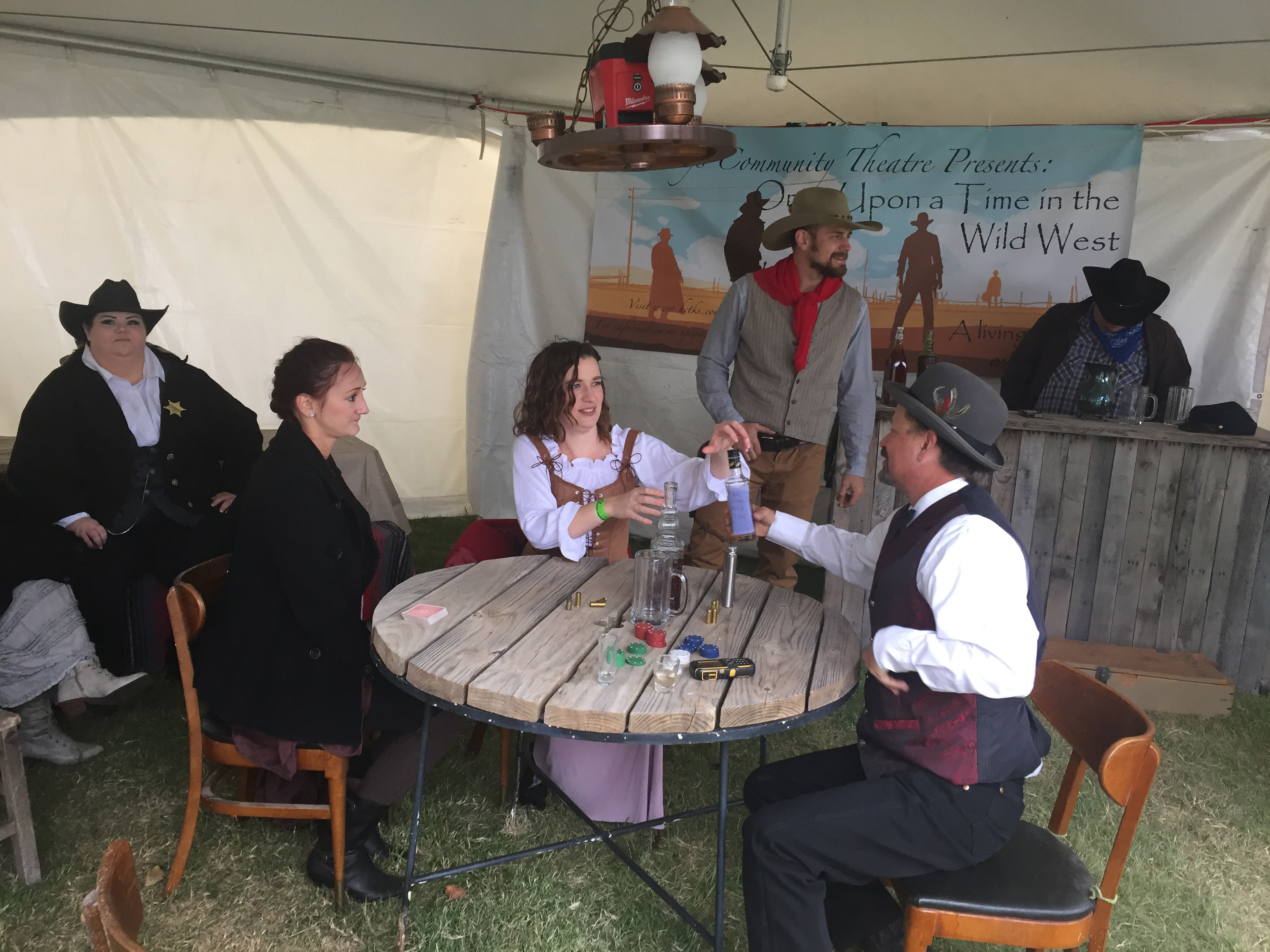
Hays Community Theatre members
Mikala Barnhart and her dad Roger of St. George
American Legion Riders & Ladies Auxiliary booth
Official Oktoberfest band
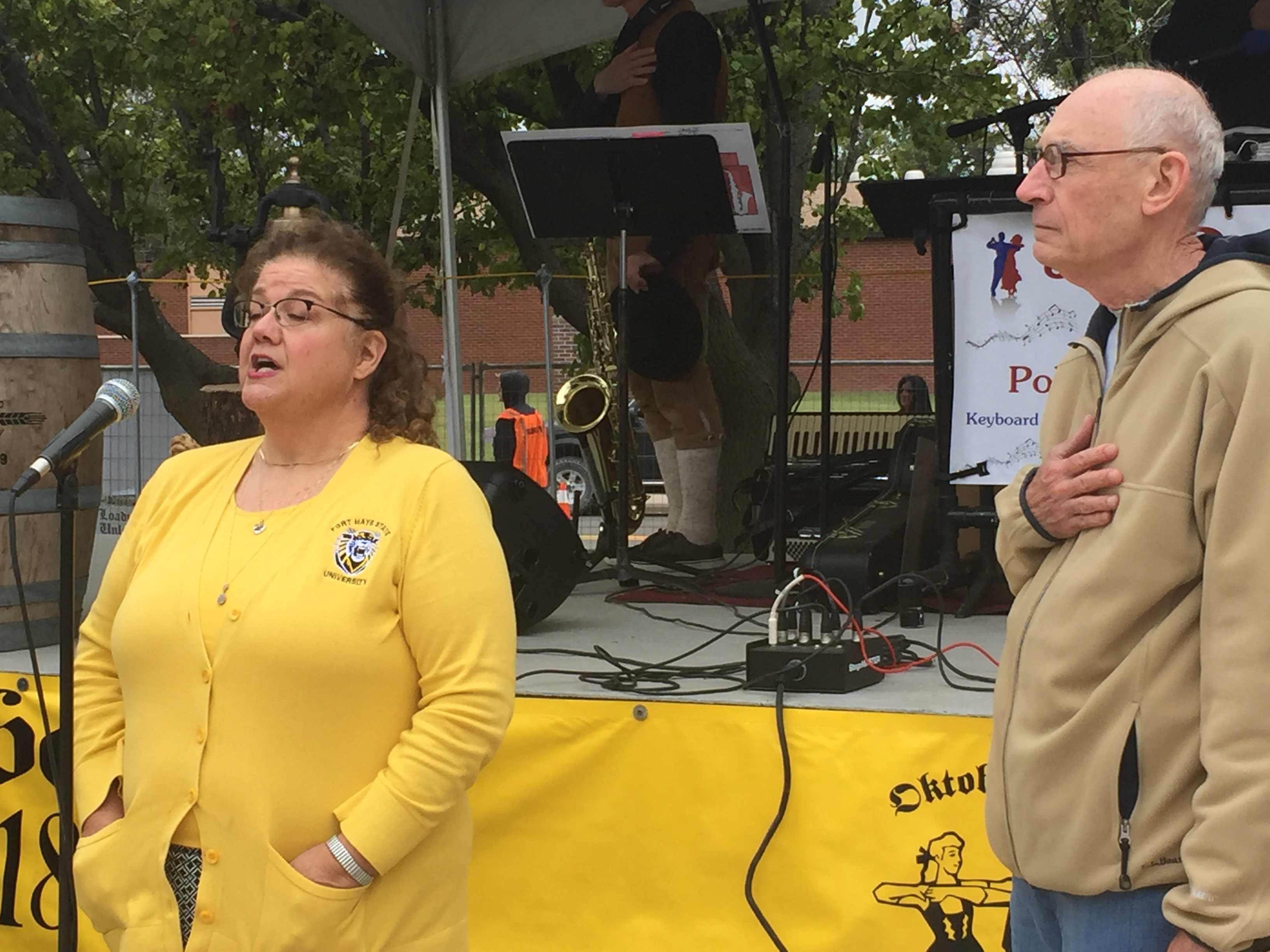
Emcee Mike Cooper with Jackie Maxwell singing the national anthem
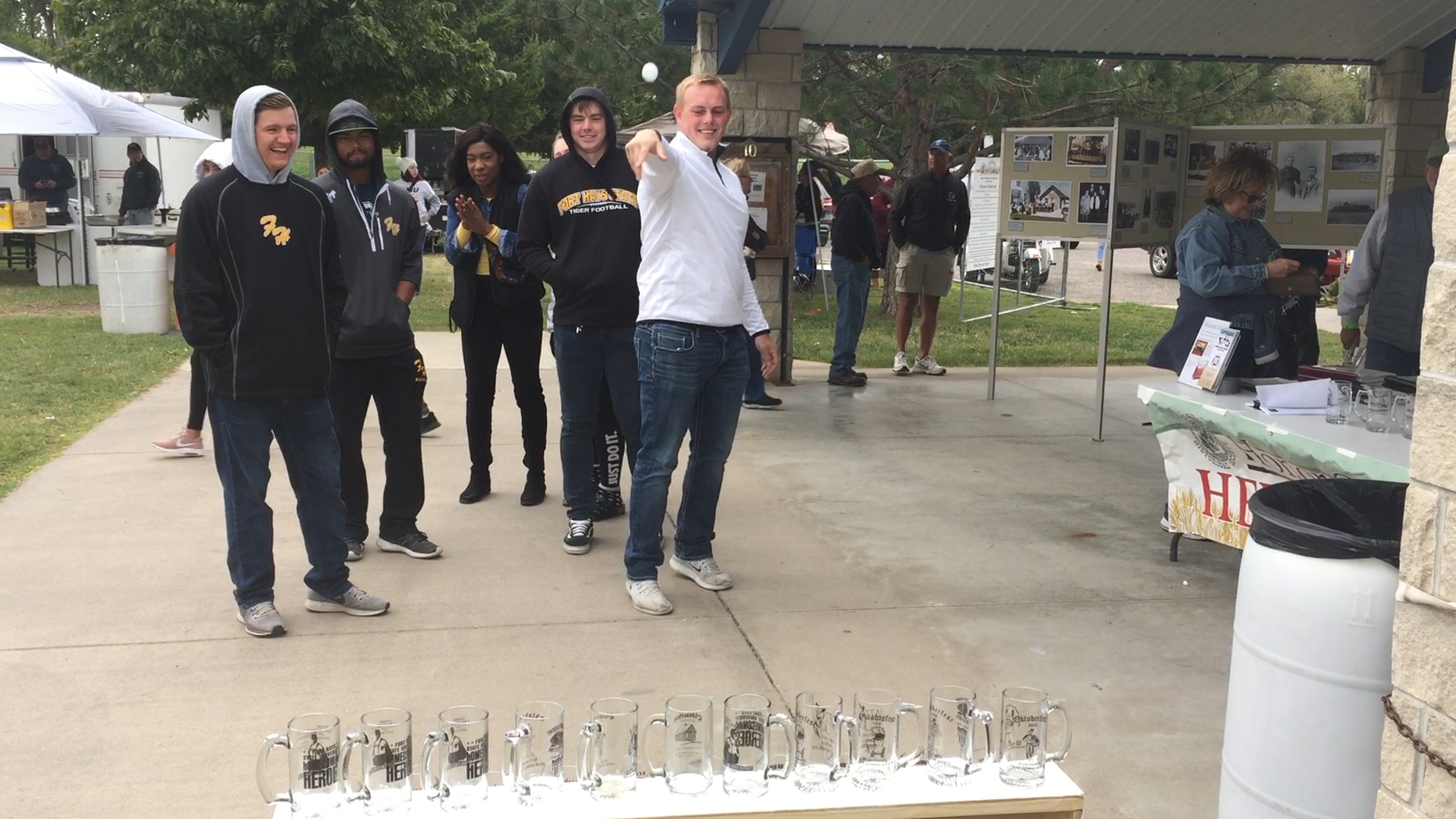
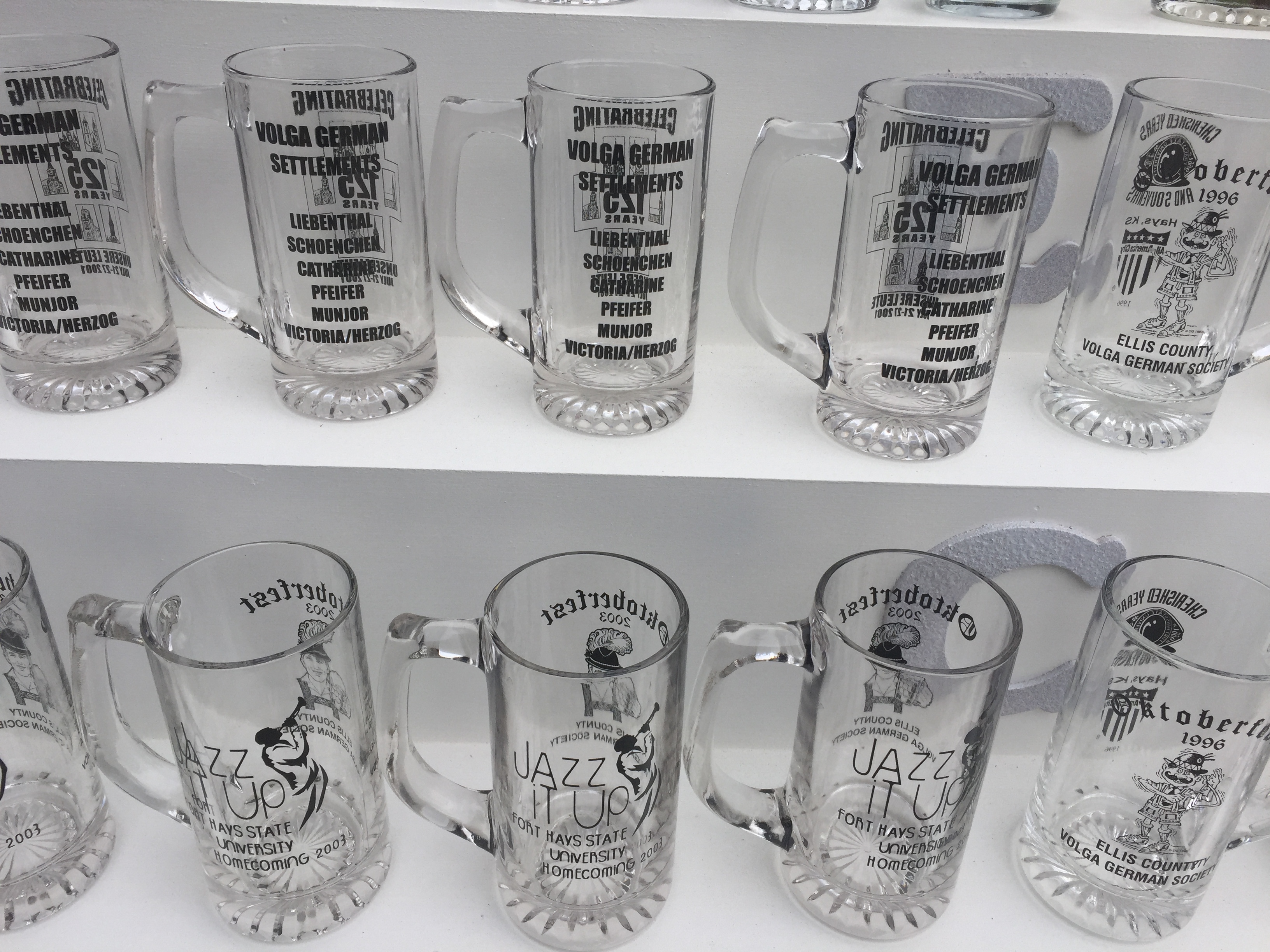
Souvenir beer mugs
Volga German Society scholarship award
FHSU President Dr. Tisa Mason
FHSU GASP students sold more hot chocolate than root beer floats.
Natalia Figuerea-Rodriguez, HHS senior, was honored with the September student Best of the Best award.By CRISTINA JANNEY Hays Post
Hays High School senior Natalia Figuerea-Rodriguez has maintained a 3.9 grade point average.
But Figuerea-Rodriguez has a unique set of challenges she has had to overcome to earn that honor.
Figuerea-Rodriguez is from Puerto Rico. She and her family settled in Hays after being displaced by Hurricane Maria. Figuerea-Rodriguez’s native language is Spanish.
Figuerea-Rodriguez was nominated by Suellyn Stenger, HHS counselor, and Linda Mayer, English language learners teacher for the USD 489 Best of the Best award.
“She literally lost a lot of things,” Stenger said, “friendships, home, belongings. She came here with her native-speaking language being Spanish. If I had two words to describe Natalia, it would be resiliency and perseverance.”
Stenger emailed the Best of the Best nomination form to Figuerea-Rodriguez’s teachers.
One teacher said, “I never knew the circumstances around Natalia’s transfer to Hays High School. I just knew she had an incredible intellect and work ethic.”
Another teacher said, “I absolutely love having her in class. Her effort is worth a million bucks.”
Her ELL teacher spoke to the school board in Spanish to illustrate how difficult it is to try to understand a school lesson spoken in language that is not your own.
“If you found it a little bit difficult to understand what I was saying, then you understand what Natalia has been going through for the past year, and she has done it exceptionally well with a 3.9 cumulative GPA in her content classes in her second language. We are extremely proud of her,” Mayer said.
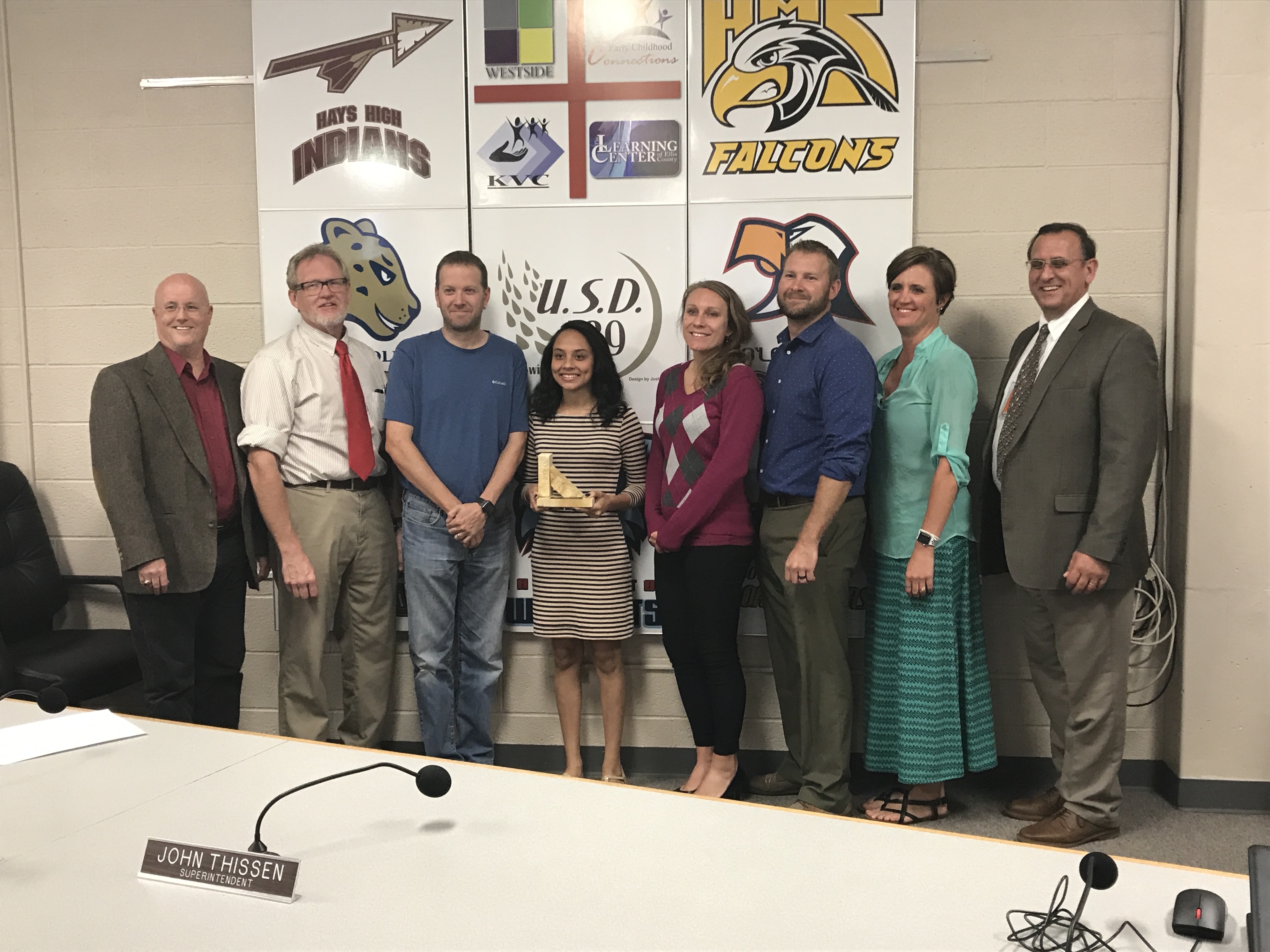
Candace Sage, a second-grade teacher at Wilson Elementary School was honored with the staff Best of the Best award. She is pictured center with school board members and members of the Haas family, who nominated her for the award.
The staff member who was honored with the Best of the Best award was Candace Sage, a second-grade teacher at Wilson Elementary School.
Parent Laycie Haas, along with her two sons and daughter, Kaden, Konner and Khloe Haas, nominated Sage for the Best of the Best award.
Sage taught all three of the Haas children. Khloe, the youngest, is in her class now.
“She goes above and beyond for all of her students in her classroom,” Laycie said. “Every year she implements new ideas and learning opportunities with her students.”
This year Sage added monthly ag lesson, which Laycie said was important to her family because they live on a farm.
With her sons, Laycie had the opportunity to volunteer in the Sage’s class. She said she was able to witness Sage’s amazing teaching techniques.
“She does so many other things like taking the kids to Via Christi to interact with the residents,” Laycie said. “Both of my older two had the same resident, and even today they will still talk about him and his stories. They had an awesome bond. That is something that is an awesome skill — to learn how to interact with people who are older than you are.
“Along with school work, she teaches them life lessons and rewards their hard work and dedication with fun Friday activities.”
Laycie’s son had an assignment in his last weeks of elementary school to write a letter to the teacher who had the most impact on him. He wrote about Sage.
“We are extremely blessed to have met her, and I am so blessed that my kids were able to have her as a teacher,” Laycie said. “She has left a life-long imprint on our family’s lives. Her dedication is top-notch, and I believe without a doubt that she is an awesome recipient of this award.”
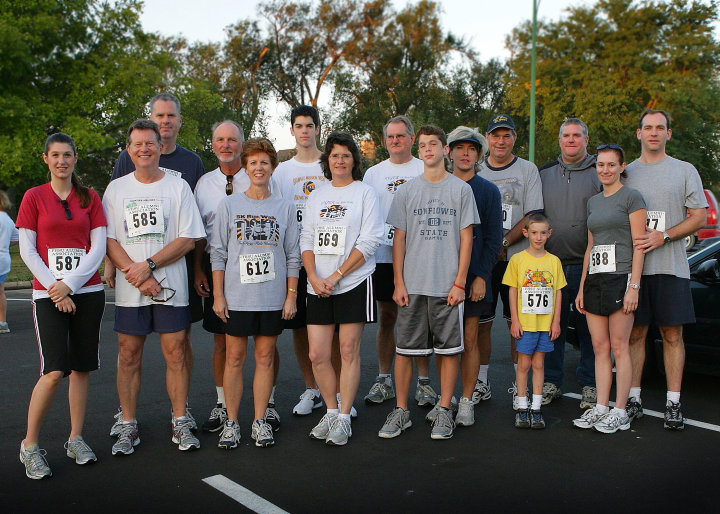
A favorite Fort Hays State University homecoming activity for descendants of the Wallace and Shirley Robinson family over the years has been the 5K race.
By DIANE GASPER-O’BRIEN FHSU University Relations and Marketing
Homecoming at Fort Hays State University has long been special for descendants of the Wallace and Shirley Robinson family.
For years, between 10 and 20 family members gathered on Saturday morning of homecoming to run the 5K race.
This year, more than two dozen of the Robinson children, their spouses, grandchildren and great-grandchildren are expected to be in Hays for the 2018 homecoming festivities. Not a single one is scheduled to line up for Saturday’s early-morning run, though, because this year, they have a lot of other activities on their homecoming agenda.
The Robinsons have been named the Tiger Alumni Family of the Year, a distinction which is in its second year and sponsored by the FHSU Alumni Association. Two dozen family members and their spouses attended Fort Hays State, and 16 of those graduated.
All nine of the Robinson children, who were raised in Hays, attended the hometown university, and all but two of those received bachelor’s degrees in areas ranging from speech pathology and psychology to business fields, from history to computer technology.
Wallace and Shirley Robinson grew up in east central Kansas, and both attended college in Emporia, where Wallace played football for Emporia State and Shirley attended a private school, the College of Emporia. They started a family before moving to Hays, where Wallace went into the wholesale ice cream business, King’s Quality Ice Cream, with his brother, George.
While Shirley took care of their growing family as a stay-at-home mom, Wallace helped run the business. One April day in 1964, the Robinson family’s lives changed dramatically.
Wallace filled in for one of his route drivers who was ill, and while driving the roads of northwest Kansas, the steering went out on the ice cream truck. The truck rolled, Wallace was thrown out and lost his life when he was pinned underneath the truck. Wallace was just 40 years old, and Shirley was left to raise their nine children ages 6 months to 16 years.
She used her husband’s life insurance money to build a new house in Hays, designed for a preschool in the home, which she ran for 30 years. All the while, Shirley stressed that each of her children would attend college, and she took classes at Fort Hays State herself.
“It was just always a given that we would all go to college,” said Ruth Heffel, the third oldest of the Robinson siblings (and oldest girl) who was 13 years old when her father died.
“I didn’t know people didn’t go to college,” added Heffel, who earned both her bachelor’s and master’s degrees from FHSU and worked at Fort Hays State for more than 25 years.
The Robinsons all stayed close to home to continue their education and still remain active with their alma mater. An avid sports fan, Shirley attended Tiger athletic events, as well as other university activities, into her 80s. A Foster Grandparent at FHSU, Shirley died in 2006 at the age of 83.
Shirley’s children followed her lead in becoming involved in their university, then and now.
Heffel joined the Alpha Gamma Delta sorority, and her younger sisters, Sheryl Rogers and Sharon Irvin, later followed suit. So, too, did Rogers’ daughter, Kelsee Hirsch, who remains active with the sorority today along with Hirsch’s sister-in-law, Carin Rogers. Four of the Robinson brothers were members of fraternities during their college days.
“I gained sisters when I joined a sorority,” said Hirsch, who graduated with a bachelor of science in nursing in 2013.
Hirsch said that because of her experience at FHSU, her husband, Bryan, chose to attend there as a non-traditional student.
“We bragged about what a great school it was,” Hirsch said, “and Bryan’s younger brother and his brother’s wife decided to come to FHSU.”
While Fort Hays State means different things to different members of the family, Hirsch said she has “very few family members who haven’t been impacted by this institution. FHSU has been such a big part of my family’s lives and will continue to impact us for many more years.”
Hirsch, a registered nurse at HaysMed The University of Kansas Health System, said she tried to get the most out of her college experience while working toward her degree.
“I loved my experience as a student worker, nursing student, sorority girl and now an alum,” she said. “More than likely, my kids and nieces and nephew will be Tigers one day, and that makes me smile.”
Shirley Robinson surely would be smiling Saturday, knowing that nearly 30 of her family members were representing her family being honored by the FHSU Alumni Association.
“Mom would absolutely be thrilled with this,” Heffel said. “She wanted us all to go to college. We all had part-time jobs growing up, and she made it happen.”
Heffel recently retired from the HaysMed Foundation after a long, successful fundraising career. She said that while she and her siblings obviously learned a lot of responsibility growing up, she also credits her Fort Hays State education for her success.
“I believe, and I think all my siblings would agree, that the education we got at Fort Hays State was equal to, if not better than, any other university we could have gone to,” she said. “The hands-on experience we got at Fort Hays State was part of a quality education that surpassed any other. I know one of my nieces says that she would put herself up against anybody with what she learned at FHSU.”
That niece, Kayla Casey – who earned a bachelor’s degree in accounting and finance in 2009 – and her husband, Allen, will be making the longest trip this weekend, traveling from their home in Moscow, Idaho.
The Robinsons’ oldest sibling, David, who lives in the Denver area, won’t be able to attend this year’s homecoming. But his eight younger siblings promise to fill him in on the weekend.
The other five brothers and their hometowns are: Greg, Weskan; Joel, Denver; Jamie, Topeka; and Mark, Westminster, Colo.; and Phillip, Aurora, Colo.
Heffel says her house will be “home base” for her brothers and her sisters – both who are making the trip from their farms near McCracken – and their families.
Heffel said the family always looks forward to getting together, but the alumni family honor makes it even more special this year.
“I was shocked when I heard we were chosen as the Tiger alumni family,” Heffel said. “Everybody is really looking forward to it.”
The Robinson family will ride in the 1 p.m. parade down Main Street Saturday, on a trailer behind the vehicle carrying FHSU President Tisa Mason and her husband, Bill. The Robinsons – who will range in from 1 year old to 69 – will be dressed in gold Tiger T-shirts from the alumni association.
After gathering at the Heffel home for a “tailgate party,” the Robinson family then will attend the 7 p.m. football game between the Tigers and the University of Central Oklahoma, where the family will be recognized at halftime.
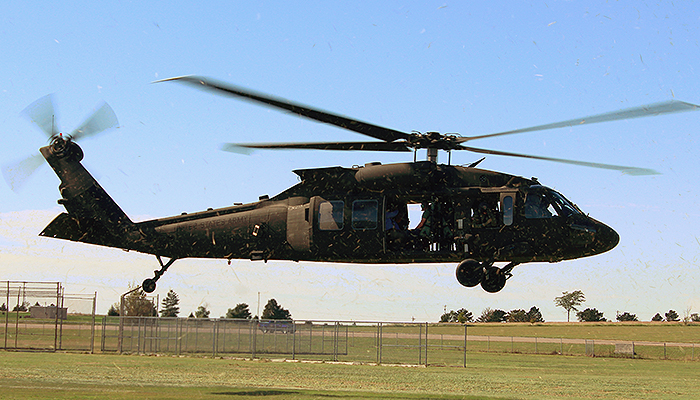
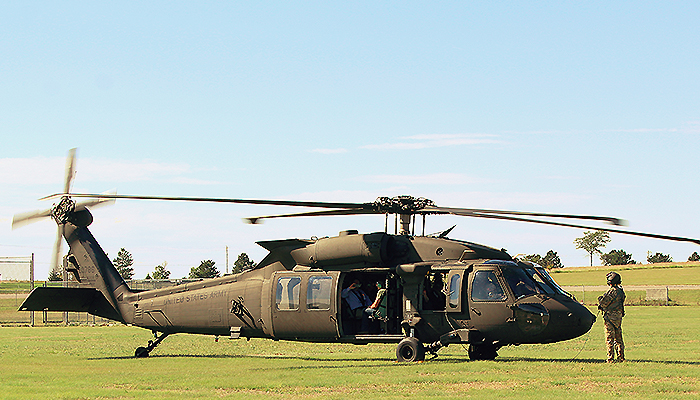
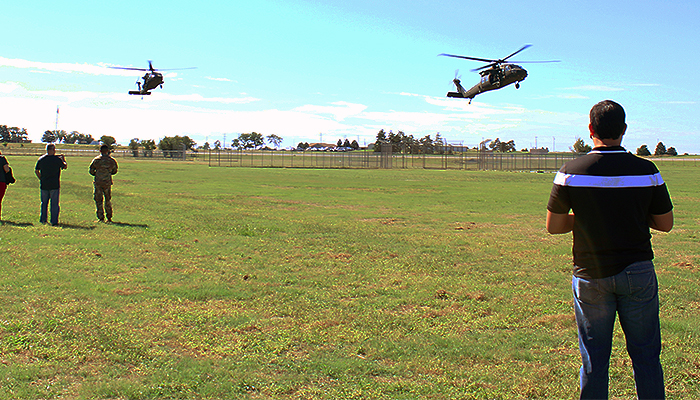
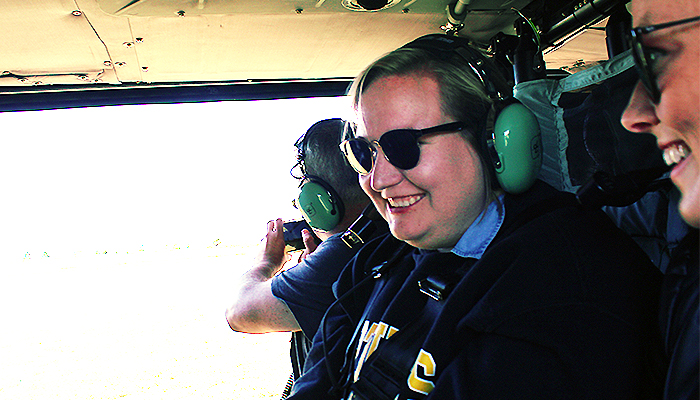
Air rushed into the cabin of the Blackhawk helicopters like a sweeping inhale.
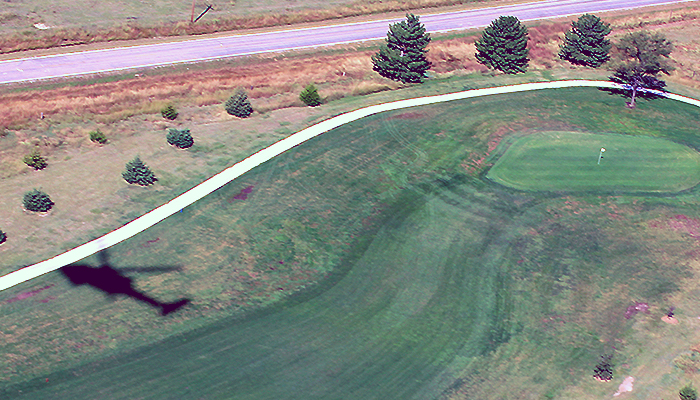
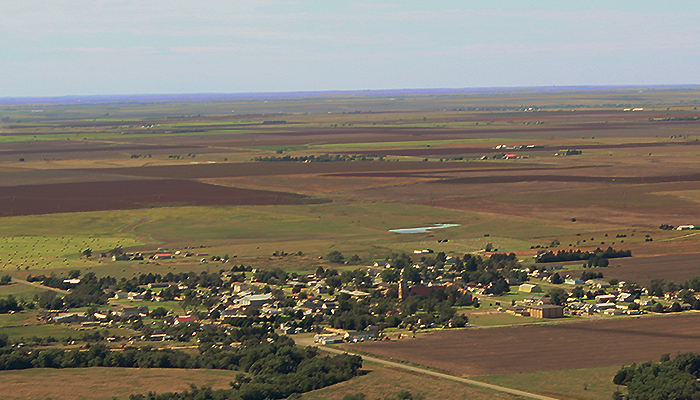
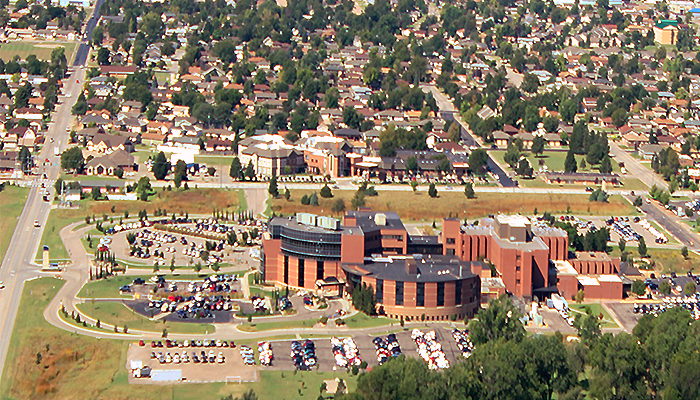
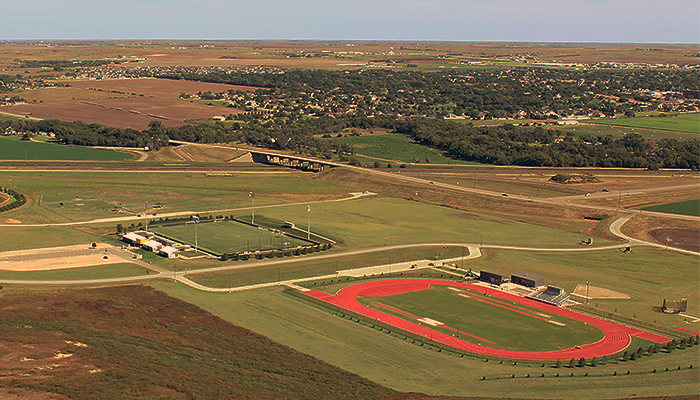
The ground slowly diminished under their feet, and Hays became a landscape of toy trucks and round bales the size of marshmallows — a familiar landscape from a very unfamiliar perspective.
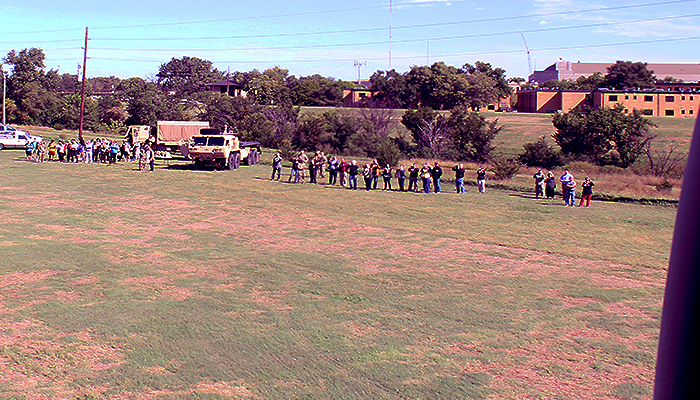
National Guard airmen know this every day, but for a group of area dignitaries, educators and the media members, it was a very new and exhilarating experience.
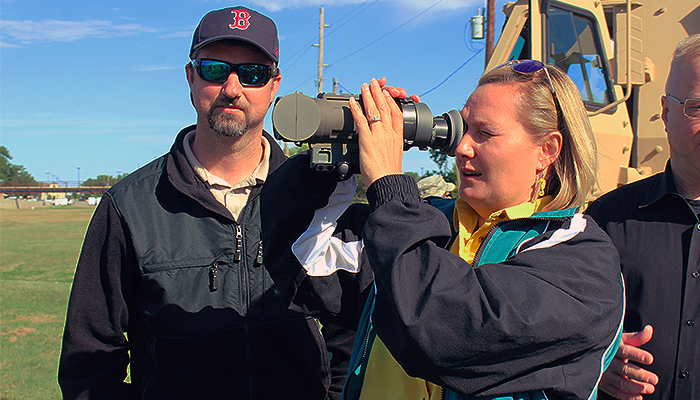
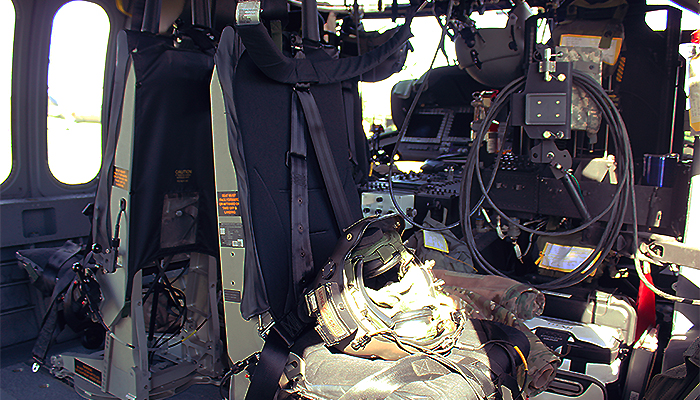
The Kansas National Guard 108th Aviation took the group up in their UH-60 Blackhawks Wednesday as part of a session to better inform local leaders about the importance of Guard recruitment.
The Army announced Tuesday it ended its fiscal year below its authorized personnel strength for all three of its components — Army, Army Reserve and National Guard.
Retention numbers are high for the Guard, but the problem has been recruiting.
The Army Guard failed to reached its accessions goal every year since 2014. But in 2018, the drop was “significant,” said Lt. Gen. Timothy J. Kadavy, director of the Army National Guard, in a column that will appear in the October NATIONAL GUARD magazine.
To combat this, the Kansas Legislature, enacted a bill during the 2017 session, which will reimburse students 100 percent of their college tuition for undergraduate studies at state colleges. Retirement benefits have also increased for National Guard members.
The state benefits can be combined with federal Montgomery GI Bill benefits for private school or grad school.
Capt. Matthew Ayres, Bravo Company Recruiting Commander, said he used his education benefits to earn his bachelor’s degree in organizational leadership and will soon complete his master’s degree in organizational leadership.
If a service person does not use all of their education benefits, they can pass them to a spouse or dependent child. Ayres has given a portion of his unused benefits to each of his four children.
Sgt. Mikayla Nicodemus used her education benefits to recently complete culinary school through NCK-Tech. When Nicodemus is not on Guard duty, she is a stay-at-home mom. She uses her culinary background to do catering to supplement her family’s income.
Guard recruits cite education benefits as their No. 1 reason for signing up.
Ayres said the Guard encourages its personnel to go to school and increase their training, because they see those soldiers as better prepared to complete their missions.
Ayres also said the state and federal government are beginning to understand the current service of National Guardsmen and women goes beyond the one weekend a month and two weeks a year that used to be the Guard’s mantra.
The National Guard serves a dual role. It serves in cases of state emergency, including floods, snow storms and wildfires.
However, the Guard can also be federalized to serve in conflicts overseas.
Several of the guardsmen and women who were on hand for the Blackhawk flights on Wednesday had been deployed to serve overseas during their terms of service.
Maj. Patrik Goss, Blackhawk pilot and full-time guardsman, has been deployed overseas multiple times, serving in Iraq, Bosnia and Kuwait.
The Blackhawks move people, parts and equipment. The helicopters can also be outfitted with armaments for aerial assault missions during which they drop soldiers in hostile areas and then pick them up from missions.
Goss’ background was in law enforcement before he became a Guard pilot. He trained for a year to be a pilot, but your training never stops once you are a pilot.
For those young people who would like to some day fly with a Blackhawk crew, Goss said they need to stay out of trouble and finish high school.
“We have so many opportunities right now,” Goss said of Guard for young people. “One of the biggest ones is after they passed the bill that is paying for college. I am talking about all of college. It’s insane. I wish I would have had that when I was going to college.”
Goss said he loves his job and would recommend it to young people looking for a career.
“At the absolute base level, the American taxpayers let me climb into a $24-million machine and fly, and they trained me to do it,” he said. “Am I a kid at heart? Yes, I absolutely am. It is wonderful. I can’t explain it. It is the greatest roller coaster on the planet.
“On the professional level, it paid for my master’s degree, allowed me to command troops both in combat and in Kansas. It allows us to go out and help the citizens whenever we are called upon and provide a tool that we can take almost anywhere.”
Goss is a lifelong Kansan and is now stationed in Salina. He has also served at home during floods, in northwest Kansas last year and this spring dumping water on wildfires. His crew also spots stranded motorists during snow storms.
“Kansas has been home my whole life,” he said. “It is no different than when I was a police officer. People call and you have the ability to go out and help where others can’t. You can’t explain that feeling. The gratitude is overwhelming, and the feeling when you go home and tell your kids what you did that day is pretty inspiring.”
Sandra Gottschalk, dean of the Hays NCK-Tech campus, said meeting the Guardsmen and riding on the Blackhawk helped open her eyes about how the Guard and the college can better work together.
The Guard offers training in many technical skills that relate back to jobs in the community, including welding, truck driving, construction, computer science, health care and many more.
“Definitely it opens eyes,” she said, “the educator eyes at the colleges and universities. At the technical college, we do a lot of the same things, so it would be a good partnership.”
Sen. Elaine Bowers, R-Concordia, said she could see how the education bill the Legislature passed last spring was assisting people in the state.
“I am very happy to know they are working with our local high schools, community colleges and vocation schools,” she said. “It think that is very key.”
Bowers said it was a thrill to ride in the Blackhawk, but it was important to see that the Guardsmen were well-trained and could execute their maneuvers safely.
For more information about joining the National Guard, contact SSG. Enrique Martinez, recruiting and retention NCO in Hays, at 785-806-2123 or by email at [email protected]. Find more information on education benefits by calling 1-785-646-0155 or go to the National Guard website.
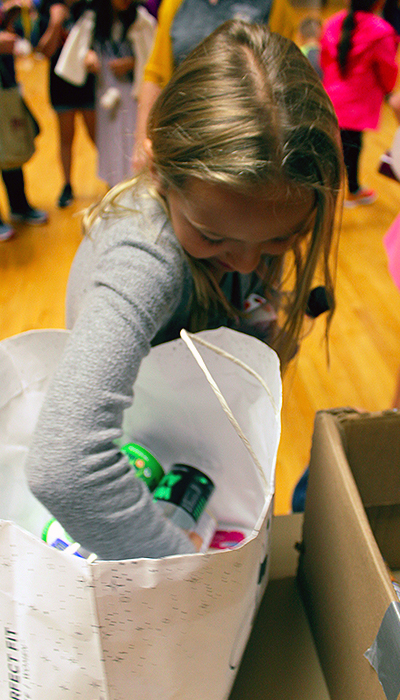
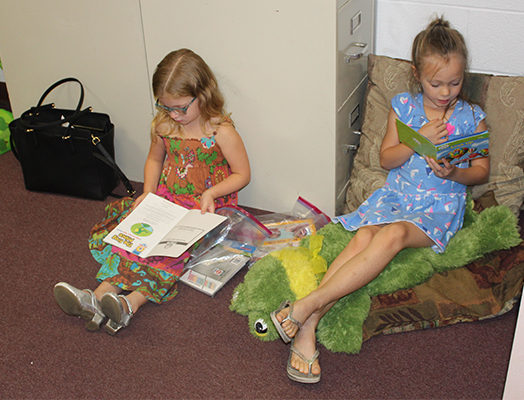
The sounds of children laughing and playing at FHSU’s Memorial Union grew to a roar Tuesday morning.
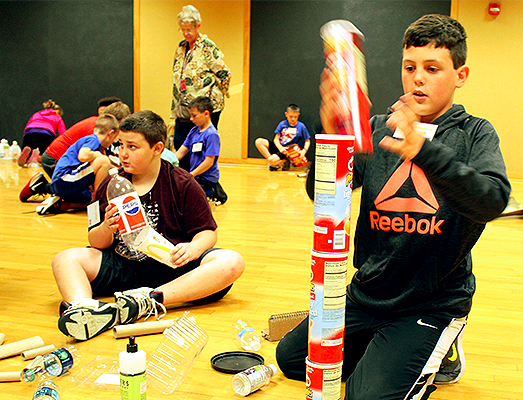
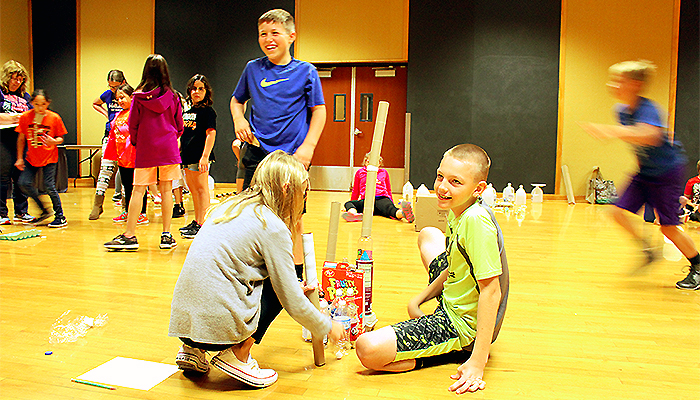
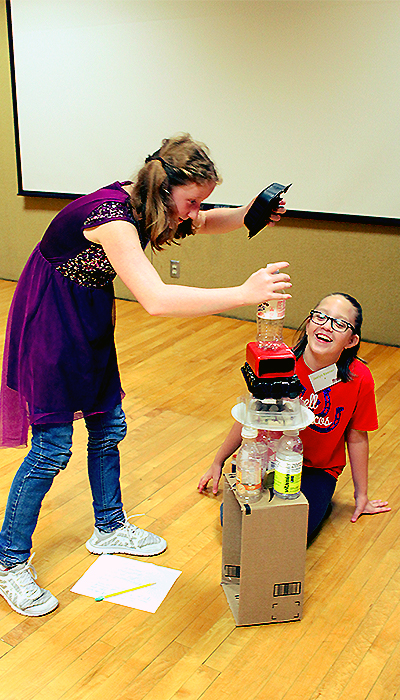
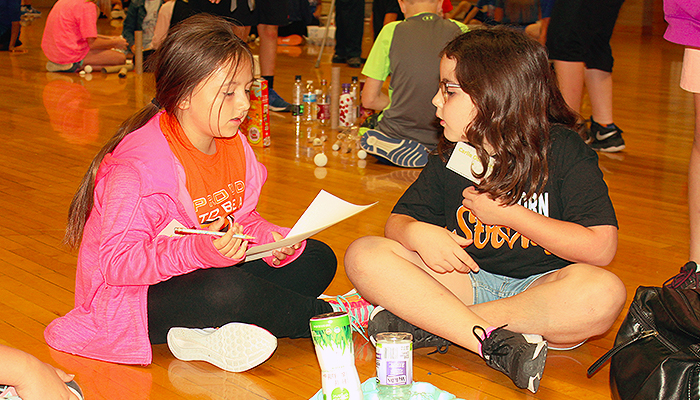
The students were encouraged to use recyclables to create their own games and then they were supposed to teach the games to other students during the Young Readers’ Conference at FHSU Tuesday.
The kids laid out paper towel rolls as race tracks, built towers and transformed plastic milk jugs into hungry monsters.
“I think it teaches them to be creative and to give them a little bit of ingenuity — ‘What can I make out of what other people see as junk?’ ” said Sarah Broman, FHSU assistant professor of education of the game-building activity.
The day started with an address from Dr. Tisa Mason, Fort Hays State University president. The students learned the story of William Kamkwamba from the book “The Boy Who Harnessed the Wind.” Kamkwamba used material gathered from the junkyard to build a windmill to power electrical appliances in his family’s home in Africa.
“Just to get kids thinking about that,” Broman said of Kamkwamba’s story. “Something that might be junk to somebody else could be something wonderful and help them and their careers or whatever down the road.”
Macy Patterson, fifth grader from Russell, described her group’s game.
“We are playing bowling,” she said. “We set up 10 bottles. We get two tries. We put corks in plastic eggs, and then it is basically just like bowling.”
Jonathon Franks and his friend Braxton Parsons, also Russell fifth graders, constructed Diaper Bowling.
These students used paper towel cores for pins and a square diaper box as the ball.
Both of the boys said they liked to read. Parsons said he liked to read the Stick Dog series, which is about a hamburger-hungry pooch.
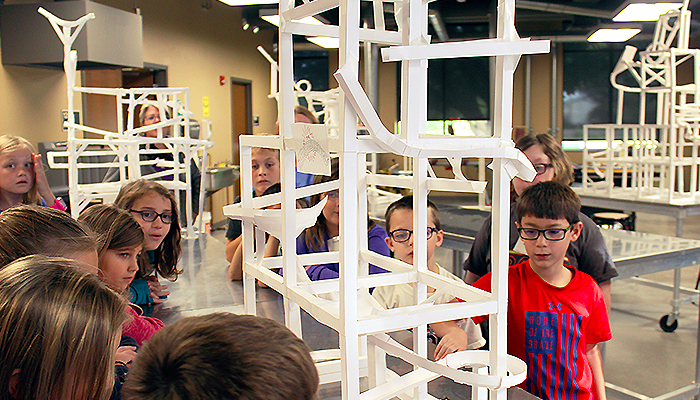
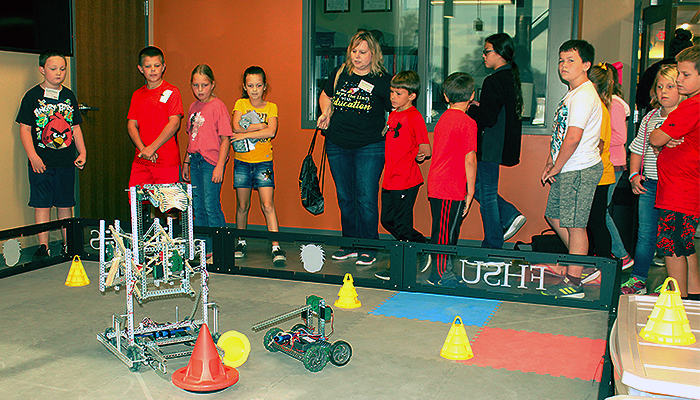
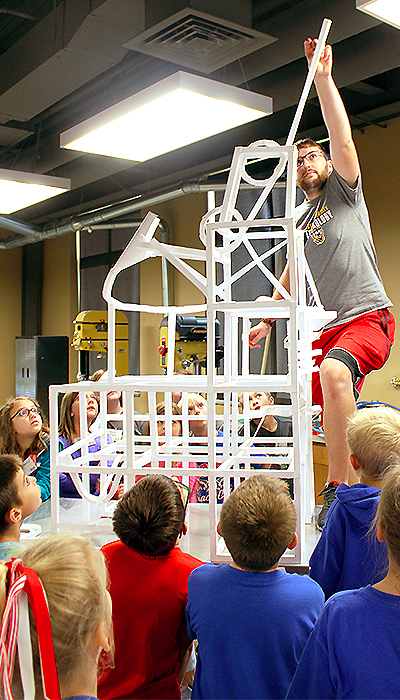
The students also visited with two authors, visited a bookstore created especially for them and visited the Center of Applied Technology building where they observed paper roller coasters and robot demonstrations.
Carrie Tholstrup, coordinator in the College of Education, said the tour at the Center for Applied Technology allowed students to better understand building materials.
“Our theme is ‘Reduce, Reuse, Recycle,’ so we were excited to have the paper roller coasters because we can show students you can make things out of unusual materials like maybe they wouldn’t have expected to make a roller coaster out of paper,” she said.
“We want to show them the principals of engineering and mathematics and that you can do fun things with those concepts.”
The Hays Public Library announced it will dedicate funds to each Hays USD 489 school library.
Vera Elwood, young adult librarian, announced the cooperative project at the USD 489 school board meeting Monday night. She said the first funds have already been requested.
“Our No. 1 goal at the Hays Public Library has always been is to get more books and more resources in the hands of more people, but particularly to the kids and students who need them most,” Elwood said. “We incredibly value working with schools and being able to work with USD 489 to reach out to those kids who are not always able come into our library for a lot of different reasons.”
The books that will be purchased with the HPL funds will stay at the schools and will not come back to the HPL unless they are no longer needed at the schools.
“The point of this was to empower and put that ability in the hands of staff that you have already determined to be so capable to make sure they have the resources they need to serve their students,” she said.
In addition, Elwood announced the HPL will be kicking off fundraising to purchase a book vending machine for Hays High School. She said the machine will be high tech and have many choices from which students can choose.
These two projects are just the latest developments in a partnership that has been growing over the last two years.
When schools in the district started its Reading Workshop program, teachers and school librarians realized they would need more books to accommodate the program than they had.
HPL checked out books to the schools in volume. It also offered books for temporary displays at the schools.
HPL staff helped students in groups and one on one to select books for book reports that were in line with teachers’ lesson plans.
Most recently, HPL conducted a library card drive. More than 650 students at HMS now have library cards. Students will not only be able to check out paper books, but be able to download ebooks.
Library staff will also be on hand at HMS and HHS for an upcoming teen book event.
Superintendent John Thissen thanked the library staff for their help.
“It is great to end up working with brilliant people. The brilliance of this is that we should have that collaboration — any community should have that collaboration between their library and schools’ libraries,” he said. “We have Individuals on the same page and it is the same book we are working from. We are really trying to do the same thing. …
“In the long run, who is going to benefits? It is going to be the children.”
Victor E. Tiger graces the Cunningham Hall foot bridge at FHSU
By DIANE GASPER-O’BRIEN FHSU University Relations and Marketing
Fort Hays State University students walking to Cunningham Hall by way of the Cunningham walking bridge for early morning classes today were greeted by a huge glowing Victor E. Tiger on the east end of the bridge.
The bright black, white and gold university mascot was installed Monday morning by Commercial Sign Co., Hays. RDH Electric coordinated the electrical connections to the sign, which is controlled by a photo cell and lit up for the first time about dusk on Monday.
Two freshmen were excited when they learned they were the first students to see the new Tiger lit up Monday evening.
Mattie Ross, an agriculture business major from Toponas, Colo., is a member of the women’s track and field squad. Dakota Blaylock, a computer science major from Halstead, runs for the men’s cross country and track teams.
They had been attending an event for student-athletes in Cunningham Hall and were returning to their residence halls with full plates of pizza when they descended the steps and saw the Tiger.
“It definitely adds more light,” Blaylock said.
“That’s pretty cool,” Ross said.
The bridge was built in 1973 as a means for crossing Big Creek to the new Cunningham Hall and adjoining Gross Memorial Coliseum.
The only way to reach the bridge for many years was by foot or bicycle, as the nearest street was one that dead-ended several hundred feet from the bridge near Wooster Place Apartments.
For four decades, the cement wall appeared as nothing more than an end support for the 486-foot long bridge.
The bridge became more visible in 2013 when Dwight Drive was extended across the top of the Big Creek levee to merge with Gustad Drive – the road connecting the main campus to Gross Coliseum and the Robbins Center.
Dana Cunningham, director of facilities planning at FHSU, his staff has been discussing for some time that the cement wall was a perfect spot for a Tiger.
When funds were made available by the FHSU administration for a Tiger sign this past summer, Cunningham began making plans with Commercial Sign Co. to manufacture and install Victor E. Tiger by Homecoming weekend.
A 10-by-10 foot digitally printed Victor E. Tiger, covered by a UV laminate, was stretched across the face of the frame. LED lights behind the face provide the illumination.
Dr. Charmane Kandt remembers walking across Cunningham bridge while working on her master’s degree at Fort Hays State in the mid-1980s. Kandt, now an instructor of health and human performance and coordinator of the Neuromuscular Wellness Center on campus, happened to be riding her bicycle on the FHSU campus Monday night.
“That Tiger is awesome,” Kandt said. “I think it will be especially great when people cross the bridge for basketball games, and there will just be even more light for students walking to night classes.”
Cunningham – no relation to Dr. Morton C. Cunningham, the fifth president of FHSU for whom Cunningham Hall and the bridge were named – said the project is just another example of the university partnering with the community of Hays.
The Hays branch of Commercial Sign Co. employs two FHSU graduates, Kaylene Gabel and Matt Eberle, in the company’s graphic design department.
Joe Leiker, manager of the Hays branch, said the complexity of the Tiger logo created a challenge but that the fabricators came through in flying colors.
“This was all was pretty exciting for us, too,” Leiker said. “We had some of our employees go out and take pictures of the Tiger lit up last night. After all this, we kind of jumped on board and decided to participate in Tiger Gold on Friday.”
Tiger Gold on Friday is a partnership among FHSU Athletics, the FHSU Alumni Association, University Relations and Marketing, the Hays Area Chamber of Commerce and Eagle Communications. The committee is leading an effort to establish a tradition of wearing Tiger Gold every Friday.
That tradition has caught on at Commercial Sign Co.
“We now have Commercial Sign gold shirts,” Leiker said, “to wear on Fridays.”
Braden Mahin of Lincoln, Kansas, works on the radiator of a car in his auto mechanics class at NCK Tech in Hays.
Editor’s note: This is the third in series about technical training for a new workforce.
By CRISTINA JANNEY Hays Post
Nineteen-year-old Braden Mahin of Lincoln wants to work on electric cars.
He came to Hays to study auto mechanics at North Central Kansas Technical College right out of high school with no real experience working on cars.
“I have always had an interest in cars ever since I can remember,” he said. “I just wanted to know how they worked, and I never had anyone to teach me, so I thought coming here I would learn everything I needed to learn.”
Mahin is one of many students who are skipping college in favor of a technical education.
NCK Tech officials say the demand for their graduates is high — and their stats prove it. The technical college has been No. 1 in the nation in student placement two years in a row.
Richard Cox, auto instructor and former NCK Tech student, has worked for years to cultivate relationships in the auto industry and boasts of a 95 percent placement rate for his students.
Eric Burks, NCK Tech president, said enrollment at the technical school has remained steady, but insists there is a strong demand for trade skills now and will be in the future.
“We train in programs [and] jobs that are needed right here in Hays and in the communities these students come from. They have been needed for a long time, and I think they are going to continue to be needed for a long time. I think it is just the technology within those trades that is going to change,” Burks said. “The tools they use to do those jobs are going to change, but we are always going to need a plumber, we are always going to need a nurse, we are always going to need someone to fix our vehicles.”
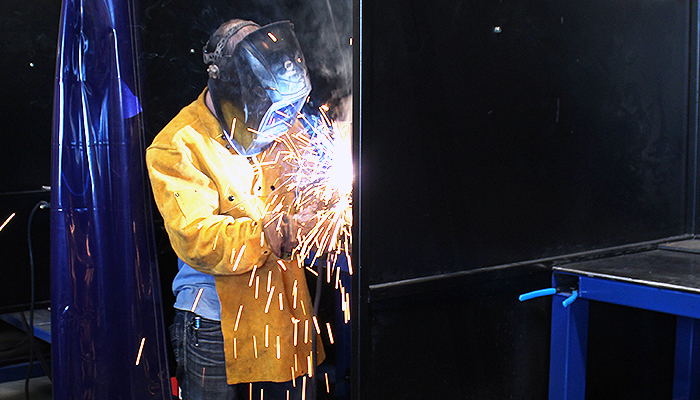
An NCK-Tech student works on a welding project. The college boasts of the best placement rate for students in the nation.
The economy is demanding skill sets, Burks said.
“Knowledge is great, and we want people who are very knowledgable, but at the end of the day, what can you do with that knowledge?” Burks said. “Just knowing it is one thing, but you have to be able to actually apply it. That is where these technical skills really become the difference maker for someone who not only has the knowledge of it, but the working ability to apply that knowledge.”
Sandra Gottschalk, dean of the Hays campus, said students learn their skills by doing.
“It’s a lot of hand-on practice,” she said. “With that hands-on practice, they get more skilled and they get more confident and more proficient. They learn the fundamentals in the course, but it is that hands-on experience that is what ties it together.”
Burks and Gottschalk said as they work with high schools, they are seeing a shift to more focus on technical education.
“I think it is because that is where the jobs are,” Burks said. “Not to keep going back to that job placement, but we have no trouble helping our students find jobs They have to meet a few requirements, but we guarantee placement, and that is because they are in such high demand.”
Burks said K-12 schools are seeing not everyone is headed to a four-year college.
“There is definitely that push toward technical because that’s what is needed, and it is also going to give our economy the boost that it needs,” Burks said. “If we push everyone into those four-year degrees, then we are not going to have enough people to do the other things that really need to be done, and they are high-paying jobs. It is not people who are living on the other side of the tracks. These are [people] living next door to four-year graduates. The quality of life is right there the same.”
As Burks addresses high school students he tries to dispel myths about vocational training.
“They are not choosing a lesser life if they go this route,” Burks said. “They may choose less debt if they just go through two years. A lot of these trades are highly sought after, and if they are skilled, they can get paid very well and very comparable to a four-year degree. …
An NCK Tech welding student grinds off an edge in the new Center for Applied Technology on the FHSU campus.
“Obviously, it is going to depend on their skill and how hard they work at it, but the sky is limit for someone who is disciplined, like we talked about earlier, and talented.”
Costs continue to rise for four-year degrees. Students going to a technical school are likely looking at less debt and being able to enter the workforce in their field sooner.
Most students graduate in nine to 18 months with tuition, tools, and room and board costs ranging from $5,900 to $15,000 per year. Costs usually drop for subsequent semesters as students do not need to repeat tool purchases.
Burks said we often think of education as linear, but for many students it is not. He said he thinks recent legislation and articulation agreements with universities like Fort Hays State University are making it easier for students to continue their education at a later date.
“Maybe they got some skills through their high school credits, and they want to go out and work for a little bit. Then they realize, ‘I need to upgrade my skills if I want to up my wages,'” he said. “So they will come to us for a year, go back and work in the field for a little while, and they will come back for another year and get some more skills and go back. We have tried to build this system, so if they want to do it linear and go one year after the next, great, but that is not how all students are going to work through this.”
Because NCK Tech is a technical college, students can start with NCK Tech and go on to a four-year college.
FHSU saw the growing need for trade leaders and constructed the new Center for Applied Technology on its Hays campus.
The building is housing students from both NCK Tech for classes, such as welding, and FHSU students who are training for applied technology degrees to be tomorrow’s managers and foremen.
FHSU has a bachelor of science in technology studies and a bachelor of science in technology leadership. These degrees are between technical degrees and engineering science degrees at a Division I school, said Kim Stewart, FHSU’s Department for Applied Technology chairman.
Students go on to be construction managers, project managers, superintendents, 3-D modelers or building information systems managers.
Just as NCK-Tech sees a blend of traditional and non-traditional students, so doses FHSU’s Department for Applied Technology.
In the department’s leadership program, students can transfer 40 hours from a technical or community college degrees and plug them into the bachelor’s degree program at FHSU. General education credits can also be applied.
The FHSU program is interdisciplinary with business, communication and leadership classes. This is an all online degree because most of these students have already developed their technical skills and are working and have positioned themselves to move up in their companies, Stewart said.
FHSU has had articulation agreements with other institutions for years, but it is recently revisiting those and making it easier for students to see and understand how courses they are taking at vocational or community colleges will fit into bachelor’s degrees at FHSU.
“I think it is going to open up avenues, based on students being able to see the path that is going to take to get to their educational goal,” Stewart said.
Stewart is seeing a growing demand for the department’s program’s and its graduates. Five years ago, the college started its construction management program with two students, and now it has 50. Many students are being recruited as juniors during their internships.
“There is a demand for labor people,” Stewart said, “and the more labor people that we have — those that have technical skills — means that we need more people to manage those people. So our niche is to create those people who can go out and be the project managers and superintendents — the people who work with the engineers.”
Misael Banderas is a 2016 FHSU graduate in construction management. He started working on construction sites when he was in high school and currently works as a senior project engineer for McCown Gordon Construction of Kansas City, Mo.
He said he was able to pick a company where he thought he could thrive professionally and personally.
“I think the biggest misconception that a lot of students have within the region is that they have to go to a KU or a K-State or an OSU for you to have the position that I have,” he said. “I can assure you based on opportunities that have come up for myself, I am driving my own career. I have been blessed with multiple, very exciting opportunities from the world’s No. 6 company in the world.”
He said his hands-on experience allows him to better relate to the people he now manages.
“My memories were all started with a shovel,” he said.
Banderas said he is proud to be a FHSU graduate and is now trying to open doors for other FHSU students at his company.
“I reached out to our talent development team and took a trip to recruit out of Hays,” he said. “I think moving forward we are going to have a partnership where we are reaching out every summer to try to have students as interns. If they work out, if they use every opportunity to grow, hopefully [we can] bring them on board when they graduate.”
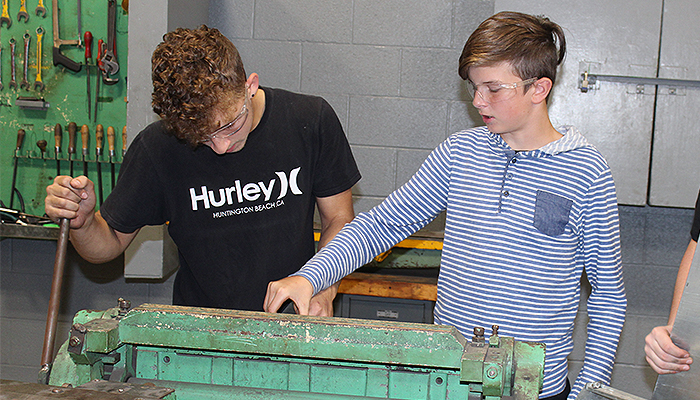
Larry Defoi, sophomore, and Devin Mayfield, freshman, work on a project in a beginning metals class at Hays High School. The Kansas Department of Education has 16 pathways in its Career Technical Education program.
Editor’s note: This is the second in a series about technical training for a new workforce.
By CRISTINA JANNEY Hays Post
At one time, students in high school were told the passport to prosperity led through college and was stamped with a four-year degree.
Although for certain students this is still going to be the case, the Kansas Department of Education has begun to acknowledge in its new accreditation process four-year degrees are not the answer for all students.
“They want to make sure we are tending to the needs of the students from the point of not just focusing on four-year college or four-year university degrees,” Hays USD 489 Superintendent John Thissen said. “They definitely want to focus on trying to prep children to work on HVAC systems, to be plumbers, to end up being an electrician, to be a welder.
“All of these are important jobs, and they are needed and they pay quite well too. We have a history in our school of not paying as much attention to prepping students for those areas.”
The new push is to create individual plans of study that highlight students’ strengths and allow them to explore career opportunities. This is includes many current and emerging careers that will require some sort of post-secondary trade education or certification. The students take surveys through the Career Cruising program that help them refine career choices.
Thissen said the assumption used to be “smart kids” all went to college. That now is not necessarily the case.
“It is crazy to think we would expect our kids to graduate from high school, go to a university, spend four years there and then realize that what I really want to do is be an electrician. That is ludicrous. It doesn’t make sense,” Thissen said. “We should do a better job of prepping the kids through public schools in K-12 that at least they have a good enough direction that they know what they want to do and they are not wasting their own time and their money.”
Sabrina Brown and Luke Letters, both HHS freshman, work on metals projects. The state’s new accreditation project includes individual plans of study, which allow students to explore careers.
KSDE supports 16 career pathways, which are careers the State of Kansas deems as high-tech, high-demand and high-wage, said Chris Dinkel, HHS industrial technology teacher.
Some of these include construction trades; metals and manufacturing; agriculture; business; consumer science; and radio/TV. Many of the pathways require a two-year degree or certificate and then students can go straight to work.
The demand for skilled workers is increasing, and so the education model needs to change with it, according to Dinkel.
Since the turn of the century, about 20 percent of the population were professionals, Dinkel said. They have at least a four-year degree and perhaps higher. These are doctors, lawyers, accountants, therapists, etc. That percentage has not changed per capita much in the last 80 years.
The majority of the remaining workers in the 1920s were unskilled. That has flipped in the last 30 years to a high percentage of skilled laborers.
“Kids coming out of school need to have some type of training, period,” Dinkel said.
Thissen said the KSDE is pushing districts to offer students paths to trade certifications while still in high school. This could be a welding, OSHA safety or Microsoft Office certification.
Matthew Bollig, HHS freshman, handles a piece of sheet metal. HHS teachers work with students on soft skills as well as learning trade skills in the CTE program.
Thissen said students are responding to Career and Technology Education offerings at the high school. The district is considering changing its hiring to accommodate what are now oversized welding classes.
Dinkel, who has been a CTE teacher for almost 30 years, said this need for skilled workers has been recognized, but states, including Kansas, still have challenges in meeting the needs of industry.
Focus on core curriculum and four-year professional training is an important part of K-12 education and must be an academic focal point, he said. However, it’s as important educators recognize the academics and skills needed for those students choosing CTE paths, Dinkel said.
Students who are in CTE pathways might not need calculus, but they might need industry-relevant math and English.
CTE has become increasingly oriented on cooperative learning and project learning. A student learns skills and practices them by building something in metal shop or wood shop. Students take a project from beginning to end and fit their skill sets into that project. There is more focus on skill development than there used to be, Dinkel said.
Schools are also trying to build cross-disciplinary cooperation. Students in a drafting class develop plans for a metal project or part. They learn in metals class how to use those plans to program the CNC plasma cutter. They then use welding skills to assemble the pieces into a final product.
The math instructors are also seeking floor plans from building trades teachers to create real-life problems to use in their classes.
Thissen said the district continues to try to expand its hands-on experiences for students. Hays High students can gain on-air experience on a new HHS radio station that launched last school year. The district IT department is also in talks with the administration about involving students in helping other students or teachers solve technology issues.
In some pathways, students can work in their fields through summer jobs or internships. However, now legally you have to be at least 18 to even operate a drill on a construction site. However, Dinkel said even working entry-level, service job can show a future employer a young person has the soft skills they need to be successful in a trade job later.
Another important thread is providing parents with information about careers within CTE pathways and the opportunities they provide.
Starting wages for technical school graduates are now higher than those for four-year college graduates.
Dinkel said he sees his job as preparing students to have the ability to make a choice between going straight to work, going to a technical school or to a four-year college or higher.
The Career and Technical Education program or CTE has an advisory board made up of people who work in the pathways the high school offers.
They generally say they have three levels of employee. The first level is entry-level. An employee can read, write, do basic math, show up to work on time and has the ability to work with others.
The second level is an employee is someone with some training. They may have a skill, such as welding.
The third level is a person with formal training, certification or experience.
“What industry is telling us is that if I can get someone to show up on time, to be honest and be able to work cooperatively, many of them will say, ‘I will train the rest because I can’t even find that,’ ” Dinkel said. ” ‘I can’t even find someone to show up on time and put in an eight-hour day.’ ”
Thissen said he also hears from employers their need for soft skills among future workers.
“They are finding there are a lot of students that graduate high school who may be knowledgable, but are very much lacking in what we would almost say are common-sense issues,” Thissen said.
Thissen said teaching students these needed skills is almost a hidden curriculum across all classes. He gave the example of mock interviews that were being conducted at the high school by the English department. Students not only learn how to create a written resume, but the practical skills of how to dress and speak during an interview.
“We even see people who are coming in for jobs for the school, and they come in 10 minutes late for an interview. That is already not a good sign, and they may show up in shorts and a tank top—very inappropriate dress for an interview,” Thissen said.
Dinkel said he thought young people have high expectations.
“Young people want to come in and make 12 bucks an hour right off the bat,” he said. “That salary is just not going to be there. That’s not high, but if they can’t make $10 plus an hour, it is below them.”
Dinkel said educators continue to struggle to keep up with evolving industries they are training young people to enter after graduation. Recently the metal shop received a grant to purchase a computer numerical control plasma cutter. Dinkel said CNC is really the direction industry is headed, but Hays is behind other schools who have had the technology for years.
For most, HHS needs another CTE instructor. The school can’t offer robotics, code reading, CNC, or materials and processes, which includes plastics, because the school does not have the staff or the space to do so.
Wood shop classes have 20 to 25 students, which Dinkel said borders on dangerous.
The district sought to expand and remodel its CTE space as part of a recent failed bond election. Thissen said he would still like to see work down in this area of the high school to better use the space and expand the school’s class offerings.
Dinkel sad he thought more young people would stay in the Hays area if there were more high-tech, high-paying jobs. However, the most abundant jobs continue to be lower-paying service jobs.
“It is kind of like fighting Peter to pay Paul,” he said. “Service-related jobs are not going to provide the type of salary that people need to live in this area because the cost of living is pretty high. It is a nasty circle here, because if you bring high-tech jobs in, what are you going to need — more service-related jobs. So which pool are you pulling from?”