We have a brand new updated website! Click here to check it out!

NEW ECONOMY: Lack of skilled workers biggest barrier to Ellis County growth

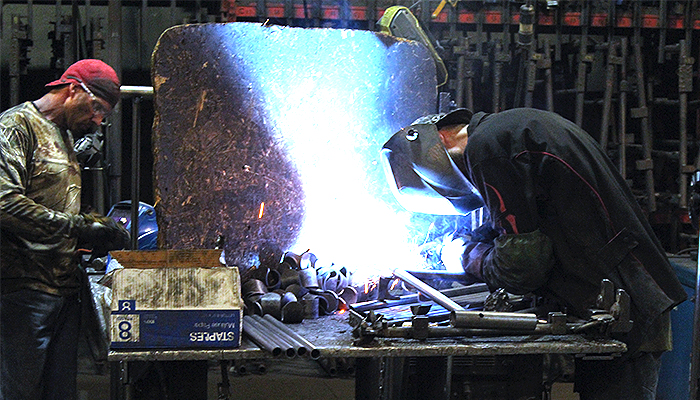
A worker welds a piece of equipment at A-1 Scaffolding in Hays.

Editor’s note: This is the first in a series about technical training for a new workforce.

By CRISTINA JANNEY
Hays Post

Finding qualified workers to meet the demand of Ellis County’s growing industries is the biggest obstacle to growing its economy, said the interim director of the Hays-area economic development agency.

Doug Williams, Grow Hays interim director, said Ellis County’s problem is a combination of low unemployment and lack of skilled workers.

“If a company cannot find capable workers, they are going to go some place where they can,” he said. “They are not only not going to grow with those workers they would potentially employ, but they are also going to potentially take the workers they have out of our community. It is a big problem, so that is why it is a high priority for us.”

Unemployment in Ellis County remains low at 2.9 percent as of July. Unemployment hit a 25-year low of 2 percent in October 2017. The Ellis County unemployment rate hasn’t been more than 4 percent since right after the 2008 recession.

“We have a very low unemployment rate,” Williams said. “Really the rate of unemployment would tell you anyone not working probably is choosing not to work. But what we are trying to do is increase skills amongst the workforce so they can get a better job or a higher-paying job because those are critical to our area, not just minimum-wage jobs, but technical jobs where they have a skill and can earn a higher living so they can buy a home, buy a car and live a better life and provide more economic growth.”

During the early 1990s, Dwight Allenbaugh was recruited to bring his A-1 Scaffolding business to Hays because the community needed employers. Today, Allenbaugh struggles to find employees of any skill level.

“It is not so much a need for skilled workers,” he said. “It is being in need of anybody that wants to work. The absence of workforce is huge.”

He said he thought a lack of affordable housing was a significant contributor to lack of workers.

“The cost of housing is way too high compared to Salina, Wichita, anywhere else in Kansas. It’s way too high,” Allenbaugh said. “For people to be able to afford housing here, they have to be in the $20 to $25 an hour range.”

A-1 Scaffolding owner Dwight Allenbaugh said he would hire at least six more employees at his Hays plant if he could find them.

Allenbaugh said he can’t keep up with that wage and stay competitive nationally.

He said he struggles to find workers with basic soft skills, such as showing up on time. He said the company used to have a policy that no-call, no-show meant automatic termination. Now he said he has had to ease such basic policies to maintain his workforce.

“It’s gone from a job interview to fog a mirror. If you can fog this mirror, you are hired,” he said.

A-1 Scaffolding implemented an Earn as You Learn program. A-1 starts new, unskilled workers out at about $9 an hour. He allows unskilled workers to spend the last hour or two of the day in the shop practicing their welding skills. As workers prove themselves, they are promoted quickly and given raises.

Grow Hays is trying to help match employer demands with the available workforce by promoting training programs.

“I do think it is more important than it has been in the past,” Williams said of vocational training. “For no other reason, there seems to be a huge shortage of technical workers. We work with manufacturers locally, and we constantly hear from them they can’t find qualified workers.

“We have taken the position as an engine for economic growth here in Ellis County, we need to come up with programs educate workers and provide more qualified workers to the job market, and that is what we are trying to do.”

A-1 Scaffolding has an Earn as you Learn program. Workers spend the last hour of the day learning to more advanced skills, such as welding.

Williams said employers are saying they especially see a need for welders and CDL drivers. Allenbaugh said having more welders in the workforce would benefit his recruiting efforts.

The demand for truck drivers is on the rise nationwide, according to the Bureau of Labor Statistics. Demand is anticipated to grow by 6 percent between 2016 and 2026.

NPR, in a January article, said an American Trucking Associations report indicated more than 70 percent of goods consumed in the U.S. are moved by truck, and the industry needs to hire almost 900,000 more drivers to meet rising demand. The current trucker pool is also aging, with the Bureau of Labor Statistics reporting the average age of a trucker at 55 years old.

The bureau stated the median pay for drivers nationally was $42,480 per year in 2017.

Most truck drivers have high school diplomas, but attend truck driving school to attain the commercial driver’s license needed for the profession. Until this fall, the closest truck driving course was offered through NCK Tech in Beloit.

However, this fall a new free class will be offered at NCK Tech in Hays. Funding for establishing the class and a another welding class the partners hope to offer before the end of the year came from a $200,000 grant from the Dane G. Hansen Foundation.

Students in the program will have both in-class and in-truck experience.

See related story: Applications open for free CDL course

See related story: MORAN: The DRIVE-Safe Act and Myth vs. Fact

“The theory is that we can turn out workers. They may not be able to step into a job and do what the company needs, but they have a basic skill level, and the company can then train them to specs they would want,” Williams said.

“We solve two problems,” he said. “We take someone who is not making a lot of money and having a tough time making ends meet and give them the opportunity to get to a higher level of pay. We also solve the problems that the companies have of finding qualified workers so they can get their products out of the door and continue to grow.”

Williams said the gap between what white-collar workers make and blue workers make is closing. This in addition to changes in emphasis in K-12 education in Kansas on career readiness may lead to more emphasis being placed on teaching trade skills in schools.

“I know some electricians, some plumbers, some welders, they can make a very good living now doing what they do in a technical capacity. I don’t think that has always been the case,” Williams said. “Historically the path to a really good, high-paying job was always through a four-year institution or a master’s — that kind of thing. I don’t think that is quite the path that it once was.”

Allenbaugh said vocational training in high school or at a technical school can be an option that can lead to good-paying jobs.

“I think vo-tech is an awesome for people who want to learn skills,” he said. “I think that is a good place to start. …

“It gives kids an option. They feel so much pressure to continue their education and go to higher education. They take it for granted their next step is college. Maybe there are some people who shouldn’t be in college.”

And it is not just young men who are going into the trades anymore.

Trade jobs, manufacturing and truck driving have been historically male-dominated. Only about 6 percent of truck drivers are women, according to the American Trucking Associations. However, Williams said some of those stereotypes and barriers are beginning to break down, and there is room for women in the new skilled workforce.

Filling the gaps in the workforce is not a problem that will be solved overnight, Williams said.

“It is not going to be something that we can find skilled workers easily,” he said. “It is going to take time, but every program that we put on that we can bring eight to 10 through, brings eight to 10 people into the job force that have a set of skills that they didn’t have before.”
Holy Family time capsule unearthed 20 years later

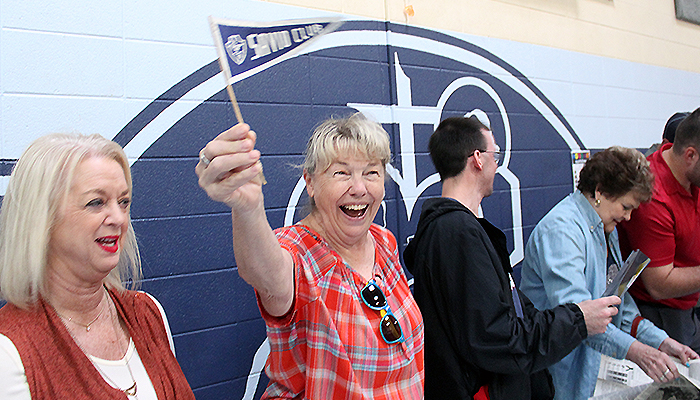
Shirley Dinkel, long-time Holy Family, teacher waves a Savio Club flag she found in a 20-year-old time capsule opened at the school Friday.

By CRISTINA JANNEY
Hays Post

A computer disk, newspaper articles, a green M&M character and a tiny handmade paper box containing a rosary were among the items unearthed Friday morning from a 20-year-old Holy Family Elementary School time capsule.

The enclosed PVC tube was buried in 1998 when the Catholic Diocese opened Holy Family in the former Jefferson Elementary School building at 1800 Milner.

Shirley Dinkel, a longtime teacher at Holy Family, was at the unearthing of the time capsule. She retired in May after 39 years as a teacher. Dinkel, now 69, was pictured in a newspaper article that was found in the time capsule about the opening of the new school.

“The community was so happy for us,” Dinkel said of the new school, “that we were getting a bigger location and we were actually going to be contained in one building. Before that, we were always moving over to Kennedy or another building — the CIC we called them in those days. We had a gym and our own cafeteria and Mass right there in our own building. It was almost like utopia to us and air conditioning and no stairs hardly.

“Honestly, I dreadfully missed St. Joe even with all of those accommodations that made it so better for the kids.”

Items that were found in a Holy Family time capsule that was buried in 1998 and unearthed Friday.

Dinkel waved a tiny flag from the Dominique Savio Club that she found in the time capsule. The club helped raise money for the poor — about $2,000 per year. Dinkel bought used toys at garage sales or people donated items. They also sold candy and pop. The children earned certificates for the club through donations and their reading program. Several of those 20-year-old certificates were also in the time capsule.

For Christmas gifts for the children’s parents, the students in their math class folded wallpaper samples into tiny gift boxes. One of these handmade boxes along with a rosary tucked inside was placed in the time capsule.

All of the teachers and the students at the time wrote notes to their future selves, and former teacher and students both were delighted Friday to read these yellow postcards, some of which had the students’ school pictures attached.

“I love my class and my new school,” Dinkel wrote on her card.

She talked about her one grandchild. Now she has 10. She wrote about missing her mother after her recent death and spending time with her father.

“I love teaching. I love my family and home, and I love God,” she wrote on the card.

Dinkel said that card was very special to her and she intended to keep it.

“It almost brings me to tears that I got to be part of a legacy like this,” she said.

The time capsule was buried near the Holy Family sign 20 years ago and unearthed Friday in time for the TMP homecoming weekend.

Madison Quimby, 28, of Hays was a third-grade student when the time capsule was buried.

“It’s exciting,” she said. “It is a little overwhelming to see everything. It is really fun to think back and reminisce.”

Quimby wrote on her card that she missed her old school, but she was excited to be at a new school, she made a new friend and she liked her teacher.

Quimby is back at Holy Family in her first year teaching sixth grade.

“I think that it is still the same family that it always has been,” she said of Holy Family. “It still has the deep roots. I think it has grown because what I see is that it is expanding and there are more students and there is more staff, but there is still that tight-knit family I remember as a student.”

Kelsey Stupka, 31, of Hays, who was a sixth-grade student when the time capsule was buried, said opening the capsule was a blast from the past.

“It is a rush of memories to see all of these things and go through them” she said.

The children from Holy family also made some predictions about 2018, which were read to the current Holy Family students. See some of those are below.

• A man or woman will walk on the planet Mars.
• Automobiles will no longer be fueled by gasoline.
• Digital TV will make action appear as if it is taking place in our living rooms.
• More than half of us will work from our homes, communicating via computers.
• Most homes will be equipped with video phones.
• Most annual publications will be replaced by CD-Rom disks.
• Pocket-size cellular phones will become a staple for all youth and adults.
• More than 75 percent of homes will own personal computers.
• Cars will be equipped with sensors to guide them to their destinations and avoid hazards.

Cause of Thursday house fire in Hays under investigation

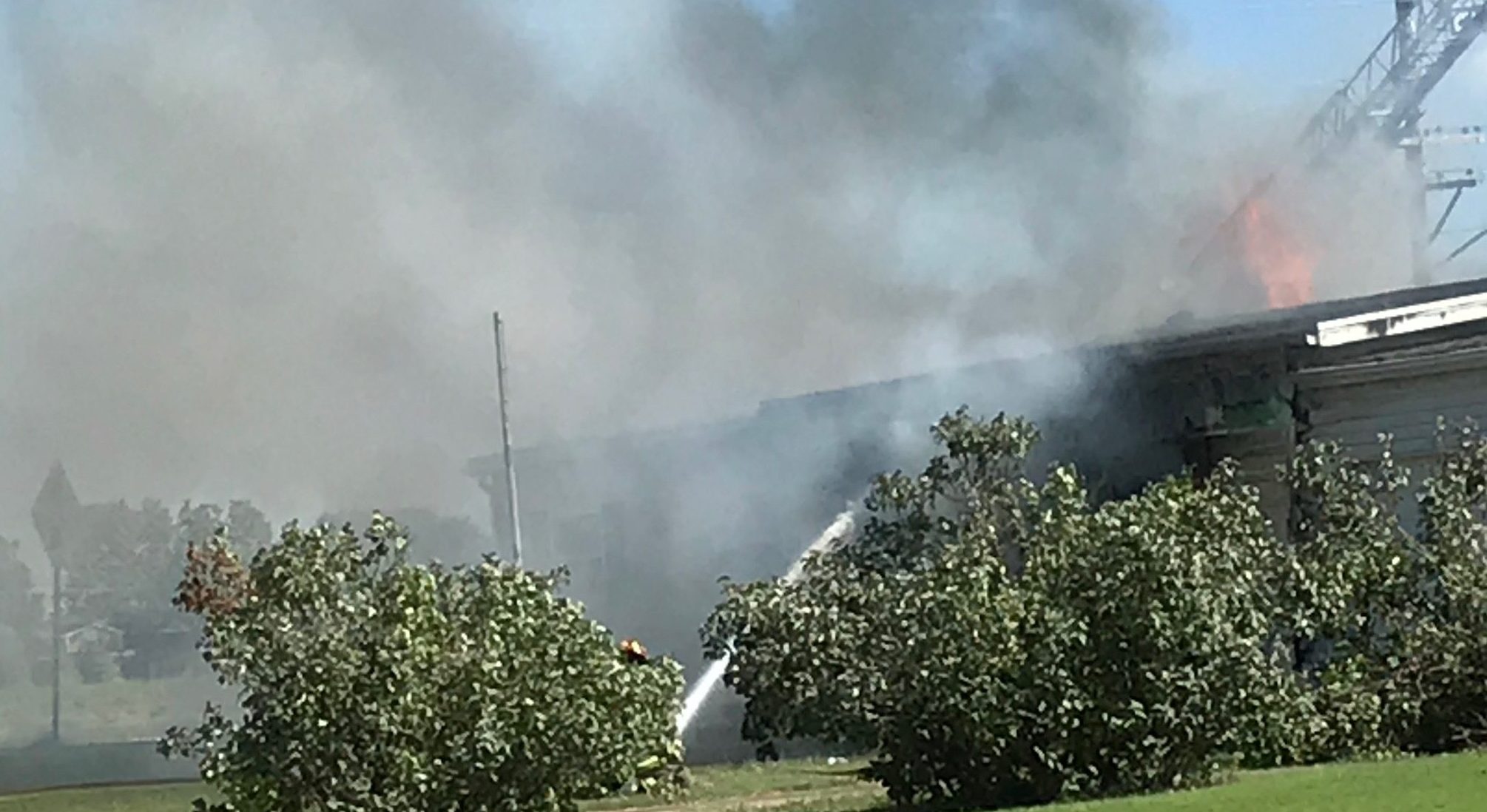
At 3:05 p.m. Thursday, city of Hays emergency dispatchers were notified of a structure fire at 2212 E 15th. The Hays Fire Department, assisted by Ellis County Fire Department Company 5, Hays Police Department and Ellis County EMS, was immediately dispatched.

Arriving firefighters found the house fully engulfed in flames. Fire crews placed three hose lines in service to control the flames.

The cause of the fire is being investigated by the Hays Police Department assisted by the Hays Fire Department and an investigator from the Kansas State Fire Marshal’s Office.

Five firetrucks and 17 firefighters responded. The last crew left the scene at 9 p.m.

“Your Hays firefighters would like to remind everyone to call 911 promptly when a fire occurs,” the HFD said in a news release. “Fires can grow and spread very quickly. Having the fire department on the way as soon as possible can help to limit the damage from a fire.”

FHSU’s Science Café explores why we eat what we eat

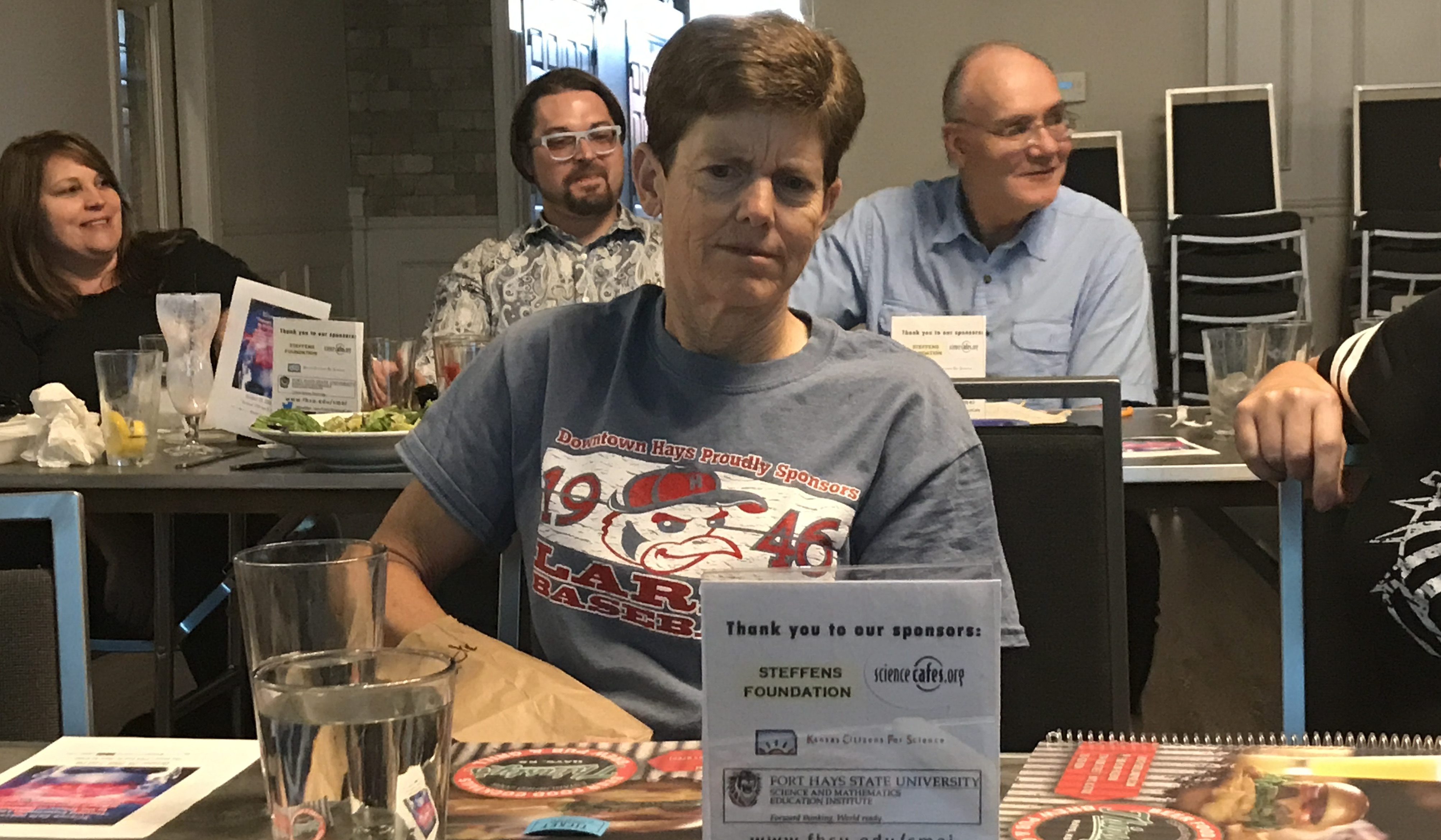
An audience member at the Science Cafe tries to determine what food is in a bag. The items were marshmallows.

By CRISTINA JANNEY
Hays Post

You probably thought picking something to eat was all about taste — something that you did with your tongue.

But Associate Professor Glen McNeil, MS, RD/LD of Fort Hays State University, set out Monday night to demonstrate food choice has much more  involved. It relates to all your senses, emotions and external factors, such as education, religion and culture.

At the first Science Café at Thirsty’s Venue, McNeil started to look at food selection by looking at taste. That can be broken down into salty, sweet, sour, bitter and umami. Umami is flavor we experience from broths and cooked meets.

“So what we do is we take these five components and combine them now with texture, temperature and odor and that produces flavor,” he said.

Although some taste receptors are more concentrated on certain parts of the tongue than others, there are food receptors for all five tastes all over the tongue.

Humans have an acquired taste for the five tastes. He used the example of salt.

“The more you use, the longer you use it, the more it takes to taste the salt,” he said. “If you add salt to your plate before you ever taste it, why? You don’t even know if it needs salt or not. It’s habit.”

If you add enough salt to something until you taste it, you have added too much, he said. Salt is a flavor enhancer.

Glen McNeil

McNeil challenged the audience to try to stop salting their food and eating foods high in salt for three days and then go back to adding the same amount of salt they had in the past.

He said they will see a marked difference in how salty things taste.

McNeil gave a couple of examples of foods that start sweet and then go to bitter, such as a tomato. Artificial sweeteners, especially the early ones like Saccharin, started out intensely sweet and then made a bitter aftertaste on the back of the tongue and throat.

McNeil then had his audience explore food through sight. He asked each person in the room to take a jelly bean out of a paper bag and try to determine what it would taste like based on its appearance. They then tasted the jelly beans. Some people had guessed their flavors correctly, others had not and still others could not put a name to the flavor of their jelly beans.

He then held up a bright yellow banana. Some people said the banana was ripe. Others said it was green.

Ripe bananas are actually mostly brown, soft and are more sweet — too sweet for most people, he said. Green bananas are more starchy.

“What we see is not always what food is meant to be,” he said.

Color can be important in affecting our food choices and perceptions of foods.

“We eat with our eyes,” McNeil said. “We make choices and selections with our eyes. We begin to associate colors with foods from shortly after birth.”

Food processors use coloring to affect our food choices. Strawberry milk has no strawberries in it. It has artificial coloring to make it pink and a mix of chemicals to make sweet.

We associate certain colors with certain favors. Some relate red with spicy like a red peppers.

People associate blue sports drinks with a sweeter taste, despite the fact they are flavored no differently and have no more sweetener than the other colors.

Perception also has effected portion size. A bottle of pop used to be eight ounces. Now a standard bottled beverage is 20 ounces. Bagels used to be three inches. Now they are they can barely fit in your hand. Hamburger patties used to be 10 per one pound of beef. Now the standard is a quarter pound.

“Serving sizes have grown as we have gotten into looking at them, looking at how much they fill a plate, looking at what we see,” McNeil said.

McNeil also brought audience participation into his program with a hearing test. His wife, behind a screen, popped popcorn, opened a pop, snapped celery, opened a bag of chips and bit into an apple.

“Sounds drive us to make selections in foods,” he said. “Sounds are used to judge quality in foods and what we see.”
To demonstrate how we use touch in food selection, McNeil prepared paper bags and asked audience members to identify the contents only by touching them. The items were marshmallows.

“Touch tells a lot of things, and there are two ways we touch,” he said. “We can touch with our fingers. We can also touch with our tongues. There are different ways to sense.”

Finally to illustrate smell, McNeil prepared bags full of peanuts.

Although you primarily take in aromas through your nose, you can also take in odors through your mouth.

Food manufactures take advantage of our sense of smell to entice us to eat certain products. They look for chemical signatures that produce the strongest response in consumers.

“Every smell has a chemical formula they can replicate,” McNeil said.

People are also conditioned to eat certain foods culturally, noting the Catholic custom of eating fish on Fridays.

Some people in Kansas eat mountain oysters, which are cattle testicles.

McNeil and his family lived in eastern Kentucky for a couple of years. One of his students had to miss class because she needed to go home and help her family castrate hogs. The family usually fed the testicles to their dogs.

McNeil asked the young women to bring him some of the testicles. He and his wife fried them and ate them.

“They thought I was nuts,” he said. “When she graduated the only thing her dad wanted to do was meet me. He came up and said, ‘Mr. McNeil, I just had to meet a guy who would eat testicles.’ We do that all the time at home. You eat head cheese. That is not overly appealing to us and chitlins and tripe, which is not bad, but it is different.”

Money, fads, nutrition knowledge, level of education, peer influence, time, temperature, and likes and dislikes all affect our food choices.

“The further you go in the educational system, whether it is formal or informal, the more educated we become, the broader your palate becomes — the more likely you are to try new and different foods and experiment with foods. It gets us out and we meet other people and we hear things and some people travel,” McNeil said.

Local environments also dictate the availability of certain foods. On the coasts, produce and seafood are more abundant. In Kansas, beef and pork is more available.

In the winter, we usually eat more soups and chilis.

“We eat warm foods,” he said. “We also have a tendency to eat more because it is cold out and here comes our genetic heritage. We need a little more fuel.”

Hunger is the physical sign your body gives you that you need food. Appetite is the psychological signal our body gives us about food, and that also affects food choices.

Marketers play on these emotions.

Perkins restaurant was struggling, so it created a commercial in which it panned across a table full of pancakes and pie with a simple theme song touting its name in the background. Sales soared. 7 Up used a radio commercial that depicted the sound of ice clinking in a glass, the pop pouring and then someone drinking the beverage. It was very successful.

You can see a video of the full presentation at www.fhsu.edu/smei.

The next Science Café titled “Thought Experiments Leading to the Theory of Relativity” by Dr. CD Clark III, associate professor of physics at FHSU, will be at 7 p.m. Oct. 29 at Thirsty’s Venue, 2704 Vine St.


Homecoming 2018 royalty finalists announced at Fort Hays State

FHSU University Relations

Royalty finalists for Homecoming 2018 at Fort Hays State University have been announced by the Homecoming Committee.

“This year there were 29 Homecoming Royalty nominees representing 20 different student organizations and groups,” said Brittney Squire, from FHSU’s Center for Student Involvement. “Each nominee’s application was reviewed and scored by members of the Homecoming Coordinating Committee in order to select the top five finalists for king and queen.”

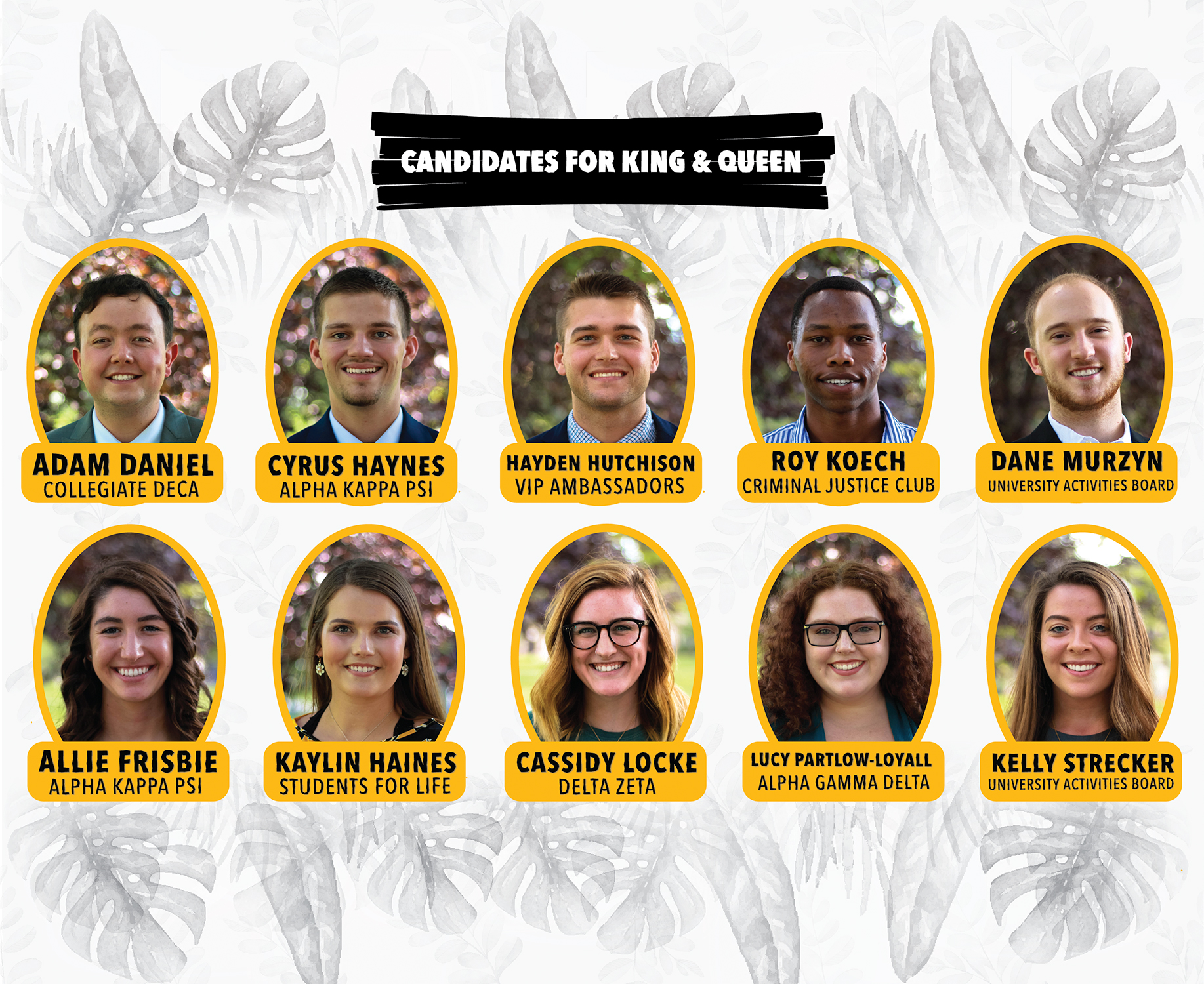
This year’s Homecoming Royalty Finalists are:

Queen:
• Anna-Lura Frisbie, McDonald senior, representing Alpha Kappa Psi. She is an accounting major.
• Kaylin Haines, Topeka senior, representing Students for Life. She is a management major.
• Cassidy Locke, Wichita senior, representing Delta Zeta. She is an English education major.
• Lucille Partlow-Loyall, Colorado Springs, Colo., senior, representing Alpha Gamma Delta. She is a social work major.
• Kelly Strecker, Highlands Ranch, Colo., senior, representing the University Activities Board. She is a physics major.

King:
• Adam Daniel, Arriba, Colo., senior, representing Collegiate DECA. He is a tourism and hospitality management major.
• Cyrus Haynes, Hays senior, representing Alpha Kappa Psi. He is a tourism and hospitality management major.
• Hayden Hutchison, Hays senior, representing the VIP Ambassadors. He is a management major.
• Roy Koech, Russell junior, representing the Criminal Justice Club. He is a criminal justice major.
• Dane Murzyn, Brighton, Colo., junior, representing University Activities Board. He is an organizational leadership major.

A new event at this year’s Homecoming schedule is the Homecoming Week Kickoff from 11 a.m. to 1 p.m. Monday, Sept. 24, sponsored by the Office of the President, the Center for Student Involvement and the University Activities Board.

FHSU President Tisa Mason will deliver a welcome, finalists for Homecoming royalty will be introduced and guitarist Sam Burchfield will provide the music.

The student body vote for king and queen will be from 9 a.m. Wednesday, Sept. 26, until noon Friday, Sept. 28 on TigerLink. Students can also vote in the Memorial Union from 11 a.m. to 1 p.m. on Wednesday, Sept. 26, and Thursday, Sept. 27.

The royalty finalists will lead the Victor E. March to the Tiger Pep Rally Thursday night. The Victor E. March starts at 7 p.m. at Tiger Village and Stadium Place Apartments and will weave through campus before arriving at Gross Memorial Coliseum for the start of the pep rally at 7:30.

The finalists will also participate in the Homecoming Parade through downtown Hays on Saturday, Sept. 29. The parade starts at 1 p.m.

The king and queen will be announced at halftime of the Homecoming football game against Central Oklahoma University on Saturday, Sept. 29. The football game kicks off at 7 p.m.

Laughing Matters teaches local children literacy skills

By CRISTINA JANNEY

Hays Post

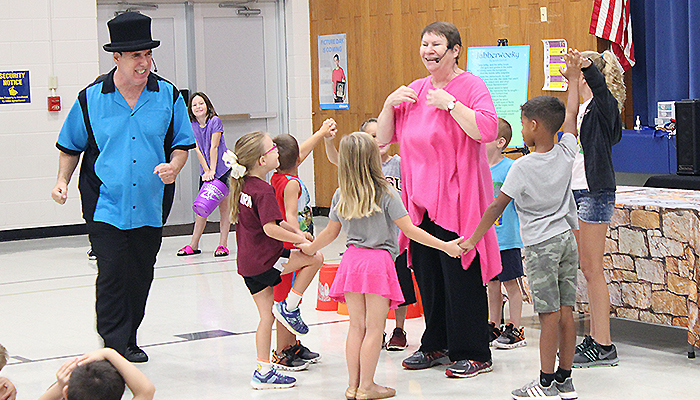
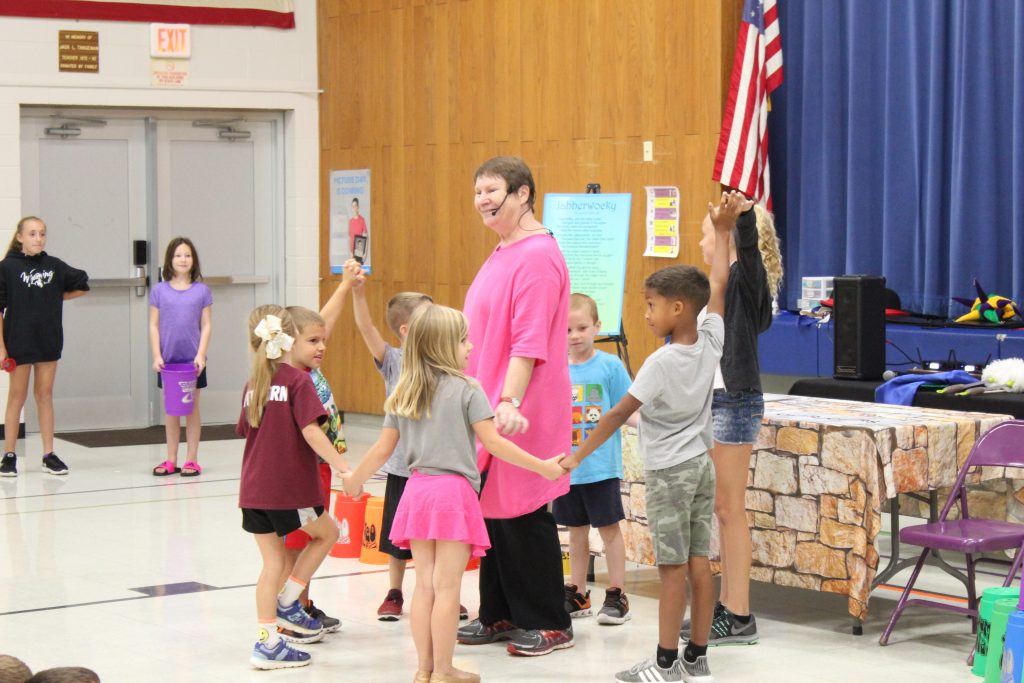
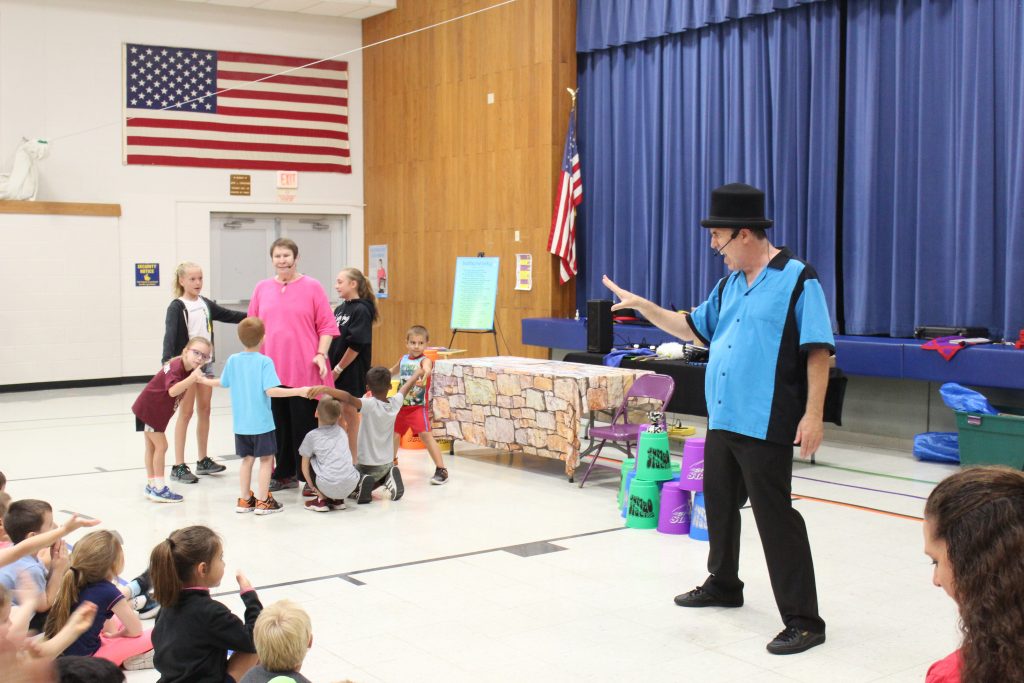
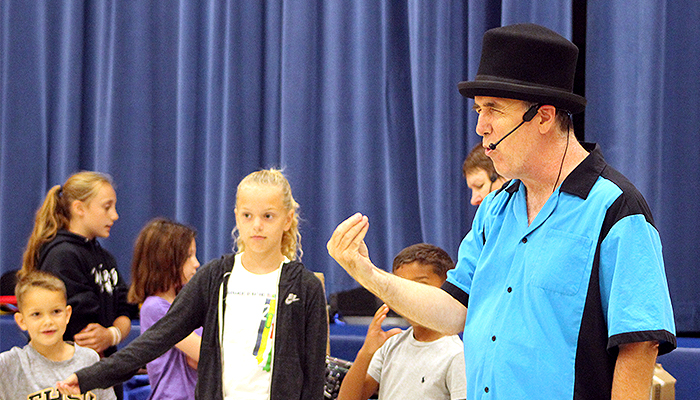
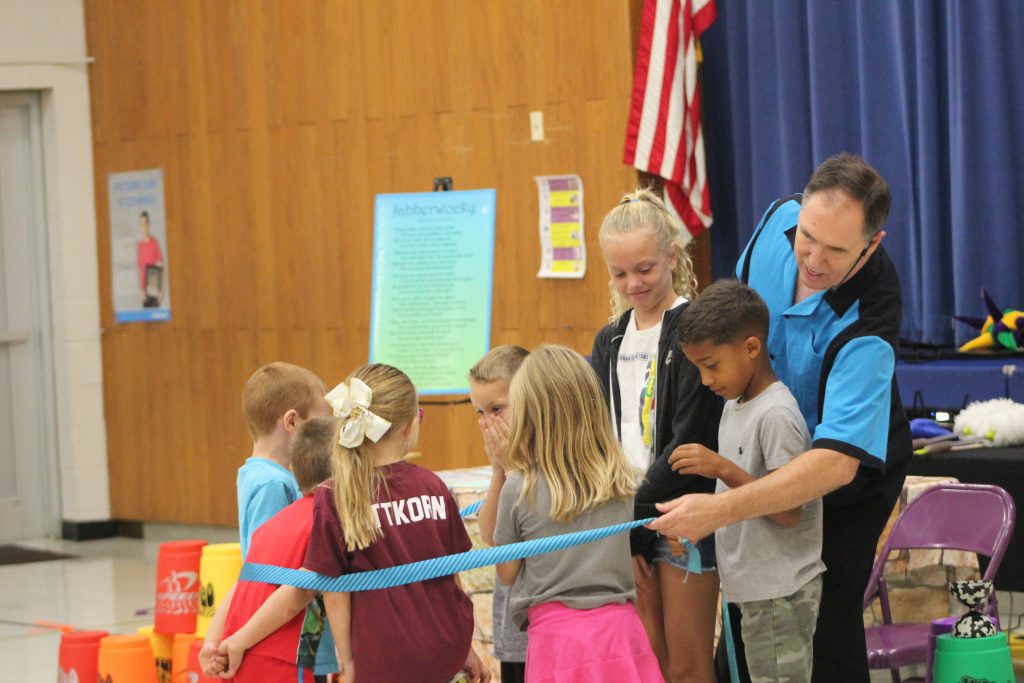
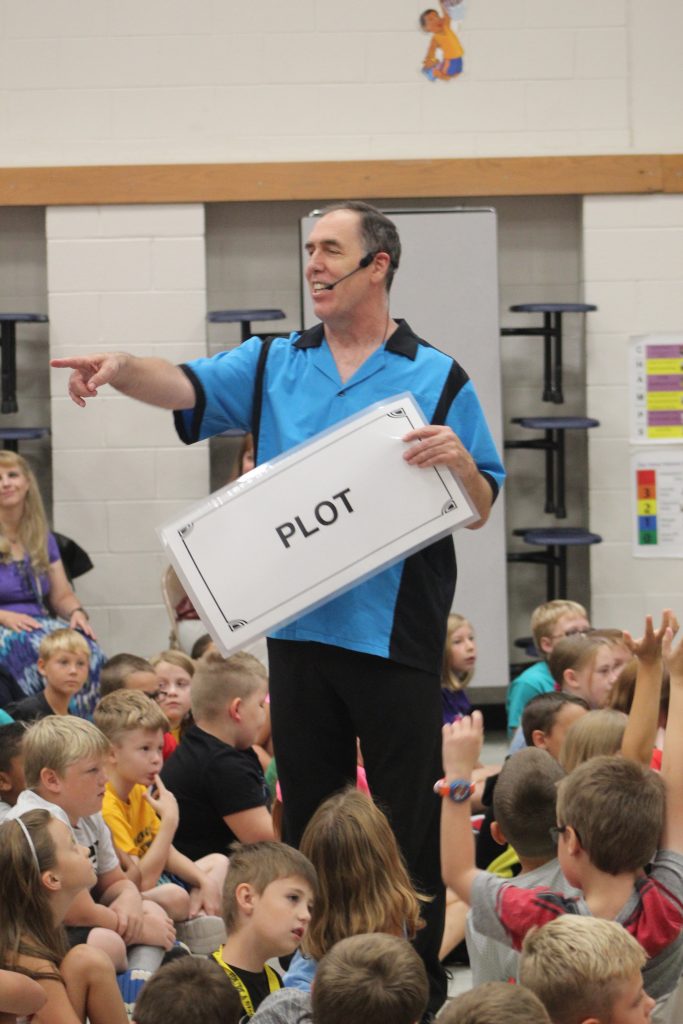
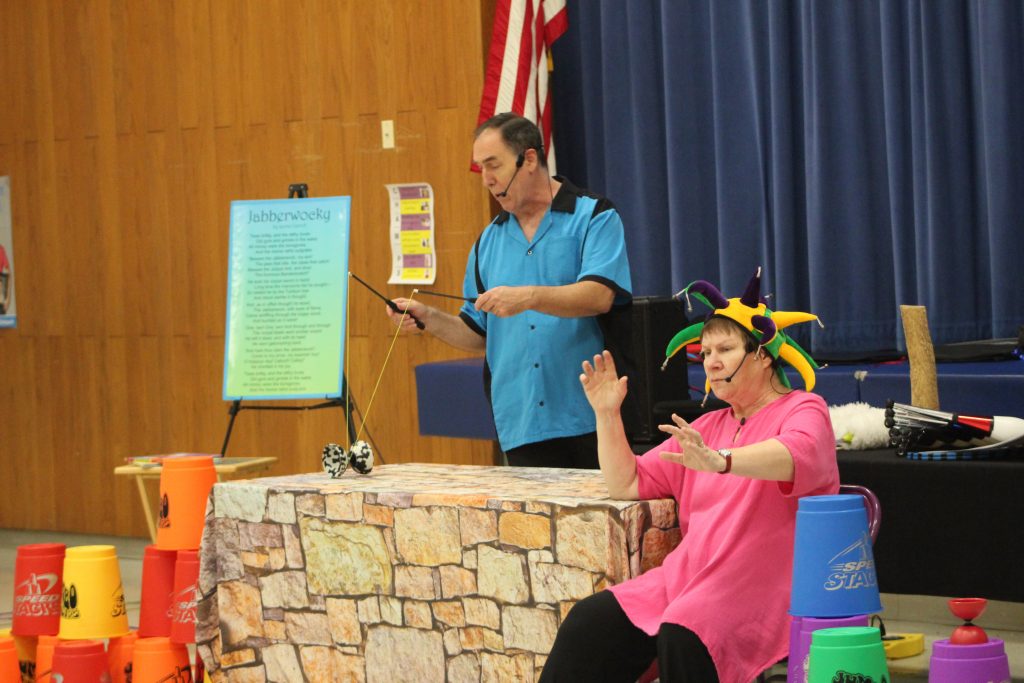
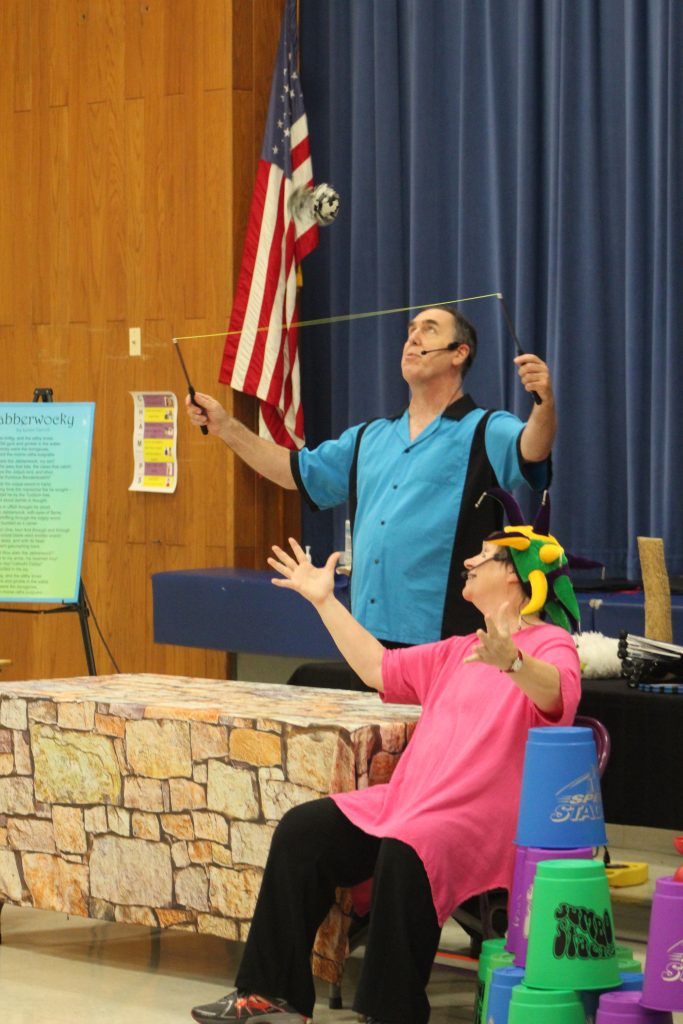
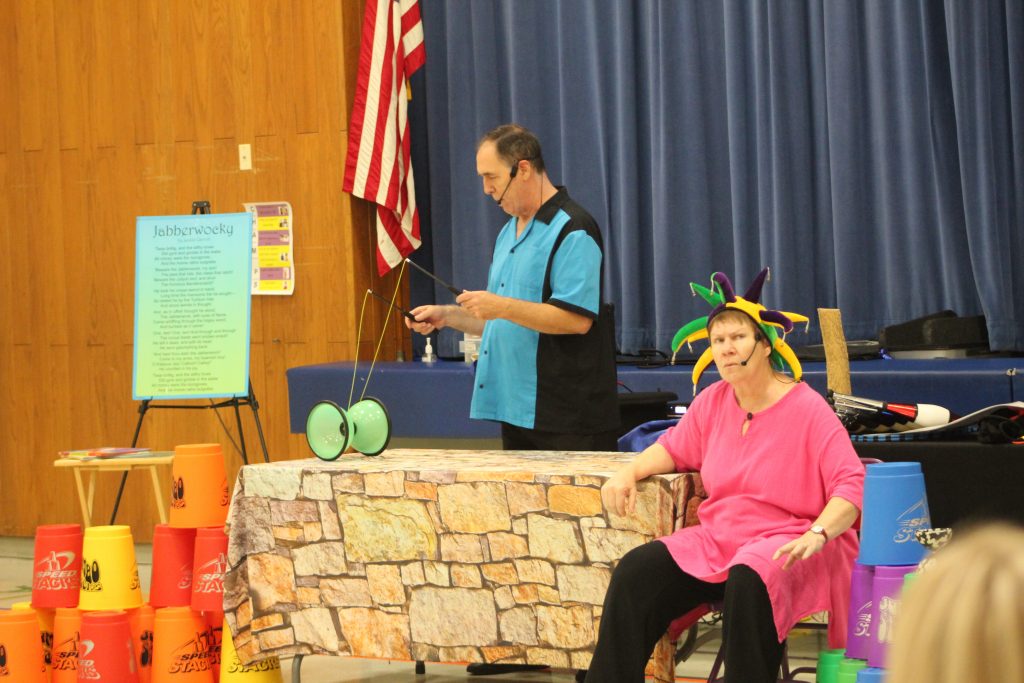
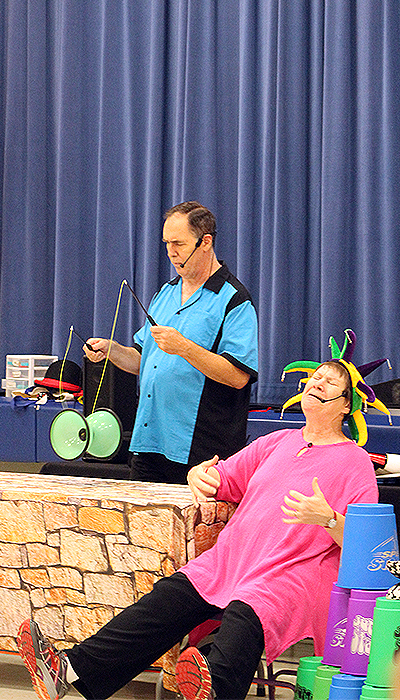
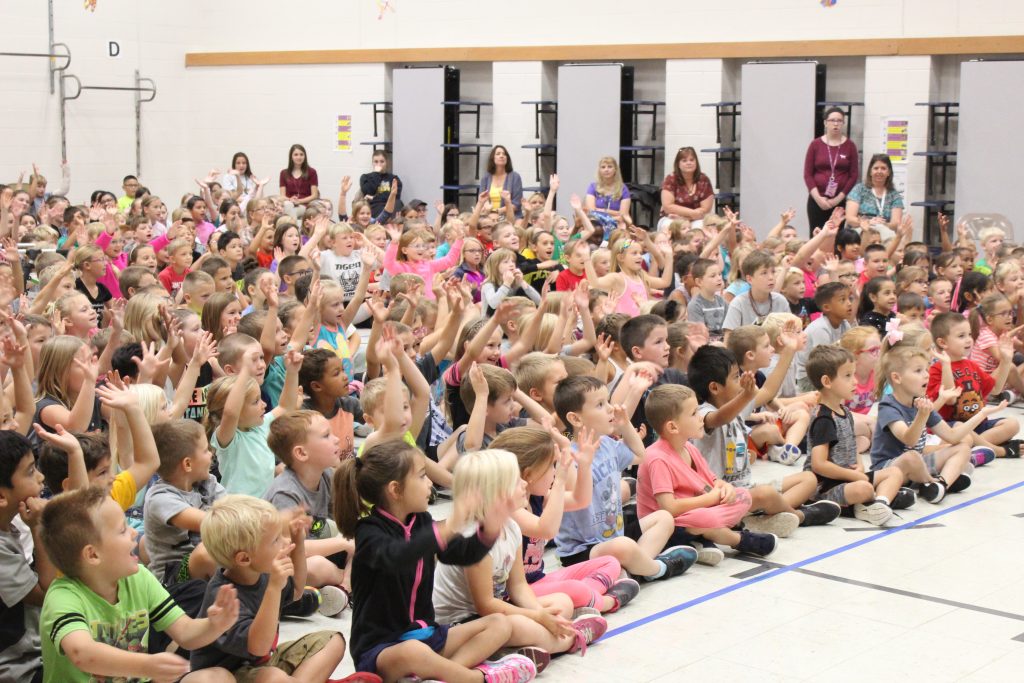
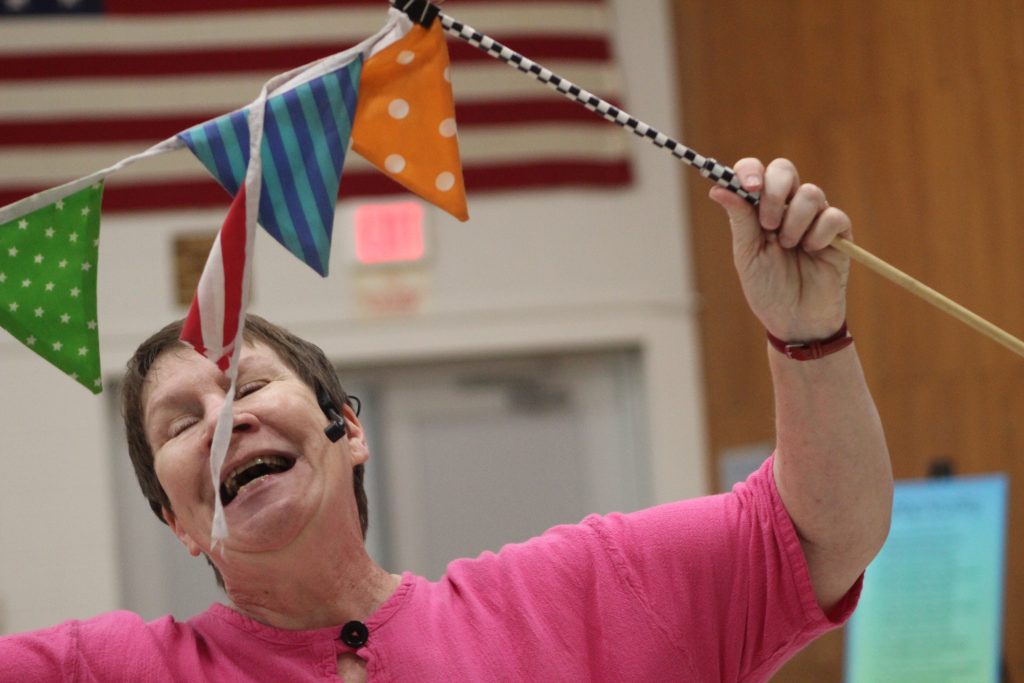
Jay and Leslie Cady—known as “Laughing Matters”—performed for children at Roosevelt Elementary School Tuesday morning.

The comic duo will be performing for children across the area thanks to the sponsorship of the Hays Arts Council.

The Cadys have performed for the HAC before. This year’s performance, “Tales with a Point: Fables and Fairy Tales,” focused on literacy skills.

The Cadys treated the children to a series of Aesop’s tales, which included “The Three Little Pigs,” “The Tortoise and the Hare,” and ” The Three Billy Goats Gruff.” The actors also portrayed the poem the “Jabberwocky.”

Through the laughs and hijinks, the kids learned about parts of the stories, including characters, plot and setting.

Full-time professional entertainers since 1980, the Cadys have performed more than 6,000 times in 36 states and seven foreign counties.

For this year’s public performance, the HAC has arranged for Laughing Matters to participate in Early Childhood Connection’s “Go Truck, Go!” event on Thursday with their roving performances taking place from 5:30 to 6:30 p.m. at the National Guard Armory in Hays.

TMP-M announces 2018 Homecoming Court

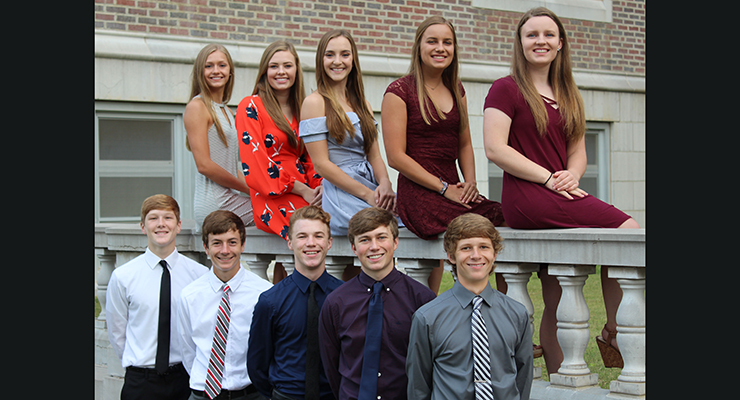
Top Row Left to Right: Emily Schippers, Aubry Appelhans, Jillian Lowe, Tiffany Pfeifer, Leanne Rack. Bottom Row Left to Right: Grant Ginther, Ethan Lang, Bryce Hickman, Cameron Rozean, Sheldon Weber.

TMP-M

Thomas More Prep-Marian, along with the TMP-M Alumni Association have announced this year’s homecoming candidates.

Thursday, Sept. 20, kicks off homecoming with the Hot Dog Feed & Bake Sale/Bonfire. The homecoming crowning will take place at halftime of the football game vs. Hoisington of Friday, Sept. 21. Events will continue through the weekend and wrap up at the homecoming banquet on Saturday, September 22.

Click HERE for the full itinerary of homecoming events.

Grant Ginther and Emily Schippers – Grant is the son of Doug & Melissa Ginther and Emily is the daughter of Troy & Geralyn Schippers.

Ethan Lang and Aubry Appelhans – Ethan is the son of Greg (Class of 1994) and LaNae (Class of 1994) Lang and Aubry is the daughter of Chris & Lori Appelhans.

Bryce Hickman and Jillian Lowe – Bryce is the son of Troy Hickman and Mary Hickman and Jillian is the daughter of Jeff & Jana Lowe.

Cameron Rozean and Tiffany Pfeifer – Cameron is the son of Travis & Jill (Class of 1996) Rozean and Tiffany is the daughter of Gerald & Marcia Pfeifer.

Sheldon Weber and Leanne Rack – Sheldon is the son of Bill & Tiffany Weber and Leanne is the daughter of Marvin & Jennifer Rack.

Colby photographer among the winners of Ranchland Trust contest

Winning photo by Crystal Socha, Augusta

Winners have been announced for the seventh annual Ranchland Trust of Kansas (RTK) photo contest, which concluded Aug. 15.

Each summer, RTK invites photographers of all ages to submit photos that showcase the mission of RTK and Kansas’ ranching heritage. The mission of RTK is: “To preserve Kansas’ ranching heritage and open spaces for future generations through the conservation of working landscapes.”

Crystal Socha of Augusta was the grand prize winner in this year’s contest. Socha also won the Fan Favorite category by receiving 378 votes on RTK’s Facebook page. This was the first time a photo won both the Fan Favorite and Grand Prize categories. Her winning photo, titled Keeping Watch, was taken in the Flint Hills in Butler County.

“I am speechless. Not in a million years did I think I would win both categories nor would I win the grand prize two years in a row!” Socha said.

Over 3,000 votes were cast for the Fan Favorite category, which included the top 25 photos chosen by RTK’s panel of judges. The Facebook album was able to reach nearly 9,000 Facebook users. Thank you to all who viewed and voted for these beautiful Kansas photos.

Additional winners in each category were: Landscape – Bruce Hogle, Leawood; Livestock– Alexis Clark, Lecompton; People – Mike Scheufler, Augusta; KLA Member – Howard Woodbury, Quenemo; Youth – Josie Roggenkamp, Blaine; and Honorable Mentions – Gail Griffin, Colby; Michael Cochran, Tescott; Josie Alexander, Ottawa; and Greg Kramos, Manhattan. All winning entries can be viewed on RTK’s website or Facebook page.

Gail Griffin’s photo

Prizes, sponsored by Wolfe’s Camera of Topeka, are awarded to the top 10 winning photographers. The photographs will be used, with the permission of the photographer, to promote Kansas’ ranching heritage and open spaces.

RTK will have photo stationery cards for sale throughout the year featuring the 10 winning photos. Printed on premium cardstock, the folded cards are blank inside and come in packs of 10 with white envelopes. The card packages can be purchased for $20 by contacting Samantha Weishaar at 785-273-5115 or [email protected].

RTK is an agricultural land trust affiliate of the Kansas Livestock Association, with a mission to preserve Kansas’ ranching heritage and open spaces for future generations through the conservation of working landscapes.

HAYP’s annual Adult Prom to raise money for ARC park

By CRISTINA JANNEY
Hays Post

The annual Adult Prom will raise money for the Hays Accessible Recreation Complex, a project being led by ARC of Central Plains.

The fourth-annual event will be Friday, Oct. 12, at the Rose Garden Banquet Hall, 2350 E. Eighth.

Audrey Werth, Hays Area Young Professionals member, said of the park “We just see the benefit it is going to bring for the entire community, especially for those who it is targeted for — kids with disabilities and really people of all ages who will be able to use it. We just want to be a part of the community, so any way we can help, we want to do that.”

This year’s theme is “ARC Across the Sky.” This brings together the elements of a starry night and the ARC fundraising effort.

The event includes a social hour from 6 to 7 p.m., dinner from 7 to 8 p.m. and dance from 8 p.m. to midnight.

Hays Area Young Professionals is sponsoring the event; however, it is open to the public (21 and older). Tickets are $30 per person. Table reservations can be made for tables of six.

Tickets are on sale through Sept. 27 at the following locations: Hays Area Chamber of Commerce (2700 Vine), Platinum Group (116 E. 11th) and The ARC (600 Main).

Although many will be wearing formal attire, you do not have to rent a tux or wear a formal dress to attend.

“It can be as big as you want to make it,” Werth said. “Just have fun with it.”

For more information, contact the Hays Area Chamber of Commerce at [email protected] or visit Hays Accessible Recreation Complex on Facebook.

Thunder on the Plains attracts young, old

By CRISTINA JANNEY

Hays Post

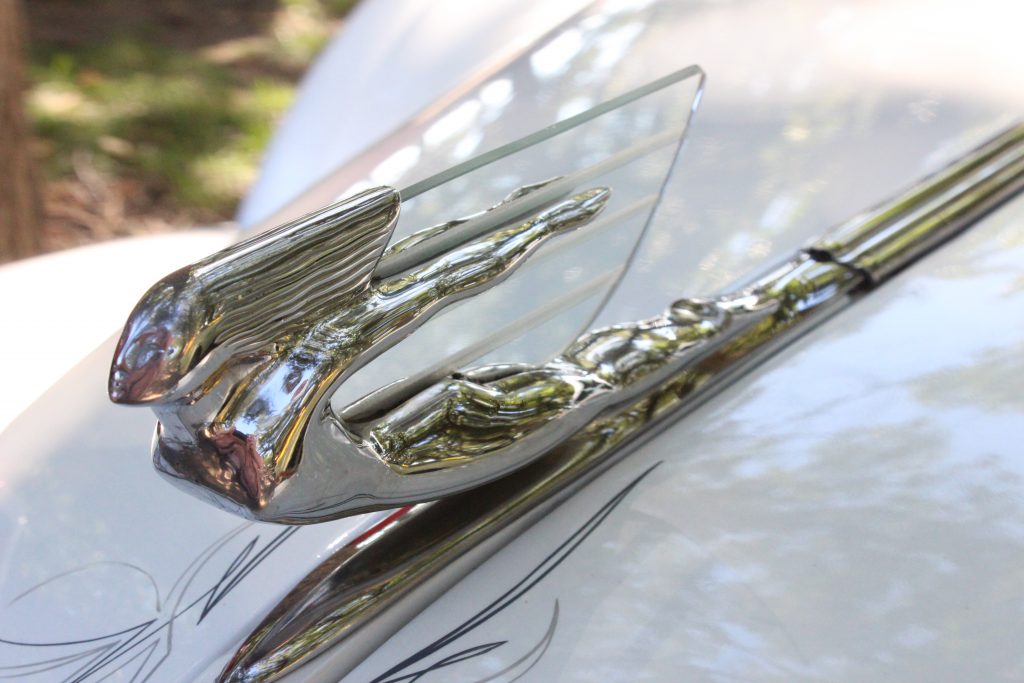
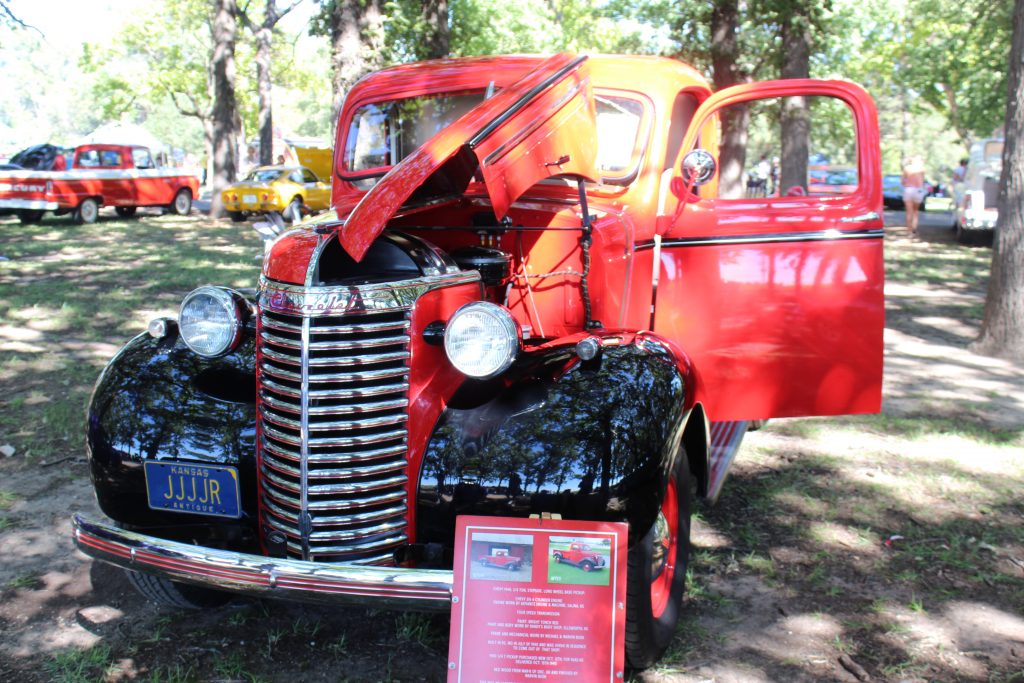
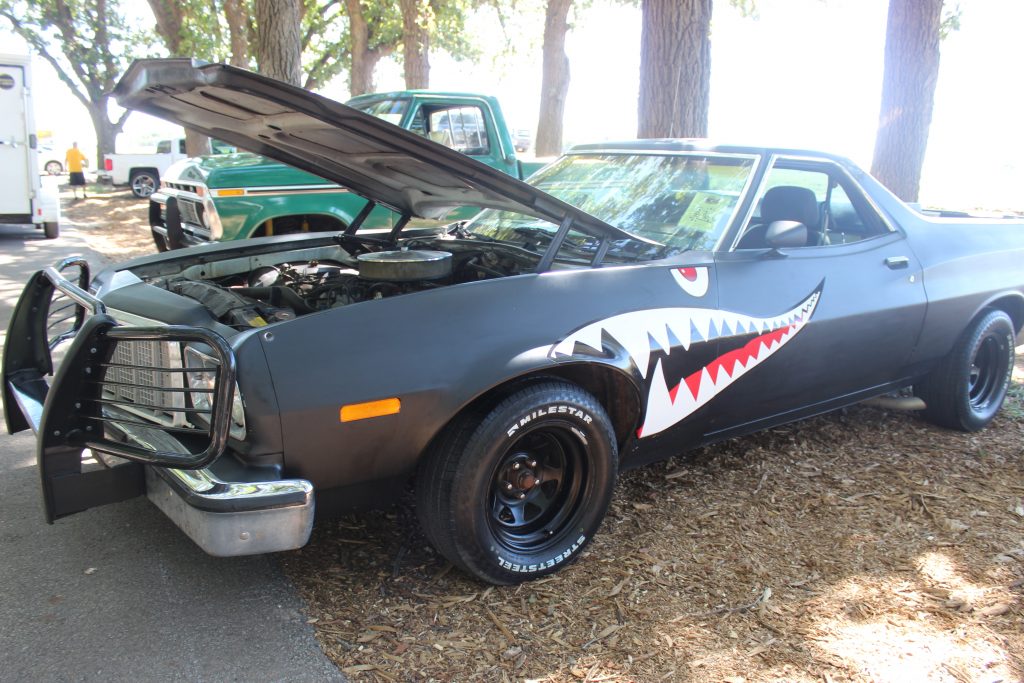
It was a breezy, but otherwise a pleasant day for a car show Saturday in Frontier Park.

The annual Thunder on the Plains car show attracted more than 180 cars, trucks and motorcycles.

“We are really happy with it,” said Jackie Lang, event volunteer, of the turnout. “This is the first time we have had it on our own.”

The event used to be downtown and co-sponsored with the Downtown Hays Development Corp.

Allen and Marie Leiker of Hays brought their 1959 Chevy Impala to the show.

Allen had a ’59 Impala when he was in high school. During his Vietnam service, he asked his father to sell the car.

“It took me 40 more years to find another one and bring it home and restore it,” he said.

Allen has owned this Impala for about 10 years. Allen and Marie said they still enjoy driving the car.

“We have to cruise Main at least once,” Marie said when they take the car out for a spin.

Thunder on the Plains is one of about six or seven car shows the Leikers attend with the Impala every year, but they said they particularly enjoy bring the Impala out for Thunder on the Plains.

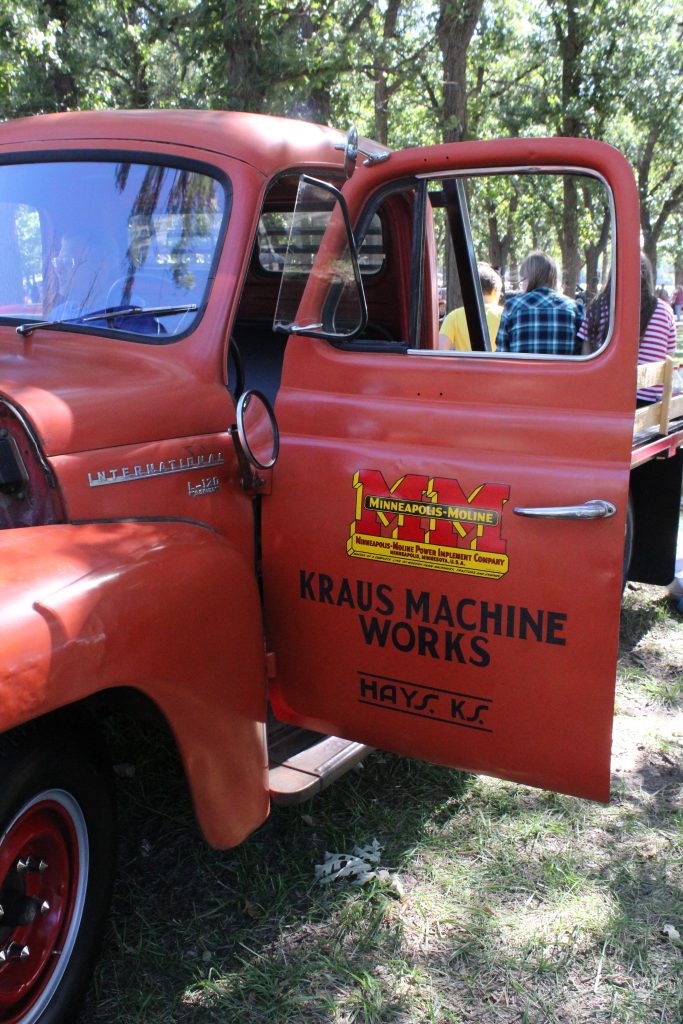
Harold Kraus of Hays attended the car show with his son who brought a 1952 International truck and Whizzer bike that had belonged to Harold when he was younger.

See related story: Historic Whizzer bike restoration a labor of love for father, son

The truck belonged to Pete Johnson. Harold’s son bought the truck from him. The truck was still remarkably preserved and required little restoration, Kraus said.

Kraus said he remembered Johnson using the truck. He put a hitch on it and pulled it from field to field behind a tractor so he would have transportation.

“But I don’t think Pete went over 30 miles per hours,” Krasu joked.


🎥 Hays IT Director: ‘Cybersecurity keeps me up at night’

By BECKY KISER
Hays Post

The city of Hays has a $2 million line of cyber liability in its commercial insurance policy with MPR (Midwest Public Risk), a group of public pooling entities across Missouri and Kansas.

Cybersecurity insurance is being sought by an increasing number of U.S. cities, according to a survey by the Wall Street Journal.

Hays has two main data centers located at city hall and at the police department, with 48 network routers and approximately 248 PCs and servers in 11 locations.

The IT Department, which recently relocated from the downtown city hall to a larger space in the Hays Welcome Center, 2700 Vine, provides Geographic Information Services, telecommunications services and support for citywide software applications. The five-person IT staff also maintains the city’s website, www.haysusa.com, and online utility bill payments. One technician is dedicated to the police department and security; another technician takes care of everything else in the city. The GIS Specialist is a shared position with Ellis County.

Chad Ruder, Director of Information Technology, who has worked for the city 19 years, recently reviewed the city’s computer network connectivity with the Hays city commission.

He told commissioners the city currently has fiber optics in place between city hall and the police department, between city hall and the water treatment plant and public works, and to the visitors center.

“We’ll soon have fiber optics to the wastewater treatment plant and the parks department. All that we have left for fiber optics is the recycling center, which currently bounces off the Sternberg water tower and the airport,” Ruder reported.

He is especially proud of the network’s “uptime” and credits that to redundancy consisting of backup domain controllers at the police department and city hall, high availability gateway firewalls in the city hall data center, and extra network equipment in the city’s inventory. “We don’t have every piece, but in order to get a building running, we’re prepared.”

The city’s financial and street infrastructure softwares are hosted in the local data center. “That’s the kind of thing you want to hold on tight, locked in that room. You want to know what’s going on.”

Email and web services, along with online bill payments, are hosted by an outside server.

“When we meet with our peers, from local to international, 90 percent of our talk is now about cyber security,” Ruder said. “That’s not an exaggeration. It’s frustrating, and it’s so important.

“There are two peer entities of mine in the state of Kansas, one of which had a payroll server taken down and the other one lost everything for two weeks.  It was terrible.”

In order to protect itself, the city is always looking at user awareness, which Ruder considers “our first line of defense. Always.”

“We have layered security, but I’ll be honest with you, there’s only one piece of about four layers that looks at what’s going on. The other ones can be bypassed if a user does something they shouldn’t. If they click on something they shouldn’t, they can bypass a lot of what we do and you can’t have business continuity without that.”

Each city of Hays employee is trained the day they start work with a new computer users orientation. As issues arise, Ruder sends employee emails showing real world examples.

“Above all that, we do things on the back end that people don’t know about, thousands and thousands of things that we block every day,” he said.

Ruder is a little concerned there may be too many mandatory video trainings but concluded “it’s not enough. I don’t want to get to where I’m tricking my own users (into clicking on something they shouldn’t) and I don’t want to overwhelm them where they think I’m crying wolf. I think I’m in a good position here, but we can always improve.”

“Just making employees aware (computer hacking) is happening close to us, should scare everybody to death,” said Commissioner Sandy Jacobs. “It scares me.”

“It just takes one, though. That’s the problem,” interjected Mayor James Meier.

Commissioners and City Attorney John Bird mentioned hacker attacks on websites for the cities of Wichita and Great Bend.

Security software that can search and look for unwanted “bad things” on a computer is not foolproof, reminded Ruder.

“Somebody can change one piece of code and then that will slip through until the definitions catch it later in the day. It’s rough.”

The Hays IT Department also goes through audits and scans, both financially and through the police department.

The IT employees bounce ideas off their peer groups on how to stay ahead of would-be hackers. Local peer groups include Ellis County, HaysMed, USD 489 and the business community.  There are also quarterly meetings of the Kansas chapter of Government Management of Information Science and the national organization. Ruder is vice-president of KS-GMIS and expects to become president next month.

Hays participates in a listserv which distributes relevant messages to subscribers on an electronic mailing list.

The city has a detailed cyber response plan from the insurance company “if we’re breached and have to start dealing with what’s been let out. I hope that never happens,” Ruder said. City Attorney Bird also looks at the legalities of the cyber response plan.

“The Department of Homeland Security has the best thing I’ve ever dealt with when it comes to free government programs, ” Ruder told the commission. “It started when Sept. 11th (terror attack) hit.”

DHS partners with the MS-ISAC (Multi-State Information Sharing & Analysis Center), the “go-to resource for cyber threat prevention, protection, response, and recovery for U.S. state, local, tribal, and territorial (SLTT) government entities”, according to its website. The MS-ISAC is recognized as the national ISAC for SLTTs to coordinate cyber readiness and response.

“They monitor our computer traffic daily. They monitor the internet for anything that has to do with @haysusa.com. Somebody will get an email that looks like it’s from the city manager, Toby Dougherty. Hackers target the ‘whales.’ It’s called spear phishing.”

“Kim Rupp (Finance Director) gets (fake) emails from me sometimes,” Dougherty confirmed, “that say please send me that invoice or wire me those funds.”

That spear phishing is monitored by MS-ISAC. “I can forward that on to this group and they spread that out,” explained Ruder. “The FBI gets involved.”

Image-based backups are performed in the IT Department and can be used by the city in an emergency operation or disaster recovery.

“I love my job and I have an amazing staff. Cyber security keeps me up at night. Scary,” Ruder concluded.

Ruder also noted the city’s website, designed in 2002, is undergoing a major redesign and will be content management driven. He hopes to be able to show the commission some proposed improvements by the end of the year.

🎥 Dr. Tisa Mason inaugurated as 10th FHSU president

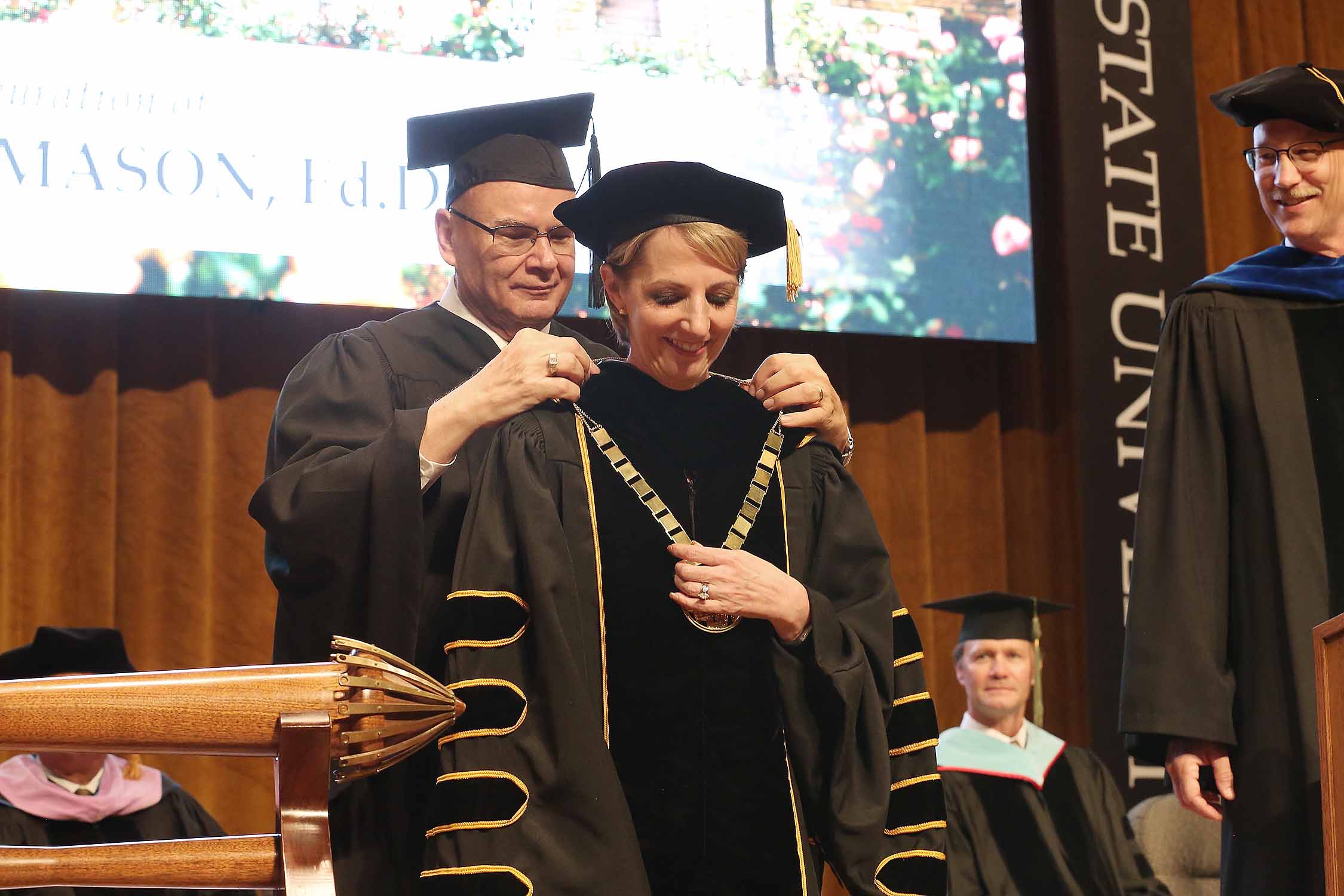
Dennis Mullin, Kansas Board of Regents Chairman, with Dr. Tisa Mason at Friday’s inauguration ceremony at Fort Hays State University.

FHSU University Relations

Proclaiming a theme of “Unlocking Untapped Potential,” Dr. Tisa Mason was inaugurated today as the 10th president of Fort Hays State University in a ceremony in Gross Memorial Coliseum at Fort Hays State University.

She noted that the inauguration is for her a personal and a professional privilege, citing the six and a half years she spent as Fort Hays State’s vice president of student affairs before leaving to be president of Valley City State University in Valley City, N.D.

She said of her previous time at Fort Hays State, “It was during that time that I came to know and love the students, the faculty, the staff, the city and the unique personality of this place.”

“For six and a half years,” she said, “Fort Hays State challenged me and supported me, showing me over and over again the power of hard work and commitment, the value of personal investment, the importance of true community, and the transformative change that happens through innovation.”

“For 116 years,” she continued, leading into the first of three videos that were part of her inauguration address, “these pillars, these lessons I’ve learned, have stood at the core of Fort Hays State University. They are the secret of our ongoing success. They are the ingredients that set us apart. They are the definition of who we are. Our journey has shaped us. Our history has built us. But our story is still being written.”

A transcript of her remarks follow. The address, and the videos that were part of her presentation, are available online at www.fhsu.edu/potential.

Leading into the third and final video, Dr. Mason said, “Today is a formality, but it is not a celebration of me. It is a celebration for us – an inauguration not of a person, but of an institution. Today is our opportunity to pause and reflect on the things that make Fort Hays State University so special: Our spirit of hard work. Our remarkable community. And our enduring legacy of innovation.”

Transcript of Dr. Mason’s prepared remarks
Regent Mullin and members of the Board, thank you for the wonderful investiture ceremony and especially for your support and the trust you have placed in me to join my colleagues in leading this incredible University. It is truly an honor. I proudly accept the responsibility to serve and wholeheartedly pledge to relentlessly pursue the very best for Fort Hays State University.

Wow. I have to tell you the audacity of this moment is surreal. I am truly humbled.

I wish to express my gratitude to a select few. To the inauguration committee and the facilities staff: thank you for planning and flawlessly executing a very personal and memorable set of inaugural activities. I am so extremely grateful.

Heartfelt appreciation to everyone who has spoken so graciously on my behalf and sent notes of congratulations.

My amazing parents, Doug and Arlene Mayer, are here today. I am also joined by my brother-in-law Mac Mason. Other members of my family are joining us virtually. There is nothing more potent in pursuing and achieving dreams than the love and support of a family. Thank you so much for sharing this day with me.
To my mom: Thank you for being an incredible role model, source of strength and inspiration, and my best friend.

I am so fortunate to have a loving and dedicated husband in Bill Mason. Bill, I thank you for being you and especially for always putting me first – changing your career plans and following me all over the country so I could do the work I was called to do. You support me without question and make it possible for me to have so much with little regard for yourself. I hope a small part of you recognizes that this is your day too. I am truly blessed to have you in my life.

I also want to extend a very personal thank you to my many friends and colleagues who have traveled far to be here today representing so many moments in time on my journey both to and back to Fort Hays State University. Please know how grateful I am and that you fill my heart with joy.

Welcome everyone and thank you for being present today as we celebrate this remarkable university. Throughout its 116-year history Fort Hays State University has been blessed with a community that consistently rallied its support around her, a committed faculty and staff, engaged students, and a strong legacy of presidents. It is on the shoulders of the nine presidents who served before me – as well as Regents, legislators, civic and business leaders, and alumni – that we share this privileged journey forward.

To everyone in this room today, to every member of our global community, to all who have been or will be impacted by our work, it is on your behalf that I proudly accept the responsibility to serve, to lead and to give all that I can to fulfill the mission of Fort Hays State University.

To stand before you today is not just a professional privilege, it is a personal one. As many of you know, this remarkable institution has been immensely formative in my own journey. For six and a half years, I had the opportunity to serve this community as the vice president for student affairs. It was during that time that I came to know and love the students, the faculty, the staff, the city and the unique personality of this place.

For six and a half years, Fort Hays State challenged me and supported me, showing me over and over again the power of hard work and commitment, the value of personal investment, the importance of true community, and the transformative change that happens through innovation.

For 116 years, these pillars, these lessons I’ve learned, have stood at the core of Fort Hays State University. They are the secret of our ongoing success. They are the ingredients that set us apart. They are the definition of who we are. Our journey has shaped us. Our history has built us. But our story is still being written.

Our theme today is “Unlocking Untapped Potential.” I hope that phrase resonates with you as strongly as it does with me. It is a refinement of our mission and our vision, our past and our future. The specifics may change shape, but that vision remains. It is why we exist. Together, all of us are here to unlock the untapped potential of our students to empower our campus, our community and our world for even greater success.

Take for example this letter recently written to a freshman seminar instructor by Logan – a May 2018 graduate. And I know in my heart the essence of this letter could have been written to anyone who teaches at Fort Hays State.

Logan writes:
“I just wanted to reach out to let you know that I am doing well. My life is busier and fuller than I ever could have imagined. And through it all, I have never forgotten what you did for me. During freshman seminar, we took a self-evaluation quiz. Afterwards, I met with you in your office, where we learned that the evaluation gave me a 25-percent chance of ever earning a college degree. I was devastated. Until I heard your response: ‘That’s a bunch of BS.’ Those words gave me motivation like you wouldn’t believe. You gave me confidence that I could actually graduate. You even gave me a graduation tassel to keep me focused on that goal.

“This past May, I received a Bachelor of Science degree in geology, with a minor in business administration, and a certificate in geographic information systems.

“I never thought I would be half as successful as I have already been, and each time I achieve something new in my career, the first thing I think of is my time at FHSU, sitting in your office, scared that I would never graduate. I think of the motivation and confidence you provided that put me in the position I am in today.

“That graduation tassel still hangs on my wall as a reminder of all the opportunities I had because you invested in me.”

Every single day, we are investing in students with the personal care and innovative education that will become the foundation for their success.

These aren’t just words, they are our reality. Take the student who wrote that letter. While Logan was a student at Fort Hays State, he used all of the same technology that he now uses in his career – from powerful microscopes to proprietary software to oil well data and more.

Logan had incredible opportunities to get hands-on experiences through classes that brought him out into the field to study rock formations and mapping. Immediately after graduation, he got a job working with a consulting company where he does on-site geology work on drilling rigs.

Today, innovation at Fort Hays State University looks like Logan. Innovation looks like Leadership 310 teams bringing community-changing service-learning projects to every corner of the globe. Innovation looks like the Forsyth librarians teaming up with faculty from new media studies to give access to modular smart classrooms that will enable students to stand inside life-size 3D models, to manipulate interactive data visualization, and to experience interactive exhibits where students can walk through history or a virtual art gallery. Innovation looks like a state-of-the-art applied technology building, where students are learning the latest in metal working, robotics, electronics and more. Innovation looks like our Maker Van, promoting STEM learning opportunities for students and teachers throughout Western Kansas. And that just scratches the surface.

Fort Hays State University truly is transforming students through innovation in education. We are creating a ripple effect that spreads throughout the state of Kansas and ultimately impacts students, families, industries and communities around the world.

Today is a formality, but it is not a celebration of me. It is a celebration for us – an inauguration not of a person, but of an institution. Today, is our opportunity to pause and reflect on the things that make Fort Hays State University so special: Our spirit of hard work. Our remarkable community. And our enduring legacy of innovation.

Together we thrive. Thank you for joining me to celebrate our bright future as we continue to write this transformative story together.

New Lincoln principal: Strong relationships key to successful students

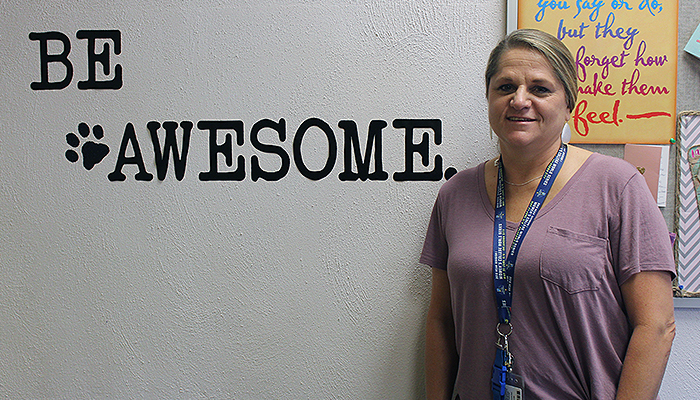
Kerri Lacy

By CRISTINA JANNEY
Hays Post

Kerri Lacy stands at the door of Lincoln Elementary School every morning so she can high-five her students as they enter the school.

Lacy, the new principal at Lincoln, said she has learned about half of her students’ names since the beginning of the school year, but it is her goal to learn them all as soon as possible.

Lacy, a 26-year veteran of education, said building relationships is the most important part of her job.

“My personal philosophy is that you must build a relationship with whoever you are working with, whether it be the student, the staff or the parents in order to be successful. My goal is, and I said it 100 times in our first meeting this year, relationships, relationships, relationship.

“They need to trust you. They need to know you care about them. They need to know family is first.”

Lacy and her husband, Brian, are empty nesters with two grown daughters of her own. Her youngest, Bailey, graduated from Thomas More Prep-Marian in the spring and is attending Highland Community College, where she is a pitcher for the softball team. Her oldest, Kelsey, attended Northwest Missouri State.

She said she has been where her teachers have been and if a teacher has a sick child, she knows that staff member needs to take care of that child.

Lincoln’s greatest challenge is a changing dynamic in families. Many children who attend Lincoln come from low-income families. As a result, those families struggle in a variety of ways. Lacy said she wants to work to connect those families with other resources in the community.

“Society has changed,” she said. “It is just different than it was when I first started teaching. That is a challenge every day to make sure every kid is safe, every kid is fed and every kid is happy.”

The school feeds many of its children breakfast, lunch and a snack during its afterschool program. Lincoln also has a Food for Kids Sake program that sends food home over the weekends.

“My goal is to make Lincoln a family centered, safe, fun place to be for not only our kids and staff but our families,” Lacy said. “I want our families to know they are welcome to come in at any time. …

“I want our kids to feel this is the best place in the world to learn and we care about them.”

Another significant challenge for Lacy as a principal is the age and condition of the Lincoln building. The school district has tried to pass bond issues twice in the last three years. Both failed. The most recent bond would have closed Lincoln, one of the oldest buildings in the district, in lieu of building a new elementary school.

The school struggles to maintain an aging AC and heating system and has had multiple issues in recent years with plumbing.

Lincoln is on multiple levels, which makes moving young students through the building more difficult. Because the school has stairs and no elevator, it can’t accept students in wheelchairs.

“Do I think Lincoln will be open in 10 years?” she said. “I would hope not, because I would hope that we can pass a bond issue or do something for our kids to get them into something that is a more functional environment.”

Lacy, 48, a Fort Hays State University graduate, began her teaching career at Kennedy Middle School, where she spent 13 years. She worked nine years as principal in Solomon before returning to Hays to teach at the middle school level and most recently fifth-grade at Lincoln.

Lacy replaces Elaine Rohleder, who retired in the spring. Lacy said already knowing the staff at Lincoln has been a great advantage. Rohleder also left Lacy a large book of notes that Lacy calls the “Principal’s Bible.”

“She did everything she could to prepare me,” Lacy said of Rohleder. “Still I call her or text her every once in a while and say: ‘What about this?’ ‘Did you do this?’ ‘Should I do this?'”

After all her time as an educator, Lacy still says seeing the excitement on her students’ faces is what brings her back to school each morning.

“Whether it is when you high-five them when you are walking in the door in the morning or when you are down in the cafeteria and they get excited. They may not be having such a great day, but they put that aside and give you a smile. That it what I love, because I know I am making a difference with those kids.”

She said she has enjoyed her transition back to being a principal.

“Being a principal, it is so nice because I get to see every kid every day. I work in the cafeteria, and I have the opportunity to talk to every kid every day, and I think that is really awesome,” Lacy said.

Lacy does not have a lot of extra time now that she has taken over the principal role. However, when she does have free time and she is not spending time with her family, she can be found with hammer and saw in hand making furniture out of reclaimed wood.

Her first project was a buffet for her home, which blossomed into a side business making beds, buffets and cooler cases for her friends and family. One of her pieces recently sold at a charity auction for more than $600.

Copyright Eagle Radio | FCC Public Files | EEO Public File