We have a brand new updated website! Click here to check it out!

Day Trippin’: Check out Czech culture in Wilson, hit the trail at Wilson Lake

Two kayakers near Hell Creek Bridge at Wilson Lake.

By CRISTINA JANNEY
Hays Post

On the map: Wilson, Kansas Distance from Hays: 50 miles Drive time: 48 minutes

On my travels across Kansas, I have been to the Irish Festival in Chapman, the Scottish Festival in McPherson, Midsummer’s Festival (Swedish) in Lindsborg and, of course, Octoberfest in Hays.

My latest international cultural excursion without leaving the state of Kansas was to the Wilson After Harvest Czech Festival.

Wilson is not shy about promoting its Czech heritage. In that vein, it commissioned a 20-foot-tall Czech egg, which stands in the center of town.

Christine Couch Slechta, Czech egg painter and designer of the giant Czech egg in Wilson.

Christine Couch Slechta was this year’s Czech Festival grand marshal. An art teacher, Slechta was the artist who designed the giant 7,000-pound fiberglass Czech egg.

Although she does not have any Czech heritage, she is known for her Czech egg art. Slechta, a long-time Wilson resident, learned the art from a Czech descendant who lived in Wilson. She gave me the lowdown on the eggs.

The eggs were originally given by young ladies to young gentlemen in Czechoslovakia during the Easter season. Symbols on the eggs indicated strength and positive outlook for the future. Slechta paints chicken, goose and ostrich eggs in both traditional Czech patterns and modern designs. The designs are painted first, and then the egg is punctured to empty the contents.

Czech immigrants settled in the Wilson area in 1874. Last weekend, the community celebrated its annual Czech Festival.

Giant Czech egg in Wilson.

If you have a fine ear for polka, this definitely where you want to be. Young ladies also wear traditional dress to practice Czech folk dances.

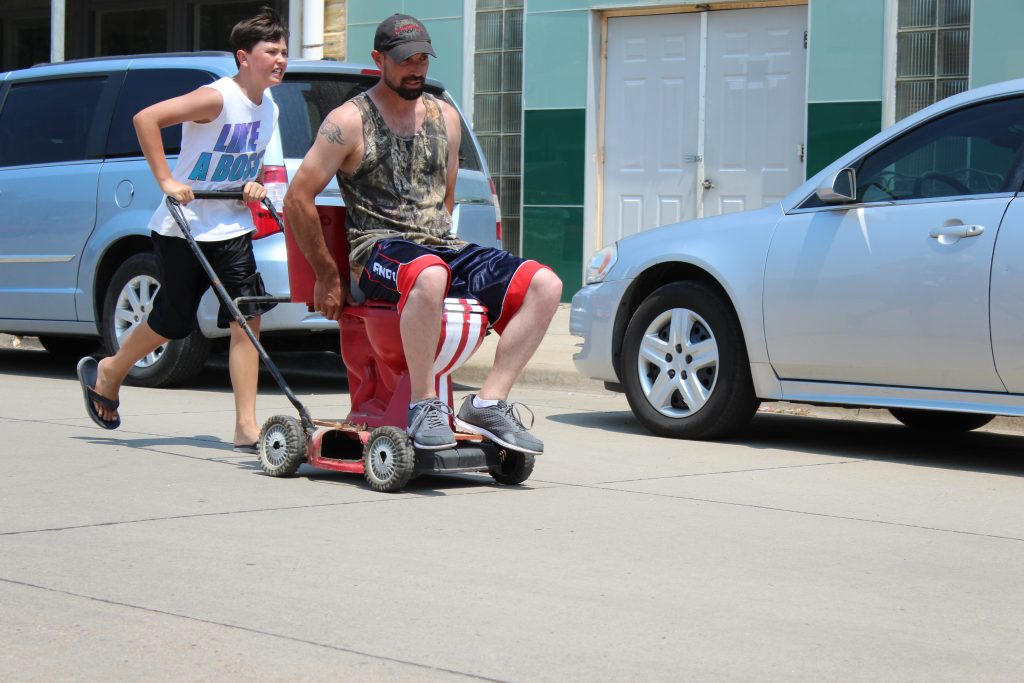
I don’t think this is Czech at all, but one of the featured events at the Czech Festival is toilet bowl races. Toilet bowls are mounted on old push lawnmower frames. One person rides, and the other person “drives” through an obstacle course. I have to give the people of Wilson points for creativity. It was a spectacle, but a bit anticlimactic. Even souped-up toilet bowls don’t go too fast.

If you are in Wilson for Czech Festival or during any other time of the year, there are a couple of foods you need to know about. One is the kolache. This is a sweet bread roll with a topping of fruit preserves. The other are case noodles. I was told this dish varies, depending how Czech you are. They are dough triangles containing cottage cheese and onion. They are usually boiled. Some serve them almost like a soup.

So I sampled both of these at Made from Scratch diner. They had a buffet and abbreviated menu due to all the visitors for Czech Fest, but look for a regular diner menu of stick-to-your ribs homestyle cooking, which includes gigantic bierocks and scrumptious pie. Don’t forget the homemade ice cream.

Enjoy the atmosphere of a 1950s soda fountain at Grandma’s Soda Shop and Diner, 2524 E. Owens, where you also can order kolaches and bierocks.

The Historic Midland Railroad Hotel, 414 26th St., offers steaks, sandwiches and pasta in the downstairs Sample Room, so named because the hotel was a popular stop on the Union Pacific route from Kansas City to Denver and businessman used the hotel to show off their wares.

The Drummer’s dining hall on the ground floor is available as an events venue. The hotel also offers special dinner events. Check their website for details.

The limestone three-story hotel was built in 1899 and is on the National Register of Historic Places. The hotel underwent an extensive $3.2 million renovation and reopened in 2003 with an interior reminiscent of its 1920s glamor. Today, the hotel has 28 rooms decorated with mission-style furniture, but with modern amenities like satellite TV.

Film buffs may recognize the building as a backdrop in the 1973 film “Paper Moon,” starring Ryan O’Neal and daughter Tatum.

Wilson’s round jail.

Also on the National Register of Historic Places is the town’s circular stone jail. The circular limestone structure was built as a water tower in 1907. It was used as a jail until 1963 to hold prisoners until they could he transported to the county jail.

Unfortunately, one of the iconic Wilson landmarks, the limestone Wilson Opera House, built in 1901, burned in 2009. You can still see the shell of the building on Old U.S. 40 just down the street from the giant Czech egg. The opera house used to serve as the community’s historical museum, the Museum of Memories. The community hopes to resurrect the opera house by using the old stone to create a new pavilion.

Burnt metal, wood and nails left from the 2009 Wilson Opera House fire.

Almost all of the historical items in the former museum were lost to fire or water damage. After almost 10 years, a new museum, the Wilson Heritage Museum, has opened in the former Wilson World newspaper office, 411 24th St.

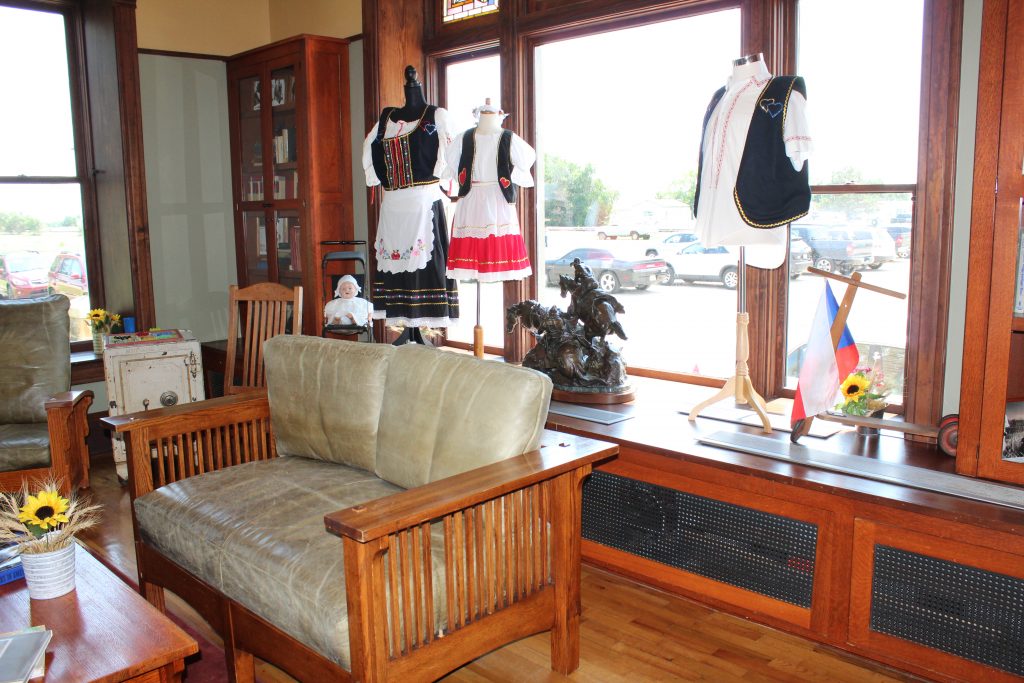
The museum has been open for less than a year, and had many visitors during the Czech Festival this weekend. The museum contains items from Wilson schools, business, veterans and churches. In addition, the museum has a small collection of items commemorating the community’s Czech heritage, including dolls in traditional dress and Czech glass. In a tribute to the fire, the museum has on display a piece of molten debris that was salvaged from the opera house fire.

Also of note are two military monuments in the community. The Wilson Cemetery at 1916 Second St. features a granite statue of Civil War Union soldier, and a metal lion’s head that once filled horse troughs. In 1919, the community dedicated the World War I monument in Legion Park that features a U.S. infantry soldier.

Kansas Originals is not in Wilson, but just north of Interstate 70 at the Wilson exit. The store is run by the Post Rock Opportunities Foundation, a nonprofit corporation. Its mission is to provide marketplaces for the work of Kansas artists, craftsmen and food producers and to promote tourism, according to its website.

This is more than a tourist trap. It houses a variety of handmade products, such as jewelry, blown glass and wood products. You can also pick from a variety of Kansas-made food products, like popcorn, salsa and sauerkraut. A bookworm, I always make a quick perusal of the book section, which features Kansas authors and topics. The store carries fiction, non-fiction, guidebooks and children’s books.

Boater at a dock at Wilson Lake, just below the dam.

We can’t talk about Wilson without talking about the 9,000-acre Wilson Lake. The Wilson I-70 exit will take you to the east end of Wilson State Park and is the best access to the dam. You can also access the Minooka Park section of the lake via I-70 exit 199 Dorrance and the Wilson Wildlife Area via exit 193, Bunker Hill.

You will need a state park pass to legally enter the state park. You can buy a year-long State Parks Passport for $15.50 when you pay your annual tags and taxes for your vehicle. You can also self-pay day passes or buy yearly passes for slightly more at a park office. The annual passes are good for any state park.

With its picturesque cliffs, Wilson is a popular spot with kayakers. There are plenty of places along the shoreline to put in, and the water is fairly clear for a Kansas body of water.

However, you do not have to have a boat to enjoy Wilson, the state park is internationally known for its 25-mile Switchgrass Bike Trail, which winds throughout the park and will take you through native grasses and wildflowers and near impressive rock features. There are shorter loops for those who aren’t up to riding the whole trial. You can hike and run sections of the trail, but it is recommended you go counterclockwise to bikers to avoid crashes.

A swallow takes off from a nest under Hell Creek bridge at Wilson Lake.

The trail head is at Switchgrass campground on South Shore Drive west of the Hell Creek Bridge. I picked up a Wilson Lake guide, printed by the Wilson Lake Area Association at Kansas Originals at the Wilson exit, which contains a state park map.

Wilson also offers both natural and paved hiking trails. The Cedar Trail in the Otoe area is a one-mile paved loop.

The second-annual Lovegrass Music Festival will be Aug. 10-12 at Lovegrass campground at Wilson Lake. It will feature country, bluegrass and folk music. For more information, contact Aimee Riegle at [email protected].

I usually shoot pictures rather than creatures; however, in addition to being a good locale for white bass and striped bass, the state park offers 8,069-acres of public hunting at Wilson.

If you travel to Wilson Lake dam via K-232, you will be on the Post Rock Scenic Byway, giving you beautiful views of the Kansas short-grass prairie and worth an afternoon drive in and of itself.

If you reach the dam, you will be fairly close to Lucas via Kansas Highway 232. Lucas, north on K-232, is worth a stop as well, but that adventure will be for an upcoming Day Trippin’. If you do decide to take the byway north to Lucas, look for faces carved into the region’s iconic post rock fence posts thanks to artist Fred Whitman.

Honestly, my next road trip is still up in the air, but I will definitely see you on the road soon!


Other links to check out while you are planning your trip:

Wilson Chamber of Commerce

Ellsworth Area Chamber of Commerce
Lucas, Kansas

Suicide survivor: ‘Be here tomorrow!’

By CRISTINA JANNEY
Hays Post

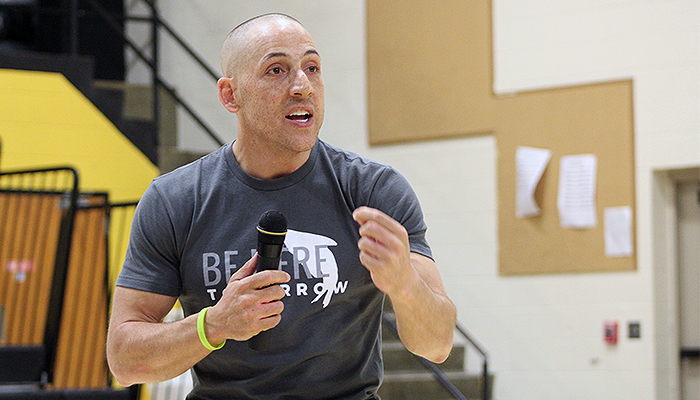
Kevin Hines’ message to the world is “Be here tomorrow!”

The message is all the more powerful because he was almost not here to share tomorrow.

Hines is one of only 36 people in 80 years to survive a jump from the Golden Gate Bridge. He is only one of five to be able to still walk and run.

“I am not just lucky to be alive,” he said. “I am blessed that I get to exist.”

To a packed crowd at Hays Middle School on Wednesday, Hines shared his journey from that dark day when he tried to kill himself by throwing himself off the bridge to a life of light.

Kool-Aid, Coca Coal and sour milk
Hines, 37, had difficult beginnings. Both of his parents were drug addicted. Hines and his infant brother were left regularly in seedy motels so his parents could score or sell drugs.

The boys were fed what their parents could steal — Kool-Aid, Coca Coal and sour milk.

When a hotel attendant finally reported the neglect to the police, the court documents read, “The children lie there in their own filth, screaming and crying not to be neglected, lying next to dangerous drug paraphernalia that had they touched it would have killed them.”

Although they entered the foster system, Hines and his brother both contracted a vicious case of bronchitis, and Hines’ brother, Jordache, died.

“People have looked at me as an adult and asked me, ‘Kevin, why does that matter? You were an infant. How can that affect you?'” Hines said. “If you don’t know, the first three to nine months of an infant’s life are the most crucial to their ability to connect, adapt, attach and be well in any future. If your first nine months of your life are filled with nothing but consistent trauma, at some point, something is going to give and you are going to have a hard time. And I would have that hard time and then some.”

Hines was in foster care for the first nine months of his life, but then he was adopted by Pat and Deborah Hines. Deborah wanted to adopt a sister for daughter, but after seeing Kevin in his red rubber ducky overalls, she fell in love.

Pat and Deborah took Kevin in, but he was violently ill over the next 30 days. No doctor could determine what was physically wrong with him. The medical profession finally concluded that his physical symptoms were all emotional.

Kevin’s biological father fought for custody of Kevin for two years before finally outside of a courtroom, he told Pat and Debbie, “‘Patrick, Deborah, I can do this no longer, please take care of my son.’ ”

Blessed childhood
“And they did,” Kevin said. “They took care of me, and they made me theirs. And I am a Hines.”

Kevin’s mother, Debbie, was an incurable optimistic, to the point of annoyance. Pat was not an optimist. He was tough. He played goalie in hockey without a mask.

“Pat Hines is a pragmatic pessimistic and stone-faced man,” Kevin said. “He is a man void of true emotion in my life, a man I had never seen cry in 19 years up to that point, not through hard times, not through deaths, not a tear dropped from that man’s eyes. I would not learn until years later when he and I would go to therapy why he was such a hardened soul and why he was so hard on me. He was like a drill sergeant who was never in the military.”

Pat’s father was in the military and was in the Battle of Okinawa. When he came home, he was a changed man. Pat’s parents, just like Kevin’s biological parents, had substance abuse issues. They were alcoholics and died of cirrhosis very young. Pat was left almost penniless to make his way in the world, Kevin said.
Pat and Debbie, who were white, adopted two other children. Kevin is mixed race, his brother is black and his sister is white. People stared, but Kevin said, “We were a family filled with love unconditionally, hope for the future and possibility. I thought growing up I had that traumatic infancy, but a beautiful childhood and adolescence. I thought to myself, How could anything go sideways from here?’

“I am going to grow up. I am going to go to that good school my dad’s always talking about. I’m going to get that great job he is always speaking of. I’m going to live the American dream. Then it happened.”

Things go sideways
“At 17 and a half years of age, it all came tumbling down, because of one thing — my brain.”

Hines was eventually diagnosed with bipolar disorder with psychotic features.

His mind was telling him things like he was a horrible person and he had to die.

“All of which was untrue,” he said. “I wish I know then what I know now, which is that my thoughts do not have to become my actions. …

“In the realm of suicidal thinking, this is very important because we think our thoughts own, rule and define our actions. Yet, in a suicidal crisis, they do not have to take us. We can always stay here.

“If you realize those thoughts don’t have to lead to an attempt, you can always survive. I live with chronic thoughts of suicide. They will never take me. Because every time I think of them, I will turn to the person to my right or the person to my left and say four simple and effective words, ‘I need help, now.’ ”

Hines said his family and friends know what that means and know what his triggers are. He has an emergency plan that he has shared with his loved ones.

“Even when I go sideways and I can’t see it, they have got my back,” he said.

He began to have delusions that the postal service was trying to kill him. If he saw a postal truck, he would run home, causing him to go into a debilitating asthma attack.

‘I wanted to tell’
Hines went from natural euphoric highs to the dark abyss that is depression.

“I would come crashing down into an insurmountable amount of pain that I could not bare on my shoulders,” he said. “At 19 I was done. I wish that morning that I attempted that I told my father the truth. …

“I wanted to tell the one man who loved me more than anything else in the world, arguably, the truth, but I couldn’t get the words out. Every time I wanted to tell my father what I was thinking, the voices in my head, (I had been hearing auditory hallucinations that no one else could hear) told me that I had to die.”

Every day, Hines would see death in the form of the grim reaper hover in through his window.

“Do you think I told anybody? No, I kept it inside, because I thought if I tell somebody what I am seeing, well, they are going to think I am crazy. I don’t use that word lightly.”

He buried all of his symptoms for two years. He silenced his pain.

“My new friends, if I am going to help you learn one thing today, and one thing only I have to ask that it be this,” he said. “When you go about the rest of your natural lives, when you walk out those doors, and you go about your day, do me a favor and learn from my mistakes and never again silence your pain. Your pain is valid. Your pain is real. Your pain is worth your time and others’ and your pain matters, ladies and gentlemen because you do.

“When we silence our pain and our struggle and our hardship, and we tell no one, it just grows and festers and morphs into rage and violence and substance abuse or domestic disputes, suicidal thoughts or actions.”

Life is a gift, Hines said, but he could not see that and on the Sept. 25 he boarded a bus for the Golden Gate Bridge.

‘Why doesn’t anybody care?’
He sat in the middle seat in the back row of the bus. He began to cry, softly at first, and then harder until finally tears streamed down his face. He then began to yell back to the voices in his head that were telling him to kill himself.

“Leave me alone, but I don’t want to die. I am a good person, why do you hate me so much? What did I ever do to you?”

The 100 people on the bus, said nothing … except for one man, with a smirk on his face said, “What the hell is wrong with that kid?”

“That is what is wrong with some of our society, today” Hines said, “our innate human ability to see someone who is in potentially the greatest pain they are ever experiencing and feel nothing for them, but fear of them and apathy toward them. That is a real problem. I believe if nothing else, this one thing — we are our brothers’ and sisters’ keepers.”

When Hines reached the bridge, still sobbing, he desperately wanted someone to stop him and ask him if he was OK. He wanted someone to stop him, to save him.

“All I wanted to do was live, while my brain was trying to kill me,” he said.

Bicyclists, joggers tourists and even police officers there to look for jumpers, passed him for 40 minutes and did not stop.

Although police are now trained to look for suicidal individuals at the bridge, a person still dies at the bridge every seven to 10 days.

Finally, a woman started to walk toward him, he thought finally someone is going to help me.

“I thought, ‘This is it! I don’t have to die today,” he said.

She reached out and handed him a camera and asked him to take her picture. Hines took the picture, she walked away.

“I used to be upset about this woman. I used to think, ‘Why doesn’t anybody care?” he said. “Everybody cared. Every member of my family, every one of my friends, my acquaintances would have been there to rip me from that rail to safety if they knew where I was and what I was doing. They would have saved me, guaranteed, and so would have yours because you care and you do matter. I couldn’t see it. I thought nobody cared. The voice in my head said, ‘Jump now,’ and I did.”

A friendly shark
Falling 225 feet, 25 stories at 75 mph in four seconds, he said he realized his value. He prayed to live.

“I had the instant recognition that I had made the biggest mistake of my life, and it was too late.”

He hit the water and it felt like hitting a brick wall. It shatter three vertebrae in his back, and the fragments came millimeters from severing his spine.

“I swam to surface, using only my arms, 70 feet with one breath and one thing on my mind — all I needed to do was live. I remember thinking that ‘If I die here, no one will know I didn’t want to. No one will ever know that I knew I made a mistake.”

As he struggled to stay afloat, something began to circle beneath him. He thought it was a shark. It pushed him up. He thought it was odd to have such a friendly shark. He named him Herbert. Much later, after doing a television interview about his experience, Hines received a letter from someone who had been standing on the bridge next to him on the day he jumped. He told Kevin, it had not been a shark that saved him, but a sea lion.

Why?
The Coast Guard pulled Hines from the water. As he was strapped to the backboard, a rescuer asked him, ‘Why?’

“You must stop asking why,” he said. “It is the wrong question. We don’t know what someone is going through up here. You never can entirely,” he said. “What we need to ask ourselves is ‘how.’ How do we look to the living and through community and togetherness to move forward?

“I don’t think we can move on from a suicide,” said Hines, who said he has lost seven people to suicide. “I think that is impossible. If someone tells you to move on from suicide, you tell them that Kevin Hines told you to tell them to sit down. You get to grieve those you love until the end of time. If you are not done grieving, you’re not.”

Uncle George
Hines still had a long road ahead. He was hospitalized for his suicidal depression seven times during the next 11 years. He had electroshock therapy after one stay in the hospital that included 60 days of suicidal crisis.

His Uncle George had been driving six hours to visit Kevin during each hospitalization. On his third hospitalization, his uncle brought him a magazine article.

His uncle said to him, “Kevin, your family can help you until you are blue in the face, but until you take 110 percent responsibility, young man, for the fact you have this disease and fight it tooth and nail every day with every fiber of your being, kid, ain’t nothing gonna change and you are going to be in and out of these places for the rest of your life. Is that what you want?”

Kevin responded, “No.”

George said, “Get it together, kid, we are counting on you.”

Kevin read the article. He learned there were techniques he could use to help his brain by creating routine—eating healthy most days, exercising, educating yourself about your diagnosis to learn tools to fight the disease. Music therapy at the hospital helped him to start sleeping again.

He read that 23 minutes of rigorous exercise lead to 12 hours of better mood.

He was finally honest in therapy.

Hines finally started to feel better. He met the woman who would become his wife.

“If we can find hope in the darkness of our hours, we can find purpose, and if we can find purpose, we can always stay here,” he said.

To end his presentation, Hines asked the audience to raise their cellphones and repeat after him …

“Be here tomorrow!”

If you or someone you know is struggling with depression, suicidal thoughts or mental illness, you can reach services through High Plains Mental Health by calling the center’s emergency line at 1-800-432-0333 24 hours a day.

You can also reach the National Suicide Prevention Lifeline 24/7 at 1-800-273-8255 or visit suicidepreventionlifeline.org.

🎥 Germans from Russia: ‘We don’t want to forget our heritage.’

Brooke Leiker, Munjor, teaches the polka at Kindertag, part of the AHSGR International Convention in Hays.

By BECKY KISER
Hays Post

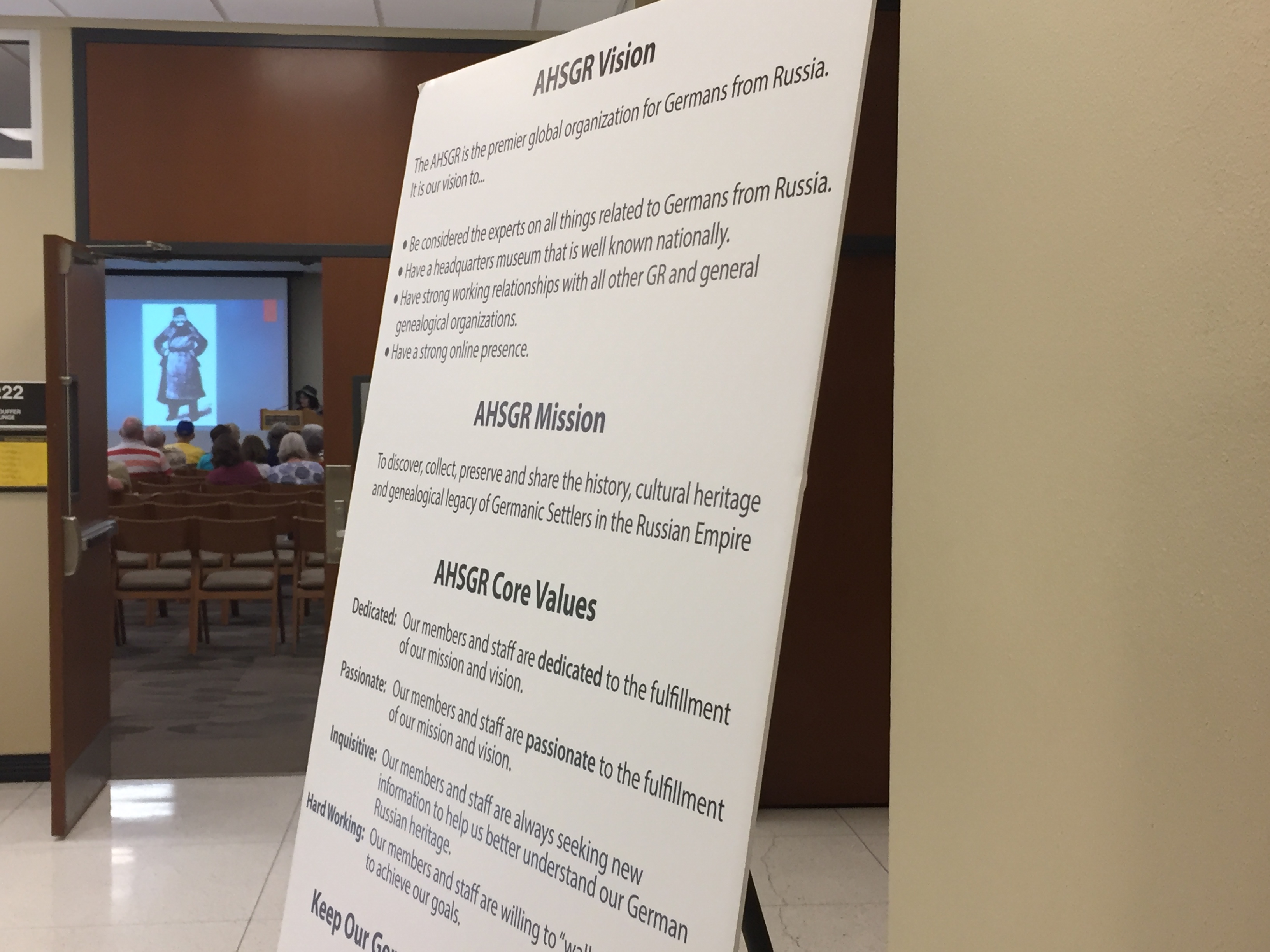
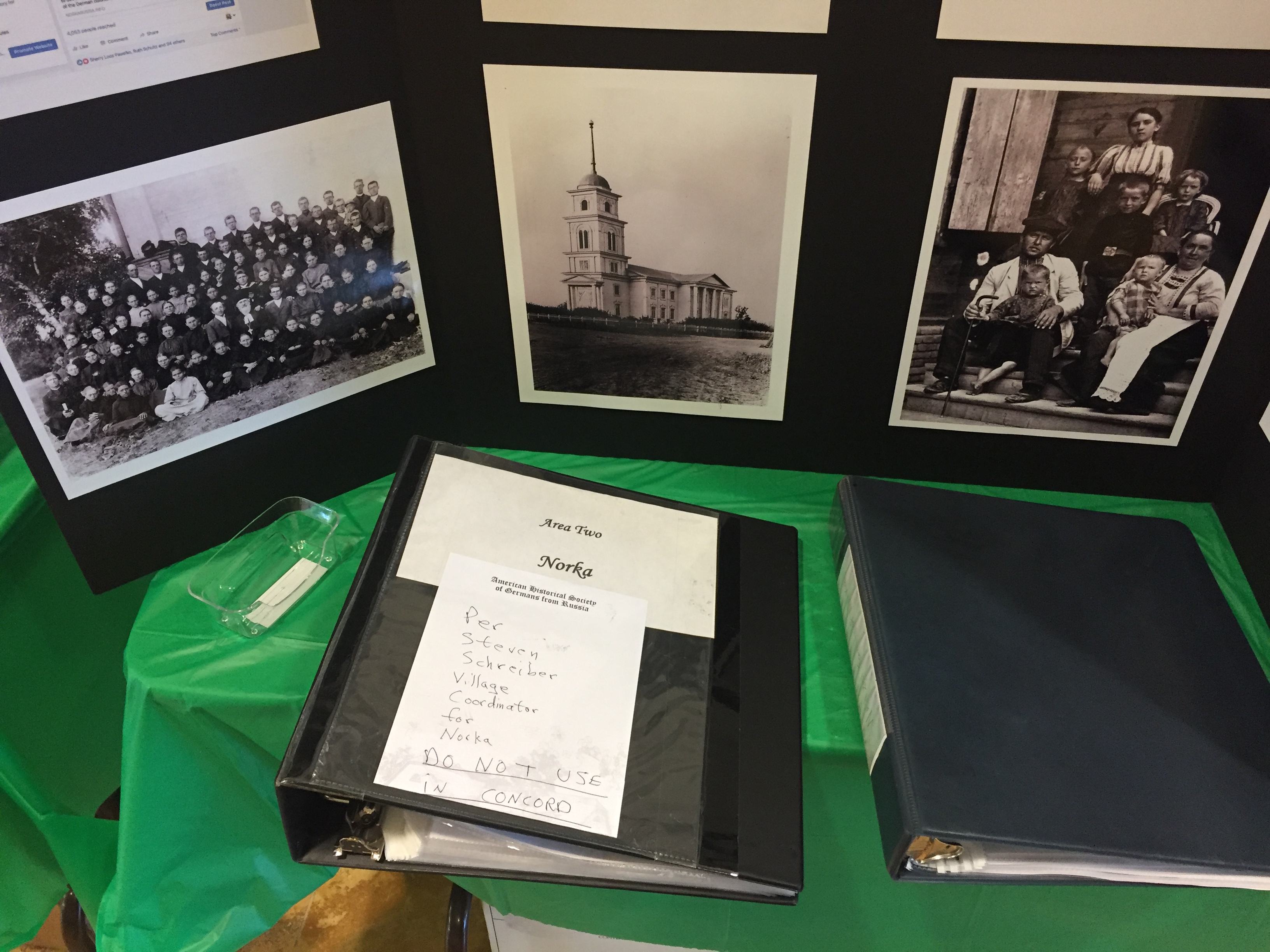
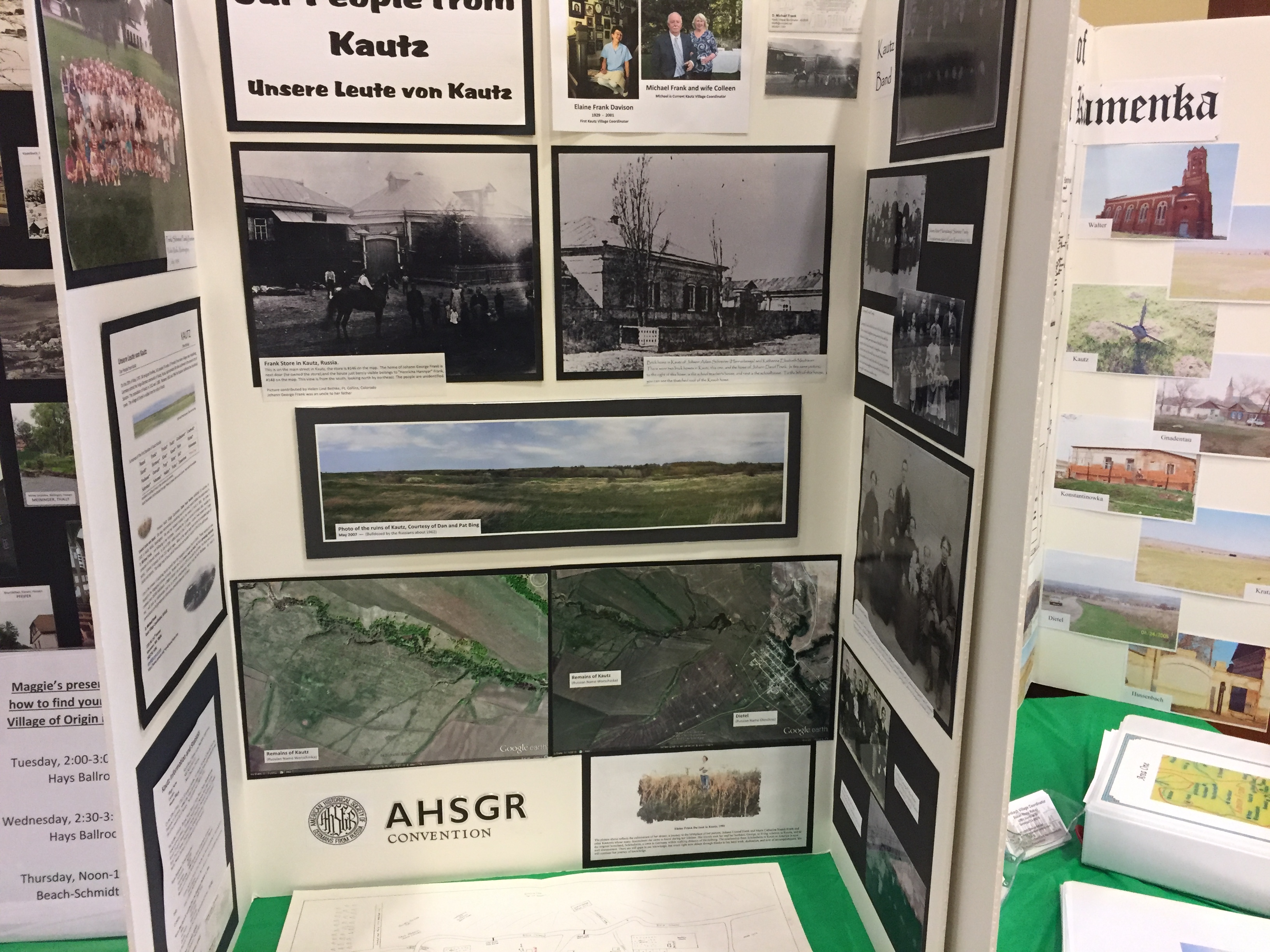
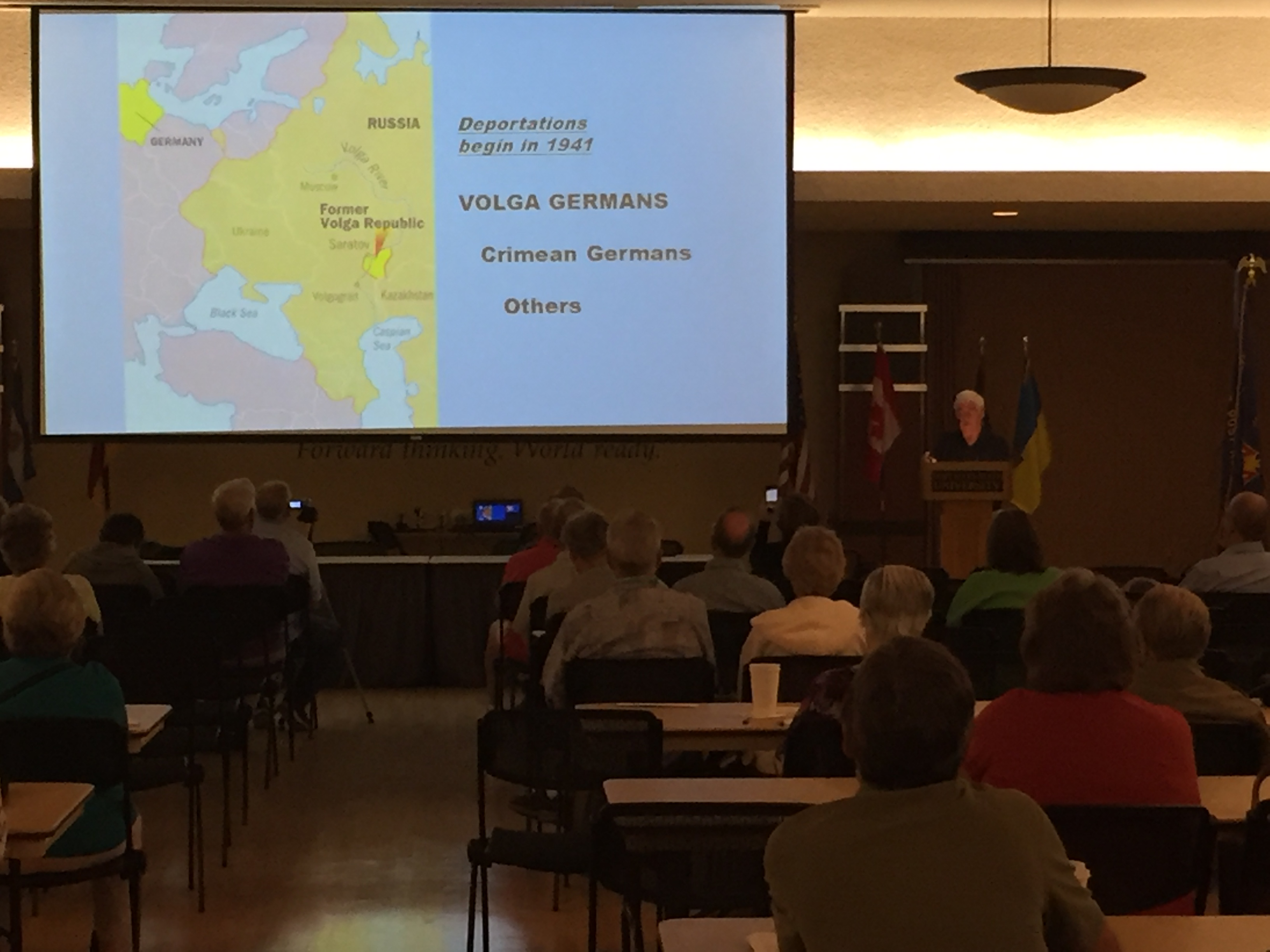
It was perfect polka weather Wednesday morning for Kindertag, a youth heritage outdoor day presented in connection with the 49th annual international convention of the American Historical Society of Germans from Russia underway in Hays.

More than 350 people from across the United States as well as Canada, Germany and Russia are attending the four-day convention headquartered in the Fort Hays State University Memorial Union.

Themed “The Storm,” participants are learning about life in the Germanic colonies of the Russia Empire as the 1917 Russian Revolution began. They’re also looking for and sharing information about their German-Russian ancestors and heritage.

The international society is headquartered in Lincoln, Nebraska, where the 50th anniversary will be celebrated in 2019. Executive Director Sherry Pawelko describes herself as “100 percent Volga-German, from both sides of the river.”

“We represent all different regions of settlements where German people were in Russia, including the Volga (river) area and of course, there are a lot of Volga-Germans in the Hays area,” she said.

“We have a rich heritage and we don’t want to forget it.”

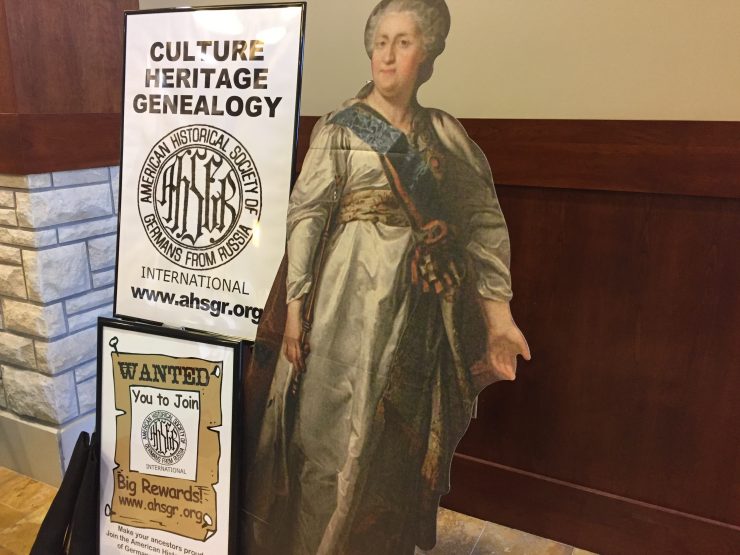
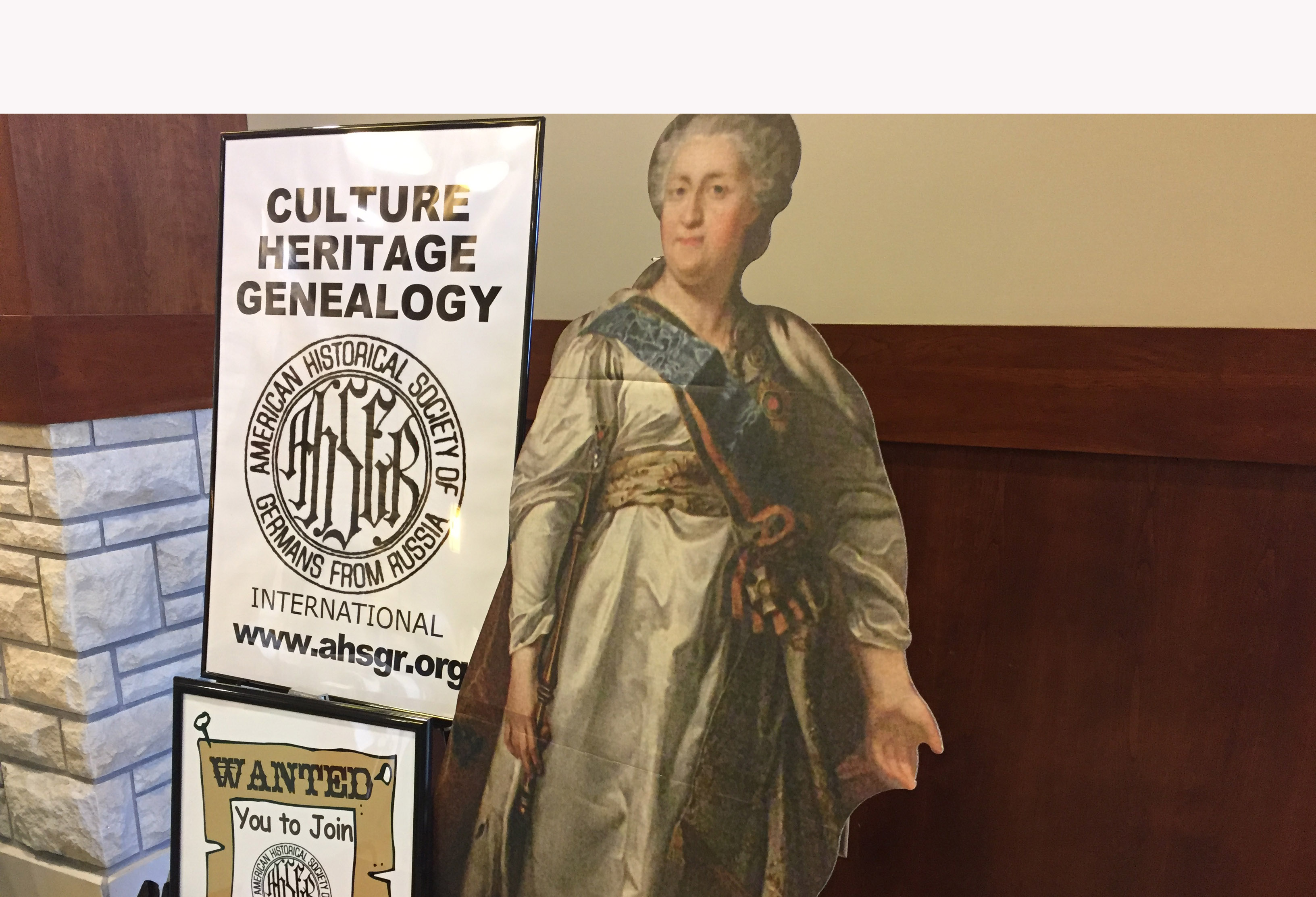
According to the society’s website, the Germans from Russia story begins in 1762 with the Manifesto issued by Catherine the Great. By the end of the 19th century, there were about 1.8 million Germans in Russia. In 1872, the Germans in Russia began to emigrate to the United States, Canada, Brazil, and Argentina.

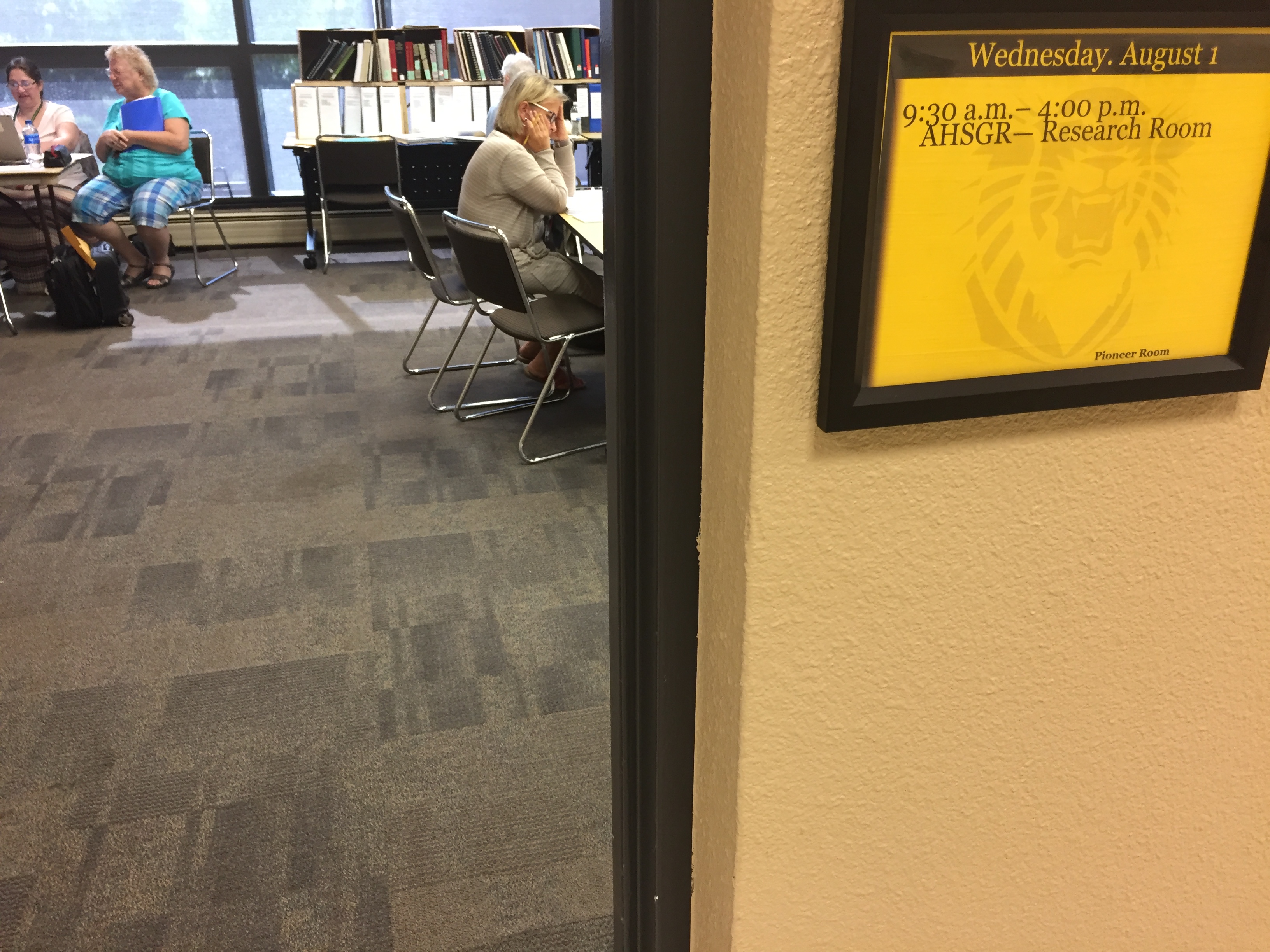
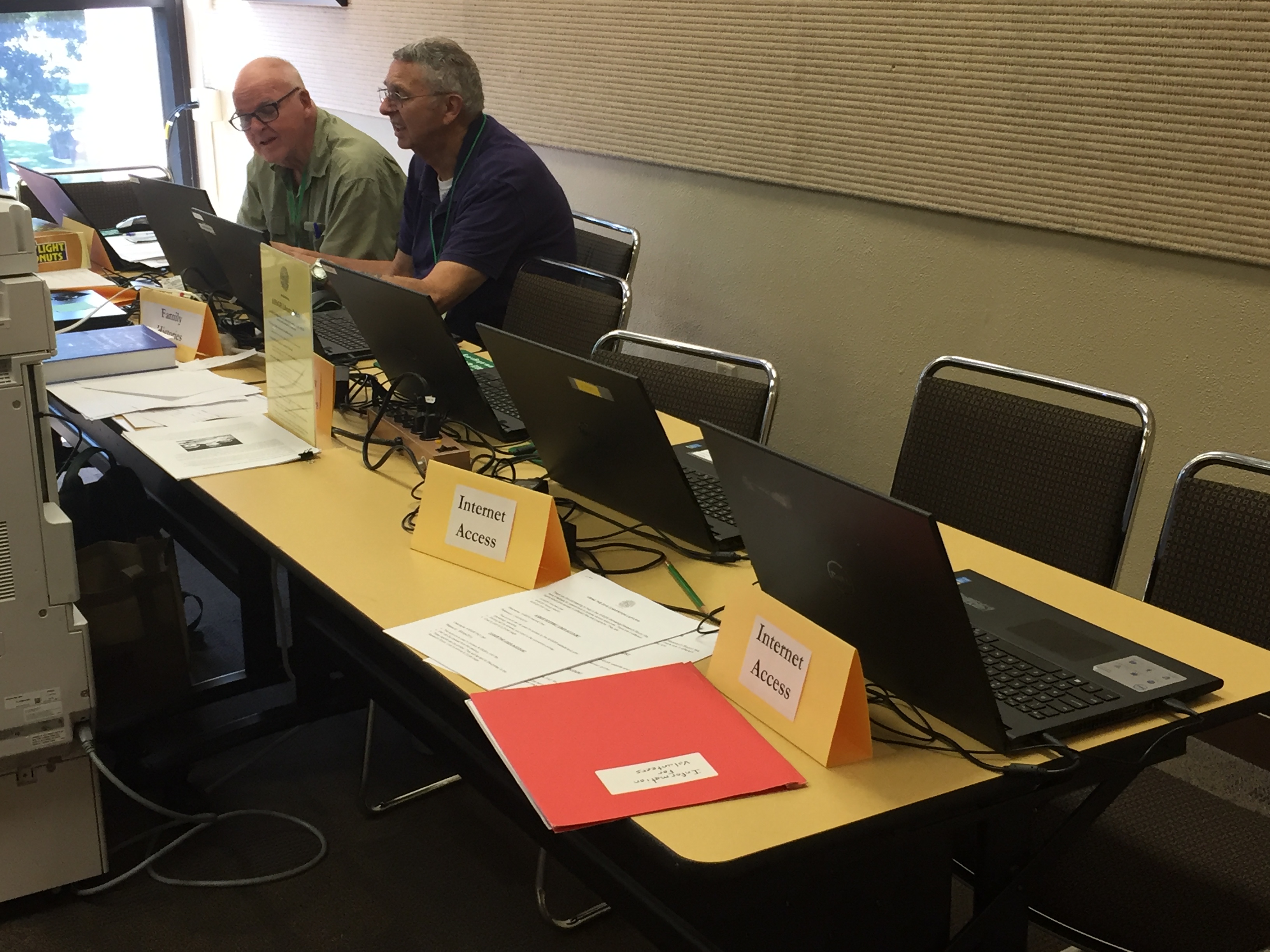
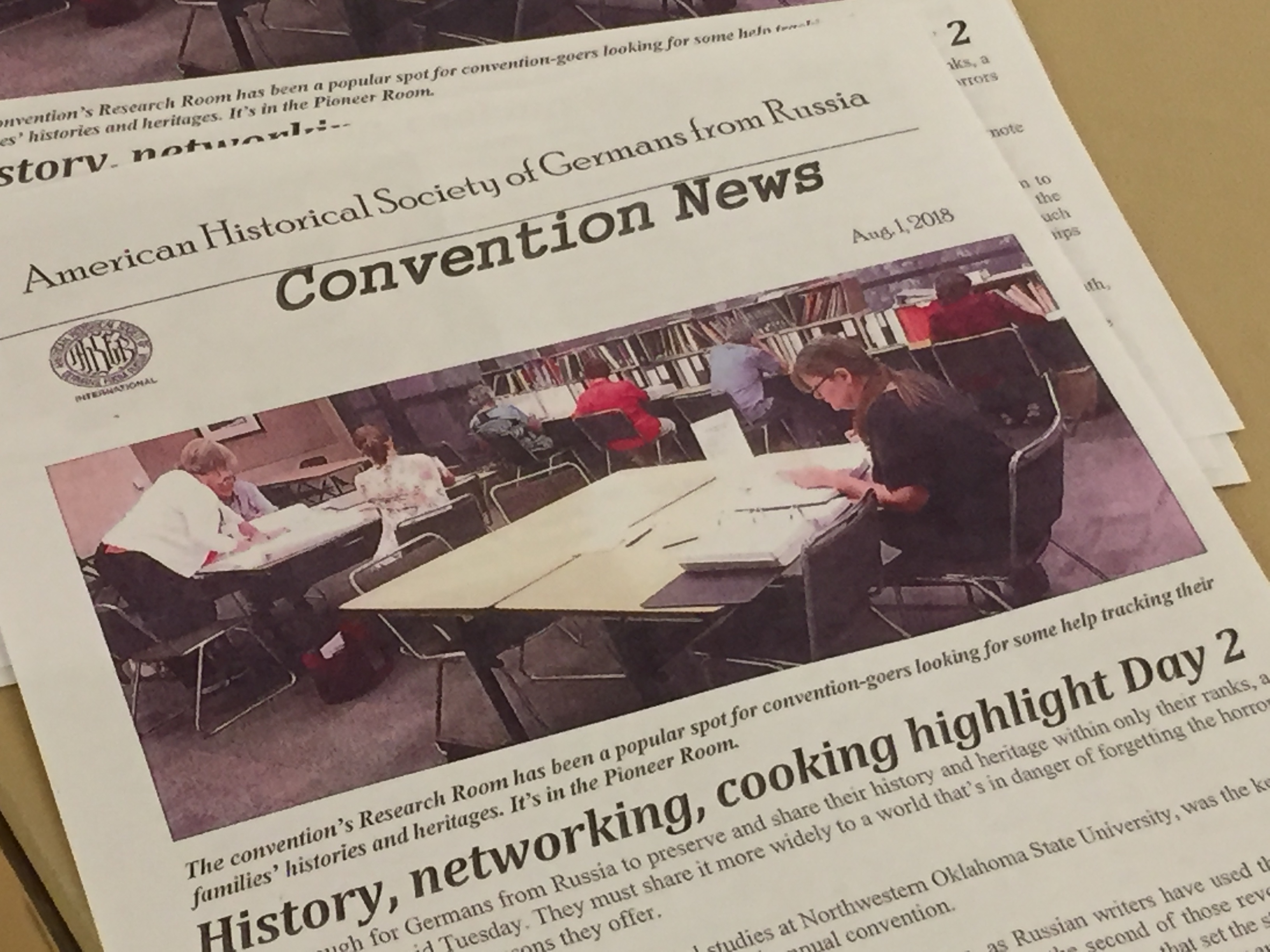
Research Room

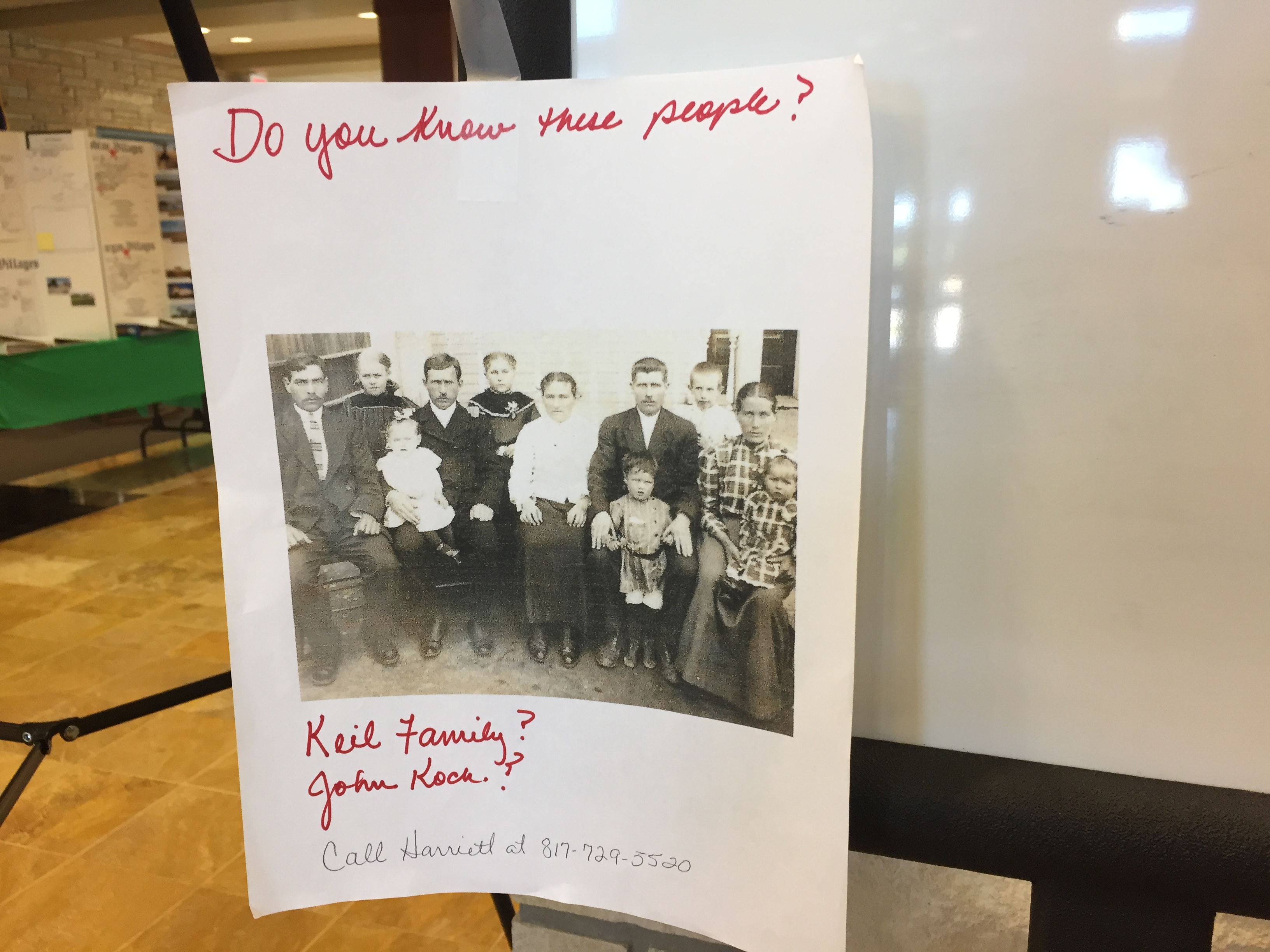
The society focuses on research. “We want to be here for future generations to do research, to find out about their families and their heritage,” Pawelko stressed.

One of the rooms in the Memorial Union is entirely lined with reference materials, computers and internet connections to aid in that research.

The future generations were also doing some research of their own at the Ellis County Historical Society Museum in downtown Hays.

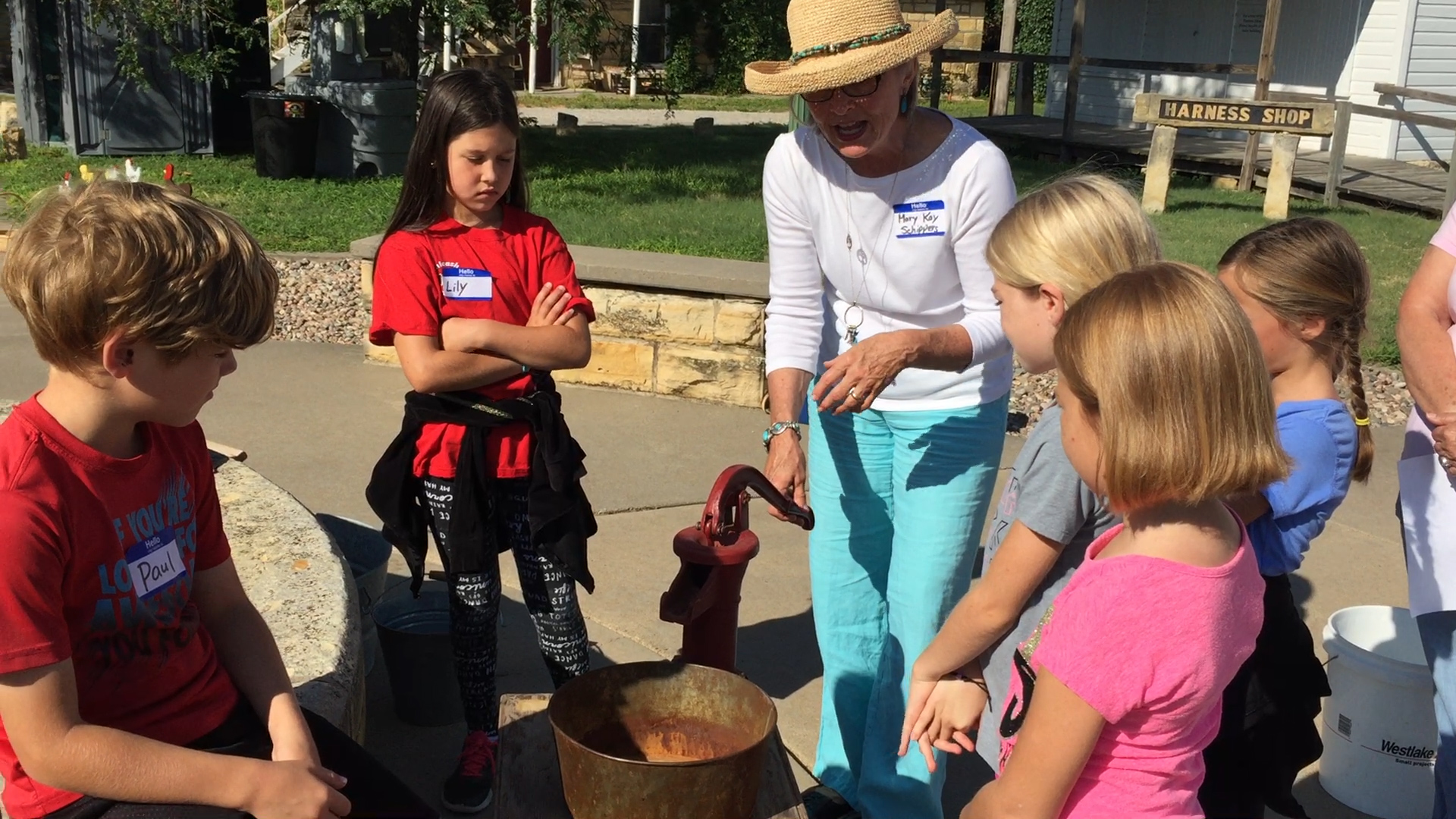
Mary Kay Schippers demonstrates how water was brought into a farm home.

Educational activities showed how Germans from Russia lived, many of them on farms or in rural villages. The nearly 60 children learned from local volunteer Mary Kay Schippers how sauerkraut and butter were made, how clothes were cleaned before the advent of electricity and where eggs actually come from.

After the chores were done, children and adults enjoyed leisure activities including dances and games.

Munjor residents Sarah Leiker and her daughter Brooke, who was wore traditional German garments, taught the young participants how to polka.

“They were really good,” Brooke said.

Jerry Braun pitches Bunnock

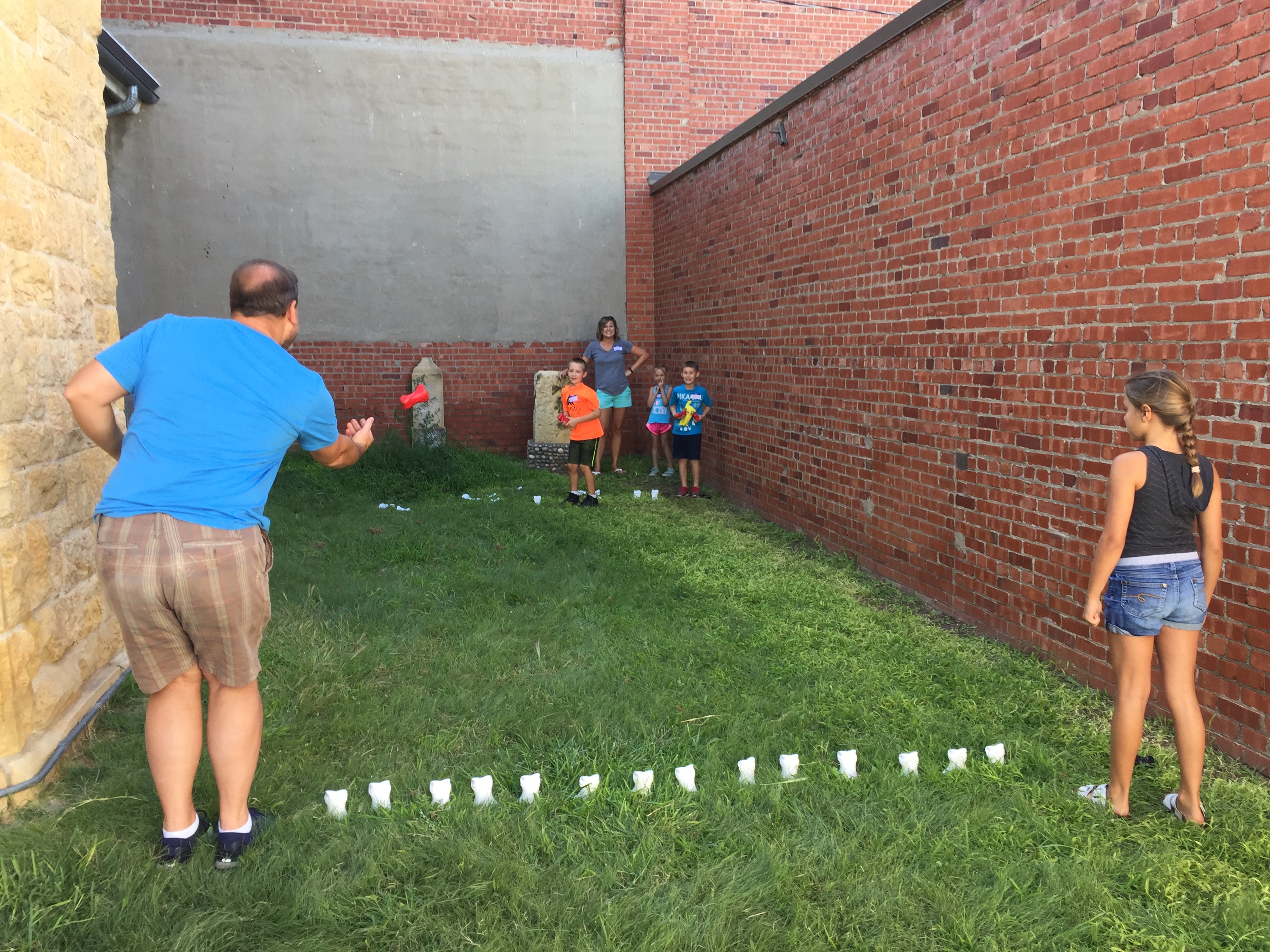
Hays resident Jerry Braun organized a rousing game of Bunnock, “The Game of Bones,” which originally used horse knuckles tossed between two teams trying to knock down all their opponent’s “bones” with the fewest number of throws.

“Bunnock began as a pastime by those in Russian military service and the soldiers brought it back to their families,” Braun explained. Today, Bunnock tournaments thrive in Canada, he added. It’s one of four countries where the Germans in Russia began to emigrate in 1872, along with the United States, Brazil, and Argentina.

Another popular game was Durak, the card game of “The Fool.” “You must lose your cards to win,” grinned Braun, “and the last player with cards is the Durak or Fool.”

Sylvan Grove resident Jana Wehrman brought her daughters Emma, 10, and Eastin, 8, to learn more about their dad’s side of the family.

“We homeschool our two girls and this is a good way to start our school year,” Wehrman said as she watched Schippers demonstrate life on the farm in the old days.

“We live on a farm but they’re learning what it used to be like for their grandmas and grandpas. They weren’t sure about the sauerkraut,” she laughed, “but they were excited to learn about some of those traditions.”

Wehrman is a former science teacher at Sylvan Grove High School and uses those skills in homeschooling her young daughters.

“Last week we looked up where Germany is. We talked about their great-grandparents and how they got to the United States. Eventually in this school year, we’ll probably do a unit on Europe.”

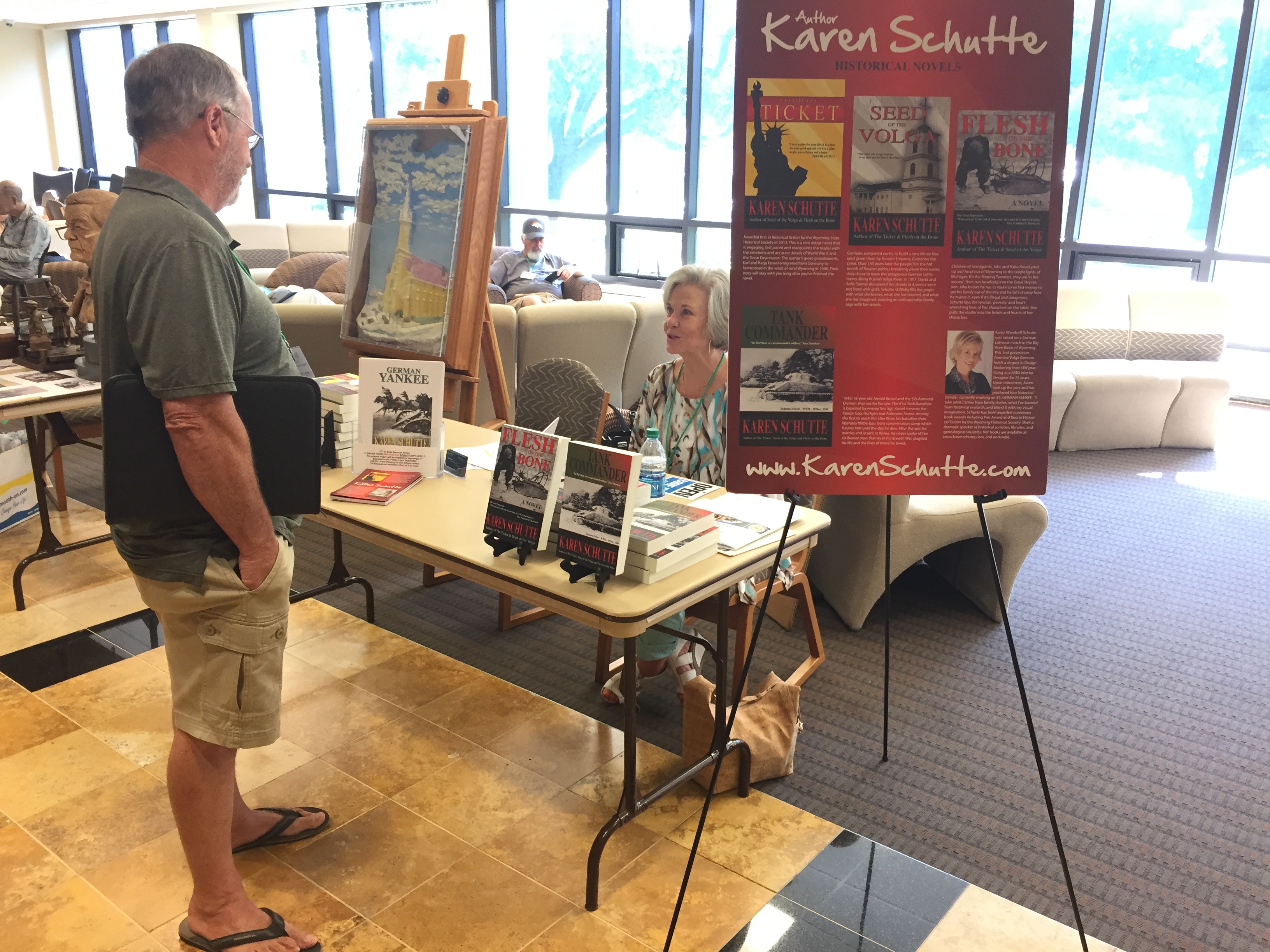
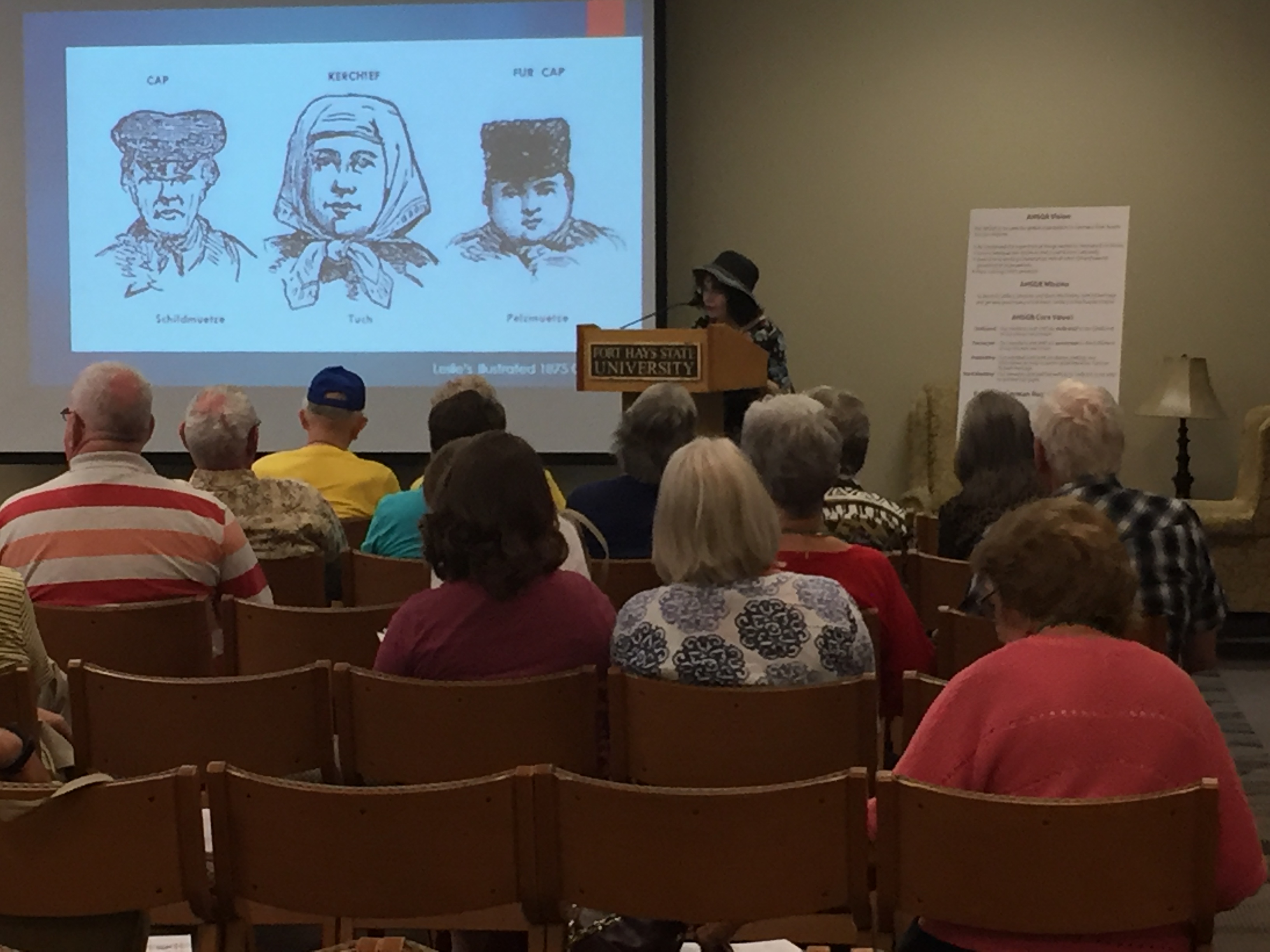
Concurrent sessions at the convention include DNA analysis, ethnic clothing, religious persecution, folklore, religious architecture, music, and authors discussing their books related to German-Russian stories and history.

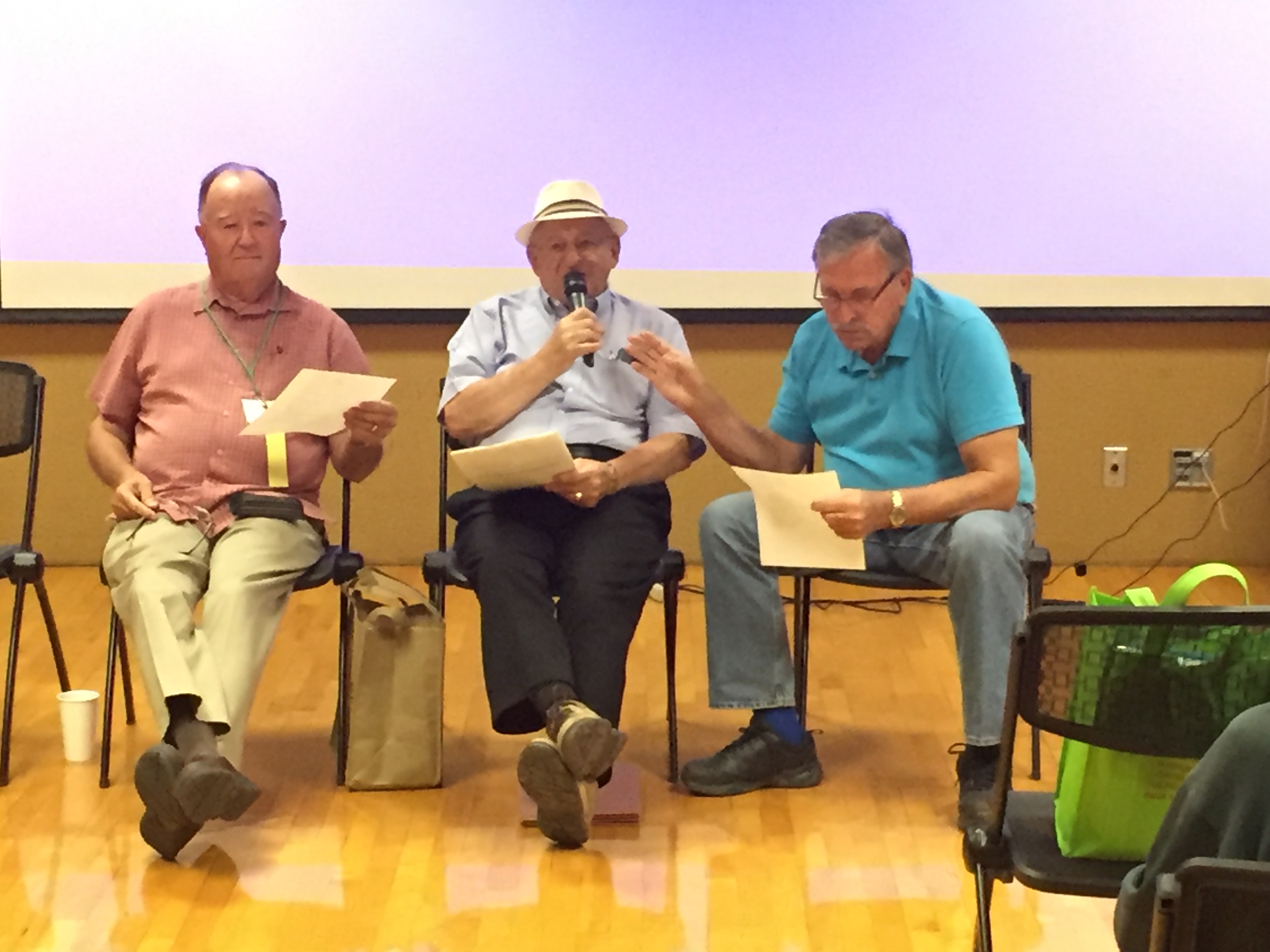
Tom Haas, Leo Dorzweiler, and Ray Breit explain different German dialects.

Area residents Tom Haas, Leo Dorzweiler and Ray Breit translated a German conversation into the local dialects spoken in Munjor, Catherine and Pfeifer.

Tours of historical and cultural sites were offered to the Volga-German “villages” in Ellis County and their famous limestone churches built by  immigrants.

Pete Felten’s limestone sculpture in Victoria of a Volga-German family. A replica sits at the AHSGR headquarters in Lincoln, Nebraska.

Pawelko was especially excited to tour the studio of Hays limestone artisan Pete Felten.

“We have a copy of Felten’s statue that’s in Victoria in Lincoln, and so that was pretty thrilling to see the original.”

They also have toured the Bukovina Society Museum in Ellis and the Ellis County Historical Society Museum.

Sam Brungardt along with Charlie Dorzweiler, who recently opened Das Essen House restaurant in downtown Hays, held cooking demonstrations of traditional German dishes including potato and dumplings and Christmas cookies.

“It’s just been a little something for everyone,” Pawelko said with a smile. “Kevin Rupp (Hays) and Leonard Schoenberger (Ellis) of the AHSGR Sunflower Chapter have just been incredible in organizing this.”

Also assisting with the convention are the Kansas Northeast Chapter and the Golden Wheat Chapter, along with the Hays Convention and Visitors Bureau. It continues through Thursday.

The international convention was last held in Hays in 2007.


🎥 Free food and free fun at Hays PD Community Night Out

HPD Community Night Out 2017 at the Hays Aquatic Park

By BECKY KISER
Hays Post

Free swimming and free eats.

That’s what residents can enjoy Thu., Aug. 2, during the Hays Police Department’s third annual Community Night Out.

It all takes place at the Hays Aquatic Park, 300 Main, from 5 to 8 p.m.

Police Chief Don Scheibler calls it an “exciting time.”

“We’ll have free hamburgers and hot dogs cooked by some of our retired officers. There’ll also be free swimming,” Scheibler said.

“It’s truly an opportunity for us to talk with and meet Hays residents and thank the community for their support of the police department.

“We truly encourage everybody to come out and join us. It’s really a great time for us.”

Scheibler also thanked sponsors for the event including Walmart, Hays Recreation Commission, Pepsi,  Crawford Supply, Fraternal Order of Police Lodge 48 and Phaze 2.

“We couldn’t do this without them,” he added.

Local barrel racers, defending rodeo champ ready for 89th annual rodeo

Norton resident Deb Christy rounds the barrels at the 2017 Cheyenne Frontier Days. The barrel racer will compete in Phillipsburg during slack on Tuesday, July 31. Photo courtesy Deb Christy.

PHILLIPSBURG – The first weekend of August in Phillips County always means rodeo time, and for the 89th time, Kansas Biggest Rodeo will be in Phillipsburg August 2-3-4.

Nearly 450 cowboys and cowgirls will make their way to north central Kansas for the chance at over $118,000 and beautiful gold buckles for the champions of each event.

Among those contestants are two local barrel racers who won’t have to travel far for the rodeo.

Deb Christy and Jenna Rolland will compete at the rodeo during slack on Tuesday, July 31.

Christy, who is married to long-time rodeo committee member Steve Christy, trains horses and will have been at futurities in South Dakota the week before the rodeo. Because her younger horses will have run at the futurities, she’ll give them a break and run one of her older horses, probably Blitz.

Blitz, a ten-year-old gelding, is a full brother to Christy’s famous horse The Chocolate Dash, who passed away seven years ago. Blitz looks like his brother but has a different personality. He’s very fast, and he loves running, Christy said. “He has such a joy for life. He loves to run.”

Christy broke her leg last April and wasn’t able to rodeo till early July, so she isn’t in the standings for any of the associations in which she usually competes. She knows she won’t be going to any of the association finals, so she’s chosen to pro rodeo with another barrel racer, Jenna Rolland.

Ten years ago, Rolland, who grew up in Hays, called Christy, asking to learn how to barrel race. Rolland was an accomplished breakaway roper and team roper, and Christy began to mentor her.

Deb Christy competes at the 2017 Phillipsburg rodeo. Photo by Jacque Bretton.

The two will compete at pro rodeos this summer, Christy showing Rolland the ropes. Rolland will run at rodeos in Burwell, Crete and Wahoo, Neb., before meeting up with Christy as the two haul together to Phillipsburg, Hill City, Abilene, and Sidney and Carson, Iowa.

Rolland looks forward to pro rodeo with Christy. “I’m so excited,” she said. “It’s like when you’re a little kid and you see these rodeos on TV. I get to live that dream this summer.”

Christy speaks highly of her protégé, who is a high school English teacher at Northern Valley School in Almena. “She is doing phenomenal,” Christy said of Rolland. “She has turned into an incredible trainer. It’s been fun for me, because she wasn’t even out of school when I started working with her. Now she has her master’s degree. I’ve watched her grow up, and it’s been fun.”

Rolland loves her job at Northern Valley High School as much as she loves running barrels. “I have the best job in the world,” she said. Her students are special to her. “They are wonderful. I cannot tell you how wonderful they are.”

And she’s excited to be on the rodeo road, running barrels. “I can’t believe I’m living this life. Who wouldn’t want to?”

The 2017 Phillipsburg barrel racing champion Christine Laughlin returns to defend her title.

The Pueblo, Colo. woman rounded the barrels at last year’s rodeo in 17.05 seconds to win first place and the buckle.

This year, as of press time, she was ranked twenty-second in the world standings and fighting to get into the coveted top fifteen in the world, who go on to the Wrangler National Finals Rodeo. Laughlin, who will run during slack on August 1, wasn’t sure which of her horses she will ride in Phillipsburg. She won last year’s rodeo on Jessi, a nine-year-old mare owned by Jack Vanwey. Jessi does well on softer ground, because “she uses her rear end quite a bit,” Laughlin said. “She prefers something she can get in and slide.” If Jessi isn’t her mount, Laughlin will ride her thirteen-year-old gray gelding named Six Pack, on whom she made the WNFR in 2014.

Laughlin has competed everywhere from Cheyenne to Salinas, Calif., Nampa, Idaho, and Ogden and Salt Lake City, Utah before coming to Phillipsburg. It takes a team to keep a barrel racer and her horses going on the road. Laughlin’s best friend, Josey Groves, drives a second truck and trailer, and Laughlin’s fiancé, Dean Derenzo, also drives. Derenzo’s sister, Doreen Wintermute, owns one of Laughlin’s backup horses. Making the WNFR is the ultimate goal, she said. “It’s how we make our living. We compare the WNFR to the super bowl, and like any pro athlete, it’s what you work for all year long.”

She is amazed at the prize money a town the size of Phillipsburg is able to raise. Rodeos in big towns in her home state don’t add as much to the purse as Phillipsburg. “It’s a really good rodeo to hit. Phillipsburg is so little, and they add more money. That’s just nice.”

Among the nine champions from the 2017 Phillipsburg rodeo, seven of them return: bareback rider Steven Dent (Mullen, Neb.); steer wrestler Tom Lewis (Lehi, Utah); team roping header Tyler Wade (Terrell, Texas); tie-down roper Blane Cox (Cameron, Texas); Laughlin; bull rider Wyatt Edwards (Sulphur, Okla.) and all-around hand Trevor Brazile (Decatur, Texas).
Twenty-five states and one Canadian province are represented among the contestants.

The rodeo begins with slack, the extra competition that doesn’t fit into the performances, on July 31 and August 1 at 7 pm both nights. The performances are August 2-3-4 at 8 pm each night.

Tickets range in price from $15 to $18 for adults and $11-14 for children ages 3-12, and can be purchased at Heritage Insurance Co. in Phillipsburg (685 Third Street) or over the phone (785.543.2448). They are also available at the gate.

For more information, call 785.543.2448 or visit the website at www.KansasBiggestRodeo.com.

SouthWind CrossFit expands into new space, plans new classes for youth

A fitness class at SouthWind CrossFit does wall balls during a recent workout.

By CRISTINA JANNEY
Hays Post

Tucker and Jill Mall and Josh Beiker recently realized their dream of owning their own building with the move of their business SouthWind CrossFit to the former Fire and Ice Club, 229 W. 10th, in downtown Hays.

“We had always envisioned owning the location that we are in, and we had actually tried to buy our old location,” Tucker Mall said.

The former club, with its 8,000 square feet of mostly open floor plan, was ideal for the workout facility. The move increased SouthWind’s space by about 3,000 square feet. SouthWind was formerly at 2005 General Custer.

The high ceilings at the new location also lend themselves well to the gym’s 15-foot rope climbs and workouts, such as wall balls in which participants throw a weighted ball and try to hit a mark on the wall near the ceiling.

SouthWind CrossFit is still waiting on some padding for the floor of their new space at 229 W. 10th St. The building used to be a night club.

Although the Malls and Beiker were not specifically looking to locate downtown, Tucker said they have been very welcomed by the downtown community.

Tucker said SouthWind will be expanding its offerings in its new location. This includes an expansion of its CrossFit Kids program and addition of CrossFit Teens.

CrossFit can be appropriate for a variety of ages and fitness levels. SouthWind also offers a Legends class for more mature or deconditioned athletes. Tucker’s parents participate in CrossFit, and they are over 60.

“My dad asked me, ‘When does it get easier?’ and I said, ‘When it gets easier, we’re not doing our jobs because we want to challenge you all of the time,’ ” Tucker said. “I have been doing this a little over six years now, and I keep coming back for more because there is always something more challenging, and it never gets stale, and it never gets old.”

CrossFit is defined as constantly varied, functional movement performed at high intensity. The workouts try to simulate movements that you would do in an average day, such as running, jumping and lifting. The wall ball workout, for instance, is a similar motion to Tucker tossing his child in the air at home when they are playing.

“We want to mimic everyday life and make your body more functional,” he said. “Eventually, we want you to have general physical preparedness. Your are generally physically prepared for anything that life can throw at you.”

Jill Mall works out at SouthWind CrossFit with one of the gym’s classes.

Jill Stecklein of Hays has been doing CrossFit for four years, a year and of half of which has been at SouthWind. She switched to CrossFit from primarily running, which was hard on her joints and she thought put her at risk for injury.

“I really like to do CrossFit because it has a wide variety of workouts that you get to do,” she said. “You get to work on strength training, flexibility, endurance. The classes are really greatly organized by all the coaches, and you’re led on how to do the movements. Throughout the workout, people are watching your form for you. The programming is really solid, so it helps me to get a workout really efficiently in an hour.”

Stecklein said an efficient workout is important to her because she is a mom and works.

Stecklein, 29, modified her workout and continued her CrossFit classes through her pregnancy with her son, Kolbe, who is 1 and a half.

“Also I really like the community of CrossFit,” she said. “Going to class with other people who have the same goals really helps to inspire you to really work toward your best and really work on your fitness goals.”

Tucker said he and Jill have tried to build a community at SouthWind CrossFit. Class sizes are small from between five and 20 people.

“The people you are working out with here are not just accountability partners, they are friends,” he said. “It is a family here. Everyone knows your name when you walk in the door. That is more powerful than anything else we have to offer here.”

SouthWind offers personal training. However, Tucker said coaching is strong even within the classes. SouthWind also requires all new members to participate in a program called On Ramp, which is four one-on-one classes that prepare you for group classes. Cost for a monthly membership is $90, which Tucker said is less than the average personal trainer.

SouthWind offers classes in the early morning, at noon and in the evening. More details can be found on their website.

High Plains Music Camp helps propel Hays music student to FHSU and beyond

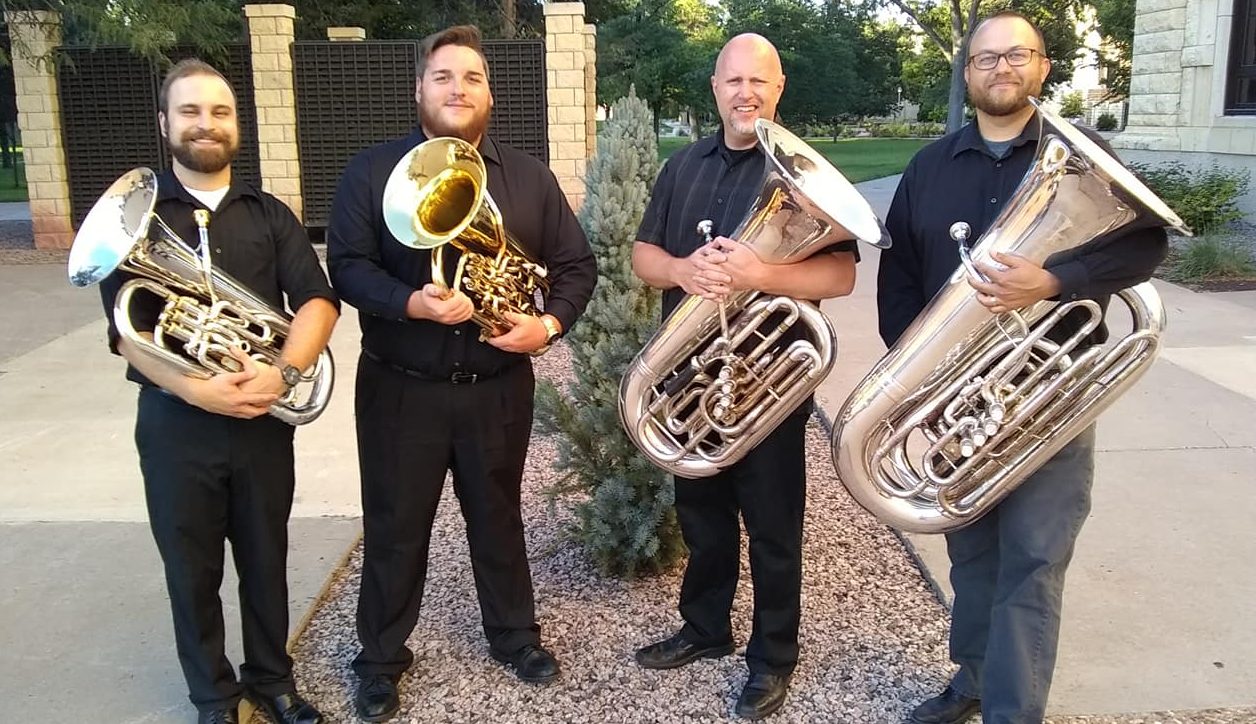
Fort Hays State University senior Nick Schumacher, second from left, shown with members of the faculty tuba quartet at this summer’s High Plains Music Camp at FHSU – from left Steven Rathert, Osage City; Dr. Peter Lillpopp, FHSU; and Steve Novotny, Pratt.

FHSU University Relations

Nick Schumacher is looking forward to his final year as an undergraduate student at Fort Hays State University.

During his “super senior” year – his fifth at FHSU – the Hays native will serve as one of the drum majors for the Tiger Marching Band for home football games.

First, though, he put in a week of work at what could be his final year at the summer High Plains Music Camp on campus.

For the first time, Schumacher got to play with the camp faculty in both the tuba quartet and the trombone choir performances.

As early as his sophomore year at Thomas More Prep-Marian High School in Hays, Schumacher had begun working with Fort Hays State faculty, taking lessons from Dr. Lane Weaver, then assistant professor of music and theater and director of the FHSU Marching Band.

After graduating from TMP in 2014, Schumacher decided to stay close to home to attend college – partly because of finances, partly because of familiarity. After all, he had been coming to campus every summer for the music since he was in eighth grade.

He also participated in numerous activities during the school year, playing in the pep and marching bands, symphonic winds and wind ensemble and the jazz band. He also sang in the brass choir and served as the student conductor for the pep band at Tiger basketball games last winter.

Weaver has since left FHSU, and Schumacher now studies under Dr. Peter Lillpopp, assistant professor of low brass and director of athletic bands for the Tigers.

Schumacher, who writes music, would like to teach at the college level someday.

“If that doesn’t work out, I could work for a publishing company,” he said.

Schumacher thinks the variety of opportunities available to him at FHSU has helped build a solid foundation for whatever route he chooses.

That includes the summer music camp – five years of participating as a student, followed by four as an intern and counselor.

“A lot of the instructors at the camp are from out of state, so you learn different things,” he said. “I’ve learned a lot about technicality, so much about being a better musician.”

Schumacher noted other advantages of attending the music camp.

“You get to know a lot of people; one of the cool things, I got to make more connections,” he said. “When I first started coming, that was back in the day when there were 600 or so kids going to the camp. They were way beyond the boundaries of Hays, America. Every year there are new faculty and students to meet.”

That was something that hadn’t even been on his radar his seventh-grade year at Felten Middle School (now Hays Middle School).

“After sixth grade, my band director wanted me to go to music camp, but I wasn’t that diehard into band. It was something I did as a hobby,” Schumacher said. “Then the next year, my mom and my band teacher coerced me into doing it.”

That one week in the summer of 2009 was life-changing for Schumacher.

“I knew no one going to the camp,” he said. “Going out of it, I loved it.”

Schumacher still was unsure if he wanted to make music his career choice, until about midway through his senior year in high school. He had been planning to go into pre-physical therapy.

“I started realizing I had a talent in music in high school,” he said. “I’m glad I chose that route.”

Ness City teacher to speak at Tiny House conference

The exterior of Ness City High School’s tiny house.

By CRISTINA JANNEY
Hays Post

The instructor of the building trades class at Ness City High School will speak about the school’s tiny house project at the international People’s Tiny House Festival  Aug. 3-5 in Colorado Springs, Colo.

The buildings trades class, which is comprised of about 20 students, built its second tiny house this spring.

Brent Kerr, instructor, said the school could not afford to build a full-size house and, even if they could, it likely would be hard to sell in their small community.

Kerr and the school board saw the tiny house as a means of teaching students valuable building and carpentry skills.

“Not every school gets the opportunity to build a house. I know there was no way to build a large house in Ness City,” Kerr said. “In the tiny house, the students did all electrical. We didn’t use an electrician, but we had everything checked. They did the HVAC, plumbing, siding, windows and doors. They got to do the whole deal.”

Kerr and his students were a featured attraction at annual Western Kansas Technology Education Fair at Fort Hays State University this spring. The school brought the house, which was in progress at the time, and opened it up for tours.

See related story: 🎥 Tiny house big hit at tech ed fair for Ness City students

The house has since been completed and is for sale on a lot in Colorado.

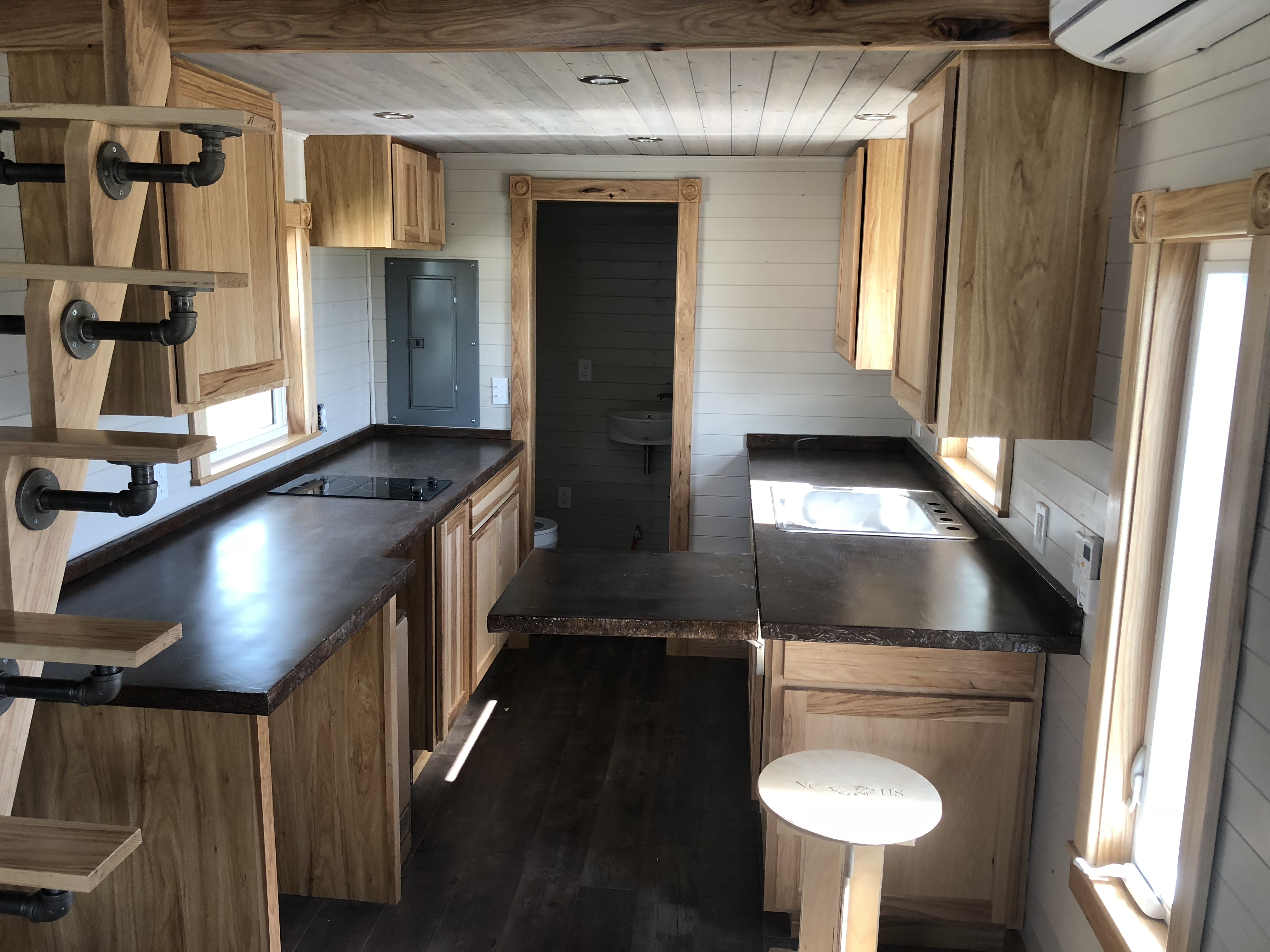
Ness City High School’s tiny house kitchen.

Kerr said by speaking at the tiny house festival, he hoped to not only promote the teaching of building trades through the construction of tiny houses, but also find a buyer for the school’s tiny house.

If the house does not sell by the festival, Kerr hoped to transport the home to Colorado Springs and exhibit it there.

The school is asking $57,000 for the house. The funds raised from the house’s sale will go into the construction of a third tiny house and to upgrade NCHS shop equipment. Kerr said if the tiny house program continues to be successful, he would like to create a scholarship for NCHS students seeking post-secondary study in technical trades.

Much of the NCHS tiny house was custom built, including the concrete counter tops. The home is only 200 square feet, but includes a sleeping loft, bathroom and kitchen.

Gloria VonFeldt of Victoria is part of the tiny house movement and a promoter for the Colorado Springs festival.

She lives with her sister in a standard house now, but dreams of owning a tiny house and using it for travel.

VonFeldt and festival founder Marcus Alvarado said buying and living in a tiny house is more than economical living, it is about sustainable living. Tiny houses make a smaller environmental footprint. Some choose to have their tiny houses classified as RVs, so they can move with jobs or for travel.

Ness City High School’s tiny house loft.

Others use the tiny homes for bed and breakfasts for extra income, yet others are baby boomers who want to downsize and live more simply. Yet others see tiny houses as a way to address social issues, such as homelessness, especially in metro areas where space is at a premium and housing is expensive.

The Ness City tiny house is right in line with want a tiny house can run. It varies greatly depending on the materials used, the square footage and how much labor the owner wishes to put into the project. Most tiny homes run between $60,000 and $120,000.

Ness City High School’s tiny house bathroom.

The festival has assembled a variety of speakers and panels, who will discuss topics such as travel, construction, buying a tiny home and zoning, which differs from city to city and state to state.

The festival will also feature booths and vendors centered on sustainable living through other means. Alvarado said this year’s festival is expecting as many as 20,000 people from 31 states and six countries.


Recent rainfall has ‘Little Great Lakes’ full

Keith Sebelius Reservoir at Prairie Dog State Park outside Norton.

Kirwin, Waconda, Webster full; Sebelius struggling

By KIRBY ROSS
Phillips County Review

PHILLIPSBURG — Despite Phillips County and surrounding counties being under a drought watch, most of “The Little Great Lakes” of the Solomon and Republican River watersheds are doing just fine. The Little Great Lakes includes Kirwin, Sebelius, Harlan, Webster, and Waconda reservoirs.

Continuing its half-century tradition of going through periods of feast and famine, over the course of recent months Kirwin Lake levels have continued to rise, and it is now at over 100 percent of its capacity.

As recently as August 31, 2016, Kirwin held only 30,384 acre feet of water, which was 31 percent of its 98,154 acre feet capacity.

Three days after that date massive downpours 60 miles west of the lake dumped a deluge of water into the Solomon and Bow Creek drainage basins, with up to 14 inches falling in Norton and Graham counties in a few hours time.

By the end of September of 2016 the lake level had jumped all the way up to 69,704 acre feet, putting it at 74 percent of capacity.

Throughout the following 22 months Mother Nature has continued to provide a healthy dose of precipitation exactly where it needs to be to feed the lake.

So healthy, that as of June 30, 2018, Kirwin was holding 102,262 acre feet of water, putting at 104 percent of capacity. And it’s worth noting that that number is down from 108,096 af just 30 days earlier, when Kirwin was at 110 percent of capacity. Releases through the Solomon River outlet has brought it down.

Throughout the month of June, an average of 223 acre feet of water flowed into the lake per day according to monthly reservoir statistics provided by the U.S. Bureau of Reclamation. But as good as June was for Kirwin, it ranked in fourth place for inflow compared to Waconda, Harlan, and Webster.
Of all of the other area reservoirs, Sebelius in Norton County continues to be the most anemic. With a total possible conservation storage capacity of 34,510 acre feet, as of the end of June it held 14,849 af, putting it at 43 percent of capacity. This number is virtually unchanged from 12 months ago, when it was just a few hundred acre feet fuller.

Adding insult to injury, a few weeks ago the Kansas Department of Health and Environment raised a blue-green algae health alert for Sebelius, resulting in direct contact with the water being discouraged and the governor declaring a state of emergency for the city of Norton, which sources its drinking water from Sebelius. Fish caught during a blue-green algae outbreak are safe to eat provided they are rinsed with clean water.

Webster Lake in Rooks County has been faring a good bit better. As of June 30, that reservoir was 110 percent full. With a total conservation storage content capacity of 76,157 af, it stood at 83,595, which is up from 106 percent of capacity 12 months earlier.

Just across the state line north of Phillipsburg, the Harlan County Reservoir is still lower that its full capacity. At the end of June 2018 Harlan was holding 248,944 acre feet of water, which is pretty good but is 79 percent of its 314,111 capacity. Like Sebelius, Harlan is down a bit compared to 12 months ago, when it held 255,759 af of water.

The 800-pound gorilla of lakes in the region remains, and will remain for the foreseeable future, Waconda Reservoir.

Waconda had an incredible month in June 2018, averaging 1,726 af of inflow per day. That compares to 243 for Webster; 223 for Kirwin; 254 for Harlan; and 20 for Sebelius.

Sitting at the edge of a slightly different climatic region and being fed by multiple rivers and creeks, as well as a relatively major constant-flowing spring, in recent years Waconda has been able to maintain, with little difficulty, its status as being one of the largest lakes in the state of Kansas.

With a total conservation storage capacity of 219,461 acre feet, as of the end of June Waconda held 225,390, which put it at 103 percent of capacity, an improvement over 12 months earlier when it was at 98 percent of capacity.

🎥 City commission approves next step for Tractor Supply Co.

Hays city commissioners set a public hearing date of Aug. 9 for the proposed 2019 budget.

By BECKY KISER
Hays Post

With no comment, Hays city commissioners Thursday night set a public hearing for August 9 on the 2019 draft budget. The public hearing will be part of the commission’s regular meeting.

The mill levy remains at 25.00 mills where it’s remained for several years. In 2011 the city commission began paying cash for most capital projects rather than utilizing general obligation bonds in an effort to keep the mill levy at 25, requiring a prioritization of projects.

The proposed budget includes a new employee pay plan and an increase from $9,500 to $11,000 per employee to provide health insurance.

In earlier reviews, commissioners increased the outside agency funding allotted to Fort Hays State University’s city scholarship program to $100,000 from the recommended $90,000.

Jesse Rohr, public works director, shows the requested zoning change for Crawford Addition to Commercial General District.

In other business, commissioners unanimously approved the Crawford Addition requests for annexation, rezoning and final plat. The property site, at the northwest corner of 48th and Roth, is being considered as a location for a new Tractor Supply Company (TSC) retail store by an Arkansas land developer.

The requests had already been approved by the Hays Area Planning Commission.

Public Works Director Jesse Rohr said the land, owned and sold by Scott Crawford of Hays, is north of Interstate 70 and contiguous to the Hays city limits. The area has been in agricultural production for many years and the request for rezoning was from Agricultural to Commercial General District.

There are two lots on the property. The south 3.5 acres (Lot 1) is the proposed location for the store. Rohr noted all public utilities, including public water and sewer, are in place to be extended across W. 48th allowing for development of this property.

(Click to enlarge)

“Water and sewer are both located on the south side of 48th and Roth and both will be extended to the north side of the developed lot by the developer at their cost, ” he said.

“They’re ready to move on this. They’ve submitted plans, hoping for your approval on these things tonight.” Rohr added that the city has received a site plan from Tractor Supply which would have two entrances on the west and north sides.

The two acres in the north end of the plat (Lot 2), for which no use has yet been designated, has a right-of-way for a future proposed street. Rohr noted the developer has dedicated the right-of-way in anticipation of a road for remaining undeveloped land to the west.

The commission also approved a bid award for construction of a three story drill tower at the Fire/Rescue Training Facility on the south ball field of the old Frank Stramel ball fields in south Hays. American Fire Training Systems had the low bid of $145,917. The city received a $272,000 grant from the Dane G. Hansen for funding to construct the facility which will be used for regional training.

Commissioners Sandy Jacobs and Henry Schwaller were absent from the meeting.

Phillipsburg’s ‘man of steel’ built rodeo grandstands, helped with construction of pens

Cliff Van Kooten, the “Man of Steel,” left a memento atop the west grandstands. The Phillipsburg man helped build the grandstands and some of the pens at the Phillipsburg rodeo grounds.


PHILLIPSBURG – He’s the man of steel, and he’s put up plenty of it at the Phillipsburg rodeo grounds throughout the years.

Cliff Van Kooten has been associated with the rodeo, either on the committee, as chairman, or as a volunteer, since 1982.

After graduating from high school in 1960, the Long Island, Kan. native spent three years in the military before coming back home to marry his wife, Helen, in 1964. The couple moved to Phillipsburg. He went to welding school and worked for the International Harvester dealer in Phillipsburg while he welded on the side.

In 1967, he started his own business, and two years later, he bought the location where Cliff’s Welding is situated, on the west side of Phillipsburg.

In 1982, a Phillipsburg businessman stopped by his shop, offering his rodeo share in the Rodeo Association for $100 to Van Kooten. But Van Kooten couldn’t afford it. “At the time, I didn’t have the money, so he said he’d keep it till I had enough. It wasn’t long, and I had the $100.”

Cliff Van Kooten has volunteered with Kansas Biggest Rodeo for every year since 1982. He served as chairman of the committee from 1986-1990, constructed the grandstands, and now serves as concessions coordinator.

A year later, he was voted on the committee, and from then on, he started rebuilding parts of the rodeo grounds.

First to be rebuilt was the above-the-chute seats. Along with help from Danzy Price and the committee, the old wooden stands were torn down and new steel ones built. Next, the stands on the southeast side were redone, then the northeast side (also known as the rowdy section). After that, Van Kooten started on the west side, with the northwest, the west, and the southwest stands. He often donated his labor, working evenings and weekends, along with Price and other committee members. Price constructed the arena fence, and he and Van Kooten often helped each other out.

Van Kooten served as chairman of the committee for four years (1986-1990). In 1997, he no longer was a committee member.

But he didn’t quit working. He volunteered as the concessions organizer, ordering the food for the concessions stands and lining up the volunteer help.

A year and a half ago, he had heart surgery, which slowed him down. He still orders the concessions supplies but gave up the job of getting volunteer help.

Van Kooten, in 1989, designed and built a self-unloading double-wide hay bale trailer, called Pride of the Prairie. He improved on the design throughout the years, and the trailer, with its ability to haul double the load, is popular across the nation and is sold by dealers from the coast to coast and border to border.

He spent countless hours, a lot of it during the evenings, at the rodeo grounds, building. But Van Kooten enjoyed all of it. He loved working with the committee, and he loved the construction part of it. “I have so much pride out there (at the rodeo grounds), I don’t know if I’ll ever sell my (rodeo) share. I took pride in what I did, and I wanted it to be good.”

One thing he especially appreciates is that people are always willing to help out. When he brings concessions supplies to the rodeo grounds, he rarely has to unload them himself. “Every time I get out there with a load of groceries, there’s always people to help unload.”

Van Kooten left a memento, high above the arena, on the corner of the big west grandstands: a sign that reads “The Man of Steel – Cliff’s Welding.” It’s a tribute to one of the many loyal volunteers who has made the Phillipsburg Rodeo possible, through his hard work and faithfulness.

Kansas Biggest Rodeo is August 2-4 and begins at 8 pm each night. Tickets are still available and range in price from $15 to $18 for adults and $11 to $14 for children ages 3-12. They can be purchased at Heritage Insurance in Phillipsburg (685 Third Street) and over the phone (785.543.2448). They can also be purchased at the gate, until they are sold out.

For more information, visit www.KansasBiggestRodeo.com.

UPDATE: St. Mary’s school, church in Ellis suffer damage from Wednesday storm


By CRISTINA JANNEY
Hays Post

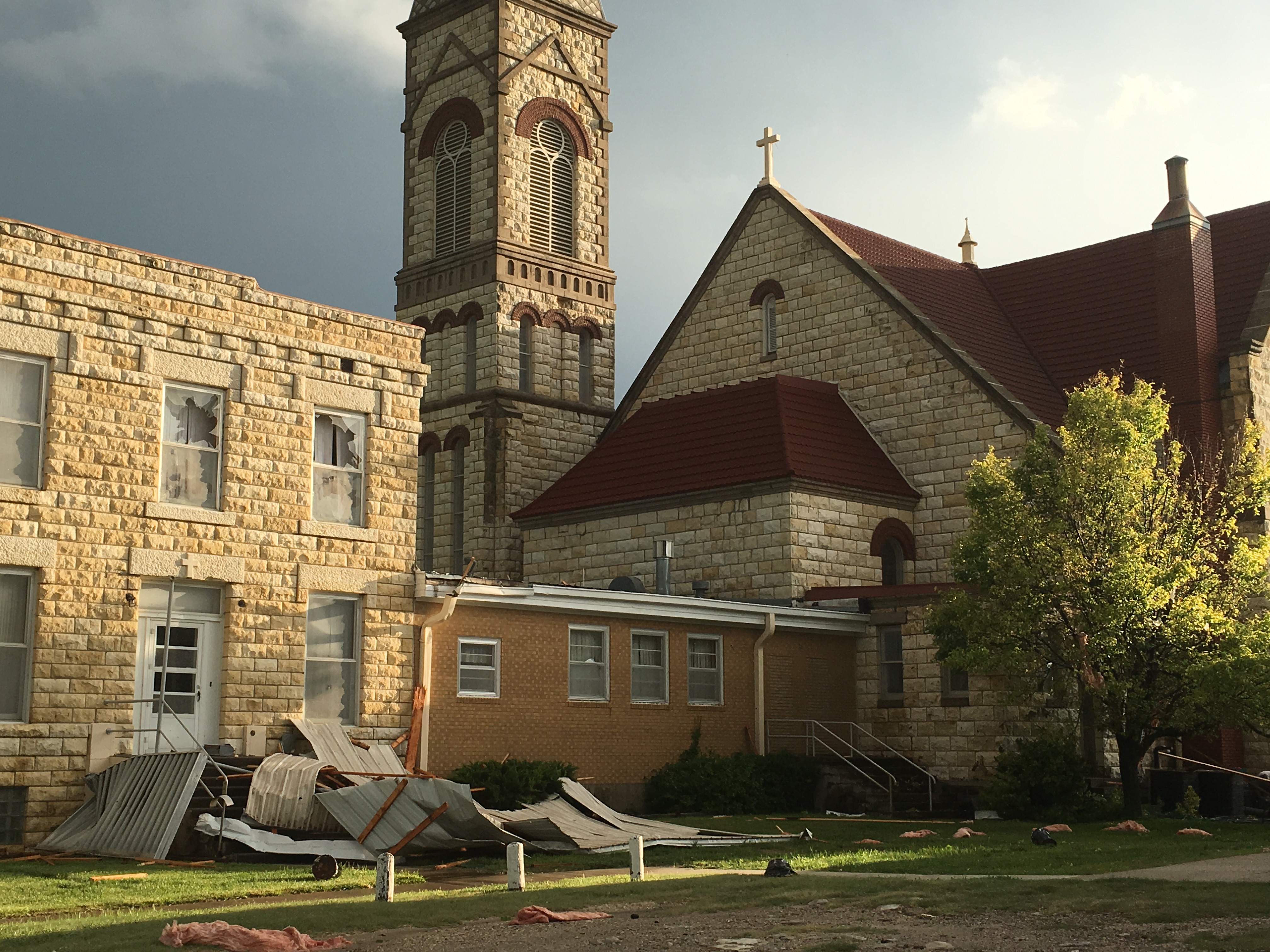
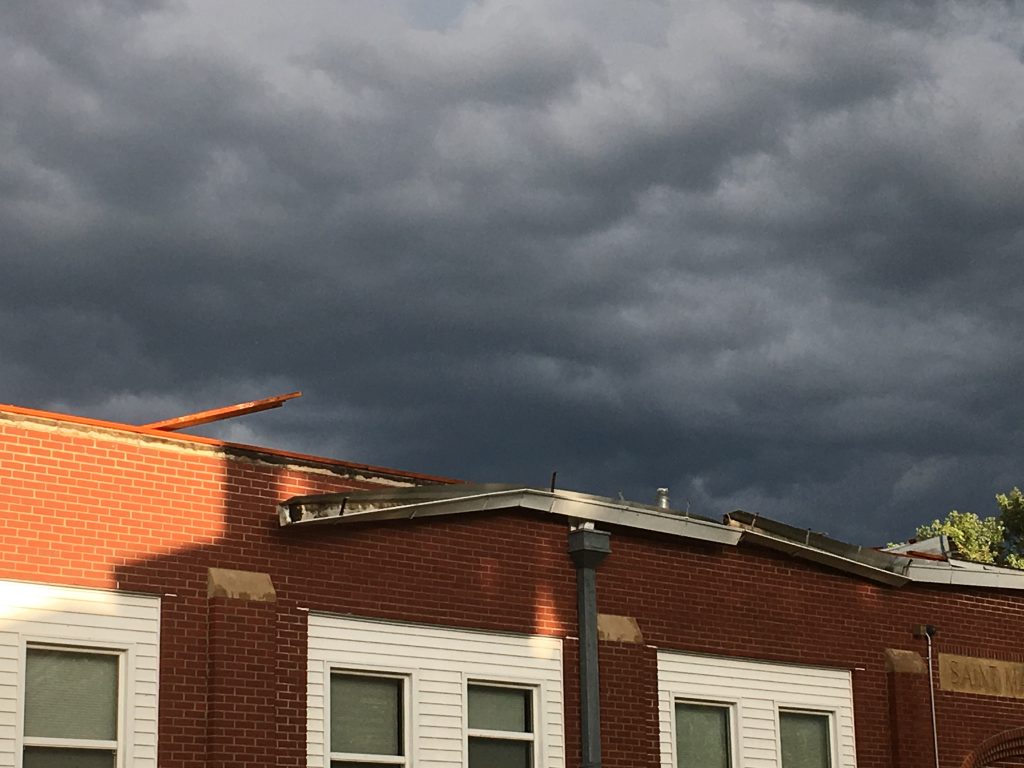
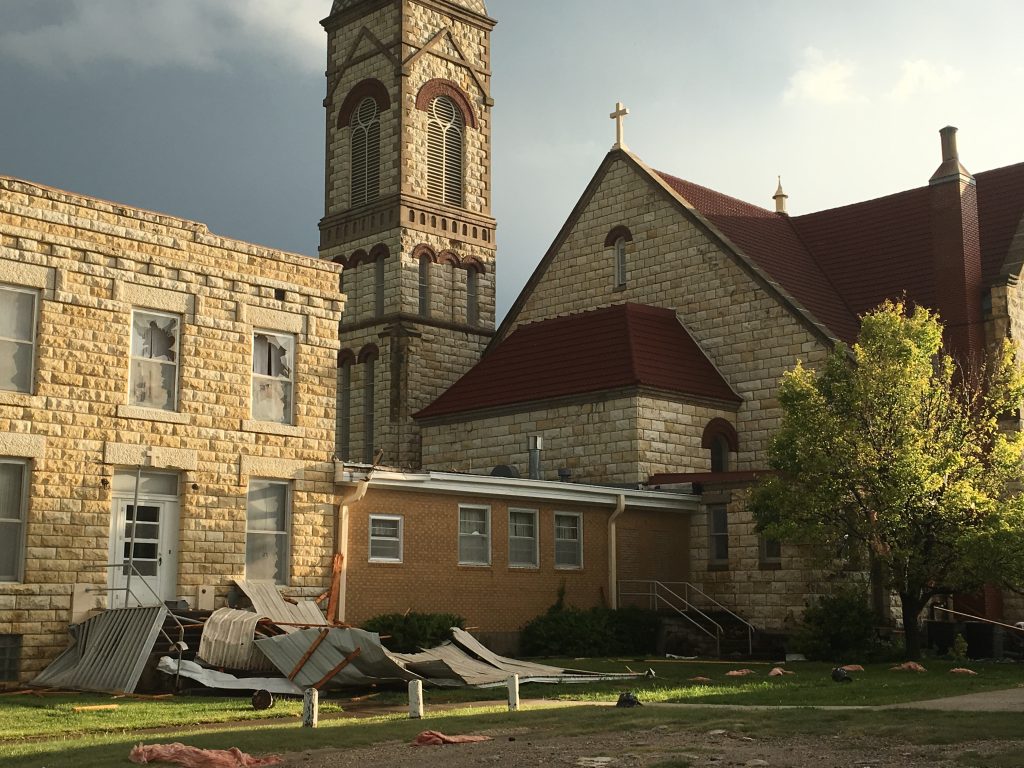
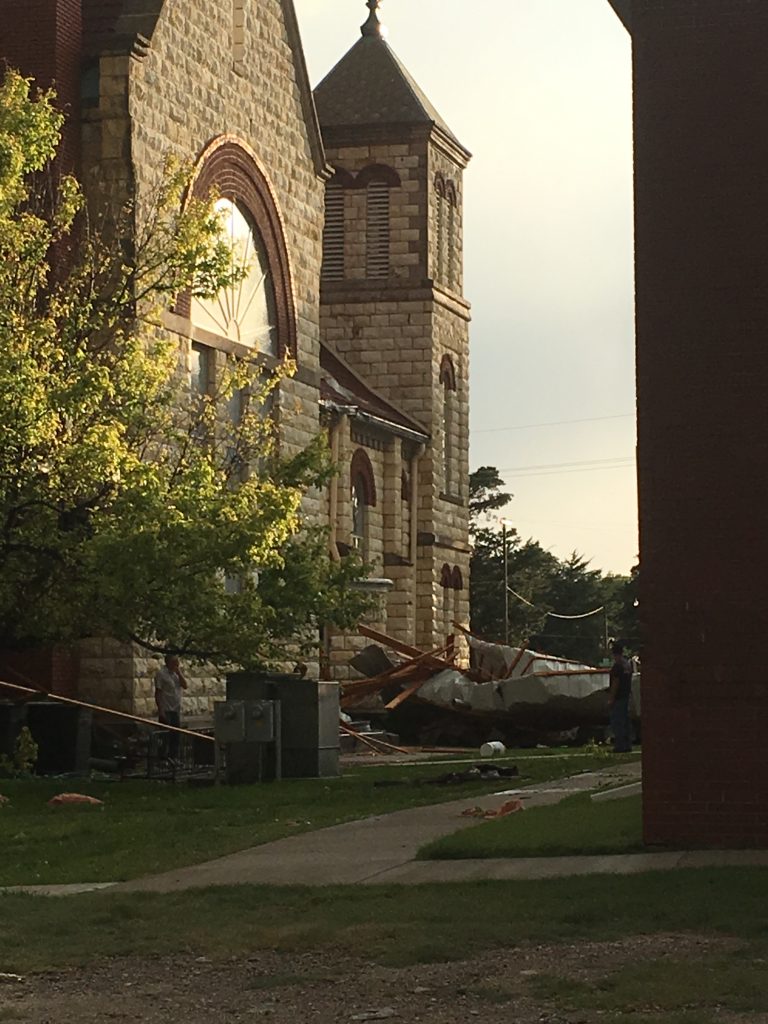
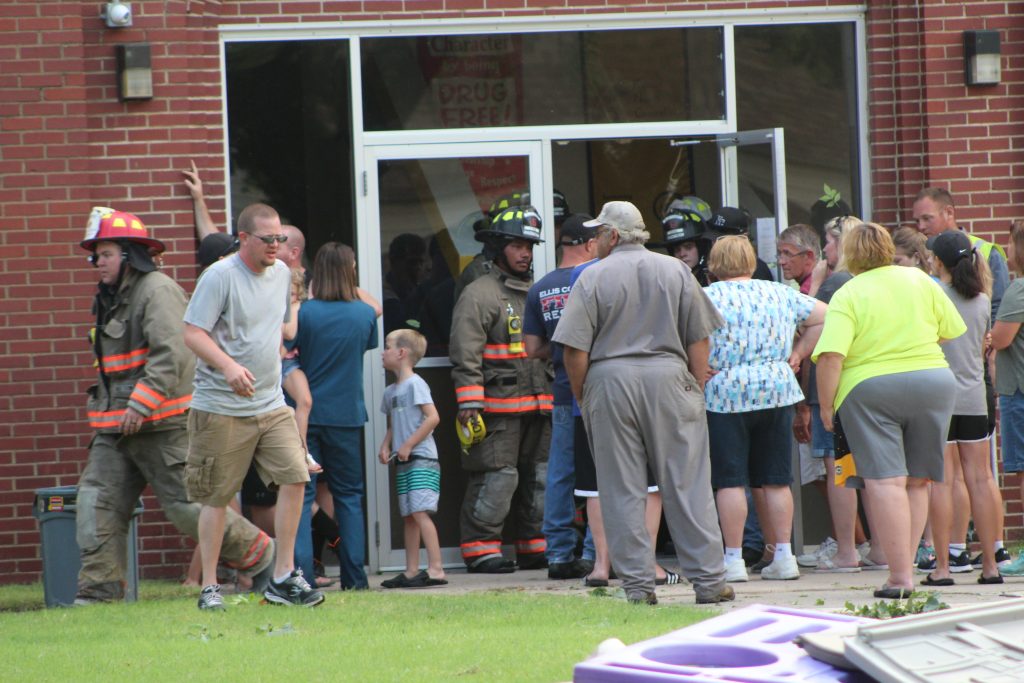
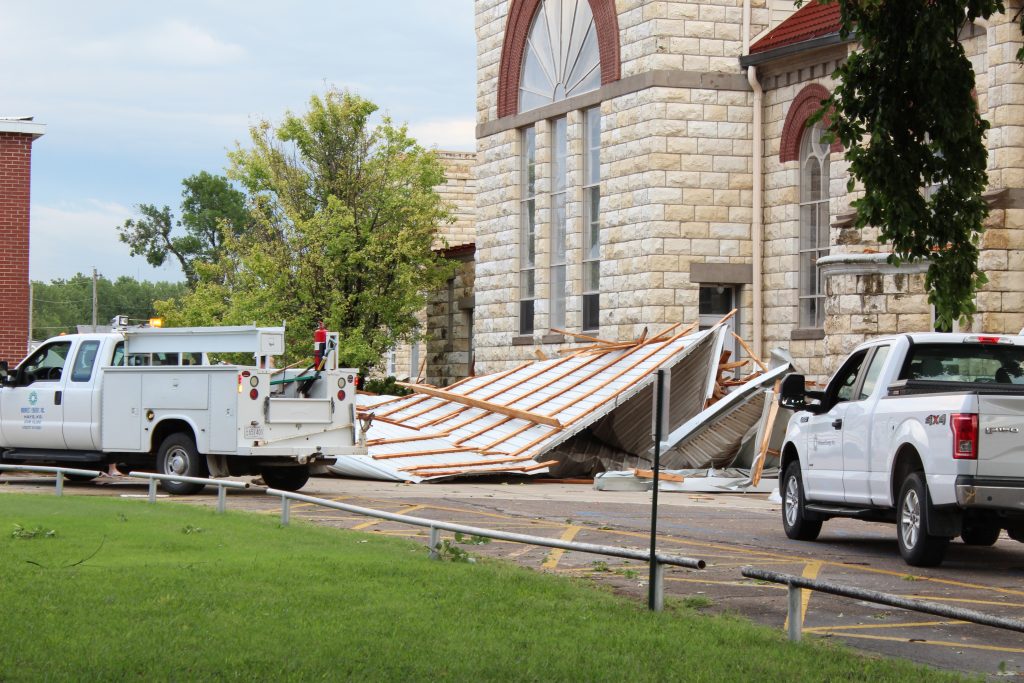
ELLIS — St. Mary’s Catholic School, 605 Monroe, Ellis, suffered roof damage from Wednesday evening’s storm, which began at about 7 p.m. and quickly passed.

A portion of the school’s roof blew off, and a portion of the gym’s rear brick wall collapsed. Part of the debris hit the adjacent church. Portions of a couple of the stain glass windows were broken. Debris also pierced the church’s roof.

Anticipating more rain, a group gathered at the school to try to board up as much as could be covered to prevent more damage.

Law enforcement encouraged anyone who was not directly involved in the cleanup effort to please avoid the area of the school.

Deputies also reported damage to two barns in northern Ellis County.

Straight-line winds were believed to have reached 80 mph or more.

Large limbs were down throughout the city of Ellis. However, no other major damage was reported.

One inch of rain was reported at the Eagle Media Center in Hays. Some street flooding was seen, however, not to the extent when a storm dumped four inches of rain on the city earlier this month.


Hays Community Theatre’s ‘King and I’ still relevant 30 years later

By CRISTINA JANNEY
Hays Post

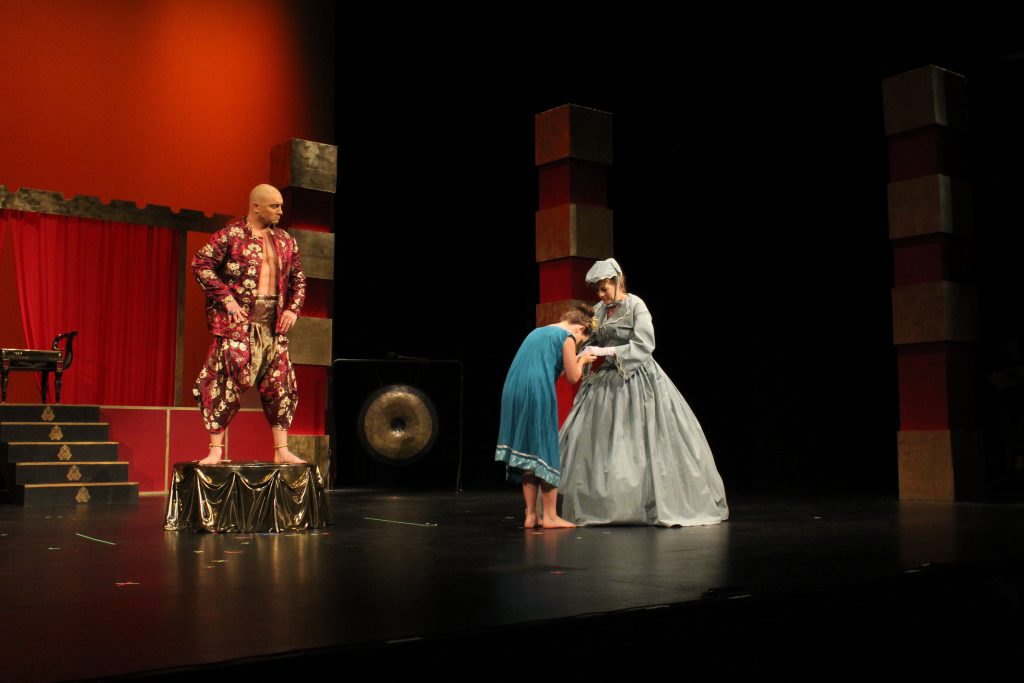
The Rogdgers and Hammerstein classic “The King and I” might have been a creation of another generation, but it touches on many issues still relevant today.

The Hays Community Theatre is set to perform the “The King and I” at 7 p.m. Thursday, Friday and Saturday at Beach/Schmidt Performing Arts Center.

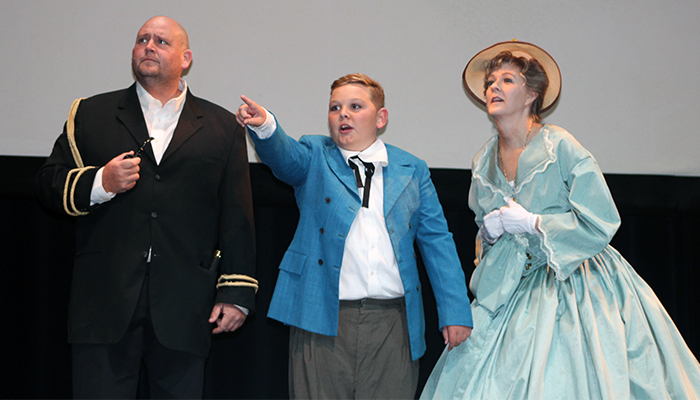
The play is directed by Pamela Grizzell and stars her husband, Travis Grizzell, drama director at Thomas More Prep-Marian, as the king and community theater newcomer Anita Walters in the female lead as Anna.

“It is a beautiful story of two cultures and that very thing — getting to know different cultures and different ways of life. And at the heart of that, there is feminism, there’s slavery, there’s the old style of ruling with a monarchy,” Travis Grizzell said. “As old as it is, it is timeless. some of the same things that were separating us back then, we are still fighting now. That with the timeless beautiful music, it is just a great show to come and experience again.”

The community theater has been planning this production for about a year, and bringing the production together has had its challenges.

“It is all volunteer,” Grizzell said. “You are dealing with amateurs who have a day job that is very much not theater usually, and you are handing them the same script that the very best people in the world have utilized on Broadway and West End. To get people there in the evenings and to commit for six to eight weeks and coalesce as a group to the level of performance that these shows demand — it is very taxing.”

Grizzell estimated it had been 30 years since 1951 musical “The King and I” had been staged in Hays, and the community theater thought it was time to bring back the classic. Pam Grizzell was part of the chorus as a high school student when the production was staged at Fort Hays State University in 1985 and was a champion of the show.

Many know the “The King and I” from pervious stage performances or the 1956 screen version staring Deborah Kerr and Yul Brynner. Grizzell said portraying such an iconic character is a challenge as an actor.

“It is one of these roles as an actor they try to make you find your own spin on the character and be original, but sometimes you find yourself doing an iconic role that you don’t really want to bring a lot of new stuff to. Dorothy, if you are doing that in ‘The Wizard of Oz,’ people have an expectation they want to see,” Grizzell said.

“This is one to maybe not quite that degree, but it was known for Yul Brynner’s performance, and the man was amazing at it. He happened to be bald, so my wife, the director, lead with, ‘Give people what they expect to see,’ so I am down a hair or two. You do find yourself on that line between acting and imitating. Inevitably, it is going to be your own and what you bring to it.”

The cast is large — 35 people — with ages ranging from a baby who is playing one of the king’s children to actresses in their 50s playing the king’s wives.

“It is a pretty massive undertaking,” Grizzell said. “It is all volunteer. Everyone is doing it for the good of the community and the good of the community theater and to just give people the opportunity to showcase their talents and present something good for our community here.”

The sets are not as elaborate as those for last year’s production of “Mary Poppins.” Most of the action for the “King and I” takes place within the Siamese palace. However, portraying Siam in 1862 required extensive costume work, all of which has been done by volunteers, Grizzell said.

“We hope it takes you to a place of royalty and the different place of Siam, and we create that feel of being somewhere else,” he said.

“The King and I” is a production recommended for all ages. Children will be exposed to the spectacle of musical theater, while older audiences may recall the Brynner film performance or occasions when they may have seen the familiar characters portrayed in another venue, Grizzell said.

Tickets cost $15 for adults or $10 for children 12 and younger. They can be purchased online at https://www.hctks.com/ or at the door.

The cast list is below:

Production Director– Pamela Grizzell

Music Director – Monica Rome

Accompanist – Amy Staab

Stage Manager – John Drees

Captain Orton – Chris Norris

Louis Leonowens – Vincent Brack

Anna Leonowens – Anita Walters

The Interpreter – Dylan Werth

Royal Guards: Alexandra Herrman, Annie Wasinger

The Kralahome – David Koshiol

The King – Travis Grizzell

Phra Alek – Tony Lewallen

Lun Tha – Justyce Briney

Tuptim – Katy Walters

Lady Thiang – Jane Rorstrom

Prince Chulalongkorn – Micah Harbough

Princess Ying Yaowalak – Chloe Rice

Sir Edward Ramsey – Dylan Werth

Royal Princes and Princesses: Madighan Norris, Sidney Wittkorn, Dayvean Koshiol, Faith Fondoble, Ainsley Harbaugh, Brynn Harbaugh, Emmalyn Harbaugh, Greta Harbaugh, Annalise Harbaugh, Micah Harbaugh, Jade Harmon, Jordyn Flavin, Isaac Bloom, Janessa Miller, Christian Miller, Malachi Miller, and Connor Miller

Royal Wives: *Sara Bloom, *Wendy Richmeyer, *Joyce Cornwell, *Katherine Leiker, Alexandra Herrman, Annie Wasinger. (*denotes solo)

Priests of Siam: Dylan Werth, Chris Norris, Tony Lewallen

Small House Singing Ensemble: Katherine Leiker, Sara Bloom, Wendy Richmeyer, Joyce Cornwell

Little Eva – Alexandra Herrman

Mischief Maker Topsy – Ainsley Harbaugh

Uncle Thomas – Sydney Wittkorn

Eliza – Annie Wasinger

King Simon of LeGre – Faith Fondoble

George – Connor Miller

Buddah – David Koshiol

Angel – Madighan Norris

Scientific Dogs: Vincent Brack, Dayvian Koshiol, Christian Miller

Dancers representing water, snow, rain, clouds, mountain and forest will be specifically announced later, however they will be comprised of the following: Isaac Bloom, Chloe Rice, Brynn Harbaugh, Emmalyn Harbaugh, Greta Harbaugh, Annalise Harbaugh, Micah Harbaugh, Jade Harmon, Janessa Miller, Malachi Miller


Copyright Eagle Radio | FCC Public Files | EEO Public File