We have a brand new updated website! Click here to check it out!

Hays girl builds homes in Nicaragua by selling homemade detergent

Reece Leiker, 13, Hays, with a bottle of her Pure Roots laundry detergent.

By CRISTINA JANNEY
Hays Post

Thirteen-year-old Reece Leiker has a pretty nice life — what you might expect of a typical American teenager. She eats well. Her parents live in a nice home in Hays. She has nice clothes.

But when Reece was 11, she learned there were people in this world who did not share that life. Something in her heart compelled her to help.

Leiker, now, 13, is selling Pure Roots homemade laundry detergent to raise money to build homes for the poor in Nicaragua.

Leiker has joined forces with her parents. Leiker alone has raised almost $49,000 to build eight homes in the impoverished country. Together, she and her family have built 14 homes in Nicaragua.

Her parents first took up the cause after they attended a seminar in February 2016 by advocate Dani Johnson of King’s Ransom Foundation. According to the nonprofit’s webpage, it helps build homes, assists orphans, provides clean water and rescues children from sex trafficking around the world.

Reece Leiker looks out a window at dump in Nicaragua. She said seeing children eat from the dump changed her perspective on what it is to be poor.

Taryn Leiker, Reece’s mother, said the family had contributed to many causes in the past, but as they researched these charities, they found very little of the money was going directly toward assisting the people they wished to help.

Taryn Leiker said she and her husband, James, were drawn to the Nicaraguan project because 100 percent of their investment is spent helping the needy. They learned there is great need. Nicaragua is the second poorest country in the western hemisphere only behind Haiti.

Taryn and James initially donated enough money to build six homes in Nicaragua. Each home costs about $5,200. The King’s Ransom Foundation leverages matching Nicaraguan funds to stretch donors’ dollars.

Reece visited Nicaragua with her parents in January 2017.

“It completely changed how I saw things,” she said, “because I saw kids living out of the dump, eating the food that was in there. When I came home, I felt so bad, because I was here eating gourmet food and eating food from the store and not from the dump, so it really changed how I saw that.”

Reece Leiker with Nicaraguan children.

King’s Ransom builds homes that are above the standard required by the Nicaraguan government. They include plumbing, a bathroom and a kitchen. Each home can house five to seven people.

The foundation also tries to establish families with a sustainable income. They might provide chickens, which the family can sell, eat or use to produce eggs.

Taryn said providing chickens can be life-changing for a family. Most poor families in Nicaragua earn $2 per week.

“When one of them would get really sick, they would say this person needs protein,” she said. “An egg can be 75 cents, but it is a full day’s walk to where they can actually purchase an egg. They lose an entire day of an income. (They) walk two ways that takes them an entire day to spend almost 50 percent of what they can earn in an entire week, hoping that is going to bring back the health of someone who has basically gotten to the point they are so malnourished they can’t function.

“It might sound like, ‘So that’s a chicken,’ but the impact that can have is huge for some of these families”

Reece knew she wanted to help, but she had to find a business model that would maximize her return. She wanted to make loom bracelets, but found her return on investment would be low.

Reece and her mother, Taryn Leiker, with a man who makes lamps out of sea shells to sell to support himself.

A family friend suggested homemade laundry detergent. She had been using a store brand, and was not satisfied with the results. The friend tried the homemade soap and found it worked better and was cheaper.

The ingredients are simple: Borax, Arm & Hammer washing soda and Fels Naptha, a recipe that has been used for more than 120 years.

Reece’s dad had a motor oil stain in a shirt. The homemade laundry soap pulled the stain out in five washes.

The return on investment was also higher. She could make 25 bottles in an hour.

Her homemade detergent is also more eco-friendly because instead of plastic packaging, Reece packages in glass bottles, which she recycles.

“It wasn’t about me,” she said. “It was about how we could best help the poor.”

Reece set her sights high — five homes at a cost of $27,000 within the first year. She reached that goal in seven months, more than her mother used to make in a year.

“It just goes to show that we limit ourselves and anything is truly possible if we are just willing to follow the simple steps that it takes to get somewhere,” Taryn said. “This was not something that we have done and encouraged her to do. We just put things on the table to see what she would do with it.

“We would make a comment and see if she would run with it. This is really who she is coming out. We are just creating an environment in which she just knows there are no limits — that she is capable of anything. We are just coming alongside her in any way we can.”

The poor of Nicaragua salvage everything they can to make a living. This swan was made by a young man who dug the paper out of the dump to create items to sell to tourists.

Reece said she can see God working through Pure Roots. The first week she sold her soap at the Downtown Hays Market, she ran out of bottles. The family prayed about it. Someone donated 100 bottles that were just sitting in a basement.

Reece still sells her detergent Saturday mornings at the market. She also accepts monetary donations for her project. Reece’s project is sponsored by one of her parents’ businesses, so 100 percent of the proceeds from the sale of the detergent goes to assisting the poor.

One bottle of Pure Roots detergent costs $6, three bottles $15 or five bottles $20. The number of loads one bottle will make depends on the type of wash machine you own. One ounce is required for high-efficiency wash machines and two half ounces for top-load washers with agitators. One bottle should last about 20-25 loads for the high-efficiency or 10 to 15 loads for a top loader.

People interested in buying detergent or donating to Reece’s cause can also reach her on Facebook.

Reece said helping the families in Nicaragua has brought her peace, and she hopes to be a missionary when she is older.

“It really hit me hard that there were people in the world who were not as lucky as me—who didn’t get to eat, who didn’t have Nike tennis shoes, who didn’t have clean water, who didn’t have homes, who didn’t have air conditioning,” she said. “It was really sad, and I knew I needed not to be somebody who just sat around and said, ‘Too bad, somebody will help them eventually.’ I just needed to step up to the plate and do what I knew I needed to do.”

Reece continues to set lofty goals. Combined with her parent’s initial investment, Reece homes to raise a total of $104,000 to build 20 homes in Nicaragua.

Unfortunately, Nicaragua is experiencing political strife right now, and King’s Ransom has had to divert some funds that it would normally invest in housing to feed people. At least $20,000 a week is needed to fund the food relief effort at this time.

The unrest started as protests over tax increases to fund the country’s pension system, but international journalists are reporting escalating violence in recent days.

Students give ceramics a spin in summer arts council classes

By CRISTINA JANNEY
Hays Post

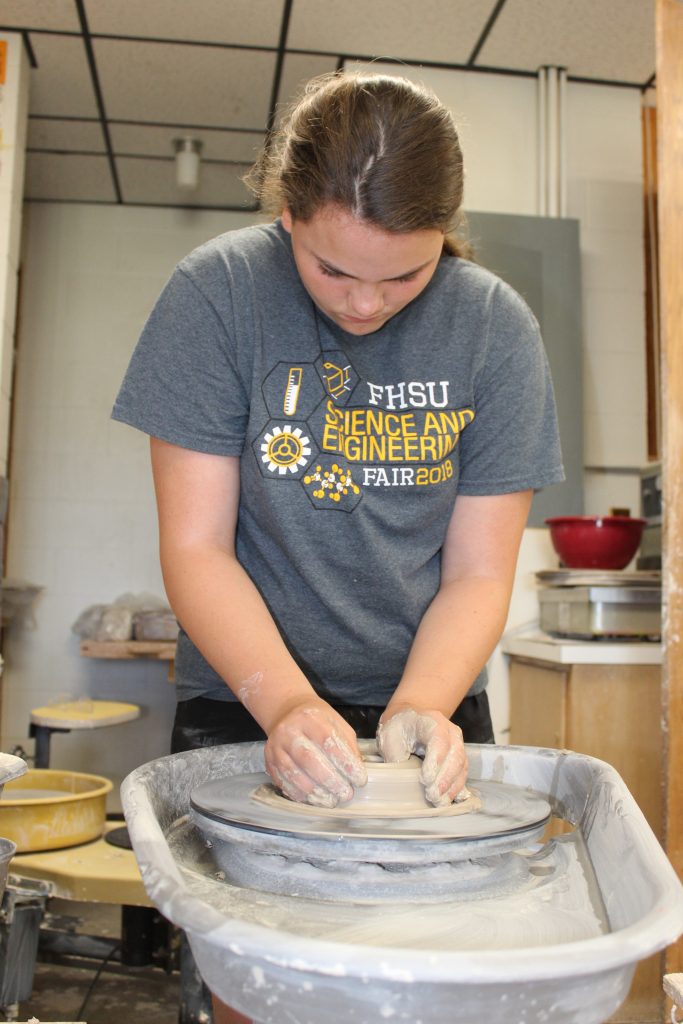
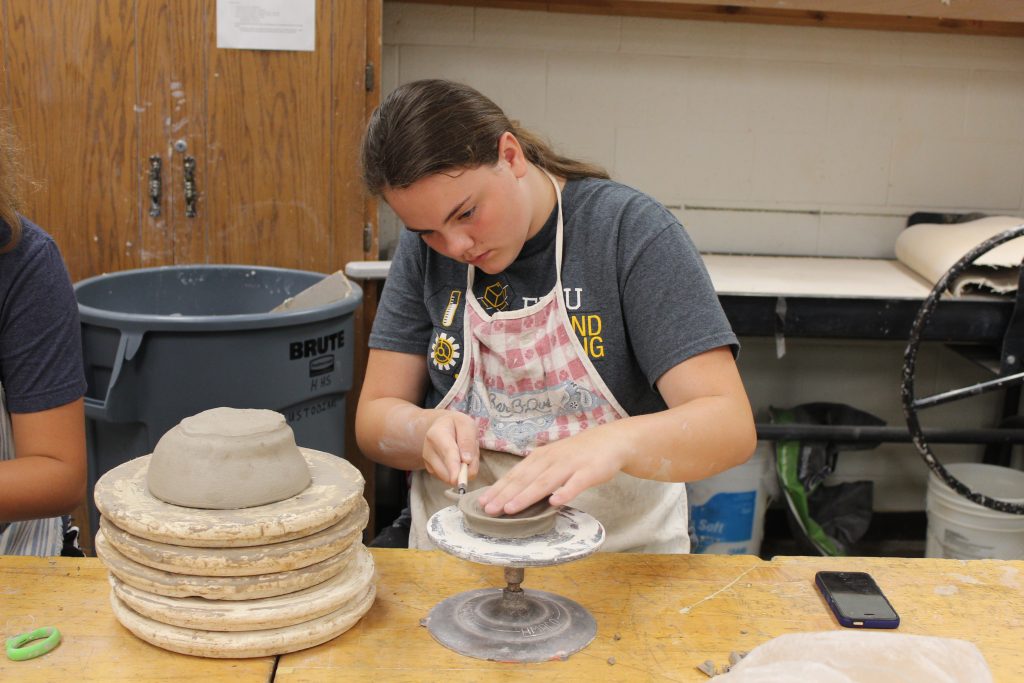
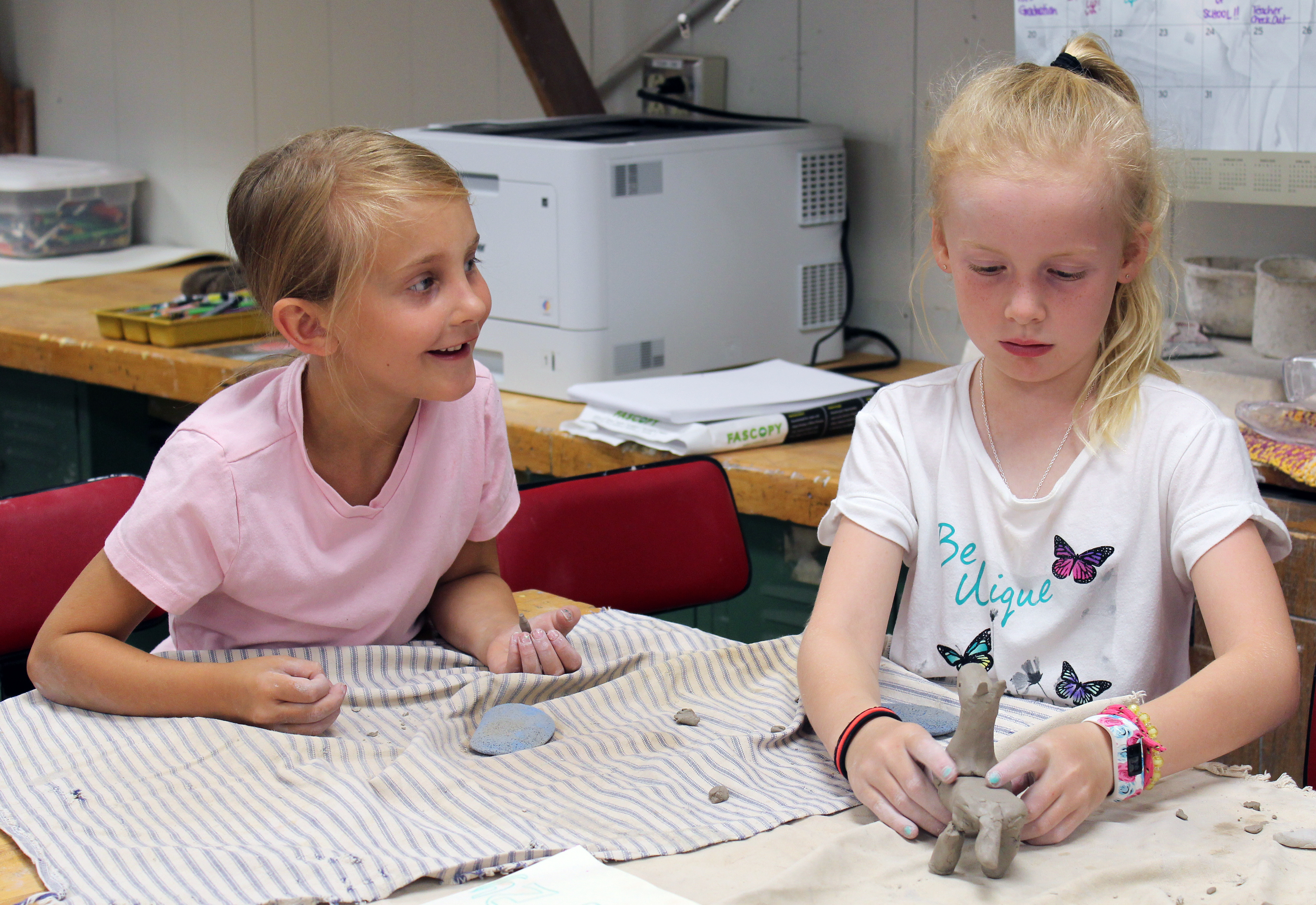
Children are getting their hands dirty as they explore the art of ceramics this summer.

Jennifer Younger, Hays High School art teacher, offered three ceramics classes at Hays High School through the Hays Arts Council.

Children ages 6 through 12 were broken into two classes based on their age to explore hand building figures or pots. Youth 11 and older could enroll in wheel-thrown pottery.

Student modeled their figures or threw their pots last week. All students will paint or glaze their pieces this week, so they can take them home at the end of the two-week session.

Students learn about the different properties of the clay and how it is affected by the moisture. Younger took them through the steps of building and curing their creations, including the first bisque firing in a kiln, glazing and then the second firing.

“It is a lot of processes they learn, and they really catch on quick,” she said. “It is really cool to see what they can come up with and how creative they are.”

The wheel-thrown class is a “crash course.” In Younger’s high school class, the students spend two weeks just learning how to center the clay on the wheel.

“For as young as they are, they do really well,” she said. “Sometimes they get frustrated, but we spend weeks in school practicing this and learning this, so they are really doing awesome.”

Younger explained why she thought exposing children to art is important.

“It helps with their creativity. A lot of them are able to use it as an outlet. I feel it is really important,” she said. “It is not quite as serious, and they can let loose and just be creative and use their imaginations. I think that is important in this day and age with all the stressors and high expectations. A lot of kids really enjoy this, and they are able to produce a lot of great things.”

Eleanor Bittel, 11, of Hays, was working on a pitcher on Thursday morning. This was Bittel’s first attempt at throwing on a wheel.

“I have been wanting to do this for a while,” she said. “I have done the hand clay a couple of times, but I have wanted to do this for a really long time.”

She talked about what she learned in the class.

“In this class, I learned that you need strength, because when you center it, you really have to move it and model it,” she said. “It is also sometimes frustrating because it will collapse on you, and you have to start over sometimes. But I really like it. I am really enjoying it.”

Darci Dreiling, 13, a TMP-Marian student, also was taking wheel-thrown pottery for the first time.

“I learned not to be frustrated, she said as she trimmed a pot on Thursday, “because you can always build it up and make it into something new.”

Janet Hugunin, 13, Victoria, is in her third year of taking wheel-thrown pottery through the HAC.

She talked about what she has learned through the classes.

“How to work with the clay and center it and making it even so you don’t have any air bubble in it so when you fire it, it doesn’t explode,” she said.

Hugunin enjoys doing other types of art in her free time.

“It is really calming to me,” she said. “It is something that if I don’t have anything else to do, I can do art … It is just fun to do.”

Students also will wrap up HAC Acting and Theater classes this week with public performances on Friday morning at the 12th Street Auditorium.

There are more HAC youth classes offered through July and a Plein Air Painting Workshop for anyone 16 and older on June 23.

See a complete schedule and information on how to enroll at the HAC website or you can visit the Hays Arts Center downtown at 112 E. 11th St.

Historic Whizzer bike restoration a labor of love for father, son

By C.D. DESALVO
Hays Post

Whizzer Motor Co. started in 1939 in Los Angeles as Breene-Taylor Engineering, a manufacturer of airplane parts. Whizzer then started to sell motor “kits” for bicycles as a way to make them motorized. After sales of engines proved to be an unsuccessful endeavor in 1942, Whizzer lobbied the United States government for the right to continue production, claiming that the the Whizzer motor was a way for defense workers to travel to and from work.

In 1946, Whizzer moved its main production facilities to Pontiac, Mich., allowing the company to take advantage of auto-production facilities to outsource the manufacturing of most of the Whizzer components. It was in 1947 when a young Harold Kraus visited Hays City Auto Tops in Hays and purchased a new Whizzer “H” motor kit from owner Swede Gilberg for $110.

“He liked to tinker. He was able to save up money working odd jobs for family members while still in high school,” said Paul Kraus, son of Harold. “He drove the family car to school and this gave him a new mode of transportation.”

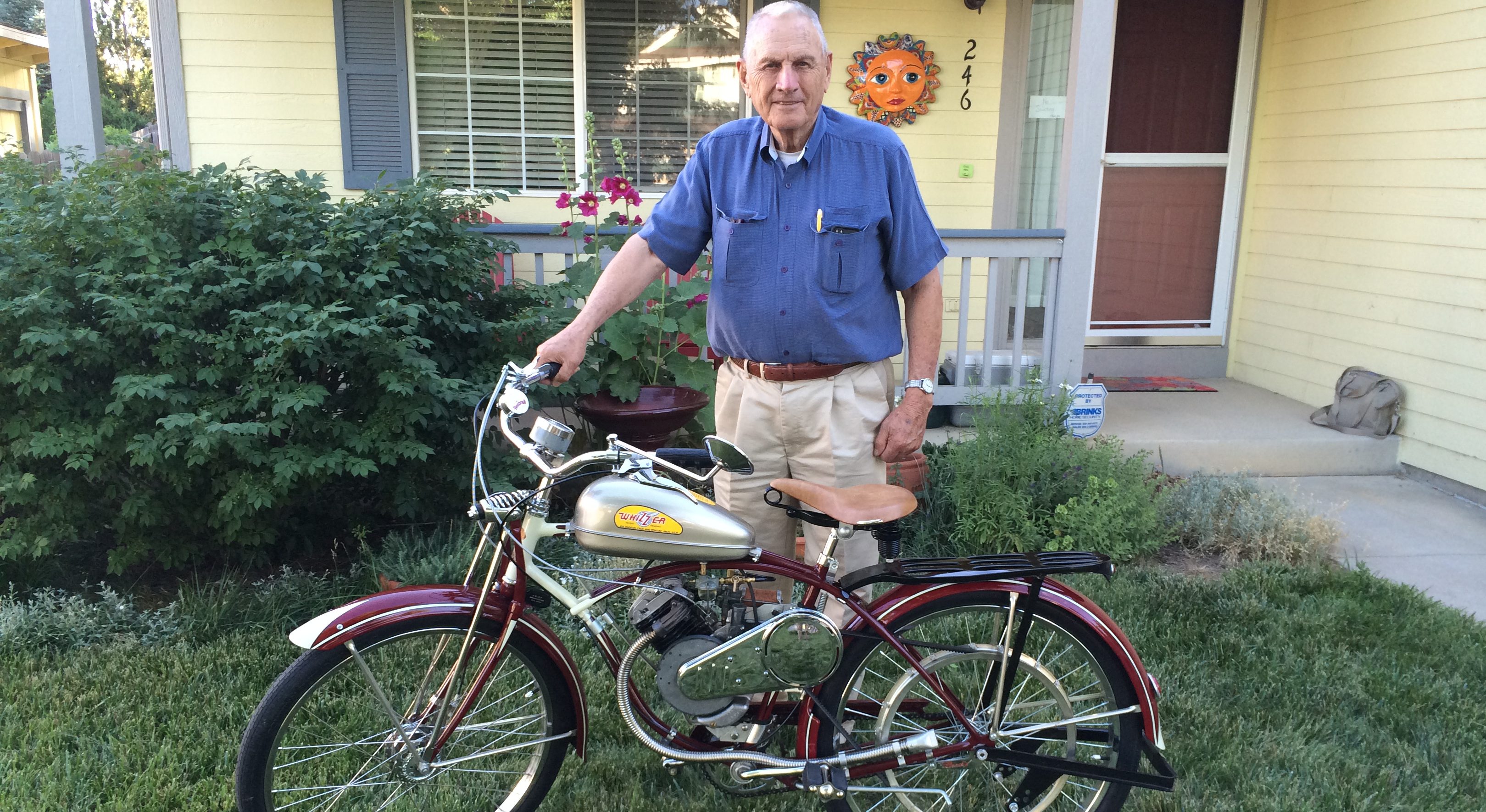
Harold, just a junior in high school at the time, installed the engine initially on his heavy duty balloon-tired Gambles bicycle frame as a way to get around the family farm for chores but the white chalk rocky roads of rural Ellis County shook the bike apart and Harold had to purchase a new Schwinn frame made for motors. In January 1951, Harold left for Denver to enlist in the Navy and the bike stayed on the family farm where it was used around the farm by his brothers.

After his military service, Harold returned to western Kansas to start his own farming operation and stored the bike in his barn where it remained until 2007 when it was passed down to Paul and traveled to it’s new home in Erie, Colorado for restoration.

“For as long as I can remember, this thing sat in the back of our barn. When I got the bike in ’07, there was not a single dent in the tank. The fenders were a little rough and it was covered in grime. There were definitely some components missing but the bike was pretty much 90 percent there,” Paul said.

Before restoration

So the five year restoration project began for Paul Kraus. A father himself now, Paul spent most of his time focusing on family, but the bike stayed in the back of his mind.

“After a while, I kept getting squirrely and it kept staring at me so I decided ‘I have got to do something about this,’ ” Paul said.

Paul did extensive research to understand what exactly he had to do to start the restoration and find out if he could even still get parts for the bike. On his quest, Paul met different people from around the country who had advice on how to restore the bike and get parts..mostly from, surprisingly, the scooter community.

“The scooter community of all places has been very open and non-judgemental. They’re always willing to help and free advice still keeps flowing to this day,” Paul said. I met some neat people and made friends for life.”

Paul worked on the restoration off and on as the years went by and it took time trying to find a company that could make new brake pads and a person who could re-upholster the seat in correct detail. A dad of one of Paul’s friends offered to rebuild the engine in exchange for two Maytag washing machine hit and miss motors.

After restoration

Paul’s own father had a hand in the restoration. Despite being five hours apart, technology allowed Paul and Harold to collaborate on the restoration and it gave Paul comfort knowing that when he hit a roadblock, he could pull up his dad on his phone, show him the bike, and ask questions.

“We were only one state away, but I could Facetime him and say ‘OK, so I’m having trouble with this tell me what you think.’ I could turn the camera around and we would both be working on it together. That was actually really rewarding to be able to share that rebuild … to share when I fired it up for the first time and rode it down the street while my wife held the phone so he could see it go up and down the street,” Paul said.

When on of Paul’s friends sent him a web form about a new Discovery Channel show called “Sticker Shock” (a show about the stories and histories of unique rides, restored vehicles, and automobile memorabilia) and suggested he send the Whizzer restoration in as a possible idea for the show, Paul was skeptical at first but he filled out the form and sent in a couple pictures and a quick video.

Two weeks later, Paul got an email from a casting director and after a few different conversations and interviews, Discovery Channel had arranged for the bike and Paul to be sent to Los Angeles for a taping of the show.

Harold Kraus with the restored Whizzer

One of Paul’s favorite parts about this whole journey has been the relationships and friendships developed during the Los Angeles trip, and at different vintage motorcycle shows that Paul has brought the bike to.

“We have made a lot of friends around the country through this little experience,” Paul said. This little bike has started so many conversations and invoked so many smiles from nostalgia. I wish we had more objects in the world to help make people smile a little bit more naturally.”

The episode of Sticker Shock featuring Harold’s restored Whizzer is set to air on Discovery Channel (Eagle Channel 64 & 664) on Wednesday, June 27, at 9pm.

The Whizzer will be back home in Hays on Sept. 15 for the Thunder on the Plains Car, Truck and Cycle Show at Frontier Park — and Paul hopes Hays recognizes a piece of it’s history.

“It’s going to be fun to bring it back to Hays and let Dad show his old bike to his buddies. Hopefully Hays recognizes it in some fashion as a little piece of it’s history preserved,” Paul said. “There’s part of me that wants to ride it down Main Street just once.”

Hays native makes Broadway debut in Disney’s ‘Aladdin’

Jacob Gutierrez

By CRISTINA JANNEY
Hays Post

The stage door to Disney’s “Aladdin” on Broadway, says “A wish on a lamp.”

It wasn’t a wish, but hard work that made Hays native Jacob Gutierrez’s dream come true as he made his Broadway debut in ‘Aladdin’ on May 25. Jacob, 28, son of Mario and Karen Gutierrez, has been cast in the ensemble of “Aladdin.”

“That night when I went on, it was quite overwhelming, and I have to admit there were moments when I completely blacked out. It was all fine because it is in your body, but I remember being in the middle of ‘Prince Ali,’ waving these fans thinking, ‘Where am I?’ There are lights on you. During the opening number, there is this huge men’s dance break, and I looked to my left and saw this guy who is in my cast, Josh, whose costume is purple and Stanley in his yellow costume and I thought ‘What is happening right now? Is this really happening?’ ”

After the performance, Gutierrez talked to his fellow cast members, and they all said the same things happened to them on their debut nights.

“It is pretty overwhelming,” Gutierrez said. “Beyond that, you have a house full of 1,700 people you are looking out at, and every seat is filled. It is a lot. If anything, it is just over stimulating because all of your senses are so elevated because of everything.”

Gutierrez said the musical is very demanding.

“I am in every single group number,” he said. “I am dancing. I am dancing. I am dancing. There is a lot of choreography. It is a very grand show, so every single production number is large and there are many moving parts.”

Gutierrez wears 12 costumes in the show with multiple quick changes. During the opening of Act II during a parade scene, the creators wanted the illusion of 150 people out of 20-member ensemble cast. So every ensemble member in that number has five costume changes.

“That number alone I think I am wearing four pairs of pants all underneath each other that are all quick rigged,” he said. “They switch out my shirts and vest and coats and my hats and my turbans. It is busy. To say I am just in the ensemble isn’t even a thing because the ensemble is such a huge part of the show that we are doing just as much as everyone else is doing in the entire show.”

Gutierrez said his family has been very supportive of his work. He was excited to initially let each of them know he had been cast on Broadway. For someone who had majored in musical theater in college, Broadway is the pinnacle, he said.

“For me, it is a milestone. It is not even the end goal. As actors, your goal is always longevity. You always want to be doing something and putting your hands in different material and different things in commercials or TV shows or musicals on Broadway or national tours or traveling in something.

“The amazing thing is performance can take you many places, and it isn’t linear. It is not like a conventional path. It is very unique to you and unique to what you have to offer the world and the entertainment industry.”

Gutierrez has been involved in music and theater since he was young. He spent three years after college playing Aladdin in a slightly different version of the musical on Disney cruise ships.

He also recently performed in an episode of “A Crime to Remember,” which aired on the Investigation Discovery channel in March. However, he said being cast on Broadway has been the realization of a lifelong dream.

Gutierrez had auditioned for a different part in Aladdin two years ago and did not get the part. He decided to give it another shot.

He went to a large union audition in March, not knowing in what he might be cast. “Aladdin” has several companies touring right now, and Gutierrez initially had a callback for the national tour. He had to go through a series of callbacks, including a recorded audition for Tony-award-winning director Casey Nicholaw, who recently appeared on the Tony’s for his work on “Mean Girls.”

On a Friday, Gutierrez’s agent received word the “Aladdin’s” company had openings and Jacob was in the mix for a part.

“That was torture,” he said. “It was the weekend and everything shut down on Saturday and Sunday. I was out of town. Life goes on. You have to keep going, but I couldn’t help to keep thinking about it. When casting says, ‘Could he be available in a week if we need him?’ your mind starts going down the path— ‘I wonder what it is?’ ‘I wonder what they are looking at?'”

His agent did not call until Tuesday.

“She said I have some good and bad news. I said, ‘OK, what is the bad news?’ She said the bad news is that you didn’t get the ‘Aladdin’ tour. I said, ‘OK, that’s fine.’ I had been in for so many things over those few weeks it could have been anything that the good news was. I didn’t know what she was going to say. She said the good news is you are making your Broadway debut in the same show.”

Gutierrez was home and started screaming. His roommate thought something was wrong and ran out of his room to ask him if he was OK.

When it rains, it pours, Gutierrez said. In the next 24 hours, he booked two more out-of-town shows he had to turn down to take the “Aladdin” part.

“You can go through seasons of dry spells where you audition a lot and are getting close to a lot of things, but the timing or the stars don’t align in that way. You can go months without doing something. When you do get calls that you have an offer, it is so exciting no matter what it is. The fact that I had three in the matter of a day, it was just crazy. It was also a testament to hard work paying off.”

Once he was cast, he had about two and a half weeks to rehearse and learn the complex choreography before he made his debut. He had one dress rehearsal or “put in” with the entire cast before he went on.

He was supposed to debut the night after his dress rehearsal. After rehearsal, he ran down the street to grab a double order of Chinese food. He received a call from the stage manager that the show had cast members out and he was needed that night. He rushed back to the theater to prepare and called his family, who was supposed to see him the next night.

They were able to find tickets and saw his Broadway debut from the fifth and sixth row of the theater.

“It is fast and furious and you really have to be on your game, because there are so many moving parts, ” he said.

Gutierrez credited his early musical education at Hays High School for setting him on a path toward performance.

Gutierrez played saxophone and piano. When he was entering his freshman year, he was going to drop band so he could pursue sports. However, the band teacher, Craig Manteuffel, called him and encouraged him to stay in band. He did.

“Honestly, I credit so much to that moment,” Gutierrez said, “because had I quit music at that point, it would have never opened the door for the choir I joined my sophomore year and moving forward. Looking back to when I was 13 or 14, that was a really pivotal moment in continuing my arts pursuant, because that was what opened up everything else.”

Gutierrez attended Oklahoma City University and moved to New York to pursue is acting dream when he was 22.

Almost all struggling performers have what they call a survival job— a job that supports them but also allows them to audition during the day. Gutierrez said he was very lucky his survival job was working for Mercedes-Benz. He traveled around the country to trade shows teaching people everything there is to know about the vehicles. It was a good job, but it cut into his audition time.

For now Gutierrez is on a rigorous schedule, and he said being on Broadway has been a lifestyle change.

He does eight shows a week plus rehearsals.

“It is really learning to take care of yourself physically,” he said. “When you do repetitive things over and over that are very physically taxing, you have to learn how to take care of your body. For me that’s chiropractic, massage or acupuncture or things that help with soft tissue release or getting physical therapy for little strains that happen here or there. More often than not, it is inevitable, because we are putting our bodies through such extreme circumstances.

“Oftentimes, theater performers or dancers are referred to as professional athletes and that could not be more true. No, I am not on a football field or on a basketball court or playing a sport, but dancing on a steel stage in 12 pounds of costumes eight times a week for three hours a night every night is very much an Olympic sport. It is very grueling on the body if you don’t take care of yourself.”

Gutierrez also said he tries to tend to his mental and spiritual self, and stays centered through his church family in New York.

“It is a whole body, whole world thing,” he said. “You have to be taking care of yourself as a whole person.”

If you are going to be in New York, check out the show’s website here.

From the “Aladdin” website

Topeka couple featured in Summer Art Walk anchor show

By CRISTINA JANNEY
Hays Post

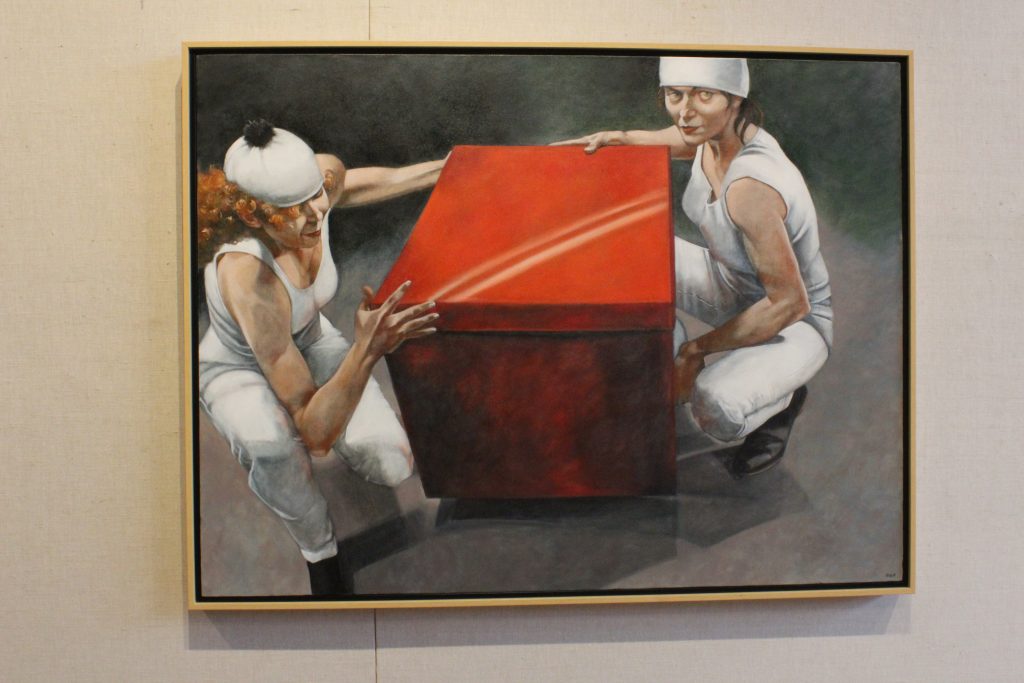
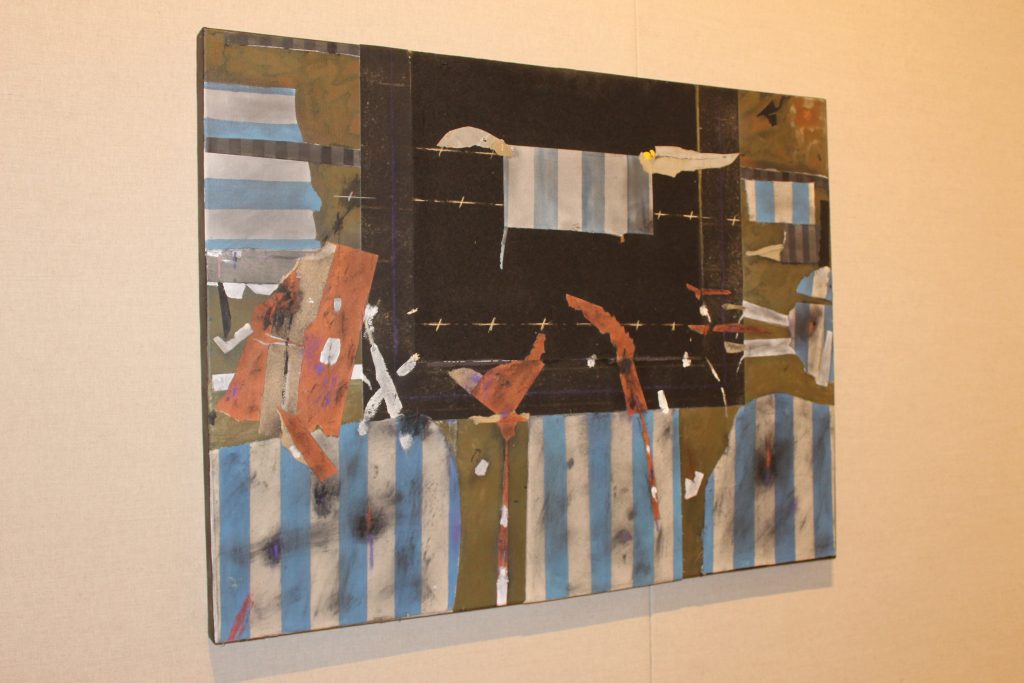
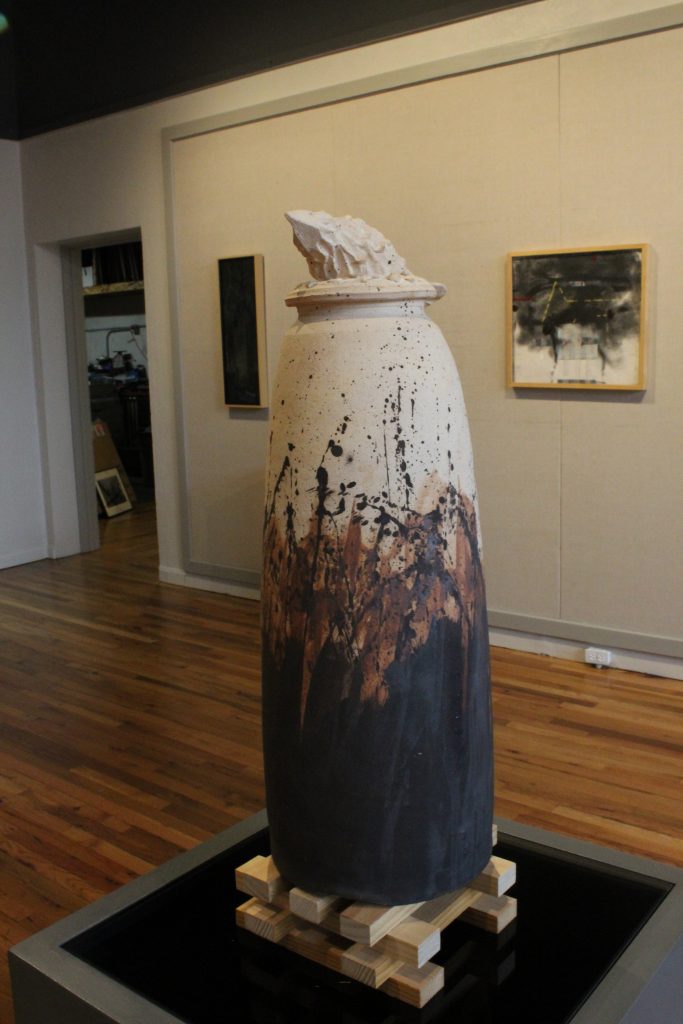
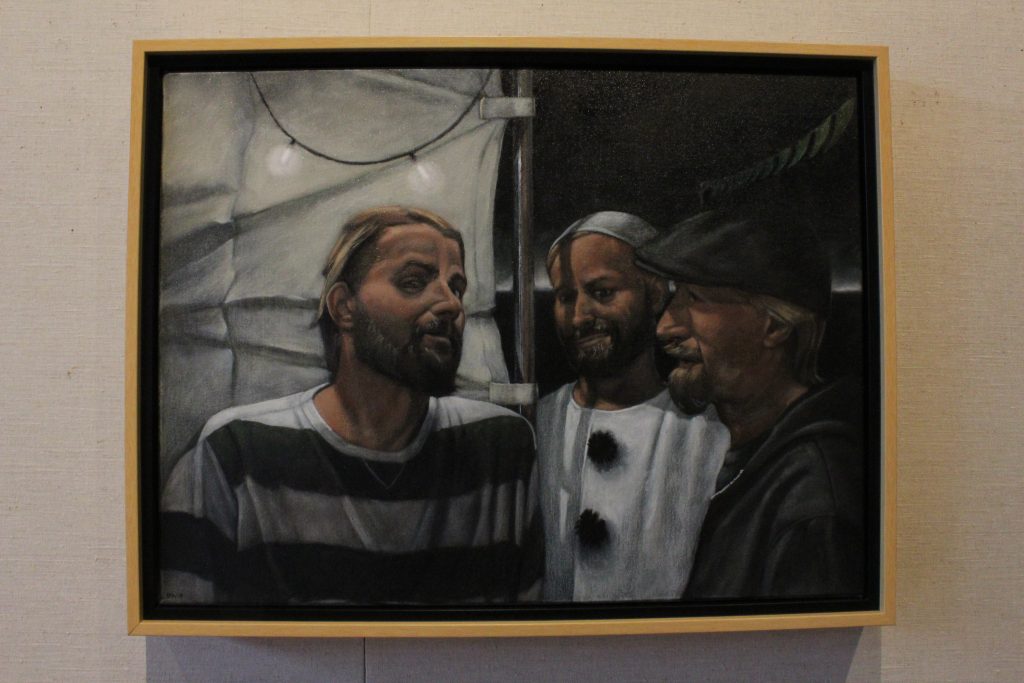
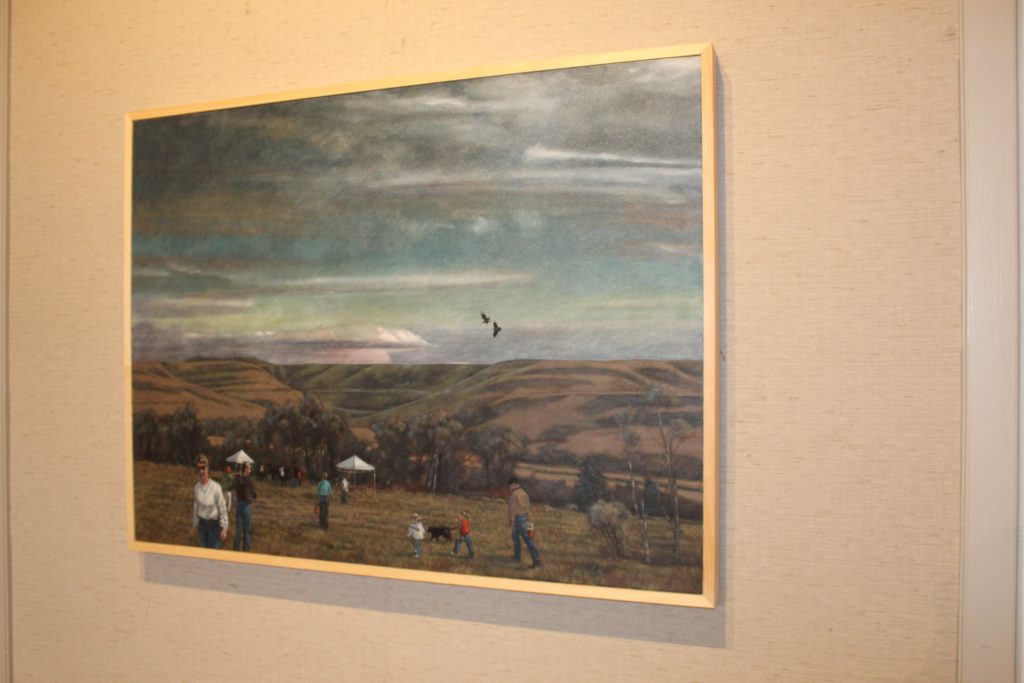
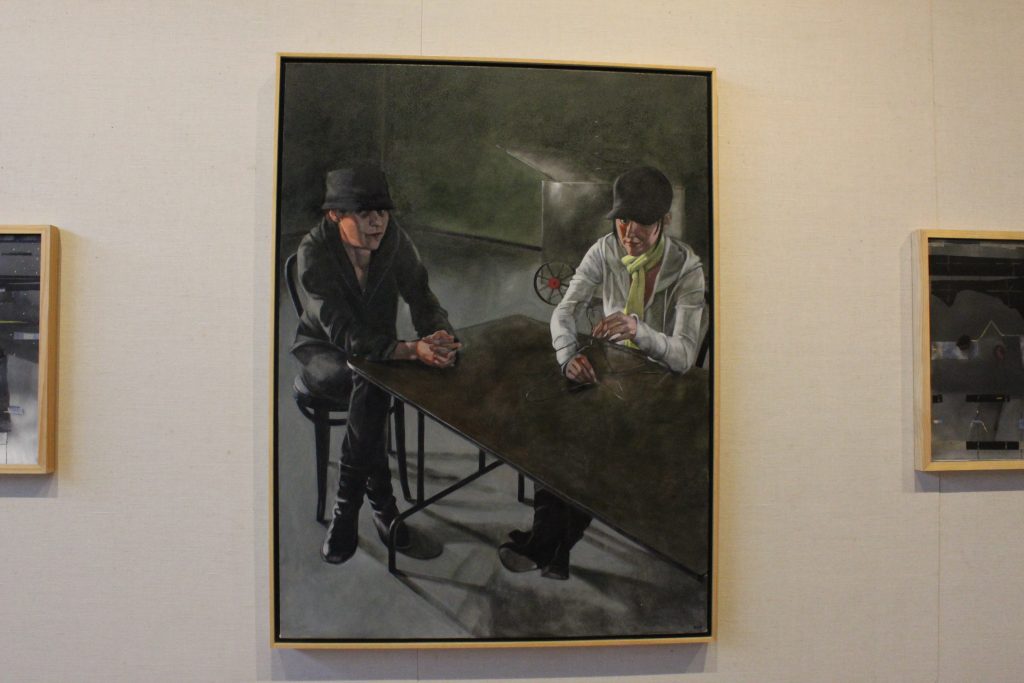
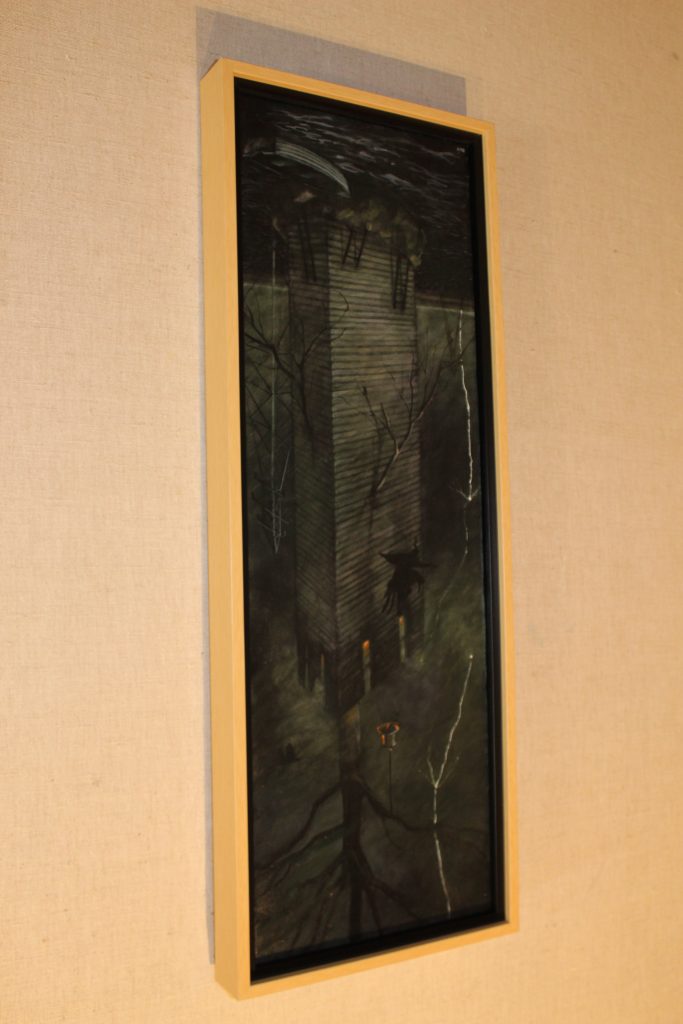
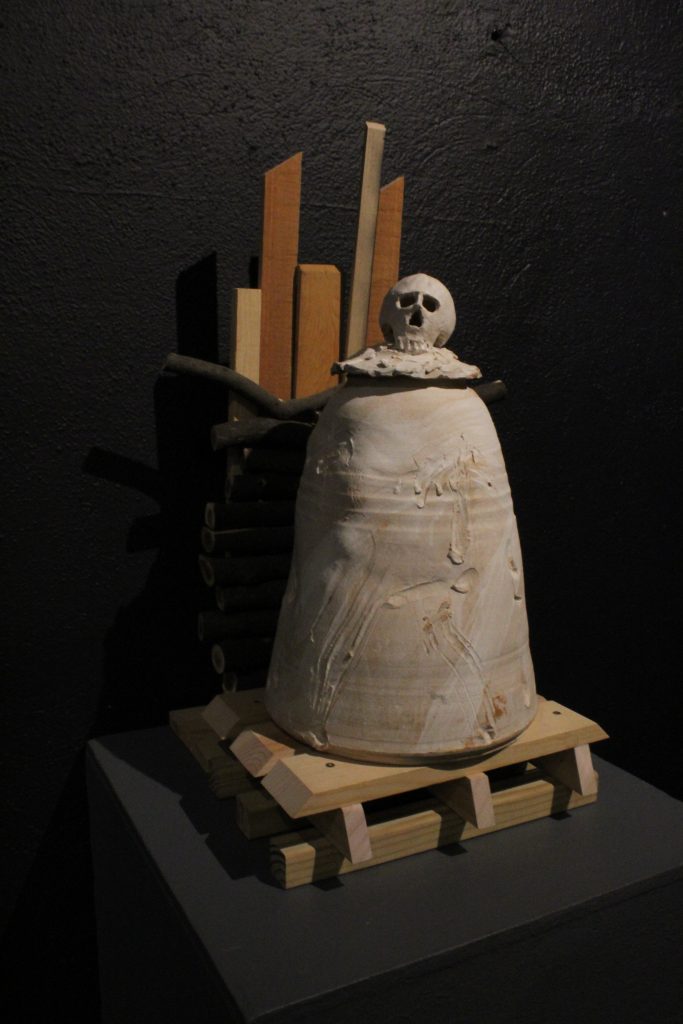
The Hays Arts Center will feature “A Summer Together” by Larry Peters and Barbara Waterman-Peters, a husband and wife team from Topeka, for the Summer Art Walk on Friday.

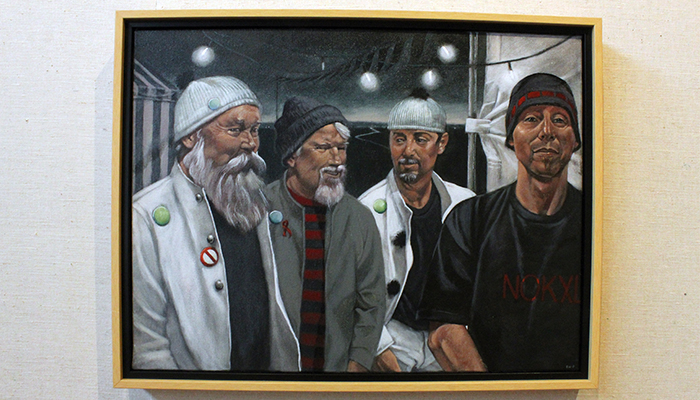
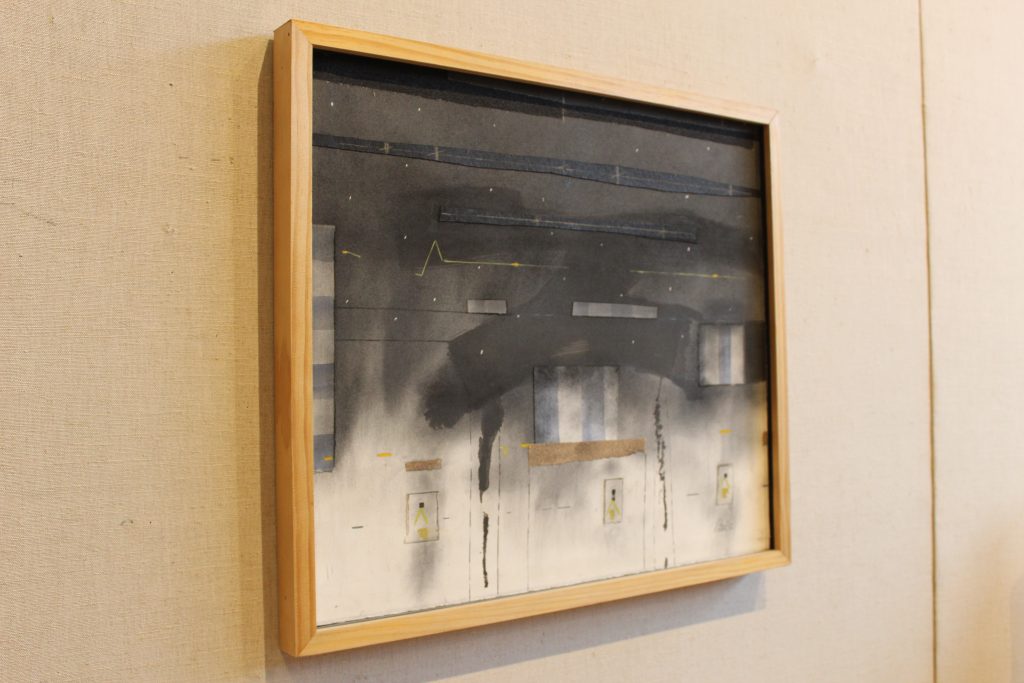
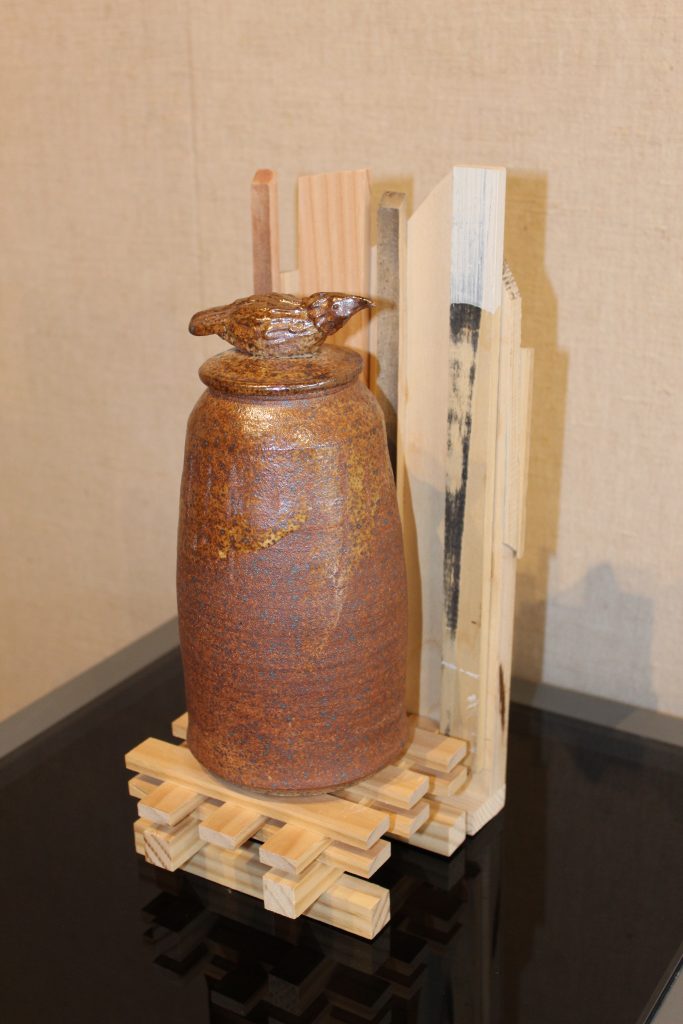
Barbara primarily works in oil on canvas. Larry produces ceramics as well as mixed-media artwork.

“These will be pieces that have figurative subjects in them,” Brenda Meder, director of the Hays Arts Council, said. “Larry’s works are a little more conceptual and abstract. Some of them are even inspired by the Holocaust. It is the stripes that are his inspiration. It is not an in-your-face darkness kind of thing. It has been an inspiration for a whole series of paintings he has done.”

Larry earned a BFA in 1962 from Washburn University in Topeka, and an MFA in 1965 from Southern Illinois University, Carbondale, according to his bio on the Strecker Nelson West Gallery website. He joined the Topeka Library first as a reader’s adviser in the fine arts department, and went on to become the director of the library’s gallery in 1974, retiring in 2003. Special honors include the creation of a bird ornament for the 2002 White House Christmas tree and participation in the U.S. State Department “Arts in the Embassies” program.

Barbara has a BFA from Washburn University and MFA from Kansas State University, according to her website. She has shown regionally, nationally and internationally in more than 250 solo, invitational and juried exhibitions. Waterman-Peters taught at Washburn and Kansas State Universities as well as Lassen Community College in California. She writes about artists for TOPEKA and LAWRENCE Magazines and has illustrated several books.

“Even though their styles are different, you can truly see the inspiration they get from each other,” Meder said, “but they don’t attempt to do what the other does in any way, shape or form.”

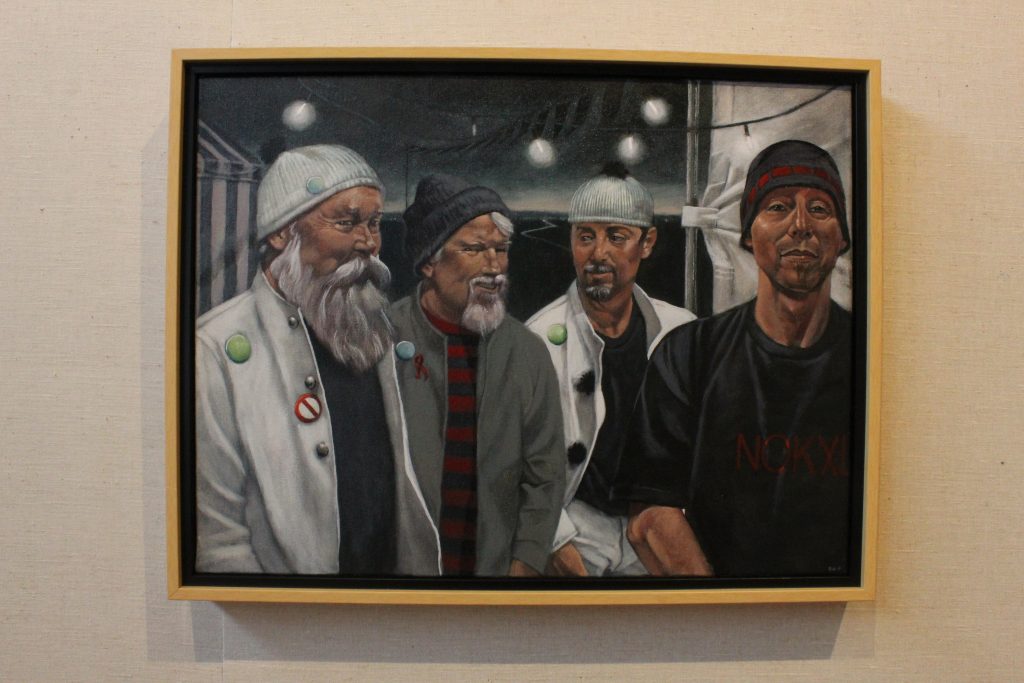
Meder said some of Barbara’s paintings almost look like photographs.

“The personalities—you just feel like you know who these people are—you want to know them,” Meder said of Barbara’s paintings. “Don’t they feel so real and honest? She is an incredible figurative artist.”

The couple plans to attend the opening reception for the exhibit on Friday. The Art Walk will be 6:30 to 9:30 p.m. The show will be on exhibit at the Arts Center through Aug. 10.

The Hays Arts Center Annex will feature Gordon Sherman, Dagan Sherman, Ariel Sherman and Brian Hutchinson in “Shermantiestablishmentism Part Deux.”

Gordon Sherman is a longtime professor at FHSU in printmaking. His son, Dagan, and former student, Hutchinson, are both also teachers and printmakers. Hutchinson, who was teaching art in Great Bend, has recently been hired to teach FHSU. He will be working with art education majors. Hutchinson has also taught summer youth art classes for the HAC.

Ariel works in fiber arts. Gordon also does paintings and assemblage work.

As usual, there will be several venues where you can listen to music, including Max Walker and Friends at the Downtown Pavilion, hosted by the Downtown Hays Development Corporation; Sunrise Biscuits at Breathe Coffee House; Company 11 at Paisley Pear; Wayne and Tammy Lang at the Ellis County Historical Society; and jazz by Brad Dawson and Luke Johnson at Gella’s Diner.

Dawson and Johnson will perform later in evening from 9 to 11 p.m., Company 11 will perform from 8:30 to 10:30 p.m. at the Paisley Pear, and Wayne and Tammy Lang will perform from 6:30 to 8:30 p.m. at the museum. The historical society also will feature 2-D and 3-D artwork by Harley Torres and Tyler Dallis,

Also in the area of the Pavilion at Union Pacific Park will be “Apophenia Art” by Craig Brendan and the KSU Watersheds and City of Hays WOW Trailer. Brendan is a self-taught artist who often works in pen and ink and mixed media. The Watershed on Wheels Trailer features hand-pained murals by FHSU students that tell the story of Hays water system and need for water conversation.

“They are using the art to have it be something bigger,” Meder said of the WOW trailer.

Visual art at Breathe will be “Wednesday Morning Breakfast” Club with Jim Hinkhouse, Michael Jilg, Kathleen Kuchar, Darrell McGinnis and Cal Mahin. This group is retired art faculty who still meet regularly for breakfast.

You can see a preview of the Hays Community Theatre’s summer musical, “The King and I” at its new performance space at 121 E. Eighth.

Angela Muller, who will exhibit at Couture for Men and Women uses many organic media in her paintings, including rainwater, wheat kernels and ground limestone. Her exhibit is titled “Spirit of the Prairie.” Although her materials are natural, her visual presentation tends to be more abstract, Meder said.

“They are made with these true, organic things—a very spiritual approach to art that is very much of the earth,” Meder said.

Meder is trying to get an exhibit of Muller’s work at the Art Center later this year.

A variety of young artists will be featured during the art exhibit. The Hays Public Library will present “The Art of Coding: Stem & Robots” by local teens.

The library also will host Sean Conroy, author of “Through the Eyes of a Young Physician Assistant.” He will be selling and signing books.

A2Z Escape will feature sisters Morgan and Madison Schremmer, both of Ellis County. Morgan is a student at FHSU and is a painter. Madison is a photographers. Jeanne Schwartz, a non-traditional FHSU student from Hays, will exhibit her mixed media work.

Students Kurt Breshears, Woody Stauffer and Zane Mahanna will be a part of an exhibit that will also include Holly Ray, Nicole Thibodeau and Shannon Trevethan, director of the Denies Culture Center in Russell. The exhibit will be at Thibodeau’s home at 206 E. Sixth St. These artists work in a variety of media, including painting, sculpture and photography.

Thibodeau works at the Hays Public Library and will be leading a Plein Air Painting Workshop on Saturday, June 23 at the Ag Research Center, which is sponsored by the Hays Arts Council. Enrollment is sill open for that workshop.

Diamond R. Jewelry will feature Darris Worcester of Hill City. Meder said he paints traditional subjects in a traditional style on canvas, paper as well as saw blades and metal. This is his first time on the Art Walk.

Avalon Advanced Health, which in Eagle Plaza at 27th and Hall streets, is on the Art Walk for the first time. They will be open from 5 to 7:30 p.m. and feature the works of Aaron Phillips, recent FHSU BFA grad; Brett Novack; and Can “Cadie” Long. Long was a student at FHSU and, since graduation, has moved to the west coast. She specializes in 3-D art and illustrations. Phillips is a painter.

The Summer Art Walk tends to have fewer stops than the spring event, Meder said.

“This is still a lot of places,” she said. “Because there are fewer places, maybe people’s pace for the evening will be a little more relaxed, and that is kind of nice too. There is still enough here to completely fill up three hours. It is nice people can just take their time and really relish what I hope will be gorgeous evening.”

Below is the complete schedule:

2018 Hays Arts Council

~  Summer Art Walk  ~

Friday, June 15  – 6:30-9:30pm

Hays Arts Center 

112 E. 11th “Peters/Waterman-Peters: A Summer Together”

Works by Barbara Waterman-Peters & Larry Peters

Hays Public Library 

1205 Main “The Art of Coding: STEM Projects & Robots”

~ presented by the Young Adult Department

Sean Conroy book signing ~

“Through the Eyes of Young Physician Assistant”

Paisley Pear Wine Bar, Bistro, Market

1100 Main Photography by Gilbert Kinderknecht

Live Music by “Company 11” 8:30-10:30pm

Couture for Men & Women 

1111 Main “Spirit of the Prairie” earth art with limestone,

wheat kernels & cottonwood by Angela Muller

J Studio & Salon 

112 W 11th Sculpture by Danielle Robinson,

Poetry by Ross Karlin, & Music by Lane Werth

Hays Arts Center Annex  

1010 Main “Shermantiestablishmentism Part Deux”

works by Gordon Sherman, Dagan Sherman,

Ariel Sherman, & Brian Hutchinson

Paintings & Photographs by Bruce Burkholder

Union Pacific Park

10th & Main “Apophenia Art” by Craig Brendan

KSU Watersheds & City of HaysWOW Trailer”

~ with hand painted interior murals

Downtown Pavilion (hosted by DHDC)

10th & Main Live Music by Max Walker

Hays Community Theatre 

121 E. 8th “The King and I” HCT Summer Musical Showcase

A2Z Escape

115 W. 8th Paintings, photography & mixed media works

by Madison Schremmer, Morgan Schremmer

& Jeanne Schwartz

Diamond R Jewelry 

807 Main Paintings by Darris Worcester

Breathe Coffee House

703 Main “Wednesday Morning Breakfast Club”

~ works by Jim Hinkhouse, Michael Jilg,

Kathleen Kuchar, Darrell McGinnis, and Cal Mahin

Music by “Sunrise Biscuits”

Ellis County Historical Society 

100 W. 7th Exploration” ceramics & drawings

by Harley Torres & Tyler Dallis

Music by Wayne & Tammy Lang

Garden Art Gallery

206 E. 6th Works by Kurt Breshears, Zane Mahanna,

Woody Stauffer, Holly Ray,

Shannon Trevethan & Nicole Thibodeau

Friday, June 15  – Early or Extended Hours

Avalon Advanced Health   5:00-7:30pm

2703 Hall, Suite13 Works by Aaron Phillips,

Can “Cadie” Long & Brett Novack

Gella’s Diner & Lb. Brewing Co.   9:00-11:00pm

117 E. 11th Live Jazz by Brad Dawson and Luke Johnson


Hays Community Theater shows off renovated space

The main hall of the newly renovated Hays Community Theatre building at 121 E. Eighth St. It was the former Eagles Lodge.

By CRISTINA JANNEY
Hays Post

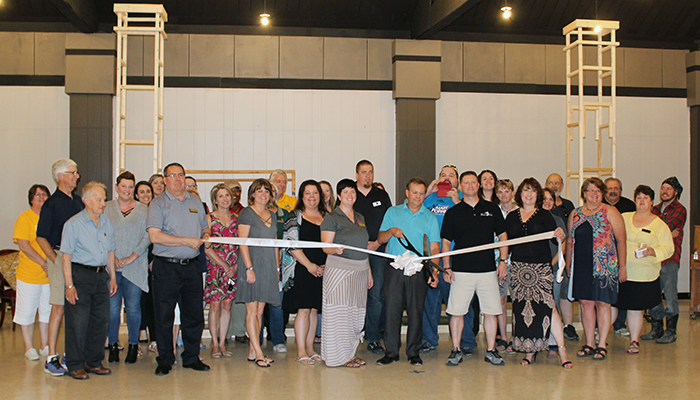
The Hays Community Theatre cut the ribbon Friday on its new space downtown at the former Eagles Lodge, 121 E. Eighth St. during a Hays Area Chamber of Commerce event.

The 2,300-square-foot main hall has been renovated into a 150-person performance space. The entire building is about 3,000 square feet.

The theater is using the space to build props, sew costumes and rehearse for its upcoming summer performance of “The King and I.” Although “The King and I” will be performed at Beach/Schmidt Performing Arts Center, the HCT performers can’t get in to Fort Hays State University venue until less than a week before the performance.

“The King and I” will be performed at 7 p.m. July 26, 27, and 28. Tickets are $15 for adults and $10 for youth 12 and younger. They can be purchased by going to the HCT website.

There will be a “King and I” preview during the Summer Art Walk from 6:30 to 9:30 p.m. at the new theater.

The theater has a small bar in the rear of its main hall that it uses to serve refreshments during events.

Volunteers are still working on the space. ADA bathrooms are in the works, and HCT plans a remodel of the kitchen so that it can be used during dinner theaters.

The area where the restrooms are now will be converted into dressing rooms to be used when HCT hosts small productions in the Eighth Street location.

HCT received grants, private donations and in-kind gifts and labor for the renovations.

Travis Grizzell, board member, said it would be difficult to put a number on the total cost.

The former lodge’s drop ceilings tiles, which were stained yellow by cigarette smoke, were removed to reveal a lattice of trusses. The walls and the ceiling were painted. The tables and chairs were removed.

Gene Stramel, HCT president, said the new space scarcely resembles the old lodge.

HCT is still working to complete ADA accessible bathrooms.

“We are excited to have some shows and bring in some entertainment, so you will be able to see some things happening in here besides what’s happening in Beach/Schmidt and down at 12th Street,” he said.

Architect Lisa Brooksher said the construction crew tried to do as little as they could during the renovation in order to preserve the original structure.

“This was quite a project,” she said. “As many renovations go, you don’t necessarily know what you are getting into. We opened up as much of the ceiling as we could. We tried to do it as inexpensively as we could, but make it a special space. We got lucky that these trusses were here. They are the original trusses. Gella’s has the same truss design.”

The HCT also will rent the space for events, such as graduation parties, wedding receptions and banquets.

Stramel said HCT is always looking for volunteers. This can be on stage or behind the scenes working on costumes, sets, props or publicity. You can learn more about volunteering on the HCT website. Also follow HCT on Facebook.

Heal Hill City’s Home Plate: ‘I believe we have the strength to get back on base’

By C.D. DESALVO
Hays Post

HILL CITY — It seemed like just a normal western Kansas Memorial Day with some severe weather here and there. Flash flood warning alerts went out to cellphones around the Hill City area and, like most western Kansas natives assume, flash flood warnings in places of drought are usually nothing to be too concerned about.

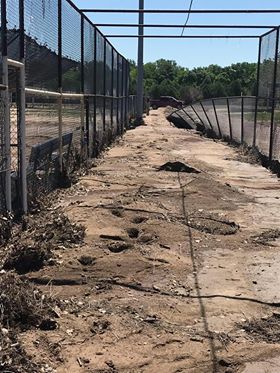
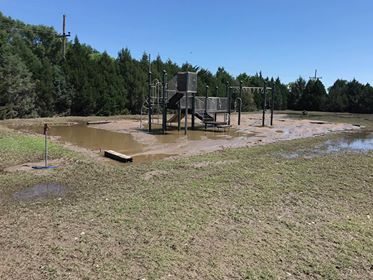
In just a matter of 15 minutes, the town of Hill City was ravaged by a flash flood. Homes, trailers, businesses, fences, pipes and fields were all victims of the water that accumulated in the town of about 1,400 people.

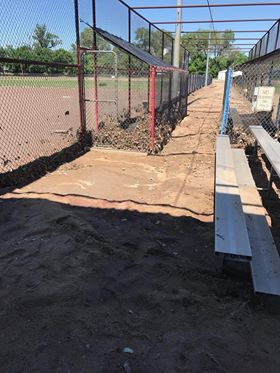
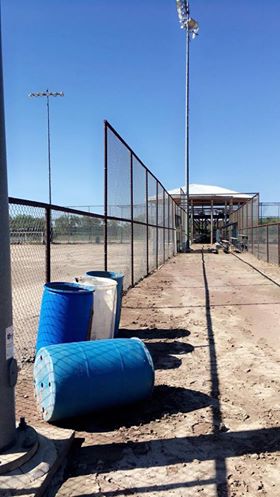
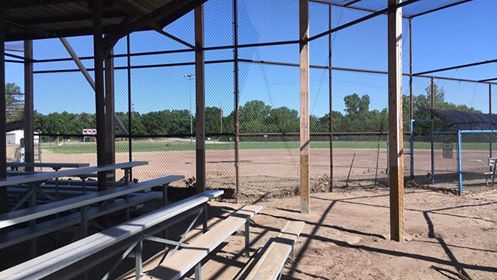
Just a couple days prior to the flood, Hill City hosted the Todd Toll Memorial Softball Tournament at the Boyd-Powers Sports Complex. The complex featured a softball field, two baseball fields and a professional field. It was originally built to house the Hill City semi-professional baseball team, the Hill City Athletics, in the 1950s and 1960s. Crowds of up to 1,000 fans would show up to these games and, years later, as small-town baseball started to disappear, the community dedicated the fields to Bob Boyd and Darrell Powers — and slowly built up the fields to a beautiful complex through donations and community support.

“The entire fields were donated and they have been added onto over time,” said Shannon Toll, daughter of the late Todd Toll, for whom the tournament was named. “People came from all over the state and they loved the fields. I had people come up to me and tell me that these were the best fields in northwest Kansas next to Fort Hays State (Larks Park).”

The Todd Toll Memorial Softball Tournament was the largest Hill City had hosted in years, bringing in 15 teams from as far as Wichita and more than 200 fans.

“A couple of the top teams that finished in the tournament loved the fields so much that they donated their winnings back to the tournament to host again next year, and this was before the storm even happened,” Toll said.

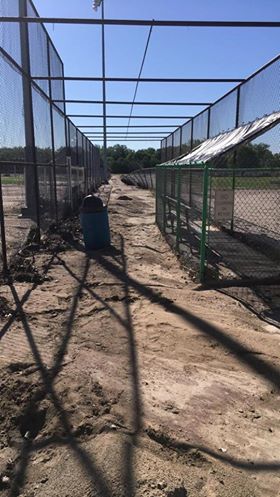
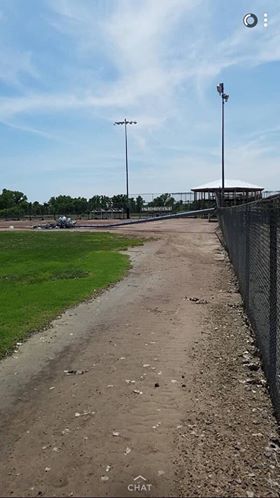
Just as it seemed baseball and softball would make a comeback in Hill City, two days later the flood compromised the electrical and lighting systems, the clay was completely gone, fences were pushed over, foundations had caved in and the concession stands were wiped out. What wasn’t physically effected was chemically effected.

“Baseball and softball were making a comeback in Hill City with these fields. We were starting to get Legion teams together, and we were going to try and get a high school team started,” Toll said. “The whole thing came fast and destroyed all of it. It’s a complete new project, and we have to wipe the slate clean.”

After Toll found out about the fields, she immediately sprung into action to start a petition with Rusty Harmon, Tawny Ashbaugh, the families of Bob Boyd and Darrell Powers, as well as a number of others to see how many people would be on board to try to save the complex. Support for the petition was huge and, in a city meeting last week, organizers presented the petition and the city agreed to open a donation account.

“My dad was a county commissioner, carpenter, rancher and farmer. He was always involved in community and I grew up with these people. Our parents grew up together and went to school together,” Toll said. “They’re not just my friends and neighbors … they’re my family, and I believe we have the strength to get back on base.”

If you would like to donate, all checks can be addressed to Heal Hill City’s Home Plate, P.O. Box 22, Hill City, KS 67642. This is a 501(c)3 and the funds are going through the Graham County Recreation Commission. You can sign the petition by clicking on this link.

For any questions or more information, call or text Shannon Toll at 785-627-2111.

Kan. law will allow bystanders to break into vehicles to save people, pets

By CRISTINA JANNEY
Hays Post

It’s not officially summer, but it’s still hot outside.

The rising heat puts both small children and pets at risk if they are left in hot vehicles.

A new Kansas law, which will go into effect July 1, protects anyone from civil liability who breaks into a vehicle to rescue an animal or a vulnerable person, including a small child.

However, Hays Police Chief Don Scheibler noted people need to follow certain guidelines when trying to rescue a person or pet.

• The Good Samaritan has to determine the person or animal in the vehicle is in immediate danger.
• The person has to determine there is no other safe way of getting the person or pet out of the vehicle.
• The person also must call 911 right before or after he or she breaks into the vehicle.
• The person also must remain on the scene until law enforcement arrives.

Scheibler said he hopes this new law will serve to educate the public about the dangers of hot vehicles.

“This is a good thing. It allows people to take some sort of action in those situations in which people or animals need their assistance,” Scheibler said. “The important thing is people need to use good judgement, and they should never hesitate to call us in those situations. I think this law has good intentions to try to educate the public and prevent tragedies.”

A number of years ago a child died in a hot car in Hays. The person who was attending to the child did not usually take the child to daycare and forgot the child was in the back seat. Scheibler recommended placing something in or on your vehicle to remind you a child is on board. This could be a ribbon on the door handle or a note on the dash.

Heat stroke is the leading cause of non-crash, vehicle-related deaths in children younger than 15, according to the American Academy of Pediatrics. Heat stroke can happen when the outside temperature is as low as 57 degrees. Organ damage starts in children when their bodies reach 104 degrees. Death can occur at 107 degrees.

Learn more on children and hot vehicles at the healthychildren.org.

There is no Kansas law that prohibits a pet owner from leaving an animal in a vehicle.

However, Scheibler said, in extreme cases, a person could be investigated for animal cruelty in the case of a pet or child endangerment in the case of a child.

Animal control will respond to all reports of endangered pets, although it may take some time for the officer to arrive.

Nikki Hausler, Hays animal control officer, said it is not enough to just see a panting dog in a vehicle. The pet must show signs of heat stroke or heat exhaustion, which can be difficult to identify. Unless it is clear the animal is in immediate risk, it is best to call police to deal with the situation.

Even in cooler temperatures, the temperature inside a vehicle rises quickly and can be a danger to any living creature.

In as little as 10 minutes, the temperature in a vehicle can increase 19 degrees, according to the American Veterinary Medical Association.

Hays Vet Dr. Mark Meier said when a dog’s body temperature reaches more than 106 degrees, its organs start to shut down. Overheating can cause death or permanent organ damage.

“I think the biggest thing is that if you don’t need to have your pets with you, leave them at home,” he said. “Pets are becoming a bigger part of our families, and it is not worth the risk.”

The city is already receiving calls about pets in hot vehicles.

“I have digital thermometer that I can use to measure the inside temperature of a vehicle,” Hausler said. “Luckily, I have not found any pets in heat distress or heat stroke, but I use the app to educate owners. Even if they crack the windows on a day with high humidity and its hot like it has been — 90 degrees — a car can heat up in the matter of minutes.”

She explained people often go into a store and think they will be there for a few minutes. They get delayed in a checkout line or they find more items they initially intended or they stop to talk to a friend — and they end up spending much more time in the store than they anticipated.

“One thing that shocks me is last summer, I was called out to the hospital for pets in vehicles,” Hausler said. “When you go for a medical appointment, it can be so much longer than you anticipate. A hospital parking lot is not the place for your dog either.”

Sharon Thompson of Hays stopped at Walmart on a recent trip to Topeka and discovered bulldogs locked in a car. She call 911 and reported it. She stayed with the vehicle for 22 minutes until the police arrived, and the owner of the pets had still not emerged from the store. She said she was in anguish watching the pets suffer in the heat until someone arrived.

Hausler said her No. 1 recommendation for pets owners is to leave the pets at home, especially during these warm months. They will be much safer.

Because of Hays being located on the interstate, local police also receive calls for people who are traveling and leave their pets in vehicles.

Hausler encouraged travelers to take their pets into to consideration when they stop. Eating at a sit-down dinner may not be the best choice for your pet. Even if you leave the car running, the car could die, the vehicle could overheat or even catch on fire.

“It may be best to get something to grab and go when you are on the road and keep the dog cool in the vehicle,” she said.

Day Trippin’: Russell sheds light on oil history, offers affordable family getaway

Made possible by: Dock’s Boat & RV, Fossil Creek Hotel & Suites, Myers Furniture, Jake’s Sales and Service, Waudby’s Sports Bar & Grill, and Russell Main Street.

By CRISTINA JANNEY
Hays Post

On the Map: Russell, Kansas Distance: 30 miles east of Hays on Interstate 70 Drive time: 34 minutes

I have lived in Kansas all my life and traveled many of its back roads and to its forgotten burgs.

However, a year ago I pulled up stakes from my hometown of El Dorado, Kansas, and moved to Hays to begin a new job working for Hays Post and Eagle Communications.

Now that I live in northwest Kansas, I feel I have a whole new geography and palette of Midwestern cultures to explore. I have set a goal to travel to all 105 counties in the state, so I am using this move as an opportunity to mark off as many of the locales in this corner of Kansas I can.

My first day trip was last weekend to Russell. Although I have sped by this city many times on I-70, I had never really stopped to explore the community.

Russell is by no means a large community, but it has a lot of history to boast about.

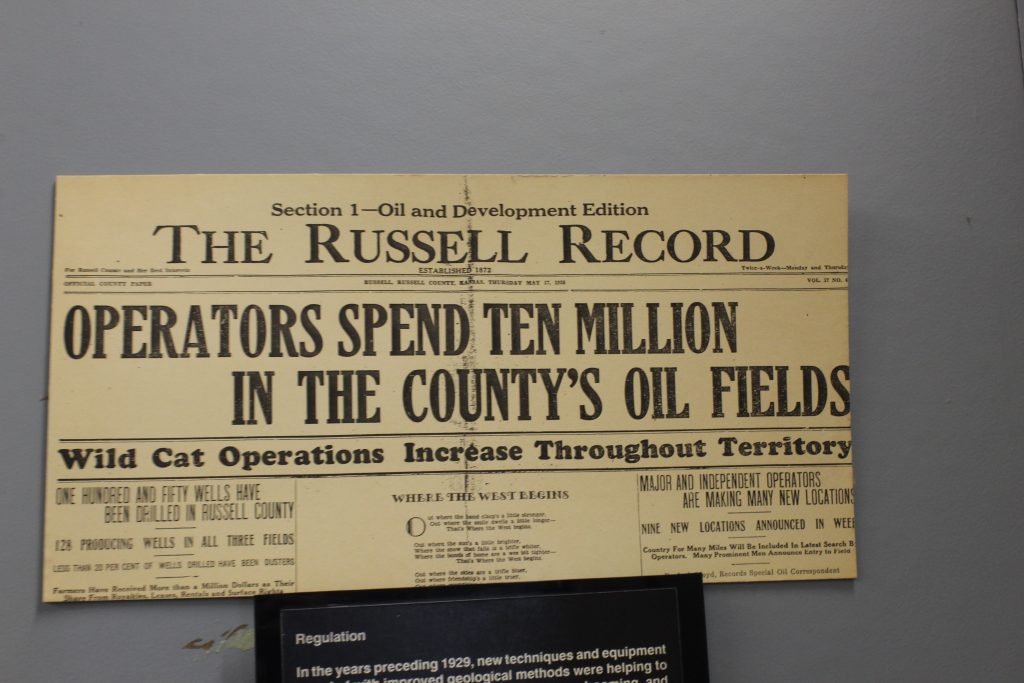
I will start in reverse with my last stop on the trip, which was the Oil Patch Museum.

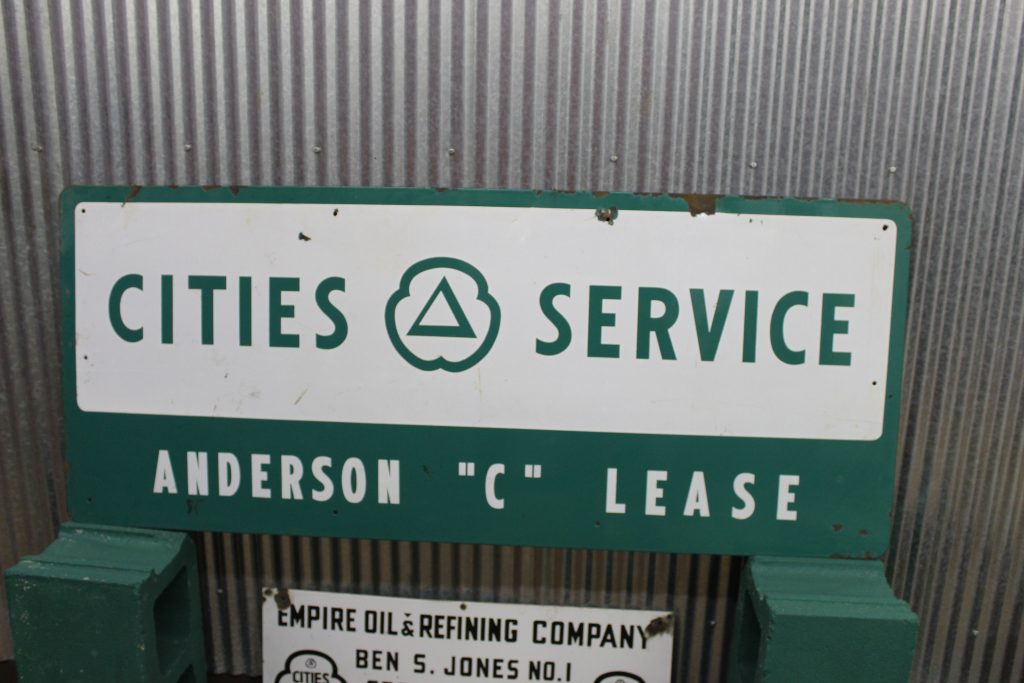
I have a special affinity for oil history because it is inexorably entwined with my own family tree. My grandfather Roy Janney came from southeast Kansas to work in the oil fields of Butler County, Kansas, and eventually was the head electrician for Cities Service. I was tickled when I saw an old Cities Service sign hanging in the Russell museum.

Ag and oil continue to be king in both the Russell and Ellis county economies. There are two things I think are really vital to a Kansas child’s education. That is knowing their food does not come from a grocery store, and the fuel for their car doesn’t come from a gas pump. The Oil Patch Museum tells the story of the latter.

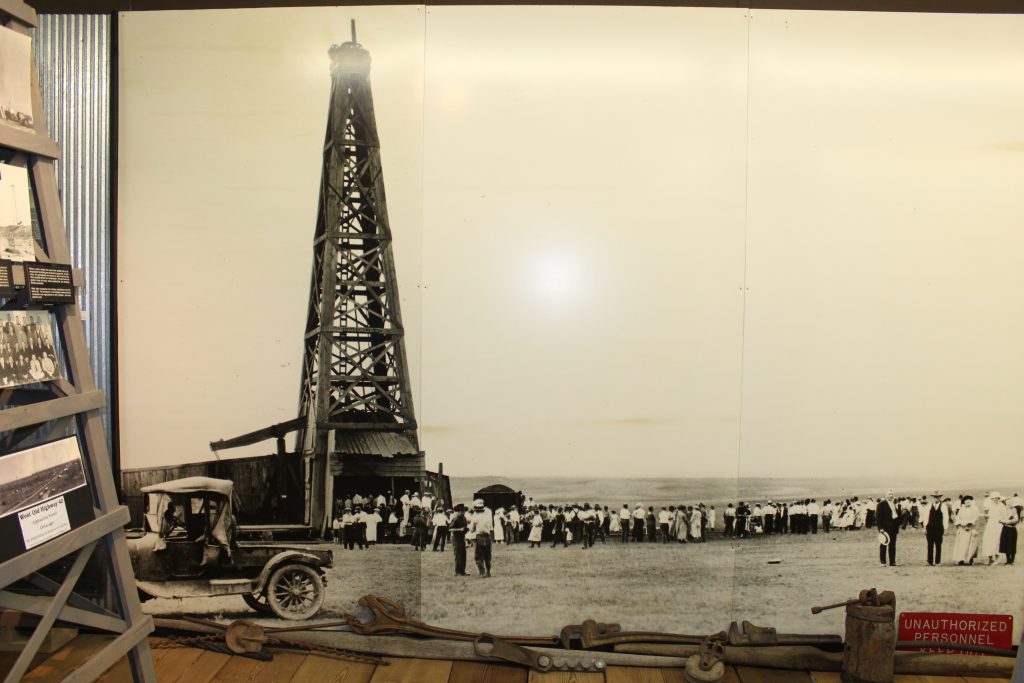
The Carrie Oswald No. 1. Oil derricks were made out of wood when oil was first stuck in Russell County in 1923.

Oil was first struck in Russell County in November 1923 at The Carrie Oswald No. 1 near what is now the unincorporated town of Fairport. The well was named for the land owner’s wife. Ed Oswald was about to go bankrupt and the strike saved his farm and house from foreclosure.

Even though I was in a different part of the state, many of the exhibits and pieces of machinery clicked with stories my grandpa and dad had told me about the oil fields.

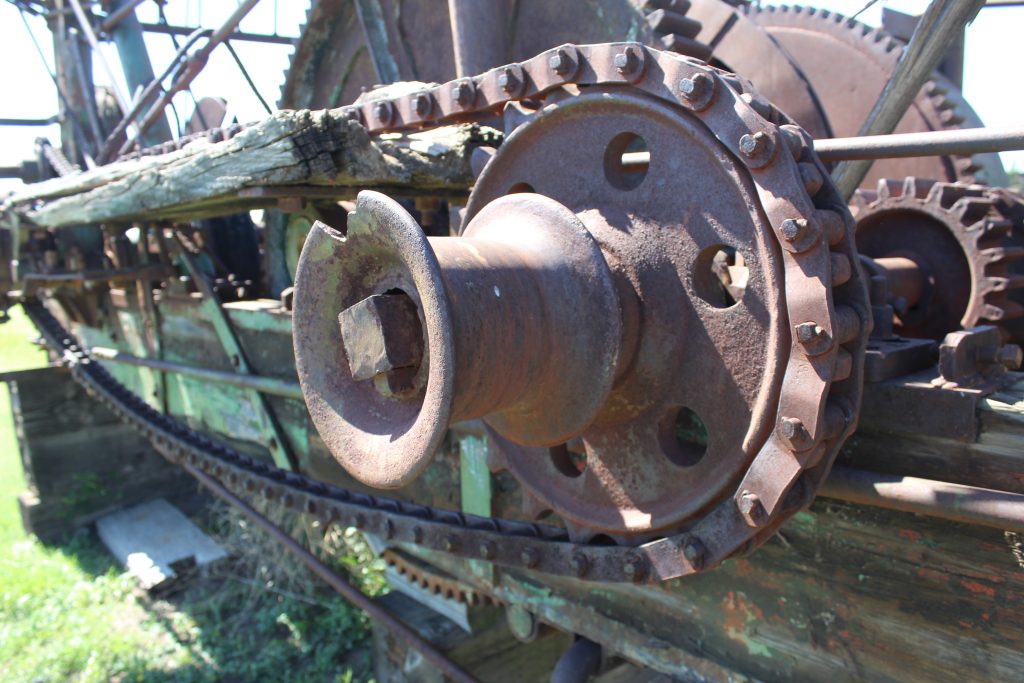
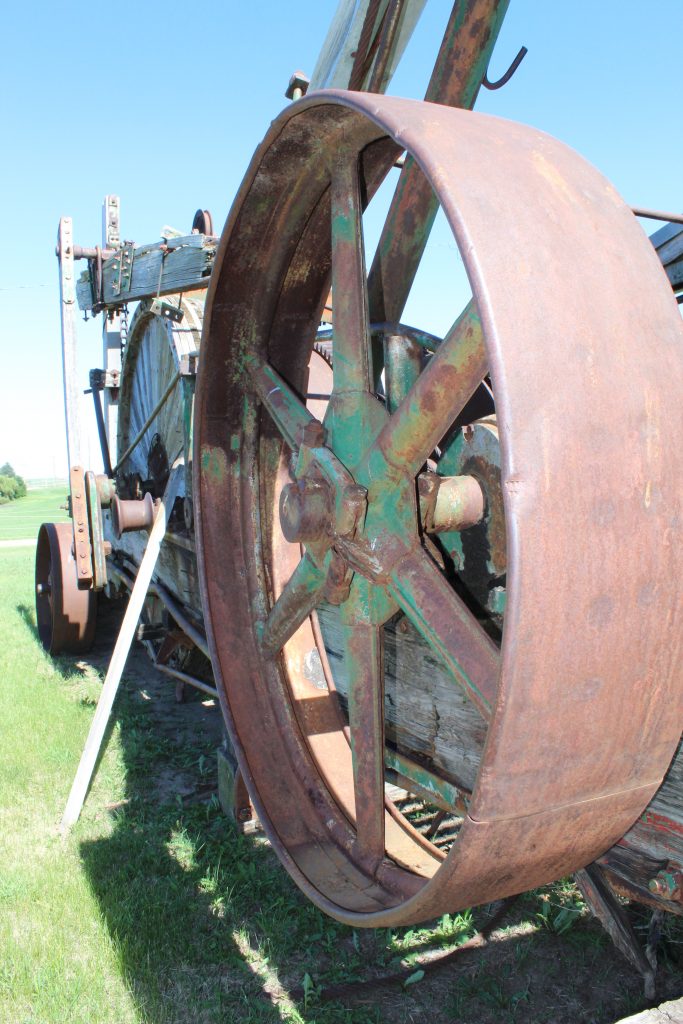
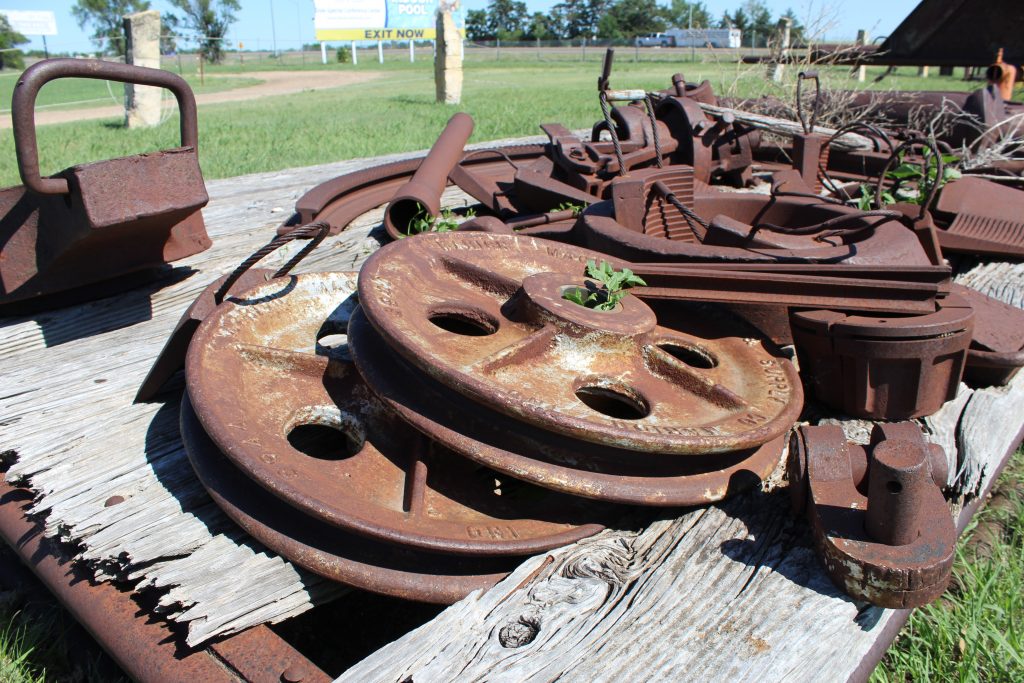
A large horizontally mounted wheel called a bull wheel is on display at the Oil Patch. Coming out from the wheel are pipes or rod lines that attached to pump jacks. These wheels were connected to engines by huge belts, and they ran multiple pump jacks. Pump jacks remind me of metal horses that bob up and down and pump the oil to the surface.

My dad said my grandma warned him to not get tripped up in the pipes as he played in the oil fields near his home in Oil Hill. Apparently the little boys used to try to ride the pipes for fun.

The platform near the top on this rotary rig is an example where my dad worked as a roughneck when he was a young man.

Rotary rigs, giant rusting towers cast criss-cross shadows on the grassy meadow. My dad worked as a roughneck (name for an oil rig worker) from the time he was 18. He was a derrick hand who worked on the stabbing board, a narrow platform just shy of 30 feet off the ground.

It was his job to catch the pipe used in the drilling as it came flying up the side of the rig. I am afraid of heights, and I shuddered at the thought of him balancing on the tiny platform, slippery with mud. He volunteered for the job because he was paid a few extra cents a day. It is a miracle he survived to bring me into this world.

Descendants of these aging rigs and pump jacks can still be seen dotting the area landscape today. In fact, I saw a rotary rig drilling in a field off I-70 on my way home.

From watching old movies like “Giant” and “Hellfighters” with John Wayne, I thought oil rigs always gushed when they hit oil. I spent one very hot, summer day when I was about 11 waiting for this to happen as I watched a well being drilled on my grandparents’ farm in Greenwood County.

To my disappointment, this is not the case. All I had to show for my patience was a bad sunburn.

Only one gusher was recorded in the Russell oil fields. As I learned at the Oil Patch, 90 percent of the wells in Kansas are strippers. Get your mind out of the gutter, not those kind of strippers. In oil field talk, this is a nearly depleted well whose income barely exceeds the cost of production.

My dad said about 90 percent of the slang he used in the oilfield is not fit to print, but here is some of the cleaner terms, according to the museum.

A wildcat is not an animal or a K-State fan. It is a drilling operation seeking unproved oil possibilities.

To spud is to commence drilling operations.

A Christmas tree is an assemblage of valves and gauges used to control the flow of oil and gas.

A tool pusher is a drilling supervisor.

The runs are the purchases from a producing lease.

Admission to the Oil Patch is through freewill donation.

As with any small town, if you really want to get to its heart, you have to sample its downtown.

My first stop downtown was to grab some lunch at Wauby’s Sports Bar and Grill. The Wauby’s building was built in 1885 and is on the Nation Register of Historic Places. The burgers are run-down-your-face juicy, which mine did.

The Wauby’s building was built in 1885 and is on the Nation Register of Historic Places.

There wasn’t much traffic downtown on a warm Saturday afternoon, so, with my belly full of burger, I strolled leisurely hitting up a couple local stores and antique shops.

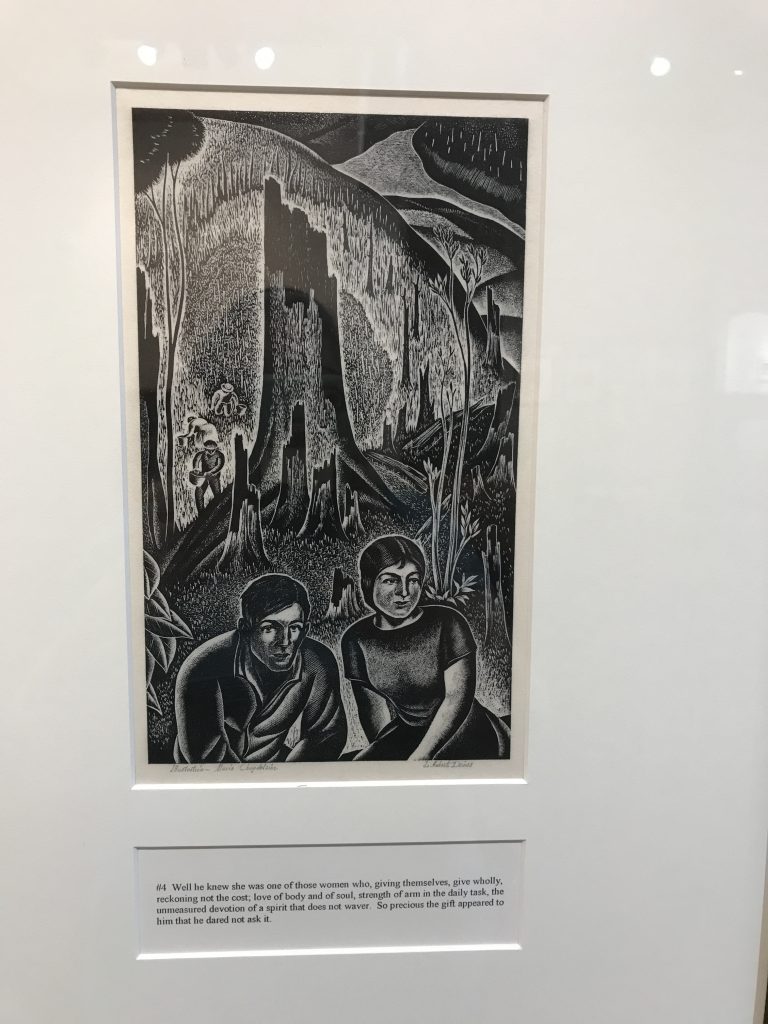
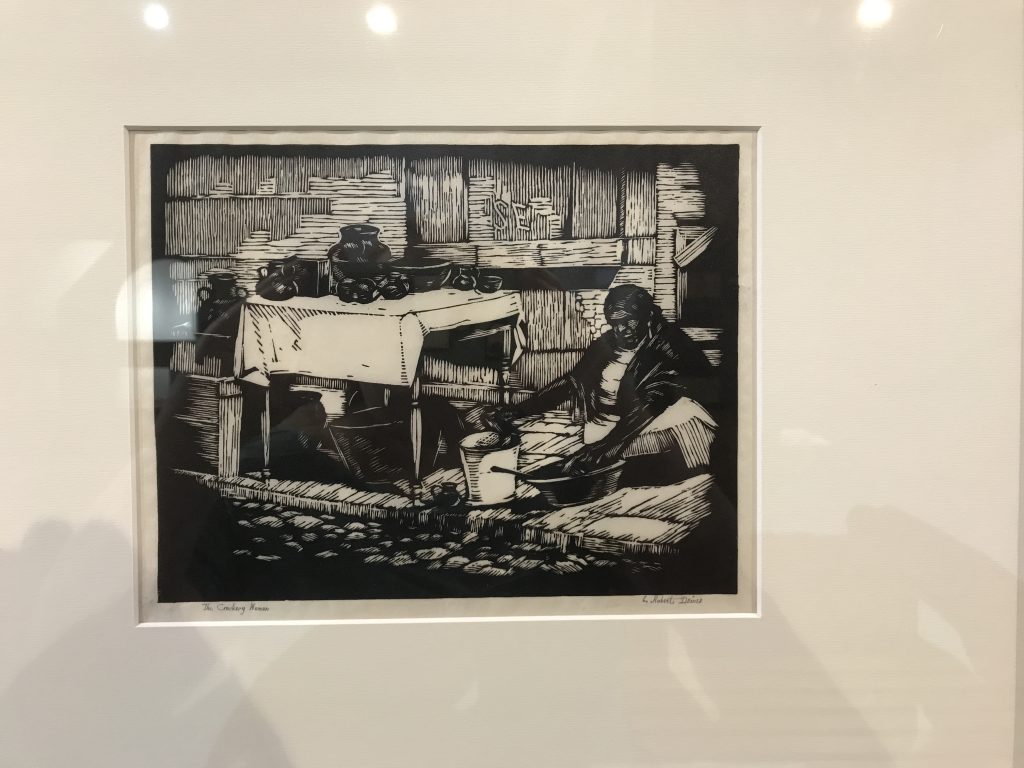
For art lovers, the Deines Cultural Center, which is also downtown, houses wood-engraved prints created by Russell native E. Hubert Deines. Deines worked in the ’30s and ’40s in commercial arts, creating artwork for the Kansas City Star and later national magazines. Admission to the center is free.

In addition to Deines’ work, the Center has on loan from the school district several Birger Sandzén paintings. Sandzén lived in Lindsborg, Kansas, and the Birger Sandzén Memorial Gallery in Lindsborg is dedicated to his work. The Sandzén paintings at the Deines were saved from obscurity, having been pelted by students with butter and one left in a broom closet.

Coming June 22 to the Deines is the Reflections on Water and My Places,” paintings by Steve Read and Post Rock Country” photographs by Greg Rud.

Just off of Main Street at 331 N. Kansas is the Fossil Station Museum, which is also on the National Register of Historic Places. The castle-like limestone building was constructed in 1907 to serve as the sheriff’s home and jail. Admission is free.

An outfit worn by a Dole supporter during one of his campaigns on display at the Fossil Station Museum.

The museum includes a tribute to Russell native son, Bob Dole, who served in Congress from 1968 to 1996. He won the Republican nomination for president in 1996 and lost to incumbent Bill Clinton. I have met Bob Dole a number of times throughout my journalism career. I didn’t always agree with his politics, but I have always respected the man. He did much for the state of Kansas and his country, and I would say he is a different breed of politician than we see in office today.

A note to the weird and wacky, the museum has a gallon jar of human teeth as part of its “The Tooth Story” exhibit on an early Russell dentist. The man saved every tooth he pulled. I am sorry I don’t have a picture. I was a bit grossed out by the sight, even though I was warned by a volunteer they were there, and scurried out of the room.

Being in post rock country, limestone was a common early building material. Just down the street you can view the Heym-Oliver House, which was built in 1879, and the Gernon House, also on the National Register of Historic Places. It was built in 1872 and is the oldest house in Russell.

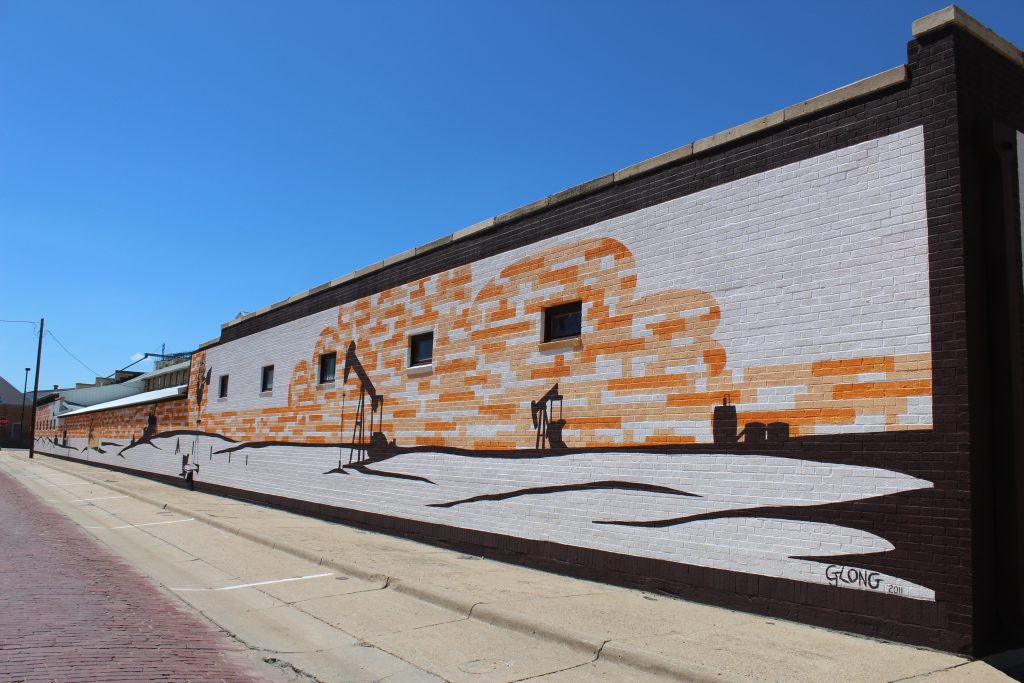
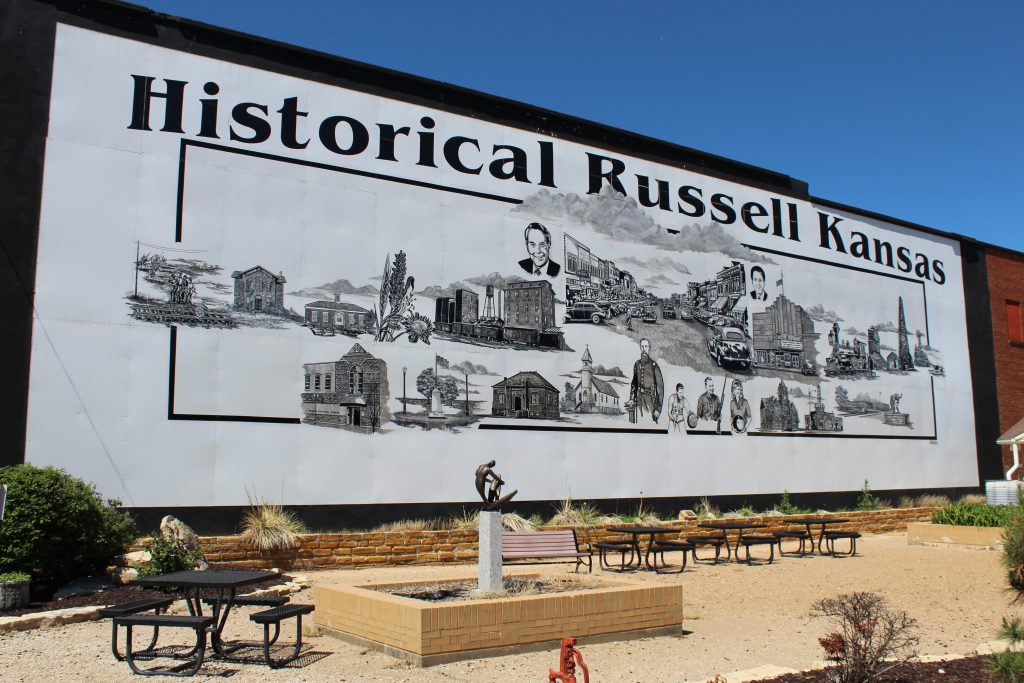
Downtown also offers several examples of public art, including a black and white mural at Eighth and Main streets by Rick Rupp that tells the story of Russell. The Russell Post Office, 135 W. Sixth, also on the National Register of Historic Places features yet another mural “Wheat Workers” by Martyl Schweig.

I didn’t make it over to the Dream Theater to see a show, but I am excited to go back.

The original theater was built in 1923, but was destroyed by fire. It was rebuilt in the Art Deco style in 1949. The theater was built by the Boller brothers of Kansas City, Missouri, and is one nine theaters in Kansas on the National Register of Historic Places. A local committee raised money to reopen the theater after it was closed by B & B Theatres in 2000.

In addition to current-run movies, the theater has summer and classic movie series.

The “Grapes of Wrath” starring Henry Fonda is coming in August and to “To Kill a Mockingbird” with Gregory Peck is showing in September. I have seen both classics on the small screen, but it is not the same as seeing them as they were intended on the big screen with the scent of butter-drenched popcorn in the air and a giant soda in your lap.

If live theater is more your speed, the Russel Community Theater is presenting “The Nerd,” June 26-30.

See related story: Russell Community Theater presents ‘The Nerd’

This weekend I am headed to my former home-base of Salina. Look for that story June 23.

See you on the road!

Below you will find some more helpful links in planning your trip.

Kansas Vendors invited to participate in Russell’s Downtown Market

Russell County Economic Development and Convention and Visitor’s Bureau

Russell Main Street 

Russell Area Chamber of Commerce

Russell County Free Fair

🎥 Dinkel resigns; Hays city commission seat open

Hays Projects Manager John Braun shakes hands with City Commissioner Chris Dinkel who is resigning to move to New York City.

By BECKY KISER
Hays Post

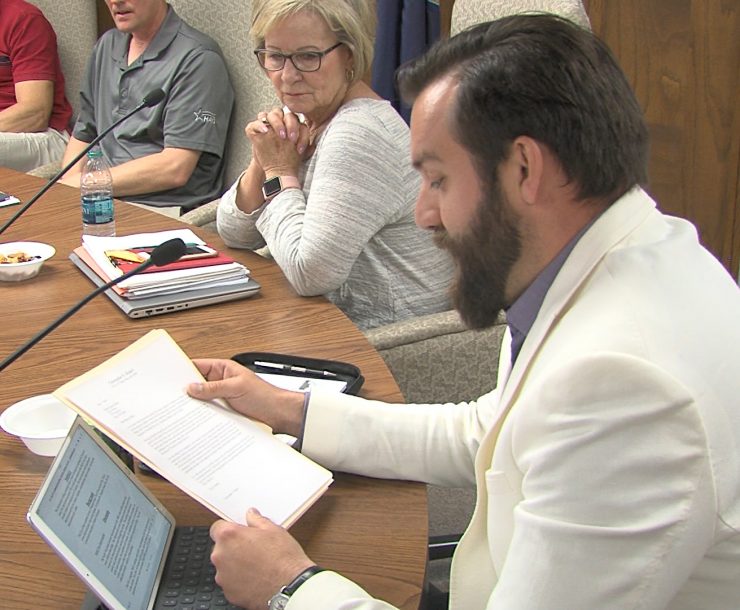
Hays City Commissioner Chris Dinkel announced his resignation, effective June 20, 2018, during Thursday night’s commission work session.

Dinkel has been accepted to Columbia Law School and will move with his family, wife Ervis and son Liam, to New York City to start classes this fall.

In a letter to Mayor James Meier which he read aloud, Dinkel said he “chose to vacate my seat early to allow the commission to select my replacement before this year’s budget process begins rather than as it ends.”

Dinkel said he originally intended to serve through the end of the 2019 budget process, but must be in New York prior to the final budget vote.

“I hope that the timing of my resignation will allow whomever you choose to fill this seat to feel that they have had ample opportunity for input in the budget process before voting on the finished product in August.”

After thanking Dinkel for his service and wishing him well, the other four commissioners discussed how to fill the vacant seat.

Previously, vacancies have been dealt with by appointment or through an application process. The commissioners decided to ask for interested Hays residents to contact one of them.

“There are a number of people in the community that have been voicing lots of opinions about what we’re doing and how we’re doing it, and maybe there’s people that would like to apply,” said Commissioner Sandy Jacobs.

Both Vice-Mayor Henry Schwaller and Commissioner Shaun Musil said they’d already been contacted by people who are interested.

“I’m happy to talk to anybody,” said Meier. “I’m not going to ask anybody. If this is something you want to do, then you need to express an interest in doing it, and not expect somebody to reach out to you.

“Being a commissioner is a responsibility to serve, and not just showing up,” Musil added, although he noted that sometimes missing a meeting was unavoidable. “It’d be nice to get somebody who really cares about the community, wants to do good for the community. And we all come in different shapes.”

Dinkel is the marketing coordinator for High Plains Mental Health Center, Hays, and also an adjunct professor of history at Fort Hays State University.

Interested persons should contact a city commissioner by June 20. Email addresses are available on the city’s website. Kansas statutes require a vacancy of the city commission to be filled within 10 days of the leaving commissioner’s official written resignation.

City Manager Toby Dougherty said Dinkel’s replacement could be seated at the June 28 commission meeting.

According to Hays City Clerk Brenda Kitchen Dinkel’s term ends in 2020.

Sternberg sets fossil hunt, murder mystery events

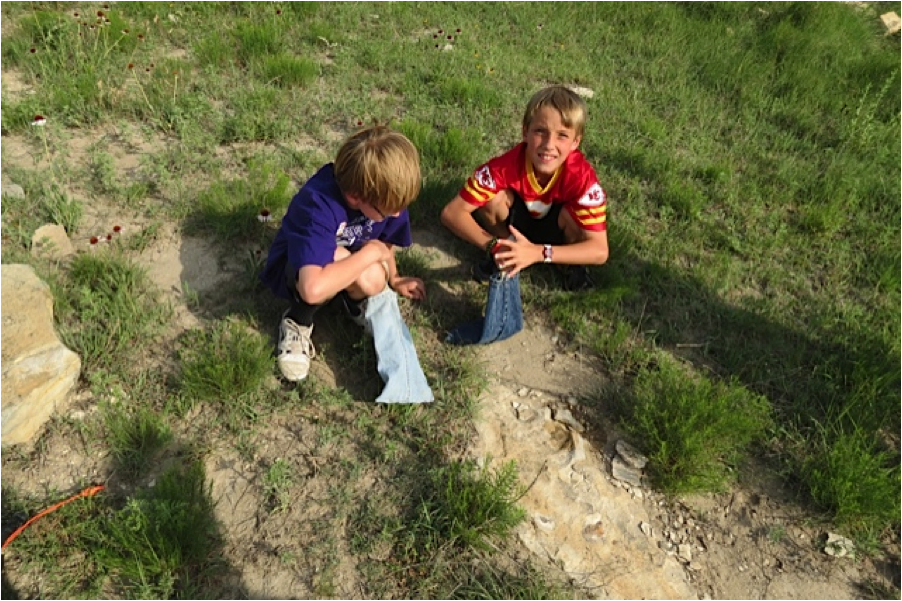
Two young hunters collect fossils at a previous Sternberg fossil hunt. Courtesy photo
By CRISTINA JANNEY
Hays Post 

The Sternberg Museum of Natural History has set its annual shark tooth and fossil hunt for 5 to 8 p.m. Saturday, June 16.

The cost is $12 for museum members and $15 for non-members. Register is required by June 11.

Participants will caravan to the collection site from the museum. Participants will be surface collecting fossils. Some of their finds could include shark teeth, clam and oyster shells, fossil fish fins, or vertebrae. Fossil hunters on a rare occasion might find a mosasaur vertebrae, Darrah Steffen, public relations assistant, said.

Fossils from the deposit are from the Cretaceous Period when Kansas was covered by a great inland sea and are about 66 million years old.

The event is family friendly and all ages are encouraged to attend, Steffen said.

Wearing long pants and closed-toe shoes is recommended. Participants are also encouraged to wear sunscreen and bug spray. Water and snacks will be provided.

To register, call 785-628-5516.

The Sternberg has also opened registration for “Murder on the Cretaceous Seaway.”

The evening is for those 21 and older. It will be 6 to 10 p.m. Saturday, Aug. 4. Cost is $20 with an additional $5 for babysitting. Tickets are available online through the link above.

Participants, who are encouraged to dress in costume, will be assigned a character in line with the event’s pirate theme.

After a voyage filled with pillaging and plundering, The Jaded Jewel, is docked. As the pirates head to town to celebrate their homecoming and spend their gold and goods, a night of turmoil and trouble is sure to transpire.

Midway through the evening, a member of the group will be “murdered.” It will be up to the remaining characters to solve the crime.

Participants will be posed with riddles and must search the museum high and low, reading museum placards for clues to solve the mystery.

Hors d’oeuvres and alcoholic drinks will be served.

The program is part of a thesis project for FHSU student Kat Rivers as a means of introducing more adult programing at the museum.

“We think it will be a lot of fun,” Steffen said. “We are really excited about it.”

SPEAKER: Renewing connections in disconnected society may help depression, anxiety

By CRISTINA JANNEY
Hays Post

The understanding of the causes of depression and anxiety has evolved over the last 50 years, but a new book suggests we might have some power to combat the debilitating illnesses.

Johann Hari, in his book “Lost Connections: Uncovering the Real Causes for Depression — And the Unexpected Solutions,” suggests reconnecting with other people and our environment can hep people suffering from depression and anxiety.

Ken Windholz, psychologist and a faculty member at Fort Hays State University, gave a presentation on the book to the Hays National Alliance on Mental Illness on Monday.

For 50 years, the medical field has relied heavily on the theory that depression is caused by a lack of the brain chemical serotonin. To combat this, medication known as selective serotonin reuptake inhibitors or SSRIs were prescribed.

Exposure to light, exercise and a healthy diet have also all been found to increase serotonin levels in the brain.

However, Hari suggests there are psychological and social factors that also can influence mental health.

Some of the those psychological factors include learning, emotions, thinking attitudes, memory, perceptions, beliefs and stress management strategies.

Social factors include social support, family background, interpersonal relationships, cultural traditions, medical care, socioeconomic status, poverty, physical exercise and biofeedback.

Psychological, social and biologic factors all intersect to affect a person’s physical and mental health.

“This is how we have been doing this in modern treatment,” Windholz said. “We separate things out. We start to think of ourselves as separated also. This is my brain. This is my social relationship. This is my psychological relationship. This brain stuff must not be impacting my social relationships, or my social relationships might have a little bit to do with my psychological stuff, but not much.

“That is the key to understanding this and understanding treatment is to understand all these things interact. We are not half a person walking around. Every one of us is a whole, blessed, integrated human being.”

The author suggests depression is a function of our lost natural and intended internal and external connections —biologically, psychologically and socially.

Windholz posed this is simpler language.

“What he is saying is that one or more of these features of ourselves is out of sync. The chance is when we are really depressed, all of these things are out of sync,” he said.

These changes tend to feed off each other. If you are off physically, then you can be off psychologically and/or socially.

Mental health treatment is coming full circle to understand brain chemistry is not the only cause of depression.

“Since the use of antidepressants came along, it has not significantly reduced the instance of depression,” Windholz said. “It has relieved a good bit of it. People still get depressed even when they are taking anti-depressant medication. Even when they have been switched to two or three antidepressants, they still get depressed. We didn’t understand why.”

Depression and anxiety are the most common complaints among those seeking mental health treatment, but Windholz said they are probably the illnesses science understands the least because there is such a wide range of factors they encompass.

Hari said we are disconnected in a variety of ways. He said we are disconnected from meaningful work. Windholz presented some statistics.

Sixty-three percent of people polled by Gallup say they’re “not engaged” in their day’s work, that they’re “sleepwalking” through their day and 87 percent of people in the poll say they dislike their jobs.

Hari argues our society is outwardly motivated on rewards.

“I think we should tell each other that we are good people and mean it, because that is the way we communicate our affections and recognition of one another in an honest way,” Windholz said. “You can give all the rewards and awards and diplomas and certificates and plaques and all the trophies and great things you want, give them the keys to the city and tell them what a great person they are. If they really don’t feel it in their heart, none of that matters. Status means nothing without authenticity behind it.”

Another way we disconnect is from other people.

“We are naturally social beings. … Our very nature is to be connected through friends, partners, families, neighborhoods, communities, clubs, organizations even municipalities. … ‘I am from the city of … and ‘I like the LA Raiders’ and civic pride, cultures … Whatever those cultural identities are, we put them into ourselves.”

Scientists have found that certain areas of the brain “light up” when people interact with other people.

Many Americans have no close friends, Windholz said. Loneliness is a key feature in depression and suicidal behavior. It correlates with anxiety, low self-esteem, pessimism and fear that others dislike us, he said.

The author also suggests that we disconnect from meaningful values.

“We have become a materially focused society,” Windholz said.

A 2017 survey of 10 grand lottery winners (winners of $3 million to $314 million) revealed two declared bankruptcy, three committed suicide, two went to prison, one married and divorced six times and two developed substance abuse dependencies.

“The more one thinks about having stuff and superiority and showing it off, the more unhappy, depressed and anxious one often is,” Windholz said.

Disconnection can be the result of child hood trauma. Bessel van der Kolk, M.D. in “The Body Keeps the Score: Brain, Mind, and Body in the Healing of Trauma” estimated 50 percent of patients diagnosed with major depression also had abuse in their past. The earlier this occurs in life, the greater the likelihood of the diagnosis.

People can disconnect from the natural world.

“Nature by itself of its own accord is connected. Nature represents connection,” Windholz said. “We go look around outside and see how the wind blows through the trees. There is a connection. We see how the birds land in the trees. There is a connection. We see how the birds build nests. We see the cycles of life between seasons. We see migrations. Nature has its cycles. Nature is connected in every possible way.”

People who do not experience nature become trapped like an animal in a zoo, he said.

“Sometimes when you force yourself out among people, you might find yourself to just slightly feel a little bit better,” he said. “You can see how the other half lives, so to speak. Now I have something to compare that with. When I am locked in by myself, I don’t have anything to compare it with. All I have to compare it with is whatever is happening inside myself.”

Finally, the author suggests people can become disconnected from a hopeful and secure future. Central to suicidal thinking is a lost sense of the future.

The adolescent brain is notorious for its “immediacy thinking” and the belief that “However it is now is how it will always be.” The depressed person reverts to this thinking mode, Windholz said.

Although brain chemistry plays a role in depression and anxiety, some researches believe less than 30 percent of depressive and anxiety disorders are caused by genetics. Only one gene, 5-HTTLPR, has been linked to serotonin re-uptake transporters you have. Even if you have a genetic predisposition to have depression or anxiety, external forces may play a role in whether you develop the illnesses.

Windholz asked his audience how they isolate from other people. He suggested some of the ways we isolate include using social media, watching TV, staying inside all day, buying things and using online buying excessively, sleeping more, over use of the Internet, and playing video games.

We can reconnect by exercising (as little as 10 to 15 minutes per day can be beneficial) and engaging in meaningful work. This can be through a job, activity or volunteering.

“It is really a matter of how we balance all these factors in our lives. How do we stay connected but no too connected—just enough connected? How do I isolate, but not become too isolated? How do I take time for myself in a healthy sort of way?” Windholz said.

He encouraged his audience to do what you love and to find love in whatever we are doing. He also challenged the audience members to keep gratitude journals.

“If we are looking for a hopeful future, if we are looking for a connection or looking for a creative way to step outside of the box we find ourselves confined into, I think the first doorway is gratitude,” Windholz said. “Gratitude points me to the other rather than what I am struggling with. It points me to the gifts rather than the boxes that it all came in. I am looking for the gift rather than rocks.”

Ann Leiker, NAMI coordinator, said NAMI and its support groups can be a way to find connections for people with mental illness or who have loved ones with mental illness.

NAMI offers support groups for those with mental illness and their families. The support groups are from 6 to 7 p.m. on the first Mondays of the month at Center for Life Experience at the First Presbyterian Church, 2900 Hall St., in Hays unless there is a conflict with a holiday. Education programs are offered from 7:15 to 8:15 p.m. For more information, call Leiker at 785-259-6859 or by email at [email protected]. See Center for Life Experiences online at www.cflehope.org.

🎥 Hays 40 & 8: Colyer proclaims June 16 Kansas Merci Boxcar Day

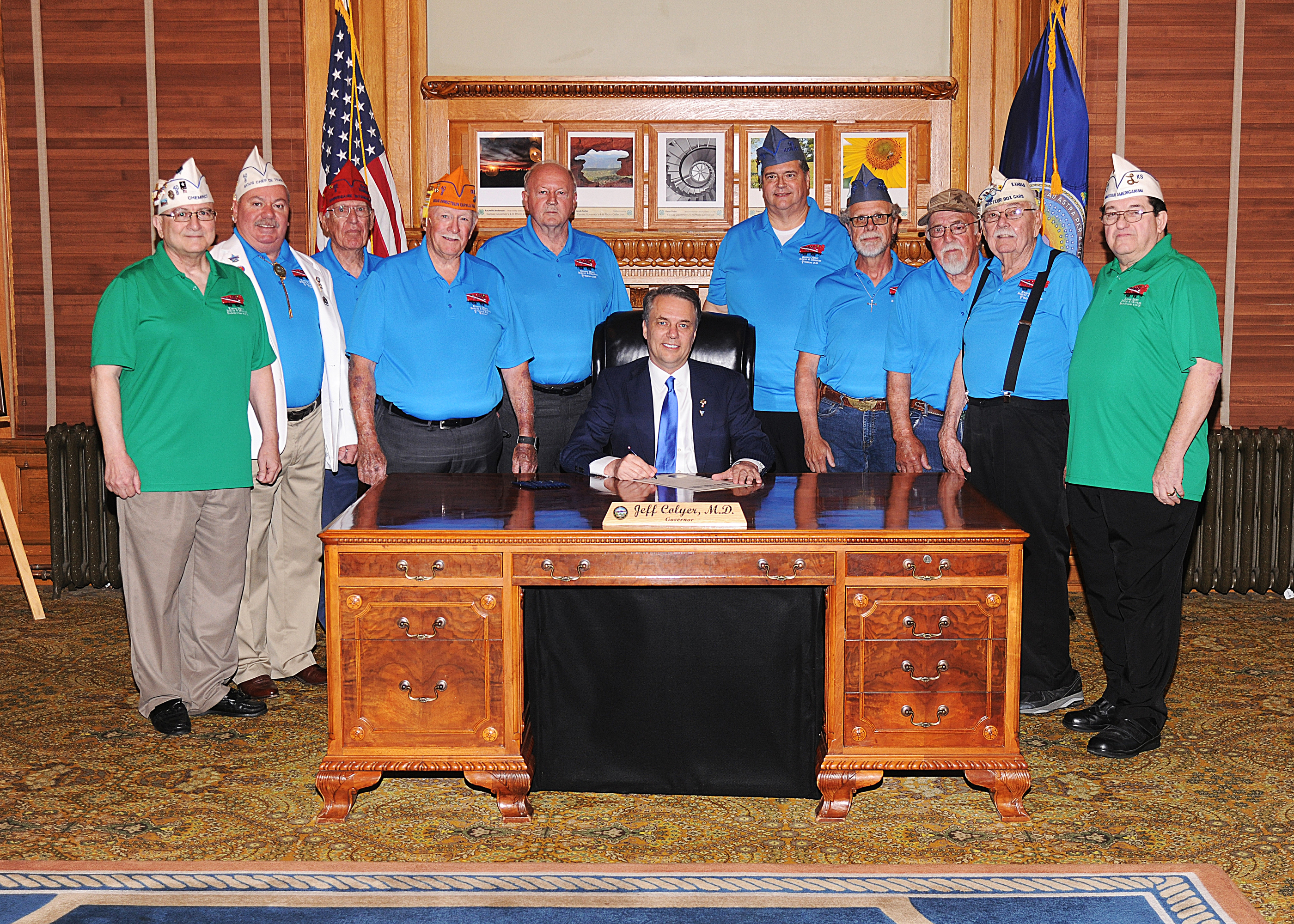
On May 31, local members of the Society of 40 men and 8 Horses, otherwise known as the 40 & 8, were joined by several others from around the state to watch as Gov. Jeff Colyer signed a proclamation declaring June 16, 2018, Kansas Merci Boxcar Day.

The reason for the proclamation was to help the citizens of Kansas know about the uniquely historic boxcar and invite them to visit. June 16 is the date The Kansas Merci Boxcar and Museum is to be rededicated in its new home in Veterans Memorial Park in Hays behind Cloud Storage at 1305 Canterbury.

The public is invited to the rededication of the Kansas Merci Box Car in Veterans Park at 3 p.m. June 16. As part of the ceremony, the 40 & 8 will read the governor’s proclamation and make presentations to the city of Hays and others who have supported the move to Veterans Park.

In 1949, famous news reporter Drew Pearson came up with the idea to send a friendship train filled with much needed supplies to France after World War II. They ended up shipping more than 700 American boxcars filled with needed supplies. In gratitude of this assistance, the people of France filled 49 boxcars of the type of boxcars used to ship equipment and supplies to the front in WWI and WWII.

The box cars were able to hold 40 men or 8 horses, which is the origin of The Society of 40 Men and 8 Horses name. The French people filled them with 50,000 gifts of cultural significance. There was one boxcar for each of the 48 states, and the District of Columbia and Hawaii shared one. The Kansas boxcar toured 120 cities in 140 days and ended in Hays on Nov. 11, 1949. After it was paraded through town during the Armistice Day Parade, it was relocated to Fort Hays State College for permanent display and awarded to the local 40 & 8 chapter to maintain and preserve the historic monument for the state of Kansas.

From its original location at Fort Hays State College, it was moved to the American Legion in 1975 where it was rebuilt and turned into a museum of the wars of the 20th century on. Because the American Legion sold its building, the Kansas Merci Box Car needed a new home. The city of Hays has approved for the boxcar to move to Hays Veterans Park, which will give the Kansas Merci Box Car a permanent home. This will help us preserve this unique piece of history here in Hays for the entire state and nation to enjoy and learn of its history.

“We encourage the citizens of Hays and the surrounding area to come and learn about the boxcar,” said Vance Chartier, Chef de Train.

Chartier and Ed Holzmeister, grand director of the Kansas Merci Boxcar, extended a personal invitation to the rededication to Hays city commissioners.

(Video by Hays Post)

“In December, the city commission graciously supported the boxcar and its relocation to Veterans Park. We’re very close to finishing it up right now,” Chartier reported. “We’re doing the final touches, doing our own repainting and stuff inside.”

Tours will be available after the ceremony. To schedule a tour of The Kansas Merci Boxcar and Museum, call Chartier at 785-623-6747 or email [email protected] to schedule your tour. Check out the group’s Facebook page for more details. Just search for Kansas Merci Boxcar on Facebook.

— Submitted

Copyright Eagle Radio | FCC Public Files | EEO Public File