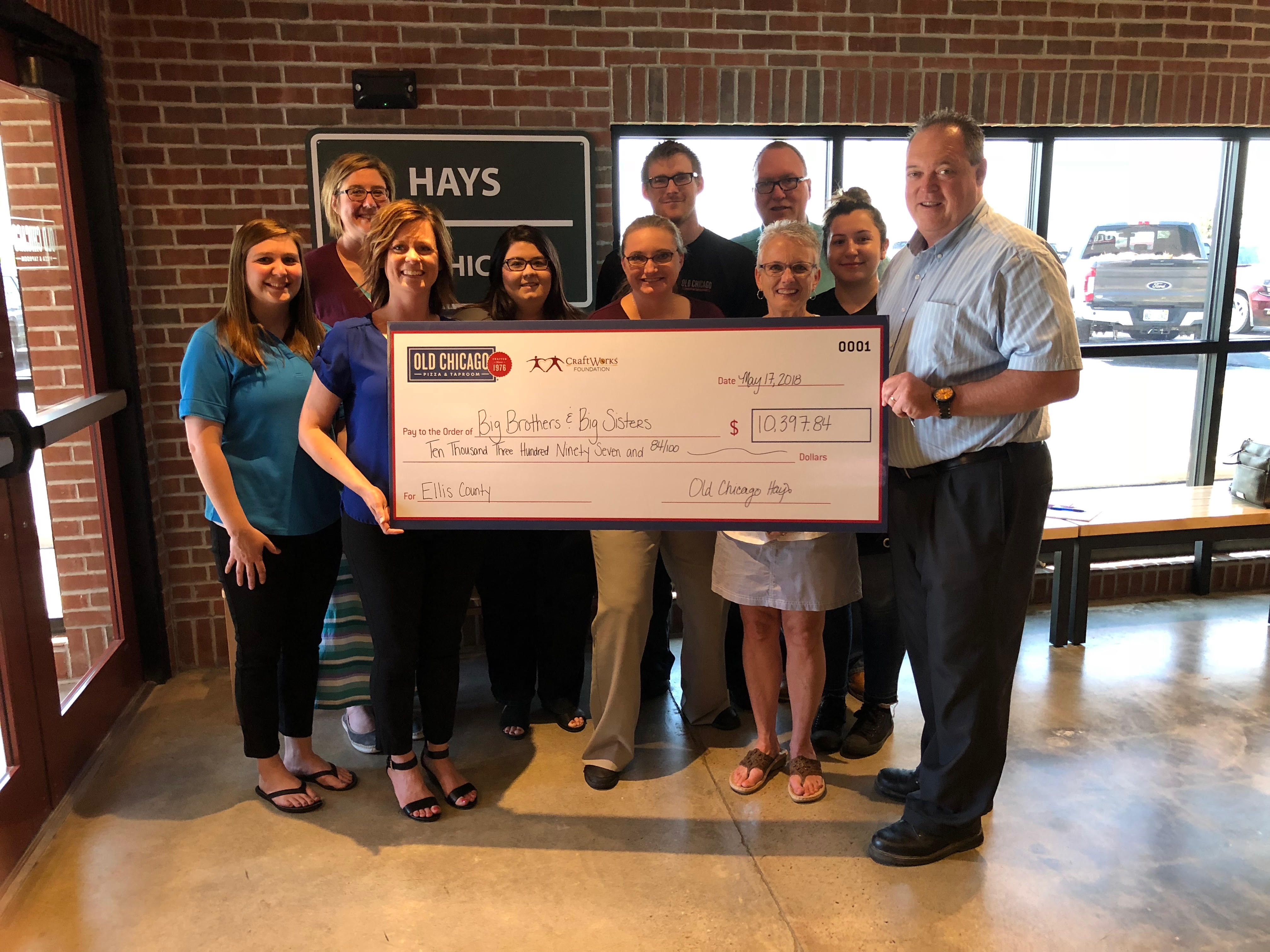
Tracey Andrews, KSBBBS; Lexi Gardner, KSBBBS; Jenny Bates, KSBBBS; Megan Schoendaler, KSBBBS; Jacki Schwender, Old Chicago; James Jordan, Old Chicago; Jeff Daley, Old Chicago; Jeanie Michaelis, KSBBBS; Damaris Flores-Ruiz, Old Chicago; Ross Olsbo, Old Chicago
BBBS
Old Chicago Pizza and Taproom, a full-service food franchise well-known for its pizza, calzones, and large beer selection, opened Mon., May 14, in Hays at 5151 Mopar Drive.
Prior to its opening date, the restaurant hosted several soft openings. During those soft openings, Old Chicago donated 100 percent of the alcoholic beverage sales to Kansas Big Brothers Big Sisters (BBBS) of Ellis County. Old Chicago also collected donations from guests throughout the pre-opening events.
On Thu., May 17, Jeff Daley, Director of Operations, and Ross Olsbo, General Manager, presented BBBS with a check for $10,397.84 from the new Hays restaurant.
“It was a great honor to make a philanthropic commitment to the Hays community,” said Daley.
“We are very grateful for the support of Old Chicago, ” said Jenny Bates, BBBS area director, “and we appreciate their commitment to raising awareness of our organization and helping the kids in our community.”
The Hays-based BBBS office serves Ellis, Rooks, Rush, Russell, Trego, Norton, and Thomas counties.
The Downtown Hays Market will open for the season on Saturday.
The market will open 7:30 to 11 a.m. every Saturday through the season at the Downtown Pavilion, 10th and Main streets.
The market has about 40 vendors signed up this year. There is no cost to be a vendor. More information on signing up as a vendor can be found at Downtown Hays website.
Parking is suggested across the street in the area where the market was in previous years. There is a new restroom available at the site.
The market has special events planned throughout the season, including music, arts and crafts, and education classes with the Hays master gardeners.
To keep up with these special events, follow the Downtown Market on Facebook. Click here.
Dane Murzyn, a sophomore at Fort Hays State University and DHDC intern, will serve as the market manager this summer. Applications are being taken for another intern this fall.
The teachers and students at O’Loughlin Elementary School have long thought of themselves as trailblazers, but long before the school honored her name, Kathryn O’Loughlin McCarthy was blazing trails of her own for women and the disenfranchised.
O’Loughlin McCarthy, a Hays resident, was most noted as being the first woman from Kansas elected to Congress, but she was breaking barriers and making a name for herself in politics long before she was elected to Congress in 1932.
She was born on April 4, 1894, in Ellis County. She lived with her family on their ranch outside of Hays until she was 9 and the family moved into the city of Hays, where her father owned an auto dealership and garage.
The initial move to the city from her country school was difficult. She was bashful, and the other children taunted her, calling her “country jake.” However, when O’Loughlin McCarthy entered the Fort Hays Normal School, which is now Fort Hays State University, to study education, she found her fire. She quickly earned honors as an accomplished debater and speaker.
After completing her bachelor’s degree in 1917, she enrolled at University of Chicago School of Law. Her father opposed Kathryn’s decision, but she persisted and was only one of three women in her graduating class. After law school, she clerked for the Kansas House Judiciary Committee for a year.
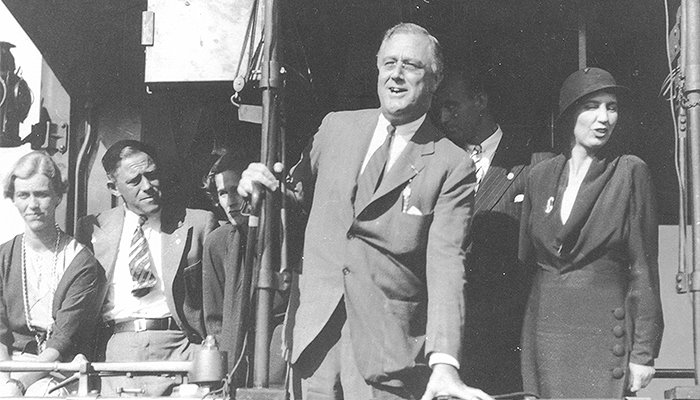
Kathryn O’Loughlin McCarthy, far right, campaigns with Franklin D. Roosevelt in 1932 in Colby. Photo courtesy of the Ellis County Historical Society
O’Loughlin McCarthy returned to Chicago where she became very active in politics during the 1920s. She campaigned on behalf of the Illinois League of Women Voters for eight-hour work days for women, maternity and infant care, and for women to be allowed to serve on juries.
O’Loughlin McCarthy told a reporter in 1932 how her years in Chicago readied her for her run for Congress.
“I had been well-trained in political tactics and debate and in rough-and tumble street speaking in political campaigns in Chicago and rural Illinois. … I spoke from the tail of a truck a thousand times to street meetings, through Chicago and towns nearby. I had learned to think rapidly while on my feet, even before a hostile audience. The heckler was meat for me. I organized the business women of Chicago into Democratic clubs, I had organized thousands of Negro women into Democratic clubs.”
Also while in Chicago, she served as an executive for an insurance company, but left that work for lower pay to assist the less fortunate. She worked as an attorney for Chicago Legal Aide and was an attorney for the Cook County Board of Public Welfare.
O’Loughlin McCarthy came back to Kansas in 1930, and ran for and won a seat in the Kansas House. She was the first woman from the area to earn a seat in the Legislature. While in the Legislature, O’Loughlin McCarthy helped establish what would become the Fort Hays State Historic Site.
When she decided to run for Congress in 1932, she faced an uphill battle. She was a single, female, Irish-Catholic, running against a two-time Republican incumbent in a primarily Protestant district. She beat nine men in the primary to advance. During her campaign, she wrote thousands of personal letters and crisscrossed the district, one of the largest in the nation, putting more than 30,000 miles on her car.
Right before she took her seat in Congress, she married fellow attorney Dan McCarthy. They were the first couple to be certified to practice before the U.S. Supreme Court.
While in Congress, she supported Franklin Roosevelt’s New Deal. She fought to assist farmers and rural residents in her district who were suffering during the Depression. Key accomplishments included wheat allotment payments, government loans to farms, federal home loans, and getting one of the Kansas Civilian Conservation Corps stations in Hays.
She served only one term in Congress, as she was defeated in 1934 by Republican Frank Carlson.
She returned home and worked as an attorney in Hays, but her years of service did not end.
O’Loughlin McCarthy pushed to integrate FHSU. She offered African-American students a place to stay in her own home and even paid some needy students’ tuitions. She lost political clout with her fellow Democrats when she fought to stop the forced sterilization of institutionalized girls in Beloit and campaigned for better living conditions for both boys and girls in state custody.
She also campaigned for funding for a hot school lunch program at Jefferson School in Hays.
She died of cancer at the age of 57 on Jan. 10, 1952.
In a news story announcing her death, a friend said, “I think a better woman never lived in Hays. She gave almost to the point of sacrifice to make the burden a little easier for others. Of herself she never thought. She was impatient of her last illness because it hampered her in work she had cut out to do for others. She was a selfless person, generous to a fault and sincere in all she did.”
5th graders learn to embroider on “Colonial and Native American Days’ at O’Loughlin. File photo
The building that would become O’Loughlin Elementary School opened as Marian High School, a girl’s Catholic School, in 1961. The Catholic Diocese closed the school when the girl’s and boy’s Catholic high schools merged into Thomas More Prep-Marian in 1981.
Hays USD 489 acquired the former Catholic high school in 1989 with the help of a school bond. After the school was extensively remodeled, it was opened as O’Loughlin Elementary School in 1990.
Nancy Harman, O’Loughlin principal from 1998 to 2015, taught kindergarten and first grade when O’Loughlin opened as a public school.
“O’Loughlin school has always been a leader in educational research and looking at what makes learning successful for students,” Harman said.
O’Loughlin was a “choice school” at the time of its opening. In 1990, when many schools were still offering half-day kindergarten, O’Loughlin had an all-day kindergarten program.
O’Loughlin implemented “looping,” a practice in which a teacher kept a group of students for two grades. O’Loughlin also eliminated grades in favor of portfolios and parent-teacher conferences, which meant the sky was the limit for student academic achievement, Harman said.
O’Loughlin school exterior today
Cooperative learning and hands-on science education were included in the curriculum, which were new strategies in education at the time. Instead of studying primarily from textbooks and workbooks, teachers were more actively involved in curriculum development and reading, writing and social studies were integrated programs.
“We really did a lot of research on what was working in education and what would help students be successful,” Harman said. “Then we tried to implement those research-based practices into our classrooms.”
For their innovative approaches the school was recognized with a number of awards in its first 10 years. Some of these included Bank IV Better Schools Award in 1996; Kansas Exemplary Reading Award in 1993, ’95 and ’96; America’s Best Schools Award from Redbook magazine in 1995; Kansas Elementary Principal of the Year, Tanya Channell in 1995; and national Blue Ribbon School in 1997.
“It was an exciting, fun place to work,” Harman said.
Today, O’Loughlin is open to all students and continues to provide quality education to children kindergarten through fifth grades. A bust of Kathryn O’Loughlin McCarthy, carved by Hays artist Pete Felten, watches over the students as they come and go through the school’s main entrance.
However, the future of the building is unclear. O’Loughlin is not the oldest building in the Hays public school system, but it has not had significant upgrades or renovations in years. A failed school bond posed to voters in November would have remodeled the school into a center for the Early Childhood Education program, Westside program and Learning Center.
Bust of Kathryn O’Loughlin McCarthy carved by artist Pete Felten that sits in entryway to the O’Loughlin school.
The school board continues to discuss elementary schools in its long-range facility plans, but how O’Loughlin will factor into the plan has yet to be decided.
“I would be sad to see it go,” Harman said. “I have so many wonderful memories there. It was my home base for many, many years. My heart would be sad, but I think our district needs to go forward. Whatever makes that possible, we will have to adjust and accommodate.”
Whatever happens to the building, Harman, who still volunteers at the school, said she hopes students will keep the spirit of Kathryn O’Loughlin McCarthy alive.
“She believed in what was right and she followed that belief,” Harman said. “That was her guiding light. I think as long as you have in your heart what is true and right and you follow that, it will take you many amazing places.”
Special thanks to the Hays Public Library, O’Loughlin Elementary School, Ellis County Historical Society and USD 489 for assistance with research for this story.
FLORHAM PARK, N.J. (AP) — The New York Jets have signed defensive lineman Nathan Shepherd, the team’s third-round draft pick out of Fort Hays State , to a four-year deal worth the slotted amount of $3.4 million.
The 6-foot-4, 315-pound native of Ontario, Canada, was the first Division II player selected in this year’s draft.
Shepherd began his college career at Simon Fraser University in British Columbia in 2011 and became a starter after redshirting his freshman season. He then left school for financial reasons and worked various jobs for the next two years before walking on to Fort Hays State’s team in Kansas.
He was the Mid-America Intercollegiate Athletics Association defensive player of the year as a senior and finished his three-year career at Fort Hays with 168 tackles, including 27 for loss, and 10 sacks.
The announcement Friday leaves the Jets with just two unsigned draft picks: quarterback Sam Darnold, the No. 3 overall selection; and tight end Chris Herndon, a fourth-rounder.
Vine Street corridor with proposed traffic roundabouts (Click to enlarge)
By BECKY KISER Hays Post
There is only one agenda item for tonight’s Hays City Commission work session and the topic is something that has generated considerable discussion in past meetings.
Commissioners will review the recommended selection of an engineering firm for design services of the roundabout corridor on north Vine Street.
John Braun, Hays project manager, will first present some history of the traffic roundabout proposal.
The configuration of Vine Street between 32nd and 41st streets has been the topic of several studies over the last 25 years. The demolition of the former Ambassador Hotel initiated the latest study on this stretch of Vine, which is also part of U.S. Highway 183.
In December 2015, the city entered an agreement with WSP (formerly Parsons-Brinkerhoff) of Lenexa to conduct a traffic impact study for potential redevelopment of the Ambassador Hotel location, 3603 Vine. That information evolved into a full study of the Vine Street Corridor from south of 32nd Street to north of 41st and Mopar Drive, north of Interstate 70. It resulted in the recommendation to install a series of traffic roundabouts on Vine Street.
“The years of studies have been about creating efficiencies and helping the travel and flow on Vine from 32nd and 33rd all the way up to 41st and Mopar Drive,” said Assistant City Manager Jacob Wood.
City staff and engineers have been working with the Kansas Department of Transportation on a concept that would replace the traffic signals in the corridor with roundabouts, a move designed to improve traffic flow and reduce the number and severity of accidents.
The recommendation from WSP calls for an hourglass, or double, roundabout at 32nd/33rd, another roundabout at 37th, and a fourth roundabout north of I-70 at 41st and Mopar.
“We’ve talked about this for a long time and this is the next step in getting the project going.”
Wood said there’s a lot of work that needs to be done for a project this size even though some some preliminary studies have already been done.
The engineers will have to do surveys, which he doesn’t expect will disrupt traffic on the heavily-traveled street.
“We anticipate it will take about a year to do that. If the commission gives them the go-ahead in the next couple of weeks, I anticipate we’d have something ready to bid at the end of 2019 or early 2020 for a project that would take place in 2020.”
Since there are still a lot of unknowns, according to Wood, there may be different ways to phase out the project over time, “but we do anticipate it’s going to take over a year to do the design.”
The cost of engineering services by WSP is a low bid of $398,895.26, which would be financed from the Convention and Visitors Bureau Contingency Fund.
After nearly three years of work, the draft master order for the R9 Ranch change applications by the cities of Hays and Russell has been prepared and distributed for public review on the Kansas Department of Agriculture’s Division of Water Resources website.
“It’s a little bit anti-climactic. I’ve read through this application about 800 times,” joked Hays City Manager Toby Dougherty. “I think this the first time I’ve read through it without there being red lines and about 1,000 comments in the document,” he said with a wry smile.
The cities purchased the Edwards County R9 Ranch and its water rights in 1995 with the expectation of development as a long-term water supply for Hays and Russell. Russell owns 18 percent; Hays owns the remainder.
Both cities have reached the effective limits of water conservation with low water use programs. Hays residents use an average 92 gallons of water per person per day. Statewide, the average is 130 gallons per person per day. In 2013, Russell’s total water consumption dropped by 22 percent over the previous five years.
According to Dougherty, “Hays officials have spent 60 years exploring many options for a long-term water supply, including Kanopolis, Wilson and Cedar Bluff reservoirs. Nothing has been found that is more viable, affordable and achievable than the R9.”
In June 2015, Hays and Russell submitted applications to KDA-DWR to change the water use from agricultural irrigation to municipal.
The proposed changes will move more than 2,000 acre-feet of water per year in excess of 35 miles. That will trigger the state’s Water Transfer Act, which has never been invoked. The change application must be completed and approved before the transfer can begin.
“In my estimation, we are on the downhill side of this process,” Dougherty said.
Still, it will be a lengthy process, he added, “because of the complexity of what we’re asking for.” There are 60 original or amended change applications listed on the DWR website.
There are more than 60 water rights on the R9 and about 40 points of diversion where the water is being pulled out of the ground, which will be combined into 12 municipal wells. The ranch’s irrigation water was previously was categorized as “non-consumptive use,” with some of the water percolating back down through the sandy soil into the Arkansas River basin. It will change to “consumptive use” as a municipal water supply with no water going into the alluvial aquifer. Instead, it will be piped approximately 67 miles north into the Smoky Hill River Basin at Schoenchen, then to Hays and Russell.
The ranch gets about 22 inches of rain annually and the water is naturally sustainable, Dougherty explained. Hays and Russell own 7,647 acre feet of irrigation water rights and have voluntarily agreed to an annual municipal sustainable yield of 4,800 acre feet. Extensive modeling by Burns and McDonnell engineers show the ranch water will be just as viable in year 50 as it is on day one.
The R9 Ranch is being turned back to native grass as agricultural irrigation water wells were shut down and equipment removed.
The agricultural irrigation water wells have been shut down and the land converted to native grass with a Walk In Hunting Area planned by the Kansas Department of Wildlife, Parks and Tourism.
The master order contingently approving change applications for the R9 water rights by DWR/KDA chief engineer David Barfield had to conform to state laws, groundwater management district regulations, and DWR regulations. Many of these rules were written for small, singular occurrences.
“We are transcending water basins, we are transcending boundaries, and we are transcending scale that a lot of the regulations and state laws are written for,” Dougherty said.
Groundwater Management Dist. #5
The draft proposed master order and exhibits were transmitted to GMD No. 5 for its review this month, along with the change applications and amendments.
The next step in the process is for the chief engineer to hold a public meeting for input and comment, including that from board members of GMD No. 5, as required by state statute and DWR regulations.
That will culminate in “draft” being removed from the order and it will be deemed complete. Then it’s on to the water transfer process, also spelled out by state statutes.
“The Water Transfer Act hasn’t been enacted since it was significantly modified back in the 1990s to create the process that we’re about to go through,” Dougherty noted, “so we don’t have any past history or previous cases to look at.”
The R9 Ranch will soon become a Walk In Hunting Area (WIHA).
He described the process as “very simplistic in nature” with a three-person panel to be convened. It will consist of the Kansas Department of Health and Environment Secretary or the KDHE Director of the Division of Environment, the head of the Kansas Water Office, and the chief engineer of the KDA/DWR.
The panel is ultimately tasked with a thumbs up or thumbs down decision on the water transfer after more public hearings are held.
“In essence, according to state statue, what the three-person panel is trying to determine is if allowing the water transfer is a greater benefit to the state of Kansas than by not allowing the transfer.”
Dougherty said it comes down to economics.
Russell Mayor Curt Mader and other Russell officials during a recent R9 Ranch update with Hays officials.
“The Hays/Russell region represents a $2 billion/year gross economy, and it’s growing,” he said.
Part of the cities’ submissions for the water transfer application included a financial study from the Fort Hays State University Docking Institute of Public Affairs.
“There are no indications the economy would slow down unless something major happens, and one major thing would be lack of available water,” Dougherty said.
“Our argument is the R9 Ranch is being set up as a regional long-term water supply. It isn’t just Hays and Russell. It would include Ellis, Victoria, Trego County Rural Water District No. 2 and Ellis County 1C Rural Water District,” he added. “There are lots of people and entities around here that can benefit from the utilization of this water. We’re all tied together economically, and it’s a solid economy.”
Hays voters approved a half-cent sales tax in 1998 dedicated to financing the $80 million project.
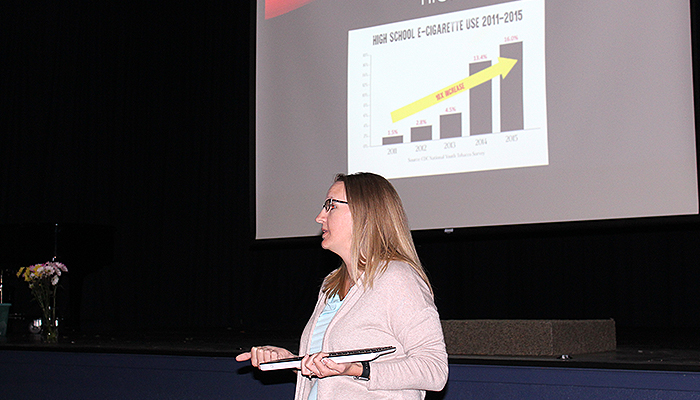
Dr. Michelle Pope discusses vaping with students at Thomas More Prep-Marian.
By CRISTINA JANNEY Hays Post
Nicotine is still dangerous even if it doesn’t come from a cigarette.
Dr. Michelle Pope of Hays gave a lecture to Thomas More Prep-Marian Junior High students Friday about the dangers of vaping.
Not only is the nicotine you can consume through vaping dangerous, but so are other chemicals and heavy metals you take into your lungs when you vape.
Vaping liquids are loosely regulated by the federal government and 95 percent of the juices are made in China. This means the juices may have chemicals in them that are not listed on the label. In fact, a study of vaping juices found the majority of the juices that said they did not have nicotine in them in fact did contain nicotine, Pope said.
“I think that is kind of scary, because you really don’t know what is in there,” she said. “When we put stuff in liquid and we heat them up, they change, and you don’t really know what that is going to do.”
Common ingredients in vaping juice include nicotine, propylene glycol, glycerin (or some other solvent) and other additives. This can include arsenic, which is found in pesticides, and formaldehyde, which is used to preserve dead bodies and lab specimens. It also can contain heavy metals, such as nickel, tin, lead, chromium and cadmium. Cadmium, which is also found in batteries, can cause kidney failure and bone disease.
Vaping and smoking in teens can permanently stunt lung development.
The nicotine concentration you are receiving can vary depending on what liquid you buy and what delivery device you use.
Nicotine, specifically, can cause cancer, is addictive and damaging, especially to the adolescent brain. It can also cause heart attack and stroke.
Young people’s brains are not fully developed until they are 25. The second greatest period of brain development happens when you are a teenager and young adult. Because teens are developing connections in their brains more quickly, they can become addicted more quickly.
Nicotine also affects the limbic system, which governs memories and emotions. Nicotine can permanently lower impulse control. It can also affect attention and learning and increase risk of mood disorders, such as depression and anxiety.
Some research has indicated teens can become addicted to nicotine with use of less than half of a cigarette, Pope said.
“Most people would say a half cigarette — ‘That is not that big of a deal. I’ll just try it. My friends are here, and I don’t want to look silly.’ If you have a genetic predisposition or a brain that is highly triggered by (nicotine), it can be all it takes to become addicted,” Pope said.
“What do I mean by addicted? Your brain reminds you of that and that was good and fun. You should do that again. You think about it again and you want to do it again. You may argue you that you don’t want to do it again, but you end up doing it anyway. It does not mean you have to do it every day.”
Pope noted signs of addiction can include: craving an e-cigarette, feeling nervous without an e-cigarette and having trouble quitting vaping. She noted youth can vape as little as once a month and still be addicted.
E-cigarette use has risen dramatically since 2011, when only 1.5 percent of high school students reported vaping. In 2015 that had risen to more than 16 percent. In 2016, more than 2 million middle and high school students reported they had vaped in the last month.
“E-cigarettes, you say, ‘Oh, weren’t those designed to help people stop smoking?’ If that is the case, this is an interesting statement. More kids use them than adults,” she said. “You guys are the prime market. You are the prime target.”
Companies are marketing to youth. They have developed candy-flavored juices with bright packaging. Some of these include gummy worms and a flavor like Swedish Fish. About 80 percent of youth who try vaping for the first time use a flavored juice, Pope said.
“There is a whole lot of science behind why they do flavoring, but basically it gets your foot in the door,” she said. “Once your foot is in the door, they have got your money, because you are going to keep coming back.”
Even the vaping devices are geared toward kids. Delivery systems called JUULs look like USB drives and can easily be hidden in school supplies. JUUL refills often contain twice as much nicotine as standard vaping juices.
“Somethings that may seem really cool and seem like it may not hurt you, but you have to be very careful,” Pope said. “Sometimes the smallest things and the coolest-looking things are the sneakiest things.”
In addition to the dangers of using the vaping products, vaping devices have been known to explode. Last week, the first death linked directly to a defective vaping device was recorded. The vaping device exploded in the person’s face, killing the vaper and then setting the rest of the house on fire.
Calls to poison control for vaping fluid overdoses in children have also skyrocketed in recent years, Pope said. Vaping juice can be deadly if ingested orally by children younger than 6.
MANHATTAN — For brothers Jake and Bryce Farrant, owners of Kansas Turf, a turf replacement and installation company based in Meriden, Kan., it was a dream come true – the replacement of the turf at Bill Snyder Family Stadium, a place they had visited many times as kids and college students.
“We were thrilled to be chosen as the turf replacement contractor for Bill Snyder Family Stadium,” Kansas Turf CEO Jake Farrant said. “We have a lifelong connection to that place, and as a locally owned, Kansas based company, we couldn’t be more proud to finish this worthwhile project.”
The Kansas Turf Facebook page has tracked the company’s progress on “The Bill,” as its affectionately referred to by fans of Kansas State football, from turf removal, to turf installation, to the “cutting in” of hashmarks, media lines, numbers and finally, the iconic Powercats.
Kansas Turf was proud to partner with AstroTurf on the BSFS project. The inventor of synthetic turf, AstroTurf is one of the most recognized brands in American sports.
Since 1965, the AstroTurf brand has been driven by forward thinking ingenuity. Today AstroTurf continuously improves its system design to deliver playing surfaces with the most realistic, sport-specific performance, longest lasting durability, and sound player protection.
Kansas State is the first FBS program in the country to install the latest artificial turf innovation from AstroTurf – RootZone Trionic 3D.
“Kansas Turf has completed many jobs for AstroTurf in the past and are eager to continue building the relationship,” Farrant said.
Kansas State University Senior Associate Athletic Director Jeremy Neiderwerder said he enjoyed working with Kansas Turf on the installation.
“Kansas Turf has been a great partner through the entire process of replacing the surface at Bill Snyder Family Stadium,” Niederwerder said. “They remained ahead of schedule throughout the entire installation process and have provided us with a surface that will greatly enhance our student-athlete performance on the field as well as the viewing experience for our fans and television viewers across the country.”
And the field at Bill Snyder Family Stadium is just the latest project for the northeast Kansas company that also does traditional natural sod installation and cemetery turf renovation.
“We streamline all of our removal and install processes by having state of the art equipment and high character employees that have a passion for what they do and take great pride in their work,” Farrant said.
Other noteworthy projects include the Bettis Family Sports Complex north of Lake Shawnee in Topeka, Kan., Northern State University’s Swisher Field in Aberdeen, South Dakota, and the Jefferson West High School football field, where turf was removed from the Superdome in New Orleans and installed on the Jeff West field in Meriden.
“We are a big enough company to complete any job, but are small enough to take care of our customers the way they should be treated,” Farrant said. “The people you call for a bid will be the people on the job getting their hands dirty, and those same people will be available for years to come for maintenance calls and questions or new projects.”
Kansas Turf has completed over 20 fields in the last 18 months, and hopes to continue its expansion, Farrant says, noting that their prices are lower than most of their larger competitors.
To follow Kansas Turf’s progress at Bill Snyder Family Stadium, or any of their other turf installation projects, visit their Facebook page or find them on Twitter. For more information, visit their website at www.kansasturf.com.
A new high priority item on the proposed Hays Parks Improvement Plan is a shade structure for the bison herd in Frontier Park West.
By CRISTINA JANNEY Hays Post
The city of Hays welcomed two baby bison to its herd last week at Frontier Park.
One was born Tuesday and another was born Friday.
The first calf was born to one of the herd’s 5-year-old cows. Another calf was born Friday to one of the 4-year-old cows. Neither the cows nor the calves have names.
Jeff Boyle, director of the city’s parks department, said the bison’s keeper thinks all five of the cows in the herd will likely have calves this season, including the herd’s white bison, sometimes referred to as Ghostbuster.
The bull in the herd does not exhibit any albino traits, so it is unknown if Ghostbuster would have a white or brown calf.
Boyle said the best time to see the calves is in the early morning or at dusk.
He noted visitors should not attempt to climb the bison’s fences. Bison can weigh between 800 and 2,000 pounds. They are very territorial. They have been known to charge, and victims can be gored by their horns.
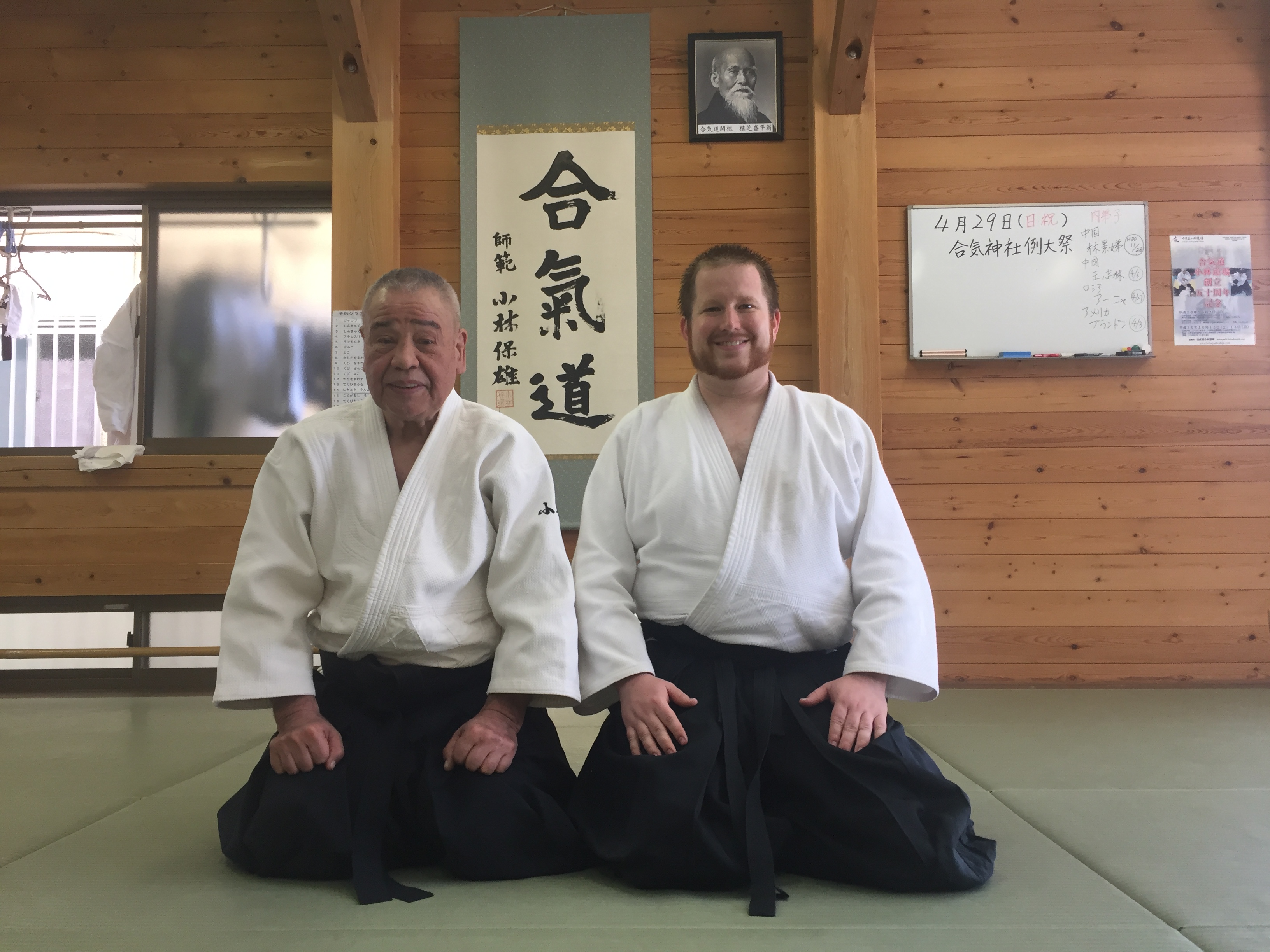
Brandon Nimz of Hays with Yasuo Kobayashi Sensei in Japan
By CRISTINA JANNEY Hays Post
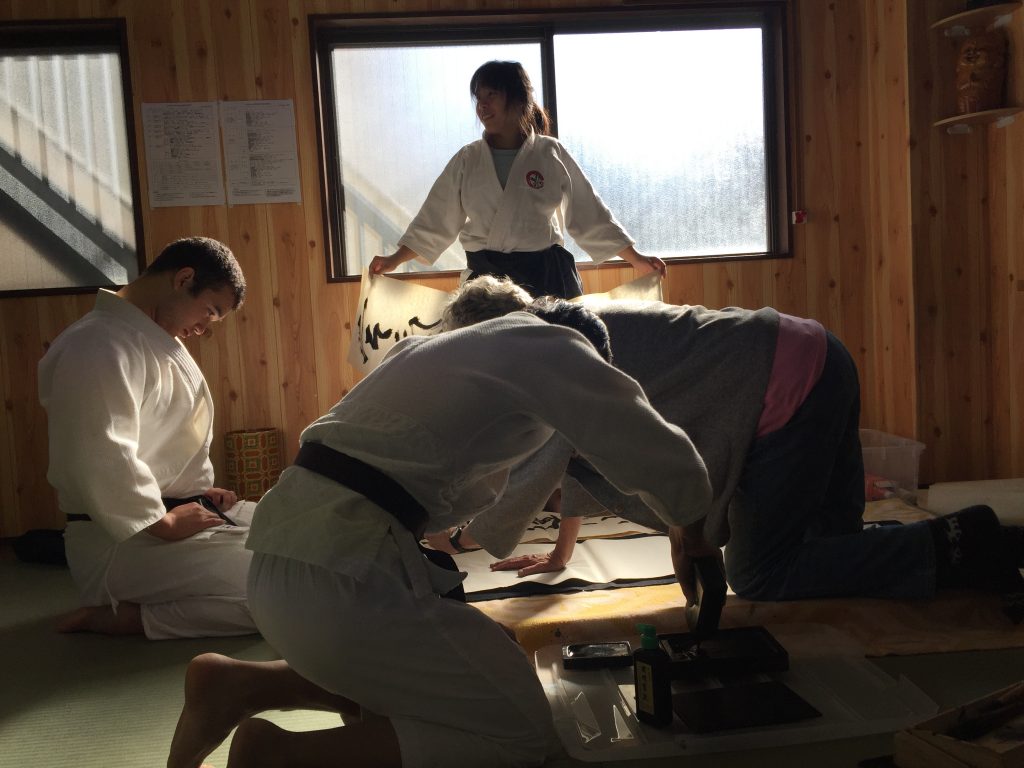
A Hays Aikido instructor recently spent more than a month of grueling 15-hour days in Japan studying with a martial arts master.
Brandon Nimz, second-degree black belt, said he gained a new perspective of his martial art, the Japanese culture and life.
Nimz started practicing aikido about 13 years ago when he was a student at Fort Hays State University. Since, he has trained for several thousand hours.
When Nimz visited his first aikido class, he almost didn’t go back. The students were practicing advanced break falls, and he thought he would never be able to do that. However, he was drawn to the aikido’s philosophy.
The philosophy of aikido is fundamentally different from other martial arts in that it is not competitive and it does not seek to have you force your will on others. It seeks to protect the person attacking you and yourself, Nimz said.
“It may seem strange, but it is based on the philosophy that everyone including the one attacking you has value and should be protected,” he said.
“It is harder to do effectively and well,” he said. “It is very easy in a self-defense situation to poke someone’s eyeball with your thumb, to kick them in the groin, to punch their throat and do very horrible things to a human, but it does not take a lot of skill or training. It just takes resolve. To try to neutralize someone who is trying to do harm to you without permanently injuring them or you is very hard.”
Nimz said the philosophy is in tune with his own Christian beliefs. In addition to Aikido of Northwest Kansas, he also runs the Gamers Guild and a nonprofit pantry located between the two.
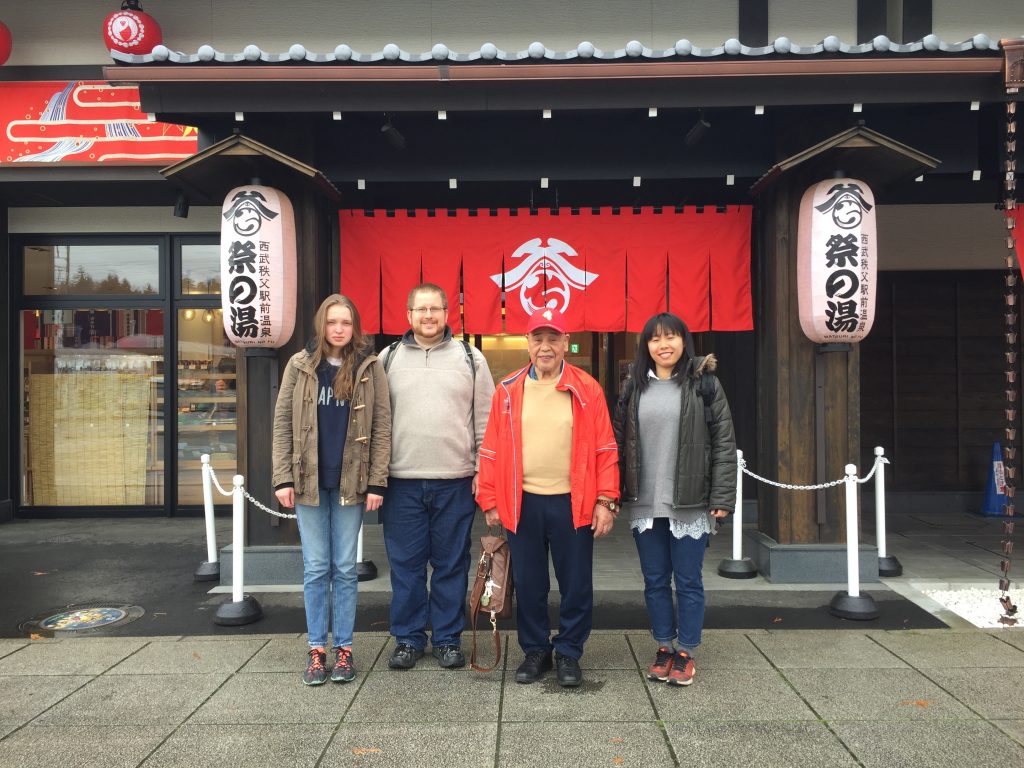
Nimz said his trip to Japan, which was Feb. 28 to April 4, helped him gain additional perspective on aikido. Many different groups from different cultures train with Nimz’s instructor in Japan, Yasuo Kobayashi Sensei. They respect him and work well with him. Nimz said he thinks that is because Kobayashi Sensei is humble and genuine.
Kobayashi Sensei, 81, is one of the older instructors who studied under aikido’s founder.
“He is like a ornery Japanese grandpa, who goes out and is joyful all of the time. He is just sincere. When you are training with him, you feel you are training with him and not training under him,” Nimz said. “He is old enough and has enough respect he could lord it over people, but he does not in any way. He just does his aikido, and you get to do it with him, which makes people inherently want to respect him, want to help him and care for him because he is so sincere and loving.”
Other instructors in Japan and America are not like this, Nimz said.
“They demand respect due to the structure. It is a very traditional society with traditional hierarchy, and they have the right within the society to do so. They force obediencey or they force respect on people, which makes people resent them in their hearts. They will still do the form, but their hearts are far away, and many of them eventually leave the groups they are in or that instructor.”
Nimz said he prefers to operate his school as Kobayashi Sensei does.
“It is good that can still exist in a very hierarchical structure—that you can still be humble in yourself. If people like what you are doing, great. If they don’t, that’s fine. You don’t have to demand respect,” Nimz said. “Eventually through sincerity, you can natively create respect, which is more how we run our school here. I was happy to see that is also done over there.”
Nimz’s current instructor, Toyoda Sensei, completed a residential study program in Japan under Kobayashi Sensei. Nimz’s instructor helped him apply for the program. Only a handful of students are accepted each year.
The program is intensive, usually going from before dawn until after dusk. Nimz, 32, said the program almost broke his body.
During his time in Japan, he lived in a dojo. Four days a week, he and the other students woke up at 4:30 in the morning. The students began cleaning as soon as the woke up and had their first class at 6:30 a.m. Throughout the day, they had a combination of cleaning duties and classes.
These would conclude about 9:30 p.m. followed by final tea, final clean up, supper and then sleep at 11:30 p.m. or 12:30 a.m.
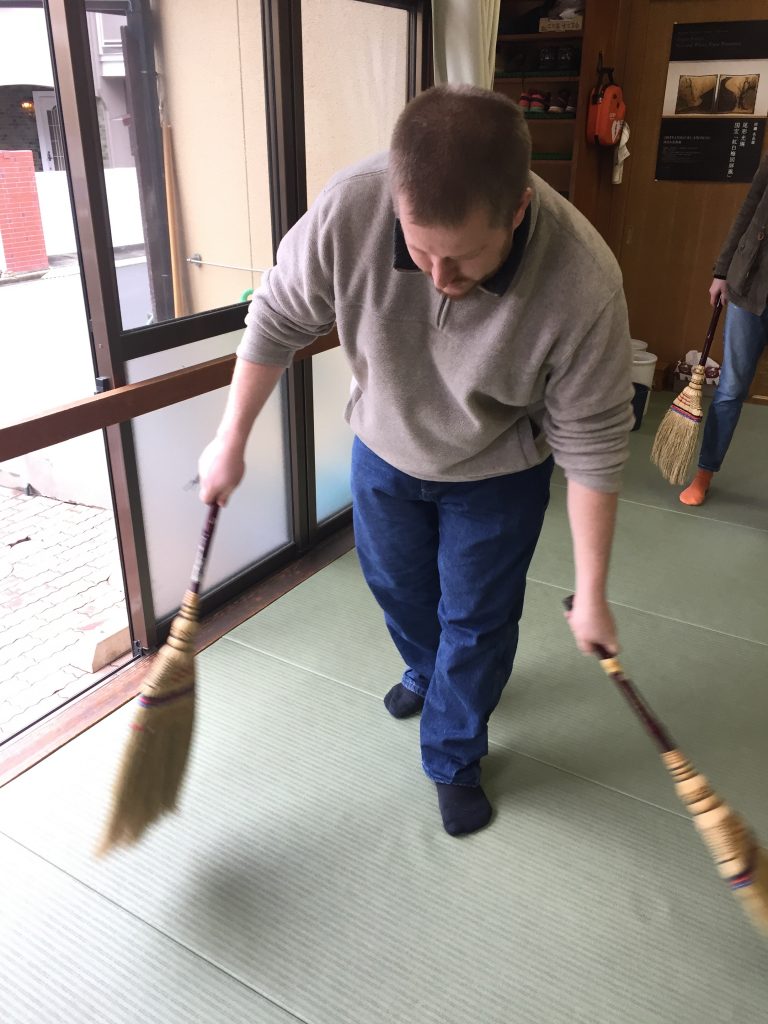
All the cleaning is part of the work-centric nature of the program and the culture. Cleaning included sweeping the streets with wicker brooms, including leaves and flower petals.
“… which leaves everything looking like a picturesque garden,” Nimz said, “but it is both positive and negative because some people really like it and it is beautiful, but it also makes you do things that many of us would consider unimportant as though they are very important.
“That is part of the program — to establish that every minute of your day should be mindful or intentional.”
When you are studying at a dojo in Japan, you go wherever your instructor goes. Your primary responsibility is to the instructor. Your secondary responsibility is to the dojo or the community in which you are living. Lastly you tend to your own needs or wants.
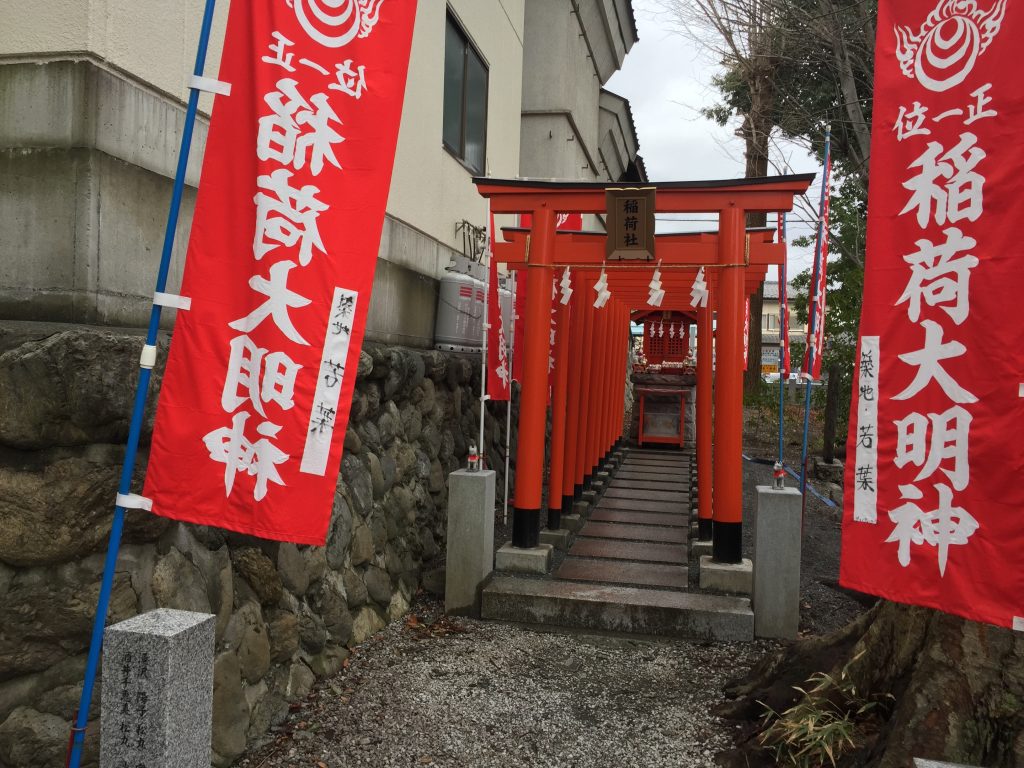
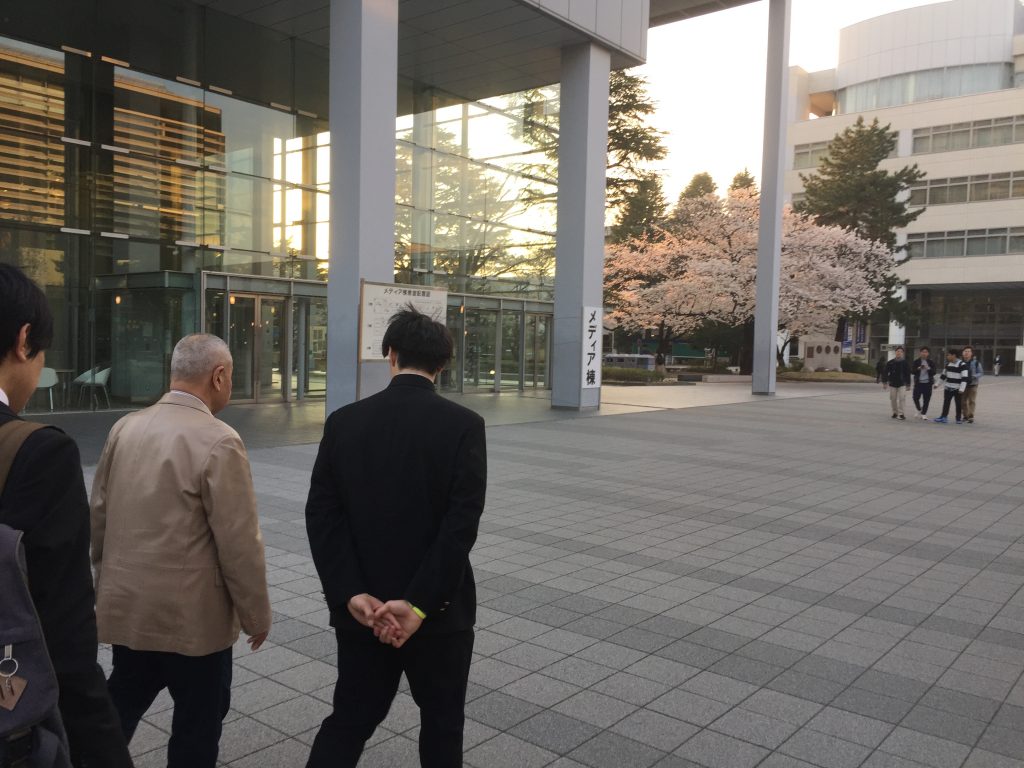
The dojo in the Tokyo metro area, but Kobayashi Sensei took the students on a hike into the mountains. The group viewed shrines and other cultural sites. The students also accompanied their sensei to a lecture at a university and went to local festivities for a national Japanese holiday.
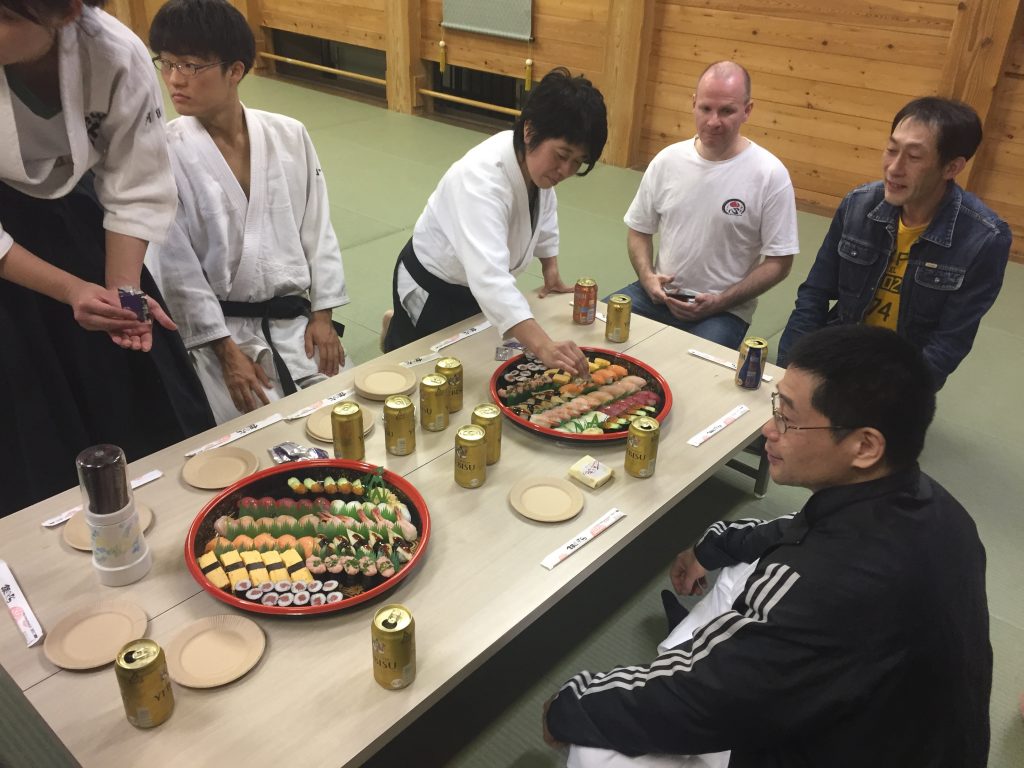
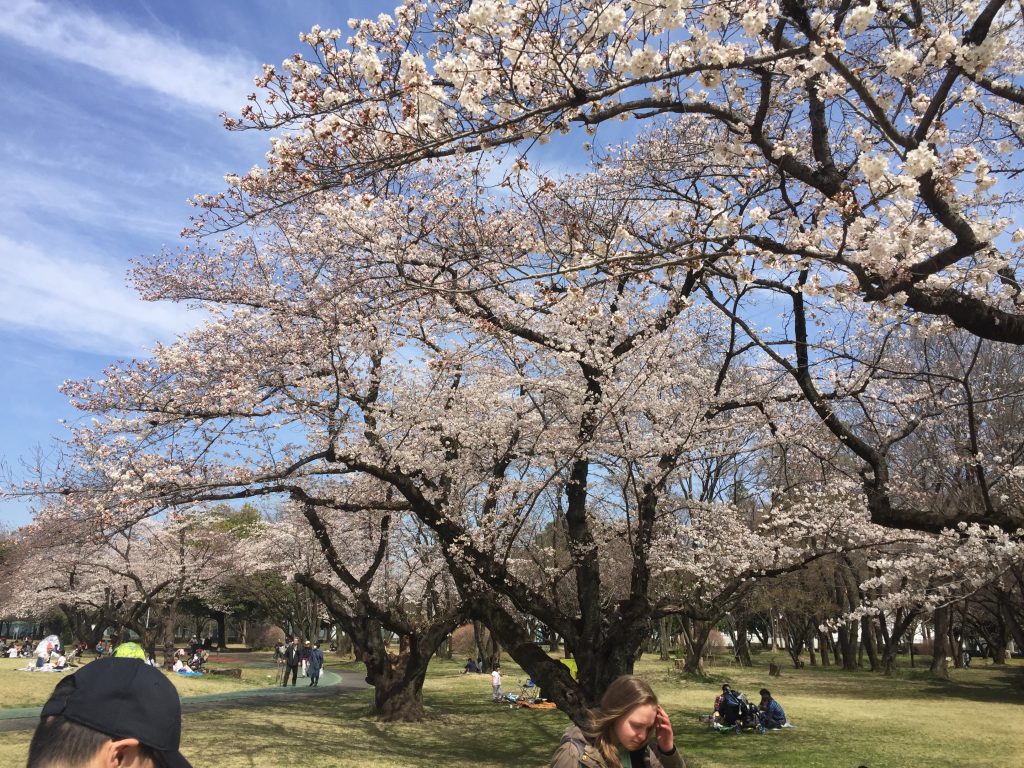
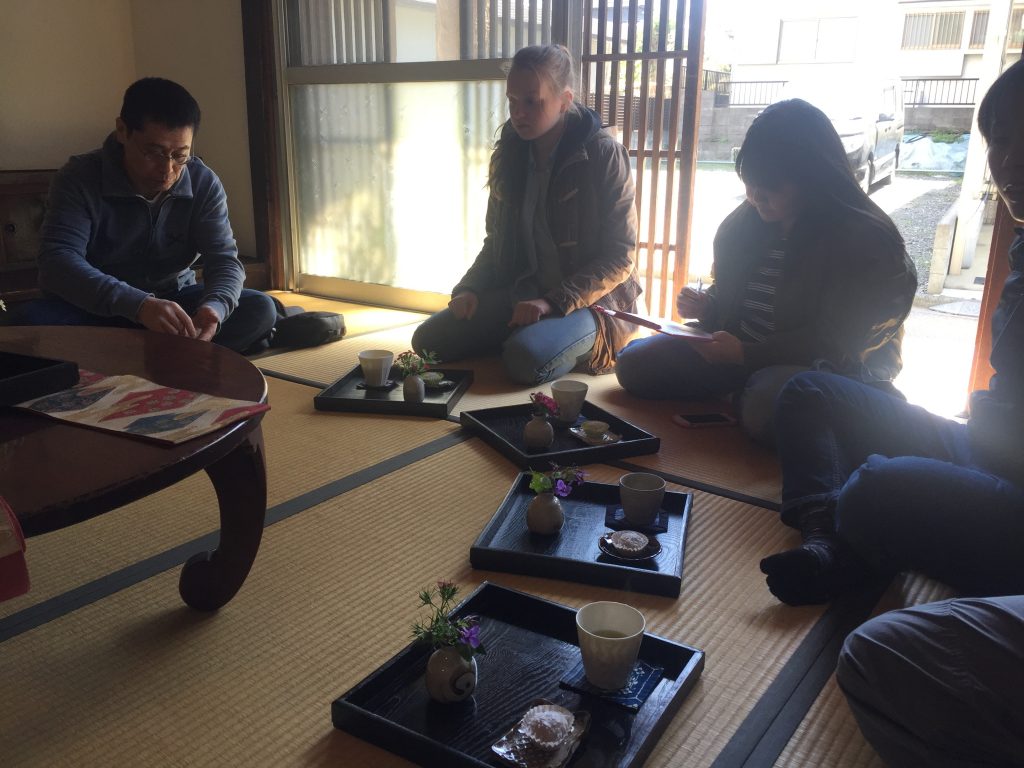
Nimz attended a sakura festival (cherry blossom viewing festival) with Kobayashi Sensei’s son, who lived above Nimz’s dojo. They ate a picnic lunch under the cherry trees. All Japanese meals usually include rice with fish or other meats. They also ate shrimp chips, tomatoes, strawberries and a rice candy called mochi.
This was Nimz’s first trip to Japan. He noted order and rules are very important in Japanese culture. An example of this is subway, which is completely silent.
“Culturally it is rude to talk out loud. It is rude to be on your cell phone,” he said “It is rude to have anything but ear buds in, but they follow it over there. There is no talking, no sound.
“People tend to follow societal rules a lot more over there, and they are just kind of known. It is a country like the UK where you drive on the left, so when you get on an escalator, everyone immediately goes to the left side and stands. That way people in a hurry can go up the right side. No one tells you to do this. There are no signs, but everyone knows to do it.”
The country is so crowded the Japanese have a rule similar to our Golden Rule: “Don’t do to others what you don’t want done to yourself.”
“They follow it for the most part,” he said. “There is very little litter or trash. Everything is upkept to the nth degree, and everyone tries not to be a bother to other people.”
The Ellis Co. Health Clinic has moved to 2507 Canterbury in Hays.
By JONATHAN ZWEYGARDT Hays Post
Ellis County officials celebrated the opening of the new county Health Department Thursday with a ribbon cutting and tours for the public.
The Health Department had been located at 601 Main Street but in June 2017 the Ellis County Commission approved the purchase of the former Post Rock Pediatric building at 2507 Canterbury Drive in an effort to offer expanded services.
At Thursday’s ribbon cutting County Commission Chair Dean Haselhorst thanked the tax payers of Ellis County for helping to fund another major project.
“This is another great occasion in Ellis County,” Haselhorst said. “In the past two years we’ve had great accomplishments in this county (and) none of this could have happened without all of you present and our fellow tax payers of Ellis County supporting EMS, Rural Fire, the courthouse, jail, Admin Center and now the Health Department.”
Kerry McCue, Health Services Administrator, with Ellis County Commissioners Barb Wasinger, Dean Haselhorst and Marcy McClelland
(Video and photos by Becky Kiser, Hays Post)
Ellis County Director of Health and EMS Kerry McCue also said he wanted to thank Ellis County residents.
“We’ve known for years that we had space issues and the commission took the bull by the horns and said we’re going to fix these,” McCue said. “With the support of the tax payers, in a number of ways, these buildings have come to fruition.”
Maren Moody, APRN
After a renovation was completed by Commercial Builders and staff completed the move to the new location the Health Department re-opened on Monday, April 23. With all of the changes complete and with the addition of Advanced Practice Registered Nurse Maren Moody, the Health Department can now offer the expanded services.
“In addition to the WIC (Women, Infants and Children) Program and the immunizations and the allergy shots and those kinds of things that we’ve done for years, we are going to start seeing some nonacute disease processes,” McCue said.
The health department lab
“We don’t want to do the care that you continue to follow your physician because that’s what your physician is for,” said McCue. “We’re a stopgap to help you get some quick medical care when you can’t get in to your physician.”
McCue said they will continue to offer services they have traditionally and that includes flu shots. The Health Department has administered more than 500 flu shots this flu season.
One of four exam rooms
The new location also allows for more room. According to McCue there are four exam rooms with additional space for the reception area and staff offices.
At Thursday’s ribbon cutting McCue thanked previous Health Director Butch Schlyer for the part he played in helping the project become a reality.
“He was involved in wanting to expand this building, so we took some of his original drawings from what they talked about doing down at 601 Main and tried to incorporate them into this building,” McCue said.
Former Health Director Butch Schlyer
“Butch always wanted to do a mid-level practitioner, and I was able to dot the I’s and cross the T’s with the legwork that he had done prior to my taking over a little over a year ago.”
Schlyer worked for the Ellis County Health Department for more than 20 years before retiring in 2016.
Patients wanting to see Moody should make an appointment by calling 785-628-9440.
The Health Department hours are Monday through Thursday 7 a.m. to 12 p.m. and 1 p.m. to 5 p.m. and Friday from 7 a.m. to 11 a.m.
Officials at Big Creek Crossing announced Friday that Stage in Hays will close as of June 30, and Gordmans will be opening in its place this fall.
Both stores are owned by the same company. James Younger, Big Creek Crossing property manager, said Stage company officials thought Gordmans would be a better fit for the Hays market.
Stage will have a closing sale that will start next week. The store will be closed through the summer for remodeling, and the Gordmans store is set to open this fall in Stage’s 30,000-square-foot space in the mall.
Gordmans is described as an off-price department store.
Grand reopening ribbon cutting with the Hays Area Chamber of Commerce
By BECKY KISER Hays Post
It was supposed to be a 12-week job. It was completed in 11 weeks and the store owners, employees and customers were very happy to be back.
McDonald’s of NorthHays, 3406 Vine, just celebrated its 39th anniversary with a remodel of the restaurant, inside and out.
“We are changing with the times, and never stop looking for ways to improve,” said Rick Kuehl, during a recent Hays Area of Chamber of Commerce ribbon-cutting celebration. Kuehl and his wife Gail, Hays, are owners of both McDonald’s in Hays as well as the McDonald’s in Russell and WaKeeney.
“Back then (in 1979), it was a much smaller building and a much different operation than now,” Kuehl told the crowd. “And none of this would have been possible without our customers and their support.”
The building and its operation have changed several times over the years. This renovation displaced a dedicated coffee group. “They had to go find someplace else to drink coffee and now they’re back,” Kuehl said, pointing to them with a smile.
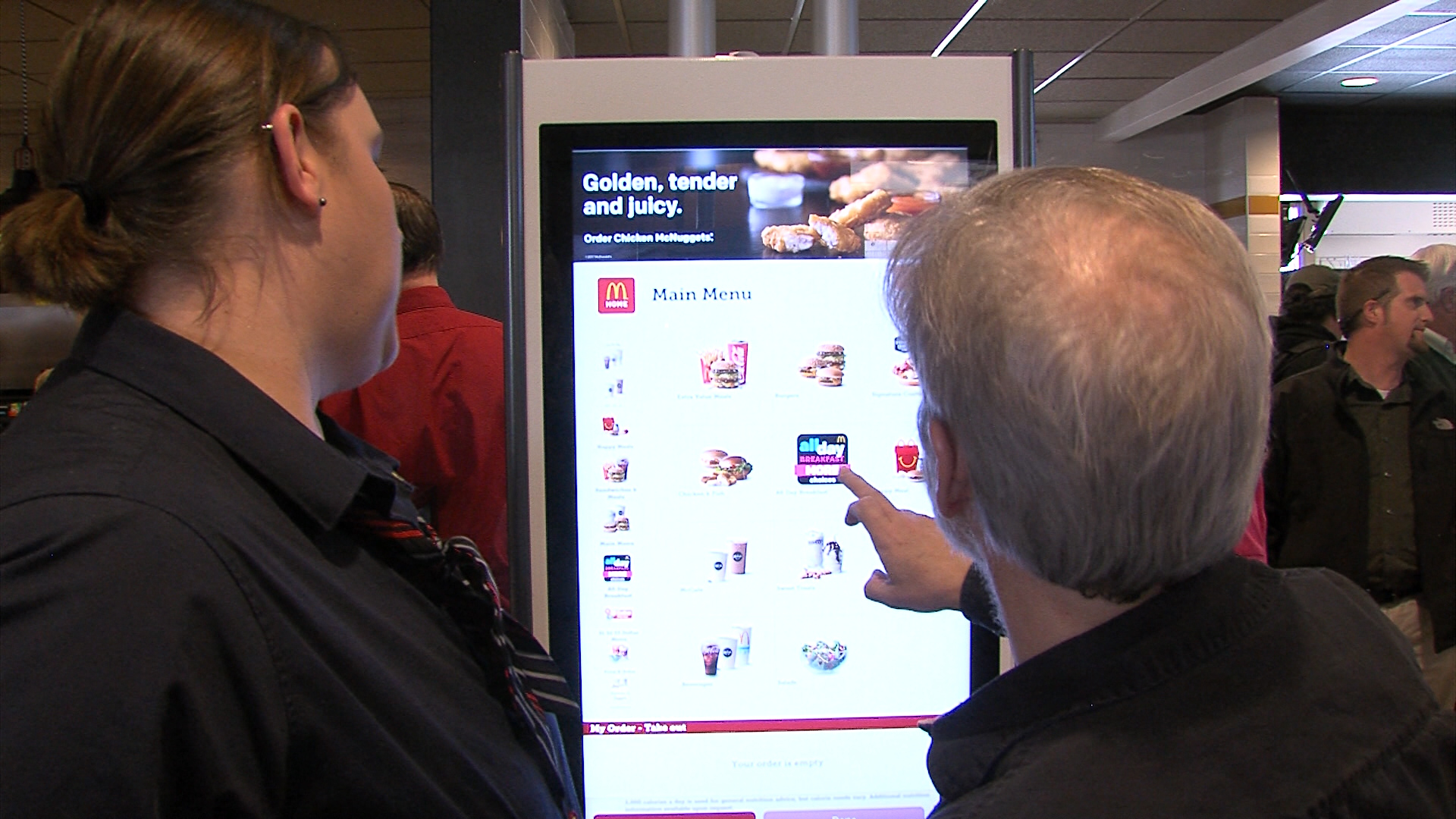
Owner Rick Kuehl points to the new digital menu boards in the NorthHays McDonald’s. When his father opened a McDonald’s in 1958, there were just five food items.
“Back then, the McDonald’s breakfast menu was new. We had a single drive-through and order point. When we opened in 1979 in Hays, it wasn’t the same McDonald’s store my dad started with, No. 71 in St. Louis, in 1958. My first job was with that McDonald’s. It was all male employees selling hamburgers, cheese burgers, french fries, soft drinks and shakes.
“Now, this is what we sell,” Kuehl said as he pointed to the new digital menu boards behind the front counter. The selections include many more food and drink options than the original five.
One of the Kuehl’s sons, Jamie Kuehl and his wife Kelsey, are the owner-operators of two McDonald’s restaurant in Dodge City.
“I would venture to say that Jamie would say his McDonald’s are not mine — his father’s restaurants – and the way we started,” Kuehl said, “and, we all continue to evolve. Our new McDonald’s speaks to the needs of our customers and our community. The space is more open, we have more outlets for electronics and we have more ordering options for our customers in this digital world.
“I’d watch people with their computer looking around for the plug-in. Now, I think they’re available every four to six feet. You should be able to charge any device you’ve got for as long as you want to.”
Other changes include expanded drink options at the self-serve beverage bar.
There are now four ways to order – on a smart phone, at one of the two new double-sided digital kiosks in the restaurant lobby, at the drive-through with new digital menus, and still, the traditional face-to-face experience at the counter. To make in-person ordering easier and faster, a new modular front counter has been installed with separate order and pick up points.
“This is really the centerpiece of the change in this store – service and taking care of the customer,” said Kuehl.
Customers can now use a kiosk to select and pay for their order, which is brought to their table.
Customers choosing to use the self-order touch screen kiosks will select their items, pay with a credit or debit card, and then pick up a digital locator to be placed on their table where employees will bring the order to the customer.
“We’ve now gone from two order points to six order points. This is the future, an extension of your mobile devices, and you don’t have to stand in line.”
Kuehl said he and his family had just returned from Disney where some of the restaurants utilize similar kiosks. “It’s so slick. You’re in and you’re out.”
Customers placing an order on their smartphone will use the McDonald’s Mobile App. “We have a daughter-in-law who has mastered this,” Kuehl quipped.
Orders are made and paid for online.
“Once you pull on the McDonald’s lot, your phone will say ‘Welcome. Are you going to come inside to get your order, get it in the drive-through or do you want it brought to your vehicle in one of the two designated parking stalls?’ Our daughter-in-law pulls into Stall 4, doesn’t have to get the kids out of the vehicle. She can play with them for a couple of minutes and then here comes the food, already paid for. Then they’re off.”
“That’s the future.”
NorthMcDonald’s manager Kirsten Barnes met owner Gail Kuehl when Barnes was a Hays High DECA student.
There are about 70 team members in the north restaurant’s “McFamily,” including manager Kirsten Barnes who began as a crew member in 2003. “I’ve known Kirsten 18 years,” Gail Kuehl said, “because we met when she was in DECA at Hays High School.”
Two supervisors have been there much longer. Ric Leiker began his McDonald’s career at NorthHays in 1979 and Stacy McKennon in 1980.
3-story playground
Another upgrade can be seen in the west side of the restaurant which houses the new indoor PlayPlace, including a three-story playground complete with a slide, toddler area, Touch2Play entertainment computer tablets and an electronic U-Create table.
The area is more open and has more seating than the previous play space.
Touch2Play entertainment tablets and an electronic U-Create table
Prior to the ribbon cutting, the Kuehls, longtime supporters of the Sternberg Museum of Natural History, presented a $10,000 check to Director Reese Barrick for updates to the Children’s Discovery Room.