We have a brand new updated website! Click here to check it out!

WHO ARE YOU? Valis Rockwell

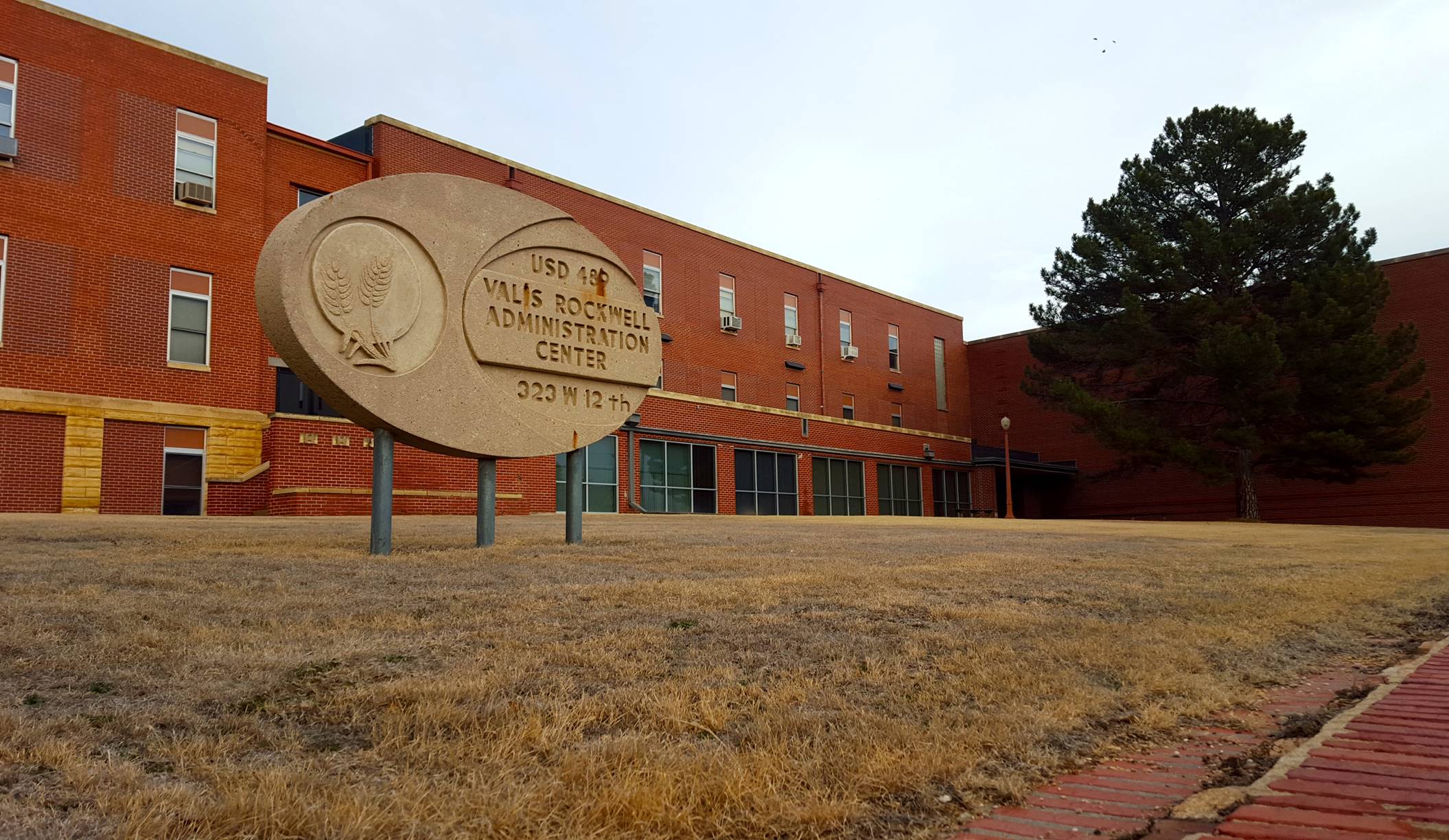
Valis Rockwell Administration Center, 323 W. 12th St., Hays, was named for former Hays Superintendent Valis Rockwell in 1990.

By CRISTINA JANNEY
Hays Post

Editor’s Note: Every day, we see names chiseled on buildings or posted on city street signs, but we don’t always know who these people were. For those who have not lived all their lives in Hays — or perhaps for some who have — “WHO ARE YOU?” is our attempt to share some history about the Hays community.

Valis Rockwell Administration Center, 323 W. 12th St., Hays

Valis Rockwell in a high school year picture from 1955. He was the HHS counselor and district business manager at the time. Photo courtesy of USD 489

If you have been to Hays USD 489 administration center on 12th Street, you may have seen a sign in memory of Valis Rockwell, for whom the building is named.

Valis Rockwell was the longest-tenured superintendent in the Hays school district.

Rockwell was born on May 17, 1913, near Waldren, Kansas. He grew up in Lewis, Kansas, and graduated from Stafford High School in 1931.

He and his wife, Freda, both worked as a teachers for rural Ness County schools. Valis was appointed as a principal and then superintendent in 1940.

He served in the Navy during World War II and then worked briefly for International Harvester in LaCrosse before moving to Hays in 1950 to attend Fort Hays State University and study for his master’s degree in education.

Rockwell began teaching at Lincoln Elementary School in 1950. A year later, he moved to the high school where he worked as a counselor and business manager for the district.

He and his wife survived the flood of 1951, and Valis earned his master’s degree in 1953.

In 1957, when Superintendent Clyde Phillips retired, Rockwell was hired to take his place.

Under Rockwell’s leadership, the area schools were unified, and the Hays district’s boundaries grew from just the city limits to encompass about a third of the county, including Munjor, Schoenchen, Antonino and Catharine schools. When Rockwell retired, the district had 4,000 students compared to this year’s enrollment of 3,201.

With the growth in enrollment, new schools had to be built. Bond issues were passed to build Wilson Elementary; Hays Junior High School, which became Felten Middle School; Roosevelt Elementary; and Munjor Elementary.

Rockwell saw his share of frustration as well. Two bond issues failed during his tenure, one by only 20 votes. He had supported a new high school proposal, but a bond to build what is now HHS did not pass until after his retirement.

The former Hays High School, where Rockwell served as a counselor, was converted into district offices in 1990 after the new high school was built on East 13th Street. The administration building was named for Rockwell during a ceremony in August 1990.

Hays Superintendent Valis Rockwell looks over diplomas in 1975 shortly before his retirement. Photo courtesy of USD 489

According to newspaper accounts, Rockwell was in attendance at the dedication and said, “To have our name associated with this stately old building is the highest honor.”

Also attending the event was Don Hurst, assistant superintendent of curriculum at that time.

He said Rockwell “had an uncanny memory and ability to call people by name, and he would usually asked how the children were and called them by name, too.”

Tom Toepfer, school board president in 1990, said thousands of students went through Hays schools while Rockwell was superintendent.

“They all knew him,” he said. “I won’t be surprised if they all call him their friend too.”

Rockwell died at age 90 in 2003.

Upon his passing, many district staff members reflected on his standing as a role model in the community in newspaper accounts.

Eric Harfmann, who was principal of Kennedy Middle School in 2003, said, “He was always cool under pressure. He always thought situations out before he made a decision, always looked at all the sides of an issue.”

Eloise Miller, who taught kindergarten and first grade for more than 48 years at Lincoln, recalled Rockwell’s flexibility.

“He was a great superintendent because he was practical,” she said shortly after his death. “Rather than saying, ‘This is a strict rule,’ he listened to people and did what was best for the people involved.”

Mike Karl, a junior high physical education teacher Rockwell hired in 1972 said, “He was a perfect guy to be in education because education is about people, and that’s what he represented. … I remember him as being a people person more than anything. He had the ability to do business with you, yet smile and make you feel important. He not only knew you and remembered your name but the names of all your family.”

A portrait of Rockwell still hangs at the top of the stairs on the second floor as you come in the main entrance to the building.

What will ultimately happen to the property on 12th Street is in question, as the district debates its long-term facilities plan. The building is declining and has accessibility issues. Some have suggested closing the building and moving administration offices to another existing school facility.

It’s interesting to note that Hays school history at 12th Street goes back much further than the Rockwell building.

The original permanent Hays school building sat on the 12th and Ash streets site where the Valis Rockwell Administration Center sits now.

Before the current building was constructed, another high school stood on that site that was built in 1916. The 1916 building was torn down to make way for a newer high school that ultimately became Rockwell Administration Center.

A school occupied that site even before 1916. The original permanent school building for the city of Hays was constructed on that site in 1873. Pieces of limestone from that schoolhouse are built into the wall just as you come in the main entrance of Rockwell.

Sources: USD 489, Ellis County Historical Society

🎥 Video board donors honored by Fort Hays State

By CRISTINA JANNEY
Hays Post

Fort Hays State University thanked the donors for the new video boards for Lewis Field and Gross Memorial Coliseum at a press conference Friday.

Verlin and Elaine Pfannenstiel, Don and Chris Bickle, the Bob and Patricia Schmidt Foundation, and Eagle Communications donated $1 million toward the $1.2 million cost of the video boards.

“Athletics is what unites us,” said Jason Williby, president and CEO of the FHSU Foundation, “It unites us as a university, as a community, as a state. We are proud to be Tiger Gold on Fridays and black and gold on Saturdays. Spectators at Gross Memorial are going to be treated for decades to a beautiful, four-sided video board that would not have been possible without the Pfannenstiel family.”

In a prepared statement, the Pfannenstiels thanked the athletic director and FHSU for allowing them to be a part of the video board project.

The video board at Lewis Field was thanks to the donations from the Bickles, Schmidt Foundation and Eagle Communications.

Curtis Hammeke, FHSU athletics director, said there was no doubt the scoreboards, which had been in place since the early ’90s, needed to be replaced.

“The common denominator with these people, I think, is their work ethic and their principals, and these are the things they are bringing to us that are great examples for our athletes to see,” Hammeke said. “We are trying to accomplish great things in the arena. We are out there in front of everybody all the time and putting ourselves at risk. These people did that with their businesses. They have gone through that and excelled, and now they are giving it back.”

FHSU head football coach Chris Brown thanked all the donors to the project. He noted the new video board has helped in recruiting efforts by showing potential players the commitment donors have to Tiger athletics.

“I can’t tell you what a privilege it is to be up here to thank such wonderful people — a group of people who bleed black and gold, through and through — a group of people who have truly supported FHSU for many, many years. I can’t thank you enough for all you have done for us,” Brown said.

Tony Hobson, FHSU head women’s basketball coach, said, “We have one of the nicest historic arenas to play in. It is one of the best in the country, but it is going on 50 years old. When we get a video board, it is like taking a beautiful classic car and putting a new engine in it. It is just better. You take something that is good already and make it better.”

Gary Shorman, Eagle Communications president and CEO, talked about the teamwork that brought the project together.

“When you talk about teamwork, you can do it on the field, you can do it on the court, you can do it with your customers, you can do it with your listeners, but you do it as a community, and that is one of the things we see happen,” Shorman said. “We at Eagle carry around a coin. On the front of the coin, it says Eagle, of course. You have to have that there, and then it says ‘Our Community Connected.’ That is exactly what we are doing here today, connecting our community with those in the area and being a partner with the Pfannenstiels and the Bickles.”

Donor Dan Bickle speaks to the press conference audience Friday. Photo courtesy of FHSU

Don Bickle remembered his friend Bob Schmidt fondly. Schmidt died in 2017. He said the friends had something in common.

“We are firmly, staunchly in favor of God and country, and we believe that from the bottom of our hearts. If you look at the projects we have been involved in, in every one of those, that is there or we are not there,” Bickle said.

FHSU President Tisa Mason concluded the press conference with her remarks.

“I wanted to remind everyone today that it is not just a scoreboard,” she said. “It is about so many other things. It is about fan engagement whether it is a kissing cam or the crazy games by Matt Cook. It is about engagement of the community. It is also, in my mind’s eye, about the athletes who fight with determination and resilience in every competition. I picture them looking out of the corner of their eye and being that much more motivated to go for the win and pull it out and fight with strength and courage for our institution.”

Mason said the FHSU student athletes are a special class of people.

“As we watch the Olympics right now, we watch people who have to have the courage to get up after a fall—to fight to work hard to have an amazing win,” Mason said. “Our student athletes not only do that every day as athletes, but they also go to class and they study and they get a college degree at the same time. The way athletics impacts this community is profound, and it brings us together, as all the speakers have said, as a true family, so thank you for being a part of our true family and making us get better every day.”


Public hearing Monday to rezone land east of Commerce Parkway

The rezoning request is for land east of Commerce Parkway and south of 22nd Street. (Click to enlarge)

By BECKY KISER
Hays Post

A public hearing is scheduled for Mon., Feb. 19, by the Hays Area Planning Commission for a rezoning request from Agricultural to Light Industrial for a 39.7-acre tract of land located along and east of Commerce Parkway between East 13th and 22nd Streets.

The rezoning request was submitted by W. E. Lusk, Jr., president of Derby Investment, Inc., Wichita.

The property is currently being used for pasture/grassland. The Comprehensive Plan identifies the area as Business Park which includes a mix of light industrial and commercial uses. The property on the west side of Commerce Parkway is already zoned Light Industrial.

Light Industrial (I-1) Zoning allows the following uses under the Unified Development Code (UDC):

 Farming Equipment Sales
 Nursery/Greenhouse, Wholesale
 Commercial Retail, Heavy (Building supply)
 Heavy Truck or Recreational Vehicle Sales, Service, and Repair
 Light Industry
 Manufacturing and Fabrication
 Recycling Collection Facility
 Research and Testing Laboratories
 Storage (with limitations)
 Vehicle Repair and service, Heavy
 Warehousing and Distribution
 Wholesale Services
 Vehicle Gas and fueling Station
 Animal boarding or Vet Services, Large and small animal
 Drive-in/Drive-Through Facility
 Heavy retail
 Hotel/Motel
 Nursery/Greenhouse Retail
 Office, General
 Retail sales and Services
 Showrooms

City staff is recommending approval of the rezoning request and a favorable recommendation to the Hays City Commission.

The public hearing is part of the Hays Area Planning Commission meeting which begins at 6:30 p.m. Monday in Hays City Hall, 1507 Main.

The complete agenda can be seen here.

TMP-M’s 2018 Sweetheart candidates announced

TMP-M

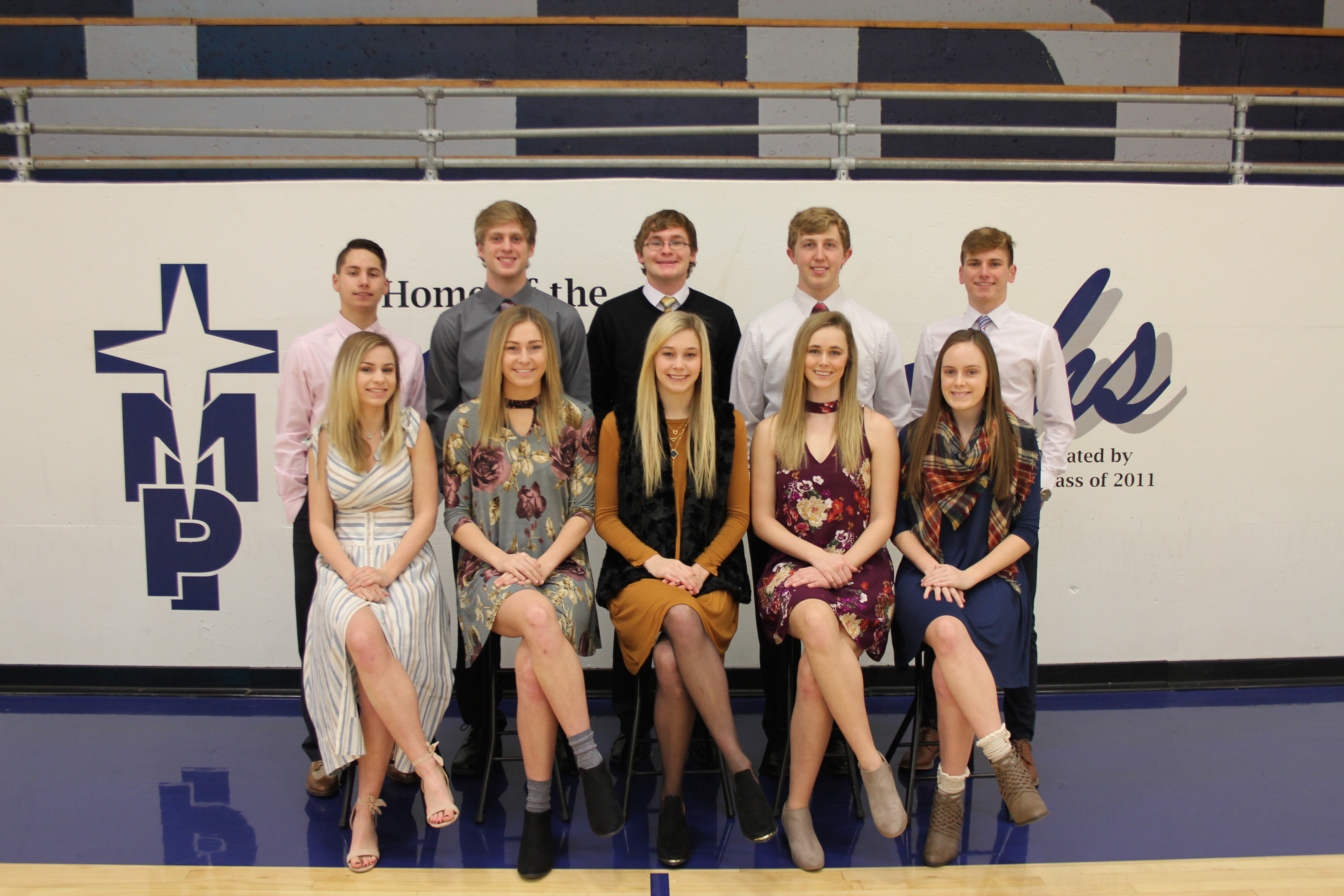
The 2018 Sweetheart candidates have been annouced. They are Savannah Yost ’18, daughter of Greg & Candace Yost – Michael Braun ’18, son of Glenn & Amy Braun – Brianna Romme ’18, daughter of Darrell & Melissa Romme – Chase Werth ’18, son of Kent & Shawnda Werth – Kayla Vitztum ’18, daughter of Brian & Tina Vitztum – Luke Ruder ’18, son of Russ and Janel Ruder – Aubrey Koenigsman ’18, daughter of Joe and Tami Koenigsman – Trenton Mayo ’18, son of Matt Mayo and Amy Mayo – Cheyenne Rhoades ’18, daughter of Chris & Leah Rhoades and Robin Lovewell – Tate Garcia ’18, daughter of John and Tara Garcia.

🎥 UPDATE: Vine Street structure fire under investigation; no injuries

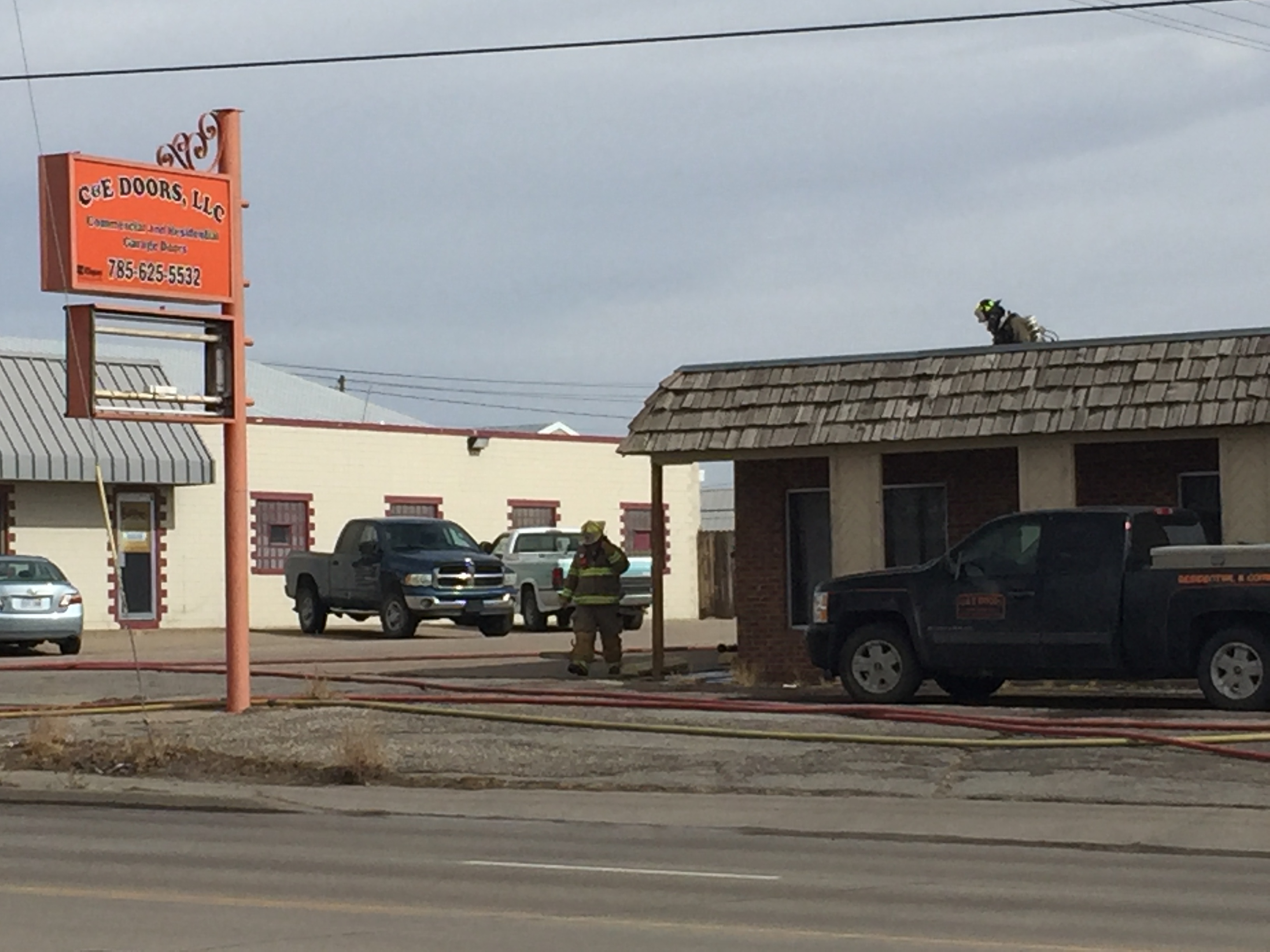
The investigation is underway into the cause of a fire early Wednesday afternoon at C&E Doors in Hays.

By BECKY KISER
Hays Post

Fire investigators from the Kansas State Fire Marshal’s Office, Hays Police Department and the Hays Fire Department remained on the scene at 3:45 p.m. this afternoon of a Vine Street structure fire that was reported at 12:19 p.m. Wednesday.

Hays emergency dispatchers were alerted to a report of a building fire at C&E Doors, 2004 Vine Street. Six fire trucks and 27 firefighters responded, according to a news release from Hays Fire Chief Gary Brown.

A fire was discovered burning above the ceiling in several rooms inside the business with dark smoke rolling out from under the eaves of the west-facing store front.

Heavy smoke conditions inside the building obscured firefighters’ vision. The interior of the building suffered significant fire and smoke damage. The fire was reported under control about 1 p.m. No one was injured.

Noontime traffic was blocked on Vine Street between 17th and 22nd.

“This fire was promptly reported to 911 dispatchers by the building occupants. This prompt report helped limit the damage to the building,” Brown said in the news release. “Because fires can grow very quickly, your city of Hays firefighters would like to remind everyone to call 911 without delay.”

🎥 Catwalk on Bricks revamp of Downtown Hays’ Taste event

UPDATE: An event will still take place on Friday, April 20 but is being revamped. See the Hays Post for further updates.

By CRISTINA JANNEY
Hays Post

Downtown Hays has revamped its spring The Taste event, added a fashion show and dubbed it Catwalk on the Bricks.

The event, which will be Friday, April 20, will offer some of the same features the popular Taste event did. Participants will be able to sample appetizer-size foods from downtown restaurants and will receive two drink tickets for wine or beer.

Stores also have the option of offering refreshments in their businesses after the fashion show.

“We want people to have a taste of downtown, whether it is services or food or anything. They got that with The Taste, but people got kind of bored. It was the same event. We had it for several years, and we wanted to throw a big flare in there, and downtown business owners actually requested to have a fashion show,” said Ashley Roth, Downtown Hays Development Corp. assistant director.

Cost will be $25. Tickets go on sale Monday, Feb. 26. Tickets can be purchased online at www.downtownhays.com or by calling the Downtown Hays Development Corporation office at 785-621-4171. You must 21 years old or older to purchase tickets, and an ID will be required to enter. Drinks will only be permitted on Main Street between 10th and 11th streets.

Only 300 tickets will be sold.

Check-in for the event will be from 5:30 to 6 p.m. Tables and chairs will be set up on Mains Street with a red carpet. Participants can mingle and enjoy their drinks, and then the fashion show will kick off at 6 p.m. The main event of the night will be a DJ’ed fashion show featuring looks from downtown retailers. Local salons will do hair and makeup for local models. The show will feature each retailer twice with different looks.

Sara Bloom, DHDC executive director, said you will see a variety of ages in the show, and the show will include men’s women’s and children’s fashions.
The committee chose the title Catwalk on the Bricks because they wanted the stylists to be creative and really go all out with the makeup and hair, Bloom said.

After the fashion show between 7 and 9 p.m., people will be free to stroll downtown with retailers extending shopping hours for the event. Participants will receive a brochure with exclusive event coupons.

“So the fun of The Taste has still been kept. It has just been added upon,” Bloom said. “With the Catwalk, you are still going to have great giveaways, because all of the business are going to donate gift cards or products or items that are going to be given away.”

The gift cards will be given away after the fashion show.

“If you are one of those lucky winners, you are going to have money in your pocket right away to go enjoy and spend,” Bloom said. “You are getting the fun of The Taste. You’re keeping the stroll. You are still getting a lot of food and drink. You are still getting to shop really late at these businesses that sometimes close a little early for you to shop at. You are getting all the excitement that was The Taste, and we are throwing in a little bit extra with the fashion show.”

FHSU interior design students tackle she sheds in exhibit

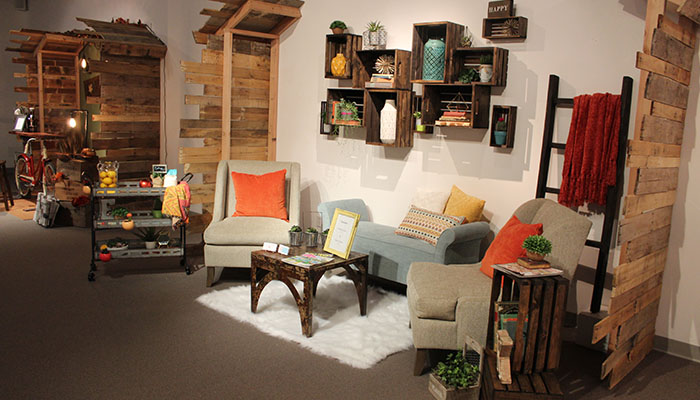
The summer she shed by interior design students Kendra Inslee and Emily Becker.

By CRISTINA JANNEY
Hays Post

There are still three days left to see HE SAID SHE SHED, an exhibition created by Fort Hays State University interior design students, at the Moss-Thorns Gallery of Art.

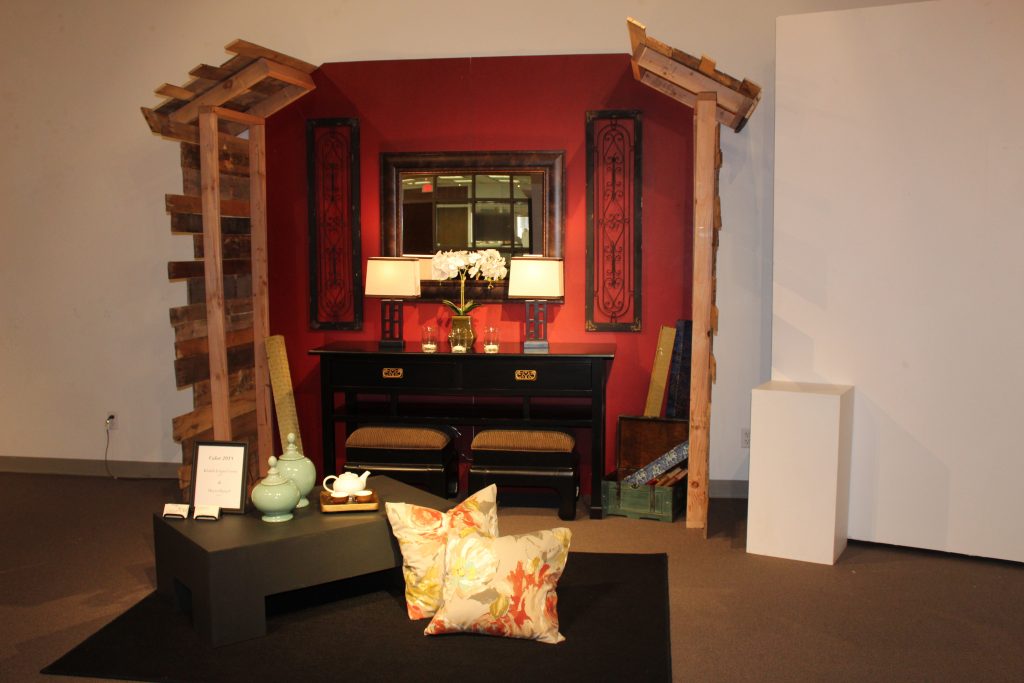
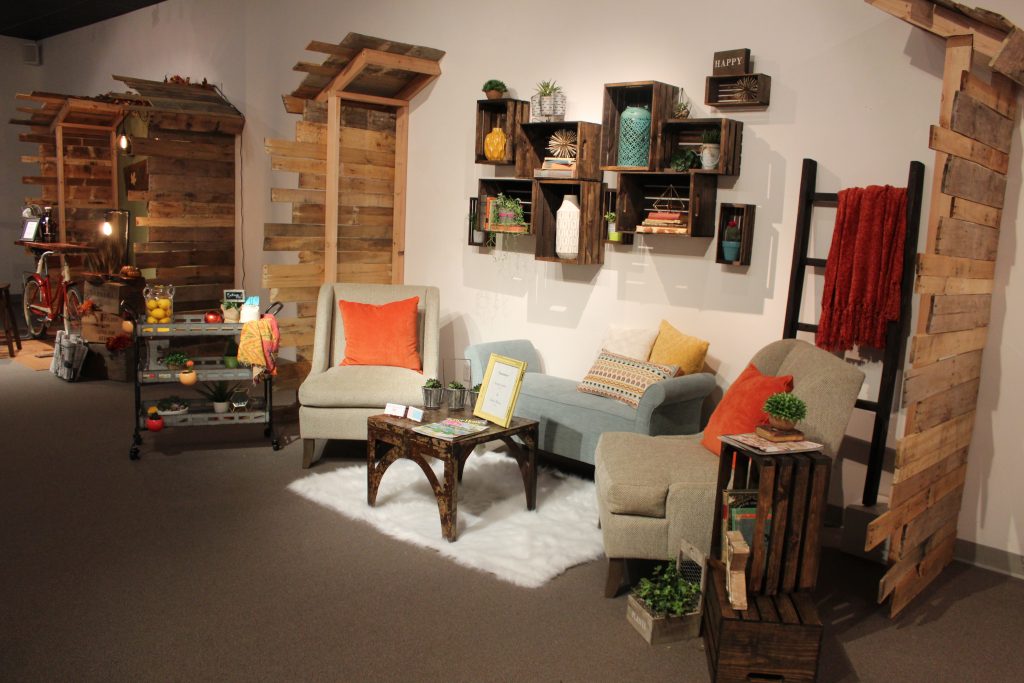
This year, the program chose the theme of “she sheds,” a relaxation or recreational area similar to a man cave. In addition, two students designed around the Sherwin-Williams color of the year, which is a deep shade of red.

“The vignettes show them the real 3-D, real-word experience of how you would create a space,” said Colin Schmidtberger, graduate teaching assistant and one of the organizers of the show. “Through classes, they work through drawings and just talking about (design). To create the space is a whole different aspect of design. Having them do the show vignette helps them understand space management and how they are going to create a space and make a space work in their layout of the design.”

Participation in at least one of the annual exhibits is a graduation requirement for the interior design program. This year’s exhibit features sophomores through seniors. The students finance their own projects and receive one graded credit-hour for the exhibit project.

“We figure out what the show will be the previous semester,” Schmidtberger said. “That way they have enough time to work up ideas and really figure out what they need to do to complete the whole process.”

Kendra Inslee and Emily Becker designed the summer-themed she shed and created an outdoor reading area. They used a grouping of crates for display of books and decorative items.

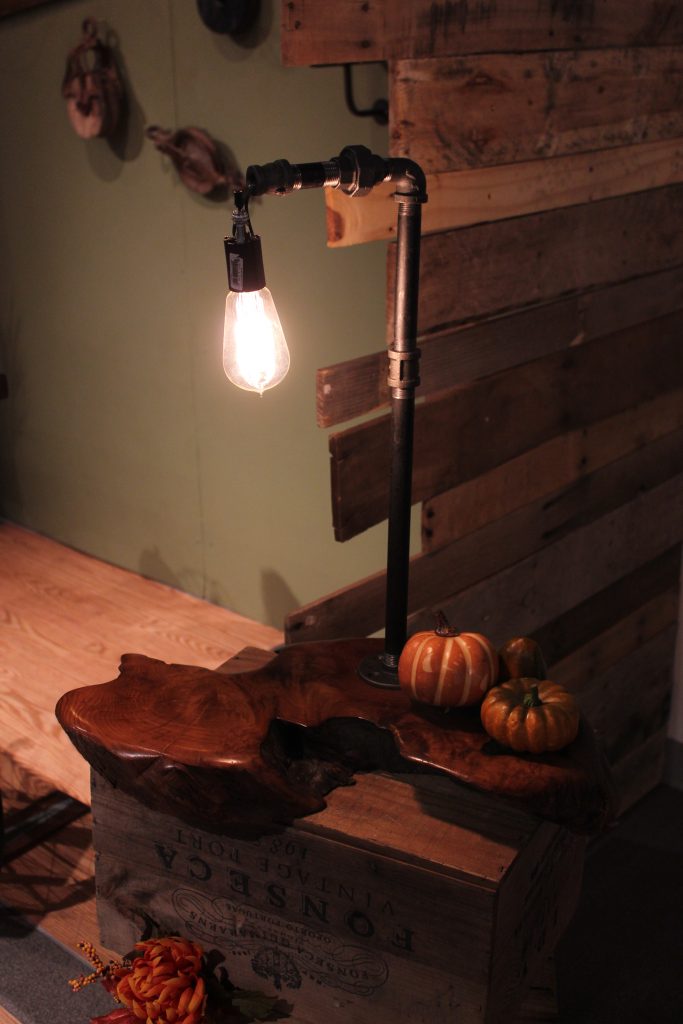
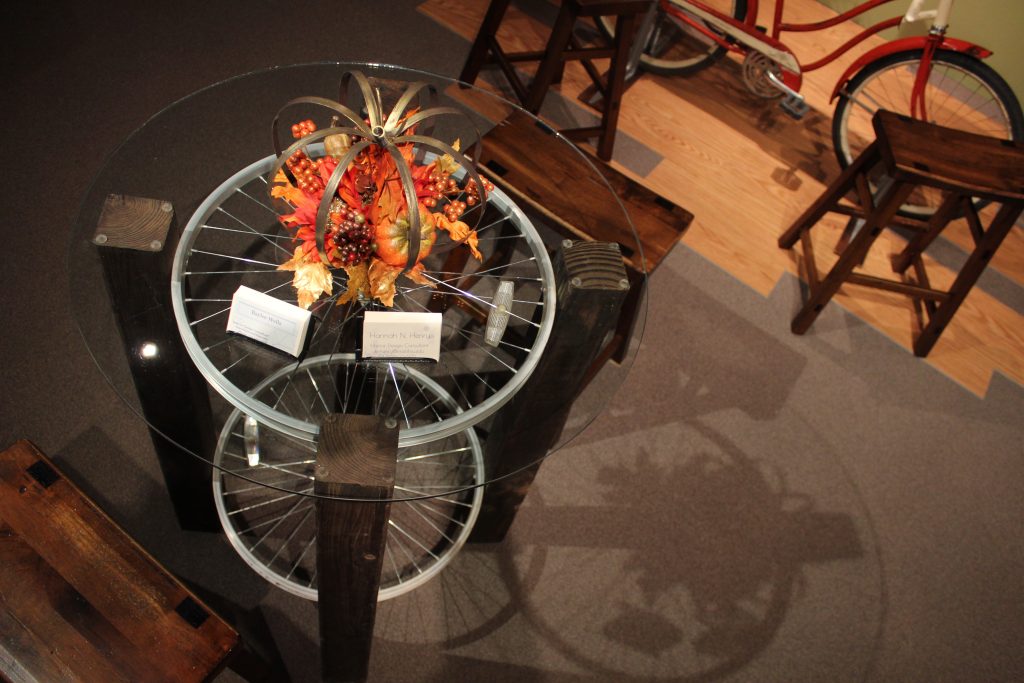
Hannah Henry and Baylee Wells created a bar area for their fall-themed she shed. They built several pieces of original furniture for their vignette. This included an antique bicycle that was transformed into a bar, two bicycle rims that were used to create a glass-top table and a free-form piece of wood that was used to build an industrial-style lamp.

“Every vignette brings in the styles of the students doing it, so it is really interesting to see the whole process through and seeing them working up the idea from the start to actually seeing it completed,” Schmidtberger said.

Khaleb Logan Cason and Mayra Rangel, who took on the color-of-the-year project, pursued an oriental theme. They set a dining room with scroll boxes, a tea set, and oriental-style furniture and wall hangings.

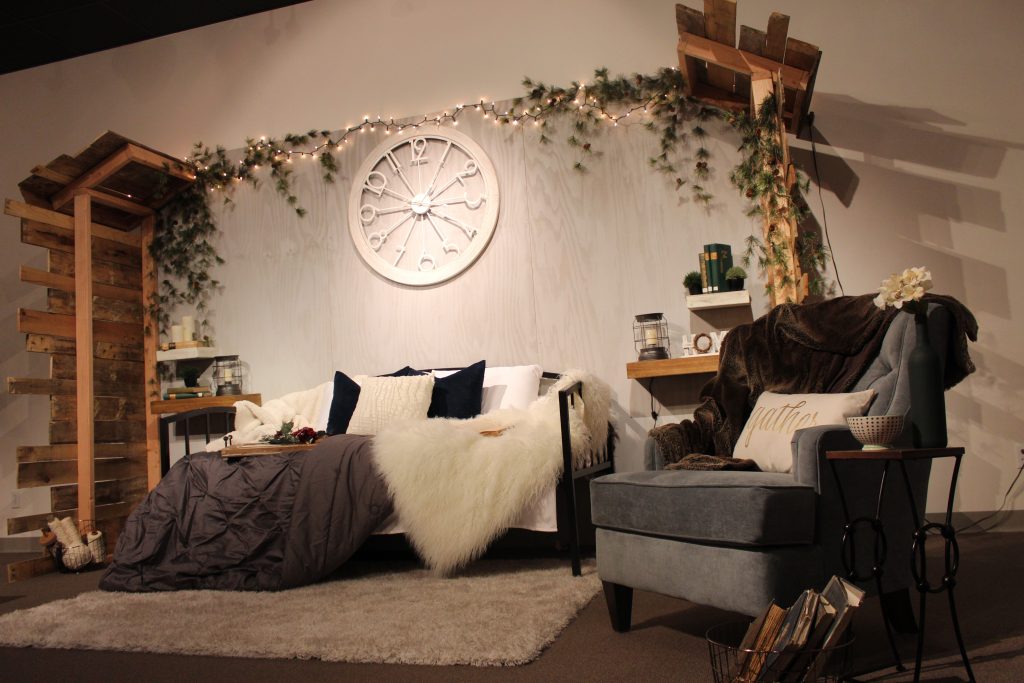
The winter-themed she shed by Brittany Ollenborger and Sarah Stute was designed as a sleeping and reading area.

“It makes you want to jump into bed,” Schmidtberger said. “They did a really good job of making the room feel homey. It is very inviting. The color scheme they used, it represents winter with the blues and whites and soft grays, so they did a really good job of incorporating winter into their space and made sure that it was a very inviting bedroom for someone to be in.”

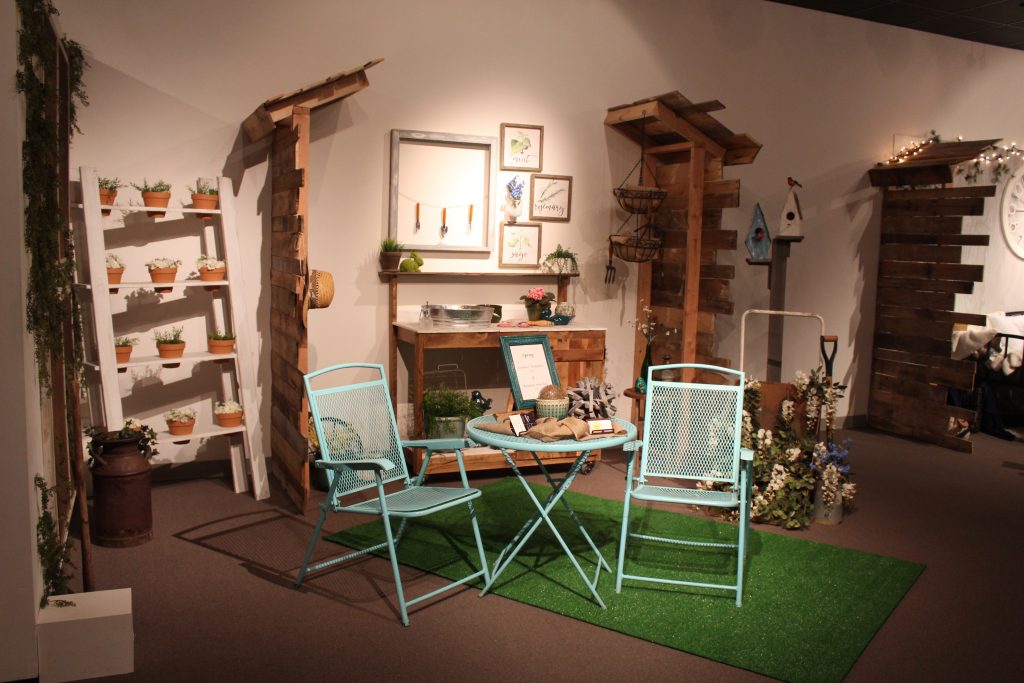
Courtney Nemechek and Madalynn Schreiber designed a planting shed for their vignette. The shed has a planting station that the students constructed out of pallet boards. They also built a tiered plant stand and birdhouse and equipped their she shed with a metal seating area with table for two.

“This is an outdoor space,” Schmidtberger said of the vignettes. “This is not something that would be in your home. It would be a backyard kind of escape from your house area.”

He said all the designs the students created would be achievable for the home designer even on a small budget.

Schmidtberger said he benefited greatly from his experience with the exhibit when he was a student.

“It showed me that I was capable of doing a design for a client,” he said. “I learned the basics of design and how to create a space. This project made me feel comfortable so I could go out and do it on my own.”

Photos of Schmidtberger’s graduate project are also on display as a part of the exhibit. He designed and remodeled two bathrooms and a utility room for a client, not only completing design work, but doing demolition and laying tile for the project.

The Moss-Thorns Gallery is in Rarick Hall. It is open from 8 a.m. to 5 p.m. Mondays through Fridays. HE SAID SHE SHED will up through Friday. It will be followed by the annual graphic design exhibit.


Great Bend area artist depicts cancer journey in Hays Arts Council exhibit

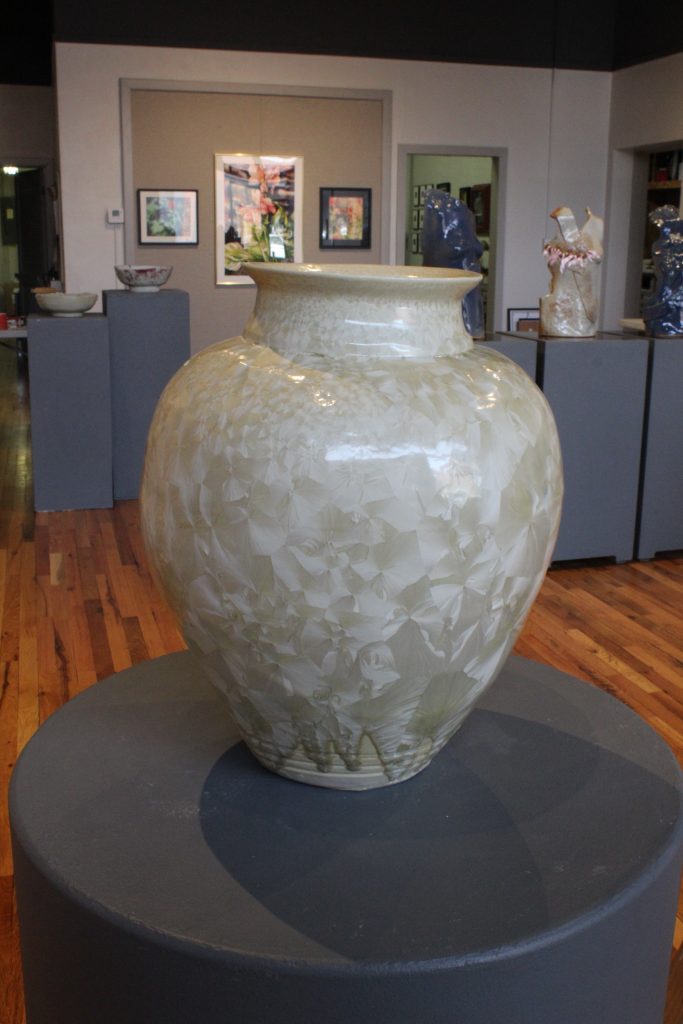
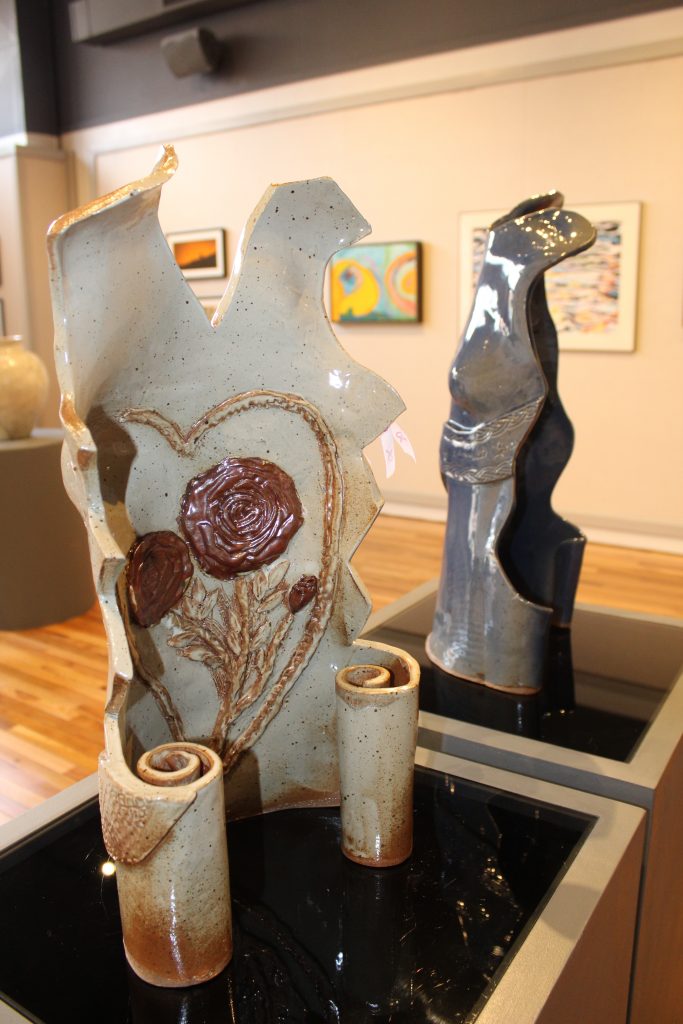
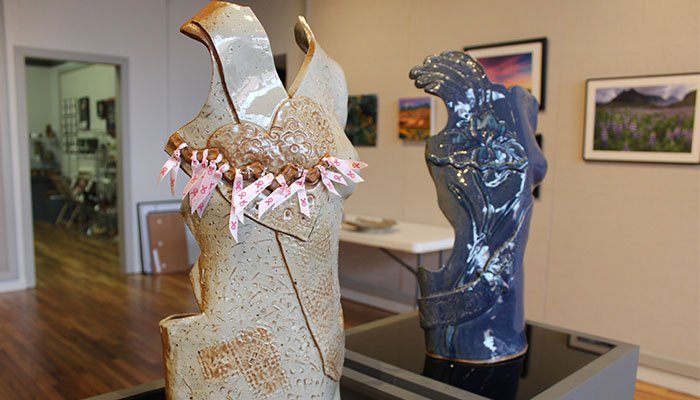
Two of three female ceramic torsos created by Dolores Baker of the Great Bend area that depict a women’s journey through breast cancer. The art is on display now at the Hays Arts Council.

By CRISTINA JANNEY
Hays Post

Dolores Baker didn’t realize when she created three female figures representing a women’s journey through breast cancer she would soon be touched by the illness.

Baker created the ceramic models of women’s torsos in memory of friends and family members who had fought breast cancer and some who had lost their lives.

This female torso depicts healing, joy and beauty after breast cancer.

Baker had a biopsy once before for suspected cancer, but she thought she was in the clear. At the end of 2015, six months after she finished the cancer pieces, she went in for a routine mammogram, and the cancer was discovered. She was shocked. Breast cancer did not run in her family.

Baker thought she might be able to escape with just a lumpectomy. However, she ended up having radiation treatments and four surgeries, including the removal of both of her breasts.

The Hays Arts Council opened a new exhibit this week featuring artists from the Great Bend area. Baker’s torsos along with a series of masks titled “Faces of Breast Cancer” are part of the exhibit.

Baker is cancer-free now. She said the message she was trying to convey with the torsos has not changed even though her own body has.

“I think the main theme is that the feminine body is beautiful with or without breasts,” she said, noting that this is contrary to what our culture tells us.

Baker said she hopes the art pieces will spark discussion among the people who see them about the subject of breast cancer.

“I am thinking I want the subject of breast cancer to no longer be taboo,” she said. “When I was creating the pieces at the college, young women confided in me about their family members who had suffered from cancer and their own fears of being a gene carrier. I want people to be able to discuss the issue out in the open.”

Baker said after her battle with cancer, her perception of the art pieces changed.

“In some ways, there was a sense of transition and moving from grief to joy and interior growth,” she said.

Dolores Baker of the Great Bend area depicts the journey through breast cancer with her ceramic pieces. Baker, a cancer survivor, said the female form should be viewed as beautiful with or without breasts.

Six months after her surgeries, Baker created “Faces of Cancer,” a series of masks that she said reflected her own journey through breast cancer.

“There was grief and feeling broken. I believe there is a screw in the mouth of one of the faces. There was both fear and the anger and then moving on to just being puzzled and then to joy,” she said.

Baker, 75, has not always been an artist. She retired as elementary school teacher and the height of her artistic creations for many years was drawing stick figures. When she retired, she started doing creative writing, but saw a clay demonstration at Barton County Community College. Twelve years ago, she started taking classes from Bill Forst, making bowls and cups.

But Baker said she wants more, “Now I want to say something with my art.”

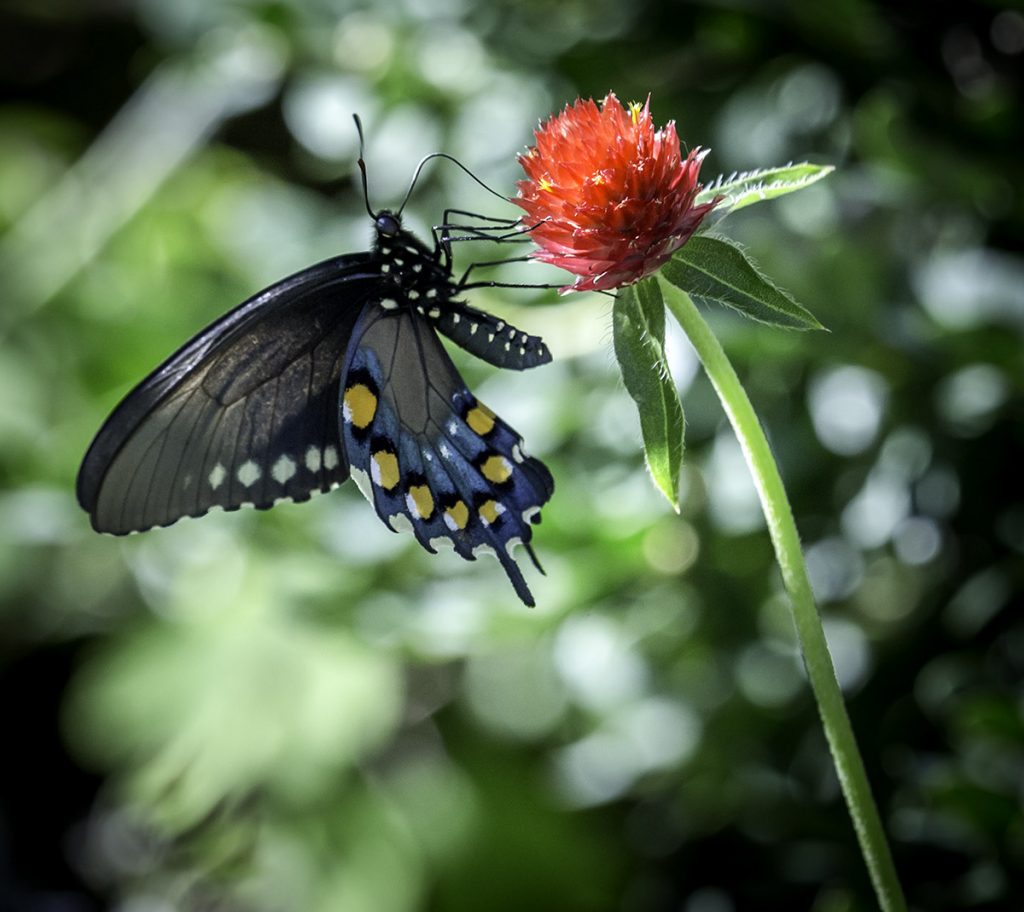
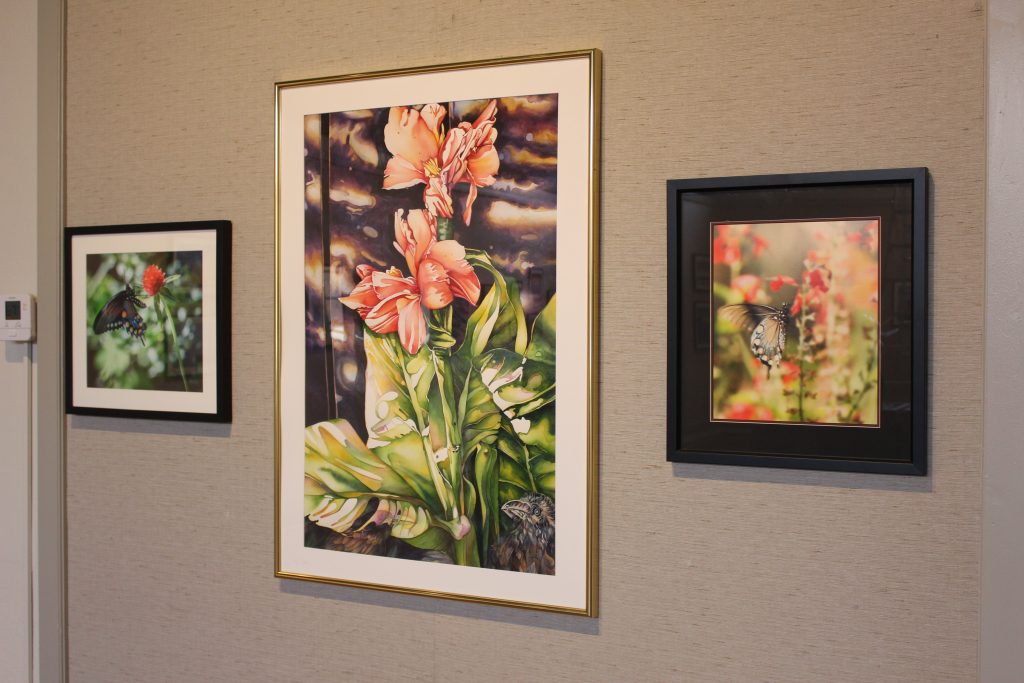
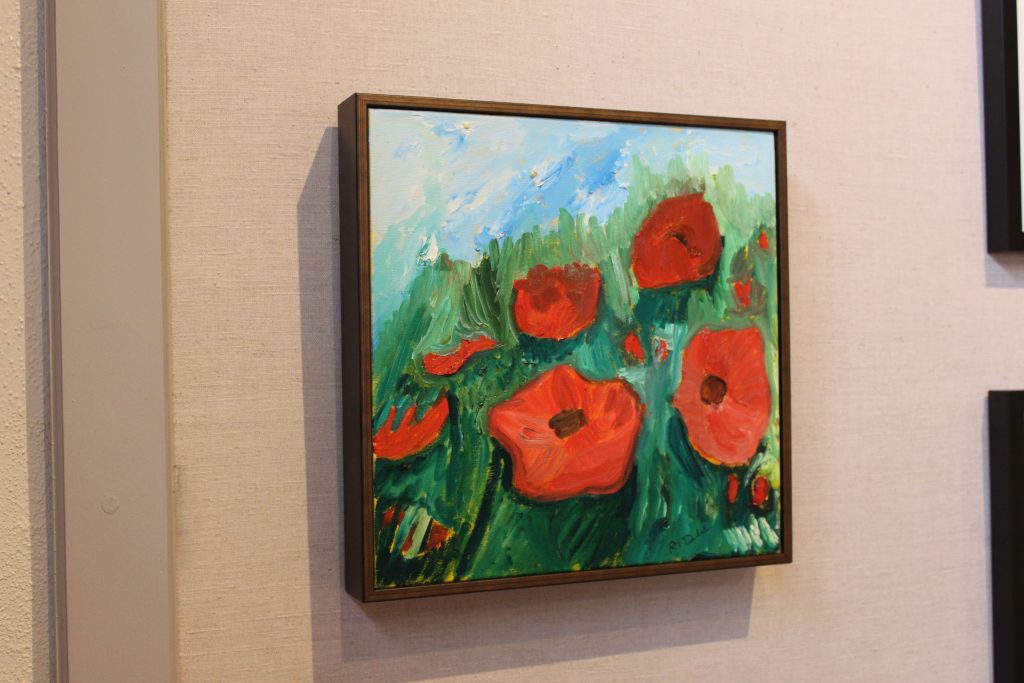
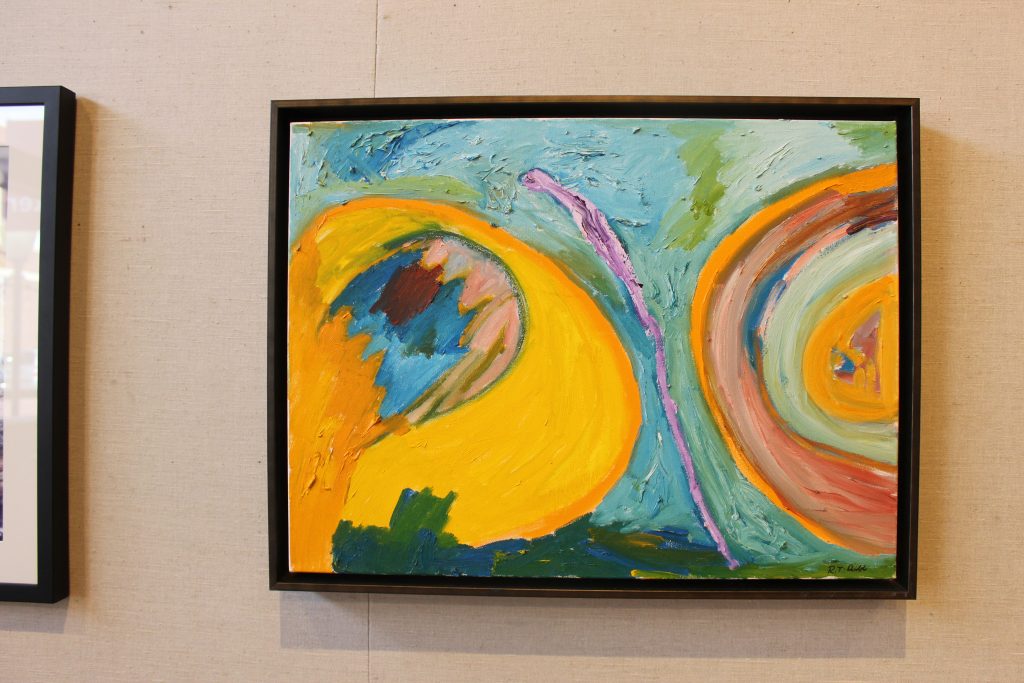
The other artists in the exhibit include Virginia Bitter, ceramics; husband and wife Rose Dudek, oils, and Steve Dudek, watercolors; and husband and wife Karole Erikson, photography; and Jay Miller, photography.

Both Erikson and Miller were recently featured in the Hays Arts Council’s Five State Photography Exhibition and have won awards in the past. They have also won placement in the HAC’s annual Smoky Hill Art Exhibition.

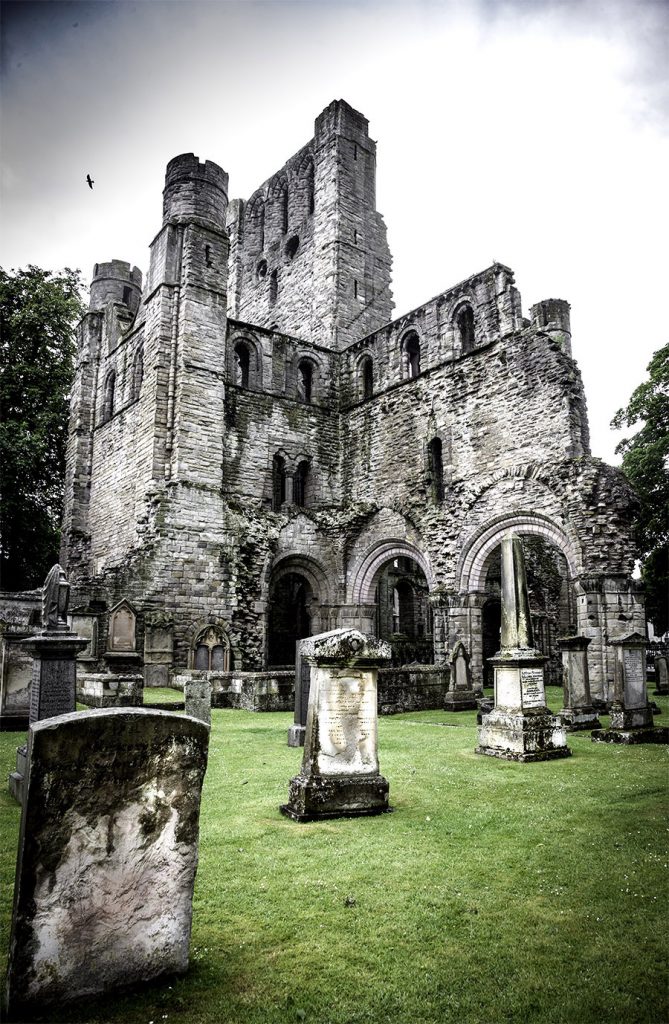
You will see wildlife photography from both artists side by side, but you will notice different styles. Miller has a portrait of a squirrel, near an image of taken by Erikson of a kingfisher snatching a fish out of the water. Miller also has a grouping of photos in the exhibit of a Kansas ranch during an annual burn, whereas Erickson’s images include scenes from decaying cemetery.

Steve Dudek is an award-winning watercolor artist and instructor at Barton County Community College. 

Rose Dudek helped put together the exhibition. Brenda Meder, HAC executive director, described her art as nonobjective, abstract oils.

Bitter also has ceramics on display at the center, but Meder said the two artists have very different styles.

“There are very perceptible individualities to Virginia’s and Dolores’ ceramics,” she said.

The artists reception will be  7 to 9 p.m. Feb. 23. The exhibit will be on display until Friday, March 23.

Wizard of Oz collection on display at FHSU’s Forsyth Library

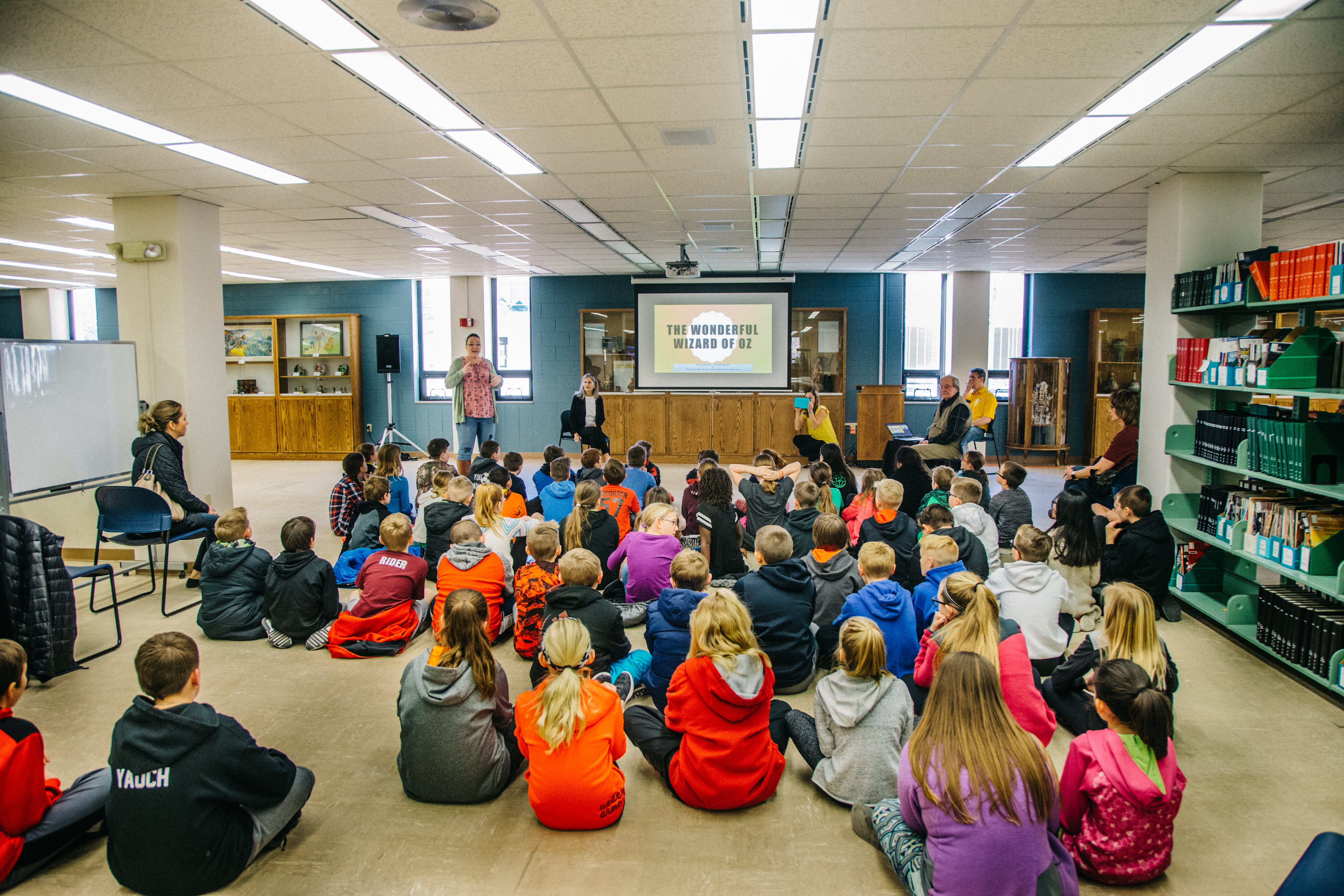
Wilson Elementary School fifth-graders visit the exhibit.
By DIANE GASPER-O’BRIEN
FHSU University Relations and Marketing

There probably aren’t many Americans, especially those from Kansas, who don’t associate the phrases “follow the yellow brick road” and “there’s no place like home,” with “The Wizard of Oz” movie.

Anyone visiting Fort Hays State University’s Forsyth Library through mid-March can follow some large yellow brick footprints to an Oz collection owned by FHSU alumni Larry and Lyn Fenwick, a retired couple from Macksville.

A close look at one of six display cases on the main floor of the library will teach viewers a lot they might have never known, or even imagined, about the 1939 musical fantasy movie that was based on a book written by L. Frank Baum and published in 1900.

The Fenwick collection will be on display through March 16 and includes a later edition of Baum’s book, “The Wonderful Wizard of Oz.”

Larry and Lyn were high school sweethearts who married their freshman year at Fort Hays State.

After both graduated from FHSU in 1966, Larry served in the U.S. Air Force and was stationed in New York State and Massachusetts. He then began a 35-year career in investments, which began in Texas and continued in Atlanta, Ga., and Charlotte, N.C., during which he frequented New York City.

On one of those trips to NYC, Larry visited a bookstore called Books of Wonder and learned about the series of 14 Oz books by L. Frank Baum, published from 1900 through 1920. That visit in the 1980s is how the Oz madness all started for the Fenwicks.

Lyn began at FHSU as an art major but quickly changed to education, without ever giving up her love for art. After teaching for a few years, she earned her doctorate in law from Baylor University School of Law. She practiced law in Texas before shifting her focus to writing and publishing two books. She currently has a weekly blog and is working on a manuscript about a Kansas homesteader and the Populist Movement.

Collecting Oz memorabilia seemed a perfect fit for the Fenwicks.

“Wherever we met people from other states, when they learned we were from Kansas, they would ask us about Dorothy or tornadoes,” Lyn said.

“We always kept our eyes open for special Oz objects, especially when we traveled,” Larry said, adding, “several of our Oz collectibles were Christmas gifts from Lyn’s family and occasionally, gifts from friends.”

Before they knew it, one of the bedrooms in their home had turned into a Wizard of Oz room.

The Fenwicks have no children, and with both being FHSU grads, they began visiting with folks from the FHSU Foundation about ways that they could support their alma mater. One day last spring, Jon Armstrong of the FHSU Foundation took along his wife, Lynette, to a meeting at the Fenwicks’ farmhouse near Macksville, where they retired in 2014.

Because of Lyn’s love for books, Deb Ludwig, dean of Forsyth Library, was quickly involved in the Fenwicks’ discussions. Larry suggested to Jon Armstrong and Ludwig that perhaps some of his and his wife’s Oz collection be displayed in connection with the Encore performance of “The Wizard of Oz” coming to FHSU in February.

“On behalf of Forsyth and Fort Hays State, we appreciate them giving us the opportunity to share it,” Ludwig said.

Lynette Armstrong, a librarian in Hays USD 489, became enamored with the Fenwicks’ collection, especially Baum’s books. She started a Wednesday luncheon book club for fifth-graders at Wilson Elementary School, and her first book for them to read was Baum’s “The Wonderful Wizard of Oz.” She also arranged to take all three of Wilson’s fifth-grade classes to Forsyth Library to hear Lyn speak and to get a glimpse of the Oz collection.

“I knew most of the kids probably had seen the movie but not read the book,” Lynette said, “and there are some things different from the book and the movie.”

For example, Dorothy’s slippers in the book are silver instead of ruby red.

“Movie legend has it that when an MGM executive saw the proposed costume for Dorothy, with the silver slippers, he demanded something that would stand out on the screen instead,” Lyn explained. “The ruby slippers were the result of his demand.”

A big difference between the book and movie is the movie portrayal that Dorothy’s trip to Oz was a dream. In the book, Baum leaves the perception that Dorothy might have visited a real Land of Oz.

“Baum’s goal was to create an American fairy tale,” Lyn said. “He wanted children to use their imaginations. I believe the movie went too far by implying that Oz wasn’t a real place and Dorothy had only had a dream. The movie seemed to tell children it had only been a dream rather than letting children believe what they chose.”

In addition to some of Baum’s books, the Fenwick exhibit features Oz Jack-in-the-boxes, an Oz chess set, figures and posters, music boxes and snow globes, a lunch pail, salt and pepper shakers – and so much more.

Their collection also includes Lyn’s handcrafted dolls of the four main Oz characters as well as other examples of her art. There is even a Christmas tree covered with Oz ornaments.

A Wizard of Oz puzzle from a painting by Scott Gustafson sits on the library’s puzzle table where students often stop by to fit in a few pieces in-between classes.

One of Larry’s pride and joys is an original drawing that Lyn created for a youth ballet production. The drawing was used on posters, programs and T-shirts.

Lyn posted photos and comments about the Forsyth display on her blog at www.lynfenwick.blogspot.com. She said she is pleased whenever people become excited about the book or the movie – as long as they get to enjoy the wonder of Oz.

“I think Kansans tend to take Oz for granted, without realizing how much people outside of Kansas love the Wizard of Oz,” she said. “Oz is such a great ambassador for our state.”

Cyndi Landis, outreach specialist at Forsyth, agreed.

“Oz is embedded in our Kansas culture,” she said. “You can’t go to an airport without being reminded that ‘there’s no place like home.’ When we heard about the Fenwicks’ Oz collection, we were interested in the wide appeal of L. Frank Baum, the impact of his literary works on young readers and researchers and the Kansas connection to the classic tale. The Wizard of Oz reminds us to use our brains and our hearts and to have the courage to dream.”

Lynette Armstrong said she thinks the Oz display is another good opportunity for community members to visit the university, “especially with the Fenwicks being alums and the book being so interesting.”

She encourages people to check out the exhibit, which is open during regular Forsyth Library hours, which can be found at www.fhsu.edu/library.

“I hope a lot of people are able to get to Forsyth to see it,” Lynette said. “I think it’s a win-win-win situation for everyone.”

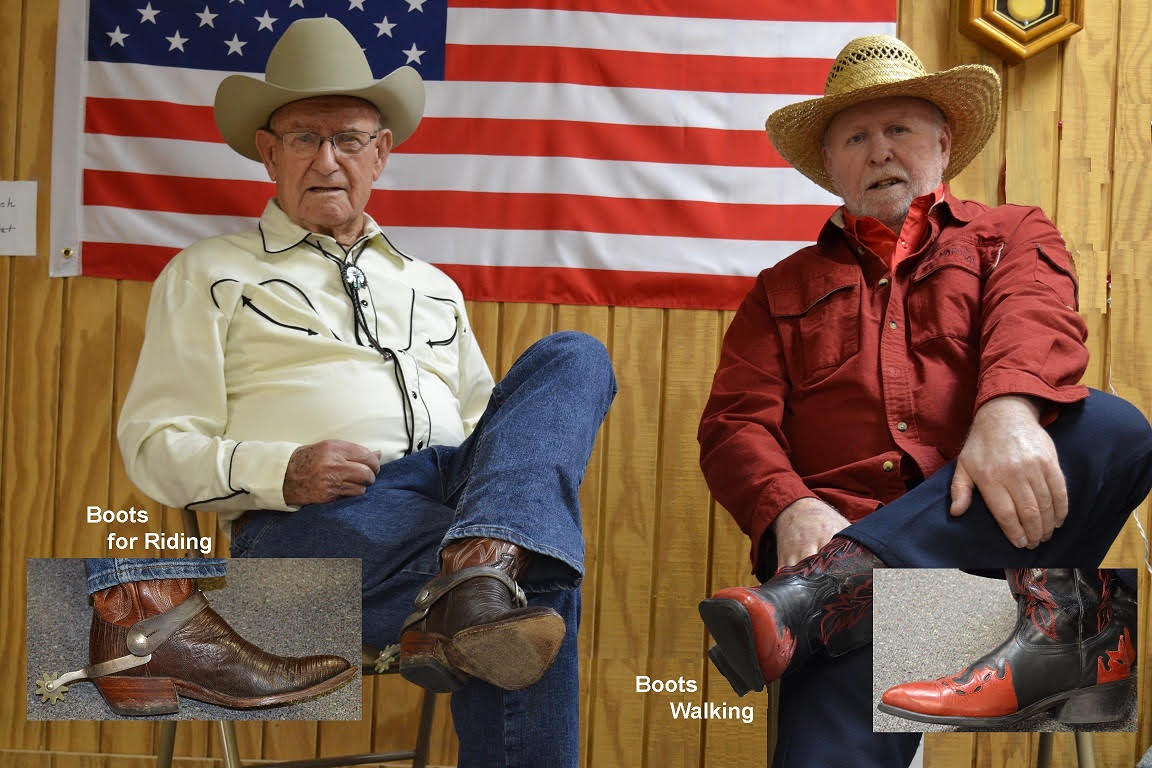
🎥 Sunflowers and songs for Kansas Day celebration at Hays Senior Center

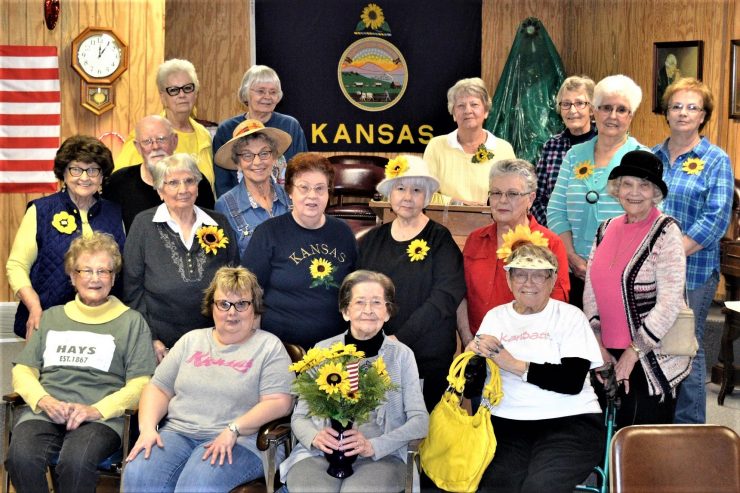
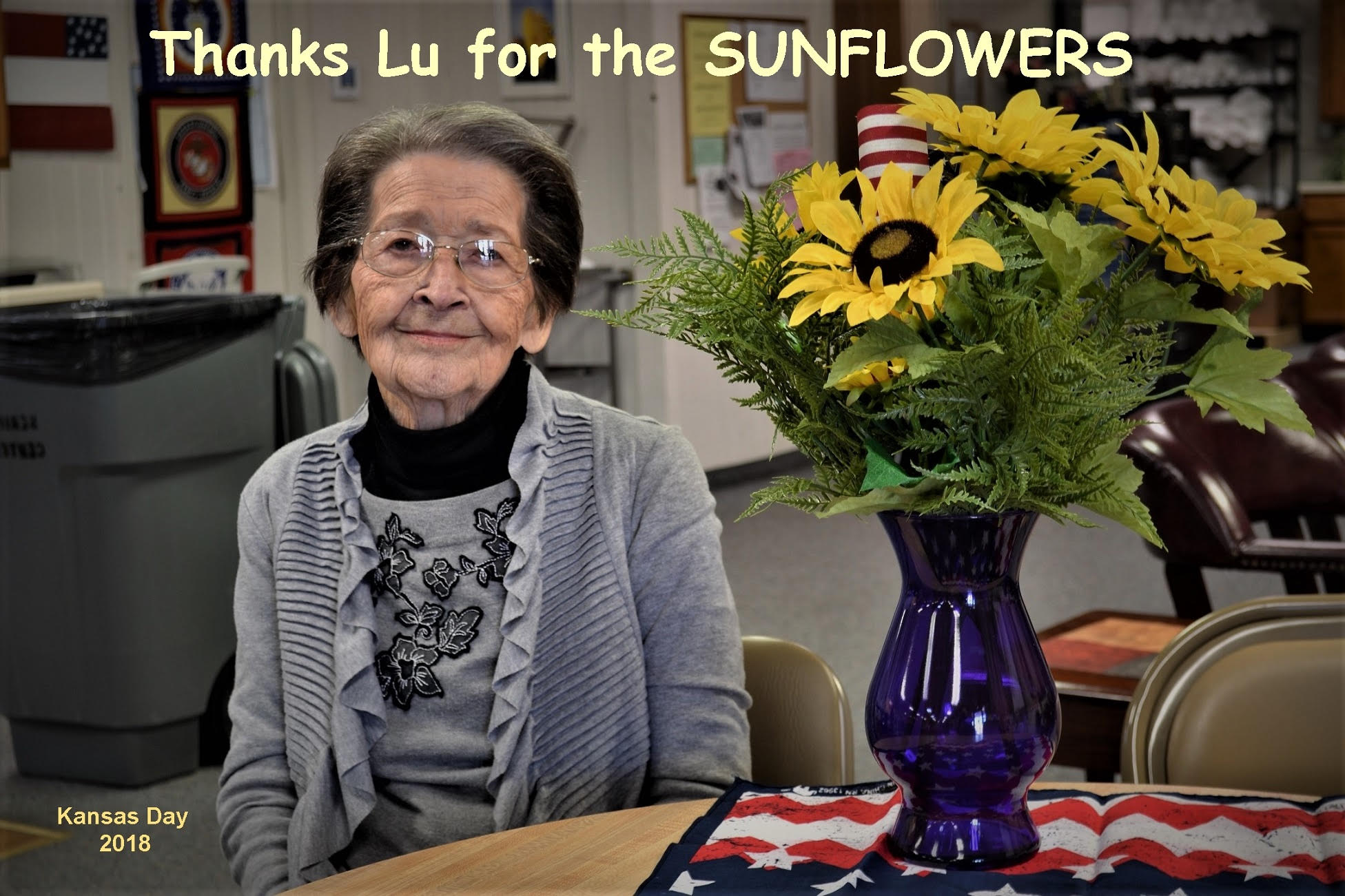
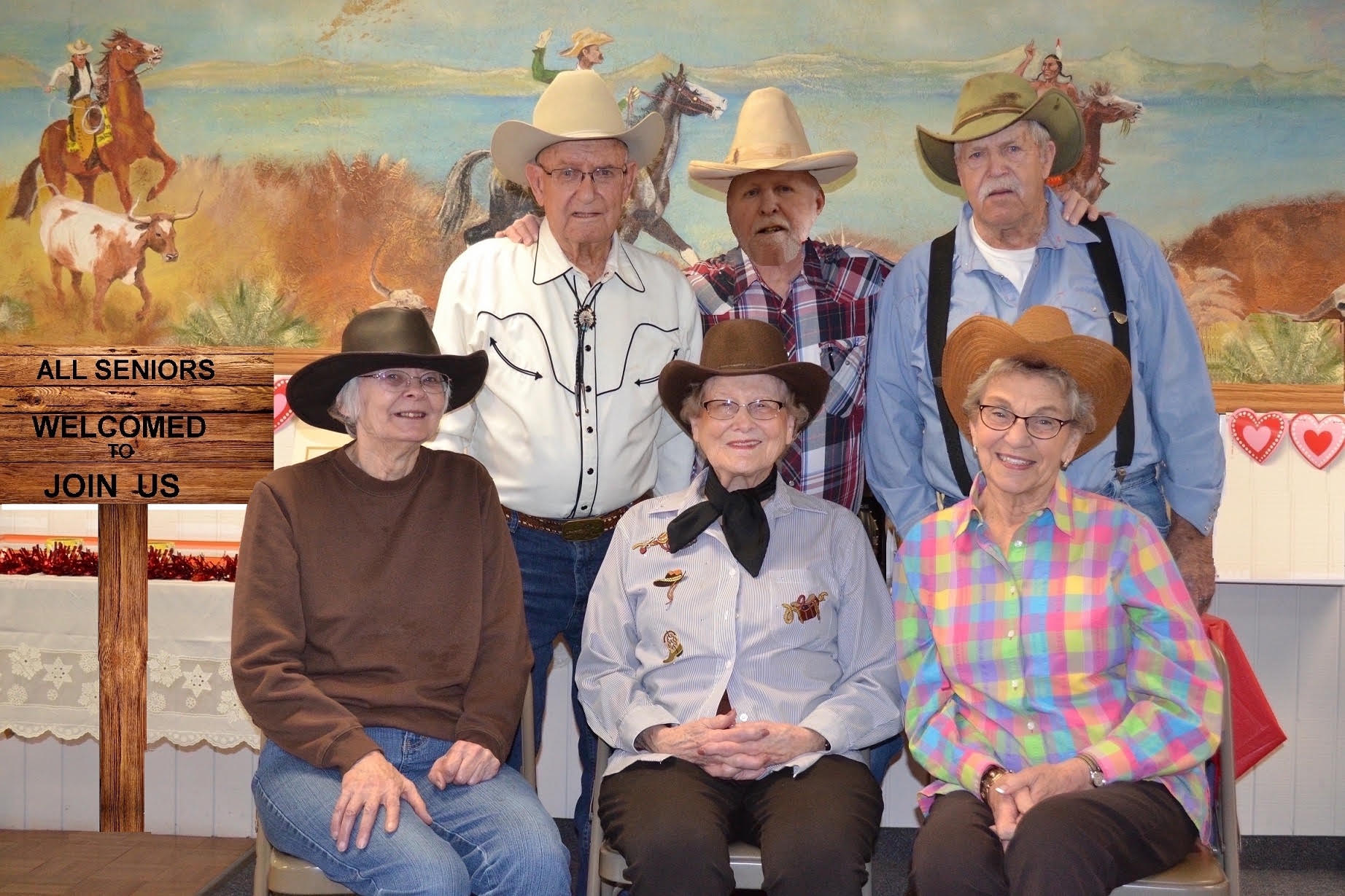
Sunflowers abound at the Kansas Day celebration at the Hays Senior Center

HAYS SENIOR CENTER

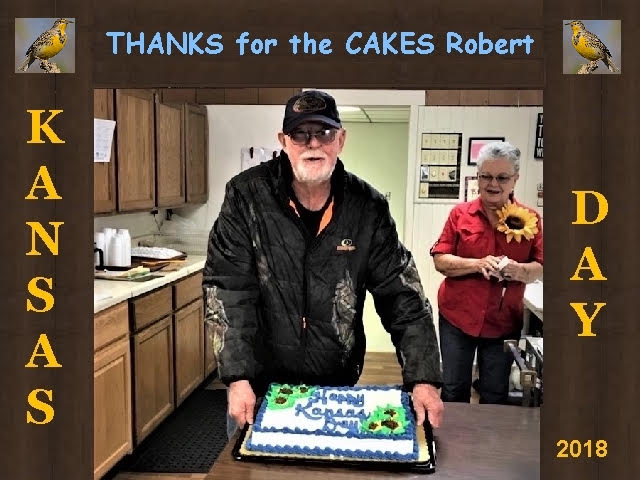
Local seniors enjoyed celebrating Kansas Day Mon., Jan. 29 at the Hays Senior Center, 2450 E. 8th St.

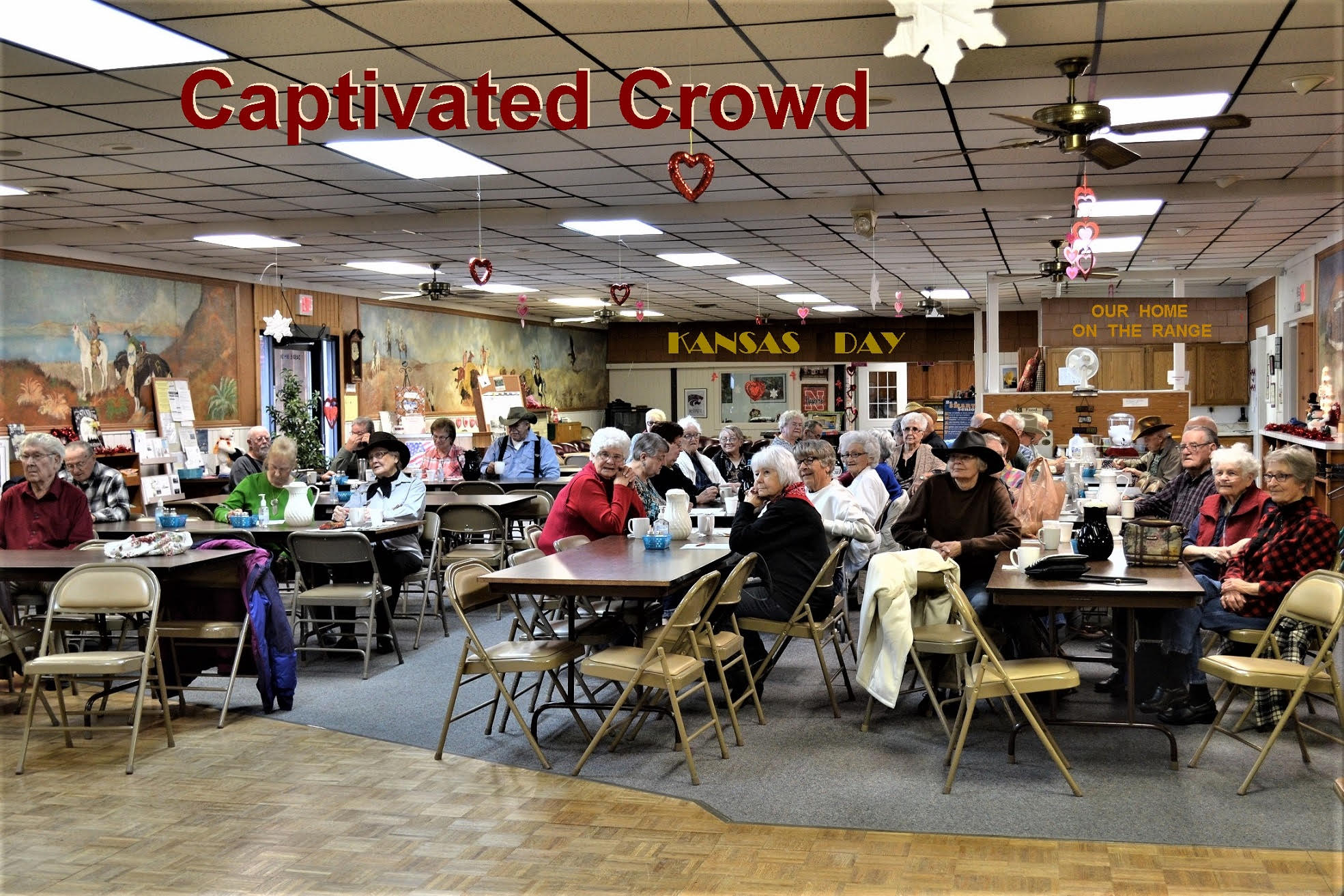
The highlight event for the month of January was saved for the recognition of Kansas Day with about 50 seniors attending.

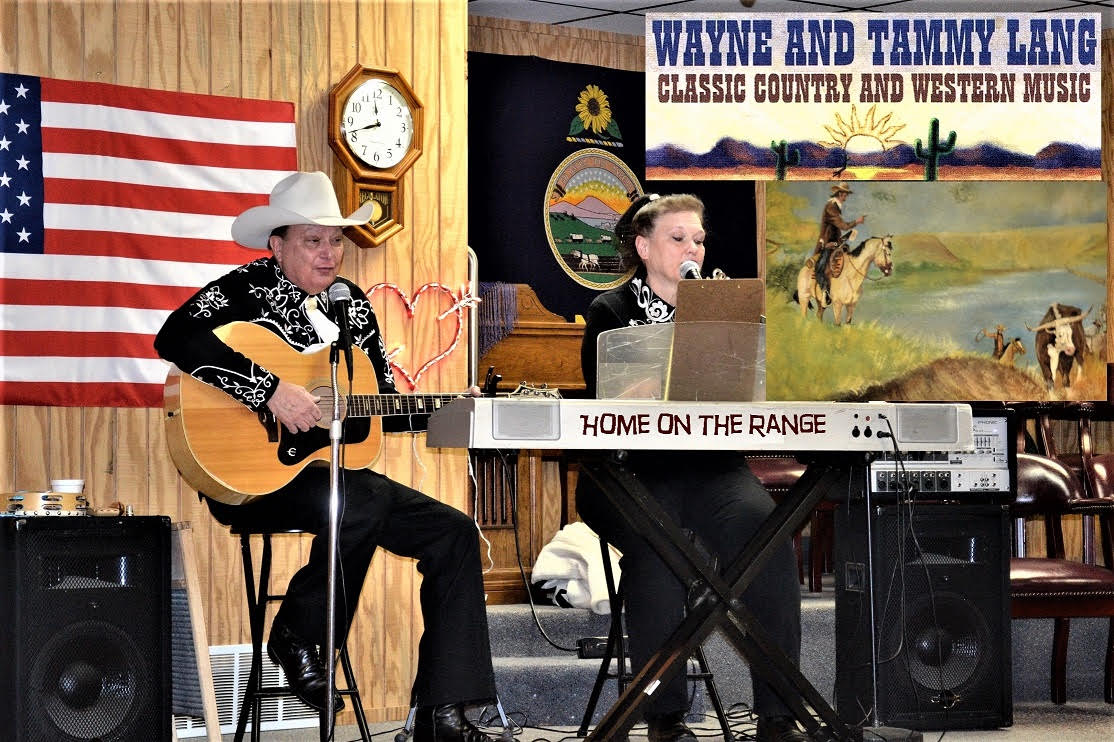
They participated in the delightful opportunity to have a duo of live musicians playing western music that fit in with the spirit of Kansas Day. Hays residents Wayne Lang and his wife Tammy were not short for adding in bits of humorous stories between songs during the half hour leading up to lunch.

Having been so enjoyable, with a great round of applause for their performance, the duo was asked by some senior members if they could return for Valentine’s Day, this month on February 14th. Senior Center Director Judy Bolte noted that calls are already being received for advance reservations for that day.

Bolte can be reached at the Center number 785-628-6644 for more information. “Our hope is the younger residents consider bringing out their parents or grandparents and have lunch with them, too,” she urged.

Activities and lunches are available for seniors ages 60 or older at the Hays Senior Center. Reservations must be made the day before eating at the Meal Site. For menus, reservations or cancellations, call 785-628-6644 between 9 a.m. and noon. Meals are served at 12:00 p.m. Monday through Friday.

Sternberg to offer activities on evolution, free admission during Darwin Day Sunday

By CRISTINA JANNEY

Hays Post

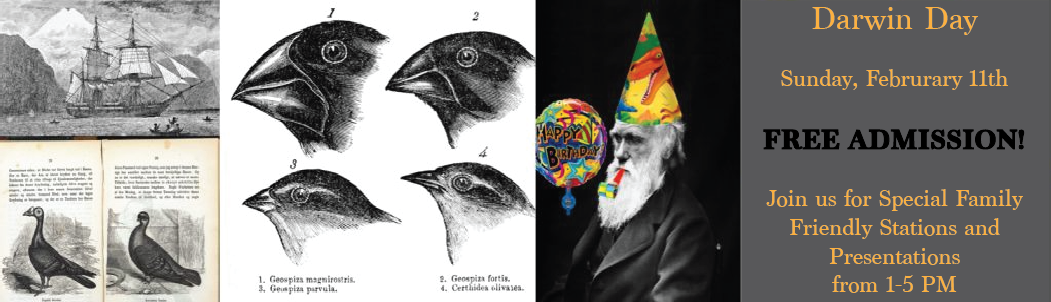
The Sternberg Museum of Natural History will celebrate Darwin’s Birthday from 1 to 5 p.m. Sunday with free admission to the museum and activities centered on everyday evolution.

Charles Darwin was actually born on Feb. 12, 1809, but the celebration is still giving the museum an opportunity to further science education in the community.

The four main aspects of evolution that will be presented will be animal husbandry, genetically modified organisms or GMOs, vaccinations and deforestation.

Jessica Barnett, who helped organize the event, said each topic will have stations manned with museum staff and FHSU graduate students and will have opportunities not only to discuss the topics, but also participate in hands-on activities.

“Every single day you come in contact with organisms that are evolving,” she said. “Whether that is humans that have evolved from other organisms or the corn that you are eating for dinner or your dog that has been selectively bred to be the modern-day equivalent of the wolf.”

The museum is using dog breeding as a way to illustrate artificial selection as opposed to natural selection. Barnett gave the example of floppy ears in dogs. Puppies have floppy ears, but in the wild in adult wolves, they are replaced by perky ears that are better for pinpointing sound during hunting.

“We choose to breed animals with floppy ears because they are so cute. It is so nice to rub their ears and let them flop around everywhere. It is adorable when they are adults, but we chose that,” she said. “That is not necessarily advantageous in the wild.”

Children will be able to “Build a Dog.” They will make dog puppets using features that have been artificially selected through breeding by humans.

Another example of artificial selection is the brassica plant. The plant was a leafy edible plant in about 4000 BC. It was bred into kale and eventually cauliflower, cabbage and broccoli.

As part of the GMO activity, the museum hopes to dispel some of the misconceptions of GMOs and focus on the science. Laura Wilson, PhD, said the definition of a GMO varies greatly depending on the source, whether it is a scientific, government or pro-organic group.

“We are not taking sides, we are just trying to keep a just-the-facts-mam attitude,” she said.

The vaccine presentation will look at how viruses mutate or evolve and how scientists have to modify vaccines to keep up with the changing organisms. Wilson said this is particularly pertinent with the flu epidemic in the U.S right now.

Children will be able to create their own viruses, and then the activity coordinators will try to develop vaccines that will keep the kids from accidentally killing everyone.

“That is a fun activity for kids to let them see how the flu virus evolves over time and how scientists do their best to anticipate what flu viruses might become problematic and how that changes year to year and why that is important to get [the flu shot] every year,” Barnett said.

On the subject of deforestation, the museum is trying to show how evolution changes plants and animals on an ecosystem scale.

The museum staff found a study on palm trees in the South American rain forest. The palm trees are being cut down and the groves fragmented, Wilson said. Toucans that feed off the palm trees are going extinct in these areas. Toucans typically carry the seeds of the palm trees. Now scientists are seeing palm trees with smaller seeds that can’t disperse their seeds as far because there are no toucans to carry the seeds.

“These kind of cascading effects within ecosystems due to deforestation and fragmentation make little islands out of what was a big expanse of land,” Wilson said. “This can cause changes to plants and animals.”

The museums live animal collection also will be on display during the event, and all of the normal exhibits will be open.

Several new exhibits will also be available to the public. The museum recently mounted a display of a new collection of minerals. The museum is constructing a new paleontology lab. Although it is not yet equipped, visitors can view the new space. A history of paleo art exhibit will also be on display.


Hays High announces 2018 Indian Call candidates

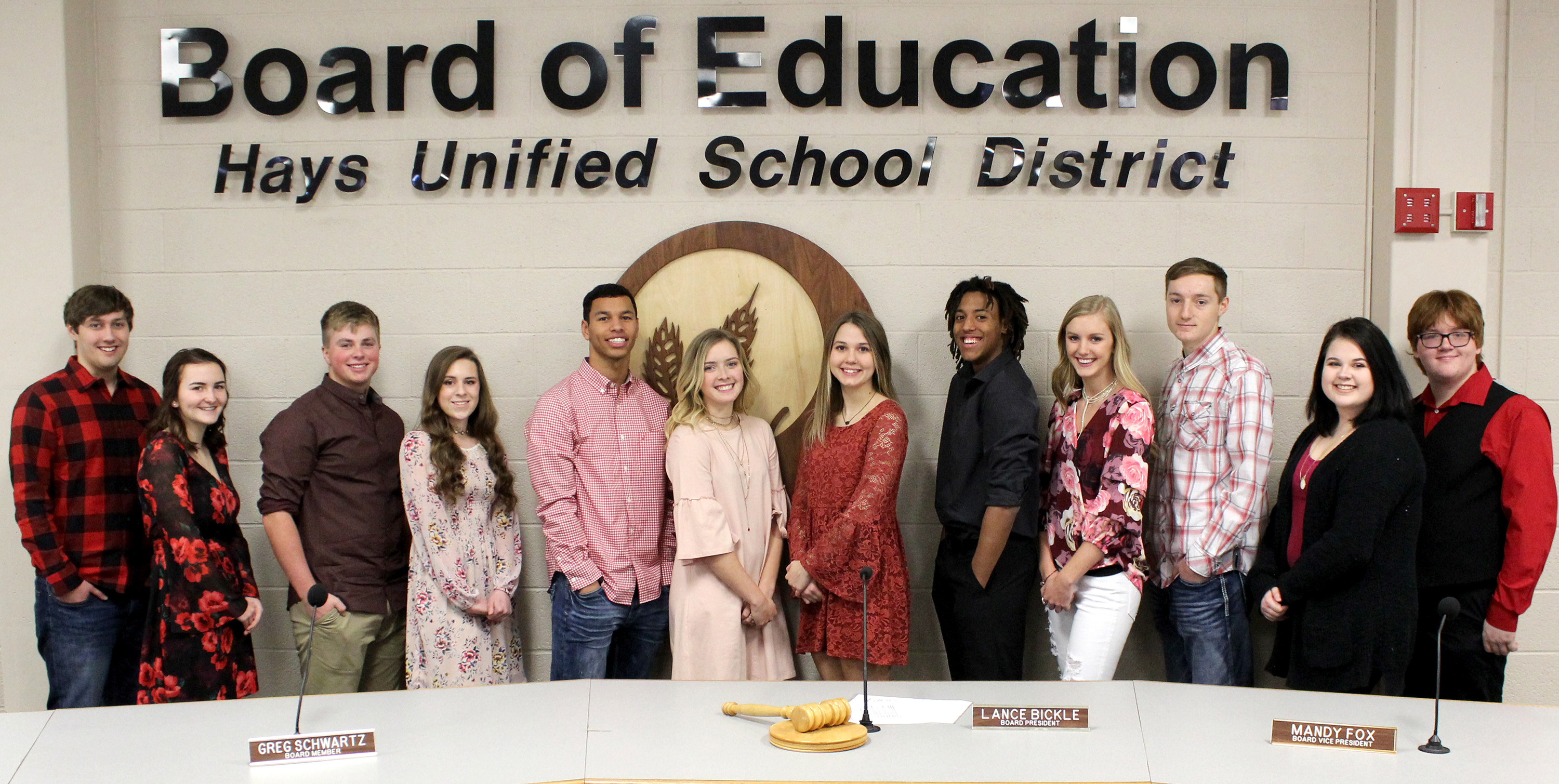
Hays High School seniors have selected the candidates for 2018 Indian Call. The dance is scheduled for Feb. 17, and the winners will be announces the previous night.

Pictured from left: Ryan Will, Gabriela Taliaferro, Logan Clark, Tana Herreman, Ethan Nunnery, Karee Dinkel, Abigail Brungardt, Tayzian Otte, Mallory Linn, Cole Murphy, Abigail Balman, Eric Adams.

— Submitted

Sternberg scientist seeks to preserve threatened Kansas bat species

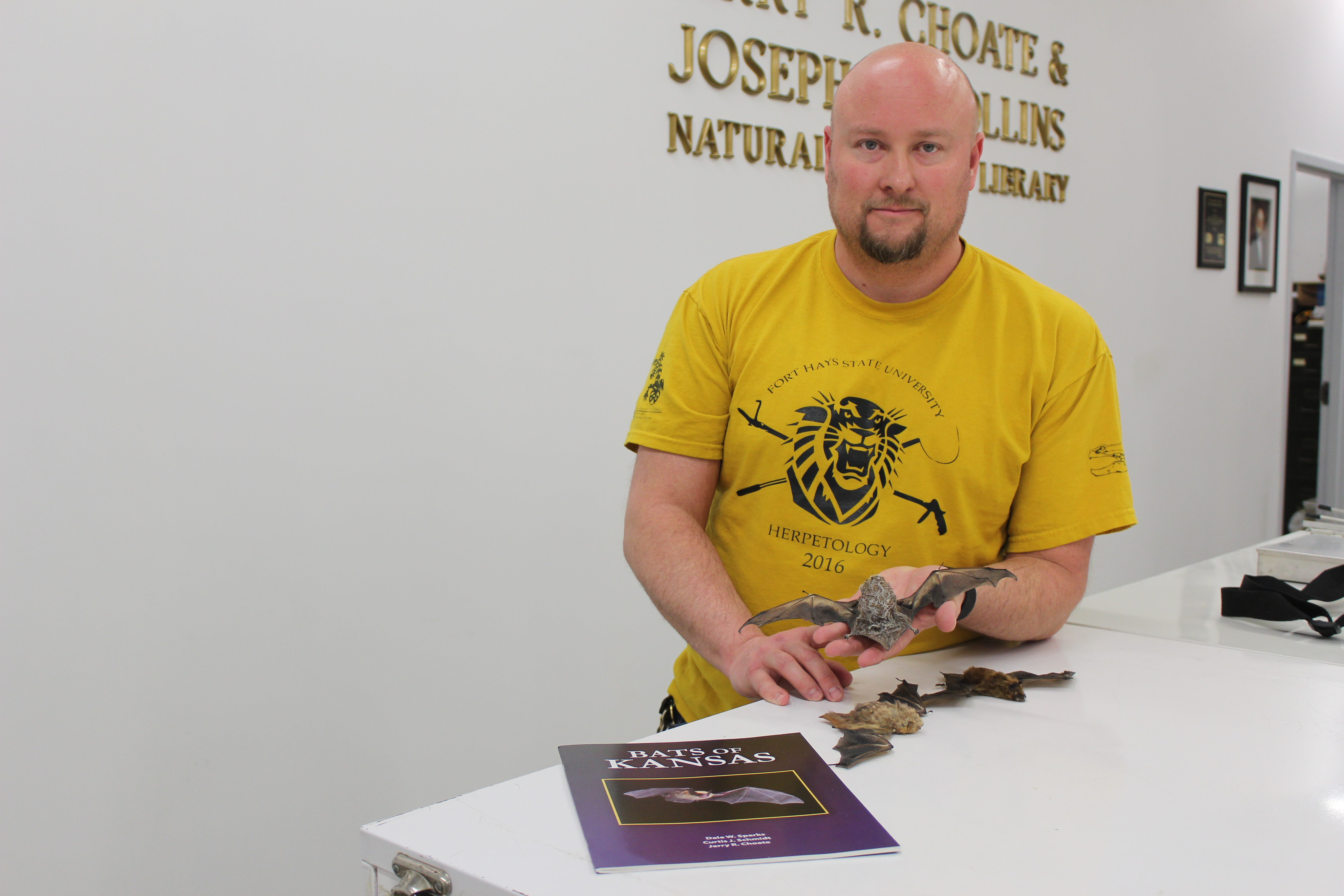
Curtis Schmidt, Sternberg zoology collections manager, holds a specimen of one of the 17 species of bats that are found in Kansas. Schmidt and his colleagues are researching threatened northern long-eared bats.

By CRISTINA JANNEY
Hays Post

A researcher at the Sternberg Museum of Natural History is studying a disease that is wiping out a species of bats across the nation.

Curtis Schmidt, Sternberg zoology collections manager, Elmer Fink, PhD, along with others from Fort Hays State University, have been studying the northern long-eared bat. Schmidt, although primarily trained as a herpetologist, co-wrote a book on Kansas bats with former Sternberg director Jerry Choate and two other scholars in 2011.

The northern long-eared bat was listed as threatened on the endangered species list in 2015. The bats, which normally live in caves, are succumbing to a fungal infection called white-nose syndrome that proves fatal in almost all cases.

The fungus was not introduced to the U.S. until 2006, but since has been decimating bat populations by the millions.

The fungal infection has not yet been found in Kansas.

The fungus that is affecting the bats is normally found in soil. However, it is being brought into caves by humans. People pick up the fungi on their shoes and carry it from one cave to another. The infection is also transferred from bat to bat and is carried from cave to cave by infected bats.

Bats have extremely high metabolisms. They have to be constantly eating when they are awake. When insects are scarce during the winter, some bat species, including the northern long-eared bat, hibernate. The fungal infection disrupts the bats’ hibernation. They become active in attempts to fight the illness, yet can’t feed, and starve to death, Schmidt said.

“It’s just spreading like wildfire,” he said, “and right now we have no idea how to control it.”

Some populations are showing they are starting to evolve resistance to the disease. One scientific paper suggested ultraviolet radiation will kill the fungus, but the caves in which the bats live are not exposed to ultraviolet radiation. If this solution proves effective, humans may have to go into the caves and provide ultraviolet radiation to kill the fungus.

Schmidt and his fellow researchers have banded about 700 to 800 bats during the last three years primarily in Ellis, Rooks, Russell and Trego counties. The scientists use fine mist nets to catch the bats as they search for water in the early evening. Contrary to the saying “blind as a bat,” bats can see. The bats use memory to locate water. The don’t start to echo locate for prey until later in the evening.

Researches don’t know much about where the bats roost or hibernates in Kansas. The bats use caves in other areas, but there are no caves in the areas in which the bats live in Kansas.

The bats not only eat mosquitoes, but many insects that can be harmful to crops. Scientists estimate bats in the U.S. prevent billions in crop damage annually.

Schmidt acknowledged bats are often viewed negatively by the public. Seventeen species of bats live in Kansas, all of which are insect eaters. The bats not only eat mosquitoes, but many insects that can be harmful to crops. A study in Texas indicated bats had a $1.8 billion annual benefit to agriculture in the state.

The most common bat in Kansas is the big brown bat, and if you have seen a bat in Kansas that is probably what you observed.

Bats are actually quite abundant, but we just don’t usually see them because of their nocturnal lifestyle, Schmidt said.

“One thing people don’t realize is how abundant bats really are,” he said. “They are extremely abundant, very, very common. If we could actually see into the sky at night, you would see that the sky is full of bats, no matter where in the country you are.”

Schmidt will be giving a presentation at the Bat Fair from 2 to 4 p.m. Sunday at the Kansas Wetlands Education Center, 592 NE Kansas Highway 156, Great Bend.

He will be talk about a day in the life of a bat, which because of their high metabolism, involves primarily eating and sleeping.

Bats mate in the fall and the female bats will hold the live sperm until they are ready for the eggs to be fertilized in the spring. Bats, as mammals, give birth to live young and produce milk for their babies. Bats usually have two pup, but can have up to five. The baby bats grow rapidly and are able to fly and be independent of their mothers within two weeks.

Schmidt said he hopes through presentations such as the one in Great Bend he can raise awareness of the importance of bats.

“The No. 1 thing I like to promote is that they are OK, and they are good to have around,” he said. “I am really optimistic because it seems the more people are learning about them more recently with these diseases and things that are going on, the more people are appreciating and liking them. I have more people who come in and want to build bat houses because they realize how beneficial the bats are not only for agriculture, but for mosquitos and thing like that.”

Following Schmidt’s the presentation, children will be able to construct their own bats, complete a scavenger hunt in a “cave,” compare bat wing spans and “capture” and measure their own bats. KWEC will have live brown bats as well as several Sternberg Museum bat specimens on display.

The fair will also have examples and instructions on how to construct bat boxes, which can be used to attract bats to the yard.

For more information, contact KWEC at 877-243-9268.

Copyright Eagle Radio | FCC Public Files | EEO Public File