Passenger boardings at the Hays Regional Airport last year may have exceeded 10,000 after all, and that would be very good news for the city.
“We were very, very close,” Asst. City Manager Jacob Wood said, “so there are some additional things we’re taking a look at.”
That “very, very close” number was just 169 short of the 10,000 mark, according to Airport Manager Ovid Seifers.
“We think we made it, although it’s not official yet,” Seifers said Tuesday morning. “It appears that we did cross it (the 10,000 threshold).”
If so, the city of Hays would be awarded another $850,000 grant from the Federal Aviation Administration (FAA) for airport improvements to go with the $150,000 in annual FAA funding.
Seifers thinks the city will know the final numbers within a week to 10 days.
Ovid Seifers, Hays Regional Airport manager
“We’ve got one more tentative report, more as a cushion than to get us over, and then we’ll know for sure.”
The boarding reports come from two sources, SkyWest, the airport’s Essential Air Service (EAS) provider with the “lion’s share by far.” Also counted are boardings with charter flights with a Part 135 Operator, an aircraft that is hired on demand for transport. Private aircraft are not included.
The airport’s numbers will be submitted to the FAA, which will publish the final numbers for 2017 on Oct. 1, 2018.
“However, we will know shortly where we’re at exactly,” Seifers said. “There’s very little change after the initial report in January. It’s minimal.”
“We were off 169 passengers, and that number reduced and reduced. Now, all the numbers indicate we are over.”
The Hays Regional Airport last reached 10,000 boardings in 2011 and 2012. In order to hit the mark of 10,000 passengers a year, an average of 833 people need to fly out of Hays each month.
Previous FAA million dollar grants have been used to repair the airport’s main runway and make improvements to the terminal.
The Hays USD 489 superintendent recommended the district opt of PEERA and future negotiations with its custodian union at a school board meeting Monday night.
Superintendent John Thissen said he was disappointed in the leadership of the custodian’s union and the direction that leadership was taking.
“I would say that it is not needed in our organization,” Thissen said of the union Monday night.
The city and county both opted out of PEERA in December, but Thissen said the school board’s discussion had nothing to do with those decisions.
An opt out from PEERA (Public Employer-Employee Relations Act) was placed on the school board’s agenda for January on the request of board members last year after negotiations with SEIU (Service Employees International Union) stalled a change in the district’s insurance provider.
There are 28 people covered by SEIU in the school district, 19 of which pay dues and are members of the union. The Hays school district is one of only two school districts in the state that negotiates with SEIU. The other is Wichita.
When the district first started to negotiate with SEIU, the cooks were also a part of the union. However, the district cooks have not been a part of the union for some time. There are about 225 classified staff that do not have union representation. The district employees about 500 people.
No one from SEIU was at the school board meeting Monday night, but SEIU released the following statement Friday to the Hays Post.
“The custodians of USD 489 value their collective bargaining rights and are hopeful that the school board will remain under PEERA. We appreciate that we were able to come to a fair and equitable agreement this year. We also understand that negotiations can be frustrating at times; however, collective bargaining aids in securing harmony in the workplace and allows employees to focus on their work rather than their grievances.”
Board attorney Bill Jeter said nothing necessarily has to change for the employees if the board decides to no longer recognize the union. The board would adopt salary, benefits, shifts and vacation via policy. However, the salary and benefits would not necessarily have to change if the district opted not to negotiate with the union.
There is a cost to negotiate with SEIU. The district has to pay staff and its attorney to be involved in negotiations.
Board member Luke Oborny said he did like the timing of a possible decision on PEERA. He did not want the custodians to think they were not valued. The district also approved several personnel transactions Monday night that moved custodians to alternate buildings.
“I just don’t want it to be, ‘Last month they were picking on me,” and, “This month they are picking on me and what is it going to be next month?’ I hope it does not look as though we don’t value our employees. … I don’t want any group to feel as though we don’t value them. I think it is safe to say that we all do. We cannot operate without the people.”
Board member Mike Walker said he had concerns with opting out of PEERA.
“If this structure provides a voice, a legitimate voice I am very concerned about taking that away,” Walker said. “If we decide it doesn’t have a legitimate voice, I am more in line with what I am feeling from most of the board.”
An opt out of PEERA would not affect the district’s negotiations with the teacher’s union. Th district would still be required by state law to negotiate with the Hays NEA.
If the district decides to opt out of PEERA by the end of June, the change would take affect on July 1, 2019. This means the district would still need to negotiate a contract with SEIU for the 2018-19 school year. The board members requested the issue be brought back to them at their February meeting for further discussion and a possible vote.
Children play basketball during recess at Wilson Elementary School. New playground policies have reduced playground office referrals by 75 percent.
By CRISTINA JANNEY
Hays Post
Hays USD 489 implemented a new behavior policy that has reduced office referrals.
The model, Positive Intervention Behavior and Supports, focuses on positive reinforcement and setting clear expectations in common areas as well as individual classrooms. At the school level, the system is known as Foundations. At the classroom level, it is known as CHAMPS for the younger students and ACHIEVE for the older students.
CHAMPS stands for conversation, help, activity, movement, participation and success. ACHIEVE stands for activity, conversation, help, integrity, effort, value, efficiency. These words refer to questions teachers or school staff ask when creating guidelines for their classrooms or school areas.
School psychologist Kyle Carlin gave an example of how the system works. He used the example of running in the hall.
Instead of reprimanding a student and telling them, ‘Don’t run,” the teacher might say, ‘Please walk.” The teacher might also reinforce the positive behavior by asking the student to practice walking down the hall.
Wilson Elementary School has concentrated on make changes on its playgrounds. In a survey last year, about 40 percent of second through fifth graders said they did not feel safe on the playground. Fifty-four percent of the office referrals were coming from the playground.
The school wrote specific rules for the playground and rules for specific pieces of equipment, which they taught to students. They encouraged children to play in the Wilson Warrior Way and created the acronym PLAY.
This stands for proper use of equipment and body; listen, load up equipment and line up quickly; always be kind with hands and words; and you are in control, be respectful and responsible.
They also retrained their playground monitors, increased the number of supervisors on the playground and zoned the playground with each playground supervisor in charge of a specific zone.
The number of office referrals from the playground decreased by 75 percent, Anita Scheve, Wilson principal, said.
The school is extending the CHAMPS model beyond the playground to the lunch room and hallways. The school moved its recess from after lunch to before. Teachers said the students are returning to class more settled, and the lunch room is throwing away 30 percent less food.
Scheve said before the school implemented positive disciple, there were children lined up in her office to see her for disciplinary reasons. That has been cut dramatically. Scheve said she is focusing on restorative justice.
“While I believe in natural consequences,” Scheve said, “I don’t want to punish. I just want to reteach. That is the principle. Let’s teach behavior like we teach everything else. Let’s assume that they want to do the right thing. Let’s set them up to do the right thing.”
Scheve and the school counselor are also working daily with students who have had repeated discipline problems. They help the students create strategies on how they are going to focus on positive behavior through their day.
Hays Middle School has focused on reducing congestion in the hallways. Craig Pallister, HMS principal, said the school is trying to deal with the issue of overcrowding in hallways and the lunch room after the latest school bond issue failed. The bond issue would have renovated the cafeteria, which was not designed to accommodate the 675 students the school now serves daily.
Signs were hung to remind students about rules during passing periods. Falcon images were placed on the floor in certain areas, and staff members have been assigned to stand on these spots and give positive reminders of the rules to the students during passing periods.
The school used the CHAMPS process to reorganize its cafeteria. Milk coolers were moved outside of the cafeteria and students are now lining up outside the cafeteria to free up more room. However, as the school continues to grow, Pallister said the school may be forced to increase its window for serving lunch. It is already serving lunch from 10:55 a.m. to 12:45 p.m.
Each school has a team that is working on implementing these new strategies in common areas, such as cafeterias, hallways, parking lots and playgrounds.
“They are looking at those areas and developing policies and procedures that are predictable and consistent,” Carlin said. After they have developed those policies and procedures, they then go and explicitly teach those to kids because we know kids are more likely to meet our expectations if they know what they are.”
Consequences are natural, but they should be more instructive to make sure the next behavior is more appropriate than the last one, Carlin said.
Carlin continued with the example of the student who ran in the hallway. Once they have been asked to model the positive behavior, which was walking, the next time they pass the spot they will remember they the need to be walking.
“It helps them know what to do instead of, ‘If I don’t do the right thing, I am going to get punished,'” he said. “We know that doesn’t have the same level of effectiveness as other strategies.”
CHAMPS also addresses expectations within a specific classroom. The expectations concerning things such as talking might not be the same in a physical education class as it might be in an English class. Even though expectations may be different from class to class, there is consistency within the class, and that helps students build trust with a teacher, Carlin said.
As students get a little older—about third grade—they can participate through surveys to help school officials identify areas that need work. They don’t dictate the policies, but they do get to have input, he said.
“We know when students have input into the process, there is more buy in from them on those rules. They are more likely to follow those rules and expectations,” Carlin said.
Sometimes adults don’t see what kids see, or the presence of an adult changes children’s behavior, he said.
“Kids have really good insight into things in their school, and their voice is very valuable to have as a part of that,” Carlin said.
Carlin said he wanted parents to know the schools want their input on the changes, as well.
The models for positive behavior can also be used at home, and Carlin said he uses the techniques with his own kids. He suggested providing positive reinforcement as opposed to negative, setting expectations, providing structure and using positive instructions when trying to elicit a behavior change.
“While there is a purpose for various consequences, the more we rely on punishing consequences, the less likely we are to get the change in the behavior,” Carlin said. “We want to make sure when we do correct behavior, it is going to get us more effective behavior in the future.”
Old West lore is filled with wild and tragic stories of tough men and women looking for their version of the American Dream on the Western frontier. Their journeys often led them to saloons and bawdy houses populating the cowtowns that popped up on the unsettled prairie.
In celebration of Kansas Day, the Trego County Historical Society welcomes Marla Matkin, an independent scholar and living history performer, to entertain us with their stories in a living history presentation called “Cowboys and Soiled Doves.
Matkin’s love for history developed at an early age and she has spent her life studying the complex lives of legendary Western heroes brought to life in books and on-screen. She now shares these stories through a character she’s created named Contessa, engaging audiences with a “first-hand” account of what life was really like in the boomtowns and upon the range of America’s empty interior. With a twinkle in her eye and tantalizing sense of humor, she describes a world where grit and determination won the day.
1878 Long Branch Saloon in Dodge City, Kansas (Photo courtesy KSHS)
Matkin traces her roots back to southwest Kansas, where in 1877 her great-grandparents claimed a homestead near Dodge City, a town notorious for hosting legendary characters, such as Wyatt Earp and Billy the Kid. Today, Matkin calls WaKeeney’s northern neighbor, Hill City, her home and for twenty years she has performed as Contessa throughout the Midwest and further, including at the Smithsonian, Buffalo Bill Historical Center in Cody, Wyoming, the National Cowboy and Western Heritage Museum in Oklahoma City and several National Park Service sites.
Matlin’s program will be the highlight of the Historical Society’s annual Kansas Day program. During your visit, you can also explore the museum’s large collection of Western artifacts. Many of the pieces come from local families, providing guests of the museum deeper insight into the history of Trego County through the stories of its citizens, past and present.
Please join us at the Trego County Historical Society on Sunday, January 21 at 2 p.m. for their annual Kansas Day celebration featuring living history performer Marla Matkin’s presentation on “Cowboys and Soiled Doves.”
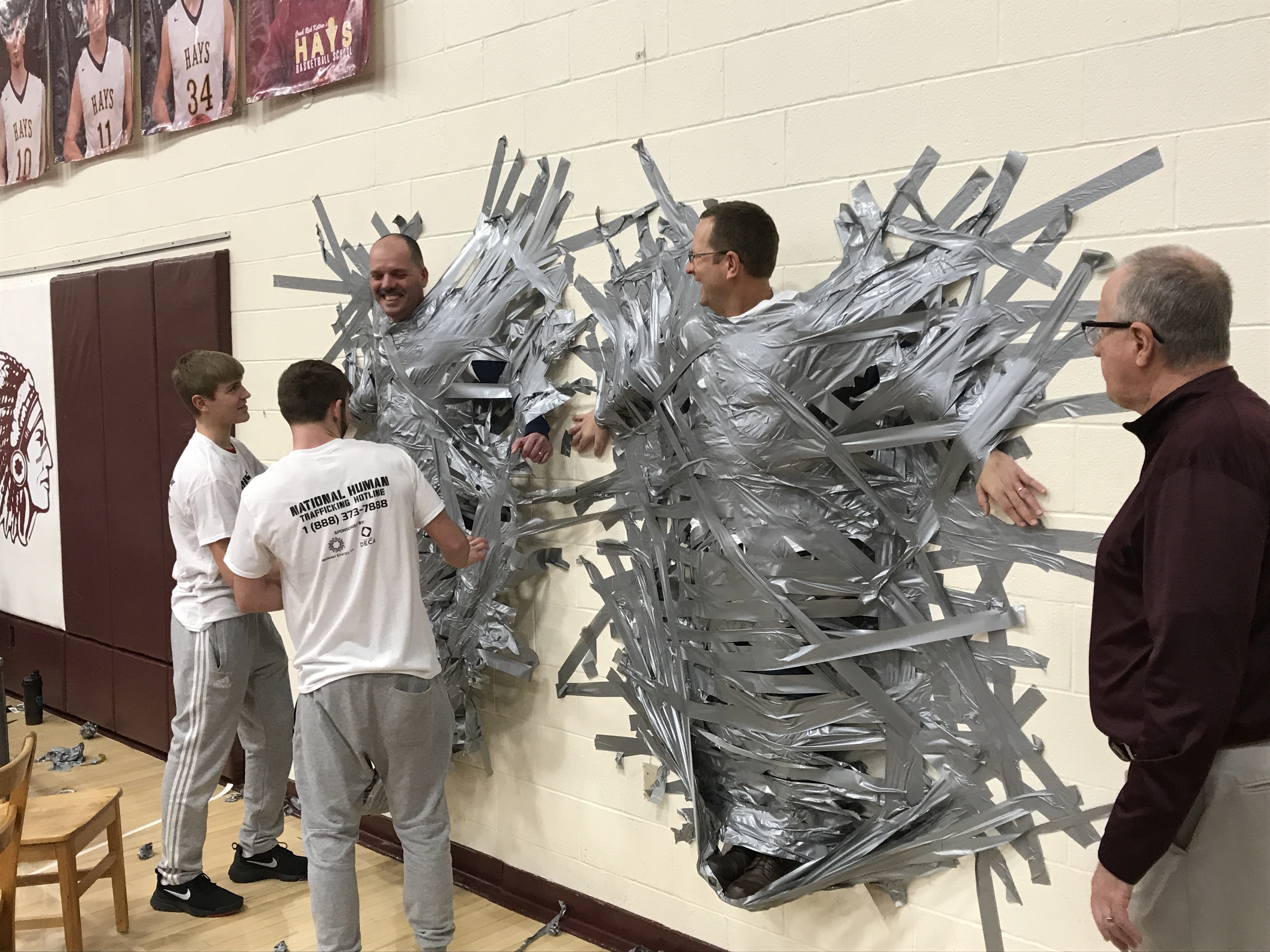
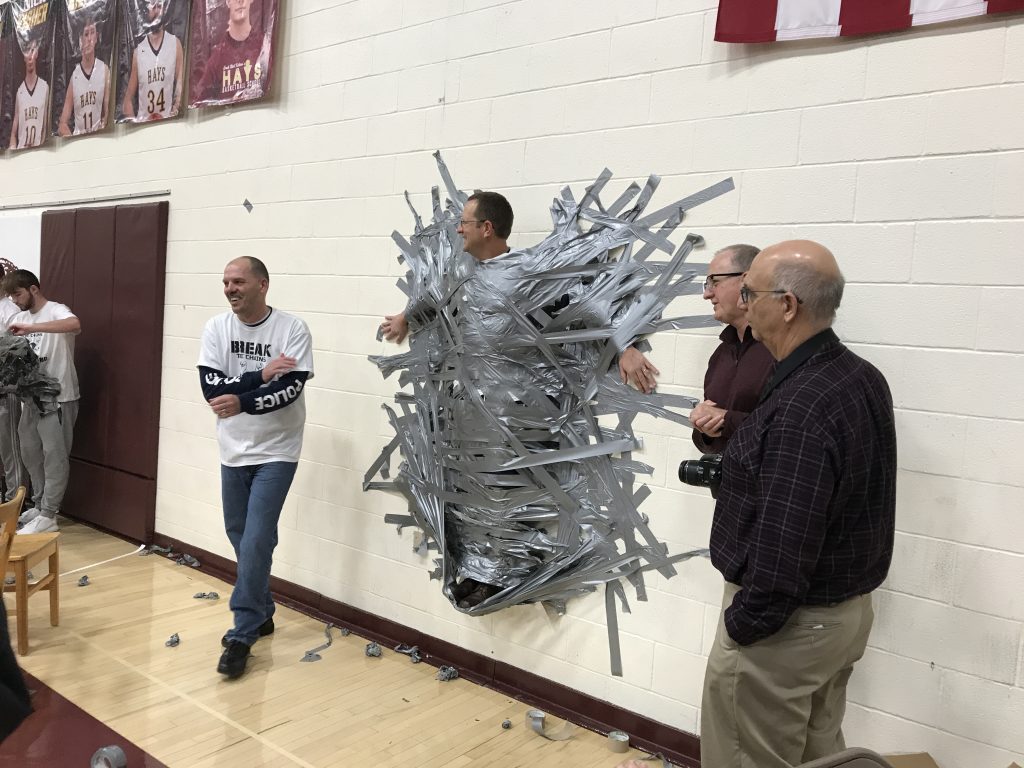
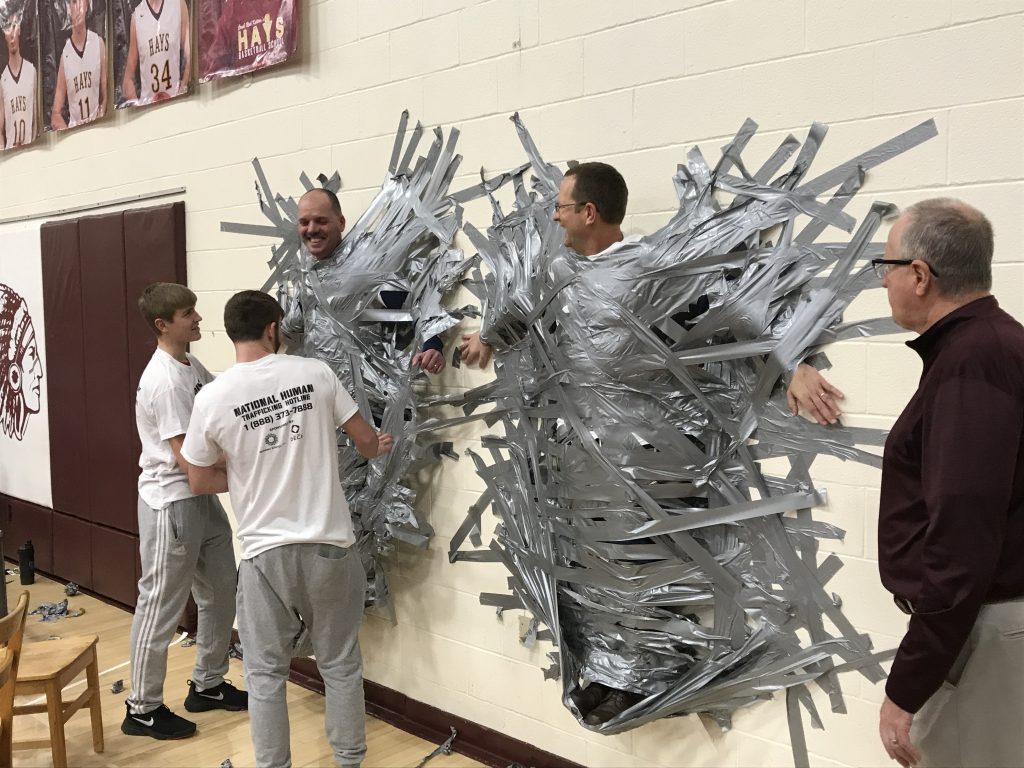
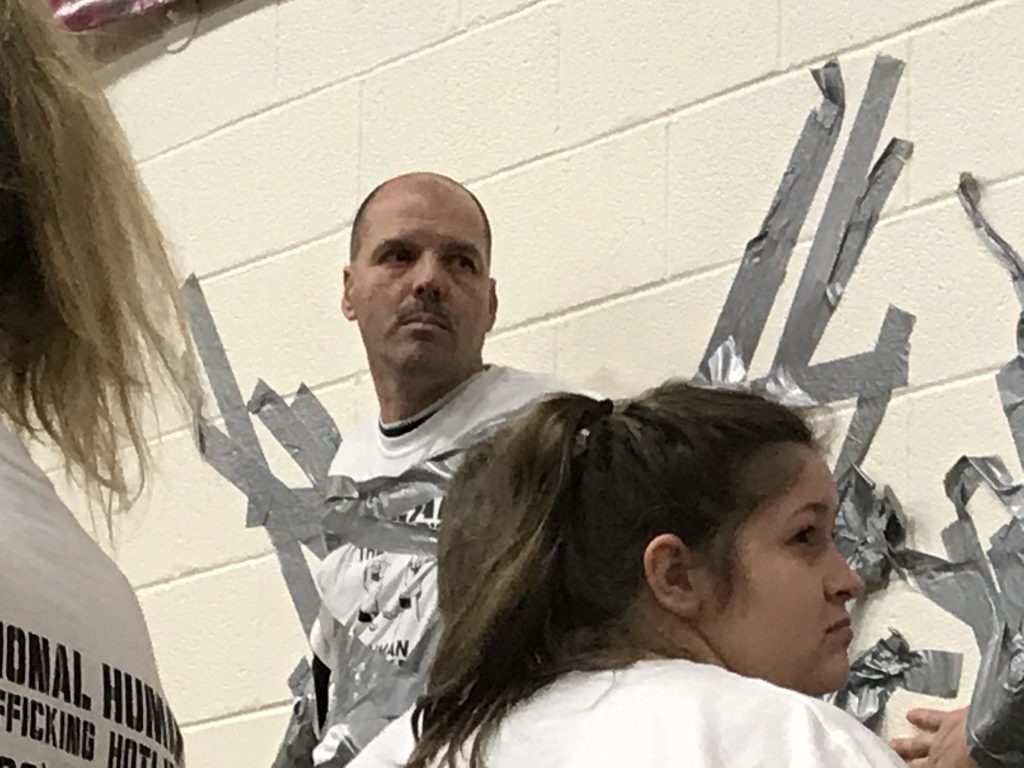
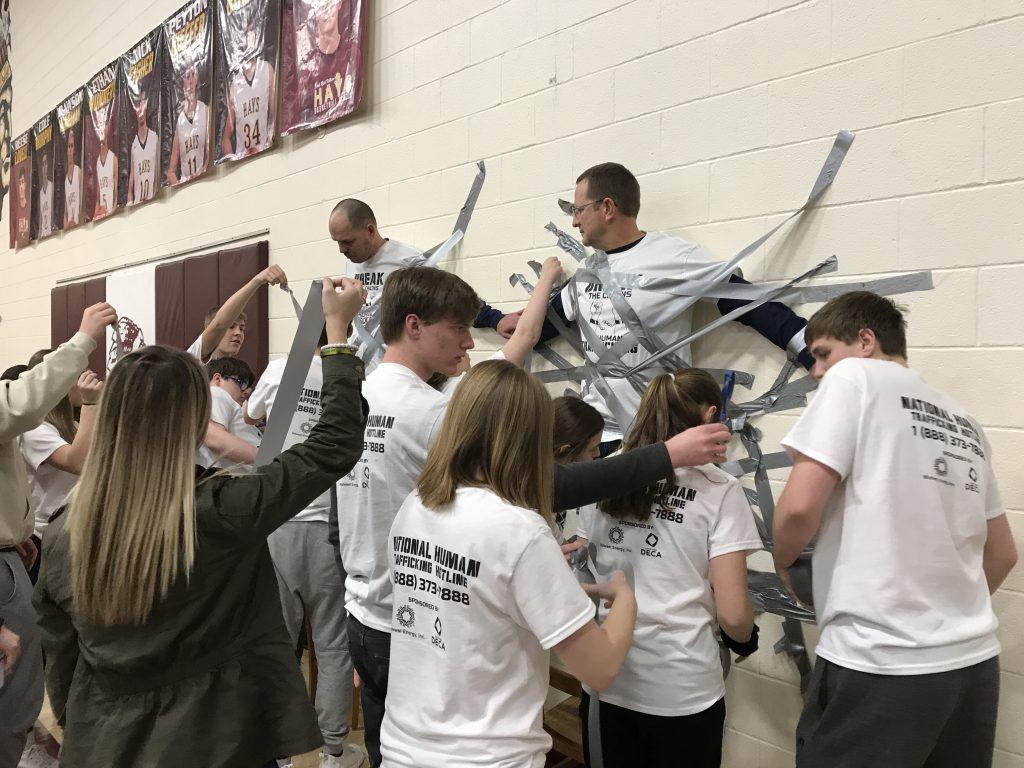
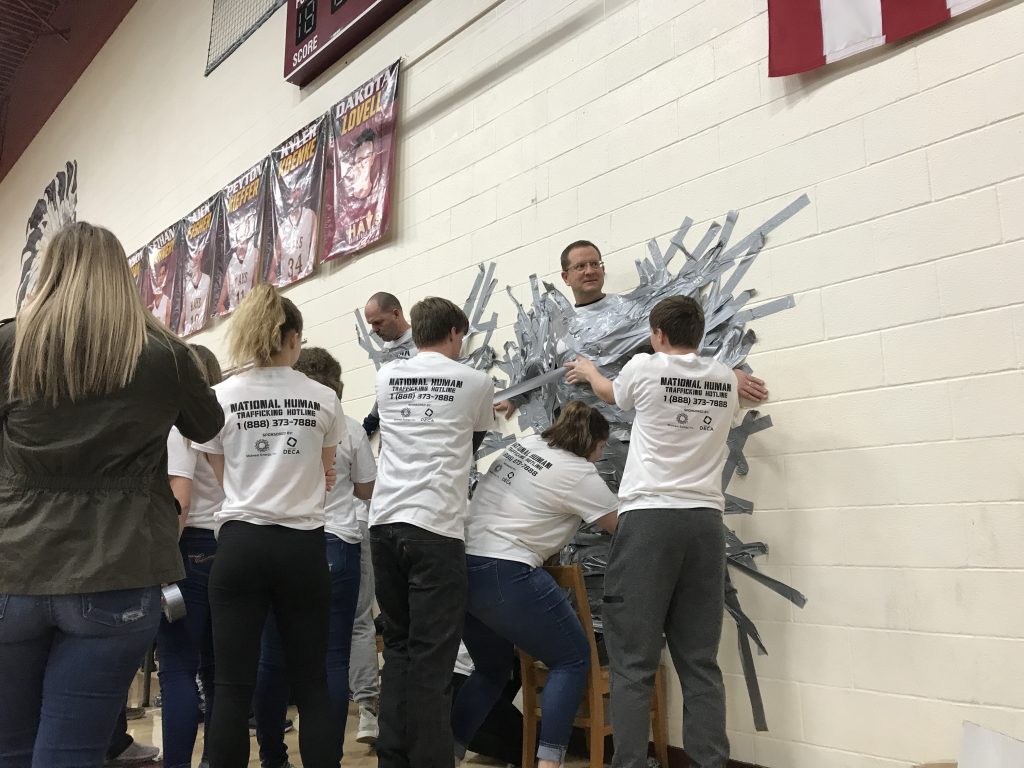
Police Chief Don Scheibler and Hays High School Principal Martin Straub hung out for a good cause on Friday.
Both of the men agreed to be taped to the wall of the HHS gym with duct tape as a part of a human trafficking prevention fundraiser.
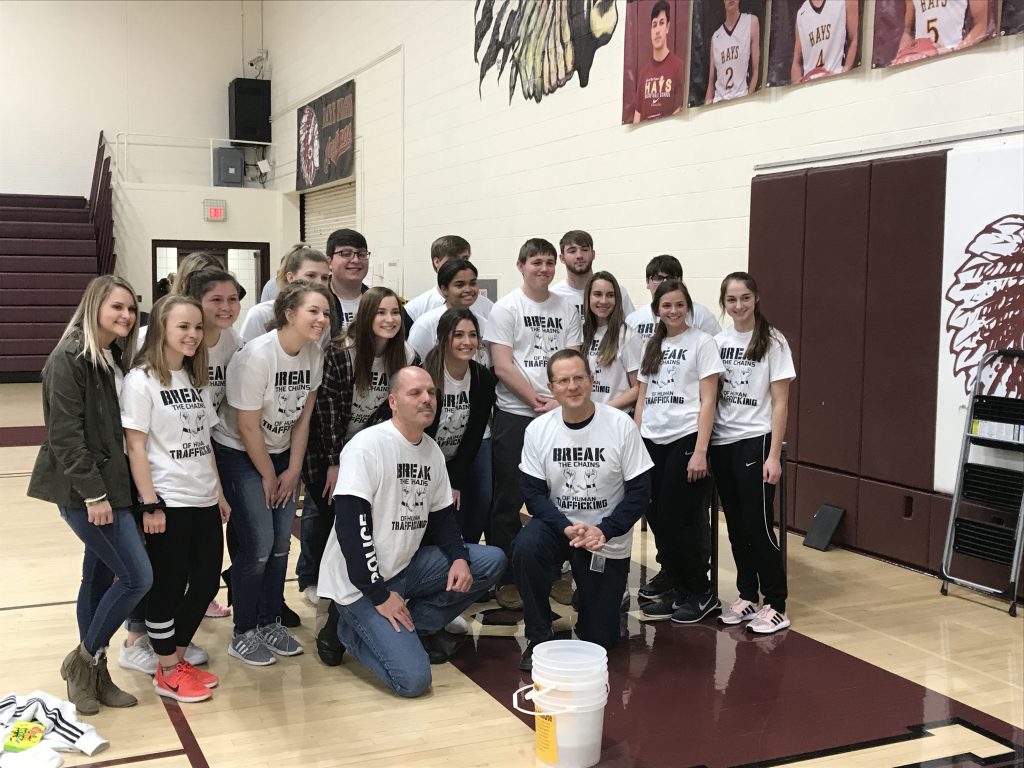
Hays High seniors Kaitlyn Schaben and Lisa Schoenberger with their peers in the HHS DECA club organized a week-long awareness campaign complete with speakers, posters and the fundraiser on Friday.
The students raised $1,500, which will be donated to Options Domestic and Sexual Violence Services in Hays.
The local Kiwanis organization supported Scheibler with a $500 donation and Auto Collision Specialists’ Mary Schoenberger gave $125 with the majority of the rest of the money coming from individual students at the high school.
Schoenberger will be attending college in Lincoln, Neb., in the fall and found through research Lincoln is a top city for human trafficking. This sparked her interest in informing her fellow students about the dangers of human trafficking.
Schaben said, “We have had some very positive feedback, and students said they did not know that went on and how easy it is to be a victim to that.”
Scheibler said the students and the local media have helped spark a discussion in the community about human trafficking.
“Human trafficking is the second largest criminal industry next to only drugs. One reason it is so successful is the high profit and the lack of information and the lack of education,” he told the students Friday. “This group and Hays High has made the city of Hays safer today.”
Straub said he received several emails from parents who said their students came home and talked about the human trafficking issue after attending one of the assemblies at the school this week.
“Whether people think this is a good or bad idea, it has let people talk about the issue,” he said. “Hopefully, it helps keep our kids safe when they leave us and go to communities where it is may more prevalent.”
Although Straub said he got rather hot being stuck in the duct tape for a half hour, he wanted to support the students.
“It is really not about me,” Straub said after he came down off the wall. “It is about trying to make a difference. We can humble ourselves and be part of some fun. I don’t think it was a thing of disrespect. I think it was a thing of fun, and sometimes we just have to have fun with the kids.”
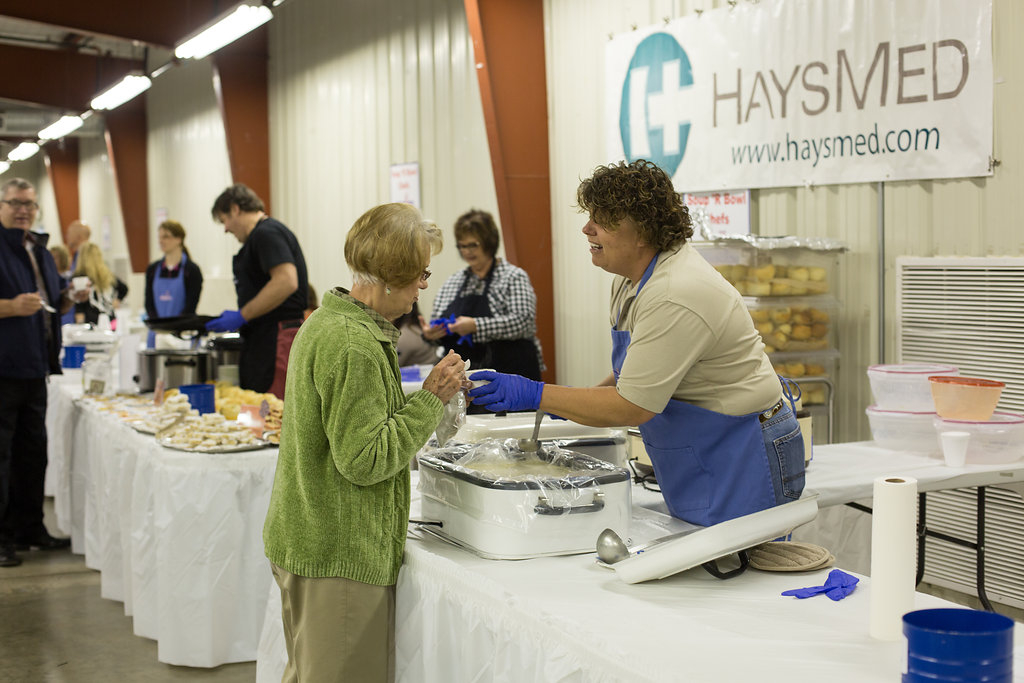
The Humane Society of the High Plains will host its annual Soup ‘R Bowl on Jan. 28. The organization is preparing for another big turnout this year as more than 600 people were in attendance in 2017. Alicia Tripler, a new board member for the Humane Society, said the event is important for the organization.
“It is the biggest fundraiser for the Humane Society every year and has become a community event that people look forward to,” Tripler said.
Patrons will be able to try many different soups and desserts made by different local organizations and businesses, as well as be entered into a raffle.
“You buy a ticket or pay at the door for admission and community organizations and businesses have someone from their company cook a soup and then you as the patron go through and try each of the soups or the ones you want to try,” Tripler said. “After you pick your favorite, you get a full cup of your soup and we give you some voting tickets and you can vote for your favorites. Whoever gets the most votes wins the Golden Ladle that year.”
The “Soup ‘R Bowl” continues to be the biggest fundraiser for the Humane Society
The Humane Society will also have membership sign-up available and donation jars around the event. With all the cooking materials and ingredients donated by the business sponsoring the chef, the organization will not have much overhead and ends up getting a good return on the fundraising.
The 21st annual Soup ‘R Bowl will be held on Jan. 28 from 11 a.m. to 1 p.m. at the Unrein Building, located at the Ellis County Fairgrounds. Tickets are $7 and can be purchased at the door or at the following businesses:
Hays Veterinary Hospital – 1016 E. 8th
Fur is Flying – 700 E. 8th
Back To Nature – 2707 Vine St.
Pet Sense – 2508 Vine St.
Barkley Suites – 2202 Vine St. Humane Society of the High Plains
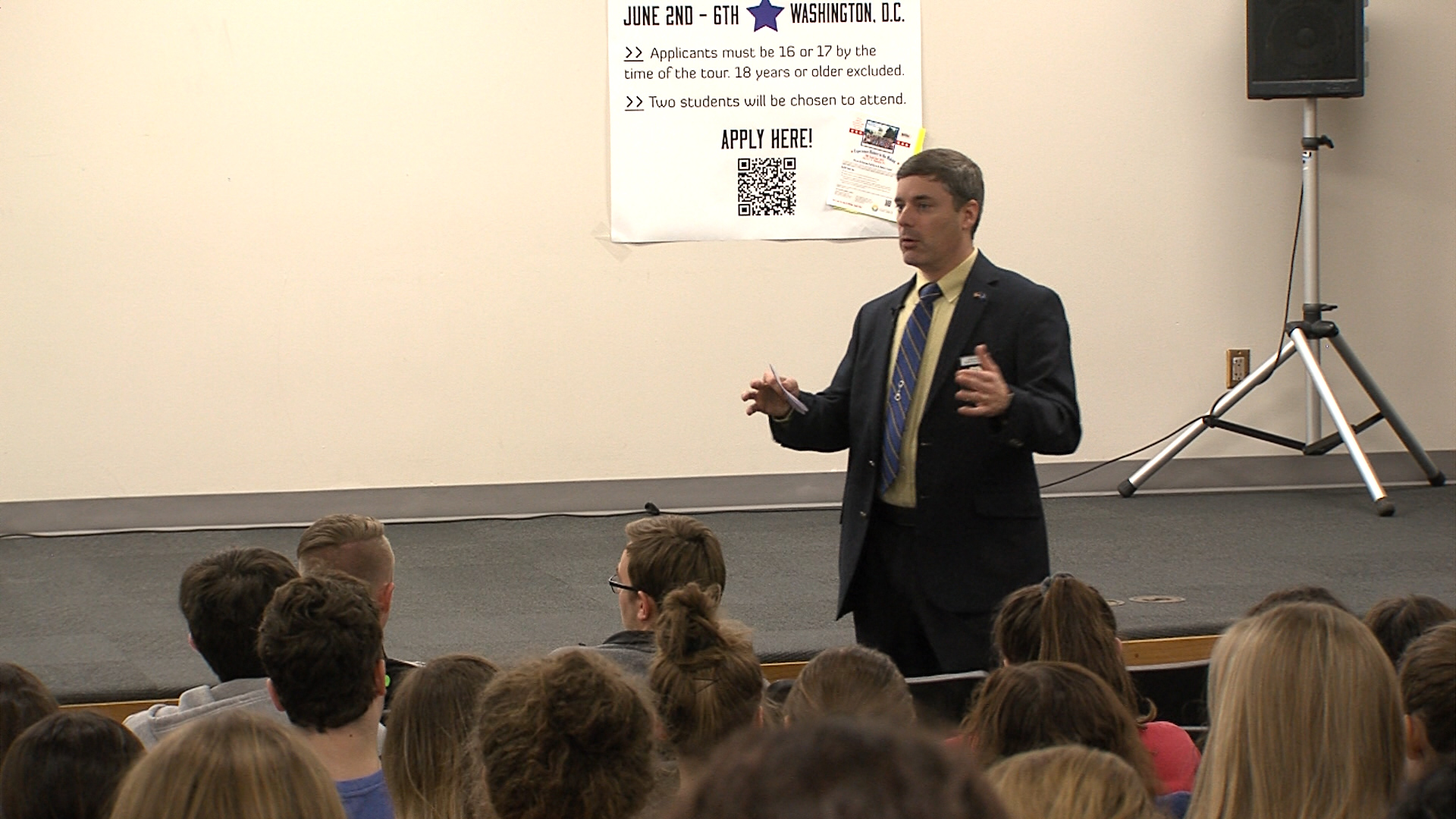
Two investigators from the Hays Police Department talked to students at Hays High School on Wednesday about attempted human trafficking in Ellis County.
The speakers were a part of a weeklong awareness project sponsored by the HHS DECA club.
HPD Investigator Jeffery Ridgway told the students about two cases of attempted human trafficking he investigated in 2015.
In April 2015, a 13-year-old girl was contacted through Facebook by a man she did not know. She accepted his friend request. Out of the blue, the man asked her if she wanted to go to Wichita with him.
“I give credit to the 13-year-old. She said, ‘You are a creeper, leave me alone,’ and contacted the police,” Ridgway said.
In June 2015, the police department was contacted by someone who had seen an advertisement on Craig’s List that offered to bring a young girl to Hays for sex. Ridgway said there was a picture with the ad of the alleged girl, who he suspected might be about 13. The person who reported the ad allowed law enforcement to use their account to investigate the case.
Local law enforcement received two more similar complaints by July 2015.
A suspect was identified in Iowa, and another suspect was identified in Ellis County.
On July 2, 2015, law enforcement found the Iowa suspect’s vehicle in the parking lot of a local hotel.
At this point, the investigation learned the suspect thought that two girls — ages 10 and 13 — were being brought from Texas to Hays for the purpose of having sex.
Ultimately, both parties were duped by a third party in another state, and the children never existed.
Ridgway said police could not take a chance there were two children being trafficked into Hays for sex.
Both suspects were charged with crimes — one attempted sex trafficking. Both suspects made plea agreements and will be serving sentences.
“My point is that, yes, we are Hays, America, but we are not immune. It can, and to some degree has, touched our community,” he said. “Are you prepared so that you are not duped into the illusion of what the human traffickers are going to make you think is on the other side? Don’t engage in the risky behavior, please, please.”
Kansas is considered a source state for human trafficking. With its central location and major highways, such as Interstate 70 and I-135, traffickers can use the Internet to target youth, sweep into the state and have a youth out of the state in hours or days.
Ridgway and Investigator Aaron Larson both said they are especially concerned with youth sexting.
Ridgway said he could not give specifics, but knows of two local active sexting cases.
His concern is youth will send pictures to a predator, and they might use those photos as leverage to get the children to do more dangerous or inappropriate things.
“Unfortunately, we have a lot of teenagers who will accept the friendship on the sole basis that it was a friend request,” he said. “It wasn’t someone they actually knew. Yep, click, I agree. It is almost if we are trying to get a tally count and the highest tally wins. But that sets you up for so much risky potential. Do you really know who is on your friend list?”
The person who is requesting the photos might not be the person who he or she says they are. They could be in another state, or they might not be the person in the picture that was sent. Pictures of youth have been used to blackmail victims. Even photos sent to a boyfriend or girlfriend could be used in unintended ways, they warned.
“Those relationships might last for weeks or months, but if you are trading photos, where do those photos go?” Larson said. “They may exchange them with someone else and now they are all over school.”
Ridgway said, “In the child pornography world, these pictures become trading cards — like you would trade Babe Ruth for Eric Hosmer. Don’t stoop yourself to the level that you become trading cards. You are better than that.”
Both officers encouraged the public if they see something suspicious online or in person to report it to police. The case in 2015 was investigated because of the tips.
Principal Martin Straub spoke to online criticism that the high school should focus on other issues, saying that if talking about trafficking keeps students safe, he is all for it. Ridgway noted high school students and even children as young as 12 are the target age for traffickers.
The DECA club is having a fundraiser for ICT SOS, which is an agency in Wichita that assists human trafficking victims. Students can purchase pieces of tape through the end of the week that will be used to tape either Hays Police Chief Don Scheibler or Straub to the gym wall during an assembly Friday. The person with the least money raised will be taped to the wall.
Brews on the Bricks, April 2, 2016, in downtown Hays
By CRISTINA JANNEY Hays Post
The Downtown Hays Development Corporation is banking on the 2018 Brews on the Bricks event April 7 to be bigger and better than ever with more tickets and more brewers.
The event hopes to have 30 brewers and 20 home brewers compared to 20 breweries and 14 home brewers last year, Sara Bloom, executive director of Downtown Hays, said.
“We are expecting a lot more brewers this year, which means a lot more beer and a lot more beer varieties, but the event will be essentially a lot similar to how it has been in the last two years only it will be bigger and better, as it is every year. This year we have expanded the event so people can walk onto 10th Street. They can walk onto the Bricks with their alcohol and enjoy the food trucks. That will help with the crowd, and we are very excited for that.”
After speedy sell outs in its first two years, organizers are increasing the number of tickets available. There will be 250 VIP tickets available, 1,000 general admission tickets available and unlimited designated driver tickets available. VIP tickets will be $75 each, general admission tickets will be $38 and designated driver tickets will be $10.
“We are really excited to bring such a large event to the heart of our downtown,” Bloom said, “and we hope to continue the great tradition we have started with the event.”
VIP ticket holders get a full-size glass beer stein and a sampling glass to use during the event. VIP participants get an invitation to sampling of the home-brew competition, which will be in the new Downtown Pavilion, and entry into the event earlier from 12:30 to 2 p.m.
The VIP tents will have food stations to pair the different beers with. It will not be a sit-down event this year, but Bloom said she hoped this will be a more relaxed atmosphere during which VIPs will have more time to sample beers and paired foods.
General admission participants get a sampling glass and three hours of sampling. General admission is open 2 to 5 p.m. designated driver attendees get a plastic cup, which says ‘Don’t serve me. I’m the DD.’ The DDs can use their cup to get root beer, cream soda and water.
“They can still go and enjoy the event with their friends, and of course not partake in the beer, and make sure their friends are getting home safely,” Bloom said of designated drivers.
The tickets for the event will be sold in several lots to give people more opportunities to get tickets. Last year tickets sold out in 11 minutes.
The first set of tickets (200 general admission tickets and 100 VIP tickets) will go on sale at 8 a.m. Thursday, Feb. 1 at the Downtown Visitor’s Center, 106 W. 12th St. All but 200 of the remaining tickets will go on sale at 9 a.m. online at downtownhays.com.
At 11 a.m. Feb. 1, 100 tickets will go on sale at Gella’s Diner and Lb. Brewing Co. and another 100 tickets will go on sale at 4 p.m. at Defiance Brewing. Ticket purchases are being limited to four at a time.
“We want to make sure as many people as possible get to enjoy this event with us,” Bloom said. “By staggering it out, we are hoping a lot of people will have opportunities to buy those tickets. Plus it gives the brewers and breweries that support this event a little exposure as well.”
The deadline to enter the home-brew competition is 4:30 p.m. Friday, March 23. More information on the contest is available on the Hays Downtown website.
For brewers this year, Downton Hays is offering a free hotel room if they are coming from 150 miles away or more.
Any licensed food vendor has been invited to participate in the event. In the past, the event has featured Slater’s Pizza, Gella’s and Joe’s Redneck Grill. Vendor forms are available on the Downtown website.
“As far as the event goes, it is still going to be a lot of fun, a lot of brewers, live music, lots of great foods, lots of food vendors, and we are excited to bring it back downtown,” Bloom said.
Eagle Communications and 8th Street Liquor are sponsors for the event.
For many, sex trafficking seems like a far-away problem — something that happens in another country or a big city, but a Kansas advocate for trafficking victims says it happens in Kansas too.
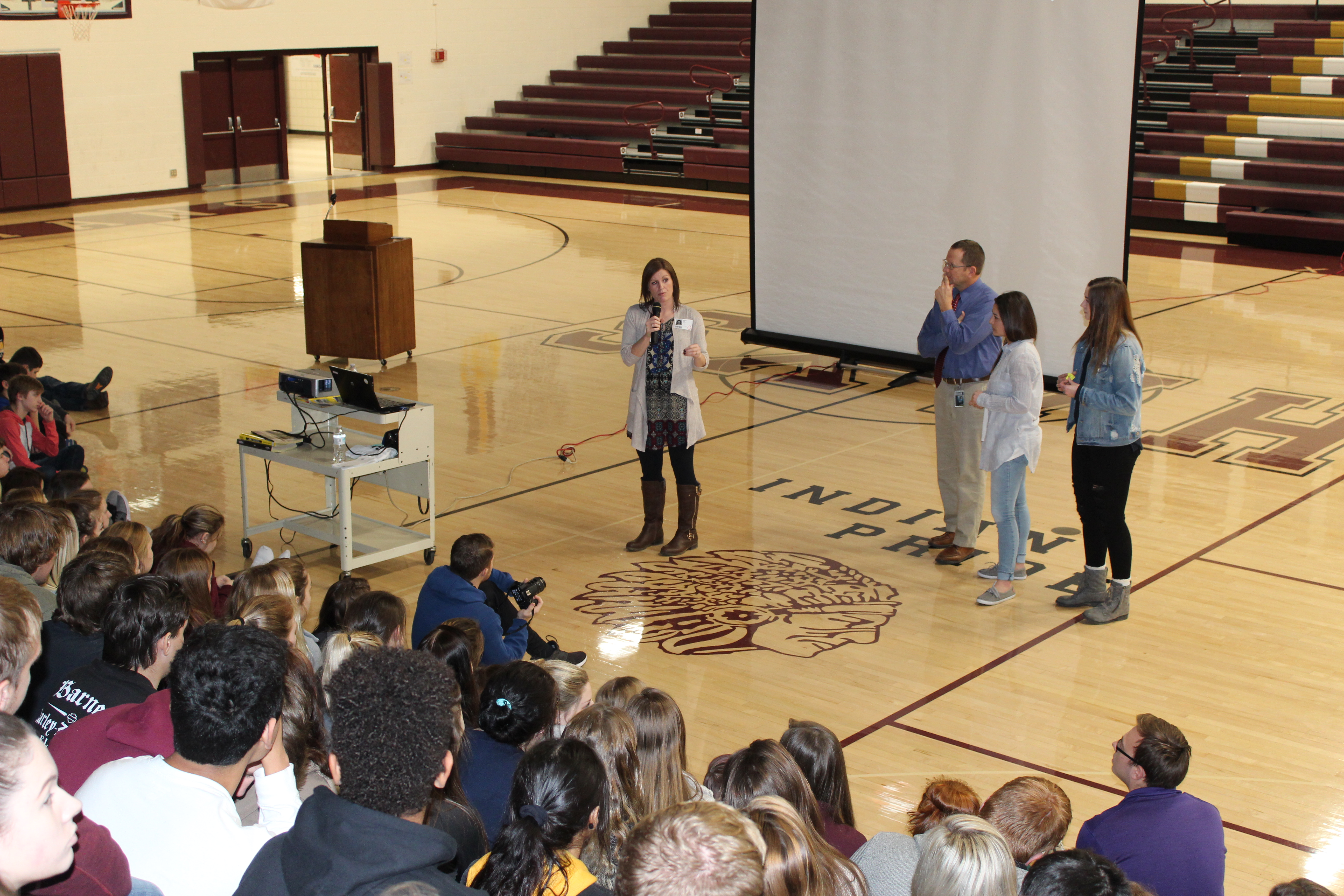
Jennifer White, executive director of ICT SOS, talked to Hays High School students Monday about human trafficking as a part of a weeklong awareness campaign sponsored by the school’s DECA club.
ICT SOS was created in 2011 after two local high-profile sex trafficking cases were covered by local media. Victims in that case were close in age to White’s own daughter, who was 12 at the time.
“Reading that article and realizing that this kind of activity was happening not only in my community, but to kids that were the same age as my kid, was really what gave me what I call a gut-check moment,” she said.
The national average for children becoming victims of human trafficking is 12 to 14 years old. In Wichita, ICT SOS typically sees victims in the 14- to 17-year-old age range. Although most of the victims ICT SOS deals with are girls and women, men and boys are also trafficked. The rate of sexual violence among girls is one in four. For boys, it is one in six.
White said almost none of the cases of human trafficking ICT SOS deals with are kidnapping cases. Most of them involve a friend, boyfriend or family member.
“This is not a stranger-danger crime,” White said. “This is a situation where someone is building a relationship. They are gaining trust. It is a gradual thing. It is manipulating. It is talking someone into taking one step, and then the next step and then the next step.”
Predators often target youth who have difficultly feeling as if they belong. It may be a child who is in foster care or is experiencing abuse at home.
“We all want to belong to something — a sports team or choir or band or whatever that is — our family, our church,” White said. “There are so many people who don’t believe they belong anywhere, and that’s who traffickers prey on. They figure out what that vulnerability is for kids, and they try to be what the kid needs if that is a father figure, if that’s a boyfriend or girlfriend or a friend to listen to them.”
Almost every case ICT SOS now sees involves the internet. It might be recruiting on the front end with social media or advertising on the back end for prostitution.
“As sad and as sick as it is, you can order a person like you can order a pizza,” she said.
She urged the students if they receive a messages through Facebook from people they do not know to block and delete them. Law enforcement subpoenaed the social media records for one human trafficker and found records of 250 women and girls he was talking to on social media.
White said the relationship between a human trafficking victim and their pimp might be similar to a domestic violence situation.
“It’s that same kind of honeymoon phase,” White said. ” ‘Oh, I love you. You are the greatest thing in the world,’ and then it switches to, ‘You are so stupid. No one is ever going to want you. Do you know what you’ve done? No one is ever going to love you. But I love you, I think you are amazing.’ ”
Some youth may fear seeking help, because they are afraid they will be in trouble for what they have done.
In Kansas, minors involved in the sex trade, such as prostitution, stripping, escorting and pornography, are automatically considered victims because it is assumed they do not have the ability to consent, White said.
Kansas is considered a source state for human trafficking. Youth are recruited in places like Wichita, and traffickers use major highways like Interstate 135 or I-70 to move the youth to other states.
Trafficking is highly under-reported, so it is difficult to get solid statistics on its prevalence, White said. The number of cases in Wichita has been steadily increasing — 81 for 2016. These are only victims who are minors, and 2017 figures are not yet available. White said law enforcement believes the incidents of trafficking are not increasing, but awareness is resulting in more victims reporting it and getting help.
“It is a conversation we have to be having because it does happen here, and when we don’t talk about it, it lives in the secrets,” White said. “It is very important that we are talking about it and talking about it accurately.”
ICT SOS works to assist victims of human trafficking, but it also has a prevention effort that seeks to end human trafficking in Wichita and across Kansas.
“As community members, we feel if we can get out in front of it and we can stop it from happening to the kid, that is ultimately what is better,” White said. “It is great to have all those restoration pieces in place and being able to help someone on the back side of this, but if we can keep this from happening in the first place, we feel that is where we can have the greatest impact.”
White listed a number of ways youth and adults can help ICT SOS or help in their own communities.
ICT SOS takes a number of donations for its partner agencies that are used when agencies interact with trafficking victims or youth who are at risk of becoming trafficking victims. These include individually wrapped snack items, hygiene items and warm clothing like hoodies, sweat pants or socks.
“We had a girl come in the (homeless youth) drop-in center a couple of years ago who was about 14 or 15, and she was hanging around with a guy the staff knew to be a pimp in the area. They said, ‘You are a smart kid, why are you running around with this guy?’
“The thing for her that meant he loved her and he was going to take care of her and he was her protector was that he taught her to wash and condition her hair properly. … This girl had not had anyone who had invested enough in her to teach her how to take care of her hair, so those hygiene products coming form a safe place might have made a big difference.”
ICT SOS does Fresh Start Bags with hygiene items and clothing for abuse or neglect victims. White said children who law enforcement see now at 6, 7 or 8 are more likely to be victims of trafficking when they get older.
ICT SOS also has a program to help trafficking victims get tattoos removed or covered up. Often trafficked victims have tattoos of their pimp’s name, a gang name or symbol, or a street name. This can be dangerous for the victim and it is a constant reminder of a life they are trying to leave behind.
Besides donations to programs like ICT SOS, youth and adults can work in their own communities to help prevent human trafficking by serving as a mentor to younger children.
“Whether it is this issue or hunger or poverty or whatever,” White said, “it starts with caring about other people. So whatever that issue is for you, figure out what that is and figure out how you can help.”
The Kansas Legislature has been charged with increasing school funding by as much as $600 million, but local legislators say that may be a painful process considering the current economic climate in the state.
The 2018 session starts today.
The Kansas Supreme Court ruled in October state funding for schools was inadequate despite the Legislature increasing school funding by $293 million over two years.
The Legislature also increased income taxes during the last session to close a budget gap created by Brownback-backed tax cuts.
Local legislators said this 2017 tax increase plus an upcoming election in November means it is unlikely a tax increase to finance schools would pass.
Rep. Don Hineman, R-Dighton, said raising taxes now would not only be very difficult politically, but harmful to the economy.
Rep. Ken Rahjes, R-Agra, did not vote for the tax increase last session and said he would not support one now.
An interim legislative committee has been meeting to try to address the funding issue.
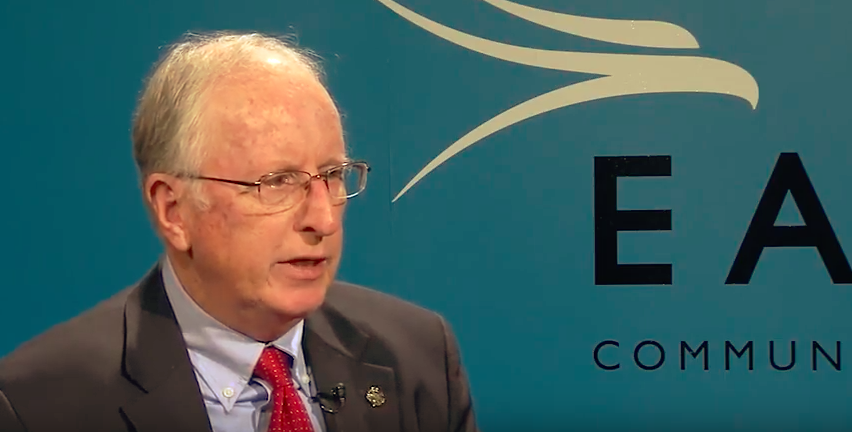
Rep. Eber Phelps, D-Hays, said in an interview for Eagle Communications’s Forum with Gary Shorman, he did not think the committee was making good progress.
“What I think they are really struggling with right now is trying to respond to the court instead of attacking the court,” Phelps said.
“So the court ruled that our formula is unconstitutional. They also questioned the amount of money that is going in for base state aid or the overall budget for education. I think rather than try to work to a solution on that, I think this committee that has been meeting has been spending a lot of time hammering the court. I don’t know if that is going to be productive. I don’t think it is.”
He said the state may be able to draw from increased revenue to fund schools.
The state has seen revenue increases beyond estimates in each reporting period for the last four to five months
Phelps said he hoped the court would allow the district to address school funding in a three-year plan.
“I think we are going to be pretty close to $200 million that we can infuse into education, and it may be more than that. As they have tried to guess, they have been surprised,” Phelps said of the revenue increases. “I think if we can do $200 million each year, that would be $600 million over a three-year period.”
If all of the estimated $600 million had to come from the existing state budget, the state estimates that would equal about an 18 percent across-the board cut to all other state-funded programs. The interim committee heard state agency reports on this scenario.
Hineman said, “The picture that emerged was pretty depressing. I think that it is apparent that no one wants to be responsible for cutting other agencies to that extent.”
If there needed to be cuts to other agencies to fund schools, he said he would prefer to see them done by department rather than across-the board. Hineman said he too supported a phased-in funding increase for schools and also hoped revenue increases would help meet the court’s demands.
However, he said the state can’t rely on increases in revenue alone to deal with the school finance issue. The state’s major industries—oil and gas, agriculture, and aviation—remained depressed.
There has been discussion by the legislators about trying to pass a constitution amendment that would limit the court’s power on school finance. That would require a two-thirds vote by both the Senate and House and a majority vote of the public.
Hineman said he thought it was time to have the discussion. However, he noted it would be an uphill battle to get anything passed.
“The people of Kansas and legislators have a high regard for public schools,” he said. “We want to see our students adequately prepared for their futures, but we have other obligations too. I don’t want to short change other departments by 18 percent. That is really not responsible government. That was not what I was elected to do.”
Rahjes also said he would be willing to discussion a constitutional amendment, but added he would have to review language before he would support it.
“Messing with the constitution is not something to be taken lightly,” he said.
Rahjes said he wanted to see local school districts, especially those rural schools in western Kansas continue to have a voice in the debate.
“The key to a successful economy and state is a strong education system, but we have to make sure the people and the taxpayers are being served well and we are being good stewards of their money,” he said. “We want to continue to engage parents and citizens and school boards and administrators. We all want what is best for students. We may have a different route to get there, but if we continue the conversation, we will get there.”
The Legislature has until April 30 to respond to the Kansas Supreme Court on school funding.
With a killer on the loose and two people discovered murdered in a rural home near the hamlet of Penokee last Thursday afternoon, an all-points-bulletin for Efren Mascarenas Jr. , 29, quickly went out in Graham County and the surrounding area. During the course of that search the focus soon zeroed in on northeast Graham County, southwest Phillips County, and Logan.
Mascarenas, who had been in the custody of the Kansas Department of Corrections from 2011 through 2017, had previously had a number of run-ins with the law including three aggravated battery convictions that sent him to jail, and over 30 citations for disciplinary infractions while behind bars. Reported to be armed and dangerous, law enforcement was advised to approach him with extreme caution.
The murders of his father, Efren “Lloyd” Mascarenas Sr., 52, and step-sister, Christin Cantrell, 28, were called in to the Graham County Sheriff’s Department around 3:30 p.m. on Thursday.
After the discovery of the bodies, Mascarenas Jr. soon became a suspect, resulting in Graham County Sheriff Cole Presley issuing a warning to rural residents to shelter in place and to lock their doors until further notice.
On the lookout for a blue Dodge Charger belonging to one of the victims that he was reported to have escaped in, before long the sheriff’s departments in Phillips, Rooks, and Norton counties became involved, along with the Hill City Police Department, the Kansas Bureau of Investigation and the Kansas Highway Patrol.
As the manhunt escalated, a Charger that had rolled on a county road in far northeast Graham County was found a stone’s throw from the Norton/Phillips/Graham county line intersect.
During this time, information had also developed that Mascarenas might have a relative residing in Logan, causing concern he might be heading there and resulting in a heavy law enforcement presence descending upon the town and on towards the southwest where the vehicle had been located.
Logan, an extremely tight-knit community, became somewhat of an armed camp as local residents and area farmers formed an ad hoc protective force.
As the search continued schools were locked down in Graham County.
With the search focusing on the area surrounding the wrecked vehicle, the suspect was eventually found dead in a nearby field, with a gunshot wound to the head that authorities say appears to be self-inflicted.
The KBI reports that the case continues to remain under investigation.
RUSSELL – The Deines Cultural Center’s next exhibition David Olson: Paper Perspectives opens on Friday, January 12th, 2018. Join us for the opening reception from 5-7pm.
David Olson cuts and folds paper to create sophisticated wall sculptures.
A Salina native, Olson graduated from Salina High School – South. He later earned a Bachelor of Arts degree from Bethany College in Lindsborg, Kansas, a Master of Arts degree from Eastern Illinois University in Charleston, Illinois and a Master of Fine Arts degree from Southern Illinois University – Carbondale in Carbondale, Illinois.
David Olson
Paper Perspectives will be on display in the Deines Center’s south gallery from January 12th through February 16th, 2018. Admission is free and all are welcome.
Raj Sharma (r) and Srujan Vusi (l) of HKHR Hospitality Corp. of Hays, announced plans Friday to build a La Quinta hotel in northwest Hays. The group will also remodel and rename Motel 6.
By BECKY KISER Hays Post
HKHR Hospitality Corp. of Hays announced Friday afternoon it will build a new urban design La Quinta Inns & Suites four-story, 81-room hotel immediately west of the closed Golden Corral restaurant (soon to be remodeled as an Old Chicago pizza restaurant and taproom.)
Partners Raj Sharma, Hays, and Srujan Vusi, Oklahoma City, said their group has also purchased the Hays Motel 6, which will be renovated and become the independent Hays Tiger Inn. The name change will become effective Jan. 18.
“Hays is a good community, a growing community,” Sharma said. “I think the new hotel will be an added bonus. So far, the city and the people of Hays, anyone we’ve asked for help, have always been willing to help and welcomed us with open arms.”
HKHR, whose investors include a Hays doctor, has been working on the La Quinta project for nearly a year. The group owns the land on which the hotel will sit. They anticipate a groundbreaking in May and a grand opening in April, 2019. “We have our construction folks all lined up,” said Sharma.
The Hays La Quinta Inn will be 4 stories with 81 rooms.
Sharma said they had to negotiate with nearby Walmart which “was gracious and helped us out. If you plan to build close to Walmart, they restrict you to three stories.” “It took about three months for them to release us from that restriction, so it will be a four-story hotel,” explained Vusi. “Our engineer contacted them and they were open to waiving the height restriction,” Sharma added.
According to the group, Hays will be the only town in western Kansas to have the La Quinta Del Sol design, featuring a “huge loft-look lobby.” The only other such contemporary La Quinta in the state is in Wichita.
They also noted the hotel will be “pet friendly.” “That’s something our travelers are always looking for,” said Melissa Dixon, executive director of the Hays Convention and Visitors Bureau.
The news conference was held at the Hays Welcome Center, home to the Ellis County Coalition for Economic Development which has worked with HKHR to move the project forward.
Asked if the group will ask for any financial incentives from the city, Sharma answered, “We value taxpayer dollars. We know other hotels have approached the city and received a CID (Community Improvement District). That’s the one place I think Hays taxpayers are not losing money. I think that we’ll be open to asking about a CID but that’s not going to restrict us from going ahead with the project.”
They noted Equity Bank of Hays is involved in the financing of both projects. “Very helpful, and we thank them,” they said.
The Hays Motel 6 will be remodeled and become the independent Hays Tiger Inn.
The economy-price hotel will retain its 87 rooms and most of its current employees. “I met with them and most of them (currently employed at Motel 6) want to stay,” Sharma said. “I think they’re excited about the transition and the changes they’ll see.”
The investment group has talked to Red Roof Inn about a potential franchise agreement. “If there’s no value by adding the franchise, we won’t add it,” Sharma said. “We’re remodeling according to the Red Roof Inn standards,” Vusi pointed out, “but we’re not going to take the Red Roof franchise as of right now.”
More than 50 people will employed between the two hotels. “It’s going to be added jobs in the local economy,” Sharma said.
A Wichita-based developer recently announced plans to build a 100-room Hilton Garden Inn and convention center immediately west of Walmart. Vusi and Sharma aren’t worried about the competition. Their group actually first talked with the Ottley Addition landowner, Mark Ottley, about purchasing his land.
“We started the conversation with Mr. Ottley way back, but location and timing didn’t work out in our favor,” said Sharma. “We’re fine with it. It’s two different concepts. I think it will add revenue to our site as well because if somebody is coming to the convention center, we’ll be the first hotel they come to. They might want to stay at the La Quinta.” “It’s positive news that we’re both here,” added Vusi.
HKHR is currently building a Marriott property in Wichita, according to Vusi.
Sharma attended the University of Kansas and has lived in Kansas for 17 years. He is employed by Hays USD 489 as the Director of Special Education for Hays-West Central Kansas Cooperative, which includes Ellis USD 388, La Crosse USD 395, and Victoria USD 432.

 By BECKY KISER