Category: Featured
Teacher of the Month: Roosevelt educator seeks to spark ‘ah-ha’ moments


By CRISTINA JANNEY
Hays Post
Suzanne Leikam is always looking for that spark in her students’ eyes — that moment when she knows they finally grasp a concept.
It is her mission and what has driven her for the last 23 years as a teacher, 20 of which have been at Roosevelt Elementary School.
Leikam was selected as the December Hays Post Teacher of the Month.
“There are many wonderful aspects of teaching,” she said, “But one of my favorite is what I call the ‘ah-ha’ moment. It’s the time when a student has worked really hard to understand a concept, and they finally get it. There is a great satisfaction seeing the confidence they gain at that moment when their hard work has paid off and they feel that sense of accomplishment.”
She explained that moment.
“It is like a light bulb going off, and you know it. Their eyes light up, and sometimes they go, ‘Ah-ha, I got it!’ You can see they brighten up. I feel great for them because they have worked so hard to figure it out. They went through each strategy and tried to work it out. Then when they finally find something that works for them, they say, ‘Ah-ha!’ and it makes you feel great. Look, see what happened. You worked hard, you were persistent and you figured it out, and you did that on your own.”
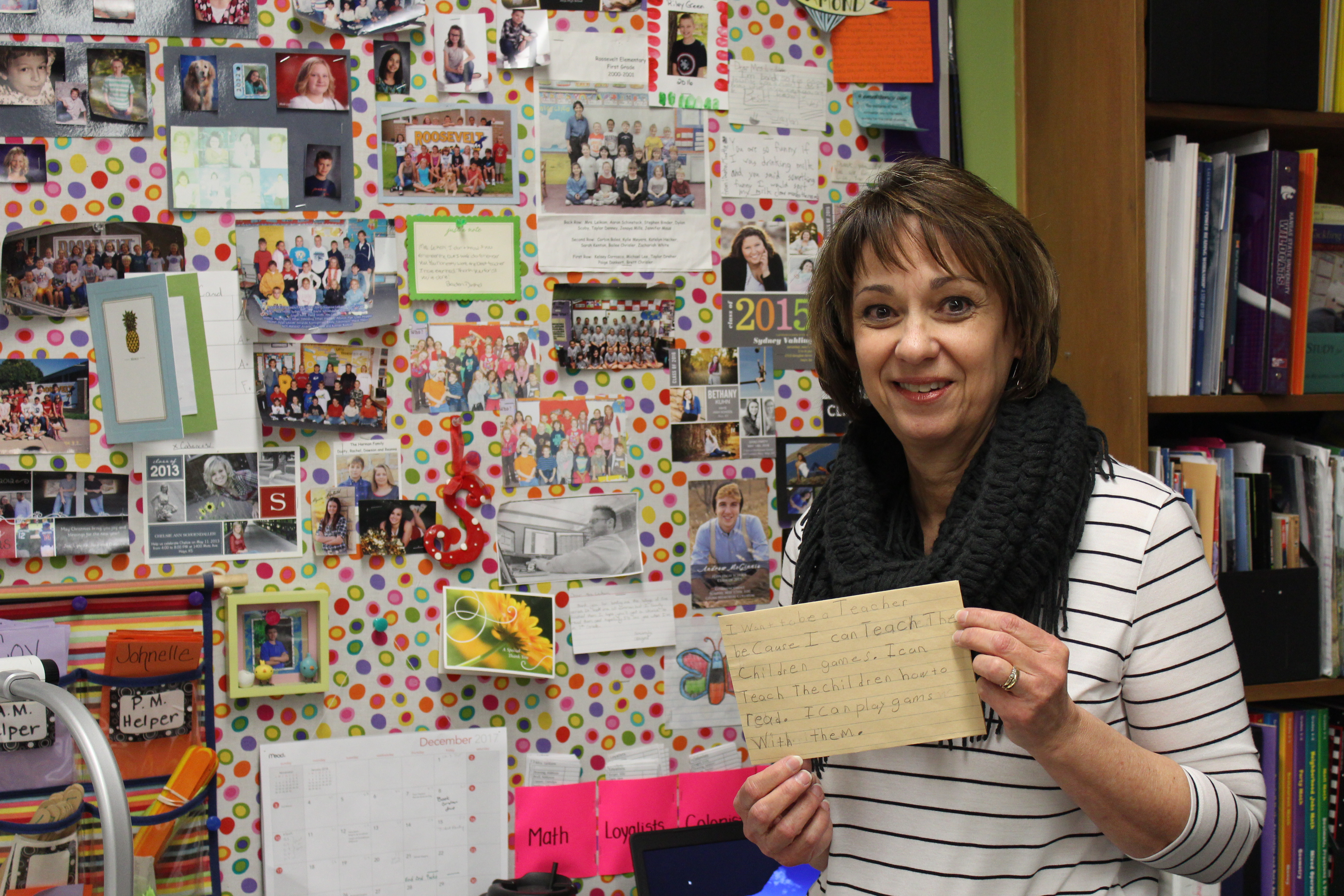
Leikam’s path to becoming a teacher was similar to her students’ struggles with math problems and history. Leikam, 57, knew she wanted to be a teacher from an early age. She has a piece of yellowed Big Chief paper stuck to one of her file cabinets that she wrote when she was in second grade.
In large printed letters it says, “I want to be a Teacher beCause I can Teach The Children games. I can Teach The children how to read. I can play gams With them.”
She said she had mentors along the way who helped her realize she was a good student.

“Because there were times that I felt that I wasn’t the smartest one in the class,” she said, “and then you have those teachers who nurture you and build up your confidence and they make you realize, ‘Oh, yeah, I can do this.’ That’s the kind of teacher I want to be as well.”
Mr. Zwink in seventh and eighth grade showed her she was capable as a student, and Roger Ruder, her high school history teacher at Marian High School, sparked her interest in history.
“(Mr. Ruder) was the one who lit the spark for me,” she said. “It was the way he taught. He would attach little stories to information we needed to know. That helped me remember the information.”
However, life intervened. Leikam got married and had a family. She went to work for Roosevelt, but as a secretary. Finally, the “ah-ha” moment struck her. She was in her 30s, and she was teaching second-grade religion courses for St. Mary’s Immaculate Heart of Mary. She enjoyed the experience so much she enrolled in the education program at Fort Hays State University.
Going back to school was difficult, but Leikam said she appreciated school more as an older student.
“It was bittersweet,” she said of going back to school,” she said. “When I went back to school in my 30s and saw these 18-year-olds and they were in a place where I was just getting to in my 30s, I said, ‘Wow, I have wasted so much of my time, but it took me a while to figure out what I wanted to do. … Once I got my mind set on something, I got really focused on what I wanted to do.”
Leikam has worked with every level of elementary student and said she each grade has its pros and cons.
She loves kindergarteners’ innocence and honesty.
“If I wore something that didn’t look good on me, I had a little girl who would say that didn’t look very good on you,” she said. “They would work very hard for me.”
Fifth-graders, which she teaches now, are more independent.
“The reason I chose to work with elementary students is their infectious love of learning,” she said. “At this age, students are still idealistic and every day is a new day of wonder and excitement about something they have learned.”
Leikam seeks to prepare her students for what they will learn later in school.
“I make the comparison between elementary school and the foundation of a house,” she said. “You need a solid foundation to support the rest of the house and that is how I view teaching elementary students. What we teach the students at this age is the foundation of their education to be built upon each year. As elementary teachers, we are also very aware that we set the tone for how our students view school and their attitude toward learning.”
Leikam not only tries to help prepare her students academically, but socially and emotionally as well. She said it is the most challenging aspect of being a teacher.
At one time, only a few of her students came from homes with divorced parents, and now it’s at least half. During her years of teaching, she has had to deal with children in poverty and who have been homeless and many other situations Leikam said children should not have to deal with.
“We have to be good listeners,” she said. “When they come in and they just need someone to talk to and it is a release for them, I am here to listen and they know that is as far as it goes — that they don’t have to worry about me going here or there and talking about it with anyone else. Sometimes they just need to express what is going on, and if there is something that I can’t help them with, I refer them to the counselor. …
“That is probably the hardest part is when you see them at such a young age dealing with stressful situations that I myself personally have never had to deal with and yet here they are 10-years-old and they are pushing through it.”
Teachers routinely help students with basic needs, such as coats or a pair of shoes to replace one with holes in the them.
“You just try to be there to be a good listener for them and to reassure them that, yes, it is a rough path now, but things do get better,” she said.
Leikam said she hopes to leave her students with a sense that she cares for them as individuals.
“I hope to instill in them some values,” she said. “We talk a lot about respect. Being respectful to each other and yourself and especially to the staff. I try to build on that respect, and I hope that has an effect on how they treat others.”
At the beginning of each school year, she does a study of the same book, “A Hundred Dresses,” which is about bullying.
“I tell them every year that you come to school here to learn, and I want you to be safe here,” she said. “I don’t want you to worry as soon as mom or dad drops you off here someone is going to be saying mean things to you or pinching you where a teacher doesn’t see it.”
She has the children raise their hands if they have been bullied, and Leikam raises her hand. She went to a small school and played football with the boys. One of the boys pushed her down regularly. She remembers vividly one day he hit her in the chest with his knee and she lay gasping on the ground for breath.
The act of raising her own hand helps open up the discussion and allows her to talk to the children about helping others during bullying situations.
“When they ask me about me bullying, I say I am too ashamed to talk about that,” she said. “That is something I don’t even want to talk about. That was a time in my life that wasn’t very good, but I want them to understand. I ask them, ‘Why?’ and a lot of it is that they were bullied.”
Katelyn Hecker, teacher at Lincoln Elementary School, nominated Leikam for Teacher of the Month. Leikam was Hecker’s teacher when she was in elementary school and was her mentor when Hecker was a student teacher. She said Leikam is the reason she became a teacher.
“She is supportive, always welcoming, and extremely compassionate,” Hecker said. “I am so fortunate to be able to say that I started my primary education with her and completed my college education with her!”
Hecker remembered dictating a parent newsletter to Leikam for her mother. Leikam did this for every student and parent weekly. Hecker also remembered feeling special when she got to take the class fish home for the summer.
Hecker said Leikam always gave the students individual attention and she was more like a mom than a teacher to her students.
Leikam said, “Special times for me as a teacher are when I have former students come up to me and say ‘Hi’ and let me know how they are doing. As a fifth-grade teacher, there are times when I see former students who are now young adults, are taller than me, and they … drive! It’s also special when these students share a memory they have of something that we did when I had them in class. However, the most rewarding part of teaching, is when these former students tell me they have decided to become teachers themselves.
“When I think about Katelyn Hecker, my former student who nominated me, I feel my whole career in teaching has been validated.”
🎥 Commissioners: Proposed hotel/convention center is ‘win-win’ for Hays


By BECKY KISER
Hays Post
Hays city commissioners are enthused about a proposed new hotel and convention center to be built west of Walmart.
The developer, Raju Sheth of Wichita, is requesting tax increment financing (TIF) on a pay-as-you-go basis for 20 years; a community improvement district (CID) of 2.0% CID sales tax reimbursed on a pay-as-you-go basis for 22 years; and a rebate of the city’s five percent transient guest tax (TGT) generated by the project for an initial term of 20 years, subject to early termination if the developer defaults under the related development agreements.
Commissioners heard from Kevin Wempe of Gilmore & Bell, the city’s bond counsel, Thursday night about the developer’s request for financial incentives. They asked about the city’s liability.
“Part of mitigating the city’s risk would be hammered out in the development agreement. You set forth terms and conditions under which the project’s built,” Wempe explained. “You can set milestones that have certain clawbacks or conditions to the eventual rebate of these incentives.
“The rebates of these incentives won’t be turned on until the project goes live and it’s fully built out. The developer will submit a statement of completion to the city saying ‘we’re done and in service’. At that point, they’ll start proving up costs and collecting.
“Another aspect is the ‘pay-go’ aspect. The city is not actually fronting money,” Wempe emphasized, “so any reimbursement is based on collections at the site.”
This would be the first time the city extends a rebate of the transient guest tax, the extra tax paid by people staying in Hays motels. It’s normally collected to fund the Convention and Visitors Bureau for marketing and promotion of Hays.
“They’re only going to collect what they’re able to generate themselves,” pointed out Vice-Mayor James Meier, “and same goes for the CID, so we’re not losing out here.
“This is really a best-case scenario for the city where we get a great facility the city doesn’t have to maintain. All we have to do is give up the transient guest tax for it, so it’s really the best of all worlds, I think.”
“I think it’s important to emphasize we still will capture the transient guest tax at other hotels,” Commissioner Lance Jones added.
Mayor Shaun Musil said other hotel operators are excited about the new development.
“I’ve talked to some managers of competing hotels out there and they think it will bring more people to Hays. They’re smart enough to know this is not only good for these guys but also for the surrounding hotels. I think it’s good for Hays.”
Commissioner Sandy Jacobs was pleased with the detailed information in the developer’s application for economic incentives and a supplemental questionnaire, along with related project and financial breakdowns.
“It was easy to read and easy to understand. I appreciate the work done by everyone, including staff,” she said. “This is really a significant investment in our community.”

Hays Hotel and Mitra Developers intend to build a new 500-seat, 8,400-square-foot conference center and hotel west of the Hays Walmart, which would necessitate extension of 43rd Street to the west.
The Hilton Garden Inn will have 100 beds and contain a small restaurant and bar. It would employ the equivalent of about 35 full-time employees.
Ground could be broken as soon as April on the new $12 million to $14 million facility with the center opening in 12 to 14 months, according to Sheth.
A possible second phase of the project includes construction of a new restaurant and/or other commercial retail. The financial incentive application information is available here.
Commissioners will vote on resolutions during their Dec. 28 meeting that would move the project forward.
Commissioner Henry Schwaller was absent from last night’s work session.
Running for governor as independent, Kloos says Kansas at ‘pivotal place’


By JONATHAN ZWEYGARDT
Hays Post
As an independent, Rick Kloos is hoping his populist message will help him carve out a place in the already jam-packed race for Kansas governor.
Kloos, a Miltonvale-area native, has been traveling the state along with his wife, Pennie, for the past seven months taking part in parades and fairs and talking with Kansans about the direction the state is heading.
The current state of conditions in Kansas and wanting to make a better life for his children and grandchildren led Kloos, a political newcomer, to enter the race.
“Just looking at where our state’s been, you know it seems like Kansas has just been on a downslide,” said Kloos. “We’re just at a pivotal place, and I just kept saying things need to be different.”
Kloss began working as a truck driver in his teens, graduated with a degree in theology and ministerial studies and worked for several years as a police and hospice chaplain. He also has worked in real estate flipping and selling houses.
In 2009, Kloos and his wife opened the nonprofit thrift God’s Storehouse in Topeka, which employs approximately 30 people.
Because he has been in public service all his life, Kloos said he believes as an independent he can “be about the people.”
Kloos, who has already collected the necessary signatures to be on the ballot, said when people talk about needing new leadership, “it’s leading from the bottom up and treating people with dignity, being respectful to everyone.”
“The governor’s to represent all the people of Kansas, not just a party and so, as an independent, I feel like I can branch out and do that,” Kloos said.
With almost 19 candidates already announcing their intention to run for Kansas governor in 2018, some believe it could be difficult for Kloos to gain traction as an independent, but he believes voters do not vote along party lines anymore.
“They vote on the individual and you can see that in a lot of elections that’s been happening,” he said. “People are really looking at that individual to see what that person will bring by policy and what their values are.
“If there is ever a window of opportunity for an independent, it’s right now,” said Kloos. “I really believe as an independent I can truly represent the people.”
He also pointed to this past legislative session, which was more than 110 days, as an example of the two sides being so far apart.
“Now you’ve got people that are so hard to the right (and) so far to the left, people are really just looking for balance,” Kloos said. “There used to be a time where we could just agree to disagree and now it’s craziness, and it just seems like there’s so much conflict.”
With a number of issues facing Kansas lawmakers in 2018 and beyond, Kloos said that being a political novice means he will have to lean on others.
“That’s what’s good about being independent, as well, because whether they are from a party or not from a party, I will be able to choose the people that’s going to move Kanas forward,” he said.
Kloos said it’s also about empowering the right people to make Kansas’ entities successful. That includes teachers in support of education and prison staff — both of which will be important topics in 2018.
Kloos’ campaign has adopted the theme of “Keep Kansas Home.”
He said it is important to the future of the state that when kids graduate they choose to stay in Kansas.
“It comes down to people feeling welcome, us offering something to Kansans and those that are considering to move to Kansas,” Kloos said.
He said lawmakers can offer incentives to draw people to Kansas, especially smaller communities where the populations continue to decline — but it is going to take time.
“We’ve got to be realistic in our outlook. We didn’t get like this overnight. It’s not going to change overnight.”
He also said one of the responsibilities of the next governor will be to restore confidence in the office because people do not have a positive opinion of all levels of government.
Kloos said working in a bipartisan way will help, as well as not making promises that can’t be kept.
“I’m going to do my best for the people of Kansas but there’s a lot of things that we’ve got to adjust and we’ve got to work hard at,” he said. “I will promise this: I’ll do my best and try to represent the people of Kansas to the best of my ability.”
Tompkins, Mason make passing the reins at Fort Hays State a smooth ride

FHSU University Relations and Marketing
His entire adult life has centered on providing service to others. So it was no surprise when Dr. Andy Tompkins said “Yes” to a job offer a year ago for a position he had never even dreamed of pursuing.
Now after a whirlwind year as interim president of Fort Hays State University, Tompkins is retiring – again.
Tompkins’ last day in his office on the third floor of Sheridan Hall was last Thursday. He admits that when he walked out that door for the last time, he took with him a lot of memories, more than he could have ever imagined.
Tompkins also paved the way for a smooth transition for Fort Hays State’s next president, Dr. Tisa Mason. Mason, who left FHSU three years ago after a seven-year stint as vice president for student affairs, returns to campus after serving as president of Valley City State University in North Dakota for the past three years.
After Tompkins departed Hays last weekend, Mason began occupying the office – and assuming the responsibilities – as Fort Hays State’s 10th president on Monday. She said it’s an easy transition thanks to Tompkins.
“Dr. Tompkins not only kept the university moving forward as interim president, he was also very thoughtful in sharing information to help ensure my success,” Mason said. “I am grateful to be following in his footsteps and building upon a rich history created by many.”
Spending a year in western Kansas wasn’t what Tompkins had in mind when he retired from 46 years of public service in education back in June 2015. After his last day of work as president and CEO of the Kansas Board of Regents, Tompkins took several vacations, then returned home to Topeka looking for his new niche.
“I am not a golfer because I was working all the time during my career,” Tompkins said.
So he chose what he knew best – serving others.
Tompkins rolled up his sleeves and became involved in projects with his local Rotary Club and performed volunteer work at a Topeka hospital and at his church.
“I had adjusted to retirement just fine,” Tompkins said with a smile.
Then came a call from Dr. Blake Flanders, president and CEO of the Kansas Board of Regents, who took over that position when Tompkins retired. Tompkins wasn’t surprised when Flanders confronted him, asking his opinion on a timely subject.
Dr. Mirta Martin had stepped down as president of FHSU for personal reasons in late November, and Flanders had to find an interim to step in for a while. As Flanders’ predecessor, Tompkins had helped the Board of Regents hire for other Regents universities, but even Tompkins felt there was something more on Flanders’ mind.
“He started out with ‘Who’s out there?’ ” Tompkins said. “Then the conversation changed pretty quickly.”
Long story short, Flanders was asking Tompkins to come out of retirement and serve as FHSU’s interim president.
“We normally had asked interims to stay six months,” said Tompkins, whose 46 years in education had covered the gamut, spanning from a high school English teacher, principal and superintendent to Kansas Commissioner of Education and even associate professor at two state universities.
“I was available,” Tompkins said, “so I thought, ‘No problem.’ ”
Six months stretched into a year as the regents conducted a national search for FHSU’s next leader. And Tompkins is glad it took as long as it did.
“No complaints, no regrets; it’s been a great experience,” he said. “As with anyone when they leave someplace, they will always miss the people they got to meet and the excitement and the celebrations. There were a lot of those this year.”
Indeed.
Tompkins had been on campus barely a week when he celebrated his first Christmas at FHSU. He seemed to have an immediate impact on everyone he met.
“His background in education is what made him a good fit for Fort Hays State at that time,” said Mike Barnett, vice president for administration and finance, who filled in as acting president until Tompkins arrived.
“Dr. Tompkins has a very calm but outgoing personality. He really cares about people,” Barnett said. “He made an effort to talk to everybody on campus.”
That alluring characteristic was not lost on students.
Hays senior Shawn Herrman is a VIP Student Ambassador at FHSU this year. The ambassadors are a prestigious group of student leaders chosen to represent FHSU at official campus events, and Herrman knew he would be involved with Tompkins.
“I had heard a lot of good things about Dr. Tompkins before I met him,” Herrman said, “and everything I was told fit the script perfectly. He was easy to talk to, even from the first time I met him. He talked to whoever entered a room. It didn’t matter if you were a faculty member, a student or a fan at a game, he was genuinely excited to talk to people. I feel lucky to have gotten to know him.”
The year for Tompkins in Hays was jam-packed. In addition to the customary responsibilities of a university president, Tompkins also got to dedicate four new facilities, speak at several news conferences celebrating donations to the FHSU Foundation, rename colleges and establish new programs.
“With all the building and repurposing that’s been done in the past few years, this is a great time for President Mason to start,” Tompkins said. “Fort Hays State is in really good shape right now.”
Dr. Brett Bruner, director of transition and student conduct at FHSU, thinks Mason will keep it that way. In fact, Bruner – who worked with Mason for two years before she left for Valley City– has high hopes for continued improvement.
“With President Mason’s background and knowledge of Fort Hays State,” Bruner said, “I think she will continue to propel us forward.”
Tompkins got to shake hands with about 2,000 graduates at the 2017 spring commencement exercises, then joined with the rest of Tiger Nation in celebrating an undefeated regular season for the FHSU football team this past fall.
Tompkins even got to travel to China for the first time with an FHSU delegation visiting its partner institutions there in June.
“He definitely got to see us at our best in a lot of respects,” Barnett said.
Joey Linn, vice president for student affairs, echoed those sentiments.
“I personally learned a lot from you this past year,” Linn told Tompkins at a university-wide holiday party. “We’ve had many great meetings, discussions and events, all of which were positive because of your strong leadership. Your professionalism, integrity, honesty and down-to-earth caring attitude has left a mark on this great university.”
Now, Mason is looking forward to continuing to build on that strong foundation.
“I am fond of the saying, ‘I am warmed by a fire I did not build,’ ” Mason said. “Clearly during this past year, Dr. Tompkins stoked the fire and did so with care and effectiveness. His efforts resulted in many new milestones and successes as a result of the collective efforts of the FHSU faculty, staff and students.”
“Returning to FHSU has been a true homecoming filled with great joy,” she added. “I am excited to have the opportunity to be part of this institution – one that thrives on innovation, excellence and a deep commitment to student success.”
While Mason settles into her new role at FHSU, one can find Tompkins in Topeka back in the role of retiree: dressed in a polo shirt – or possibly even a T-shirt. Chances are, it’s a black and gold shirt.
“I’ve got a lot of black and gold,” he said. “It’s amazing what you can collect in a year – T-shirts and polos and blankets. I’m set for a while.”
However, Tompkins said he wouldn’t need the black and gold attire to remind him of his once-in-a-lifetime experience at FHSU.
“What I’ve learned over this past year is that Fort Hays State is lucky to be in this community,” Tompkins said. “It’s a really good, supportive area. I’ve never seen so many local people attend university football and basketball games, as well as other university events, in my life. It’s amazing the fans of all ages who come and support the athletic programs at Fort Hays State.”
“The whole community seems to be supportive of the university,” he added. “That really helps it feel a part of the community. I’ve seen some instances where the university doesn’t have as big of a tie to the community. But that’s not the case at Fort Hays State. This was indeed an honor for me.”
Colby native leaves $3 million to Nebraska cancer center

University of Nebraska Medical Center
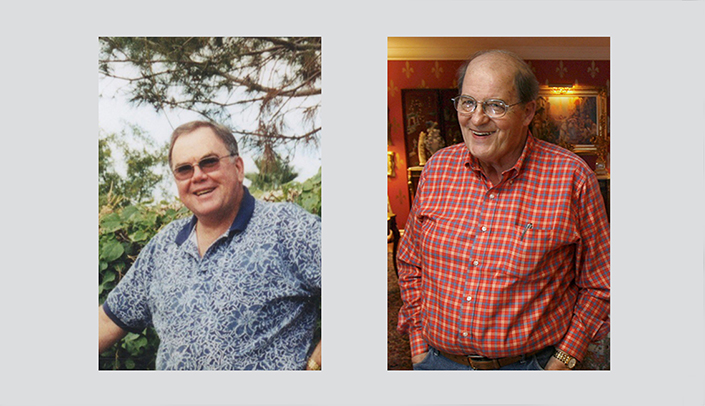
OMAHA, Neb. — Hoping to advance new discoveries in prostate cancer treatment and care, longtime Omaha art teacher and businessman Gerald “Jerry” Pabst donated $3 million through an estate gift to support cancer research carried out by the Fred & Pamela Buffett Cancer Center.
The gift establishes three permanently endowed funds at the University of Nebraska Foundation to support the efforts of prostate cancer researchers and physicians. The funds will be conferred as honorary chairs named after Pabst and his late partner, Bill Bures, who died of prostate cancer. Pabst also lost his father and uncle to prostate cancer.
The University of Nebraska Medical Center (UNMC) will confer a Bill Bures and Jerry Pabst Chair award to three individual prostate cancer specialists, one each to an expert in urologic surgery, radiation oncology and to a specialist in chemotherapy, vaccines or prevention methods. Annual income from the endowed chair funds will be used to support the medical research and patient care of those who are conferred with a Bures-Pabst Chair.
Pabst died in 2016 due to complications of esophageal cancer. While planning this gift some years ago, he told the university he believes an investment in people at the cancer center will someday pay high dividends.
“I realize it just doesn’t happen overnight, but I’m hoping this research will bring us closer to discovering new cancer treatments and possibly a cure,” he said.
Prostate cancer is the most common cancer in men in the United States and the second leading cause of death from cancer in men. In Nebraska, it’s the third most-diagnosed cancer behind breast and lung cancers. While a serious disease, a majority of men in Nebraska are diagnosed early, providing an opportunity for successful treatment options.
“We’re extremely thankful for the generosity of Jerry Pabst and Bill Bures, and the endowed chairs in their honor will absolutely help to expand our expertise in researching and treating prostate cancer,” said UNMC Chancellor Jeffrey P. Gold, M.D. “This perpetual financial support will benefit our mission to transform lives through premier educational programs, innovative research and extraordinary patient care.”
Ken Cowan, M.D., Ph.D., director of the Fred & Pamela Buffett Cancer Center, said recruiting national leaders in cancer research is essential to the cancer center’s success. Endowed faculty positions that provide long-term financial support strengthen UNMC’s ability to do so.
“Jerry’s gift is truly visionary in its support of our future needs,” said Cowan soon after first meeting Pabst and learning about his plans to support cancer research and care. “Funding for endowed chairs is significant to an academic medical center, as the income generated from each will enable us to recruit and retain a renowned physician-researcher.”
The Omaha World-Herald said Jerry Pabst “never stopped to take a break” and that he “worked tirelessly” to provide quality art courses to students in Omaha Public Schools during his 31 years as district art coordinator.
Pabst was a native of Colby, Kansas, and the son of Herman and Lucille Pabst. He graduated from Kansas State University and then received a master’s degree from Fort Hays State University. He was hired by Omaha Public Schools as an art teacher and was later promoted to district art coordinator.
He helped introduce discipline-based teaching to the art program in 1986 with the aid of grant money from the Getty Center. The style integrated art history into regular art courses for students from kindergarten to high school. He also advocated for students to receive more time for art classes.
Pabst and his companion, William “Bill” Bures, founded Collector’s Choice in Omaha in 1969, a business providing premier estate sales services and an antique sales showroom in the former Center Theater.
Bures was a native of Geneva, Nebraska, and the son of Frank and Helen Bures. After high school he attended business school before working for Gold’s department store and Ben Simons clothing store in Lincoln, where he managed the men’s department for many years. He retired from clothing retail in 1991 to devote time to Collector’s Choice.
Bures died on Feb. 2, 2005, at age 61 from complications of prostate cancer, and Pabst died on Aug. 26, 2016, at age 79 from complications of esophageal cancer.
The Fred & Pamela Buffett Cancer Center – a National Cancer Institute-designated cancer center – is a collaboration of Nebraska Medicine and the University of Nebraska Medical Center in Omaha, Nebraska. The cancer center opened in 2017 with cancer research at the Suzanne and Walter Scott Cancer Research Tower and clinical treatments at the C.L. Werner Cancer Hospital.
— Republished with permission
🎥 Parents announce Joey Weber Endowment to benefit DSNWK

By CRISTINA JANNEY
Hays Post
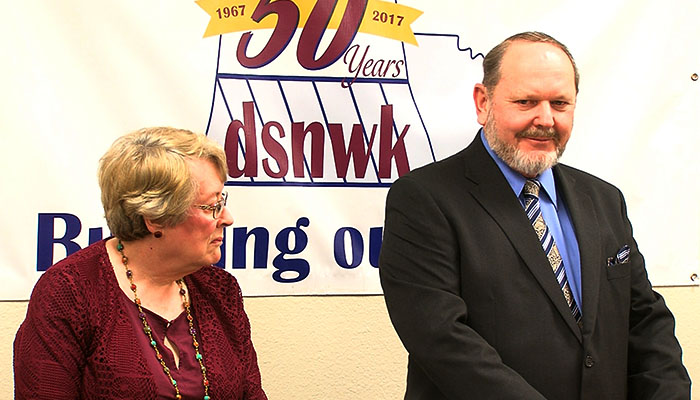
Development Services of Northwest Kansas announced Tuesday the creation of an endowment in honor of Joey Weber.
Joseph “Joey” Weber, 36, was fatally shot by a Hays police officer Aug. 18, 2016, after grabbing the officer’s gun as the officer tried to take him into custody after a traffic stop. Weber was autistic and had been served by DSNWK since he was in high school.
Joey’s father, John, said he wanted Joey to be remembered as an honest and hard-working young man. Joey was John and his wife, Nancy’s, only son.
“We loved him with all of our heart. He meant the world to us,” John said.
Joey’s parents started intervention with a doctor in Hays when he was 3. He was speech delayed and frightened of loud noises and crowds. Joey, however, was very intelligent. John smiled as he recalled Joey’s ability to recall everyone’s birthdays, especially their ages.
He had a passion for tractors, combines and birds. He learned to spell by writing dinosaur names. He could rattle off all the specs on tractors and combines and could name any bird. Joey grew up in Oakley, but moved to Hays and lived independently in an apartment and worked at Pizza Hut.

“Joey was a cautious, but a very good driver, maybe too cautious at times,” his father said.
“Joey did not have a mean bone in his body,” John continued. “He was a very good worker and very contentious. We want Joey to be remembered for the honest man he was and the justice he stands for.”
“This is the greatest holiday gift that our family could receive,” John said of the endowment.
The Joey Weber Endowment is a permanent fund that will continuously support services for individuals with intellectual and developmental disabilities, and their families in northwest Kansas.
“This is very close to them,” Jerry Michaud, president of DSNWK, said of the Webers. “Joey, as mentioned, impacted their lives clearly, and he is impacting lives today as we move forward. We are honored that you would work with DSNWK to establish this that carries on Joey’s impact and his desire for independence and having a full life. That goal and legacy can now carry on into the future. What a wonderful thing.”
The Weber family worked with State Sen. Rick Billinger, R-Goodland, to get a law passed dubbed “Joey’s Law,” which allows people with autism to have noted on their driver’s licenses and state ID cards that they have a cognitive disorder. There are also placards available similar to those for handicap individuals and a multi-color puzzle piece decal that can be placed on the lower left corner of a license plate.

Related story: Brownback signs Joey’s Law at Friday ceremony in Topeka
Joey’s parents said they think had the police who stopped Joey known that he was autistic, the tragedy might have been averted.
Related story: Ellis Co. Attorney: Officer acted in self-defense in Aug. 18 shooting in Hays
John Weber said Tuesday he hoped through the endowment and Joey’s Law other families could be helped through Joey’s death.
Billinger was on hand in Hays for the endowment announcement Tuesday.
“The Joey Weber Endowment will give back to DSNWK every year in perpetuity to impact persons with intellectual and developmental disabilities and their families in northwest Kansas,” Billinger said. “I thank and congratulate those with the foresight to establish this endowment and the legacy it establishes to serve others in Joey’s memory.”
Billinger read a statement from Lt. Gov. Jeff Colyer that said Joey’s Law will not only protect Kansans with autism but police officers.
“If officers know they are dealing with someone on the spectrum, they will be more adequately prepared to handle the situation in a manner that takes the needs of that individual into their consideration,” Colyer’s statement said.
Billinger said he did not know the exact number of people who have taken advantage of the new license designation, but he said he knows there has been significant interest in the new law.
DSNWK hopes to raise $100,000 for the endowment in 2018.
“Each of us aspire to a life that matters. Joey’s life mattered,” Michaud said. “And moving this forward is worthy of support.”
For more information about the Joey Weber Endowment and how to make a charitable estate gift, contact Allen Schmidt at 785-621-5327 or [email protected] You may also mail donations to DSNWK Attn: Director of Development, 2703 Hall St., Suite 10, Hays, KS 67601. Note the Joey Weber Endowment in the memo line. You may also give to DSNWK online at www.dsnwk.org.
DSNWK serves more than 500 individuals with intellectual disabilities in 18 northwest counties. Those include Ellis, Cheyenne, Decatur, Gove, Graham, Logan, Norton, Osborne, Phillips, Rawlins, Rooks, Russell, Sheridan, Sherman, Smith, Thomas, Trego and Wallace counties. There are service centers in Hays, Atwood, Hill City, Hoxie, Norton, Russell and Stockton.
DSNWK celebrated its 50th anniversary this year.
Board approves master’s program, honors outgoing board members
By CRISTINA JANNEY
Hays Post
The Hays USD 489 school board approved an agreement Monday that would create a program that would help Hays teachers earn their master’s degrees at Fort Hays State University.
The board unanimously voted to approved a revised agreement after requesting more restrictions.
Some board members at last week’s board meeting said they did not think the program was restrictive enough.
Related story: Board wants more focus for program that would help teachers earn master’s
A revised agreement stipulates applicants to the program would have to be approved by building and district administration. They would also have to be applying for a program “in a high needs area based on anticipated openings and lack of qualified applicants, as designated by the district.”
Under the agreement, one-third of participant’s tuition would be paid for by the district, one-third would be paid for by Fort Hays State University and one-third would be paid for by the participant.
Board member Greg Schwartz also suggested last week the program stipulate a participant would have to work for the district for a certain number of years or have to pay back the district’s contribution to the program. That was not included in the revisions.
After the vote, Schwartz asked Superintendent John Thissen to write a letter of memorandum specifically outlining which administrators would be approving requests to participate in the program. Thissen agreed to do this.
Audit
The board also heard a report on the district’s annual audit from Adams, Brown, Beran, and Ball. The company said there were was one significant deficiency found during the audit. A person who was not eligible to be paid through federal Head Start dollars had been paid with federal funds for a year incorrectly. Those dollars had to be returned to Head Start. The administration was made aware of the issue, and it was corrected.
There were no other significant issues in the audit.
However, the accounting firm did recommend the district create a system to reconcile its Hays Middle School gate receipts, update W-4s and K-4s for name and address changes and review activity fund policies and procedures in light of staff changes.
Financial report
Tracy Kaiser, director of finance, said the district is under budget to this point in the year. It has spent 29 percent of its allowable budget. It budgeted to spend up to 38.5 percent of its budget by this time of year.
Outgoing board members
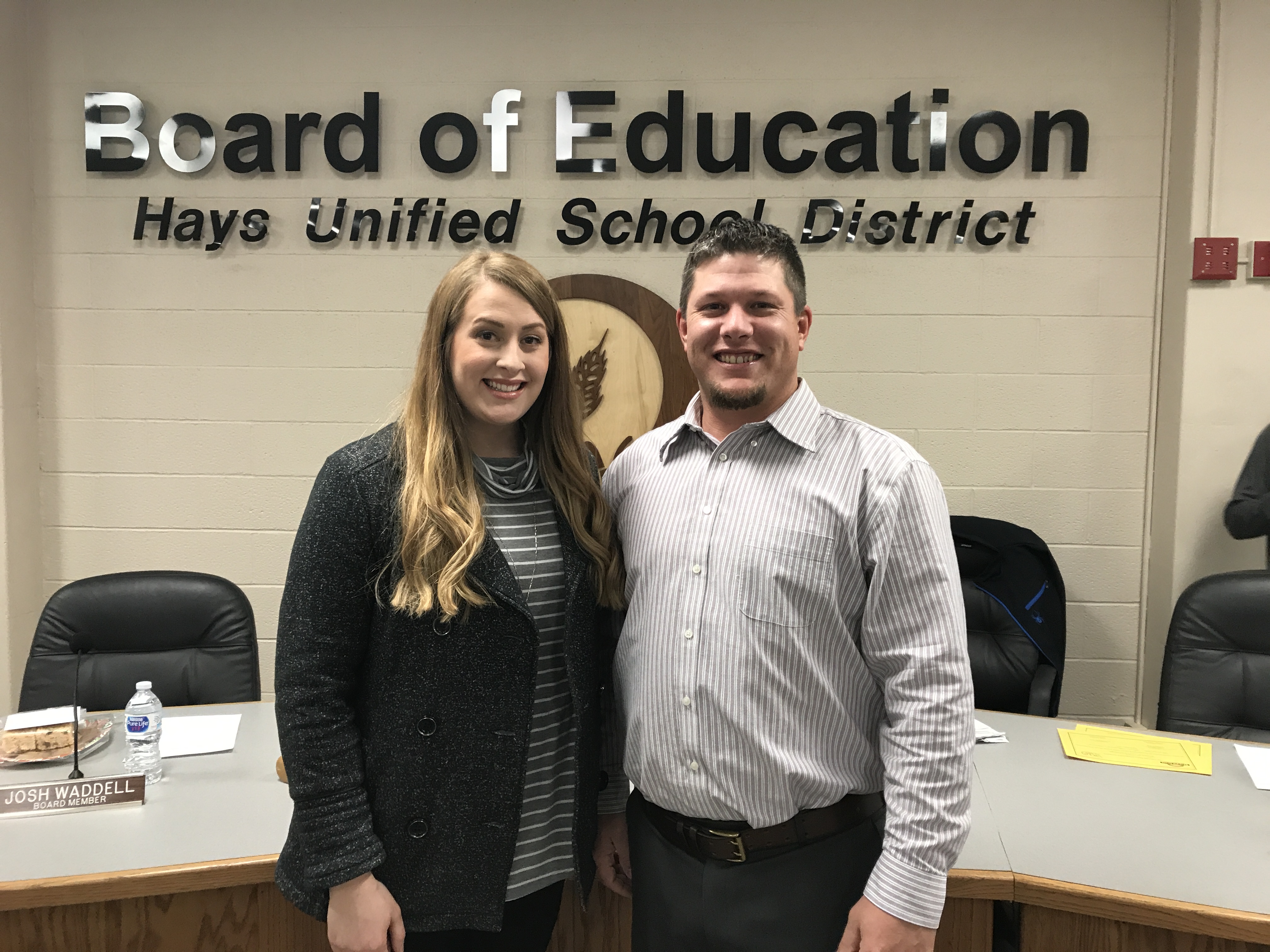
Outgoing board members Josh Waddell and Danielle Lang were honored for their years of service. Both board members served one four-year term.
A reception was conducted prior to the board meeting Monday night.
Thissen said, “I really do appreciate very much your service. In this position, there are not a lot of thanks. In your service, you have been very, very helpful to Hays. It is really a difficult job and takes quite a bit of time.”
Board president Lance Bickle said, “Thank you for all your service. We’ve been through a heck of a lot. Thank you.”
New board members Sophia Young and Mike Walker will take their seats in January.
In other business, the district approved the Hays High Curriculum Guide changes and heard a report on board goals.
Indian Grounds gives HHS students chance to get a taste of the work world
By CRISTINA JANNEY
Hays Post
Hays High School is offering a new way to wake up in the morning.
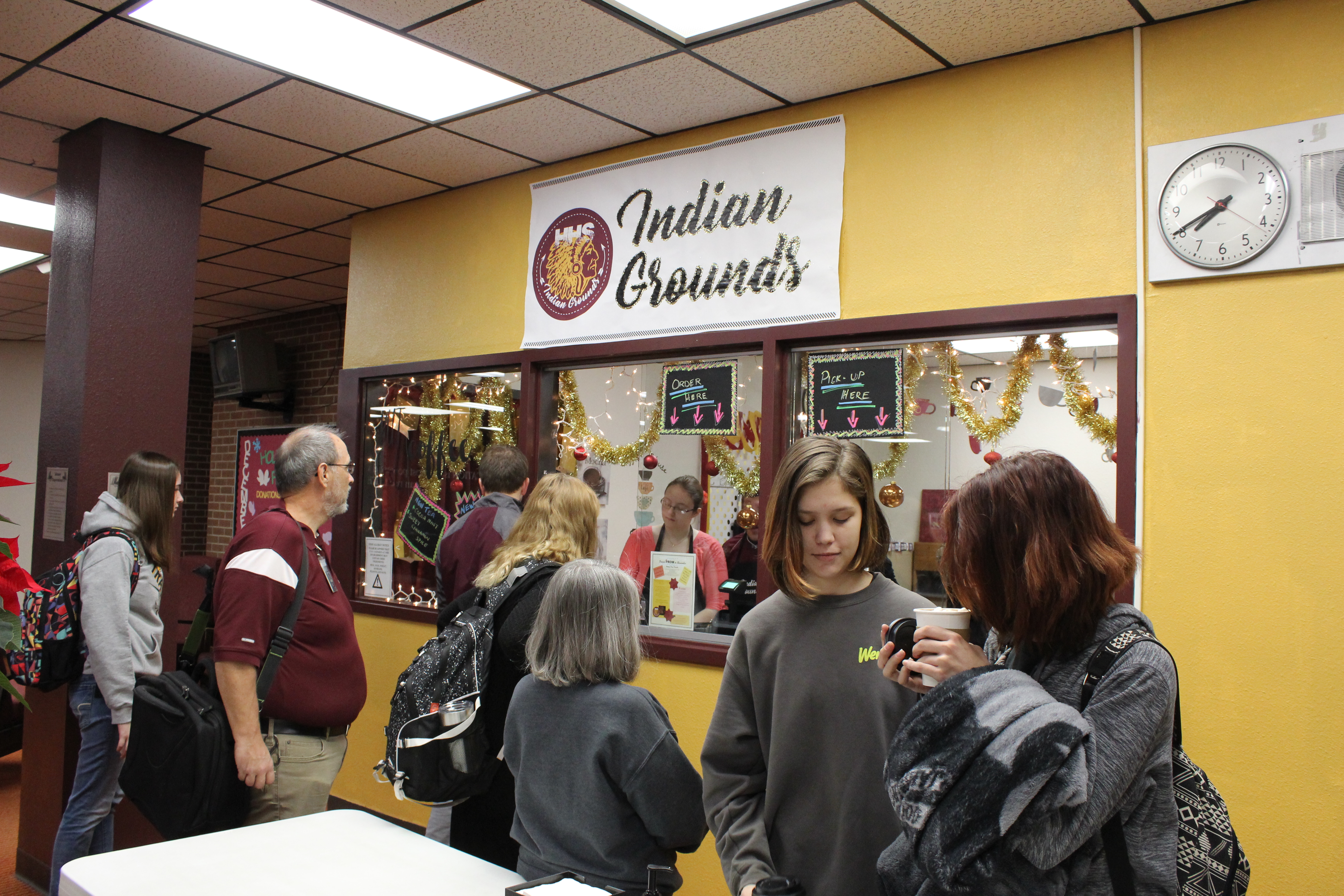
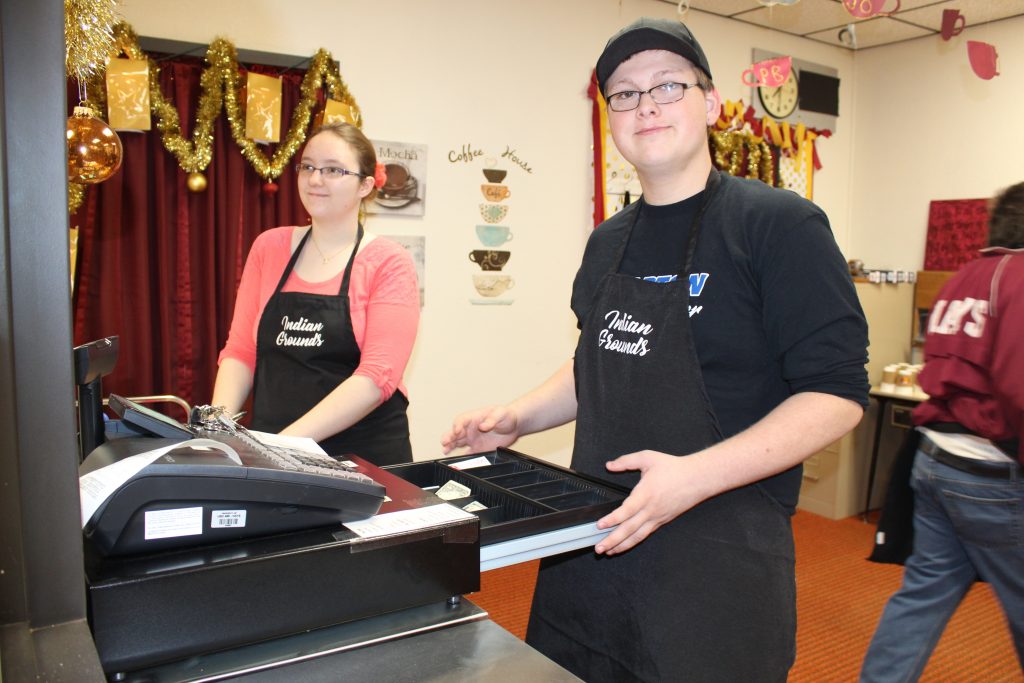
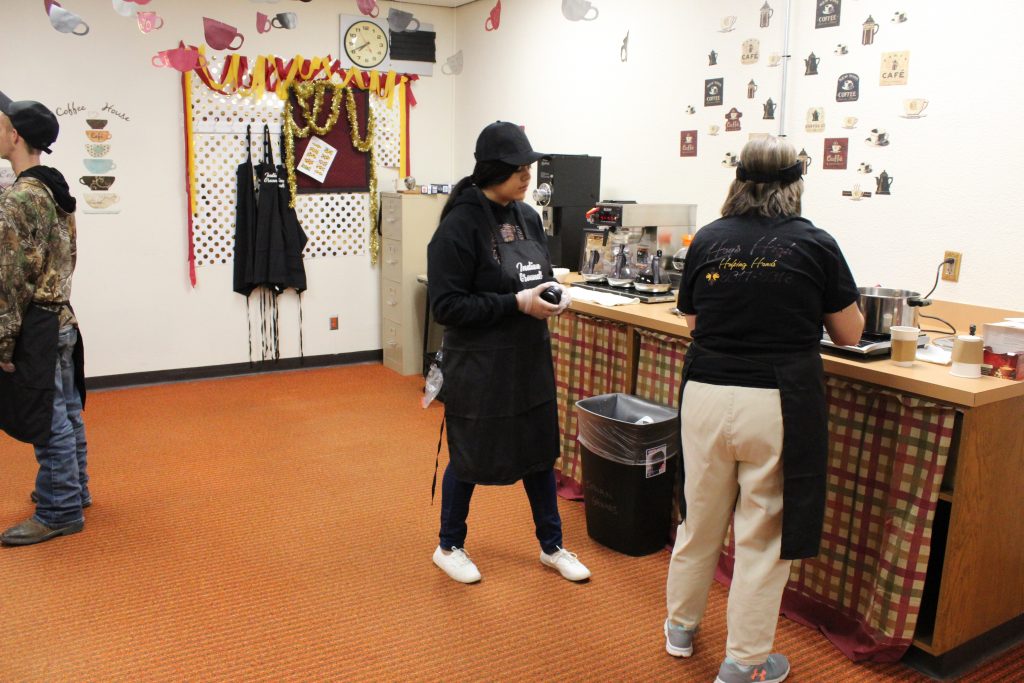
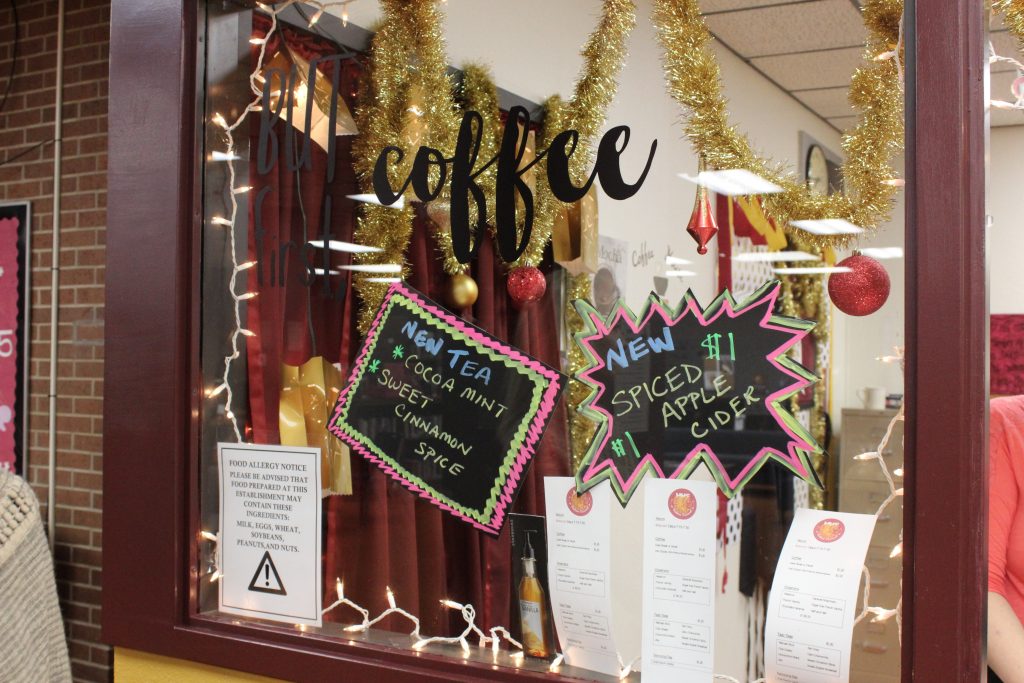
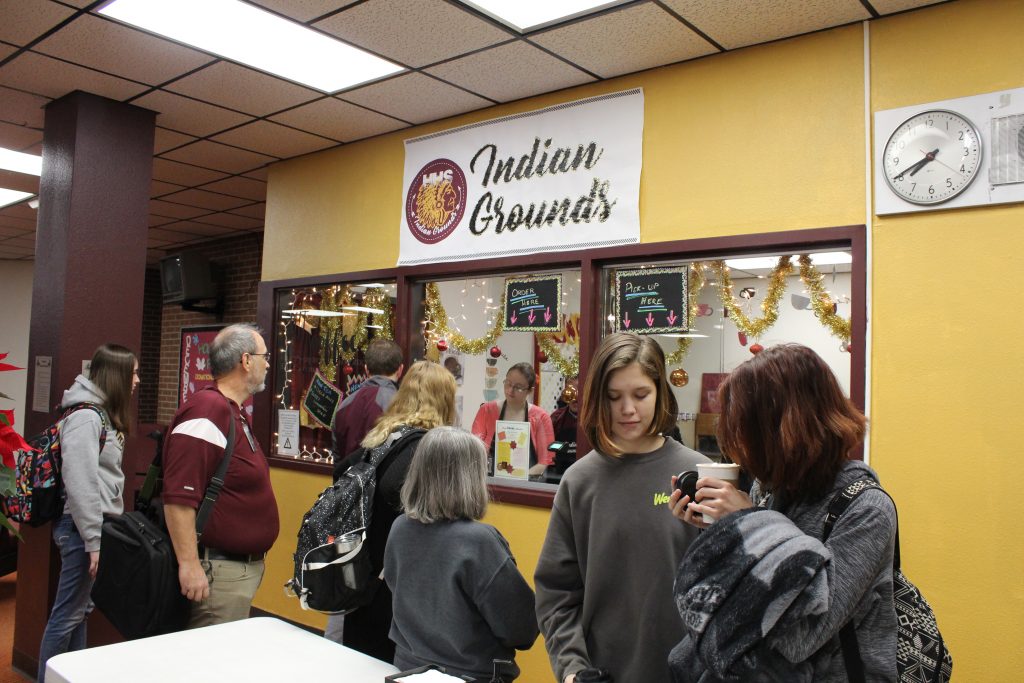
Helping Hands opened a coffee shop called Indian Grounds in the HHS library in October.
The program is offered for any junior. This includes students in the special education program. The program is only open to juniors this year, but the school hopes to expand the program to seniors next year. Twenty-eight students participate in the program currently.
HHS teacher Michelle Thacker said Principal Martin Straub approached the staff about using the space now occupied by Indian Grounds for something besides library materials.
“I just thought a coffee shop would be a perfect fit for Helping Hands kids to learn in. It is just a perfect complement to the program,” Thacker said. “They are already learning how to work together and communication skills and teamwork and integrity and honesty and punctuality. They already get to make products, but they don’t get to interface with the customer. This way they get to interface with the public and the customer and learn those soft skills and actually practice those communication skills with other people.”
Helping Hands has been a program in Hays for 27 years.
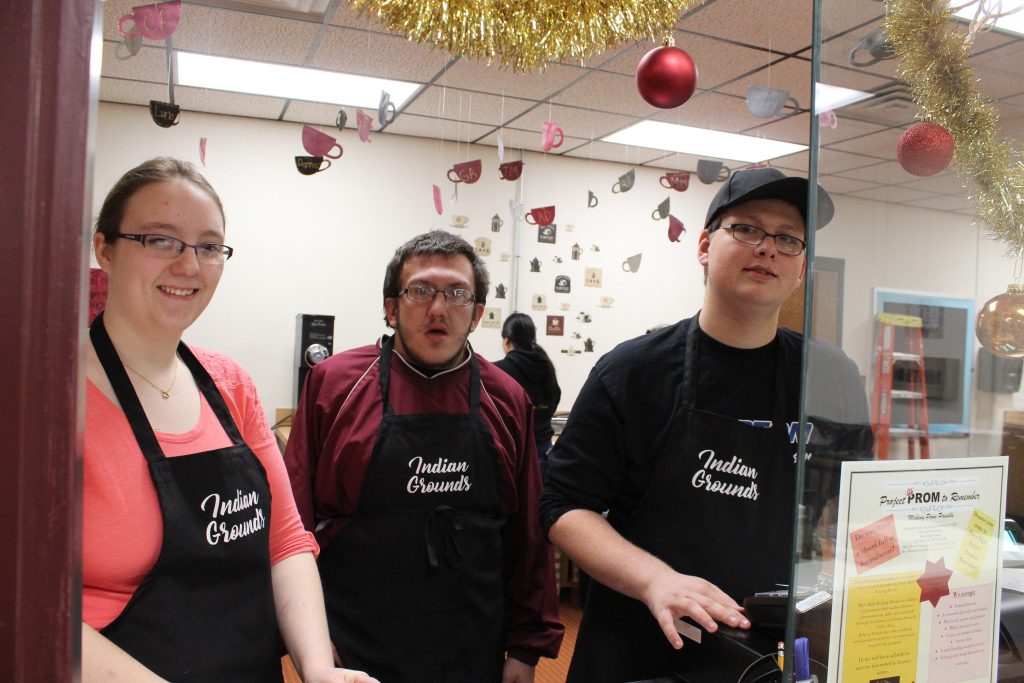
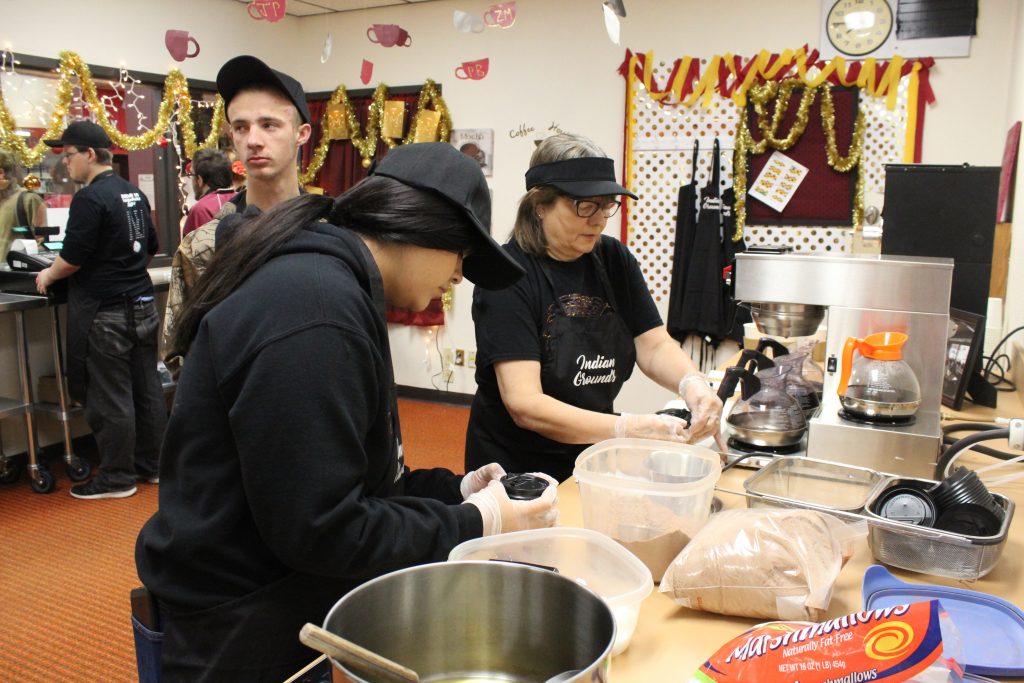
It already has a commercial bakery at the old high school building, but teacher Jolene Windholz said the program did not allow the students to build customer service skills and work face to face with the public. The Indian Grounds program requires the students to work in groups, learn customer service, be responsible for something larger than themselves and be good employees, she said.
“This is pretty real world,” she said of the shop. “We get pretty busy, and we have to buy and keep up with demand and meet students and promote.”
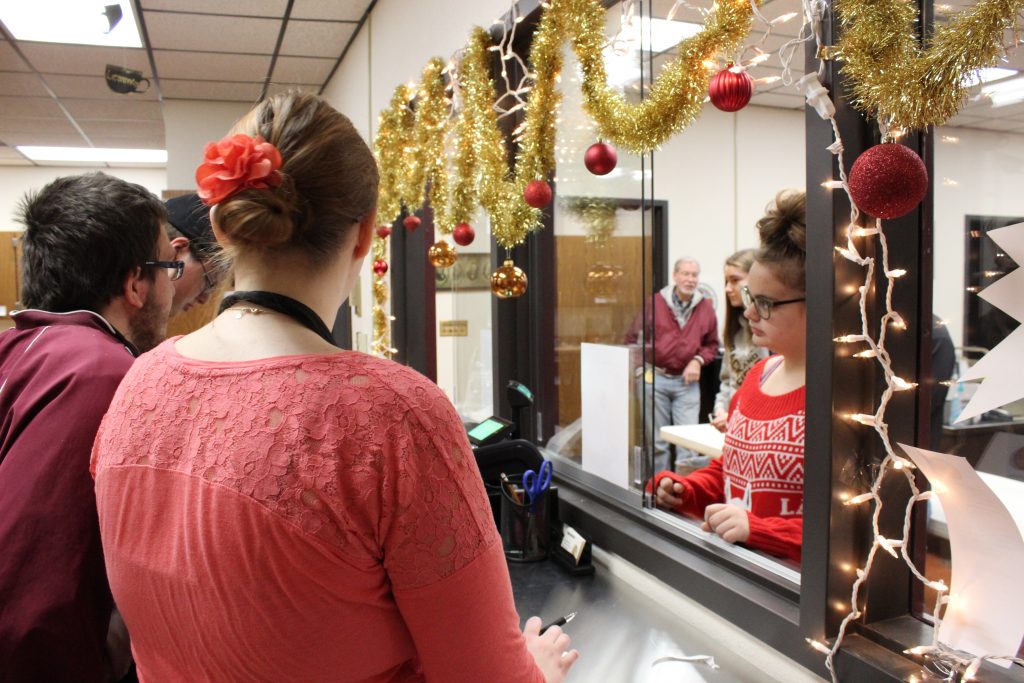
The coffee shop serves coffee, teas, hot chocolate and cider to about 50 to 60 customers between 7:15 to 7:50 a.m. on Maroon Days at the school, which means the coffee shop is open two to three days per week depending on the high school schedule. Prices are kept reasonable — $1 a cup.
Thacker said the shop has had great buy-in from the teachers, students and staff and has developed a regular customer base.
“The students who work the coffee shop have been wonderful about showing up,” she said. “It is just like any job. You sometimes have enough help and sometimes you don’t. That is part of the learning process. The kids know that it takes everybody to make it work. When someone doesn’t show up, that makes it hard on everyone. That is a whole other learning opportunity for students.”
Gabriela Arthur, HHS junior, said she is learning customer service, money handling and how to use a cash register.
Preston Brown, HHS junior, said he has enjoyed his experience working at Indian Grounds and would like to pursue a job in customer service after graduation.
Jocelynn Ornelas, HHS junior, wanted to gain work experience.
“I could see a new opportunity and see how the business works here. I like working with other people, I guess,” she said.
The money raised at the coffee shop helps support the Helping Hands program. Any additional profits will go toward a scholarship fund, which students who have participated in the program can apply for.
In addition to Indian Grounds and the bakery, Helping Hands sponsors a community service project. This year Helping Hands is coordinating Project Prom To Remember. The program is collecting formal wear for both male and female students. Helping Hands will have a prom store open in the spring, so students can select free outfits for prom.
HHS to launch student-run radio station

By CRISTINA JANNEY
Hays Post
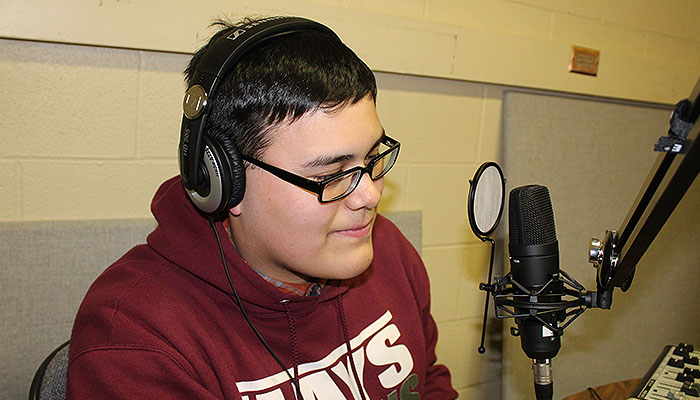
Hays High School will be on the air with its own student-run radio station starting next semester.
Two HHS juniors have spearheaded an effort to start a web-based radio station at the high school.
Juniors Isaiah Schindler and Jackson Stanton went to their adviser Dan Balman and suggested the school start a radio station. Balman charged the students with developing a plan to present to the administration that would include what type of equipment the school would need, its cost, the space needed for the radio studio and the licensing required.

“We didn’t want to go to Walmart and get the cheapest stuff we could,” Stanton said. “If we were going to do it, we wanted to make it so it would last and be worth the effort. We didn’t want to make a sub-par program.”
The administration approved about $900 for the purchase of a mixer, three microphones and stands, and a computer and software for the program to be paid out the high school’s regular audio/visual program budget. Balman predicted it will cost about $1,000 per year to keep up the cost of subscriptions and licensing for the station.
Eventually Balman said he hoped the students will sell advertising to help support the program.
“They took the ball and ran with it,” Balman said of the two students. “It is a big deal they were able to do something with it.”
Although the students will be gaining practical experience running a radio station, Balman said the skills they are learning in communication may be even more important.

“They had to use their communication skills,” Balman said. “I am not talking about technology. I mean face-to-face.”
Kansas Education Commissioner Randy Watson has said school programs in all areas of study should build communication skills, Balman added.
“As these students go out in the business world, whether they go into radio or not or go to college or not, this is going give them an advantage. They have had to give a presentation and listen to what other people say. I am proud of them.”
Schindler has been involved in radio for several years, doing his own programming on short wave and Caster.fm. He said radio/TV may be his future profession and this a good way to gain some practical experience.
Stanton said the radio station will let him explore his passions.
“For all my life music has been a giant passion of mine. I also love technology and computers. Radio just sums all that up and lets me listen to the music I like to listen to and the equipment I like to use and use the computer programs I like to use. It is just like the perfect scenario for me,” he said.
Radio may be his passion, but not his profession. Stanton said he thinks he would rather study herpetology in college.
The station will play music from local musicians as well as classic rock from ’80s and ’90s and maybe some current pop. Stanton said getting the licensing for the music was the most challenging aspect of the project. The students are continuing to grow their catalog. Stanton is a big classic metal fan and looks forward to pumping out some Black Sabbath on the new station.
The station, which will air from 7 a.m. to 4 p.m. will also include some talk programming and sports casts. The students hope to interview students, teachers and administrators as well as broadcast HHS sports, such as football and basketball.
The students are still waiting on some computer equipment and expect they will need more training before they are ready to go live. They should hit the internet in mid-January or February. There should be a link to listen to station on the HHS website once the station goes online.
🎥 City commission votes 3-2 to exit PEERA and employee union negotiations

By BECKY KISER
Hays Post
Longtime Hays city commissioner Henry Schwaller called it “probably one of the most difficult decisions I’ve had to make” as he voted Thursday night against adopting an ordinance to withdraw the city from participation in PEERA.
Still, the vote passed 3-2, with Commissioners Lance Jones, Sandy Jacobs, and Vice-Mayor James Meier voting yes. Schwaller and Mayor Shaun Musil voted no.
By law, the PEERA exit becomes effective one year after the vote, beginning in January 2019.
The city of Hays has participated in PEERA (Public Employer-Employee Relations Act) since 1972 and negotiates wage and benefits with three employee unions representing fire, police and service workers. Hays is one of just 12 cities in Kansas to participate in PEERA, which is optional for local governments.
Commissioner Jones, whose term is nearly up, has pushed for the opt out. “I believe the city and commissioners value all employees and should not be negotiating with certain groups when it comes to wages and benefits,” Jones said during the Nov. 16 work session. “We should be doing what’s best for all employees.”
All 178 Hays city employees, including the 61 members of the three unions, received a four percent pay increase for 2018. Members of the city’s Wage and Benefit Committee are volunteers, 8 to 10 employees, from across all city departments, according to Asst. City Manager Jacob Wood. He is a member, along with Human Resources Director Erin Giebler.
“It’s my understanding that we’re having good participation of all three unions in the Wage and Benefit Committee,” said Commissioner Sandy Jacobs as she read a statement prior to the vote.
Jacobs, the newest commissioner, said she previously had very little experience with unions, and did a lot of fact-finding in coming to her decision.
“After considering all the facts, I’m focused on staff productivity and efficiency, and I believe union activity negotiation affects both those areas,” said Jacobs. “And in speaking with union members and representatives, they, for the most part, could not provide examples of what may have benefited our employees solely because of their negotiations.”

Musil asked Hays Police Dept. Cpl. Phillip Gage, president of the Fraternal Order of Police, Lodge #48, what his union members feared losing.
“I feel like our voice would be taken away from us,” Gage responded. “That would be the one thing. It’s a new horizon if you guys do get out of it. It’s just uncertain to me. What we have now is certainty in the way it works. It’s been working for 40-plus years.”
“We’re struggling now to keep our numbers up in the police department,” said Schwaller. “How’s this going to look to someone that wants to apply to work in Hays? ‘Oh, they just voted to get rid of the FOP.’ Is this going to look good? I don’t think so. That’s why I’m voting no tonight.”
The FOP is the city’s biggest union. Of the 43 eligible employees in the police department, 27 are union members. All 18 employees eligible for the firefighters union, International Association of Firefighters (IAFF #2119), are members. There are 52 eligible employees for the Service Employees International Union (SEIU #513) of whom 16 are members.

Esau Freeman, Wichita, is the business manager of SEIU #513. “It is important to acknowledge that while numbers for SEIU are low, higher wage earners like police and fire have greater numbers in their membership,” Freeman told the commission. “As a whole, all of the unions combined do exceed 50 percent of the represented worker population.”
“Good intentions can be put on paper but without unions, who will be there to enforce the agreement when it becomes less than convenient to fulfill the promised benefits or wages?,” asked Freeman.
Firefighter Brandon Woods, president of IAFF #2119, also spoke in support of retaining PEERA.
“We’re not trying to replace the unions,” Jones stressed. “Opting out of PEERA does not get rid of unions. It’s just the way the city negotiates with unions.”

According to Asst. Manager Wood, the city currently spends about $20,000 annually during the negotiation processes. “That includes all the meetings, staff time, and city attorney time,” he said. When the city and unions are at an impasse, “there are more meetings and the more it costs the city” to hire an agreed-upon mediator or another third-party fact finder, if necessary.
A new city commissioner, Chris Dinkel, will be sworn in January 8, 2018, who ran for the seat Jones will vacate. Jones opted not to run again due to time constraints of his job. Musil and Jacobs were re-elected.
Ellis County, which also has had an opt-in to PEERA since 1972, will discuss a possible withdrawal during its commission meeting Mon., Dec. 18.
🎥 FHSU receives $1 million from Schmidt estate
https://https://youtu.be/7-5AQmQHaMU
(VIDEO BY HAYS POST)
By Diane Gasper-O’Brien
FHSU University Relations and Marketing
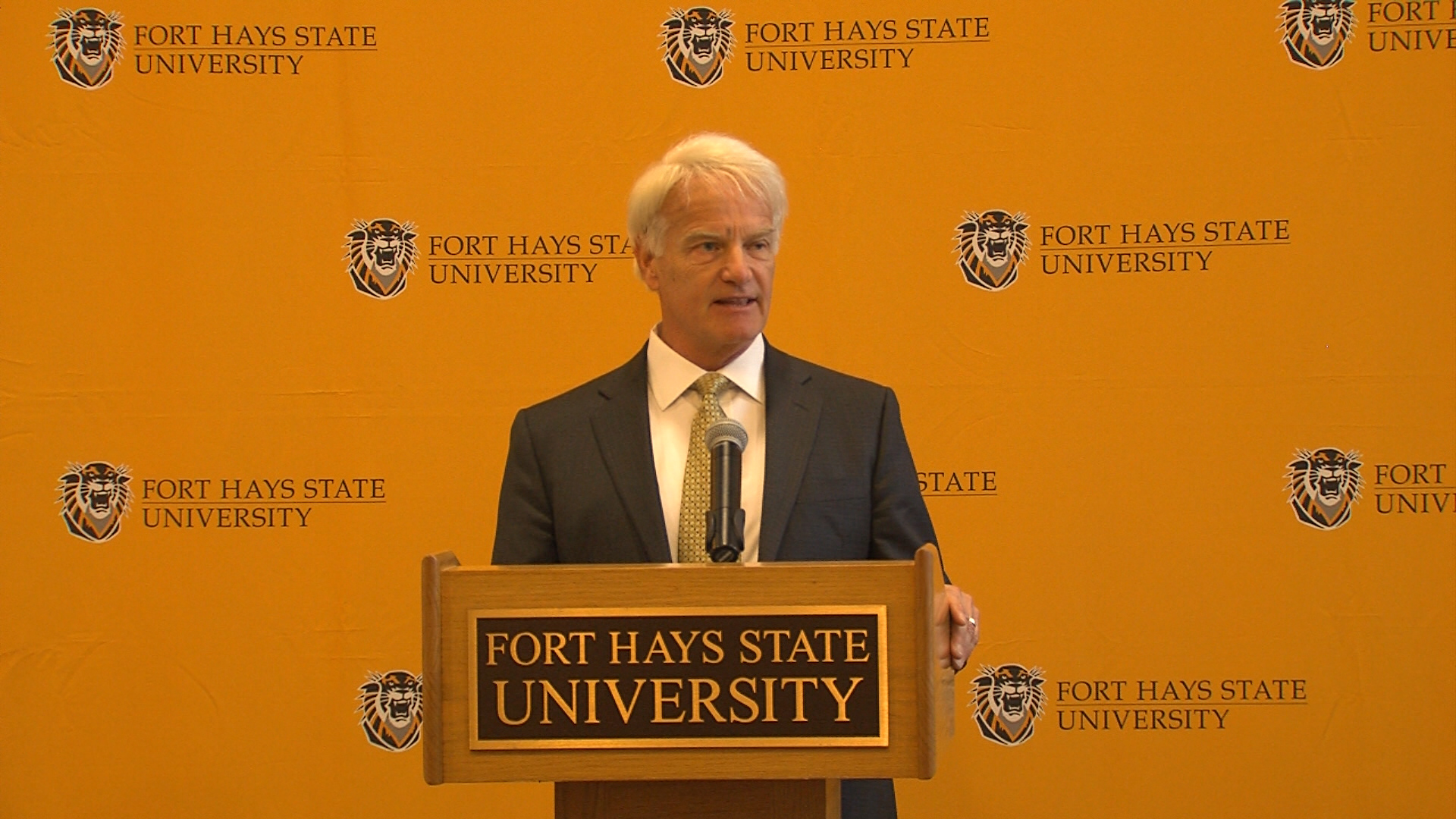
HAYS, Kan. – Tony Schmidt said he grew up in a house where his parents stressed the importance of faith and giving back. That’s part of the reason why he felt honored Thursday to present to Fort Hays State University a $1 million check from the Robert and Patricia Schmidt estate to be used for student scholarships.
“We are quite honored to represent the estate of my mother and father,” said Tony Schmidt, the oldest of the three children of Robert and Patricia Schmidt. Tony, who lives in Lawrence, was accompanied at a morning news conference on the FHSU campus by his wife, Loreta.
“This gift to the FHSU Foundation is a culmination of Dad’s lifetime,” Tony Schmidt said.
The estate gift benefits the Robert E. and Patricia A. Schmidt Family Foundation Scholarship through the FHSU Foundation. This latest gift from the Schmidts pushes their total giving to FHSU over the $4.5 million mark.
“We are here to honor a family that is an icon of our community,” said Jason Williby, president and CEO of the FHSU Foundation. “Bob and Pat Schmidt’s generosity will literally affect thousands, if not tens of thousands, of students. If you were lucky enough to know Bob and Pat, you knew of their generosity to the entire Tiger community.”
Some of those gifts have the Schmidts’ name attached, such as the Beach/Schmidt Performing Arts Center in Sheridan Hall and the Schmidt-Bickle Indoor Training Facility.
But there have been numerous other notable contributions, including those toward the construction of the Robbins Center, renovations in Picken Hall and Sheridan Hall, the Sternberg Museum of Natural History and the Dr. Edward H. Hammond Endowed Chair Fund.
In highlighting the generosity of the Schmidts, Dr. Andy Tompkins used three words to describe the couple.
“Several synonyms for generosity help create a more complete picture of the hearts of Bob and Pat toward this university and this community, and they are goodness, kindness and unselfishness,” said Tompkins, interim president of FHSU. “We have often spoken of the joy of giving at these press conferences, and for Bob and Pat, joy was the emotion that came from a generous heart built on goodness, kindness and unselfishness.”
A native of La Crosse, Bob Schmidt stayed close to home to attend Fort Hays Kansas State College (now FHSU), where he met his future wife, Pat, also a student at Fort Hays State.
Bob graduated from FHSU in 1950, and relying on the foundation he gained from his education there, he went on to become a renowned broadcaster and eventual owner of KAYS Inc. before retiring in 1998.
Along the way, Bob Schmidt become a Hays icon, both through his leadership and his philanthropy. He died this past August, two years after his wife of 69 years died.
“It was Fort Hays State that helped him prepare for what he was to become,” Tony said of his father, who graduated from FHSU with a business degree in 1950. “It all started for them here at Fort Hays State.”
Gifts to Fort Hays State are 100 percent tax deductible. To learn more about the FHSU Foundation and how you can support FHSU, visit https://foundation.fhsu.edu or contact their offices at 785-628-5620 or [email protected].
One student who has already benefitted greatly from the Schmidts’ scholarships is Hannah Keil, Hays, a graduate student majoring in speech-language pathology.
Because of the intensity of that master’s program, Keil said it would have been difficult to work while pursuing her degree. Had it not been for the generous scholarship she received from the Schmidt Family Foundation Scholarship, she might have had to take out a student loan.
“It is support like this that has me fortunate enough to be graduating completely debt free,” Keil said, “which I recognize is something that most college students today are not able to say. I am so thankful to Bob and Pat Schmidt for their generosity. It is my hope that one day as a speech-language pathologist I can give back to my community in the way that Bob and Pat Schmidt gave back to theirs.”
Tompkins, whose last day on campus as interim president is today, had one last comment before accepting the $1 million check from Tony Schmidt.
“Thank you to Bob and Pat Schmidt and their family,” he said, “for forever changing Fort Hays State University.”
🎥 Donation to TMP-M reinforces strong Catholic faith, leadership lived by Bob Schmidt

By BECKY KISER
Hays Post
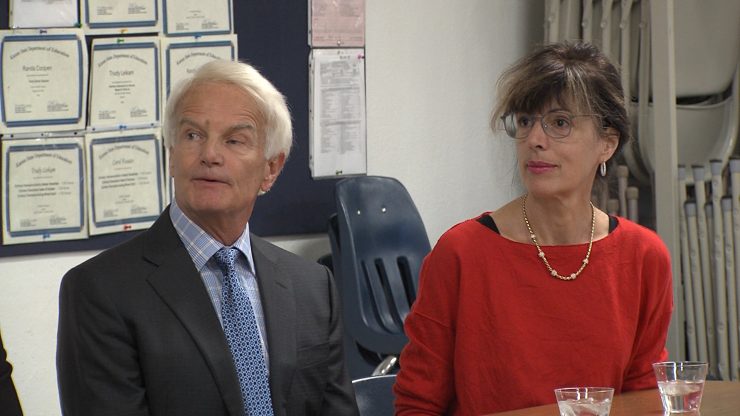
Many of the community members attending Wednesday afternoon’s reception at Thomas More Prep-Marian School had a special relationship with Hays residents Bob and Pat Schmidt and their family.
“You more than anyone know the generous spirit of Bob and Pat which drove their philanthropy throughout their lives to which our community owes a debt of gratitude,” said TMP-Marian Advancement Director Troy Ruda.
“Investing at the high school level is an investment in the future, which Bob and Pat believed,” Ruda continued, “and with their strong Catholic faith they knew TMP-Marian was a worthy contribution. We are eternally grateful.”
Ruda welcomed the Schmidt’s son Tony and his wife Loreta of Lawrence.
“They continue the generosity that was so important to Bob and Pat with the investment of $500,000 to the TMP-Marian Endowment Foundation,” Ruda announced.
Tony Schmidt made his way to the podium amid a standing ovation from the audience which also included TMP-Marian Jr. and Sr. High STUCO members, school faculty and staff, representatives of the school’s finance and advisory councils, endowment board and alumni association, and clergy from the Heartland parishes.

“The Catholic faith was a very large part of our family growing up in LaCrosse,” Schmidt said, “and it was also a very large part of our family in Lawrence.” He noted two former priests at TMP-M, Father Mike Scully and Father Charles Polifka, went on to serve at Schmidt’s parish in Lawrence.
According to Volga German genealogy from the TMP Alumni Association, Tony Schmidt is a fifth-generation member of the Schmidt family in Ellis County who emigrated from Russia to the United States.
“It started with Peter Schmidt, who came to Russia from Germany back in the 1700s. Approximately 141 years ago, Jacob Schmidt and his wife traveled from Catherinestadt, Russia with 16 immediate family members. As I understand it, they met a man named Dreiling in Kansas City who then guided them out here…goes way back to 1876.
“I believe Jacob Schmidt helped found Catherine (located in eastern Ellis County). He became known as the school master as he’d been in Russia. There was no Catholic priest available when they arrived so he actually had to lead some of the early Catholic religious services.
“I know Dad was a friend with each of you and I hope you know that we are too. He’d be pleased to know that this gift I’m delivering will help forward the mission here at TMP,” Schmidt said. “Like you, he believed in Catholic education, in faith, in ethical principles, and in leadership. He was proud to support TMP.”

“This gift makes it possible for us to improve our society via the youth who will learn, who will live, who will love, who will serve in our hallways and classrooms, and who ultimately, serve in our community,” said TMP-Marian Principal Chad Meitner as he thanked the Schmidts for their donation and commitment.

Before leading a closing prayer of thanks, Father Earl Befort, president of the TMP Alumni Association, told the Schmidts he “has the honor to serve the Catherine parish for nearly 25 years, which is the home to your ancestors. We thank you for that gift as well, the gift of your family.”
Robert E. “Bob” Schmidt, 90, philanthropist, renowned broadcaster and retired chairman of the board of Eagle Communications passed away Aug. 8 at his home. His wife, Pat, died in August 2015. The city of Hays declared Aug. 12 as ‘Bob Schmidt Day’ to honor his leadership and many contributions in the region.