Hays City Commissioner Sandy Jacobs sits in the driver’s seat of the new HFD fire truck Thu. night.
By BECKY KISER Hays Post
Although they agreed it would be “an awesome view,” none of the Hays city commissioners accepted the invitation Thursday night to climb the 78-foot ladder on the city’s new fire truck.
Commissioner Sandy Jacobs and Vice-Mayor James Meier did however, climb up into the driver’s seat of the double cab which seats six firefighters. Jacobs likened it to “an airplane cockpit” and declared “it’s cool.”
The commissioners, along with Asst. City Manager Toby Wood and Finance Director Kim Rupp, were given a tour of the truck by Hays Fire Department Lt. Tyler Brungardt and several other on-duty firefighters.
The 2016 Rosenbauer America pumper-ladder truck was purchased from Hays Fire and Rescue Sales and Service a couple months ago. It has a lighter duty ladder, no front bucket, and is more compact than the 2002 pumper-ladder truck it replaced, Brungardt explained.
The other truck had four outriggers with a 20-foot spread; the new truck has two stabilizing jacks with a 15-foot spread. “They also deploy a lot faster,” noted Brungardt. “The aerial ladder also raises and extends more quickly.” The other truck had a 104-foot ladder, but Brungardt believes that’s not a big loss.
“Today’s street construction is more narrow with more cul-de-sacs, and we’ve got to have better placement. If people are parked on both sides of the road, we can still get access in. It turns tighter and is more maneuverable.”
The new truck is also more environmentally friendly and meets newer emission standards, according to Brungardt. “It burns a little more cleaner than the old trucks.”
“Aside from the fact that it looks sharp,” Brungardt told the group he’s most excited about the quiet cab.
“The old trucks, the cabs sit right over the engine compartment so it makes it hard for me to communicate with my driver. This one, we’ve got the built-in headsets and communicate with each other through those. It used to be that I had to talk loudly and almost shout across the cab. I like to talk to the guys when we’re en route to an emergency scene and start prepping on what we’re going to do. This makes a difference in that aspect.”
Brungardt pointed out the specialized tools the truck carries, along with its 300-gallon water tank. “It can handle car fires. We can get started on a fire while we’re waiting on a water supply if we have to.
“We’re well-equipped to handle emergencies,” he said. “People call us for all sorts of emergencies. This truck allows us to perform fire-fighting activities, basic rescues, automobile accidents, and medical emergencies.”
“We’re proud that you’re able to have this,” said Jacobs.
HFD sold its 2002 pumper-ladder truck for $125,000, resulting in a final cost of $476,850 for the current truck.
CORRECTED Nov. 21, 2017 at 4:50 p.m. to reflect Lt. Brungardt’s first name is Tyler, not Travis.
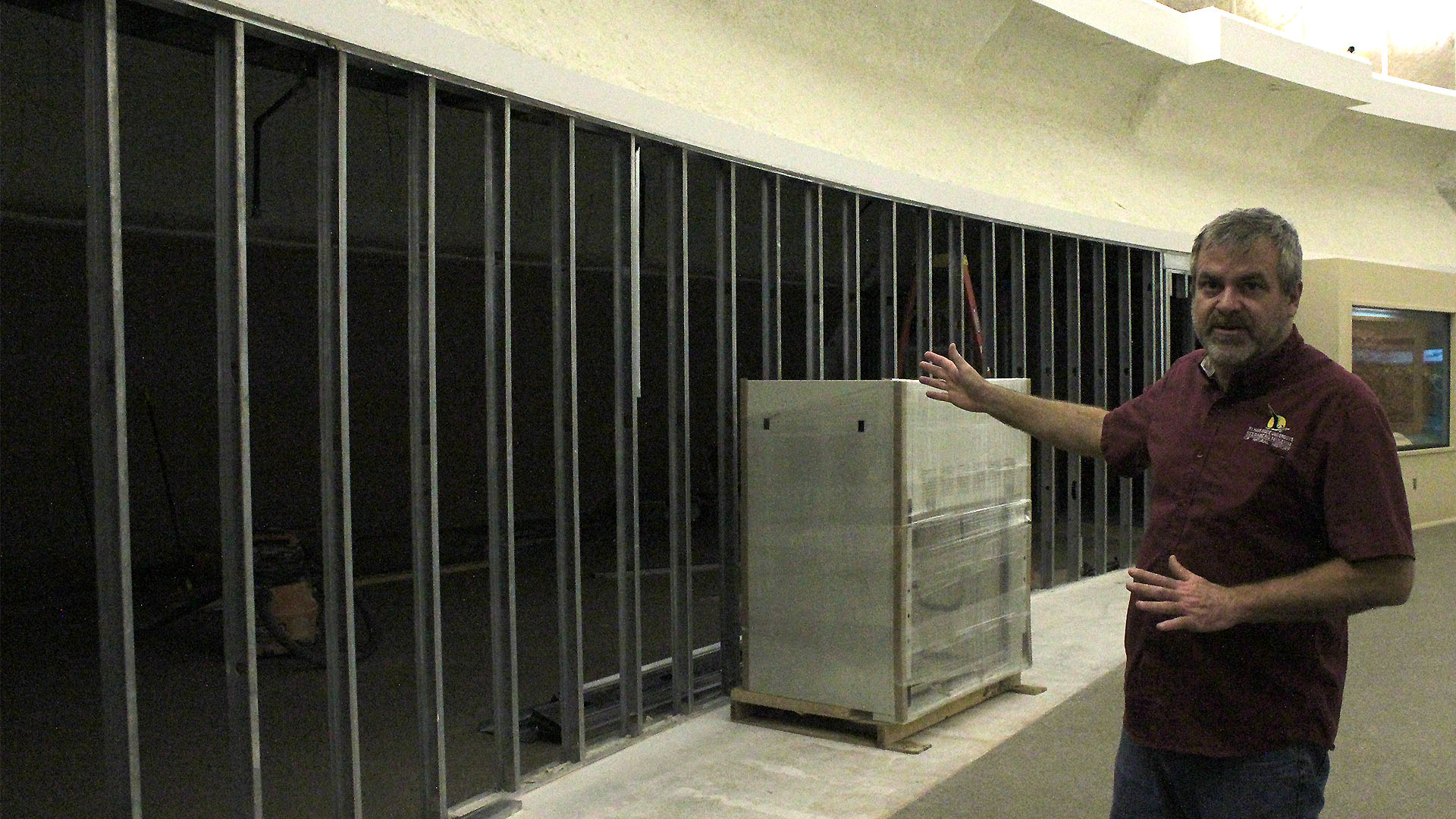
Reese Barrick, Sternberg Museum director, shows off the space where a new paleontology prep lab will be located.
By CRISTINA JANNEY Hays Post
Visitors to the Sternberg Museum of Natural History will soon have the opportunity to watch and interact with scientists as they process fossils.
The museum received $160,000 from Dane G. Hansen Foundation, Mike and Pam Everhart and many other individuals to construct a 750-square-foot paleontology prep lab. The lab will include a 12-foot sliding window that will open and allow visitors to interact with scientists as they prepare fossils.
“This is a chance to really upgrade and renovate our ability to interact with the public, show off what we do in getting things from the field to the research collection to the exhibits. You’ll really get to see what happens at the museum,” museum director Reese Barrick said.
Barrick said this interaction will help both the students and the public. The public will learn more about the animals, and the students working in the lab will get hands-on experience speaking and interacting with museum guests.
The new lab also significantly expands the museum’s research space, which will give the museum opportunities to train students and volunteers in fossil preparation and move fossils more quickly from the field to the museum’s collection.
The additional space will allow the museum to add equipment and small separate research lab. This will facilitate Dr. Laura Wilson, museum curator, in her study of fossil histology. Wilson slices bones into very small pieces and evaluates them under a microscope, research that helps determine how an animal grew.
Some animals grow slowly over their whole lives, Barrick said. While other animals, such as mammals, grow quickly in their early years and then stop growing. Some animals’ bones resemble the growth rings of trees and can be used to determine age or even gender.
The information gleaned from histology studies can also be used to extrapolate ancient animals’ ecologies.
“We know as mammals we have a pretty high metabolisms and we eat a lot,” he said. “You can figure out how many grocery stores in a town it is going to take to feed people. You can run that with animals. If you have an elephant, how many acres is it going to take to live in and feed it? Whereas if you have an elephant-sized thing that has the metabolism of a lizard, it doesn’t take nearly as much space.
“We have things like our big mosasaur over here and our plesiosaur over there. If we can look at how fast those things grew, we can get an idea of how much those things had to eat. You can work back and figure out how much food was in the ocean period. How many fish did there have to be to feed all these giant monsters and how many smaller fish did there have to be to feed these bigger fish all the way down to these single-cell organisms?”
The lab should be completed by Christmas and all the equipment in place by mid-January.
The lab construction has set in motion a major reconstruction in several other areas of the museum.
Barrick shows the area in the Earth Sciences Gallery where the Rocks of Western Kansas exhibit will be moved.
To make way for the lab in the Fossil Gallery, the Rocks of Western Kansas exhibit had to be taken down. That is being moved to the Exploring Earth Sciences Gallery. Five cases in the Earth Sciences Gallery that were dedicated to an exhibit titled Fossils Through Time have been take off of exhibit and the fossils returned the museum collection.
Rocks of Western Kansas should be in its new home by Christmas, as well.
The rest of the Exploring Earth Sciences Gallery will also change very drastically. A new exhibit will eventually be added that will explore the invertebrates of the Kansas seaway, such as clams and ammonites.
The museum will receive a donation next week of a private mineral collection worth an estimated $100,000 to expand its minerals exhibit.
Next week, the museum will pick up a new $100,000 collection of minerals that is being donated by a private collector. It will be added where the fluorescent minerals display is now.
The rest of the Earth Sciences Gallery will be dedicated to explain the evolution of the grasslands in Kansas over the last 50 million years, which will encompass the Paleocene through Miocene eras.
Finally, visitors to the museum will walk into the ice age exhibit, which includes skeletons of large mammals of the time period, including a mammoth. This exhibit will largely remain the same.
Barrick said the museum has considered for some time restructuring its exhibits to show the evolution of the Kansas landscape from an inland sea, to a closed canopy forest to the grasslands we see today.
“I think we want to give them a more comprehensive idea of the changes in life and ecology through the Cretaceous of Western Kansas in a more inviting, exciting and appealing way, so they will spend more time, be more enthused about what they are seeing and come back and learn a lot more about what Kansas is like — what the Cretaceous was like and learn a lot more about the value of rocks and minerals,” Barrick said.
Other areas of the museum will be renovated to depict the transition of Kansas from an inland sea to a modern grassland.
He said many people see minerals as shiny, bright items, but they may not understand the full economic values of minerals and how they are used in industry and how they end up in household goods.
When the museum received the funding for the paleontology lab, it jump-started renovations of the rest museum. The funds for the paleontology lab have already been secured. However, the museum will still need to raise money for the further renovations of the invertebrate, mineral and Paleocene through Miocene exhibits.
It will likely be three to four years before all the renovations and new exhibits are complete, depending on fundraising. The museum will need about $50,000 to $60,000 to finish the exhibits. Barrick said he did not anticipate any museum closures associated with the renovations.
Donors can give by visiting the Sternberg website and clicking on the Donate button at the bottom of the homepage. This will take you to the Fort Hays State University Foundation page. You will need to indicate on this page that you want the money to go to the Sternberg.
The museum will continue to feature traveling exhibits In its rotating exhibit space. This summer, the museum will have a traveling exhibit titled “World of Giant Insects” that will feature animatronics insects.
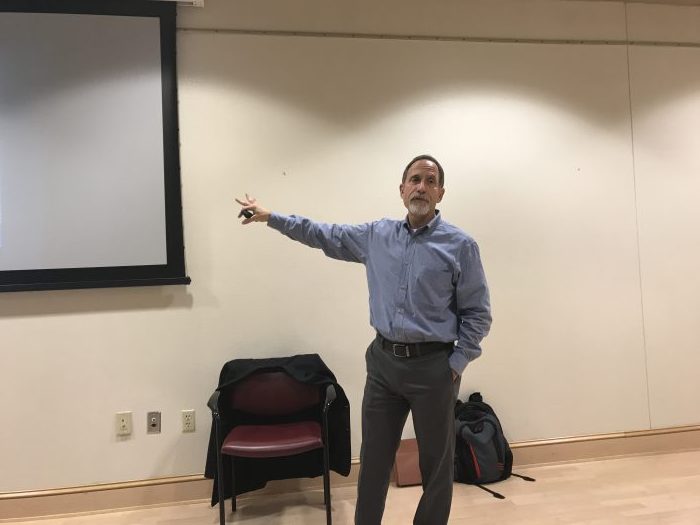
Sheldon Weiagrau, director of the Health Reform Resource Project, talks to a group in Hays about Medicare expansion.
By CRISTINA JANNEY Hays Post
A health educator told a group of Hays-area residents Tuesday that Medicaid expansion would not only be revenue positive to the Kansas budget, but boost the state’s economy.
Sheldon Weisgrau, director of the Health Reform Resource Project, a foundation-funded initiative to provide education and technical assistance in the implementation of health reform and the Affordable Care Act, was invited to speak at the Hays Public Library by Women for Kansas.
Women for Kansas is a non-partisan group that aims to promote election of moderate candidates who support moderate policies.
There are several groups who qualify for Medicaid (known as KanCare in Kansas) under the current system including low-income residents with disabilities, low-income pregnant women, low-income elderly and low-income children.
Those making a certain amount of money and who are not covered by health care insurance at their jobs can qualify for plans under the Affordable Care Act. About 90 percent of those people qualify for subsidies.
About 150,000 people in Kansas make too little to qualify for the Affordable Care Act, but do not qualify for Medicaid, Weisgrau said.
She said expansion of Medicaid under the Affordable Care Act was supposed to cover these people in the gap, but Kansas has refused to expand Medicaid, 100 percent of which would have been funded by the federal government in the first three years (2014 to 2016).
Kansas has lost more than $2.2 billion in tax revenue in the last three years by not expanding Medicaid and that number increases by more than $1.9 million every day. This is money that is going to the other 33 states that enacted Medicaid expansion.
“Everyone in this room is a federal taxpayer. The federal government is saying, ‘Here, take some of it back,’ and we are saying ‘No thank you,’ which means your federal tax dollars are going to California and Colorado and Massachusetts and all the other states that have accepted this program and it is not coming back to the state of Kansas,” Weisgrau said.
Now the federal government is paying 95 percent of the cost of Medicaid expansion, which will eventually go down to 90 percent.
The Kansas Legislature passed a measure to expand Medicare in Kansas during the last session. However, it was vetoed by Gov. Brownback, and the Legislature was just shy of enough votes to override the veto.
Brownback and other opponents of the Medicaid expansion have argued the expansion would be too costly to the state’s budget. Weisgrau disagreed.
Kansas pays 45 percent of the care for Kansas residents who are currently on Medicaid. If the state would move some people who qualify for Medicaid to the federal Medicaid expansion, there would be cost saving, because the cost to the state would shift from 45 percent to 10 percent.
Weisgrau gave the example of a low-income woman. If that woman becomes pregnant, they qualify for Medicaid for the duration of her pregnancy then they fall off the Medicaid rolls. If she was continuously enrolled in Medicaid under Medicaid expansion, the state would only pay 10 percent of her care during pregnancy and delivery instead of 45 percent.
There are people with disabilities that could also be covered under Medicaid expansion for similar savings.
“If you look at the budget, which we have done very carefully, not only will this not cost Kansas money, but we will save enough money to completely pay for this,” Weisgrau said.
In addition, the three managed care companies that provide insurance to KanCare recipients each pay a privilege fee to the state for each person they cover. Covering another 150,000 would increase privilege fee revenue for the state.
Most of the states that have implemented Medicaid expansion have seen a 1 percent growth in GDP. In Kansas expansion of Medicaid would create an estimated 3,800 jobs. Based on population, Ellis County could expect $4.3 million in new health care spending and addition of 27 new jobs. Because Hays draws patients from smaller outlying communities, those figures are likely conservative.
The millions in revenue Medicaid expansion would bring the health care industry could be especially critical to small, rural hospitals. Thirty rural hospitals in Kansas are classified as financially vulnerable.
A big hit in these hospitals’ bottom lines is uncompensated care. Federal law dictates if someone comes to the emergency room, they have to be evaluated and treated for acute conditions, including women in active labor. Hospitals rarely are able to collect payment from uninsured patients.
Medical debt is the No. 1 reason for bankruptcy in the United States. When uninsured patients can’t pay, it ruins their credit and inhibits their ability to land a good job, get a loan for a car or qualify for a mortgage.
Weisgrau said we need to dispel the myth of the “Welfare Queen.” There are people who take advantage of the system, but that is not true in most cases.
“This is a real way out of poverty,” Weisgrau said. “Most of the people who fall in the gap work or are sick. … Medicare helps people get jobs and creates a path out of poverty and a way to economic security.”
Weisgrau said people who support Medicaid expansion in the state should contact their local state representatives and senators. Rep. Eber Phelps, D-Hays, and Sen. Rick Billinger, R-Goodland, both voted in favor of Medicaid expansion during the last session. Rep. Ken Rahjes, R-Agra, voted against.
In surveys, 70 to 82 percent of Kansans support Medicaid expansion. Sixty-six percent of Republican voters support it.
“This is not a controversial issue,” he said. “It is not a partisan issue. There are some legislators who are honestly not representing their communities.”
To join the Alliance for a Healthy Kansas in support of Medicaid expansion or find other material supporting Medicaid expansion, visit www.ExpandKanCare.com.
Also like the group on Facebook @ExpandKanCare or follow them on Twitter at /ExpandKanCare.
By DIANE GASPER-O’BRIEN FHSU University Relations and Marketing
Seeing immediate results from a project you’ve put your heart and soul into is rewarding. When the reverberating effect could potentially positively impact thousands of people, it’s even better.
So it’s easy to understand why Brianna Witchey was a little giddy when she learned that a grant she had written for the City of Ellis Fire Department was being funded in full. She had first become a firefighter in Gage, Okla., when she was 18 years old because she likes helping people. And this grant could help a lot of people.
Under the direction of an Ellis Fire Department officer, Witchey, now a 23-year-old Fort Hays State University senior and an Ellis firefighter, wrote a successful grant proposal for $35,000 from the Dane G. Hansen Foundation.
Using the skills she learned in the grant writing program at FHSU, Witchey requested funds for new self-contained breathing apparatus (SCBA) equipment for the department. In layman’s terms, those are airpacks with two bottles each. The SCBAs must be updated every several years.
“Secretly, I was hoping for all of it, but realistically I was anticipating maybe $20,000,” said Witchey, a sociology major. “But I actually would have been happy with a dollar.”
It was the first grant proposal Witchey had ever written, but she said she felt confident about it because of the skills she learned in the grant writing program under the direction of Dr. Keith Campbell.
Dr. Keith Campbell
“Dr. Campbell teaches you how to write the most sophisticated grant proposals,” Witchey said. “He refers to it as a tool bag. For one job you might only need a hammer, and for another you might only need a screwdriver. You need to be prepared for anything.”
Campbell, professor of sociology, is in his 43rd year of teaching at Fort Hays State. After writing grant proposals for FHSU projects years ago, he talked to the sociology department about adding a grant writing program to the department’s curriculum.
“Long ago, we faculty saw a lot of value in the skill of grant writing for students,” said Dr. Brett Zollinger, chair of the Department of Sociology. “So we built that into our core curriculum.”
Campbell created the courses and has taught them ever since.
“Learning to write grant proposals is helpful to students in a lot of different ways,” Campbell said. “Oftentimes, it helps them obtain their first job, or it can help them receive promotions in their current job.”
In addition to the grant writing class required of all sociology majors, there also are six additional credit hours of grant proposal development offered by sociology that form a nine credit-hour certificate. Three of those nine credit hours are in the form of an internship.
About 10 years ago, the department decided to add a second segment, one that involved an eight-week, online grant writing training.
“That one is designed for busy working people,” Campbell said. “We realized that there are a lot of people with full time jobs and busy lives, but who want to write grant proposals.”
More than 2,000 people have taken the eight-week course, resulting in huge success for some. Campbell talked about a student who successfully wrote a grant for $1.8 million for a learning center project in Missouri.
Closer to home, Carol Sloper, from St. Francis in the northwest corner of Kansas, has written numerous grants, calling on her expertise gained from the FHSU classes.
A native of Cheyenne County, Sloper worked in information technology for 30 years in Denver before returning home in 2012 to take care of her ill father.
She said she stumbled across Campbell’s training online, enrolled in it and was impressed with the learning curve from the get-go.
“The content was easy to understand, a mode that I could digest and immediately put to work,” she said. “He really gets to the heart of what’s important.”
“It’s the most useful class,” she added, “that I’ve ever taken to help my career.”
Projects for which Sloper has successfully written grant proposals include an ambulance in Sheridan County, a trail around a public pond and a swimming park in St. Francis, new sidewalks in Bird City and a public transportation program and tornado shelters program for Cheyenne County.
“I’m helping make it a place I want to retire in because they are having the services we need,” Sloper said.
Campbell said he enjoys hearing all student success stories and was particularly pleased with Witchey’s good news.
“With the internship, students are asked to find a nonprofit in their community that is doing some kind of work the student respects,” Campbell said. “This involves a lot more detail on how to design a program to help a category of people in need and how to evaluate that program after it has been introduced. The evaluation is determining how the program has attained its objectives.”
Zollinger also was pleased with Witchey’s accomplishment, especially considering she is still an undergraduate.
FHSU’s program is unique, he explained, saying “it’s unusual that a university would teach this program at an undergrad level. ”
More information about FHSU’s grant writing program can be found at fhsu.edu/sociology.
Witchey currently is completing her internship through the Ellis Fire Dept., and she is anxiously awaiting the arrival of the new airpacks for her department.
“It’s phenomenal to apply something that you learned,” Witchey said, “and have the result come back and see that you did it.”
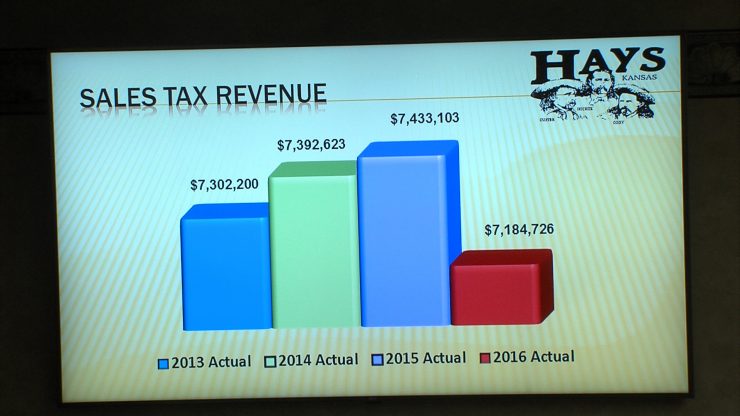
The city of Hays is looking for ways to increase sales tax collections which support the city’s General Fund.
Sales tax collected was at an all-time high of $7,433,103 in 2015. The total collected in 2016 was down by 3.34% or $248,377. Collections for 2017 are on pace to remain flat or slightly below 2016 amounts.
(Click to enlarge)
Assistant Hays City Manager Jacob Wood presented a Retail Gap Analysis and Recruitment Request For Qualifications (RFQ) to Hays city commissioners during their work session Thursday night. The purpose of the RFQ is to obtain the services of a qualified firm to provide assistance with a Retail Market Study and Gap Analysis that would aid in retail attraction and development in Hays.
The city hasn’t been sitting still when it comes to “development across the board,” Wood noted.
“Some things we’ve done recently, not necessarily specifically for retail development, include adoption of the UDC (Unified Development Code), updating our development policy trying to make things a little easier for new developments.
(Click to enlarge)
“We also updated our economic development policy, streamlined everything so that the application is an easy process. That’s resulted in a couple of approved CIDs (Community Improvement Districts) the past couple of years–north of the JT Travel Plaza and TownPlace Suites (north of I-70). JT Travel Plaza has been open for over a year. The TownPlace Suites will be open in the next couple of months. “We also have a CID that’s sitting in place north of the Home Depot (also north of I-70) for 73,000 square feet of retail space.
“We have done some things trying to be pro-development and I do think we’ll see some additional requests for incentives in the near future,” said Wood.
“But with declining or stagnating sales tax we’re always looking for methods and ways to increase that retail base.”
Once the retail analysis is complete, the hired firm would represent the city in a retail recruiting effort.
“There’s no downside sending this RFQ out,” said Vice-Mayor James Meier. “We’re just going to listen to what people have to say.”
Commissioner Sandy Jacobs agreed, adding “I think there’s a lot of discussion once we get the information back.”
(Click to enlarge)
“We’ll have a lot of work to do to vet these firms to see who’s the right fit with our community,” Wood admitted. He told commissioners there’s no firm in the region which does this kind of work.
As far as Wood knows, Hays is the only city in Kansas to do this type of recruitment. “I used a couple models from a rural town in Iowa. I found one in Wyoming and in Oregon. I’m not aware of anyone in Kansas who has gone through this exact process.”
Commissioners Thursday night approved sending out the RFQ. Commissioner Henry Schwaller was absent from the work session.
Sunrise Rotary Club Grocery Grab winner Sheila Eichman takes off on her 5-minute free shopping spree in east Dillon’s Wednesday night.
By BECKY KISER Hays Post
Since her mom convinced her to enter the annual Hays Sunrise Rotary Club’s Grocery Grab and even bought her $10 winning ticket, Plainville resident Sheila Eichman handed over the frozen turkey she grabbed Wednesday night to her mom, Shirley Eichman.
Sheila Eichman’s name was drawn from more than 270 entries in the fourth annual fundraiser for the Sunshine Rotary Club which uses the proceeds for improvements to Ekey Park, 1902 Holmes. “I was shocked I won,” she said. Her mother, Shirley, lives in WaKeeney and works at Enersys in Hays.
Club president and official timekeeper, Larry Dreiling, yells out the remaining minutes.
Eichman had just five minutes to race through Dillon’s, 1902 Vine, and managed to toss $833.90 worth of free groceries from the shelves into two grocery carts. Store manager Don Koerner watched while several Rotary Club members chased along. Martin Straub recorded the trek on his iPad while president Larry Dreiling acted as the official timer, loudly yelling out the remaining minutes and seconds.
Still slightly out of breath as she watched the Dillon’s clerk check out and total up her winnings, Eichman joked “I should have trained for this for awhile.”
There were a few restrictions for the grocery grab, including a one minute limit in the meat department with a maximum two items of each type. Pharmacy, alcohol, and tobacco products were prohibited.
Eichman started filling her first cart in the meat department.
“I went for the staples, filling up our pantry,” Eichman said. She started in the meat department and soon headed straight to the coffee aisle. “Oh my gosh, I love coffee,” she laughed. Although her kids had made some requests on what she should pick up, Eichman stuck with the basics, including industrial size containers of cooking oil and black pepper.
Eichman, who works in the Rooks County Health Center business department, and her boyfriend Alon Zimmerman, scoped out the grocery store to determine her strategy before the event started.
“We haven’t shopped here since Dillon’s was remodeled so I wanted to find out where everything was. It’s a lot bigger than the old store,” she said. Zimmerman, who acted as “chief scout and cheerleader” helped load the groceries in their vehicle. “There were a lot of bags,” he smiled.
Club member Mary Straub records Eichman’s trek on his iPad.
According to club member Martin LaBarge, whose two daughters were along to watch the fun, the grocery grab is “usually the week before Thanksgiving. We work with Dillon’s to determine which day works for them.” The event is held in the evening when there are generally fewer customers in the store. Wednesday night’s shoppers were advised over the store’s public address system about what was going to happen and asked to “step aside” if possible, while Eichman ran through the aisles.
The Sunrise Rotary Club pays for the groceries out of the ticket proceeds. “We raised a little over $2,500 bucks,” Dreiling reported. The remaining money will go into the club’s fund to pay for a restroom in Ekey Park.
Eichman gathered $833.90 of groceries in just 5 minutes.
“We’ve built up the playground area and put in a picnic area, but the one thing we don’t have is a restroom. So we’re raising money to put in a restroom similar to what’s installed in downtown Hays. The Parks Department can lay it down very quickly.
“It runs about $20,000. We’re about halfway there right now. It’s a major fundraiser. Hopefully, within a year or two, I think we’ll have it done,” Dreiling predicted.
“One of the best things about it, with the restroom facility, the citizenry will be able to rent out the park and use the picnic area for family reunions, high school graduations, quinceaneras, whatever you want to have.”
Sheila Eichman with her mom Shirley Eichman (L) who bought Sheila’s winning ticket.
And, oh yes, Eichman did earn Dillon’s fuel points with her grocery haul–80 cents off a gallon. “I’m definitely going to enter again next year, and I bet a lot of my co-workers will too,” she added with a grin.
Chartered April 29, 2010, the Hays Sunrise Rotary Club is the newest service club in Hays. It is comprised of 20 men and women who are business, professional and community leaders with a shared commitment to make the world a better place through humanitarian service above self. The club meets the second and fourth Thursday mornings of each month in the Tiger Room of Fort Hays State University’s Gross Memorial Coliseum.
Residents in Rush County voted in Nov. 7’s general election to allow the expansion of a hog farm two miles southwest of Pfeifer near the Rush County and Ellis County line.
The vote total, finalized after the canvass on Monday, was 568 voting to allow the expansion of the hog farm and 496 voting against.
The expansion by Bison Rush Genetics, LLC, would increase the permitted number of animals from 3,840 to 24,408.
Those who live close to the hog farm were concerned about potential contamination of water wells. The Smoky Hill River is 1.5 miles away from the site and the source for drinking water, private wells and agricultural wells in the area. The Pfeifer well field on the Smoky Hill River is the primary source of water for the city of Russell. Most of the water wells for the city of Hays are also located along the Smoky Hill River.
Concerns were raised at the August meeting about dead swine being buried less than the required 5,000 feet from a home.
Waymaster said he addressed the issues that were brought to him during the August meeting to Agriculture Secretary Jackie McClaskey. McCalskey assured Waymaster in August that all of the environmental and regulatory concerns surrounding the swine farm had been addressed.
The problem with the pig carcasses being buried outside of the required setbacks occurred under the last owners of the pig farm, Waymaster said.
“I can understand why they may still have some concerns about that,” Waymaster said. “You might think, even though they are separate owners, that history might repeat itself. Because of the size of the hog farm that is moving in compared to one that was there previously, Sec. McClaskey assured me that they are going to be regulated probably more.”
He said he had been assured by the department of agriculture and the department of water that they are going to be monitoring the hog farm and its effects on the water table.
The current applicant is listed as Bison Rush Genetics LLC, with a post office box address in Carthage, Ill. That address is associated with Professional Swine Management. The application includes a facility address of rural Bison in Rush County.
A call to Professional Swine Management was not returned Tuesday.
Ellis County Public Works Director Bill Ring also attended the meeting in August and expressed concerns the hog farm will increase heavy truck traffic on Ellis County roads without any tax benefit from the farm. Waymaster forwarded this concern to the Kansas Secretary of Transportation, but Waymaster said he had not heard if any progress had been made on this issue.
Ring is at a conference this week and was unable to be reached.
Waymaster drew parallels between the expansion of the hog farm and Russell County’s attempt to bring a Tyson plant to the area. The proposal also met with opposition for many of the same reasons.
“I look at it as an economic development as the farm is ag commerce,” he said. “One thing is that in our area of the state, it will be creating jobs, which is something that we definitely need. It may not be the most ideal jobs coming into the economy, but it will still be individuals who are employed and hopefully living in our local communities, spending in our local stores and businesses, increasing sales tax revenue and also property tax.
“You can look at it from many different perspectives, but I do understand the concerns citizens had.”
Had Rush County residents voted against the hog farm expansion, the county would have had the right to contest the KDHE finding.
A Sept. 25 letter confirming approval of the water pollution control permit application by Bison Rush Genetics LLC was mailed to participants in the July 25 public hearing convened in Lacrosse by the Kansas Dept. of Health and Environment.
The second paragraph of the 11 page letter reads “The Kansas Department of Health and Environment (KDHE) has reviewed the information, comments and questions; particularly in relation to meeting the applicable statutory and regulatory requirements for a water pollution control permit for a confined feeding facility. The evaluation has determined the permit application, design plans, nutrient management plan and supporting documentation demonstrate the capability of the facility to adequately protect waters of the State and public health. Therefore, KDHE has issued the permit to the facility.”
The letter is signed by Tara Mahin, Chief of the Livestock Waste Management Section, Bureau of Water.
The Hays USD 489 school board discussed the replacement program for the district’s tablets.
The districts several years ago went to a one-to-one program for all students and staff. Every student has access to a computer.
Technology Director Scott Summers brought a replacement plan to the board at its meeting Monday night.
This shows the high school computers being replaced after four years and then the middle school, then elementary school replacement being split into two years with fifth through third grade being replaced in one year and the Kindergarten through second grade being replaced the next year. Replacement of staff computers would also be staggered.
The computer replacement plan would cost an estimated $310,800 in 2018-19, which would include the sale of old computers. The program would cost $206,000 in 2019-20, $203,320 in 2020-21 and $227,430 in 2021-2022.
Board member Greg Schwartz asked why the high school computers were being replaced before the projected six-year lifespan that was suggested when the computers were purchased.
Superintendent John Thissen said creating the replacement plan would allow the district to budget for the replacement instead of being hit with a large expense all at once. Further it would avoid the chaos of introducing so many new pieces of technology at once.
Summers said the district only receives a discount on packs of 10 computers, so buying all the computers for the district at one time would not reap a significant savings.
Board member Josh Waddell said he would like to see better measures of how the technology is improving the education experience for students. He questioned the expense of the one-to-one technology policy, especially in light of the district’s recent $78.5 million bond issue failure. He said funds may need to be diverted to other capital needs.
Schwartz also said he thought the district needed to equate the increase in technology with some type of objective measure such as test scores.
“Is it a toy or a tool?” Schwartz said.
Waddell also said he would like the district to look at a bring-your-own-device policy for staff.
Board member Paul Adams brought up a study that indicated the use of technology in the classroom did increase student performance on his computer during the discussion and forwarded to all the board members and asked them to at some point look at it.
He added that the district needs to look at the use and access to technology and consider how it will be used to reach the new district accreditation standards.
Thissen said the replacement policy has not been finalized and can still be revised by the district’s Technology Committee.
New website
Summers also discussed a proposal to contract for a new website. The estimated prorated cost for the site would be $7,600 for a site going live in February. Ongoing maintenance of the site would cost $11,000 annually. The company would create an updated design, help create consistency within the district’s webpages and help teachers and staff manage content on the site.
The plan also includes a notification system, which would save the district $5,600 annually through elimination of its current notification system. The contract would also give the district the option of a branded App.
The district’s site is not ADA compliant. It should create text when a cursor hovers over pictures. The district could be forced to update the site if someone makes an ADA complaint.
Board member Lance Bickle said WordPress, which the district currently uses, can be used to make the site ADA complaint.
Board members questioned the cost and a move away from WordPress and into a proprietary software system.
Summers said the district would encumber no cost until the website would go live. He said he would bring back some designs at a later board meeting.
A collective cheer went up from the crowd in Gross Memorial Coliseum Sunday afternoon when fans saw “Fort Hays State University” pop up on the new interactive scoreboard with the numeral 1 before its name.
But the FHSU basketball teams were nowhere in sight.
While both the Tiger men’s and women’s basketball squads have each played two games this year, it’s still football season at Fort Hays State as well.
Following a perfect 11-0 season, the Tigers learned Sunday at a viewing of the selection show in GMC that they are the top seed in Super Region 3 for the 2017 NCAA Division II Football Playoffs.
That’s a lot to say in one breath, but it sure is a sweet sound, says anyone associated with FHSU football.
“Fort Hays State football is the talk of the town,” said Mike Karl, a former FHSU football player who has lived in Hays for nearly 50 years. “Even people who haven’t really been associated with Fort Hays football are talking about it. It’s such a positive thing for our university, a great thing for the entire community.”
While working their way through a grueling schedule in the MIAA – widely known as one of the top two Division II conferences in the country – the Tigers have drawn fans to Lewis Field Stadium in droves.
A new tailgating program with reserved spots for the entire season, implemented for the 2017 season, has been well received. Game attendance for the NCAA Division II era of Tiger athletics has far surpassed the former record for home games. Average attendance this season is 4,800, with a season-high 6,875 for Homecoming.
No one might be more thankful for those numbers than Chris Brown, the Tigers’ head coach, who is well aware of the “12th-man” effect on his team.
FHSU University Relations
“Our fans are a huge part of our success at Lewis Field,” Brown said. “Our players feed off their energy and excitement. They want to do anything they can to win games for the university, the Hays community and for each other.”
The Tigers hope to give fans something to cheer about for weeks to come. Their first playoff game is set for 1 p.m. Saturday, Nov. 25 – two days after Thanksgiving – at Lewis Field Stadium. Ticket information can be found at fhsuathletics.com.
Brown said the team has plenty to be thankful for this year, making the Division II playoffs for only the third time ever and the first time since 1995, when many of this year’s players weren’t even born.
“Our fan support has been tremendous this year,” Brown said. “We really appreciate the support from our Tiger fans and the atmosphere they bring to Lewis Field.”
The team’s success not only has helped boost attendance at home games. It also has helped put a lot of black and gold in the stands at road games.
About 500 FHSU fans were in attendance in Maryville, Mo., on Nov. 4 as the Tigers pulled out an exciting 13-12 victory over two-time defending champion Northwest Missouri State University. It was Brown’s first win over Northwest Missouri State since he took over as the Tigers’ head coach before the 2011 season, and it clinched FHSU’s first MIAA football title.
The scene on the Bearcats’ field following the game was full of electricity as fans took photos of the team and its new MIAA championship trophy. Many of those fans traveled the 300-plus miles to Maryville for the game, and many more were from the strong FHSU alumni base in and around the Kansas City area.
Some of them were former players of Brown’s who helped build the foundation for returning a winning tradition to FHSU. Before Brown took over, the program recorded just one winning season in six years. Under Brown, the Tigers improved their record by one victory in each of the first five years and have advanced to postseason play three years running.
“We never imagined they would get to this point this fast,” said Layton Hickel, who was a senior in Brown’s first season as FHSU, then served as a graduate assistant coach for the Tigers for two years. “As a former football player, this has just blown my mind.”
Hickel now works and coaches at a high school in Independence, Mo., and he attended both the game in Maryville and the one vs. Missouri Western State University in St. Joseph in October.
“My wife and I are both Fort Hays grads,” Hickel said, “so this is really special.”
About 400 more fans watched the game vs. Northwest Missouri State at a watch party at Big Creek Crossing in Hays. The game was live streamed onto a large screen in the former Midwest Drug business space.
Nancy Stramel from Hays, a fan who couldn’t make the trip to Maryville, said the watch party was the next best thing to being there in person.
“It was decorated with balloons and posters, and we had great temperature and great seats,” said Stramel, a longtime season ticket holder at Lewis Field Stadium. “It was great to be with a whole group, cheering on the Tigers.”
Melissa Dixon – executive director of the Hays Convention and Visitors Bureau, which sponsored the event – said another such watch party might be organized for an away playoff game.
But that will be a while. If the Tigers keep winning, they will be at home for at least two more games, and possibly one more before heading to Kansas City, Mo., for the national championship game on Dec. 16.
Whether it be in Lewis Field Stadium, some field far away from Hays or live-streaming it in their living room, the importance of that kind of fan support is not lost on Brown or his players.
“Without their encouragement and support,” Brown said, “none of this would be possible.”
Running back Kenneth Iheme, in his sixth year with the Tiger program, agreed.
“When we were down 17-0 to Pittsburg State on Homecoming, I was looking at the crowd and thinking, ‘All these people are here to see us win. We can’t let them down.’ ”
Iheme and the Tigers made a comeback and won that game – and the next five games as well en route to their perfect regular season.
“We definitely have our fans and the crowd behind us,” Iheme said. “We know they’re here for a reason, and it helps us try harder.”
Karl, who played for the Tigers in the late 1960s and early ’70s, has followed the Tigers ever since. His son, Scott, was a part of the last FHSU team that qualified for the Division II playoffs in 1995.
“This is so much fun right now,” Karl said. “I wake up on Monday morning and can’t wait until Saturday to get here. It’s been a long time since I’ve felt that way.”
U.S. Sen. Jerry Moran (R-KS) at the open of Kansas Startup Weekend at FHSU.
By BECKY KISER Hays Post
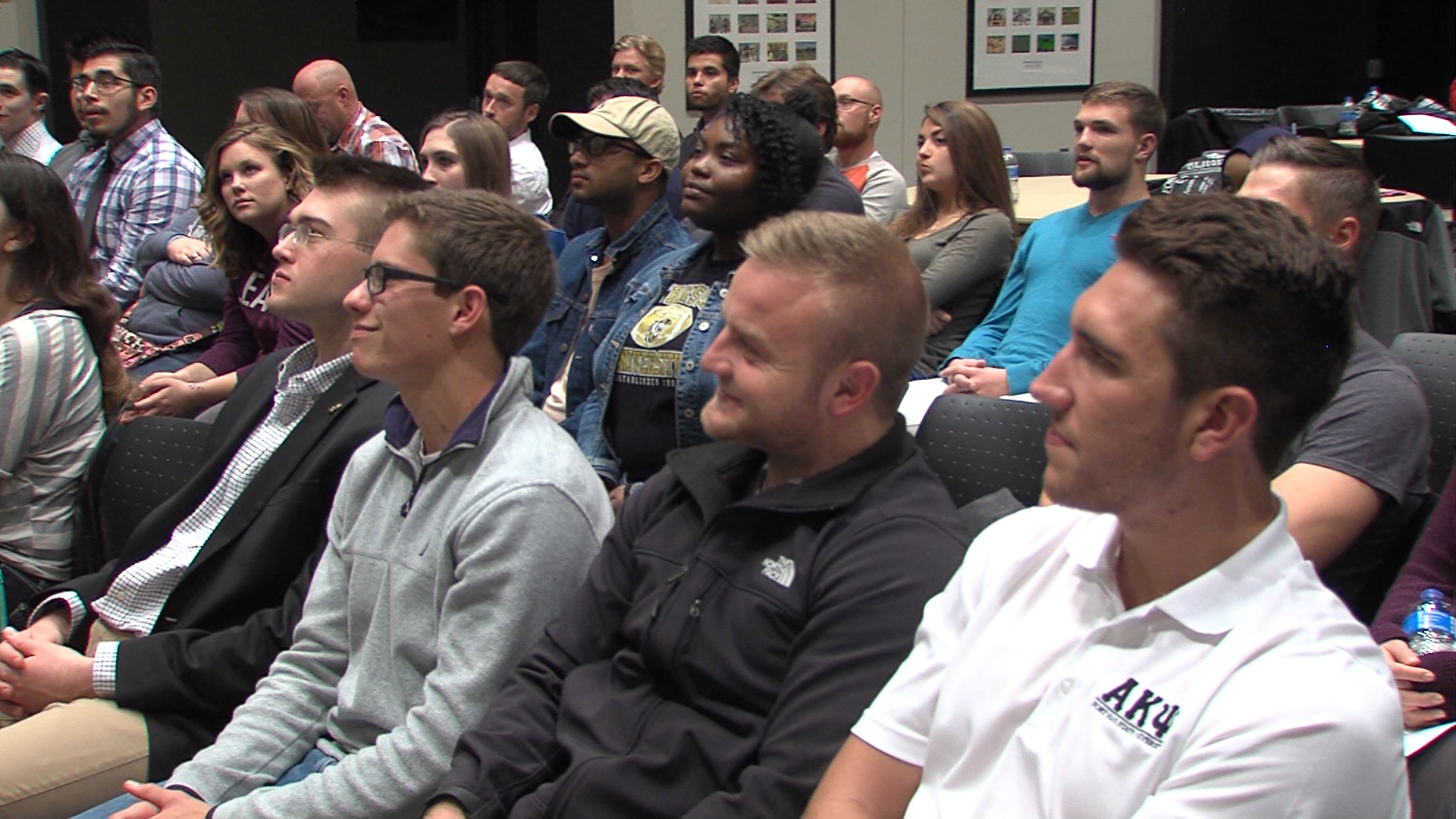
The 41 participants of the sixth annual Kansas Startup at Fort Hays State University kicked off their entrepreneurial weekend in the Robbins Center with a pep talk from a U.S. Senator Friday night.
Sen. Jerry Moran (R-KS), a former Hays resident, was back home to encourage their ideas and desire to help make western Kansas become an entrepreneurial hub. Moran is a member of the Senate Commerce, Science and Technology Committee
“I got interested in startups because I was worried about the fiscal condition of our country. A report from the Kauffman Foundation of Kansas City landed on my desk and talked about the opportunities we have to grow our economy by increasing the number of startups and improving the number of startups that are successful. It occurred to me that maybe it’s easier politically to deal with a growing economy than it is figuring out where we cut spending or raising taxes on somebody.
“This became something I developed a passion for. I’m particularly glad we have startup interest in parts of Kansas that are rural.
“I teamed up with Senator Mark Warner (D-Virginia) and we’ve been pursuing something now in its fourth version, called Startup Act 4.0.” The bipartisan jobs legislation would encourage creation and growth of new businesses.
“We took a lot of Kauffman information and recommendations and are working to pursue a tax code, an immigration policy, access to federally funded research, and increasing the amount of money, authorizations and opportunities for economic development authority of the Department of Commerce to provide resources for startup businesses and entrepreneurs.
“The goal is to see if we can get this legislation through the Congress. The tax code portions of our bill — the ability to retain capital and to reward success and entrepreneurial efforts –have already passed Congress.
“We’ve encouraged our colleagues in the United States Senate to host startup events, to visit startup companies, and talk about entrepreneurship.”
Moran has visited SXSW (South By Southwest) in Austin several times, each time making sure his attire was less formal. “I got out of my suit about the third year and out of the tie and sport jacket the fourth year,” he joked with the crowd. SXSW is a popular annual conference and festival celebrating the convergence of the interactive, film, and music industries. “I’m trying to figure out how what we see in Austin, in Boston and in Silicon Valley, can be replicated in Kansas.”
Immigration issues are primarily what keep his Startup Act legislation from being passed, Moran thinks.
“Our suggested legislation allows for 75,000 new visas for people who are foreign-born and educated in the United States who want to put their capital into starting a business and employ people in the United States. It also allows for 50,000 more STEM visas for those who are interested in science, mathematics, technology, and engineering.
“This may be the most important thing we can do.
This is the sixth year of Kansas Startup.
“In fact, the Kaufman studies indicate the number of entrepreneurial efforts by those who are foreign as compared to American is significantly larger. About 40 percent of startups come from foreign individuals in the United States. We want to utilize people’s entrepreneurial and intellectual skill sets. We want to utilize their capital if they want to start a business. But because it deals with immigration and people coming to the United States, that then lends itself toward broader political discussion.
“I would guess 80 percent of my colleagues agree with those two (visa) proposals and could vote for them. But too often we can’t deal with any immigration issue unless we deal with every immigration issue, which then results in dealing with no immigration issues. So we are redoubling our efforts in this Congress and this Senate to pursue that success.
“Someone in Silicon Valley was telling me they applied for H-1B visas for the 18 engineers they needed. They got none of those in the (visa) lottery. They said ‘Senator, you should know we hired them anyway.’ So how do you hire people when you didn’t get the visa? They hired them at their facilities in Canada.
“Not only did we lose 18 new engineering jobs in the United States, but I have little doubt that one or more of those 18 hired engineers will be the creator of the next Facebook or the next Google, and the sad fact is, they’re not in the United States. So we lose a lot if we can’t come together and figure out how to have an appropriate, fair immigration system.
“We want to improve the chances regulations don’t get in the way of a new business. Most people starting a new business don’t have a lot of money. Anything that drives up the cost of just getting your business off the ground diminishes the chances for its success.
“This is really about The American Dream,” Moran concluded. “I wish you well. If you can succeed in pursuing The American Dream, you will help others achieve theirs. And that’s a great thing for one generation to pass on to the next.”
Kansas Startup, led by the FHSU W.R. and Yvonne Robbins College of Business and Entrepreneurship, is a time for entrepreneurs to meet, share ideas, and launch new businesses.
Henry Schwaller, co-organizer of Kansas Startup
“This three-day event is open to anyone with a great idea and the desire to make that idea a reality,” said Henry Schwaller, instructor of management and co-organizer of Kansas Startup. “The weekend is a 48-hour, hands-on experience where anyone interested in starting a business or non-profit can find out if their idea is viable.”
Hopeful entrepreneurs begin by making their pitches over an open mic on Friday – bringing their best ideas and hoping to inspire others to join their teams.
Saturday and Sunday, the focus is on developing the business idea and building a viable product. On Sunday evening, teams present their product to a panel of experts for feedback and prizes. Participant presentations are open to the public free of charge at 5 p.m. Sunday in the Robbins Center.
The event is sponsored by NetWork Kansas, Sunflower Electric Power, Commerce Bank, and Midwest Energy.
The Hays Post chose four home-grown businesses to highlight as innovators in the local community. These included RANS Design, Joe Bob Outfitters, Pat’s Beef Jerky and Diamond R Jewelry. If you have a local business you would like to see profiled, email Cristina Janney at [email protected].
RANS Design
Randy Schlitter has operated aircraft manufacturer RANS Design in Hays since 1974.
RANS Design, an innovator in aircraft design, has been located in Hays since 1974. Randy Schlitter, who grew up in Russell, is founder and creative force behind RANS. He started the business by designing and manufacturing sail trikes.
Now the company, located at 4600 Highway 183 Alternate, is designing all-metal kit aircraft for flight hobbyists around the world.
Flying is a more accessible sport than some may realize, Schlitter said. You can purchase an airplane for about the same cost as a new car. Most municipal airports have a flight-school, which makes learning to fly accessible to even those in rural areas. The Hays airport passes dozens of new pilots through every year.
A drafting board sits in the corner of Schlitter’s office, but most of his designing is now done on computer.
“It has become an art form,” he said of the designs.
The company’s latest release is its new Outbound series. RANS intends to offer it in two- and four-seat versions.
Schlitter said he has loved and hated being in Hays. The community is clean, friendly and easy to get around on his bicycle. However, Hays is far away from many amenities available in large cities.
The company moved some manufacturing away from Hays a few years ago, but the company is considering bringing it back. RANS currently employs 20 workers in Hays.
“Hays has an advantage that it has a good workforce. Employees have a good work ethic locally,” Schlitter said.
Schlitter is reaching retirement age, and said he hopes in the next few years to hand off the leadership to others in his company.
Joe Bob Outfitters
Joseph Boeckner is the owner of Joe Bob Outfitters in Hays.
Joseph Boeckner started Joe Bob Outfitters in 2010 Hays with just $5,000 and 14 products. The company has since grown to a national online force that has shipped more than half a million orders to all 50 states, Puerto Rico and Guam.
Although Boeckner has a storefront on Vine, about 90 percent of his business is online. The business has tried to find a niche by offering hard-to-find parts, accessories and ammo that are not carried by big box outfitters like Cabela’s or discount stores like Walmart.
“We have evolved quite a bit,” Boeckner said. “I had not intended us to be this large, but the market decided.”
Joe Bob tries to be a one-stop shop for gun enthusiasts with top customer service and quick shipping. Logistically, Hays is in a good location for Joe Bob’s online business. He can ship to either coast within two to three business days.
The business tries to keep lots of eggs in lots of baskets. Boeckner said diversity helps him weather downturns in the economy as guns are a luxury and not a necessity.
Boeckner served in the Army National Guard. When he left the Army, he enrolled at Fort Hays State University. However, he found he was doing much of what he was being taught in class in his business. He decided to leave school and concentrate on Joe Bob Outfitters.
Boeckner said he has had to learn to flex his business model and change the businesses inventory based on the demands of the market. Some of the main lines Boeckner started with just seven years ago have already been discontinued.
“You can’t paint yourself into a corner” he said. “You have to be efficient and stay in your wheelhouse.”
Pat’s Beef Jerky
Pat Carver has operated Pat’s Beef Jerky for 27 years in Liebenthal. He poses in his business in front of a display of his famous jerky.
Pat’s Beef Jerky in Liebenthal has been cranking out its signature beef jerky for 27 years.
Pat Carver and his crew make about 30,000 pounds of jerky each year. Not only can you pick up the jerky at Carver’s small processing facility off U.S. Highway 183 in Liebenthal, but Carver ships jerky all over the United States.
Among his customers have been NBA and NFL players and Tiger Woods’ caddy. Pat’s has even shipped to the White House.
Although Liebenthal is a small place, 70 percent of Pat’s business still is walk-in. Carver used to have a map hanging in the shop that showed the hometowns of all his customers. They included places as far away as Japan and Alaska.
Although Carver had worked in meat processing for grocery stores, he fell into the jerky business by accident. Someone asked Carver to make some beef jerky. He experimented with recipes until he developed the famous formula he sells today.
The business started out as a part-time job for his parents, Ray and Velma Carver. However, what was supposed to be a two-to-three-day-a-week job quickly became a full-time business. Pat quit his job working for the city of Hays and went to work full time making jerky.
The beef for the jerky is sourced locally from Kansas. Pat’s offers four flavors: regular, peppered, hot and teriyaki. The business also sells ring bologna, summer sausage and brats.
He would not reveal the formula but said, “We have a good quality jerky. It’s tender and a little easier to chew, so you don’t have to pull your teeth out.”
Making the jerky is a three-day process. The meat is sliced and marinated, dried and then packaged.
Celebrities have tried to partner with Carver to market his jerky nationally, but Carver declined. The big names wanted to significantly mark up the cost to consumers, and Carver didn’t want to be associated with that.
Carver is nearing retirement age and said he hopes to eventually hand off the business to someone younger.
“I have enjoyed it,” he said. “I have enjoyed meeting the people.”
If you can’t make it to Liebenthal, Pat’s jerky is available locally at Cerv’s locations.
Diamond R. Jewelry
Dustin Roths started Diamond R Jewelry in 2011 with $12,500 and a 300-square-foot space in the Hadley Center.
A few friends pitched in $2,500 each for a 2.5 percent share in the company.
He knew breaking into the fine jewelry business would be tough, but he hoped he could parlay his experience working at a local jewelry store in college and a high-end store in Overland Park and a business plan that focused on customer service into a successful business.
Diamond R is now located downtown at 807 Main and is selling more than three times his initial investment every month.
The store carries 1,500 engagement sets and wedding bands and has been popular with students in the area seeking engagement sets. Diamond R is a diamond broker, which allows the store to offer competitive prices and design pieces that fit each couple’s budget. The store also offers a selection of estate jewelry as well as colored gem stones such as rubies and emeralds.
Roths knew he had to be very aggressive on price and marketing as he was trying to break in against stores that had been the community 80 and 20 years.
“My thought process was I knew a lot of people in Hays, and that would help us get started,” he said.
Roths said he has enjoyed the store’s downtown location and participating in many community events. He wants the business to be a part of the community.
“Because we have someone in here for a drink and to hang out,” Roths said, “they may see something, and when Christmas rolls around and it is still in the case, they come in and buy it.”
Hays’ regional pull as a shopping center has helped Roths build his business. His customers have been willing to travel, and he is pulling customers from as far away as Salina.
Although Diamond R has an online presence, it’s the in-person personal touch that has been the business’ bread and butter. The store is using the website to market one-of-kind pieces. He used the example of a pink/peach padparadscha sapphire. A $4,000 ring like that might sit on the shelf for two years, but the store could find someone online that would love and cherish it, Roths said.
Roths is considering expanding to another location and has considered Wichita, Lawrence or Kansas City. However, he worries about being able to replicate the customer service experience he has developed in Hays.
“The big question is training,” he said. “Can we find the same kind of help that will offer the same kind of service and quality we offer? I am not sure if we can replicate what we do here.”
Carla Eddie Barber, McPherson, formerly of Hays, will sign copies of her recently published fantasy fiction novel, “Brennem Wild,” from 9 to 11 a.m. Saturday, Nov. 18 at Craft Coffee, 120 N. Main St., McPherson.
Barber, a Fort Hays State University grad with bachelor’s and master’s degrees in English, was curator and then director of the Ellis County Historical Society for 10 years, from 1995 to 2005.
Also on hand to sign their work will be the book’s illustrators, Dr. Alisha Mervyn, who created the cover, and graphic artist Britny Arnett, who created the six interior illustrations.
In addition to copies of the book for sale, artwork from both artists will be on display. The trio welcomes fantasy fiction fans, friends and well-wishers to stop by for a cup of coffee and a chat. The book is also available online at Amazon.com and on Kindle. For more information, visit the Brennem Wild Facebook page.
“Brennem Wild” is the first of a series focusing on a smart but introverted Chicago native who finds herself suddenly on another world, in some ways similar, but in others highly different from her own. Her quest to find a way home leads her into some dangerous, and some awkwardly hilarious, adventures.
Barber calls this series a salute to her hero, C.S. Lewis’s, Narnia series. Some elements, such as the switch of worlds and talking creatures, are similar, but so is the use of the novel to discuss deeper topics. However, while Lewis’s series was written for children, “Brennem Wild” is intended for adults, although appropriate for younger voracious readers who’ve enjoyed fantasy such as J.R.R. Tolkein’s Ring series.
Left to right: Gen. Barry McCaffrey, Gen. Peter Pace and Cdr. Kirk Lippold discuss “The U.S. Military’s Role in Global Security” at the Fort Hays State University Presidential Speaker Series Thursday at Beach/Schmidt Performing Arts Center. Jamelle Bouie, Slate’s chief political correspondent, moderated.
By CRISTINA JANNEY Hays Post
The Fort Hays State Presidential Speaker series brought three prominent military leaders to campus for a panel discussion titled “The US Military’s Role in Global Security,” and the discussion quickly turned Thursday night to North Korea.
The panel was moderate by Jamelle Bouie, Slate’s chief political correspondent and a contributor to publications such as The Atlantic, The Washington Post, The New York Times, TIME and the New Yorker. The panelists were Cdr. Kirk Lippold, Gen. Barry McCaffrey and Gen. Peter Pace.
Cdr. Kirk Lippold retired from the U.S. Navy in 2007 after 26 years of service. He was commanding officer of the USS Cole when it came under a suicide terrorist attack by al Qaeda in the port of Aden, Yemen, in 2000. Lippold’s personal awards include the Defense Superior Service Medal (three awards), Combat Action Ribbon, Navy Commendation Medal (two awards), Joint Service Achievement Medal and Navy Achievement Medal (two awards), in addition to various campaign and service ribbons.
Gen. Peter Pace, left, discusses a point while Cdr. Kirk Lippold, right, listens at the Fort Hays State University Presidential Speaker Series Thursday at Beach/Schmidt Performing Arts Center.
Gen. Barry McCaffrey served in the U.S. Army for 32 years and retired as a four-star general. At retirement, he was the most highly decorated serving general, having been awarded three Purple Hearts, two Distinguished Service Crosses and two Silver Stars for valor. For five years after leaving the military, McCaffrey served as the director of the White House Office of National Drug Control Policy (ONDCP).
Gen. Peter Pace retired from active duty on Oct. 1, 2007, after more than 40 years of service in the U.S. Marine Corps. Pace was sworn in as 16th Chairman of the Joint Chiefs of Staff in 2005. In this capacity, he served as the principal military adviser to the president, the Secretary of Defense, the National Security Council and the Homeland Security Council. Prior to becoming Chairman, Pace served as Vice Chairman of the Joint Chiefs of Staff. He holds the distinction of being the first Marine to have served in either of these positions.
In June 2008, Pace was awarded the Presidential Medal of Freedom, the highest civilian honor a president can bestow. He is a member of the Director of National Intelligence (DNI) Senior Advisory Group, and has served on the president’s Intelligence Advisory Board, and the Secretary of Defense’s Defense Policy Board.
Pace began the discussion by saying the president has many tools to contain North Korea.
“The truth of the matter is that North Korea is not going to be dictated to on the outside by Twitter or any other way,” he said.
Gen. Peter Pace, right, and Gen. Barry McCaffrey, left, listens at the Fort Hays State University Presidential Speaker Series Thursday at Beach/Schmidt Performing Arts Center.
Pace said China and other countries in the region are going to need to be brought on board to form a regional response to North Korea. Some of these can include China, the United States, South Korea, Japan and other countries that are interested in the South China Sea, including Vietnam, Malaysia, the Philippians and Indonesia.
The Chinese are not happy with U.S. support of Taiwan. Pace said the U.S. could use trade, or the manner in which it discusses Taiwan, as leverage to entice China to be more forthcoming with its influence on North Korea. With United States focused on North Korea, China is free to do what it wants in the South China Sea, including building up artificial reefs in attempts to expand its territory and influence, Pace said.
China may be motivated by the possibility of America troops on its border with North Korea.
“If there were a war, we would certainly prevail, and if we did prevail, that would put U.S. troops on the north border of North Korea,” Pace said.
With North Korea firing missiles over Japanese territory, the Japanese at some point could seek to obtain nuclear capabilities. This too would not be in the interest of the Chinese, Pace said.
“Some combination of things that are important to China, things that are important to South Korea and Japan and the United States, some combination of that will get us to a dialogue that will allow diplomacy to take hold that can get us to where we want to be, and the president will have more tools at his disposal to get us to that dialogue,” Pace said.
Jamelle Bouie, Slate’s chief political correspondent, moderated the panel.
McCaffrey described North Korea as the most desperately cruel place on earth — a poor country wrapped around an army. Over three generations, the North Koreans have been molded to the mindset they would gain nuclear weapons, unite the peninsula and drive the U.S. out of the region.
“They have learned that if you provoke South Korea or the U.S. and then demand negotiations, you will get rewarded and you can provoke again. Essentially, in that period of time, we never took military retaliations, neither the United Sates or South Korea,” he said.
McCaffrey said if North Korea engaged the U.S. in open war, they would destroy North Korean army and its government in less than six months with terrible humanitarian consequences, and in the end it very well may go nuclear.
“There is this tremendous potential for a literal regional armageddon, which we would win, but none of us want to go down that route. The South Koreans and the Japanese and Australians are never going to agree to a pre-emptive conventional strike to take out the nuclear capability, so we are going to have to go back to diplomacy and economic power.”
McCaffrey said he was very concerned about the president’s use of language, calling Kim Jong Un, “little rocket man,” and threatening the use of military force.
“Two years ago, I would have said there was a 5 percent chance of war. As of this time around and listening to the president talk, I am saying 51 percent by next summer unless the Chinese come to their senses and realize their purposes are ill-served by conventional war in the region,” he said.
Lippold said the real two players in the region are the United States and China. There is a tremendous amount that can be done diplomatically and economically and to inform people in the United States, Japan, South Korea and even China that our intentions are not to drive North Korea out of power.
China can’t afford any conflict with the United States and will be the linchpin, Lippold said.
“The United States cannot afford to let a country gain nuclear weapons for the first time in our history,” he said, “to threaten us with the offensive use of those weapons in the manner that they gain more capability and credibility to use them so that Kim Jong Un is in fact becoming that clear and present danger.
“China will not want to (go to war) because of the economic impact it would have not only on them but the United States as well. Let’s face it, there are billions of dollars in trade and trillions of dollars in debt that they hold of the United States. They would not want to engage in it,” he said.
“I believe if the North Koreans continue to threaten us with those nuclear weapons that China, with North Korea as their only political ally, would go right up to the brink of nuclear war and then they would negotiate back from there to bring the tensions down, but I think it is literally going to take up to that point to get there, and the United States is going to be in that unfortunately position. … We have spent 50 years negotiating and what has it accomplished? At the end of the day, nothing. That is going to have to be resolved, unfortunately by this administration,” Lippold said.
McCaffrey said despite threats of biowarfare, proliferation of nuclear weapons, terrorism and international crime the U.S. has the strongest and most prepared army in the world and the United States is safer than it has been its history.
Pace added, “When you are seeing military leaders go in front of Congress and ask for more of your tax dollars, it is not because they want to use those weapons in war. It is because we believe it is the strength of our military that prevents us from having to fight most places on the planet. The weaker your military, the more likely that someone is going to test you out.”
The U.S. can secure the world climate by being so clearly superior that nobody wants to take us on, Pace said, and therefore they will resort to terrorism or cyberwarfare, which is not good, but it is better than the devastation of conventional warfare or better they are going to realize that combat is not going to get them their aims and they will resort to diplomacy.
“What your military does best is not fight, and the reason they get to not fight is because they are the best fighters on the planet,” Pace said.
Lippold described the military as a weapon of last resort.
“We have to have the credibility, that when pushed, should the United States military need to or must be used to defend our national security or the surrounding world, we have the credibility that we are willing to exercise that option as a last resort and do it decisively, do it overwhelmingly and do it in a manner that ends the issue on a permanent basis,” he said.
The panel also discussed the need for adequate military funding and the need for long-term presence and support in countries in which the U.S. has been militarily involved.
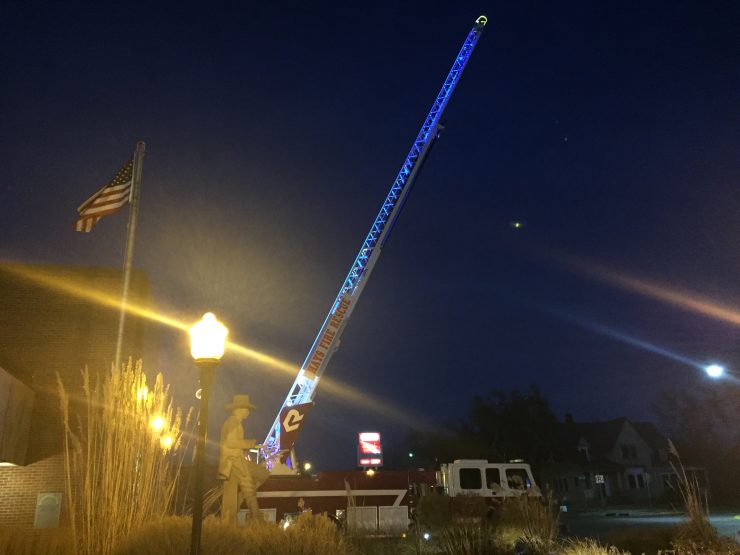

 The other truck had four outriggers with a 20-foot spread; the new truck has two stabilizing jacks with a 15-foot spread. “They also deploy a lot faster,” noted Brungardt. “The aerial ladder also raises and extends more quickly.” The other truck had a 104-foot ladder, but Brungardt believes that’s not a big loss.
 Brungardt pointed out the specialized tools the truck carries, along with its 300-gallon water tank. “It can handle car fires. We can get started on a fire while we’re waiting on a water supply if we have to.