Last week, the Hays Police Department completed training with a new weapon that soon will be deployed, expanding the department’s arsenal and helping increase the range of less-lethal weapons currently used by the department.
“Through the department’s history, we have evolved as needed,” said HPD Detective J.B. Burkholder. “We have seen the need for a larger tool belt and have more options as to how to solve a problem with the least amount of force possible. In doing that, we have slowly graduated and gotten pepper spray, obtained batons, which is an impact weapon, and we have obtained Tasers. That has assisted us in solving problems without having to use a lot of force, and hopefully not lethal force.”
The weapons give officers another option in using less-lethal force with increased range and accuracy over existing options.
“It’s just something else in that ladder if you want to call it that, from where we can try these different things if we have time and the situation dictates, that we can try to solve the problem without causing injury to people,” Burkholder said. “So the 40 mm program came into play.”
The Special Situational Response Team has used a 37mm launcher for a number of years, but the new weapon has considerably improved accuracy, mostly due to the rifling in the barrel.
“Once you start using rifling, the accuracy improves dramatically,” Burkholder said. “With the 40 mm, we are able to deliver an impact munition at a greater range, which allows officers to keep distance from a threat, keeping ourselves and others safe.”
The effective range of the weapon is 5 to 131 feet, where the currently available bean bag round is only 20 to 75 feet Burkholder said.
“That distance is what we are looking for,” he said.
The goal of the weapon is to create a moment of pause in action when dealing with a subject trying to do harm to others.
“We want that person to have to think about, the pain stimulus, where they get hit with that impact projectile and they have to pause and decide whether or not they want to continue with the fight or if they want to start complying with the officers’ orders,” Burkholder said.
That pause allows officers to move in for an arrest safely.
Two types of ammunition will be deployed with the weapon for regular patrols that are intended for use on a subject – a softer foam round designed to create a pain response, and a slightly harder round that includes an OC component, more commonly known as pepper spray.
Both rounds are designed to be aimed away from the head or upper chest and do minimal damage to a subject, unlike a traditional firearm where the goal is to hit a target center mass.
“It allows the officer to hit the subject in a large muscle mass, where the injury is hopefully going to be limited to bruising or they may have small cuts and lacerations,” Burkholder said.
The foam rounds absorb energy from the impact, causing pain, with injuries generally limited to bruising at the impact site.
The OC rounds add another level of pain after the initial impact, giving an even greater chance the subject will comply.
“Once that round impacts the target, you will have that pain compliance and then they will also have to deal with the effects of the OC,” Burkholder said.
The OC affects respiration and causes inflation of the mucous membranes and skin irritation.
While the weapon increases the range of the department’s less-lethal options, Burkholder warns, if necessary the weapon can inflict lethal damage if an officer is forced to use the weapon differently than designed.
“With all of these weapons, When you start talking about less-lethal impact rounds … it’s not non-lethal, it’s less-lethal,” he said.
With training being completed last week, the weapon will be put into service in the near future.
“I don’t have an exact date, but it will be available to officers sooner rather than later,” Burkholder said.
The main goal of the weapon, Burkholder said, is increased safety and gives another option to officers before the use of deadly force.
“Our hope is that it is never used. Our hope is that we never have a situation where we need to use this, but it is another weapon in our tool belt where we can come up with a solution to a problem before using our firearm.”
Sara Bloom, DHDC director, at last year’s Farm to Fork dinner. Courtesy photo
By CRISTINA JANNEY Hays Post
Tickets went on sale at 8 a.m. Monday for the annual Downtown Hays Market Farm to Fork dinner.
The dinner will be at 6 p.m. Friday, Oct. 25, at the Downtown Pavilion. Tickets are $60 each or a table of eight for $450. They can be purchased online or at the Downtown Hays Development Corp. office, 1200 Main. Only 104 tickets will be available.
Farm to Fork supports the Downtown Hays Market. The market has about 80 vendors who annually sign up to sell items. The market does not charge a vendor fee, so the proceeds from the dinner are used in promoting the market, Sara Bloom, DHDC director, said.
The event begins with an hors d’oeuvres and cocktail hour. Musical entertainment will be provided, but the group has yet to be named.
Chef Manuel Hernandez, Gella’s Diner and Lb. Brewing executive chef, is preparing the meal again this year.
The menu is as follows:
Appetizers
Corn-roasted salsa with guacamole, tortillas and pita bread
Honeycomb with brie
Roasted veggies
Meatballs
Soup
Black bean soup
Salad
Mercado shredded salad with jicama (Mexican turnip), carrots, cucumber and mango
Entree
Tricolored beef enchiladas
Dessert
Petite Mexican assortment of desserts with churros, tres leche cake and conchas (sweet bread)
Mexican hot chocolate
Centerpieces from last year’s Farm to Fork with materials provided by Bethesda Place and arranged by Norman Keller of Regeena’s. Courtesy photo
Once the chef has the menu, he provides DHDC with the list of needed ingredients, which he tries to source from local market vendors.
“That covers everything from the dairy products to the egg products to produce and meats,” Bloom said.
Vendors who do not sell food have the opportunities to donate merchandise that is given away during the event.
Resurrection Vineyard will again provide a selection of wines, and Lb. Brewing will offer a new dessert beer.
“We try to keep this event very small and intimate,” Bloom said. “We want the people to be able to meet people they haven’t met before and create a real intimate evening for those who attend.”
What truly makes the event unique, is Chef Manuel’s discussion of the ingredients that he uses and the dishes that he has prepared.
“He is the highlight of the evening,” Bloom said. “Listening to him talk about the ingredients and the difference between the eggs you find in a grocery store compared to ones you can get from a farm and just hearing him talk about his passion for food and his passion for local sources is just wonderful. He really does make the event.”
Lb. Brewing will provide a new dessert beer for the event and Resurrection will provide a selection of wines. Courtesy photo
The Downtown Hays Market will be wrapping up on Oct. 18. It is 7:30 to 11 a.m. through the summer and early fall every Saturday at the Downtown Hays Pavilion at 10th and Main streets.
“We have wonderful vendors who participate in that event,” Bloom said, “and it has truly become a gathering place for our community – free coffee and just good conversation and wonderful products and services that are down there. I always want to encourage people to check out the Downtown Hays Market, and if you are able to support that event by purchasing tickets to the Farm to Fork dinner, by all means, I hope that you do that.”
On Saturday the Humane Society of the High Plains, with help from the Hays Public Library, hosted Paws and Pints at Defiance Brewing.
The event was a fundraiser for the humane society and gave animal lovers the chance to interact with others and participate in a number of activities, including paw painting and a talent show.
A group walks during the Out of Darkness Walk Saturday in Hays to bring awareness to suicide.
By CRISTINA JANNEY
Hays Post
You are not alone — that was the message many of the walkers had at the annual Out of Darkness Walk in Hays had on Saturday.
About 70 people gathered at Municipal Park to remember friends and loved ones who have died as a result of suicide or to find support as they or someone they care for struggles with depression.
The Kelly Center, one of the sponsors of the event, provided colored beads that walkers could wear to show how they have been affected by suicide.
One woman, who did not wish to give her name, said not only has she struggled with depression, but she lost both her mother and grandmother to suicide. She was only 18 when her mother died. She said she felt as if her mother abandoned her.
“… that she didn’t care enough and didn’t love us enough to stick around,” she said, “but at that time, I didn’t understand that has to do with suicide like I do now. I am more understanding now, and I don’t have any anger toward her. If anything, I want to give back.”
A desire to be here for her family has helped her resist acting on thoughts of suicide. She also leans on her friends, some of whom also struggle with depression and anxiety. She also goes to therapy regularly and takes medication.
“It is weird with people who have never been suicidal. It’s hard to explain. It is easier for them to say, ‘Get over it’ or ‘I’ll get you something that will make you feel better.’ There is always some easy solution. … ” she said. “A lot of people who commit suicide have a lot of things we don’t even know about as far as what they have gone through and their traumas.”
She added, “It is not any select group. It happens to the rich. It happens to the poor. It happens to people who have everything and people who have nothing.”
Jess Bieker, 30, also struggles with depression. She attempted suicide and survived. She also lost a friend in high school to suicide.
In her darkest time, she struggled to care for herself even to eat because of her depression. For almost a year, she almost never left her house.
“Taking a shower was like running a mile,” she said. “I could hardly get myself to do that.”
She was constantly hearing a voice that told her to kill herself. She was convinced nobody wanted her around.
“Suicide victims are not selfish,” she said. “When they are doing that act, they think they are doing everybody a favor. I thought by sacrificing myself, I thought I was going to help my family, not be a burden.”
To deal with her depression and anxiety, she goes to therapy regularly and changed her diet.
“I was isolating myself in my bedroom in big cycles, so I forced myself to get out and get sunshine,” she said. “I did a lot of self-worth talk. That was a problem. I thought I was worthless and everybody’s lives would be easier without me. I learned to love myself because I learned I couldn’t help anyone else until I helped myself.”
Bieker has a bachelor’s degree in psychology and has worked as a recovery specialist. She hopes to return to school and study for her master’s degree in social work and work with others who have struggled with mental illness.
Bieker encouraged people who also may be struggling with depression to reach out.
“There are people who care. Your brain tricks you. You are going to think nobody loves you at all. That is never true. There is at least one person that will listen. Please just talk to somebody.”
Emma Vredenburg, 17, of Hays said it was a friend physically pushing her into her school counselor’s office that led to her getting help for her depression and anxiety.
“It was really rough in the beginning. I didn’t feel anything in the beginning and then I felt all of these emotions,” she said. “I didn’t know where they came from or how to process any of it.”
Her depression made school very difficult. She wasn’t motivated to do her school work and she was anxious about even going to school.
Vredenburg is now participating in therapy.
“It helped me realize what I was doing to work through my depression wasn’t healthy and that I needed to change how I processed things to make my brain healthier,” she said.
She said she would tell other students her age that depression and anxiety is not just something that you are going through.
“There are people you can reach out to,” she said, “and it will help. In the beginning, it feels horrible, but if you talk to someone, even if it is just a friend or a teacher or a parent and then get professional help if you need it, you’ll feel way better.”
Vredenburg said she has struggled with suicidal thoughts, but her family has been there to listen and help her through those feelings.
She said she would tell others who may be struggled with the same thoughts, “Everyone is loved. No matter who you are or what you think of yourself, there is someone who loves you.”
Alexis White, 16, and a large group of other participants, walked for White’s best friend, Calista Isbell, an Hays High School student who died by suicide when she was a freshman. This is White’s second year participating in the walk. Isbell’s mother also participated in the walk, wearing a picture of her daughter pinned to her shirt.
“I just really feel like it is important to get the word about suicide out there,” White said. “It is one of the things that isn’t talked about as much. It is something that is happening all over the world.”
White said her friend’s death had a significant negative affect on her.
“I didn’t realize how much I relied on her until she wasn’t here anymore,” she said.
She said she and others felt a lot of guilt after Calista died.
“After awhile you learn to accept the fact that you couldn’t have changed what happened,” she said. “There is nothing that could have been said or done that could have changed anything if they were already in that state of mind.”
High Plains Mental Health has a 24-hour crisis line that can be reached at 1-800-432-0333. The National Suicide Prevention Lifeline is 1-800-273-TALK (8255). The national suicide crisis text line can be reached at 741741.
The local National Alliance on Mental Illness (NAMI) group meets on the first Monday of the month at 6 p.m. at the Hadley Center. For more information, contact Ann Leiker, coordinator, at 785-259-6859.
Canstockphoto.comA Hays Post series focusing on mental health issues.
By CRISTINA JANNEY Hays Post
An occasional glass of wine with dinner is not a symptom of mental illness, but for more than 21 million Americans — 8 percent of the U.S. population older than 12 — substance use disorder is a debilitating disease.
Alcohol use disorder is the most common of the substance use disorders, with 17 million American affected, students in a recent Mental Health First Aid class offered by High Plains Mental Health learned.
Substance use disorders are characterized by a dependence on the substance.
“For instance, you no longer just want to have a glass of wine with dinner, you need a glass of wine with dinner,” Kaley Conner, trainer, said. “It can become something that people depend on like a coping mechanism or a way to relax for people with extreme social anxiety. It may become an unhealthy coping mechanism for how to socialize, how to make friends, to cope in society in some of those stressful situations.”
It can also mean substance use, which is use of alcohol or drugs, leads to problems at work, home, school, in their physical or mental health, or to legal problems.
Substance use disorders start at a median age of 20. They are common among people who suffer from other mental illnesses. People who have mood or anxiety disorders are twice as likely to have substance use disorders, and men are twice as likely as women to have substance use disorders.
Warning signs of alcohol use disorder can include an increased tolerance, difficulty controlling use, symptoms of withdrawal, preoccupation with alcohol, impairment of major functions in life — ability to live, love and learn — inability to stop drinking even though they have expressed a desire to decrease or stop drinking.
Mental Health First Aid uses a four-question screen to determine if someone is at risk for alcohol use disorder
Rapid Alcohol Problems Screen
During the past year, have you had a feeling of guilt or remorse after drinking?
During the past year, has a friend or family member told you about things you said or did while you were drinking that you could not remember?
During the past year, have you failed to do what was normally expected from you because of drinking?
Do you sometimes take a drink in the morning when you first get up?
Yes to any of these questions indicates that a person’s drinking is harmful to their health and well-being. The person should receive a full evaluation from a qualified professional, according to the Mental Health First Aid curriculum.
Risk factors
Availability
Social factors
Genetic predisposition
Sensitivity
Learning
Other mental health problems
“I think it is important we change our frame of understanding around substance use disorders. For a long time, it has been thought of as a moral failure and maybe we have not had as much patience with people who have substance use disorders,” Conner said, “but realistically it is a physical addiction. It’s an illness.”
How to help
The course offers the acronym ALGEE to help first aiders remember the steps in aiding in a mental health crisis.
Access risk of suicide or harm.
Listen non-judgmentally
Give reassurance and information
Encourage appropriate professional help
Encourage self-help and other support strategies
Alcohol and drugs can lower inhibition. About 26 percent of people who complete suicide have a substance use disorder.
In addition to suicide and self-injury, a person with substance use disorder can have medical emergencies, including alcohol poisoning, overdose or severe withdrawal that will need medical attention.
Continual vomiting; vomiting while unconscious; person falls into unconscious state; signs of head injury; irregular, shallow breathing; irregular, weak pulse; and cold clammy pale or bluish skin are all signs of alcohol poisoning. Call 911. If a person is unconscious, roll them on their side until medical help arrives to avoid the person choking on vomit.
Confusion, visual hallucinations, agitation, fever, seizures and blackout are signs of severe alcohol withdrawal. Seek medical attention.
Some people when they drink may become aggressive. Don’t put yourself or others in harm’s way.
Remain as calm as possible and try to de-escalate the situation by talking calmly, not arguing, not threatening, refrain from using negative words, don’t restrict the person’s movement, consider taking a break to allow the person to calm down, according to the MHFA curriculum.
The only thing that can really help a person sober up is time. Black coffee, water and other cures are a myth, Amy Byrd, MHFA trainer, said.
Talk when you are both sober and when you are in a calm frame of mind, Amy Bird, MHFA trainer, said.
“It is very different dealing with a friend or family member who you love and you really care about, not that you don’t care about your co-workers or someone you don’t know as well. This can be a really emotional topic,” Bird said. “There may be kids involved or someone else you love. There can be a lot of anger and a lot of emotion. The time to talk about your concerns is not when you are really upset or angry because then you are going to be talking out of emotion.”
A person who has a substance problem might not have good insight into their problem. They might not recall everything that happened when they were intoxicated. Pointing all of those things out, though, might not be helpful.
“My perception of what is going on and their perception of what is going on may be two very different things,” Bird said.
She suggested refraining from assigning labels, such as alcoholic or drug addict.
As when dealing with other mental illnesses, try to focus on “I” statements and avoid “you” statements that may seem to assign blame —”I am concerned about your drinking?” instead of “You are drinking too much.”
“I am not saying you are a bad person. I am concerned about what you are doing, but I am not saying you are bad,” Bird said.
When you try to give reassurance, the G in ALGEE, consider the following:
Changing a substance use habit is not easy.
Willpower is not always enough.
Advice alone might not help a person change their behavior.
If abstinence from drinking is not the person’s goal, reducing the quantity consumed is a worthwhile objective.
A person may attempt to change or stop their behavior more than once before they are successful
Don’t join the person in drinking or substance use. Don’t try to control the person through nagging or threatening. Don’t make excuses for the person to cover up their substance use or behavior. Don’t take on the person’s responsibilities. Try not to feel guilty. You are not responsible for someone else’s substance use.
“Sometimes addressing underlying depression or anxiety [may help],” Bird said. “Asking people, ‘What does drinking do for you?’ Not just assuming you are drinking because you want to be drinking.”
Major life changes may be required in recovery.
“In AA, they talk about when you get sober you have to change your playmates, your playthings and your playgrounds,” Bird said.
Treatment does not necessarily mean inpatient rehab. You may start with your primary care physician, a drug and alcohol specialist, mental health professional, certified peer specialist or a support group, such as Narcotics Anonymous or Alcoholics Anonymous, which have support groups worldwide. There is an app for Apple and Android devices to find AA meetings.
High Plains Mental Health has a 24-hour crisis line that can be reached at 1-800-432-0333. Valley Hope is an addiction treatment facility, which has a site in Norton. They can be reached at 1-800-544-5101.
However, there remains a treatment gap. In 2014, an estimated 22.5 million Americans 12 and older needed treatment for a problem with drugs and alcohol, but just 4.1 million people received help. Money, stigma, lack of insurance, waiting lists and proximity to treatment can all be barriers to receiving treatment, Bird said.
Although you can’t make someone seek treatment, you can be there during treatment. Statistics indicate sufferers of substance use disorder are more likely to be successful in treatment if they have supportive friends and family. Groups for those who have loved ones struggling with substance use include Al-Anon and Alateen.
Canstockphoto.comA Hays Post series focusing on mental health issues.
By CRISTINA JANNEY Hays Post
Imagine someone was constantly whispering negative comments in your ear. “Don’t trust them.” “Is he looking at you?” “Why are you talking him?”
A group of Mental Health First Aid students experienced what this might felt like recently. One person whispered in their ear while they tried to carry on a conversation with a second person. All the students reported it was difficult to concentrate on the conversation, and it was difficult to respond to the person they were speaking with.
Hearing voices can be a symptom of psychosis — one of the topics discussed in Mental Health First Aid, which is offered by High Plains Mental Health.
Just the word “psychotic” is scary to most people. They don’t understand it. They think it means the person is going to be violent, and it is has become synonymous with “crazy.”
However, those who suffer from psychosis are people who deserve compassion, MHFA trainers said. Despite stereotypes, people who suffer psychosis with proper treatment can be good friends, neighbors and employees.
“As a teenager I did watch the original ‘Halloween’ movies, and I did remember Michael Myers,” said Kaley Conor, MHFA trainer. “He is running around and he is killing everybody. Who is chasing after him? It’s a psychiatrist. Because he is ‘crazy.’ He is ‘psycho.’ It paints this picture that people who are experiencing psychosis are violent. They are serial killers. They are people you need to be really terrified of, and we know that is not true …
“I think stigma is especially prevalent with psychosis and with disorders in which psychosis would occur.”
According to the Mental Health First Aid curriculum, psychosis is a general term, which is used to describe a mental health issue in which the person has lost some contact with reality. It can disrupt thinking, emotions and behavior and as a result impact relationships and work and make self-care difficult.
Conner noted just because a person is experiencing psychosis doesn’t mean they are completely gone or completely out of touch with reality.
“We don’t ever want to speak about someone with psychosis as if they are not in the room, as if they don’t have ears on their head, or as if they don’t understand you,” she said.
Disorders in which psychosis is present are less common than other mental illnesses. They can include schizophrenia, bipolar disorder, psychotic depression, schizoaffective disorder, drug-induced psychosis and delirium. For example, bipolar disorder affects 2.8 percent of Americans, while schizophrenia affects just 0.3 percent to 0.7 percent of Americans.
Most people who develop schizophrenia do so between the ages of 16 and 30. The illness can develop quickly over weeks or take months or years. People who are in the early stages of psychosis can go undiagnosed and untreated for a year or more.
“That is a long time to wait,” Conner said. “If you are seeing things that are not there or hearing voices that aren’t really speaking to you, a year seems a really long time to wait to ask for help.”
People suffering from psychosis might be afraid to tell someone about their delusions for fear of hospitalization or that they may be laughed at, she said.
Trainer Amy Bird, said, “Even though I believe they are so real, I know if I call [someone] and tell her I think aliens are coming into my house, she is going to be ‘Wow!’so I am not very likely to reach out. I also might be really scared to reach out to somebody.”
A person can suffer psychotic episode as a symptom of their mental illness, but that does not mean that they will be constantly psychotic, Conner said.
The symptoms of psychosis could differ depending on the type of disorder from which the person is suffering. Schizophrenia is not split personality. It is an illness in which thoughts and perceptions become disordered, according to the MHFA curriculum.
Major symptoms of schizophrenia include:
Delusions: False beliefs of persecution, guilt, having a special mission or being under outside control. Although a person’s belief’s may seem very bizarre to us, they are very real to person experiencing the psychosis, according MHFA.
Hallucinations: Most commonly hearing voices, but can include seeing, feeling tasting or smelling things. Conner gave the example of a person feeling bugs crawling on him or her.
Thinking difficulties: Problems concentrating, with memory, ability to plan and communicate.
Loss of motivation
Blunted emotions: The person may be oblivious to the things happening around them and may not react appropriately
Social withdrawal
Conner tried to further explain blunted emotions, “Their face might be completely slack. They are terrified. They’re shaking. They’re trembling. They are very scared of things only they can see, but it is like there is nobody home. There is absolutely no emotion displayed on their face.”
Because senses can be heightened during a psychotic episode, a person might be constantly wearing headphones or sunglasses, Conner said. Someone who is hearing voices may have difficulty responding to questions and directions, she said.
People who suffer from bipolar disorder can suffer from severe depression, periods of mania and then have extended periods of normal mood in between, according MHFA.
A person who is experiencing mania, which is the upper swing of the bipolar mood, can have symptoms including:
Increased energy and overactivity
Elevated mood
A need for less sleep: A person may go for days without sleeping
Irritability
Rapid thinking or speech: The person may keep changing topics and may be hard to follow
Lack of inhibitions: The person may disregard risk, spending excessively, being very sexually active, excess drinking or drug use
Grandiose delusions: Inflated self-esteem, such as a belief that the person is superhuman, especially talented or intelligent, or an important religious figure.
Lack of insight: Person may not realize they are ill
“If someone is in a manic state, they might decide, ‘I am going to paint my house.’ They might start painting their house and then they are remodeling their kitchen,” Conner said. “All at the same time. Then they get bored with remodeling their kitchen, and they are organizing their bedroom. They have all these different projects going a the same time, and then they crash and nothing was actually accomplished.
“It was just a lot of hyperactive energy moving from thing to thing to thing.”
They might have grandiose ideas such as they might believe they are a secret agent on a top secret mission.
“You might have really inflated beliefs or ideas about yourself,” she said.
“These signs and symptoms might not seem very alarming on their own,” Conner said, “but when you start stacking them up, you can see how it might be more of a problem.”
Early intervention and treatment of disorders that include psychosis can be important in long-term functioning and recovery. Delayed treatment may result in increased risk of suicide and depression, can delay maturation, hurt relationships, disrupt employment, increase the instance of alcohol and drug abuse, and increase the chance the person may have problems with law enforcement.
Although people who suffer from psychosis might encounter law enforcement because of disruptive behavior, it is a myth that people mental illness are more prone to violence. Less than 4 percent violent crimes in the U.S. are attributed to people who have mental illness.
The course offers the acronym ALGEE to help first aiders remember the steps in aiding in a mental health crisis.
Access risk of suicide or harm.
Listen non-judgmentally
Give reassurance and information
Encourage appropriate professional help
Encourage self-help and other support strategies
Risk of suicide is high among people who suffer from disorders that include psychosis. About one-third of people who have schizophrenia will attempt suicide, and one in 10 will complete suicide. People who have bipolar have a lifetime risk of suicide that is 15 times higher than the general population. It is estimated that 25 percent of all people who kill themselves have bipolar disorder.
If you believe someone is an immediate threat to you or others or is acting out violently, call 911.
Other helping strategies include:
When you approach someone, do so non-judgmentally.
Chose a private time and place free from distractions. Stay calm and portray confidence. Be aware of body language.
State the specific behaviors that concerns you without blame.
Be sensitive to the way the person is behaving.
Let the person set the pace and style of the interaction. Speak quietly and in short sentences. Repeat things when necessary.
Don’t touch the person without permission.
Allow them the person to talk about their experiences and beliefs, but don’t force it.
Comply with reasonable requests
Offer help at the moment or when they are ready.
Offer practical help during crisis and after? Send get well cards, offer to make dinner, offer to help them do grocery shopping or laundry. Think about what you would do for someone who has been the hospital for a physical illness.
Don’t take delusional comments personally, raise your voice, use sarcasm, dismiss delusions or hallucinations, laugh at symptoms or inflame the person’s paranoia or threaten. Don’t restrict movement, which may agitate the person.
Instead of telling someone to stop a behavior, try asking them to do another behavior. Instead of telling a person to stop pacing, you might ask them to sit down, Bird said. If you do the same, this may also help.
“Don’t whisper,” Bird said. “People who are paranoid are scared. I may go over and say something to Kaley that has nothing to do with that person whatsoever, but if they’re scared and on alert, they are going to think they are conspiring and they are going to do something.”
A person who is experiencing psychosis may not have insight they are unwell. Unless a person meets the criteria for involuntary committal, they can’t be forced into treatment, the MHFA curriculum said. “If the they are not at risk of harming themselves or others, be patient, as people experiencing psychosis may need time to develop insight regarding their illness.”
High Plains has a 24-hour crisis line that can be reached at 1-800-432-0333. The local National Alliance on Mental Illness (NAMI) group meets on the first Monday of the month at 6 p.m. at the Hadley Center. The group also offers support for family members of those who suffer from mental illness. For more information contact Ann Leiker, coordinator, at 785-259-6859 or email her at [email protected].
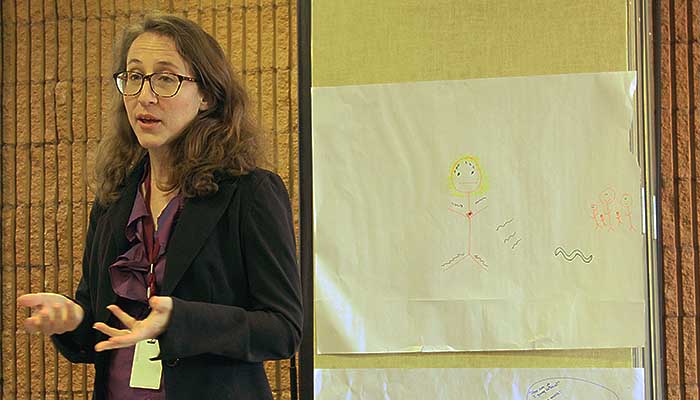
Kaley Conor, Mental Health First Aid trainer, teaches a recent class at High Plains Mental Health Center. Behind her is how the students depicted a person who might be experiencing anxiety.A Hays Post series focusing on mental health issues.
By CRISTINA JANNEY Hays Post
Your hands are sweaty. Your heart is pounding. You feel like you can’t breathe. All your senses seem like they are on overload. Everything is too bright, too loud and even your clothes feel like sandpaper on your skin.
You may think you are having a heart attack, but these are also symptoms of an anxiety attack. One in five Americans will suffer an anxiety attack in their lives. Some might only have one instance and never experience an attack again. However, about 3 percent of Americans suffer from reoccurring anxiety attacks, which is also known as panic disorder. The broader category of anxiety disorders affects 18 percent of U.S. adults and may coexist with other mental illnesses.
Mental Health First Aid, which is course regularly offered by High Plains Mental Health, offers people steps to aid a person in a mental health crisis, including an anxiety attack or an anxiety disorder.
“We all get anxious about some things,” Amy Bird, MHFA trainer, said. “Anxiety serves a purpose. It makes us do things. If I’m not anxious about getting my documentation done, then I would just sit back and whatever happens. But if I know my supervisor is watching that list, I better do that. Sometimes it can become overwhelming and inhibits us …”
Bird gave the example of hearing a loud bang. We might jump, our heart might start to pound. A person may step in say, “Sorry, I was moving a file cabinet and I dropped it,” but it can take up to an hour for us to return to normal after an extreme state of anxiety.
Panic attacks occur when our bodies release fight or flight chemicals. These physical responses are needed if we are running for our lives or fighting off a bear, but are no so helpful if you are sitting talking with a friend over lunch.
In addition to the scenario listed above, other symptoms of an anxiety attack can include:
Trembling and shaking
Abdominal distress or nausea
Dizziness, lightheadedness or feeling faint
Feelings of unreality or of being detached
Fear of losing control or “going crazy”
Fear of dying
Numbness or tingling
Chills or hot flashes
Anxiety and anxiety disorders can be very physical.
“How many kids are going to come to you on the first day of school and say, ‘I’m anxious’?” Bird said. “They are going to say ‘I have a stomach ache or a headache,’ and they probably do.”
The median age for the onset of panic disorder is 24, but the median onset for specific phobias is 7 and the median age for all anxiety disorders is 11.
How you can help
An anxiety attack can mimic symptoms of a heart attack or other serious medical emergency. If a person presents with symptoms, and you are uncertain they are having an anxiety attack, it is best to call 911. Some people may wear a medic alert bracelet indicating panic disorder, so look for that.
Anxiety attacks do not necessary have a precipitating event, but can come “out of the blue.”
The course offers the acronym ALGEE to help first aiders remember the steps in aiding in a mental health crisis.
Assess risk of suicide or harm.
Listen non-judgmentally
Give reassurance and information
Encourage appropriate professional help
Encourage self-help and other support strategies
Mental Health First Aid students try to draw a picture of what they think a person who is experiencing anxiety might look like.
If you believe the person is having an anxiety attack, try to be calm and reassuring. Ask the person if they know what is happening and if you can help. Speak slowly and clearly and in short sentences. Because of the person’s state, they may be slow in answering or not be able to answer at all.
“Even if they know that is what it is, with all that adrenaline going through your body that is making all those physical things happen, it makes you scared because that is what tells you flight, fight or freeze,” Bird said.
Try to be patient with the person and acknowledge their fear. An anxiety attack is not life threatening, but it may seem like it to the person having one. Try, ‘I can see how scared you are.’ Reassure the person that he or she is safe and the symptoms will pass.
“When you are panicked you can’t make a decision,” Bird said. “There are lots and lots of thoughts going through your head. ‘I’m dying. I can’t breathe. All these people are watching me. What is going to happen? I don’t know what to do.’ Sometimes the best way to help is say, ‘I’m going to tell you what to do.’ ”
Ask the person what you can do to help. Byrd noted some people feel more threatened when people try to surround them or touch them during an anxiety attack. Others may feel comforted if you hold their hand.
Although anxiety attacks usually peak within 10 minutes, it could take up to an hour for someone who has had an anxiety attack to come back to feeling normal. Reminding a person the attack should peak in 10 minutes might not be helpful. The person might not have a good concept of time or could become obsessive over the duration of the attack.
Avoid expressing your own negative response to the anxiety attack. Saying things like “Calm down” or “Get over it” are not helpful. Also don’t have the person breathe into a paper bag. This is a myth.
Bird suggested first aiders have the person having the attack look at you. Breathe in for three counts and exhale for three counts.
Risk factors
Anxiety disorders also includes phobias, social anxiety disorder, post traumatic stress disorder (PTSD), general anxiety disorder, obsessive-compulsive disorder (OCD) and agoraphobia. Anyone can suffer from an anxiety disorder, but there are some risk factors, which include:
Having a more sensitive nature and a tendency to see the world as threatening
Having a history of anxiety as a child
Being female
Alcohol abuse
Having a traumatic experience
Difficult childhood (physical, emotional, sexual abuse or neglect)
Family background of poverty
Family history of anxiety problems
Family history of separation or divorce
Some medical conditions
Side effects of some prescription medication
Use of alcohol or drugs
Withdrawal from alcohol or drugs
Some anxiety attacks or flashbacks in the case of PTSD have triggers. Just because something might be benign to you, it may cause great distress to a person who has PTSD or a phobia. People who have PTSD can be triggered by a sound or a smell. Veterans may be triggered by loud sounds or fireworks.
The most common phobias are spiders, bugs, mice, snakes and heights. The most common causes of PTSD include war, accidents, assaults or witnessing a significant event, which can include a mass shooting, terrorist attacks or severe weather events, such as a hurricanes, tsunamis or tornadoes.
Resources
If a person has persistent issues with anxiety or anxiety attacks that are affecting their daily lives or functioning in their job, you can suggest the person seek professional help. If a person who has experienced a traumatic event still can’t stop thinking about the event, is upset and fearful, feeling jumpy, and has suffering relationships four or more weeks after the event, professional help is advised.
Talk therapy and/or medication may be used.
High Plains also has a 24-hour crisis line that can be reached at 1-800-432-0333.
The local National Alliance on Mental Health (NAMI) support group meets on the first Monday of the month at 6 p.m. at the Hadley Center. For more information, contact Ann Leiker, coordinator at 785-259-6859 or email her at [email protected].
Canstockphoto.comA Hays Post series focusing on mental health issues.
By CRISTINA JANNEY Hays Post
If someone fell and gashed their leg, a stranger would likely jump to their aid. They would apply pressure to stop the bleeding and call 911.
Training in first aid and CPR is common for many Americans — even required by some professions and volunteer organizations.
How many of us would know what to do if someone was suicidal? How many of us even know the signs and symptoms of depression? How many of us would simply walk away too afraid to get involved?
High Plains Mental Health offers a day-long course in Mental Health First Aid. The program originated in Australia and now is offered across the U.S., including 10 years through High Plains for the adult program and six years for the youth program. Since the program started, HPMH has certified 2,387 northwest Kansas residents (from 20 counties) in Mental Health First Aid.
The course covers the most common mental illness, including depression, anxiety disorders, psychotic disorders and substance use disorders as well as ways every-day people can help people suffering from mental illness.
High Plains last year received a $20,550 grant from the Kansas Health Foundation to expand its Mental Health First Aid program and has had record participation this year. It has placed an emphasis this year on training first responders, said Kaley Conner, HPMH marketing coordinator and MHFA trainer. High Plains also received a $25,000 grant from the Schmidt Foundation this year to further public education and outreach efforts geared toward the agribusiness community. A small portion of that funding will also go toward MHFA.
Between 2014 and 2017, the suicide rate in the 20 northwest counties served by High Plains increased by 64 percent. In addition, a Centers for Disease Control study released in July 2016 reported farmers as a group had the highest suicide rate of any occupation in the U.S.
Mental illness affects about one and five Americans. It is more prevalent than cardiovascular disease, diabetes and chronic respiratory disease. Many people delay seeking help because of lack of education about mental illness or the stigma surrounding it. Support services may be hard to access, especially in rural communities, and the person suffering the illness might not have good insight into to their illness, according to the MHFA curriculum.
Conner talked about why the MHFA classes are important.
“First and foremost, this class helps raise awareness in our communities, as well as acceptance and empathy,” Conner said. “It is important for our communities to talk about mental health and to understand mental illness is a real illness that has the potential to be very impactful.
“It is also important to give community members practical, easy to remember tools for how they can approach and offer assistance to someone who might be struggling. When someone has a possible mental health problem, it is often going to be family members, friends, colleagues and others in the community who might first notice. For this reason, it is important for community members to be educated about possible warning signs and symptoms, and to know how to respond effectively.”
The first section in the MHFA curriculum discusses depression and goes on to discuss suicide prevention.
Although women present more often for treatment for depression, statistically men are more likely to complete suicide because they tend to use more lethal means, including guns and hanging. Men are four times more likely to complete suicide than women. Although this is a trend, it is not true in all cases.
Depression, which is believed to be caused by the changes in the natural brain chemicals called neurotransmitters, can have many causes, according to the HMFA curriculum.
Some of the risk factors include:
Stressful or traumatic events
A difficult childhood
Ongoing stress and anxiety
Long-term poverty
Bullying
Victim of a crime
Long-term physical illness
Death of a partner
Substance abuse
Depression can also be the result of another medical condition, childbirth (AKA postpartum depression), side effect of medication, the stress of having another mental illness, withdrawal from drugs or alcohol premenstrual changes, lack of exposure to light in the winter (AKA seasonal affective disorder), caring for a person with a long-term disability.
You may be more prone to have depression if you have a family member who has had depression or you have had a previous episode of depression.
Additional risk factors for suicide, include a previous suicide attempt, a friend or loved one who has completed suicide, and an organized plan.
If you believe a person is suffering from mental illness, the trainers urged first aiders to talk to person using “I” statements, as opposed to “you” statements that may seem judgmental. For example, “I am concerned about you.”
There is a difference between empathy and sympathy. Avoid saying, “I understand exactly how you feel.” You don’t. Instead you might say, “I can imagine how you might be feeling.” Empathy, trying to put yourself in another’s shoes, is different than sympathy, feeling sorry for someone.
Other helpful examples included:
How long have you been feeling this way?
Have you spoken to anyone about this before?
Is something bothering you?
You haven’t been joining us lately at coffee.
If the feelings that you are describing have been present for a long time, I think it’s important that you see your family physician.
Your goal as a mental health first aider is not to treat the person who is suffering from the mental health crisis, just as a physical first aider you are not going to set a person’s broken leg. You can offer to get the person to the professional help they need.
“You may not know how to handle the situation,” Conner said, “but you can move them on to someone who does.”
The course offers the acronym ALGEE to help first aiders remember the steps in aiding in a mental health crisis.
Access risk of suicide or harm.
Listen non-judgmentally
Give reassurance and information
Encourage appropriate professional help
Encourage self-help and other support strategies
When accessing risk of suicide, there are signs to look for:
Saying goodbye
Giving away items
Withdrawal
Saying they are thinking of killing themselves
Talking about suicide, death or dying on social media
Seeking means to kills themselves (buying a gun, seeking pills)
Expressing hopelessness
Engaging in reckless behavior
Increased alcohol or drug use
Dramatic mood change
Anxiety or agitation, unable to sleep or sleeping all of the time
Saying they feel trapped
According to the MHFA trainers, asking a person if her or she is considering suicide will not cause the person to kill him or herself or “put the idea in their head.” Talking about their thoughts and feelings may give them a release.
Amy Bird, MHFA trainer, said talking about death or suicide should not be thought of as an attention-seeking behavior. It should be thought of as attention-needing. The person may feel hopeless and worthless, and they need your help.
If you believe a loved one or you may be at risk of suicide, it is wise to put as much distance between thought and action as possible, the trainers said. For instance, move guns out of the house, separate guns from ammo, remove pills from the house.
If you have an immediate concern about a person’s safety, speak to them calmly and sincerely. Appearing confident can be reassuring. Ask:
Are you having thoughts of suicide?
Are you thinking of harming yourself?
Have you decided how you are going to kill yourself?
Have you decided when you are going to kill yourself?
Have you collected the things you need to carry out your plan?
If you have a serious concern about a person’s safety, do not put yourself in danger. If the person has a weapon or is acting aggressively, call 911.
High Plains has a 24-hour crisis line that can be reached at 1-800-432-0333. The National Suicide Prevention Lifeline is 1-800-273-TALK (8255). The national suicide crisis text line can be reached at 741741.
The annual Hays Area Out of the Darkness Walk, which seeks to bring light to the issue of suicide is Saturday at Municipal Park. Registration will start at 1 p.m. in Municipal Park and the walk will start at 2 p.m. If you are interested in walking, volunteering or donating, go to www.asfp.org/Hays.
When dealing with a mental health crisis, include the person in making a safety plan. Do not leave a person who is actively suicidal alone. However, you must recognize you can’t be with a person at every moment. You can help them with the second E in ALGEE by asking them what has been helpful in the past.
Do not use guilt to try to dissuade the person from hurting his or herself. Don’t make comments such as “You will go to hell” or “You are going to ruin other people’s lives.” Also don’t agree to keep the person’s suicide plan a secret.
Help can be found through doctors, psychiatrists, social workers, counselors, peer specialists and other mental health workers. Some people suffering depression may be prescribed medication. They may also engage in talk therapy, support groups or other professional support. Sadly, only about half of the people with depression in a given year receive treatment.
Other self-help strategies can include:
Exercise
Relaxation and meditation
Peer support groups, such as National Alliance on Mental Illness (NAMI). The local NAMI group meets on the first Monday of the month at 6 p.m. at the Hadley Center. For more information contact Ann Leiker, coordinator at 785-259-6859 or email her at [email protected].
Principal Tom Albers discusses cafeteria space issues during a recent school board tour of HMS.
By CRISTINA JANNEY Hays Post
Hays Middle School is out of room, Principal Tom Albers told the Hays school board during a tour Monday night.
HMS enrollment is at 686 students, the largest being the sixth-grade class of 248.
The gradually increasing enrollment has meant an already cramped lunch room is faced with even bigger challenges, the school is out of classroom space, has teachers on carts and class sizes are getting even larger.
“Every sixth-grade class is big,” Albers said. “We are talking 24 to 30 kids and some even bigger. We’re tight.”
Albers said he would love to have more electives for the students, but if the district added staff, he said more teachers are need for core courses to reduce class sizes. HMS is offering half-year English classes for seventh- and eight-graders, and they would like to make those full-year classes.
USD 489 school board members tour a special education classroom at HMS.
However, if HMS added staff, there is the question of where they would put the teachers. On carts, move in trailers? The options are limited.
The last renovations to the HMS were finished in 2014, which included HMS’ tornado shelter.
“People ask, ‘You put these new buildings in. How can you be short? How can you not have room?’ ” Albers said. “One of the reasons is our need for special education.”
Special education is taking up three rooms at HMS now, when at one time it took up just one. More paras and aides are required, the number of students in the program has increased and newer teaching methods require more space. One of the rooms that is being used as a special-ed classroom used to be the teachers’ lounge.
Albers is in his second year in his position at the middle school. He said several times during the tour he knew there were space issues at HMS, but until he actually saw it, he didn’t really understand how much HMS was doing in its existing spaces.
One of these areas is the cafeteria, which was not designed to handle as many students as it does today.
The cafeteria gets very noisy because of the number of students crammed into such a small space. HMS serves lunch from 11 a.m. to 12:45 p.m. Students have 20-minute lunch periods, but really don’t have that long to eat once they get through the line, are seated, and must clean up and line up.
“It’s definitely complicated. It is like ant farm — kids everywhere,” said Shauna Zweifel, HMS assistant principal.
HMS boiler room
Albers said, “It does work, but it doesn’t work well.”
HMS is also serving 150 to 200 students breakfast.
One plan school officials have considered is expanding the lunchroom into an old boiler room adjacent to the existing cafeteria. It is currently being used for storage.
Although the gym is nice and is in good repair, it also has to hold a lot of kids.
With two physical education classes and a weights class going on in the upper deck simultaneously, there can be 110 students in the gym per class period.
Albers described three different teachers using intercoms and bullhorns to direct students all at they same time.
“You had this going on. You had this going on. You had that going on. I was like this is crazy. It was crazy that we would put this many kids in the gym at one time, but it is the only option we have,” Albers said.
HMS Principal Tom Albers points out an uneven point in the HMS track that can be a tripping hazard.
The HMS track is in disrepair. Albers pointed out a large crack in the asphalt that has been repaired with a tar patch and is a tripping hazard. HMS can’t host meets at the school because of the condition of the track. HMS had 177 kids out last year for track.
The school has changed its drop-off procedures with the installation of a new secure entrance at the front of the school. During school hours, visitors buzz into the school and enter through the office. Students are required to enter in the morning through the west doors and check in through the gym.
Albers said the west door drop-off gives the school better control of the students’ movement through in the morning.
The school is working on plans to improve traffic control in the parking lot during drop off. Within the next month, the school plans to convert the parking lot to one-way traffic. Facilities also plans to paint a white area in the parking lot that will be a designated student drop-off zone.
August storm damage on the west side of HMS.
HMS is still working with insurance to complete repairs to the west side of the school that was damaged during a wind and hail storm in August.
“This has been our best year ever to date and we are going to far exceed our expectations.”
Enplanements on United Express at the Hays Regional Airport are up considerably this year, according to Hays City Manager Toby Dougherty.
July 2019 enplanements at the Hays airport set a new monthly record with 1,450 passengers.
In fact, July was the best month on record for airport boardings and total boardings so far in 2019 are also at a record high.
For years, the Hays benchmark boardings number has been 10,000 passengers per year. Reaching that number qualifies the airport for grant monies from the Federal Aviation Administration.
“We’re going to have to modify that benchmark,” Dougherty said, noting every month of enplanements this year has exceeded those of 2018.
Enplanements at the Hays Regional Airport so far in 2019
Dougherty includes himself in those numbers, having recently flown twice from Hays to Florida and also to New York to visit family.
“Ridership is good. The flights are pretty full going out,” Dougherty confirmed.
“Between Hays and Salina, we’re packing that airplane, which is good. Full seats mean revenue for the carriers and that means they want to keep doing business here.”
Utilization of the direct flight to Chicago is increasing.
“We were a little slow to adapt to that flight. I think Chicago is just such an unknown quantity for the Hays Regional Airport flying public.
When Dougherty and his wife traveled to New York, they flew into Denver and then Syracuse, New York, on a direct flight.
“But coming back, it was easier to come through Chicago,” he said.
“Everybody understands the Denver airport – the layout, the schedule, the terminal. O’Hare is a lot different airport. It was a good experience. I had no problem with it. It’s just different than what people are used to with that Denver outlet.”
Boardings at the Hays Regional Airport are “demonstrating that a lot of people are realizing Chicago is another venue, especially if you’re going east or if you’re coming back from the east. So, those boardings for the Chicago flight are slowly increasing.”
Dougherty attributes the overall increased ridership to schedule and consistency. “We have pretty prime schedules.”
The first weekday flight out of Hays was adjusted Sept. 1, moving back an hour to 8:03 a.m. from about 7 a.m.
“That still gets you to the big bank of flights in Denver and you can make it pretty much anywhere the same day.”
Dougherty believes the morning flight out, a mid-day turnaround with a swing-through to Chicago, and the late night flight coming back to Hays, is a schedule attractive to both business and pleasure travelers.
“It puts most of the United States in a situation where you can easily get there in one day and you can easily get back in one day. In many cases you can get there and get back that afternoon.”
When Dougherty flew to Syracuse, they left on the morning flight and arrived at 1:30 p.m. local time. Coming back through Chicago, they left Syracuse in the morning and arrived in Hays by 1:30 p.m.
“That’s a pretty timely schedule to leave central New York and arrive back in Hays in the early afternoon.”
Passengers using the Hays Regional Airport has always been more heavily skewed toward business travelers.
Still, Dougherty encourages people to check flyhays.com and use the True Cost Calculator when planning any type of trip.
“Our flights are relatively affordable when you look at comparing flying directly out of Kansas City or Wichita or Denver.
“We are extremely competitive and extremely affordable especially when it’s just one person traveling.
“It’s rare to find an instance out of Hays where it’s cheaper to drive somewhere and then fly. By the time you figure in time, gasoline, the possibility of an overnight stay, and parking, it is rarely cheaper than flying out of Hays.”
If you’re flying a family of four, however, Dougherty acknowledges it’s sometimes more expensive to fly out of Hays.
Still, he says, “when I fly out of Hays, I see a lot of people who are heading out on vacation.”
Barry Grissom, a Democratic candidate for the U.S. Senate seat being vacated by Pat Roberts, stopped in Hays Saturday at Breathe Coffee House.
By BECKY KISER Hays Post
It’s the “kitchen table” issues, not national politics, Barry Grissom is most interested in as a Democratic candidate for the U.S. Senate seat being vacated in Kansas. Republican Pat Roberts is retiring after nearly 40 years in Washington.
Grissom, 65, is the former U.S. Attorney for the District of Kansas, a position he was appointed to by President Barack Obama. The Leawood resident served in that office from 2010 to 2016.
Grissom was in Hays Saturday afternoon to meet privately with the Ellis County Democratic Party after kicking off his senate campaign July 1.
“Most of us got jobs, we got kids, we got responsibilities. We can’t be in the finger-pointing game that exists in Washington, D.C. or in different media circles,” Grissom said in an interview prior to joining the local Democratic get-together.
The Kansans he’s talked with are more concerned about issues directly impacting their daily lives, Grissom says.
“Things like is my kid going to get a good education, am I safe in my community, I want to exercise my religion as I see fit, I want to vote.
“Issues that people have, whether Republicans, Democrats or independents, the vast majority of them are the same. I think the differences that separate us are not that great and we can disagree about those. But we agree on so much. I think what has happened is we’ve gotten away from the larger group agreeing on the agreeable items and just focused on the divisive items. And I think that only harms us as a community and certainly as a state and as a country.”
Those agreed-upon “kitchen table” issues include three major areas, according to Grissom.
“Not surprisingly, number one is health care. Access to rural health care in Kansas is a real challenge, and even in some larger communities.”
He pointed to Fort Scott, the county seat of Bourbon County, which does not have a hospital. Mercy Hospital closed its doors Feb. 1. “We have one institution in Crawford County servicing the needs of 50,000 residents in southeast Kansas. Even if you’re fortunate enough to have the best health insurance in the world, if you have no place to utilize it, health insurance really doesn’t make any difference.”
Grissom is a little surprised by another “kitchen table” issue – student loans – but it’s come up more and more as he’s talked with Kansans during his campaign.
“If you have a young person in your family and they have a lot of student loan debt and you live in a rural area, they’re probably not going to return to the rural area because there aren’t jobs there that provide sufficient income to service your debt.
“So they’re forced to leave the farm. They’re forced to leave a community they might otherwise want to come back to.”
Community safety concerns are something Grissom is well-acquainted from his years as a U.S. Attorney.
He recalled his office’s investigation and prosecution of bombing plots targeting Wichita Mid-Continent airport in 2013 and Fort Riley in 2016.
“So I’ve had some real, on-the-ground meaningful experience working with law enforcement.
“We all came together. Nobody was a Republican. Nobody was a Democrat. We came together as a team to keep Kansans safe.”
Grissom has also worked with smaller law enforcement agencies, particularly in human trafficking and drug transportation along Interstates 70 and 35. While in office, Grissom spoke to classes at Fort Hays State University about human trafficking and sexual exploitation.
In 2014, he worked with Ellis County law enforcement and the Kansas Highway Patrol in a drug stop that netted 80 pounds of methamphetamine and 11 pounds of cocaine. Grissom was also involved in the prosecution and conviction of a former temporary employee of HaysMed who infected a number of patients with Hepatitis-C, including one woman who died.
As the state’s former top federal law enforcement official, Grissom has name recognition in Kansas as a senate candidate.
So does second-term First District Congressman Roger Marshall of Great Bend, who announced his candidacy for the senate seat Saturday morning at the state fair in Hutchinson.
“I’m going to leave it to my Republican friends to sort out who they want to be their standard-bearer after the primary,” Grissom said with a smile.
Grissom went back into private law practice for a short time after his appointment ended. “It was satisfying in its own way but didn’t give me the satisfaction I got from doing public service.”
He and his wife talked about whether they wanted to “throw ourselves into the meat grinder that is otherwise known as politics.” They decided to do it and once Sen. Roberts announced he would not run again, Grissom says “it became that more attractive.”
An open federal seat in Kansas is rare.
“It provides our citizens in Kansas a real opportunity on both sides of the aisle,” Grissom believes, “to have a primary process and pick somebody that they think might do their very best to share their interests and their desires of what a public servant might do, from all the major things you might think about in national politics to the more important things, which are ‘kitchen table’ issues.”
Kansas, a die-hard “red state,” has not had a Democratic U.S. Senator since 1932.
Exhibits at the Sternberg Museum usually feature wonders from earth’s natural history but on Saturday attendees had the opportunity to interact with characters from a long time ago in a galaxy far, far away as the museum hosted it’s annual Star Wars day.
The event featured costumes, informational displays and contests spread throughout the museum, including a build your own lightsaber sessions.

 By JAMES BELL