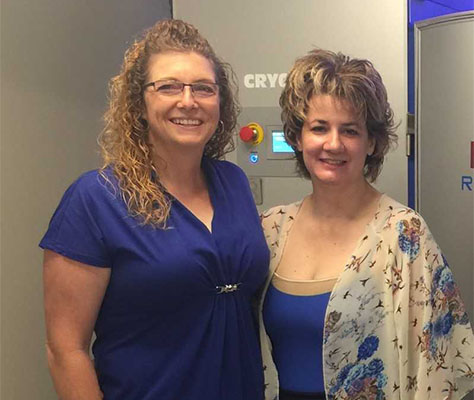
From left Shayne Whisman and Ceena Owens, co-owners of H20.
By CRISTINA JANNEY Hays Post
Imagine floating in a tank of salt water with no light and no sound — just you and the sensation of warm water against your body. Relaxed?
A new business, H2O, is bringing floatation tanks, as described above, and cryo therapy, along with some varied massage practices to Hays this fall.
The flotation tanks and cryo chambers will be a first for the region. The next closest float tanks are in Lawrence and Kansas City.
H2O is a cooperation between Shayne Whisman of Heavenly Soles and Ceena Owens. The co-owners both have their own massage practices in Hays and will be closing those in lieu of opening H2O
An example of a float tank.
The float tanks, also known as sensory deprivation chambers, contain about 18 inches of a combination of water and Epson salt.
The idea is to slow the mind, so that all you can hear and sense is the sound of your breath and your heart beating. Some people relax so fully they fall asleep, Owens said.
Owens suffers from an autoimmune disease and has had her thyroid removed.
“I am like a computer with 15 tabs open at the same time,” Owens said, adding the floating helps to calm her mind.
For people with autism who can be easily over stimulated, the floats can be relaxing. The tanks are also often used by people with anxiety, ADD, PTSD, insomnia or who are seeking a way to deal with stress.
“It cuts off all your external stimuli,” Owens said. “We are stimulated by our cell phones and TVs and fluorescent lighting in the rooms and external noise and radios. You can’t take your cell phone in water, so you disconnect.”
Floating also helps with water retention and may help pregnant woman or others with edema.
A cryo chamber.
The flotation tanks have four-way filters, and Owens said they intend to be very careful with hygiene and cleanliness.
The center will also be offering cryo ice baths. The units are vertical, you step into them and your body is surrounded by liquid nitrogen for three minutes. The cold helps treat inflammation and can be helpful for people with arthritis and those who are recovering from injury.
Some people use the process for weight loss, as it burns about 800 calories.
Both co-owners will be certified by the companies who manufactured the float chamber and cryo unit to use the equipment.
H2O will also offer a salt sauna and hydro therapy tub. For the hydro therapy room the business is brining in Indonesia body treatments from Bali. The women will do Curry scrubs and a yogurt splash. The enzymes in the yogurt help soften the skin. Then you get in the tub with floating flowers and jasmine frangipani oil. You finish with a massage with the jasmine frangipani oil highlighted with a bowl of flowers below you in the face cradle.
Owens said they are modeling their offerings after bath houses in Budapest, where saunas are used to boost the immune system and circulation.
Massage will continue to be an important facet of Owens’ and Whisman’s work.
Some of the massage techniques they will offer include: hot stone, fire cupping and Chinese cupping.
Owens said the owners are looking to offer a holistic approach to the care of the mind, body and spirit.
The center will be decorated in hand-painted murals and house a life coach, relaxation lounge and water bar.
Owens teaches massage at Fort Hays State University and she hopes the center at 1011 W. 27th St., Building F4, (Eagle Business Plaza) can be used for classes starting this fall. They are planning a soft opening in August with a full opening in October when the center gets its float tanks and cryo chamber.
Owens is a nurse and she has worked with local physicians to be complimentary to traditional medical treatment.
For example, physicians often refer her lymphedema patients. Patients, who have blocked lymph nodes or have had lymph nodes removed because of cancer can have problems with build up of fluids, and the massage helps drain these fluid.
Owens and her partner hope to keep their services accessible, with costs starting at $40. They will be open 8 a.m. to 8 p.m. Mondays through Saturdays and 3 to 8 p.m. Sundays.
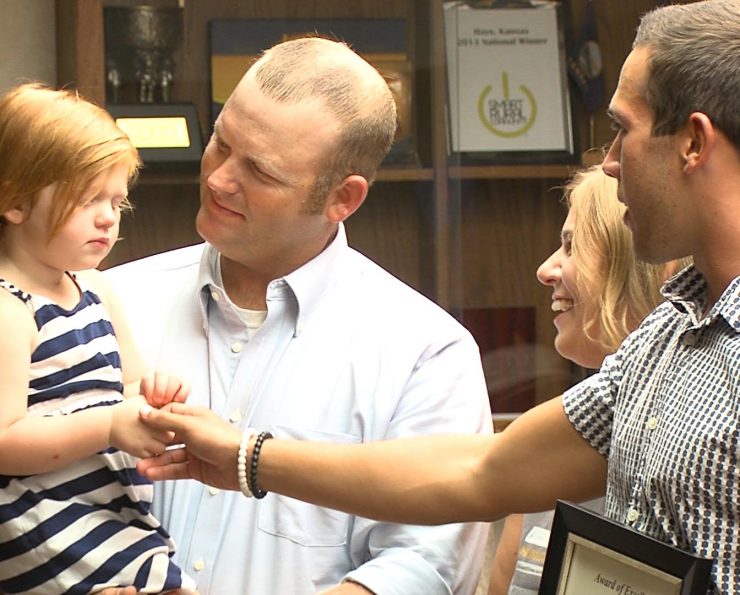
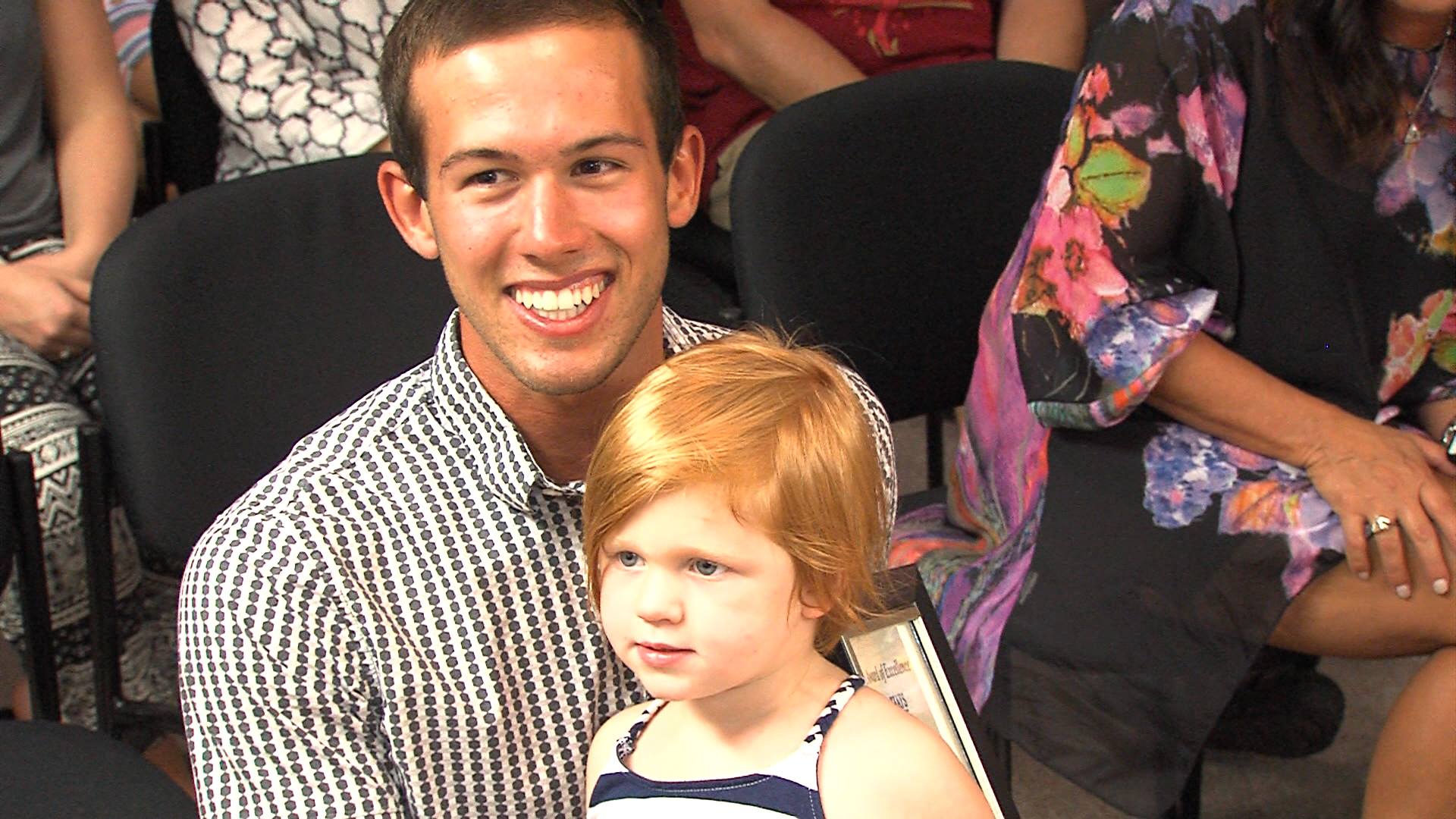
Morgan Mathews and Joanna Hodges are reunited after Mathews saved the 3-year-old’s life July 19 at the Hays Aquatic Park.
By BECKY KISER Hays Post
Three-year-old Joanna Hodges of Hays has made a new best friend under the worst of circumstances.
The little girl was revived by 20-year-old lifeguard Morgan Mathews last week as she nearly drowned while playing in the water at the Hays Aquatic Park.
Joanna and her parents Daniel and Gwen Hodges said a heartfelt “thank you” to Mathews Wednesday night during a public ceremony at Hays City Hall.
“Words seem to come up short when you’re thanking someone for saving a life,” Gwen Hodges told Mathews in a tear-choked voice. “But we are so grateful…you will always be a part of, and a very important person to our family.”
Mayor Shaun Musil, who has three children, and City Commissioner Sandy Jacobs, who has four young grandchildren, also were emotional.
Musil read aloud a recognition of excellence on behalf of Hays and its residents which said in part “…his prompt and infallible response saved a precious life. Morgan Mathews’ courage and leadership are highly commended…and to one little girl and her parents, he will be forever a hero.”
“I think it’s important to recognize this is the kind of youth we are raising, and we’re proud of that in this community,” Jacobs added, followed by a loud round of applause from the audience. There were many hugs and handshakes, including some from Hays and Ellis County emergency responders.
Musil also presented Mathews with a key to the city of Hays.
Grant Lacy and Roger Bixenman, Hays Recreation Commission, attended the ceremony.
From the audience, Roger Bixenman, Hays Recreation Commission superintendent thanked HRC Aquatics Director Grant Lacy, who was sitting next to Bixenman, and Lacy’s staff for the training provided to the swimming pool’s life guards.
“I want to thank Morgan for his quick response,” Bixenman said. “We appreciate it.”
Another life guard, Hannah Norris, came from her post at the HAP Lazy River to assist Mathews, according to Lacy. Hannah and her parents, Eric and Tami Norris, were in the audience.
Mathews, who has been an HAP lifeguard for four summers, said he was “very grateful that Joanna is doing so well and she’s made a full recovery.”
The youngster was unconscious when he pulled her from the deep end of the zero-depth entry pool mid-afternoon July 19.
“When I got out to her, I activated our EAP and that got everything set into motion. That calls 911, brings out the AED (Automated External Defibrillator) if we need it.” Before the pool opens each summer, the lifeguards practice their Emergency Activation Plan (EAP). “Everyone knew exactly what to do,” Mathews added.
Joanna and Morgan pose with their families for pictures.
Joanna is the first person Mathews has rescued from the water.
“I noticed when she was playing and jumping up and down, it didn’t look normal….looking closer, I noticed that her nose and mouth weren’t coming out of the water. And then, she started to float.
“By that time, I was out of my lifeguard chair and on the pool ledge thinking this is suspicious. I’ve never seen a kid do that. She’s little and little kids just can’t hold their breath that long. So I decided to check it out.
Mathews is thanked by a Hays Police officer for rescuing Joanna.
“Once I got to her, I immediately just grabbed her and took her to the side of the pool and began CPR right then. Thankfully, she came back after a minute, but it was very traumatic, very nerve-wracking for sure. When I got her rolled over, I just zoned in right away and she instantly became my entire world. This was my priority. All the training that I’ve done led up to that moment.”
According to the Hays Police Department, Joanna had been at the pool with a daycare provider and was lethargic when emergency responders arrived. Her parents were called to the scene. The Hodges declined to identify the provider Wednesday, saying their family has been with the provider for six years and is “appreciative of the day care staff.” Joanna was responsive when the Hodges took their child to HaysMed.
She was released in good condition from the hospital and also was in good condition at a follow-up appointment with the doctor the next day.
Joanna gave Mathews a keepsake lifeguard whistle engraved with her initials and the date she was rescued by him.
At the conclusion of last night’s ceremony, Joanna ran from her parents to give her new friend Morgan a present, a silver lifeguard whistle engraved with her initials and the date of her rescue.
“Joanna was asking the next morning if she could go swimming again,” said her dad Daniel. “She’s obviously fearless,” her mom Gwen added with a smile.
The Hodges, and Mathews and his parents, Cammy and Brennan Uehing, posed together for pictures in the commission chamber room which was filled to capacity with more family and friends.
Mathews returned to Lawrence today, getting ready for the fall semester at the University of Kansas where he is majoring in geology.
He says he’ll “probably” continuing working as a lifeguard.
“I was having my doubts about wanting to stay because it has been four years and I was getting kinda tired of it,” Mathews admitted. “But after last Wednesday, I told myself I don’t know if I can afford to get tired of it because who knows, this might happen again. I really hope it doesn’t but you never know.”
Carolyn Fuller, former Hays Middle School teacher, stands in the Schmidt Gallery at the Hays Public Library with her Mr. Potato Head collection.
One off-hand comment ended up in a collection of over 90 Mr. Potato Heads for Carolyn Fuller.
Fuller taught math at Hays Middle School for more than 30 years. She was always encouraging here students to participate in class.
“I opened my smart mouth and said, ‘You should participate more than a potato would,’ ” she said.
Her daughter found out about the comment and purchased Fuller her first Mr. Potato Head as a joke.
Fuller brought the Potato Head to class, and the kids thought it was funny.
From there, the Mr. Potato Head collection was born.
Fuller retired from teaching a couple of years ago, but this summer she unboxed her more than 90 Mr. Potato Heads and is displaying some of them at the Hays Public Library in the Schmidt Gallery.
Fuller never intended to collect Potato Heads, but people kept bringing them to her as gifts. They have come in all shapes in sizes and designs.
The original Mr. Potato Head was created by George Lerner of New York City in 1949. It was modeled after an earlier toy, “make a face,” which was a collection of facial parts that you stuck into a real potato. Although Fuller nor her daughters ever had Mr. Potato Heads as children, she said she did remember her cousins have the original “make a face” toy.
“Can you imagine giving that to a child now with the sharp points?” she said.
Parents complained about the rotting fruit and vegetables and the government banned sharp parts in children’s toys, so the head was replaced with a plastic potato in 1964.
The pieces were at one time distributed as prizes in cereal boxes, but the toy was picked up by what is now Hasbro in 1951.
Lerner’s Mr. Potato Head was the first toy to be marketed on network television.
“Toy Story,” which was released in 1995, lead to a resurgence in Mr. Potato Head’s popularity and diversification of his personas as evidenced in Fuller’s collection.
Fuller’s Potato Heads include Spud Trooper and Darth Tater from “Star Wars,” Albert Einspud, Santa Clause, a pirate, an Indiana Jones and Superman spud. The Three Stooges are portrayed as the vegetable toy as well as the characters from the “Wizard of Oz.”
The Loony Tunes are also represented, including Donal Duck and Bugs Bunny.
Fuller has a young Elvis, old Elvis and Blue Hawaii Elvis. Hasbro has also made other toys that portray the character like a piggy bank, key chains and toys similar to a View Masters.
She has several Mr. Potato Heads that represent sports teams. The last Potato Head she received was a Pittsburg Steeler Mr. Potato Head, which mysteriously appeared on her on her last day at school. Fuller never discovered who gifted her the Potato Head.
Fuller said she has never met anyone else who collects Mr. Potato Head, but she is sure they are out there.
“It was fun,” she said of collecting the toys. “The kids at school liked it. I had a former student who told me she really liked my Mr. Potato Heads. She said no matter what was happening in class, there was always something to look at in my room. I am not sure that was a compliment, but it amused me.”
Fuller said she doesn’t know what the future of the Mr. Potato Head collection will be. Most of the toys were gifts, and they have meaning because of the people who gave them to her.
“It was just fun, and it just got out of control,” she said.
The collection will be on display at the library until Aug. 5.
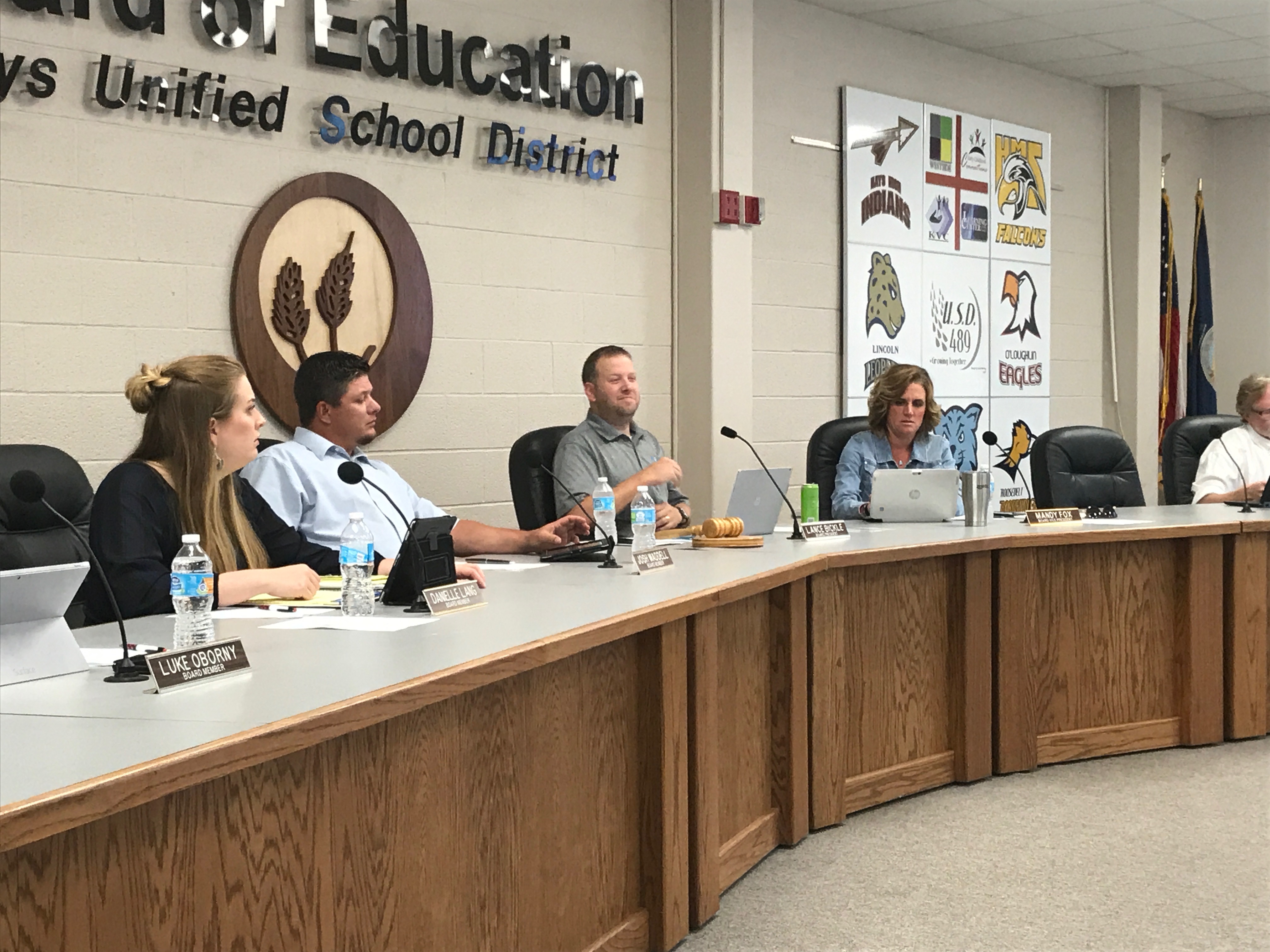
The Hays school board unanimously voted to send a $78.5 million bond issue to voters at its meeting Monday night.
The school board members asked many questions about the bond but ultimately decided to place the issue on the Nov. 7 general election ballot.
The bond issue seeks to build two new elementary schools, and renovate Roosevelt Elementary School, the high school and middle school. O’Loughlin Elementary School would be renovated to accommodate the Westside Program, Learning Center and Early Childhood Connections. A new auditorium would be part of the high school renovation. For a more detailed list of the bond improvements, click here.
The bond would be paid over 30 years, with an owner of a $150,000 home paying $16.43 per month.
Paul Adams, board member, asked if all the space that was being added or renovated was going to be used for education.
Amy Foster, associate for DLR, the district’s architectural firm, said the project would add a gym at the middle school, but the space would be used for PE classes. As many as 130 students are using the current gym at the school. If there is another event in the gym, there is no place to put those students.
A performing arts auditorium will also be built at the high school. Foster said the space could not only be used for performing arts classes, but guest lectures for classes or community events. All the schools will be equipped with accessible storm shelters once the bond is completed, but all those spaces will be used during the school day for other educational purposes.
Adams asked if furniture and technology was included in the bond price. The DLR team said all furnishings and fees for the architectural and engineering firm are included in the $78.5 million.
The district has chosen to hire a construction manager at-risk, Nabholz Construction. Once the project goes out for bid, the school district is given a guaranteed maximum price. If any savings are found during the project, that money goes back to the school district, Ron Ferris of Nabholz explained to the board.
Ferris said if the bond passes, his company would meet with local subcontractors, vendors and suppliers, and the company tires to develop bids that keep as much of the work within the local community as possible.
“The dollars that are spent in Hays keep being spent in Hays over and over,” he said.
Adams praised the teams that worked on the bond issue for their consideration of how the education process has changed. One of the focuses for work at all schools has been to right-size classrooms.
Valerie Wente, parent and community Vision Team member, said elementary teachers want to be able to get down on the floor and work with groups of students on science and social studies projects, but there is no room. Some projects require assistance from paras and parents, but there isn’t enough space to get everyone in the classrooms.
Adams said, “I just returned from a conference in Boston where teachers across the country were learning about how the physical plant affects learning. I wish my children would have been able to benefit from this.”
Board president Lance Bickle said he struggled with his decision on bond issue, but he was willing allow the community to decide on the bond.
“No matter what we do with the bond, how big or small. We are not going to be able to fix everything,” he said. Some will agree with it and some won’t. There is no perfect plan, and there are plenty of items to address. No matter what proposal we have, not all of us are going to agree, not the community, staff or the board.”
Bickle also asked about how many sections would be available for each grade in the elementary schools.
There would be 12 sections for grades second-fifth and 13 sections for kindergarten and first grade. Adding classrooms would move the district closer to smaller class sizes.
However, Josh Waddell, board member, criticized the district for not having a funding plan for additional teachers to staff additional elementary class sections.
Superintendent John Thissen assured Waddell the district would develop a plan to reach that goal. He said staff could be added slowly over time as not to overwhelm the budget.
Foster of DLR noted going from four elementary schools to three is estimated to save the district $300,000 per year for a total savings of $9 million over the life of the bond. Some of that savings could be used for teacher salaries.
The bond financing includes a 2 mill reduction in the capital outlay fund in order to reduce the burden on taxpayers. Bickle asked about how this affects the district’s ability to maintain its buildings.
Thissen said the renovation and construction of new buildings would significantly reduce the list of projects the district has slated to accomplish with its capital outlay funds and further reduce needs going into the future.
Bickle also expressed concerns about the length of the bond.
Dustin Avey of PiperJaffray, which is handling the financial aspects of the bond, said the 30-year bond has some advantages compared to more frequent, smaller bonds. The longer bond would take advantage of low interest rates at this time. The bond could be paid off early, but interest rates could increase if another bond was issued at a later date.
The state has also changed the law on bond debt. A new law passed this spring limits the amount of bond debt that can be issued state-wide in a given year. USD 489 is exempt from this law because it hasn’t passed a bond issue in the last 25 years. Its ability to issue bond debt could be restricted in the future.
Avey also said a 30-year bond spreads the cost of bond to future residents whose children will benefit from the school improvements.
Mandy Fox, board member, wanted to make sure teachers felt they had an opportunity to give input on the bond. A $94 million bond failed to pass in 2016 and Fox said she thought teachers felt they did not get to give input in the development of that bond.
Amy Waginger, O’Loughlin teacher, and Krista Brooks, reading teacher, both said they thought the district-wide in service that was conducted in creating this bond allowed teachers to voice their opinions.
Board members asked John Fuller, chief marketing officer for DLR, if a general election or special election would be better for the bond issue.
Fuller said special elections tend to be most successful for bond issues, but a general election is a close second. He said it might be more advisable to go forward now because interest rates and building costs could go up by the time the district could mount a special election in early 2018. The district will not have to pay to have a bond question on a general election ballot, but it would have to pay for a special election.
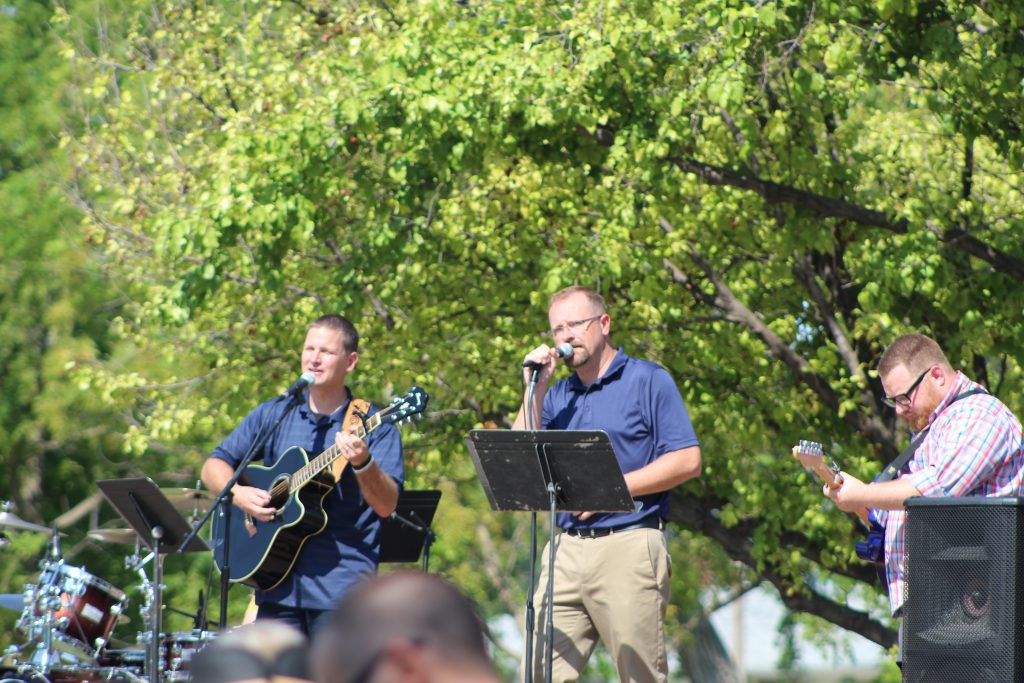
The city of Hays and Ellis County celebrated its 150th birthday this weekend with a variety of events.
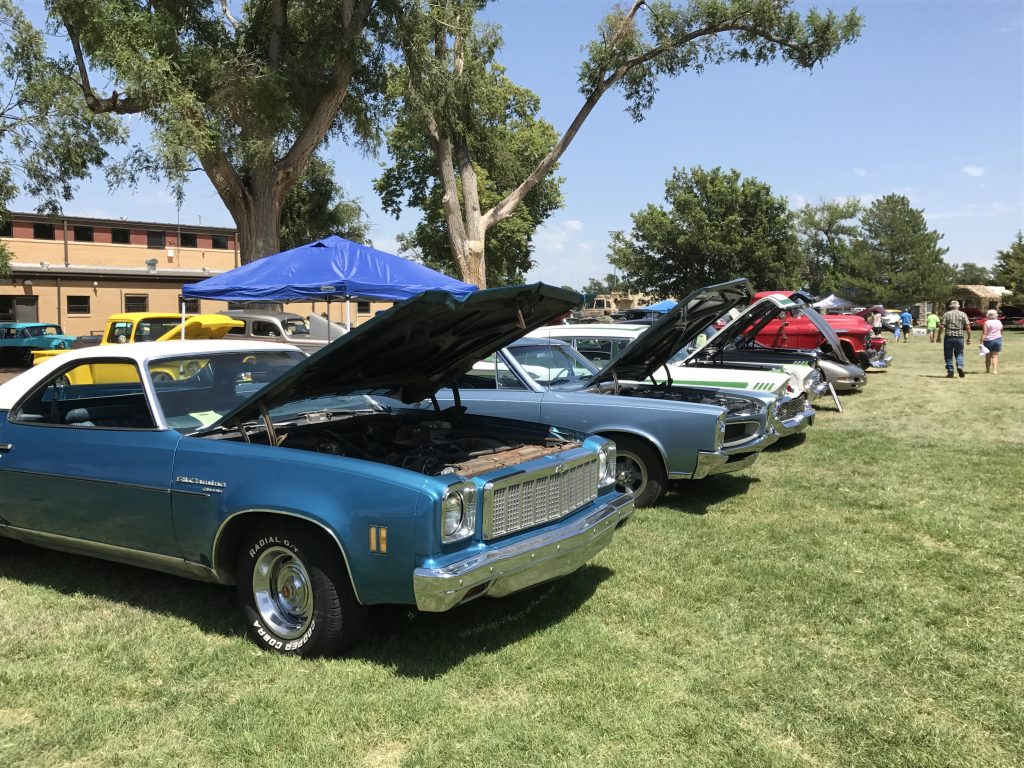
The annual Thunder on The Bricks Car, Truck and Cycle Show recorded more entires than the previous year with 225 vehicles and 50 motorcycles.
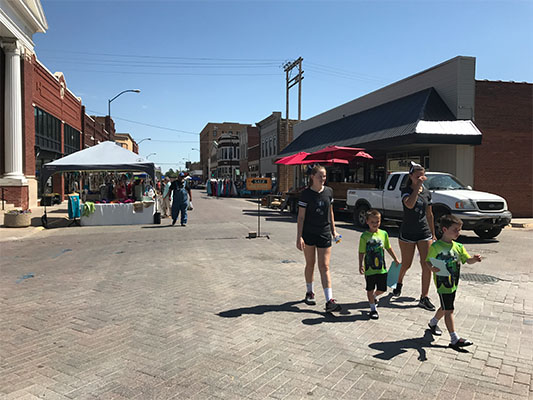
Saturday morning started with the Cancer Council of Ellis County 5K and the Bargains on the Bricks sidewalk sale and Downtown Hays Market.
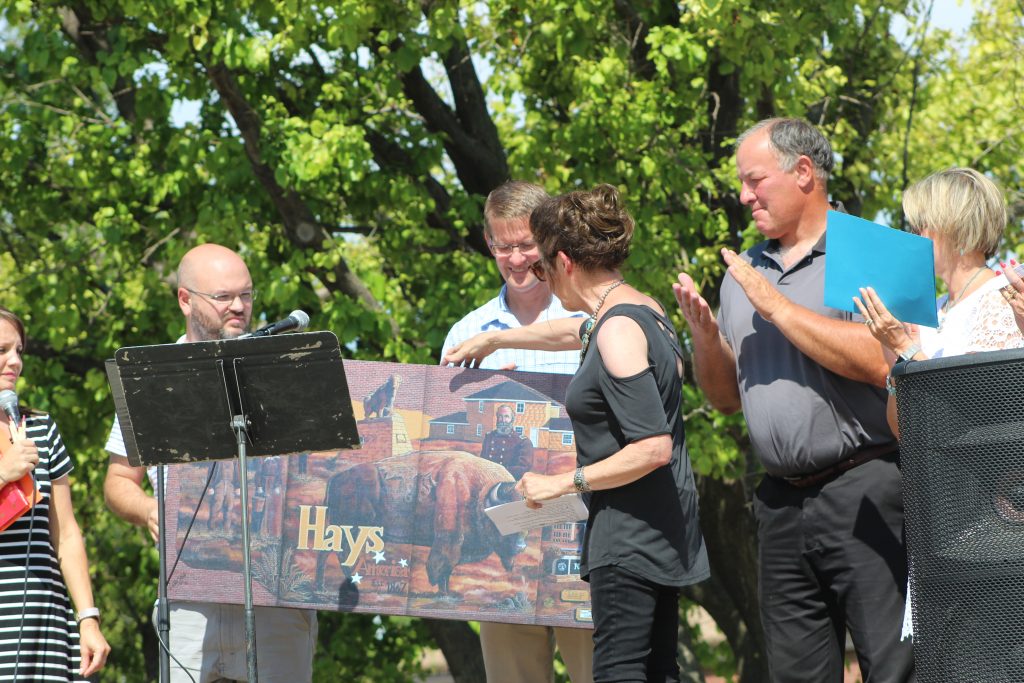
People crowded Municipal Park Sunday morning for a city-wide church service, which was followed by proclamations being read by city and county officials and presentations being made between representatives of Hays and delegations from Hays’ sister cities, Santa Maria de Fe, Paraguay, and Xinzheng, China.
A free picnic lunch was offered in the park as well as inflatables for children.
The city of Hays, historic Fort Hays and Ellis County were all established in 1867, 150 years ago this year.
Henry Schwaller IV
The community’s sesquicentennial was celebrated this weekend.
For three men living in Hays, that history is not just something to be celebrated once or twice a century. It is not plaques on a wall or disintegrating newspaper clippings. It is their lives and their families.
Henry Schwaller IV, George Philip V and Pete Felten, agreed to sit down with the Hays Post and talk about Hays history and changing face of the city.
Early Hays
Pete Felten
Schwaller’s family history dates back to the 1870s in Hays. His great-great grandfather Clemens immigrated to America with his brothers from Switzerland in the early 1800s. Clemens brought his son, Henry I, to settle in Ellis County on a farm near Walker.
Henry and Clemens worked in a general store in Catherine Astad. In about 1888 or 1890, the family acquired a lumberyard along the railroad tracks in Hays.
George Philip V
“They were a large Swiss German family. They were not Volga Germans, but they integrated into the community well and were very involved,” Henry Schwaller IV said.
Henry I, married, May Farley, the daughter of the local druggist. She was the Ellis County beauty queen and represented the area at the 1904 World’s Fair.
Henry II was the third child of Henry I and May. The family focus was business, but they were also involved in the community. May and her sister volunteered at the Presbyterian Club and were very active in other social circles, including Bridge Club and the Women’s Literay Club, which successfully obtained a grant from Andrew Carnegie to build the Hays Public Library.
Henry I was politically active and was one of the groups that campaigned to pave the Hays streets with brick, which was controversial at the time. Some people said they wanted to stay with their rural roots, and brick streets were too cosmopolitan. Henry I’s brother, Fred, was a charter member of the Hays Rotary Club and started the first golf course in Hays.
The Depression
The 1910s and 1920s were good years for the Schwallers, but the prospects changed even for successful families during the 1930s.
The first set back for local businessmen like the Schwallers was the income tax of World War I.
“Although we were comfortable and we had a business,”Schwaller said, “The 1930s were very, very tough. Our customers couldn’t pay and our customers could not afford. There was no building going on. It was a tough time to be in the lumber business.”
Although the economic conditions were awful as commodity prices were very low, the environmental conditions were perhaps worse, Schwaller said.
The dust storms during the Dust Bowl were so bad that it turned day into night. Schwaller said his grandfather recalled going to a basketball game inside Sheridan Coliseum. It was so dusty they had to call off the game because they could not see inside the building.
“The dust would get in houses. I understand that my great-grandmother would close all the windows as best they could and get all the towels they could and make them wet to seal every crevice, and the dust was still crazy,” Schwaller said.
“Not only were there really tough economic times … they were really horrible … but the environmental conditions were awful because the topsoil was just drifting away. Those are the stories that will stick with me most. If it were not for Franklin Delano Roosevelt and the New Deal, we would not have made it.”
In fact, Roosevelt’s WPA commitment to Hays was what turned the family from Republicans to Democrats and frankly other families too. Schwaller said many families had two pictures hanging in their parlor. One was of Jesus and the other was of Franklin Roosevelt. Roosevelt’s administration helped to revise farming practices, bring electricity to the region, and build the courthouse, municipal park and the pool.
“The list was a huge bounty to Ellis County when people couldn’t find work,” he said.
Philip Hardware
George Philip II came to American in 1873 from Scotland. He and a cousin had a general store in Victoria and George Philip was the postmaster there. In 1894 George started the hardware store in Hays. In 1896, the store was moved into its long-time location at 801 Main St.
The Philip family ran the hardware store until 1996.
George Philip V, 62, who still lives in Hays today, grew up working in his family’s store. He used the hardware to build himself elaborate toys, which his father would eventually disassemble and restock.
Downtown was the shopping hub. It was the social hub, Philip said.
“I remember when 27th and Vine were dirt roads, and now look what is there,” he said.
George grew up in what is now the Mary Elizabeth home. They family kept horses, and George said he remembers ridding along Big Creek and many areas that are now busy streets.
“It was a very small town,” he said. “That is one of the things we took for granted, maybe it was something we shouldn’t have taken it for granted.”
During Hays’s centennial in 1967, George and his family participated in a large pageant that depicted the history of the city. The pageant was staged on the football field and included elaborate costumes and live action with actors on horseback.
As the large chains came into the city, small local businesses like the Philip Hardware Store began to suffer. George V dropped power tools and appliances and focused on items that were harder to find and the big box stores did not carry. Eventually it would not be enough, and George made the decision to close. During this time, other downtown retailers suffered.
“Hays has done a lot downtown, a lot of revitalization. A lot of business is interested. They realize, hey, downtown can be a real vital place to shop … just to visit. There is the Art Walk,” Philip said.
————————————————
Catholic, protestants and the War
Pete Felten, local artists and Hays native, was born in Hays in 1933. Felten’s ancestors came from Germany in the 1700s and settled in Pennsylvania. They farmed their way across the country and finally settled in Hays. His father had a truck line and hauled freight from Kansas City to Colby on Highway 40.
He remembers a division in Hays between the German Catholics and the Protestants. Although the two groups got along fine, they had separate schools.
He remembers playing with the boys from German families. The Catholic schools were strict, according to his Catholic friends. The nuns and priests did not like the boys speaking German or using the term, gella, which was a slang for the affirmative. This is where the name of Gella’s Dinner came from.
The boys’ military school may have been strict, but Felten remembers their huge cheers during football game.
“The were really fiery. They were great,” he said.
Felten he had fond members of Hays growing up and riding the hills of Hays on his bicycle.
Hays never had a boom, but had continual growth. The population of Ellis County never soared, but many of the older farm families moved into the city over the years, Felten said.
Farming had never been lucrative, but oil was discovered in the area in 1920s and that brought some prosperity to the farm families. The oil industry brought new businesses to Hays. The oil industry along with the college, which was established in 1902, both helped bring people from new regions with different backgrounds to the city.
“The general health of the city just got better and better,” he said.
Felted remembers pretending to fight the Nazis during World War II. He remembered scrap drives and the slowing of building in the city.
The USO was located in Hays and young men from the Walker Army Airfield would come into the city to visit the beer gardens. A lot of those soldiers ended up staying in Hays after the war.
Hays had prisoners of war at the experiment station.
“They loved it here,” Felten said. “They did not have to fight. They could speak the language because there were so many Germans out here and good food. They liked it out here in Hays.”
———————————————————————————————————————————-
Building for Boomers
As the cloud of the Depression lifted, the Schwallers knew they needed to diversify the business beyond a lumber yard.
“When he was running the lumberyard, there were 12 other lumber yards in town,” he knew he needed to get ahead,” Henry IV said of his grandfather.
In 1950s, Hays was hit by devastating floods. Henry II built some spec homes in the area of 22nd and Oak, which he called Highland Avenue. People eager to move out of the flood plain moved to the addition.
In 1959, Henry II bought the Winter’s family farm at 22nd and Vine for about $200,000. The property extended to 27th Street to about Indian Trail, about 150 to 200 acres.
At the time, this was thought to be an odd move. Most people in the community at the time assumed the city would grow to the west away from the cemetery. With the government land bordering the city on the south, Henry II saw the potential of city growth to the north and east.
Henry II also knew the state had adopted Vine Street as part of the new Highway 183.
———————————————————————————————————————————-
Not a hip city
Felten served four years in the military and came home to Hays as the hippie movement was beginning. He said the city leaders thought the city had a hippy problem, but Felten said it was exaggerated.
Locals were unsure if Felten, with his beard, was a hippie or an artist.
A group of students from Victoria came to interview him at the time and were shocked that the FHSU president’s daughter was riding around town in an open jeep with a big dog.
Felten just explained she was an artist.
The people in Hays were practical, Felten said, but there was a significant opposition to the war in Vietnam, especially among the young men in the community.
The completion of I-70 to the Colorado border in 1970, brought more motels and restaurants to the city and Felten said the city became more cosmopolitan.
Growing up in Hays in the 1960 and ’70s
Henry Schwaller IV was born in 1966, one year before the community’s centennial.
Schwaller remembers growing up in a much smaller city surrounded by country. He remembers a time before the Dillons was built on 27th and Hall and when everything west of that point was fields and farming.
His grandfather Henry II lived at 22nd and Oak, which at that time was in the country, and the family had a small farm there.
“It is hard to explain,” Schwaller said. “When you are really tiny and you look from your house and there is nothing and it is all fields and all dirt and now there are things there, it is really mind-boggling how the city has grown not only in population, but in density and land mass over the last 50 years.”
When he was born Interstate 70 was not finished and not connected to the rest of the country, and Vine Street did not exist in the form it is today.
He remembered going to the first A&W Drive on Eighth Street and Sandy’s Drive-in where the Hays Welcome Center is now at 2700 Vine.
Henry IV walked and biked to school and was among the first students as a sophomore to attend classes in the new Hays High School on 13th Street east of Canterbury.
“As a little kid all my memories are around parks and food and fun,” he said.
Henry IV spent a lot of time with his father and grandmother, Juliette Schwaller. She was also active in the family business and in the community.
Juliette had a son who would be eventually diagnosed with a mental illness and was referred to Menninger’s Clinic in Topeka. Juliette had the means and time to drive her son back and forth to receive care. However, she thought much about those families who did not have the means to seek care for their loved ones. Juliette helped form High Plains Mental Health and community mental health centers around the state.
She was involved with the Hays Arts Council to a degree and became the first women to run the Democratic Party in Ellis County.
Henry II was also very politically active and served in Kansas Gov. Robert Docking’s administration first on the highway commission, which helped build Vine Street and completed Interstate 70. Then he was Secretary of Administration.
By this time the family had diversified even further, Henry’s grandfather raised cattle and horses and his father helped in the family real estate and rental business as well as ran a liquor store and connivence food store.
More economic hard times
Although the Dust Bowl had been very difficult on many Hays families, it was by no means the only economic downturn the community has faced.
“With the economic collapse again with farming and oil and industry in 1980s that extended all the way to 1994, it was very bleak here,” Schwaller said. … “It was absolutely devastating. It was devastating to our business and our family.”
“There was some who thought we may not survive the 1980s,” he said.
Growing a community
Henry IV said his families involvement in public service and politics in part lead him to be a city commissioner. He entered the commission in 1999. He lost re-election in 2007, and then won election in 2009 and has been on the commission since. His current term expires in 2020.
“This is something we do,” he said. “We are not just here to make a profit. We are here to give back to the community.”
The city started primarily because of three people, Buffalo Bill, who settled Rome; H.P. Wilson of the Union Pacific Railroad who developed Hays as we know the core; and Martin Allen, who named all the streets and told the residents what could and could not grow here.
However, Schwaller said it has really been groups of people who built Hays to what it is today. When Hays wanted a college, a group of residents worked toward that. A group fought for a bigger, better depot.
Since the recession in the 1980s and 1990s, the city has been able to build up reserves and steady its financial status. Many infrastructure repairs have also been completed since the turn of the century.
Henry IV said his biggest concern for the future is economic development. Rural Kansas’ population is in decline, and Hays can’t solely rely on retail for economic stability.
“We need to figure out what our next act is,” he said. “What are we going to do next. I have no doubt we will figure that out, but it is going to be a painful path getting there. It is going to take some time.”
Late in his grandfather’s life in 2013, his grandfather liked to be driven around town looking at construction and new additions. Henry IV took his grandfather up to 55th and Vine to the water tower and the two looked out over the city.
“He was blown away. We had been driving around looking at individual houses and where he used to live and now he could see the whole city. He said, ‘This is incredible. I never imagined this. Hays is a wonderful place. I never thought it would be this big. This is amazing.’”
When Schwaller was asked where Hays might be in 50 years or 100 years, he recalled a quote from Ray Crock, the founder of McDonald’s
“’I don’t know what we will be selling in the year 2000, but we will be selling more than anyone else,’ and I don’t know where we will be in 50 years, but we will be vibrant, we will still be here and we will be a regional center,” he said.
Hope for the future
George Philip also said he is optimistic for the future of Hays.
“Hays is obviously growing,” he said. “There is a lot of residential development going on, obviously commercial development if you only look at the number of restaurant or retail outlets and the various products and services.”
“If I would have been dropped off the face of the earth 50 years ago and suddenly been dropped off again now,” he said, “I don’t think I would have recognized the place. So many landmarks have been torn down, so many new structures have been put up. It is rather remarkable.”
Hays residents and four members of a delegation from Santa Maria de Fe gathered at the Hays Public Library Saturday afternoon for a presentation and dedication of an art installation “World Apart, Cities Together” honoring Hays’ sister city.
Milciades Ramon Mancuello, tourism coordinator, Erma Elizabetk Del Puerto de Ramirez, director of Institute of Technology, Isabelino Victor Martinez Galiano, manager of Jesuit’s Museum and Derlis Hernan Maidana Zarza, governor of Misiones, are visiting the city in honor of the city of Hays’ 150th birthday.
The group attended many events during the sesquicentennial this week, including the Hays City Commission meeting Thursday night.
Hays and Santa Maria became sister cities in 1976. Although there had been exchanges back and forth since that time, the sister city organization began working in earnest to renew the partnership between the two cities in 2001, culminating with the four dignitaries’ visit to Hays this weekend.
Del Puerto de Ramirez gave a presentation to a group gathered at the library about her home city.
Santa Maria has about 10,000 residents in the surrounding area with an economy that is based on agriculture, meat production, industry and fine arts.
Erma Elizabetk Del Puerto de Ramirez, Director of Institute of Technology, gives a presentation Saturday at the Hays Public Library on her hometown of Santa Maria, Paraguay.
The community has 25 elementary schools, seven middle school/high schools and one technological institute, which Del Puerto de Ramirez is the director.
Max Maximov, Sister Cities board member, has traveled to Santa Maria and said in introductions of the Hays group has tried to help the schools in Santa Maria.
The Santa Maria school district has about 925 students, but only 45 computers, and those are from the 1990s. The Hays Sister Cities group tried unsuccessfully to obtain a grant to buy new computers for the schools.
Students in Santa Maria are studying English, which allows them to take tests that would allow them to study in the United States or the United Kingdom. About 90 students have passed the British Cambridge test, and 178 students are studying English at various level at this time.
Santa Maria hopes to soon have a branch of the state university, Del Puerto de Ramirez said through Maximov, who was interpreting. Transportation proves to be a large barrier for students to reach university branches in other communities.
The technical institute is privately funded. A British journalist traveled to the community and fell in love with the city and its people. She helped set up a charity in Britain that helps fund the institute, which offers classes to its students for free.
The technological institute’s two-year program focuses on food production and packaging. The students are working with the municipal meat packing plant on quality control.
The institute also has worked with local residents to identify and cultivate medicinal plants and vegetables and improve nutrition.
Paraguay produces some herbs that are shipped all other the world. Production has picked up as people have become more aware of the use of alternative medicine.
Del Puerto de Ramirez talks about the Paraguayan brick cooking oven called tatakuas.
Homes in Santa Maria are equipped with brick ovens called tatakuas, which translated into English literally means “fire where.” Del Puerto de Ramirez noted the ovens provide a superior taste in food than a flat top stove.
The city of Santa Maria is also known for its rich cultural history and fine arts. Santa Maria was established by Jesuit priests in 1631. Isabelino Victor Martinez Galiano, is manager of Jesuit’s Museum, which was created with a donation by Marianna Beach.
Today the museum preserves many of the religious artifacts from early Santa Maria. Martinez Galiano showed photographs of the museum and its art, which included life-size statues of the early priests, a nativity, angels, and complete statuary depiction of the passion of Christ.
Donations were taken for the museum during the art dedication Saturday.
Early Jesuit art of Santa Maria.
The art installation is in the lobby of the Hays Public Library. It includes photos taken in Santa Maria by Cody Custer. The installation also includes examples of hand embroidery and a scroll documenting both the histories of Hays and Santa Maria.
Martinez Galiano talked about his impressions of Hays.
“We have found a lot of calm and a lot of tranquility and humans that are very similar to our own ,” he said through a translator. “We have seen that the city is very connected to the land … to agriculture. People are very proud of their work and have good organization.”
Martinez Galiano met with members of the art department during his visit.
He said there are many people in Santa Maria who have art inside them, but they do not have the opportunity to let it out. In Hays there is an opportunity.
He said the biggest difference between Hays and Santa Maria is its approach to education.
“Education is so much present here that it is first importance, second importance and third importance,” he said.
He said he hoped the two cities can continue to cooperate culturally, and there would opportunities for both young people and adults.
Martinez Galiano said he has learned about the history of Hays, which is very different than that of Santa Maria. Santa Maria was indigenous and then religious. Hays went through many different levels of development and was influenced by different cultures.
Ramon Mancuello said he thought Hays was a small community like Santa Maria, but was impressed by its size when he arrived.
Hays Street in Santa Maria
“We have met kind people, very friendly people and everybody knows each other,” he said.
Ramon Mancuello said in this way, Hays is very similar to Santa Maria.
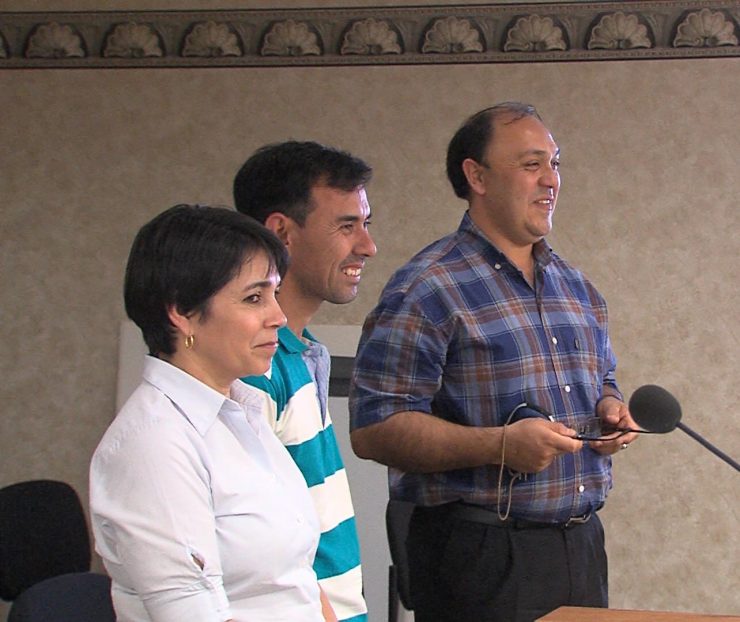
(L to R) Sister Cities Santa Maria, Paraguay delegation Erma Elizabetk Del Puerto de Ramirez, Milciades Ramon Mancuello and Isabelino Victor Martinez Galiano address the Hays city commission assisted by translator Max Maximov, Sister Cities of Hays.
By BECKY KISER Hays Post
The sesquicentennial celebration of Hays has been made even more special this weekend with an honored delegation of visitors from Paraguay.
Four people from Hays’ Sister City Santa Maria de Fe, Paraguay, are in town to enjoy the festivities, including a dedication and reception Saturday at 1 p.m. in the Hays Public Library of the permanent display “Worlds Apart, Cities Together.” It was created by local artist Cody Custer to honor the Sister City relationship.
The Sister Cities display will be dedicated Saturday in the Hays Public Library. (Courtesy photo)
The group arrived in Hays Thursday in time to attend the city commission work session. One delegation member, Erma Elizabetk Del Puerto de Ramirez, is a Santa Maria city commission member as well as director of the Institute of Technology in Santa Maria.
With assistance from translator Max Maximov of the Hays Sister Cities group, she told the commission the “Santa Maria mayor and city commission send their appreciation of the Sister Cities partnership and congratulations to Hays on its 150th birthday.”
Santa Maria is considerably older. Established as a Jesuit mission in the 1600s, Santa Maria today has a population of about 4,000 and is located in southern Paraguay, some 160 miles from the country’s capital Asuncion.
Del Puerto de Ramirez was pleased to point out the similarities in the two municipalities’ governing bodies. Although Santa Maria is not incorporated and does not have a city manager, residents of both towns elect representatives to the city commissions, five year terms in Santa Maria, four and two year terms in Hays. The commissioners then elect their own chairman (Santa Maria) or mayor (Hays). “That’s what happens here,” replied the Hays commissioners.
Marianna Beach in 2012 (Courtesy Gwen Lang)
Isabelino Victor Martinez Galiano, is manager of Jesuit’s Museum, where the Santa Maria/Hays partnership began 41 years ago with a financial donation from Hays resident Marianna Beach for construction of the museum.
“It’s a great joy and great honor to be here. It’s been 40 years of conversations and unity between the two cities,” Martinez Galiano said through translation.
“This is an opportunity to thank the ‘natural’ ‘ ambassadors Ross and Marian Beach who in 1976 paved the way for this day to come true.” “We’re very proud to have you here,” Mayor Shaun Musil replied in greeting the delegation. The museum was dedicated Oct. 25, 1979. A document on display there signed by former Hays Mayor Dan Rupp.
The flag of Paraguay flies in Hays at the Sister Cities Plaza , 13th and Hall, which is sponsored by the Hays Rotary Club.
The Santa Maria tourism coordinator and manager of the town’s only hotel, introduced himself to the commission. Milciades Ramon Mancuello lived for a time in Scotland where he learned hospitality management, and some English.
Maximov, who teaches Spanish and German at Fort Hays State University, has visited Santa Maria twice, working to revive and help strengthen the Sister Cities partnership which had languished over the years.
Erma Elizabetk Del Puerto de Ramirez is a Santa Maria city commission member as well as director of the Institute of Technology in Santa Maria.
According to Del Puerto de Ramirez, many Santa Maria residents her age remember as school children they received small packages from young Hays students filled with items such as books, pencils and postcards. “Hays, our Sister City, was an intangible place that was always there. We grew up with these little interchanges.” She plans to update and continue the gift exchanges with Hays officials during a formal presentation at the 150th anniversary proclamation Sunday at 11 a.m. in Municipal Park.
A toast to Sister Cities Santa Maria and Hays, June 1, 2016, in Hays.
Also with the Paraguay delegation is Derlis Hernan Maidana Zarza, governor of Misiones, who was unable to attend the city commission meeting. He visited Hays last year for the first time with a Sister Cities delegation.
The group has a full itinerary, including visits to Fort Hays State University, where they were to meet Mauricio Etcheverry, an FHSU soccer athlete from Asuncion, Paraguay. They’ll be attending the Ellis County Fair, have already watched a Hays Larks baseball game, and will meet with Hays business people working in similar professions.
Sunday evening, the Sister Cities members will enjoy a private dinner at the home of Mayor Musil and his wife Heather, who is a member of the Hays Sister Cities Advisory Board.
The Santa Maria delegation will head back to Paraguay Monday morning from Wichita.
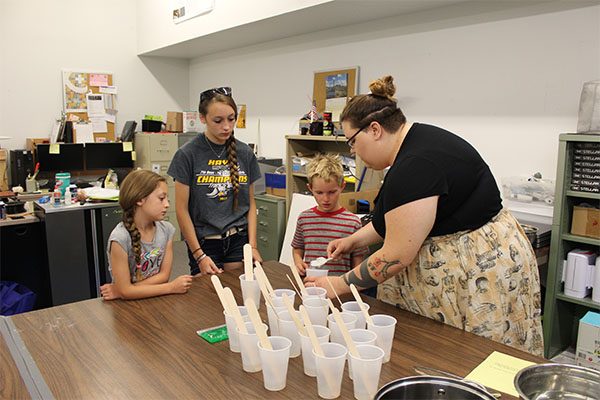
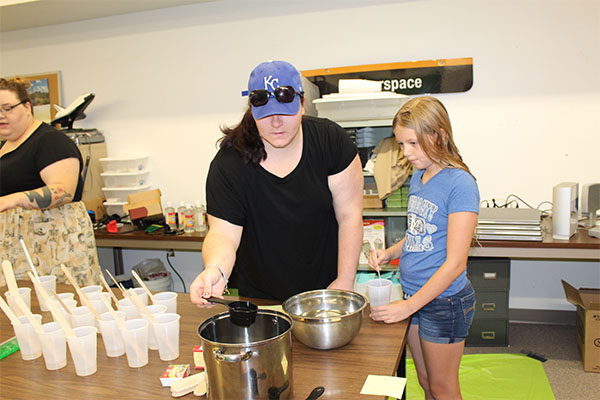
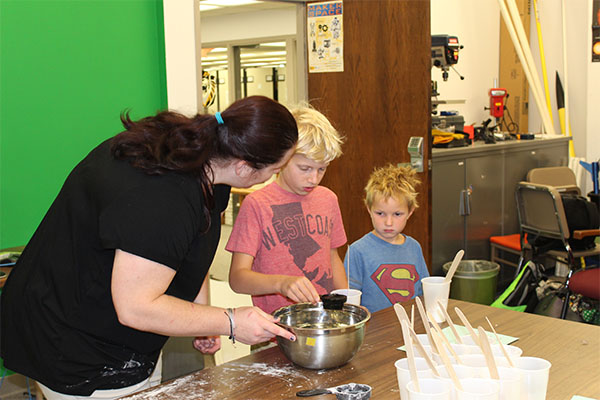
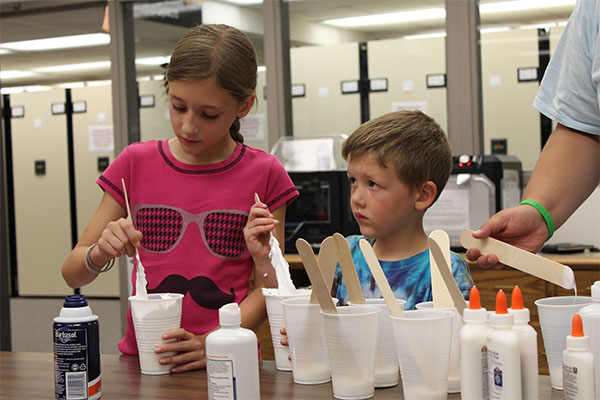
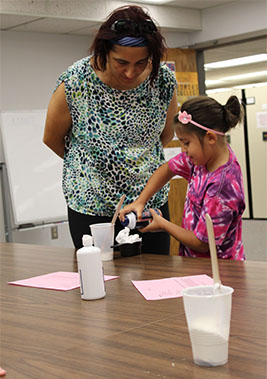
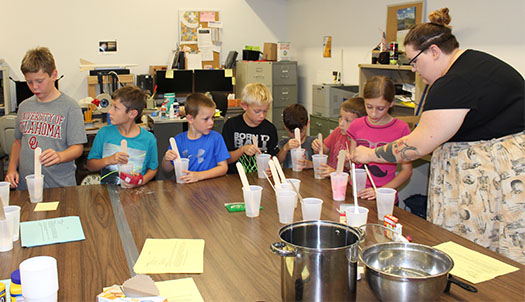
Children crowded into the Makerspace at the Forysth Library at Fort Hays State University Thursday morning to get icky and sticky.
Slime Time let children try their hands at making three types of slime: clear slime, fluffy slime and oobleck.
Slime is a non-Newtonian fluid. It’s viscosity can be affected by factors other than temperature, according to Brian Rohrig and his article,“The Science of Slime.”
Viscosity is a fluid’s resistance to flow.
In the case of slime, it may almost act like a solid, but it if you add pressure to the slime by squeezing it in your hand, it begins to flow like a liquid.
A polymer is a large chain of molecules made up of smaller units that repeat themselves, which are called monomers. A single polymer molecule may comprise hundreds of thousands of monomers, Rohrig said.
The white or clear school glue in the slime is a polymer. When the liquid starch is added, in this case Borax, it changes the structure of the chain making the polymer thicker.
According to Rohrig, common synthetic polymers are rubber, plastic and nylon. Common natural polymers are starch, DNA and some proteins.
Megan Adams, summer director at the Makerspace, said it is not so important that the children understand the scientific properties of the slime.
“They get to have a hands-on experience with science they may not have the opportunity to have in the summer,” she said.
The exercise also helps the children develop problem-solving skills, she said.
Lima McLoughlin, 8, just thought it was icky fun.
Mariah Werth, 10, of LaCrosse said she loves science, but it is just fun to make slime, which she has done at home.
“It is supper fun to play with,” she said. “It is easy to work with. I have made it with my different cousins. It’s gooey, but it won’t ever stick to you.”
Maysyn Tippy, 11, of Hays, was trying her hand with the fluffy slime for the first time.
“It is fun to create. It is fun to work with and makes a mess. It makes it all gooey,” she said.
Maysyn’s mom was just glad that she and her cousin were making the mess at the Makerspace and not at home.
“They are always making it at home,” she said. “It is always messy, and it is not always successful.”
Recipes
Clear Slime
Ingredients:
Glue Base:
1/4 cup of clear school glue
1/4 cup of water
food coloring
Activator:
1/2 cup of warm water
1/2 tablespoon of Borax
Instructions: In a bowl, mix together Borax and warm water until Borax is completely dissolved. Set aside and let cool.
In a separate bowl, mix the first three ingredients together until combined. Add activator (Borax solution) tablespoon by tablespoon, stirring your slime after each addition until the slime reaches desired consistency. If you are unable to stir your slime, remove it from the bowl and knead it on waxed paper.
Store slime in an airtight bag, Wash hands after use.
Fluffy Slime
Ingredients:
1/4 cup of white school glue
1 cup of shaving cream
food coloring
3 squirts of contact solution
Activator:
1/2 cup of warm water
1/2 tablespoon of Borax
Instructions: In a bowl, mix together Borax and warm water until Borax is completely dissolved. Set aside and let cool.
In a separate bowl, mix the first three ingredients together until combined. Add three squirts of contact solution, mixing after each addition. After this, add activator (Borax solution) tablespoon by tablespoon, stirring your slime after each addition until the slime reaches desired consistency. If you are unable to stir your slime, remove it from the bowl and knead it on waxed paper.
Store slime in an airtight bag, Wash hands after use.
Oobleck
Ingredients
1/2 cup of cornstarch
1/4 cup of water
Food coloring
Instructions: In a bowl, measure out 1/2 cup of cornstarch. In separate container, combine food coloring and water, mixing well. Add water to the cornstarch tablespoon by tablespoon, stirring after every addition. Continue to add water until the mixture can be grabbed and formed into a ball, but is still runny.
If the mixture is too runny, add in cornstarch a tablespoon at a time. If the mixture is too thick, add in water a tablespoon at a time.
Store in an airtight bag. This mixture will eventually dry out but can be easily rehydrated by adding water.
Commissioner Sandy Jacobs explains why she agreed with a 50% cut in city funding to the Ellis Co. Coalition for Economic Development.
By BECKY KISER Hays Post
In a 28-minute discussion, Hays city commissioners Thursday night came to a consensus to cut city funding to the Ellis County Coalition for Economic Development (ECCED) by 50 percent in the 2018 budget.
The proposal came from Commissioner Henry Schwaller and is the same percentage funding cut recommended last month by Ellis County commissioners in the county’s draft 2018 budget. Hays and Ellis County are the biggest contributors to the ECCED budget. The city’s distribution now stands at $43,775, down from the 2017 allocation of $87,550.
Vice Mayor James Meier went even further. “My position is that the Ellis County Coalition should not be funded this year,” he said. The Coalition has been criticized by city and county commissioners for not being responsive to the governing bodies’ directives for some time.
ECCED Executive Director Aaron White and Board President Deron O’Connor, Commerce Bank president, were in the audience but did not address the commission.
It was the only agreement reached and change made to the outside agency cuts proposed by City Manager Toby Dougherty in the draft budget. Dougherty’s recommendations were a 10 percent cut in allocations to the Fort Hays State University (FHSU) scholarship program (from $100,000 to $90,000) and to the ECCED (from $87,550 to $78,795).
“I was part of a strategic planning session yesterday for the Coalition,” Sandy Jacobs told her fellow commissioners, “and as I said last week, I had a tremendous amount of indecision. I was ready last night to agree with James and totally cut the funding.”
Jacobs said she was “really proud and very respectful of the people on that board. They all have jobs and lives and they still give their time to that.” She noted 19 of the 25 board members were present for Wednesday’s hours-long planning session. During a joint meeting with county commissioners in April, the discussion included a recommendation to downsize the number of board members to become more effective.
“There’s been some lapses, in my opinion, some veering off course and inability to reach consensus on some serious issues,” Jacobs read from a note in front of her, glancing out at White and O’Conner. “I know my fellow commissioners and our predecessors on this commission have given strong warning about funding with specific changes and initiatives in mind to no avail. … I think it’s a vital, vital organization,” she added.
“Commissioner Schwaller offered something tonight that I would be interested in. To reach consensus, I could (agree with) a 50 percent cut to the Coalition,” Jacobs concluded. “Changing my decision is very difficult….I’m serious. I don’t know what other words to use than ‘feet to the fire….we will be watching it.'”
Mayor Shaun Musil agreed.
“I think they need to do need to make some changes. I’ve met with the current board president and the president-to-be and I really think they get where we’re coming from. I think they want to make some changes. I hope that’s true,” Musil said. “To not have economic development, to me, would be a shame in our community.”
Commissioner Lance Jones, who is away for annual military training, has been absent the past two commission meetings.
The other four commissioners were still in disagreement about the FHSU cuts, with Musil and Jacobs fearing any reduction “sends a bad message.” Meier said he “can’t disagree with that but local government doesn’t exist to fund another governmental entity.”
In speaking with FHSU representatives, Musil noted they said “this year may be the biggest on-campus freshman class, more than 1,000.” Although he did not have the data in front of him, Musil said he had been told “every freshman student spends about $12,000 while in Hays, and part of that is retail purchases. That brings millions (of dollars) to our community. Where would we be without Fort Hays?”
Commissioner Schwaller, an instructor in the FHSU Robbins College of Business & Entrepreneurship, said he “would not participate” in the FHSU allocation discussion.
The cuts in outside agency funding would in part help pay for city employee raises in 2018.
“We have a set of 181 employees that we didn’t give a raise to last year,” Meier pointed out. “This year we said the only way you get a raise is if you cut your way to it (within department budgets). There’s nothing wrong with that. We should always be looking for efficiencies and say if you want something you can find it yourself through efficiencies. But beyond that, our employees are the ones that are affecting our policies and taking care of what a local government should be taking care of. For us to hold harmless outside agencies that withdraw from our General Fund while we ask our employees to cut their way to a raise, sends a message that perhaps we don’t want to send, not only to our employees but also to the general taxpayer.”
Meier concluded he was “fine with the staff recommendation” to cut FHSU funding by 10 percent.
The city’s General Fund monies come from the city sales tax. Hays is the only city in Kansas to do so. With the current flat trend in sales tax receipts, sales tax revenues in 2018 are projected flat compared to 2017. The 25.000 mill levy is maintained for 2018.
Also proposed by Dougherty is moving the remaining half of city funding for the Downtown Hays Development Corporation (DHDC) to the Convention and Visitors Bureau (CVB) budget which is funded by the Transient Guest tax.
During the July 6 work session, Commissioner Jones said he favored also cutting DHDC by 10 percent. At that meeting Mayor Musil disagreed, saying “DHDC is one area of our sales tax base that’s growing.” Thursday night Musil noted he and his wife Heather will soon become owners of a downtown business and said he felt he “shouldn’t speak on the DHDC funding.”
Discussion of the 2018 draft budget will continue at the July 27 regular meeting. The approved 2018 budget must be submitted to the Ellis County Clerk by Aug. 25, following a public hearing yet to be scheduled.
Jamie Nemechek, left, 18, of Goodland was crowned the Miss Ellis County Rodeo Queen Tuesday night.
By CRISTINA JANNEY Hays Post
Two sisters from Goodland came away with the Miss Ellis County Rodeo Queen and Princess titles Tuesday at the Ellis County Fair Rodeo.
Jamie Nemechek, 18, who is a K-State student in pre-veterinary medicine, was crowned Queen, and her sister, Sara, 10, was honored with the Princess title.
They are the daughters of Jerry and Penny Nemechek.
Jamie’s hobbies include reading, spending time outside and working with her 4-H project animals.
Both girls will be showing sheep at the Kansas Junior Livestock Show and the state fair. They also plan on showing their horses at the state fair.
Jamie exhibited the grand champion lamb at the 2016 Northwest Kansas District Free Fair. Jamie and her siblings also manage a small herd of commercial cows.
“I come from a long line of pageant royalty,” Jamie said. “I really love pursuing and doing pageants. I recommend it to anyone who wants to learn more about rodeo.”
Jamie said her favorite portion of the pageant was horsemanship during which she rode her horse, Skip.
The young ladies competed the weekend of July 8 in horsemanship, modeling, talent or speech, and personal interview. They were also required to take a written test on rodeo and horses and submit photographs in their western wear.
During the horsemanship portion of the competition, the ladies compete in reining. The ladies are given a course that is written on paper and they have to replicate it in the arena. The riders also complete a queen’s run and flag run.
Sara said she wished to follow in her sister’s footsteps. This was her first pageant.
Sara Nemechek, 10, Goodland was named the Miss Ellis County Rodeo Princess Tuesday night.
“I thought a pageant would be a lot of fun to do,” she said. “I decided to try it out for the first time.”
Sara also said she most enjoyed the horsemanship portion of the competition, riding her horse, Babe.
The girls who did not win said they also had good experiences. Mariam Towns, 12, Palco, enjoyed the interview portion of the contest. Towns had to overcome a fear of horses to compete in the rodeo competition. She was bucked from a horse at the age of 6.
“I have taken it a little bit at a time, and I work with the horses every day,” she said.
Emma Pope, 16, said she hopes to take her 4-H experiences in public speaking and parlay them into a career.
Emma Pope, 16, Hays, Miss Ellis County Rodeo runner-up.
“I would really like to do something in science. I really like biology, anatomy and physiology. I would like to do something that coordinates the two,” she said.
She said she hoped to inspire other young girls through her participation in the pageant.
“I know when I was little, I was inspired by rodeo queens. They do a lot with the younger kids and in the community, and, of course, they go to a lot of rodeos. I like the atmosphere. Everyone is positive, but it is competitive too.”
Queen candidate Hailey Fisher, 16, Plainville, also competed.
The outgoing royalty for 2016 were Queen Jaylinn Pfeifer of Ellis High School and Princess Jaelyn Himmelberg of Lawrence, Nebraska.
The ladies who were named royalty this year will help plan next year’s pageant and assist at fair activities. They are required to travel to at least two other state rodeos and participate in local events as a representatives of the rodeo.
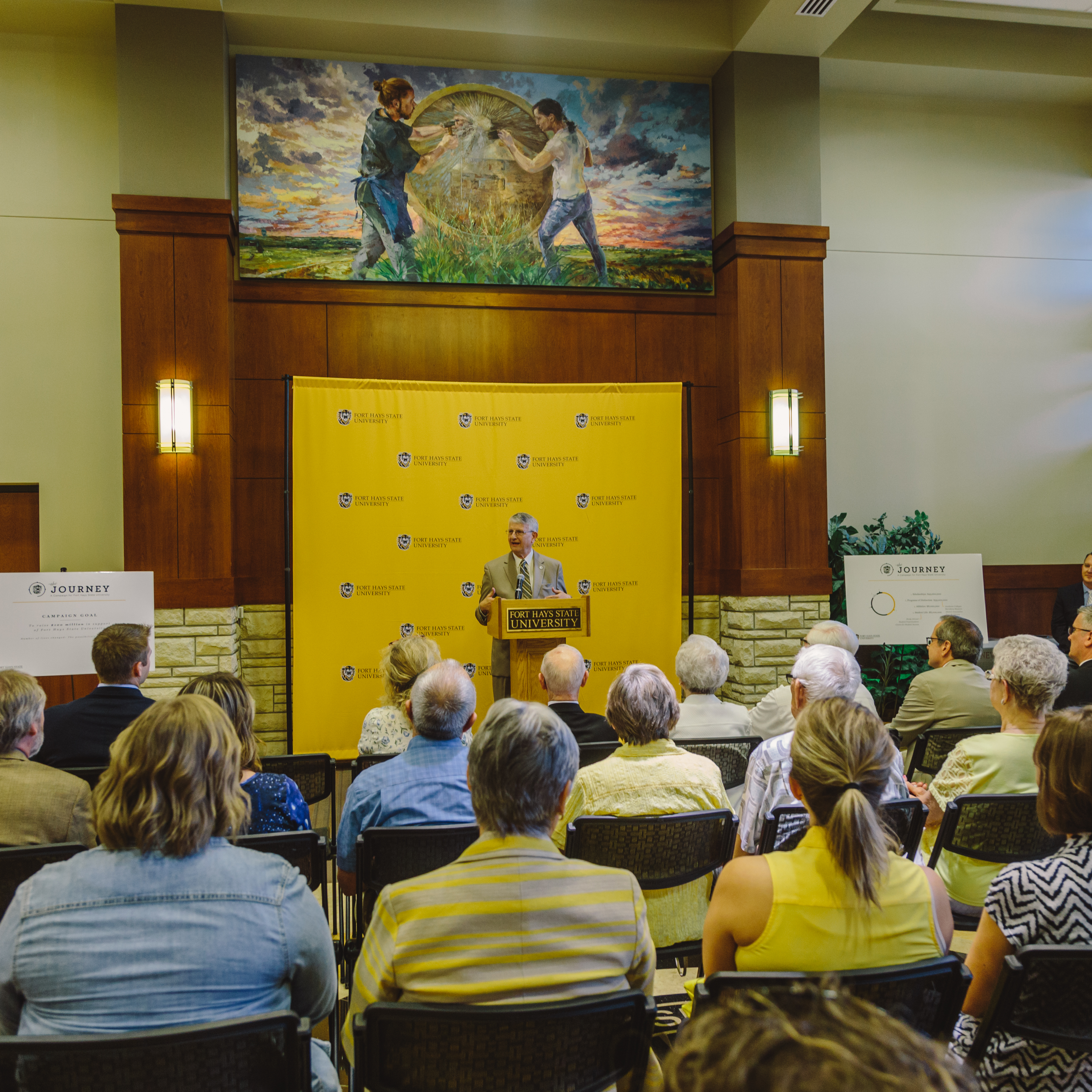
Dr. Andy Tompkins, Interim President of FHSU announces a $1 million gift from Don and Chris Bickle at Tuesday’s news conference.
FHSU University Relations and Marketing
Fort Hays State University announced today a $1 million gift from Don and Chris Bickle that will impact a multitude of students in a variety of areas at the university.
“Don is known to lead the band and crowd in cheering on Tiger athletics, but Don and Chris Bickle’s encouragement permeates the university,” said Jason Williby, president and CEO of the FHSU Foundation, at a news conference announcing the gift.
Historically, support received from the Bickle family has enhanced university administration, leadership, scholarships and capital improvements.
“The Bickles’ support for the largest fundraising initiative in Fort Hays State’s history shows that they are true difference makers,” said Williby. “Their most recent gift benefits all four pillars of FHSU’s Journey Campaign – programs of distinction (academics), scholarships, athletics and student life.”
As an entrepreneur himself, Bickle recognizes the importance of fostering the entrepreneurial spirit and how, in turn, entrepreneurs increase the vitality of western Kansas. The Dane G. Hansen Foundation enabled Fort Hays State to construct the Dane G. Hansen Scholarship Hall, and a portion of the Bickles’ $1 million gift went toward the Hansen Scholarship Hall’s building fund, allowing the housing wing to be named in honor of the Bickles.
“The Bickles’ willingness to support the next generation of business people and entrepreneurs is exemplary,” said Dr. Mark Bannister, dean of the W.R. and Yvonne Robbins College of Business and Entrepreneurship.
“Their gift will make a difference to both the students they are supporting and also to the communities in which these Fort Hays State University graduates will live,” he said. “Few people are as extraordinary in their support of a variety of community and university assets as the Bickles.”
The Bickles also understand the need for students to be experienced in foreign language and cultural awareness, so another part of their gift established a scholarship fund for study abroad. The benefits positively impact all aspects of a student’s life: academic, social, cultural, personal and professional. Most students simply cannot afford this experience without financial assistance.
Andree Brisson, who leads the study abroad program at Fort Hays State, said that private donations have helped send FHSU students to Europe, Africa, Asia, Australia, South America, and the Caribbean. Examples include a trip to Italy by art students studying Renaissance art; history students walking the World War I trenches of France and Belgium; and nursing students working alongside nurses in the Dominican Republic.
“Students have been humbled by these experiences, and at the same time they have learned to be more independent, more tolerant and more appreciative of a greater world,” said Brisson.
“You are responsible for helping to create these global citizens,” she told the Bickles.
The quality of life for all students at FHSU is also important, and another major component of campus life is a support system where high-quality, accessible programs provide support in academic advising and career services, counseling, wellness, physical and mental health, and tutoring or supplemental instruction. The endowed Bickle Family Success Fund serves as a resource for all student services.
“The addition of the Bickle Family Success Fund aligns perfectly with the goals of the university and the Student Affairs division with respect to our student success initiatives,” said Dr. Joey Linn, vice president for student affairs.
“This wonderful gift is an investment in our students and will be key to driving innovative programming to assist with the recruitment, retention and graduation of our student body,” he said. “Their generosity will also provide resources for many years to come as it will support programming in the future Fischli-Wills Center for Student Success.”
With more than 450 student-athletes on the Fort Hays State campus, of whom more than half are honor students with a GPA of 3.0 or higher, the need to compete at the highest level calls for additional support and program enhancements.
“Don and Chris Bickle have been consistent supporters of Tiger Athletics in scholarships and facility development,” said Curtis Hammeke, director of athletics.
“These are two areas critical to our growth and future success. The Bickles have made significant impacts to both,” said Hammeke. “In addition to their financial support, they have been true ambassadors for Fort Hays State University and our department, from leading cheers at games to encouraging others in the community to join in on the fun. We are grateful for their ongoing generosity to Fort Hays State University and the Hays community.”
Don Bickle has played key roles as a friend of the university as an FHSU Foundation trustee and by serving on various advisory committees. The Bickles understand the importance of giving back to the community in which they live.
“These news conferences are a celebration of gift, giver, and legacy, all in support of this great university and its students,” said Dr. Andy Tompkins, interim president of Fort Hays State. “And I admit, I feel especially privileged and humbled to serve this university as its interim president during an extremely exciting moment in its history.”
He made note of some of the circumstances that make this a particularly exciting moment in the university’s history: Several major construction projects nearing completion; 16 consecutive years of record-setting enrollment growth; an outstanding faculty and staff dedicated to the mission of education; one of the lowest undergraduate tuition rates in the country; a 95-percent placement rate for graduates going into a career or advanced education.
“And,” he said, “we have one of the most ambitious capital campaign goals of any university of our size and type – $100 million, and we are already over halfway to that goal with three years remaining in the campaign.”
He attributed the university’s accomplishments to “an incredible synergy” of leadership, students, faculty, staff, the support of its community, in Hays, in Kansas and around the world, and “the commitment of the alumni and donors of the university that make dreams possible.”
The Bickles, he said, “are the quintessential role models for philanthropic giving.”
“They not only want to give to the university, but they want to find new and meaningful ways to keep supporting the university,” said President Tompkins. “They have discovered what I call ‘the joy of giving.’ ”
“So today,” he concluded, “Don and Chris, we say ‘thanks’ again for helping this and future generations of our students.”