We have a brand new updated website! Click here to check it out!

Children to bring crazy characters of ‘Seussical’ the musical to life

The 40-member “Seussical” cast dance during their opening number.

By CRISTINA JANNEY

Hays Post

Local children will take audiences on a fanciful tour through the world of Dr. Seuss during performances next weekend of the musical “Seussical.”

Addy Brull portrays JoJo in the Hays Community Theatre’s youth performance of “Seussical.”

The musical is the annual children’s production sponsored by Hays Community Theatre. Performances will be at 7:30 p.m. Friday, Sept. 13 and 10:30 a.m. and 7:30 p.m. Saturday, Sept. 14 in the gym of Celebration Community Church. Tickets are $5 and can be purchased at the door or online at www.hctks.com.

“Seussical” is by Lynn Ahrens and Stephen Flaherty and is based on the Dr. Seuss stories. Although the musical does not follow exactly any of the Seuss plots, you will recognize many of the Seuss characters. The plot is most closely related to the story of “Horton Hears a Who.”

“It is a lot of singing. It is a lot of Dr. Seuss characters all in one story,” Wendy Richmeier, director, said. “We have the Whoes. We have the Grinch. We have The Cat in the Hat. We have Horton. We have a lot of Seussical-like jungle creature and circus creatures. It is all one ‘think’ rolled into one.”

Richmeier and student director and choreography 15-year-old Faith Fondoble have taken on quite a challenge with a cast of 40 kids ages 7 to 14 plus an eight-student stage crew. Fondoble, Ellis High School sophomore, assisted with choreography last year in HCT’s youth production of “Junie B Jones” and stepped into a larger role this year. 

“She is wearing a big hat this year,” Richmeier said of Fondoble. “She has done a great job. I am very proud of her. It has to be very nerve-racking — one, taking this role when she has never done it and also doing choreography. She knows she has 40 kids that she has to choreograph a dance for.”

The production has put as much color and fantasy in the props, costumes and set design as possible.

“A zebra is not going to look like a regular zebra,” Richmeier said. “It is going to be a colorful Dr. Seuss zebra. A tiger is not going to look like a regular tiger. It is going to look like a Dr. Seuss tiger. Kids’ imagination is what it is.”

Richmeier said not every child is athletic or academic. Theater gives some kids a niche and a place to be, she said.

“Seussical” is by Lynn Ahrens and Stephen Flaherty and baed on the Dr. Seuss stories.

“They meet new friends. They learn new things about themselves. Some of them just wanted to try it,” she said. “Maybe they will find this isn’t for them or maybe they will find this is my love, my passion.

“We see a lot of kids just grow. We have some kids with our children’s theater program since our very first show. We have some from this who have gone on to vocal lessons because they enjoy singing — they enjoy doing musicals. It is really getting them out of their box and out of their normal shell — trying something new.”

Although this a children’s story performed by children, Richmeier said she thought it is a musical all ages can enjoy.

“I think everybody read Dr. Seuss at one time, whether it was to themselves or to a child or to a classroom, so this is an opportunity to see a little Dr. Seuss come alive on stage,” she said.

Despite having the roof ripped off its worship center in August, Celebration Community Church is again hosting the HCT youth production. The production will be in the gym, which has been converted into the church’s worship center pending repairs to the main hall. A free-will donation to benefit the church repairs will be taken during all three performances.

“Our kids show is all about the kids learning and having fun and experiencing something new,” Richmeier said. “The one thing that I never worry about is perfection. This is about them. This is what makes our children’s productions so enjoyable to direct is seeing them have a good time, try something new and just enjoying themselves.”

Cast and crew list

  • Addy Brull – JoJo
  • Avery Koehn – The Cat in the Hat
  • Nathan Stecklein – Horton the Elephant
  • Jesse Staab – Mr. Mayor
  • Brooke Leiker – Mrs. Mayor
  • Chloe Rice – Gertrude McFuzz
  • Elizabeth Noble – Maizie La Bird
  • Owen Appelhans – Wickerhsam Monkey
  • Brynn Harbaugh – Wickerhsham Monkey
  • Josiah Hill – Wickersham Monkey
  • Judah Bloom – Wickersham Monkey
  • Clare Tholstrup – Bird Girl
  • Maycie Holdeman – Bird Girl
  • Jenna Kisner – Bird Girl
  • Bailey Barnes – Sour Kangaroo
  • Genevieve “Evie” Dietz – Young Kangaroo
  • Micah Harbaugh – Judge Yertle the Turtle
  • Ainsley Harbaugh – Vlad Vladikoff, Courtroom Attendant
  • Christian Miller – The Grinch
  • Emmalyn Harbaugh – Thing 1
  • Aliyah Conner – Thing 2
  • Conner Miller – Who Family Dad
  • Ahnalyn Leiker – Who Family Mom
  • Malachi Miller – Who Family Kid
  • Blair Paul – Who Family Kid
  • Isaac Bloom – Ring Master, Who Family Dad
  • Janessa Miller – Who Family Mom
  • Greta Harbaugh – Who Family Kid
  • Annalise Harbaugh – Who Family Kid
  • Ella Pfeifer – Jungle Creature, Fish
  • Savannah Wittkorn – Jungle Creature, Fish
  • Lydia Hickel – Jungle Creature, Fish
  • Rexton Leiker – Jungle Creature, Boy Hunter
  • Makailyn Leiker – Jungle Creature, Girl Hunter
  • Claire Myers – Jungle Creature, Circus Animal
  • Michaela Lane – Jungle Creature, Girl Hunter
  • Micah Hill – Jungle Creature, Circus Animal
  • Zachary Leiker – Jungle Creature, Circus Animal
  • Silas Hill – Jungle Creature, Circus Animal, Courtroom Attendant
  • Loucinda Meade – Jungle Creature, Circus Animal, Courtroom Attendant
  • Faith Fondoble – Student Director / Choreography
  • Silas Hill – Stage Crew, Props
  • Grace Wente – Stage Assistant / Production Assistant
  • Jacob Wente – Stage Assistant / Production Assistant
  • Anna Brull – Stage Assistant / Production Assistant
  • Reese Myers – Set Design Assistant / Production Assistant
  • Annie Wasinger – Production Assistant
  • Wendy Richmeier – Show Director
  • Amy J Staab – Music Director
  • Sharona Fondoble – Costume Design
  • Chelsie Nelson – Costume Design
  • Jerrett Leiker – Set Design / Build
  • Many, many parents – prop, set, costume collaborators!

Census to go online for 2020 count

Although the census is not set until next year, you may see census employees in your neighborhood now verifying addresses. Courtesy photo

By CRISTINA JANNEY
Hays Post

You will be able to count yourself in the 2020 census in a new way — on the internet.

The U.S. Census Bureau will send invitations for your household to sign in online to complete your census form beginning March 9. Ninety-five percent of Americans will receive their invitations by mail, but 5 percent will have invitations dropped off at their homes. This is because the U.S. Census Bureau will not be sending census invitations to post office boxes.

You will be able to login to the website using computers, tablets and smartphones. You will also be able to complete the census by phone, by mail or in person with a census taker.

Steven Hale and other representatives of the U.S. Census Bureau in Kansas were in Hays Wednesday talking to the Western Kansas Rural Economic Development Alliance about the ramp up to the 2020 Census.

You may be seeing census employees in the community now who are verifying addresses prior to the census next year.

The U.S. Census Bureau is also forming Complete Count Committees to help ensure accurate counts across the country. There is a state Complete Count Committee, but they can also be formed at the local level by local governments or civic groups. In some areas, librarians and even Girl Scout troops are leading the push to have their communities correctly counted.

The U.S. Census Bureau knows from past census audits communities with Complete Count Committees have more accurate counts.

Hale said people are more likely to listen to community members and trusted local officials.

In areas such as Liberal, where some census tracts are more than 80 percent Hispanic, U.S. Census Bureau is working with a local Complete Count Committee as well as Hispanic partnership specialists like Carlos Urquilla-Diaz to bridge culture divides.

“Let me help you be the bridge,” Urquilla-Diaz said. “I can initiate those conversations. It may be hard at first, but I can be a bridge and translate and create trust and understanding through those communities. After all this is over, we are still going to be dealing with their souls for 10 or more years. Whether you count them or not, whether you like them or not, they have a significant impact on the economics of and the political part of the state of Kansas.

“If you don’t get the money for the state of Kansas, that money will go somewhere else. The checks will be cut. How much is in that check every year depends on all of you.”

Group quarters counting will start in January. This includes college dorms, military barracks, senior living centers and prisons.

Hale said the modern census faces a number of challenges, including a mobile population, a diverse population, a distrust of government, complex living arrangements and rapidly changing use of technology.

The two hardest populations to count, Hale said, are children younger than 5 and adults older than 65.

The 10 questions on the census form will include:

  • Name
  • Phone number
  • Age
  • Sex
  • Race
  • Hispanic/non-Hispanic
  • Relation to householder
  • Household tenure (rent/own)
  • Number of people in household
  • Usual place of residence

All information that is taken will be kept confidential. Anyone releasing confidential census data is subject to up to a $250,000 fine and five years in jail. When data is released, it is only released in summary form. Census information is not shared with other government agencies.

Hale talked about why the census is important. The census is constitutionally mandated as a means to apportion U.S. House seats. Hale said Kansas is not expected to lose representation in the House as a result of this census, but that will not be determined until all of the numbers are in.

Perhaps a larger impact is money. Kansas receives $6 billion in federal funds annually. The census data is used to allocate funds for a bevy of government program. The top five are Medicaid, federal student loans, SNAP (food stamps) Medicare Part B and infrastructure projects.

“When you ask why should we care about listening to you guys about the U.S. census, the answer is very simple. It’s in front of you,” said Urquilla-Diaz, “All of these programs in front of you, and there are many more. If any of those programs affects you, your family or your friends, that is a reason why you should care. For example, when we undercount children, the needs of those children will be there period. K through 12 can be affected in a very negative way. The same thing with senior citizens.”

The 2020 count will affect funding through 2030.

“We have one shot to get it right in 10 years,” Hale said.

The U.S. Census Bureau will need to hire 4,500 people in Kansas, both part-time and full-time.

One audience member, asked where the census bureau was going to find these employees in a tight labor market. Emily Kelley, census coordinator, said anyone who is 18 or older, has a driver’s license and passes a federal background check can be a census employee. You can set your own hours and the number of hours you wish to work.

You can apply for a job with the U.S. Census Bureau at 2020census.gov/jobs for part-time workers and www.usajobs.gov for full-time workers. You can learn more about the census at www.census.gov.

“It is a great side hustle job,” Kelley said. “It is a great gig economy job. Instead of driving Uber, get out and walk and earn money that will help pay for your holiday shopping or the next family vacation.”

🎥 Drill assesses emergency response to aircraft crash at Hays Regional Airport

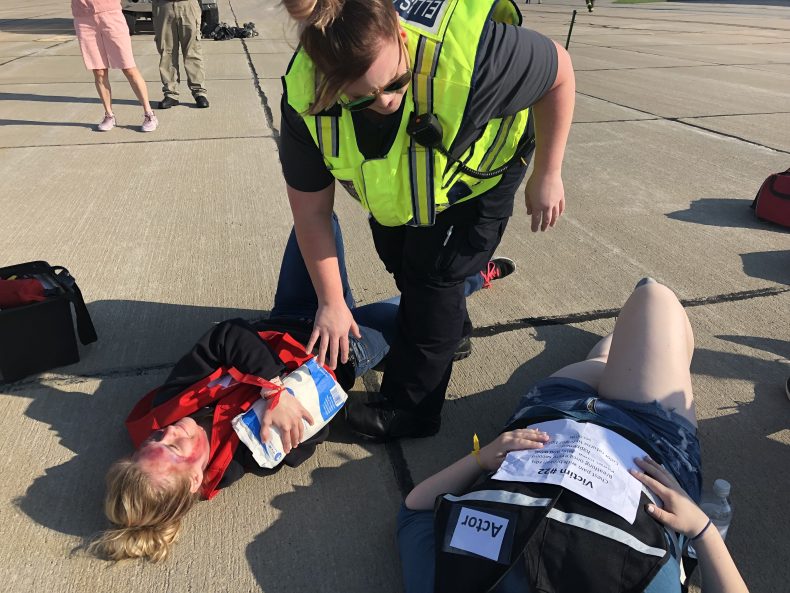
Ellis County EMS personnel triage volunteer plane crash victims during Wednesday’s drill at the Hays Regional Airport.

By BECKY KISER
Hays Post

A drill for the emergency response to an airplane crash at the Hays Regional Airport won’t replicate such an incident exactly, but it comes close.

Emergency responders from throughout Ellis County participated in a full-scale exercise Wednesday morning at the airport.

Darin Myers, Ellis County Emergency Manager and Rural Fire Chief, along with Ryan Hagans, Hays Fire Chief, were the exercise directors.

Overall, things went well, Myers said.

“You can only have a pretend fire for so long before the pretend fire goes out. Then you move on to the next phase of evacuating the fuselage.”

The drill started at 9 a.m. and took a little more than 90 minutes. An actual airplane crash response would likely take longer.

“It may have taken us only 10 to 15 minutes down there, but in real life to move patients who are unable to walk like we did today, they would have to be carried out or drug out,” Myers said. “That would take a lot more time.”

Approximately 30 volunteers from the NCK-Tech College nursing program portrayed the injured passengers.

Each person wore a vest identifying them as an actor and also had a piece of paper with their symptoms written on it. Most actors were wearing red makeup to resemble blood flowing from their injuries. Some patients also had moulage kits applied to simulate wounds.

After they were triaged by Ellis County EMS personnel, four passengers were declared dead.

“I had no visible injuries,” said Kylie Watson, Topeka, “but I had a blank stare, couldn’t feel air movement and had no color to my fingertips. So they had to decide whether I was dead or not, which I was.”

Tyra Younie, Hays, portrayed a victim who had been decapitated.

“I wasn’t wearing any special makeup to indicate that. I just kind of slumped over and hid my face,”  Younie said.

Alexa Brull, Catherine, had a head injury. “I was not responsive, not breathing, so I was tagged ‘black.’

The NCK-Tech students have been working with hospitalized “patients” in their classrooms. They found the response to casualties at an airplane crash to be quite different.

“It was very interesting to see how they coded each one of us and who they responded to first,” Watson said.

“We were all on the aircraft. They got to us pretty quick and were really good about prioritizing each victim and getting us off the plane.”

There were also individuals inside the airport terminal portraying distraught family members.

In yesterday’s exercise, a Hays USD 489 yellow school bus served as the airplane. Hays and Ellis County firefighters poured water on the simulated fire and smoke visible at the crash site off the south end of the airport apron.

The Hays airport is required by the Federal Aviation Administration to conduct such emergency exercises every three years.

Following the drill, all the participants gathered near the airport fire station and submitted their feedback in written form to Myers. Then each agency, observer and evaluator talked about what went well and what could have been done better.

Airport manager Jamie Salter and Hays Public Works Director Jesse Rohr

This was the first such exercise for airport manager Jamie Salter, who was appointed to the position in late February. “I felt like she did a great job,” said one observer.

In her series of contacts, Salter first notified Jesse Rohr, Hays public works director, then city management followed by the city’s Public Information Officer. Rohr was one of the on-site observers.

Hays Fire Department Captain Aaron Dome talked about the incident command post.

“We had a pretty good unified command between medical branch, law branch, and the airport. We were all face-to-face. It went pretty smooth  on our end,” Dome said.

Site security was evaluated by Toby Prine, the Kansas Regional Emergency Management Coordinator for northwest Kansas who is based in Hays.

Toby Prine (left), NWKS Emergency Management Coordinator, evaluated site security during the Hays airport drill.

“About 9:04 a.m., Hays police started blocking access to the airport. At 9:16 a.m. they brought in mutual aide units like the sheriff’s department and Kansas Highway Patrol,” Prine reported.

“Later on they identified the hospital as a possible critical area with internal security at the hospital (HaysMed). The discussion was we need to keep that in the forefront in case they need additional law enforcement out there. Overall, they did a very good job,” he added.

Don Scheibler, Hays police chief, agreed.

“In this type of event, law enforcement’s primary job is to provide a safe and secure environment for you guys to do what you need to do,” Scheibler told the participants.

Ellis County EMS reported they were on scene for 40 minutes with all the critical patients transported within 20 minutes. SkyWest Airline personnel provided information to EMS on the number of passengers and crew which EMS used to determine whether they needed to request out-of-county ambulances.

A couple of concerns were noted by firefighters.

All the county’s fire trucks are paired with supplies according to the vehicles’ engine capability.  “On scene we can split the crew, but we need to keep the equipment together,” said one rural firefighter.

Hays firefighters assist a patient into an ambulance.

“In that transition period when we went from operations fire-wise to EMS-wise on our end, we kind of ditched a crew down there. I knew Justin (firefighter Choitz) had it under control,” said Tyler Brungardt, HFD lieutenant. “I feel like that probably could have gone a little bit smoother.”

HaysMed Security Manager Mike Filley evaluated the performance of EMS and health support. “I’m going to talk to Kerry (McCue-Ellis County EMS/Health Services Director) a little more about it but, overall it was pretty good.”

An after-action report will be compiled and distributed with a summary of key information related to the evaluation along with plans for improvement.

Participating agencies were Hays Public Works, Fire, and Police Departments, Ellis County EMS, Fire and Emergency Management, and Sheriff Departments, Kansas Highway Patrol, Hays Aircraft, SkyWest Airlines, TSA, Hays Medical Center, EagleMed, and NCK-Tech College.

New business hopes to help area residents meet their fitness goals

By JAMES BELL
Hays Post

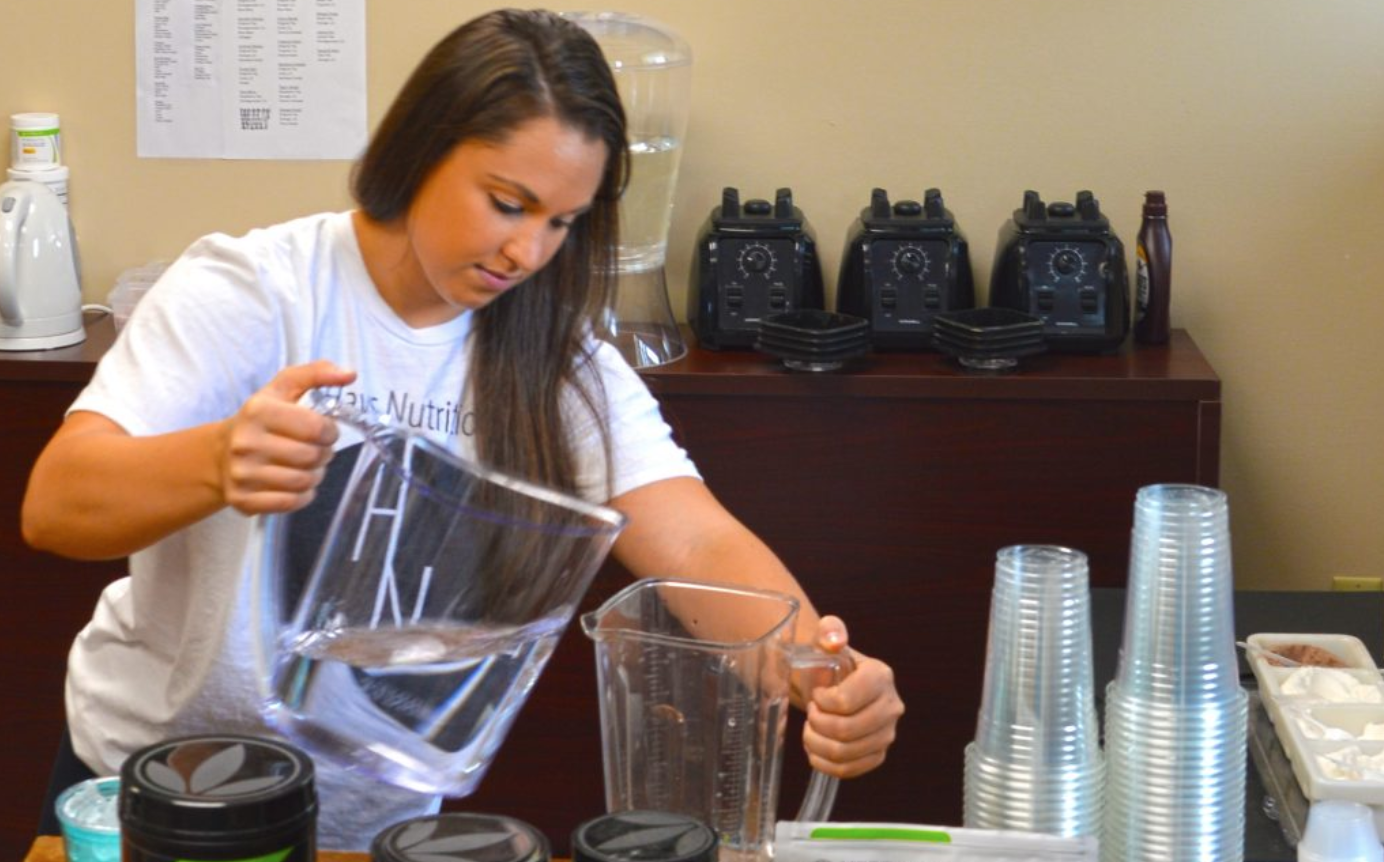
Last Monday, Hays Nutrition opened its doors in the Hadley Center, 205 E. Seventh, with the goal of providing an outlet to help area residents meet their fitness goals with nutritious shakes and teas.

The shop is the second for Kayla Heronemus and her fiance and co-owner Jordan Ward.

After attending Bethany College and trying her hand in another field, she saw nutrition shops opening in Salina, sparking an interest in opening her own location in near her alma mater in Lindsborg.

“Health and nutrition is a big part of my life,” said Heronemus, who has been certified as a personal trainer and in fitness nutrition. “I love to work out and help people with their goals.”

With Hays, she saw another opportunity after finding success working with student-athletes at her first location.

“In Lindsborg, we were very active with the college,” she said. “We donated money to the athletes’ awards and helped with their banquet. We are very close with the coaches as well. We give the team free teas sometimes before the practices and protein shakes after their practices.”

Meal replacement options in the shop are often healthier and faster than some of the other options they may have in the cafeteria or fast food locations in town, she said.

“It helps heal their bodies and helps them recover since they are so active, with all of their practices and hours of work,” Heronemus said. “I’m focused on something that is fast, and nutritious as well.”

In the shop, they offer protein shakes that can work as a supplement or as a meal replacement.

“People can come in here and get a quick breakfast, lunch or snack,” she said.

They also carry energy teas.

“They boost your metabolism and they burn calories, but they have caffeine in them,” Heronemus said.

In an effort to help people achieve their fitness goals, Heronemus said she uses challenges to keep them on track.

“I have done six-week challenges where I have helped them with their meal plan. It all ties together,” she said. “They use the products and they lose or gain weight or muscle. Whatever their goals are, I help them with that.”

Signing up to a challenge, however, is not required.

“Even if they don’t want to do a challenge, they can sign up for a plan and get started on their journey, whether that be weight loss, weight gain, muscle gain or body fat loss,” she said. “They all tie together.”

While the shop offers nutritional beverages that are ready to drink, they also offer the same mixes the shop uses for anyone to purchase and make at home.

“The shop is a gateway to get into the products,” Heronemus said. “They can buy the product and make it at home or they can buy something small, whatever they want to do.”

While the location’s address is listed as Seventh Street, it is easier accessed on Eighth, just west of the Hadley Center courtyard.

Hays Nutrition is open from 7 a.m. to 4 p.m. Monday through Friday and from 8 a.m. to 2 p.m. Saturday.

More information about the location can be found on their facebook page by clicking here. 

Five-show theater festival in northwest Kansas shines spotlight on area talent

By JESSICA HEFLIN
MSAC Intern

HOXIE – The Main Street Arts Council (MSAC) completed the last round of performances in the 2019 Main Street Summer Theater Festival on July 21. The festival, which featured five shows in five towns, began with rehearsals all throughout June and culminated in nine performances the first three weekends in July.

Approximately 160 area youth between the ages of 5 and 18 from all over northwestern rural Kansas participated in the festival, performing for family and friends throughout the region. Towns and shows in this year’s festival included Goodland: Disney’s “Alice in Wonderland JR”; Quinter: Roald Dahl’s “Willy Wonka KIDS”; Hoxie: DreamWorks’ “Madagascar – A Musical Adventure JR”; Colby: Disney’s “Cinderella KIDS” and Atwood: Disney’s “The Lion King JR.”

The 2019 shows were made possible in part thanks to the generosity of Dane G. Hansen Foundation Community Fund Grants received from the Sherman County Community Foundation, Thomas County Community Foundation, Gove County Community Foundation, Sheridan County Community Foundation, and the ACE Foundation/Rawlins County Community Foundation, respectively. All foundations are affiliates of the Greater Northwest Kansas Community Foundation, Bird City.

Grant support from the Dane G. Hansen Foundation, directly, aided with staff fees for festival directors, choreographers and student director interns. A grant from the Kansas Department of Commerce’s Kansas Creative Arts Industries Commission and National Endowment for the Arts also assisted with staff fees.

Participation in the festival was free to all cast members thanks to the generosity of these grant funders, members of the MSAC and from ticket sales. Without the help of the community, this would not have been possible for the youth to experience. Culture and creativity are important in a child’s life, and the MSAC sincerely thanks all who contributed to helping make the theater festival possible and a success.

Along with the summer theater festival, the arts council sponsors various programs for the community to participate in and learn about different aspects of culture and expressions of art and music. These include adult theater production(s), community choir, art classes, and the annual Main Street Art Walk in downtown Hoxie.

All MSAC programming is made possible through the financial support of paid members, donations, and grants. To support MSAC in its endeavor to promote the arts, encourage creativity, serve the Arts community, and act as an advocate for the Arts, consider paid membership. Varying levels are available for both individuals and businesses, each offering a multitude of benefits and advertising premiums in acknowledgment of support.

Visit www.mainstreetartscouncil.com/join-us to join today or contact Executive Director Karl Pratt at [email protected] for more information.

Roald Dahl’s “Willy Wonka KIDS” in Quinter (Photos by Amanda Richards, Bow Creek Photography)


Disney’s “Cinderella KIDS” in Colby


DreamWorks’ “Madagascar – A Musical Adventure JR performance in Hoxie

Dust in the wind? KU prof develops methods to predict dust storms

Bing Pu, assistant professor of geography & atmospheric science at KU, has developed a long-range dust-prediction method her team used to accurately predict dustiness in the southwestern and central United States. (Credit: NOAA)

KU News Service

LAWRENCE — Southwestern Kansas in the 1930s saw some of the worst dust storms ever recorded in the U.S., when apocalyptic clouds of heavy dust terrified and even killed people, livestock and wildlife.

Long ago, farmers phased out the kinds of practices that brought about the Dust Bowl, but dust still can harm health, agriculture and transportation while exacerbating environmental problems. Indeed, dust storms may increase as climate change causes drier conditions. (The National Oceanic and Atmospheric Administration asserts windblown dust storms increased 240% from 1990 to 2011 in the southwestern United States.)

Today, a researcher at the University of Kansas has developed an advanced technique for forecasting dusty conditions months before they occur, promising transportation managers, climatologists and people suffering health issues much more time to prepare for dusty conditions. By contrast, common methods of predicting dust in the air only give a few days of advance warning.

Bing Pu

Bing Pu, assistant professor of geography & atmospheric science at KU, is lead author of a new paper in Geophysical Research Letters detailing a long-range dust-prediction method her team used to accurately predict dustiness in the southwestern and central United States.

“We use a statistical model constrained by observational data and the output of a state-of-the-art dynamic seasonal prediction model driven by observational information on Dec. 1,” Pu said. “We found using our method, we actually can give a skillful prediction for the dustiness in springtime, one of the dustiest seasons in the U.S., over the Southwestern and Great Plains regions — two of the dustiest areas in the U.S.”

Pu and her colleagues, Paul Ginoux and Sarah Kapnick of the NOAA Geophysical Fluid Dynamics Laboratory, and Xiaosong Yang of NOAA and the University Corporation for Atmospheric Research, were able to predict “variance,” or days when there was more or less dust in the air than average.

“Over the southwestern U.S., our model captured the variance of the dustiness over the time period from 2004 to 2016 by about 63%,” Pu said. “Over the Great Plans, about 71% of the variance is explained.”

Pu said factors influencing amounts of dust in the air can include surface winds, precipitation and amount of bareness of the landscape. These kinds of data were incorporated as key variables into the prediction model.

According to Pu and her collaborators, high levels of airborne dust can affect individual people, transport systems and agricultural production.

(a) Climatology (2004‐2016) of dust event frequency (%) in March‐April‐May (MAM), and anomaly (with reference to the climatology; %) in 2010 from (b) Moderate Resolution Imaging Spectroradiometer (MODIS), (c) prediction with En1 ensemble, (d) prediction with En2 ensemble, and anomalies averaged between 2011 and 2013 from (e) MODIS, (f) prediction with En1, and (g) prediction with En2. The dotted area indicates that at least eight out of the 12 ensemble members show the same sign as MODIS anomalies. Missing values are shaded in grey. The black boxes denote the averaging areas over the southwestern United States (box 1) and northern (box 2) and southern Great Plains (box 3). Pattern correlations (uncentered) between the predictions and MODIS over the southwestern United States (first) and the Great Plains (second) are shown in bottom left in blue. (Credit: Pu, et al )

“Small dust particles are very easily taken into your breathing system and then could cause lung diseases like asthma — and some studies suggest there might be some connection with lung cancers,” Pu said. “There’s a study finding dust storms are related to valley fever in Arizona as fungi can attach to dust particles. And when there’s a severe dust storm, visibility is reduced so it can increase car accidents on the highways. In 2013, there were severe dust storms in western Kansas that reduced visibility and caused problems for local traffic. In Arizona, when there’s a strong dust storm usually called a ‘haboob,’ the dust wall goes up to a few kilometers high, and this can affect airports —airports have to close due to the dust storms. Fortunately, these storms are moving quickly and dissipate after a few hours.”

Beyond safety for people, Pu’s team detail in their study how high dust levels can sway the environment as a whole.

“Dust particles absorb and scatter both solar and terrestrial radiation, thus affecting the local radiative budget and regional hydroclimate,” they wrote. “For instance, dust is found to amplify severe droughts in the United States by increasing atmospheric stability, to modulate the North American monsoon by heating the lower troposphere, and to accelerate snow melting and perturb runoff over the Upper Colorado River Basin by its deposition on snow.”

Pu said she hopes someday an organization or government agency could run the model she’s developed and issue seasonal dust predictions months in advance, especially if the potential for high levels of dust cause concern.

“Traffic systems and human health would benefit most from this long-term prediction ability about dust and air quality,” she said. “I think it would be great if an institute would try to give regular predictions of dustiness variations that could be helpful for airports or road traffic or transportation managers. Facilities could plan for times when there could be a lot of dust in the local area. It could even affect the plans of local farmers.”

For the time being, Pu aims to continue to refine the dust-prediction model to include atypical weather influences and human activity that could contribute to dust patterns.

“We want to continue to understand what other factors haven’t been explored in the seasonal variation of the dust,” she said. “For instance, those large-scale factors such as the El Niño-Southern Oscillation, and also anthropogenic factors, how people’s influence through agriculture or construction projects, might affect dust emission in the future. Of course, we want to also keep collaborating with people at NOAA GFDL to give dust predictions.”

Humane Society, Defiance Brewing team up to raise funds

By JAMES BELL
Hays Post

Rarely do the words “brewery,” “dog” and “fundraiser” go together, but a new event next month hopes to combine all three.

From 3 to 7 p.m. Saturday, Sept. 14, the Humane Society of the High Plains and the Hays Public Library will team up to host Paws and Pints at Defiance Brewing Co., 2050 Old U.S. 40.

Humane Society manager Betty Hansen said interest is already high and she hopes will it turn into an annual event.

Paws and Pints will offer “all kinds of new things, and we are hoping to start this year and make this thing bigger and better every year,” she said. “I think it’s going to be great.”

“Bring your dogs out,” she said. “We will have a lot of dog activities.”

Some of the events planned include dog painting, dog toy stations, live music, and a dog talent show, which will be manned by staff and volunteers from the Hays Public Library.

“We are opening it up to the public to help them out,” said Abby Artz, HPL adult services programming coordinator.

Volunteering at the event is a part of the library’s ongoing effort to increase community outreach.

“Every month, we do what we call HPL: Hands-On — a volunteering event with a different organization around town,” Artz said. “We are trying to create more of a sense of togetherness and show that we are a community and it is really fun to work together on different events, especially this one.

“It’s going to be really fun,” she said.

Defiance is also excited to host the event, as co-founder Matthew Bender said working with community organizations is becoming a trend for breweries across the county.

“We are huge, huge animal lovers, so it was a no-brainer for us,” he said. “It felt like a natural fit.”

There is a $5 fee per dog to enter.

To sign up to volunteer with the library, visit the events Facebook page here or email [email protected].

More information about the event can be found on the Humane Society of the High Plains facebook page.


Former Hays woman who bought out Payless store for flood victims again paying it forward

Abby Tritt, formerly of Hays on “Ellen” this spring. Photo courtesy of KWCH

Courtesy of KWCH

About four months after being recognized on “Ellen” for paying out a local Payless Shoe Source store and sending shoes to help flood victims in Nebraska, Addy Tritt, FHSU grad and former Hays resident, is paying it forward again.

Tritt is now using a donation from Ellen to buy $20,000 worth of merchandise from another store going out of business, Charming Charlie. Tritt plans to donate the merchandise to women impacted by domestic violence.

“My plan is to create a “closet” for women in domestic violence shelters to come pick out a new outfit and accessories,” Tritt said. “I couldn’t have done it without Ellen.”

RELATED STORY: Hays women buys out Payless store, sends shoes to flood victims

🎥 Grant pays for more training of local Crisis Intervention Team

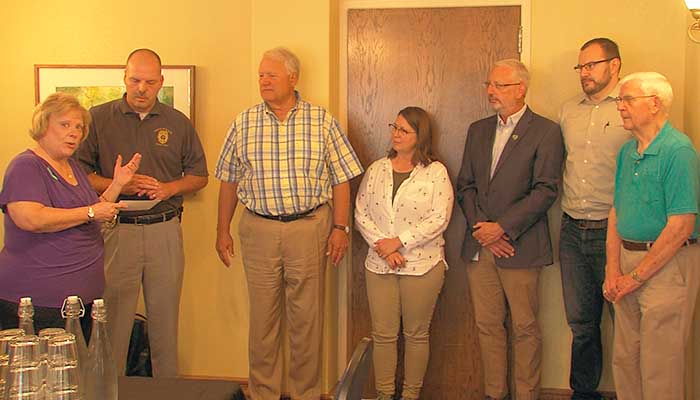
Ann Leiker, NAMI-Hays, presents a $10,000 check to Hays Police Chief Don Scheibler for national CIT training in Spokane, Wash. Onlooking are Joe Jeter, trustee of the Schmidt Foundation which funded the grant; Sherrie Vaughn, NAMI-Kansas exec. dir., Dave Anderson of High Plains Mental Health Center and an Ellis County CIT Council member; Josh Tanguay, psychologist and Ellis County CIT Council member; and Tom Pitner, founder of NAMI-Hays.

By BECKY KISER
Hays Post

Six members of the new Ellis County CIT (Crisis Intervention Team) Council were in Seattle, Wash., this week for national CIT training, thanks to a $10,000 grant from the Bob and Pat Schmidt Foundation of Hays.

NAMI-Hays (National Alliance on Mental Illness) applied for the grant on behalf of the council.

“One of the areas Bob and Pat Schmidt were always interested in was health in our community,” said Joe Jeter, Schmidt Foundation trustee. “When Tom Pitner (the founder of NAMI-Hays) approached the foundation about a potential grant for NAMI, it seemed like a no-brainer. It fit right into what we’re doing. We know Bob and Pat would be very pleased about this.”

Crisis Intervention Team programs are supported nationally by NAMI in more than 2,700 communities.

The lack of mental health crisis services across the U.S. has resulted in law enforcement officers serving as first responders to most crises. A Crisis Intervention Team (CIT) program is an innovative, community-based approach to improve the outcomes of these encounters, according to NAMI.

“High Plains Mental Health Center has always had a really strong and great working relationship with local law enforcement,” said Dave Anderson, a member of the Ellis County CIT and director of clinical resources at HPMHC.

“We rely on them heavily for the work that we do because many of the people who are in mental health crisis, law enforcement is often the first people that come into contact with them,” Anderson pointed out. “CIT strengthens that relationship. We spend a lot of time talking about issues in the community and the ways we can work together to help deal with those issues.”

“CIT in a community this size is fairly unusual. It’s usually in larger, more urban areas. We’ve had some challenges, but I think we’ve hit the ground running.”

Hays Police Chief and CIT member Don Scheibler spoke to the HPMHC board about CIT last month and explained the challenges law enforcement faces in dealing with people who have mental health crises.

CIT, which is ever evolving, began with the Memphis, Tenn. police department in 1988 following the fatal shooting of a mentally ill person.

“In 2016, we had the same situation happen here in our community,” Scheibler said, “and that really made us start looking at a way we could do this better, is there a way we could provide better service to our mental health consumers, and that’s how CIT grew out for us.”

“I’m especially pleased with the support of High Plains Mental Health Center and NAMI, and Ellis County law enforcement.”

Scheibler agreed that “law enforcement has become the de facto health provider for a lot of people.”

“We are often the very first people they see in a crisis. Better training, better preparing of our people in those types of situations is huge.”

Hays resident Joey Weber, 36, who had autism, was shot and killed by a Hays police officer during a brief struggle Aug. 18, 2016, following an attempted traffic stop for an expired license tag. The Kansas Bureau of Investigation determined the officer acted in self-defense.

The bill “Joey’s Law,”  aimed at protecting Kansas drivers with cognitive disabilities, was signed into law by then-Governor Sam Brownback  on April 7, 2017.

NAMI was actively involved in the Memphis development of CIT and continues to be involved in CIT, according to Dr. Sherrie Vaughn, executive director of NAMI-Kansas.

“We were active partners and collaborators for the implementation of CIT and growing it across the nation,” Vaughn said. She thanked Jeter and the Schmidt Foundation for supporting NAMI-Hays in their efforts to support the Hays police department and the CIT team.

“What a great opportunity that this grant award is going to give to you and your board in growing CIT here in Hays. I’m excited about what that’s going to do for your department, for your department morale and also for the citizens that receive your services,” she added.

Scheibler and Anderson attended an international CIT training program in Kansas City last year, where presenters urged CIT groups to have training for all their members.

ELLIS COUNTY CIT COUNCIL

Sgt. Brandon Hauptman, President–Hays Police Dept.
Sgt. Tim Deines, Vice-President–Ellis Co. Sheriff’s Office
Chief Don Scheibler–Hays Police Dept.
Chief Ed Howell–FHSU Police Dept.
Chief Taft Yates–Ellis Police Dept.
Undersheriff Scott Braun–Ellis Co. Sheriff’s Office
Brenda Basgall–Ellis Co. Attorney’s Office
David Anderson–High Plains Mental Health Center
Gina Smith–FHSU Kelly Center
Bob Piatt–NAMI Hays
Josh Tanguay–NAMI Hays
Pat McGinnis–Community member

The Hays Police Department recently completed the One Mind Campaign started by the International Association of Chiefs of Police. HPD was the second agency in Kansas participate in the intiative to improve response to community members with mental illness.

Former art teacher, counselor recount story of Gus the therapy dog in print

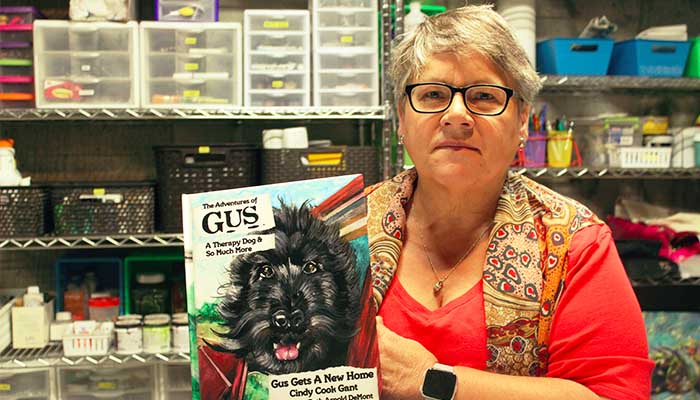
Hays resident and former art teacher Beth DeMont is the illustrator for “The Adventures of Gus: A Therapy Dog and So Much More” series.

By CRISTINA JANNEY
Hays Post

DeMont’s watercolors depict the story of the real therapy dog, Gus, in Cindy Cook Gant’s books on positive character traits.

A very special dog was the inspiration for a new series of children books aimed at teaching character and encouraging children to talk about their feelings.

Gus, a black goldendoodle, was a therapy dog who worked along side school counselor and author Cindy Cook Gant. When Gant decided to publish a series of books based on Gus, she tapped into the talents of Hays resident and former colleague Beth Arnold DeMont.

The first book, which was released in 2018, is titled “Gus Gets a New Home.” It will be one of six books each highlighting character traits in “The Adventures of Gus, A Therapy Dog and So Much More” series.

Gant,62, based the books on the same character trait program she taught when she was a counselor in public schools. Gant and DeMont, 61, worked together in White City, where DeMont worked as an art teacher, Gant worked as a counselor and Gus served as a therapy dog.

An illustration from “Gus Gets a New Home,” which was released in 2018. The next book in the series, “Gus Goes to School,” will be out in September. DeMont also illustrated that book. Courtesy art

The first book teaches the character trait of caring. The book highlights that Gus was the only black dog in a litter of blonde pups. He overcomes challenges and difficult feelings to embrace his new home with the Gants. Questions in the book encourage adults to ask children about how they feel about the story or times in their own lives when they have felt left out, dealt with change or felt scared or nervous.

Gant said she hopes the book will allow adults and children to more freely talk about their feelings.

DeMont described Gus as the light of the school. He was a comfort for both students and staff.

Gant said children would often lay on her office floor and use Gus as a pillow. They would talk about the their problems as Gant would work on her computer. Depending on the child’s age, Gant would pretend as if Gus was whispering something into her ear and then she would tell the student what Gus thought about their problems.

“What might take be two or three sessions to accomplish without Gus,” she said, “I could do in one with Gus.”

She said Gus was very loving and seemed to know exactly what a child needed. She gave a couple of examples of when Gus aided children.

One child was crying and inconsolable. Gus licked his tears, and the child started to giggle.

Hays resident and artist Beth DeMont works in her basement studio.

Another child had missed a dose of medication. His mother thought he had taken it, but he hadn’t. The mother was on the way with the medication, but, in the meantime, the child was tearing up the principal’s office. He was throwing papers on the floor and screaming. Gus came in the office, and the boy laid down on the floor and began calmly petting him.

“His sense of what people needed was very rare and unbelievable,” Gant said of Gus.

Sadly, Gus died from cancer after Gant’s retirement from the school district.

DeMont said her hope for the books and her illustrations is they will help kids, “because Gus helped kids.”

“The main thing is that Gus was such a loving, caring dog with the kids and adults. There were a lot of adults that would need time to go pet Gus,” DeMont said. “Just to see him took your concerns away from the day if it was a bad day. He helped so many kids with anxiety and grief. It is amazing how he worked in that school. …

“You couldn’t help but love Gus,” she said. “Even if you didn’t want to, he made you. He was just one of those dogs.”

Gant said when she decided to write the books on Gus, she knew she wanted DeMont to illustrate them because she knew Gus. DeMont said she initially didn’t want to do the artwork, because she had never done book illustrations before, but this project was special.

The first book was terrifying, DeMont said. She said she had no idea about illustrating a children’s book. She reached out to a Facebook group of children’s book illustrators for feedback.

“A lot of the younger people said they really liked it because it had a vintage feel,” she said. “I think I really drew that from my Golden Books when I was little. I loved books.”

Now that she has the second book under her belt, the work is becoming more enjoyable, she said.

DeMont said she always loved to draw even when she was little. One of her early memories is getting in trouble for drawing on the side of her school building when she was in kindergarten. Art was her favorite class in school. However, in 1971 DeMonte’s family lost their home in Ashland to a fire. The family moved to Kendall, Kan., which had no art program.

She continued to pursue art in her free time, and the journalism instructor allowed her to draw illustrations for the yearbook. Her small high school closed after her junior year, so she started college a year early at Garden City Junior College. She thought she might study pre-vet, but decided she didn’t have the math background the complete that program. Her mother suggested art classes.

The first day of college art class the instructor told the students to create a color wheel and the left the room.

“I was just sitting there because I didn’t know what a color wheel was,” she said. “He came back in and said, ‘Why are you still here?’ I said, ‘I don’t know what a color wheel is,’ and he looked at me like I was crazy.”

DeMont’s teacher, Bob Scott, was kind and helped her through the assignment and mentored her through her time at the college. She eventually transferred to Fort Hays State University where she earned a degree in art education. She worked for 33 years as an art teacher before retiring in 2014.

She said teaching did not leave her as much time to pursue her own art as she would like, but it did force her to experiment with many media. She was constantly working with new media and techniques so she could pass those on to her students. She is a sculptor, a painter, has worked in oil, pencil and collage.

“I enjoy it, so when I get tired of one thing, I jump to another,” she said. “I have a lot of variety. I am not afraid to try something new. I like the challenges.”

DeMont said her favorite media continues to be drawing, just as it was when she was drawing horses in her bedroom as a child out of the Western Horseman magazine. However, these days she is working more in paint and collage, which stems from her love of color.

“The thing about illustration is that it is such a different type of art,” she said. “It is hard to explain. You are expressing yourself when you do your own artwork, but when you are doing a book, you are doing what someone gave you.”

DeMont had an exhibit in the Hays Art Council Fall Art Walk titled “Daring to Change.” She and Gant also sold autographed copies of the first Gus book at the event. DeMont will be a part of show with Hays Society of Layerists in October and another show with the group in April at the Deines Cultural Center. She also has a show coming in September 2020 with her sister at the Deines.

Gant and DeMont have another book launching in about a month in the Gus series, “Gus Goes to School.” In this book, Gus learns responsibility as he attends school to become a therapy dog as well as starts attending school with Gant.

The Gus series is published by Dorrance Publishing and is available from the publisher, Amazon, Barnes and Noble, or personally from Gant or DeMont. You can contact the author at [email protected] or the illustrator at [email protected].

Hays students explore downtown during annual March to Main

Hundreds of students from Fort Hays State University, Hays Academy of Hair Design and NCK Tech gathered at the FHSU quad Tuesday night for the annual March to Main.

School officials and faculty as well as elected officials joined the students in the annual parade.

The Press catered a free meal, and students were entered to win $3,000 in prizes. During the next two weeks, students can complete activities downtown to win even more prizes.

The event seeks to welcome students to Hays and connect them with businesses in the city’s core. It is sponsored by the Downtown Hays Development Corp., Hays Convention and Visitor’s Bureau and the three participating schools.

RC pilot looks to hand off hobby after over 50 years in the air

Sherwin Stielow of Russell holds up one of his RC planes. He has flown RC planes for more than 50 years.

By CRISTINA JANNEY
Hays Post

Stielow, 85, of Russell is looking to pass on his RC Plane hobby after more than 50 years in hobby. Courtesy photo

RUSSELL — Sherwin Stielow has flown to great heights without ever leaving the ground.

Stielow, 85, of Russell has been flying RC planes since the late 1960s.

He said the hobby is a combination of the challenge of building the planes, the satisfaction of seeing the something you built fly and the challenge of flying the plane.

Stielow’s love of the skies started when he was a young adult. He and his cousins liked to watch planes at the local airport. They decided to pool their money and buy a  World War II military training airplane.

The cousins first took flying lessons from a former World War II pilot and trainer before finishing their lessons with a pilot in Hays. His two cousins went to work as airplane mechanics. Stielow was hired by the Kansas Highway Patrol as a pilot. He flew traffic enforcement in a Cessna Skylane and often aided in searches before damage to his hearing forced him to retire in 1987.

Stielow said one of his most memorable moments on the KHP was not in the air. He received a call from his superintendent one day in 1970 and he was asked to report to Beloit. When he arrived, the superintendent was there with Neil Armstrong, who was in Kansas to go pheasant hunting.

A painted wood burning by Sherwin Stielow depicting Stielow and his fellow Kanas Highway Patrol pilots.

“Guess what I got to do in full blue highway patrol uniform? I was the bird dog that went down in the weeds. I am not 100 percent sure I got to shake his hand. I think I did,” Stielow said.

He had dreams of flying for an airline, but in those days, work for an airline was not very steady and private pilots made less than he was making as a trooper. He had a family to support. He also had a job offer to work for the Alaska State Police, shortly after Alaska achieved statehood.

“I was going to have to report to Fairbanks on Feb. 15, 1959 in the middle of winter with two children. We couldn’t hardly rub two quarters together,” he said. “Everybody talked me out of that one. But I had a good career. I still bleed blue.”

When Stielow became involved in RC planes in the 1970s, he said he enjoyed building the planes more than flying them.

“It is a challenge to put it together, and then once you have it together to see it in the air flying,” he said. “That is something that you did.”

Stielow related it to working in the oil field when he was a young man.

One of many of the RC planes Stielow has built over the years. Courtesy photo

“I got to driving a bulldozer, building oil field locations,” he said. “The challenge was you go out there into this pasture on a hillside and you level this location and get it almost perfectly level and dig the pits and everything an oil derrick has to have. I did that. That was the challenge and the fun of working there. Just like building the airplane, I put this thing together.”

He started with gas engines, and as the technology progressed, he made the transition to electric engines. He has made planes from kits and from his own designs, from Styrofoam and basal wood.

Planes can take hours to build or they can take months. He worked on the planes during the winter when he couldn’t fly. His largest plane has a wing span of 64 inches. The planes’ top speeds can vary anywhere from 30 to 70 mph. The RC speed record was set in 2017 by a jet that was clocked at 465 mph.

The first gas trainer he built was his favorite — a stick-built high wing, which was followed by a low wing, which was faster and more aerobatic.

“It was easy to handle, but it was a challenge. It was faster and you really had to stay on your toes,” he said. “I’ve still got that airplane.”

He once scaled down plans from a life-size plane to an RC plane when a friend who worked at Beechcraft lent him the specs. He has 13 planes in his basement currently, some ready for flight, others not.

Flying an RC plane is not as easy at it might look.

“People want to learn to do this, but they try to do it on their own,” he said. “They will buy an airplane kit like this, and they will go in the backyard or out in the pasture or out in the field and try to learn to fly it themselves. The odds are against them. It is not going to happen. There are enough variables there. It doesn’t take long to learn to fly, but you need a instructor to teach you how to fly. …”

He gave an example. If the plane is moving away from you, then it is like you are sitting in the plane’s cockpit, but if the plane is coming toward you, you have to reverse the controls.

Stielow admits he has spent hours building planes only to crash them.

Flying is not necessarily a solo hobby. Stielow was part of a club based in Russell and often flew with friends before he constructed his own grass RC plane runway (a mowed strip of grass) on his farm north of Russell. He also attended a couple of large RC plane fly-ins over the years.

His favorite moment in the hobby came at one of these fly-ins. There were thousands of hobbyists at the rally. An announcer came over the loud speaker and said, “Ladies and gentlemen, we’re thrilled. We did not know they were going to show up, but the Blue Angels have agreed to a fly by. If you’ll look to your left …”

Over a group of trees came four blue RC jets tethered together doing all sorts of acrobatics.

Stielow said he has tried flying a drone, although he does not own one of his own. He said it is just not the same as flying an RC plane. With a RC plane, you can do loops and flips. RC planes are challenging to fly.

“When a drone runs out of battery, it will come back to where it took off and land itself,” he said. He waved his hand off dismissively.

Stielow has reached a time in his life he realizes it’s time to start letting go of most of his planes. Replacement knees and hip means it is hard for him to balance when he is flying.

He has listed his planes for sale. His own kids never bought into the hobby and now they’re asking dad, what they are going to do with a basement full of planes when he is gone. He said he would like to pass the planes on to Girl Scouts, Boy Scouts or a 4-H group. He hopes a new generation of flyers will get the same joy out of planes as he did.

“I’d just like to see them go to a good home and some young kids learn to fly,” he said.

If you are interested in purchasing any of Stielow’s planes, you can contact him at 785-942-3275.

Kinnamon takes a shot at FHSU football following basketball career

Kyler Kinnamon works on a receiving drill at FHSU preseason camp. Courtesy FHSU Sports Information / Ryan Prickett

By GERARD WELLBROCK
Hays Post

After spending the last four seasons on the Fort Hays State basketball court, Kyler Kinnamon is taking a shot at college football.

He said the thought of playing football entered his mind last fall while watching his younger brother Jace play at McPherson High School.

“I just was watching him and (realized), man, I really miss that a lot” he said following the Tigers scrimmage on Thursday. “I did a little bit of research and figured out a way that you get an extra semester or two of eligibility and said, ‘Heck, I might as well if I don’t have anything else to do.’ ”

Kinnamon was the Tigers starting point guard the last three seasons and played in 120 games over his four years. He finished with the fourth most assists in school history and was named honorable mention All-MIAA following his senior season.

In addition to being an All-State basketball player, Kinnamon was a standout on the football field at MHS, where he played quarterback, wide receiver, running back and defensive back. When he graduated in 2015, he held the school’s single-season record for rushing yards (1,662) and was second in Bullpup history in career passing yards (4,354).

Kinnamon

Kinnamon said it’s been an adjustment making the move from the basketball court to the football field.

“It’s a lot more physical out here. You’re out in the sun a lot, practices are a lot longer, you’re dealing with the elements,” he said. “It’s been really fun, and I love these guys. I’m having a blast with it.”

Kinnamon joins an already deep receiving corps that returns starters Harley Hazlett, Layne Bieberle and Andrew Jay as well as Dandre Reed and Manny Ramsey, who also saw significant playing time a year ago.

“They’ve been incredible in helping me out. If I’m lined up wrong, Coach McCray helps me out” Kinnamon said. “We’re in the film room every single day, and they’ve all been awesome and supportive.”

Courtesy FHSU Sports Information / Ryan Prickett
Copyright Eagle Radio | FCC Public Files | EEO Public File