HaysMed, part of The University of Kansas Health System, received the American Heart Association/American Stroke Association’s Get With The Guidelines-Stroke Gold Plus Quality Achievement Award with Target: StrokeSM Honor Roll Elite. The award recognizes the hospital’s commitment to providing the most appropriate stroke treatment according to nationally recognized, research-based guidelines based on the latest scientific evidence.
Hospitals must achieve 85 percent or higher adherence to all Get With The Guidelines-Stroke achievement indicators for two or more consecutive 12-month periods and achieve 75 percent or higher compliance with five of eight Get With The Guidelines-Stroke Quality measures to receive the Gold Plus Quality Achievement Award.
To qualify for the Target: Stroke Honor Roll Elite, hospitals must meet quality measures developed to reduce the time between the patient’s arrival at the hospital and treatment with the clot-buster tissue plasminogen activator, or tPA, the only drug approved by the U.S. Food and Drug Administration to treat ischemic stroke. If given intravenously in the first three hours after the start of stroke symptoms, tPA has been shown to significantly reduce the effects of stroke and lessen the chance of permanent disability. HaysMed earned the award by meeting specific quality achievement measures for the diagnosis and treatment of stroke patients at a set level for a designated period.
These quality measures are designed to help hospital teams follow the most up-to-date, evidence-based guidelines with the goal of speeding recovery and reducing death and disability for stroke patients.
“A stroke patient loses 1.9 million neurons each minute stroke treatment is delayed. This recognition further demonstrates our commitment to delivering advanced stroke treatments to patients quickly and safely,” said Bryce Young, Chief Operating Officer at HaysMed. HaysMed continues to strive for excellence in the acute treatment of stroke patients. The recognition from the American Heart Association/American Stroke Association’s Get With The Guidelines-Stroke further reinforces our team’s hard work.”
“The American Heart Association and American Stroke Association recognizes HaysMed for its commitment to stroke care,” said Paul Heidenreich, M.D., M.S., national chairman of the Get With The Guidelines Steering Committee and Professor of Medicine at Stanford University. “Research has shown there are benefits to patients who are treated at hospitals that have adopted the Get With The Guidelines program.”
Get With The Guidelines®-S puts the expertise of the American Heart Association and American Stroke Association to work for hospitals nationwide, helping hospital care teams ensure the care provided to patients is aligned with the latest research-based guidelines. Developed with the goal to save lives and improve recovery time, Get With The Guidelines®-S has impacted more than 3 million patients since 2003.
According to the American Heart Association/American Stroke Association, stroke is the No. 5 cause of death and a leading cause of adult disability in the United States. On average, someone in the U.S. suffers a stroke every 40 seconds, someone dies of a stroke every four minutes, and nearly 800,000 people suffer a new or recurrent stroke each year.
Arizona Commemorative Air Force Museum brings a rare chance to tour and ride in an iconic warbird
Arizona Commemorative Air Force Museum
MESA, Ariz. – One of the most iconic airplanes from World War II, B-17 Bomber “Sentimental Journey,” will make a stop in Hays as part of its Summer Flying Legends of Victory Tour across U.S. and Canada. Joining the B-17 Bomber is the P-51 Mustang from the CAF Great Plains Squadron.
The tour, made possible by the volunteers of the non-profit 501(c)3 Arizona Commemorative Air Force Museum, includes three restored WWII combat aircraft: C-47/DC-3 Combat Legend “Old Number 30;” B-17 Bomber “Sentimental Journey;” and B-25 Bomber “Maid in the Shade.” These warbirds and their crew will visit approximately 50 cities from June through October to fulfill their mission of educating all generations about the role of aviation in combat.
The public will have the opportunity to climb aboard the B-17 Bomber to soak in the breathtaking stories of courage and service by Americans during one of the most important periods in U.S. history. The B-17 is an exceptionally rare aircraft, as it’s one of 10 in the world that is still flying. Nicknamed the “Flying Fortress,” the B-17 was a strategic weapon in WWII because of its ability to suffer extensive battle damage and still return home. The public can book a ride in advance using the link below under pricing.
The P-51 “Gunfighter” will be available for rides Friday through Sunday. The Gunfighter was built in the Inglewood, California North American plant and accepted into the USAAF in March 1945. That month, it was shipped to England, where it was assigned to the famous ‘Mighty Eighth’ Air Force. In July of 1945, after the War ended in Europe, it was returned to the U.S. and assigned to Olmstead Field in Pennsylvania. In 1947, it was transferred to the Air National Guard and it thereafter served with units in Wyoming, New Mexico, Illinois, and Kentucky. In 1956, it was declared surplus and sold on the civilian market.
OLYMPUS DIGITAL CAMERA
Information about the Hays, Kansas B-17 tour stop is as follows:
Dates and times:
May 30 – June 5
Tour Hours: Tuesday, May 30 – Sunday, June 4: 2 pm – 6 pm
Ride Hours: Friday, June 2 – Sunday, June 4: 10 am – 1 pm
Pricing:
Tours cost $10 per person and $20 for a family of four.
Seats in the B-17 Bomber are $425 per waist compartment seat and $850 for bombardier/navigator seats in the nose and are limited to 8 passengers per flight.
The Hays school board learned Monday night the Hays High School football games this fall will not be subject to a new concealed carry law.
The district renewed its annual agreement with Fort Hays State University Monday to use Lewis Field for home football games.
Under the agreement Superintendent John Thissen said he thought the games would be subject to a law that would allow conceal carry on college campuses that will go into effect July 1.
However, Kerry Wasinger, FHSU general counsel, told the board Monday the games fall under the K-12 exemption, because the district is renting the entire facility.
The district rents other facilities from FHSU, including Beach/Schmidt Performing Arts Center. Because the school does not rent the entire facility in those instances, the concealed carry law would apply.
The district will rent the field for $2,400 each game; HHS will have five home games this fall.
Board president Lance Bickle, who joined the meeting by phone, said he wanted the district to look at the cost of using the district’s own facilities for games in the future.
The district also approved a $58,381 bid for a new bus for the Early Childhood Connections program.
The bus is replacing a small bus that is no longer running.
The district had about $35,000 in savings left in its transportation budget from when it bought other buses this year, and that money will be put toward purchasing this bus.
Another $15,000 will come from the Early Childhood program. Less than $10,000 will come from the capital outlay fund.
The district also approved $2,389.50 bid from Fire Alarm Specialist of WaKeeney for fire alarm testing and maintenance.
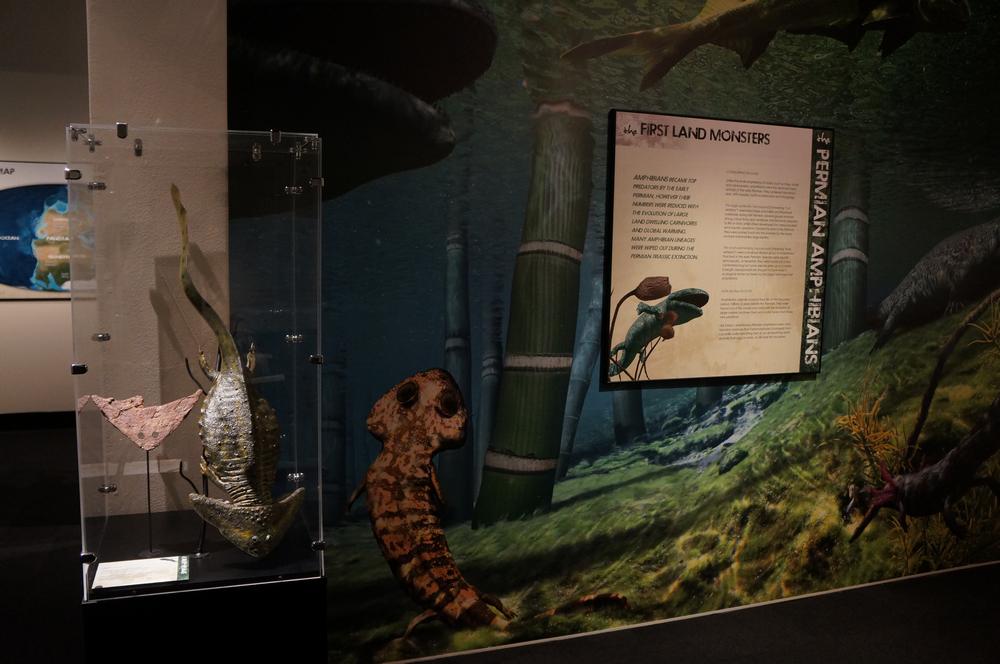
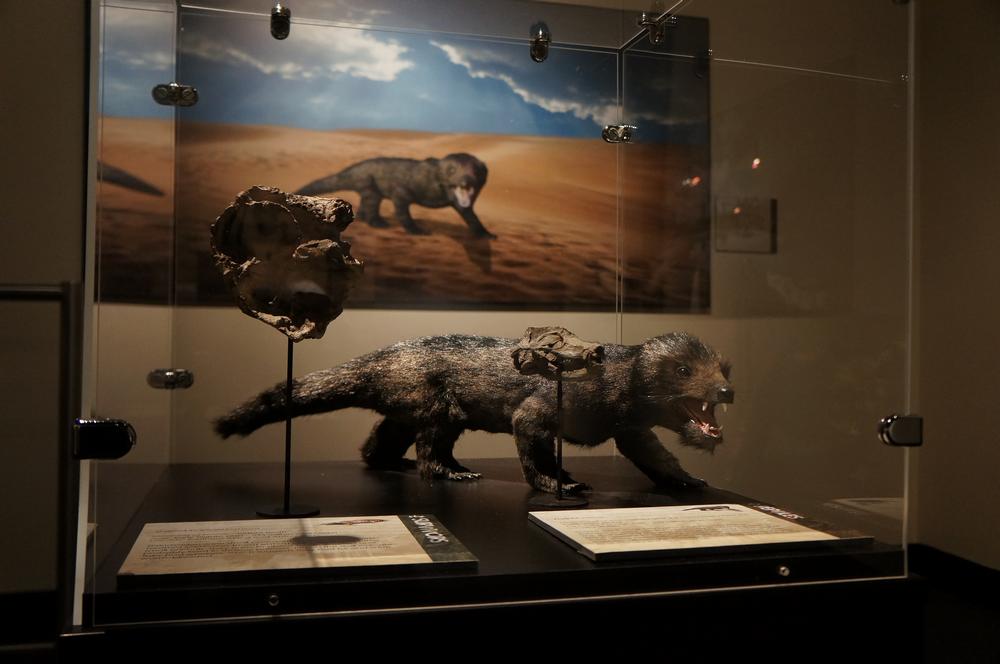
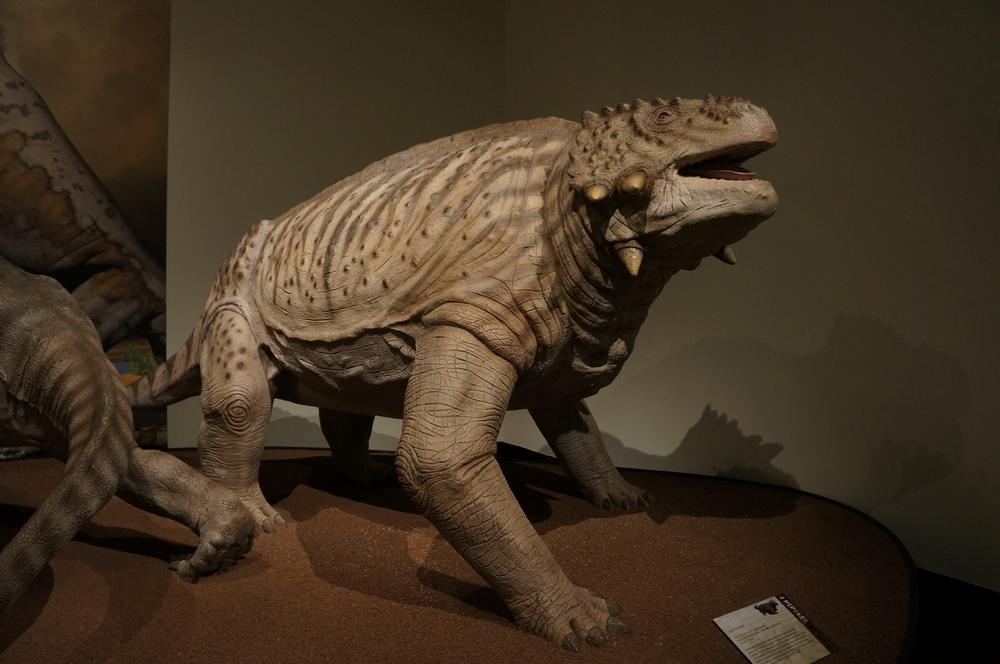
The Permian Age was a time when giant insects and strange mammal-like creatures dominated a thin layer of seashore on the supercontinent of Pangaea.
The age ended with a greatest extinction on the planet with 95 percent of life going extinct.
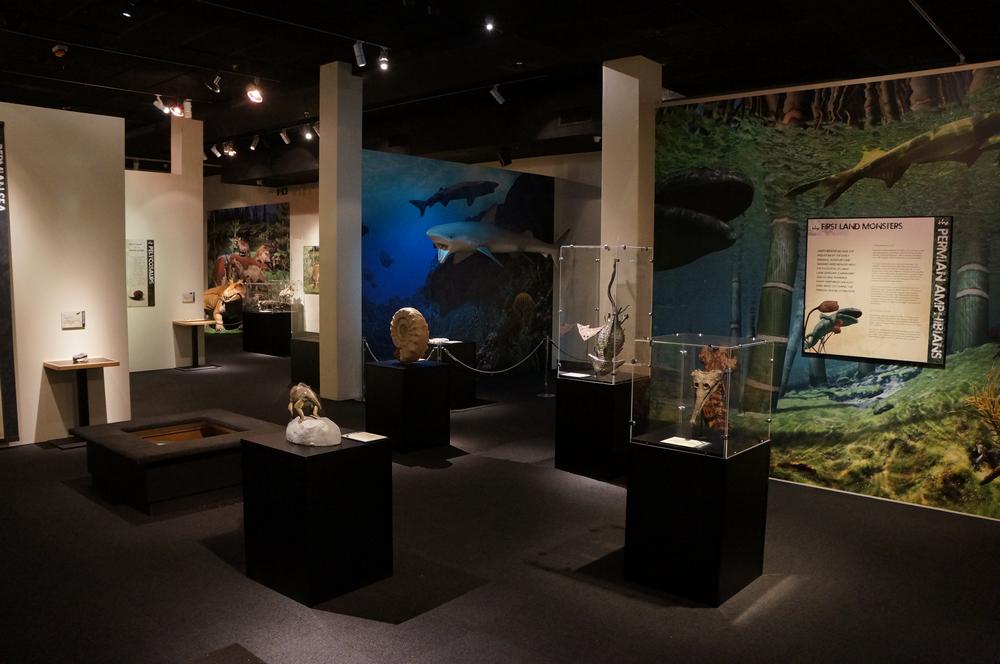
The Sternberg Museum of Natural History will host the traveling exhibit “Permian Monsters: Life Before Dinosaurs” from May 27 through Labor Day.
Reese Barrick, Sternberg director, said the Permian age is one of his favorite geological time periods.
The 5 percent of the creatures and plants that survived the mass extinction are the precursors to what inhabits the planet today.
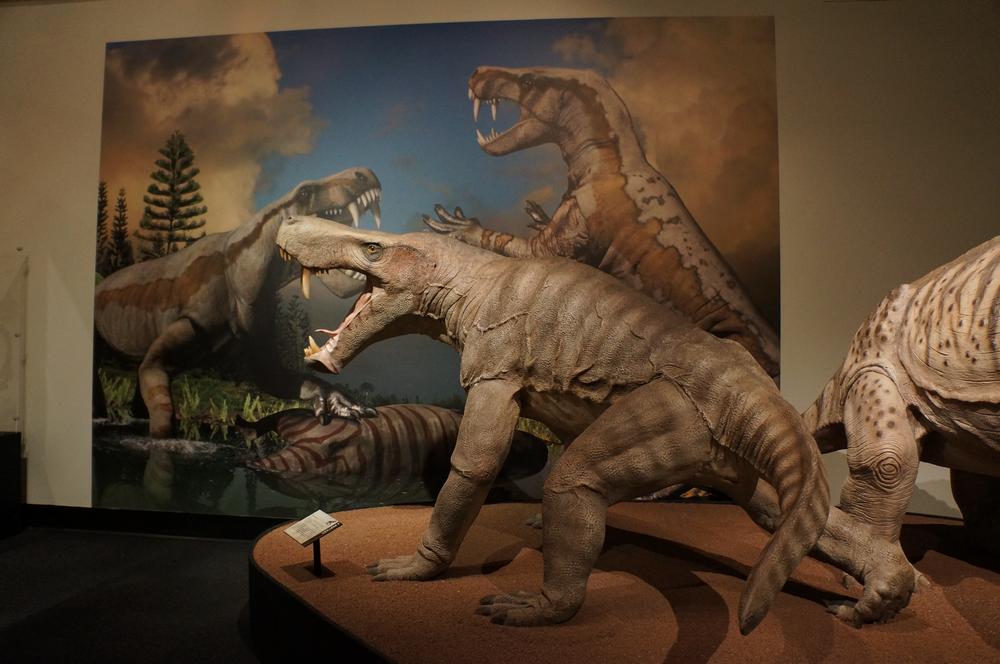
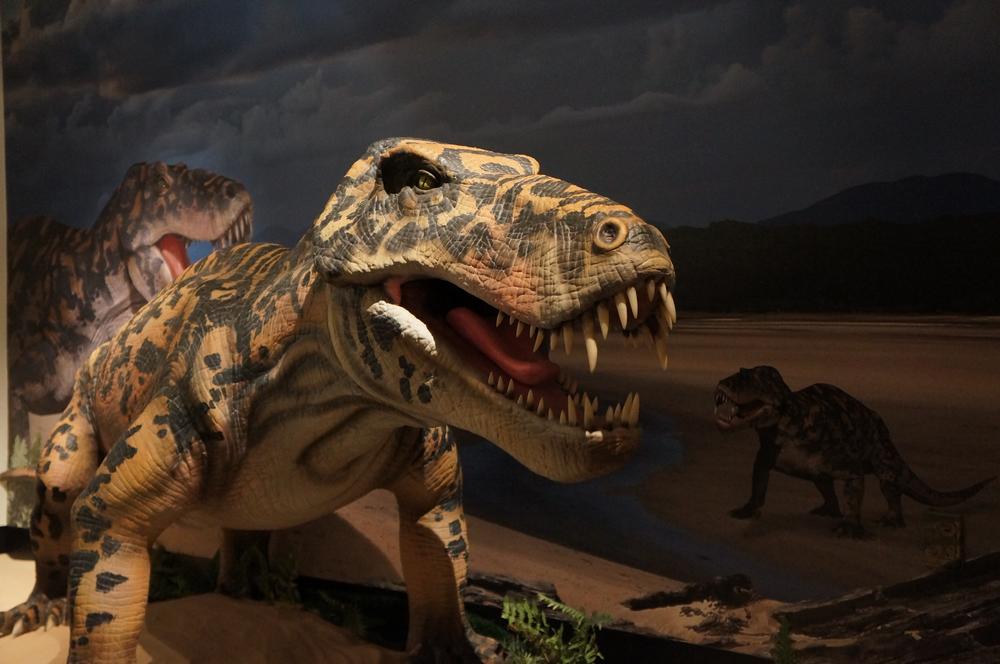
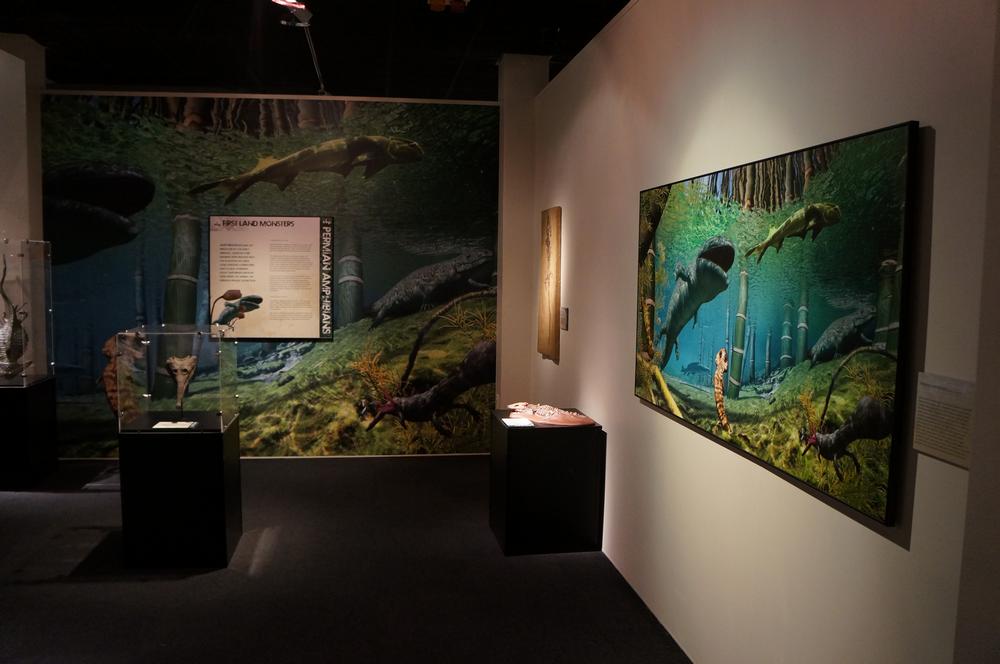
Giant dragon flies with four-foot wing spans ruled the air, amphibians trolled coastal areas and creatures that resemble today’s mammals were in abundance.
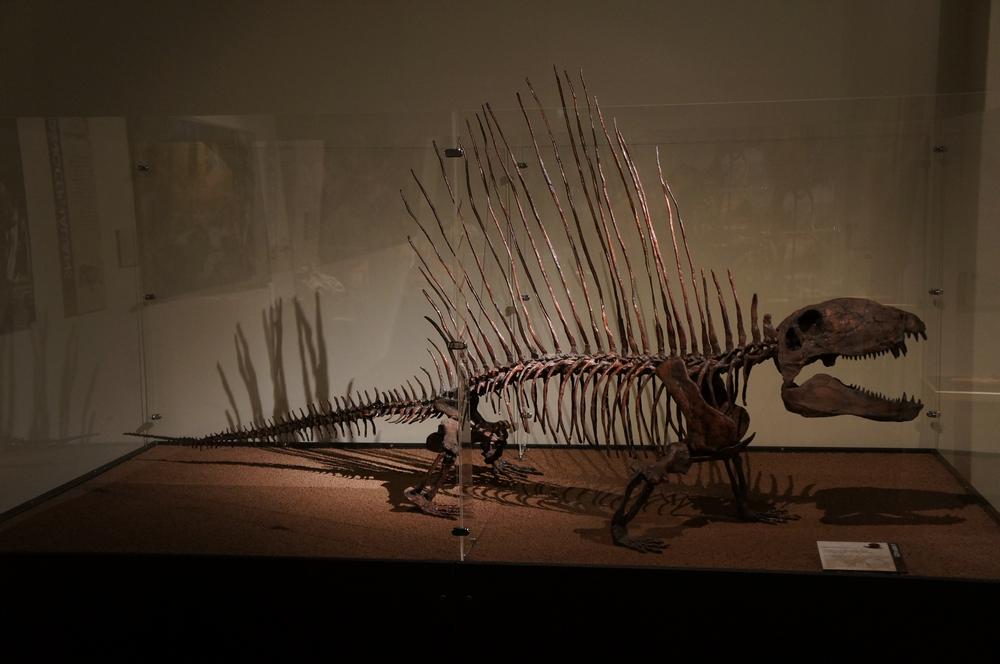
The exhibit presents the life of the Permian Age through multiple mediums, including artwork, fossils, animatronics and life-size models of these ancient creatures.
“It will show how they lived, how they evolved and how they died,” Barrick said.
He noted many of the creatures look odd compared to today’s amphibians, reptiles and mammals.
They had huge skulls and big arms one might think to hold up those large skulls. The creatures had more squatty back legs.
During this period, Kansas was under the ocean. As ocean water evaporated, it left large salt deposits as the ones that can be found in Hutchinson today.
Fossils consistent with those in the exhibit have been found in eastern Kansas, Texas and Oklahoma. Similar discoveries have been found in Russia.
The Appalachians were as high as the Himalayas, and South America and Africa were joined. One big ocean surrounded the giant continent, which means that circulation of the water was sluggish.
With one continent, there was a limited area of shallow coastline where life could thrive. Interior areas were dominated by desert.
The period was also a time of much volcanic activity. Volcanic eruptions extruded 10s of miles of lava and ash that might have changed the climate drastically.
In addition, methane had built up at the bottom of the oceans. Something may have happened to release the methane. The green house gas also could have significantly altered climate, resulting in the mass extinction.
Whether it was an asteroid or a drop in sea level that allowed the green house gases to escape, about 290 million years ago earth became a “bad place to live,” Barrick said.
“Without the Permian time and its increased level of oxygen, giant insects and the ancestors of mammals would have never existed,” he said. “Without the extinction, dinosaurs would have never evolved.”
The Permian Age has been well-studied, but it has not been well presented in museums, Barrick said.
The Permian Monsters exhibit was created in Australia. It has been in the U.S. only once before for a stop in Texas.
The Sternberg exhibition will be the first stop in the exhibit’s upcoming U.S. tour.
“It is a unique opportunity,” Barrick said. “Not everyone will get this traveling exhibit of these crazy looking animals that are pre-dinosaur.”
Admission to the exhibit will be included in the regular price of admission to the Sternberg. Admission costs are as follows: adults (age 13-59) $9, youths (age 4-12) $6, senior citizens (60+) $7, and FHSU students (w/valid ID) $5. For more information on the Sternberg click here.
Barrick said the Sternberg plans to have a special science day involving the exhibit, special events surrounding the sesquicentennial celebration and also a member’s only opening on May 26.
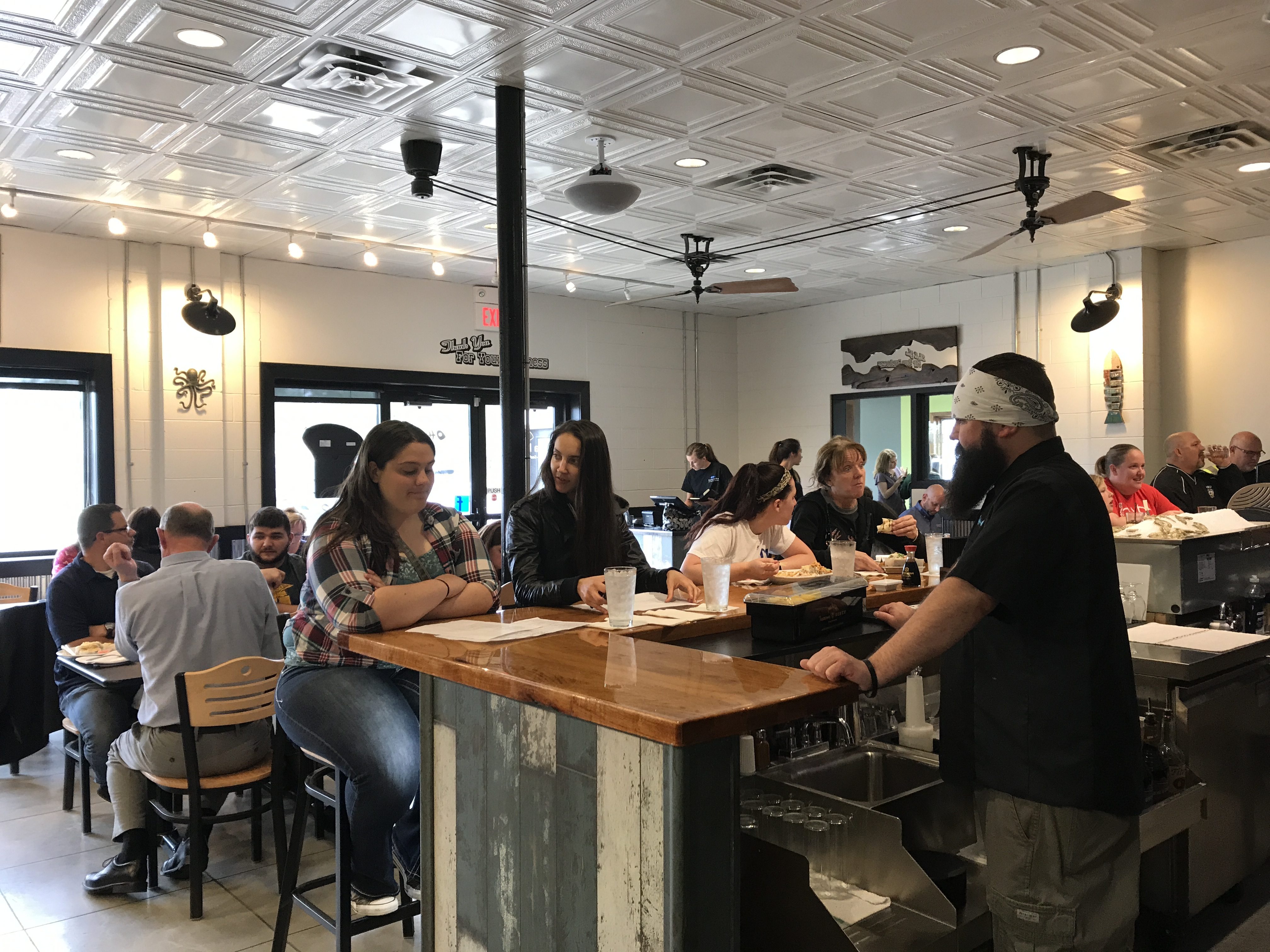
Diners fill Sake 2 Me’s new location at 2306 Vine.
By CRISTINA JANNEY Hays Post
Sake 2 Me has opened in a new location — and with a new concept and menu.
You’ll still be able to get the same great sushi, but the restaurant has eliminated stir fry, expanded its seafood menu and added other American cuisine and international dishes at 2306 Vine.
The business was located at 700 Main.
Mike Huskey, owner, said his goal is to broaden the restaurant’s customer base and appeal.
“I have so many people who have come to me and said we would love to get our parents in here to eat, but they won’t eat raw food,” he said.
To pursue the restaurant’s new mission, it has brought in local executive chef Roy Herman, who is known for his work at the Rooftops Restaurant in Hays.
Although Huskey brings a personal touch to all the dishes, he said Herman brings some items on the menu to a new level, including the restaurant’s lobster mac and cheese.
Huskey said he wanted at opportunity to stretch his talents and the talents of his staff.
“My job and Roy’s is to turn people on to seafood,” he said. “We want to offer people something they can’t do at home.”
The duo are bringing new items to their menu, including clams, mussels, raw oysters, oysters Rockefeller, and peel-and-eat shrimp by the pound.
For those whose are not into the bounties of the sea, the restaurant’s grill menu will also include hamburgers, steaks and po’ boys.
“We took food from all over the world,” Huskey said. “We have a Vietnamese dish and American foods like Southern fried catfish.”
All the breading and sauces for the restaurants dishes are made from scratch. The restaurant ships its food in next day from all over the United States, including Hawaii, Texas, Massachusetts and San Diego. Hays’ proximity to a central airport in Salina and the interstate makes getting fresh seafood easy, he said.
The restaurants also will have price points to fit everyone’s pocketbooks, with dishes ranging from $5 to $38.
Sake 2 Me offered a bar with 12 craft beers on tap, all but two of which are from Kansas. Huskey is planning a beer and oyster happy hour.
Sake 2 Me is open now in its new location with extended hours. It will be open 10 a.m. to 11 p.m. Mondays through Saturdays. At its previous location, the restaurant was closed in the afternoons.
Student Council members at Lincoln Elementary School donated a check for $150 to the High Plains Humane Society from the sale of 3D printed toys.
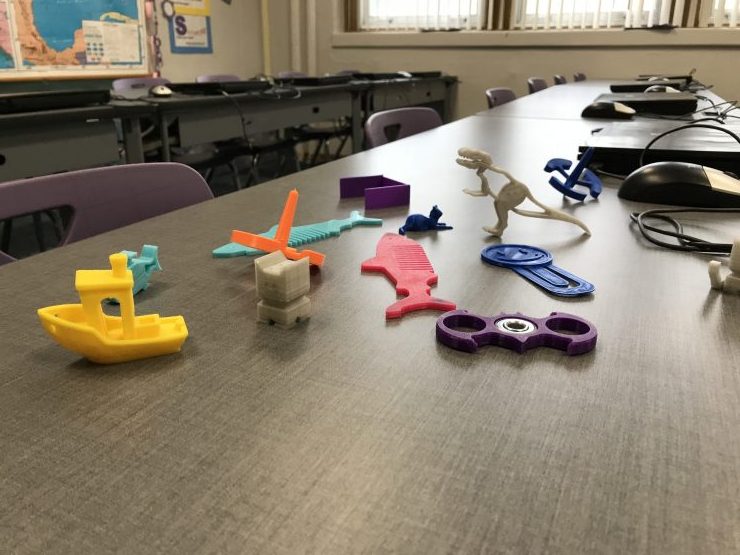
Little yellow boats, shark combs, tops and T-Rexes sold to fellow students lead to a Lincoln Student Council donation to the Humane Society of the High Plains.
The school received a grant from the Dane Hansen Foundation to purchase a 3D printer.
The students used an array of preset designs to create small toys that they sold to classmates at the school.
Regina Hammerschmidt, computer lab teacher, said the students will experiment with their own designs next year.
Examples of toys that Lincoln Elementary School students made with their new 3D printer.
She said the work incorporates a lot of research and trial and error to learn how to translate a two-dimensional design into a three-dimensional object.
The students used some of the toys they created to create stop-motion movies with their tablets. Hammerschmidt said the activities include a lot of Science Technology Engineering and Math (STEM) learning.
The $150 check that the students presented to Humane Society will go toward medical needs of the animals at the shelter, including spay and neuter.
The Twist was in, and all the girls swooned over Elvis. The new rock-’n’-roll sound was all the rage.
One group of guys from St. Joseph Military Academy in Hays with their duck-tail haircuts and white dinner jackets brought this new break-out music to local proms and dances. They were called the Flippers.
The story of the band and this early rock history is told in a new book by fellow St. Joseph student Darrell Mudd. The book is called “The Original Flippers.” It is available from Amazon and is a compilation of seven of the band’s members’ memories from the late ’50s to early ’60s.
Proceeds from the sale of the book will go to Thomas More Prep-Marian, and band members and the author will be back in Hays in September for the TMP homecoming for book signings. Gella’s Diner will even name a beer for the band.
Some of the band members said their time in the Flippers was the best time in their lives. For others, it was a jumping off point for a lifelong career and love of music.
Although some of the band members had played in the St. Joseph marching or jazz band, the players were mostly self-taught.
John Cooke Fross recalled picking out tunes on an old wide body guitar in Terry Wierman’s basement. His parents bought that first guitar on payments from Montgomery Ward.
By the time Fross was 16, the band was making good money, (about $10 to $15 per member per dance). Fross and Wierman bought brand-new Fender Startocasters for about $300 each. After Fross left the band, he traded his for a $150 air conditioner.
“I had a wife and a son. That is what we needed,” he said.
Wierman wore his Stratocaster out playing in a second incarnation of the Flippers, The Fabulous Flippers, that toured nationwide. Today those guitars in good condition could be worth as much as $38,000.
Eventually other locals joined the group: Lee Allen Leiker on vocals, Tom Bunker on piano, Dennis Rohr on drums, and Jim Gross on sax.
The band had no sheet music. They listened to records of their favorite singers and duplicated the sound.
“Thank God for 45s,” Gross, sax player, said.
Elvis, Ricky Nelson, and Gene Vincent, who is known for “Be Bop A Lula,” all became staples. The band often kicked off its concerts with “Say Mama” by Buddy Dean and the Enchantments, and ended the evening with Ritchie Valens “Oh Donna.”
The band played its first concert in 1958 at a New Year’s Dance at the Sunflower Ballroom. The band members were not sure of their own talents or how the music would be received, so they brought along an accordion player who could step in and play German polkas if the crowd became restless.
He was never needed. The audience loved the new sound.
“The first song we played was Johnny Cash’s ‘Folsom Prison Blues.’ They went nuts. We didn’t have much use for the accordion player,” Fross said.
The Flipper name came by chance when one of the band members bought a pair of flipper-style hub caps for his car. The band members all quickly agreed to moniker.
Before long, the Flippers were booked most Friday and Saturdays at dances and proms around the area. An owner at a theater in Lenora, Kansas, booked the band to a regular gig.
The theater would show a movie and then remove the chairs and create a dance floor.
“They did the twist and free dance. How wild it got depend on how much beer they had. Three or four beers will do that to you,” Wierman said.
“It was a great deal of fun. I think it was all legal. None of us ended up in jail. It must have been all legal,” he said of the band’s concerts.
The guys sometimes would have a few beers before or after a show. One night, Dennis Rohr got a little carried away. He drank a case.
“I was totally wiped. I was crazy,” he said. “We had to play at this prom. They gave me a shower and coffee. At one point, I was up in a tree, and they couldn’t get me out.”
However, Rohr said he still honored his faith and family on Sunday morning.
“We might be out to 3 or 4 a.m. We might go to a party afterward, but I never missed church Sunday morning. I had to pray to God for all the stuff I did at the dance the night before,” he said.
Although Lee Leiker was considered by some of his bad mates as the group’s heart throb, there was no leader of the band.
“We had camaraderie,” Fross said. “We didn’t have a leader. We didn’t have disagreements. If everyone didn’t like it, we didn’t do it. Everybody booked dances.”
Although the young men all attended a Catholic military school, they received little pushback from their teachers and elders.
“The parents liked it,” Gross said. “It was something that got the kids off the streets on Friday nights.”
Except for their hair. The cadets were required to wear military haircuts and a couple of the band members were reprimanded for wearing their hair slicked back into duck tails.
Father Timothy Gottschalk, who Wierman said hated the music, even let the group practice in the St. Joseph’s band room for a time.
When the group wasn’t practicing at the school, they pulled a piano up to a door at one of the member’s houses and played in the yard. People from the neighborhood would stop by to listen at the outdoor impromptu concerts. Even police officers would swing by and linger to listen to the band.
Band members also said they enjoyed playing outdoor concerts on top of the swimming pool.
“It was a wonderful atmosphere,” Wierman said. “I won’t mind doing that again.”
The band even sent a letter to Capitol Records, but they were so good at emulating other artists, Capitol told them they couldn’t record the band because they didn’t have an original sound.
The original Flippers were together until 1964 when the guys went on to divergent lives.
Fross unfortunately no longer plays guitar. He broke his hand as a young man, and the bones did not set properly. He can no longer play certain chords.
“It about killed me when that happened,” he said.
Rohr, 73, took a while to recover from his party days with the band. He flunked out of college twice, but eventually graduated with a master’s degree.
“I would have been well educated a lot earlier if it had not been for rock ’n’ roll,” he said.
He lives in North Dakota and still plays drums.
Leiker, 78, became a family man and still lives in Hays.
“In 1960, I got married and, in 1962, I quit the band,” he said. “I had a family, and it was a whole different world.”
He now has four children, seven grandchildren and 16 great-grandchildren and says all of the kids and grandkids are getting copies of the book. Although he doesn’t sing much anymore, he still loves music and has fond memories of his time int he band.
“It was a lot of fun growing up,” he said. “I would never change anything. In the band, we are all like one. We all had fun together, That’s how I grew up.”
Gross, 72, briefly co-owned a record shop in Hays, The Record Village, which was located off Vine Street.
He said his time in band made a great deal of difference in his later life.
“It gave me confidence,” he said. “It made a lot of difference in my career. I was managing plants with 300 people working in them. When I was in upper management, I knew how to deal with people.”
Bunker, 79, had a lifelong career in music and is still conducting choruses today, including a large chorus with Idaho State University for the opening of a new Mormon Temple. His children took up music as well, including a daughter who has played with Garth Brooks.
Wierman, 73, went on to play in The Fabulous Flippers and toured the nation. The band was know for their single “Harlem Shuffle.”
The time in the band took its toll from poor food and little sleep from constantly being on the road. He said he saw a lot playing rock in the ’60s. The nation was changing.
“In the bigger cities, there were riots, vandalism and looting,” he said. “It was not safe. … It was a wild time in a disturbing sense.”
Wierman abandoned touring in 1969 and took a construction job with his brother in Hays, where he lives today.
“I have no regrets,” he said. “I play still occasionally, but my hands are not as good as they used to be. I blame it on my mom for having me pray too much over the Rosary.”
Wierman summed up his music experiences very simply, “It has been one hell of a ride. I enjoyed it.”
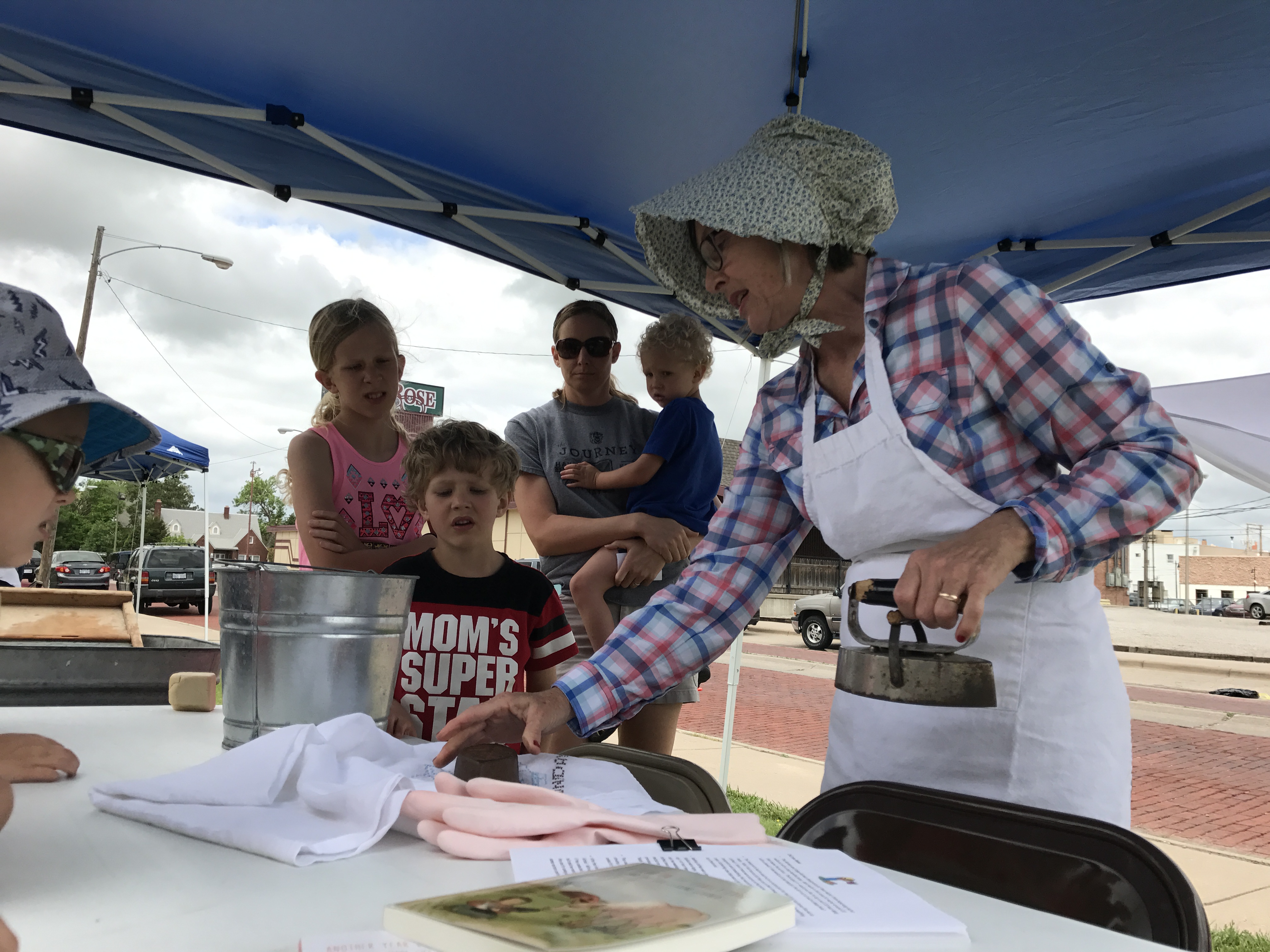
Mary Kay Schippers shows children how pioneers ironed and did laundry Wednesday at the Ellis County Historical Society Museum’s Pioneer Day.
By CRISTINA JANNEY Hay Post
About 140 children were able to step back in time Wednesday as part of the annual Pioneer Day at the Ellis County Historical Society Museum.
Children learned how to make a rag rug, do laundry without a wash machine, sing, fight a fire and cut wood. They also toured the Volga German house and played pioneer games.
Pat Albrecht, volunteer, showed the children how to make a rag rug. Old clothing was torn into strips, and the strips were crocheted into an oval rug.
Albrecht told the children mothers nor children were idle in pioneer times. Children hoed in the garden, helped take care of the house and did other chores, such as tearing strips for rugs.
Mary Kay Schippers, volunteer, showed the children how pioneers did laundry. She demonstrated using a washboard, lye soap her grandfather made and a ringer.
Heavy wind blew laundry that she hung on line just as the pioneers did, and s
Hays homeschool students tear pieces of fabric for a rug Wednesday at the Ellis County Historical Society Museum’s Pioneer Day.
he noted people usually did not do laundry when it rained.
She told the children most people had two sets of clothing. They would put one outfit on Sunday for church and then wear that outfit all week. The second outfit would be washed, and the cycle would start over the next Sunday.
“I want them to appreciate how easy life has become,” she said of the children, “and maybe have a greater appreciation of how life was before us for the early pioneers.”
Lee Dobratz, museum director, said she hoped the event inspired the children’s curiosity.
“I hope they find out the way things used to be,” she said. “I hope it sparked an interest in the way people lived here in Ellis County.”
Next year the format for the event will change. It will be conducted on a Saturday afternoon as a family event.
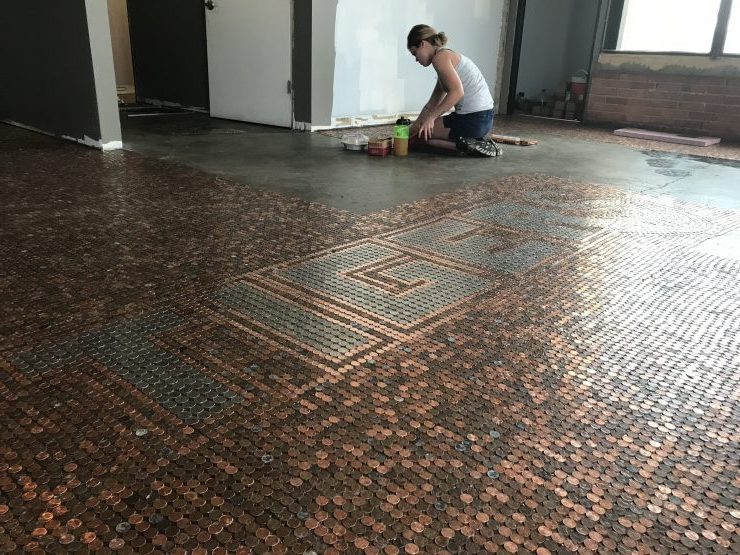
Rose Lewis lays pennies at the Tiger Burgers in downtown Hays.
Pennies, pennies and more pennies pasted one at a time by hand on the floor of the new Tiger Burgers.
Tiger Burgers, the brainchild of Jacob and David Proffitt, will occupy the space at 700 Main St., which was recently vacated by Sake 2 Me. It has moved to the 2300 block of Vine St.
Jacob is the owner of the Auman Company, and the brothers are co-owners of Munsch Fitness and have other interests in local restaurant franchises.
This is their first concept restaurant venture.
Tiger Burgers will focus on sliders, burgers, chicken fingers, shakes and beer in a fifties-style atmosphere.
The brothers are working to restore the 1923 Sinclair gas station, which is on the state register of historic places, to near as possible to its original look.
Jacob’s wife found a penny table on Pinterest, and Jacob thought it would be a great project for the restaurant’s floor.
Hundreds of thousands of pennies have gone into floor thus far. The brothers’ bank had to bring in a special shipment of pennies for the project.
Jacob and David Proffitt are opening a new restaurant in downtown Hays called Tiger Burger.
A crew of three to four workers have spent two weeks working 12 hours per day on their hands and knees to finish the project, which is nearing completion.
In the middle of the floor is the word “Tigers,” spelled out in quarters and dimes.
All of the pennies on the floor are heads up, except for two wheat pennies that are laid side by side. These pennies have the dates of the brothers’ parents’ birthdays.
Once the restaurant opens, the business will have a contest to see who can find the pennies. A progressive $100 prize will be offered to the person who can find the special pennies.
The oldest penny on the floor dates to 1893, but the floor also contains, Indian heads, wheat pennies and steel pennies from the 1940s.
The restaurant interior will include a wrap with Hays photos and memorabilia.
“We want this to be a tribute to the people of Hays. We want this to be a place where people can come together and talk. We wanted to do something for Hays,” Jacob said.
Anyone with old photos of Hays or the surrounding area can email photos to David at [email protected].
The restaurant will have an outdoor beer garden and seating area, which will have a stage and projectors on which old movies will be shown.
Jacob said he has been interested in the building for 15 years, and when the Sake 2 Me decided to relocated, he approached the building’s owner about a lease.
The business is set to open June 25 right before the Wild West Festival with a grand opening to be scheduled at a later date.
Hours will be 10:30 a.m. to 10 p.m. Sundays through Wednesdays and 10:30 a.m. to 3 a.m. Thursdays through Saturdays.
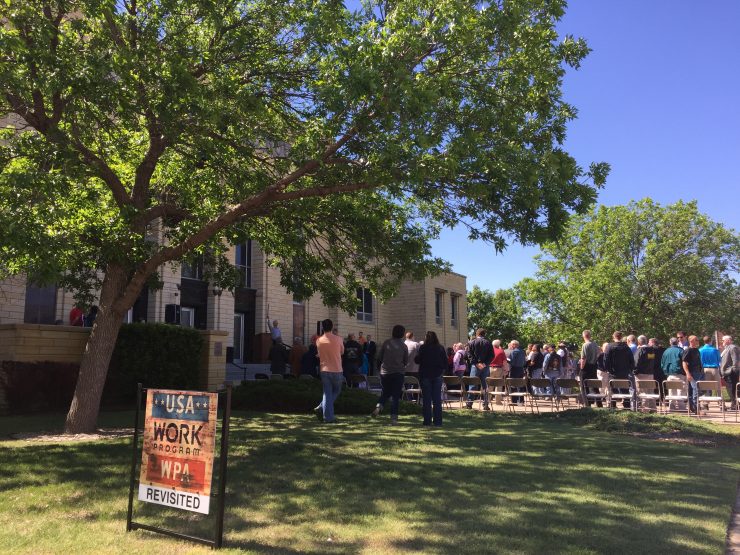
The Ellis County Courthouse, 1204 Fort, was a WPA project built in 1942.
By JONATHAN ZWEYGARDT Hays Post
Members of the Ellis County community gathered under a sunny sky on the western steps of the county courthouse Friday morning to celebrate the 75th anniversary of the original dedication and ribbon cutting.
The event, put together by the Courthouse Preservation Committee, began with the American Legion Riders presenting the colors to the VFW Honor Guard and the Pledge of Allegiance.
Ellis County Counselor Bill Jeter served as the Master of Ceremonies during Friday’s event, just like his father Norman did at the original dedication in 1942.
“My father on numerous occasions expressed to me how proud he was of the then-current county commissioners for not only have the foresight to build this courthouse but to also spend an additional $45,000 — which is $700,000 in today’s money — for the beautiful marble that’s in the interior of the building,” Jeter said.
Norman Jeter served as the county attorney at the time.
(Video and photos by Becky Kiser, Hays Post)
Friday’s event also featured a welcome by Ellis County Commission Chair Barb Wasinger and musical entertainment from Trilogy and Crossroads.
Harold Kraus, former Ellis Co. commissioner
Former Ellis County Commissioner Harold Kraus served as the guest speaker and talked about the history of the Works Progress Administration and the courthouse.
Kraus said the courthouse and Larks Park are two examples of WPA projects, both built of locally sourced limestone, that are still standing today.
“You’ll see this all over Kansas and the whole United States, very similar type construction,” Kraus said. “That’s permanent and very useful to our communities.”
Kraus said the courthouse has served as a location for a number of departments, including the U.S. Department of Agriculture, Soil Conservation, draft board and the Health Department.
“All through school we had chest X-rays, every four or five years it seemed like, for tuberculosis,” Kraus said. “Those were held in the basement here.” Kraus said they also went to the courthouse for their inoculations.
“Nobody’s going to change this building for a long time as a courthouse,” Kraus said. “It’ll be remodeled and so on, but the stone will be here almost forever.”
Ellis County Commissioners Marcy McClelland, Dean Haselhorst and Barb Wasinger cut the ribbon for the courthouse rededication ceremony.
The Hays Area Chamber of Commerce also marked the event with a ribbon-cutting ceremony.
The two earliest Ellis County courthouses were destroyed by fire.
Committee member Guy Windholz unveiled a pair of limestone corner pieces from the 1898 courthouse that will be used to replace broken stones on the west steps.
The rededication closed with the Honor Guard retiring the colors inside the courthouse and a 21-gun salute and the playing of taps.
The Preservation Committee is continuing its efforts to raise money to restore the granite and limestone on the western side. Donations can be made through the Ellis County Historical Society.
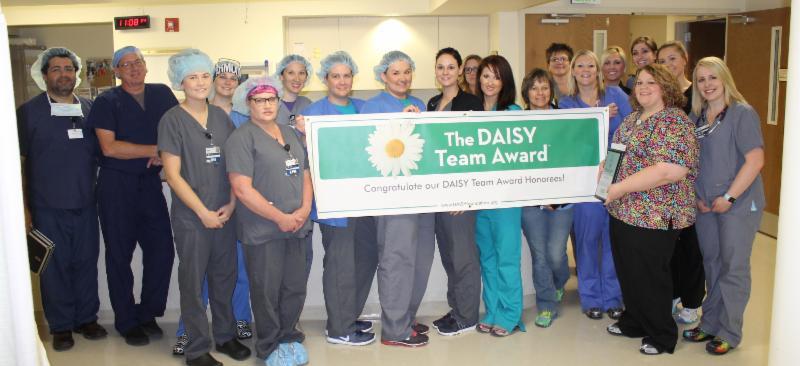
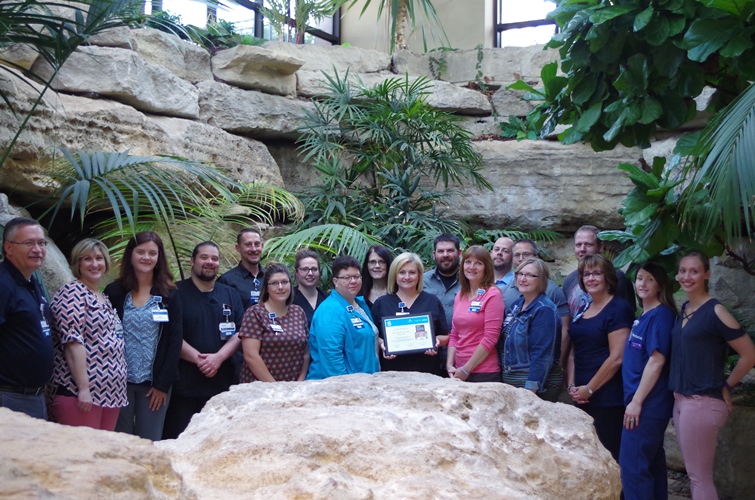
On May 5, HaysMed officials honored their first DAISY Team Award members. Winning the award was the Peri-Operative Process Improvement Team for their actions in improving the experience of Cataract Surgery patients while reducing the length of stay and improving patient safety.
Peri-Operative Director Sarah Green said, “I am very impressed by how focused this team was on making a difference and what an amazing outcome resulted from the work done over a series of several weeks.” Team members represented PACU (Post Anesthesia Care Unit or “Recovery”), Ambulatory Surgery, OR, Anesthesiology Associates and Eye Specialists Clinic.
Terry Siek, Vice President of Patient Care/CNO said of the winning nomination, “this is such a good example of what can be accomplished when people work together and the ultimate winners are HaysMed patients! I congratulate the team on being willing to not see any barriers while working to make improvements.”
Samantha Sramek, RN, submitted the nomination.
Peri-Operative Associates participating in this Process Improvement Team were Samantha Sramek, Lisa Gagnon, Anne Marie Hager, Teri Hart, Traci Jacobs, Amy Ranker, Jodi Schmidtberger, Caitlyn Dreitz, Susie Kohlrus, Jacque Krueger, Bridget Malir, Abby Schlabach, Mary Beth Sell, Amanda Tibbits, Taylor Albers, Deb Bohm, Emily LaBarge, Carey Lewis, Carol Linenberger, Megan Richard, Danielle Vonfeldt, Katie Wendell, Melissa Portenier and Sarah Green. Anesthesiology Associates of Hays team members included Dave Bose, Krista Garrison, Dr. Keith Green, Dr. David Lenser, Dr. Patrick Marecic, Dr. Joe Menendez, Dennis Muldrew, Candice Norris, Marc Polson, Kari Ryan and Cole Wiggs. Dr. John Pokorny of Eye Specialists was also an integral member of the collaboration.
The DAISY Team Award was founded by the DAISY Foundation as a way to recognize that while an idea to achieve better patient and family outcomes may start with one individual, it often takes an entire team to implement successfully. Plans are to award a DAISY Team each year in conjunction with Nurses Week. HaysMed also partners with the DAISY Foundation to present a quarterly award to individual nurses who exhibit compassion, kindness and concern while providing exemplary patient care.
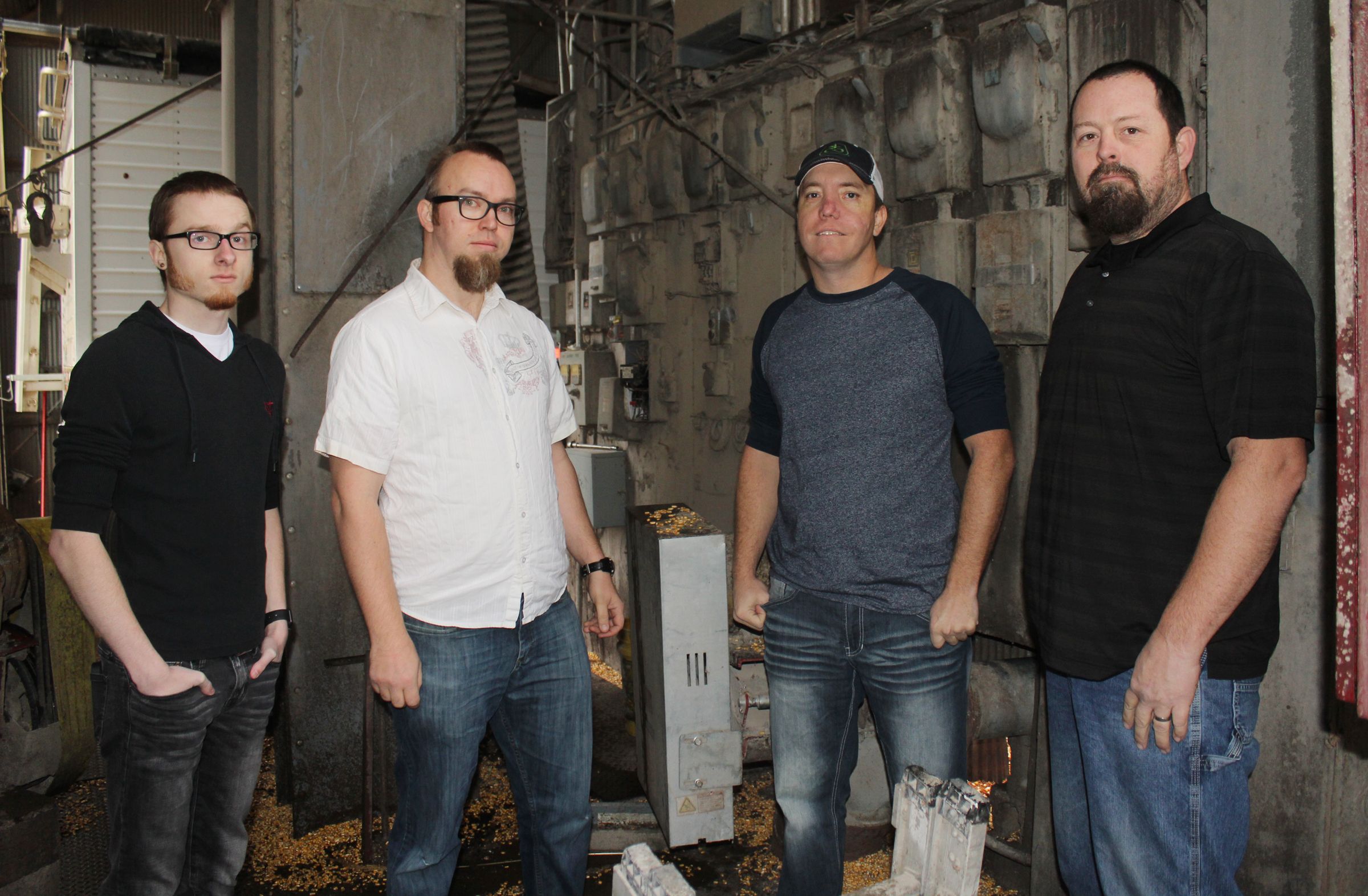
The members of Kerwood Band, from left, Caleb Lackey of Highland, David Kerwood of Hiawatha, Casey Rush of Troy and Jeff May of Hiawatha. Photo by Joey May/Hiawatha World
HIAWATHA — “Kerwood” — not just a community in the township of Adelaide-Metcalfe in the County of Middlesex in Ontario, Canada (according to Wikipedia), but also the name of a recently formed local Christian rock group.
The group, formed by vocal front man, lead guitarist and general instrument wizard David Kerwood of Hiawatha, began after a Craigslist meeting between Kerwood and bassist/backup vocalist Casey Rush — of Troy — in August of 2016.
“It was actually my one ditch effort to put a band together; otherwise I was going to start doing a solo singer/songwriter act instead,” Kerwood said. “Casey was looking for another musical adventure at the time and answered my ad.”
In November, Highland resident Caleb Lackey and Hiawathan Jeff May were invited to fill out the group.
“Casey knew Caleb as a utility multi-instrumentalist from church and wanted to work with him more,” Kerwood said. “ I knew Jeff as a fill-in drummer from church. I knew he was a lot more rock-oriented of a drummer and figured he’d be a good fit for the style we were imagining.”
Lackey sings backup vocals and plays guitar and keyboard for the group while May single-handedly mans percussion, though not in a Rick Allen of Def Leppard sort of way.
Kerwood’s (the man’s) first collaborative effort — a band he played in the eighth grade — involved a karaoke machine PA system, a microphone taped to a cymbal stand, and a drum track created on Kerwood’s computer and recorded on a tape recorder.
“It was a LOUSY gig, but I adored it and wanted to do it for the rest of my life,” Kerwood said.
He stuck by that dream through high school and college, performing in several groups, including Leave Thursday, a band he formed with his younger sister and a family friend.
“[Leave Thursday] recorded an EP, took a weeklong tour through Kansas and Missouri, and did several other things in my bucket list: we played Lawrence Dumont Stadium in Wichita, performed at festivals, did several sets at the Kansas State Fair, and shared the stage with national touring bands like ApologetiX and Radial Angel,” Kerwood said. “The band died when I graduated college, however, and I still had ‘the bug’ to play in a band.”
It was this “bug” that ultimately inspired Kerwood to put feelers out last year for like-minded musicians.
“As I was approaching a couple of major milestones — 10 years of teaching and my 35th birthday — I wanted to try once more to put together a band that might pick up where my old band left off,” Kerwood said.
Kerwood (the band) plays original Christian modern rock songs as well as contemporary worship music. They played their first gig at the end of November of last year at the First Baptist Church Family Life Center in Hiawatha after only two rehearsals and, in the words of Kerwood, “haven’t looked back since,” averaging about two shows per month.
Dave Kerwood earned his Bachelor of Music Education degree from Wichita State University and his Master of Music degree from Kansas State University. He lives in Hiawatha, with his wife Alicia, daughters Genevieve and Zoë, and a third daughter on the way.
Casey Rush began playing guitar in college, after a friend convinced him that he had to play guitar to get a girlfriend.
“I learned in about two weeks, and it never got me a girlfriend,” Rush said. “I started out in a punk rock band as lead singer while in college. We never got past the practice phase.”
After college, Rush began playing with the worship band at his church, later taking on a role leading that group. He has since assisted other area churches in forming their own worship bands and currently leads the worship band at the Baptist church in Troy while also playing in a Christian group called Kith and Kin.
Caleb Lackey started playing guitar in the sixth grade when his parents purchased him an acoustic guitar.
“I played trombone in high school and I sang in the choir through high school and college,” Lackey said. “I’ve written several songs for the guitar and other various instruments. My musical influences vary, but the band that got me to start playing the guitar was Green Day.”
Lackey graduated Fort Hays State University with a Bachelors of Arts in Music Technology.
Drummer Jeff May began playing drums in church when he was 28 years old — roughly 17 years ago. His church’s worship band needed a drummer, and though May had never played drums, he was able to slowly pick up the instrument and found he enjoyed it.
“I have a big family background in music – it’s always been part of my life. I grew up listening to family members and have an aunt and uncle who are in the Kansas Music Hall of Fame for their jazz and blues,” May said, noting it’s his kids who inspire him the most as both have a love for music and performance.
The group will also be working on recording its first EP as they plan to play in several gigs this summer.
Kerwood — the man and his band — will be playing at the Resound Festival in Bethany, Mo., on June 9 this summer, and will be opening for Christian rock artists Colton Dixon and Building 429 at the “Rock the Ridge” festival, hosted by Northridge Church in Sabetha, on Saturday, July 8 starting at 4:30 p.m. The band also will be playing at Imagine 11, a downtown music festival on Sunday, July 16 in St. Joseph, Missouri.
You can find mofre information about the band @kerwoodband on Facebook, Twitter and Instagram and at www.kerwoodband.com.
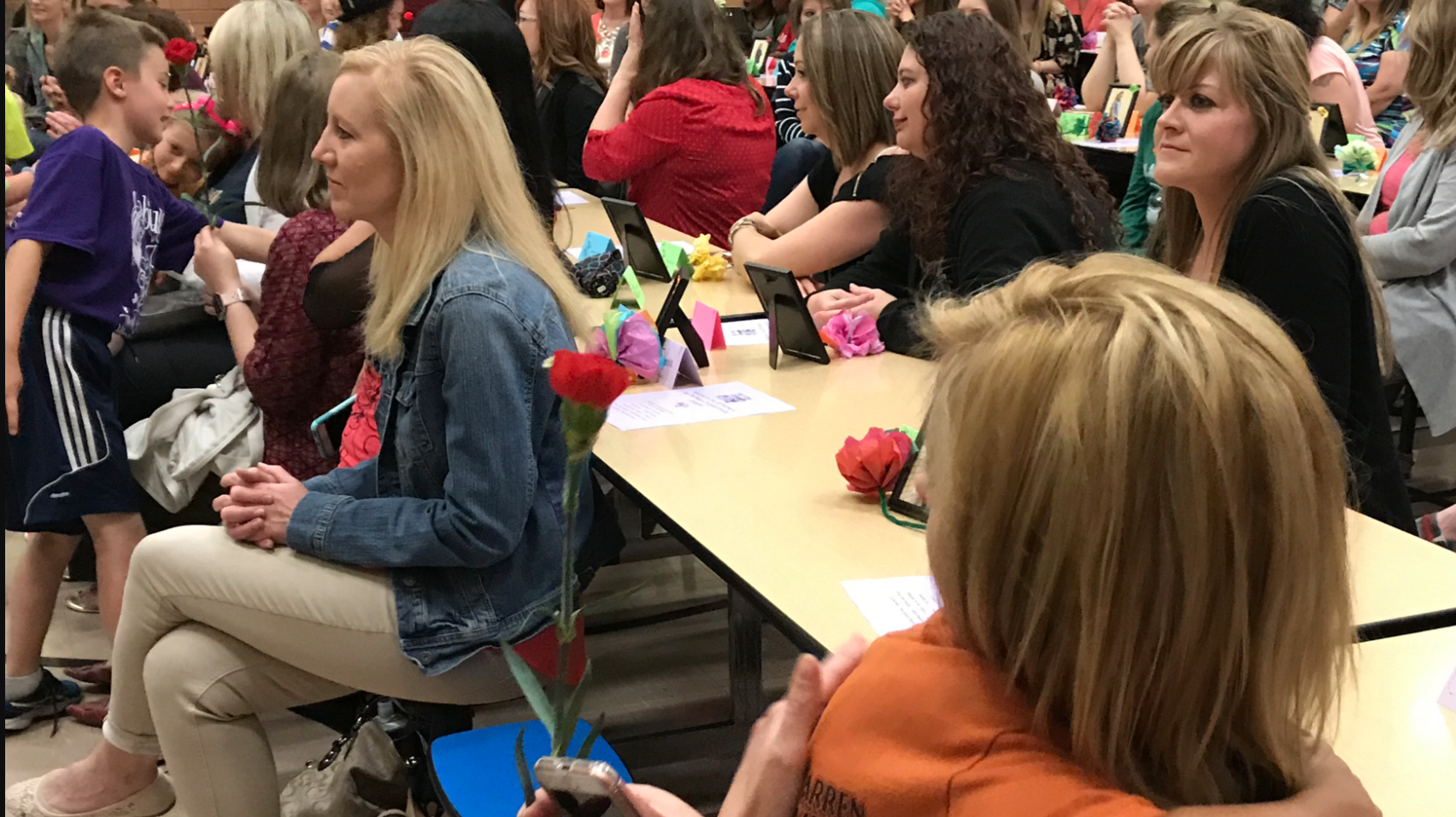
Courtney King receives a hug from her son, Likon, at the Wilson Mother’s Tea Thursday, May 11.
Students at Wilson Elementary School celebrated a 20-year tradition Thursday by honoring their mothers at their annual Mother’s Tea.
Gloria Blackwell, music teacher, has worked at the school for 20 years, and said the tradition started before her tenure at the school.
The second-grade classes, which accounted for about 70 students performed an insect-themed musical titled “Bugz!” In addition, the children made flowers of tissue paper and presented their moms with live carnations and framed pictures of themselves.
The closing of the program was a slide show of pictures of the children when they were babies and what they look like now. The children “Oooed,” “Ahed,” and giggled as they saw the baby pictures and then shouted the students names as their identities were revealed.
“It’s cool,” said Brianne Sultzer, mom of Harper. “The kids have been together for the last three years and you get to see how they have grown up.”
Mom Freddi Unruh and Parker, 8, will be spending Mother’s Day at a soccer tournament this weekend.
“I think it is heart warming,” she said. “You get to see how they have grown in the last seven or eight years.”
Other grades used to put on year-end programs or musicals, but changes in curriculum have made it difficult to fit everything in, Blackwell said.
Candace Sage, teacher, said the school’s staff has worked to keep the tradition alive.
“It is awesome,” she said. “It is not something that we could give up.”
 Hays Medical Center