One mile west of Wilson I-70 interchange March 6, 2017 (Fire photos and video courtesy KHP Technical Trooper Tod Hileman)
By BECKY KISER Hays Post
Every work day is different for each Kansas Highway Patrol trooper.
But March 6 was a day different enough for Technical Trooper Tod Hileman of Troop D in Hays, he probably will never forget it.
That Monday started out fairly routine for Hileman, who serves as the KHP Public Resource Officer for all of northwest Kansas.
Hileman was driving back to Hays on Interstate 70 after presenting a public program in Marysville.
As he continued westbound, Hileman began seeing smoke in fields north of the interstate at Ellsworth.
“I heard my law enforcement partners on the radio asking where the fire was, how big is it, how fast is it going,” Hileman said.
Very strong gusty winds out of the north pushed the smoke across I-70.
“I stopped a few miles west of the Wilson interchange in the median to take pictures and started uploading them to my Trooper Tod KHP Facebook and Twitter accounts to warn people, telling Wilson residents to keep an eye on it,” Hileman said. He and his law enforcement partners began a radio discussion of whether a mandatory evacuation should be implemented in Wilson.
Two firetrucks arrive at the scene while a white SUV (at left) turns around on I-70.
“I could see fire out in field quite a ways off. One minute it was 50 yards away from interstate, the next minute it was there. I wondered if it would jump I-70 with the high winds. Then I saw two fire trucks and thought maybe they’ll contain it.
“Next thing I know, the fire got to westbound I-70, and had a mind of its own. It twisted up into the air and right down into the median. I was like, wow, that is incredible.”
Trooper Hileman has been hailed as a hero, even nationally, for his quick thinking and what he did next.
He does not consider himself a hero.
“Everything was happening so fast. Once it jumped into the median, (emergency responders) behind me said we gotta get I-70 shut down. I jumped the car onto I-70 and was trying to turn people around–signaling them to go back, go back. To the west, it wasn’t too bad. To the east, you couldn’t hardly see anything. So I had to stop cars, not knowing if there was a fireman standing 50 feet into that smoke cloud who could be hit.”
It was a confusing scene, filled with dense smoke and wind-blown embers and ash.
“Our job there was to protect the firemen there and let them do their job. They’re the real heroes,” Hileman insisted. “They’re the ones going into that stuff.”
He first got one semi to safety by telling the driver to “angle it through the median and turn around.”
A pickup backs up from approaching fire in the median.
“I couldn’t leave those vehicles just sit there on I-70 because I knew fire was going to engulf that whole area pretty quick.”
As Hileman continued turning other traffic around, a second semi he had told to turn around and go at a 45-degree angle through the median started spinning it tires.
“I was thinking, I hope he can get that thing out of there. I walked up to the truck and asked if he could ‘rock’ it out of there. Then, wow, it was incredibly smoky all of a sudden. I looked behind us and it was…the fire was in front of us. It was behind us now. And I was like, we just have to get out of here.
The front end of the stranded semi-truck in the median as seen from Hileman’s dash cam video.
“I told him to get in my car. We went west driving through all of that, praying.”
Hileman wound up speeding west on I-70 through the smoke and fire with the stranded truck driver in the passenger seat as flames leaped towards both sides of the KHP vehicle.
The audio on the in-car microphone was accidentally disabled when the passenger got into the KHP vehicle, reached up to balance himself and hit the microphone.
What was missed on the dash cam video?
“Just me telling him, like six times, to put a seatbelt on. And there were probably some prayers in there somewhere,” Hileman admits.
A still shot from an NBC-TV Nightly News story March 8 about Hileman and other emergency responders during several days of wildfires.
The video of the narrow escape went viral on social media after Hileman posted it on his Trooper Tod KHP Facebook page:
“I have to say in my 20 years with the KHP, this ranks up there as one of the most steering wheel gripping moments I’ve had. 😮 Glad we got the trucker out of there and thanks to Trooper Trav for getting traffic stopped behind me! Btw, Firefighters….#Respect.”
Kansas news media utilized his dashcam video and the frightening scenes also appeared on national television newscasts.
According to Hileman, Kansas Highway Patrol officers train for vehicle fires but not wildfires, although they do study information about grass fires.
Driving on I-70 with wildfires on both sides of the westbound lanes
“I’ve been in a lot of fires like that. That one though, moved so fast. It was crazy.”
By state law, only the Kansas Department of Transportation can shut down the state’s interstate highways, Hileman explained.
“If KHP is telling you to turn around, there’s a really good reason, a short-term emergency. We’re not trying to make your life harder. We’re trying to save your life.”
Hileman is a Colby native and has served as a KHP Trooper for 20 years.
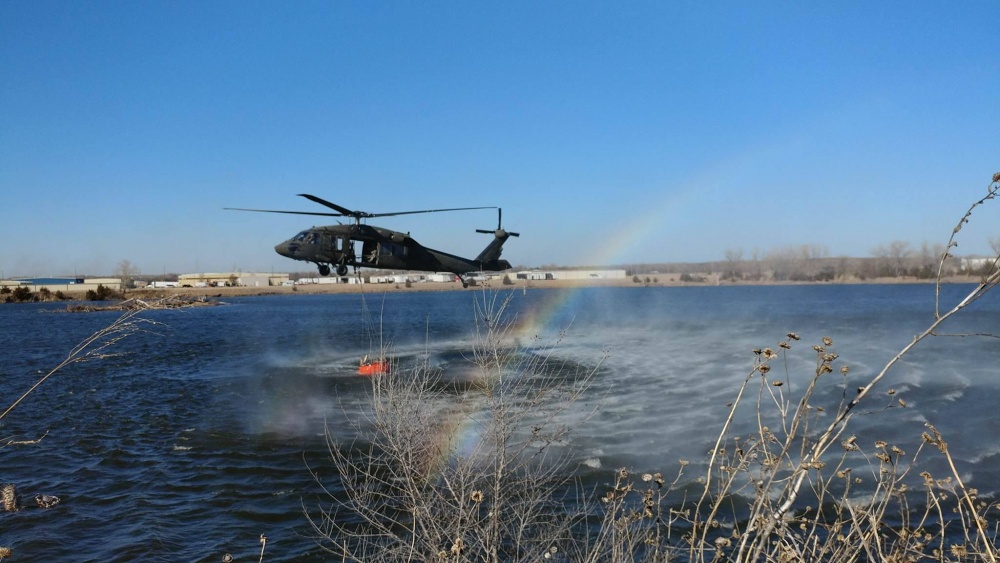
The Kansas National Guard dropped 482 Bambi buckets of water from Black Hawk helicopters, which equals approximately 289,200 gallons of water on a series of wildland fires across the state of Kansas in March 2017. (Photo by Sgt. Zach Sheely)
TOPEKA–When people think of emergencies in Kansas, floods and tornadoes may come to mind. However, that may be changing after a series of fires blackened more than 1,000 square miles of northwest, southwest and central Kansas – all within a matter of 10 days in March.
Lives were at stake in the small communities that dot the map of America’s Heartland, and the first responders’ swift and calculated response was vital to protecting them.
The dry winter, low relative humidity levels and high winds combined to form perfect conditions for a fast-moving, blistering fire. The numbers are staggering – one fatality, approximately 658,000 acres (roughly the size of Rhode Island) burned, thousands of livestock lost, and 40 homes destroyed. It’s the largest recorded fire event Kansas has ever seen.
The agencies of the Kansas Adjutant General’s Department, including the Kansas National Guard and Kansas Division of Emergency Management, partnered with numerous other local, state and federal agencies to safeguard the lives of Kansans and contain this conflagration.
In their words:
Angee Morgan, deputy director of KDEM
“I’ve been in emergency management since 1987 and we’ve never had a day in Kansas when the threat of wildland fire was that great,” said Morgan.
FEMA granted a Fire Management Assistance Grant to the state of Kansas on March 6. The FMAG provides a 75 percent federal cost share while the state pays the remaining 25 percent of firefighting costs.
“In our first phone call to FEMA, we had five fires that were not contained and were threatening cities that had evacuated,” said Morgan. “It’s extremely difficult to get the FMAG and we got it in record time. It was just unheard of.
“Our goal in emergency management is to get the right resource to fit the need at the local level to protect lives, property and critical infrastructure.”
KDEM works closely with the Kansas National Guard under the Adjutant General’s Department umbrella, and it became apparent that the local fire responders would need the aerial fire suppression help of the Kansas Army National Guard.
“The capability of fighting the fire from the air is critical because, as we saw in the Anderson Creek Fire in 2016, the terrain is different from other parts of the state,” said Morgan. “You cannot get fire trucks into some of these areas. There are no road systems in place. There are deep canyons. The ability of being able to attack from the air is vital.”
Morgan said that the communication between the civilian agencies and the Kansas Guard was seamless.
“The interaction goes very well because we work together daily,” she said. “It’s really important to have pre-disaster relationships established so we understand each other’s capabilities.”
(Photo by Sgt. Zach Sheely)
Maj. Ryan Bernard, commander of Army Aviation Support Facility #2, Salina
“We tried to get an aircraft out the door as quickly as possible based on the request from KDEM to be available,” said Bernard.
At approximately 2 a.m. on March 6, Bernard received notification that UH-60 Black Hawk helicopters with accompanying Soldiers and Bambi buckets were needed to assist with fire suppression in Rooks County, located in northwest Kansas.
Bernard, as with many Kansas National Guard Soldiers and Airmen, serves in multiple roles. He is the 1st Battalion, 108th Aviation Regiment logistics officer, an experienced UH-60 Black Hawk helicopter pilot, and the commander of Army Aviation Support Facility #2.
“At four o’clock in the morning,” said Bernard, “I notified the operations officer to start the alert roster and to give (the Soldiers) a 5 a.m. show time. Going into it, you have no idea how long the mission may last, so you have to pack a minimum of a three-day go bag.”
Initially, Bernard was the pilot in command of the lead aircraft from AASF #2 and remained the officer in charge of the fire suppression mission throughout its duration. The mission began with two Black Hawks on March 6, then grew to four with the addition of two additional birds out of Aviation Facility #1 in Topeka, to seven total aircraft by March 8, all equipped with Bambi buckets.
Bernard said the view from the air was unlike anything he had ever seen.
“Seeing the amount of land that burned from the air took my breath away,” said Bernard. “There were some areas where the landscape was black as far as the eye could see.”
Bernard said the soldiers’ mission was to contain the fire and protect property.
Each Black Hawk is piloted by two soldiers and there are two crew chiefs in the rear of the aircraft. For fire suppression missions, the helicopter uses a large bucket to dip water from a predetermined source, then haul the water to dump it where it is needed most. The Bambi bucket is affixed by a 30-foot line on the underside of the airframe and can hold up to 660 gallons of water.
The aviators of the Kansas Army National Guard gained valuable experience in aerial fire suppression during the Anderson Creek Fire of 2016 and this year, which Bernard said adds to their capability and readiness.
“From the time before Anderson Creek to now,” said Bernard, “we have a lot better idea of what we’re capable of in an emergency response. We’ve learned a great deal about ourselves and our readiness.”
The regiment fielded new UH-60M model Black Hawks in early 2016. The pilots – who often have civilian careers – have also had to train to fly the new models. National Guard helicopter pilots are required to fly a minimum of 96 hours per year, the same as their active-duty counterparts.
“We are blessed in Kansas to have the most competent, proficient and flexible aviators in the country,” said Bernard. “I truly believe that.”
Capt. Casey Atkins, operations officer AASF #2, pilot in command of UH-60 Black Hawk helicopter
“It’s special,” said Atkins, an experienced medevac and assault UH-60 helicopter pilot. “Being an aviator, you don’t get a lot of interaction with the people you’re helping, but being down in those communities and seeing their gratitude makes you feel like you are making a difference.
“That’s what you signed up to do, to be able to help people that are in need. It’s very rewarding.”
Atkins also flew aerial fire suppression missions during the Anderson Creek Fire in Barber County, which, until this year’s blaze, was the largest in recorded Kansas history. He said teamwork is paramount when coordinating response to an emergency of this magnitude. “It’s pretty spectacular watching the agencies from all the different backgrounds and training come together, with no previous experience working together, to determine the best course of action,” Atkins said. “The guys on the ground are the experts. They’re the ones who know what they need done.”
Along with the Kansas National Guard soldiers, there were civilian-operated fixed-wing aircraft and three CH-47 Chinook helicopters from the 11th Expeditionary Combat Aviation Brigade, U.S. Army Reserve Aviation Command, assisting with aerial fire suppression.
It was the first-ever domestic air mission for the U.S. Army Reserve under the Immediate Response Authority, which authorizes local Army Reserve commanders, at the request of a local civil authority, to take action to save lives, prevent human suffering or mitigate great property damage in a situation of urgency.
The Chinook is a twin-rotor helicopter that can lift heavier loads than a Black Hawk, and can utilize a larger 2,000 gallon Bambi bucket. The pairing of USAR and KSNG aviation assets was a first for the state of Kansas in an emergency response.
“We actually teamed up a Chinook and a Black Hawk together, which gives you 2,660 gallons of water,” said Atkins. “The guys from the USAR were excellent and worked with us great. They were just like we were, ready to do whatever it took to get the situation under control. It was a complete team effort.”
Atkins also credits his fellow Kansas Guard pilots and crewmembers for their professionalism and resilience.
“It’s a testament to the type of people who are in the Kansas Guard,” he said. “They’re willing to give up their time to go on state active duty in a moment’s notice, no questions asked. It shows the type of character and the type of people we employ here at the facility, as well as the Kansas National Guard.
“It’s a privilege to work with people like that.”
Spc. Orin Meyer, a UH-60 Black Hawk crew chief, Company A, 1-108th Aviation, Topeka, Kansas
“I was glad to be able to do my job,” said Meyer. “It’s an incredible experience. I was happy to be a part of that.” Meyer, who works on reconstructing bridges in Wichita, has served in the Guard for more than two years. This was his first real-world experience as a crew chief.
“I wasn’t nervous, I was excited,” said Meyer. “We train a lot and I have trust in my pilots. They have the utmost level of professionalism.”
The crew chief sits in the rear of the aircraft and is responsible for everything that happens in or to the helicopter and helps to maintain it.
On a fire suppression mission, they are the eyes of the pilots while making water dips and drops.
(Photo by Spc. Orin Meyer)
“My job is to guide the pilots down to get the bucket filled,” Meyer said. “Once it’s filled, we get the location of where we need to drop. Once I have eyes on the target and once we’re over it, I hit the release and drop the bucket load on the fire.”
Meyer also captured photos and video of what he was seeing in the air over the fires. One photo he took of an unburned house surrounded by charred landscape was used widely by news outlets.
“That was pretty neat,” said Meyer. “I was kind of in shock that everything around it had burned, but the house. And there were a lot of other houses like that that we and the crews on the ground helped save.”
Staff Sgt. Gilbert Gonzales, readiness noncommissioned officer, Company A, 1-108th Aviation, Topeka, Kansas
“It’s a feeling of elation,” said Gonzales of being activated to help with an emergency. “You’re excited, you’re pumped. This is why people join the military and the Guard, to help their community. It’s a great sense of accomplishment and pride.
“These are the things they show you in the recruiting office.”
The seven Kansas Army National Guard helicopters dropped a combined total of 482 buckets of water, which equates to roughly 289,200 gallons of water. However, Gonzales said that most of the credit should go to the firefighters on the ground.
“I want to make sure that everybody understands the ground crews did a majority of the work,” said Gonzales. “We came in and we helped close things up, but the ground crews were working their butts off.”
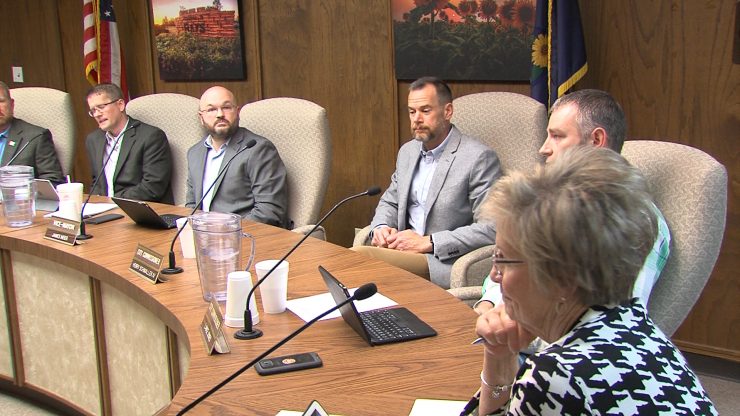
Vice Mayor James Meier and Commissioner Henry Schwaller
By BECKY KISER Hays Post
Hays city commissioners tabled a vote Thursday night, deciding they needed more time to review proposed updates to several building codes.
“Others have had two years to look at it. We’ve had a week,” said City Commissioner Henry Schwaller as he explained why he planned to vote no.
“If we have the inevitable conversation in a grocery store or Heartland Building Center with a contractor about why did you guys pass this, I’ll have no idea what I passed,” Schwaller said. “I would like to know what’s in the new codes.”
City of Hays staff as well as the Building Trades Board is recommending adoption of several updated building codes, according to Jesse Rohr, Hays Planning, Inspection and Enforcement Supervisor.
The proposal updates the 2006 versions of the codes to the 2015 codes and includes the Building Code (IBC), Residential Code (IRC), Fire Code, (IFC), Existing Building Code (IEBC), and the Property Maintenance Code (IPMC). Also included is the 2014 National Electrical Code (NEC) which is being updated from the 2005 version. The changes are reflected in 2015 International Building Codes under the International Code Council.
Hays PIE Supervisor Jesse Rohr
Rohr said city staff has had several meetings the past 18 to 24 months with the Building Trades Board and local licensed contractors discussing the changes in-depth.
Commissioner Lance Jones suggested a joint meeting with the Trades Board. The other commissioners didn’t think that was necessary.
“I have no intention to micromanage,” Commissioner Sandy Jacobs said, “but I think we all need a comfort level that I’m not feeling in the group right now.”
Rohr told Mayor Shaun Musil there would be no impact in delaying the proposal vote by a month.
“Why don’t you let us send out the Cliff Notes version of the codes to start with,” suggested Hays City Manager Toby Dougherty. Rohr told commissioners he would also send them online links to the information. The current codes are available on the city’s website.
“I think that’s good,” agreed Vice-Mayor James Meier. “When we adopted the Unified Development Code, that was available online and we had it several months ahead of time so that we had the opportunity to look through it.”
STOCKTON–The FFA students at Stockton High School spent one day of their spring break helping their neighbors, according to the group’s Facebook page.
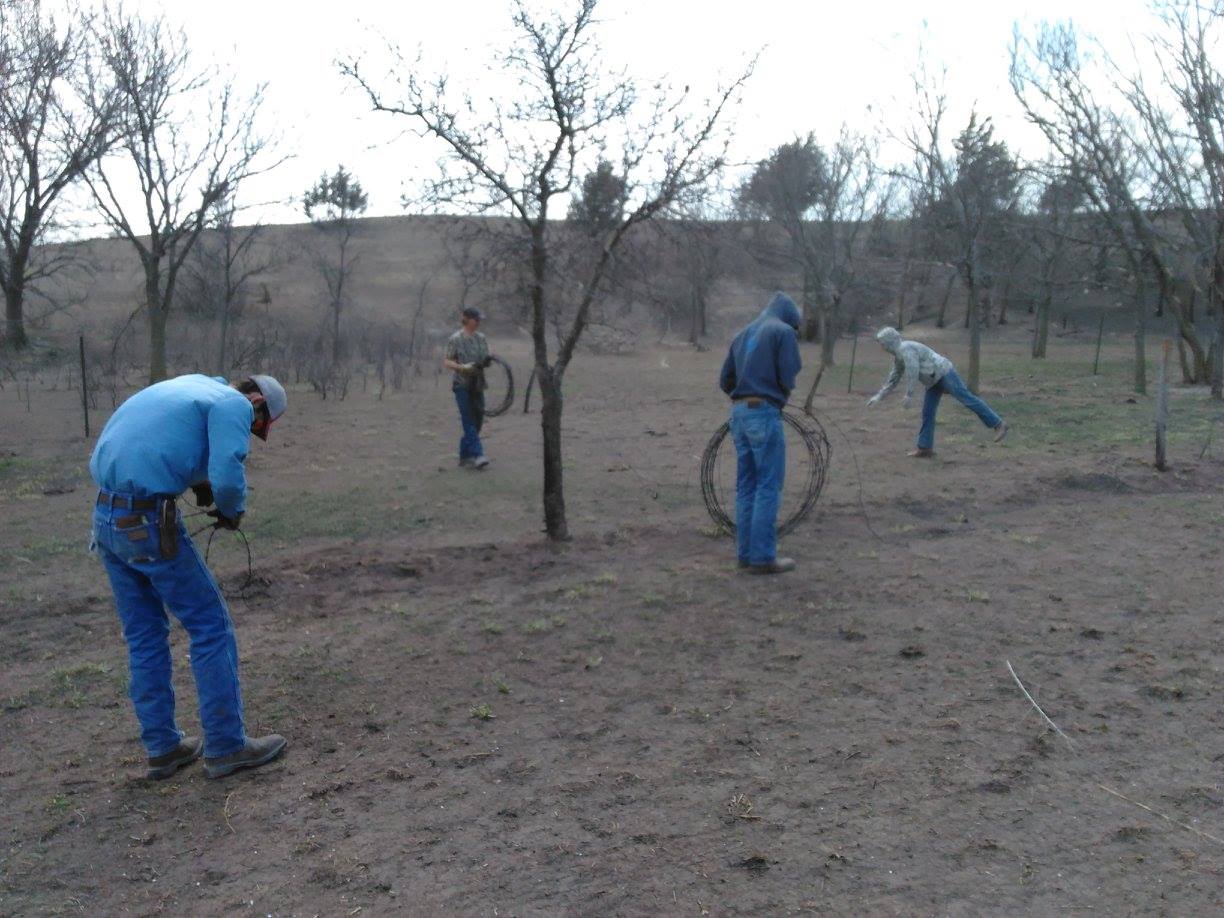
On Thursday, March 23, Stockton FFA members along with FFA Alumni members and the Neil Brown family spent the day from 9 a.m. to 5:30 p.m. working on fence damaged by recent wildfires for the Carsten and Brown families.
Tasks included replacing burnt wood posts with steel posts, taking out posts, and rolling up lots of wire in preparation for the installation of new fence!
Lunch was sponsored by Bellerive Construction and the Stockton FFA Alumni at 183 Lanes.
Stockton High School FFA members spent part of their spring break helping repair wildfire damage in Rooks County.
Stockton FFA Participants:
Kennedy Chesney, Elizabeth Lowry, Laura King, Annabelle Kester, Macy Odle, Katy Kriley, Bryce Graf, Trevor Miller, Trey Kuhlmann, Kieran Graf, Kody Odle, Joel Green, Jacob Eck, and (not in photo) Payton Keller.
Stockton FFA Alumni Participants:
Bob Atkisson, Cathy Atkisson, and Dan Atkisson.
From left: Phelps (at podium), Gerard, Tammy and Garrett Wellbrock. Photo courtesy Rep. Eber Phelps
TOPEKA — Longtime northwest Kansas broadcaster Gerard Wellbrock was honored on the floor of the Kansas Legislature on Thursday.
Wellbrock, Eagle’s “Voice of the Fort Hays State University Tigers,” was recognized today by state Rep. Eber Phelps, D-Hays, after he won the 2016 National Sports Media Association Sportscast of the Year for the state of Kansas.
He was joined by his wife, Tammy, and son, Garrett.
The state of Kansas produced just 37.9 million barrels of crude oil last year, according to the latest numbers from the Kansas Geological Survey.
If borne out by tax figures from the Revenue Department, that would be the state’s lowest annual production total since 2007.
KGS said Ellis County produced 2.67 million barrels of crude last year. Harper County was next at 2.01 million. Barton County weighed in with 2016 production of 1.73 million barrels. Haskell (1.72M) and Finney County (1.67M) were next, followed by Russell County with 1.62 million barrels, and Stafford County at 1.1 million barrels.
In 2015, Kansas ranked 10th in crude oil production among the 50 states, excluding the federal offshore areas.
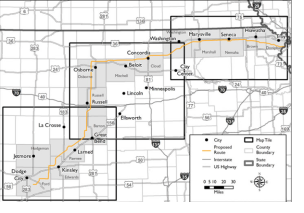
The overview map on this page depicts the route of the Grain Belt Express Clean Line in Kansas- Image Clean Line Energy Partners. Click to expand
JEFFERSON CITY, Mo. (AP) — A renewable energy company is again facing opposition as it seeks one of the final pieces of regulatory approval needed to carry wind power from the nation’s heartland to the east.
Missouri utility regulators began hearing testimony Monday on a request from Clean Line Energy to build a high-voltage transmission line from western Kansas across Missouri and Illinois to an Indiana power grid that connects with eastern states.
The Houston-based company already has won approval from other states, but the Missouri Public Service Commission rejected it in 2015.
Clean Line Energy is trying again — this time by showing it has Missouri municipal power companies lined up as customers.
Several landowner and farmer groups are questioning the true need for the project and the discounted rates provided to those cities.
Click HERE for an interactive map of the proposed route.
When asked where her passion for weddings comes from, Kayla Rathbun simply replied, “I loved planning my wedding.”
Rathbun, owner of Something Blue, 1008 Main specializes in wedding and event decor with unique gifts for any special occasion from paper roses to bridal shower items to dresses, Something Blue has something for you.
“Just doing paper roses in Hays, Kansas, wouldn’t be as successful and just needed a few more items, so incorporating rentals which is the first thing we wanted to do and then pre-owned items and new items and it just all came together,” Rathbun said.
While Something Blue has all the items needed for a wedding, its niche is the paper flowers.
Rathbun, who got married in 2015, had paper roses at her wedding. It was after the wedding when Rathbun found them online and started looking at them more closely.
“They really stood out to me and I thought that I could probably make these,” Rathbun said.
Rathbun said the first flower took her about five hours to make, but she was so proud of it she went up to her mom like a little kid.
“It took forever to make the one flower, but I ran up to my mom like I just made a cool picture. I was so proud of it,” she said.
From there, Rathbun continued to work on the paper flowers. Rathbun said she now can make a single paper flower in five minutes or less.
“It has taken me a lot of flowers to get to that point,” she said.
In October 2015, she decided to start a Etsy page to sell the paper flowers. By June 2016, according to Rathbun, she had sold between 4,000 and 5,000 paper flowers from the comfort of her own home.
“From there, I kind of wanted to do something outside of my house and just incorporating the paper flowers into the whole wedding vision, I thought would work out perfect,” Rathbun said. “It just all came together.”
Rathbun has stuck with the handcrafted theme for Something Blue, as about 70 percent of its items in the store are handcrafted. Most of what Something Blue ships is handcrafted and, with the Etsy page, it is not uncommon to work on 40 to 50 orders at a time.
“I think the difference between handcrafted items and owning a store that does that versus a store that only has items you order in, the difference is you put a lot of pride into your work,” Rathbun said. “When you make something and people want to spend their hard-earned money on it, I just get a real good feeling about it.”
Rathbun takes her work seriously and puts her heart into what she does. She said she will not ship something unless it is absolutely perfect.
“It has to be perfect to me, and I am willing to remake it if I have to. There is just a difference when somebody puts their time, handwork and energy into building something for you versus just ordering it. I like to put my time into things,” she said.
Rathbun is especially appreciative of the three employees she has to help her run her store.
“I love my employees,” Rathbun said.
The three Something Blue employees are all sorority members at Fort Hays State University and have started to help with the making of the paper flowers and more of the handcrafted items.
“They’ve been helping with the flowers, the T-shirts, run the store, the brides, the prom girls, and my online things … so they have been great,” Rathbun said.
Rathbun is always thinking down the line when it comes to Something Blue. She has what she calls “idea notebooks” and whenever she has an idea she writes it in the notebook.
“I have a notebook that is full and sometimes I’ll go back through and be like, ‘Oh yeah, thats a good idea,’ ” she said.
In the future, Rathubun hopes to expand and bring in more bridal gowns and also offer big wallpaper flowers.
“I want to do more. I want to do everything, but with it being wedding season right now, we are bombarded with orders,” she said.
Something Blue has recently added prom gowns and bridals gowns to its store and will be adding bridesmaid dresses and mother of the bride dresses soon to go along with rentals.
Something Blue is open 10 a.m. to 6 p.m. Monday-Friday.
By DIANE GASPER O’BRIEN FHSU University Relations and Marketing
To foster curiosity and wonder.
That was the goal of the Hays Rotary Club and Fort Hays State University’s Teacher Education Department when they partnered with Hays USD 489 in a recent science initiative.
Thanks to a grant written by Rotary Club member Dr. Lorie Cook-Benjamin, associate professor of teacher education at FHSU, elementary students in several classrooms around the city will get the use of microscopic lenses to take photos.
The Rotary Foundation matching District Grant of $1,440 provided the purchase of 204 macro lenses that clip onto devices such as tablets and smart phones to allow students to take magnified photos of very small items.
“This is a synergistic benefit to all involved,” said Dr. Teresa Woods, assistant professor of teacher education at FHSU. “This is our gesture of thanks to our (district) teachers who are helping to train our students.”
FHSU’s Teacher Education Department long has placed its students in local and area schools as interns. And there have been numerous after-school programs featuring science activities.
However, this is the first year of placing interns in the classroom specifically in charge of a science curriculum.
“I believe it’s good to actually be in the classroom face to face and see how they do science in the classroom,” Woods said, “because that’s what they will be asked to do as teachers.”
Woods said she was redesigning her internships for elementary school science this year, and Cook-Benjamin, interim executive director of faculty affairs, asked how she could help.
“We tried to think of something that could be a perk for the elementary school science classes,” Woods said, “something that would spark the students’ imagination and enhance our partnership with the school district. It’s a partnership we value highly.”
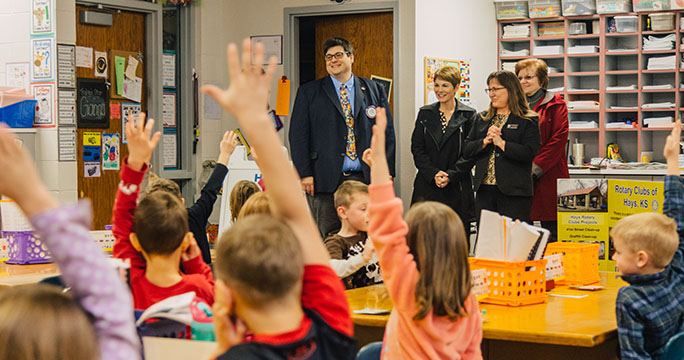
Woods joined Rotary Club members and FHSU elementary education majors in presenting the first group of macro lenses to a kindergarten class at Roosevelt Elementary School earlier this week. Woods also handed out a bag of lenses to each of the FHSU students who are interning at other Hays schools and were in attendance for the Roosevelt presentation.
Roosevelt kindergarten teacher Heidi Wamser seemed as excited as her students to receive the new learning tools.
“Sorry, we get excited in kindergarten,” Wamser said, flashing a big smile as she asked her students to show their appreciation with a silent cheer.
“I remember when student teachers would come into our classrooms when I was young,” said Wamser, a Hays native who attended Hays schools and is a product of FHSU’s Teacher Education program.
Now in her 17th year as an elementary school teacher in the local school district, Harper-Wamser said. “I have Fort Hays State interns come into my classroom all the time. They are a great addition.”
Wamser’s current FHSU science intern, Alyssa McCandless, also was excited about the macro lenses.
“I love my internship; I wouldn’t trade it for anything in the world,” said McCandless, a Hutchinson senior.
McCandless said her favorite grades to teach are third and fourth but that she enjoys all elementary school levels, including kindergarten.
“I love working with this age. I like seeing their lightbulb moment when they get it,” she said. “Kindergartners definitely keep you on your toes.”
So, too, does Wamser, who said she puts her interns in charge of a group of students from the first day they walk into her classroom.
“I tell them that no one is going to give you what to teach when you are a teacher,” Wamser said. “So I want them to get the hang of it right away. I put them in charge of the lesson plan and behavior, everything.”
McCandless said she appreciates that approach.
“The mentor teachers can’t hold your hand forever,” she said. “Here, if you make a mistake, the mentor teacher can backtrack and see what points you might have missed teaching. It’s perfect.
“Mrs. Wamser is a great teacher to be under,” McCandless added. “She’s always giving me constructive feedback that is going to help so much when I get out and teach.”
McCandless stayed close to home and attended Hutchinson Community College her first year out of high school.
But at the urging of her parents, both Fort Hays State graduates, she checked out FHSU’s Teacher Education program — and is glad she did.
“On my visit to Fort Hays State, they were so warm and welcoming,” McCandless said. “Now, with all these opportunities I’m getting, it’s turned out great.”
Shanna Dinkel, assistant superintendent of Hays USD 489, said “it’s wonderful to be in a community where the civic organizations like the Rotary Club make education a priority. They are always willing to support education.”
Dinkel has held a multitude of positions in her 20-plus years in the district, ranging from classroom teacher to several interim administrative jobs to her current position. So she is well aware of the benefits of forming partnerships with organizations outside the school district.
“The grant opportunities from civic organizations, especially when budgets are tight, are great,” she said. “They keep finding opportunities for our students in a variety of ways.”
Dinkel echoed those sentiments about Fort Hays State, from where she earned her building and district leadership endorsements.
“It’s such a positive thing for the district to be able to partner with FHSU in so many areas, whether it be internships or student teaching or after-school programs,” Dinkel said. “The College of Education is wonderful to work with as far as what our needs are, and in the end, all our students benefit from it.”
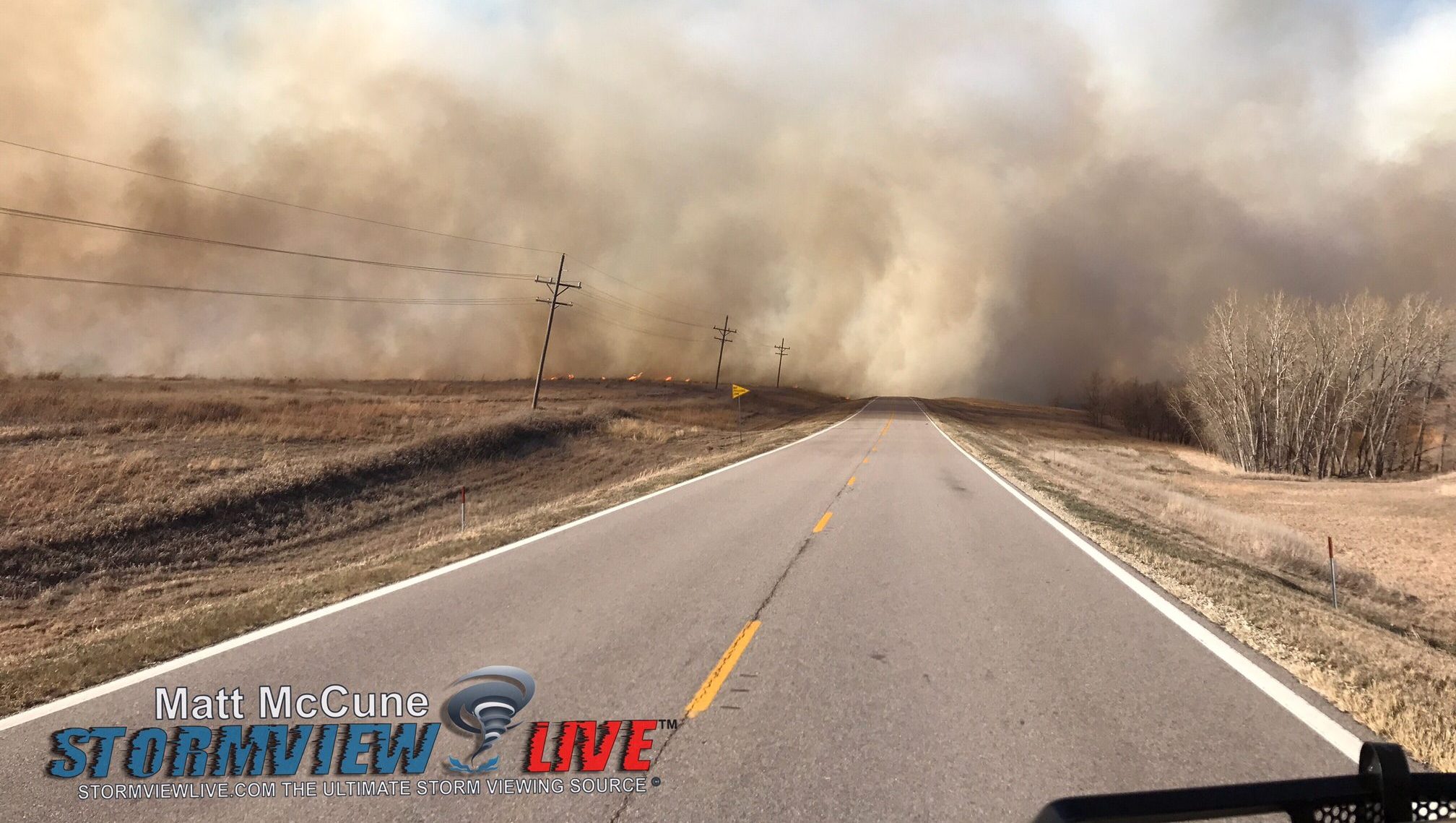
Image from an early March grass fire in Rooks County. Photo courtesy Matt McCune. www.stormviewlive.com
By JONATHAN ZWEYGARDT Hays Post
Rooks County fire crews are continuing cleanup efforts on a wildfire that is now more than a week old.
According to Rooks County Emergency Manager Butch Post, approximately 10,000 acres of grassland have burned in the South Fork Solomon River Valley fire west of Stockton.
The fire was reported at about 1 p.m. on March 6 5 miles west of Stockton and came within three-quarters of a mile to the west edge of Stockton. Crews had the fire contained by Tuesday afternoon, but Post said they have been dealing with flare-ups since then although the size of the fire has not grown in size.
Currently the fire is considered 99-percent contained as crews were called back this week after another fire flared up in the area. Post said they hope to have it 100-percent contained Wednesday.
Post said the cause of the fire is still under investigation, but he said officials believe the fire was started by arcing power lines due to the high winds.
While damage assessment continues, Post said there was one home and a number of outbuildings destroyed in the fire. Residents also reported damage to numerous vehicles and some farm equipment. As of Tuesday, only two cows were lost as a result of the fire.
The Farm Service Agency is working on damage assessment for farmers and ranchers.
During the proximity of the fire on Monday, March 6, 128 inmates from the Stockton Correctional Facility were evacuated to the Norton Correctional Facility and residents in the southern part of Stockton were told to be on alert and be prepared to evacuate if needed.
There were 40 Rooks County volunteer firefighters and 12 vehicles actively fighting the fire with the rest of the department on standby.
Almost two dozen entities responded to help fight the blaze with fire departments from all across western and central Kansas providing mutual aide.
Post praised the response from area emergency departments through mutual aid and said, “If you need help, you call (and) fire departments will come.”
“Most of the departments are volunteer in the state, so people are taking off from their job to go fight fires,” Post said.
They also received support from a numerous local businesses, farmers, ranchers and private residents who brought water and heavy equipment.


 😮 Glad we got the trucker out of there and thanks to Trooper Trav for getting traffic stopped behind me! Btw, Firefighters….#Respect.”