We have a brand new updated website! Click here to check it out!

Report: Kansas stuck in the middle in overall health

By Meg Wingerter

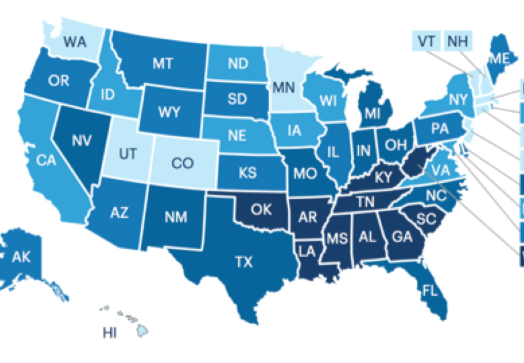
Image -AMERICA’S HEALTH RANKINGS/UNITED HEALTH FOUNDATION

Kansas was the only state where the obesity rate went up significantly in 2015, according to an annual report, and state officials are trying to figure out why and how to reverse the trend.

The state also lagged on vaccination rates and remained stuck in the middle on overall health, according to the America’s Health Rankings Report, which was released Thursday.

Kansas ranked 27th in the report, which rates the 50 states on a broad range of measures, including health behaviors, access to care, state policies and residents’ health outcomes. The state has hovered at 26th or 27th since 2013.

About 34 percent of Kansans, or one in three, were obese, according to the report. That echoes another annual report issued earlier this year by the Trust for America’s Health and Robert Wood Johnson Foundation, which also noted that Kansas also was one of only two states whose obesity rate increased significantly between 2014 and 2015.

Missouri didn’t fare much better, with 32 percent of residents classified as obese. Its obesity rate also appeared to go up, though the change was not statistically significant.

Jennifer Church, section director for community health promotion at the Kansas Department of Health and Environment, says state epidemiologists are analyzing why the obesity rate increased in Kansas when most states were holding steady and a few had decreases.

“We can’t say with any certainty why Kansas is continuing to go up,” she says. “A lot of their strategies (in states where the rate decreased) look the same as what we’re doing.”

Not all people who are obese develop other health problems, but extra weight does increase the risk of type 2 diabetes, heart disease, stroke, arthritis and cancers in the uterus, breast, colon, kidney, gallbladder and liver, according to the Centers for Disease Control and Prevention.

The report estimated the United States spends about $190.2 billion annually on health issues related to obesity, and about 200,000 people die from related causes each year.

KDHE has provided programs to encourage better nutrition for about 20 years and offers grants for communities that want to include pedestrians and bicyclists in their master transportation plans, Church says.

This coming year, however, KDHE plans to put more emphasis on underserved communities, such as lower-income neighborhoods that can be overlooked when city officials discuss adding bike trails, she says.

“It’s really clear who is disproportionately affected by obesity and tobacco,” she says.

Work remains on vaccines

Kansas also ranked in the bottom 10 states on the percentage of adolescents vaccinated against meningococcal disease and human papillomavirus, or HPV.

Missouri also was in the bottom 10 when it came to vaccinating all teens against meningococcal disease and female teens against HPV. It ranked 32nd for male teens, mostly due to extremely low rates in other states — only about one-quarter of Missouri boys age 13 to 17 had received an HPV shot.

Jennifer VandeVelde, director of KDHE’s Bureau of Disease Control and Prevention, cautioned that the report doesn’t reflect progress in 2015, however. For example, the HPV vaccination rate in Kansas for teen girls increased from about 38 percent in 2014 to about 51 percent last year, which wasn’t captured in the rankings, she says.

KDHE and the Immunize Kansas Coalition are focusing on raising awareness that teens need the HPV and meningococcal vaccinations, as well as a booster to protect them against tetanus, pertussis and diphtheria, VandeVelde says. That includes talking with health providers about using the opportunity when they treat teens to offer vaccines, she says.

“While these rates are still not as high as we would like them to be, there is marked improvement noted in just one year, and we are confident that we will continue to see marked increases under our current strategies,” she said in an email.

Meg Wingerter is a reporter for KHI News Service in Topeka, a partner in the Heartland Health Monitor team. You can reach her on Twitter @meganhartMC

Free Christmas tree disposal available through Jan. 16

CHRISTMAS TREESCITY OF HAYS

Citizens are encouraged to bring used, live Christmas trees to the free disposal site located north of the Public Works building at 1002 Vine Street. This area is right next to the bathrooms at Speier ball fields. Place the trees inside the orange snow fence area. Signs will be posted.

Please remove all plastic, ornaments, and lights before dropping off trees. The disposal site will be open Wednesday, December 28, 2016 through Monday, January 16, 2017.

Midwest Energy will provide personnel and a wood chipper to chip the trees to make mulch. The mulch will be placed at the Parks Department on the Highway 183 Bypass and is available for pickup free of charge.

If there are questions, please call the Hays Public Works Solid Waste Division at (785) 628-7357.

Battling the growing obesity epidemic in Kansas

By AMIE JUST

Brandon Johannes knew he was dying.

As Johannes and his brothers toured Alcatraz in 2011, his view of The Rock was slightly different than planned.

“I can tell you where every bench was on Alcatraz,” Johannes said, “because that was the tour of Alcatraz for me.”

After a few minutes of walking, Johannes, then 31, needed a place to sit and rest. Shortness of breath and back strain made daily routines such as standing and walking incredibly difficult.

At 6-foot-1 and 500 pounds, he was nearly three-times the size of the average man his height. Johannes’ body mass index was 66. On most BMI charts, obesity starts at 30. Johannes’ belt was more than 5 feet tall — longer than some of his friends were tall.

While walking throughout San Francisco, drenched in sweat, Johannes would fall blocks behind his physically fit brothers.

Johannes’ brothers, Aaron and Matt, are both taller than Brandon. Aaron, is 6-foot-3 and weighed approximately 175. Matt, the tallest of the three, is 6-foot-7 and weighed approximately 260.

For 14 years, Johannes had deflected comments from his family and friends telling him that he needed to lose weight. His response was always the same: “I’m not ready yet.”

Alone on an Alcatraz bench, with his brothers out of sight, Johannes realized it was time for a change. He couldn’t ignore his obesity anymore; he needed weight-loss surgery.

Johannes, a Leavenworth resident, was far from alone.

According to the national 2015 State of Obesity report, obesity rates increased in two states: Kentucky and Kansas. With Kansas’ latest increase, the state now ranks seventh nation in highest obesity percentage at 34.2 percent.

Over the past 20 years, the percentage of obese Kansans has increased 153 percent. In 1995, Kansas’ obesity percentage was 13½ percent, ranking 36th nationwide.

A combination of issues has contributed to Kansas’ precipitous increase in obesity, but experts are unable to pinpoint a direct cause.

“It would be great if we could wave a magic wand and identify and pinpoint the exact issue for obesity rising in Kansas,” said Kate Hoppe, the Physical Activity and Nutrition Manager for the Kansas Department of Health and Environment’s Bureau of Health Promotion. “The fact of the matter is that obesity is a pretty complex issue. Body weight is the result of many factors, including behavior, metabolism and genetics.”

During the past eight years, one of First Lady Michelle Obama’s cornerstone initiatives has targeted healthy eating habits. Her Let’s Move! campaign promotes raising a healthier generation of children.

But that program, and others like it, is for kids, not adults.

In 2015, roughly one in five adults 18 years and older ate vegetables less than one time per day, according to the Kansas Behavioral Risk Factor Surveillance System. That number was even higher for fruit, as about two in five adults for that same age group ate fruit less than once daily. Those numbers aren’t significantly different than 2013.

There’s also a difference between not eating healthy foods and being addicted to eating.

In the fifth edition of the Diagnostic and Statistical Manual of Mental Disorders, food addiction, otherwise known as “Binge Eating Disorder,” is now recognized as its own category of eating disorders. It joints other disorders such as Anorexia Nervosa and Bulimia Nervosa.

Food addiction

Sometimes twice a day, Johannes would venture to McDonald’s. For breakfast, he’d have the Deluxe Big Breakfast with scrambled eggs, sausage and pancakes. He’d also get two bacon, egg and cheese biscuits with hash browns, as well as several breakfast burritos. For lunch or dinner, Johannes would order two double cheeseburgers to eat on the drive home as an appetizer. Upon arrival, he’d eat a double quarter pounder meal with supersized large fries as his entree.

When he’d have pizza for dinner, it wouldn’t be a slice or two. He’d eat an entire large Meat Lovers pizza with stuffed crust from Pizza Hut in a single sitting.

According to Pizza Hut’s menu, that’s 3,840 calories.

“I can’t think of any place that I used to go where I didn’t usually double up,” Johannes said. “I was eating upwards of 2,500 to 3,000 calories a meal.”

According to the U.S. Department of Agriculture, on average men should consume about 2,500 calories daily.

Johannes had a problem. He was addicted to food.

“One of the things about this particular addiction is that you can live without alcohol. You can live without hard drugs. You can’t live without food,” Johannes said. “You don’t get days where you’re sober. You’ve gotta stick with your drug every day until the day you die.”

While Johannes was eating high quantities of food well above the recommended amount of trans and saturated fats, his cholesterol was through the roof at 238. Any higher than that is considered extremely dangerous. He’d been on medicine to help regulate it for over a year. In addition to medication, Johannes preemptively took an additional medication for 13 months in hopes of staving off diabetes.

A week after Johannes scheduled his bariatric surgery, his doctor called. He had officially crossed the diabetic line.

Johannes’s health problems didn’t stop there. He’d been diagnosed with high blood pressure, gout and enlarged organs.

“There was a point in time where my doctor was worried that my pancreas wasn’t even functioning,” he said.

To this day, he has weak knees and ankles because of the weight he carried for the better part of 14 years.

All told, Johannes was taking at least six different medications for his various health conditions related to obesity, plus at least two more for unrelated medical conditions.

“I had a lot of different side effects and it was only getting worse the older I got,” he said. “I don’t know if I would have made it to my 40s or 50s and if I had, oh my goodness, the kinds of stuff I would have been on then.”

In the state of Kansas, nearly 10 percent of adults have been diagnosed with diabetes and 31.6 percent of adults have been diagnosed with hypertension. Both of those figures are approximately median figures nationwide.

To compare, Colorado has the lowest adult diabetes rate in the union at 6.8 percent, while Mississippi bolsters a rate of 14.7 percent to lead the nation. Utah has the lowest adult hypertension rate at 23.6 percent. West Virginia leads the nation in hypertension rates at 42.7 percent.

Currently, approximately 558,000 adult Kansans have hypertension and 239,000 adult Kansans have diabetes. If the rates continue to increase at the current pace, over 700,000 adult Kansans will have hypertension and 367,000 adult Kansans will have diabetes in 2030.

The entire population of Johnson county in 2012 was roughly 559,000 people.

According to the 2012 “F as in Fat” report, there were over 176,000 heart disease cases in the state of Kansas in 2010. If the projection numbers remain on course, by 2030, more than 769,000 adult Kansans will be diagnosed with a heart disease. That would be the entire population of Kansas City, Kan., Wichita, Topeka and Manhattan combined.

“Quite a lot of health professionals are concerned about obesity rates because they feel like it’s going to bankrupt the health care system,” said Marty Glenn, a registered and licensed dietician and lecturer at the University of Kansas. “ Because of the cost involved for treating all these diseases, especially diabetes because it affects a lot of different parts of the body. You have to go see a specialist for every body part almost.”

State of Obesity report

The main unit of measurement for the annual State of Obesity report is body mass index. To calculate BMI, all it takes is knowing someone’s height and weight. But it’s not a perfect measurement.

Glenn, and many medical professionals, aren’t keen on using BMI as a measure for obesity.

“It’s very, very practical, but it’s just flawed,” Glenn said. “It’s too general. I am not a huge fan of the BMIs at all. I think they over estimate how many people truly are unhealthy.”

Some people, such as athletes, are more likely to have higher BMIs because muscle tissue is dense and heavier than fat tissue.

Glenn said muscle tissue is like a sponge that’s been soaked in water, whereas fat tissue is a dry sponge.

“It’s still the same size, but the weight because of the water content is much higher,” he said. “You get somebody, like (Cleveland Cavaliers) LeBron James, and about any player in the NFL and they’re going to be obese or at least overweight.”

It’s true. James’s calculated body mass index is 27.4, indicating someone who’s overweight. But his body composition was 6.7 percent body fat in 2003. According to BMI, New England Patriot quarterback Tom Brady is overweight, while Patriots tight end Rob Gronkowski and Green Bay running back Eddie Lacy are obese.

Glenn wishes that there was a more practical way to assess whether or not someone’s weight was unhealthily overweight or obese or healthily overweight or obese.

Even though Glenn has qualms with the main measurement used for the study, he doesn’t dismiss that obesity is truly a problem in Kansas.

“They’re moving up the ranks that’s for sure,” Glenn said. “Unfortunately those are rankings you don’t want to slowly move up, but they have been.”

Kansas solutions

Back in 2006, then-Kansas Governor Kathleen Sebelius reinstated the Kansas Governor’s Council on Fitness that was abolished in 1995. Its mission is “to encourage physical activity, healthy diets and tobacco use prevention by sharing information with Kansans and partnering with businesses, schools and individuals to promote healthy lifestyles.

The Governor’s Council on Fitness is still active and has 18 current members including the Secretary of Health and Environment, the Chief Operating Officer of Blue Cross and Blue Shield of Kansas Foundation, professors at Fort Hays State and the University of Kansas School of Medicine, among others.

One of their main goal is working on the Healthy Kansans 2020 plan by focusing on 12 different areas related to health by building “on the comprehensive, nationwide health promotion and disease prevention agenda” and “to establish state-specific measures and initiatives.”

Those 12 areas include: access to health services, chronic disease, disability and health, environmental health, immunization and infectious disease, injury prevention, lifestyle behaviors, maternal, infant and child health, mental health, oral health, social determinants of health, and violence prevention.

But this wasn’t just a Kansas initiative. The Healthy Kansans 2020 plan derives from the national Healthy People 2020 plan.

The Kansas-oriented plan has two objectives related to obesity. One is to reduce the proportion of Kansans who are obese to 30.5 percent. The other is to reduce to the proportion of Kansas adolescents aged 12 to 19 who are obese to 16.1 percent. The current rate of adolescent obesity, according to the Center for Disease Control, is 16.3 percent. The plan doesn’t outline how those objectives are going to be achieved, other than by “promoting access to healthy foods and support policies that promote healthy food choices.”

The Kansas Department of Health and Environment is currently supporting other initiatives as well, according to Hoppe, such as, increasing access to local foods by increasing the number of farmer’s markets and farm to institution programs, as well as, increasing physical activity among all populations by implementing pedestrian and bicyclist plans to further implement sidewalks and bicycle lanes.

“Another thing that I think complements these efforts too that’s really important is that we’re supporting evidence-based lifestyle change programs across the state,” Hoppe said. “What those programs do is give people with chronic conditions the tools to make and sustain lifestyle changes that will help them to be healthier.”

A real-world example Hoppe mentioned is the incorporation of a new grocery store to Allen County.

Back in May 2015, it was announced that a grocery store company submitted a letter of intent to build in Iola. The press release announcing the plans said Thrive Allen County– a non-profit devoted to healthy living– had been trying to get a new supermarket built in the area since January 2013. According to Hoppe, the purchase of the land was conditioned on adopted design standards to make the area walkable and bikeable. The official groundbreaking of the grocery store was on Oct. 27, 2016.

In addition, Hoppe also outlined a new wayfinding plan in Sedgwick County. The plan provides signage for pedestrians and cyclists to healthy food retailers and health clinics.

“I think that this work highlights the importance of these strategies that we’re working on and our communities are working on for not only increasing physical activity and healthy eating but also ensuring that underserved and high-risk populations have physical access to needed health care services that can assist them with managing their obesity or other chronic conditions,” Hoppe said.

The first meeting in regards to the Wichita Bicycle Wayfinding System occurred in early June 2015. The most recent meeting, according to the wichita.gov website occurred in March 2016, but no minutes were posted. According to the October 2015 meeting minutes, the wayfinding system master plan was supposed to be finalized in February 2016, The final system plan was dated Sept. 13, 2016. That doesn’t include a final date for when the nearly additional side paths, bicycle lanes and shared use paths will be completed. The master plan says 770 miles of bicycle facilities are recommended. The wichita.gov website says the city currently maintains more than 100 miles of bicycle facilities.

But these programs aren’t quick fixes. Most, if not all of them, require years of planning, years to execute and additional years to see concrete results.

“We’re confident we know that based on the evidence that these strategies do make an impact on population health, it just takes some time,” Hoppe said.

Amie Just is a University of Kansas senior from Funk, Neb., majoring in Journalism and Mass Communications.
Kansas police departments struggling to recruit officers

By NICK PRICE

Buzz, buzz, buzz.

It’s 4:30 a.m. in McPherson, Kansas. Robert McClarty slaps the alarm. It’s time to start the day.

He reaches for his glasses on the nightstand and begins his morning ritual — with prayer. He prays for his family. He prays for his safety. He prays for the people he has sworn to protect and serve. Afterward, Chief McClarty is ready to start the day.

Same time, 200 miles away. Kansas City, Kansas is fast asleep, but nevertheless Bob Angell’s alarm goes off.
Buzz, buzz, buzz.

Shower, breakfast, hug the kids. It’s time for Captain Angell to go to work.

Both men realize that the people they interact with today are most likely having the worst day of their lives. Some of these interactions won’t be safe. You see it on the news with images of police brutality and violence conducted by law enforcement and against law enforcement.

But nevertheless, these men love what they do.

“Today is not my day. I’m going to be OK today.”

Angell lives by those words. It allows him to go to work with a peace of mind that he will return home.
But not every officer is lucky enough to return home.

Cop killing is a trend that is growing nationally. According to the National Law Enforcement Officers Memorial Fund’s mid-year report released on July 20, there had been 67 officers killed in the line of duty in 2016. Thirty-two of the fatalities were firearm-related, a 78 percent increase from last year. Among those shootings were multiple police killed in Baton Rouge and Dallas.

And the toll continues to rise. Since that report, 20 more police officers have been shot dead, including two officers in Urbandale, Iowa, on Nov. 2.

Law enforcement officers aren’t the only victims of today’s policing climate. In 2015, police killed more than 100 unarmed members of the black community. The killings have expanded the divide between law enforcement and the people of this country, particularly members of minority groups.

“99.9 percent of the officers out there would never betray their badge, and I think that they take a bad rep for the less than 1 percent that do betray their badge and do something unforgivable,” McClarty said.

Angell said that specialized programs have been established in police academy training to reduce the number of police brutality incidents. Juvenile aggression and Fair and Impartial Policing courses have been implemented across the state. The programs are designed to prepare officers for the type of altercations that can be escalated by an age and racial divide.

“It’s a hot topic, and if we aren’t addressing it and preparing them for it, then we aren’t doing our officers or our citizens justice,” McClarty said.

A June 2015 Gallop poll indicated that while a majority of citizens (52 percent) remain confident in police, that confidence level is at a 22-year low. By July 2016 confidence in police had rebounded to 56 percent. But while 58 percent of whites had confidence in police, only 29 percent of blacks felt the same way.

Tragedy in Kansas City
Improved training methods won’t prevent all violence between officers and civilians. Earlier this year, tragedy struck the Kansas City Kansas Police Department.

On May 9, U.S. Air Force Veteran and 20-year member of the police force Brad Lancaster reported to work like he did every morning since joining the Kansas City Kansas Police Department 10 years ago. Shortly after his lunch break, Detective Lancaster received a dispatch of a suspicious person at the Hollywood Casino.

Before being given the chance to take the call, it was claimed by another squad car. But then another call came in: the suspicious person had fled from the responding officers on foot.

Lancaster located the suspect attempting to escape through a nearby field. He exited his unmarked vehicle and commanded the suspect to stop.

But he didn’t.

Instead the suspect opened fire on Lancaster. By sheer coincidence, the detective had been caught in a shootout. He was in the wrong place at the wrong time.

He was struck twice. Brad Lancaster, 39, died at 12:20 p.m. that day. He left behind his wife, Jamie, and two daughters, ages 9 and 10. Two days later, Curtis Ayers was charged with capital murder.

As he had done for 26 years, on July 19 Cpt. Robert Melton reported for duty. He had been a member of the Kansas National Guard, and served in Afghanistan prior to his police work.

Melton had worked for the Kansas City Kansas Police Department for 17-years, and had worked with Lancaster the past 10.

At 1:33 p.m., dispatch requested an officer respond to a report of a drive-by shooting near 22nd Street and Haskell Avenue. Another squad car took the call, but. Melton flipped on his lights and raced toward the scene to provide backup.

Melton and a partner arrived at the scene within five minutes. The car involved in the drive-by was located, and suspects were being questioned. One suspect had already been taken into custody.

When pulling up to the scene, the captain saw another suspect attempting to flee. He shouted to the suspect. The suspect opened fire on Cpt. Melton’s car. The bullets penetrated his windshield, striking the captain.
Robert Melton, 46, was pronounced dead at 2:22 p.m. He is survived by his three children and expectant girlfriend. Jamaal R. Lewis was arrested two days later and charged with capital murder.

“When it comes to losing somebody as violently as we lost these two guys, it starts rocking your whole understanding and belief of police work,” KCK Police Cpt. Angell said. “For years I knew this was a dangerous job to do, but I never really accepted it for what it actually is.”

The slaying of the two officers by armed gunman were the first in the department in more than 47 years. Now there were two officer fatalities in two months.

Repercussions
McPherson is 50 miles northwest of Wichita. The KCK officer fatalities occurred 200 miles away, but the impact hit close to home for McPherson Police Chief Robert McClarty.

“Anytime you get a fellow police officer that has been shot or shot at, it definitely has an impact on our officer’s morale,” McClarty said. “We saw it when the Baton Rouge officers were killed, we saw it when the Dallas officers were killed, and we saw it when the KCK officers were both slain.”

McClarty said that the impact on morale isn’t exclusive to the officers they know personally. Any death in the line of duty has a negative impact on the psyche of the entire police fraternity.

The deaths of the KCK officers add to the growing total of gunfire-related fatalities in our nation’s police force. Of the 257 officer-fatalities in the state of Kansas history, 170 were the result of gunfire.

“I haven’t lost any officers because of this impact yet, but I certainly have heard officers talking about it,” McClarty said.

To McClarty, the consequences of the shootings are immediate as officers second-guess their decision to be cops. For a department with 34 sworn officers, losing just one or two could negatively impact their ability to protect their community.

McClarty said the recent officer fatalities haven’t only affected current officers, but it has significantly impacted recruitment efforts.

“It has limited our number of applicants. I believe it has also made people question more whether they want to be police officers,” McClarty said.

This impact of police fatalities and the media coverage that follows is having an increasing affect on recruitment. For instance, at times the Lawrence Police Department has had as many as 600 applicants. Lawrence Police Department Sgt. Amy Rhoads said that has drastically declined during the past decade.

“There could be a lot of different variables that could play into that — it could be the violence that’s going on in the country, or it could be something else,” she said.

New recruitment tactics
It used to be enough to place an ad in the local newspaper, or on a few websites, but the traditional recruitment methods don’t seem to be sufficient anymore.

“Our recruiting methods had to become much, much more aggressive because we need to expand our resource base,” McClarty said. “We have to reach out to all of the major colleges throughout the state —we need to expand.”

As part of the expansion, the McPherson Police Department has created a new career fair program where recruiters travel throughout the state in hopes of finding good potential officers at each of the state’s universities and colleges, as well as at other Kansas institutions.

It’s not enough for departments to look for recruits in their own backyards anymore, and the need for recruitment expansion is something that departments across the state are beginning to realize.
Even in urban areas where potential officers are more abundant, changes to the recruitment process are being made.

Angell said the Kansas City, Kanas Police Department had previously taken a need-based approach to the recruitment process, only interviewing and screening potential applicants before upcoming retirements or other departures. Now, the department has implemented a monthly screening process to establish a group of promising potential recruits that can be brought into police academy training at a moments notice.

“Now we have a stack of applicants where we look at the oral interview and say, ‘Wow, this person has wanted to do this since they were 2 years old,’ and we can confidently say that this person is an excellent candidate to become a police officer,” Angell said.

This screening process involves multiple steps, including a written exam, physical test, background check, psychological evaluation, and a series of oral interviews.

Taking preemptive measures to compile a list of potential recruits works well for areas where potential job applicants are abundantly available, but this method isn’t as practical for rural areas with lesser populations. It’s one reason some departments throughout the country have been loosening the requirements of their potential officers.

In Lawrence, the previous prohibitions on tattoos have been removed. Police departments are more concerned with finding candidates with strong ethical characters, and are willing to make exceptions to prior requirements as long as prospects don’t have a questionable past. In many other Kansas departments, the requirements and restrictions for applicants have not been reduced.

New training procedures
Finding qualified candidates is only half the battle. Angell said the real challenge is preparing officers for the adverse situations of today’s policing environment.

The problem is that police academy training pales in comparison to the training that is required for other professions. For instance, Kansas requires 560 hours of training to graduate from the police academy and become a full-time officer. However, to obtain a barber’s license requires a minimum of 1,500 hours of training.
Angell said police academies must use the little time they have with recruits wisely in order to prepare them with the skills to effectively police in today’s society.

The state of Kansas now requires every officer to go through an additional 40 hours of Advanced Officer Training each year. The training is used to address changes in law enforcement.

Advanced Officer Training involves courses in Fair and Impartial Policing, Verbal Defense and Influence, and most relevant to today’s policing circumstances, De-escalation Training.

De-escalation Training includes a newly introduced program called CIT training (Crisis Intervention Team Training), which focuses on preparing officers to interact with people who are in unstable mental states. CIT training teaches officers how to communicate properly with people with suicidal thoughts, schizophrenia, and other mental impairments.

“It deals with things that we didn’t dig into 10-or-15 years ago that we are examining much more closely today,” Angell said.

As part of the newly introduced CIT training, officers in Kansas City are now required to complete an additional 16 hours of scenario-based training as well. This type of training is conducted by sending officers into pre-set situations in which they would be dealing with a person with a mental impairment.

The Kansas City Kansas Police Training Academy, located on the campus of Kansas City Kansas Community College, uses trained officers as well as students from the college’s theater department as role-players for these training exercises.

“If the officer comes in here and does great, that’s what you’d like to see,” Angell said. “If the officer comes in and makes mistakes, this is the perfect place to correct those.”

Moving forward
While confidence in police has fluctuated in recent years, McClarty said the relationship between the police and the communities they serve is fixable.

“It starts with doing good police work in your community… doing what’s right, and doing it well,” he said.
After getting the policing portion of the job down, McClarty said they have to be an active part of the community they serve.

“I think the more interaction that you have with the community in a non-enforcement manner builds that relationship and allows us to have a better response when and if something does get bad.”

Relations between law enforcement and their communities seem to be getting better. According to an October Gallup Poll, 76 percent of Americans said they have “a great deal” of respect for police in their area, up 12 percentage points from 2015.

Gallup has asked this question nine times since the peak of the Civil Rights Movement in 1965, and the percentage of people who say they respect police is higher now than in any measurement taken since the 1990s. And while 80 percent of whites said they have a great deal of respect for police, 67 percent of non-whites have the same level of respect.

Many officers have said it would be ill-advised to declare this trying time for police-civilian relations to be one that will have a negative impact for the future of law enforcement.

Lawrence Police Department Sgt. David Hogue is one such officer. He said that the future of law enforcement in this country is promising. He said the recent negativity toward police won’t discourage people who have a passion for helping people from taking the oath to protect and serve.

“Ultimately, you come into this job understanding that there’s going to be conflict and that people do bad things,” Hogue said. “The people that would naturally be drawn towards a career where they are making a difference, making and impact, or changing the world… I don’t think those people have been deterred.”

Nick Price is a University of Kansas senior journalism student from Overland Park.

High school cheerleaders raise $800 for Rooks Co. Cancer Council

rooks-co-cancer-councilSUBMTTED

Stockton and Plainville high school cheerleading squads came together on December 20 to show support for county residents diagnosed with cancer in a powerful display of cheer squad dance routine excellence and county unity.

Prompted by a desire to do something different for their annual fundraiser to benefit the Rooks County Cancer Council, the Stockton squad decided to reach out to inter-county rival Plainville and team up in order to increase the fundraising potential.

Stockton cheer sponsors Jessica Billinger and Donna Hamilton laid the groundwork for the unified routine. Billinger stated “We wanted to do something to include most of Rooks County. We contacted administrators of both schools and got the event approved. We contacted Cardinal Creations who came up with the design and made the t shirts for the event. We also thought it would be neat to show unity for a great cause. That is when we came up with the idea of performing a routine together at halftime of the Tigers/Cardinals basketball game”.

Mallory Buresh, head cheer coach for Plainville, choreographed the challenging routine. Billinger noted that finding times to practice was difficult due to conflicting schedules and with a group of girls that are active in many activities. The squads were able to practice together only five times before the performance.

The cheerleaders made the most of their short time working together to make the event such a success, while also enjoying the challenge. Madalyn Billinger, Stockton cheerleader, said “I thought it was cool to work with another school to raise money for a great cause. It was also fun to perform with another cheer squad”.

Jasmine Creighton, Plainville cheer squad captain noted that overcoming the novelty of working out a routine with another squad was a little daunting at the start.

“At first we were all skeptical about performing together but as our practices went on we all started to come together and it even became fun! It was such a satisfying feeling when we all hit our stunts perfectly throughout the dance and it was even more satisfying when we all handed money to the cancer council! I hope that this will continue between the two squads because I would love for future members to always have this opportunity” said Creighton.

Buoyed by the success of the difficult routine (cheers went up throughout the gym at its conclusion) and by the amount of money raised, members of both squads expressed the hope that they could continue the event annually to help raise funds for the Rooks County Cancer Council.

The effort raised $800 for Rooks County Cancer Council. The united squads presented the donation to Council volunteer Karen Hageman following their routine during half time of the December 20 Stockton/Plainville boys basketball game.

Rooks County Cancer Council, supported by the Rooks County Healthcare Foundation, uses funds received that are designated by donors to provide fuel vouchers to offset travel costs to treatments and appointments as well as nutritional supplements for qualifying Rooks County residents who have been diagnosed with cancer.

For more information on the Rooks County Cancer Council call (785) 688-4428.

Rural health care crisis puts critical care out of reach for many Kansans

Ozell Pouncil
Ozell Pouncil

By DEANNA AMBROSE

Ozell Pouncil is a short, black man with a wide smile and snowy white hair that he combs down on his head to spread out the waves. He goes to First Missionary Baptist Church on Sundays and doesn’t use the Internet or a landline telephone.

He worked several blue-collar jobs, but his favorite was farming. Ozell farmed for eight years in Caney, 23 miles southwest of Independence, as his wife, Elizabeth worked at a nursing home. They raised four children, returning to Independence because Elizabeth was, as Ozell says, a “city girl from Albuquerque.”

Ozell had his garden, which served as a compromise, and Elizabeth had a sense of community. As they grew older, the town changed. Industries left, Washington Elementary School closed and the hospital shut down. He said as soon as he can sell his house, he will move anywhere, as long as it isn’t Independence.

“How would you like to live in a town this size, if a heart attack or something or you get a gall bladder eruption or something, you got to take them 20 miles or 45 miles or 100 miles away,” Ozell, 78, said. “You may have to get to the hospital in a hurry, you can’t wait 25, 30 or 45 minutes to get to Bartlesville, which is 45 minutes away, or go to Tulsa which is 100 miles away, or Wichita, which is 119 miles away, everywhere you go it’s a ways away. You could be dead by then.”

Ozell knows firsthand what it’s like for someone to “be dead by then.” On the evening of July 24, 2010, he and his wife Elizabeth sat at the dinner table talking about selling some of Ozell’s golf clubs. Ozell walked into the kitchen to talk with his nephew, and when he returned to the dining room, he found Elizabeth slumped over the table, unresponsive. She had suffered a stroke. He rode in the ambulance to Wichita, praying she would die peacefully and without pain. He couldn’t wish for her to come back as “a vegetable,” as he put it.

“We were married 56 years and renewed our vows twice.”

He told her if she could hang on for another 25 they could have another ceremony. That didn’t happen.

In 2010, Independence’s Mercy Hospital couldn’t provide critical care, like for a stroke, and had limited bed space. But the hospital still served other needs and provided a source of employment in the community.

Independence represents just one hospital and just one town in Kansas, but serves as a possible example for the future of other rural communities. Hospital closings only portray part of the rural health issue. Medicaid expansion and access to primary care both play a role in the overall wellbeing of Kansans and their communities. But the State Legislature and individual communities are trying to find solutions.

In addition to Mercy, 31 other hospitals in Kansas are at risk of closing too, according to the Kansas Hospital Association. This includes Sumner Regional Medical Center in Wellington. A recent 1 percent sales tax increase went into effect in 2015 to support the hospital. The future of Sumner Regional Medical Center might rely completely on the town’s residents.

Independence couldn’t save its hospital. Ozell watched as industries left town and as Mercy Hospital fell deeper into financial problems.

Independence today
Independence has a population of about 9,000 but seems smaller. On a Sunday morning, the streets are quiet: no cars, no people, no dogs, no children. Dirty storefronts that closed years ago line some sidewalks, while others still functioning keep neon open-signs hanging in the window serving as an example of what might be the beginning of the end of small-town life in Independence.

As the population has declined by more than 5 percent since 2010, other changes have come to Independence as well. In 2014, the second most common job in Independence was in health care and social assistance, which accounted for about 22 percent of employment. The highest paid employees in the community were doctors and surgeons, according to Data USA. But in October 2015, that all changed. When Mercy Hospital closed its doors, not only did 190 employees lose their jobs but the community was left without a full-service medical facility.
With the closing of Mercy, Coffeyville Regional Medical Center is the only hospital remaining in Montgomery County. It’s located 25 miles from Independence.

Since August, Mercy has functioned as Independence City Hall headquarters after an outbreak of mold in the original city hall building caused illnesses in some city employees.

Mickey Webb, the Independence city manager, said the city is leasing 10,000 square feet of the hospital to St. John’s Medical Center of Bartlesville, Oklahoma, for MRI imaging and a lab. The emergency helicopter pad remains operational but unused.

Although the helicopter pad works, Webb said, Independence does not hold emergency helicopters in the area. The procedure for moving a trauma patient from Independence to a functioning emergency room involves transporting the patient in an ambulance and stopping at pre-ordained helicopter landing areas on the way.

Labette Health will open an emergency services building in Independence sometime next summer. Labette Health media contact Kerri Beardmore said the new emergency room will feature a helicopter pad. Webb said with the opening of the emergency room, Independence could serve as a more central helicopter hub in the future.
Since 2010, 76 rural hospitals closed nationwide. That is less than 1 percent of the 5,627 registered U.S. hospitals, but 4 percent of 1,855 rural hospitals nationwide. Even with the physical buildings, though, access can remain an issue.

Medicaid expansion
Hospital administrators indicated that Medicaid expansion could have saved Mercy Hospital, whereas Kansas Lt. Gov. Jeff Colyer said expanding Medicaid would not provide much help to Kansas rural hospitals. But not all agree. In Wellington, Sumner Regional Medical Center board member Terry Deschaine said expansion would have added about $800,000 to the hospital.

Colyer leads a task force searching for a solution to the rural health care crisis outside of Medicaid expansion. The task force met with groups that work for or in rural health like the Kansas Hospital Association and National Rural Health Association.

“I think Kansans have made it pretty clear, that they’d rather have, that they don’t like big government solutions,” Colyer said.

But, a survey from the Kansas Hospital Association indicates 62 percent of Kansans support Medicaid expansion in some form. In addition, 171,000 Kansans would qualify for expanded Medicaid, according to the Center on Budget and Policy Priorities. In a 2014 study conducted by the Urban Institute, the 10-year financial losses of not expanding Medicaid are $5.3 billion from direct expansion and $2.6 billion from hospital reimbursements.

Colyer also linked health care to overall economics of rural communities.

“One thing that the task force is recognizing is that health care has a big economic impact in these communities, and how do we best preserve it or expand it, not just with the services, but with the economic part.”

Health as a profession is related to rural economies. Colyer said on problem facing rural communities is retaining health care professionals. He said training doctors in a rural area during their residencies is a key factor to retaining those professionals in rural communities. He said he’d like to focus on ways to increase opportunities for training in rural areas. He expects the task force report to be available to legislators in January.

University of Kansas Associate Professor Dr. Mugur Geana is the Director of the Center for Excellence in Health Communication to Underserved Populations, and has conducted research in coordination with the Kansas Department of Health and Environment. He’s identified access to health care in rural communities as a primary issue.

“When I’m talking about availability of resources, I’m not only talking about having a hospital or a clinic, I’m talking about having doctors, having different specialties available, nurses, and so on and so forth, having transportation means to go to the hospital.”

Geana also said oftentimes communities have plentiful health resources, but still face problems.

“Because access means more than just having a building with doctors in it. It means affordability, you know, it means ease of access in terms of transportation, in terms of language barriers.”

When affordability enters the mix, Medicaid expansion and the lack of it in Kansas become a talking point. Geana said health is often a for-profit industry and even highlighted the importance of competitiveness to the development of health care.

Jeff King, R-Independence and vice president of the state Senate, was against Medicaid expansion until Mercy Hospital closed. Although he is not seeking re-election, King now agrees that Medicaid expansion, done correctly, could benefit Kansans and rural hospitals. He said when the federal government allowed Indiana to create its own form of expansion that he changed his mind on the issue.

The Healthy Indiana Plan provides insurance to adults 19-64 based on income levels and family size. The plan differs from traditional Medicaid expansion in that those insured pay copays for care and prescription. Each month they deposit an amount based on income into a POWER account, a type of health savings account, which the state uses for $2,500 of initial expenses.

King said the money problems and provider problems can’t be separated.

“I’m an attorney; I’m not going to move my family where there are no clients,” he said. “It’s the same for a doctor that it is for a lawyer.”

Primary care
Primary care is another important aspect of rural health that contributes to further declines of health services accessibility. Jason Wesco, Vice President of Community Health Center of South East Kansas, which is a federal nonprofit corporation, said the issues at this point become the corporate influence and cost of health care for residents of Independence, which lacked what he termed good city planning for the hospital.

The Community Health clinic in Independence exemplifies a possible way to cut costs because of the nature of its integrated services. It is located in Four County Mental Health Center, and while serving behavior health issues, also takes on general health issues.

Kansas Secretary of Health and Environment Susan Mosier said integrated care is a hopeful solution to cutting costs while ensuring quality of services, as well as allowing patients to access more services they need in one place. She also said technology she called “telehealth” could cut costs to residents and provide them with additional services.

One example of telehealth at work would be a doctor or nurse practitioner engaging in “telementoring,” which means a licensed professional would assist them via video conferencing or some other form of communication to help train them in behavioral health issues that may arise outside of their immediate experience.

As of now, Community Health Center of Independence has increased its open hours from three days a week to five days a week since the closing of Mercy Hospital in 2015, though Wesco noted other factors could have played into the expanded hours.

He also said 35 percent of the patients the Independence clinic sees are uninsured, and that 90 percent can be described as low-income. Wesco said many of the uninsured would qualify for Medicaid if it were expanded. But access to health insurance isn’t the only problem for rural Kansans.

Without insurance or health care providers, poorer residents suffer from lack of access and extended wait times as clinics close in communities that lack access to health care, Wesco said. He also said eventually that lack of access will probably extend to the middle-income population as well.

The same Medicaid expansion that might have kept Mercy Hospital open, would also provide low-income Kansans with the safety of some form of health insurance in terms of both emergency and primary care. Quality primary care can often reduce the need to go to a hospital anyway, Wesco said.

The Wellington solution
In Wellington, Kansas, another local hospital has faced its share of financial problems. In 2015, 64 percent of residents voted yes to a 1 percent sales tax increase to support Sumner Regional Medical Center. The total sales tax rate now sits at 9 percent, according to the Kansas Department of Revenue.

Terry Deschaine, a board member of Sumner Regional Medical Center, said it’s not uncommon for towns to raise sales taxes in order to keep hospitals afloat.

“It’s not a solution to save hospitals. It’s a solution to help hospitals survive,” he said.

Sales taxes can only go so high, he said, before they start adding up, especially on major purchases, which create a burden for everybody.

He also said Sumner is now working to recruit more physicians since three have either retired or relocated. Although the hospital faced significant financial problems for two years, Deschaine said through good management and recruitment he thinks the hospital will succeed.

He also said that the future for Kansans and Kansas hospitals probably will include Medicaid expansion, because Kansas will see a shift in policy and new faces in legislature after the election.

In the meantime, Ozell Pouncil isn’t going to wait. He’s willing to leave behind a community he has known his entire life to find a place with proper health availability.

“You could always depend on (Mercy Hospital) being there,” he said. “Back when I was a kid, there was always a place to go for safety.”

Deanna Ambrose is a University of Kansas senior from Frankfort, Kansas, majoring in journalism.

Examining the misunderstood world of self-harm, cutting

screen-shot-2016-12-15-at-11-33-20-amBy ANISSA FRITZ

The television blares this week’s episode of “Glee.” The parents are out of town for the weekend. April’s warm weather welcomes summer’s debut.

But on this Thursday evening, the seasons weren’t the only thing changing for 13 year-old Samantha.

“The house was empty, my brother opens up the door and so he’s yelling down ‘Samantha we have to go, we have to go now.’ And I said, ‘Can you wait? Do we have to?’ And he was like, ‘Jess just tried to kill herself. We have to go.’ So I pause the TV right on Jay Lynch’s face.”

Samantha’s sister Jess, gobbled a bottle of pills.

This is the night Samantha first experienced self-harm. Samantha was in seventh grade when she was forced to pause on Jay Lynch’s face. She was in eighth grade when she had to repeat that night, this time with her older brother the victim. At the time, Samantha would have never imagined that four years later, she would follow the cycle of self-harm that engulfed her family.

In a 2011 report, the Centers for Disease Control and Prevention (CDC) cited 836,000 emergency room visits for self-inflicted injury. But a 2002 study of Massachusetts’ college students concluded that those who partake in self-harm tend to be highly functional in the community. They are oftentimes overlooked and rarely receive treatment.

Sociologists Peter and Patricia Adler are among the top researchers of self-injury. In one of their studies, they concluded:

“Psychologist consider self-injury a practice that emerges spontaneously in troubled individuals, yet we note the more widespread social learning of self-injury that has been transmitted through the media, health education, and peer group interaction.”

Middle school troubles

Now in college, self-harm for David, Amanda, and many other current KU students, began in middle school.

“One of my friends had actually told me that he has started to cut and it just came as kind of like a shock to me,” David said. “I didn’t fully understand it. … and then within a year I had felt compelled to do it myself.”

Brian Donovan, University of Kansas associate professor in the sociology, said the sociological and psychological studies of self-injury reveal that the phenomenon occurs much more frequently in younger people, specifically those in middle school and high school.

David was in the eighth grade. David played football. David got stressed. David found a pair of scissors on his desk, and began carving into his shoulders.

Click to expand
Click to expand

Today, the scars at the back of his shoulders remain. David calls them “fun conversation starters” as he feigns a laugh.

Adler and Adler’s study reported that the most common behaviors of self-mutilation took place in the form of needle sticking, skin cutting, and scratching.

But tendencies evolve. David escalated his self violence outside the norm.

“I sometimes hit myself uh, on the side of my head. I’ve actually bruised myself several times and I uh… this sounds really weird I’ve never really said it out loud but I bite myself,” Davis said. “I bite my fingers specifically. Sometimes till they bleed.”

The eighth grade version of Amanda ripped at her hair until brown chunks filled her tightly wound fists. She clawed at any part of her body she could grab. She ripped at herself until her skin came undone, finally producing blood.

Having a favorite safety pin to inflict self-harm, keeping a bedside jar of needles, taking a cigarette lighter to the wrists, scratching skin until bleeding, pulling hair until chunks are removed, punching or head butting walls are all scenarios of self-harm.

Although they are now in college, self-harm was gruesome and popular for these pre-teens. Sometimes, it was only that: a popularity contest.

“I don’t know if I thought it was cool or if I really intended to do it,” KU senior Tara said.

She told her friends she had been self-harming because she felt alone. Her friends reacted with both shock and acceptance. All her eight-grade peers participated. She wanted to be part of the group.
But self-injury wasn’t just popular in social groups.

Self-harm was already plastered deep within in the crevasses of Samantha’s home-life. But the ideas, thoughts, images, and discussion of self-mutilation oozed into her social life and leisure time as well.

“You see these things online or you read about it somewhere or you see it on TV and you’re like, ‘Oh I could try that, maybe it will help’,” Samantha said.

According to the Cornell Research Program, “The risk for contagion is increased when high-status or “popular” peers are engaged in self-injury or when self-injury is used as a means for students to feel a sense of cohesiveness or belonging to a particular group.”

Cornell Research has identified the social aspects that occur in educational settings that promote middle school and high school students to partake in self-harm either mostly, or purely because their friends do it. (See sidebar).

Samantha’s story

But the act of self-harm was all too real for Samantha. It was something she understood and even embraced. Her situation was “in style” during her middle school and high school years, but it was not fleeting. Self-harm’s presence in Samantha’s life couldn’t be changed with a new wardrobe or school environment.

Living in the shadow of her siblings’ traumatic events, to ensure Samantha would live a healthy life her mother sent her to a therapist. But 18 months of therapy did little to end the family cycle. As a high school junior, Samantha started self-harm.

At first, Samantha used a lighter against her skin, but it made a rotten smell and hurt like hell. She tried cutting, the most common method of mutilation, but cutting wasn’t fulfilling either.

“I didn’t like the process of, I hate the word. I hate the ‘C word’,” she said. “I hated the process of cutting because it hurt and I have a really low pain tolerance. But I really liked the outcome of it.”

She stopped trying. Life went on. She went to school, went to therapy, all while being given the constant reminder by her older sister that the family’s long list of issues came to life by Samantha’s doing.

As the youngest, Samantha’s siblings would pester, tease, and dote on her.. Being lowest in birth order, Samantha would report the incidents to her father.

But he was not a forgiving man.

“He would hit them,” she said. “And it wasn’t an in-private kind of thing it was like a, we are all sitting at the dinner table kind of thing and things would escalate and we all are just kind of watching this happen.”

But it wasn’t the disrupted family meals, her father’s tirades, her brother’s bruises, or her mother’s silence that pushed Samantha over the edge.

It was 12 words.

“Is it tough for you because you feel like it’s your fault?”

This string of words put together and spat out by her sister began to fester.

One day, while re-arranging her room Samantha knocked a mirror to the hardwood floor. Glass shattered and scattered in a beautifully chaotic pattern at her feet.

Suddenly, the outcome outweighed the pain; Samantha cut.

“There was this really big shard and I thought, ‘Wow, that’s actually super sharp.’ So yeah, I did it with a sharp shard of mirror. I mean how poetic is that,” she laughed.

Although research suggests that self-harm tends to be something that adolescents “grow out of,” David, Amanda, and Samantha did not.

David said he does it because he hates himself.

“It’s like a punishment,” he said.

For Amanda, it’s a cry for help.

“It really is yourself attacking yourself. It’s a physical way of expressing the emotions that are inside your head,” she said. “I picture it like I’m two separate entities at that time so I’m trying to pretty much hurt what is hurting me but in actuality I’m really just hurting myself.”

For Samantha, it’s a battle scar.

“There’s something about having, God it sounds so weird when I say it but… there’s something almost respectable about having scars. It’s like having something on the outside to show for what you’re feeling on the inside.”
Among the three KU students, only David seeks treatment at KU’s Counseling and Psychological Services (CAPS) where they provide a therapist at Watkin’s Memorial Health Clinic.

Watkins offers help through the CAPS therapists, “Campus Blues” (a self-help website), and the single mental health nurse practitioner. If students choose to make an appointment with a medical examiner, the doctor will then refer the student to counseling. Whether that counseling is through CAPS or an outside therapist is up to the discretion of the medical examiner.

Anissa Fritz is a University of Kansas senior from Dallas majoring in Journalism and Mass Communications.

Tenure v. adjunct: A closer look at Kansas university professors

adjunct-vs-tenure-graphic-sarah-krugerBy BENJAMIN FELDERSTEIN

Natalie Grant has been second guessed her entire life. Her peers have doubted her. Her potential has been questioned.

Since Grant became an academic adviser at Wichita State in 2001, she knew she wanted to pursue something greater in academics.

In 2007, Grant was hired as an instructor in Wichita State’s School of Social Work, where she began her long journey to fulfill her teaching dreams. While Grant was an instructor, she taught several classes in the Social Work curriculum, as well as studied to earn her doctorate. Now after being hired as an assistant professor in 2011, Grant is well on her way to earning tenure at WSU.

“I have fought hard to prove myself and to achieve,” Grant said. “While it is not something I go into great detail about with students, it does allow me to empathize and understand the processes of growth and achievement.”

Nationally, adjunct teachers are on the rise. David Wright, associate Vice President for Academic data systems at WSU reports that since 2009, adjuncts and non tenure-track staff members have increased by more than 9 percent. Comparatively, tenure and tenure eligible numbers have decreased.

Having been a part of both the tenure and non-tenure side of teaching, Grant acknowledges advantages to both. Each bring different perspectives to the classroom.

“I was kind of groomed onto the tenure track” Grant said. “The University was like, ‘Let’s do this, let’s get your Ph.D.’”

Grant was encouraged by her department chair Linnea Glenmaye to pursue her doctorate. When Glenmaye moved on to work in the Provost’s office, the current chair, Brien Bolin continued pushing Grant toward the tenure track and ultimately worked within the system to solidify Grant’s tenure-track position.

“I have always known that in order to be a professor, I needed a doctorate,” Grant said. “Having been with the University for seven years prior to entering the doctoral program, I had multiple conversations with professors and leaders within the institution. I went through an extensive decision making process as to how I wanted to complete it.”

Grant is the mother of three children, as well as the caretaker of her grandmother. She needed a Ph.D. program that fit into her life.

After a long deliberation period, Grant enrolled in WSU’s Educational Leadership program. This program was the most practical for Grant to continue caring for her family and still pursue her career goals. WSU’s website explains the program as beginning to work in the real world.

Members in the program work with a mentor in order to identify strengths and weaknesses within your desired program. The program is two years long, and is designed to put you in a group that becomes your “learning family” for the duration of the program.

“It gave me all the opportunities I wanted for my education, deepened my knowledge of WSU, and really gave me a much stronger focus on my goals within my career at WSU,” Grant said.

Professor Requirements

In order for an assistant professor to earn tenure at Wichita State, he or she must meet several criteria. It includes a probationary period of seven years, which takes more than just meeting that seven-year mark. Decisions regarding tenure are made on the academic credentials on the candidate hoping to receive tenure.

When a professor or administrator searches to find a job at a university, Glinmaye, who is now WSU’s associate Vice President for academic affairs, said he or she applies for the position with the knowledge of it being a tenure or non-tenure position.

“A new staff member’s offer letter includes whether or not the position is tenure eligible,” Glinmaye said. “It would also include a date for mandatory tenure promotion review.”

During an assistant professor’s sixth year at WSU, he or she has a tenure review period to determine if he or she is upholding the standards of the university and ready to receive promotion and tenure.

Grant said the beginning of the tenure review process provides a confirmation of her life’s goals. It is crucial for her to maintain her position at WSU and remain a leader on campus.

“If I do not receive tenure, I lose my position, my job, everything I have fought to achieve for the last 15 years,” Grant said. “My family would be displaced and a questioning of my path in life would occur.”

Tenure decisions can be made by a variety of entities; specific departments tend to have requirements for tenure-track hires on their own. For example, WSU’s school of social work has an entirely separate set of guidelines for receiving tenure than, say, the business school.

Tenure is not only granted based on a professor’s prior accomplishments. It is given with the idea in mind that the future of the professor’s career will be as bright as his or her past. The hope is that a tenured professor will continue contributing research to the University as well as providing opportunities for scholarship.

“(Tenure) is a badge of honor, it’s a respect thing, it legitimizes you in the institution you are with,” Grant said.

Tenure vs. Adjunct


Both adjunct and part-time professors provide clear advantages to their classrooms. A professor that is either tenured or on the tenure-track has the ability to focus his or her time on either teaching or doing research to further legitimize their university. Meanwhile, adjunct professors have the ability to bring knowledge from outside jobs to increase their students’ knowledge inside the classroom.

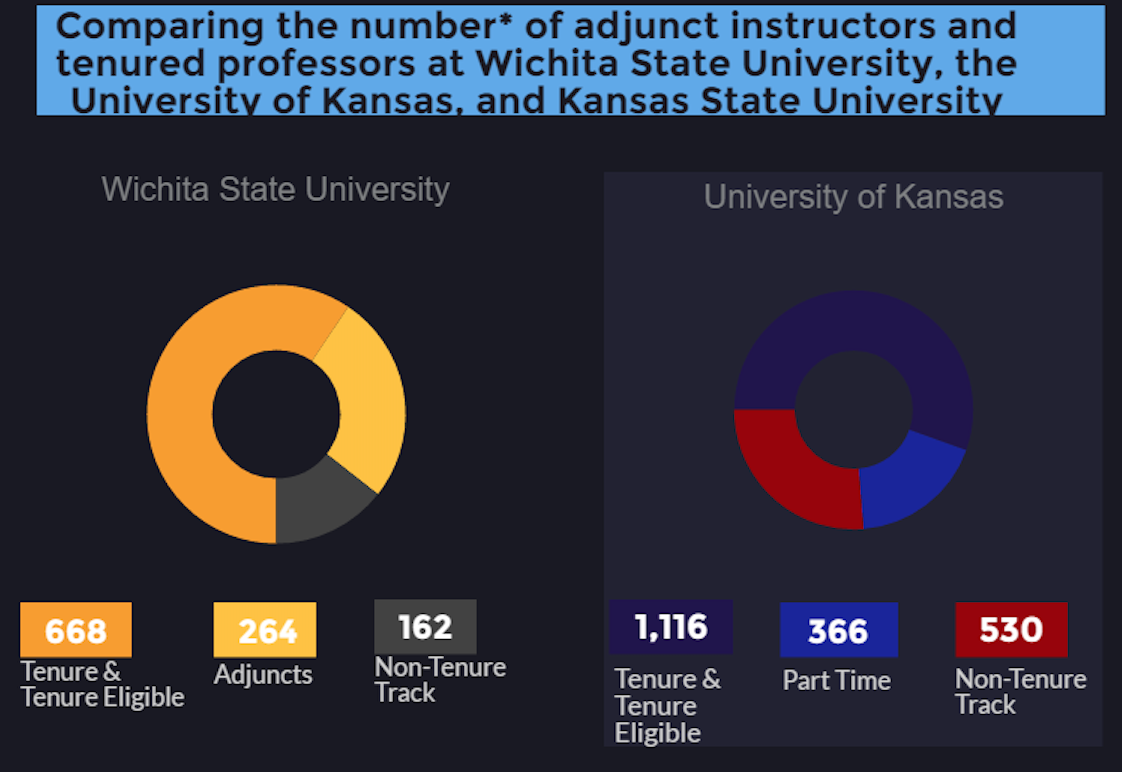
At WSU there were 420 adjuncts and non-tenure track teachers at the school in 2010, while that number grew to 442 in 2015 (5.2 percent increase). Meanwhile, tenured professors have fallen off, as there were 407 in 2010 and 392 in 2015 (3.7 percent decrease).

This trend of growing adjunct numbers is consistent at the University of Kansas as well, as tenured professors have dropped from 904 to 879 (2.8 percent decrease) at KU in the past year, and part-time instructor numbers have risen from 509 to 530 (4.1 increase).

According to the Atlantic, the number of full-time-tenured faculty has decreased nationally by nearly 10 percent since 1975 and sits around 18 percent now. Meanwhile, part-time faculty figures are on the rise, growing more than 15 percent in that same time.

Kansas State has 1,088 members of its faculty, with 546 of those members already having tenure, and another 243 are on the tenure track. K-State’s 73 percent is the highest amongst the three major universities in the state of Kansas.

Glenmaye said while adjuncts can be economically beneficial to a university, it is not the driving motive behind the increasing hires.

“I think our hiring practices have been stable over a fairly long period of time,” Glenmaye said. “Departments are hiring adjuncts when either tenured professors cannot teach a class or there is a very specific need to be met.”

Glenmaye continued to say there are times when community professionals are more qualified to teach a course than a tenured faculty member. She also said it is possible that as the number of online classes increase, adjuncts might be hired more to instruct those classes.

On the tenure-track, Grant is doing research to supplement her academic curriculum. Grant has published six articles in the past five years, adding legitimacy to her department and the university.

“We are also scholars that study deeply into our subjects,” Grant said. “We have a much better understanding of the impact and intention of the material because of the research.

Electrical Engineering and Computer Science Chairperson at the University of Kansas, Victor Frost, echoes the sentiment that tenured professors are invaluable to their university, as all of their time and energy is put into either their class or the betterment of the institution.

“Being a research-one university, tenured faculty are doing more than just teaching,” Frost said. “They’re involved in research and creating knowledge, which is very often brought into the classroom.”
While KU’s EECS program only has tenured faculty on its staff, Frost acknowledges the value of having part-time professors with constructive jobs as well.

“Anything that brings practical examples into the classroom is a benefit to the students,” Frost said.

Frost said the EECS department has always used tenured faculty. He went on to say that guest lecturers are occasionally brought into classrooms to provide real world cases to the students.

Matt All is an adjunct professor at the KU Law School. He is also the senior vice president of the general counsel at Blue Cross/Blue Shield of Kansas. All teaches insurance law at KU and has taught other classes such as Indian Gaming Law.

KU’s law school had not been teaching insurance law, and Edwin Hecker, the law dean at the time, got in touch with All to begin teaching the class in 2002.

All said that his teaching position has helped with his day jobs as well, crediting the classroom with making him a better lawyer and insurance regulator. He said there is a strong link between what happens in his classroom and what he deals with on a daily basis in the real world.

Especially when it comes to law school, All said that students find there is often a lot more ambiguity and gray-areas outside of the classroom than in the cases they read in textbooks. All has the ability to bring real-life examples of that ambiguity into a teaching environment to give his students a preview of what to expect.
“What I find is that their eyes light up when I talk to them about what being a lawyer is like, and what different types of career paths they can choose,” All said. “I can describe how a legal issue actually manifest itself into a real-life situation.”

While All brings outside instances into the classroom, he admits that it is not the most important part of being an instructor. He said he advises new instructors that “war stories” cannot supplement a real syllabus. Stories and scenarios from day jobs should only be used as supporting material. All said understanding the material you are going to teach is crucial to your success and the success of your students.

“As an adjunct, you have to teach them the basic material and respect that and use your experience and material as a compliment to that,” All said.

The number of adjuncts found at major universities is trending upward around the country. Adjuncts and tenure professors both bring a unique perspective to their classroom that benefits the students in different ways. Glenmaye said that adjuncts and tenure professors are important to making a University run.

“Adjuncts are not being hired in lieu of (tenure professors),” Glenmaye said. “I don’t think there is any sense here at Wichita State that adjuncts are seen as a replacement, they are a compliment.”

Benjamin Felderstein is a University of Kansas senior from Rockville Centre, New York, majoring in journalism. 

🎥 Hays man unites classic car with its original owner

By JONATHAN ZWEYGARDT & COOPER SLOUGH
Hays Post

While on a trip in Colorado, Merle Loewen, Ellinwood, purchased a scale-model car, at his wife’s urging, for his desk. The model is a red and white 1957 Chevrolet Bel Air, a car Loewen and his wife owned brand new in 1957 — and a car he last saw in 1967 and never thought he would see again.

But that all changed earlier this year when he was contacted by Chris Miller, owner of Auto Tech in Hays, who told him he had the classic 1957 Chevrolet and it has been in Hays for 15 years, just 75 miles away.

In 2001, Chris Miller purchased the classic from a car collector in Wichita. Miller is only the third owner in the car’s history.

The car is an all-original red and white 1957 Chevrolet Bel Air two-door hardtop. According to Miller, the engine and transmission have been rebuilt but everything except the tires are still original, just like it came from the factory in 1957.

Miller said it is rare to find classic cars in this good of shape. It won the “Best Original Award” at a car show in Hays this year.

He began searching through the car and found an original warranty sheet in the glove compartment with the original owners’ names on it — “Merle and Betty Loewen.”

“I got me thinking,” Miller said. “I wonder if he’s still around.”

Over the years, Miller would search the internet on occasion for Loewen but was never able find anything — until January of this year, when Miller found the obituary for Betty Loewen. Loewen had passed away from cancer in December 2015.

Miller reached out the Loewen’s son and, a short time later, Loewen called Miller and they talked for almost an hour. Miller said Loewen expressed interested in seeing that car again, so they were able to set up a meeting for this month.

On a cold December day last week, Loewen and a friend, Dennis Carson, also of Ellinwood, made the trip to Hays to see the car Miller calls a “true survivor.”

Miller had Loewen help him remove the car cover in the garage at Auto Tech, 600 Vine, and he immediately remembered the two identical dents on the top of the cars tail fins left by a garage door that fell on the car one morning at their home in Topeka.

Loewen, who worked as a teacher for more than three decades, said they purchased the car new in 1957. The car came straight from the factory and was delivered April 4, 1957, according to the warranty sheet.

While looking over the car, Loewen also recalled taking the car on a road trip with his family and driving to the A&W in Topeka. They had seat belts – which were not a standard option – installed to make it safer for the kids to ride in. The seat belts were removed by the second owner, who Miller called a “purist.” But the anchors are still there.

Loewen said his family lived in Topeka while he attended Washburn and also lived in Emporia, where Merle taught at Emporia State University, and in the Wichita area.

In 1967, the car had nearly 80,000 miles on it and they decided to sell it to a man in Wichita — a decision Miller said he regrets.

“It wasn’t until later you discovered what an interesting vehicle you had,” he said.

Loewen said after paying $3,000 for the car when it was new, he sold it for $400 or $500.

“Well, it was good for Howard anyway,” Miller said with a laugh, “because he’s the one who got the big check.”

According to Miller, the car has 96,763 miles on it now.

Miller told Loewen and Carson to climb in as they went for a drive around Hays, much to all three’s delight as they smiled from ear to ear.

On multiple occasions when seeing the excitement on Loewen’s face, Miller said, “I’m having just as much fun as you are.”

Following their ride around town, Loewen got a chance to sit behind the wheel of the car for the first time in 50 years. Loewen said with smile, “50 years,” as he placed his hands on the steering wheel.

Miller said this is definitely a rare story; one where an original owner is reunited with the car. He said it may happen after 30 years, “but not 60.”

The two men said they hope reconnect again and might drive it in a local parade in the future.

🎥 FHSU interim president: ‘This was a matter of doing the right thing’


Video by Cooper Slough

By GARRETT SAGER
Hays Post

Fort Hays State University is under new leadership as Dr. Andy Tompkins is now officially on campus to serve his role as interim president of FHSU.

The Kansas Board of Regents made the announcement Dec. 14 that Tompkins would be named interim president after the Nov. 23 resignation of Dr. Mirta Martin.

The conversation between Tompkins and the Regents was short, according to Tompkins, who said he really did not need to think about it that long — just needed to talk with his wife.

“This wasn’t a matter of saying ‘yes.’ This was a matter of doing the right thing,” Tompkins said. “I have this special affection for this institution, so it was easy for me.”

While he is is still getting settled into his new home and office, Tompkins said he about the opportunity he was given.

“I’m honored to have this chance of being in a interim role and help out,” Tompkins said. “I feel at home.”

Tompkins is a the former president and CEO of the Kansas Board of Regents, a position he held for five years before retiring last year. It is because of that position that Tompkins says he has a good idea of what university presidents are supposed to do.

“I was at the board and worked with all the presidents. That was part of the role as CEO, so I do have a pretty good idea of things presidents have been doing,” Tompkins said.

His CEO position of KBOR also allowed him to get acquainted with different faculty and staff members at FHSU, including former FHSU President Dr. Edward Hammond. Tompkins also served on the search committee that hired Martin.

“I’ve know Dr. Hammond for a lot of years. … When we hired Dr. Martin, I was apart of the search committee so I was able to get to know more people because of that. And then there’s been people who have been very generous to the university that I have gotten to know of the years, some are faculty members here and former faculty members here, so it’s a nice start for me to have people that I at least know,” he said.

Tompkins is aware he takes over a role in which his predecessor left under troubling circumstance, but Tompkins would rather focus on the future rather than the past.

“The way I like to say this is, I don’t know anything about it and I really don’t want to know anything about it because there is not anything that I can do about it,” he said. “The only thing that I can do is try to help us be as good as we can be, move forward, and try to make sure we have this place as great as a place as it can be.”

Tompkins said his role as interim president is to make sure that faculty and students continue to like being at the university, make sure that previous goals set by FHSU stay on track, and to make sure that the university is ready for the next president when that time comes.

He knows there will be new challenges as the months progress, but is fully confident that he can handle those situations when they come to be.

Currently Tompkins is in discussions with the FHSU Student Government President Emily Brandt on scheduling a meet and greet with students, faculty, staff and the community.

He will be touring campus and visiting with different staff members to get better acquainted with the campus and faculty in preparation for the beginning of the second semester.

🎥 Three-time Olympian brings back special gift to Hays second graders

By GARRETT SAGER
Hays Post

Second graders in Beth Simon’s class at O’Loughlin Elementary were greeted by a world-class athlete Monday afternoon who brought a gold-caliber surprise with her.

Kaillie Humphries, a two-time Olympic gold medalist in bobsledding for Canada, came to visit Simon’s class, bringing with her “Flat Morgan” — a rendition of the classic “Flat Stanley” character from the popular 1964 children’s book.

www.flatstanley.com
www.flatstanley.com

Morgan Armbruster, a second grader in Simon’s class, sent the “Flat Morgan” replica of herself to Humphries, who is dating her uncle, Travis Armbruster.

Before sending the cutout of herself, Morgan had mentioned to Humphries that she wanted to send it to her, and she jumped at the chance.

“As on Olympic athlete, I have a responsibility to give back,” Humphries said. “It’s important to find different avenues in which you can give back and help the young kids out.”

Simon said a lot of friends and family willingly participated in the Flat Stanley project, but was grateful Humphries did what she did.

“We’re so thankful Kaillie participated in this,” Simon said.

Humphries had Flat Morgan for a week and was more than enthused to take it along with her as she trained for the 2018 Winter Olympic Games in PyeongChang, South Korea.

bobsled
Kaillie Humphries and Flat Morgan inside a bobsled.

During her training sessions, Humphries took photos with Flat Morgan and send them back for the class to see.

“She sat in the bobsled with me and she came to the gym with me because I have to work out a lot,” she told the class.

Flat Morgan also lifted weights with Humphries, rode the bike and even rode shotgun in the bobsled with Humphries.

Humphries was in town visiting Armbruster’s family after competing in the World Cup last weekend in Lake Placid, N.Y., where she took home the bronze in the two women bobsled competition.

The Olympic champion did not leave the class until offering the students some advice, telling the class to always chase their dreams because they never know what they will achieve, to do their best, and know itss not always about winning or losing.

“Whatever you want to be, just chase it and do your best,” Humphries said.

Humphries knew she always wanted to be an Olympic athlete, but bobsledding was not her first sport of choice.

“I played soccer, volleyball, badminton and figure skated first,” Humphries said.

At first, Humphries wanted to be an Olympic skier.

Humphries grew up in a mountainous area of Canada, she said, and started skiing at age 9. She skied until about age 16, which is when she realized she wasn’t going to make the Olympics in that sport.

“I really wanted to go to the Olympics, but I was not built to be a skier,” she said.

Down the mountain from where Humphries skied was the bobsled track — she decided to give it a try. Within a year, Humphries had made the national team at age 17 and began traveling the world.

“I went to some different places traveling the world and met a ton of cool people,” she said.

In 2006, Humphries made the Olympics for team Canada as alternate for the games in Turin, Italy.

“An alternate meant that I did not compete,” Humphries told the class. “It was hard for me to watch, because all I wanted to do was compete.”

In the 2010 Olympic Games in Vancouver, British Colombia, Humphries got her chance to compete in her home country and in front of her friends and family.

Humphries and her teammate Heather Moyse won gold in 2010 and would win it again in the 2014 games in Sochi, Russia. She is currently training to qualify for the 2018 Winter Games, working out six hours a day, six days a week.

“Bobsledding is my job. It’s what I do,” Humphries said.

Eighth annual Community Christmas Dinner scheduled at VFW

Submitted

The eighth annual Community Christmas Dinner will be held at the VFW on Christmas Day, Dec. 25, from 11 a.m. to 1 p.m. A traditional meal will be served, provided in part by the VFW and in part by donations received from the community, purposefully given toward the Christmas dinner. The venue is donated by the men of the VFW, who also give their time on Christmas Day, and prior to the dinner, to prepare the meal.

The vision of the Community Christmas Dinner is to provide a place where people from the community can gather together to celebrate the true meaning of Christmas, and that is celebrating the birth of Jesus. We often find ourselves consumed by the busyness of the season and lose sight of the true purpose of Christmas; the dinner brings the community together to acknowledge this, as well as to fellowship with one another. The dinner provides a peaceful, family-friendly atmosphere open to all who wish to come and enjoy a Christmas meal at no cost, whether this means coming as a family, with friends, or alone. The dinner also allows members of the community to serve one another and be served through volunteering, which is a reminder of Jesus and who He is, and what He has called us to do. Though Jesus is acknowledged, all are welcome and invited to the Christmas Dinner regardless of personal beliefs.

Volunteers help to keep the dinner going each year and are vital to the dinner’s success; we are seeking people willing to serve this year as in years past—last year, approximately 80 volunteers served at the dinner in various areas, and over 700 meals were served in total. Volunteers are welcome to serve any portion of the day and can leave at any time. For those able to attend, a meeting will be held at 9:30 a.m. the morning of the dinner. Information will be relayed during this time regarding areas of help needed, as well as getting the volunteers situated prior to the dinner. Tasks include (but are not limited to) decorating/set-up, greeting, filling drinks, distributing desserts, clearing tables, clean-up, delivering meals, and making sure other needs are being met. We are also asking for willing community members to provide desserts for the dinner, as these are solely provided by the community.

If interested in volunteering, providing dessert, donating, or if needing delivery of meals, please contact Brittany at (785) 259-3766 or [email protected]. Donations received will go toward the dinner itself or other areas of need within the community.

Copyright Eagle Radio | FCC Public Files | EEO Public File