We have a brand new updated website! Click here to check it out!

FIRST FIVE: Teacher-led prayer — unconstitutional but appropriate?

Benjamin P. Marcus

There is no question that Americans could use a lesson or two on the Constitution and its amendments. The Freedom Forum Institute’s 2019 State of the First Amendment survey found that only 29 percent of respondents could name freedom of religion as one of the five freedoms safeguarded by the First Amendment. To protect religious freedom, we must educate the public about our inalienable rights.

But what should educators and legal literacy advocates do when people know the law but do not care if authority figures violate it? That is the question raised by a recent survey of teenagers, ages 13 to 17, conducted by the Pew Research Center.

On Oct. 3, Pew published the results of a national survey of American teenagers designed to provide insight into religious activities conducted in American public schools. Their findings are a treasure trove for those who care about religion and education, not least because it is the first large-scale, national survey that asks teens themselves about their experiences with religion in schools.

Some findings might not surprise readers. For example, 53 percent of teens report that they often or sometimes see other students wearing clothing or jewelry with religious symbolism such as the hijab, turban, cross, or Star of David. And 39 percent of respondents say they often or sometimes see other students pray before sporting events.

But another finding should shock Americans committed to religious freedom: 29 percent of students simultaneously know that teacher-led prayer is unconstitutional, but still think it is appropriate.

On the one hand, teachers can be proud of the fact that 82 percent of teens in public schools correctly answer the question, “According to rulings by the U.S. Supreme Court, is a public school teacher permitted to … lead class in prayer?” The answer is, of course, no — though the U.S. Department of Education has affirmed that student-led, student-initiated prayers are allowed when conducted alone or in groups before, during or after the school day, as long as they do not disrupt student activities or teacher instruction.

However, 41 percent of teens say that it is “appropriate” for a teacher to lead a class in prayer. Across multiple religious groups (e.g. evangelical Protestant, mainline Protestant, Catholic and unaffiliated), fewer students say teacher-led prayer is constitutional than appropriate. For example, only 18 percent of evangelical and 13 percent of unaffiliated students say incorrectly that teacher-led prayer is constitutional, but 68 percent of evangelical and 25 percent of unaffiliated students say that teacher-led prayer is appropriate.

Memorizing the five freedoms of the First Amendment will not solve this problem. The data shows that an encouraging percentage of American public school students already know that teachers should not lead students in prayer. Perhaps teachers have covered the U.S. Supreme Court’s 1962 decision in Engel v. Vitale in government or U.S. history courses. Or perhaps students learn about the prohibition against teacher-led prayer from the media, parents or religious communities. In any case, lack of knowledge is not the issue.

The problem is more fundamental: students do not seem to understand why it is important to preserve a religious freedom principle as foundational as the non-establishment of religious practice by public schools.

Students may have different reasons for finding teacher-led prayer appropriate but unconstitutional. Some religious students might think that the U.S. Supreme Court wrongly prohibited teacher-led prayer and they might consider it good to defy the court to protect religion. Other students might be more ambivalent. Perhaps they know the rule about teacher-led prayer, but they do not think enforcement — or lack thereof — affects their lives.

The reality could not be more different. Upholding religious freedom protections is in the interest of every student, whether religious or not, in a country that is rapidly becoming a nation of religious minorities. And the careful balance struck by the Establishment and Free Exercise clauses of the First Amendment — which has compelled the court to strike down teacher-led prayer — actually protects religious communities from harmful government interference or cooptation. Plus, religious communities can never be sure that a government body will not write prayers that contradict their sincerely held beliefs.

So how can educators close the gap between students’ knowledge and commitment to religious freedom?

Students should learn why the current constitutional order matters. To do this, legal literacy education will need to move beyond the memorization of constitutional amendments and court cases. Teachers should help students understand why religious freedom protections — like the prohibition against teacher-led prayer — benefit people of all religions and none. And students should learn about the negative social and political consequences of religious freedom violations. Inquiry-driven coursework should offer students opportunities to explore cases, both historical and contemporary, which demonstrate why students should protect the rights safeguarded by the First Amendment. Without the ability to articulate why religious freedom matters, students will not care whether or not people in authority transgress longstanding rules protecting it.

And, in the spirit of the Williamsburg Charter, published on the 200th anniversary of Virginia’s call for a Bill of Rights, students should learn that their rights are best guarded when they accept the responsibility to protect those rights for others, including those with whom they strongly disagree.

Pew has offered a glimpse of students’ attitudes toward religious freedom in schools, but there is so much more to learn. I suspect that the disconnect between students’ knowledge about the law and their commitment to the law and its underlying principles extends far beyond the realm of religious freedom to other rights. Thankfully we do not need more data to start improving the way we teach about the laws that bind us out of many into one.

Benjamin P. Marcus is religious literacy specialist at the Religious Freedom Center of the Freedom Forum Institute. His email address is: [email protected].
The Latest: Crews contain large grass fire in northwest Kansas

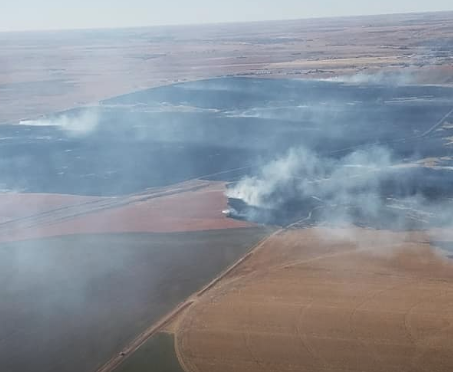
Photo Cheyenne Co. Sheriff

CHEYENNE COUNTY — Crews were busy fighting grass fires Saturday in Cheyenne County that prompted Governor Laura Kelley to issue a verbal disaster declaration.

The first grass fires were reported just after 11:30 a.m., according to Ryan Murry, Cheyenne County Emergency Management Director.

They ultimately had to battle several grass fires across the county. Just after 5 p.m., Murray said the fires were contained. Crews continued to monitor hot spots and the Kansas Forrest Service continued to drop water on those hot spots.

There is no word on the number of acres burned. The fires may have started by a semi driving by on the highway with a mechanical issue, according to Murry. The cause of the fires is still under investigation.

Space at a premium at Wilson, school board members learn on tour

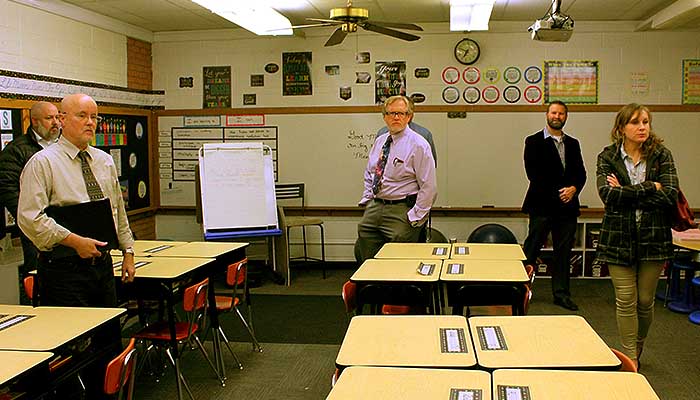
Hays school board members toured Wilson Elementary School on Monday and learned that space is an issue throughout the school.

By CRISTINA JANNEY
Hays Post

The Hays school board toured Wilson Elementary School during its work session Monday night and discovered space is one of its significant challenges.

Wilson is housing more students now than it ever has, said Principal Anita Scheve. The school’s enrollment is 408 students. The school has three sections of each grade kindergarten through fifth grade.

A teacher has carved out a reading area in her room to promote the district’s reading and writing curriculum.

Although the enrollment at the other three-section elementary schools in the district are similar, the total square footage at Wilson is much less. Wilson has about 39,000 square feet. The square footage at O’Loughlin Elementary is 49,000 square feet and the square footage at Roosevelt is 59,000 square feet.

“If you think about it, Roosevelt has almost the same enrollment but almost 50 precent more square footage to work with,” Scheve said. “A common theme you are going to see tonight is lack of storage and we are crowded.”
At several locations throughout the school, Scheve noted lighting. Many of the lights are original to the building when it was built in 1959. The district has been replacing lights at other schools with LEDs in attempts to save money.

The art and music wing was added to Wilson in 1966. An addition was built at Wilson in 1985 and one more classroom added in 1989, but the school has not had a significant renovation since.

The Wilson boiler is original to construction of the school in 1959. At least one room remains at 85 degrees year round because of the problems with the HVAC system.

The HVAC system in the building also dates to when the building was constructed in 1959. Scheve said at least one of the classrooms remains at 85 degrees year round.

Storage is a serious concern for the school. The fire marshal told the school officials after a recent inspection that it will have to move items that are being stored in hallways to other locations for safety reasons.

The school has two very small storage sheds. Scheve said she is working with buildings and grounds to move in a shipping container for more storage for the school.

The school is using smaller desks, because it needed to have some floor space for children to gather to work on reading and writing curriculum. Each classroom has its own library as a part of that curriculum. Those books take up space, which is at a premium. Teachers also have to carve out space for the storage of iPads.

The average size of classrooms at Wilson is 700 to 750 square feet, but designers today are recommended new elementary classrooms be a minimum of 900 to 1,000 square feet.

Outside, Scheve said she would like to have more cameras on the playground, because it is large and hard to supervise. She also said she would like less asphalt, because children have been injured by slipping and falling on the asphalt.

Plumbing and corroded pipes are problems at Wilson. Some of the pipes date back to 1959 when the school was built.

Plumbing is becoming an issue because much of it is also original from 1959. Much of the plumbing in the building is cast iron.

As part of the school’s trauma responsive practices, classrooms have calm-down corners for kids.

“Really just a space where they can use if they are feeling frustrated and they don’t know what to do with those feelings,” she said. “It is a space to stay in the class, but for the teacher to recognize and the student to recognize ‘I need some help or I need some time to figure things out or to get myself back to a learning state.’ ”

Wilson’s gym is also used as the cafeteria and auditorium. When the building was built, it only had two sections of each grade, so many more students are using the space than was originally intended.

Scheve said the school has to schedule everything around its gym classes, because the time in the gym/cafeteria/auditorium is at such a premium. She said the students and staff are pressed for a time on a daily basis, because there is a gym class 10 minutes after breakfast and a gym class that ends 10 minutes before lunch is served.

The schedule is further complicated because Wilson shares a PE teacher with Lincoln Elementary School.

Wilson’s combined gym/cafeteria/auditorium causes scheduling problems.

The school can’t fit all of its students in the gym/auditorium for programs, so it has to break the student body into two sections — K-2 and 3-5.

O’Loughlin has a larger gym, and it also has a separate cafeteria, Scheve said.

The school does not have a tornado shelter. The children shelter in the school’s hallway, which has skylights.

Hays High senior awarded Smith 4-H scholarship

Quentin Rupp

The Ellis County 4-H Scholarship & Development Fund has awarded this year’s Rosemary Smith 4-H scholarship to Quentin Rupp of Hays.

Rupp is a senior at Hays High. He has been an active member of the Big Creek Astros 4-H Club for the past twelve years. He has been actively involved in Livestock, Photography, Woodworking, Leadership and Community Service projects.

Rupp has served as an officer in his 4-H club and has held several county leadership positions as well. He has been actively involved in planning and carrying out the Photo Adventure Day Camp for community youth each summer.

Rupp plans to attend NCK-Tech in the fall, majoring in welding. He is the son of Julie Miller of Hays.

The Rosemary Smith 4-H scholarship is presented in memory of a long time Ellis Co. 4-H volunteer by her family. The $250 scholarships are awarded to high school students who are taking concurrent credits or to current college students with a 4-H background.

4-H Scholarship & Development is a subcommittee of the 4-H Program Development Committee representing the Cottonwood Extension program. Their primary focus is fund development to support the 4-H Youth programs and scholarships in Ellis County. To give support to this fund, contact the Cottonwood Extension Office at (785) 628-9430.

– SUBMITTED –

Report: Voter turnout up at Fort Hays State in 2018 mid-terms

FHSU University Relations

Fort Hays State University recently reported that student voting on its campus was up in last year’s election, increasing to 40.2 percent in 2018 from a rate of 26.3 percent in 2014.

“Education for democratic engagement is more crucial than it ever has been, given the current partisan divide and polarized political environment,” said Dr. Larry Gould, chair of the Department of Political Science at Fort Hays State and current faculty adviser and long-time participant in the American Democracy Project.

“Recent student ADP leadership and FHSU’s Student Government Association have made a spectacular difference in getting students to understand the importance of voting as a responsibility of citizenship,” he said. “The excellent improvement in all voter categories is a testament to their hard work and dedication.”

The report is part of the National Study of Learning, Voting, and Engagement, or NSLVE, conducted by the Institute for Democracy and Higher Education at Tufts University’s Tisch College of Civic Life.

Noble

The full campus report can be viewed HERE.

The study shows that, nationwide, the voting rates at participating college campuses doubled on average compared to the previous midterm election, in 2014. In 2018, the Average Institutional Voting Rate among campuses in the study was 39.1 percent, nearly 20 percentage points higher than 2014’s average turnout rate of 19.7 percent. Turnout increases were widespread, with virtually all campuses seeing an increase over 2014.

“Voting and registration rates at Fort Hays State University are up in every category – age, race/ethnicity, gender, and enrollment status,” said Dr. Donnette Noble, Voss Distinguished Professor of Leadership Studies and director of civic learning and engagement at FHSU.

“The increases are significant and demonstrate that Fort Hays State is living up to its commitment to promote civic engagement and foster a generation of forward thinking and world ready global citizens,” she said. “It is incredibly exciting that our community of students is outpacing the national averages.”

The NSLVE is the only national study of college-student voting. It is based on the voting records of more than 10 million students at more than 1,000 colleges and universities in all 50 states and the District of Columbia. The IDHE does not receive any information that could individually identify students or how they voted.

The study provides reports to participating colleges and universities, like Fort Hays State, which use them to support political learning and civic engagement as well as to identify and address gaps in political and civic participation.

Breathe Coffee House to host Operation Christmas Child packing party

On Nov. 12, more than 100 empty shoeboxes will be transformed into gifts of hope as part of Breathe Coffee House’s packing party aimed to help children in need around the world.

Operation Christmas Child, a project of the international Christian relief organization Samaritan’s Purse, will deliver the shoeboxes — filled with fun toys, school supplies, and hygiene items — to children in need.

“It is amazing to be a part of a community that understands the power of giving. We are so excited to host a party to prepare shoebox gifts that will send a message of hope and love to children around the world. For many of these children, the gift-filled shoebox is the first gift they have ever received,” said Rachel Albin, Operation Christmas Child NW KS Area Coordinator.

SEE RELATED: Cambodian woman finds Christ’s love through Operation Christmas Child

SEE RELATED: Shoebox packing parties in full swing for Operation Christmas Child

The party, held at Breathe Coffee House, 703 B Main St., Hays, November 12 at 7 p.m., is open to the public, and anyone is welcome to experience the joy of giving.

Donations of items and monetary would be accepted and appreciated.

Breathe Coffee House hopes to pack 100 gifts to contribute to the expected 3,000 shoebox gifts collected this year in Hays.

To RSVP or donate to the event, email [email protected].
– SUBMITTED –

Calling all businesses: Lender Rodeo will be this month at FHSU

FHSU University Relations

The Kansas Small Business Development Center at Fort Hays State University, along with the U.S. Small Business Administration’s Wichita District, will host the Lender Rodeo, an event geared towards connecting individuals with various lenders.

The event will be from 11:30 a.m. to 3:30 p.m. on Wednesday, Nov. 20 at the Robbins Center at Fort Hays State.

The W.R. and Yvonne Robbins College of Business and Entrepreneurship of Fort Hays State wants to provide pre-existing or start-up business opportunities to pitch their financial needs. One-on-one, ten-minute sessions will be available.

Cost of attendance is $20 with lunch included. You can register at: https://ksbdc.ecenterdirect.com/events/25244. You can also call the office at 785-628-5615 for more information.

Free Lake Wilson admission on Veterans Day

Wilson Lake / KDWPT

KANSAS CITY, Mo. — The U.S. Army Corps of Engineers announced it will waive day use fees at its more than 2,850 USACE-operated recreation areas nationwide, including Wilson Lake, in observance of Veterans Day, Nov. 11.

The waiver covers fees for boat launch ramps and swimming beaches. The waiver does not apply to camping and camping-related services, or fees for specialized facilities (group picnic shelters) and events. Other agencies that manage recreation areas on USACE lands are encouraged, but not required, to offer the waiver in the areas that they manage.

USACE began the Veterans Day fee waiver in 2006 as a way to honor the men and women who have served our nation and the armed forces.

USACE is one of the nation’s federal leaders in providing outdoor and water-based recreation, hosting millions of visits annually to its more than 400 lake and river projects. It’s estimated that 90 percent of the USACE-operated recreation areas are within 50 miles of metropolitan areas, offering diverse outdoor activities for all ages close to home.

To discover a USACE recreation site nearest you, please visit www.corpslakes.us, or www.recreation.gov

— U.S. Army Corps of Engineers

Rush County woman hospitalized after SUV crash

STAFFORD COUNTY— One person was injured in an accident just before 10p.m. Friday in Stafford County.

The Kansas Highway Patrol reported a 2007 Dodge Durango driven by Donald L. Elliott, 58, Otis, was westbound on NE 70th Street four miles north of St John.

The driver disobeyed the stop sign at U.S. 281. The vehicle left the road, entered the ditch, struck a fence and rolled onto the driver’s side.

EMS transported a passenger Amber L. Rightmyer, 22, Otis, to the Stafford County Hospital. Elliott was not injured. Both were properly restrained at the time of the accident, according to the KHP.

Boil order rescinded for Osborne County community

TOPEKA – The Kansas Department of Health and Environment has rescinded a boil water advisory for the City of Portis, located in Osborne County. The advisory was issued because of a loss of pressure due to a waterline break. Failure to maintain adequate pressure may result in a loss of chlorine residuals and bacterial contamination.

Public water suppliers in Kansas take all measures necessary to notify customers quickly after a system failure or shutdown. Regardless of whether it’s the supplier or KDHE that announces a boil water advisory, KDHE will issue the rescind order following testing at a certified laboratory.

Laboratory testing samples collected from the City of Portis indicate no evidence of bacteriological contamination and all other conditions that placed the system at risk of contamination are deemed by KDHE officials to be resolved.

For consumer questions, contact the water system or call KDHE at 785-296-5514.

Copyright Eagle Radio | FCC Public Files | EEO Public File