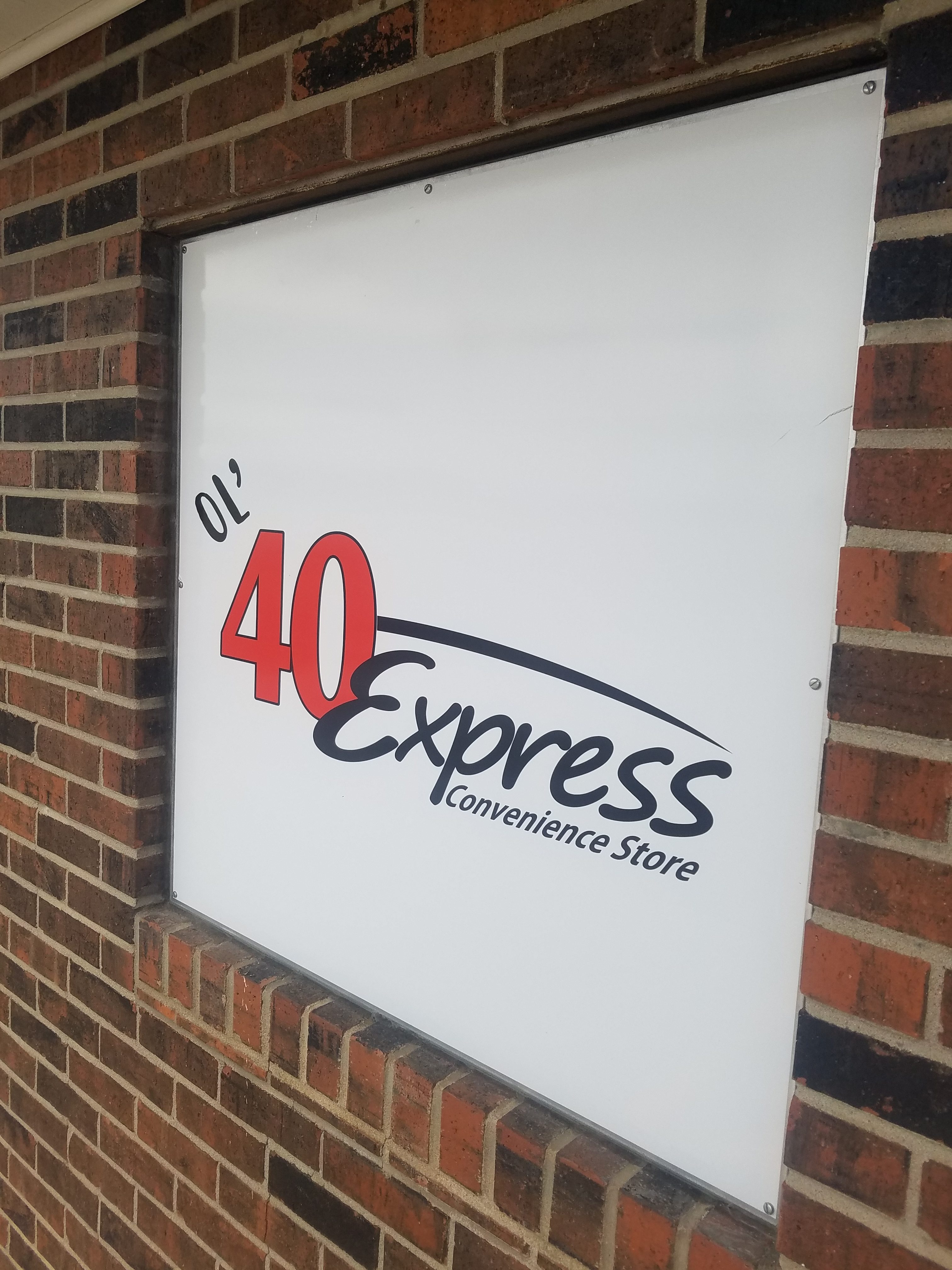
About a year after the El Charro Convenience, 2020 E. Eighth, store closed its doors, new owners are to reopen the location with a new look and offerings.
Co-owner and manager Liz Smith said she was interested in purchasing the business last year after driving by the location.
“When we saw it was for sale, it sparked our interest,” she said.
Smith has a background in retail and thought this would be an opportunity to once again be self-employed.
“It’s nice to work for yourself,” she said.
Since completing the purchase on June 4, Smith began on full remodel on the building, bringing new life into the old solid brick walls.
“We have repainted, put in new floors, brought in all new appliances, all new countertops and shelving, everything is new,” she said.
That work is not expected to end when the store reopens, as Smith has plans to continue to grow the business with a kitchen that will be completed in the future, allowing the sale of freshly made breakfast and grab-and-go lunch items.
“I will be able to make anything I want,” Smith said. “It’s not just convenience store food.”
She is also excited about new fuel pumps installed at the location and new fuel options.
“They will be open 24 hours and will be card accessible and will have 91 octane with no ethanol in it,” Smith said.
She believes they will be the only location in town that will offer the ethanol-free 91 octane.
“There are a lot of people interested in having the no ethanol in the 91 for their motorcycles, their jet skis and their older cars,” she said.
They will also have treated diesel fuel.
“We have a diesel pickup and we know what it is like to have it untreated and trying to start it when it is cold,” Smith said.
Early interest is also encouraging, Smith said.
“We took the paper off the windows (Thursday), and we can’t believe how many people have tried to stop in, which is great.”
Once finishing touches are complete on the exterior and the kitchen is up and running, Smith said a grand opening will be planned, hopefully in about a month.
Some of the employees of the previous business have returned to work in the new business.
“There will be quite a few familiar faces for those that used to come in here,” Smith said.
Hours for the Ol’ 40 Express will be from 6 a.m. to 11 p.m. seven days a week, and the fuel stations will take card payments 24/7.
The House has kicked off August recess and I was happy to be home back in Kansas with my beautiful wife, Laina, to celebrate our 36th anniversary. We have four wonderful children, and two grandchildren, who are jewels in our crown. She takes a dull day, and suddenly makes it seem worthwhile and she is a saint for putting up with me! Thank you to everyone who prays for us, as we continue this wonderful American journey, 36 years later.
Scam Alert
The Social Security Administration is working with the Consumer Financial Protection Bureau and the Federal Trade Commission to create a new fraud prevention placemat to help you identify and avoid Social Security scams. You can order free copies of the placemat to use at home, or to share with friends and family.
Here are a few things to remember to help others avoid scams:
Talk about it! Social Security scams haven’t been as common until recently. Share the message with others to make them aware of this type of scam.
Government employees will not threaten to take away benefits or ask for money or personal information to protect your Social Security card or benefits.
Report Social Security scams to the SSA Office of Inspector General Fraud Hotline at (800) 269-0271 or oig.ssa.gov/report and to the Federal Trade Commission at FTC.gov/complaint.
If you think you are being targeted by a scammer, please call my office at (785) 829-9000 for assistance. We are always happy to help!
Champlin Tire Recycling
Last week, members of my staff visited Champlin Tire Recycling in Concordia, Kan.
This small, family owned business looks for new and innovative ways to recycle old tires, turning them into items such as park benches, picnic tables, and playground mulch.
Owner Gary Champlin is the chair-elect of the Institute of Scrap Recycling Industries, Inc – an international trade association representing scrap commodities. While there, they spoke about a number of issues facing the industry, including ways we can all work to do more with less.
Thank you, Gary, for showing my team around and helping them better understand the creative ways recycling can benefit our communities.
Beef Up Sustainability
Cargill recently announced they are launching a new initiative, in partnership with The Nature Conservancy, called “BeefUp Sustainability.”
The project is committed to achieving a 30% greenhouse gas (GHG) intensity reduction across its North American beef supply chain by 2030. The opt-in initiative will reduce GHG emissions throughout Cargill’s beef supply chain from a 2017 baseline, measured on a per pound of product basis.
BeefUp Sustainability is designed to engage a variety of stakeholders including producers, customers and innovators. The initiative will focus on four areas: grazing management, feed production, innovation and food waste reduction. The 30% reduction builds on the industry’s existing GHG efficiency efforts and will equate to removing 2 million cars from U.S. highways for a year.
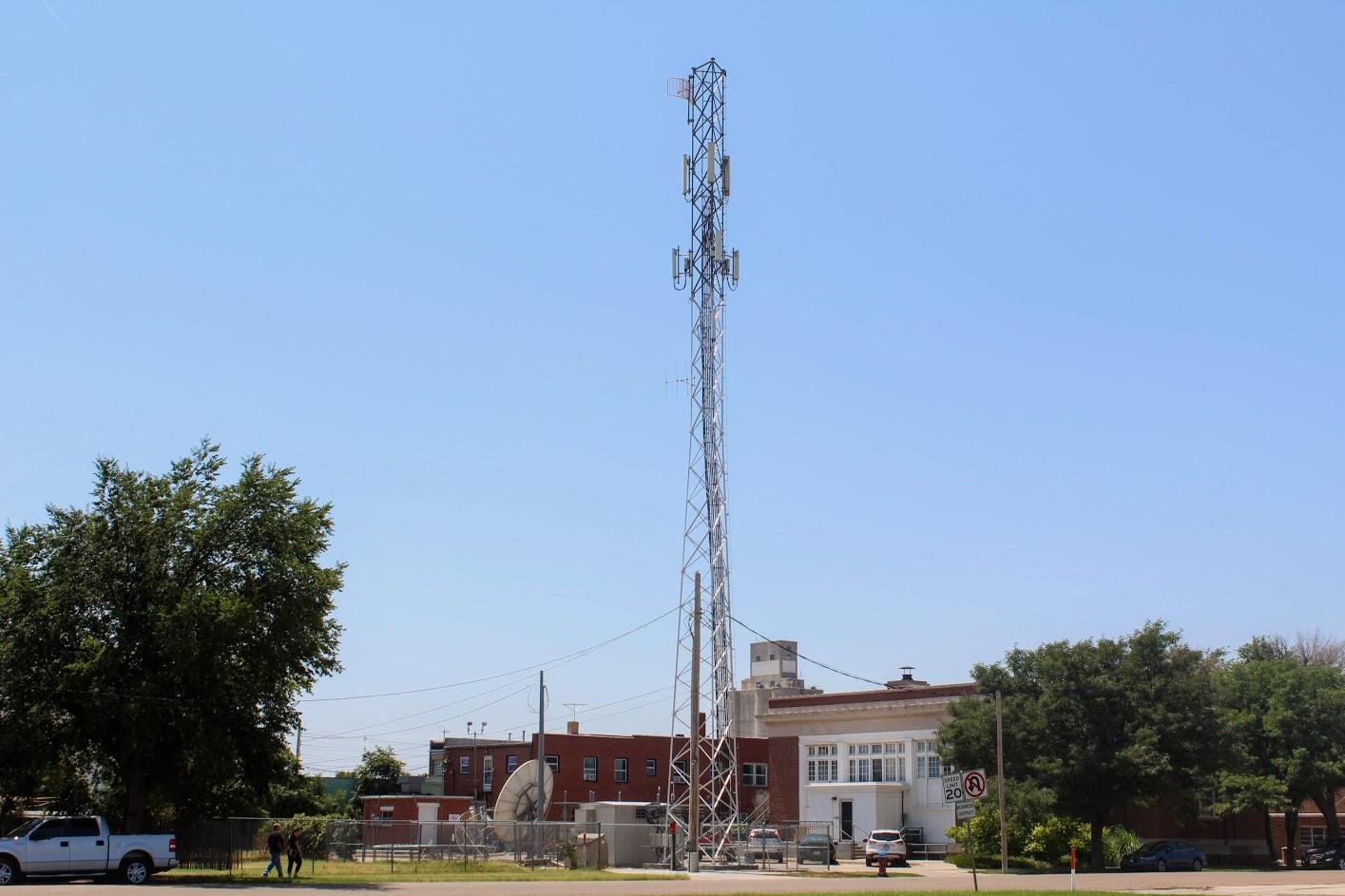
My office hosted a roundtable in McPherson to discuss issues of importance to rural broadband providers. The providers emphasized the need for updates to the national broadband maps, which are necessary for closing the digital divide. The roundtable included discussions about the need to empower stakeholders by establishing a strong challenge process to the FCC and USDA, to ensure the accuracy of data being reported. These providers are working tirelessly to build out future-focused networks in rural America, and I appreciated them taking the time to share ways in which I can help support these efforts.
Big News for Kansas Ranchers
President Trump has announced a trade deal to sell more American beef to the European Union. Kansas is one of the top beef-producing states in the nation – each year the industry contributes more than $9 billion to the state’s economy.
Thank you to the Trump Administration for fighting to deliver new and fair trade deals on behalf of Kansas farmers, ranchers, and producers.
FCC Open Meeting
The Federal Communications Commission held its August meeting and considered a number of rural-focused agenda items. The FCC is working to make access to their programs easier, by streamlining and simplifying the way health care providers can apply for telehealth support, and by formally establishing the Rural Digital Opportunity Fund. Reducing the red tape for providers is critical to continue building broadband networks, and to ensure rural homes, small businesses, and community institutions are able to connect.
Lou Ann Kibbee, Hays, is seated in front.
National Council on Independent Living
Last week, I had a great meeting with Kansas representatives, including Lou Ann Kibbee of Hays, from the National Council on Independent Living (NCIL) the longest-running national disability and grassroots organization led by people with disabilities.
The conversation focused on health care, as well as employment and economic equity. We discussed my support for H.R. 3253, the Empowering Beneficiaries, Ensuring Access, and Strengthening Accountability Act of 2019, which reauthorizes funding for the “Money Follows the Person” program, so elderly people and those with disabilities can use federal dollars to pay for care by providers of their choice.
I am pleased to report this legislation is now on its way to the President’s desk to be signed into law.
Volunteers Needed!
My office is looking for volunteers to help out at my booth at the Kansas State Fair on Friday, September 6, through Sunday, September 15. Volunteers are needed to hand out fliers and take down contact information from constituents with questions.
Gate admission and WiFi will be provided – couples welcome! If you are interested please contact my District Director, [email protected] for more info.
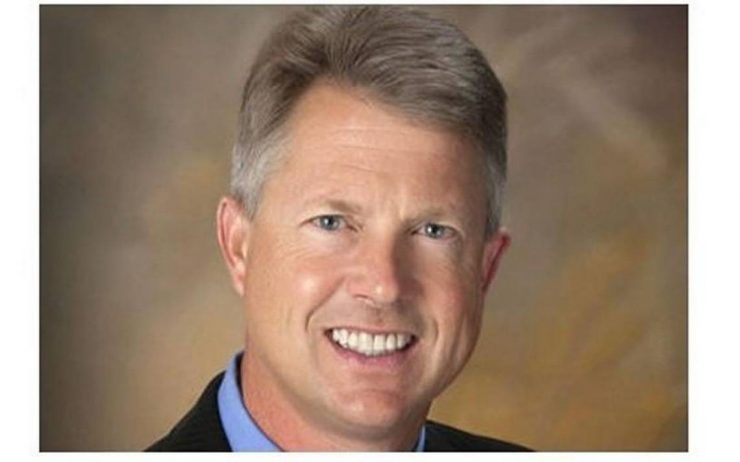
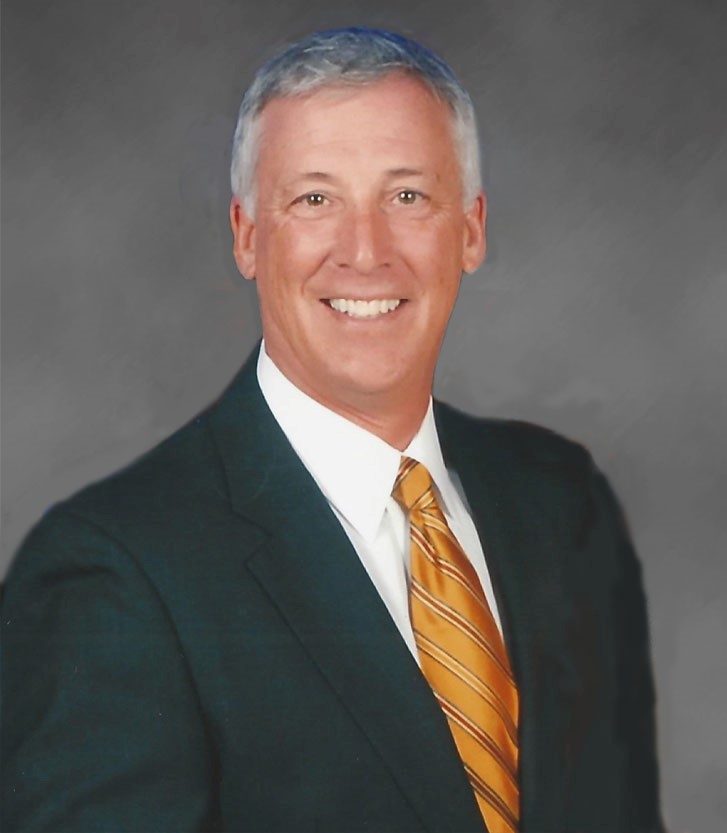
Dr. Roger Marshall (R-Great Bend) is the First District Kansas Congressman.
TOPEKA – The Kansas Department of Health and Environment has rescinded a boil water advisory for the city of Norton. The advisory was issued because of a line break resulting in a loss of pressure in the system. Failure to maintain adequate pressure may result in a loss of chlorine residuals and bacterial contamination.
Public water suppliers in Kansas take all measures necessary to notify customers quickly after a system failure or shutdown. Regardless of whether it’s the supplier or KDHE that announces a boil water advisory, KDHE will issue the rescind order following testing at a certified laboratory.
Laboratory testing samples collected from the City of Norton indicate no evidence of bacteriological contamination and all other conditions that placed the system at risk of contamination are deemed by KDHE officials to be resolved.
ELLIS COUNTY JOINT PLANNING COMMISSION SPECIAL MEETING
August 7, 2019 at 7:00 p.m.
Ellis County Administrative Center Meeting Room
718 Main Street Lower Level, Hays, Kansas
Agenda is Subject to Change
I. Call to Order
II. Roll Call
III. Public Presentation
IV. Old Business
A. Comprehensive Plan
B. Other
V. New Business
A. NONE
B. Other
VI. Confirm next meeting date: August 28, 2019 at Ellis County Administrative Center Meeting Room, 718 Main Lower Level, Hays, Kansas at 7:00 p.m.
IX. Adjournment
One of the amazing things about life in the Statehouse is that nearly everything that happens here has a political edge to it. Or two or three edges.
The latest scrap? Probably the Kansas Department of Revenue’s notice to the rest of the folks in the nation that if they sell stuff over the phone or internet or plain old mail and ship it to Kansas, they have to collect Kansas sales tax on the merchandise and send that money to Kansas, just like Kansas stores do. Those folks who don’t have a store in Kansas? They are “remote sellers” and the U.S. Supreme Court has held that they can be required to collect and remit sales tax just like the stores on any street in Kansas.
Well, Revenue has now put all those remote sellers on notice that Kansas wants that sales tax, and they should spend the morning filling out forms, registering with the state, and collecting and remitting those taxes to Kansas. Starting Oct. 1.
Sorta evens-up the prices, you don’t save 7.5 percent by just ordering stuff from out of state.
As it turns out, that notice is essentially a recitation of current state law.
Well, that notice of state law by Democrat Gov. Laura Kelly’s Department of Revenue and her agency’s intent to enforce it have become a political time bomb for conservative Republicans.
Senate President Susan Wagle, R-Wichita, has blasted the governor for enforcing that state law because she believes that Kansas is going to be sued over it at some cost to the state, or at least diverting state lawyers who could presumably be doing something else, to defend it.
Oh, and the reason Wagle’s upset? It comes down to the governor vetoing a bill that cut $35 million in income taxes to generally upper-income individuals, $72 million to corporations that do business overseas, maybe in a few years reduce the sales tax on food, and…put some limits on just which out-of-state merchants have to collect Kansas sales tax.
Nope, the out-of-state sales tax wasn’t a big deal in the bill, and the political aspects of the corporation-oriented income tax cuts don’t appear to be as heart-rending as the sales tax on food for Wagle…at least in press releases.
And, that lawsuit over that out-of-state sales tax collection might actually happen because the U.S. Supreme Court has indicated that states probably ought to have some provision for exempting some minor-league businesses from the state’s strict sales tax rules. Something like maybe $100,000 in annual sales, and maybe 200 distinct transactions.
But that’s not state law now, and we’re wondering whether the Department of Revenue just administratively allowed those exemptions, so-called “safe harbor” exemptions, without legislative authority, whether there would be an arrest warrant out for Revenue Secretary Mark Burghart…
***
Any chance lawmakers will consider some low-cost exemptions to the sales tax law next session? Or whether that “safe harbor” will become part of another major tax cut bill next session?
It could go either way.
If there’s a lawsuit, asserting that the state’s current law unconstitutionally hampers interstate commerce, it could take years to make its way through the U.S. Supreme Court.
If there’s a “safe harbor” bill that lets small and infrequent sales into Kansas without sales tax and the hassle of registering with the state? Well, that’s an amendment magnet that will undoubtedly wind up as an income tax cut bill that will include as frosting reduction in sales tax on food.
This may become a big issue in the election-year legislative session which starts Jan. 13.
Syndicated by Hawver News Company LLC of Topeka; Martin Hawver is publisher of Hawver’s Capitol Report—to learn more about this nonpartisan statewide political news service, visit the website at www.hawvernews.com
Warren H. GfellerThe Dane G. Hansen Foundation on Monday announced Warren H. Gfeller as the newest member of its board of trustees, effective immediately.
Gfeller has strong ties to northwest Kansas. He was born in Oakley, and spent his early childhood on a farm near Winona. He later moved to Russell, where he attended school and graduated from Russell High School. He earned his accounting degree at Kansas State University.
Following college, he worked for four years for Arthur Young & Company in Wichita, specializing in oil & gas accounting and taxation.
In 1978, he became the CFO of a small publicly-held oil and gas exploration and production company in Dallas, and then held a similar position at Ferrell Companies, Inc., a Kansas City based company involved in oil and gas, real estate, banking, manufacturing, financial services and propane distribution. He became President and CEO of Ferrellgas, Inc. in 1985.
Gfeller never lost his attachment to Northwest Kansas. He still has family in Russell. In 1992, he purchased a ranch northwest of Russell and began spending quite a bit of time there. In 2013, he and his wife, Angela moved to the ranch permanently.
After leaving Ferrellgas in 1991, Gfeller worked in the investment field and also served on a number of boards including many public, private and foundation boards across several different industries. He says his personal criteria for service has always been “whether I thought I had something to offer, whether the mission was one I could support and whether I could commit the time needed to do the necessary work.”
“I appreciate my rural roots and I believe sustaining our rural heritage is vital to our communities. I support 100% the mission and guiding principles of the Hansen Foundation,” Gfeller said. “I have seen the value of the grants, scholarships and initiatives of the Foundation’s work.”
Gfeller’s appointment follows the death of former Trustee, Gary Poore, who served the Foundation for 13 years.
He joins current board members, Doug Albin, Wakeeney; Carol Bales, Logan; Doyle Fair, Wichita; Robert Hartman, Hays; Cy Moyer, Phillipsburg; and Brien Stockman, Logan.
The Dane G. Hansen Foundation was established in 1965 with an estate gift from Dane G. Hansen. Based in Mr. Hansen’s hometown of Logan, the Foundation has been providing scholarships and grants to support growth and prosperity to the residents of Northwest Kansas for 54 years. The Foundation has a primary service area that includes the 26 most northwest counties in the state.
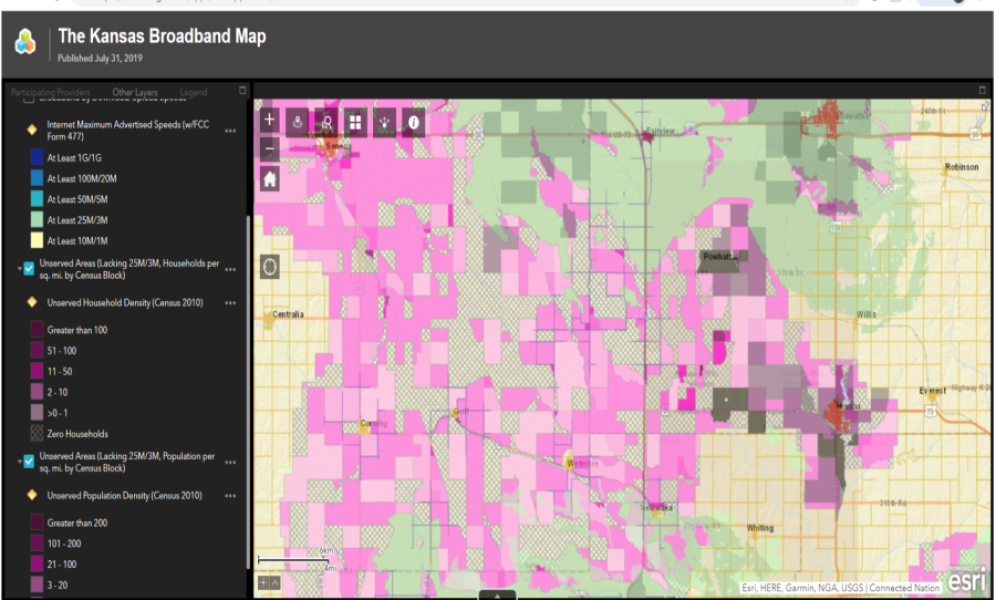
DODGE CITY – Where would we be if we couldn’t stream movies or music? Far-eastern Kansas counties and a broad swath of western Kansas.The newly released statewide broadband map shows in greater detail than ever before where 3.5% of Kansas residents don’t have adequate access to the internet. You can even search by your address … if you have internet, that is.
Telecom experts know it’s expensive to get service out to those areas, but advocates say it’s crucial to make up for the gap that’s been left in the wake of rural hospitals closing.
Kansas is bathed in shades of blue that stretch north to south, east to west. That’s not a reference to politics: It’s what the state looks like on the Federal Communications Commission’s Fixed Broadband Deployment map.
The map shows the approximate number of internet service providers within an area — the lighter blue represents fewer, the darker multiple. Considering the entire state is blue, you’d think internet service is available everywhere.
In reality, internet access has been a problem for Kansas residents, service providers, health care and lawmakers.
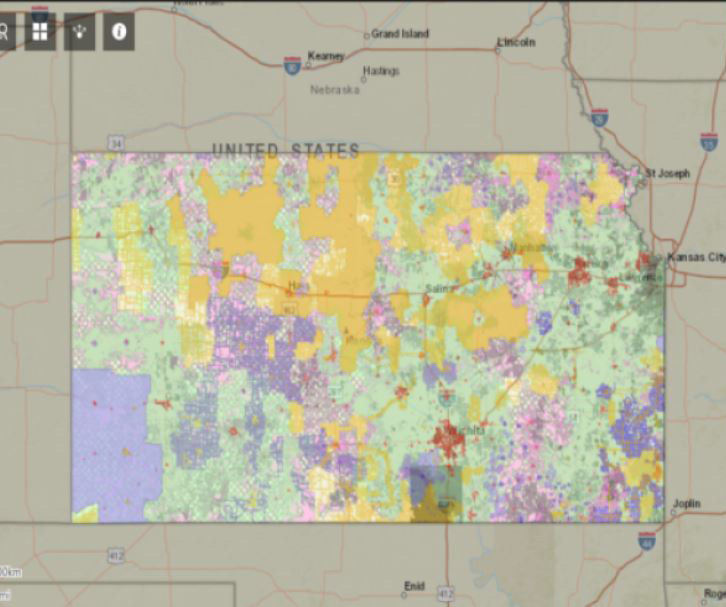
So a new map was created with information supplied by dozens of providers around the state. And the data shows that more than 95,000 people, or about 3.5% of the state’s population, do not have internet access; places like rural eastern Kansas.
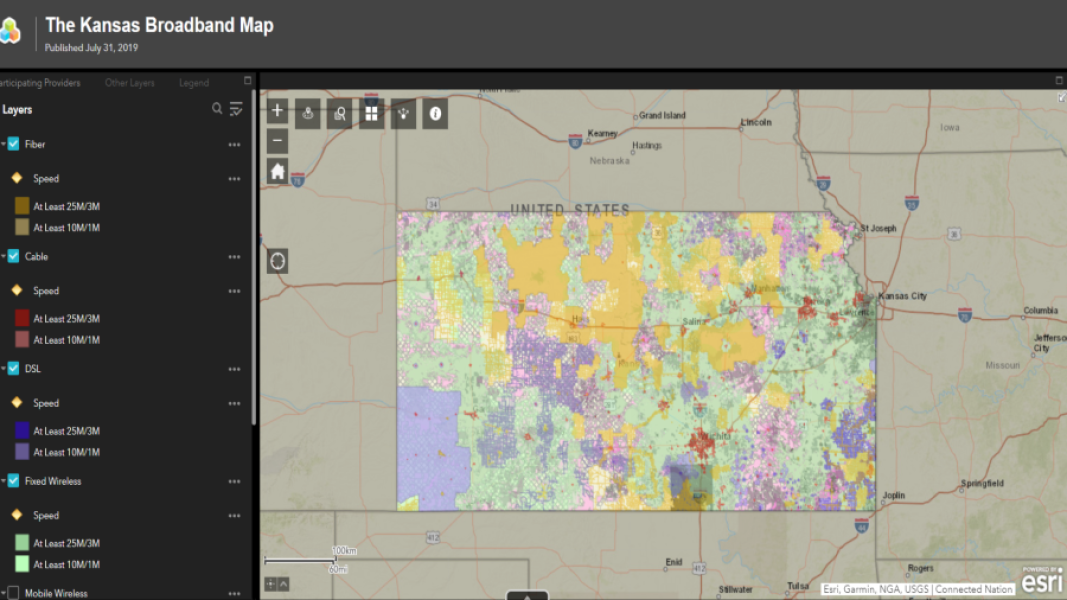
The new Kansas Broadband Map shows speeds, types of service available and features an address search feature. (Credit ArcGIS.com)
“We found, through this mapping exercise, that there actually are pockets of areas where people do live — here in Dodge City and even in the suburbs of Kansas City — that don’t have service, that need it,” said Brent Legg, who’s the vice president of government affairs with Connected Nation, at the State Independent Telephone Association Conference on July 30.
Connected Nation, a nonprofit, created the new map with a $300,000 grant from the Information Network of Kansas. It worked with internet service providers and deployed engineers to verify service providers’ data, so now multiple layers of broadband availability by speed and type are publicly available.
Seventy-two of the state’s 88 internet service providers voluntarily submitted data, and FCC data was used for the companies that declined to respond or participate (Legg said none was available for six providers).
Jason Smith is CEO of Rainbow Telecommunications based in Everest, Kansas. He said the map is “desperately needed.” Laying fiber outside of of Rainbow Telecommunications’ coverage area is expensive.
“When you’re looking at anywhere from $20 to $40,000 a mile to build fiber services, you can’t make a business case on that for a small pocket of 10, 20 customers — it will never pay for itself,” Smith said. “And so you’re going to need types of grant funding.”
But federal grant funding for expanding rural internet service uses FCC census block data, which in rural and remote areas are larger and may even be measured by square miles. The census block data can lead to long and costly application processes for providers like Rainbow Telecommunications.
“So you might consider an area that you could help expand broadband to, but if you base it off those maps … they weren’t accurate,” Smith said. “So you would spend time and effort and money to find out you couldn’t participate in that program.”
What areas lack
Nationally, 19 million people in the U.S. don’t have access to broadband, according to the FCC. That’s about 5.8% of the population. Kansas’ connectivity rate is better than the national rate, but the lack of internet access can deter people from moving to and working remotely from rural areas, where populations are generally declining.
Earlier this year, some Kansans testified before the Statewide Broadband Expansion Planning Task Force about painfully slow internet speeds.
And some rural areas have seen hospitals close, Executive Manager of SITA Colleen Jamison said July 30, noting that broadband could deliver telemedicine to people who live hours away from specialized care.
“Maybe somebody who’s got a high-risk pregnancy in Ulysses, Kansas, and the nearest potential NICU for a birth maybe in Wichita,” Jamison said. “But that monthly or even weekly monitoring of maternal health could be so vitally important to that unborn child.”
And even though it may not be entirely useful for people who already don’t have internet, the new map contains an address search feature. For households without internet, searching online may involve traveling to a public place, but Legg said the new feature will be helpful to service providers that might be be unaware of unserved residents.
“So they may want to build out service into those areas,” Legg said. “It will also help service providers identify places where they could go apply for federal grant dollars to build out via the (U.S. Department of Agriculture) reconnect program, for instance.”
Pinks and purples on the new map indicate areas without internet, and some are found outside of eastern Kansas counties, including Atchison, Brown and Wabaunsee. Clicking on the unserved layers of the map shows where household are and how many don’t have access to internet.
Areas without service are located under the “other layers” tab within the new broadband map. (Credit ArcGIS.com)
Jamison said legislation authorized the creation of a more accurate map allowed it to guide the state’s broadband task force. “The statewide broadband task force said, ‘Let’s look at what we recognize the issues that there are at the federal level.’ So let’s look at what can we do to ensure that Kansas is mapped as accurately as possible,” she said. “So that it guides the state efforts at the task force level and beyond.”
Corinne Boyer covers western Kansas for High Plains Public Radio and the Kansas News Service. You can follow her on Twitter @corinne_boyer or email cboyer (at) hppr (dot) org.
The Kansas News Service is a collaboration of KCUR, Kansas Public Radio, KMUW and High Plains Public Radio focused on the health and well-being of Kansans, their communities and civic life.
MIAMI, Fla. – Former Hays High standout golfer Tradgon McCrae recently finished second at the Optimist International Junior Golf Championships in Miami, Florida.
McCrae, who will play golf Hutchinson Community College, competed at the Trump National Doral Resort and Spa July 26 thought July 31st.
He finished the four-day tournament at even par 286, one shot behind the winner Angel Guerra, of Venezuela.
McCrae tallied four birdies and two bogeys and fired a first-round two-under 70 at the Blue Monster Course.
He followed day one with back-to-back rounds of 74. McCrae played the Blue Monster Course on day two and the Golden Palm, Black Course on day three.
In the final day of the tournament, back on the Blue Monster Course, McCrae turned in the lowest round of the day, a three-under 69.
I stepped out the front door one spring morning a few years back just in time to see a large falcon-shaped bird glide low overhead. It landed in a tree a block away, so I hustled to get my binoculars and our Kansas bird book. The bird sat contentedly, almost posing for me as if making certain I correctly identified it.
It was a Mississippi Kite, and although my bird book doesn’t show or give details to differentiate between males and females, we figured it to be a female in town to nest. I often begin my day with a walk around our neighborhood and I’m usually greeted by as many as 6 Mississippi Kites in the neighbor’s tall dead tree. They seem to like the high open vantage point from which to survey the neighborhood.
Mississippi Kites are light gray and slightly smaller than a red tail hawk, and are built trim and sleek, much like a falcon. They derive their name from their unique soaring style called “kiting.” Picture how a child’s kite rides the wind, gliding and sliding sideways back and forth. That’s how Mississippi Kites soar, as if on a string, sliding and almost rocking back and forth from side to side as they float effortlessly on the Kansas summer thermals. They are summer residents here, arriving in mid-April and leaving again in mid-November.
They are slowly expanding their territory northward and are quite comfortable nesting in our Kansas cities and towns. Nesting females are known to become very aggressive when their chicks are about to leave the nest, often dive-bombing humans and pets that get too close to the nest to suit them. We try each year to find a Mississippi Kite nest to watch, but have been unsuccessful thus far. Mississippi Kites are very social birds and are often seen in large groups. One day this week in downtown McPherson as I waited in the car for my wife to return from an errand, I began seeing Kites soaring above me. One or two at a time they appeared until I lost count at fifteen.
Kites occasionally feed on small reptiles and snakes but are mostly insect eaters and are skilled at snagging locusts and other flying bugs in mid-air. Last Sunday while eating ice cream in a local Dairy Queen, I watched a Mississippi Kite having dinner on a power pole just outside. It would suddenly fly toward a small group of trees nearby and return with a snack. After eating its snack, it would fly again toward the same trees, always returning with a morsel of some sort. I’ve been seeing the first locusts of the summer, and I’m betting it was finding them too.
My wife Joyce grew up on a farm south of Meade, KS, and after we got married I began hearing stories about a man named James Parker who had come to their farm for years to watch and study Mississippi Kites. A friend still living in Meade did some research and found more details to the story.
According to newspaper clippings, it was mid-June 1982 when Dr James Parker from the University of Maine first visited the Friesen farm near Meade. He was indeed there to observe Mississippi Kites, but he brought with him some visitors. Stan and Gladys were Swallow Tailed Kite chicks rescued from a nest in the Florida swamps.
Swallow Tailed Kites, although larger with a huge ornate tail, are close cousins to Mississippi Kites and until the early 1900’s were common in the eastern Kansas skies. They hadn’t been seen in the state for decades and Dr Parker was there to explore the possibility of reintroducing Swallow Tailed Kites into Kansas by transplanting chicks into existing Mississippi Kite nests. Stan and Gladys were put into active nests and Parker stayed around to observe. After two or three weeks Stan grew weak, lost weight and died, but Gladys was accepted by her foster-parents and seemed to thrive. Although the time line is unclear, Parker spent parts of 14 summers in Meade during the 1980’s and 1990’s studying the local Mississippi Kite population.
No one seems certain whether any more Swallow Tailed Kites were transplanted into Kansas. They’re not listed in my Kansas bird book so I suspect there are none in the state today. No one knows what happened to Gladys either, but I can say with certainty that Mississippi Kites are here to stay in south central Kansas and are steadily expanding their summer range to the north and east. So watch the sky and you’ll soon know if Mississippi Kites have come to your neighborhood, as you’ll see them floating and gliding effortlessly on the Kansas winds. Continue to Explore Kansas Outdoors.
Steve Gilliland, Inman, can be contacted by email at [email protected].
Kansas Common crude at CHS in McPherson starts the week Monday at $46 a barrel. The Kansas benchmark ended the month of July at $48.75 a barrel. That’s a dollar more than the average price for the month. But it’s half a dollar less than at the beginning of the month, and $10.25 below the price on the same date a year ago.
A new federal report shows Kansas crude-oil production dropped to 2.81 million barrels in May. According to the latest numbers from the Energy Information Administration, the daily statewide average in May was 91,000 barrels per day, down four thousand barrels per day from April, and down six thousand barrels per day from May of last year.
National crude-oil production totals declined as well. EIA said U.S. producers pumped more than 375 million barrels or 12.1 million barrels per day. That’s down 54,000 barrels per day from April but is more than two million barrels per day higher than the average in May of last year. The state of Texas pumped more than 41% of the national total at 4.9 million barrels per day. North Dakota reached 1.3 million barrels per day, and New Mexico notched 900,000 barrels per day.
The Kansas Corporation Commission reports 111 new intent-to-drill notices filed during the month of July, a slight drop from the month before. So far this year there are 641 intents in Kansas, down from 1,067 through July of last year. The KCC shows three new intents in Barton County, five in Ellis County and one in Stafford County.
The weekly Rotary Rig Count from Baker Hughes shows 942 active drilling rigs nationwide, down six oil rigs. The count in Oklahoma dropped by five while New Mexico was down two rigs. Independent Oil & Gas Service reported a drop in the number of active rigs in Kansas, but an increase in the total rig count for the state. East of Wichita there were 12 active rigs last week, up two. In Western Kansas the count dropped by four to 22 active drilling rigs. Drilling was underway on one lease in Ellis County and one in Stafford County.
Regulators approved 19 permits for drilling at new locations last week. Seven of those were in eastern Kansas and 12 were west of Wichita, including two new permits in Barton County. So far this year we’ve seen 569 new drilling permits, well below the 1,000 new permits issued by this time last year.
Independent Oil & Gas Service reports 20 newly-completed wells over the last week, three in eastern Kansas and 17 west of Wichita, including one in Barton County, one in Ellis County, and two in Stafford County. Operators have completed 843 wells so far this year, compared to 917 at this time last year.
The government reported a large weekly drop in U.S. crude oil stockpiles. The U.S. Energy Information Administration reported inventories of 436.5 million barrels. That’s down 8.5 million barrels from a week ago, but right at the five year average for this time of year.
EIA reported total U.S. crude oil production of 12.244 million barrels per day for the week ending July 26. That’s the fifth highest weekly production total ever, up 985,000 barrels from the week before. The cumulative daily average so far this year is up 15% over the same period a year ago.
Crude-oil imports dropped last week to 6.7 million barrels per day. The four-week average is down 13% from the same period a year ago. Total gasoline inventories decreased by 1.8 million barrels last week and are about 2% above the five year average for this time of year.
The Association of American Railroads reports the oil patch is one of just three categories of rail freight that showed growth for the week ending July 27. Oil-by-rail totals remain above year-ago levels but growth continues to slow. Operators filled 12,642 rail tanker cars with petroleum and petroleum products, up 4.1% over the weekly count a year ago. Canada’s tanker car traffic was up nearly 24%.
Please be advised that beginning Tuesday, August 6, 2019, seal coating will begin on various street throughout the city of Hays. See the map below for street locations. Door to door notification will be made the day prior to street closure.
Seal coat is spray applied in two coats with a dry time of 2 to 3 hours per pass, so the streets being sealed will be temporarily closed during this time.
On the date scheduled for treatment, all cars need to be moved from the street by 8:00 a.m. Streets being sealed will be closed from approximately 8:00 a.m. until 5:00 p.m. Access can be achieved in cases of emergency. Parking on adjacent streets is recommended during the daytime. Parking in driveways is okay if you DO NOT plan on moving the vehicle between 8:00 a.m. and 5:00 p.m.
The seal coat treatment should not be driven on until it has set up (dried). It will stain surfaces such as concrete, carpet, or flooring if tracked from construction areas.
Please have all lawn watering devices turned off the evening before the scheduled date. Please help keep the streets clean and dry for a smooth and lasting project.
Traffic control will be set in areas of work being completed and picked up by the end of the work day. This project is scheduled to be completed within two weeks (pending weather conditions).
The city of Hays regrets any inconvenience this may cause to the public. If there are any questions, please call the Office of Project Management at 628-7350 or the contractor, Circle C Paving at 316-570-4652.
 By JAMES BELL