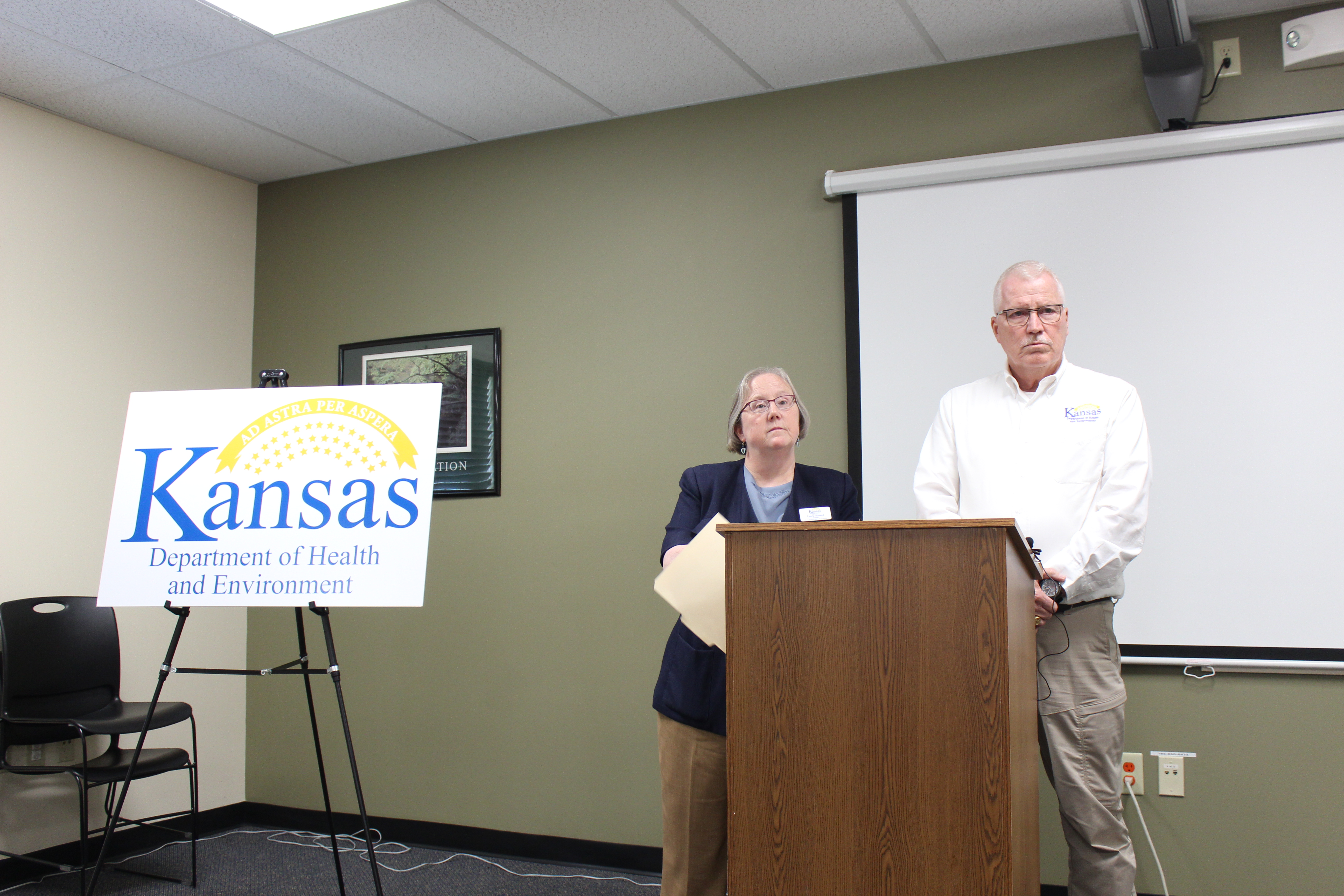
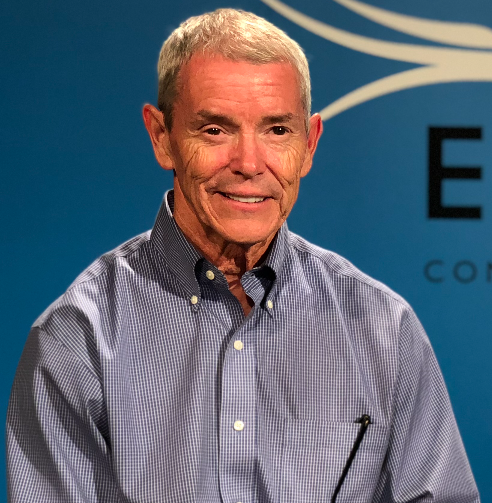
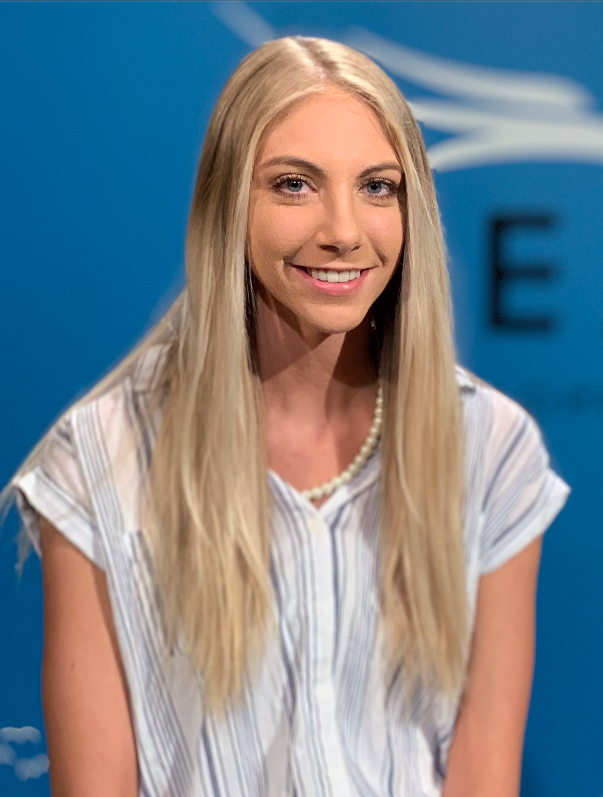
Department of Children and Families Sec. Laura Howard and Department of Health and Environment Sec. Lee Norman announce a KDHE employee who will process Medicaid applications will be located in the DCF office in Hays.
Kansas Department for Children and Families Secretary Laura Howard and Kansas Department of Health and Environment Secretary Dr. Lee Norman Monday announced at the Hays DCF office a new partnership that will locate KDHE employees in DCF offices.
KDHE is moving processing of Medicaid applications from a private contractor back under state control. It will take a year to completely make the transition. Eventually 350 once private employees will be employed by KDHE.
Thirty KDHE employees who will determine eligibility for Medicaid will now be located in 17 DCF offices across the state. One of these employees will be in the Hays DCF office. The Hays and Wichita offices will be the first to receive the KDHE employees as of this week.
Howard and Norman said in a press release that the move will foster collaboration around the KanCare application process for the elderly and people with disabilities. It is also designed to improve efficiencies and expand the reach of both agencies.
“This is just one way we want to bring a high-touch approach back for Kansas citizens,” Howard said during the press conference.
Norman said, “We’re pulling a bunch of these services back into the state to provide more customer service.”
Norman said in the press conference most Medicaid applications are being processed in the 45 days required by federal law. However, he said he hopes the changes will improve approval times beyond the federal standards.
“I’ve always believed that our DCF offices can be an important connection point for Kansans who need services,” Howard said in the news release. “This new partnership is a first step in providing a more efficient experience for those who need assistance with the complicated KanCare application process.”
“As an agency, we are continually looking for opportunities to collaborate and improve the stakeholder experience,” Norman said in a news release. “By co-locating, we are making good use of existing state office space and extending our reach across the state.”
Elderly and disabled KanCare applications are among the most complex. Under the new partnership, KDHE employees will initially spend most of their time processing home and community-based service applications.
“These complicated cases take a special approach,” Norman said. “You wouldn’t go to a family physician, necessarily, to have a brain tumor removed. You would go to someone who is highly specialized in that area. The population that Sec. Howard spelled out is a group that needs a specialist in that area. There is a fairly lengthy training process involved in that.”
The KDHE employees also will be available to work with DCF staff on complicated cases. Once the full transition is complete in mid-2020, it is expected that KDHE staff will be able to meet face to face with Kansans who need help navigating the KanCare application process.
“I believe this collaboration with DCF will result in positive outcomes for Kansans,” Norman said in the news release.
Norman said during the press conference Monday KDHE is also working to update technology to make the KanCare application process more efficient. He said the system is still requesting information through fax, and most people no longer use fax machines.
Other offices that will have KDHE employees include:
Kansas City and Overland Park in August
Emporia, Great Bend and Newton in September
Manhattan and Pittsburg in October
Atchison, Chanute and Salina in November
Dodge City, Garden City, Hutchinson and Liberal in December
Independence in Jan. 2020
As more KDHE staff are hired, the agencies plan to expand to other DCF offices that have available space.
“I’ve heard first hand from our workers how excited they are to have KDHE staff in the same office,” Howard said in the news release. “We know this is an important step in helping Kansans connect with services that are vital to their well-being.”
We have about five months, if we pay attention, to get a good idea of just what the upcoming Legislature is likely to consider doing for us—or to us—in the session that will precede next year’s elections for every member of the House and Senate.
Yep, they’re all going to be on the ballot, and if there is a key to re-election it is passing, or at least voting to pass, laws that we’ll like. Or, of course, voting against bills that we don’t like, but someone, somewhere, thinks is a good idea.
The regimen of interim committees that will start this month or next will give us our first peek at just what we have to look out for next winter.
The interims don’t pass laws, or even bills, they just study and hear arguments for and against issues that will likely become bills. While they are public meetings anyone can wander into or listen to over the Internet, most Kansans don’t know much about them or just what legislators do when they come to Topeka out of session.
Well, a big issue that is going to be chewed through is, of course, the possibility of Medicaid expansion: First, the Senate interim committee—which essentially just knows what it read in the papers about the House passing expansion—then the Special Committee on Medicaid Expansion with both House and Senate members.
Key to that process: Probably to try to assemble an expansion bill. Or…to figure out just how the lawmakers who oppose Medicaid expansion can be convinced that it will affect so few people that they can probably look the other way briefly for at least one vote or two, and pass it.
But interim committees are also going to consider legalizing marijuana, probably just for those who can convince their doctor to prescribe it or who can make the point that they’re getting old enough that they represent a solid revenue stream for those doctors so that they will… Chances of general legalization? Slim, but we’ll be watching that medical marijuana proposal to see just how far it will stretch without bogarting that roach…
Medicaid aside, a health interim committee is going to try to figure out why health care is so expensive in Kansas and whether there’s some way to make it cheaper. Look for that to stretch into tele-medicine where you essentially talk over the Internet with a health-care provider who lives outside your Zip code or county or congressional district or maybe even state line. Doesn’t work if you’re bleeding, but chances are good that telemedicine will be part of the key to dropping the out-of-pocket, or at least out-of-insurer’s pocket, expenses.
Oh, and for those of you who watched flood waters creep toward the porch, a committee is going to try to figure out how government at all levels can work together to avoid flooding or at least how to get help to voters and business owners more quickly when the water recedes enough that you don’t need a life jacket to retrieve your newspaper.
Yes, a lot of topics, and a total of 52 days of hearings approved so far…some that will yield proposed legislation, many that will just let lawmakers know how state government is running while they’re out of town and paying for their own lunches instead of gazing at the ceiling while lobbyists buy their meals and drinks.
Those interim committees are also where ideas good and bad are sifted, and they’ll to a large degree determine just what we watch the Legislature debate next session. But some of us remember when the preview was better than the movie. And for many issues, the interim committee is the preview…
Syndicated by Hawver News Company LLC of Topeka; Martin Hawver is publisher of Hawver’s Capitol Report—to learn more about this nonpartisan statewide political news service, visit the website at www.hawvernews.com
The Senior Companion Program, sponsored by Fort Hays State University, will celebrate 45 years of service in communities throughout western Kansas with a brunch buffet on Thursday at the Rose Garden Banquet Hall in Hays. Senior Companions, dignitaries and guests from throughout the 14 county service area of the program will attend the celebration.
The program, established in 1974 at Fort Hays Kansas State College was one of 18 original projects, and the first in the nation to be sponsored by an institution of higher education. The program began with 60 volunteers serving frail elderly in a five county service area of western Kansas. With a mission to provide needed community service to frail adults through life enriching volunteer opportunities for limited income adults, Fort Hays received a grant in the amount of $146,108 from ACTION, the federal volunteer agency.
An August 6, 1974 news release stated, “To be a Senior Companion, the applicant must be 60 years old or older, have an income of less than $2,330 per year, work a maximum of 20 hours a week, five days weekly….The pay schedule is $1.60 stipend an hour, 50 cents allowance for transportation….”
Dr. John Gustad, College President selected Dr. Calvin Harbin, then Dean of Instruction to administer the Program. Dr. Harbin remains an ardent supporter and advocate for the Program. Mr. Howard Sloan was the first Director and established SCP as a successful model for other areas in the country.
Since its inception in 1974 seniors, age 55 and better, dedicate their time and talents helping frail, disabled and homebound adults in Barton, Ellis, Ford, Gove, Graham, Hodgeman, Logan, Ness, Pawnee, Phillips, Rooks, Rush, Russell and Trego counties.
Senior Companion volunteers respond to personal needs of frail adults by helping their clients with daily living activities so they may remain in their homes. They support families by providing respite care for those who give 24 hour support in caregiving roles. More than 300 adults throughout the service area receive the cost-free services of Senior Companion volunteers.
The Senior Companion Program is funded by the Corporation for National & Community Service, Washington, DC and sponsored by Fort Hays State University. Ellis, Gove, Pawnee, Rooks, Rush, Russell and Trego counties and the cities of Ellis, Victoria and WaKeeney also provide financial support.
For information about the Senior Companion Program call 785-628-5809.
The Ellis County Joint Planning Commission will hold its monthly meeting along with a Public Hearing on Wednesday. The meeting will be at 7 p.m. at 718 Main in the commission chambers.
Contact the Ellis County Zoning Office at 785-628-9449 for more information.
On Wednesday, Robert Mueller, Special Counsel investigator into possible Trump collusion with Russia to win the 2016 presidency, appears (reluctantly) before two congressional House committees. He does not want to testify. He knows there’s a lot in his final 448-page report that makes no sense. Democrats, with their unadulterated hatred for Trump, are praying for some miracle in his testimony that will lead to impeachment.
The testimony during this hearing may be one of the most interesting in recent American history. It may be a bombshell, possibly one that back fires, maybe a nothing burger. But you can bet a major portion of America will be watching!
Mueller tried six ways to Sunday every week for two years in ousting President Trump for collusion with Russia. He spent 30 million tax dollars, hired an army of Clinton connected lawyers, umpteen witnesses and subpoenas, etc. Nothing worked.
Dirty cop Mueller took on the Special Council job on a whim that Trump colluded. There never was any evidence of collusion to begin with, but the Never Trumpers insisted on an investigation based on speculation and wishful thinking. No good cop takes on an investigation where there isn’t even a crime. The left was hoping for a collusion crime created out of thin air and Mueller was right there to oblige.
After two years of investigating, our cop, several months ago, gave his final report. He found no Trump collusion, but unprofessionally insinuated there might have been. He did the same with obstruction of justice, therefore, he gave House Democrats in congress crumbs, so to speak, to continue the investigation. A black mark with a part of Congress, like no other time in American history, becoming primarily an investigative body to take out a president, while its primary legislative function goes by the wayside.
No collusion and no clear obstruction in the final report should have put this entire hoax to bed, but the beat goes on with the Wednesday hearing.
During his investigation, Mueller indicted some 30 people making it look like Trump and associates were guilty, but none of the indictments had anything to do with Trump’s supposed collusion with Russia. Liberal media brought up the indictments constantly insinuating guilt for collusion. Dirty cop Mueller, unethically and immorally, ruined many lives in the process for no good reason. He buried these people in questionable legality when they refused to give him dirt on Trump. Mueller has a history of unprofessional and unethical prosecutions many of which have been overturned.
The biggest (among many) bombshell in Mueller’s 448 page off the wall final report is the complete omission of the indisputable and incontrovertible evidence that Hillary, the Democrat Party, the FBI and CIA in unison actually did the colluding with Russia to affect the election, and it’s all tied into the Trump collusion narrative. It is virtually impossible to investigate one party’s collusion without constantly coming across the other.
As readers tune into the Wednesday hearing, keep in mind Mueller’s shady past. I only scratched the surface of a man high up in the chain of American justice that makes us look like a third world country. Call it American injustice. Mueller is actually part of the deep state doing everything possible to destroy a Trump presidency.
Thank God the literal attempted coup didn’t work, and hold on to your seats as justice is finally served in this country by new leadership that loves America.
The O’Loughlin Elementary School PTO is donating more than $62,000 for new playground equipment at the school.
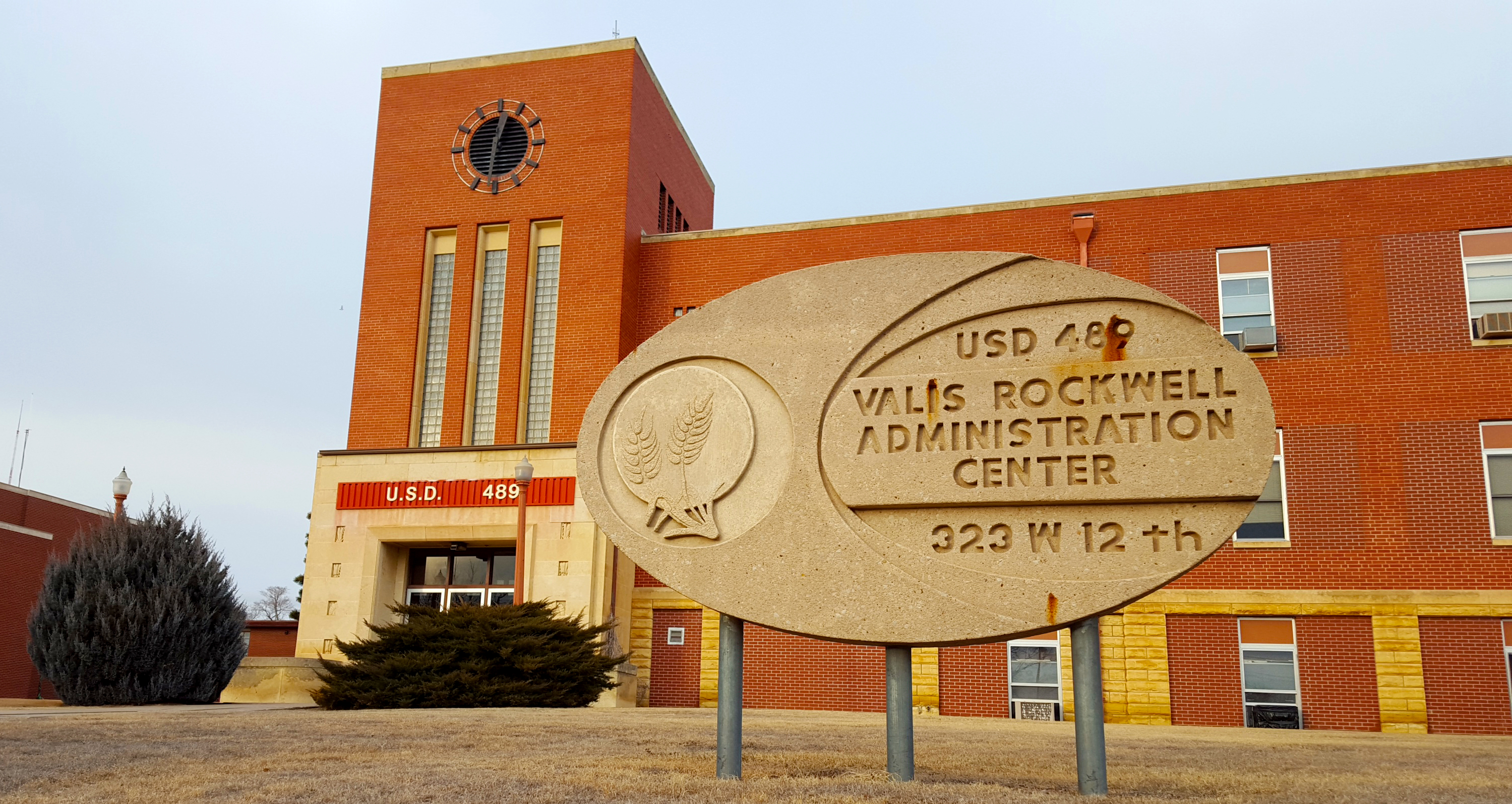
The Hays USD 489 school board will hear a report on the donation and the new equipment at its meeting at 6:30 Monday at the Rockwell Administration Center.
The board will also hear a report on capital improvement projects that are ongoing throughout the district, including progress on the Oak Park Complex.
The complex is to be the new home of the Early Childhood Connections program. The renovated space is set to open this fall.
The board will take up whether to purchase a new metal building for Hays High School at a cost of $57,250.
It will also vote on whether to enter into an agreement with Russell USD 407 to provide gifted services to its students.
Washington school
The district also has on its agenda the continue discussion of the sale of Washington school.
The board at its last meeting opted to reopen bids for the building, which is being vacated by ECC. Developer Overland Park Group offered to buy the building, but notified the school board it will not be able to meet its contract obligations because it did not receive the tax credits needed this year to support the project.
Overland Park offered an addendum to the contract that would extend its option to buy the property until it could reapply for tax credits to turn the school into low-income apartments next year.
The school district has not acted on that addendum yet, preferring to rebid the property first.
The board will also consider board appointments tonight.
Last week’s inspection results from the Kansas Department of Agriculture:
Walmart 4301 Vine., Hays – July 15
A follow-up inspection found six violations.
In the back storage area near the bakeshop, there were five three-gallon containers that were being stacked inside one another. Sticker residue was present along every bucket.
At the three-compartment sink next to the bakeshop the spray nozzle was hanging below the floor rim of the sink. There is no backflow prevention device present.
At the mop sink in the shipping/receiving area, there was a hose that was connected to the Y shut off valve hanging below the flood rim. The AVB is leaking.
In the chemical storage area in the back near the electronics section, there was a bottle that contained a white powder substance. This container had no labeling of what it was.
In the back chemical storage area next to the deli prep area there was fry cleaner and foaming drain cleaner that was being stored on a solid wooden shelf directly next to a box of single-use gloves and 10 food-grade containers. No evidence of leaking was observed.
In the chemical storage area next to the deli department there was a case of quat sanitizing solution that was being stored directly above a case of deli paper. Both of these items were being stored on a speed rack with sheet pans under both. No evidence of leaking was observed.
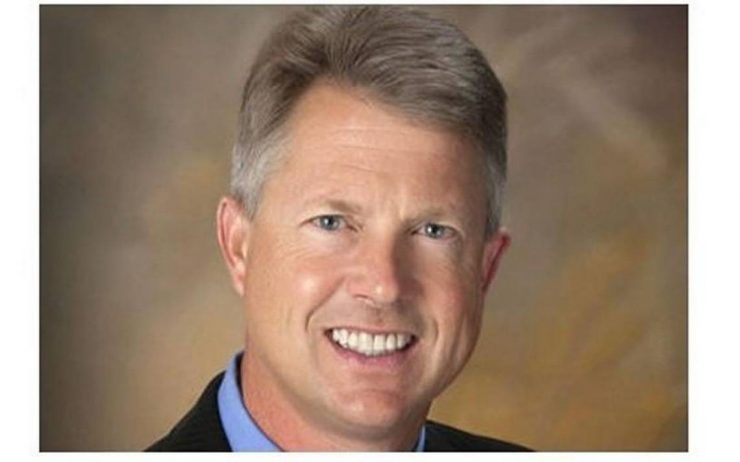
Dr. Roger Marshall, R-Great Bend, is the First District Kansas Congressman.
Friends,
On July 20, 1969, people across the country and around the world watched in eager anticipation as Neil Armstrong and Buzz Aldrin landed on the moon. With this feat America won the space race and it amazes me to think of all of the advancements that have been made as a result of these Apollo missions.
At this very moment native Kansan from the Big First, Nick Hague, is currently 240 miles above Earth on the International Space Station continuing to advance scientific knowledge. I am a member of the Science Space and Technology Committee and gave a speech on the house floor in honor of this special anniversary, Click Here to view it.
The Smithsonian National Air and Space Museum commemorated the occasion with a to-scale projection of the Saturn V rocket on the Washington Monument this past Tuesday, Wednesday and Thursday. And this weekend they will be performing the Apollo 50: Go For The Moon show, a full-motion projection using archival footage to simulate the actual launch.
Pro Life Update
The Trump Administration recently advanced our efforts to fight for the unborn. The U.S. Department of Health and Human Services announced that it will immediately begin implementing President Trump’s Protect Life Rule. This will stop any taxpayer-funded facilities from referring for abortions or commingling finances with abortion businesses, meaning abortion centers cannot serve as taxpayer-funded family planning centers. I want to extend the most sincere thank you possible to President Trump for making this happen and fulfilling another major campaign promise to the American people. Our fight to protect life certainly isn’t over however, and I want to assure you all that I am still fully committed to seeing abortion practices completely ended in this country.
Science, Technology, Engineering, Mathematics
Chairwoman Johnston and Ranking Member Lucas of the Science, Space and Technology Committee hosted a roundtable focused on the unique challenges facing rural communities in providing quality Science, Technology, Engineering and Mathematics (STEM) education programs. This has been a big priority for me, as an increase in STEM opportunities would be beneficial in workforce development across the Big First. At this roundtable we talked about the different ways rural schools can teach STEM and what federal agencies can do to help. We highlighted the specific geographical challenges faced by rural Americans and discussed the different ways federal funding could efficiently be directed towards meeting those challenges.
USDA Expanding Access to Capital
The USDA has announced new programs designed to help farmers get access to capital. They announced up to $16 million in available funding through the USDA’s Outreach and Assistance for Socially Disadvantaged Farmers and Ranchers and Veteran Farmers and Ranchers Program, also known as the 2501 Program. Since 1994, the 2501 Program has awarded 451 grants totaling more than $103 million and the 2018 Farm Bill boosted mandatory funding for the program through FY 2023.
They also launched a new service on Farmers.gov, the Farm Loan Discovery Tool. This resource asks a series of simple questions to help those interested in exploring financing options to operate a farm or buy land. The tool will then find the information on farm loans that best fit their specific needs and provide the loan application and additional resources. This new system is only one of the many tools on farmers.gov that help connect farmers to information that can help their operations and I am glad that they are constantly adapting their systems to meet modern needs.
Building Out Rural Broadband
Last week the FCC authorized $38.7 million in funding over the next decade to help expand broadband access in rural Kansas communities. This comes as part of last year’s Connect America Fund Phase II (CAF II) auction, which will help providers deploy high-speed internet to thousands of homes and businesses across the state that currently lack service. Closing the digital divide in rural Kansas remains a top priority not only for my office but also for the FCC. Our providers across Kansas are working hard to leverage federal dollars to build out networks in rural communities. IdeaTek in Buhler was one of the recipients of CAF II funding, and will work to expand access in Reno County. While much work still remains to be done and I had the chance to thank Chairman Pai in person on Tuesday for his continued efforts to ensure that all Americans have access to broadband, no matter where they live.
Working Towards RESULTS
On Tuesday, I had a chance to sit down with a few Kansas RESULTS advocates to discuss initiatives which will help Americans and our friends across the globe who are stricken by poverty and malnutrition. It is always nice to speak to young people about their goals for the future of our nation, and witness their passion for service firsthand. I look forward to helping carry out several of their initiatives, one of which includes a resolution that I am sponsoring H.Res.189 that will help combat malnutrition in children around the world. Click Here to read more information.
Talking Corn
On Wednesday, I had the pleasure of sitting down with Kent Moore, a farmer from Iuka, and Dennis McNinch, a farmer from Utica, who were in town representing the Kansas Corn Growers Association. Among other issues, we discussed the urgent need to pass USMCA as well as the importance of other bilateral trade agreements to develop new markets for corn and corn products around the world. We also touched on the significance of year round E-15 sales and the value of ethanol in general to Kansas Corn farmers.
I am also pleased to share that Dennis will be serving on the National Corn Growers Association (NCGA) Corn Board next year, where he will provide a strong voice from the heartland to advocate on behalf of farmers in DC and around the country. Last month, NCGA’s “Off the Cob” podcast series caught up with Dennis to discuss some pressing issues facing farmers and to hear what inspired him to run for the position on the board. To listen to the full interview, Click Here.
Agribusiness Retailers in DC
It was great to catch up again with the “Tomorrow’s Agribusiness Leaders” (TAL) class for a meeting in my office after we took a tour of the Capitol building. A jointly sponsored initiative of the Kansas Agribusiness Retailers Association (KARA) and Kansas Grain & Feed Association (KGFA), the leadership development program is designed to teach the associations’ members about the state and federal legislative and regulatory process. During their visit to Washington, they met with the Kansas delegation and agency officials while also touring historical sites around the city. I really enjoyed meeting with the group to discuss transportation issues, trade, farm bill implementation, and ways I can help to continue to break down regulatory barriers that negatively impact the entire agricultural supply chain.
Kearny County Hospital
Thanks to my grandsons, I always keep a stash of toys in my office and it came in handy when the Kearny County Hospital leadership (and son) stopped by my office to discuss maternal health.
Benjamin Anderson has been the hospital’s CEO for the past 6 years and he’s made Lakin a leader in rural health service, and in particular, maternal health. Because of hospital closures in rural Kansas, women were losing access to maternal health services.
In order to address this, Kearny County Hospital partnered with the University of Kansas School of Medicine and implemented several strategies to improve access to care. As a result of their collaboration, local physicians were able to provide better care for high-risk pregnancies. They also implemented telehealth strategies like creating virtual support programs for pregnant and postpartum women. It was so successful, the Administrator of the Centers for Medicare and Medicaid (CMS) highlighted this partnership in her speech at the National Rural Health Association Annual Conference this past May. CMS is currently working on building out this model, and Kearny County Hospital continues to develop new strategies at the helm of the American Hospital Association’s Task Force on the Future of Rural Health Care.
I’ll be joining Benjamin and other members of the task force next month for their meeting and am looking forward to contributing to this important discussion.
Trump Honors Cobalt
Growing up near Lake El Dorado, I remember watching many families enjoy the water on Cobalt boats. Headquartered in Neodesha, Cobalt has been churning out American-made boats for over 50 years. This week the company was recognized by President Trump at the third annual Made in America Product Showcase at the White House. Thank you Cobalt Boats for your dedication to the American worker and manufacturing in Kansas!
Dr. Roger Marshall, R-Great Bend, is the First District Kansas Congressman.
SALINA – Taking a new direction in education is like being the first explorers on a jungle safari – the way is uncertain and difficult, with no clear end in sight.
On July 16 and 17, Smoky Hill Education Service Center (SHESC) helped guide about 40 educators through such a change – the Kansans Can School Redesign Project – with its annual “Teacher Safari” workshop at the Rolling Hills Zoo.
One attendee was Craig Batchman, history and government teacher in Sylvan Grove USD 299. He recently moved to the area and said that Teacher Safari came highly recommended.
“One of the other teachers had taken this workshop and said it was really good information,” Batchman said.
The Kansas State Department of Education launched the Redesign Project in 2017 after extensive conversations and surveying of Kansans and Kansas educators. The project is focused on moving schools toward the Kansas Vision for Education – “Kansas leads the world in the success of each student” – and designing Kansas education to meet five outcomes to accomplish that vision.
The outcomes are: measuring social-emotional growth locally; kindergarten readiness; individual plans of study based on career interests; high school graduation; and post-secondary success.
A central focus of the Teacher Safari workshop was helping the educators discover a personal “why” within the more formalized process of Redesign, which has been rolled out gradually to school districts since its introduction.
Darla Smith, SHESC assistant director and a co-presenter with Lori Scuitte, said that identifying a personal motivation would bring more passion and a richer curriculum within Redesign. For Batchman, for example, the “why” was having his students become better citizens.
With the unique zoo setting, of course, the workshop took advantage to allow unique connections. For example, just as the zoo was mapped out on paper first, then continued to grow and expand after the initial construction, Redesign benefits from a plan on paper, with the willingness to grow, change and expand with new opportunities.
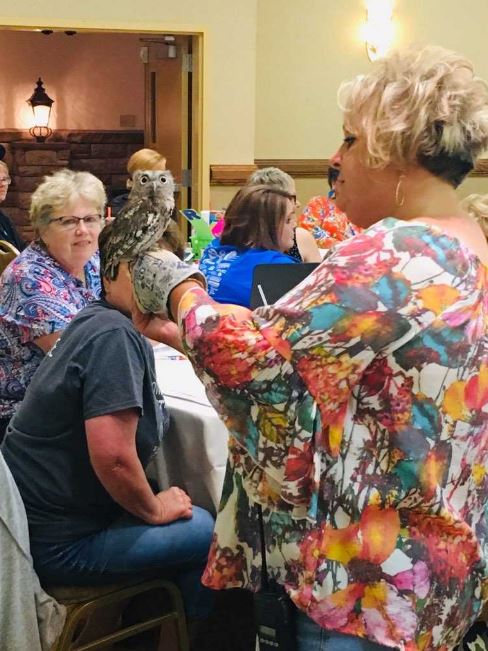
And, of course, there were some opportunities to enjoy the location – meeting some real-life Eastern screech owls in person, exploring the museum and taking the tram through zoo exhibits as well!
A grant of $22,000 from Logan’s Dane G. Hansen Foundation provided the final funding piece that enabled the Department of Applied Technology at Fort Hays State University to acquire new industrial robotic arms this spring.
The $62,000 total purchased five ScorBot ER4U educational robots to replace aging Rhino units from the 1980s.
“Small manufacturers throughout central and western Kansas are growing and now are looking for more tech savvy employees,” said Joe Chretien, associate professor of applied technology and the author of the grant.
“Manufacturers in Norton, Phillipsburg, Hays and other towns already use these technologies and are realizing their benefits,” said Chretien. “A different kind of employee is needed to operate, program and maintain these systems.”
The robotic curriculum of the department is not limited to FHSU students. FHSU faculty will also use the bench-top robotic arms to conduct workshops for high school and middle school teachers in regional communities.
“Our own KAMS students already take advantage of these types of curriculum,” said Chretien. Kansas Academy of Mathematics and Science students last spring used the ScorBot platforms for research and presented their findings at the annual Scholarly and Creative Activities Day in April.
He said the department will seek one new school district or two-year institution to form a partnership to conduct the workshops and extend the reach of the training.
“We are pursuing further additions to these systems and the larger industrial robotic systems, also,” said Chretien.
The Hansen Foundation grant was supplemented by funds from the Peter and Pamela Werth STEM initiative account and the FHSU Foundation.