RUSSELL COUNTY — The Kansas Department of Transportation will temporarily close a portion of U.S. 281 north of the city of Russell starting Monday, July 22.
The highway will be closed to through traffic between Shoreline Road and Land Road, or from milepost 146 to 149, for crews to make partial repairs to a slide area that has affected the roadway. KDOT expects to reopen the road to one-lane traffic controlled by a traffic signal by the end of the week, weather permitting. The traffic signal configuration will remain in place until further repairs can be made and be removed once the additional work is completed.
Travelers are advised to utilize state routes K-18, K-232 and I-70 as an easterly route around the closure, and K-18, U.S. 183 and I-70 as a westerly route around the closure.
American College of Cardiology NCDR Chest Pain̶MI Registry Platinum Award recognizes high standards of patient care
HaysMed has received the American College of Cardiology’s NCDR Chest Pain̶MI Registry Platinum Performance Achievement Award for 2019. HaysMed is one of only 225 hospitals nationwide to receive the honor.
The award recognizes HaysMed’s commitment and success in implementing a higher standard of care for heart attack patients and signifies that HaysMed has reached an aggressive goal of treating these patients to standard levels of care as outlined by the American College of Cardiology/American Heart Association clinical guidelines and recommendations.
To receive the Chest Pain̶ MI Registry Platinum Performance Achievement Award, HaysMed has demonstrated sustained achievement in the Chest Pain̶ MI Registry for eight consecutive quarters and has performed at the top level of standards for specific performance measures. Full participation in the registry engages hospitals in a robust quality improvement process using data to drive improvements in adherence to guideline recommendations and overall quality of care provided to heart attack patients.
“As a Platinum Performance Award recipient, HaysMed has established itself as a leader in setting the national standard for improving quality of care in patients with acute myocardial infarction,” said Michael C. Kontos, MD, FACC, chair of the NCDR Chest Pain – MI Registry Steering Subcommittee, Virginia Commonwealth University Medical Center. “By meeting the award requirements set forth in the registry, HaysMed has demonstrated a commitment to providing reliable, comprehensive treatment for heart attack patients based on current clinical guideline recommendations.”
The Center for Disease Control estimates over 700,000 Americans suffer a heart attack each year. A heart attack occurs when a blood clot in a coronary artery partially or completely blocks blood flow to the heart muscle. Treatment guidelines include administering aspirin upon arrival and discharge, timely restoration of blood flow to the blocked artery, smoking cessation counseling and cardiac rehabilitation, among others.
“This award reflects the ongoing commitment of DeBakey Heart Institute, HaysMed, and the University of Kansas health system to the goal of improving the cardiovascular health of our patients in western and central Kansas. Congratulations to all involved!” said Jeffery Curtis, FACC, FACP, director of Cardiology Services.
Chest Pain̶MI Registry empowers health care provider teams to consistently treat heart attack patients according to the most current, science-based guidelines and establishes a national standard for understanding and improving the quality, safety and outcomes of care provided for patients with coronary artery disease, specifically high-risk heart attack patients.
The American College of Cardiology envisions a world where innovation and knowledge optimize cardiovascular care and outcomes. As the professional home for the entire cardiovascular care team, the mission of the college and its more than 52,000 members is to transform cardiovascular care and to improve heart health. The ACC bestows credentials upon cardiovascular professionals who meet stringent qualifications and leads in the formation of health policy, standards and guidelines. The college also provides professional medical education, disseminates cardiovascular research through its world-renowned JACC Journals, operates national registries to measure and improve care, and offers cardiovascular accreditation to hospitals and institutions. For more, visit acc.org.
About 5:15 p.m. Saturday Hays emergency responders were dispatched to a structure fire in a residence in the 200 block of Ash St. in Hays.
The reporting party told Hays dispatch a fan had caught in on fire inside a bedroom and all occupants and pets were outside of the home according to scanner traffic.
Utilities were cut to the residence while emergency responders were on scene.
By 5:45 p.m. the fire was reported out after a check of the entire building was completed.
ELLSWORTH COUNTY — Two people were injured in an accident just before 9a.m. Saturday in Ellsworth County.
The Kansas Highway Patrol reported a 2002 Ford F150 driven by Chantrielle Porter, 21, Wichita, was eastbound on Interstate 70 just west of the K-156 Junction. The driver fell asleep. The pickup drifted into the median, struck a drainage berm, went airborne and vehicle came to rest on the passenger side.
Porter and a passenger Derrick Cottner, 35, Wichita, were transported to the hospital in Ellsworth. Both were properly restrained at the time of the accident, according to the KHP.
SALINA – Years before joining Smoky Hill Education Service Center as one of its newest consultants, John Girodat was a high school principal having a difficult conversation with a teenager about to drop out of high school.
“I asked him if there was anything we could have done to avoid that conversation,” Girodat said, recalling, “And he gave me one of the best insights I’ve ever heard.”
He had given up on school in third grade, when he realized that if he was ahead of his classmates he would just be given “busy work” or sit around because they wouldn’t be getting to the next topic until tomorrow. He wasn’t pushed, or even allowed, to dig deeper and explore his strengths.
On the other hand, if he was struggling, he wasn’t given the time he needed to fully understand the material, because they had to get to the next topic tomorrow.
The student was turned off to school and eventually tuned out because of the rigidity of a system that didn’t meet his needs. The student wasn’t given the time to develop his strengths, or work on addressing his weaknesses, so he slowly withdrew from the educational process.
So now at Smoky Hill ESC since March 1, Girodat sees his mission as being coach and counselor to allow educators to focus on their kids.
Smoky Hill ESC is comprised of more than 50 Kansas school districts, including Hays USD 489, Ellis USD 388, and Victoria USD 432 across 25 counties.
“My main goal is to give support to our teachers, administrators and schools so they can accomplish the goals they have for their students. They don’t lack the will or ability to make these changes,” he said. “They lack the time. So my job is to do the things they could and would do if they had the time.”
He is designing his workshops, training, and consulting work to meet the personalized needs of area educators served by Smoky Hill ESC – whether that be understanding the influence of poverty; critically examining the true usefulness of grades, homework, and school discipline; or infusing practical skills that lead to employment into the classroom.
This has led to him developing courses this summer that go beyond academic abstraction and give workshop participants the skills and lessons they can apply in the classroom on day one. Girodat is also developing an array of workshops and training sessions coming this fall, with dates still to be determined, including:
· Project Based Learning: Both the basics and more advanced topics of this innovative teaching style that gives students ownership, self-direction, and voice within their learning.
· Grading and Homework: Focuses on making homework assignments and grading effective and efficient, as well as how to make these traditional parts of education meet their true purpose.
· Family Engagement: Develop authentic and effective interactions and partnerships with students’ families to support student education – particularly families not already involved.
· Chronic Absenteeism: Showing up to class is a strong early indicator of ultimate academic success. The class will teach participants how to use existing attendance data to identify and assist at-risk students as soon as possible.
· Scarcity and Poverty: With almost half of Kansas students eligible for free or reduced lunch, poverty and scarcity has a profound effect on student education across the state. The class well help educators better understand the effect of scarcity on students and to be more effective in closing that achievement gap.
· Self-Care for Administrators and Staff: There’s a reason airlines instruct passengers to put on their own oxygen mask before helping others – people have to care for themselves to be of any service to anyone else. In education, more and more is being asked of teachers and administrators and burnout is becoming epidemic. This course will address these critical self-care techniques.
Perhaps as important as Girodat’s expertise in these areas is his perspective. His knowledge is far beyond the academic, with nearly two decades in education in as a teacher, coach, athletic director, assistant principal, principal, and with the Kansas Department of Education as an education program consultant.
Having seen education at all levels, he can now step back and give the larger picture and quality advice to educators at all levels.
Those interested in workshops or training with Girodat – or the other six expert on-staff consultants or guest consultants – can visit www.smokyhill.organd click on the link for the calendar for a comprehensive month-by-month listing of all workshop events. A workshop brochure, monthly newsletter, and online registration form are also available under “News” or “Learn & Connect” on the site.
Girodat said students are in the classroom only about a quarter of their day-to-day lives, so the most important resource educators have isn’t money or materials.
It’s time.
“With limited time, we have to be intentional about what we do,” he said, “because we don’t have time to waste.”
Founded July 1, 1990, Smoky Hill Education Service Center is a cooperative consortium of more than 50 school districts, including Hays USD 489, Ellis USD 388, and Victoria USD 432 across 25 counties, formed to provide cost and efficiency savings in a variety of educational services for its participating members. The service center’s mission is: “In partnership with school districts, we promote success for learners by providing superior services.” Through staff development classes and services, the service center supports more than 2,700 teachers and administrators – benefitting more than 31,000 students. In addition to educational institutions, any non-profit or governmental organization can benefit from Smoky Hill Education Service Center, either as a member or by selecting needed services.
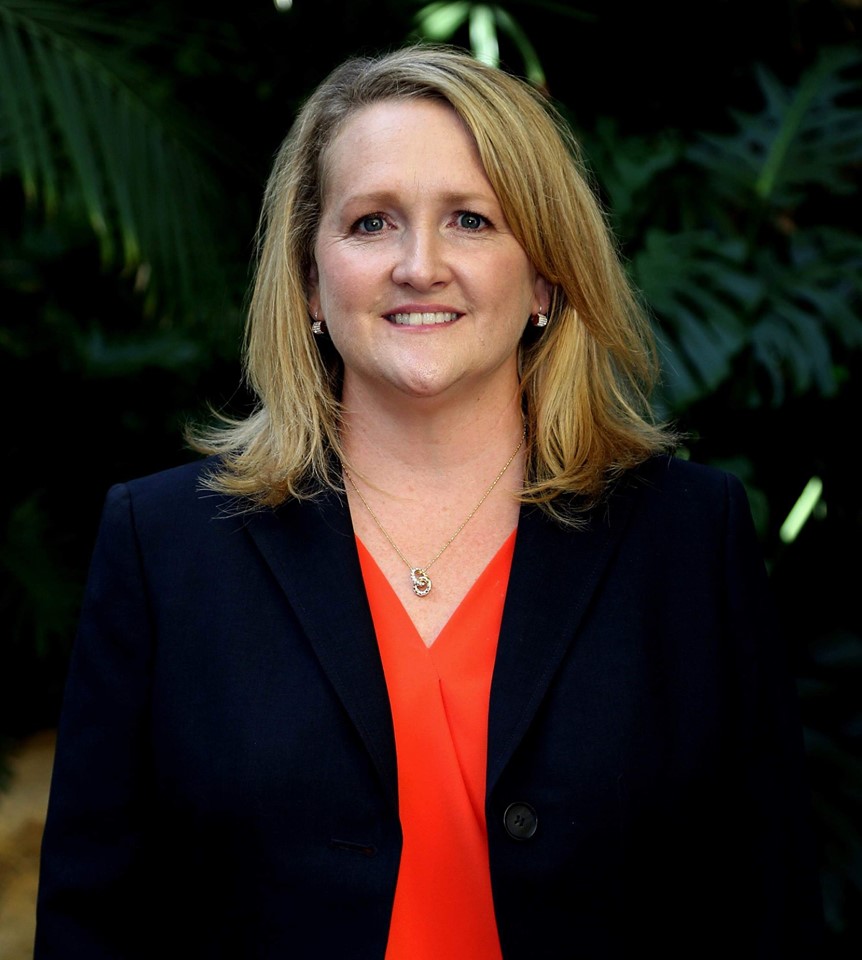
LARNED – Melanie Urban, RN, BSN, HACP has been named administrator of The University of Kansas Health System Pawnee Valley Campus in Larned. She will begin her duties on August 19.
Urban currently serves as the Director of Patient Quality services at HaysMed, a position she has held for the past 10 years. Overall, she has twenty-six years of experience in the healthcare industry serving as a quality, accreditation and infection prevention director; risk manager; case manager and acute care nurse. Urban has also served in a leadership role at Pawnee Valley Campus since 2010.
She earned a BS in nursing from Fort Hays State University, Hays, Kansas. Urban is a Healthcare Accreditation Certified Professional. She is a member of the American College of Health Executives, board member for the Kansas Association of Risk and Quality Management and task force member for the American Society of Healthcare Risk Management.
“The Pawnee Valley Campus is very dear to my heart and I look forward to expanding my leadership role at the hospital and integrating myself into the community,” Urban said. “I’ve been increasingly impressed by the amazing healthcare team and the outpouring of support the hospital receives from the community. The Pawnee Valley Campus is absolutely a top-notch facility and a vital part of the community.”
Urban is a native of central Kansas and she and her husband own and operate a farming operation in Rush county.
“I’m excited about Melanie becoming the new Administrator and vast experience she will bring to the facility. I look forward to her continued leadership with our organization in this new role.” stated Eddie Herrman, President and CEO, HaysMed, part of The University of Kansas Health System.
University of Kansas Health System Pawnee Valley Campus
A hike in the solid waste fee for city of Hays customers has been postponed for a month.
City commissioners discussed the proposal at their work session Thursday night.
The Solid Waste Division, which performs refuse and recycling collections, compost operations, annual alley cleanup and tree disposal for customers, is funded by fees charged to Hays customers. It is now dipping into its reserve funds.
The $15.20 monthly fee has been in place since 2006.
Jesse Rohr, public works director, explained that expenses have gone up the past 13 years for fuel increases, higher hauling and sorting fees for recyclables, salaries, and higher tipping fees at the Ellis County landfill, up from $68 a ton to $75 a ton last year.
At the same time, revenues from recycling are down “mostly in the funds collected for the sale of paper/cardboard recyclables. Revenues have gone from over $63,000 in 2011 to less than $5,000 in 2018,” Rohr told commissioners.
Building the city’s own waste transfer station was considered, but that “didn’t cost out,” according to Toby Dougherty, city manager.
The city then looked at other contractual options, including a private hauler rather than Ellis County.
The five year contract offer is less than what the county charges, but there are “some potential negatives down the road that have not been fully ferreted out,” Dougherty told the commission.
“We went back to the county and asked them if they could give us a better deal and we haven’t had a formal response at this time.
“I told my counterpart we found a cheaper option but we understand the convenience of location [of the Ellis County Landfill]. Plus, there are other interactions at the landfill aside from the municipal waste. We have the tree limb disposal, we have the other stuff. It’s easier to do it at one spot,” Dougherty acknowledged.
City commissioners are unhappy with Ellis County’s delay. Rohr says his county counterpart has been aware of the city’s negotiation request since April.
“Here’s the problem,” said Mayor Henry Schwaller with a thump on the table.
“The county raised their rate on every taxpayer in this county without any notice last year. The city and every person living here had to bear the burden of that. When asked if they can get something together for us this year, they can’t do it. I’m going to vote for a private hauler.”
The city of Hays is the biggest customer at the Ellis County Landfill and 77% of its solid waste budget goes towards the tipping fees for trash collection.
“If we are no longer their customer, they will collapse,” Schwaller declared.
“I’m starting to feel a little bit held hostage,” said Commissioner Sandy Jacobs, “because of other things they will do for us thinking we won’t go to another source for this piece (municipal waste].”
Hays has the lowest solid waste rate among its peer cities in Kansas. Most cities do not provide an alley clean up or compost site, according to Rohr; Hays does.
Marvin Rupp, Solid Waste Div. superintendent and Kim Rupp, finance director, listen to Public Works Director Jess Rohr talk about a fee increase for Hays solid waste customers.
To close the gap in the solid waste fund, Rohr, Solid Waste Division Superintendent Marvin Rupp and Finance Director Kim Rupp came up with a five year plan for incremental increases in the solid waste fee, starting with a 15% hike beginning August 1.
Commissioners are concerned about the first big jump on top of water and sewer rates that have increased dramatically the past few years “as they needed to,” said Schwaller.
“People aren’t really looking at what their trash is costing them. What they’re looking at is their final bill. And my bill went from $43 a month to $61 a month. …”So we’re looking at this on top of that.”
Commissioners ultimately agreed to wait 30 days for a response from Ellis County.
They also discussed the possibility of eliminating the collection of plastic products for recycling due to a worldwide reduction in sales of recycled plastics.
The Ellis County Public Works Road & Bridge Division is announcing that Union Pacific will be performing railroad crossing maintenance on the crossing located at Walker Avenue and Highway 40, reference DOT #814307L, MM 275.46.
The maintenance will begin Wednesday and will last through Thursday.
Motorists traveling in the affected area should use alternate routes of travel until the project is completed.
Please direct any questions to Union Pacific at 1-888-877-7267.
MANHATTAN – As the Kansas wheat harvest winds down, farmers likely are turning their attention to another bit of business in those same fields.
“With all the moisture we’ve gotten in the state this spring and summer, the weeds have come on,” said Dallas Peterson, a weed management specialist with K-State Research and Extension.
Previously flooded areas and other bare spots are prime locations for weeds, Peterson said. Plus, harvesting wheat means there are now more open areas for weeds to grow.
“We need to get on these (weeds) as soon as possible, especially in those areas where weeds were present when we were harvesting wheat,” he said. “They’re going to be tough to control.
“One thing we do have going for us is we are not limited on moisture; weeds are always more susceptible when they’re actively growing and not stressed, so that’s a good thing. But they are at an advanced stage of growth, and that does make them difficult to control.”
In past years, glyphosate has been the go-to herbicide to control most weeds, but Peterson notes that many species – including marestail, kochia and Palmer amaranth — have become resistant to glyphosate.
And, he adds, “in many cases the 2,4-D and the dicamba are not doing the job either, partly because in many cases we let the weeds get too big for them to control.”
Peterson said that farmers may need to consider alternative products, such as paraquat or flumioxazin, as effective weed management options.
Paraquat works well to control emerged pigweed and kochia. It can be used in tank mixes with atrazine, metribuzin, dicamba, 2,4-D and others. “We tend to get better long-term control with those tank mixes than when we use straight paraquat,” Peterson said.
“Wharpen is another herbicide that can be used as an alternative or tank-mix partner with other herbicides for burn-down of exiting weeds, as well as some residual control,” he said.
Flumioxazin is an herbicide used primarily in soybeans in the past, but Peterson said it may be beneficial as a tank mix partner for extended residual control of weeds in wheat stubble. “This is especially true in wetter summers,” he said, “which result in multiple flushes of pigweed and kochia.”
“The advantage to using the flumioxazin is the residual control, especially pigweed control,” Peterson said. “There’s a range of rates we can use, but probably 2-3 ounces per acre is the best. The main difference you’re going to see is the amount of residual control it provides.”
Farmers are encouraged to visit with their local extension agent for specific advice in their fields. They can also get updated recommendations from K-State in the annual publication, Chemical Weed Control for Field Crops, available online.
“We got spoiled when glyphosate was still working,” Peterson said. “It would control big weeds. Most other herbicides are not going to control the large weeds nearly as well. Even though some of these do have some residual, there are limits to that too; it’s not going to last forever.”
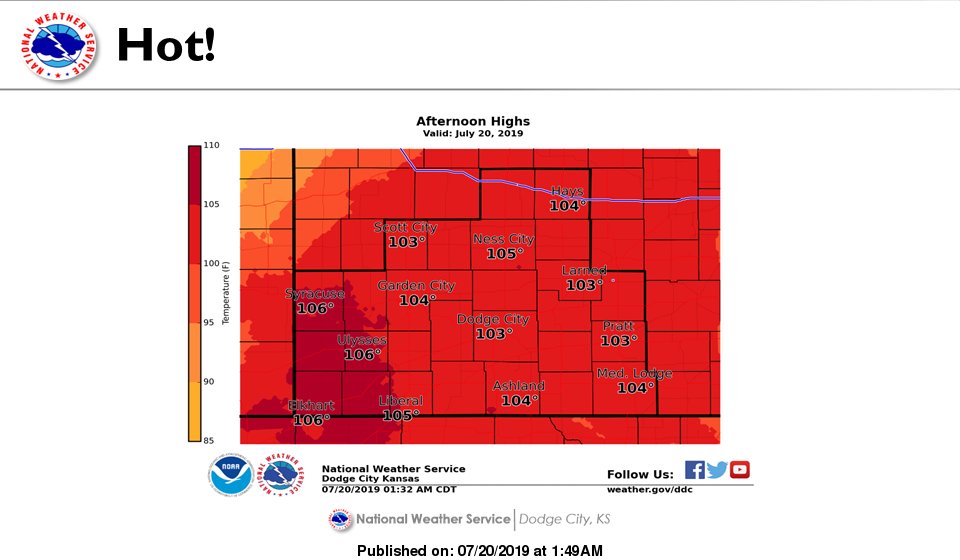
Sunny and hot, with a high near 104. Heat index values as high as 109. South wind 11 to 17 mph.
Tonight
A 30 percent chance of showers and thunderstorms. Increasing clouds, with a low around 69. South wind 11 to 16 mph becoming east southeast 5 to 10 mph in the evening.
Sunday
A 40 percent chance of showers and thunderstorms. Mostly cloudy, with a high near 80. North wind 11 to 15 mph.
Sunday Night
A 30 percent chance of showers and thunderstorms, mainly before 1am. Mostly cloudy, with a low around 60. Breezy, with a north northeast wind 10 to 20 mph.
Monday
Mostly sunny, with a high near 81. Northeast wind 9 to 13 mph.
A grant of $22,000 from Logan’s Dane G. Hansen Foundation provided the final funding piece that enabled the Department of Applied Technology at Fort Hays State University to acquire new industrial robotic arms this spring.
The $62,000 total purchased five ScorBot ER4U educational robots to replace aging Rhino units from the 1980s.
“Small manufacturers throughout central and western Kansas are growing and now are looking for more tech savvy employees,” said Joe Chretien, associate professor of applied technology and the author of the grant.
“Manufacturers in Norton, Phillipsburg, Hays and other towns already use these technologies and are realizing their benefits,” said Chretien. “A different kind of employee is needed to operate, program and maintain these systems.”
The robotic curriculum of the department is not limited to FHSU students. FHSU faculty will also use the bench-top robotic arms to conduct workshops for high school and middle school teachers in regional communities.
“Our own KAMS students already take advantage of these types of curriculum,” said Chretien. Kansas Academy of Mathematics and Science students last spring used the ScorBot platforms for research and presented their findings at the annual Scholarly and Creative Activities Day in April.
He said the department will seek one new school district or two-year institution to form a partnership to conduct the workshops and extend the reach of the training.
“We are pursuing further additions to these systems and the larger industrial robotic systems, also,” said Chretien.
The Hansen Foundation grant was supplemented by funds from the Peter and Pamela Werth STEM initiative account and the FHSU Foundation.














 Today
Today