We have a brand new updated website! Click here to check it out!

Colby Community College announces spring semester graduates

COLBY — Colby Community College conferred 288 degrees and certificates on May 10 at the Colby Community Building during the 54th annual commencement ceremony.

Names are published alphabetically by home location as indicated by the student. Kansas students are arranged by city, out-of-state students are listed by city and state, and international students by country.

Associate of Applied Science

Aberdeen, S.D.: Adrianne Schaunaman. Abilene: Kathleen Hand. Aurora, Colo.: Edwin Situmorang. Benkelman, Neb.: Tammy Collins. Burlington, Colo.: Jimena Schlichenmayer-Garcia. Colby: Jacqueline Bartlett, James Bomba, Hannah Shop, Abigail Tarango.Garden City: Kaitlyn Kreutzer. Gem: Madisyn Haggard. Goodland: Tawnya Ramirez, Kelsey Monnett. Great Falls, Mont: Sarah Mizener. Hays: Shay Hoekman, Kiley Mallon. Hill City: Hannah McCollum. Hope: Nichole Taylor. Hoxie: Amber Erwin. Jennings: Keri Vanover. Kensington: Kendra Billings. Leavenworth: Damien Day. Logan: Nova Bates. Louisville, Ky.: Lori Brownstein.Marienthal: Alexandra Castillo. Norton: Nicholas Peterson. Oakley: Kelsey Wilson. Oberlin: Renee Jones, Taylor Macfee. Osage City: Tracy Wilk. Paola: Alexandra Hamm. Paxton, Neb.: Michael Weber. Phillipsburg: Thelma Boydston, Marissa Davis. Pittsboro, N.C.: Brittany Raynor. Potwin: Meghan Nipper. Quinter: Caden Glick. Rea, Mo.: Elexis McLaughlin. Republican City, Neb.: Kai Wolfe. Saint Francis: Molly Bertram. Selden: Colten Wachendorfer. Smith Center: Kandis Attwood. Springfield, Neb.: Samantha Scholting. Sterling: Elise Kelley. Stockton: Macey Strutt. Topeka: Alisha Gibson. Trenton, Neb.: Pacanda Carfield. WaKeeney: Shawnee Phillips. Whitewater: Katrina Regehr.


Associate of Arts

Bahamas: Tino Thompson. Basehor: Savannah Shiner. Beloit: Karissa Winkel. Brazil: Gabriel Oliveira. Broken Arrow, Okla.:Michaela Bethel. Burlington, Colo.: Renee Richards. Burundi: Estella Akimana. Canada: Andrew Asselin, Jacob Bouzide, Logan Hofmann, Sophia Nduwayo, Alexander Orenczuk, Jesse Simpson, Nathan Stark. Castle Rock, Colo.: Peyton Ingalls. Chappell, Neb.:Jo Hummermeier. Chicago, Ill.: Craig Beaudion. Colby: Brittany Alexander, Mauro Arancibia Campos, Madison Bartlett, Brooklyn Bice, LaVonna Carmen, Danielle Chacon, Tayber Haremza, Olivia Heydt, Taylen Hubbell, August Hutfles, Anica Jestratijevic, Brandon Johnson, Elizabeth Koel, Makenna Mettlen, Brynan Sherwood, Bubacarr Sisay, Kenzie Spreier, Joseph Unruh. Colorado Springs, Colo.: Toby Welty. Colwich: Julie Archer. District Heights, Md.: Edward Oliver-Hampton. Ellsworth: Emma Klein. Englewood, Colo.: Alexis Kagan. Goodland: Ariadne Hernandez-Soto. Gunnison, Utah: Emily Brackett. Hays: Lakin Ditter, Cameron Jensen, Lanie Schmidt. Healy: Rebecca Rebarchek. Hickory Corners, Mich.: Mahealani Haegele. Hoxie: Brynn Niblock. Idalia, Colo.: Paulina Trevizo Tena. Irving, Texas: Jordan Dixon. Jennings: Taylor Wahlmeier. Johnson: Caleb Carrasco. Jonesboro, La: Jason Evans. Keller, Texas: Kaitlyn Guillory. Kenya: Emmanuel Kipngetich. Larned: Casey Danler. Lauderhill, Fla.: Sia Williams. Leavenworth: Blake Gallagher. Longton: Dalton Moody. Lyndon: Allison Taylor. McAlester, Okla: Meona Leonard. Meeker, Colo.:Austin Russell. Oakley: Richelle Kitchel, Claire Wegele. Ogden, Utah: Katelyn Medina. Phoenix, Ariz.: Samantha Spellman. Rochester, NY: Rian Carter. Roy, Utah: Whisper Doliwa. Russell: Jessica Nichols. Saint Francis: Katie Schmid. Salina: Asher Crandell. Sedgwick, Colo.: Landon Enninga. Stratton, Colo.: Yazmin Herrera, Natalie Miltenberger. Sudan: Moses Bol. Syracuse:Emily Westeman. Thornton, Colo.: Allison Hiatt. Tornillo, Texas: Erika Alvarado. Ulysses: Estefani Acosta-Delgado. WaKeeney:Allen Goff. Wallace: Kevin Martinek. Walsh, Colo.: Morgan Turner. Wichita: Carrie Thomas. Winona: Hudson Stramel. Yuma, Colo.: Julian Blanco.


Associate of Science

 Aberdeen, S.D.: Adrianne Schaunaman. Beloit: Karissa Winkel. Benkelman, Neb.: Cole Lutz. Boone, Colo.: Ashlee Marsh.Burlington, Colo.: Renee Richards. Burundi: Aline Munezero. Canada: Jacob Bouzide, Matthew Coutney, Logan Hofmann, Jesse Simpson, Nathan Stark. Chappell, Neb.: Jo Hummermeier. Colby: Brittany Alexander, Mauro Arancibia Campos, Danielle Chacon, Jose Davila, Tayber Haremza, Anica Jestratijevic, Brandon Johnson, Hunter Kasdorf, Makenna Mettlen, Grace Oard, Isabel Rosales, Brynan Sherwood, Lara Stephens. Colorado Springs, Colo.: Haley Fox, Toby Welty. Colwich: Julie Archer. Croatia: Marija Kristina Mamic. Denton, Texas: Kylee Arie. Ellsworth: Emma Klein. Englewood, Colo.: Alexis Kagan. Fremont, Neb.: Amilcar Gonzalez. Gem: Madisyn Haggard. Goodland: Dalton Arntt, Ariadne Hernandez-Soto. Grainfield: Bailey Bixenman. Grinnell: Weston Lewis.Hays: Lakin Ditter, Lanie Schmidt. Healy: Rebecca Rebarchek. Hickory Corners, Mich.: Mahealani Haegele. Hoxie: Brynn Niblock.Idalia, Colo.: Paulina Trevizo Tena. Ingalls: Michaela Loewen. Irving, Texas: Jordan Dixon. Jennings: Taylor Wahlmeier. Johnson: Caleb Carrasco. Jonesboro, La.: Jason Evans. Lauderhill, Fla.: Sia Williams. Leavenworth: Blake Gallagher. Lyndon: Allison Taylor. McAlester, Okla.: Meona Leonard. Monument: Maddie Lamb. Natoma: Dylan Pruter. Ogden, Utah: Katelyn Medina. Osborne: Alyssa Carswell. Pawnee Rock: Cassandra Wolff. Roy, Utah: Whisper Doliwa. Salina: Asher Crandell. Scott City: Karlee Logan. Springfield, Neb.: Samantha Scholting. Stratton, Colo.: Natalie Miltenberger. Syracuse: Emily Westeman. Walsh, Colo.: Morgan Turner. Winona: Hudson Stramel.


Certificates

 Abilene: Raycelon Kuntz. Atwood: Kassandra Collins, Sara Rutten, Alexandria Samson. Benkelman, Neb.: Emilee Swigert. Burlington, Colo.: Tessika Davis. Clearwater: Madison Lange. Colby: Jason Ackerman, Heath Bolyard, James Bomba, Mikayla Boyce, Brandon Brier, Trace Evans, Kayla Faus, Megan Lees, Kainin O’Malley, Patyn Pfeifer, Tatym Rundel, Hannah Shope, Stephanie Velasquez, Baylee Weinmann, Shane Westcott, Thane Wildeman. Emporia: Barbara Haynes. Eureka: Alixandria Boulanger. Garden City: Kaitlyn Kreutzer. Goodland: Cienna Brannick. Grinnell: Bailee Fritts. Hays: Kristen Klitzke. Hill City: Amanda McDermott, Shelby Thomas. Hope: Nichole Taylor. Hugoton: Amanda Mangels. Jennings: Keri Vanover. Idalia, Colo.: Kyle Prather. Kearney, Neb.: Mariah Dillon. Kensington: Kendra Billings. Lakin: Jocelyn Crum. Logan: Kristy Bainter. Long Island: Kailey Hammond.Ludell: Miranda Sisay. McCook, Neb.: Monica Macfee. McLouth: Emma Jolley. Menlo: Alicia Baalman. Meriden: Amber Graber. Ness City: Angelena Copeland. Norton: Jessica Porter. Oakley: Rebecca Farrow, Shannon Kincaid. Osborne: Regina Hall. Paola: Alexandra Hamm. Paxton, Neb.: Michael Weber. Potwin: Meghan Nipper. Raymore, Mo.: Brenna Zuniga. Saint Francis: Samantha Acosta. Scott City: Gracy Chambless. Selden: Dulce Soto. Sharon Springs: Sydni Allen. Spearville: Hailey Weber. Sterling: Elise Kelley. Stockton: Macey Strutt. Stratton, Colo.: JaKayla Torson. Topeka: Elyssia Young. Ulysses: Jordan Stein, Jesus Zermeno.WaKeeney: Shawnee Phillips.
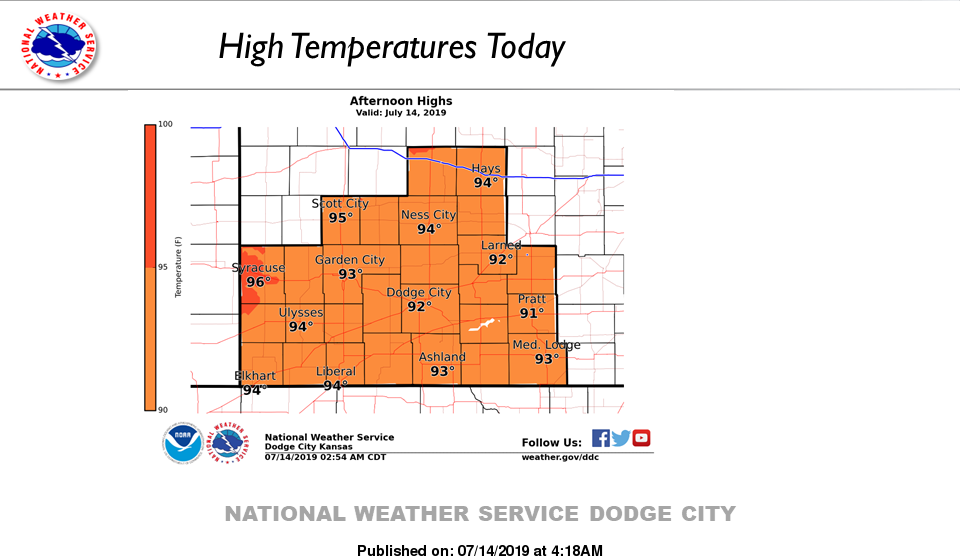
Hot, dry Sunday

Today
Sunny, with a high near 94. Light south southwest wind increasing to 5 to 10 mph in the morning.
Tonight
Mostly clear, with a low around 69. South southeast wind 7 to 14 mph.
Monday
Sunny, with a high near 95. South wind 7 to 11 mph.
Monday Night
Mostly clear, with a low around 68. South southeast wind 6 to 11 mph.
Tuesday
Sunny, with a high near 98. South wind 6 to 11 mph.
Tuesday Night
Mostly clear, with a low around 73.
Wednesday
Sunny and hot, with a high near 102.
Wednesday Night
Partly cloudy, with a low around 75.
Thursday
Mostly sunny and hot, with a high near 102.

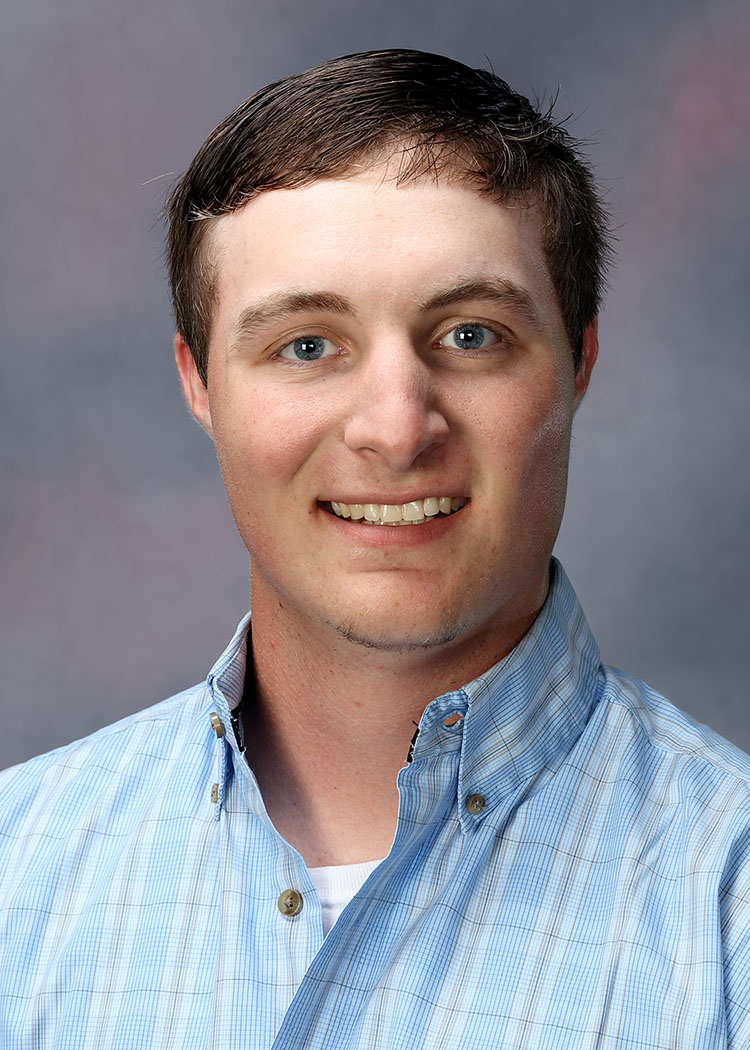
FHSU alum named KBA Outstanding Young Bandmaster

Casey Hands / courtesy photo

GARDEN CITY — Garden City Community College Director of Bands Casey Hands has been named the 2019 Outstanding Young Bandmaster by the Kansas Bandmaster’s Association.

The award will be presented to Hands at the KBA Convention in Wichita on July 19. The Outstanding Young Bandmaster award is presented annually by the KBA and the International Bandmasters Fraternity, Phi Beta Mu. The award is distinguished by its presentation to a bandmaster who has taught for fewer than seven years.

Hands began his teaching career at Garden City Community College in the fall of 2013, as the Athletic Band Director. He moved into the Director of Bands position in July of 2015, and since that time, has made some major improvements to the band and music programs at GCCC, not the least of which was Casey’s instrumental role in proposing and developing the only marching band at the community college level in Kansas. GCCC’s marching band made its debut, under Casey’s direction, in the fall of 2016, and has grown exponentially since that time. Casey recently completed his Master’s degree in Music at Fort Hays State University, and holds a graduate certificate in Teaching and Learning in Music from Kansas State University.

Casey will deliver a speech at the KBA Convention to accept his award. He plans to send a message that includes some advice for success in any undertaking.

“When you try to do everything by yourself, you almost always fail,” Casey said. “For me, it is not an award that just I have won, because I have always had people backing me up and helping me, and I think that what makes you successful and able to accomplish things like this and do things like this is if you are always willing to take help when it is offered and always willing to work with people.”

Casey was nominated for the KBA award by his former high school band instructor and active KBA member, Paul White.

About the KBA and the Outstanding Young Bandmaster’s Award
The Kansas Bandmaster’s Association is a state-wide organization for anyone interested in band, and its members represent educators and band enthusiasts from both the K-12 and collegiate levels. Each year, the organization partners with Phi Beta Mu, an international bandmasters’ fraternity, to honor an Outstanding Young Bandmaster in Kansas, through a nomination process. For the past three years, a bandmaster from western Kansas has been named as a recipient for the award.

For more information about KBA, visit www.kansasbandmasters.com

COLUMN: How bovine embryo transfer affects the human population

Regan Kats

EDITOR’S NOTE: This essay on a topic in agriculture was researched and written by a student as part of a project in a senior animal science class at Fort Hays State University. The project director is Dr. Brittany Howell, associate professor of agriculture.

By REGAN KATS
Prairie View senior

Every day at exactly 12:34, I crave a juicy hamburger. Luckily for me, I can buy one from any number of the millions of restaurants in the country. I can’t imagine a world where I wouldn’t be able to buy one because we ran out of beef.

Embryo transfer (ET) is the process of harvesting fertilized, 7-day-old embryos from a donor female, and then injecting a single embryo into a recipient female, also known as recips, to carry out the pregnancy. The ET process can first be traced back to the 1890s, when Walter Heape performed the first successful procedure in rabbits. It wasn’t until 1949 that the first successful bovine transfer was accomplished. While the technology surrounding ET is constantly developing, the basis for what is used commercially today mostly came about in the 70s.

Lots of people associate artificial insemination (AI) and embryo transfer as the same thing. However that is far from the case. Artificial insemination is the practice of using previously harvested semen from one bull in order to inseminate more cows than the bull could physically service. This provides more extensive use of a superior bull over a wider range of cows. Using ET with one bull’s semen will result in all the offspring being full siblings, butr they won’t all be genetically identical. Because ET involves fertilization of the eggs in the cow, one way or another the semen has to be deposited into the uterus. One of the benefits of ET is that the semen can be utilized at a cheaper cost than AI, as it’s cheaper to buy three units to inseminate a donor cow than it is buying a unit per cow for your entire herd. In order to be able to harvest multiple eggs, the cow has to be super-ovulated through multiple injections of follicle-stimulating hormone. Another version of ET is through in vitro fertilization. Similar to the process that women go through, eggs are harvested from the female and then fertilized in a sterile lab environment.

Many purebred seedstock producers utilize embryo transfer to provide leaps and bounds of genetic improvement in one breeding season. ET allows for a donor cow to be flushed several times during a year. Therefore a producer can become more efficient in the use of higher producing females. Another way to lower operating costs is to use cheaper commercial cows as recipient cows. Millions of seedstock catalogs are sent around the country every year, and lots of similarities can be found in the pedigrees. Many buyers will find a sire group of bulls they like or some fancy heifers that descend from certain cows. ET helps producers generate and offer more of the genetics that consumers want to buy. Not only can producers sell high demand genetics, but the cattle are often more consistent and predictable.

Embryo transfer isn’t always the most cost effective choice. Commercial cattlemen don’t often need or want to personally flush their cows, but they can still utilize the benefits of ET. The easiest route is through the purchase of ET bulls. More often than not, the producers sell more than just one ET bull from a mating. By buying these bulls, commercial cattlemen can generate a more consistent calf crop without the added labor of the AI process. Another way to benefit as a commercial producer is renting out cows as recip cows. Sometimes purebred producers don’t have enough cows to use as recips, or maybe don’t have enough grass to run them. This opens the door for commercial producers to earn a little extra money.

According to FarmBureau.org, farm and ranching families only comprise 2 percent of the U.S. population. So, how does ET affect the other 98 percent? With the exponential growth of the world’s population, more and more food needs to be produced to meet the growing demand. The only way to accomplish to this increasingly difficult task is to produce more with less. In crops, farmers strive for higher yields, and in beef production we are trying to produce more pounds of beef per head at the cheapest cost of gain.

To do this, producers have to be aware of the type of cattle we produce and constantly strive to improve not only our own herd but the industry as a whole. As with the growing population, the genetic advancements need to be growing exponentially as well. First we had AI, and it helped us to start producing more pounds of beef with fewer animals. Now the human population is gaining and growing faster than the beef industry has been able to keep up with. With ET and the huge genetic advancements it can provide, the beef industry now has another weapon in its arsenal to combat the challenges it faces today.

The use of ET benefits a wide range of people – everyone from the purebred breeder carefully selecting the next mating to the young diner waitress serving hamburgers at lunch. Luckily for me, when I get hungry from working out on the ranch I can come into town and sink my teeth into the only food that can satisfy my hunger – beef.

Regan Kats, a 2016 Logan High School graduate, is a senior majoring in animal science at Fort Hays State University. Regan is the son of Michael and Shannon Kats, Prairie View.

SW Kansas woman appointed to Lottery Commission

OFFICE OF GOV.

TOPEKA – Governor Laura Kelly appointed three members to the Lottery Commission.

“This team will play an integral role in enhancing the Kansas Lottery,” Kelly said. “I look forward to seeing what they can do to improve our lottery system.”

Catherine Moyer (D), Ulysses, retained as Chair; she is CEO and General Manager of Pioneer Communications and CEO of High Plains Telecommunications, Inc., and chair of the Telcom Insurance Group. She sits on the board of the Rural Trust Insurance Company and on the advisory council of the Washburn University School of Law Alumni Association Board of Governors.

Kala Spigarelli (D), Pittsburg, succeeds Tom Roberts. Spigarelli is an attorney at the Spigarelli Law Firm.

Ed Trimmer (D), Winfield, succeeds Alan Roethle. Trimmer is a retired teacher and former legislator.

These appointments are pending confirmation by the Senate and were submitted prior to Sine Die.

The Lottery Commission administers the lottery in the state of Kansas. The commission consults with and advises the executive director on the operation of the lottery, in the establishment of policies governing the lottery, and reviews and approves its annual budget. No more than three of the five members of the commission may be of the same political party.

Railway cars carrying ethanol derail in Hays on Sunday

By JAMES BELL
Hays Post

A Union Pacific train derailment in Hays caused some home evacuations and a few road closures near downtown late Sunday afternoon.

“A little after 5 p.m. dispatch received a call from Union Pacific Railroad concerning a derailment they had near the intersection of Ninth and Milner,” said Kim Rupp, Hays public information officer.

“At this time there are three tanker cars off the tracks,” he said.Train derailment Hays KS Train derailment 2 Hays KS Train derailment 3 Hays KS Train derailment 4 Hays KS

By 6:30 p.m. there was no immediate danger to the public, and no injuries had been reported.

“They do contain ethanol, however, there are no leaks, so there are no hazards to the public,” Rupp said.

While there was believed to be no immediate danger, some limited evacuations of housing were immediately conducted after the derailment in the vicinity as a precautionary measure.

The fire department set up a 300-foot perimeter, but no intersections were closed by 6 p.m.

The traveling public is asked to avoid the area and observe cones and barricades while the accident is being cleared, Rupp said.


HaysMed cardiologist presents at international conference

Dr. Byungsoo Ko

HAYSMED

Dr. Byungsoo Ko, Cardiologist and Director of the Cardiovascular Cathertization Laboratory at HaysMed, part of The University of Kansas Health System, recently presented at the C3 (Complex Cardiovascular Catheter Therapeutics: Advanced Endovascular and Coronary Intervention Global Summit) international conference. The conference was held in Orlando, Florida.

The C3 Conference is specifically designed for physicians who specialize in interventional cardiology, vascular surgery, and interventional radiology, as well as fellows, residents, and other healthcare professionals interested in atherosclerotic cardiovascular disease. Their mission is to deliver educational innovation through a global exchange of scientific research, new techniques, and technologies to improve patient care and utilize best practices to improve lives of countless individuals across the world.

Dr. Ko presented on Impella Supported Left Main Intervention in a Patient with STEMI Complicated by Cardiogenic Shock.

He also was on a panel for the International Joint Session with Korean Complex Cardiovascular Invention (CCI) Group Complex Endovascular and Structural Heart Disease Intervention.

KDHE issues stream advisory for Big Creek after sewer leak

The sewer line contents are being trucked to the Hays wastewater treatment plant.

Residents and pets should not enter these waterways

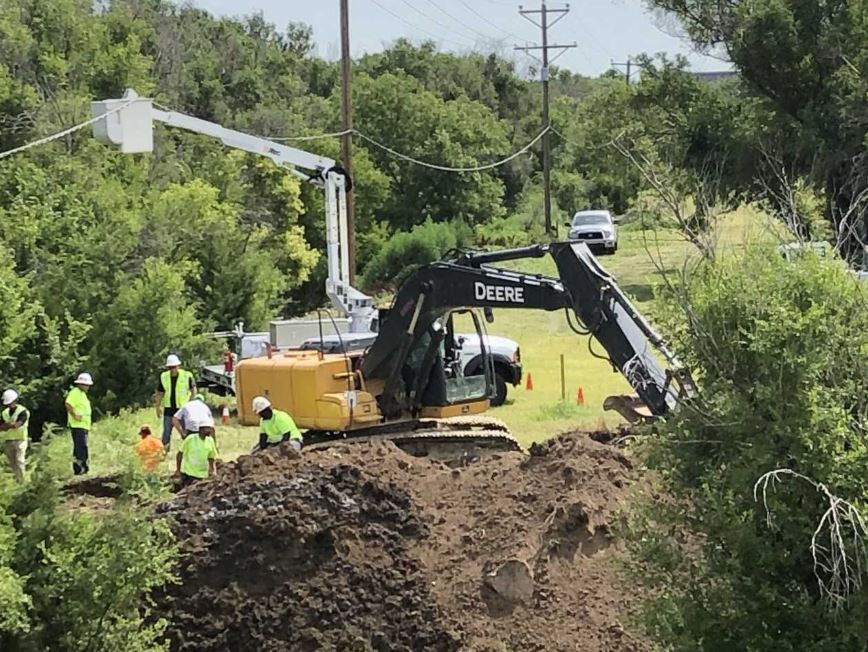
TOPEKA – Kansas Department of Health and Environment has issued a stream advisory for Big Creek in Hays downstream of the intersection of 27th Street and U.S. 183 Bypass on the west side of town. The stream advisory is a result of a sewer line break earlier in the week. The City of Hays is working to replace the sewer line and no sewage is currently being discharged into Big Creek.

RELATED: Sewer line & lift station still shut down; new replacement pipe to arrive Monday

Elevated bacteria levels were recorded at downstream locations of Big Creek and other contaminants may be present in the stream from the sewage spill. Residents and pets should not enter Big Creek at this time.

KDHE is determining if any sources upstream of Hays are contributing to the elevated bacteria levels. KDHE will rescind the advisory once water samples show no health risk and water contact in the creek has been deemed safe.

— KDHE

Soil compaction a concern as harvest nears completion

Winter wheat harvest in Ellis county 2019By JAMES BELL
Hays Post

The 2019 winter wheat harvest was one for the books.

Heavy moisture during the spring and continuing wet conditions kept the wheat growing and maturing late, pushing harvest back more than two weeks from normal in some areas of Kansas. Those wet and cool conditions created heavier than average yields and generally happy producers.

According to the National Agricultural Statistics Service, winter wheat production is forecasted to be up 19 percent from last year, with 330 million bushels expected to be produced.

Across the state, the average yield 50 bushels per acre, up 12 bushels from last year, and some local producers are well above that average.

That production is also coming from less with a drop of 6.6 million harvested acres since last year, according to the service.

But those wet conditions have also created potentially long-term negative effects to the soil and future winter wheat crops.


The problems of soil compaction

When the silty loam in the Hays area is dry, soil compaction is unlikely — but this year was different. Across Kansas, producers have dealt with copious amounts of rain and, in western Kansas, the water that remains in the soil could create deep compaction up to 18 inches below the surface, the effects of which might not be fully realized until next year.

In short, compaction happens when the soil is compressed and the structure of the soil is disturbed.

Topsoil compaction is easier to see but much less of a problem for producers.

“You can obviously see some of this by driving through the fields,” said Augustine Obour, assistant professor of soil science at Kansas State University Agricultural Research Center.

But the deep compaction that occurs when heavy pressure is applied to wet soil is more problematic and a serious concern for long-term crop production.

“There is probability (there is) more compaction out there than a lot of farmers realize,” said Stacy Campbell, K-State Research and Extension agriculture agent. “It definitely is real, and probably some of that was happening this year.”

Sometimes it is not visible when the soil is at its maximum water-holding capacity, according to Obour.

“When it is near its full capacity, it is prone to compaction issues,” he said.

Chart of soil moisture at 20 cm (7.87402 in) on July 11 from the Kansas State Mesonet

Soil moisture around Hays has been decreasing over the last 30 days, but still remains higher than normal up to a depth of almost 20 inches, while the soil in other areas of the state remains almost completely saturated.

That waterlogged soil compacts when heavy loads are applied to it and generally there is little that can be done to prevent compaction outside of staying off of the fields.

“If it is deeper than 6 inches, it can be a big issue,” Obour said. “The problem is that it affects a lot of things, particularly water movement.”

With the no-till crop production that is commonly used in the area, soil compaction may be compounded as no-till fields hold more water because of increased biological matter in the soil that retains more moisture.

Generally, Obour said, those no-till practices are good, but in years with heavy rain, it means producers have to wait longer to avoid compaction risks.

“In my experience, it takes about one more week for our no-tills to dry compared to our traditional till plots,” he said.

It also makes compaction harder to remedy.

“If you get compaction in the no-till field, then it is more difficult to correct because you do not want to till those fields,” Obour said.

Tilling a field that has been developed as no-till will damage the soil structure, he said.

Outside of water flow concerns, once soil is compacted the inability of water to flow properly can impact soil nutrient rates.

Producers will commonly use seed treated with nitrogen fertilizer, but once the soil structure is disturbed through compaction, the nitrogen might not go where it needs to for ideal crop growth.

“With all of the rain that we have gotten, nitrogen does not hold in the soil, it moves, so there will be some leaching of nitrogen fertilizer,” Obour said.

To combat nitrogen loss, he recommends producers sample up to 24 inches to get a good nitrogen profile.

“This year, if you do that with all the rain, I’m afraid it may not be there,” he said.

In order to combat nitrogen loss, producers will often spray fertilizer on the crop, but with heavy rains, this could cause another problem — runoff that spreads the fertilizer into other areas, including waterways.

“It’s very unusual in this environment, but it’s possible this year you may have some of those issues,” Obour said.

Soil compaction can also impact the root system of crops.

“About any of the crops that we produce here, they can get rooted down several feet,” Campbell said. “So if you have compaction at 18 inches, those roots if they hit that compaction layer may not be able to get through that.”

“It can take more than five years to have this corrected,” Obour said.


Producers have options for prevention

Avoiding putting significant pressure on damp soil is the best remedy for issues associated with deep soil compaction, meaning for producers sometimes a difficult choice has to be made; harvest a damp field and risk compaction, or push harvest past the ideal time.

“The bottom line is you have to consider the implications of soil compaction to justify field operations,” Obour said.

It the equipment is light, it may only create surface compaction in the top few inches, but if it is heavy equipment, such as trucks in a loading area, then the high pressure can create deep compaction.

“Iowa State did some work on this and they found that regardless of (design) … once you have about 10 tons per axle of weight and if the soil is wet enough or fairly moist, it can cause deep compaction,” Campbell said.

A report in 2017 by DeAnn Presley, K-State soil management specialist, found a full grain cart can carry more than 17 tons per axle.

An empty combine can weigh over 15 tons as well, pushing into the danger zone of per axle weight when fully loaded.

“The machinery just keeps getting bigger,” Campbell said.

Before producers move equipment into fields they have options to help determine if they are at risk of deep soil compaction.

Obour said pressing soil into a ribbon can help determine the moisture content. If the ribbon does not break apart at a length of 3 inches compaction is a risk, if it is under 2 inches when breaking apart it the risk is lower.

He said producers can also use the K-State mesonet to check soil moisture levels.

Producers can also take steps if they must enter a field that has high moisture to reduce the risk.

“Two key points for minimizing compaction from heavy axle loads are to limit traffic when fields are wet, and to confine the majority of traffic to end rows when possible,” Presley said in the report. “Keep in mind that the first wheel pass causes 70 to 90 percent of the total soil compaction, so preventing random, unnecessary traffic routes on the field is very beneficial.”

While the risk of compaction this year is high, Obour said he believes most producers around Ellis County know of the risk and he has not heard of any issues so far this year.

A government program is also working with producers that could not work fields due to high moisture content.

The Natural Resources Conservation Service has offered an Environmental Quality Incentives Program that helps producers plant cover crops that will help retain nutrient loads in the soil and prevent soil erosion.

“Cover crops help farmers to manage soil erosion, weeds and pests and to improve soil health,” said Karen Woodrich, NRCS state conservationist in Kansas in a news release for the program.  “They can also help your soil health recover after a flood or a long period of remaining wet.”

The application deadline is July 26. Producers interested in the program can call the local NRCS office at 785-625-3081.


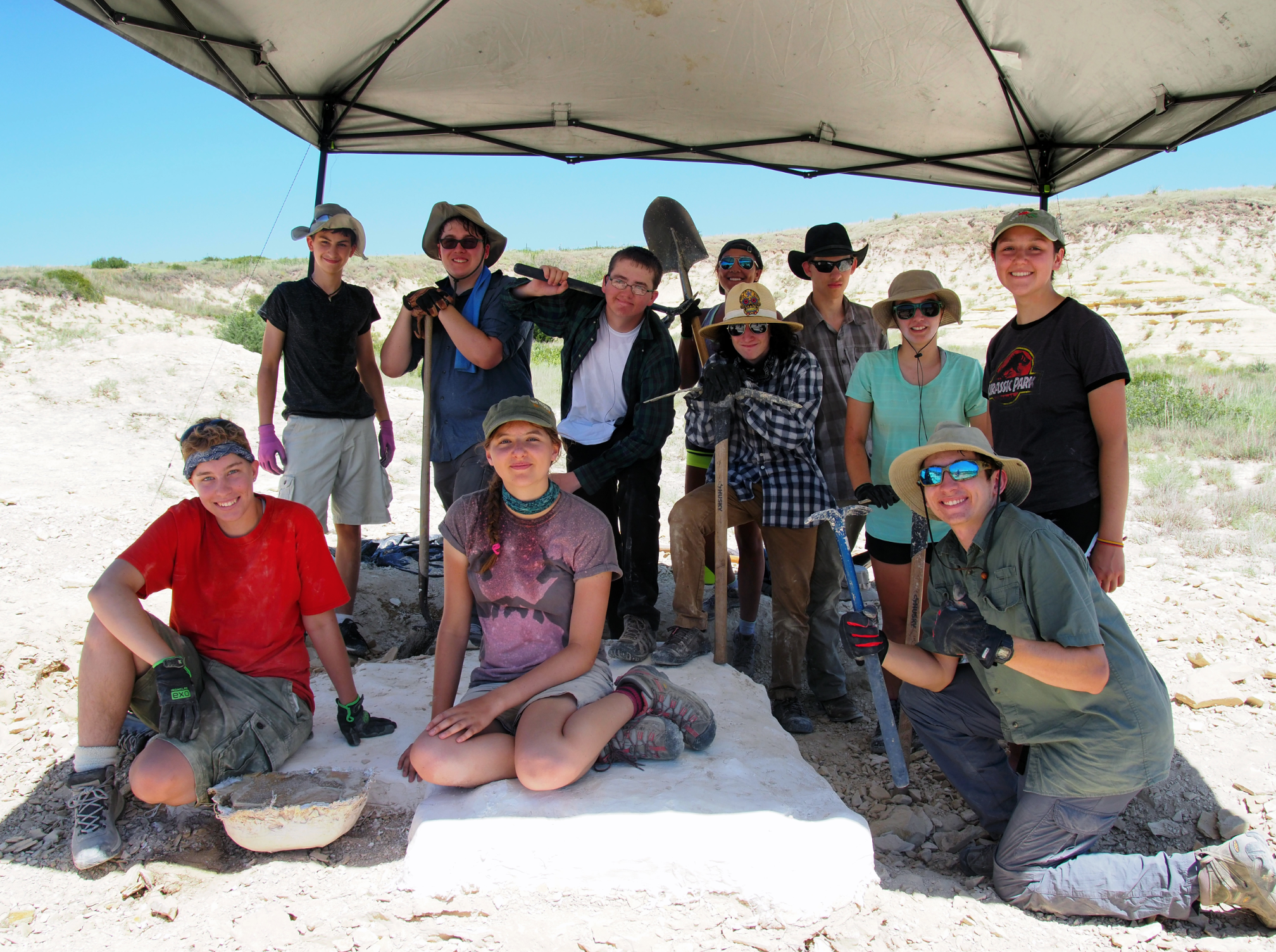
Students receive benefits from Fort Hays State summer science camps

Sternberg summer science camp 2016 / courtesy photo

By RANDY GONZALES
University Relations and Marketing

Alex Landwehr loves science. He attended science camps as a high school student. He is now an instructor at science camps. He finished his freshman year at Fort Hays State University this spring dreaming of a scientific career in paleontology.

FHSU’s Sternberg Museum of Natural History helps nourish that passion for science. Its scholarship program provided financial assistance in 2017 and 2018 for Landwehr to attend – and flourish – at summer science camps, which led to a position on camp staff.

“Without the financial aid, I wouldn’t have been able to go,” Landwehr said recently, taking a break from the six daily camps he is involved in this summer as an instructor.

The Sternberg summer science camps, now in their sixth year, have grown both in numbers and income generated. The first summer in 2014 had an enrollment of four students, all from Kansas. The net income generated was $1,200. This summer, there are 51 participants from 22 states enrolled in Sternberg’s camps for elementary, middle school and high school students. The net income for 2019 is $35,000. In addition to the scholarship program, income generated goes toward purchase of new equipment for the camps and marketing.

Camps Director David Levering wants Sternberg’s programs to be both affordable and accessible. They fill a need for youth science camps in Kansas and the surrounding area. He knew of expensive science camps on both coasts, and he wanted just the opposite when he was hired in 2013.

“It seemed to me that a lot of the students benefiting the most from these opportunities were students who already had a leg up, economically,” Levering said. “It occurred to me that if we could get those kinds of opportunities readily available in rural communities, it would be hugely beneficial.

“Having it here, in the middle of the country, is crucial,” he added. “Lower income students don’t have the resources to participate in camps that are across the country.”

That’s where the scholarships come in. Landwehr is thankful for Sternberg’s financial assistance.

“I think it’s really good that they do that,” he said. “They’re providing opportunities for people who aren’t financially able. I know I have friends from other (Sternberg) camps who wouldn’t have been able to go without financial aid.”

Landwehr was able to attend paleontology field camps in 2017 and 2018 with Sternberg’s help.

“I wanted to know if paleontology was something I wanted to do,” he said. “I went to those camps to see if that was what I wanted to major in.”

Landwehr now knows what he wants. He is a double major at FHSU, in biology and geology with a paleontology emphasis.

“I’ve always been interested in the natural sciences,” said Landwehr, a 2018 graduate of Topeka High School. “I really liked geology and biology. Paleontology is a really good mix of those two.”

Levering was originally hired as Sternberg’s museum educator. Dr. Reese Barrick, Sternberg’s museum director, soon realized the camps, as envisioned by himself and Levering, was a full-time job. Levering, who had previous experience with youth science camps, quickly showed that was an area of expertise. Barrick shifted job responsibilities and named Levering as camp director.

“I had wanted to have more connection with high school kids in general,” Barrick said. “That was one of the reasons I hired him as education director. He was at his best when he interacted with high school and middle school kids.”

Levering had a vision of what he wanted to accomplish. Barrick lent his support.

“It’s a big credit to Dr. Barrick,” Levering said. “I told him and the rest of the museum staff when I was interviewing what I wanted to do. I think it is a lot of credit to Dr. Barrick to agreeing with that idea as something that would be hugely beneficial to students in rural western Kansas.”

Barrick said many of the students attend camps in multiple summers. That helps boost attendance, as does word-of-mouth testimonials from students. Sternberg also capitalizes on serving an area previously under-utilized by science camps. And, one summer’s camper can become next year’s Fort Hays State student, like Landwehr.

“Because there are not a ton of camps in the country that do what we do, some of it is just in marketing,” Barrick said. “We’ve had some kids come to Fort Hays State through the camps. That’s pretty exciting.”

As the camps have grown in both the number offered and in participants, the need for additional camp instructors was filled in part by students such as Landwehr, in his first summer on staff.

“I wanted to keep doing camps, and being an instructor is a good way to stay on with the program,” said Landwehr, who is compensated for serving as an instructor. “It helps a lot. If I didn’t get paid I don’t know if I would get to be on summer staff.”

Being able to go to Sternberg’s science camps, and later serving as instructors, can put students on the path to success.

“The long-term benefits can be huge for students participating in these kinds of opportunities,” Levering said.

BOOR: ‘Perfect’ conditions for mosquitos

Alicia Boor

The current wet weather and standing water has provided “perfect” conditions for mosquitoes. The three primary strategies that must be implemented to avoid mosquito problems and bites are: source reduction, personnel protections and insecticides.

Source Reduction:
It is important to routinely eliminate or reduce all mosquito breeding sites. This will effectively decrease mosquito populations by removing stagnant or standing water from items or areas that may collect water. These include: wheelbarrows, pet food or water dishes, saucers underneath flower pots, empty buckets, tires, toys, wading pools, birdbaths, ditches, and equipment. In addition, check gutters regularly to ensure they are draining properly and are not collecting water.

Personnel Protection:
Protect yourself from mosquito bites by delaying or avoiding being outdoors during dawn or dusk when most mosquitoes are active. Use repellents that contain the following active ingredients: DEET or picaridin. Generally, DEET provides up to 10 hours of protection whereas picaridin provides up to 8 hours of protection. A product with a higher percentage of active ingredient will result in longer residual activity or repellency. For children, do not use any more than 30% active ingredient. Furthermore, do not use any repellents on infants less than two months old. Clothing can be sprayed with DEET or permethrin. However, be sure to wash clothing separately afterward. Before applying any repellent, always read the label carefully.

Insecticides:
For stationary ponds, there are several products that may be used, such as Mosquito Dunks and/ or Mosquito Bits. Both contain the active ingredient, Bacillus thuringiensis subsp. Israelensis which is a bacterium ingested by mosquito larvae that results in death. The bacterium only kills mosquito larvae with no direct effects to fish or other vertebrates. Avoid making area-wide applications of contact insecticides because these are generally not effective, and may potentially kill many more beneficial insects and pollinators (e.g. bees) than mosquitos.

The following items will not control mosquitoes:
Mosquito repellent plants (citronella plants)
Bug zappers
Electronic emitters
Light traps or carbon dioxide traps.

Alicia Boor is an Agriculture and Natural Resources agent in the Cottonwood District (which includes Barton and Ellis counties) for K-State Research and Extension. You can contact her by e-mail at [email protected] or calling 620-793-1910

Road improvement will close portion of 230th Avenue next week

The Ellis County Public Works Road and Bridge Division announced an asphalt overlay project will take place beginning at the intersection of 230th Avenue and Golf Course Road and will commence North on 230th Avenue for three-quarters of a mile.

On Tuesday, weather permitting, that stretch of 230th Avenue will be closed to through traffic beginning at 7 a.m. and will remain closed until the project is completed. The project is expected to be completed on the same day. Motorists traveling in the affected closure area should use alternate routes of travel until the project is complete.

Copyright Eagle Radio | FCC Public Files | EEO Public File