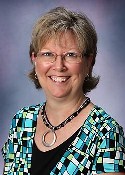
Fort Hays State University’s Dr. Janet Stramel, associate professor of teacher education, was recently elected to serve as president of the Kansas Association of Teachers and Mathematics.
Stramel will serve as KATM president for the 2019-2020 year and will lead more than 30,000 elementary and secondary math teachers across Kansas.
KATM, an affiliate of the National Council of Teachers of Mathematics, fosters an engaged community to advance effective practices in teaching and learning mathematics throughout Kansas.
Goals of KATM include: to create and maintain greater interest in the learning and teaching of mathematics; to provide opportunities for professional growth and development of teachers of mathematics; to provide a forum through which educators can discuss and respond to issues and activities affecting mathematics education in Kansas and the nation; to promote the value of learning mathematics; and to foster cordial relations among and between various groups in Kansas who are interested in and impacted by mathematics education in Kansas.
The Hays Area Chamber of Commerce (HACC) is seeking qualified applicants for the full-time position of Membership Coordinator. This position reports to the President/CEO of the HACC and works closely with the rest of the HACC staff, Board of Directors, Chamber members and other stakeholders. This position is responsible for communicating, connecting and developing quality relationships with existing and prospective chamber members. Furthermore, this position will assist with selling sponsorships and other event programming details.
Must have proficiency in general computer skills in Word and Excel; strong written and oral communication abilities; able to build effective rapport with others; be highly energetic, organized and self-motivated with superior attention to details; be able to understand, assist and promote the Chamber mission. Send cover letter and resume to:
Sarah Wasinger Hays Area Chamber of Commerce
2700 Vine Street
Hays, KS 67601 [email protected]
Resumes will be accepted until position filled. For more information, click HERE.
Benjamin P. Marcus is religious literacy specialist at the Religious Freedom Center of the Freedom Forum Institute.
By BENJAMIN MARCUS Freedom Forum Institute
Can a Latin cross ever be anything other than a symbol of the crucifixion and resurrection of Jesus? Can religious symbols or practices — Christian, Hindu, Native American or other — take on other meanings?
In the “Peace Cross Case” — American Legion v. American Humanist Association — the U.S. Supreme Court was presented with the question of whether it was constitutional for a 32-foot cross, maintained by taxpayer dollars, to remain on Maryland state property, where it has been since 1925.
Justice Samuel Alito, a Roman Catholic, wrote: “The cross came into widespread use as a symbol of Christianity by the fourth century and it retains that meaning today. But there are many contexts in which the symbol has also taken on a secular meaning. Indeed, there are instances in which its message is now almost entirely secular.”
Perhaps the most important question raised by the ruling: Are courts or government agencies competent to adjudicate what is religious and what is not?
I think not. But the more we include religion in government-funded, public spaces, the more that courts and government agencies will be asked to determine the meaning and significance of religious symbols and practices.
Let’s go back to the Peace Cross Case. The cross in question was completed by the American Legion in 1925 to honor fallen soldiers from Bladensburg, Md., during World War I. A Roman Catholic priest and a Baptist pastor took part in the dedication ceremony and U.S. Rep. Stephen W. Gambrill asked attendees to think of the cross as “symbolic of Calvary.”
What did the court say? The cross can stay. It does not violate the Establishment Clause. Why? Justice Alito — writing the majority opinion and joined by Chief Justice Roberts and justices Breyer, Kagan and Kavanaugh — explained that though the cross is certainly religious for some folks, “With sufficient time, religiously expressive monuments, symbols and practices can become embedded features of a community’s landscape and identity. The community may come to value them without necessarily embracing their religious roots.”
Perhaps this ruling, and the court’s reasoning, should not surprise us. After all, 25 years ago, in the majority opinion in Lynch v. Donnelly, the U.S. Supreme Court repeatedly referred to wreaths, garlands, reindeer, carolers and even Santa Claus as “secular images” and “secular figures.” Tell that to the Christian carolers singing “O Come, O Come Emmanuel.” Or to Saint Nicholas of Myra.
The upshot? If religious communities want to spare themselves the pain of having a court say that a Latin cross or Santa are not primarily religious symbols for some people in some circumstances, then religious communities should reconsider whether it is in their best interest to ask governments to play a role in creating or maintaining religious symbols or practices in the public square.
Ultimately this is about what we want our government saying about religion. History tells us that individuals and communities ascribe new meanings to religious symbols and even religious ritual practices, in different times and places. The American Academy of Religion — the world’s largest and most respected professional association for scholars who study religion — affirms that a central premise of the study of religion is that religious interpretations and expressions change over time as they influence and are influenced by culture. But should we ask the government in a religiously diverse democracy to dictate how society should understand specific religious symbols or practices?
To be fair to courts, deciding whether a symbol or practice is religious, secular or both can be an incredibly difficult task that vexes even the most savvy theologians and religious studies scholars. It is precisely because answers to questions of definition and classification are so nuanced — and so important — that we should avoid putting the government in a position to make the call whenever possible.
Take yoga as a reminder of what is at stake. The type of yoga practiced today by tens of millions of Americans in the United States is often considered a secular physical activity that promotes mindfulness. Yet it has its origins in a Hindu religious practice. In 2015, the Court of Appeal for the Fourth Appellate District in California was asked to decide whether a yoga program in a physical education class is a religious activity that violates the California Constitution’s ban on the establishment of religion. Its answer: no. You might agree with the decision. But have you contemplated its effect on the religious identities of the Hindu Americans who started a Take Back Yoga campaign in 2010 because they mourned the fact that “Hinduism has lost control of [yoga’s] brand?”
Or take lacrosse. I would guess that fewer Americans recognize the connection — historic and contemporary — between the stick-and-ball sport and religion. Yet members of the Haudenosaunee, including the Onondaga Nation, consider the game to be sacred. From the Onondaga Nation website: “It is a game that was given by the Creator, to be played for the Creator, and has been known to have healing power.” What pain do we inflict on Haudenosaunee communities when we ignore the religious significance of the game while playing it in our public schools?
I do not mean to suggest it is easy to determine the extent to which yoga and lacrosse are religious — and by extension whether they should be allowed in public schools. But I know that when courts and government agencies decide that yoga and lacrosse are not entirely religious, they can compound the pain of religious communities that already consider themselves marginalized.
Back to Bladensburg. The Supreme Court affirmed the religious significance of the Latin cross, but they also suggested that the cross might be understood as both a religious and secular symbol in certain contexts. That should give pause to those Christians who feel sidelined by secularism but support governmental ownership and upkeep of the Peace Cross.
In the aftermath of the case, Harvey Weiner, the national judge advocate of the Jewish War Veterans of the United States Inc., lamented the suggestion that the Peace Cross is not primarily a symbol of Christ: “Alas, to Christians, that a war memorial Latin cross has significant meanings other than being the ultimate symbol of Christianity.”
So next time you want the government to support a religious practice or display your most cherished religious symbol, consider whether you are willing to have the government later say that those symbols or practices are not entirely religious after all.
Benjamin P. Marcus is religious literacy specialist at the Religious Freedom Center of the Freedom Forum Institute. His email address is: [email protected].
PLAINVILLE — Following the June 27 auction of the Plainville Livestock Commission real estate and effects, another Plainville business is scheduled to go under the auction block Aug. 1.
The other shoe has dropped for Chuck Comeau and Dessin Fournir Cos. The once madly successful DFC Holdings, which includes several businesses in Plainville and Hays, despite filing for restructuring bankruptcy, is to be sold by sheriff’s auction.
Comeau commented that several things added up to the demise of the company, that virtually blindsided the company’s plan.
“Prior to 2008, there was nothing we could do wrong,” Comeau said. “It was all we could do to stay in front of it.”
The recession of 2008 started knocking the dominoes down, and according to Comeau, things went from bad to worse.
“Most businesses were developed to grow,” he said. “The hardest thing to do is to downsize. After 2008, in a nine-month period, we lost 40 percent of our business, and it’s been a fight ever since the recession happened. We had an infrastructure here and around the country to support growth, not to get smaller.”
He added leased show rooms in major cities across the country couldn’t be put on hold.
Comeau had to begin scaling down staff in 2016, and again in 2017.
“We tried to continue to grow, but the beginning of 2015 and into 2016, there was a huge change I did not expect. Into 2017, I lost all of my partners in one year.”
In 2017-2018, partner Chris Mraz suffered a disabling stroke; Comeau’s second partner, Len Larson developed severe dementia, and a financial partner died in August.
“It was all over. It was like all the pieces were thrown up in the air, and I had to catch them,” he said.
Not one to look for sympathy, Comeau said it all was on him, not anyone else’s problem, but he began to wonder what else could go wrong.
“All you’re doing [then] is to try to figure out how to stay afloat, and you need to stop and reorganize,” he said. “We had to furlough everybody in April — and we thought it would be a short one, but it wasn’t.”
Comeau said steps to stop expenses were taken, and showrooms in New York, Chicago, Los Angeles and San Francisco were closed.
Had the restructuring been given, Comeau and his staff decided on different ways of selling the company’s products. His customers — high-end designers — now do the bulk of their shopping online.
“It’s hard to go from feeling positive to feeling negative,” Comeau said, “and losing key people.”
Comeau’s health has also been challenged. He believes stress has a part of those issues.
“But you just try to get out of a situation and give yourself time to heal,” he said. “There are a lot of things to be thankful for. I have a brand new grandson, and now I have a daughter-in-law, so I have four kids, I have a great wife, and live in a great community.”
He said the biggest stumbling block to selling the company is that buyers want to take the business somewhere else.
Comeau and his doctors are keeping track of the non-Hodgkin’s lymphoma since 2016, and none other than his local hospital is where he prefers to be, any time he needs care.
He became ill when he was in New York, and those around him wanted to take him to a hospital there. Comeau commanded them to get him on a plane, so he could check himself into Rooks County Health Center.
With the future up in the air, Comeau said, “for the last 20 years this town has been the backbone of this company.”
Now that future will be determined in the front lobby of the Ellis County Courthouse.
The Kansas Highway Patrol helicopter arrived at Pratt Optimist Park beyond the Larks Park left field wall just after 4 p.m., according to Trooper Tod Hileman. The helicopter will be at the park until 7 p.m.
The Larks will play the Denver Cougars. It’s Pack the Pantry weekend with all fans are encouraged to bring a canned food or non-perishable food item.
Admission is free courtesy of the Hays Convention and Visitors Bureau and the Hays Regional Airport.
Come to @HaysLarksBB tonight from 5-7 pm and you can check out our cool KHP Helicopter!
It will take off at 7 and I will parachute out of it and land on the pitcher’s mound. Wait what..I can’t parachute out of it? Okay scratch the parachuting idea 😕
OWASSO, Okla. — Marty Barnett recently made history when he was selected as the inaugural winner of the top high school strength coach of the year for Oklahoma.
It was an honor the Rejoice Christian coach humbled accepted last month at the National Convention in Nashville, Tennessee.
“That was pretty cool,” Barnett said. “I was just really blessed. We’ve got a really neat thing going.”
A staple of the Eagles athletic success since 2016, Barnett was nominated for the award by Rejoice athletic director Brent Marley and fellow coaches in the department, who have been appreciative of his impact.
“He’s made a huge impact,” Marley said of Barnett, who also serves as an assistant coach on his football staff. “We talk about the process. He’s the process guy. His role as a strength coach, he takes that on very seriously and he understands it.”
Barnett’s award is another sign of his success at Rejoice. But, more importantly, the former high school football coach acknowledged the formal recognition and plaque were just another example of how a decision he made more than decade ago proved to be one of the best moves of his life.
Barnett is a native of La Crosse. He grew up in the Sunflower State and attained both his bachelor’s and master’s degrees in Kansas. His wife, April, was raised in nearby Otis.
Barnett went on to be a head football coach at Stockton and later at Pratt Skyline, which was part of the smallest 11-man classification in the state.
Even leading a pair of football program during the early-to-mid 2000s, Barnett’s heart was pulling him in a different direction.
“I enjoyed being a strength coach more than I did being a head coach,” Barnett said. “I enjoyed the process of getting the kids ready. That’s the reason I became a head football coach. It wasn’t because I wanted to be the guy. It was because I wanted to run the weight room.”
Barnett continued to feel the tug to working as a strength coach. In 2006, he took action.
“I’m mowing the football field like every small school coach in Kansas does and I’m just praying about it,” he said. “I knew my heart. That’s where my heart was.”
So, Barnett began to do some research and eventually accepted an unpaid internship at the University of South Florida in Miami. He, his wife and their then 6-month-old son, Isaac, packed up and made the trek to an unfamiliar area and a vastly different environment.
During that year, Barnett completed his internship and April got her foot in the door on a new career path as well, in the human resources and recruiting industry. It paid off. She currently works as a senior recruiter for the Williams Companies in Tulsa.
“She found her niche when I found mine,” Barnett smiled.
Following the completion of Barnett’s internship at USF, the couple decided to move to Oklahoma in 2007. They took another leap of faith.
“Neither of us had a job offer there,” said Barnett, whose only connection to family in Oklahoma was an older brother in Chandler. “We just knew we didn’t want to stay in Florida. We wanted to get closer to family.”
Marty found a job as a freshman football and basketball coach at Mustang High School. April continued her work in HR with INTEGRIS Health Care System.
In the summer of 2008, Marty had reached out to a connection from his college days at Kansas State University and found a way to sharpen his skills as a strength coach. This connection was working at the University of Tulsa at the time so Barnett drove back and forth that summer as free labor for Golden Hurricane athletics.
By that fall, the athletic department created a graduate assistant position for Barnett, which brought them to Tulsa. While working at TU, Barnett attended Victory Church. It was there, he struck up a friendship with another Victory attendee, Marley, who was then a coach at Victory Christian.
“Brent was needing a strength and conditioning guy at Victory,” Barnett said. “And, even though I was at TU at the time, I knew I wanted to work at the high school level again. I wanted to be able to have my cake and eat it too. I wanted to do what I love but I wanted to be home in time to tuck my kids in and see my wife.”
In 2009, Barnett went to work at Victory Christian. He stayed at the south Tulsa school until 2015 when Marley left to take over at as Rejoice’s head coach and athletic director. Even though Marley moved to Owasso, the new campus and facilities, which included a weight room, were a year away from being completed.
“The timing wasn’t right,” Barnett said. “They didn’t have a position for me, unless it was as assistant athletic director. And that’s not where I feel called to be.”
Instead, Barnett moved back to the Oklahoma City area, this time as a strength coach at Moore High School. He served in that capacity for a year before Marley reached out again in 2016.
While he and his family had been faced with tough decisions in the past, Barnett said the choice to move to Rejoice was a no-brainer.
“I loved the people and the vision,” he said. “Coach Marley has done an amazing job as an athletic director of setting the tone with the whole athletic department. I’ve been blessed that every coach has bought in and they see me as their head strength coach.”
Marley said the addition of Barnett has helped raise the level of athletics at Rejoice across the board.
“He knows what he needs and what we need as a school and what we need as a football program,” he said. “If our football program and athletic department was an automobile, he’d be the transmission. He definitely is the guy that makes it go on the inside.”
When Barnett reflects on his journey, he sees his path to Rejoice led by his faith.
“When you step out of the boat and step out in faith, hold on,” Barnett said. “We joke about it but God has been good. All along the way, he’s been there.
“I tell anybody that will listen, it took me 10 years but I’m in my dream job. Now I get what all that was about.”
Manual pumping of the sewer lift station at West 27th and U.S. 183 Bypass continued Friday morning following a sewer line break and subsequent shut down late Wednesday afternoon.
By BECKY KISER Hays Post
The city of Hays Water Resources Department continues to manually pump waste today from the sewer lift station at 27th and U.S. 183 Bypass after a leak was discovered late Wednesday afternoon in a forced sewer main line along nearby Big Creek.
Jeff Crispin, director of water resources, said Friday morning his crew decided not to find and temporarily fix the leak.
“This is an old line, and we’re going to abandon it for safety’s sake,” he said. Crispin estimates the 10-inch sewer line is buried 15 to 20 feet below the bank level of Big Creek.
A new line will be installed parallel to the existing line. Crispin said materials have been ordered and he expects the supplies to arrive Monday.
The city immediately shut down the sewer line and nearby lift station that serves that line after the leak was reported by a farmer who saw excess water flowing from the side bank of Big Creek.
There is no contamination of the city water supply, Crispin said. He noted the Kansas Department of Health and Environment’s northwest unit in Hays asked for two samples of the Big Creek water late Thursday afternoon, which were sent to Salina for analysis.
There has not been any interruption of water or sewer service to city customers, and installation of the new pipeline will not require service interruption.
Hertel Tank Service has been hired to help with pump removal of the sewer line contents into trucks as needed and transporting it to the city wastewater treatment plant.
Crispin said manual pumping at the lift station began at Thursday morning at 6:30 a.m. and continued until approximately 1 a.m. Friday.
Crews from the city and Hertel Tank Service were back on the scene after sunrise this morning.
Hertel Tank Service is has been hired to help manually pump waste from the sewer lift.
The sewer line contents are being trucked to the Hays wastewater treatment plant.
PLAINVILLE — The Dessin Fournir bankruptcy case has been dismissed from federal bankruptcy court and a sheriff’s sale has been set for Aug. 1.
Seven pieces of property with mortgages held by Sunflower Bank will be auctioned.
Properties listed in the foreclosure included 201 E. 12th St. in Hays, and Plainville properties 108 N. Main, 211 1/2 Mill, 205 N. Main, 317 W. Mill, 211 W. Mill, 221 W. Mill. All the properties listed in the Aug. 1 sale are in Plainville.
Edward Nazar, the bankruptcy attorney for Dessin Fournir and its subsidiaries, said Wednesday that Chuck Comeau, Dessin Fournir’s owner, has not been able to secure a new owner for the company.
The Comeuas own multiple properties in Plainville and Hays. Court documents indicated an $81,000 insurance payment for the properties was coming due in June, and Comeau did not have the funds to make that payment.
Dismissal of the bankruptcy case, which was ordered on June 19, will allow the foreclosure in state court to move forward, Nazar said.
Dessin Fournir and 11 other Comeau companies filed for Chapter 11 bankruptcy on April 8. The company also closed its doors and laid off its staff in Plainville. At its height, Dessin Fournir employed more than 90 people in Comeau’s hometown of Plainville.
Chapter 11 involves a company reorganizing, but the court determined Dessin Fournir did not have enough cash on hand or assets to continue with a reorganization.
Although Comeau was unable to find a buyer for the company as a whole, Nazar said there likely will be buyers of the smaller assets and product lines.
The furniture manufacturer was listed in court documents to have more than 200 creditors locally, nationally and even internationally with a total liability of more than $13 million. Some of its subsidiaries had other creditors, including companies in the trade.
The company is listed as owing more than $8.9 million in secured debt to three local banks, including $952,000 to Astra Bank, $7.5 million to Bank of Hays and $420,000 to Sunflower Bank.
Bank of Hays and Sunflower Bank filed for foreclosure on Comeau properties last year.
On March 26, District Court Judge Blake Bittel in a summary judgement ordered Comeau’s companies and other loan guarantors to pay Sunflower Bank a total of more than $420,000. A sheriff’s sale was ordered by the court on July 5.
According to court records, on June 27, FSSW LLC filed a motion for to recoup more than $1 million owed by the Comeau companies. It seeks to gain first lien on property above the Bank of Hays. Its motion seeks the authority to sell property listed as collateral to satisfy the Comeau companies’ debt.
Hays Post contacted the U.S. Justice Department, which is assigned to take media requests on behalf of the U.S. Trustee in the bankruptcy case, but no response was given as of the publication of this story.
The sheriff’s sale will be at 10 a.m. Thursday, Aug. 1, in the front lobby of the Ellis County Courthouse.
Ellis County residents will get a break on the price of disposing of tires at the landfill for two weeks in the fall in an effort to help clean up the county.
On Monday, the Ellis County Commission approved a rate reduction on the disposal of tires at the landfill from 10 cents to 5 cents per pound for a two-week period once a year.
Public Works Director Bill Ring the county used to receive grants to help with the cost of disposing of old tires, but those are no longer available. The measure will allow the landfill foreman to conduct the tire sale annually.
“We’re looking at doing it a 50 percent off of what we normally charge to let homeowners, not commercial businesses, bring tires in,” Ring said. “It will cost them something, but it will be half of what it normally would.”
Ring said the discount will be offered two weeks before the Hays city cleanup, which is typically held in late October.
“They also do not take tires, because of the cost involved,” Ring said. “If a Hays resident did have a tire, they would still have to bring it to us (at the landfill), but they could do it for the half price.”
There is a form that anyone bringing tires to the landfill would have to sign affirming that the tires are from Ellis County, that they are not from a commercial business and they are not being paid to bring the tires to the landfill.
Ring also said this is an effort to help clean up the county.
“We’re just asking our residents to be good stewards of the county and the environment and maybe offering somewhat of an incentive in doing it this way,” said Ring.
There will not be a limit on the number of tires a person brings to the landfill.
Ring said currently it costs $6 to dispose of two passenger car tires at the landfill so during the two-week tire sale if would cost $3.
The tires brought to the landfill will be recycled.
H. Edward Flentje is professor emeritus at Wichita State University.
Most Kansans are aware of former Governor Sam Brownback’s failed tax experiment, but fewer know of his equally flawed experimentation with the lives of Kansas children and families in poverty.
Beginning in 2011, Brownback initiated restrictions on federal aid through “temporary assistance for needy families,” or TANF, intended for poor families.
TANF provides cash assistance for families living in poverty as a result of job loss, divorce, health issues, domestic violence, the birth of a child, or other such disruptions in life. TANF encourages a transition from welfare to work, and states can design their own programs. TANF benefits are fully underwritten by the federal government, but federal law limits TANF lifetime benefits to no more than five years.
TANF typically serves families comprised of a single parent, predominately a mother, with two or more children, most aged five and under. TANF cash assistance for a family of four is roughly $500 per month.
Republican lawmakers followed Brownback’s lead, eventually writing more stringent TANF restrictions into law. Lifetime TANF benefits were lowered from five years to four years in 2011, shortened again to three years in 2015, and cut further to two years in 2016. Stricter work regulations were added as well.
Kansas Republicans theorized that forcing poor Kansans off welfare quickly would motivate them to find a job. Thus, the number of Kansas families assisted through TANF has been cut by three-fourths since 2011, and the state now ranks near the bottom among the 50 states in making TANF benefits available for needy families.
Blocking available TANF benefits did not open a path out of poverty, as Republicans imagined. Most beneficiaries worked before, during, and after exiting TANF, but, after losing TANF benefits, work was irregular. According to research on TANF in Kansas conducted by the national Center for Budget and Policy Priorities, during the first year after exiting TANF, “nearly two-thirds of the parents had no earnings or earnings 50 percent below the poverty line.” Four years after exiting TANF over half the families had earnings below 50 percent of the poverty line.
Further, a new Kansas study by Professors Donna Ginther of the University of Kansas and Michelle Johnson-Motoyama of Ohio State concludes that recent TANF restrictions substantially increase the likelihood that affected children will enter foster care. The researchers found that TANF time limits alone dramatically increase the probability that children will be removed from parents and enter foster care. In total, they estimate 10,085 Kansas children have entered or eventually will enter foster care due to recent TANF restrictions, such as time limits or work sanctions
The costs to Kansas taxpayers of restricting TANF benefits and pushing children into foster care are huge. Kansas taxes pay none of the cost of TANF benefits but do pay 69 percent of the cost of foster care. An average 20-month stay in foster care for a single child costs Kansas taxpayers roughly $30,000. As a result, these researchers conservatively estimate that children who have entered or will eventually enter foster care, as a consequence of TANF restrictions begun in 2011, will cost $264 million in Kansas taxes.
Brownback sought to remake Kansas into a national model for red-state governance, but his experiment with the lives of these vulnerable Kansans is failing. This social engineering continues to contribute to the breakup of families, pushes children into foster care, and costs Kansas taxpayers millions. Republican lawmakers should acknowledge this human and financial tragedy and put an immediate end to this flawed social experiment.
H. Edward Flentje is professor emeritus at Wichita State University and served with former Kansas Governors Bennett and Hayden.

 Today
Today