We have a brand new updated website! Click here to check it out!

In Kansas, wind turbine placement rules are made by counties

(Photo by Brian Grimmett)

By BRIAN GRIMMETT
Kansas News Service

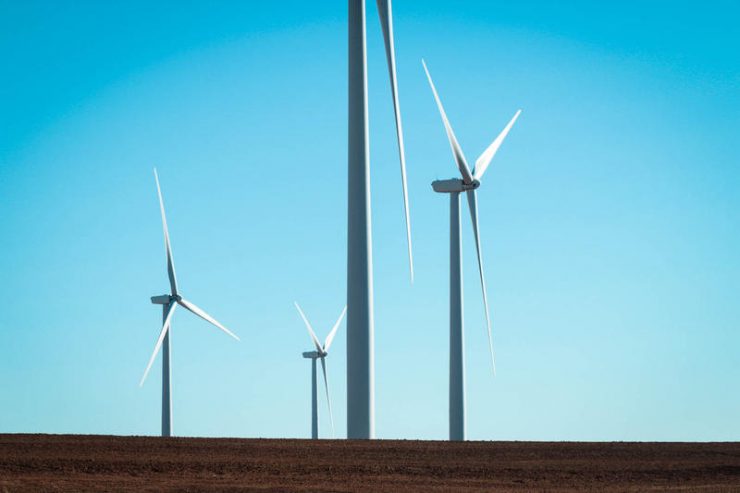
Wind farms have been sprouting across Kansas horizons for nearly 20 years, planting ever-more-giant turbines capable of transforming breezes into clean-energy megawatts and remaking the plains-and-prairie landscape.

The rules about how close those towering structures can stand to a road, to a home, or to a property line vary by project and from one county after the next.

Kansas has no statewide rulebook on the setbacks that govern how close a turbine can sit next to, well, anything. At least not yet. Legislators considered a statewide setback bill in 2019, but it didn’t get very far.

Instead, counties have been figuring out regulations as they go. That’s created a hodgepodge of agreements and regulations that range from outright prohibitions to whatever deal wind farm builders can cut with landowners and their neighbors.

Setbacks

One of the most common and hotly contested types of regulations regarding wind farms (see Reno County) has to do with what’s known as a setback. A setback is the distance a wind turbine must be from something else —roads, homes, a neighbor’s land.

Setbacks aim to protect against potential damage from ice that breaks off of the blades and to reduce the impacts of noise and shadows generated by the turbine.

Let’s take a look at how counties have been handling this so far.

No single government agency in Kansas keeps a comprehensive list. What we’re sharing here was gathered through phone calls and emails with county clerks, appraisers and commissioners in counties with operating turbines. Where possiblewe’re sharing links to documents with the information. If you have more information to provide, send an email to [email protected] and we’ll update our data set.

No Setbacks

Clark County
Cloud County
Elk County
Haskell County
Kiowa County
Marshall County

These counties have no setbacks, at least any mandated by the county through an agreement or conditional use permit. They’ve left that to the landowners and the developers.

Largest Setbacks

There are several different types of setbacks, but the most common is how far the turbine must be from houses where people live. That’s also sometimes broken down into whether the house is on land that’s been leased or is on land owned by someone not participating in the project.

Pratt has the largest setbacks in the state.

Setbacks for non-participating houses

  1. Pratt County – 2,500 feet
  2. Kingman County – 1,400 feet
  3. Allen County – 1,400 feet
  4. Marion County – 1,320 feet
  5. Barber County, Butler County, Coffey County, Ellis County, Ford County, Harper CountySumner County – 1,000 feet

Counties have set a more standard number for houses on land participating in the project. In every county that’s set that type of regulation, it’s 1,000 feet — all except Pratt County, which sets it at 2,500 feet.

Typical Setbacks

Every county is free to set its own rules, but some consensus has emerged. While not every county with wind farms has each of these restrictions, it’s generally where most have landed.
(Tiantian Zhou/Kansas News Service)

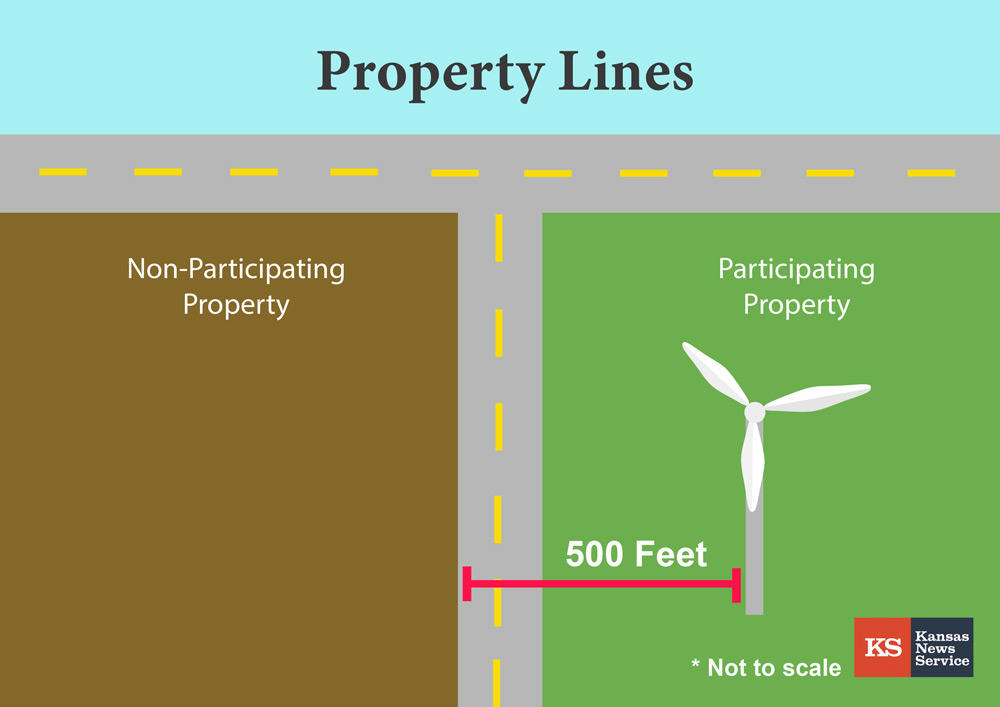
Property Lines

500 feet or 1.1 times the height of the turbine at its highest point.

To better understand the math, the average height of a wind turbine in Kansas is 417.7 feet. Multiply that by 1.1 and you get 459.5 feet.

But, new wind turbines do seem to be getting taller. One of the newest projects in the state is in Marion county. It also has the tallest turbines in the state. Each one is 492 feet tall when you include the top of a blade at its peak.
(Tiantian Zhou/Kansas News Service)

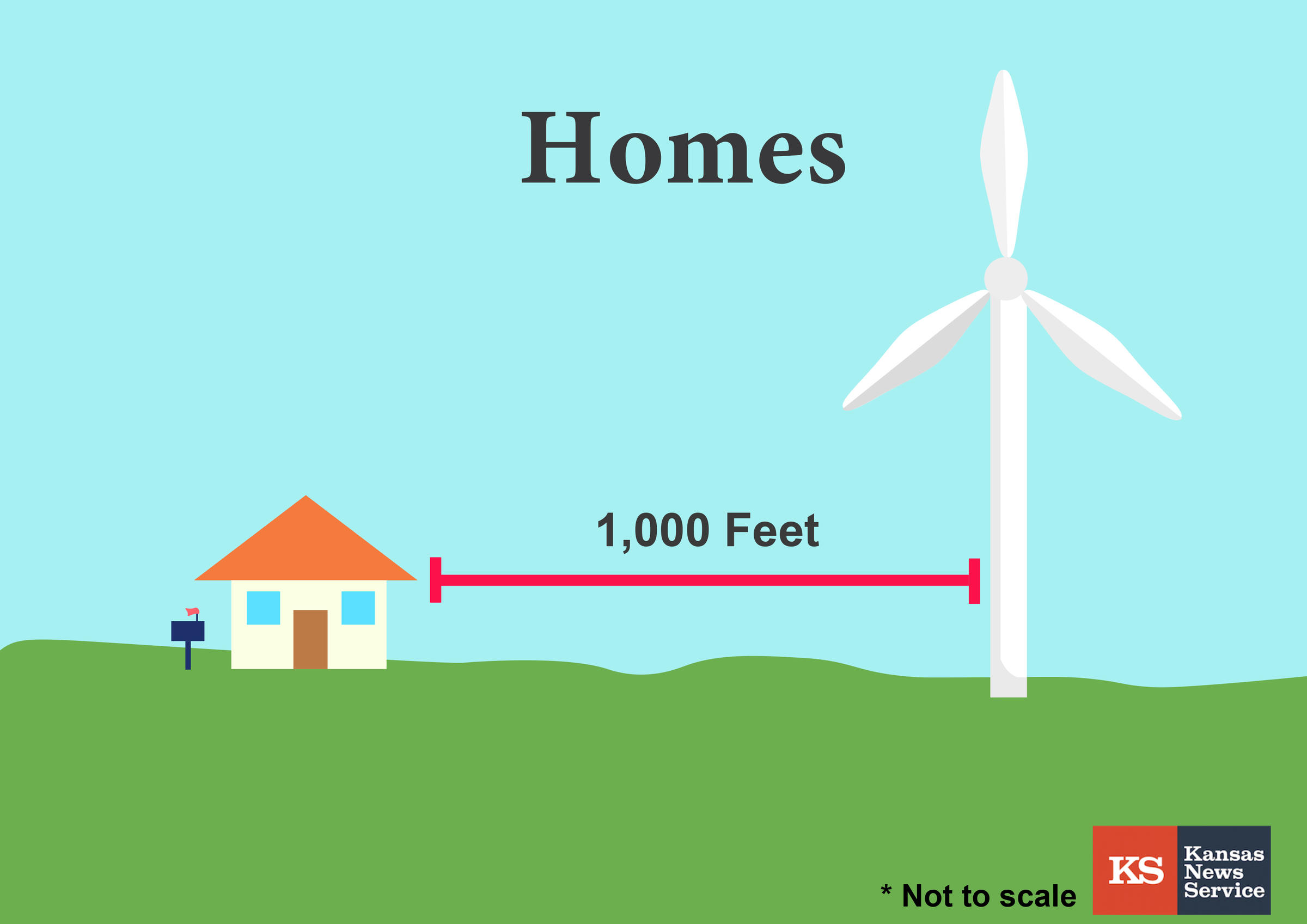
Homes

1,000 feet.

Accessory Structure

The height of the turbine plus 50 feet.

(Tiantian Zhou/Kansas News Service)

Roads

500 feet or 1.1 times the height of the turbine at its highest point.

(Tiantian Zhou/Kansas News Service)

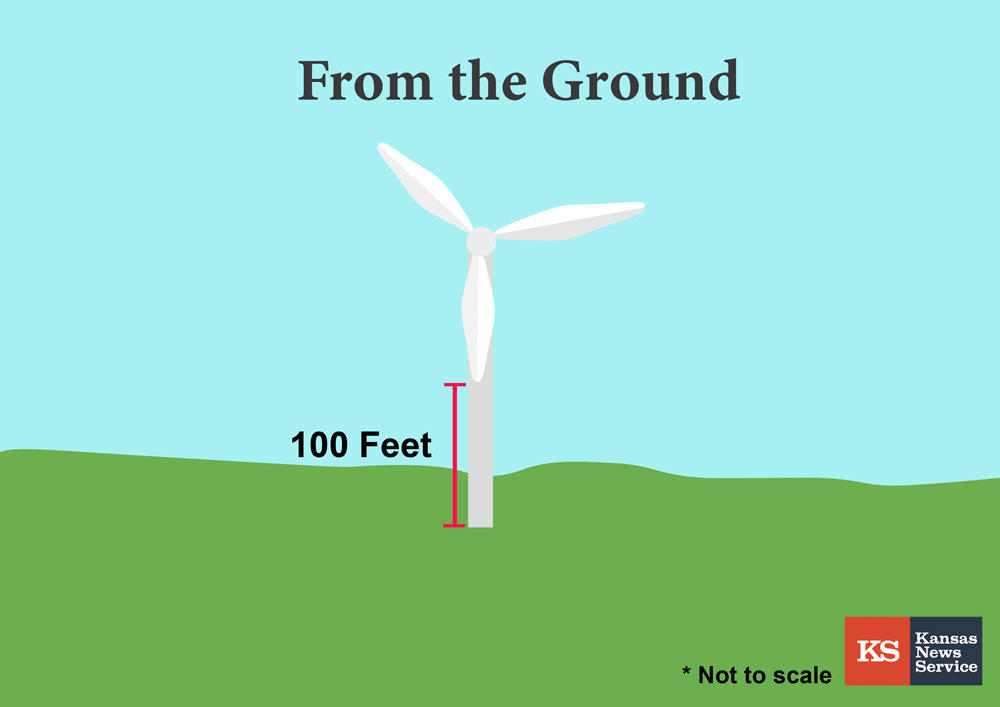
Distance of the blade from the ground

This category is more varied. Only six counties even regulate this. It ranges from 40 feet to 100 feet.

It’s also worth noting that wind developers will sometimes exceed the limits set by counties and choose to keep their turbines further away from homes and roads. They generally tend to follow the turbine manufacturer’s recommended setbacks.

Ultimately, finding the right setbacks for each location involves compromise. Developers need space to be able to build enough turbines to make a project economically viable, and the people who live nearby want to be protected from potential hazards and annoyances.

But in Kansas, that ad hoc approach has mostly worked.

While speaking to numerous county officials for this story, most seemed pretty pleased with the arrangements they’d worked out. Generally, there were very few, if any, complaints about the turbines.

Brian Grimmett reports on the environment and energy for KMUW in Wichita and the Kansas News Service, a collaboration of KMUW, Kansas Public Radio, KCUR and High Plains Public Radio covering health, education and politics. Follow him on Twitter @briangrimmett or email grimmett (at) kmuw (dot) org.
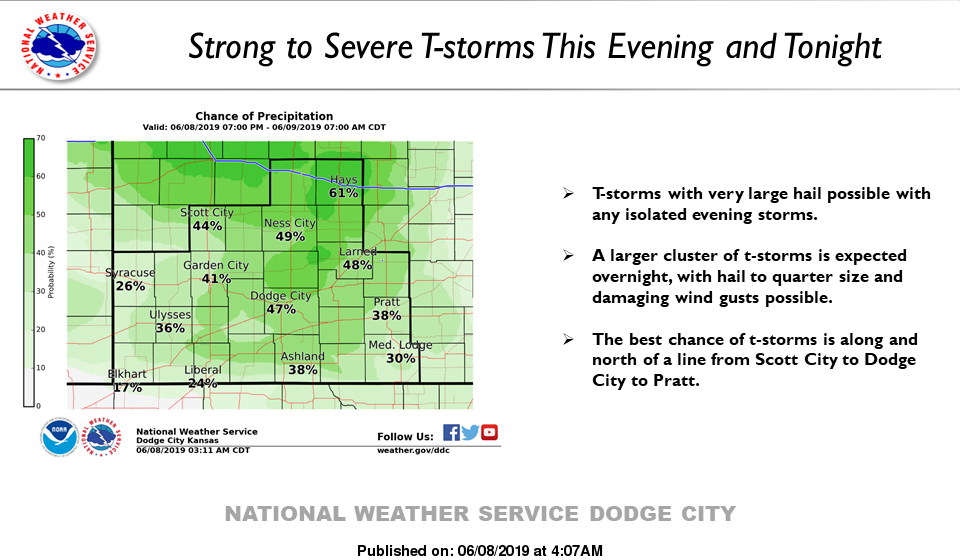
Mostly sunny, warm Saturday, chance of storms late

Today
Mostly sunny, with a high near 86. South wind 7 to 15 mph.
Tonight
Showers and thunderstorms likely, mainly after 1am. Increasing clouds, with a low around 59. South southeast wind 9 to 15 mph becoming north northeast after midnight. Chance of precipitation is 70%. New rainfall amounts between a half and three quarters of an inch possible.
Sunday
Showers likely and possibly a thunderstorm before 1pm, then a chance of showers and thunderstorms after 1pm. Cloudy, with a high near 62. Breezy, with a north wind 17 to 22 mph. Chance of precipitation is 70%. New rainfall amounts between a quarter and half of an inch possible.
Sunday Night
A 20 percent chance of showers and thunderstorms before 1am. Mostly cloudy, with a low around 49. North wind 13 to 18 mph decreasing to 7 to 12 mph after midnight.
Monday
Mostly sunny, with a high near 73. North wind 5 to 8 mph.
Monday Night
Partly cloudy, with a low around 52.
Tuesday
A 20 percent chance of showers and thunderstorms after 1pm. Partly sunny, with a high near 74.
Tuesday Night
A 40 percent chance of showers and thunderstorms before 1am. Partly cloudy, with a low around 53.
Wednesday
Sunny, with a high near 75.

NW Kan. woman, 2 children hospitalized after semi crash

PHILLIPS COUNTY— Three people were injured in an accident just before 4:30p.m. Friday in Phillips County.

The Kansas Highway Patrol reported a 1986 Peterbilt semi driven by Kelly Wade Lyon, 56, was eastbound on U.S. 36 behind a 2006 Chevy HHR driven by Elanor Ann Conrad-Farr, 55, Phillipsburg

The HHR was slowing, and failed to signal a left turn, according to the KHP. The semi attempted to pass the HHR on the left and struck the HHR on the driver’s side. The semi jack-knifed and came to rest in the north ditch.

Conrad-Farr and to passengers Dakota Conrad-Farr, 15 and Autum Conrad-Farr, 13, both of Phillipsburg were transported to the hospital in Phillipsburg. Lyon was not injured. All four were properly restrained at the time of the accident, according to the KHP.

Kansas man hospitalized after pickup rear-ends semi

GOVE COUNTY — One person was injured in an accident just before 1:30p.m. Friday in Gove County.

The Kansas Highway Patrol reported a 2014 Dodge Ram driven by Cory S. Romanowksi, 25, Phillipsburg, was northbound on Gove County Road 30 four miles south of Grinnell.

The pickup rear-ended a 2018 Peterbilt semi driven by Daniel I. Weis, 36, Grainfield, that was slowing to turn east onto Gove County Road Z.

Romanowski was transported to Gove County Medical Center. Weis was not injured. Both drivers were properly restrained at the time of the accident, according to the KHP.

Kelly sends right-hand man to hear out rural towns on economy, housing and more

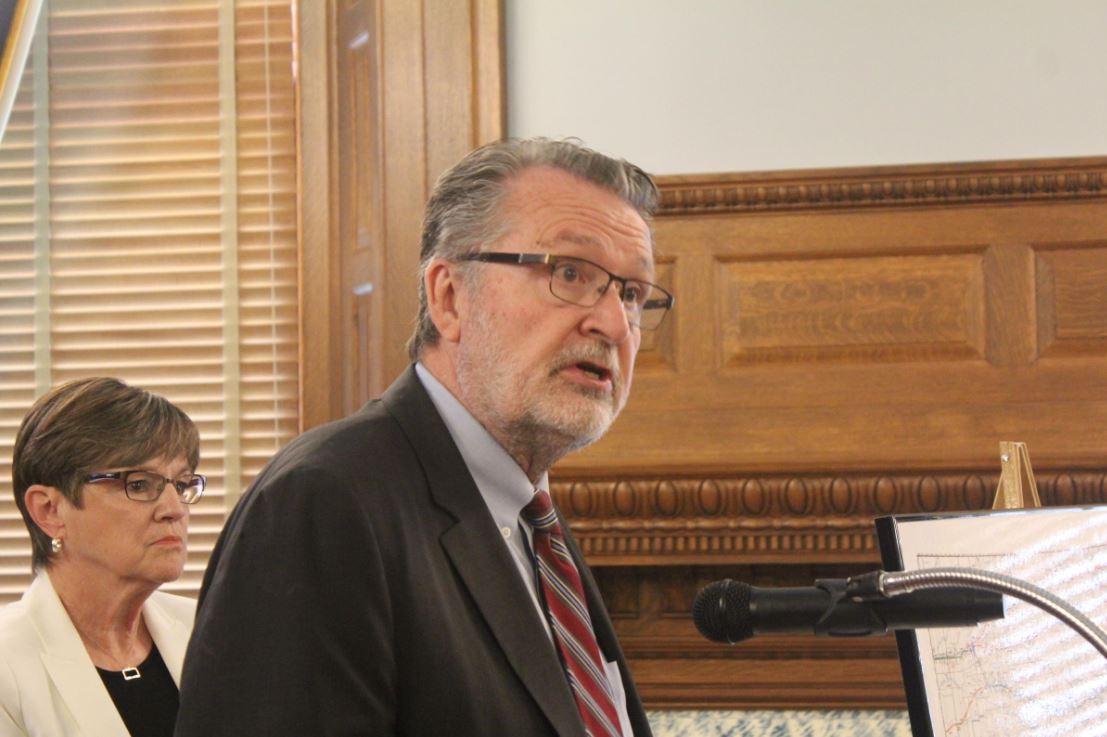
Lt. Gov. Lynn Rogers and Gov. Laura Kelly at a Wednesday press conference announcing a tour of rural communities. (Photo by Jim McLean/Kansas News Service)

KANSAS NEWS SERVICE

TOPEKA – Lt. Gov. Lynn Rogers will spend 12 days this summer in 12 far-flung towns in what is clearly an effort to show the governor’s office cares about rural challenges.

Rogers will be in Colby June 24 and Phillipsburg June 25.

He’ll hear about pains that can seem counterintuitive: Housing shortages on the wide-open prairie, for one. Or the fact that growing communities with plenty of work-age folks can struggle to train up local health workers, even while thousands toil there at lower-paying jobs.

Rural towns are used to politicians promising help or taking piecemeal stabs at fixing things. With a fresh rural revitalization effort in the Legislature and Rogers’ upcoming tour, could bigger solutions materialize? Read about the tour.

Barton Co. student elected alternate Boys Nation senator

MANHATTAN – Two delegates from the 2019 session of the American Legion Boys State of Kansas Leadership Academy have been elected by their peers to represent Boys State of Kansas as senators at Boys Nation this summer.

Ian Gould, a resident of Roeland Park, Kan., and a senior-to-be at Shawnee Mission East High School in Prairie Village, Kan., and Zachary Wash, a resident of McPherson, Kan., and a senior to be at McPherson High School, will attend Boys Nation, Friday, July 19 through Saturday, July 27, at Marymount University in Arlington, Va. The announcement was made this afternoon during the ALBSKLA’s closing ceremonies at Kansas State University in Manhattan.

Benjamin Brake, Wichita, Kan., Wichita Collegiate School, and Gabe Wolff, Pawnee Rock, Kan., Macksville (Kan.) High School in Barton County, were selected as first alternate and second alternate, respectively.

At Boys Nation, Gould and Wash will join representatives from each of the 49 Boys State programs across the country (Hawaii does not have a Boys State program) to receive an education on the structure and function of federal government. At the event, each delegate acts as a senator from his Boys State. The young lawmakers caucus at the beginning of the session, then organize into committees and conduct hearings on bills submitted by program delegates. Senators learn the proper method of handling bills, according to U.S. Senate rules. Participation in the political process is emphasized throughout the week, including organization of party conventions, and nominating and electing a president and vice president.

The week of government training also includes lectures, forums and visits to federal agencies, national shrines, institutions, memorials and historical sites. On Capitol Hill, Boys Nation senators meet with elected officials from their home states.

Approximately 405 young men from across the State of Kansas, all of whom will enter their senior year of high school this fall, participated in the 2019 session of the American Legion Boys State of Kansas Leadership Academy. The event, which completed its 82nd year, started June 3 and concluded today.

The ALBSKLA provides a relevant, interactive, problem-solving experience in leadership and teamwork that develops self-identity, promotes mutual respect and instills civic responsibility. Boys State is a “learning by doing” political exercise that simulates elections, political parties and government at the state, county and local levels, providing opportunities to lead under pressure, showcasing character and working effectively within a team. It’s also an opportunity to gain pride and respect for government and the price paid by members of the military to preserve democracy.

– SUBMITTED –

ARC Park in Hays receives $5,000 donation from Cenex

Accessibility-focused park honored for meaningful contributions to Kansas community

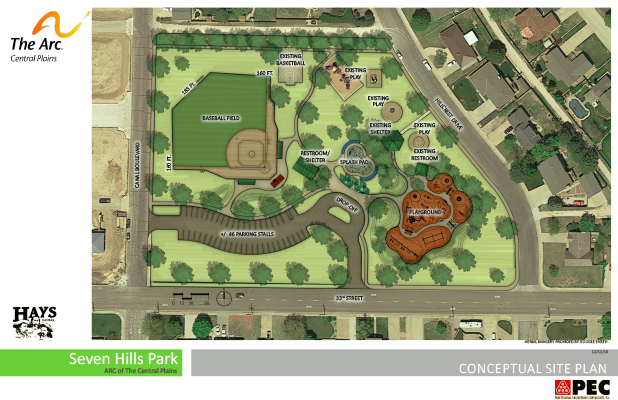
The Accessible Recreation Complex (ARC Park) that is being constructed in Hays was recognized by Robcom LLC and Cenex, the energy brand of CHS, for being a unique source of pride in the community. ARC Park is an accessible play space for children of all abilities that is set to open this fall.

 The Arc of Central Plains received a $5,000 donation to help fund construction of the park.

Once completed, ARC Park will provide children of western Kansas with a fully accessible playground, baseball field and splash pad where those of all abilities can play together. The space will emphasize inclusion, self-empowerment, collaboration and imaginative play for the 1,400 children and adults with disabilities in the area, along with their families and friends.

 “Southside Convenience is proud to support our community,” said Tara Patel, owner of the Southside Convenience Cenex location in Hays. “ARC Park will be a tremendous asset to the city of Hays and to the thousands of children who will play there each year.”

 The $5,000 donation was provided to Southside Convenience through a grant program that encourages Cenex retailers to share stories about what makes their local communities unique or special. In total, Cenex retailers will receive more than $100,000 to give back to their communities this year. 

 “The Cenex brand has a deep-rooted history of serving the people and communities of rural America,” says Bryan Brignac, director of marketing at CHS, the nation’s largest farmer-owned cooperative. “We are proud of our Cenex retailers, like Southside Convenience, who play an active role in enriching their communities.”

Applications for the grants are competitive among almost 1,500 stores in 19 states.

“The ARC Park has a unique opportunity to be the pride of western Kansas,” Brignac said. “we are supportive of any meaningful projects that will help enrich the lives for so many different families and kids in the Hays area. When you look nationally, how many of these parks are out there?

“This, in our eyes, is a very unique attraction that will definitely benefit not only the residents of Hays, but people from the surrounding communities. With an impact like that, we definitely thought it was unique and deserving of a community contribution.”

Cenex, the energy brand of CHS, provides high-quality refined fuels through nearly 1,500 locally-owned convenience store locations across 19 states. CHS owns and operated the refinery in McPherson, Kansas, where 800 people are employed. CHS buys the majority of its fuel that is processed at McPherson from framers and ranchers in the Kansas area, Brignac said.

Consumers depend on Cenex fuels, lubricants, propane and renewable energy products to power homes, businesses and communities. CHS, Inc.(www.chsinc.com), which owns the Cenex brand, is a leading global agribusiness owned by American farmers across the United States with domestic and international operations including energy, agronomy, grain trading and food processing.

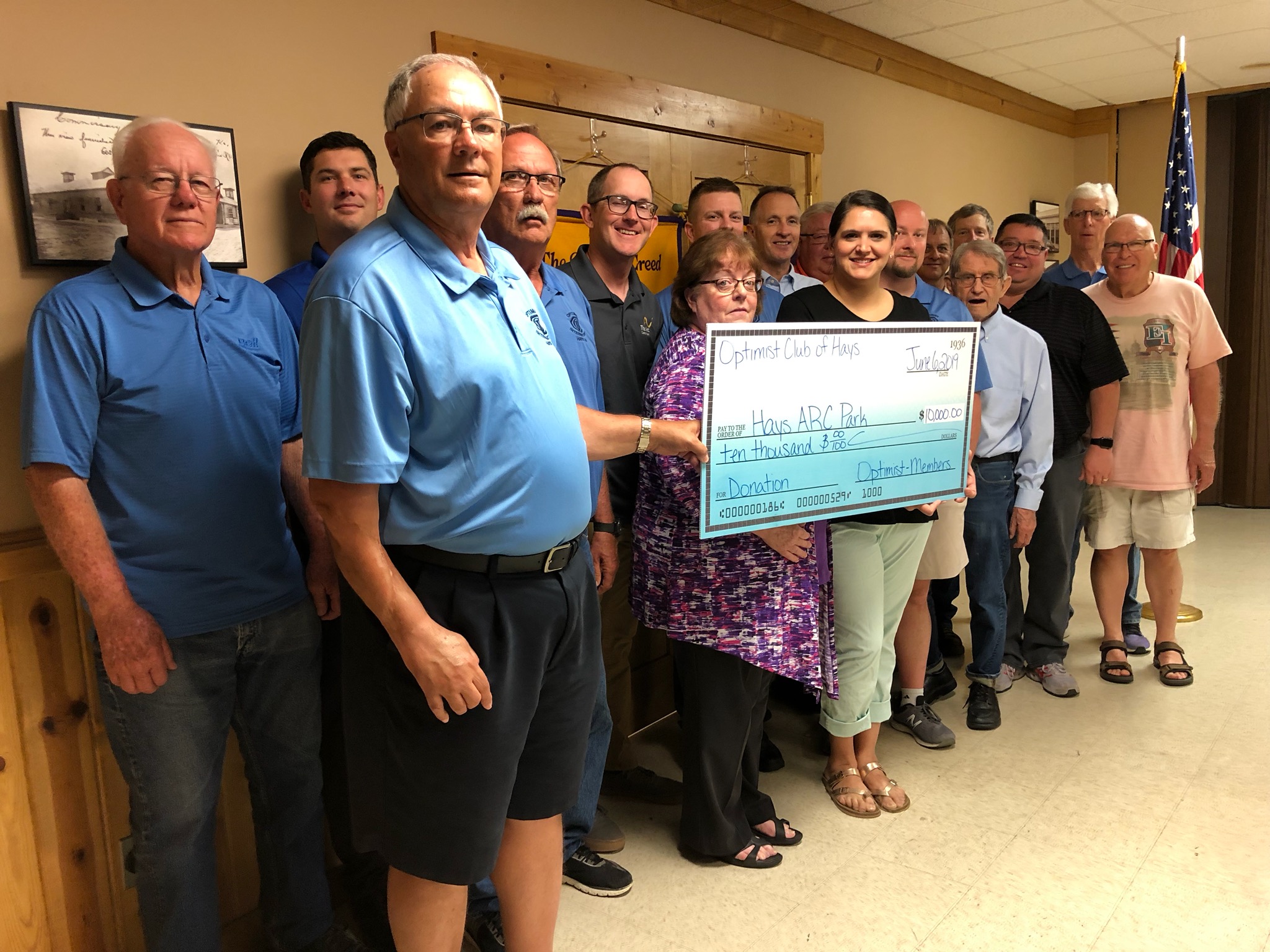
Hays Optimists contribute $10,000 to ARC Park

Hays Optimist members present a check for $10,000 to Sarah Meitner and members of the ARC administrative team.

Submitted

The Hays Optimist Club is proud to present a $10,000 contribution to the ARC of the Central Plains for the accessible park that they are constructing at the site of the Seven Hills Optimist Park.

Twenty plus years ago the Optimists in conjunction with the City of Hays provided funds to build a shelter house and purchase playground equipment for the park.

Optimist members in addition volunteered their time to build the shelter house and assemble and install the playground equipment.

Hays Optimists has been in existence since 1966. Three of the original charter members still regularly attend the weekly meetings. Optimist members in fall 2018 volunteered more than 244 hours to sell Christmas trees and also volunteered their time and efforts to sell raffle tickets. The proceeds of both projects were used to fund 21 different youth projects in 2019.

Funds for the contribution to the ARC project were the result of funds set aside from past tree sale projects. The members knew that at one time there would be a need to make additional improvements to the Seven Hills site.

When the ARC Park project was announced, they voted to use the funds that had been restricted to assist in the fundraising for the project.

SHPTV receives Hansen grant for Thomas County

SHPTV

BUNKER HILL – The Dane G. Hansen Foundation Community Grant for Thomas County has awarded Smoky Hills Public Television with a grant for $1,000 to support the station’s Literacy Leadership Program.

The grant funds will provide books for Head Start children, as well as, support for children’s programming.

“We are thankful for the generosity of the Dane G. Hansen Foundation Community Grant for Thomas County,” said Larry Calvery, Smoky Hills Public Television General Manager. “Educating the youth of our area is an important mission of Smoky Hills Public Television and this grant will help us put books in the hands of the children in Thomas County.”

The Dane G. Hansen Foundation is committed to providing opportunities for the people of Northwest Kansas to enjoy the highest possible quality of life. The foundation advances its mission by investing in the areas of education, health care, economic development, community social services and security, conservation and environment, arts and culture and community beautification.

Smoky Hills Public Television serves 71 counties in central and western Kansas and has been named the Kansas Association of Broadcasters Non-Metro Station of the Year.

INSIGHT KANSAS: Bipartisan lawmakers mend state finance

Kansas voters who threw far-right Republicans out of office in 2016 and elected Laura Kelly as governor in 2018 should be pleased that state finance is on the mend after facing bankruptcy three short years ago.

In assessing the condition of state finance at the close of the 2019 legislative session, Kansans should not forget the disastrous financial mess of 2016:
· block grant funding of schools had been ruled unconstitutional;
· a $700 million state bank account had been drained empty by four years of unbalanced budgets triggering repeated downgrades in state credit;
· frequent borrowing had ballooned tax-supported state debt to an historic high;
· a reckless tax experiment bumped up property taxes as a portion of state and local revenues to the highest level since the 1980s;
· cutbacks in highway maintenance, suspended pension payments, child deaths, prison uprisings, and a decertified state hospital highlighted an overall deterioration in state services;

H. Edward Flentje is professor emeritus at Wichita State University.

To top off this debacle, far-right Republican lawmakers skipped town in 2016 after authorizing spending that exceeded revenues by more than $300 million.

Most Kansans correctly place primary blame for this mess at the feet of former Governor Sam Brownback and his tax experiment, but current legislators, including Senate President Susan Wagle, Senate Majority Leader Jim Denning, and House Speaker Ron Ryckman, had a hand in doing the governor’s bidding.

In 2016, Kansas voters rebuked legislative allies of Brownback and elected 40 centrist Republicans and Democrats to contested seats.

Then, in 2018, they chose Kelly over Kris Kobach, who wanted to redo the experiment.

A current snapshot of state finance demonstrates that elections do make a difference.

First, and most importantly, a genuinely bipartisan school funding package has been enacted. That package addresses specific issues raised by the Kansas Supreme Court and should end 10 years of turmoil over school finance.

Second, abandonment of the tax experiment in 2017 has restored state balances, estimated at $550 million by July 1, 2020. However, that balance could quickly evaporate if lawmakers fail to keep spending in line with revenues. For example, on the last day of the legislative session, Governor Kelly, with the help of Democrats and a handful of Republicans, successfully fought off an attempt to override her veto of partisan tax cuts that would have shrunk balances.

Third, axing the experiment has also rebalanced the tax mix among property, sales and income taxes. Relative equivalency among these tax sources should assure lower tax rates overall, reduce competition with other states, and promote tax fairness based on income.

Fourth, state legislators enacted a bipartisan budget package that begins to repair state services in a number of areas. Kelly trimmed the package with line-item vetoes but was overridden on those. This action diminished state balances by over $50 million.

Finally, state debt is being paid down from record highs, and state credit has edged upward since 2016.

While state finance is on track, thorny, unresolved issues could throw the recovery off course. Kelly narrowly blocked the Republican’s tax bill but pledged a comprehensive review of state tax policy in advance of the next legislative session. Kelly proposed extending the payoff of unfunded pension liabilities in order to achieve short-term financial flexibility, but Republicans balked at the cost her proposal. And Senate leaders stalled Medicaid expansion.

Kansans chose a bipartisan path forward in 2016 and 2018, and lawmakers produced. Kelly and legislative leaders now face the dual challenge of keeping on track while also finding consensus on continuing, unsettled issues of state finance.

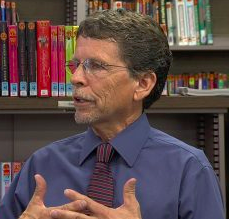
USD 489 election: Pallister wants to maintain quality education for next generation

By CRISTINA JANNEY
Hays Post

After 37 years working in schools, former Hays Middle School Principal Craig Pallister is seeking to get back into education. He filed this week to run for the Hays USD 489 school board.

Pallister, 65, joins a field of eight other candidates for four open positions on the board, including incumbents Paul Adams and Luke Oborny and newcomers Lori Hertel, Tammy Wellbrock, Alex Herman, Allen Park, Jessica Moffitt and Cole Engel.

“My thoughts are still with public education,” Pallister said. “It is one of those [things I wanted] to give back now to education that I have the time to do it.”

Pallister said he does not think the district or the board needs any major changes.

“I moved to Hays 37 years ago when my oldest child was just getting into kindergarten because it had a great education system and it’s a great community to raise kids,” Pallister said. “We just need to publicize how good our public schools are. I don’t think people realize that if they went to other places around the state of Kansas, Hays is very, very lucky.”

In terms of facility needs, Pallister said he thought the biggest need is at the elementary level.

The district has had two failed bond issues in three years — in 2016 and 2017.

The school board has discussed adding two sections to Roosevelt Elementary School and closing Lincoln Elementary School, which is more than 90 years old and has significant infrastructure problems. The board will consider time lines in July for a bond election in 2020.

The board has also discussed including in the bond issue expansion of the HMS cafeteria.

“The specific need for Hays Middle School after being there for 25 years is the cafeteria,” Pallister said. “We were lucky to get additions built on a couple of times while I was there, so we have the space, but it is the cafeteria that is really the specific need. It is not a want; it is a need.”

The cafeteria was built for 400 students and is now serving almost 700 students.

“We get them fed, but we had to rush their lunches so much,” he said. “They don’t get to socialize. It is like being in a restaurant that is overcrowded and has people standing in line all of the time.”

The school district reached impasse with the Hays NEA during negotiations last year.

“The district just needs to listen to the teachers about their needs and what they want to change in the district,” Pallister said. “I think the district needs to get back to realizing our staff and faculty are the most important part of the school district. They are the ones that meet our kids every day. … If you have great staff and great teachers, you will have an outstanding district, and that is what we have.”

He said he thinks the district needs to promote itself to continue to draw quality teachers and staff members to the district.

“We should send out something that says, ‘Hays USD 489 — one of the best districts in the state of Kansas,’ ” he said, “and we could stand behind it because we have the teachers and we have the staff and our kids come out and are prepared.”

The board has also heavily debated its one-to-one computer policy.

“Technology is just part of the integral education process,” Pallister said, “but our kids need that solid technology background to be able to be successful through 12th grade and then through post-secondary education.

“I have had two daughters go through universities now, and they had a very good technology background after being in USD 489 and it is having it every day in front of them.”

Pallister was the assistant principal at HMS for four years before serving as head principal for 21 years. Prior to working in Hays, he was an assistant middle school principal for three years and a teacher for 10 years at the middle school in Dodge City.

He earned both his bachelor’s and master’s degrees from Fort Hays State University.

“I have the historical background because I have worked under four superintendents of schools in Hays,” he said. “I feel like I bring a lot of knowledge of education and the historical knowledge of how the district has done the good things and the times we have not done good things.”

Pallister’s wife also worked for the Hays school district. She retired this spring from her position as a librarian for Roosevelt and Lincoln Elementary schools.

Pallister said the most important reason he is running is because he has a granddaughter who will be a second grader at Wilson Elementary School in the fall.

“I just have the time, and I want to be involved in education because that has been my life,” he said.

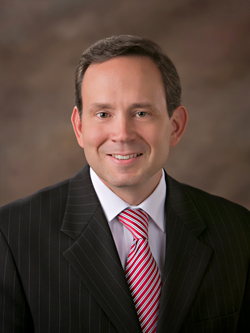
Hays native and FHSU graduate appointed to chief judge for the 21st District Court

By James Bell
Hays Post

The Kansas Supreme Court announced Thursday the appointment of Hays native Grant Bannister to chief judge of the 21st Judicial District.

The appointment will be June 16 through Dec. 31.

“We are glad that Judge Bannister has agreed to serve as chief judge, providing continuity in capable leadership in the 21st Judicial District,” said Lawton Nuss, chief justice of the Kansas Supreme Court in a press release.

Bannister has served as a district judge for the 21st Judicial District since September 2016 and will replace Judge Meryl Wilson following his retirement.

“It has been a pleasure to work with retiring Chief Judge Meryl Wilson who has selflessly and admirably served the judiciary for over 22 years,” he said in the news release.

“I am grateful to be surrounded by hard-working staff, clerks, and judges who are dedicated to having fair, efficient, and accessible district courts in Riley and Clay counties.”

Bannister graduated from Fort Hays State University with a B.A. in economics in 1993. While attending FHSU he served as President of the Student Government Association, was a Truman Scholar National Finalist and a Rhodes Scholar Nominee.

He was the FHSU Young Alumni Award winner in 2007.

“Bannister graduated from the University of Kansas School of Law in 1997,” the release said. “He was in private practice in Manhattan for 19 years and also served as an adjunct professor teaching ethics in the College of Business at Kansas State University. He is married and has three children.”

Copyright Eagle Radio | FCC Public Files | EEO Public File