The Hays USD 489 school board will discuss the purchase of three new buses at its work session at 6:30 p.m. Monday at Wilson Elementary School.
The purchase is part of the district’s transportation plan. One of the buses is a gas route bus, and the other two buses will be diesel route buses. The low bid was from Kansas Truck for a total of $279,223, which is $24,777 under budget.
The district’s transportation plan does not have the purchase of cars or Suburbans in the budget for this school year.
Rusty Lindsay, director of buildings and grounds, will give a presentation about infrastructure projects and the capital improvements budget for 2019-20.
The school board will also tour Wilson during its meeting.
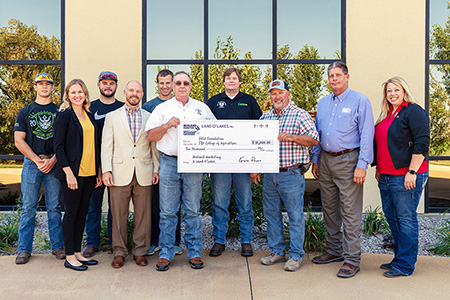
Midland Marketing firmly believes in supporting Fort Hays State University and the surrounding community, and the company’s new annual $1,000 Midland Marketing Agriculture Scholarship will support students at Fort Hays State University with a major or minor in agriculture.
“We are fortunate to have a great working relationship with the university, and we are pleased to be growing that relationship this year,” said Kevin Royer, general manager.
Midland Marketing has also established the Midland Marketing Agriculture Technology Fund to support FHSU’s Department of Agriculture with equipment and technology upgrades.
“We had already planned to increase our support of Fort Hays State University, but decided to apply for a matching grant offered through Land O’Lakes that would double the impact of our gift,” said Royer. “Thank you to Land O’Lakes as we’ve secured funding through their matching gift opportunity, and we’re excited about the potential moving forward.”
Discussing FHSU and the agriculture needs of today, Midland Marketing’s Palco coordinator Anna Luna said, “Everything in agriculture is so technology driven. That’s what’s nice about Fort Hays State University – it’s the hands-on opportunity.”
Luna, a 2007 FHSU agriculture graduate, said, “That’s what I love about being a Fort Hays State alum. I, too, had the opportunity to go out into the field and gain real-world, hands-on experiences.”
“By creating the Midland Marketing Agriculture Technology Fund, we’re hoping to increase the opportunities for success within FHSU’s Department of Agriculture,” said Brian Staab, Midland Marketing board president.
“Those in the agriculture business are facing more challenges than ever, and technology integration is critical,” said Staab. “It is Midland Marketing’s belief that students must learn as much agriculture technology as possible, which will not only prepare them for the current industry, but it will enable them to adapt to future technological changes.”
“Currently, only 2 percent of the population is feeding the other 98 percent,” said Dr. Clyde Cranwell, chair of FHSU’s Department of Agriculture and the University Farm superintendent.
“We warn our agriculture freshmen every year that they’re going to be expected to feed a larger population with fewer resources and more government regulations than ever before,” he said. “Thankfully, our students are up to the challenge.”
Cranwell said Midland Marketing’s support is essential because students need to learn ever-changing technologies and how to use them in order to succeed in the field. FHSU, he said, does this with “hands-on” application.
Midland Marketing’s gift, he said, is also timely in another way.
“This gift has fortuitous timing,” said Cranwell. “The opportunity to expand offerings in precision agriculture dovetail well with FHSU President Tisa Mason’s strategic plan for the institution.”
“We are grateful for the support of Midland Marketing,” said Dr. Grady Dixon, interim dean of FHSU’s Peter Werth College of Science, Technology and Mathematics. “They’re not only impacting students’ lives by offering scholarship support, but they’re helping us to stay ahead of the curve with the latest technologies and equipment.”
Midland Marketing has partnered with Fort Hays State since 1982. The company first sponsored an agriculture scholarship in 1992, and has given $30,000 to support agricultural education at Fort Hays State.
The funds created by Midland Marketing are open-ended, meaning that others can support their specific initiatives by visiting https://foundation.fhsu.edu/donate. Simply type “Midland Marketing Agriculture Scholarship” or “Midland Marketing Agriculture Technology Fund” as the area of designation.
Savannah Pfeifer, HHS senior and member of HHITA, drives an electric car during the HHITA open house last week.
By CRISTINA JANNEY Hays Post
Parents and family members got the chance to feel the pull of a corner and the grip of track during the Hays High electric car program open house last week.
The annual open house lets the students show off the cars to their loved ones and current and potential sponsors.
Last year, one of the Hays High Industrial Technology Association’s cars won the state championship, but with each year comes a new car and new challenges.
Quentin Rupp is a senior on the team and vice president of HHITA this year. He said the team’s state-winning car last year reached speeds of between 20 and 25 mph. This is in a vehicle that weighs less than 100 pounds. Drivers can weigh no more than 190 pounds. Weights are added during competition if drivers weigh less than 180 pounds.
The upper classmen get the first shot at racing. Students have to be at least 16 to race the cars. The students compete for most laps in an hour; ties are broken with the fastest lap.
The team’s most common challenges are flat tires or a chain popping off in the middle of the race, Rupp said.
The cars each have three tires, two batteries, a chain and motor. Each car is fabricated from scratch each year.
“We are always working on them, always improving them,” he said. “We try to build a new one every year to improve our ability, and then we get rid of the older ones, so we can keep getting better and better as we go on.”
The students weld their own frames. Leon’s Welding bends some of the metal for the students, but the rest of the metal work is done by students.
“I like working hands-on and welding,” said Rupp, who has been on the team since his freshman year, “so I have worked on fabricating a lot of these cars, and I just enjoy racing.”
He added, “It’s the speed and adrenaline that gets me going. It’s just fun to drive.”
Rupp said the team of about 30 students has had to up its game in the last couple of years as the competition has been getting tougher.
“Last year, we had to make some improvements to the car,” he said. “When they work and you win, it’s really fun.”
Rupp plans to take technical training to the next level after graduation by attending Dodge City Community College or NCK-Tech and pursuing a degree in welding. His dream is to own his own fabricating business.
Chris Dinkel, career technical education teacher, said the open house puts the students in the limelight.
He said the students can learn a variety of skills in the program that can be applied to careers after graduation. They learn design processes, materials and processes through construction, as well as electrical and mechanical skills.
“There are a lot of different technologies that can stir the students’ interests,” he said. “We try to use as many of those type of applications.
“[We] get the kids thinking about problem solving — how the car performs and about changing and manipulating that system in order to get it to preform at higher efficiency.”
Students who have aspirations to be in the industrial fields, such as welding and fabrication, work side by side in this program with students who want to go on to college to be mechanical or electrical engineers.
“There is nothing more inclusive than an electric car program where they can do the design process and complete the project, engineer it for a specific application and move into where their interests are,” Dinkel said.
Like other extracurricular activities, Dinkel said the electric car team builds character.
“We try to build the type of student and the type of person we want to see in society,” he said. “We do that by trying to put them around people that can [be] models …”
The program sprung from grants from the Green Energies Act in 1995. Although federal money has gone away, HHS has been able to sustain the program through local donations and sponsorships.
“This was just too good of stuff for kids not to be exposed to,” Dinkel said.
The program is in need of sponsors for this year. If you would like to be an electrical car sponsor, you can contact any of the students in HHITA, Dinkel or an administrator at HHS at 785-623-2600.
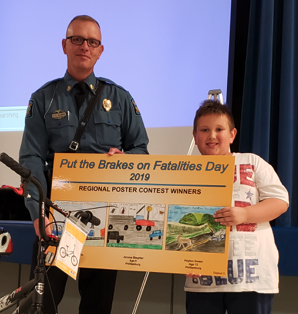
The Kansas Department of Transportation has announced the regional and statewide winners of its 2019 Put the Brakes on Fatalities Day poster contest.
Northwest regional winners included Colt Raudis, age 7 of Hays, Jerome Beighler, age 9 of Phillipsburg and Peyton Gower, age 13, also of Phillipsburg. Each received a bicycle from the Kansas Turnpike Authority and helmet from Safe Kids Kansas. The prizes were awarded by representatives from KDOT and the Kansas Highway Patrol during presentations at the students’ schools.
Put the Brakes on Fatalities Day is a nationwide effort to increase roadway safety and reduce traffic fatalities. A total of 434 kids across Kansas, ages 5-13 took the time to think about traffic and participate in the contest, which is in its 18th year.
— KDOT
Trooper Tod and Jerome BeighlerJerome’s artworkTrooper Tod and Peyton GowerPeyton’s artwork
Hays native Henry Schwaller IV is running for re-election to the Hays city commission after being encouraged to do so by some constituents.
Schwaller, the owner of a real estate investment firm and instructor of entrepreneurship and management at Fort Hays State University, thought about it a lot before making his decision.
“Their logic was there’s a lot on the city’s plate – water and other projects. I was told they thought my seniority and my knowledge would be helpful in moving the city forward,” Schwaller says.
Although he admits his memory isn’t perfect, his believes his familiarity with the city is helpful.
“If we’ve approached a problem before, I’d like to know why haven’t we fixed it, or how is this different. Having that knowledge of where we’ve been and how we’ve gotten here is important.”
Schwaller, 53, is adamant that local officials are not politicians.
“We’re problem solvers. People come to us and say I need my street fixed, my alley fixed. Whether it’s a water issue or economic development, really, local elected officials are problem solvers.”
One problem yet to be resolved is a long-term water supply for Hays.
“We continue to pursue our long-term water option (R9 Ranch) in Edwards County and that has been an issue for the city since its inception but certainly since the late 1980s.
“We’re much closer than we were when I started (on the commission) and certainly much closer than we were in January of this year.
“Now with the master order from the (Kansas Dept. of Agriculture) Division of Water Resources, we are moving ahead. There are some stumbling blocks along the way, but we’ll get through them.”
Schwaller was first elected in 1999 and served until 2007. He was reelected in 2009 and has served since then.
He understands some people may think he’s been on the city commission too long.
“But I approach each meeting as if it were my first. I do my homework. I make sure I know what’s on the agenda. I talk to as many people as possible.
“I think people find that refreshing and also that I’m not afraid to take a viewpoint that may not agree with the majority.”
The most important thing the city does well, according to Schwaller, is creating financial stability through a balanced budget and paying cash for its projects.
Schwaller says the city is not doing enough to prevent the “brain drain” of local college graduates from FHSU and NCK Tech.
“They may go away for a couple years and want to come back. What can they come back to? So it’s imperative that we focus our efforts in the next three to five years on building homegrown businesses through entrepreneurship and by focusing on the needs of our existing businesses, whether to retain or to expand them. Because when you talk to many of these employers, and some of them pay incredibly well, they cannot find talent.”
The top two city commission candidates will serve for four years, while the third-place vote-getter will serve for two years.
Advanced voting is underway. The election is Nov. 5.
The 2019 Hays Area Ducks Unlimited Annual Banquet will be Saturday at the Ellis County Fairgrounds.
Doors open at 5 p.m. with social hour, dinner and live auction to follow. Tickets are available for purchase at ducks.org in advance. Limited tickets will be available at the door.
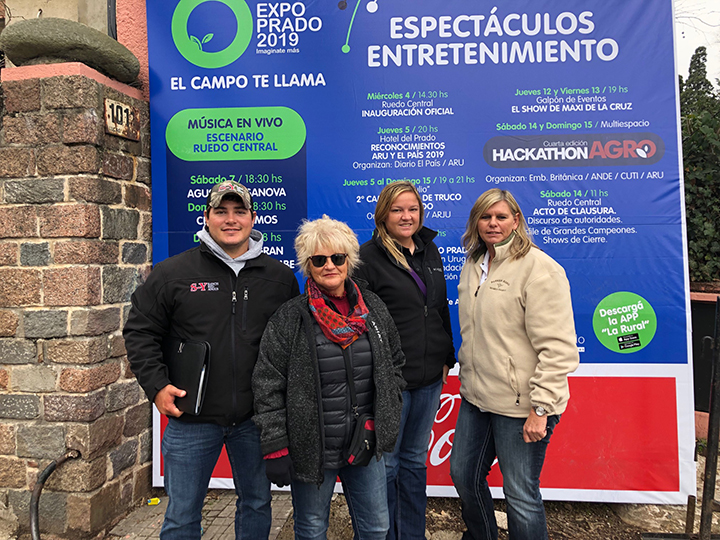
A team of Kansas beef cattle producers traveled on a state-sponsored trade mission to Uruguay in September, where they visited with the current president and two past presidents of the Uruguay Charolais Association (from left): Enrique Crotto, José Boismenu, Megan Larson, Shirley Acedo, Horacio Bianchi Jr., Gerri Schumacher, Kelly Younkin and Horacio Bianchi Sr.
MANHATTAN — In September, the Kansas Department of Agriculture participated in a trade mission to Uruguay, where the team attended the Rural del Prado 2019, the most prominent livestock show in the country. In addition, the Kansas delegation had the opportunity to meet with officials from the U.S. Embassy and visited three ranches in western Uruguay: El Caballero, Durazno; Rincón de los Tapes, Durazno; and Curupí del Salvador, Mercedes.
Representing Kansas on the trade mission were: Megan Larson, Fink Beef Genetics, Olsburg; Gerri Schumacher, Schumacher Trust Ranch, Hays; Kelly Younkin, Smoky Y Ranch Red Angus, Oakley; and Shirley Acedo, KDA agribusiness development coordinator.
Uruguay is a relatively small beef producer especially when compared to its neighbors, Brazil and Argentina. Despite its status as a small producer, Uruguay has strict sanitary protocols and an extensive traceability system and is well positioned as a leading exporter of beef to markets such as China and the EU. Because of this, Uruguayan breeders are expected to continue to enjoy higher-than-normal returns in 2020. During this time of profitable production, cattlemen in Uruguay are seeking improved and diverse genetics — Kansas producers see this as an excellent export opportunity.
“The Kansas Department of Agriculture provided the opportunity to meet face to face with producers from Uruguay, which is more personable than communicating via email or phone,” said Larson. “It was a way for me to learn more about their type of cattle and provide insights on the advantage of Kansas genetics to their operations.”
Younkin agreed. “I greatly appreciated the opportunity to make this very informative trip to Uruguay. I believe Smoky Y could extend the phenotypic strength of Uruguayan beef cattle while infusing genetic diversity, which matches the core values of Smoky Y Ranch.”
“Trade missions like these are vital to connect Kansans with export opportunities. Trade is contingent upon relationships which are essential to trade exploration and growth,” stated Acedo. U.S. total exports of agricultural products to Uruguay totaled $77 million in 2018. Over the past 5 years, Kansas has exported nearly $1.4 million in agricultural commodities to Uruguay, primarily residues.
The trade mission was organized by KDA and the U.S. Livestock Genetics Export, Inc. KDA strives to encourage and enhance economic growth of the agriculture industry and the Kansas economy by exploring and expanding both domestic and international marketing opportunities. The Kansas Ag Growth Project identified beef as a key component for state growth.
KDA is offering two upcoming opportunities to Kansas farmers, ranchers and agribusinesses to participate in State Trade Expansion Program (STEP) grant trade missions planned for 2020: VICTAM Asia/Petfood Forum Asia, Bangkok, Thailand, March 24-26; and NAMPO Harvest Day, Bothaville, South Africa, May 12-15. Interested persons should contact Suzanne Ryan-Numrich at [email protected] or 785-564-6704.
— KDA
A team of Kansas beef cattle producers traveled on a state-sponsored trade mission to Uruguay in September, where they attended the Rural del Prado in Montevideo. Pictured (from left): Kelly Younkin, Gerri Schumacher, Megan Larson, and Shirley Acedo.
John Richard Schrock is a professor at Emporia State University.
Teacher shortages are growing nationwide. Fewer students are entering teaching. More veteran teachers are leaving the classroom. There has always been a shortage in inner city schools, and in specific disciplines such as special education and secondary physics. But now, teacher shortages extend into all disciplines including elementary education. With no overall solutions, more states are lowering the bar, filling positions with online-“trained,” tested-out, or other alternate route “teachers.” In some states, veteran teachers call these recruits “heartbeat” teachers because that appears to be their only qualification, and experienced teachers have the burden of assisting their clueless new colleagues.
Surveys have attempted to assess the reasons for this growing shortage, but few are asking the right questions, often using a query about “school climate” without detailing what specific factors are involved: respect from administrators, threats involving test scores, support of disciplinary actions, etc.?
The National Center for Educational Statistics conducted a nationwide “Schools and Staffing Survey” seven times between 1987 through 2011 and has conducted a “National Teacher and Principal Survey” since. Nearly every state tabulates the extent of its teacher shortage, although there is much variation in the way permit teachers, emergency teachers, teachers with waivers, and other non-standard-licensed or uncertified teachers are counted in or out of the shortage. These variations make it difficult to tally a common set of reasons or extent of the real shortage.
But I have a network of former students who are now secondary teachers, along with a cohort of teachers coast-to-coast who read this column and are eager to share their concerns. Their narrative into why they are losing colleagues provides insight into the complex situations in public schools.
Those teachers fortunate enough to teach in an affluent community were mostly unaffected by the No Child Left Behind (NCLB) shift to testing. Indeed, some teachers from poorer or rural districts felt fortunate when they were hired into an affluent district. However, this has left less affluent districts with much higher rates of teacher shortage. —So, different schools, different problems.
The foremost cause of leaving teaching is their loss of professional responsibility caused by the shift to external testing under NCLB. Science teachers were first to leave when they were unable to continue offering genuine labwork and field trips. With the reputation of their school and even their job depending on test results, classwork shifted to teaching-to-the-test rote memorization. Many teachers had to stop using printed textbooks and were directed to use all-online materials. Principals would write in professional journals how the new generation of tech-savvy student teachers were to be preferred to the old veteran teachers who resisted this digital futurism. Some veteran teachers became fed up and retired early or entered science vocations outside of teaching. Teachers in other disciplines likewise retired in growing numbers, expressing relief they got out. Some teachers became mere monitors of a room of laptops under the ironically impersonal “personalized education.” In these last two decades, public school students have seen their teachers de-professionalized; this has a major impact, discouraging this next generation of students from wanting to become teachers. They wanted to change students’ lives, not drill-and-kill student interest.
The second important reason, often hidden in surveys under “school climate,” is classroom discipline and lack of administrative support. Veteran teachers remember when a student who got in trouble at school also got in trouble when they got home. Now it is likely the parent of the misbehaving student will arrive at school the next day to blame the teacher. A survey in the October 6 Education Week found that 69 percent of administrators felt their teachers were empowered to bring problems to them; only 25 percent of teachers agreed. Lack of administrative support is now a serious concern of many teachers.
Money usually is not the reason for rejecting teaching. But more teachers are now finding they cannot afford housing in their school’s community. Potential teachers value education and when the cost of higher education exceeds their ability to pay for their own children’s tuition, it is natural that they choose another vocation. States have failed to keep school teachers’ professional salaries adequate.
Universities that attempt to lure teaching candidates from other fields and train them online and send them into classrooms as rookies with a masters degree (and therefore higher salary) also anger regular licensed teachers who are well-trained and experienced, but paid less with their bachelors degrees.
Finally, lack of respect from our society at-large figures into some teachers decision to leave teaching and in the drop in students entering teaching. In countries that respect teachers, in Europe and Asia, only 2–3 percent leave teaching annually; in the United States, that figure is over 8 percent.
John Richard Schrock is a professor at Emporia State University.
BraunEllis County Undersheriff Scott Braun on Thursday announced his 2020 candidacy for the office of Ellis County Sheriff.
The Victoria High School and Fort Hays State University graduate has 24 years of law enforcement experience and has been with the Ellis County Sheriff’s Office since 1997.
He issued the following statement Thursday afternoon:
Scott J. Braun, the current Ellis County Undersheriff, has announced his candidacy for Sheriff in the 2020 election. He chose today to announce his candidacy in memory of his mother who passed away earlier this month. This would have been her 77th birthday and she was his most loyal supporter.
Braun graduated from Victoria High School and then attended Barton County Community College and Fort Hays State University. Braun married his high school sweetheart, Terri, and will celebrate 24 years of marriage in November. Terri has been employed at High Plains Mental Health for 24 years and is also a Christian book author. They were blessed with 2 boys, Bryce and Coby.
Braun has served in law enforcement for over 24 years. He began his career in 1995 as a Reserve Deputy Sheriff for the Ellis County Sheriff’s Office before being hired in 1995 by the Ellis Police Department. While employed by the Ellis Police Department, he attended the Kansas Law Enforcement Training Center graduating in 1996. In 1997, Braun was hired by the Ellis County Sheriff’s Office as a Deputy. In addition to Braun’s regular duties in 1998, he became a member of the Ellis County Drug Enforcement Unit advancing to Field Operations Coordinator and then to his current position of Administrative Coordinator of the Unit. In 1999, Braun spearheaded the Canine Program in Ellis County. He became the first Canine Handler and later became a Canine Instructor. In 2005, Braun was promoted to Narcotics Detective serving in that the capacity until 2018 when he was appointed by Sheriff Harbin as the Ellis County Undersheriff. In addition to becoming Undersheriff in 2018, Braun became Certified as a DARE Instructor, teaching 5th graders in Ellis County.
In addition to serving in a law enforcement capacity, Braun believes in serving the community in a civic capacity. He has been a member of the Hays Rotary Club since 2014 and served as President from 2017-2018. He continues to remain an active member by being on the board. Braun also currently serves as the Vice Chair of St. Nicholas of Myra Church Council and has been on the board for 5 years. He is an active member of the St. Nicholas of Myra Knights of Columbus Council and is a 4th Degree Knight. He served on the First Call for Help Board from 2014-2018. Braun also belongs to professional organizations and boards. He has served on the Board of the Kansas Narcotics Officer Association since 2010 and has been a Regional Trustee, Vice President, President and currently is an advisor to the board. He also currently serves on the Ellis County Crisis Intervention Team Council and is a founding board member.
Braun has been honored with the following awards in the course of his law enforcement career: 2001 Kansas Highway Patrol Superintendent Meritorious Award, 2006 Kansas Deputy Sheriff of the Year, 2007 Gold Award for Valor, and Top Cop Honorable Mention. Braun also has received the following civic awards: 2013-2014 Hays Rotary Outstanding Community Service Award and 2018-2019 Outstanding Club Service Award.
He is asking the citizens of Ellis County to support him in the 2020 election for Sheriff. Braun brings with him Dedication, Experience and Integrity.
TOPEKA—District Magistrate Judge Marty Clark was elected president of the Kansas District Magistrate Judges Association.
The organization, open to all state district magistrate court judges, elected officers to serve in the coming year. Officers were elected at a statewide conference for judges conducted in Wichita.
Clark serves in Russell County of the 20th Judicial District. He previously was first vice president.
He is a Smith Center native and has been a magistrate judge since 1998. He graduated from Fort Hays State University in 1989 with a degree in sociology and an emphasis in criminal justice. He currently serves on the Kansas Criminal Justice Reform Commission and the judicial branch’s Judges Assistance Committee. He is a member of the 20th Judicial District Juvenile Corrections Advisory Board.
Clark has served in various offices of KDMJA over the years. He was named Kansas CASA Judge of the Year in 1989. He was nominated twice for the National CASA Judge of the Year.
Bigge
He succeeds District Magistrate Judge Douglas Bigge, who completed two terms as president. Bigge serves in Rooks County of the 23rd Judicial District.
Other officers are:
District Magistrate Judge Jenifer Ashford, first vice president. She serves in Johnson County, which is the 10th Judicial District.
District Magistrate Judge Brendon Boone, reelected second vice president. He serves in Gove County of the 23rd Judicial District.
District Magistrate Judge Shannon Rush, third vice president. She serves in Osage County of the 4th Judicial District.
District Magistrate Judge Debra Anderson, reelected secretary. She serves in Norton County of the 17th Judicial District.
Anderson
District Magistrate Judge Daniel Gilligan, treasurer. He serves in Reno County, which is the 27th Judicial District.
Elected to the board of directors were:
District Magistrate Judge Timarie Walters of Stafford County of the 20th Judicial District
District Magistrate Judge Robert Scott of Johnson County, the 10th Judicial District
District Magistrate Judge Phil Moore of Clark County of the 16th Judicial District
The organization also presented service awards:
Boone
35 years
District Magistrate Judge Richard Ress, serving in Thomas County of the 15th Judicial District
25 years
District Magistrate Judge Blaine Carter, serving in Wabaunsee County of the 2nd Judicial District
15 years
District Magistrate Judge Steve Hilgers, serving in McPherson County of the 9th Judicial District
10 years
District Magistrate Judge Julie Cowell, serving in Pawnee County of the 24th Judicial District
District Magistrate Judge Kenton Gleason, serving in Hodgeman County of the 24th Judicial District
District Magistrate Judge Kristin Hutchison, serving in Elk County of the 13th Judicial District
District Magistrate Judge Dale Snyder, serving in Rush County of the 24th Judicial District
Janet Kuhn, convention sales manager for the Hays Convention and Visitors Bureau, was awarded the Leilani Thomas Spirit of Tourism Award at last week’s Kansas Tourism Conference in Mulvane.
In 2019, Kuhn served as president of the Northwest Kansas Travel Council, treasurer for Tour Kansas, and treasurer for the Kansas I-70 Association. She also represents Hays as a member of Sports Kansas and Meet Kansas, travel coalitions that promote the state as a destination to those respective groups.
“Janet is so deserving of this award, and it was wonderful to see her peers in the industry acknowledge her dedication,” said Melissa Dixon, Hays CVB executive director. “She is an amazing ambassador for our community and our state, and we are lucky to have her working with us in Hays.”
Kuhn has been on staff at the Hays CVB for over 15 years. Prior to that, she was director of sales for the former Holiday Inn Convention Center and increased banquet sales by 10 percent during her time there.
The Hays Convention and Visitors Bureau is located in the Hays Welcome Center at 2700 Vine. For additional information on CVB efforts or community events, call 785-628-8202 or go to www.VisitHays.com.