The Hays Fire Department will be inspecting and flow testing fire hydrants on April 18 in the area of Vine St. to Ash St. between 27th St. and 19th St., Augusta St. to Hall St. between 27th St. and 15th St. and the Sports Complex. This is part of a coordinated effort by the City of Hays to inspect all fire hydrants in the city and flush all water mains annually.
Inspecting fire hydrants ensures that the valves operate properly and that there is no damage or obstructions that will prevent or interfere with the prompt use of fire hydrants in an emergency.Firefighters are also checking the pressure and volume of water mains in each neighborhood for firefighting purposes. The associated flushing of water mains allows chlorine to be distributed throughout the system to eliminate bio-filming in the water mains.
Slight discoloration of the water supply may be encountered although there will be no health risks to the consumer.All reasonable efforts will be taken to minimize the inconvenience to the public.Drivers are asked to avoid driving through water discharging from a fire hydrant during the short flushing period.
For more information, please contact the Hays Fire Department at 628-7330.
Submitted by
Judith Deedy, Game On for Kansas Schools
Patty Logan, Stand Up Blue Valley
Megan Peters, Education First Shawnee Mission
Nikki McDonald, Olathe Public Education Network
Susan DeVaughn, Educate Andover
House Speaker Ron Ryckman’s recent op-ed was extremely disappointing to Kansas public education parent advocates.
We disagree with Rep. Ryckman’s assertion that the Legislature should have passed his “better” school funding plan. We oppose the way his plan attempts to resolve the inflation issue and believe it would fail constitutional muster. We can’t go into much detail, though, because Rep. Ryckman submitted only an outline of his “better” plan to his fellow legislators over 250 days after the Court issued its opinion and with only two days remaining in the regular session. Rep. Ryckman’s “better” plan had no public hearings, no budget runs, no legal basis, and yet he complains because his last-minute deal wasn’t adopted.
Instead of proposing a last-minute problematic plan, Rep. Ryckman should have provided constructive leadership through the regular session. The Senate understood how narrow the Gannon VI school finance ruling was and how close lawmakers are to reaching constitutional adequacy for the first time in over a decade. They passed a bill to fund inflation in mid-March. House leadership failed to resolve the inflation issue, choosing instead to usurp the role of our state and local boards of education through controversial policy changes and entered the final days of the regular session without having passed a funding bill.
More offensive than the procrastination and lack of focus exhibited by House leadership is the way Rep. Ryckman rewrites history. If the Legislature had returned to the promises made in the Montoy case as the national recession lifted in 2010, there would be no Gannon lawsuit. Instead leadership prioritized continued budget cuts and later the 2012 tax plan that many of us correctly predicted would put Kansas in a huge fiscal hole, leaving it unable to meet its financial obligations. The Block Grant plan Rep. Ryckman championed in 2015 is more typical of past obstinance that ensured school finance litigation would continue as our children progressed from elementary to middle to high school. The bill passed by the Legislature this session is not “the same failed approach,” but is rather a refreshing good-faith effort to end the litigation.
Rep. Ryckman’s concept of how to deal with fiscal uncertainty in the future defies common sense and abdicates his responsibility. His overall theme is that we must “help” our children by avoiding promising them adequately funded schools, because that promise might be challenging to keep in the future. Instead, he urges Kansans to ignore actual estimates on the cost of educating our children, and instead for schools to make do with less, regardless of needs, regardless of state standards. Rep. Ryckman’s stance is particularly ironic given his support for SB 22, a tax cut proposal that would blow a much bigger hole in the budget than the inflation adjustment that just passed.
Funding inflation into the future is not a “poison pill.” Unless the Legislature plans to prohibit school vendors from increasing their prices, the inflation adjustment merely maintains district purchasing power from year to year. Failure to adjust for inflation was the lesson we learned from the Montoy case and results in functional cuts to our schools.
Rep. Ryckman knows we were watching the votes on the inflation funding bill. He voted against it. He says the vote was not about who loves schools and who doesn’t, but about whether “we want to make promises we can keep.” We understand the competing demands on the state budget, but the Legislature has never been able to demonstrate our schools don’t need the funding they agreed to provide last year. The expert hired by the Senate last year only bolstered the claims of education advocates. The real question isn’t how do we avoid making promises we can’t keep, it’s how do we keep the promises we need to make for the sake of Kansas children?
After 40 years as a doctor interacting with patients, in the last two and a half years the tables turned, and I’ve become the patient. Although most are good, I’ve found some doctors are detached, some are too quick, some would rather be somewhere else, some are even angry; but, when a physician who cares walks into the room, and I’m not exaggerating, the day becomes better, the pain becomes less, and hope fills my heart. Scientific knowledge is important, but the ability to convey honest concern, human thoughtfulness and compassion is equal in importance in this healing profession. So, how do we select pre-med students for that, or teach compassion in medical school?
There are studies that show those interested in humanities or taught disciplines that explore how people tick, do better in the compassion department. These disciplines include history, literature, religion, ethics, anthropology, psychology, cultural studies and the arts of theater, film, painting and poetry. Some explain that the humanities give us the very reason to learn science and mathematics.
Several studies support the value of humanities in medicine. Seven hundred medical students were surveyed about their lifetime exposure to the humanities and the results indicated that those who had more humanities knowledge had more empathy, tolerance to ambiguity, resourcefulness, emotional intelligence and less burnout. Another study found that a med student’s ability to recognize diagnostic clues increased by more than 35 percent after taking a visual arts class. Another study found practicing improv theater helped med students learn to prepare for unexpected questions and conversations. A fourth study showed how writing exercises helped med students have foresight into what a patient may be experiencing. Clearly, an exposure to the humanities makes a better doctor.
I believe that care providers who have had a well-rounded humanities education have a better chance of understanding about how it feels to face pain, nausea, loss of bodily functions or even a cancer diagnosis. Those steeped in good literature or art have a better opportunity to tap creative juices to problem solve and tolerate a life that can be ambiguous and unpredictable. Those who are knowledgeable of history, ethics, cultural ways will find it easier to know when it is time to stop aggressive care and move toward comfort.
This is a call for all students to become readers, to find time to enjoy the humanities, to exercise your caring and compassion muscles; so, when you come into the room of a person suffering, it makes their pain less and day better.
For free and easy access to the entire Prairie Doc® library, visit www.prairiedoc.org and follow The Prairie Doc® on Facebook, featuring On Call with the Prairie Doc® a medical Q&A show streaming live most Thursdays at 7 p.m. central.
Master storyteller Roy Wenzl will discuss his book “The Miracle of Father Kapaun” at the Hays Public Library on April 20 at 2 p.m. in the Schmidt Gallery.
Father Emil Kapaun, a Kansas native, was a priest and U.S. Army chaplain who won the Medal of Honor for actions in combat and in a North Korean prisoner of war camp. Kapaun also is being considered by the Vatican for canonization as a saint.
The book, authored by Wenzl and Travis Heying, chronicles Kapaun’s service and alleged miracle healings. Kapaun died in captivity in 1951.
Wenzl is an award-winning Wichita journalist, who is also the primary author of “Bind, Torture, Kill: The Inside Story of BTK, the Serial Killer Next Door.”
You can find out more about this and other library programs at hayslibrary.org or by calling 785-625-9014.
LOGAN — The Dane G. Hansen Museum will present a grilling class, led by instructors Anna Schremmer and Cody Miller from the Phillips-Rooks K-State Research & Extension Office.
The class will be at 6 p.m. Tuesday, April 23 in the Hansen Museum Community Room.
Enjoy samples and discover new recipes during this fun class at the grill.Menu includes several items, including grilled pizza and kabobs.All grilling supplies will be provided.Class size is limited, so sign up today.Registration deadline is April 20.
This creative learning opportunity is offered to the public through the Hansen Museum’s Continuing Education Program with funding from the Hansen Foundation. Registration fee is $25 per participant. For more information, contact Director Shari Buss at 785-689-4846.
The museum is open weekdays 9 a.m.-noon and 1-4 p.m.; Saturdays 9 a.m.-noon and 1-5 p.m.; Sundays and holidays 1-5 p.m.. It is closed Thanksgiving, Christmas and New Year’s Day. The museum is handicap-accessible, and thanks to the generosity of the Dane G. Hansen Foundation, there is never an admission fee.
African American girl from Nicodemus. Photo courtesy of the Nicodemus Historical Society.
Angela Bates, executive director of the Nicodemus Historical Society, gave a presentation Saturday in Hays on Nicodemus and the role of African American women through history.
Bates spoke to the Courtney-Spalding Chapter of the Daughters of the American Revolution.
She is a descendant of the first settlers in Nicodemus, who came to Kansas in 1877. Nicodemus is the last and only remaining all-African American settlement west of the Mississippi. At its height, the community had about 600 residents, but the population declined after the railroad decided not to route through the town.
Bates has done extensive research on Nicodemus. In 2012, she published a book with more than 200 historical photos. It is still available in Nicodemus, which Bates was instrumental in getting declared a National Historic Site.
To understand African American culture today, Bates said you have to go back to the slave culture in the South.
“Women did not have choices during slavery,” Bates said.
African American women worked in the fields or in the master’s house. Women who were older or not as physically capable raised the children during the day. They referred to them as aunties or grannies.
This is why women or men that are family friends are often still referred to as aunts or uncles in black culture, even though they may be no blood relation. It is a term of respect, Bates said.
African American girl and resident of Nicodemus. Photo Courtesy of the Nicodemus Historical Society
Some of the slave children would be assigned to the master’s children. They would help take care of the children, empty their chamber pots, fan them, help them dress and maybe even play with them.
By the time the slave children were 12, they were assigned adult jobs.
“You did not have any control of what was going to happen to your kid,” Bates said. “If they wanted take the kid and take her to the house like in the movie ‘Queen’ after she had the child by her master, the master could say ‘I want the child to be raised in the house.’ ”
Bates said part of the psychology of controlling the slaves was divide and conquer. The slave owners fostered division between house and field slaves as well as division among light-colored slaves and darker-colored slaves.
Yet, any amount of African blood in a person in the South, no matter what their appearance, meant they were regarded as black.
“If you were dark and had kinky hair, you were considered less than a mixed blood that would have lighter complexion and more white features and straighter hair,” she said.
“So when Emancipation comes, the mixed bloods that were living in the house and some of them may be living in quarters, they are shunned on both sides of the fence. The full bloods have been taught to shun them because they think they are better, and that still has psychological effects on African Americans today. We have intraracial prejudice against each other along those same lines.”
Also after Emancipation, women begin to have choices not only about their own lives, but the rearing of their children.
Angela Bates, executive director of the Nicodemus Historical Society, gives a presentation Saturday in Hays to the Courtney-Spalding DAR chapter.
“Freedom affords you an opportunity to have a choice,” Bates said. “You can pick who you want to be married to. You can decide what your children’s names are going to be. Many people change their names right after Emancipation.”
In some cases, brothers chose different surnames. Bates gave the example in Nicodemus of the Wellingtons and Weltons. There were three brothers all Wellingtons, but one changed his name to Welton.
“If you were looking at genealogy or even the census, you would not know,” she said.
In another case, a woman was pregnant at the end of the Civil War and decided to give her child the surname Taylor, instead of the name of her plantation owner. There were brothers and sisters in that family as well who had a different surnames.
Freedom in Kansas meant choices, your children weren’t going to be sold away from you and it was an end to a violent life.
“Imagine you have a child and you love that child and you watch that child grow, and then he does something that he wasn’t supposed to do and he gets beat on the public pole,” Bates said. “You don’t have any choice, and they make you stand there and watch your child get beat.”
A new psychology took hold after African Americans were freed. Bates summed up with the phrase “We rear our daughters and we love our sons.”
Bates said African American women are very independent and opinionated.
“We had to be,” she said. “How can you depend on a man who you may have jumped the broom with, but he doesn’t have any control over himself? So how can I rely on him? Coming out of slavery, African American women relied on themselves. So in the culture we raise our daughters to be independent.”
Women also continued to rely on the “sisterhood,” friends and other women in their community, just as the women in slavery relied on the aunties and grannies to raise their children.
In a white society, black mothers felt sons, who might struggle to find jobs and face other prejudices, needed their support, Bates said.
“We are all suffering from post-slavery trauma,” Bates said referring to both white and black cultures.
Bates said the relationships between black and white women can still be strained.
“Back in the ’60s I would be called a Tom, an Uncle Tom,” she said. “That would be someone who embraced relations with white people. I have found just being a human being that people are people, no matter what. There are people who are black that I would not want to be around.”
Angela Bates receive the DAR Women in American History Award Saturday.
At the end of her presentation, Bates was honored with the DAR Women in American History Award for her work to preserve African American history.
Bates also serves as a speaker for the Kansas Humanities Speakers Bureau, who sponsored her talk Saturday. She is a member of the National Parks Conservation Association and the National Trust for Historic Preservation. Bates received the Kansas Sampler Foundation’s “We Can” award (1993), the Brown Foundation’s award for excellence (1994), the Outstanding Contributions award (1996) from the Kansas Humanities Council, the African-American Preservation Hero award (1996) from the National Trust for Historic Preservation, and the Woman of Distinction award (1997) from the Kansas Martin Luther King, Jr. Memorial Committee of Topeka for her work in preserving African American history, and, more recently, the 2012 Kansas Trail Blazer Award. (Bio information courtesy of the University of Kansas).
Thursday A 20 percent chance of showers after 2pm. Mostly sunny, with a high near 64. Very windy, with a northwest wind 10 to 20 mph increasing to 20 to 30 mph in the afternoon. Winds could gust as high as 41 mph.
Strong cooler north to northwest winds are expected Thursday afternoon. Some gusts may approach 50 mph during the afternoon hours. #kswxpic.twitter.com/m87GUvvu6Q
Thursday Night A 20 percent chance of showers before 8pm. Mostly cloudy, then gradually becoming clear, with a low around 36. Windy, with a north northwest wind 21 to 26 mph decreasing to 8 to 13 mph after midnight. Winds could gust as high as 37 mph.
Friday Sunny, with a high near 70. North northwest wind 8 to 10 mph.
Friday NightClear, with a low around 44. North wind 6 to 9 mph becoming south after midnight.
Saturday Sunny, with a high near 82.
Saturday Night Mostly clear, with a low around 51.
Sunday A chance of showers between 8am and 2pm, then a chance of showers and thunderstorms after 2pm. Mostly cloudy, with a high near 65. Chance of precipitation is 30%.
Area law enforcement officials are on the lookout for a suspect who fled a traffic stop early Wednesday morning in Ellis County and are asking the public’s helping in locating the suspect.
According to Ellis County Undersheriff Scott Braun, at approximately 5:30 a.m. Wednesday, an Ellis County Sheriff’s deputy conducted a traffic stop at mile marker 172 on Interstate 70 on a car driven by 56-year-old James D. Pfaff.
Braun said the deputy because suspicious of the possibility of illegal drugs in the vehicle and detained Pfaff in order to search the vehicle. While waiting for a K-9 unit to arrive on scene, Pfaff was able to flee the scene in his vehicle, according to Braun.
Pfaff proceeded east on I-70 into Russell County at speeds in excess of 100 mph, Braun said, leading enforcement officials on a chase south of Gorham toward the south county line. There, he drove into a field and was able to escape from law enforcement.
Pfaff’s car was found unoccupied a short time later.
Law enforcement officials from the Barton, Ellis, Rush and Russell County sheriff’s departments, the Kansas Highway Patrol, and Hays Police Department all assisted in the pursuit.
Braun said Pfaff is not considered a danger to the community, but they are asking for the public’s helping in locating him. Anyone with information on his whereabouts is urged to contact law enforcement.
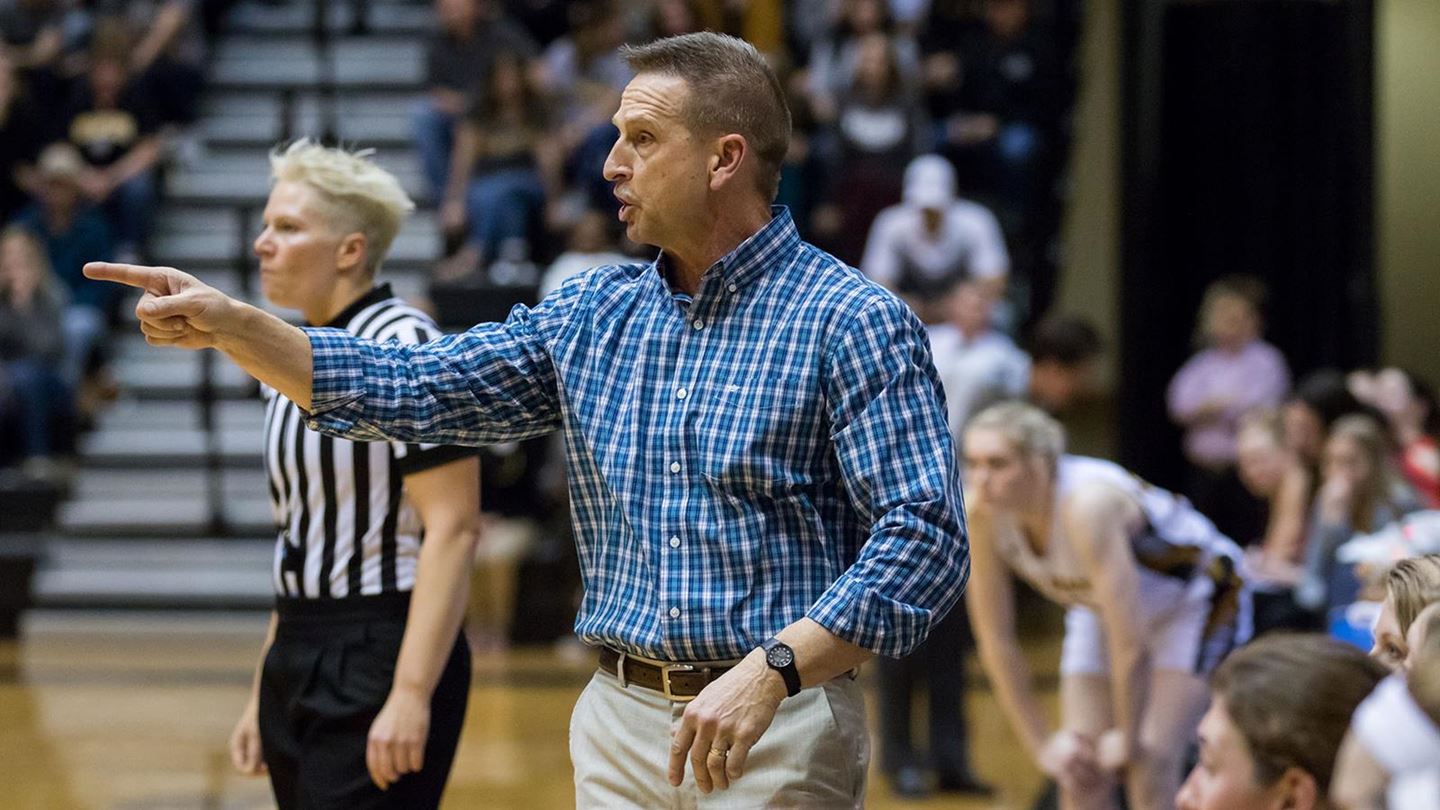
WASHINGTON, Kan. – Fort Hays State Women’s Basketball head coach Tony Hobson has been named the Kansas Basketball Coaches Association Women’s Four-Year College Coach of the Year for 2018-19. This is the first time Hobson has received the honor from the KBCA in his coaching tenure at FHSU.
Hobson guided Fort Hays State to its best record since joining NCAA Division II with a 32-2 mark in 2018-19. The Tigers set a new program best for fewest losses in the regular season, going 27-1 prior to the MIAA Tournament. The Tigers won the MIAA regular season with an 18-1 record, besting defending national champion Central Missouri by three games in the standings, then captured their first MIAA Tournament Championship. The Tigers became the first women’s team in the MIAA to capture both titles in a season since 2012. FHSU finished the year ranked No. 5 in the WBCA Division II Top 25 Poll, the highest finish in the poll in program history.
Fort Hays State claimed the No. 1 seed in the Central Regional of the NCAA Tournament, entering with a mark of 30-1. The Tigers defeated conference foe Pittsburg State in the regional quarterfinals, then Minnesota State-Moorhead in the semifinals, before falling in the regional final to eventual national runner-up Southwestern Oklahoma State. The regional final appearance was the second in five years for the Tigers, matching the progress of the 2014-15 squad that also reached the 30-win mark under Hobson, going 30-4 overall. It also matched the 2014-15 team for the deepest run in the NCAA Tournament in program history.
The Tigers have now enjoyed eight consecutive 20-win seasons under Hobson’s guidance, making four NCAA Tournament appearances in that span, all within the last five years. In his 27 years of coaching women’s basketball teams at the collegiate level, Hobson has put together eight 30-win seasons, which includes two at FHSU, five at Hastings (Neb.) College, and one at Barton (Kan.) Community College. All three of his NAIA national championship squads at Hastings College won at least 30 games in a season. He has reached the 20-win plateau in a season 21 times his 27 years as a coach, which helps add up to an astonishing 650-200 (.765) overall coaching record.
Hobson became the all-time wins leader in FHSU history during the 2018-19 season, passing Helen Miles’ record of 217 wins accomplished in 15 years from 1971-86. Hobson went past the mark in just his 11th season, now with a record of 237-94 guiding the Tigers. He also tops the all-time win percentage list for FHSU coaches now at .716, with the closest on the list at .665.
The consistent run of success for Hobson’s teams at Fort Hays State has strongly impacted attendance at home games inside Gross Memorial Coliseum. Official attendance reports for 2018-19 will not be released until the summer of 2019, but Fort Hays State has ranked second in the nation in average home attendance the previous four years. It will likely move to five years in a row when the official reports are released. However, this year Fort Hays State by far led cumulative attendance at home with more than 47,000 fans witnessing 19 home games, nearly 14,000 more than any other Division II school can claim. The attendance numbers were capped with an average of more than 4,000 fans witnessing the Tigers’ three NCAA Regional Tournament games at Gross Memorial Coliseum. More than 5,000 attended the Central Regional Final.
This Kansas Basketball Coaches Association Coach of the Year honor gives Hobson 17 Coach of the Year honors in his 27-year history as a collegiate head coach. This is his third Coach of the Year honor for 2018-19, also named MIAA Coach of the Year and WBCA Central Region Coach of the Year. He was also a finalist for WBCA Division II National Coach of the Year.
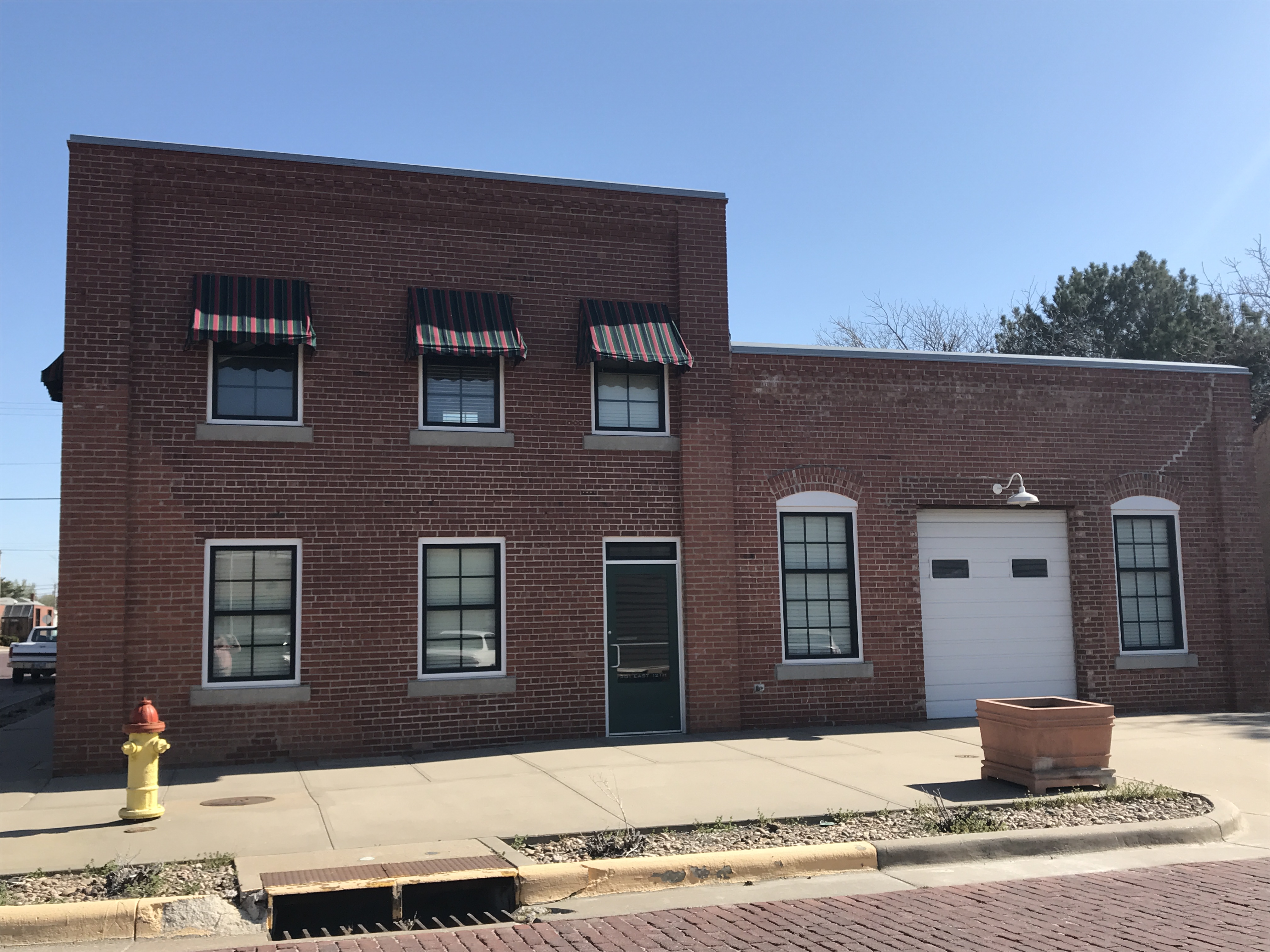
201 E. 12th St. in Hays, one of the Comeau properties foreclosed by Sunflower Bank.
All remaining employees at Plainville company laid off, attorney says
By CRISTINA JANNEY Hays Post
After foreclosure filings on multiple buildings owned by Chuck Comeau and his subsidiaries, his luxury furniture company Dessin Fournir and 11 of its subsidiaries filed for Chapter 11 bankruptcy on April 8.
The company’s offices have closed, and all of its employees have been laid off, including those in Plainville, according to Edward Nazar, the attorney handling the bankruptcy.
At its height, Dessin Fournir employed more than 90 people in Comeau’s hometown of Plainville.
Nazar said Comeau is seeking to find a third-party buyer for the multiple divisions of his company. In the meantime, a meeting of creditors is set to convene, Nazar said.
“It was a very successful business,” Nazar said, “which had a reversal of fortune in 2008, and it struggled for the last 10 years to overcome the reduction in revenue and was regretfully forced to file a bankruptcy.”
The furniture manufacturer was listed in court documents to have more than 200 creditors locally, nationally and even internationally with a total liability of more than $13 million. Some of its subsidiaries had other creditors, including companies in the trade.
Some of main company’s creditors include the IRS, the Kansas Department of Revenue, the Rooks County Treasurer, Assurance Partners in Salina, designer Holly Hunt and singer Lionel Richie, who had a customer deposit of more than $15,000 with the company.
Dessin Fournir assets were listed as $6.6 million, $3.8 million of that is in inventory. The assets also includes Plainville properties at 308 and 310 W. Mill, 223 W. Mill, 211 W. Mill and 111 N. Jefferson.
The company is listed as owing more than $8.9 million in secured debt to three local banks, including $952,000 to Astra Bank, $7.5 million to Bank of Hays and $420,000 to Sunflower Bank.
Bank of Hays and Sunflower Bank filed for foreclosure on Comeau properties last year.
On March 26, District Court Judge Blake Bittel in a summary judgement ordered Comeau’s companies and other loan guarantors to pay Sunflower Bank a total of more than $420,000.
The companies included Oak Street Plaining Mill, Classic Cloth, Dessin Fournir, DFC Holding, C.S. Post, Liberty Group, plus individuals Chuck Comeau, Shirley Comeau, Christopher Mraz, Lenice Larson and Palmer Hargrave.
Properties listed in the foreclosure included 201 E. 12th St. in Hays, and Plainville properties 108 N. Main, 211 1/2 Mill, 205 N. Main, 317 W. Mill, 211 W. Mill, 221 W. Mill.
If the money for the bank loan is not paid in full, the properties involved were ordered to be sold in a sheriff’s sale.
The Bank of Hays also had a loan on Rooks County property worth $7.5 million.
Judge Bittel ruled Sunflower Bank’s interest in the case took priority over Bank of Hays’ loan.
The Kansas Center for Entrepreneurship also had a mortgage on a portion of the Rooks County properties, but the agency disclaimed any interest in the real estate in the foreclosure.
DFC Holdings listed the property at 311 S. Washington in Plainville in its real property asset list in the bankruptcy filings on April 8.
Business Home in a story published April 10 said Chuck Comeau sent a letter to clients last week saying, “I failed to understand the ‘right-sizing’ for our company after the recession, and instead thought we should try to maintain jobs.”
A call to the Attorney Ashley Comeau, who is representing her in-laws was not returned. Attorney for Sunflower Bank, Aaron Martin, said he could not comment on ongoing litigation.
On Monday, Addy Tritt will be featured on “The Ellen DeGeneres Show.” A show spokeswoman said that while Tritt generously gives back to her community, she is actually in debt herself with student loan and even relies on family support to buy groceries.
Tritt, a Fort Hays State graduate, said she wanted to help others because so many people have helped her in the past. When the price at a Hays store dropped to $1 per pair, Tritt negotiated with the business to buy the remaining shoes for $100.
They included 162 pairs of baby shoes, two pairs of men’s shoes, and the rest were women’s shoes.The retail price of the shoes would have been more than $6,000.
DCF Secretary Laura Howard speaks to the media Tuesday during a stop in Hays.
By CRISTINA JANNEY Hays Post
Kansas Department for Children and Families Secretary Laura Howard remains focused on agency process, despite recent criticism from child welfare advocates who are pushing for more rapid reform in the agency.
Howard made a stop Tuesday morning at the Hays DCF office.
One of the recommendations from the Child Welfare Task Force was to increase recruiting for foster families.
“Placement stability is one of our top priorities as an agency as we come on board with a new administration,” Howard said. “There is no doubt that kids have been placed too far from home, and they move around too often. We are doing a number of things in that regard.”
The agency has new foster care management contracts starting, and the agency will have individual contracts with child placing agencies. Additional funds will also be available for foster family recruitment.
The agency is starting a practice called Team Decision Making, where the agency is able to bring more resources to the table for kids and bring other people who have connections to the child into the process.
“What the evidence tells when we do that from other jurisdictions that use this model is that children are more likely be placed with a relative and be placed in their home community, and they also reach permanency more quickly,” Howard said.
The new contracts begin Oct. 1. The Team Decision Making model will be phased in over the next 12 to 18 months and will be launched in the Kansas City area.
Kansas has 7,300 children in the foster care program, which is high compared to other similar states. The agency is looking at prevention programs to help children and families, so children do not have to be removed from their homes.
These can include parent training, early childhood services, Parents as Teachers and mental health services.
DCF also will be using the federal Families First program, which will bring federal funds into the state that can be matched with state funds.
“Part of my goal is to reduce the number of youth we have in foster care,” Howard said. “Our system has a lot of strain today, but as we are successful in diverting children safely on the front end to preventive services, we will have less demand than we have today as we have fewer kids actually in the foster care system.”
She said Kansas initially saw more children coming into foster care during the recession. Other states saw their numbers decrease as the economy recovered. Kansas has not.
“I attribute it to a couple of things. I can’t prove these things, but I at least see a correlation between policy changes that were made about safety net programs in Kansas,” she said, “and there were policy changes made in Kansas in the last few years to reduce eligibility for the TANF cash assistance program down to a two-year lifetime limit. There were other changes made to really limit family access to cash assistance, to child care assistance.”
The governor has recommended an additional 52 workers per the recommendation of the task force. Twenty-six workers would be added this year and 26 next year. These would primarily be social workers in field offices. The Legislature is close to approval of at least the first round of these new employees.
The agency is also trying to take advantage of social work practicum students and is working to reduce requirements for social workers coming from other states to work in Kansas.
Task force members said in a recent letter they have “deep concern” lawmakers have only made minimal progress and have made no progress on most recommendations, according to the Associated Press.
The agency has also been criticized in recent years for several high-profile deaths of children after DCF became involved with the families. In the latest case in Wichita, a 3-year-old boy was found dead in his crib and a 4-month-old boy was removed from the home and hospitalized in critical condition.
Howard said she could not comment on that case specifically, but said DCF is investigating.
Howard said some reforms will need to be enacted by the Legislature, but other actions can be done internally within DCF.
She said the task force’s tier one recommendations are being met, including new staff, aggressively pursuing Families First, $13 million in new funding (half federal, half state funding) and improvements in the agency’s information systems.
“I am actually really pleased that the governor and the Legislature have prioritized those tier one recommendations,” she said. “There are more recommendations, but many of those recommendations we are already making progress on administratively.”
DCF is working with the state’s managed care organizations that control Medicaid to help youth in foster care more timely access health care, health care screenings and mental health care.
“It is important to understand that some things require legislation. Some things require new funding. Some things just require us to change how we do our business or practice and our practice models,” she said.
Howard said she has walked into some agencies that do not have the resources they need, but she said she was pleased in the progress that has been made in the last 100 days.
“What I would say is that agencies have really been hollowed out over the last few years based on the state’s challenge with financial resources,” she said. “I have agencies that don’t have enough staff, and they don’t have enough resources. We won’t get out of that overnight. It is going to take some time to dig out of that.”
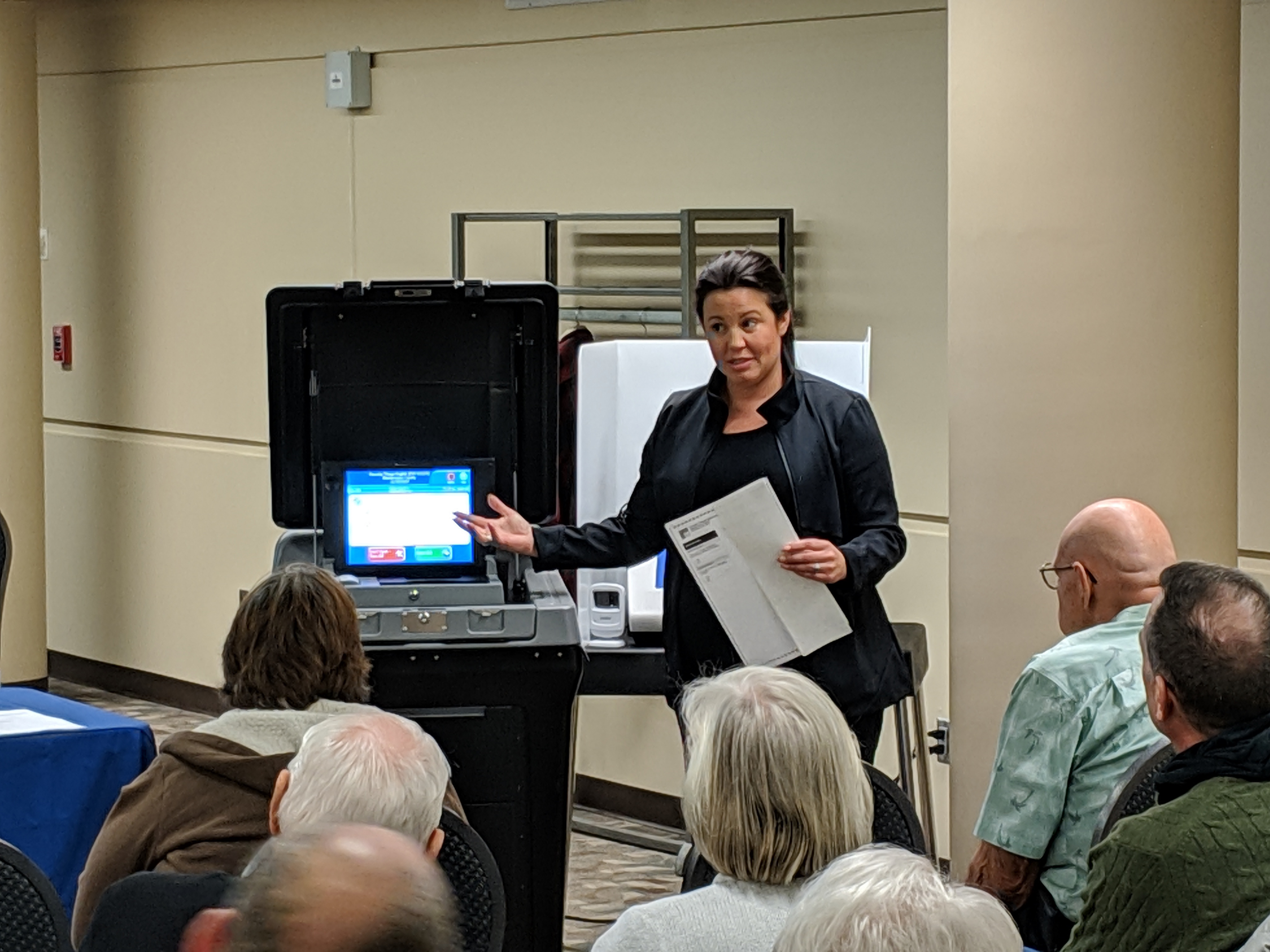
ES&S sales representative Angie Frison explains voting equipment during a February demonstration in Hays.
By JONATHAN ZWEYGARDT Hays Post
Ellis County residents will cast their votes on paper in future elections after the county commission approved the purchase of new voting equipment Monday.
The commission approved the purchase of 11 ballot counters and 11 touchscreen machines that are ADA compliant from Election Systems & Software (ES&S) of Omaha, Neb., for $85,391.
The new machines replace the more than decade-old existing equipment and also allows the county to comply with state law that requires paper ballots for a post-election audit.
Officials from ES&S and two other companies held demonstrations of the equipment to groups of election officials and Ellis County voters in February.
The commission also approved the purchase of poll books for an additional $24,896 from Election Source. According to Election Officer Donna Maskus the poll books are the tablets that scan the voter’s ID and tell the election worker what ballot that voter gets.
Maskus said the election officer has been setting money aside in the equipment fund for several years to pay for the new equipment.
Barton County also recently purchased similar equipment from ES&S.
In other business Monday, the commission:
• Approved the use of $29,424 of excess sales tax revenue to build a fitness room for emergency services personnel in the basement of the Emergency Services Building.
• Accepted a bid for $180,900 from Commercial Builders to make improvements to the elevator at the Law Enforcement Center.
• Approved the reorganization of the Environmental Division within the Public Works Department and rejected a bid for the removal of the staircase in the central atrium at the Administrative Center.
The commission will also take part in a tour of county roads on April 29.