We have a brand new updated website! Click here to check it out!

Hays teachers, school board move to fact-finding in contract negotiations

By CRISTINA JANNEY
Hays Post

After failing to come to a contract agreement during federal mediation, the Hays USD 489 school board and Hays NEA have moved on to a fact-finding process.

The compensation package, specifically health insurance is the stumbling block in the negotiations.

“The compensation package is the difficult issue,” Mike Walker, board president, said. “The board had proposed a compensation package addressing both a salary increase and an adjustment to the health benefits package. Hays NEA has stated that they would like to consider each item separately.”

Walker said the board wants to provide a total compensation package to teachers and staff that increases base salaries and addressed the benefit package.

“We hope to reach agreement on the total compensation package soon so that employees will have time review their salary increases and any adjustments to the health benefits package before open-enrollment the following year,” he said.

RELATED: Teachers, Hays USD 489 locked in dispute over wages, insurance

The district had proposed setting a specific amount it pays toward family plans instead of a percentage. It currently pays about 83 percent. The district proposed continuing to pay 100 percent for single plans.

The district proposed capping the amount the district pays for dependent plans at $1,000. Having a set amount the district pays for dependent insurance rather than a percentage would help the district in setting its annual budget, the board contends. The district proposed the change in the insurance take affect next year.

Kim Schneweis, Hays NEA board president, said in a previous interview with the Hays Post, the teachers don’t want to lock themselves into that plan. Teachers have also been unhappy about the district’s change to Aetna away from the state’s Blue Cross Blue Shield plan. She was unavailable for comment Tuesday.

This is the second year in the row the school board and teachers union have come to an impasse during negotiations.

Further attempts were made during mediation to end the impasse, but as that was not a public session, Walker said he did not wish to disclose that information at this time.

“The board hopes to end the impasse and the board and Hays NEA will agree on a total compensation package,” he said.

Walker said he did not know how long the fact-finding process might make.

Teen from Hoisington hospitalized after rear-end crash

BARTON COUNTY — One person was injured in an accident just after 12:30 p.m. Tuesday in Barton County.

The Kansas Highway Patrol reported a 2011 Dodge Caliber driven by Kejlt Robert Michael Phillips, 19, Hoisington, was northbound on U.S. 281 five miles south of Hoisington.

The vehicle rear-ended a 2007 Chevy Silverado driven by John Morgan Hendershot, 21, Little Hocking, Ohio, that slowed to make a left turn.

The Dodge then rolled and came to rest on the driver’s side. EMS transported Phillips to Clara Barton Hospital. Hendershot and two passengers in the Silverado were not injured. All four were properly restrained at the time of the accident, according to the KHP.

UPDATE: Up to 5 inches of snow, high winds as front moves into NW Kan.

Be sure to check Hays Post for the latest cancellations and delays through the winter storm season and tune into your Eagle Radio stations for the latest on severe weather.

UPDATED 3:45 p.m. Tuesday

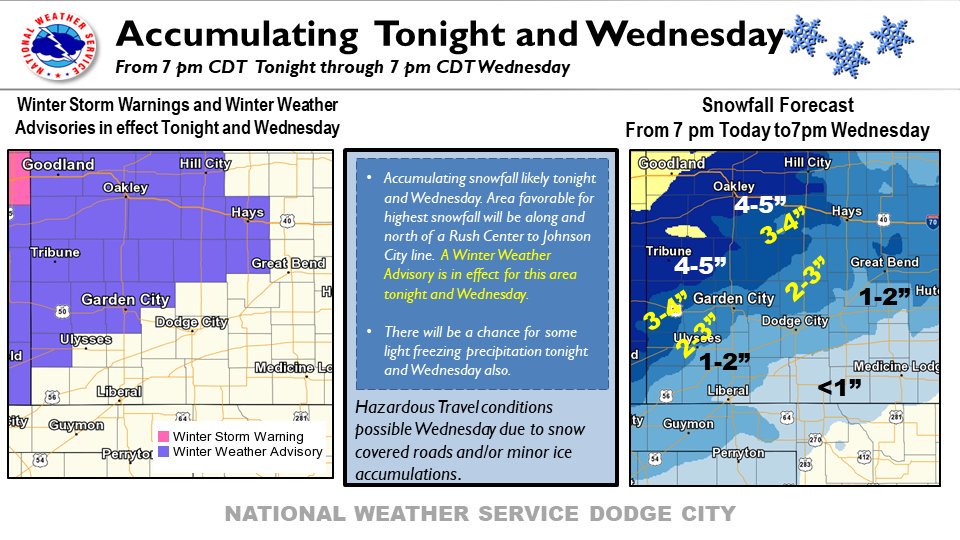
A winter weather advisory is in effect for much of northwest Kansas beginning Tuesday evening.

The warning will remain in effect until 7 p.m. Wednesday, according to the National Weather Service in Dodge City.

There is a 30 percent to 80 percent chance of snow Tuesday, with the temperature dipping into the low 20s. Drifting and blowing snow could occur, as strong north winds will accompany the storm, with steady winds of 25 to 35 mph and gusts near 45 mph.

The NWS said there is a chance for 2 to 5 inches of accumulation, as well as ice possible. The snow is expected to accumulate northwest of a line from Ulysses to Great Bend.

The conditions could make Tuesday evening and Wednesday morning road conditions hazardous and visibility will be reduced.

“This will be the first round of winter driving conditions this season,” the NWS warned. “Motorists are urged to slow down and allow extra time to reach their destination on Wednesday.”

Eastern Colorado could receive as much as 11 inches of accumulation, the NWS in Goodland reported.

Tune into your Eagle Radio stations for the latest on severe weather, as well as cancellations and delays.

Record low temperature at Cedar Bluff overnight

The National Weather Service in Dodge City said Tuesday several sites reported record low temperatures for this morning.

At the Cedar Bluff Reservoir dam, the mercury dipped all the way to 16 degrees, toppling the previous record of 18 set in 1991.

Record lows also were set in Ulysses (9), Ashland (12), and Greensburg (13).

The K-State Ag Research Center recorded an overnight low of 15 degrees, above the 11-degree record set in 1913.

Emprise Bank to close Hall Street location in Hays

By JAMES BELL
Hays Post

In a letter dated Oct. 25, Emprise Bank notified customers the Hays location at 2701 Hall would permanently close on Friday, Jan. 24.

The location at 1011 E. 27th, which was built in 2014, will remain open.

The closure was attributed to shifts in customer behavior towards online use.

“As banking customer preferences shift towards exceptional digital offerings and experiences, convenience is increasingly measured by having a branch at your fingertips, rather than the number of locations we offer,” the release said. “As we adapt to meeting evolving customer preferences, we are adding new capabilities in our digital offerings. These preferences also affect traffic to our branches, so we are adapting there too by continuously evaluating our branch footprint.”

Employees from the closing location will be transferred to other Hays branch, according to the release.

The bank said it does not plan to change its community engagement.

“Our support of the Hays community will continue, including our involvement with the Hays Area Chamber of Commerce, Hays Medical Center Foundation, Fort Hays State University, and many others,” the release said.

Wichita-based Emprise Bank is Kansas owned and operated, operating in over 20 cities in the state.

The bank began in 1910 as the Stockyards National Bank in Wichita and was bought by the Michaelis family in 1965. After mergers and acquisitions, the bank was renamed Emprise in 1989.

The Michaelis family still owns and serves as senior leadership at the bank, which has assets totaling over $1.7 billion and more than 450 employees.

Customers with questions are directed to call the bank at (855) 383-4301.


Outgoing Ellis Public Works director shares water concerns with current, potential council members

By JAMES BELL
Hays Post

ELLIS — Before the regular meeting of the Ellis City Council last week, outgoing Director of Public Works Alan Scheuerman shared with current and potential council members a summary of issues the council will be facing.

Among the issued presented was the continued presence of higher-than-allowed total trihalomethanes, commonly referred to as TTHM, in the water system.

“We do have a TTHM problem, and it’s getting worse,” Scheuerman said.

Trihalomethanes are a byproduct of chlorine interacting with organic material in the water supply and refers to a group of chemicals that include chloroform, bromodichloromethane, dibromochloromethane and bromoform.

The Kansas Department of Health and Environment, following the guidance of the Environmental Protection Agency, mandates TTHM levels under 80 parts per billion in public water supplies.

“We are coming in at 89 and 100, which brought our (running annual average) up to 89 and, unless we can come up with a much lower number – like a 40 in December, we’re going to have another one above 80,” Scheuerman said.

The highest TTHM average in Ellis last year was reported as 73, according to the KDHE consumer confidence report, meaning even with the current high levels the risk to the public is low.

Standard warnings from the EPA for consumers with water high in TTHM indicate health problems only occur after years of ingestion.

“This is not an emergency,” the EPA said in the standard letter to consumers that have high TTHM levels. “If it had been, you would have been notified immediately. Some people who drink water containing trihalomethane in excess of the (maximum contaminant levels) over many years may experience problems with their liver, kidneys or central nervous system, and may have an increased risk of getting cancer.”

Scheuerman said he believes the high TTHM levels are due to bromide leaching into the water system from organic materials while the amount of water in the city water wells is higher than normal.

“When it starts coming in at every test scheduled, which is every quarter, my guess is that the state is going to require us to take some kind of change or alteration to improve that,” he said.

Last year, 27 water systems in Kansas were found to have TTHM over the statutory limit – resulting in 55 violations, and Scheuerman, noting another city in western Kansas is currently facing similar issues.

The city is working with outside companies to find a cost-effective solution that can be worked into the city’s water plan.

Those companies will meet with the council in the future to address the issue, Scheuerman said, warning that if a solution is not found to alleviate the problem, the state could force the city into action.

Iron manganese treatment is a potential option and is likely the most cost-effective as it would only add another chemical feed into the system and the treatment is already used for inflow water, Scheuerman said.

“The other option we could do is a (reverse osmosis) system, which is extremely expensive,” he said. “We are not looking to do that method if at all possible.”

Mayor David McDaniel said at a recent governmental meeting he spoke with agents from two engineering firms that work with the city and was informed they are nearing a solution that would not require the reverse osmosis system.

As the city searches for other water sources, Scheuerman said, adding water into the system might also dilute the TTHM in the water under mandated levels and KDHE grants could cover up to one-third of the cost of adding another source of water to the system if that is used as the TTHM solution.

“There are multiple options there, but the city also needs to keep moving forward, because the state does not like you to sit on your laurels and say ‘We’ve got the water, we’ve got the land, but we are just going to sit there and look at it for the next 10 years,’ ” Scheuerman said. “They want to see you do something with it, which means you are probably going to have to spend some dollars.”

An engineering estimate totaled $3.7 million to $4.25 million two years ago that would secure another water source, including land and construction costs.

Scheuerman said the city could also try to partner with a rural water district to bring in water at a lower cost than securing new wells.


It’s not just what is going out, but what is coming in


Another issue that the council will face in the future will be water entering the sewer system rather than what comes from the taps, Scheuerman told the group, from damaged roads and storm drains.

“If you look at where the most damage is occurring, (it) is underneath the sewer and storm drains,” he said, noting water is infiltrating the sewer system under roadways and sections of roads in several areas of town.

“It’s getting worse,” Scheuerman said, noting repairs and maintenance need to be kept in mind when the council is lining up capital improvement projects.

Current council member Martin LaBarge agreed.

“Sometime, somehow, those streets are going to have to be fixed, because they are getting worse,” he said.

“On Washington Street, it is quite visible,” Scheuerman said. “You can see parts of the street are dropping and part of that is due to the tile breaking and water infiltrating down, going into those openings and taking dirt with it.”

He also noted one storm drain line has already collapsed.

“I know it is collapsing because there is no pipe left underneath there,” Scheuerman said. “We can’t get the sewer machine through it. If you can’t get a 2-inch sewer machine to ream that line, I guarantee … it was collapsed.”

He warned the council that funding is needed to address the problem, and other cities often have a fund specifically for storm drain maintenance, something he has recommended to the council in the past.

“If you have a major break, where you have to redo a section of storm drains, you have set no funding aside for that purpose,” Scheuerman said.

In those situations, the only solution is using tax dollars if no funds are available, which would take away from street repair funds.

“It will come back to haunt you because it will get worse,” Scheuerman said.

He suggests the new council begin accumulating a capital improvement fund to help those kinds of repairs.

“Your cost to repair will continue to rise,” Scheuerman said.

Repair funds, he told the group, are mandated by law to be separated and recommended the council re-evaluate the 2 percent water bill increase that was voted down this year to be used for maintenance.

“With these types of dollar amounts that you are going to need to keep your water safe and usable, I suggest that you reconsider about that 2 percent,” Scheuerman said.

“I think with the kind of dollar amount that you need to continue to put into your water system you can probably not afford to let that drop,” he said. “An annual 2-percent increase is a lot easier to swallow for a lot of people … than a $20 change 10 years from now.”



🎥 City commission candidate: Ron Mellick

Ron Mellick
By BECKY KISER
Hays Post

There are five men running for three open seats on the Hays city commission.

Two are incumbents, Ron Mellick and Henry Schwaller IV. The three other candidates are all political newcomers, Michael Berges, Mason Ruder and Ryan Rymer.

This week Hays Post will run a series of interviews with each candidate.

Ron Mellick, 67, says he has no immediate plans to retire. In another 18 months, he will have worked 50 years in the floor covering business as in installer. All but two of those years, he will have been self-employed.

He and his wife Mary, who runs an in-home daycare, have four adult children and 12 grandchildren.

Mellick previously served as a Hays city commissioner from 2007 to 2015. In July 2018, he was appointed to fill Commissioner Chris Dinkel’s unexpired term.

Mellick is proud of two major accomplishments made during the time he has served on the city commission, but is quick to say, “I don’t believe any commissioner, individually, can take credit for accomplishments that the commission achieved because it takes a majority of the commissioners.”

He points to the city’s stable mill levy. It’s remained at 20 mills for 12 of the past 13 years.

“You won’t find any city in Kansas, outside of Johnson County, that has a lower city mill levy. Nor will you find another Kansas city still operating on the same mill levy that they were in 2007.”

Mellick is also proud of the city commission’s adoption of a “pay-as-we-go” policy.

“We save our money. We pay for our projects in cash. We’re no longer bonding them and paying that interest for years to come.”

He doesn’t want that to change.

What Mellick does want to change is the stability of the city’s long-term water supply with activation of the state’s Water Transfer Act.

“I think once we get that water here (from the city-owned R9 Ranch in Edwards County) we could see a huge economic development driver not only for Hays but the region for years to come.”

The top two city commission candidates will serve for four years, while the third-place vote-getter will serve for two years.

Advanced voting is underway. The election is Nov. 5.

Man from Hays avoids injury after 2-vehicle crash

NORTON COUNTY — One person was injured in an accident just after 12:30 p.m. Monday in Norton County.

The Kansas Highway Patrol reported a 2018 Ford F150 driven by Tre Frankhouser, 27, Goodwell, Okla., was behind a 2019 Ford pickup driven by Kevin J. Ubert, 39, Hays, eastbound on Kansas 383 four miles north of U.S. 36.

As Ubert attempted to make a left turn, the 2018 F150 attempted to pass and struck the driver side of the 2019 truck.

A passenger in the 2018 Ford, Jena K. Eder, 27, Goodwell, was transported to the hospital in Phillipsburg.

Fankhouser and Ubert were not injured. All three were properly restrained at the time of the accident, according to the KHP.

KWEC stargazing event rescheduled for Nov. 8

FHSU University Relations

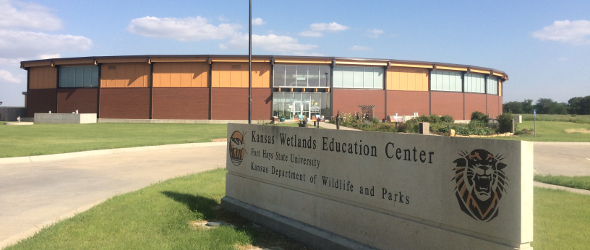
The Fort Hays State University Astronomy Club stargazing night at the Kansas Wetlands Education Center has been rescheduled for Friday, Nov. 8.

The event, originally scheduled for Oct. 18, was postponed because of weather.

Night sky observations and astronomical activities will be conducted from 8 to 10 p.m., led by FHSU’s Dr. Jack Maseberg, associate professor of physics, and Dr. Paul Adams, dean of the College of Education.

Mandy Kern, program specialist at the center, said the activities will be conducted regardless of weather. If the weather turns inclement, she said, the event will be moved indoors.

Adams

The FHSU Astronomy Club will bring its telescopes to the KWEC and educate participants about different cosmic objects.

That night, Saturn, Jupiter, and Messier Galaxy Objects will be in view. Messier Objects include nebulae, globular and open clusters, and galaxies discovered by Charles Messier in the 1770’s as he was searching for comets.

KWEC will also provide refreshments, a galaxy craft and other activities inside the center.

KWEC is located at 592 NE HWY K156 in Great Bend. For more information call 877-243-9268.

HAWVER: Upcoming session a complex one for Kan. lawmakers

Martin Hawver

Well, Kansans, we have a little more than two months before the Legislature goes into session and becomes either dangerous or helpful.

Remember those good old days, when whoever voted to cut your taxes was a reasonably good pick for your vote in the upcoming election? Well, those days appear to be over. One reason is that the state is still in shaky financial condition, which means that if there is going to be a tax cut, it’s going to be pocket change or directed to such a small number of Kansans that we could probably notch their ears so we can tell who they are.

So, the upcoming holiday season is one in which we’re going to have to listen and watch for issues that are much more complex than we’ve had to weigh for decades.

Expand Medicaid so that between 130,000 and 150,000 Kansans can be provided health care? Even when the federal government will pick up 90 percent of the cost, and for just a dime on the dollar, we have healthier Kansans to mingle with at the mall or at the convenience store, or send your kids and grandkids to school with?

Sounds simple. Except that there are conservative Kansans who want work requirements tied to getting health care. And even at the 90 percent federal funding, it’s still going to cost the state money that it can’t easily spend.

Wrestle with what sounds good on that one…and then look at your car in the driveway.

This summer the Kansas Supreme Court held that the $235,000 cap on non-economic damages (basically reductions in physical and mental agility after the other guy has rebuilt your car) is unconstitutional. That cap, while probably high enough for the non-economic damage from not being able to dance, may require a jury to consider higher damages from the life-altering psychological changes a car crash may cause without a lid.

That removal of the cap is undoubtedly going to raise your potential liability in a wreck that is your fault—and your premiums to drive legally on Kansas streets.

What’s right there? Something to talk about because it will affect your checkbook, and the Legislature is going to figure out how much.

Oh, and then there is, as always, marijuana. Or cannabis as we’re calling it now in the Statehouse.

No doubting that there are Kansans with constant pain that makes their lives miserable and who have found that medical or some other genre of marijuana can alleviate that pain, physical and mental—even if the federal government doesn’t approve and doctors don’t know for sure.

Seems simple. Legalize its prescription by physicians. Except that, well, it is “marijuana” and some lawmakers fear that it will be mis-prescribed, or will lead to legalizing recreational marijuana in Kansas which apparently is more dangerous than, say, legalizing drinking…

So, what do we have to worry about for the next two-plus months? Strangely, it is worrying about what legislators believe will be good for Kansas and Kansans and whether they will find the right way to do what’s good without costing them votes. Because, of course, it’s all about votes for lawmakers who want to hang out in the Statehouse in 2021.

Oh, and then there’s that Internet, where anyone who disagrees with lawmakers’ decisions can spread that dissention worldwide, or at least to Kansas voters, and legislators have to explain why they voted right. That all becomes more difficult in the era of social media.

Those simple tax cuts appear out of reach, and everything else is becoming more complicated and divisive.

Best part is that nobody is yet talking about letting legislators break the skin…

Syndicated by Hawver News Company LLC of Topeka; Martin Hawver is publisher of Hawver’s Capitol Report—to learn more about this nonpartisan statewide political news service, visit the website at www.hawvernews.com

Copyright Eagle Radio | FCC Public Files | EEO Public File