NORTON, Kan. (AP) — Authorities say a Kansas teen has been killed in a farming accident.
Norton County Sheriff Troy Thompson says his office received a call around 9:25 p.m. Monday from a concerned parent.
The parent said the teen went missing while doing chores. Deputies arrived and found that the teen had involved in an accident involving farming equipment.
He was pronounced dead at the scene. His name wasn’t immediately released.
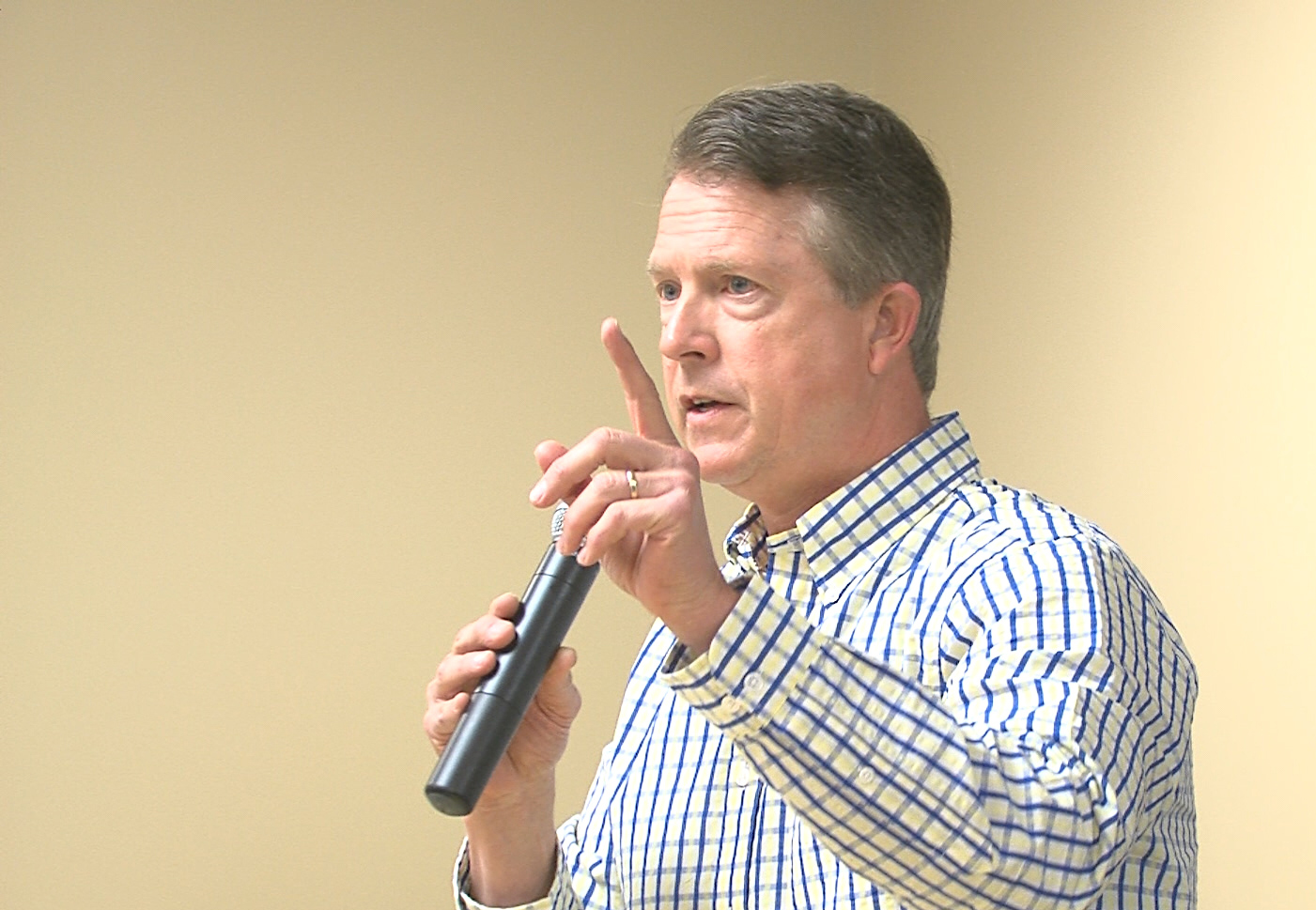
State Sen. Rick Billinger (R-Goodland) and Rep. Barb Wasinger (R-Hays) listen to 1st Dist. Congressman Roger Marshall (R-Great Bend) during the Hays Area Chamber of Commerce legislative forum Saturday.
By BECKY KISER Hays Post
“Government works kind of slow.”
As a former Ellis County and Hays city commissioner, Barb Wasinger already knew that before she was elected last fall as the 111th District state representative from Hays. Now she’s in Topeka, where the state legislative process is even slower.
During a Saturday morning forum in Hays, Wasinger and other local legislators – all Republicans – along with First District Congressman Roger Marshall talked about Medicaid expansion in Kansas as well as health care reform.
The rising cost of health care is one of the top concerns of Kansans, according to Marshall, a Republican from Great Bend.
“What we have in 2020, I think is a big choice, very much a binary choice,” said Marshall. “I think it’s very evident both Democrats and Republicans are ready to throw out the Affordable Care Act. It hasn’t worked.
“We want to address what it didn’t, and that’s the cost of health care.
“The Democrat plan would be universal health care, Medicare for all which is really Medicare for none. It’ll end up looking like Medicaid. If you’re getting health care through your employer, that’s going to be gone. If you’re in the VA (Veterans Administration) system, that’s going to be gone.”
Marshall says he wants to push choices back to the state level and “let the states run more of those types of solutions, whether it’s individual market or other things.”
The true issue, Marshall believes, is driving down the cost of health care.
“If I can drive the cost of health care down, then those people with pre-existing conditions can afford health care,” Marshall said.
“And it’ll help your state budget because it will drive Medicaid expenses (down). I can maybe someday balance the budget at the federal level.”
Currently, 28% of the federal budget is spent on health care, according to the Kansas congressman.
“I’ll never be able to balance the budget until I get the costs of health care down.”
Marshall says there are three basic principles to driving down the cost of health care – transparency, innovation and consumerism.
“When you go out for a meal, you get more information from the menu than when you have a hip procedure done, or when you walk into an emergency room and you then get a helicopter ride plus all the surprise billing.”
Pharmacies also lack transparency. He said there are four Pharmacy Benefit Managers in the United States controlling 90% of the market.
“When you go to your local pharmacist and spend $100 a month on your medication, that Pharmacy Benefit Manager is extracting a third of that. They don’t improve health care and they’re giving legal kickbacks to big pharma and insurance companies.
“That just first needs to be transparent. I think when America sees that, they’re going to scream and say this isn’t right.”
Innovation will do more to drive the cost of the health care down than any legislation, “if we just get the government out of the way,” Marshall stressed. He is a longtime obstetrician and gynecologist.
As an example, he said twice as many generic drugs are now being approved per year than were during the Obama administration. “We got the government out of the way and expedited the FDA (Federal Drug Administration) process.”
Marshall’s third principle for lowering health care costs is consumerism – making patients consumers once again.
He wants all patients to have access to an HSA – Health Savings Account – and use pre-tax dollars to pay health insurance premiums and out-of-pocket medical expenses.
“Don’t let the press fool you. We (the Republicans) do have a plan. We have 20 bills, each to help guide the cost of health care down 1 or 2%. Most of it is common sense. Now the question is, can Congress execute some of those plans?”
Many major health care systems are no longer accepting any of the Affordable Health Care Act plans, also known as Obamacare, because “they look like Medicaid,” Marshall said.
“Many of the reimbursements are so horrible, the household factors are so bad, that most of the major institutions are no longer going to accept any of these individual market plans.”
Jon Armstrong, interim director of admissions at Fort Hays State University, addresses a record-breaking crowd at last week’s visitation day for high school sophomores and juniors.
By DIANE GASPER O’BRIEN FHSU University Relations and Marketing
About three years ago, the Kansas State Board of Education adopted an Individual Plan of Study for every student, beginning in the middle grades, as an aid to plan for success after high school.
Fort Hays State University is taking an innovative approach in helping students begin career exploration early in high school, providing organized campus visits long before their senior years.
Last week’s Tiger Mania, a visitation day designed exclusively for sophomores and juniors to explore FHSU, broke the all-time attendance record with 249 students and about 200 guests, such as parents, teachers and other school staff. That number is up considerably from just two years ago, when 143 students attended. Attendance increased by 42 students last year, then ballooned by nearly 65 more this year.
Fort Hays State also sponsors similar events for juniors and seniors, and it started adding sophomores to that list a few years ago.
“I think a lot more students are taking the opportunity as juniors, and even sophomores, to prepare themselves for college,” said Hugo Perez, assistant director of Admissions. “Tiger Mania was a great opportunity for us to peak their interests.”
Students from all across the state, as well as some from Colorado and Nebraska, attended.
Phillipsburg High School brought its entire sophomore class of more than 40 students to take part in the event.
Suellyn Stenger, a guidance counselor at Hays High School, said that research shows it’s about their sophomore year in high school that students’ post-secondary education interests start jelling.
“I think it’s a very good thing that students are exploring their options early,” said Stenger, who has been in the education field for 30 years, including 11 as an HHS counselor. “Visiting colleges used to be more of a focus for their senior year. Then colleges started having junior days. Providing this for sophomores is great.”
“The best decision is an informed decision,” Stenger continued. “If students can be getting that information now – early in their high school years – to help them make decisions, I’m all for that.”
Jeanne Isbell, a parent of two Hays High School students, said she thinks “it’s really important to do college tours.”
“The sooner, the better,” Isbell said. “This is a fantastic idea.”
Isbell said she thinks the opportunities students gain while attending college are “endless.”
“And I don’t just mean getting a degree,” she said. “The experiences you get with the people you meet in college help with how you think about life. Some kids don’t think they can flourish in college, but they are so helpful here in pointing out they will help anyone who is interested in going to college.”
Isbell was accompanied by her daughter, Judith, a junior, and her son, Jesse, a sophomore.
Isbell’s older daughter, Cori, is a senior at Hays High and has her heart set on attending college in California.
“I took Judith with me to some of Cori’s college visits,” Isbell said. “It’s good to compare, and we’re really impressed with Fort Hays State.”
So, too, is Woodson Corbett, a junior at Ellinwood High School.
Corbett was all smiles as he left the table featuring the Department of Art and Design. What he learned confirmed what he had from others.
“I heard good things about Fort Hays State from friends who go here and people in the graphic design field,” he said. “This is what I want to do.”
The Admissions staff told the students it’s OK to change their minds even if they do have their mind set on a certain major.
“I had a plan, and it all changed the first semester,” said Katie Hindman, admissions counselor for the eastern part of the state. “You will find what you’re really good at.”
“Your life is going to change,” added Kyle Stacken, admissions counselor in charge of recruitment in Ellis County and central Kansas. “Embrace those changes, and Fort Hays State will help you succeed in whatever you choose in your life.”
Representatives from the Admissions Office pointed out advantages of attending Fort Hays State, such as the most affordable tuition among state universities, small class size, numerous scholarship opportunities and ways to get involved on campus.
A panel of three FHSU students answered questions from the audience. Several $1,000 scholarships were awarded throughout the morning – some for winning trivia contests about Fort Hays State and others for simply locating a Tiger logo under a chair. And every student got a tour of the campus, including a residence hall and one of the dining cafeterias.
Keith Sides, a business teacher at Phillipsburg High School, accompanied the large contingent from his school and said he thought “it was a really good thing for our kids.”
“We can talk about Fort Hays State, but until they get on the campus and see more of it, it doesn’t mean as much,” Sides said.
Stenger agreed.
“It’s as important to find out what you don’t like as it is to find out what you do like, and to actually see what you read about the colleges,” she said. “From my personal experience, when I did on-campus visits when I was in high school, it was the deal maker or the deal breaker. Seeing in person all the good things that Fort Hays State has to offer could be a deal maker for a lot of kids.”
CAPE GIRARDEAU COUNTY, Mo. – With the assistance of the Cape Girardeau Police Department, the Kansas Bureau of Investigation (KBI) and the Norton County Sheriff’s Office made an arrest connected to the murder of Lori Shields.
Damien Shields -photo Cape Giradeau Co.
At approximately 4:20 p.m. on Monday, he was released from the Saint Francis Medical Center in Cape Girardeau, Mo., Damien L. Shields, 42, of Norton, was arrested for the first-degree murder of his wife, 38-year-old Lori Shields.
Shields was then booked into the Cape Girardeau County Jail.
—————
NORTON COUNTY– The Kansas Bureau of Investigation (KBI) and the Norton County Sheriff’s Office are currently investigating a homicide that occurred in rural Norton, Kan. on Sunday.
According to a media release from the KBI, preliminary information indicates that the Norton County Sheriff’s Office received information Sunday afternoon that a female victim was deceased at 16353 U.S. Highway 36, in Norton. At approximately 3:40 p.m., sheriff’s deputies responded to the residence where they discovered 38-year-old Lori Shields, of Norton, deceased inside.
A suspect connected to the case was identified, and KBI agents and sheriff’s deputies worked to try to locate him. On Monday, at approximately 2:40 a.m., the Cape Girardeau, Mo., Police Department responded to a report of person calling out for help from a hotel room. Once police arrived, they learned the man in the hotel room was being sought by Kansas authorities connected to this homicide case.
The man was taken to a hospital in Cape Girardeau to be treated for injuries that were likely self-inflicted. He remains hospitalized at this time.
According to a social media post by the Norton Telegram, Shields was the Eisenhower Elementary School secretary. USD Norton School District has canceled Monday classes and all activities.
The investigation is ongoing. Nothing further will be released at this time.
The Kansas Corporation Commission reports just 75 new intent-to-drill notices filed across the state during the month of March for a first-quarter total of 228. That compares to 422 at this time last year and 1,455 intents for the first quarter of 2013. Barton County saw just two new intents in March, for a total of nine in the first quarter, compared to 18 in the first quarter last year. Ellis County saw just one new intent filed in the first three months of the year, compared to 11 in the same period in 2018. Russell County, saw one last month and four for the first quarter. That’s an improvement over the one intent filed there during the first quarter of last year. Producers in Stafford County filed two last month and seven during the first quarter compared to ten during the first three months of 2018.
Independent Oil & Gas Service reports a nearly 18% increase in the Kansas rig count. There are 10 active rigs in the eastern half of the state, up six, and 23 west of Wichita, down one.
Shutterstock.com
Baker Hughes reported 1,025 active drilling rigs across the U.S. Friday, an increase of 15 oil rigs and four seeking natural gas. The count in Texas was up eight. New Mexico gained three. Canada reports 68 active rigs, which is down 20 for the week.
Regulators approved 30 permits for drilling at new locations in Kansas over the last week. That’s 225 so far this year. There were 16 new permits in eastern Kansas, and 14 west of Wichita, including two in Barton County and two in in Ellis County.
Independent Oil & Gas Service reports 27 new well completions across the state, ten east of Wichita and 17 in Western Kansas, including one each in Ellis, Russell and Stafford counties. So far this year, operators have completed 447 wells across Kansas.
The U.S. Energy Information Administration reports domestic crude oil inventories increased for the second week in a row. For the week ending March 29 U.S. stockpiles rose 7.2 million barrels to 449.5 million barrels. That’s equal to the five-year seasonal average.
The government has reported new records for U.S. crude production for three weeks in a row. The latest report shows production of 12.182 million barrels per day for the week ending March 29. That’s up 93 thousand barrels per day over the week before, and more than 1.7 million more than last year at this time.
U.S. crude oil imports averaged 6.8 million barrels per day for the week ending March 29, up by 223,000 barrels per day from the previous week. The four-week average is 12.1% less than the same period last year.
A non-profit Native American advocacy group on Friday filed yet another challenge to the permit allowing TransCanada to complete the Keystone pipeline. The latest permit suggests that the president’s authority to approve the pipeline is not subject to judicial review. But Bloomberg reports the new complaint filed in U.S. court in Montana argues that President Trump lacks authority to issue the permit, because the Constitution gives Congress the power to administer federal lands and regulate foreign commerce. According to the complaint, the project would pose “grave risks” to the climate, cultural resources, water resources, fish and wildlife, and human health and safety.
A federal judge says the President exceeded his authority by trying to overturn Obama-era restrictions on Arctic and offshore oil and gas drilling. In a ruling Friday, Judge Sharon Gleason reinstated the drilling ban, saying President Trump’s executive order last year exceeded his authority. Judge Gleason ruled that while sitting presidents have the power to ban development with an executive order, only Congress has the power to revoke such a ban instituted by other presidents. The bans involve about 98 percent of the Arctic coastal shelf in northern Alaska, and nearly six thousand square miles of underwater canyon complexes in the Atlantic Ocean, stretching from Virginia to the Canadian border.
North Dakota’s oil regulator plans to sue the state of Washington if it goes ahead with a proposal to reduce the volatility of Bakken crude oil transported by rail, saying it is not supported by science and would devalue the product. The Washington Senate voted last month to mandate a lower vapor pressure limit for Bakken crude shipped through the state by rail, aiming to limit fiery derailments. The Bismarck Tribune reports North Dakota regulators have requested state money to sue Washington if the legislation advances. About 200,000 barrels per day are carried by rail from North Dakota to refineries in Washington.
Continuing a nearly year-long string, the U.S. and Canada continue to increase reliance on railroads for delivery of petroleum and petroleum products. That’s according to the latest numbers from the Association of American Railroads. For the week ending March 30, domestic oil-by-rail shipments increased by nearly 28 percent over a year ago, and the year-to-date cumulative total was up 22 percent. Canada’s totals were up 13 percent for the week and 19 percent year-to-date.
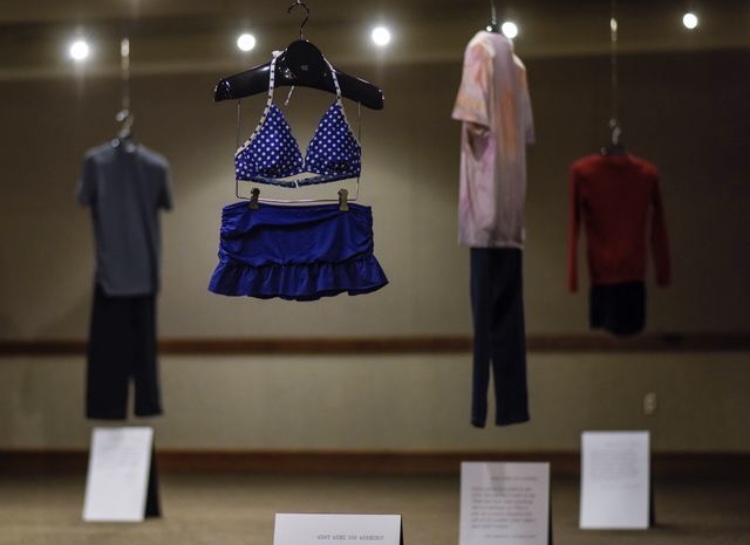
“What Were You Wearing?” exhibit (Photos provided by Jana’s Campaign)
Every April, victim advocacy and prevention organizations across Kansas, and the nation, recognize April as Sexual Assault Awareness Month and an opportunity to bring awareness to the ongoing issue of sexual violence in our communities.
This year, Options Domestic & Sexual Violence Services, Jana’s Campaign, and the FHSU Women’s Leadership Project are collaborating to bring “What Were You Wearing?”, a sexual assault survivor art exhibit, to the FHSU campus and the community at large for the second time in as many years. The exhibit features re-creations of outfits that survivors of sexual assault were wearing at the time of their assault, based on personal testimony from the survivors themselves.
The survivor art exhibit was born out of an advocacy lens. The question, “What were you wearing?” is pervasive for most survivors. The project’s intent is to place the work of bearing witness to this question’s answer back onto the shoulders of the community. The exhibit asks viewers to understand that sexual assault is NEVER about the clothing the survivor wore – and the act of shedding those clothes is never enough to bring peace or comfort to survivors. The violence is not simply woven into the fabric of the material; it is a part of the survivor’s new narrative.
The exhibit requires all of us to evaluate what caused us, as individuals and as a society, to ask victims of sexual assault, “What were you wearing?” in the first place. To ask the question, “What were you wearing?” costs the questioner nothing; however, the survivor pays dearly in not only their answer; but also in the burden of self-blame.
“Everyone in our community needs to see this exhibit and understand the survivor is never at fault. The exhibit is also personal; attendees can see victims as their friends, family, neighbors, even themselves, and realize sexual assault can happen to anyone.” Kim Cebula, executive director of Jana’s Campaign.
“Research shows that one in five women will experience sexual violence in their lifetime; and in eight out of ten cases, the rapist already knew their victim. As you read the stories in this powerful exhibit, you’ll see that statistic rings true,” said Jennifer Hecker, executive director of Options Domestic and Sexual Violence Services. “Demand for sexual assault services at Options has increased 655% in the last three years alone. This isn’t a problem in other communities – it’s a problem right in our own backyard.”
The “What Were Your Wearing?” exhibit will be open April 15-18 from 10 a.m. to 4 p.m. in the south end of Forsyth Library on the Fort Hays State University campus. The exhibit will also be featured in the Spring Art Walk in Hays on April 26th from 6 p.m. – 9 p.m. at Styles Dance Centre at 1501 Main St.
If you or someone you know needs help because of domestic violence, sexual assault, stalking, or human trafficking, call Options’ free Helpline at 800-794-4624 for help 24 hours a day, 7 days a week.
Options Domestic & Sexual Violence Services, Inc. is a non-profit agency dedicated to providing direct assistance to victims and survivors of domestic violence, sexual assault, human trafficking and stalking through individual support. Options provides services to 18 counties in northwest Kansas; services are always voluntary and provided free of charge, with complete confidentiality.
Jana’s Campaign is a national education and violence prevention organization with the single mission of reducing gender and relationship violence. In honor of the late Jana Mackey and other victims and survivors of gender and relationship violence, Jana’s Campaign delivers educational programs that prevent domestic and dating violence, sexual violence, and stalking.
Martin HawverRemember back in November, when there were five choices for governor, and a blank line where you could write in your neighbor or your dog or probably any other mammal for the state’s top job?
And remember that it came down essentially to one decision for Kansas voters: very conservative Republican Secretary of State Kris Kobach or Democrat Sen. Laura Kelly?
Well, Kelly won, of course, by more than 50,000 votes, or 48% to 43% over Kobach.
The race essentially came down to Kobach, or the best-known candidate who wasn’t Kobach. Not being Kobach was a campaign asset — he was a lightning rod for folks who didn’t care for his voter rights/immigration policies and for those who feared he would reignite the Gov. Sam Brownback fiscal era.
But just being “not Kobach” didn’t really tell us anything about whether the “not Kobach” would be a competent and persuasive governor.
With the first adjournment of the Legislature last Friday, it looks like Kelly has been persuasive. She got the GOP-pushed tax-cut bill knocked down; her veto won’t be overridden. That’s victory No. 1.
And she got her school finance plan, worth about $90 million more a year for schools for the next four years, passed. That might, just might, be enough to convince the Kansas Supreme Court that the state is “adequately” funding public schools for our kids and grandkids. Not sure, depending on the court, but it could well be victory No. 2.
Victory No. 3? That would be expansion of Medicaid health care to more than 100,000 generally poor Kansans, their children, the disabled and others who can’t afford health care. No. 3 will be the target of the governor’s intense lobbying of legislators and their constituents during the next three weeks. Kelly and Lt. Gov. Lynn Rogers will be crisscrossing the state during the Legislature’s spring break, with public events where they can try to get Kansans to tell their senators that they want Medicaid to be expanded.
The Senate has so far refused to hear the bill in committee, to consider voting it to the floor of the Senate where there are probably enough votes to pass it. It’s a different deal than two years ago. When the Legislature strongly passed Medicaid expansion, Gov. Brownback vetoed it, and either because of allegiance to the outgoing governor or maybe just because most Republicans were still referring to it as “Obamacare,” legislators couldn’t or didn’t override the veto.
That puts this year’s House-passed Medicaid bill, which the Senate’s anti-expansion leadership has specifically opposed, the target of Kelly and the health-care industry and Kansans without health coverage and lots of others in the next three weeks.
It’s the biggest test of the political power and the political strategy of the “not-Kobach” governor who got elected last November.
If successful, the effort by Kelly and others to get Medicaid expanded could reshape the Republican Party in Kansas.
It could mean that the hard-right conservativism, which got Kobach through the GOP primary election by about 400 votes over slightly more moderate then-Gov. Jeff Colyer, has seen its day. Could mean that the leaders of the Kansas House and Senate, who essentially set the rules for lawmakers and have their thumbs on the scale on nearly every vote taken, are losing horsepower.
Debate over important issues such as taxes, school finance and Medicaid expansion is a good thing. That’s how you find the upside and the downsides of major issues.
The outcome could tell us just how persuasive the new governor is…and might mean Republicans have to figure out how to deal with her…
Syndicated by Hawver News Company LLC of Topeka; Martin Hawver is publisher of Hawver’s Capitol Report—to learn more about this nonpartisan statewide political news service, visit the website at www.hawvernews.com
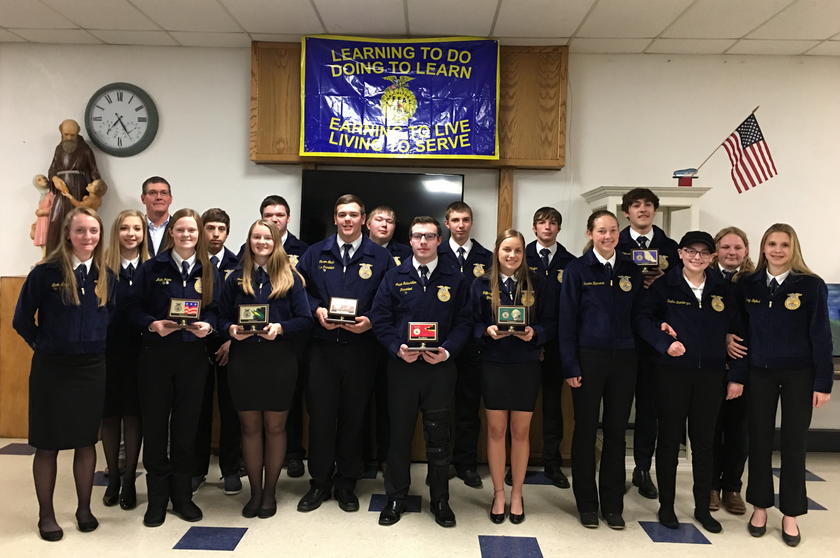
On March 31, the TMP-Marian Future Farmers of America Chapter hosted its first annual Banquet and Awards Night. Seventeen students received either their Greenhand or Chapter FFA Degrees.
FFA members enrolled in their first year of a high school credit in agricultural science, that have satisfactory plans for a Supervised Agricultural Experience (SAE) Program and that have demonstrated their understanding of the history and purpose of the FFA may apply for their Greenhand Degree. The Chapter Degree is the highest degree a chapter can bestow on its members.
It is usually awarded during the second or third year of membership. Requirements include having the Greenhand FFA Degree, two semesters of agricultural course work, SAE Program, SAE earnings and investments of at least $150 or 45 hours outside of class time, leadership of a 15-minute group discussion, demonstration of five procedures of parliamentary law, progress towards individual achievement in the FFA Award Program and satisfactory scholastic record. While students are active members of the FFA there are a total of 5 degrees that they can obtain. Degrees include: Discovery Degree, Greenhand Degree, Chapter Degree, State Degree and American Degree. The State Degree and American Degree are only awarded by state associates and an elite group of members at the national level.
A highlight of the evening was when Sophia Linenberger, FFA Member, currently fighting cancer, came to share in the festivities.
“We had such a great night sharing a meal and time with her,” said Jay Harris, FFA adviser.
Principal Chad Meitner said, “The ceremony was very nice. I want to say thanks to Jay for all his work with the FFA! It gives our kids some great experiences.”
In addition, at the FFA Meal funds were collected to send to the Nebraska Red Cross for victims of the flooding in Nebraska. A total of $310 was collected.
“I took the donation to the Eagle Communications office where I was told that the Schmidt Foundation is matching all donations brought to them. This means the money we collected will be doubled to $620,” said Harris.
Steve GillilandA term often used around Christmas and Thanksgiving is “Seasonal Smells,” meaning scents like pumpkin pie, roasting turkey and the scent of pine; pleasant fragrances that we associate with that time of the year. We are entering a time of the year that also has a specific essence associated with it that is not quite so pleasant.
Anyone who has set foot outside lately and has a nose on their face has noticed the air of late smells slightly more “skunky” than usual. Also at this particular time of the year, dead skunks seem to litter the roadside. Welcome to skunk breeding season in Kansas! For our pungent friends the skunks, breeding season begins at the first sign of spring warm up, usually late February and early March, and I believe is a tad later this year because of a slightly later spring warm-up. Skunks are among the most den-dependent furbearers, meaning that more than many other furbearers, their lives rely on them having a permanent den from which to come and go daily.
Skunks do not hibernate, but become very inactive during the heart of winter, when a den becomes very important. Communal denning is common during this time, and a dominant male will often share a den with a dozen or more females during this time of inactivity. Their breeding season is fast and furious, but very short, so keeping oneself close to as many females as possible pays big dividends for male skunks when skunk love is in the air.
All right, so this is skunk breeding season, but I’ve always wondered why that means we have to smell them so much more than usual. After all, they certainly don’t spray their girlfriends do they? Maybe it’s some kind of ritual mating dance that ends each time with a poof into the air? The answer is simple, and as a trapper I should have figured it out. At this time of the year male skunks might roam as far as five miles in one night looking for eligible ladies, and since all male skunks are currently of the same mind, the chances are pretty good males will encounter each other on their quests. And then, just like a bunch of jocks fighting over the cheerleaders after the junior high dance, someone’s gonna’ get sprayed! Figure this happening several times a night for a few weeks with all the male skunks in Kansas and you have the answer.
With that solved, what about the reason for finding so many dead skunks along the road right now? I’m glad you asked, because I’ve found some interesting takes on that question too. First and the most obvious part of the answer is simply the fact that all male skunks in the kingdom are draggin’ main street right now lookin’ for girls, so the law of averages says that because of that, many will get flattened. There’s possibly more to the answer though, and that calls for a little skunk psychology lesson.
Skunks have few natural enemies and can turn even the biggest bully around on a dime with just the lift of their tail. This seems to create in them a certain cocky attitude that appears to be present even from birth. Skunks will not back down from anything; it’s as simple as that. Couple that with the fact that male skunks have a one-track-mind this time of year, and if they even notice a car coming at them, they possible see it as just another bully that will turn and run with the lift of their tail. That all equals a flat skunk! Another interesting suggestion says that skunks have black eyes that do not reflect light well like the eyes of most other animals, possibly making them hard to spot ahead of time.
By the way, if you, your dog or your car ever happen to get sprayed directly by a skunk, here is a recipe for a deodorizer that really works, and yes, I know this from experience, and that’s another story in itself: mix together 1 quart 3% hydrogen peroxide, ¼ cup baking soda and 1 teaspoon liquid dish soap (Dawn works well.) Mix this up just before use and don’t save any leftover. Bath yourself or the dog and scrub the car with this concoction.
Skunks are amazing critters that have amazingly soft, luxurious fur (once you get past the smell) and whose potent, pungent essence is invaluable to the fur-trapping industry as an additive to trapping lures. Trappers who extract the pure skunk “quill” from the animals can expect to get one to two ounces per skunk, and at about $20 an ounce that’s pretty good gas money. Skunk essence enhances and magnifies other fragrances and is actually used in very minute amounts in perfume. Some years back there were rumors that someone was developing an aerosol spray from skunk essence called “Skunk Power” that could be used by women against an attacker. I couldn’t verify its existence but what a good idea! Native Americans are said to have used skunk oil as a healing balm and liniment; I knew our Native American ancestors were tough, but that fact gives me a whole new respect for them.
So there you have it, a little Pepe Le Pew 101 so-to-speak. When I smell a feed yard here in Kansas I just think of it as the smell of money. Even though I know they’re yet another example of God’s marvelous and diverse Creation, it’s pretty hard to think that way when the spring air is ripe with the smell of skunk. Continue to Explore Kansas Outdoors!
Steve Gilliland, Inman, can be contacted by email at [email protected]
Kristen Farrington is executive director of the Religious Freedom Center of the Freedom Forum Institute.
By KRISTEN FARRINGTON Freedom Forum Institute
Religious freedom in today’s world is synonymous with controversy. Debates rage around the country on issues that touch our deepest beliefs: abortion, adoption, vaccinations, war memorials, equity and identity.
Families and communities are torn apart waiting for courts to sort out the fine and complicated lines between basic human rights and religious liberty. After waiting months if not years for court decisions, communities discover that legal rulings don’t have the power to heal fractured communities.
This part of our American story is as old and real as when the first settlers arrived on our shores, but the intensity today feels somehow different. Surely by 2019 we Americans have learned to live together despite our deepest differences!
The stark reality is that, no, we haven’t. According to several watchdog organizations and the FBI, religious intolerance and religion-based hate crimes are on the rise; bullying in schools continues to threaten the well-being of our children.
Religious leaders and educators share similar stories — we just aren’t equipped to deal with the controversy and division we are experiencing in our classrooms and communities. There is an urgency to do something, coupled with a sense of exhaustion that all we have been doing is simply not working.
Complex issues call for complex solutions. Civil dialogue is not the solution, but it needs to be an integral part.
Over the last 10 years, organizations have emerged to provide resources, training and opportunities for dialogue: Living Room Conversations, Difficult Dialogues National Resource Center, National Institute for Civil Discourse, Generation Global and the Religious Freedom Center are just a few committed to restoring civility and creating intentional spaces for difficult conversations while promoting pluralism and understanding across differences.
It is easy to dismiss the value of this work. Someone once described such efforts to me as fluffy. Make no mistake — there is nothing fluffy about dialogue or understanding our differences. Such work takes commitment, constant practice and the courage to stay engaged when things get heated.
Any person can engage in informal dialogue by learning the basic skills and finding opportunities to practice them at home, at work, with friends, neighbors and family. Formal dialogue is usually a series of dialogue sessions led by a trained teacher.
I’ve met a lot of people who don’t really understand the purpose of dialogue. At the most basic level, it means to seek understanding through words. The purpose of engagement is to learn as much as you can about each other — to share stories, beliefs and perspectives about an issue. It is a space where you can explore an issue from many different sides, so you come to understand the meaning and significance of that issue to each person in the discussion. Dialogue is a place for curiosity — a place where you can ask questions about and explore a perspective with which you completely disagree. It is a space where you can disagree and yet stay engaged.
Dialogue is not debate, deliberation, mediation, conflict resolution or problem solving. Its value often is overlooked in favor of rushing to solve a problem or dismissed because people don’t wish to engage with different beliefs, values or perspectives.
As a dialogue practitioner, I’ve had opportunity to train thousands of educators, religious and civic leaders. As the religious liberty debates rage around us, as we watch our schools, communities and places of worship become places of controversy and division, as we find ourselves caught in situations that challenge our deepest beliefs, I can attest that dialogue works. I’ve seen it transform classrooms and community groups.
I’ve seen educators, community and religious leaders become more confident in helping their students, congregations and communities navigate difficult issues. I’ve heard young people find their voices and become more confident talking about what is meaningful and significant in their lives. I’ve seen prejudice challenged, pain shared and unlikely friendships forged.
We should give it a try.
Kristen Farrington is executive director of the Religious Freedom Center of the Freedom Forum Institute.
Ron Wilson is director of the Huck Boyd National Institute for Rural Development at Kansas State University.
By RON WILSON Huck Boyd National Institute for Rural Development
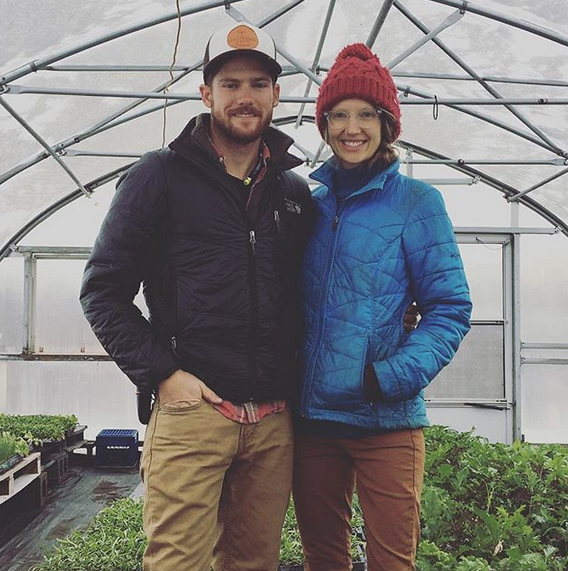
“How big is your farm?” “It’s about 4-by-8.” “Oh, 4-by-8 acres? “No, 4-by-8 feet.” That imaginary conversation sounds like an unlikely discussion between Kansas farmers, but it illustrates how one young couple got their start in urban farming. They started raising microgreens on a 4-by-8 sheet of plywood. Now this innovative young couple is expanding their operation to provide local food while serving their community.
Adam and Maggie Pounds are the founders of Simple Abundance Farm in South Hutchinson, Kansas. Adam grew up at Hutchinson and went to Wichita State. Maggie went to high school at the nearby rural community of Buhler, population 1,289 people. Now, that’s rural. She went on to Bethel College.
Adam and Maggie met through friends and ultimately married. “We caught the travel bug,” Adam said. They worked a summer at Estes Park and then in Key West, Florida doing eco-tourism. Adam and Maggie are also talented musicians, playing guitar and multiple folk instruments. “Maggie sings like an angel,” Adam said.
The young couple traveled and played music. While visiting friends in the Pacific Northwest, they decided to focus on the principles which were important to them: Community, intentional living, healthy food, and an active lifestyle. They apprenticed at an organic farm in Washington state.
“As you’re traveling, you see life through a different lens,” Maggie said. Their passion for a healthy, local food system grew. They moved back to Kansas to put this into practice.
Adam and Maggie Pounds
In winter 2014, they started growing microgreens in South Hutchinson. “Our whole farm consisted of a 4×8 sheet of plywood,” Adam said. Seeds were planted in compost on trays. Plants were harvested very young. “Microgreens are tender, nutty, and tasty,” Adam said. They now have a high tunnel for additional vegetable production.
They produce sunflowers, peas, radishes, arugula, spinach, salad greens, kale, and more. “We use natural and sustainable methods to produce high yields on a minimal amount of land while protecting the environment,” Adam said.
Back when they were still interns but wanting to start a farm of their own, Maggie and Adam were on a farm tour in the northwest. While in one grower’s home, they saw a cross-stitch design on the wall that said “Simply Abundant.” The term clicked for both of them. When they got back to Kansas, they named their place Simple Abundance Farm.
The “farm” is a specialty crop operation on less than an acre in the city of South Hutchinson. “We are urban, so we’re very convenient for our consumers,” Adam said. “The city has been really great to work with us.”
“They’ve been an amazing addition to our Reno County Farmers Market,” said Pam Paulsen, K-State Research and Extension – Reno County horticulture agent. “We are huge advocates of farmers markets,” Adam said. They have also opened what they call the Farm Stand, which is a self-service market for their farm crops and other local products year-round. “Our customers get a key code so they can pick up products at their convenience,” Adam said.
They are now building a commercial kitchen which will enable them to produce shelf-stable products such as sauerkraut and kimchi. They’re also joining the Kansas Department of Agriculture’s “From the Land of Kansas” program.
Meanwhile, they’re caring for their two-year old son Arlo. “We call him quality control, he’s out there in the dirt,” Adam said.
Maggie is president of the newly-formed Central Kansas Young Farmers Coalition. She also recently lobbied for the farm bill with the National Young Farmers Coalition in Washington, D.C.
“We need to support one another, whether a farmer or consumer, to forge a path for local food production,” Maggie said.
How big is your farm? This innovative young couple got a start on a 4-by-8 sheet of plywood. Now they are producing a wide variety of fresh and flavorful produce. We salute Maggie and Adam Pounds – and Arlo too – for making a difference with their approach to urban agriculture. Their farm ground may be small, but their vision is tremendous.
Tuesday Sunny, with a high near 83. Breezy, with a south wind 6 to 11 mph increasing to 15 to 20 mph in the afternoon.
Increased fire risk this week w/Wednesday being the greatest risk with red flag criteria likely with low relative humidity and strong winds. pic.twitter.com/Ekb1EgN76s
Tuesday Night Partly cloudy, with a low around 57. Breezy, with a south southeast wind 17 to 21 mph.
WednesdayA 20 percent chance of showers after 2pm. Mostly sunny, with a high near 80. South southeast wind 8 to 17 mph becoming west in the afternoon.
Wednesday NightA chance of showers and thunderstorms. Mostly cloudy, with a low around 35. Very windy, with a north northwest wind 28 to 30 mph, with gusts as high as 43 mph. Chance of precipitation is 50%.
ThursdayA chance of rain showers before 8am, then a chance of rain and snow showers between 8am and noon, then a chance of rain showers after noon. Cloudy, with a high near 41. Very windy. Chance of precipitation is 50%.
Thursday NightA 20 percent chance of showers before 8pm. Mostly cloudy, with a low around 27. Very windy.