We have a brand new updated website! Click here to check it out!

SCHROCK: Teachers come first

John Richard Schrock is a professor at Emporia State University.

State legislatures nationwide are entertaining an assortment of proposals to require all students to take courses in financial literacy or computer literacy or coding. But in every instance, they fail to ask the most basic question: how can you require a course unless you have an adequate supply of teachers who can teach that course?

Over a decade ago, New York state passed a mandate for all students, beginning in grade 6, to learn a second language and demonstrate communicative proficiency in a language beyond English in order to receive a high school diploma. The rationale was correct, as it remains correct today. The legislation funded new positions to be created and curricula to be developed. It failed completely.

In the March 2, 2011 issue of Education Week, Ann de Bernard described the problem. “The single greatest obstacle to implementing these lofty goals was the inability to locate and hire qualified teachers to help children develop second-language proficiency. There weren’t any.”

For several years, New York struggled to find teachers. Teachers who only spoke English could require students to just read from books in a foreign language; that did not begin to work. You needed teachers fluent in that foreign language. But hiring any person who could speak the language did not work either. Teaching a second language is a teaching skill, and the bilingual person on the street did not automatically have that skill. Nor did New York have enough professors qualified to produce teachers who could develop foreign-language proficiency in students. After a few years of failing to gear up to foreign language teaching, the mandate was abandoned as futile.

But over a decade earlier, another country implemented a nationwide second-language mandate and has today succeeded where the United States failed.

Ascending to power after their disastrous Cultural Revolution, Deng Xiao-ping moved China from communes to a market economy. Russian had previously been the official second-language-to-learn. Now, due to its predominant usage in world trade and science, English would be their new required second language, to be taught from elementary school upward. An English test was also added to the all-important school leaving exam, the gao kao, that determined if and where China’s next generations of students would go to university to study. That focused every student in China on getting the best education in English possible. But where would China get their English teachers?

Since 1993, every year I have flown to China, there have been U.S. college graduates on the plane going to China or returning from China where they have spent a year or more teaching English in China’s high schools and colleges. China likewise has sent English-fluent Chinese students to the United States, several hundred thousand each year over this last decade, to study in all fields. Most now return to take up positions in China’s industries, government, and education system. Come with me on my annual trips to Chinese universities and you can get around quite well on their university campuses speaking just English, because all of their university students and young professors speak English.

English extends down to elementary school. “Number One” urban schools now have excellent Chinese teachers of English. Their rural elementary schools lag behind. Among a population of 1.4 billion, there are more Chinese who speak English in China than there are people in the United States with just over 330 million people. But it took China three decades to build up their educational capacity.

That is where American state legislatures go astray. We want results tomorrow. Educational changes take generations in time. Our average American school curriculum is now the weakest among developed countries. Exchange students come here to find they are several grades ahead of U.S. students. Our students travel overseas and find themselves behind their foreign classmates. Many states have boosted high school science requirements from two years to three, but our students’ science achievement is not increasing because we lack enough qualified science teachers to support our prior weak curriculum.

If we immediately—today—boosted our curriculum in science and foreign language up to developed world status, it would take us 20 to 30 years to train enough teachers to begin producing science literate and world fluent graduates. Instead, we will just buy their future inventions and they can speak English.

John Richard Schrock is a professor at Emporia State University.

Sunny, mild Monday

Monday Sunny, with a high near 63. South southwest wind 7 to 16 mph.

Monday Night Mostly clear, with a low around 35. South wind 9 to 14 mph becoming west northwest after midnight.

TuesdayMostly sunny, with a high near 63. North northwest wind 7 to 10 mph becoming east southeast in the afternoon.

Tuesday NightMostly cloudy, with a low around 44. East wind 11 to 13 mph.

WednesdayA chance of showers between 2pm and 5pm, then a chance of showers and thunderstorms after 5pm. Partly sunny, with a high near 64. Breezy. Chance of precipitation is 30%.

Wednesday NightA chance of showers and thunderstorms. Mostly cloudy, with a low around 41. Chance of precipitation is 50%.

ThursdayA 30 percent chance of showers before 8am. Partly sunny, with a high near 60.

Thursday NightMostly clear, with a low around 40.

2 hospitalized after van goes airborne on I-70

THOMAS COUNTY —Two people were injured in an accident just after 12:30p.m. Sunday in Thomas County.

The Kansas Highway Patrol reported a 2013 Nissan NV driven by Laura Michelle Bergstraser-Lorenz, 32, Franktown, CO., was westbound on Interstate 70 just west of U.S. 83.

The van left the roadway to the left, struck a median turn around, went airborne and continued through the median until it came to rest facing westbound.

Bergstraser-Lorenz and a passenger Janet Ann Kaufmann, 61, Colorado Springs, Co., were transported to the Logan County Hospital. Both were properly restrained at the time of the accident, according to the KHP.

W. Kansas students among new Rudd Scholars at FHSU

By DIANE GASPER-O’BRIEN
FHSU University Relations and Marketing

Each speaker at Tuesday’s Rudd Foundation presentation at Fort Hays State University talked about grit, determination and a strong work ethic.

Those traits are the cornerstone on which the Rudd Scholarship Program was formed, and they are ones that the scholarship selection committee feels Rudd Scholars should possess.

The Rudd Foundation believes that Fort Hays State University also possesses those characteristics. Therefore, FHSU is one of three state universities chosen for Rudd Scholars to attend “because they represent the Midwestern values of grit, determination and work ethic,” said Peter Najera, president of the Rudd Foundation.

At a reception in the Robbins Center, the five new Rudd Scholars who will be attending Fort Hays State next fall were recognized.

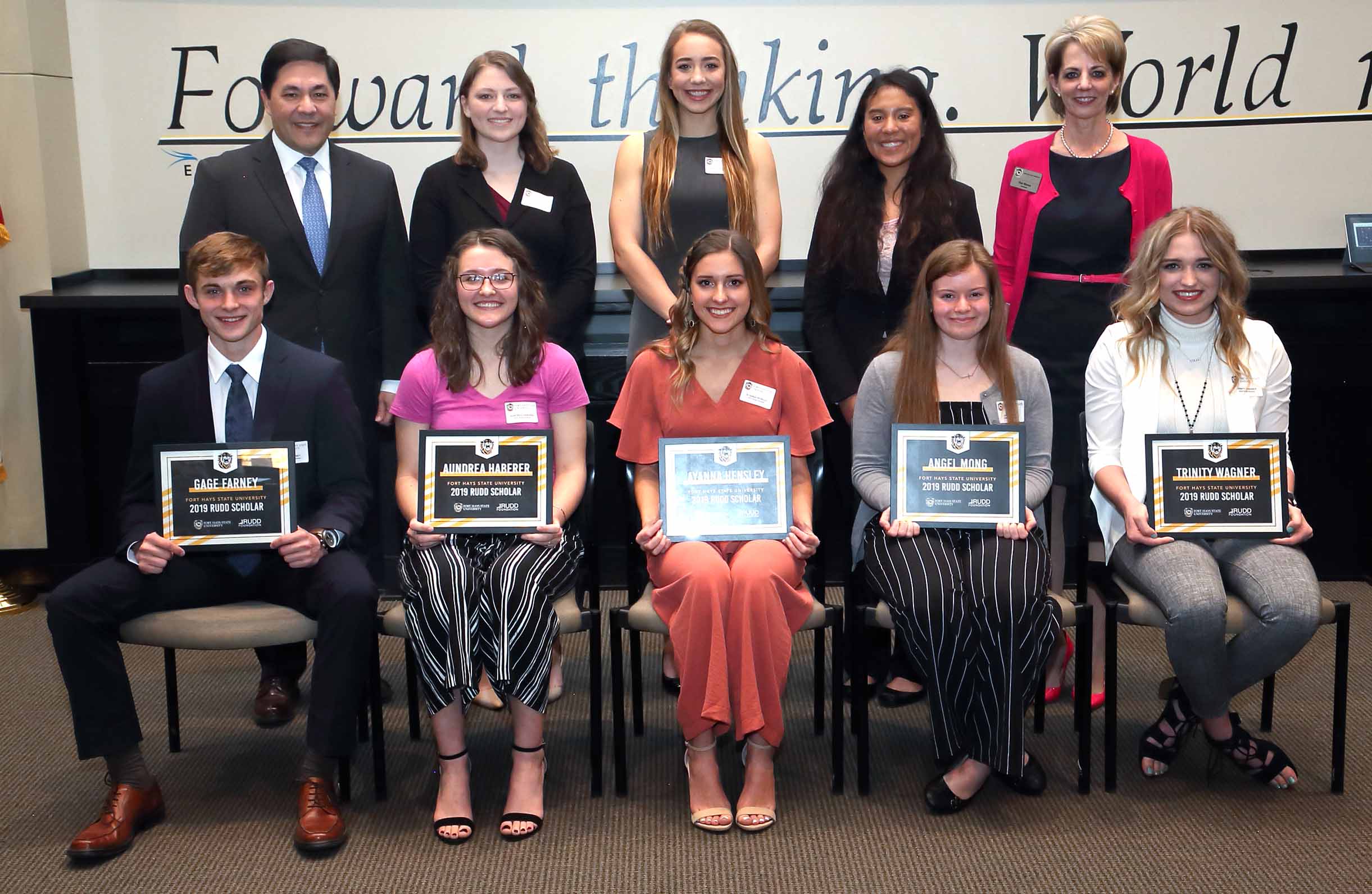
Members of the first two classes of Rudd Scholars at Fort Hays State University are: Back row, from left, Rudd Foundation President Peter Najera, entrance class of 2018 Danica Kostner, Cydney Bergmann and Meleny Jacome-Banuelos, and FHSU President Dr. Tisa Mason; front row, from left, entrance class of 2019 Gage Farney, Aundrea Haberer, Ayanna Hensley, Angel Mong and Trinity Wagner. (Photo by Mitch Weber)

Nearly 900 students from around the state were among this year’s list of applicants, from which only 25 were chosen. Five will attend Emporia State University, and the remaining 15 will enroll at Wichita State University, the alma mater of the late Leslie Rudd, a Wichita native.

Rudd was an entrepreneur and philanthropist who founded the Rudd Group, a privately owned portfolio of luxury businesses and established the Rudd Foundation in 1998. Through the foundation, the Rudd Scholarship was started “to help students for whom the the financial burden of higher education made its attainment nearly impossible,” he wrote in a letter to potential Rudd Scholars before he died in 2018.

The four-year scholarship is open to Kansas students who qualify for a Pell Grant. It covers any remaining cost of attendance after all other aid, grants and scholarships are applied to a student’s account. The expected value for the 25 members of the second class of Rudd Scholars is $1.4 million over four years. More information about the program can be found at ruddfoundation.org.

“Kansas high schools continue to produce very talented young men and women imbued with the Midwestern values, and we are excited to make an investment in them through a college education,” Najera said. “These 25 recipients, in addition to the 19 previously selected, brings us to a total of 44 Rudd Scholars in college who will continue to support each other as they are groomed to strengthen the talent pipeline here in Kansas upon graduation.”

The scholarship is earned through a competitive selection process that requires grades, test scores, essays, letters of recommendation. The 50 semifinalists then go through a personal interview as well.

One of the new Rudd Scholars is Aundrea Haberer from Sylvan-Lucas Unified High School, who plans to major in agronomy. She will be the third member of her family attending FHSU. Her older sister, Elaia Haberer Garrett, graduated in 2017, and heir mother, Rhonda Haberer, also is a Tiger alum.

Haberer visited other colleges but said she “really liked the feel of the campus” at Fort Hays State.

The three members of the first class of Rudd Scholars at Fort Hays State attended the reception.

Meleny Jacome-Banuelos from Johnson welcomed the incoming class to “our family.”

“From this moment forward, we three individuals are here to support you,” she said. “The hardest things in life are usually the best things for you, and we are here to offer any kind of help or support.”

She told the newcomers they will “get to work with the people and get to know more people who want to be successful. We can all learn from each other. I am looking forward to them coming to campus. I will get some leadership experience.”

Current Rudd Scholars talked about the numerous advantages of the Rudd Scholarship, other than the financial piece of it.

“I was extremely grateful for this, not just for the financial aspect of it but for the networking angle, too,” said Cydney Bergmann from Concordia, a pre-veterinarian major.

Bergmann was considering other colleges as well as Fort Hays State when she heard of the Rudd Scholarship.

Bergmann had received enough academic scholarships to cover expenses for the first year of college but was unsure of future years. Plus, she knew vet school would be more schooling – and additional expense.

“This scholarship has made a huge impact, because I don’t have the financial burden and can focus on my classes,” she said. “I didn’t want to be in debt twice.”

Some of the requirements for Rudd Scholars are to live on campus, take an active part in organizations and pursue leadership opportunities. They also must graduate in four years.

Jacome-Banuelos is a first-generation student majoring in organizational leadership. She said she already has been positively impacted during her first year.

“This scholarship has really helped me connect with people in my field,” Jacome-Banuelos said. “Building connections has been really helpful.”

“This scholarship strives to find the brightest Kansas minds – those who have that grit, integrity, and drive to succeed – and empower those students with the resources to achieve their goals,” said Dr. Tisa Mason, FHSU president. “At Fort Hays State, we are thrilled to provide innovative educational opportunities, vibrant learning communities, state-of-the-art technology, world-class internships and unparalleled opportunities for experiential learning inside and out of the classroom – and all at the most affordable tuition rate in the Kansas and the region.”

Najera said he is pleased with the first two classes and looks forward to adding more and more in years to come.

“In just two more years, we will have nearly 100 Rudd Scholars on campus learning from one another,” Najera said. “And in a few years after that, they will all be networking with one another throughout the state as they continue on their trajectory of being positive contributors to our Kansas communities and society as a whole.”

Each of the new scholars talked a bit, thanking the foundation for this opportunity and had their picture taken with Najera and Mason. They got to learn a little about the welcoming culture of Fort Hays State as administrators, faculty and staff joined the new scholars and their families at their tables.

Haberer already has bought into the FHSU campus spirit.

After thanking the Rudd Foundation “for this amazing offer,” she finished her talk with “Go Tigers!”

The list of the second class of Rudd Scholars at FHSU (for the 2019-20 school year), listed by hometown, name, high school and major:

BELOIT (67420): Trinity Wagner, Beloit High School, biology.
DODGE CITY (67801): Ayanna Hensley, Dodge City High School, radiology.
GRAINFIELD (67737): Angel Mong, Wheatland/Grinnell High School, elementary education.
LURAY (67649): Aundrea Haberer, Sylvan-Lucas Unified High School, agronomy.
STERLING (67579): Gage Farney, Sterling High School, construction management.

Current Rudd Scholars at FHSU, from the first class of 2018-19, listed by hometown, name and major:

CONCORDIA (66901): Cydney Bergmann, pre-veterinary medicine.
JOHNSON (67855): Meleny Jacome-Banuelos, organizational leadership.
KINGMAN (67068): Danica Kostner, biology.

Cutline:

🎥 Eagle Communications fundraising for NE flood relief adds GoFundMe and donation match

HAYS POST

Eagle Communications is collecting monetary donations at its Kansas radio stations for victims of the recent catastrophic flooding in Nebraska.

A GoFundMe account is now available for online donations.

Hays-area residents wishing to make a contribution may bring cash or checks to the Eagle Media Center, 2300 Hall Street, Hays. Checks should be made out to the Nebraska Red Cross.

Donations will be collected through Thu., April 4.

The Robert E. & Patricia A. Schmidt Family Foundation, Hays, will be matching our Nebraska Flood Relief donations up to $25,000. Bob Schmidt was the founder and CEO of Eagle Communications.

The Hays contributions will be combined with those collected by our Eagle Radio stations in Great Bend, Salina, Hutchinson, Manhattan and Junction City. The final amount will then be matched by the Schmidt Family Foundation  and will be distributed to the Nebraska Red Cross.

For more information, contact the Hays Eagle Media Center at 785-301-2211.

Disclosure: Eagle Communications is the parent company of Hays Post.

BOOR: Proper timing for crabgrass preventers
 

Crabgrass preventers are another name for pre-emergence herbicides 
that prevent crabgrass seeds from developing into mature plants. Many 
people have a somewhat foggy idea of how they work and assume they kill 
the weed seed.

Such is not the case. They do not kill the seed or even 
keep the seed from germinating but rather kill the young plant after it 
germinates.  Therefore, they do not prevent germination but prevent 
emergence.

Crabgrass preventers are just that – preventers. With few 
exceptions they have no effect on existing crabgrass plants, so they 
must be applied before germination. Additionally, preventers do not last 
forever once applied to the soil.  Microorganisms and natural processes 
begin to gradually break them down soon after they are applied. If some 
products are applied too early, they may have lost much of their 
strength by the time they are needed. Most crabgrass preventers are 
fairly ineffective after about 60 days, but there is considerable 
variation among products. (Dimension and Barricade last longer. See below.)

For most of Kansas, crabgrass typically begins to germinate around 
May 1 or a little later. April 15 is normally a good target date for 
applying preventer because it gives active ingredients time to evenly 
disperse in the soil before crabgrass germination starts.  Even better, 
base timing on the bloom of ornamental plants. The Eastern Redbud tree 
is a good choice for this purpose. When the trees in your area approach 
full bloom, apply crabgrass preventer. A follow-up application will be 
needed about 8 weeks later unless you are using Dimension or Barricade. 
Products that do require a follow-up application include pendimethalin 
(Scotts Halts) and Team (Hi-Yield Crabgrass Control).

Dimension and Barricade are the only two products that give 
season-long control of crabgrass from a single application. In fact, 
they can be applied much earlier than April 15 and still have sufficient 
residual strength to last the season. Barricade can even be applied in 
the fall for crabgrass control the next season.

Dimension can be applied as early as March 1. Because of the added 
flexibility in timing, these products are favorites of lawn care 
companies who have many customers to service in the spring. Though 
Dimension is usually not applied as early as Barricade, it is the 
herbicide of choice if it must be applied later than recommended. It is 
the exception to the rule that pre-emergence herbicides do not kill 
existing weeds. Dimension can kill crabgrass as long as it is young 
(two- to three-leaf stage). Dimension is also the best choice if 
treating a lawn that was planted late last fall. Normally a pre-emergence 
herbicide is not recommended unless the lawn has been mowed two to four 
times.

But Dimension is kind to young tall fescue, perennial ryegrass, 
and Kentucky bluegrass seedlings and some formulations can be applied as 
early as two weeks after the first sign of germination. However, read 
the label of the specific product you wish to use to ensure that this 
use is allowed. Lawns established in the fall can be safely treated with 
Dimension the following spring even if they have not been mowed.

Alicia Boor is an Agriculture and Natural Resources agent in the Cottonwood District (which includes Barton and Ellis counties) for K-State Research and Extension. You can contact her by e-mail at [email protected] or calling 620-793-1910.

Volunteering at Kansas Special Olympics event a rewarding experience for FHSU students

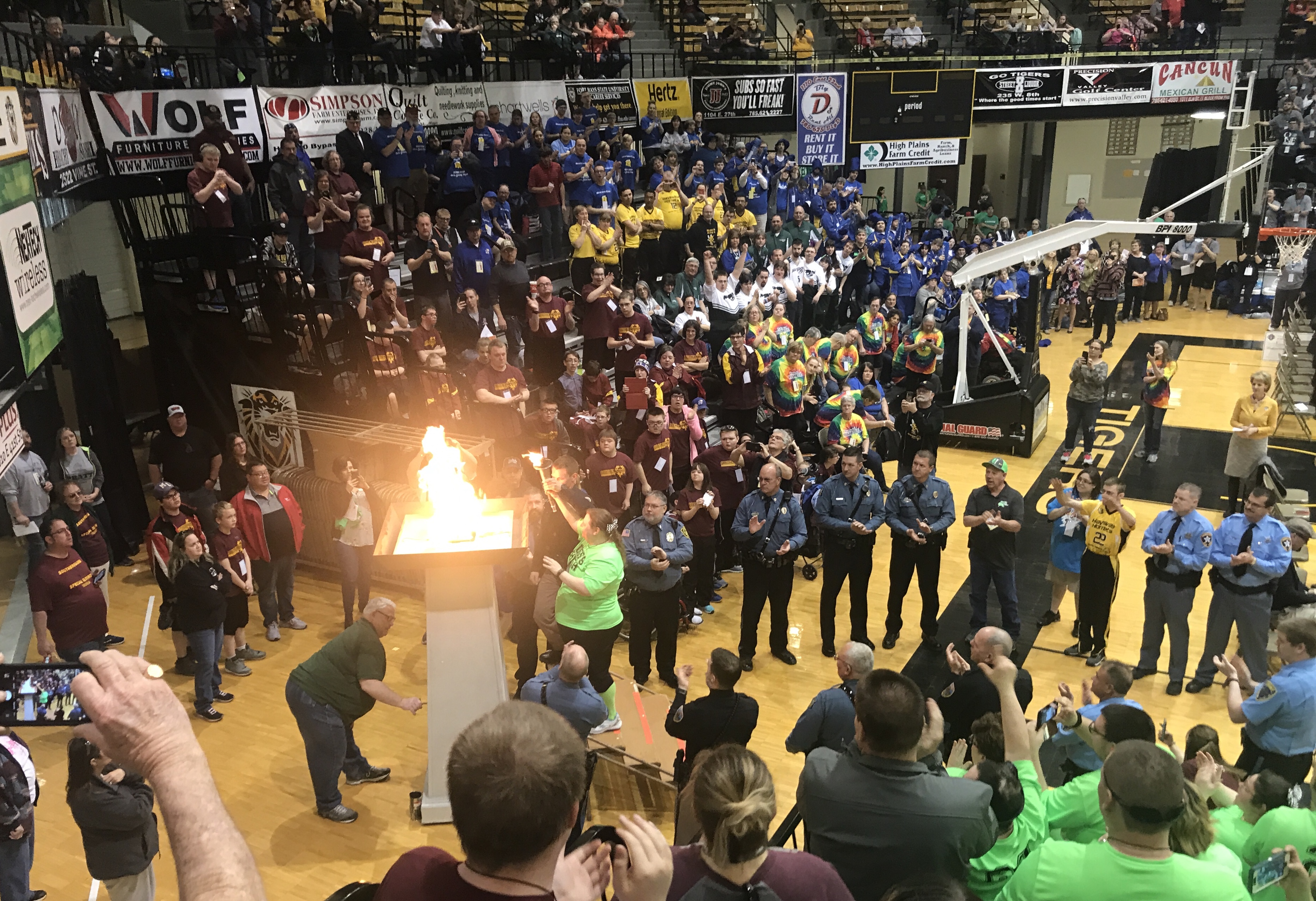
Special Olympics Opening Ceremony 2019 (Courtesy Hays Convention and Visitors Bureau)

By DIANE GASPER-O’BRIEN
FHSU University Relations and Marketing

Alysha Werth and Chloe Brown have belonged to the same church while attending college but weren’t all that acquainted with each other until recently. The two Fort Hays State University students got to know each other a little better last weekend.

They signed up to volunteer at the Special Olympics Kansas Basketball and Cheerleading Tournament in Hays, and they were assigned to work together at the scorers’ table in one of the Cunningham Hall gyms.

By the conclusion of the two-day tournament, Werth and Brown realized they had more in common than they might have thought, specifically their desire to give of their time.

Werth, a senior elementary education major from Ellis, and Brown, a senior organizational leadership major from Ottawa, both were drawn to the Special Olympics event after volunteering for two years at Night to Shine, a prom for people with special needs.

“The first year at Night to Shine, every time I saw a special needs person, they made me smile,” said Werth, who is adding a minor in special education to her resume. “So when I saw this opportunity to volunteer, I decided to sign up. I am so glad I did. This was so rewarding.”

Special Olympics Kansas is a volunteer-driven organization that features a year-round program of athletic training, health education and competition to more than 5,400 athletes.

The state basketball/cheerleading tournament is held at two different sites, in Hays and Topeka. The Hays tourney, which this year featured about 600 athletes and more than 200 coaches, relies on hundreds of volunteers to help facilitate.

“We know the volunteer base is there in Hays and that we can count on some college students for help,” said Tim Rehder, senior vice president of programs for Kansas Special Olympics, who is in charge of all the state competitions.

Hays has hosted the state basketball and cheerleading tournament for four decades, and about 250 people volunteer to help out each year, including 50 to 75 FHSU students.

“That’s a good feeling, knowing we can more or less run the tournament with students there,” Rehder said.

Werth said she empathized with the Special Olympians. It was quite an undertaking for some to score a basket, no matter how hard they tried.

After graduating from Ellis High School in 2014, Werth decided to stay close to home and attend Fort Hays State.

A first-generation college student, Werth said she was unfamiliar with the ins and outs of making college life a successful venture. She struggled to keep up with her classes, so she took a few semesters off.

“Being the first one in my family who went to college, I didn’t have anyone to help me figure it all out,” she said. “I realized I needed to reach out for help, and FHSU was there all the way. The instructors I have in my classes are amazing and want us to be excited to teach.”

Brown said watching so many Special Olympic games over the weekend “brought everything into perspective.”

“A person can take so many things for granted,” she said. “We always had the opportunity to play on basketball teams growing up. For the special needs people, it’s more difficult.”

“But,” she added, “they are so joyful just to be able to play. Whenever they made a shot, it was the best thing ever.”

Like Werth, Brown changed majors before she found the right fit.

“I had a passion for service and helping others,” Brown said, “so I went into social work at first. But I quickly realized that wasn’t for me.”

Brown found her niche in organizational leadership and plans to work for a non-profit organization that works with special needs citizens when she graduates in 2020.

However, unlike Werth, Brown had tradition on her side when it came to continuing her education after high school. Both Brown’s parents and an older brother all attended college, all in eastern Kansas.

She decided to break that tradition, however, when she decided to attend college on the other side of the state.

“My mom said, ‘You will know when you get there if that’s the right school for you,’ ” Brown said of her college visits her senior year in high school.

Brown visited two other state universities before coming to Hays.

“I remember sitting in the orientation here, and I was looking around, and I felt so comfortable,” she said. “Everywhere we went around the campus that day, I could see myself there the next few years.”

“My mom was right,” Brown continued. “I knew, I had that feeling that Fort Hays State was the right place for me.”

Brown said she is unsure of whether or not she will stay in western Kansas or go closer to home when she graduates in 2020, but wherever she ends up, she will take some valuable lessons with her.

“My professors are always talking about how we should apply what we are learning to what we do when we get out of college,” she said. “It’s basic career preparation, and it’s made a huge impact on me.”

FHSU students made a similar impact on the 2019 Special Olympics event in Hays.

“The fact that students will carve out time, the fact that they consider this important enough to help out, is flattering to us,” he said. “The support we get from Hays, especially the college, is phenomenal. They don’t charge us a dime to come in there and host this event.”

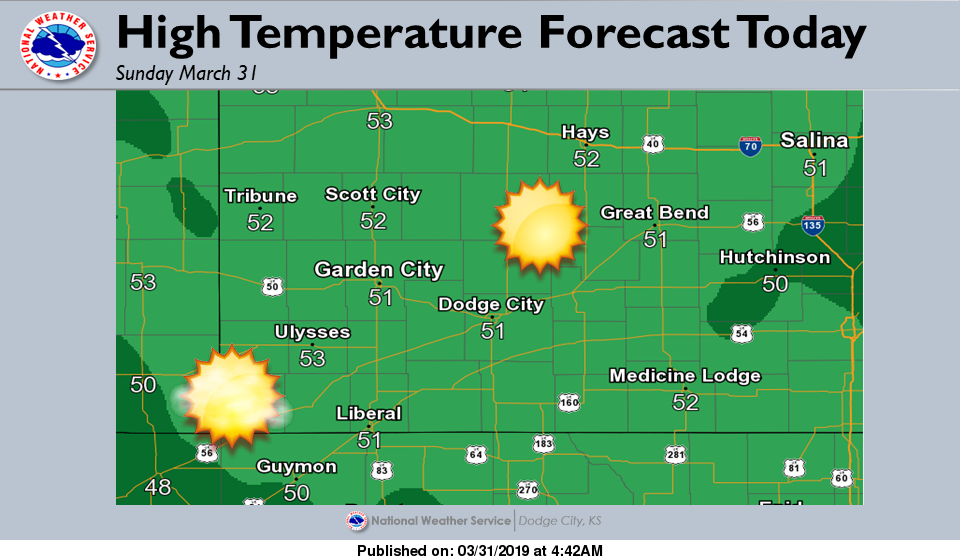
Sunny, mild Sunday

Today
Sunny, with a high near 51. West northwest wind 5 to 9 mph becoming southwest in the afternoon.
Tonight
Mostly clear, with a low around 31. South southwest wind around 7 mph.
Monday
Sunny, with a high near 61. South southwest wind 6 to 14 mph.
Monday Night
Partly cloudy, with a low around 35. South southwest wind 8 to 10 mph becoming north northwest after midnight.
Tuesday
Mostly sunny, with a high near 61. North wind 7 to 11 mph becoming east southeast in the afternoon.
Tuesday Night
Mostly cloudy, with a low around 44.
Wednesday
Scattered showers after 1pm. Partly sunny, with a high near 64. Chance of precipitation is 30%.
Wednesday Night
Showers likely and possibly a thunderstorm before 1am, then isolated showers. Mostly cloudy, with a low around 41. Chance of precipitation is 60%. New rainfall amounts of less than a tenth of an inch, except higher amounts possible in thunderstorms.
Thursday
Partly sunny, with a high near 60.

Aspiring nurse, USD 489 counselor named Best of the Best

By CRISTINA JANNEY
Hays Post

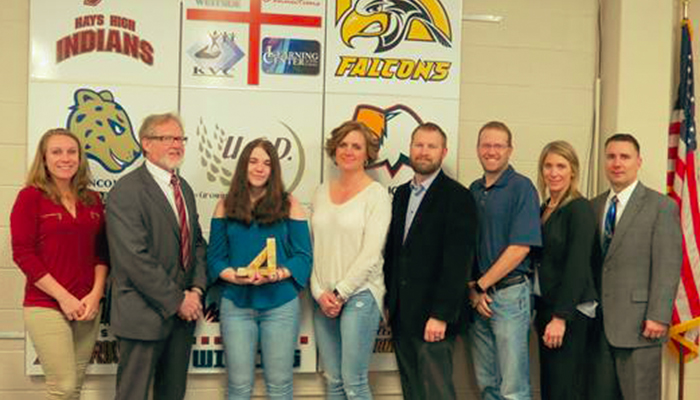
Rhiannon Cummin, was nominated as the March’s student Best of the Best by teacher Sondra Hickert.

Rhiannon Cummin, Learning Center student, is pursuing a dream to be a registered nurse by the time she is 20. 

She was nominated as the March’s student Best of the Best by teacher Sondra Hickert.

“I often stand before the board of education at Learning Center graduations to emphasize the things that students overcome to graduate,” Hickert said. “Whether it is illness, loss of a family member or some other life issue, we like to accentuate the challenges that the graduates had to overcome. But tonight I introduce you to Rhiannon Cummin who is a student who couldn’t overcome.

“She couldn’t overcome her passionate desire to become a nurse at the earliest age possible. Rhiannon came to us less than a year ago, telling me she wanted to be a nurse. She wanted the option of working at her own pace because she is determined to be a working RN by the age of 20.”

She drives into Hays each day to attend the Learning Center. She pays for her own gas, earned from a part-time job she works in between her studies.

Hickert said Cummin has applied herself like no other student, completing her core courses for both her junior and senior years since August. 

“She is a friend to every student who walks in the lab,” Hickert said.

By May Cummin will have completed 17 hours of concurrent college credit.

“She has traded working the drive-thru for answering call lights at her hometown nursing facility as a certified nurse aide,” Hickert said.

Cummin is poised to enter nursing school three months after graduating with her class in May 2020.

“Society, not just the health care industry, is fortunate to have a citizen like Rhiannon Cummin who is forging her future industriously and compassionately,” she said.

Eva Junk, Lincoln and Roosevelt counselor, was nominated by peers at Roosevelt for the staff Best of the Best award.

Eva Junk, Lincoln and Roosevelt counselor, was nominated by peers at Roosevelt for the staff Best of the Best award. Roosevelt Principal Paula Rice spoke on her behalf at Monday’s school board meeting.

“Eva is just one of those who goes above and beyond,” Rice said.

“Too many times in education, staff members are asked to take on additional duties to help fill in the gaps to continue to provide the best for students,” Rice said. “Our fantastic staff steps up and does this because of our love for our students.

“One shining example of this is our school counselor Eva Junk, who every year is asked to take on more and more roles and responsibilities. These roles and responsibilities are accepted by Eva with a nod of the head and a smile on her face and a ‘yes’ all the while continuing to excel in every aspect of her core performance. This is what sets her head and shoulders above so many others.”

Junk is responsible for more than 650 students and families. Rice said having responsibilities between two buildings pulls her in many directions each day. She visits classrooms, teaches lessons, sponsors two student councils, checks in weekly and daily with students who need counseling, and eats lunch with students.

Junk also has taken an active role in building leadership at both schools.

“Despite being surrounded by daily stressors, enough to make most people want to give up,” Rice said, “Eva continues to be a compassionate, listening ear for all who are in need to help shape our building into the happy, comforting and joyful place that it is. Eva deserves more than a modest pat on the back. For indeed, she is the Best of the Best.”

WAYMASTER: From the Dome to Home March 30

Rep. Troy Waymaster, R-Bunker Hill, 109th Dist.

Budget Bill Passes the House

On Tuesday, March 26, we had final action on the Kansas House of Representative’s position regarding the budget. The final vote on the budget was 99-25, and now we will go into conference committee with the Senate to negotiate those details that differ between each chamber’s budget bill.

House Substitute for Senate Bill 25, which is the House Budget Bill, contains numerous provisions in it. It includes the annual bill that we pass regarding claims against the state, many of the recommendations from various state agencies, departments, and boards across the state, and some recommendations made by Governor Kelly.

Following are some of the highlights in the budget bill for the remaining months of fiscal year 2019 and for 2020.

  • We are not going to payoff the Pooled Money Investment Board loan in full, as suggested by the Governor. Instead, we will accelerate the payment schedule so it is paid off more quickly.
  • We will appropriate dollars for the hiring of 26 social workers in 2019 and an additional 26 social workers in 2020.
  • We did provide funding in 2020 through the Department of Agriculture for the Cattle Traceability Program, money for the State Water Fund, additional funds for mental health, reestablishing funding for the Kansas Main Street program for rural development, and a 2.5% pay increase for all state employees, excluding legislators and the Judicial Branch. We have another provision for pay increases for the Judicial Branch in the budget bill.

Commercial Hemp

Also on Tuesday, final action was taken on House Bill 2173, the commercial hemp bill, which passed 119-5. I voted “yes.” Due to the federal government making provisions in the Federal Farm Bill that passed in December of 2018, the state of Kansas needs to update our statutes regarding hemp that we passed last year for the industrial research program. House Bill 2173 establishes procedures to be used by the Kansas Department of Agriculture in submitting a plan to the US Department of Agriculture under which the KDA would monitor and regulate the commercial production of hemp. This bill also stipulates that industrial hemp authorized by the Alternative Crop Act would be excluded from the definition of marijuana and the list of Schedule 1 controlled substances.

Senate Bill 16 – House Education Finance Bill

Among the 33 bills debated in the House of Representatives on Monday was House Substitute for Senate Bill 16. The bill, which is the House’s position for addressing the Supreme Court’s demands regarding K-12 Education, received lengthy deliberation and was passed in the House, 63-61, on Tuesday morning. While there was little to no funding provisions in the bill it does address how funding should be spent.

The bill provides for performance and longitudinal achievement reports, goals in meeting the Rose standards, accessibility for ACT testing, adding computer science and financial literacy courses, a bullying prevention hotline, changes the bilingual weighting to seven years, and adds the dyslexia task force for another two years, among other changes.

Although the bill provides only policy provisions, and has some flaws which I disagree with, it does create a House position from where we can negotiate with the Senate and start a discussion, which was why I voted in favor of the bill. Then we will see the final version to address education finance.

Contact Information

As always, if you have any concerns, feel free to contact me (785) 296-7672, follow on twitter at @waymaster4house, visit www.troywaymaster.com or email me at [email protected]. Also, if you happen to visit the statehouse, please let my office know.

It is a distinct honor to serve as your representative for the 109th Kansas House District and the state of Kansas. Please do not hesitate to contact me with your thoughts, concerns, and questions. I always appreciate hearing from the residents of the 109th House District and others from the state of Kansas, as well.

Troy Waymaster (R-Bunker Hill) is the 109th Dist. state representative and chairman of the House Appropriations committee. The 109th District includes Osborne, Russell, and Smith counties and portions of  Barton, Jewell, Lincoln and Rush counties.

Battle of the Brews: Win Brews on the Bricks tickets!

Stop in at Kaiser Liquor and purchase these four different brews available in singles…then vote for your favorite at HaysPost.com. At the end of four weeks, somebody is going to win a pair of tickets to Brews on the Bricks.

This week’s singles are:

Boulevard Tank 7
Martin City Abbey Ale
New Belgium Abbey
Great Divide Colette Farmhouse Ale

It is your chance to purchase just a single bottle or can and not the whole six pack. Who knows? You might find a new favorite.

Battle of the Brews at Kaiser Liquor…your chance to buy these unique beers in singles this week at Kaiser Liquor!

Copyright Eagle Radio | FCC Public Files | EEO Public File