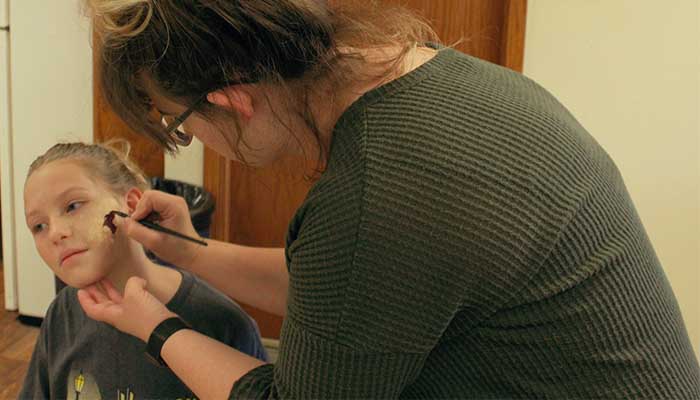
Taylor McClung applies zombie makeup to her sister Chloe McClung, 13, during the Makey Makey Monday at the Ellis Public Library. Chloe plans to dress as 11 from “Stranger Things” for Halloween this year.
By CRISTINA JANNEY
Hays Post
Chloe McClung, 13, in her Zombie makeup.
ELLIS — Makeup Artist Taylor McClung visited the Ellis Public Library on Monday to give kids tips on creating monster makeup during its regular Makey Makey Monday event.
McClung, a cosmologist at Body and Soul, said she taught herself to create realistic-looking wounds and scary zombie makeup by watching YouTube videos and practicing on her younger sisters.
McClung and the kids laid down a base using tissue paper and latex makeup. Flesh-tone base was added to the latex and tissue layer to mimic skin.
They made tears in the latex/tissue layer and added dark red makeup to make the areas appear like wounds. Some of the participants also added oatmeal for more texture.
Makey Makey Monday is a new program at the Ellis Public Library. The sessions, which are aimed at children, have been focused on art or science. Some other events have included a Model Make ‘N’ Take and robot art.
The next Makey Makey Monday will be in November and be Lego themed. A date has not yet been set.
Elijah Wagoner, 7, paints zombie makeup on his arm on Monday. He said he plans to be a skeleton Grim Reaper for Halloween.Amethyst Moses, 8, Ogallah, dabs latex on her mother Brenda’s hand during Makey Makey Monday at the EPL on Monday.Steve Arthur, EPL librarian, paints zombie makeup on his hand on Monday.
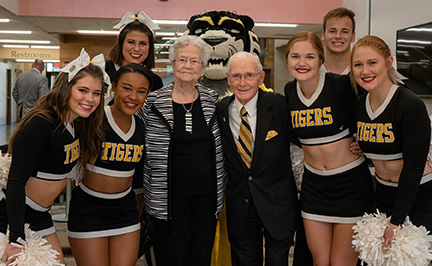
Don and Chris Bickle with Tiger cheerleaders and Victor E. Tiger at a reception in their honor announcing their latest $1 million gift to Fort Hays State.
By HAYLEY BIEKER FHSU Foundation
Don and Chris Bickle have long been known for their philanthropy and support of Fort Hays State University. A reception earlier this week in FHSU’s Center for Applied Technology celebrated the couples latest $1 million commitment to the university.
The majority of their gift will support Tiger Athletics, which will continue to propel FHSU’s student-athletes and programs to success. The remainder of their gift will support:
• The Robbins College of Business and Entrepreneurship
• The Robotics program within FHSU’s Department of Applied Technology
• Their lifetime support of Fort Hays State University’s Alumni Association
• FHSU President Tisa Mason in support of her strategic plan for the university
Their gift to the president’s strategic initiatives fund will help fuel the success of FHSU’s strategic plan for years to come
“We are here to honor Don and Chris Bickle – some of our most loyal and generous supporters to Fort Hays State University,” said Jason Williby, president and CEO of the FHSU Foundation. “I want to express our humble gratitude for their loyalty and commitment, but also for their ongoing support and encouragement, which permeates throughout our community.”
“You’ve supported Tiger Athletics in many ways over many years,” added Curtis Hammeke, director of FHSU Athletics. “From the indoor training facility, which has meant so much to all of us, to the new video board, and your scholarship support. I could go on.”
“As you know, we feel it’s important to not just have nice facilities, or facilities that are as good as others, but we strive to have facilities that are even better,” said Hammeke. “Recruiting is the livelihood of our athletic program, and our facilities make a great difference in that recruitment process. I feel that this all leads back to making Hays the special community that it is, and Fort Hays State the special university that it is.”
“I’m so very grateful for this opportunity to recognize the ongoing support of Don and Chris,” said Dr. Melissa Hunsicker Walburn, interim dean of the W.R. and Yvonne Robbins College of Business and Entrepreneurship.
“Sometimes we are challenged as educators to ask ourselves: ‘Why do we do what we do? What is our why?,’ ” she said. “For many of us, our answer is to fuel the passions of the next generation – their curiosities, their imagination and their desire to explore the world around them. There’s no doubt that this support from Don and Chris will create many, many opportunities, which would otherwise not be accessible to a great deal of FHSU students.”
“Today,” she continued, “I thank Don and Chris most specifically for their continued support of experiential world travel and the learning opportunities that would remain ideas and dreams rather than actual plane tickets and detailed itineraries. Thank you for your support of student travel, and for allowing our students the opportunity to learn from other cultures.”
Cody Escritt, a graduate student from Nebraska, spoke on behalf of FHSU’s robotics program.
“I’ve worked a lot with the robotics program here at Fort Hays State – throughout my undergraduate program in manufacturing and now in my graduate program as I’m taking a course in advanced education through instructional technology,” he said. “I know I would not be where I’m today without our robotics, without our phenomenal instructors and without your support. It’s very important for students, like myself, to have this robot, this up-to-date technology, and to learn what it will be like in the field upon graduation.”
“I’m here today to represent the Fort Hays State University Alumni Association,” said Mike Koerner, vice president of the Alumni Association Board of Directors.
“We want to thank you for the many ways you’ve helped our mission of developing positive life-long relationships between the university and our alumni, faculty, staff, friends and students,” he said. “FHSU’s alumni events just wouldn’t be the same without you running up and down the aisles singing the university’s unofficial anthem ‘In Heaven There is No Beer.’”
In typical Don Bickle fashion, he concluded the celebratory reception by leading the FHSU pep band, cheerleaders and mascot, Victor E. Tiger, in the university’s unofficial anthem and fight song. Before long, the full crowd had joined Don in clapping and singing along.
Join Don and Chris Bickle in supporting the area(s) of campus that mean the most to you by visiting https://foundation.fhsu.edu/donate.
To learn more, visit https://foundation.fhsu.edu or contact the FHSU Foundation at 785-628-5620 or [email protected].
Webster Reservoir is no longer on a KDHE Watch/Warning list for blue-green algae.
KDHE
TOPEKA – The Kansas Department of Health and Environment (KDHE), in conjunction with the Kansas Department of Wildlife, Parks and Tourism (KDWPT), has issued public health advisories for Kansas lakes.
Warnings:
Jerry Ivey Pond, Saline County
Lake Jeanette, Leavenworth County
Lakewood Park Lake, Saline County (unchanged)
Lifted Warnings 10/24:
Central Park Lake, Shawnee County
Yates Center Kids’ Fishing Pond, Woodson County
When a warning is issued, KDHE recommends the following precautions be taken:
Lake water is not safe to drink for pets or livestock.
Lake water, regardless of blue-green algae status, should never be consumed by humans.
Water contact should be avoided.
Fish may be eaten if they are rinsed with clean water and only the fillet portion is consumed, while all other parts are discarded.
Do not allow pets to eat dried algae.
If lake water contacts skin, wash with clean water as soon as possible.
Avoid areas of visible algae accumulation.
Watches:
Gathering Pond near Milford (Hatchery Supply Pond), Geary County
South Lake, Johnson County
Lifted Watches 10/24:
Carousel Lake (Gage Park), Shawnee County
Lake Afton, Sedgwick County
Rock Garden Pond (Gage Park), Shawnee County
Webster Reservoir, Rooks County
A watch means that blue-green algae have been detected and a harmful algal bloom is present or likely to develop. People are encouraged to avoid areas of algae accumulation and keep pets and livestock away from the water.
During the watch status, KDHE recommends the following precautions be taken:
Signage will be posted at all public access locations
Water may be unsafe for humans/animals
Avoid areas of algae accumulation and do not let people/pets eat dried algae or drink contaminated water.
Swimming, wading, skiing, and jet skiing are discouraged near visible blooms
Boating and fishing are safe. However, inhalation of the spray may affect some individuals. Avoid direct contact with water, and wash with clean water after any contact.
Clean fish well with potable water and eat fillet portion only.
KDHE samples publicly-accessible bodies of water for blue-green algae when the agency receives reports of potential algae blooms in Kansas lakes. Based on sampling results, KDHE reports on potentially harmful conditions.
Kansans should be aware that blooms are unpredictable. They can develop rapidly and may float around the lake, requiring visitors to exercise their best judgment. If there is scum, a paint-like surface or the water is bright green, avoid contact and keep pets away. These are indications that a harmful bloom may be present. Pet owners should be aware that animals that swim in or drink water affected by a harmful algal bloom or eat dried algae along the shore may become seriously ill or die.
TOPEKA — A top Republican in the Kansas Senate said he’s designed a Medicaid expansion plan that aims to walk a fine line — one that can win over conservatives without losing support from moderate Republicans and Democrats.
But the proposal also risks satisfying neither faction.
Republican Senate Majority Leader Jim Denning outlined a proposal this week that would grow the Medicaid health care plan to cover an added 150,000 or so low-income Kansans.
His strategy includes a mix of policies inspired by ideas from Republicans and Democrats. But the plan also adds in the private insurance market, with the goal of stabilizing the federal health care exchange in Kansas where people without Medicaid buy private coverage.
The would-be bill passed an initial hurdle Wednesday. A special Senate committee recommended the plan get further study during the coming legislative session that kicks off in January.
Denning said the ultimate goal is securing health care coverage for as many Kansans as possible.
“There’s things to like about it on both sides of the fence,” Denning said.
Sen. Jim Denning (left) speaking to a legislative staff member Wednesday. Credit Stephen Koranda / Kansas News Service
It comes after years of wrangling over the issue. Supporters have failed to overcome opposition from leadership in the past. Coming into this session, some Republican leaders said they’re going to work on the topic.
To try to attract Democrats and moderate Republicans, the bill would expand health coverage. But it doesn’t take the simple path Democrats have pushed for of expanding Medicaid to cover people with incomes up to 138 percent of the federal poverty level.
Many of the new people covered would go into the regular Medicaid health care program. But the bill would also use private insurance for some low-income Kansans.
It would leverage $50 million in tobacco and vaping taxes to make plans sold through the federal health care exchange — established through the Affordable Care Act, or Obamacare — more generous and affordable. That’s intended to draw more people to that market.
Doing that could help stabilize costs on the health care exchange, Denning hopes.
“The exchange is in a death spiral,” Denning said, “and if we can leave those patients there and bring in new patients, we can probably save it.”
The blueprint would also require some people to pay 5 percent of their household income in premiums. If they fall too far behind, they’d be locked out of Medicaid coverage for six months.
Some conservative lawmakers want work requirements to be part of any expansion plan. Denning’s bill doesn’t include strict work rules, but people working fewer than 20 hours per week would be referred to a state program aimed at connecting them to jobs.
“Let’s find out why they’re not working and see if we can get them working,” Denning said.
That’s a good compromise to Republican Sen. Molly Baumgardner, who likes that it can inform unemployed people about services they might not know exist.
Baumgardner doesn’t support strict work requirements because she’s concerned it might create problems for people like single mothers, who may have to leave children in unsafe conditions or in unlicensed child care to meet a work requirement.
“What we see far too often is when a single mom is trying to work and care for children, that’s when the problems occur,” Baumgardner said.
Other Republicans would like a requirement insisting that at least some of the people getting health care through Medicaid get employment.
“If you don’t have children and you have an able body, I’d like to see effort for work,” Republican Sen. Ty Masterson said.
Masterson said the lack of stronger works rules and concerns over the cost mean he’s not backing the bill.
Expanding Medicaid would cost over $1 billion per year. Federal taxpayers would cover 90 percent of that, state money would pay for the rest. New fees on health care providers would help cover the cost under Denning’s plan.
The bill faces opposition from some Democrats. Adding private insurance into the plan adds additional complications, and Senate Minority Leader Anthony Hensley said that will lead to delays if the federal government doesn’t approve it.
Hensley wants to vote on a bill that simply expands Medicaid without adding other issues like private insurance.
“That ought to be the first step,” Hensley said. “That ought to be the only step that this Legislature passes this session.”
Denning’s bill includes a fail-safe. If the federal government doesn’t approve the private insurance proposals, the bill directs the state to submit a Medicaid plan without them.
Democratic Gov. Laura Kelly urged lawmakers last month not to over-complicate Medicaid expansion. She didn’t give Denning’s plan a warm reception.
“We don’t need to create extra bureaucratic red tape, raise taxes, and create more hurdles to access to health care,” Kelly said in a statement.
Advocates for Medicaid expansion are still digesting all the details in Denning’s proposal, but they’re feeling upbeat that lawmakers who previously opposed expansion are now bringing forward ideas.
“It looks like this is a good-faith effort,” said April Holman, executive director of the group Alliance for a Healthy Kansas. “We’re encouraged that we’re seeing this conversation happen.”
Stephen Koranda is Statehouse reporter for Kansas Public Radio and the Kansas News Service, a collaboration of KCUR, Kansas Public Radio, KMUW and High Plains Public Radio covering health, education and politics. Follow him on Twitter@kprkoranda or email [email protected].
Patrick R. Miller is an Assistant Professor of Political Science at the University of Kansas.
Kansas faces a prison crisis of crowded facilities and escalating costs to taxpayers. Fixing that requires addressing mental health, and the grim reality that our approach to the mentally ill is often to imprison them.
In fairness, America has evolved on this issue. Historically, states often forced the mentally ill—especially the poor—into state-run institutions where they faced involuntary sterilization. In Kansas, from 1913 to 1961, the state sterilized over 3,000 individuals, mostly with mental illnesses.
In the 1960’s, states started to deinstitutionalize the mentally ill, shifting the care burden to families, nursing homes, or other community-based settings. But states often failed to follow through on promises to fund these alternatives. This meant that more people with mental illness lacked access to adequate care, which often resulted in homelessness and incarceration.
As the state mental health apparatus withered in Kansas, the burden of care shifted to local communities that varied in their ability to meet that challenge. In many communities, county jails became the default mental health providers, and law enforcement officers increasingly became first responders to mental health crises.
Kansas also started imprisoning more people with mental illness. In 2018, the Kansas Department of Corrections reported that 33 percent of the nearly 10,000 inmates in state prisons were diagnosed with serious to severe mental illnesses, and 65 percent had some degree of mental illness. By comparison, the department reported that in 2006 only 38% of inmates were mentally ill.
Compounding that problem, experts show that mentally ill offenders are more likely to receive extended sentences and other punishments in prison due to behavioral incidents, and many return post-release because of incidents explicitly related to their illnesses.
Kansas also faces the challenge that companies contracted to provide prison services have often failed to meet contractual obligations. Local media reported earlier in 2019 that Corizon Health, which the Brownback administration hired to provide health services in Kansas prisons, had failed to provide adequate staffing and medication to cover mental health needs of prisoners.
Are there solutions?
First, Kansas has a patchwork of mental health services—and strong mental health advocates—that can help address the issue. Those providers need policy and financial support from local, state, and federal policymakers.
Second, some Kansas communities have trained law enforcement on defusing mental health crises. But how many do this and the effectiveness of that training is uncertain.
Third, as some politicians recognize, prison alternatives merit consideration. Other states have explored criminal justice reforms such as mental health courts, pretrial diversions that emphasize supervision and treatment over prosecution, and expanding services for offenders post-release to avoid reentry. Adapting those reforms to Kansas is worth exploring.
Fourth, some states have started reverting privatized prison services back to state functions. Some states have found that implementing services like mental health care effectively themselves is cheaper than contracting with corporations that require additional oversight, and that may botch program implementation in ways that increase state costs.
Yes, this costs money. But, the system now incurs great costs and sets many mentally ill Kansans up to fail. For both politicians and citizens, it is often easier to say that we care about mental illness, but harder to act on that financially. If we had cared financially decades ago, today’s prisons might not be leading mental health providers.
Patrick R. Miller is an Associate Professor of Political Science at the University of Kansas.
CHEYENNE COUNTY — One person was injured in an accident just after 9:30p.m Thursday in Cheyenne County.
The Kansas Highway Patrol reported a 2004 Land Rover driven by Lorie L. Wood, 56, Johnstown, CO., was southbound on Kansas 27 sixteen miles north of U.S. 36.
The vehicle blew a tire on the rear trailer, rolled and came to a rest in the northbound lane on its side.
A northbound Lincoln LS driven by Irene R. White, 80, Haigler, NE., hit an animal running from the Land Rover after it rolled. The Lincoln stopped in time to avoid collision with the Land Rover.
EMS transported Wood to the Cheyenne County Hospital. White was not injured. Both drivers were properly restrained, according to the KHP.
Dr. Janet Stramel, associate professor of teacher education, received a grant from the National Science Foundation to work with former FHSU Noyce Scholars who now teach. In Fort Hays State’s efforts to serve rural Kansans, this grant provides training to rural Kansas teachers of middle-to-high school students to teach how mathematics and science is applied to real-world experiences.
The grant, High Flying Math and Science, included a day of project-based learning (PBL) training for teachers during the spring semester 2019.
Dr. Sarah Broman Miller, assistant professor of teacher education, provided the training.
Ten former FHSU Noyce Scholars, now Teacher Leaders in their schools, participated in the training and toured the National Weather Service in Dodge City to see the community connections of mathematics and science.
A follow-up to that training was a PBL project with their own students, culminating in the launch of a high-altitude balloon. Middle and high school students prepared a payload of sensors, cilantro seeds, sea-monkey eggs, and a GoPro camera in order to collect data to analyze so that students could see the connections among mathematics, science, and the real world.
Katie Flax, a science teacher at Trego Community High School, WaKeeney engaged her high school students in a PBL lesson with a balloon launch on Sept. 16.
Science teachers Julie Weber, Wamego Middle School, and Thomas Broxterman, Royal Valley High School, Hoit, collaborated on a joint PBL with their students. Their balloon launch was at Wamego Middle School on Oct. 1.
The Hays Symphony will present a Children’s Halloween Concert Sunday, October 27, 2019, 2:30 pm in the Fort Hays State University Beach Schmidt Performing Arts Center with pre-concert activities starting at 1:30 pm. More information on the Hays Symphony’s Facebook Page. Conductor Dr. Brian Buckstead visited the KHAZ Studio to talk about the concert with Theresa Trapp…
MANHATTAN — The Kansas Department of Agriculture has announced that vesicular stomatitis virus (VSV) was confirmed in horses in Sherman County on October 23, 2019. Kansas becomes the eighth state in the U.S. to have confirmed cases of VSV this year.
The infected horses all reside on the same premises, which is a private residence, and no animal movement has occurred on or off that premises for more than three weeks. KDA has quarantined the livestock on the affected premises, and there is no known exposure to other animals.
“Protecting the health and safety of horses and other livestock in Kansas is our highest priority,” said Dr. Justin Smith, Animal Health Commissioner. “We encourage all livestock owners to be aware and follow best practices to limit exposure to insects. We also advise owners to take extra precautions with animals that may be comingling with other animals.”
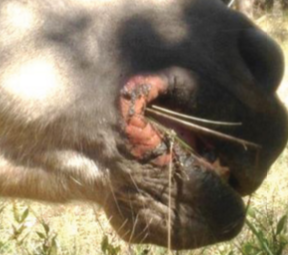
VSV is a viral disease which primarily affects horses, but can also affect cattle, sheep, goats, swine, llamas and alpacas. The disease is characterized by fever and the formation of blister-like lesions in the mouth and on the dental pad, tongue, lips, nostrils, ears, hooves and teats. Infected animals may refuse to eat and drink, which can lead to weight loss. Vesicular stomatitis can be painful for infected animals and costly to their owners. Humans can also become infected with the disease when handling affected animals, and can develop flu-like symptoms.
The primary way the virus is transmitted is from biting insects like black flies, sand flies and midges. Owners should institute aggressive measures to reduce flies and other insects where animals are housed. VSV can also be spread by nose-to-nose contact between animals. The virus itself usually runs its course in five to seven days, and it can take up to an additional seven days for the infected animal to recover from the symptoms. Premises with animals diagnosed with VSV are quarantined until at least 14 days after the last affected animal is diagnosed. There are no USDA-approved vaccines for VSV.
VSV is considered a reportable disease in Kansas. Any person who suspects their animals may have VSV should contact their local veterinarian or state animal health official.
When VSV was confirmed in neighboring states this summer, KDA implemented increased importation requirements from the affected regions to help prevent the spread of VSV into Kansas. Because of the confirmed case in Kansas, other states are likely to increase restrictions on livestock imports. Animal health officials strongly encourage all livestock owners and veterinarians to call the animal health authority in the destination state for the most current import requirements prior to travel.
For more information about VSV, including documents outlining symptoms, fly control practices, and current situation reports, visit the KDA website at www.agriculture.ks.gov/VSV. If you have specific questions or are seeing suspicious lesions on your animals, contact the KDA Division of Animal Health at 785-564-6601.