We have a brand new updated website! Click here to check it out!

BOWERS: Senate Scene Week 6

36th Dist. Sen. Elaine Bowers (R-Concordia)

SENATE HIGHLIGHTS

Last week marked the sixth week of session with the first half of the legislative session almost behind us.  As we approach “turn-around” the Senate held floor debate on Tuesday and Wednesday and worked bills which were sent out of committees to the full Senate.  The bills voted on by the full Senate now cross over to the House of Representatives where the process starts over.  Conference committees will meet to iron out the differences between the Senate and House versions before the 2019 session ends in May.  

FLOOR ACTION

EXPIRATION DATE OF RISK-BASED CAPITAL INSTRUCTIONS – SB 28 will change the date specified in the Insurance Code for risk-based capital (RBC) instructions.

EXEMPTING CERTAIN DOMESTIC INSURERS FROM FILING ENTERPRISE RISK REPORTS –SB 66 will modify registration requirements in the Insurance Holding Company Act related to filing exemptions for enterprise risk reports.

M DRIVER’S LICENSES OPERATING UNDER TEMPORARY PERMIT – SB 17 will remove an exception for motorcycles operated with a temporary registration permit from requirement for each operator of a motor vehicle in Kansas to hold a license classified for the operation of the motor vehicle.

CLAIMS AGAINST THE STATE – SB 25 will authorize expenditures of $82,886 in FY 2019 to pay claims against the State of Kansas.

APPROACH OF AN EMERGENCY VEHICLE – SB 40 will remove language requiring a law enforcement officer to issue a warning citation from, and after, the effective date of the act, and prior to July 1, 2001. This is for provisions requiring a driver to move into a nonadjacent lane or, if changing lanes is not possible or unsafe, proceed with due caution upon approaching an authorized emergency vehicle or police vehicle using flashing or hazard warning lights.

SEAT BELT USE IN TRAFFIC INFRACTIONSB 41 will amend the Uniform Act Regulating Traffic to specify the violation of law that requires seat belt use by occupants ages 14 and older in passenger cars or autocycles. This will now be considered a traffic infraction.

KANSAS FARM BUREAU MEMBER HEALTH CARE BENEFITS – SB 32 will allow the Kansas Farm Bureau to establish a health care benefit that offers coverage specifically for Farm Bureau members in Kansas. Senate Bill 32 aims to reduce the number of uninsured Kansans by creating competition and free-market options for health care. Senate Bill 32 is the Farm Bureau’s solution to addressing the critical need for KFB members to find affordable health care coverage. A recent study pointed out that 65 percent of agriculture producers view health care as the number one threat to the future of their operation. 

KANSAS REAL ID LICENSE

Passed by Congress in 2005, the REAL ID Act enacted the 9/11 Commission’s recommendation that the Federal Government “set standards for the issuance of sources of identification, such as driver’s licenses.” Starting October 1, 2020, every state and territory resident will need to present a REAL ID compliant license/ID, or another acceptable form of identification, for accessing Federal facilities, entering nuclear power plants, and boarding commercial aircraft.  This is called “card-based” enforcement.  The card, itself, must be REAL ID compliant unless the resident is using an alternative acceptable document such as a passport.  The card that is Real ID compliant will feature a gold circle with a star cut out symbol printed in the top third of the card on the front right side.  Real IDs are optional and Kansas residents can choose between either Real ID card or a Nonreal ID card and there are no changes to fees for Kansas cards.  In order to receive a Real ID card, a proof of lawful presence is required such as a birth certificate, unexpired US passport or naturalization certificate.  Also required is a social security card, current W-2 or 1099 or current pay stub showing full social security number.  Proof of Kansas residency is required by several means including a rent or lease agreement, renewal postcard, vehicle registration, utility bill or financial institution documents such as a bank statement, deed or mortgage.  More information can be found at https://www.ksrevenue.org/dovrealid.html.  You can order certified vital records like birth certificates at https://www.kdheks.gov/vital/birth.html. 

TOUR THE STATE CAPITOL FROM HOME

Take an online tour of the magnificent Kansas State Capitol, floor by floor at  https://www.kshs.org/p/kansas-state-capitol-online-tour/15843.  The classically inspired building is an impressive public monument as well as the working offices for the governor and legislators. The building holds a dramatic array of art, architecture, and colorful Kansas history. The building hours are 8 a.m. – 5 p.m. Monday – Friday, and now open 10 a.m. – 4 p.m. on Saturdays.  

FROM THE STATE LIBRARY

Research for Kids

The State Library has online interactive eBooks, storybooks, and puzzles for children.  These resources encourage new and reluctant readers to develop a love for reading. BookFLIX (PreK to third grade) pairs children’s video storybooks with related nonfiction titles. TumbleBooks offers animated talking picture books and read-along chapter books that improve sight word recognition. Britannica E-Stax (PreK to 5th grade) features nonfiction that can be downloaded to any Internet enabled device. https://kslib.info/kids.  If the page above asks for a Kansas Library eCard number, you may get one at any library in Kansas.  Most people will be automatically recognized as inside Kansas and will not need this step.   Questions: [email protected] or 785-296-3296.

VISITORS FROM SENATE DISTRICT #36

The sixth week of session was another busy week with visitors to the Kansas legislature. Three hundred plus 4-Hers from across Kansas held their mock Legislative session in the House Chamber on Sunday evening and then met us for lunch on Monday in the Capitol.  Mental Health Centers, Kansas Association of Conservation Districts and students and staff of the Kansas After School program were in the Capitol for their annual visit and receptions.

I always encourage you to stay informed of the issues under consideration by the Kansas Legislature. Committee schedules, bills, and other helpful information can be easily accessed through the legislature’s website at www.kslegislature.org. You are also able to ‘listen in live’ at this website.  The House meets at 11:00AM and the Senate at 2:30PM.  Please do not hesitate to contact me with your thoughts, concerns, and suggestions. An email is the best at this point in the session.

Thank you for the honor of serving you!

Senator Elaine Bowers
Kansas State Capitol Building
Room 223-E
300 SW 10th St.
Topeka, KS  66612
[email protected]
785-296-7389
www.kslegislature.org

Elaine Bowers, R-Concordia, is the 36th Dist. state senator and serves as the Senate Majority Whip. The 36th Senate District includes Cloud, Jewell, Lincoln, Mitchell, Osborne, Ottawa, Republic, Rooks, Russell, Smith and Washington counties and portions of Marshall and Phillips counties.
REMINDER: City switches to new notification system Friday

CITY OF HAYS

The city of Hays has implemented a new website!

Please visit haysusa.com to browse and explore all of the new content including an expanded home page with current news and project information.

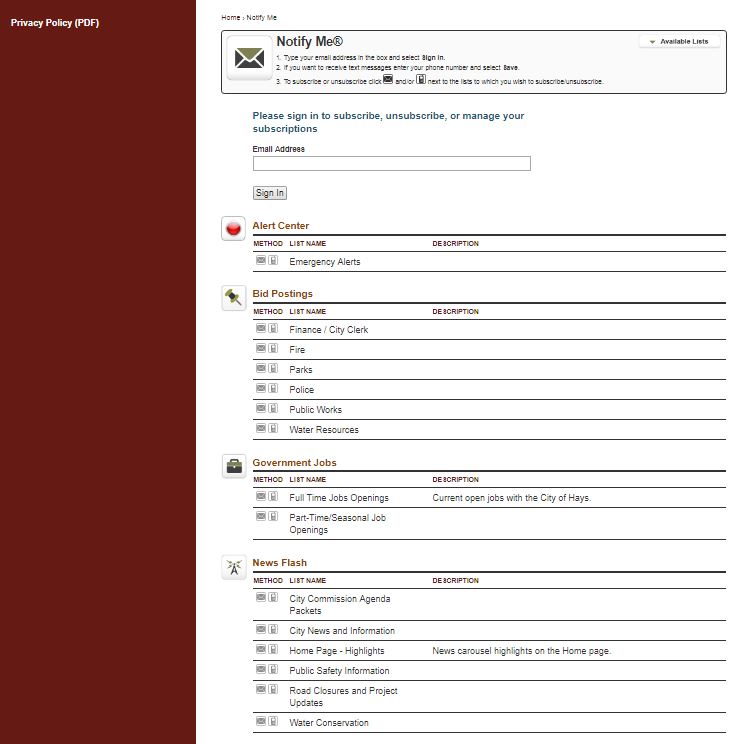
The new website also has a “Notify Me” feature that will soon replace these Nixle notifications. The Notify Me sign-up page can be found on our home page under “How Do I” and then “Sign Up For”, “Notifications / Notify Me”. From there you can sign up for email or text messages to notify you on topics of your choice.

The current Nixle notifications will no longer be used starting March 1st, so we invite you to sign up for Notify Me soon!

Hays USD 489 school board questions need for touchscreens

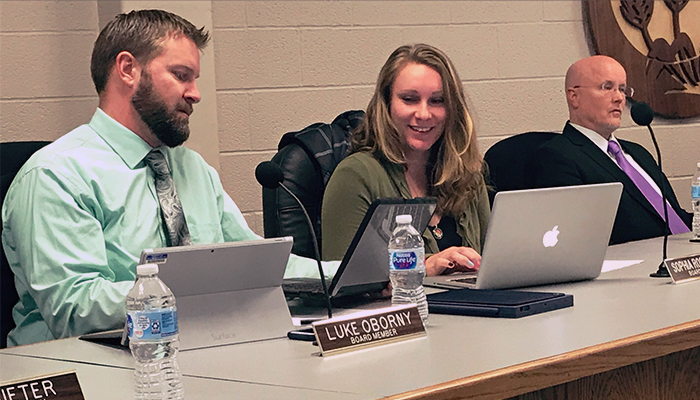
Hays USD 489 school board members Luke Oborny and Sophia Rose Young inspect an iPad and Chromebook at the board’s meeting Monday night. The board is considering purchasing new computers for Hays Middle School.

By CRISTINA JANNEY
Hays Post

Some Hays USD 489 school board members are questioning the need for touchscreens as a feature on computers for the Hays Middle School students.

The board was set to vote on the replacement of 680 computers at HMS at its meeting on Monday. The purchase is part of a four-year rotation of computer buying for the district.

The district technology committee looked at three different devices for the HMS students.

These included replacing the school’s iPads with new iPads. Over four years, the computers would cost $254,320, which is less than the $290,000 the district budgeted for replacement.

Chromebooks with the same capabilities would cost $317,612 with a significantly lower resale value at the end of four years. A Windows device was significantly above budget at a cost of $344,071.

If the district bought iPads, the technology committee planned on not buying new devices for teachers. The district also would not have to pay for professional learning time if it stayed with the iPads.

The technology committee conducted a study this fall on the use of Chromebooks at HMS, in an elementary classroom and at the Learning Center. After the study, the committee concluded the iPads better met the learning needs of the district’s students.

Members of the board still questioned if the iPads were the correct purchase for the district.

Board member Paul Adams said, “I am interested, and the other board members are, in the reasons touch is such a vital need.”

Adams wanted to know what touchscreens were being used for besides annotation while reading.

“It’s not what you want; it’s what you are using,” he said.

Nineteen HMS teachers out of 32 indicated in a survey PDF annotation was important to students mastering learning objectives.

Board member Luke Oborny suggested staff email teachers to gather more information about how the touchscreens are being used in their classrooms.

Scott Summers, technology director, said teachers provide worksheets to students via their tablets, and they use the touchscreen to write with a stylus or draw with their finger to complete those assignments. The teachers then use the touchscreens to grade the worksheets.

Superintendent John Thissen also said during an Eagle Morning Show interview Tuesday, teachers use a variety of free educational game apps that are touchscreen based.

The technology committee checked with other similar-sized schools to see what type of devices they were using.

Board member Lance Bickle noted 15 of 23 of the schools were using Chromebooks.

“If there was a big price discrepancy or a difference in there … We are not the only district that struggles with cost. I’m just curious of what they are doing differently that we are not seeing,” he said.

Bickle added, “At the end of the day, I am merely looking at this from a cost standpoint. That is the biggest part I have struggled with, especially seeing this list. I know that most of these other districts are not using touch. I am just trying to see how they are getting around it. I am sure there are advantages and pros and cons each way. I don’t know what those are.”

Bickle also questioned if district needed video editing software on all of the devices in the school. The editing software is included on the iPads but would have to purchased for the Chromebooks.

Board member Greg Schwartz said he thought the district is spending too much from the capital outlay budget on technology.

“In the time we have started the one-to-one initiative at the high school to now, I think we have spent probably between $15 to $20 million on technology. All of it is coming out of the capital outlay fund. The next item on our agenda is to look at the bond issue. If I am right and it is $20 million, that’s an elementary school.

“You could have had an elementary school that is still here and around as we are seeing most of our stuff last three years and it is worth between $10 and $60. It really has zero value. There were educational uses for that, and hopefully the students learned and got some benefits back out of that, but I am still waiting for that study that definitively shows our investment in technology is paying back dividends.”

Schwartz also questioned if other districts were paying for their technology out of capital outlay.

The board is set to reconsider the computer purchase at its March 25 meeting.

Most CWD deer tested in Kansas are in northwest area

KDWP

PRATT – In a continuing effort to monitor the prevalence and spread of chronic wasting disease (CWD) in Kansas deer, the Kansas Department of Wildlife, Parks and Tourism (KDWPT) has collected and tested samples from 360 deer so far this year. Thirty-seven of those samples were confirmed positive. The targeted region for sampling deer taken by hunters this year was southwestern Kansas. However, sick or suspect deer observed in other parts of the state were also tested, and KDWPT recommends that hunters who take deer in counties where CWD is known to occur have their deer tested, as well.

The 37 confirmed positives came from deer taken in Cheyenne, Rawlins, Decatur, Norton, Phillips, Smith, Thomas, Sheridan, Gove, Rooks, Osborne, Scott, Lane, Hamilton, Haskell, Hodgeman, Ford, Edwards, Stafford, Reno, and Pratt counties. While most positives are still coming from northwest Kansas, new counties were added to the list this year, including several that show the disease’s spread to the south and east ­– Haskell, Edwards, Pratt, Osborne, and Reno.

Testing History

CWD infects members of the deer family, including whitetail and mule deer, elk and moose. CWD testing in Kansas began in 1996 to help track the occurrence of the disease in the state’s wild deer, and more than 28,000 tissue samples have undergone lab analysis since. The first CWD occurrence documented in a wild Kansas deer was a whitetail doe killed by a hunter in 2005 in Cheyenne County. To date, 216 deer have tested positive, and most have occurred in a region that includes Decatur, Rawlins, Sheridan and Norton counties.

Current Research

Although research about the disease is ongoing, currently there is no cure, vaccine or other biological method of preventing CWD. And while recent news has reported a potential vaccine based on research that indicated the disease may be caused by spiroplasma bacteria, attempts to duplicate that research have been unsuccessful, and many CWD researchers remain skeptical of the findings. Currently, the only tool to prevent the spread of CWD is to restrict the transport of deer and deer carcasses, especially from areas where it is known to occur. Once the infective particle (a mis-folded protein called a prion) is deposited into the environment – either through an infected carcass or from a live animal – it may exist for decades or more, capable of infecting a healthy deer.

While CWD is always fatal to infected deer and elk, humans have never been known to contract the disease. CWD is a member of the group of diseases called transmissible spongiform encephalopathies (TSEs). Other diseases in this group include scrapie in sheep and goats, bovine spongiform encephalopathy (BSE or mad cow disease) in cattle, and Creutzfeldt-Jakob disease in humans.

The Disease

CWD is a progressive, fatal disease that results in small holes developing in the brain, giving it a sponge-like appearance under the microscope. While deer may carry the disease for up to two years without showing any outward signs, in latter stages a deer may exhibit decreased brain function and display a droopy head, staggering, loss of appetite, and a lack of response to people. It is advised that hunters who take deer from areas where CWD has been found have their deer tested whether or not they exhibited any symptoms. KDWPT staff ask that any sick deer or elk observed with symptoms listed above be reported to the nearest KDWPT office or the KDWPT Emporia Research and Survey Office, 620-342-0658.

Hunters can help protect the health of the Kansas deer herd and slow CWD’s spread by properly disposing of deer carcass waste. The best way is to bone the deer out in the field, taking only the meat, antlers with skullcap and hide. Online electronic check-in is available to allow hunters to transport boned out deer taken with whitetail antlerless permits. If this is not possible, dispose of carcass waste by double-bagging it and taking it to a landfill. Landowners can also bury carcass waste on their own property.

The Chronic Wasting Disease Alliance, www.cwd.info.org, maintains an online clearinghouse of information about the disease. More information is also available at www.ksoutdoors.com.

Letter: Contact legislators on water plan funding

The media reports that many fiscal issues confront Governor Laura Kelly and the 2019 Legislature.  An unreported vital issue is funding of the Kansas Water Plan (KWP).

For Fiscal Year 2019, the Governor recommends a State General Fund (SGF) Transfer of $2.75 million and an Economic Development Initiative (EDIF) Transfer of $0.5 million, totaling $3.25 million for the Kansas Water Plan. This amount is woefully inadequate.

I respectfully request Kansans to ask their legislators to take the following actions with respect to the KWP in Fiscal Year 2020 and thereafter:

  • To fully restore the $6 million State General Fund Transfer and $2 million Economic Development Initiatives Fund Demand Transfer, totaling $8 million in Fiscal Year 2020 and thereafter.
  • To fully recover the denied SGF Transfers and EDIF Demand transfers totaling over $77 million since their statutory establishment by the Legislature in 1989.
  • To support the dedication of 1/10 of 1 percent of state sales tax revenue to provide a more adequate, reliable, and long-term financial support of the Kansas Water Plan.
  • To support a required super majority vote, for example 80 percent, of the Legislature to transfer monies from the KWP to non-KWP purposes.

The “2019 Kansas Water Authority Annual Report to the Governor and Legislature” contains useful information. For example, pages 12 and 13 show in feet the 2017-2018 groundwater level changes and the years remaining until 0% reservoir storage occurs.

It also shows past year’s progress in meeting the challenges, which is appreciated. But much more and faster progress is needed to resolve challenges. Kansans can access the “Report” by typing “Kansas Water Office” in the search box of their computers.

Kansans are continuing to lose their surface and ground waters. They can reverse these trends by asking their legislators to take the above actions.

Allyn O. Lockner,

Topeka

Update: Firefighters battle blaze in commercial building

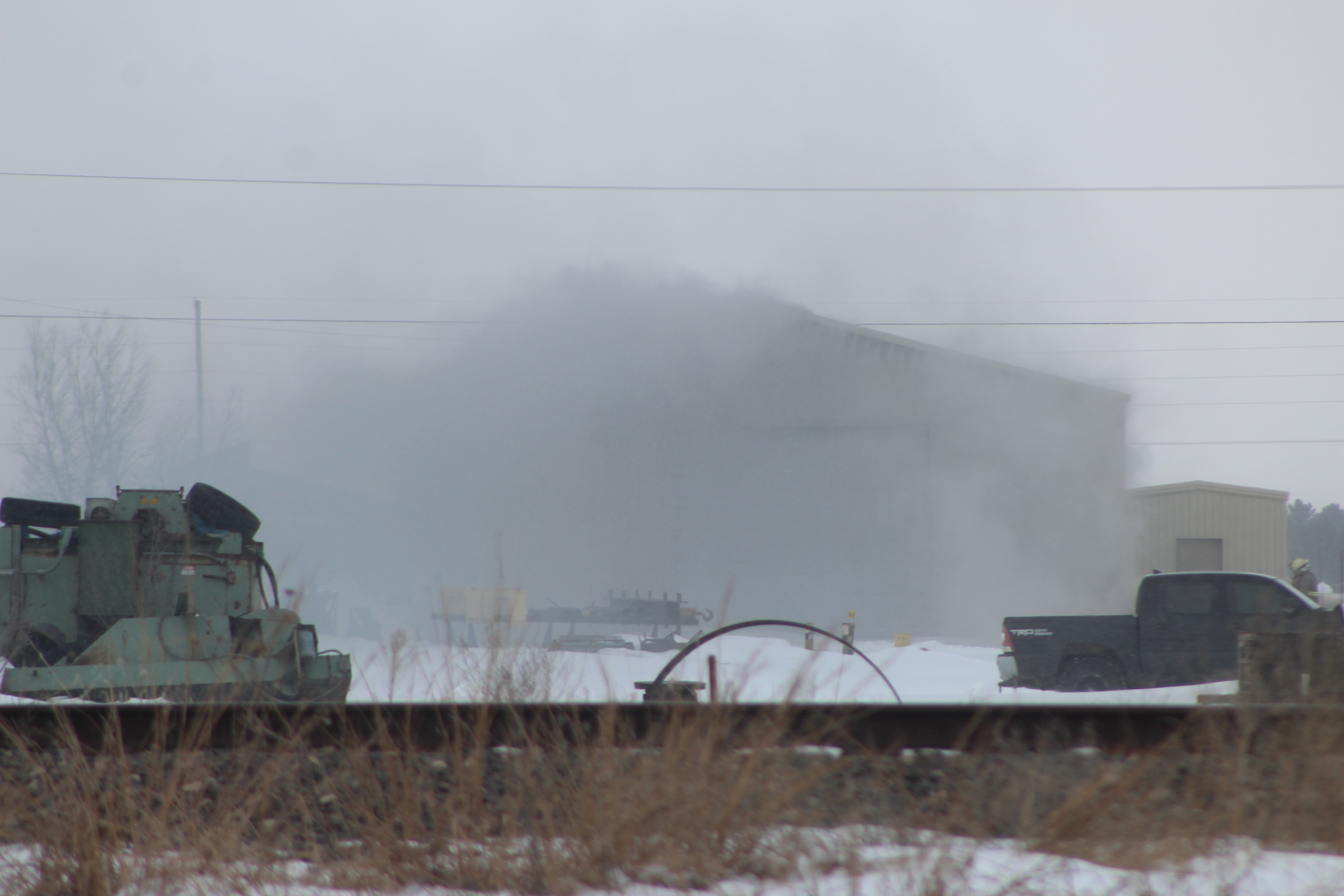
View of fire from Old Highway 40.

Update: 8:30 a.m. Tuesday, Feb. 26

Hays Fire Department

At 3:26 p.m. Monday,  Feb. 25, the Ellis County Fire Department was dispatched to a structure fire at 2670 E. Ninth St.

Upon arrival, heavy smoke was found coming from a metal storage building.

Fire crews made entry into the building and found multiple vehicles inside the structure, with one being on fire.

Firefighters used two fire attack lines to extinguish the fire and keep the fire to the vehicle of origin.

The building and other vehicles inside suffered extensive smoke damage.

The fire was reported out at 4:03 p.m. and under control at 4:13 p.m. at which times fire crews were starting to be released from the scene.

Midwest Energy was contacted to shut off utilities to the building. Fire crews remained on scene until 6:05 p.m. to assist the Ellis County Sheriff’s office with the fire investigation.

The employees of the business did a great job to keep the building closed. Keeping the doors shut slowed fire growth and stopped fire spread to the building and other vehicles inside.

Thirty-three firefighters from the Ellis County Fire Department (Hays, Ellis, Victoria, and Munjor) responded to assist. The fire was located within the automatic aid program area and the Hays Fire Department responded with an additional seven firefighters.

The ECFD was also assisted by the Ellis County EMS, Sheriff’s deputies, and the Kansas Highway Patrol.

By CRISTINA JANNEY

Hays Post

Firefighters are on scene at a fire in a commercial building at 2670 E. Ninth St.

According to scanner reports, everyone was able to escape the building.

Crews reported at least one vehicle on fire inside the building.

Crews were starting to be dismissed from the scene as of 4:30 p.m.

Watch the Hays Post for more information as it becomes available.


FHSU student veterans group seeks donations of youth sports equipment

Submitted

The Fort Hays State University Student Veterans Association in conjunction with the Hays Recreation Commission is proud to announce the kickoff of a project to give back to the community.

The SVA is starting an all-donation-based sports equipment locker to be located at the Hays Recreation Commission building. 

The purpose of the Area Youth Equipment Locker is to provide new or gently used, sports equipment to those youth in our community that may not be afforded the opportunity to purchase sports equipment otherwise.  The AYEL will not charge for the equipment that a child receives; however, we do request those participating in the program either bring in a piece of sports equipment that they are no longer using or return the equipment they take if it is still in good working condition. 

 Student Veterans Association is asking for the help of the community in providing some gently used equipment to help get us started or a monetary donation that can be dropped off at HRC marked attn: Area Youth Equipment Locker or AYEL.

The Student Veterans Association is just coming off a fundraiser that raised $2,500 for scholarships for veterans and current service members to take classes at FHSU.

The kickoff for AYEL fundraising will be a 50/50 raffle at the basketball game on Thursday when the Fort Hays State Tigers take on the Lions of Missouri Southern. A portion of the proceeds raised by the SVA will go to pay fees at the rec commission for the children whose families cannot afford to do so, the other half will go to one lucky winner at the game.

The goal of this program is to help make children’s lives a little better. 

“We will never know the full impact of the AYEL. If a child receives a pair of cleats from the AYEL, gains confidence, becomes a world-famous soccer player, and changes the lives of others it is a big win!!!  If a child receives a pair of cleats from the AYEL, and that child smiles, it is just as big of a win!!!” the SVA said in a news release.

“Please help us to start creating smiles for all those children in our community that may need it.  We are looking for sports equipment for all ages for both boys and girls alike,” the release said.

See the following list of locations that will have a drop box for equipment. Continue checking for more drop off locations as the group is hoping this list continues to grow.

Drop off Locations:

  • First Care Clinic, 105 West 13th St. Hays Ks
  • Kat’s Hallmark Shop, 4320 Vine St. Hays Ks
  • Hays Recreation Commission, 1105 Canterbury Drive, Hays KS

Types of equipment needed:

  • Baseball/softball cleats
  • Soccer cleats
  • Gloves/bats/balls
  • Basketballs/volleyballs/soccer balls
  • Volleyball kneepads
  • Soccer shin guards
  • Tennis rackets/balls
  • Golf clubs/balls
  • Football cleats
  • Football pads
  • Swimming googles
  • Weight lifting gloves/belts

The Student Veterans Association would love your support on this community project.  If you would like any further information, you can send an email to [email protected].

Prescribed burn workshop set in Oakley

Sponsored by K-State Research & Extension

 Logan County NRCS and KSRE’s Golden Prairie District are co-hosting a prescribed burn workshop from 9 a.m. to 2:30 p.m. March 8 at the Northwest Educational Service Center at 703 W. 2nd St. in Oakley.

The workshop will focus on safe and effective means of burning the land that you manage. Topics include reasons for burning, regulations, weather considerations, liability, burn contractors, equipment and crew, hazards, fuels, firebreaks, fire types and behavior, ignition techniques, and burn plans.

This workshop is open to the public. There is a $25 fee for admission, which includes meals and materials. Registration is requested by calling Dana Charles at 785-672-3841 by March 1 or by visiting goldenprairie.ksu.edu.

K-State Research and Extension is a statewide network of educators sharing unbiased, research-based information and expertise on issues important to Kansas. Learn more at ksre.k-state.edu.

MDC: Learning how to provide customer service in the digital age

FHSU University Relations

Customer service is no longer face-to-face conversations and phone calls. Rather, businesses are increasingly interacting with their customers online utilizing Facebook posts, tweets, snaps, and texts.

Learn more about digital customer service strategy at “Customer Service in the Digital Age: First Impressions Matter 2.0,” a new workshop from Fort Hays State University’s Management Development Center.

This follow-up to the popular “First Impressions Matter” workshop will be from 8:30 a.m. to noon on Wednesday, Feb. 27, in the Trails Room of the Memorial Union on the FHSU campus.

This training will give participants tools to begin implementing a service culture within their organizations’ digital channels, including on their websites, social media channels, and instant messaging. Specifically, the facilitators will cover what to do when an angry customer posts a negative review, as well as discuss chatbots and self-serve customer service.

Participants can also expect to examine a variety of helpful online service-oriented tools, as well as learn about updates on where the customer service industry is headed in the future.

Dr. Stacey Smith, chair of the Department of Applied Business Studies Department, and Hannah Hilker, training specialist at the Management Development Center, will facilitate.

Each person who completes the workshop will receive a completion certificate. The cost is $119. Hays Area Chamber of Commerce members are eligible for a 15-percent discount.

Registration is available online at https://webapps.fhsu.edu/MDC2.0/Default.aspx

To learn more about this workshop or receive discount codes, contact Hannah Hilker, 785-628-4121 or [email protected]

HAWVER: KPERS debate is Kelly’s first big test

Martin Hawver

It’s going to take a few days, but the first and biggest fight of new Gov. Laura Kelly and, well, apparently the entire Legislature, will break out this week.

The bell that started the first round: Friday’s 117-0 passage by the House of the Senate’s unanimously passed on Valentine’s Day of a short little bill that sends $115 million to the Kansas Public Employee Retirement System to pay back the $97 million (plus interest) that it didn’t pay in 2016.

Repaying debt…not a bad idea, except that everything is different when the Legislature is dealing with the pension fund that, while “not actuarially balanced,” is still making those monthly pension check payments to retirees.

But here’s the big fight over the very first bill passed by this year’s heavily Republican Legislature to the brand-new Democrat governor Kelly: pay KPERS now, or pay KPERS later…

Why is this so mesmerizing? Because the governor clearly lost her argument to the Legislature for her own KPERS plan. Now, she can sign the bill, reluctantly, and say she just didn’t want to waste time with a veto.

Or, she could veto the bill and get overridden. Hard to say who would want to be in that picture with her.

Or she could just put it in her desk drawer, and after 10 days it becomes law anyway with none of her DNA on it.

The governor hasn’t said what she intends to do with the bill.

There really isn’t a good choice for her, and it’s going to be interesting to see how she describes what she’s going to do with the bill. A well-thought-out explanation is necessary, one that will make the ultimate beneficiaries of the pension program believe she’s working for their best interests.

The “pay KPERS now” side of the issue makes sense to pay back money that lawmakers borrowed from the pension fund back when the state was scrambling to keep its annual balance out of red ink. That $97 million non-payment to KPERS was needed as the state started a series of tax increases to dig out of the former Gov. Sam Brownback “lower taxes and the economy will boom, and we’ll take in more money” experiment which just didn’t work.

The “pay KPERS later” side of the issue? Well, Kelly had a different idea. Refinancing the pension fund’s actuarial shortfall (basically the amount it would need to pay off all its members in one day) over another 30 years brings smaller annual payments that the state is more likely to actually pay. Everyone gets paid, it just takes longer…and the state pays interest on that refinancing for 30 years, a long time.

***

The politics are interesting, because that borrowed money is from the schools/state workers’ section of the pension fund. Democrats voted for the bill because those two categories of pensioners are often solid Democrat voters.

Republicans decry that interest the state would pay on refinancing the pension system under the Kelly plan. They’ve made a big deal out of the $24,000 per day interest the state is running up by not paying that $115 million now. They apparently pay cash for their cars and houses.

What happens next? Nobody but the governor knows. But whatever Kelly does, it is going to influence future governor-Legislature fights, and whatever happens, she’ll go into Round 2 of the prize fight a little weakened.

Dramatic, and it might tell the future. Or at least change the relationship between the governor and the Legislature.

Get your bets down…

Syndicated by Hawver News Company LLC of Topeka; Martin Hawver is publisher of Hawver’s Capitol Report—to learn more about this nonpartisan statewide political news service, visit the website at www.hawvernews.com

Kansas Farm Bureau Insight: Opening our doors

Kim Baldwin

By KIM BALDWIN
McPherson County farmer

During certain parts of the year I secretly cringe when someone walks into my house. It’s not that I don’t like visitors; it’s more about what my houseguests might see when they enter our home. In the winter and spring, odds are my floors will have some mud deposits that someone tracked in. In the summer and fall, dirt clods and seeds sprinkled around my house are a given.

“It’s just part of life,” I tell myself. Even then, at times it still creates a bit of uneasiness for me when someone comes to visit.

My concerns about my house have had to take a backseat though, as we have an extended houseguest this year. My farmhouse — in all its seasonal, messy glory — has been on full display as we have opened our home to a high school foreign exchange student. She’s a Sicilian from a large city who is accustomed to warm weather, ocean views and pasta. Lots of pasta.

In preparing for her exchange experience, she watched all the Hollywood teen movies to help her formulate an understanding of what life would be like for her in America. There were dance routines, musical interludes, mean girls, study groups and school dance scenarios that she studied.

She made a conscious choice to come to the United States to study and participate in the lifestyle and culture. Little did she know, the images, events and people portrayed in the movies she studied in preparation for this once-in-a-lifetime experience would be very different from her reality: life on a farm in rural, central Kansas.

Our family’s goal is to carry on our business as usual while also working to give her the best possible experience this year. It’s safe to say Hollywood didn’t prepare her for the majority of it.

Common conveniences including accessibility to a mall, a movie theater, a great pizza place and a coffee shop are all still possible, although getting there requires a bit more planning and miles on our part.

She’s experienced early drives into town to get to school, dirt road treks required to get to a classmate’s house, small class sizes at our rural school where the math teacher is also the cross country and scholars bowl coach, making selections at our small town grocery store and the beauty of a community coming together for a weeknight high school basketball game.

She’s had friendly conversations with folks during a community meal served family-style at a local church, checked out books from our local library, discovered butterscotch, experienced slow Wi-Fi, which affects her Netflix viewing. She’s also learning the beauty of Amazon’s two-day shipping.

She’s watched our farm dog give birth, and she’s held a piglet in her arms. Our local FFA chapter members welcomed her and then put her to work , and she has experienced the joy (and chill) of traversing the farmyard on an inner tube pulled by a four-wheeler following a recent snowstorm.

While the clothes shopping options are limited, especially for a teenager who usually spends portions of her weekends visiting shops trying on clothes with her friends for fun. She’s beginning to realize that we have to plan our shopping adventures a little more than she would in Sicily. And, thank God almighty, it only took two trips to Wichita to secure the prom dress!

After multiple video calls with her family and Snapchat posts seeking advice, she has even purchased her own pair of cowboy boots. The girl is committed and living a life she didn’t even know existed. To say she’s adjusted nicely is a huge understatement. She has become part of our small, rural community, and she has fully embraced the lifestyle and all the community has to offer.

While she has learned and experienced a lot during her time with us, I know my family has gained some valuable lessons as well. And for me, allowing her to view our farmhouse in all its seasonal, messy glory is something I’ve been able to relax about. After all, it is just a part of life for our farm family here in rural, central Kansas.

“Insight” is a weekly column published by Kansas Farm Bureau, the state’s largest farm organization whose mission is to strengthen agriculture and the lives of Kansans through advocacy, education and service.

Prairie Doc Perspectives: Woman’s work?

Rick Holm

Women’s health can be directly tied to the burden of household responsibilities. In a 2016 study, researchers found that women are more often the primary parent of children, the one who determines family healthcare decisions, the caregiver for the elderly parents on both sides and the one that does more of the cooking and dishes, cleaning, laundry and grocery shopping. Other studies have found that doing dishes alone was particularly burdensome.

The U.S. Bureau of Labor says our society is getting somewhat better in sharing the household work, but a difference still remains. For example, in 2003, men participated in food preparation and clean-up on average of 35 percent of his days, and in 2015 it was 43 percent. Nice to see an eight percent improvement but the women’s share in 2015 was still 70 percent. In 2015, women participated in cleaning housework 50 percent of her days while it was 22 percent for men. Lawn and garden work was the only chore accomplished more by men than women.

How much does this happen because the man is often the primary earner? In another study done at Indiana University in 2016, they studied household work in families where the woman’s income was larger than the man’s. They found that household burdens seemed not to align with income but rather with the traditional roles of masculinity and femininity. They also found that in same-sex couples, gender identity still directs roles. We haven’t reached equality of the sexes at work and we haven’t reached equality at home, either.

This is important because of the possible negative effect it may have on family relationships. There are studies to show that each person in a household has expectations and responsibilities, whether it be the alpha mom, the alpha dad, the children or even the grandparents. If the woman (or the man) expects the other to pitch in but ends up stuck with all the chores, she or he may be disappointed, embittered, angry and feeling abused. If those hard feelings are not resolved and are covered up, then depression may be the result.

When one member of the family is hurting, everyone feels the pain. Research data from Myrna Weissman PhD, a professor of psychiatry, shows that mental illness and depression spreads within a household. Strong emotional sharing occurs there, and when emotional pain of one person in the family is treated and improves, everyone gets better.

Simply helping with the dishes might be an enormous step toward making a happier home.

For free and easy access to the entire Prairie Doc® library, visit www.prairiedoc.org and follow The Prairie Doc® on Facebook, featuring On Call with the Prairie Doc® a medical Q&A show streaming live most Thursdays at 7 p.m. central.

Cloudy, cold Tuesday with a chance for snow

Tuesday Scattered snow showers before 11am. Cloudy, with a high near 20. Wind chill values as low as -5. North northeast wind 5 to 10 mph. Chance of precipitation is 30%.

Tuesday NightMostly cloudy, with a steady temperature around 20. Light and variable wind becoming north northeast 5 to 9 mph after midnight.

WednesdayMostly cloudy, with a high near 19. Wind chill values as low as -1. North northeast wind 8 to 13 mph.

Wednesday NightMostly cloudy, with a low around 13. Northeast wind 5 to 8 mph becoming south after midnight.

ThursdayPartly sunny, with a high near 29.

Thursday NightMostly cloudy, with a low around 18.

FridayPartly sunny, with a high near 34.

Copyright Eagle Radio | FCC Public Files | EEO Public File