Many of us have been talking about that very subject recently, from NBA stars and league executives to Chinese government officials, from President Trump to journalists and members of Congress.
Some ground rules for our conversation: The First Amendment protects us from government attempts to control what we say, or from punishment simply for having said it. Freedom of speech — one of five freedoms in the amendment — offers no protection from private companies or individuals who don’t like what we say or hold other views.
The First Amendment only applies in the United States. Other nations may have rules or laws that in some fashion say they protect or really do protect freedom of speech, but none has quite the same strong constitutional protection that we have in the U.S.
And even after 220-plus years, we’re still working out how First Amendment freedoms apply here to everyday situations. Let’s continue the conversation with some real-life examples.
The National Basketball Association has been working for several decades to build its audience in China, where it’s reported more people watch NBA games on TV than do people in this country. A carefully crafted combination of sports and marketing took a real hit in a matter of days recently, after a Houston Rockets executive tweeted an innocuous message of support for protesters in Hong Kong — who it’s worth noting, were protesting in part any attempt by Chinese officials to limit their free speech. The tweet: “Fight for freedom. Stand with Hong Kong.”
Chinese state television stopped broadcasting and streaming the Rockets’ games. Pre-season game broadcasts of several other NBA teams were dropped.
Government-controlled Chinese companies dropped their NBA-related sponsorships. Banners touting NBA stars and events were torn down from buildings. And state-owned news media called on NBA players and executives to be more “respectful” of that nation’s internal policies and to consider how “rioters” in Hong Kong pose a threat to life and property there.
China makes no pretense of protecting free speech when it involves the government’s policies there — so yet another lesson: While our freedom of speech is protected from our government, it affords no such defense against other governments.
President Trump this week threatened this week to sue CNN, following release of “undercover” video by the self-styled conservative media criticism operation called “Project Veritas,” which purports to demonstrate bias against him by CNN.
One hurdle such a lawsuit will face is that the First Amendment’s provision for free speech and free press don’t have a “fairness” requirement. While our laws do allow challenges to speech that is immediately threatening, or is libelous, there’s no such provision for requiring anyone — from a cable network to any one of us — to be nice or “fair” when speaking about a politician. The First Amendment does provide that Trump or any other political officeholder can use his or her own free speech rights — in his case, a Twitter account with a massive following — to counter such alleged bias.
Moving from the courtroom to Congress, there are suggestions of future laws to prevent hateful speech, speech that glorifies violence, to ban so-called “deep fake” videos (which use new technology to falsify video images and scenes) or to filter out what someone would determine are false and misleading statements about political candidates. Most, if not all, of those efforts start with good intentions: to make our society a more civil, honorable place.
But on the pragmatic level, each runs up against a free-speech concept strongly held in place so far by the U.S. Supreme Court: That such social issues and values involving free expression should be settled by public debate and discussion, not by court or legislative decision.
Yes, such debates and discussions may well have a price or penalty for participation — starting with no guarantee of civility or fair play. NBA superstar LeBron James — despite a reputation for speaking out in defense of those challenging authority — nonetheless faced a Twitter firestorm for comments he made that many saw as critical of the original Hong Kong tweet, though he denies that intent. The exchanges between Trump and his critics carry a special vitriol, which damages his reputation with some and damages his critics’ standings with others.
In the end, we all may need to see, hear or read ideas that offend, anger or even sicken us — across the widest possible spectrum of views if only, as one Supreme Court justice once wrote, to be better prepared to argue against them.
To speak frankly, that’s how free speech works.
Gene Policinski is president and chief operating officer of the Freedom Forum Institute. He can be reached at[email protected], or follow him on Twitter at@genefac.
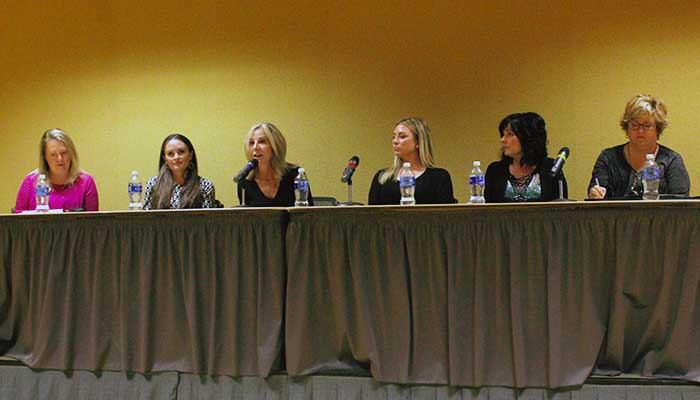
Second from left, Lisa Kisner, founder of Lisa’s Custom Interiors; Bonnie Pfannenstiel, owner of PoPt! Gourmet Popcorn; Kiley Rupp, founder of Body and Soul Day Spa; Deanna Doerfler, owner of Doerfler’s Harley Davidson; and Tammy Wellbrock, founder of Girl Twin Solutions, answered questions on the FHSU campus Tuesday in honor of Women Entrepreneurship Week. Sarah Wasinger, far left, director of the Hays Area Chamber of Commerce, moderated the panel.
By CRISTINA JANNEY Hays Post
Although several of the women on FHSU’s “Women in Business” panel on Tuesday said they did not set out to be entrepreneurs, all of them now own their own business.
Deanna Doerfler, owner of Doerfler’s Harley Davidson; Lisa Kisner, founder of Lisa’s Custom Interiors; Bonnie Pfannenstiel, owner of PoPt! Gourmet Popcorn; Kiley Rupp, founder of Body and Soul Day Spa; and Tammy Wellbrock, founder of Girl Twin Solutions, answered questions on the campus in honor of Women Entrepreneurship Week.
Being your own boss
Kisner’s business celebrated its five-year anniversary in June. Although Kisner has long had a passion for interior design, she worked for other people for 10 years before taking the leap to being her own boss.
“I was kind of at a crossroads as what to do next,” she said. “There are not a lot of design businesses here in town, so I had to make a decision. I am so passionate about interior design and I knew I couldn’t give that up. I didn’t want to move, so I decided to take the leap to go out on my own.”
Pfannenstiel was a licensed physical therapist before she started PoPt!. She also ran her own real estate business in Phoenix before moving back to Hays. Pfannenstiel started PoPt! in 2014. It was supposed to be a part-time job, but has grown into a business in its own 1,600-square-foot brick-and-mortar store and processing area. She hopes to double the business’ building footprint within the next two years.
Kiley Rupp answers a question as Bonnie Pfannenstiel, left, and Deanna Doerfler look on.
Rupp has been in the cosmetology industry for about 13 years and was the manager of Body and Soul Day Spa before taking ownership in May.
Doerfler and her husband, Brian, purchased the Harley Davidson dealership from Brian’s father and uncle in 1993.
“It was difficult at first,” she said, “because we had an older generation that was leaving. Harley was on a huge growth pattern at that time, and we had lots of changes.”
At that time, an owner had to be in the building 70 percent of the time.
Doerfler is not college educated. She had ridden dirt bikes as a kid but was not a street rider at the time she started with Brian in the business.
“There was a Harley University, and I probably went to every class and I absorbed everything that I possibly could,” she said.
Wellbrock founded her company, Girl Twin Solutions three months ago after working as the director of the Hays Area Chamber of Commerce for eight years.
“The entrepreneurial spirit was certainly part of me because I grew up the daughter of a farmer,” she said, “and I saw my dad have all the good and the bad that comes with being self-employed. I knew that was in my heart.”
Wellbrock came to Hays to study at FHSU.
“I would like to echo the fact that I’m probably more of a student today and learning more and doing more research than I ever did when I was a student,” she said. “Your learning doesn’t stop when you leave these walls.”
‘I was a job gypsy’
From left Sarah Wasinger Lisa Kisner and Bonnie Pfannenstiel.
The panelists were asked what inspired and motivated them to start their businesses.
Kisner said she was passionate about interior design, but she knew she needed to do her research before setting out on her own. She spent six months doing research. She also told the audience, which was comprised of many students, she wished she had taken more business classes in college.
Pfannenstiel was helping her husband, Russ, find speciality products to be featured in the remodeled 27th and Vine Cerv’s. He brought back some popcorn samples from market, but Bonnie was not impressed. Pfannenstiel said she considered herself a “job gypsy” and was looking for something to do.
“I thought, ‘I will pop popcorn for a couple of days and put it in your stores,’ ” she said.
She found someone from Texas to train her in the popcorn business, but he was using a retail model. Pfannenstiel wanted to be able to wholesale the popcorn.
“I was going to do this part-time and not have any employees and you don’t realize what is about to happen with your life five years later,” she said.
Rupp comes from a long line of entrepreneurs. Her grandparents owned hotels, and her parents owned an ag and lawn business in Nebraska.
“Growing up, I was sure that was something that I was sure I didn’t want to do,” she said. “But looking back, each new job was preparing me for this journey I am on now.”
She said when the opportunity came to purchase the spa, she realized she had the opportunity to make changes in her industry.
Doerfler said she saw an opportunity to grow and modernize the business. When she and her husband took over the Harley shop, they were still using paper tickets.
“The marketing side had me really excited,” she said. “I was in a man’s world, and not every man in the motorcycle world accepts women.”
Doerfler said she wanted to open up the biking world to women, beyond just riding on the back of a bike.
“After I started riding and got to know some of these other women who were coming in the shop who were just kind of along with their husband or friends, I thought it would be so cool if all these women I knew just through my retail experience from them walking in the doors and talking to me knew each other.
“I knew I could sell the sport, the brand and everything if they could get to know one another, because relationships in the motorcycle industry are the key to keep people riding.”
She started an annual four-day women’s ride. The ride has continued for 16 years and today mother/daughter pairs are joining the group.
Wellbrock said she had a desire to start a new project.
“I need the whole scene to change,” she said, “and the people around me. I desire a lot of variety in my professional career.”
She said she loved the Chamber industry and loved Hays.
“To reinvent yourself, some people then will take that same position and just choose another community,” Wellbrock said. “The community wasn’t going to be able to change for me, so I needed to change the scope of the job.”
What’s in a name?
FHSU students and community members will the panel audience.
The panelists were then asked about what lessons they have learned that would have been beneficial to them when they first opened their businesses.
Pfannenstiel said she wished she would had done a little more research on the community before she started her business. PoPt! had a lot of naysayers in the beginning, but she ended up having a lot more community support than she imagined, she said.
Rupp said recruiting and retaining a quality team who sees your vision as you do has been important to her business. She urged new business owners to not be afraid to ask questions and ask for help.
Doerfler urged entrepreneurs to have a doable succession plan. Harley requires the Doerflers to have an updated plan on file.
Building strong managers is important in succession planning, and Doerfler admitted she could have been much better at that in her business.
Wellbrock said some of the best advice she received was in developing her business’ name. She considered naming her business Tammy Wellbrock Consulting, but she was told no one will buy Tammy Wellbrock. She thought about what made her stand out, and that was that she had a twin brother. She is the girl twin.
Wellbrock did not have to have a business plan, because she wasn’t approaching a bank for a loan, but she did one anyway. She said the best thing she ever did was develop her own business plan with the help of the Small Business Development Center.
Kisner said the best advice she could give was not let you emotions make your decisions.
“When you are getting started, it is really important to take the time to do your research,” she said. “Contact people that know more than you. … It is really easy to get really excited and jump on a decision, and it can affect everything.”
Electric bikes to a unicorn
Rupp said she has focused on learning more about the community and staying involved with current events.
Doerfler said Harley is having challenging with an aging demographic. They also have a desire to keep manufacturing in the United States.
The average age of a Harley owner is 40 to 50 years old.
Harley is trying to realign themselves to be more appealing to younger riders. One of the tools it is using to do this is a Jumpstart platform. You can put a bike on it and a non-rider can learn how to run through the gears.
Appealing to new riders has also included making lighter, more affordable bikes and introducing electric bicycles for children and adults.
“Given those challenging times, it’s still exciting times,” she said. “I think we are engaging another world. Obviously, technology is affecting every industry. It is challenging for any car or motorcycling manufacturer right now. We can’t change fast enough, is what I always say.”
Wellbrock said she is asking businesses, “What is your pain? What is keeping you up at night.”
She is using those answers to develop content.
Kisner said, “If I don’t stay up with the trends, my business would not exist. What I have to do in interior design must always be up with the current trends.”
She spends a lot of time going to design expos and talking to her wholesalers about what kind of trends they are seeing in their sales.
Kisner said she also tries to keep up-to-date with technology. She is using virtual reality to show her clients what their spaces are going to look like when they are finished.
Pfannenstiel said, “PoPt! is a niche retail brick-and-mortar store in a decade where brick and mortar is going away. When I tell people we are looking to expand our business to a bigger building, they look at me like ‘Are you sure?’
“The great thing about PoPt! is that my business is not a franchise. I can do what I want. It is like spin the wheel everyday and where is the dart going to end?”
The older generation likes the popcorn and nostalgic candy. The kids like the candy. The 20- and 30-year-olds bring their kids in to get candy, and they buy too, she said.
“Basically this business is your imagination is your limitation and Pinterest,” Pfannenstiel said.
PoPt! just introduced its new mascot — Poppy the Unicorn. Pfannenstiel hopes to use the mascot to expand the business into special events and birthday parties.
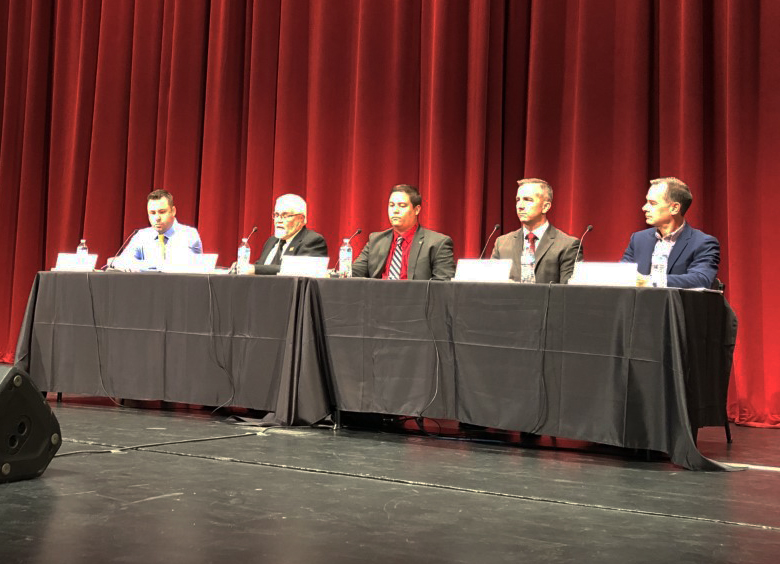
Dr. Jay Steinmetz and Dr. Wendy Rohleder-Sook, FHSU Dept. of Political Science, at Tuesday’s forum with Hays city commission candidates Michael Berges, Ron Mellick, Mason Ruder, Ryan Rymer and Henry Schwaller IV.
By BECKY KISER Hays Post
The five men running for three open positions on the Hays City Commission agreed on two things during their 90-minute public forum Tuesday night in Fort Hays State University’s Beach Schmidt Performing Arts Center.
Incumbents Ron Mellick and Henry Schwaller IV, along with newcomers Michael Berges, Mason Ruder and Ryan Rymer all said they love the community of Hays and want to give back to the town and its residents by serving on the city commission.
Each candidate also declared the need for affordable housing to be a top concern.
Written questions from the audience of about 75 people were read by Dr. Jay Steinmetz, FHSU political science assistant professor.
One of the first questions asked the candidates to name the biggest problem facing the city and how they would fix it.
Their answers varied but each included a mention of affordable housing.
Ruder, the Ellis County Environmental Planning Supervisor, grew up in Hays. Like many young people, he left for awhile to live and work in a bigger city – Kansas City. Then Ruder returned to Hays start a family.
“Our biggest issue we need to tackle is finding ways to retain young people in Hays. Affordable, moderately-priced housing is part of that,” Ruder said, “and working with developers, realtors, Grow Hays.
“We have a bunch of resources available to us to bring in some of these potentially new developments to let the students and the younger people plant roots right here in town.”
Ruder said he struggled to find a house in his price range but “got lucky with what I found. It was a difficult, difficult process.”
He also believes the city should help sustain local businesses and encourage entrepreneurship to help support the economy and retain young residents.
Rymer, an ER nurse at Russell Regional Hospital, told the audience he had done a “search of homes in Hays looking at middle-income housing, which to me was about $200,000 on down to about $150,000 for entry-level folks. I only found two that had been made in the last 20 years.
“If we are to remain competitive and attractive for young people to move to and, when they get done with college here, to not want to leave, we have to look for ways to make housing more economically affordable.
“The city’s parks, with the upcoming addition of the accessible recreation complex, and our blossoming Main Street are amazing, so we’ve got to do other things to help accommodate” people in Hays, Rymer said.
“I’m going to turn the question around and ask what’s the biggest opportunity for Hays,” said Berges, a financial advisor.
Although he sees a lot of opportunities for people living in Hays no matter their stage of life, “we have a kind of wage stagnation with very little opportunity for growth which comes down to a greater problem in affordable housing.”
Berges estimates 80 percent of Hays residents are spending 30 percent of their income on housing, whether rent or mortgage, and says “that’s not affordable housing.”
It’s also not unusual for those raising a family in Hays to be spending another 20 to 30 percent of their income on daycare, according to Berges.
He suggested leaning on Grow Hays and similar organizations to attract higher-paying jobs to town.
The two incumbents approached concerns about affordable housing a little differently.
Schwaller owns more than 150 properties in Hays as president of Henry Schwaller and Associates. He is also a management instructor at FHSU.
“If we’re going to continue to grow, we’re going to have to invest in the fundamentals,” said Schwaller.
“We’re going to have to retain and grow existing businesses and encourage startups. We have to build houses for the people who work here. We’re going to have to make sure we’re creating jobs that are high-skill and high-wage.”
Schwaller pointed out the many employable FHSU and NCK Tech College graduates who “can find jobs that fit right into our economy, and that is a spot we are missing.”
Mellick, a self-employed floor covering installer, referenced the declining population of western Kansas, saying “we need them. They rely on us for services and we rely on them for shopping.”
The city’s general fund is financed primarily by a half-cent retail sales tax.
“I do believe affordable housing would keep a lot of people in our community and in western Kansas,” Mellick said.
“But land prices here in Hays are so high you can’t have affordable housing because affordable housing starts with affordable land prices.”
According to Mellick, the city has many areas that could be developed “but to get those land prices down so we can put in affordable housing is going to be very, very difficult.”
A perennial topic of debate in Hays is traffic roundabouts and their inclusion in the North Vine Street Corridor Improvement Project.
Berges, Ruder and Rymer all said they understand the increased safety and driving convenience but question the roundabouts’ locations in the proposed design.
Schwaller has previously expressed his opposition to the configuration as presented to the city commission. Mellick continues to support the project.
Each candidate stressed the importance of fostering a good relationship between the governing bodies of Hays and Ellis County.
As a county employee, Ruder often works with city department heads.
“We’re currently working on redesigning the Extra Territorial Jurisdiction (three-mile zone) around Hays to better suit both the county and the city,” Ruder noted.
Mellick and Schwaller talked about the currently shared services and resources between Hays and Ellis County including law enforcement, emergency medical service, a mutual aid fire agreement and fire training and occasional roadwork.
The city has also written letters of support for the Northwest Business Corridor, proposed improvements to 230th Avenue and Feedlot Road to complete the U.S. 183 bypass around Hays.
“We have an open dialogue,” Mellick said, “and will keep the lines of communication open.”
Although there are many opportunities to work together, “the county is working on getting ahold of their budget and figuring out their revenue sources for the future,” Schwaller said. “Because they’re focused on that, it’d be difficult for us to says let’s work on this together.”
Ellis County residents will vote on a proposed sales tax increase in April. If approved, the city of Hays would receive a portion of the sales tax revenue.
“As Hays goes, Ellis County goes,” Berges said. “I know Victoria and Ellis residents don’t want to hear that.”
Acknowledging that the county’s budget work comes first, Berges added “it is important that we work with our county commissioners and our county employees from a city level.”
“We are just one city in the county,” Rymer said, “and we owe it to the citizens of our county to be able to assist it and augment it in any way possible. We’re all in this together.”
Rymer and Ruder both believe joint commission meetings should be conducted for large projects such as the Northwest Business Corridor. In light of the county’s budget difficulties, Ruder also suggested the city should consider providing financial support to the project.
“It’s going to be a good thing for the city in the long run,” said Ruder.
The audience also asked questions about downtown Hays revitalization, subsidizing Safe Ride, recycling, and long-term water supply problems and solutions.
In their closing statements, each candidate encouraged Hays residents to vote in the Nov. 5 election. Advance voting began Monday.
The top two city commission candidates will serve for four years, while the third-place vote-getter will serve for two years.
Tuesday’s forum was organized by the FHSU Student Government Association, American Democracy Project, the Department of Political Science and Tiger Media Network along with the Hays Area Chamber of Commerce and the Docking Institute of Public Affairs.
If you missed out on last week’s Eagle Radio Auction don’t worry, there are still opportunities to bid on several items through the Eagle Radio Online Auction.
With over 25 years of protecting your trucks, trailers, and other toys, Rhino Linings is the leader in durability, warranty, and resistance.
Protection never looked so good.
This spray-in bed-liner contours to your bed, bumper, fender or grill to create a tough, factory-like finish.
Standard black or custom colors are available.
It is impact-resistant, watertight and protects your covered area. KJ and G Customs will cover most short bed and long bed pickups, and can also be used on cabs, bumpers and other accessories.
Get with Troy Robinson and the guys today at 614 E. 13th in Hays. KJ and G Customs, your exclusive Rhino Linings dealer in the area. Call 785-621-4949 to get yours scheduled today and enjoy forever!
Fort Hays State Athletics will welcome seven new members into the Tiger Sports Hall of Fame on Saturday,. The inductees include Marvin Andrews (men’s basketball), Kent Bauer (men’s track and field), Chris (Biser) Drea (women’s basketball), Bill Hall (baseball), Jack Harms (men’s cross country/track and field), Maddie Holub (softball), and Kelly (Skidmore) Gunning (volleyball). The induction ceremony will take place the morning of October 26 at the Memorial Union Ballroom on the campus of Fort Hays State University at 9:30 am. The inductees will be recognized at halftime of the football game vs. Nebraska-Kearney at 2:00 pm.
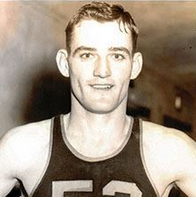
Marvin Andrews (Men’s Basketball, 1951-55) Posthumous
Marvin Andrews, a native of Formoso, Kansas, is one of 20 players in FHSU men’s basketball history to score over 1,000 points in his career. Playing from 1951 to 1955, Andrews was a three-time All-CIC selection for the Tigers, earning second-team honors as a sophomore, and first-team honors as a junior and senior. He and teammate Merlyn “Bud” Moeckel were the first two Tigers to reach 1,000 points in a career, occurring during the 1955 season. Andrews transferred to Fort Hays State from Kansas State University after his first semester of college and played for the Tigers in the second semester of his freshman year. He broke the single-season FHSU scoring record as a junior with 357 points, averaging 17.0 points per game over a 21-game season. He broke his own single-season scoring record as a senior in 1955 with 374 points, averaging 18.7 points per game over a 20-game season. Andrews finished with 1,054 points in his three and a half-year career at FHSU, averaging 14.4 points per game in 73 games played. Andrews held the school’s career scoring record for nine years until Sam McDowell passed the mark in 1964, reaching 1,220 points. Beyond his days at FHSU, Andrews taught and coached for one year and then was drafted to the U.S. Army. While in the Army at Fort Sill, Oklahoma he played basketball in the Special Services. His team won the Fourth Army Championship and participated in the All-Army Tournament at Port Monmouth, New Jersey. After his years in the service, Andrews returned to coaching and teaching. He finished a master’s degree in 1968 and then went on to serve as a junior high school principal in Cheney, Kansas until his death in 1980.
Kent Bauer (Track and Field, 1959-62)
Kent Bauer, a native of Radium, Kansas, was a member of the FHSU Track and Field squad for four years from 1959 to 1962. Bauer was the NAIA National Champion in the pole vault as a senior in 1962, clearing a height of 14 feet, 1 inch. Bauer was a two-time All-America performer at Fort Hays State, also finishing third in the nation as a freshman in 1959. He was the CIC Champion in the pole vault his final two years as a Tiger. He set the school record at the time in 1962 at 14-feet, 6.5-inches by tying for first at the Missouri Valley AAU meet. Bauer was a recipient of the FHSU Busch Gross Award. Upon graduation from Fort Hays State University and then Wichita State University, Bauer worked as an aircraft engineer and was named Boeing Wichita Engineer of the Year. He still resides in Wichita, Kansas today.
Chris (Biser) Drea (Women’s Basketball, 1986-90)
A native of Plain, Wisconsin, Chris Biser was a three-time All-CSIC performer in women’s basketball, playing from 1986 to 1990. She set the FHSU Women’s Basketball career rebounding record for the program with 901 in 1990, only to be topped a year later when Annette Wiles pushed the record to 961 and then eventually Kate Lehman set a new record of 1,109 in 2015. Biser is one of 20 1,000-point scorers in the program’s history, ranking ninth on the all-time scoring list with 1,321 points, but ranked third on the list at the end of her career. She ranks seventh on the all-time list at FHSU in field goals made with 548 and seventh in blocked shots with 64. She led the team in rebounding three of four years, including an impressive 10.0 rebounds per game as a freshman in 1986-87. She averaged 7.5 per game as a junior and 8.0 per game as a senior to lead the squad. In 1989-90, Biser was an All-District 10 selection and would have easily been an all-conference performer for a fourth straight year, but FHSU did not have a conference that season in its transition from the CSIC to the Rocky Mountain Athletic Conference. Beyond her days at FHSU, Biser went on to have a successful coaching career of over 25 years, earning college and high school conference coach of the year honors in her home state of Wisconsin. Currently, she serves as the Director of Community Relations and Marketing at The Richland Hospital in Richland Center, Wisconsin, but resides in her hometown of Plain, Wisconsin.
Jack Harms (Cross Country/Track and Field, 1963-66)
A native of Ellinwood, Kansas, Jack Harms competed for the FHSU cross country and track and field squads from 1963 to 1966. Harms was the NAIA indoor national champion in the 880-yard run in 1966 in a time of 1:55.9. He finished third in the event at nationals during the outdoor season, earning All-America honors for both indoor and outdoor that year. He helped the team to an outdoor conference championship that year, while finishing second at indoor nationals and third at outdoor nationals. Overall, Harms was a four-time All-America performer in track and field and was a member of the FHSU national champion cross country teams in 1963 and 1965. Harms was a member of the mile relay team that placed second nationally in 1965, and a member of the two-mile relay team that placed third nationally during the indoor season of 1966. Along with being part of two national championship teams, he also helped cross country to a second-place finish at nationals in 1964 and a pair of conference championships in his time wearing the black and gold. Now living in Tulsa, Oklahoma, Harms is retired from the British Petroleum Controller’s Department and he also worked for PriceWaterhouseCoopers and the IBM Global Business Group earlier in his career.
Bill Hall (Baseball, 1974-76)
A native of Hays, Kansas, Bill Hall played baseball two years at Fort Hays State from 1973-1974 as a right fielder. He was a two-time all-conference and All-District 10 performer, while claiming All-America honors as a senior in 1974. He led FHSU in batting average as a junior in 1973 at .350, while recording 8 doubles, 1 home run, and 26 RBIs, earning all-conference first team and all-district honorable mention. As a senior in 1974, Hall produced a .316 batting average with 16 doubles, 1 triple, 2 home runs, 33 RBIs, and 35 runs scored. He earned All-District 10, All-Area 3, and All-America honors that season. Hall helped the Tigers to an NAIA National Tournament Appearances both years, including an appearance at the championship site in 1974 after the team was champions of Area 3. Hall now resides in Missoula, Montana, where he is a General Agent Manager for Old American Insurance.
Kelly (Skidmore) Gunning (Volleyball, 2002-05)
A native of Aurora, Colorado, Kelly Skidmore played volleyball at Fort Hays State from 2002 to 2005. Skidmore was a two-time All-America selection for the Tiger Volleyball team as a libero. The defensive specialist earned third team honors as a junior in 2004 and second team honors as a senior in 2005, while earning All-Region and All-RMAC First Team honors each year. She was the RMAC Defensive Player of the Year three times from 2003 to 2005. Skidmore owns the FHSU career record for digs at 2,421, the only player in the program’s NCAA Division II history with at least 2,000. She averaged 5.17 digs per set in her career, the only player in the program’s Division II history with an average of 5.0 or better. With 777 digs in 2005 (6.64 per set) and 756 in 2004 (6.15 per set), she owns the two-highest dig totals for a season in the rally scoring era at FHSU. She helped the team to back-to-back NCAA Tournament appearances in 2003 and 2004. The 2004 team was the most successful in program history, reaching the finals of the NCAA Regional (round of 16), finishing at 31-5 overall. Skidmore now lives in Parker, Colorado with her husband and two children.
Maddie Holub (Softball, 2010-13)
A native of Hays, Kansas, Maddie Holub, is the most decorated player in Fort Hays State Softball history, playing from 2010-2013. At the end of her career in 2013, Holub owned 34 FHSU records (19 pitching, 15 offensive) – career, single-season, and single-game combined, and still owns the majority of those records today. Holub was an NFCA and Daktronics All-America First Team selection in her senior year of 2013, as one of the most dominant players in the nation both in the pitching circle and offensively. For pitching, she finished the year with a 29-4 record, a 1.03 ERA, 26 complete games, 13 shutouts, and 345 strikeouts in 224 innings pitched. She threw six no-hitters that season, including back-to-back perfect games, the first player ever throw perfect games in consecutive starts at any NCAA level. Offensively, she finished with a .426 batting average, 32 extra-base hits (including 19 home runs), 56 RBIs, 62 runs scored, and 10 stolen bases. For her efforts in 2013, Holub was named both the MIAA Player and Pitcher of the Year, the first player in conference history to earn both in the same year. She was a three-time all-region selection and four-time All-MIAA selection. She threw seven career no-hitters individually and had a hand in a combined no-hitter. For her career, Holub had a 1.97 ERA with 77 wins, 93 complete games, 25 shutouts, 974 strikeouts, and seven saves in the pitching circle, while posting a .372 batting average with 255 hits, 46 home runs, 42 doubles, 7 triples, 160 RBIs, 183 runs scored, and 35 stolen bases. She was also solid in the classroom, earning CoSIDA Academic All-America honors. Holub went on to play professionally in Italy and in her first game, threw a perfect game in a six-inning contest. Holub went on to throw another no-hitter later that year and finished the season with a 0.78 ERA for Labadini Collecchio. Holub has gone on to a successful coaching career in softball beyond her playing days at FHSU, earning NFCA Assistant Coach of the Year for NCAA Division II at St. Leo (Fla.) University in 2015 and helping the team to a regional championship and NCAA Division II World Series appearance in 2018. She coached four years at St. Leo before taking the pitching coach position at Marshall University, where she currently coaches today.
The JFK in Hays, Kansas committee and the Ellis County Democratic Party are pleased to announce the keynote speaker for a banquet honoring John F. Kennedy’s campaign visit to Hays in November 1959.
Pulitzer Prize-winning journalist Thomas Oliphant, who co-authored a best-selling book about Kennedy’s 1960 campaign for the presidency, will share his insights at a 7 p.m. banquet on Nov. 20 at Kennedy Middle School, known as Jefferson West in 1959. Oliphant and Curtis Wilkie wrote “The Road to Camelot: Inside JFK’s Five-Year Campaign,” in which they detailed Kennedy’s unconventional path to the presidency.
General admission tickets are now on sale at $50 each. In 1959, tickets were $10, which today would cost $88. VIP seating includes assigned seats near the main table and is available at $100 per ticket. Event sponsors will meet Mr. Oliphant at a private reception before the banquet. Sponsorship levels are $2,500, which includes eight tickets and priority seating near main table; $1,000, four tickets and priority seating; $500, two tickets and priority seating. Sponsors also will have their name or company name on the banquet program. Those interested in becoming a sponsor can either email [email protected], call 785-628-6162 or stop by 1500 Vine. Copies of Mr. Oliphant’s book will be available for purchase at the banquet, and signed copies will be part of a raffle for prizes. Tickets are available at 1500 Vine, Hays, Kansas or online HERE or go to eventbrite.com and search for JFK in Hays, Kansas.
In addition to the banquet honoring the 60th anniversary of Kennedy’s visit, Mr. Oliphant will hold a 3:30 p.m. news conference that afternoon in the Memorial Union.
The evening before the banquet, at 7 p.m. on Nov. 19, there will be a panel discussion at the Fort Hays Ballroom on the FHSU campus focusing on Kennedy’s trip to Kansas in 1959 and Norbert Dreiling’s role. The panel discussion is free and open to the public.
In addition, Randy Gonzales — who graduated from Fort Hays State University in May 2019 with a master’s degree in history, and who wrote his thesis on Kennedy’s trip to Kansas — will discuss his thesis at 3 p.m. Nov. 7 at Forsyth Library on the FHSU campus, at the opening of an exhibit focusing on Kennedy and Dreiling.
Presidential hopeful John F. Kennedy toured five cities in a Kansas tour November 19-20 of 1959. Prior to arriving in Hays, Kennedy stopped in Kansas City, Wichita, Dodge City and Salina. Instead of relying on party leaders to choose a candidate at the national convention, Kennedy ushered in a new era, traveling from state to state to win delegates. While in Hays, Kennedy gave an interview to the local television station, held a press conference in the Memorial Union on the campus of Fort Hays Kansas State College (now Fort Hays State University), rode in a parade down Main Street, and was the keynote speaker at the banquet. There was an overflow crowd at the fundraiser in the school’s gym, with 645 in attendance.
For updates on the banquet and other planned events, visit the committee’s Facebook page, JFK in Hays, Kansas.
Water pressure in northwest Hays is not as strong as it is south of Interstate 70.
Plans to install a second waterline under I-70 will correct the problem as well as provide better fire protection and a redundant water supply to the growing number of businesses north of I-70.
According to Jeff Crispin, director of water resources, water north of I-70 is supplied by a single 16-inch water main.
“In 1993 this line was installed as well as the half-million gallon water tower north of Hays to supply the few businesses north of I-70,” Crispin told commissioners last week. The current above-ground booster station is located near the curve of 41st Street.
“In the last 26 years we have seen growth in this area of many businesses that are vital to our economy. A failure of that single water main under I-70 would have huge consequences to be able to provide water just for use, but most importantly fire protection.”
Crispin also noted a break in the existing line cannot be easily repaired.
A typical water main break in the city takes an average of about four hours to repair.
“That’s from notification to that you have a water leak, to repair, to the service being put back in. If you look around in the industry, that’s pretty darn good timing,” Crispin said.
If the single water line under I-70 breaks, the city will not be able to dig up I-70, according to Crispin.
“You’re talking about getting approval (from state and federal agencies) to bore a new line would take time, and then to actually bore that new line, we would probably be talking weeks in order to replace that line.”
City commissioners are expected Thursday night to approve a low bid of $769,678 from Midlands Contracting, Inc., Kearney, Neb. for construction of the second waterline crossing and a booster pump station.
Authorization of the 2020 health insurance plan for city employees from Blue Cross Blue Shield. The renewal cost is about two percent less than in 2019.
Approval of up to $390,020 toward the acquisition of right-of-way and easements associated with the North Vine Street Corridor Project.
Annexation request by Mark Ottley of property at 700 W. 48th St., formerly Mid-Kansas Auto Auction. Ottley has changed
business plans for the location and has also requested from the Hays Area Planning Commission a change of zoning from C-2
(Commercial General) to A-L (Agriculture) for a portion of the property.
Presentation of 5, 10, 15, 20, and 25 years of service awards to city employees.
The meeting begins at 6:30 p.m. in Hays City Hall, 1507 Main.
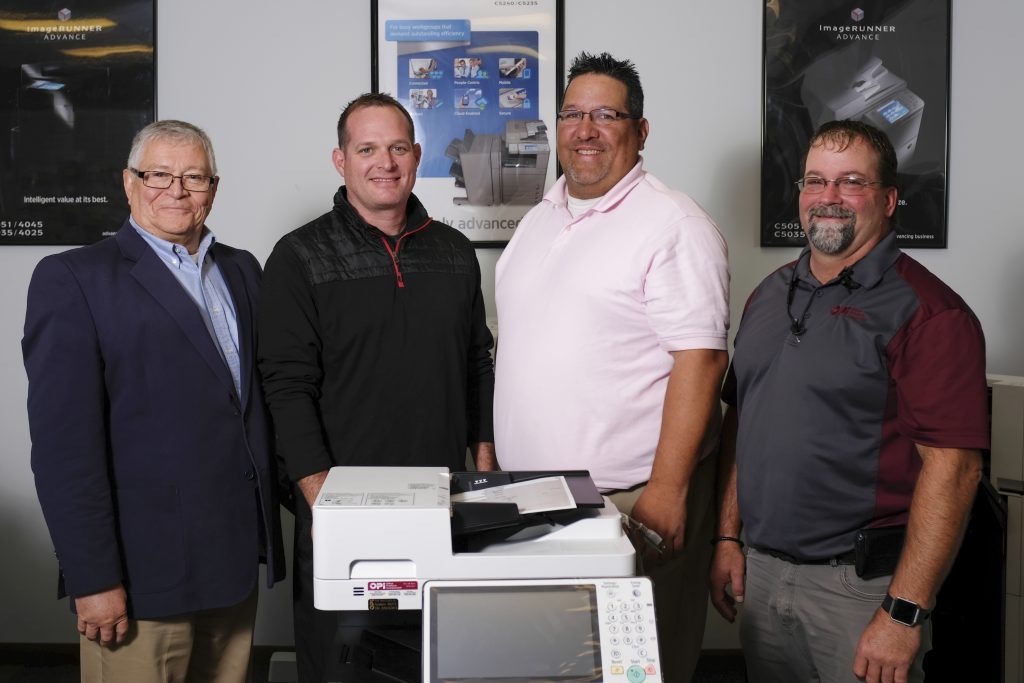
Employees for Office Products Inc Hays location, Jim Grabbe, Ty Berry, Chad Mayfield, and Jeff Thummel pose for a picture at Office Products Inc in Hays, Kansas on October 21, 2019. (Photo: Joey Bahr, www.joeybahr.com)
The newest member of the Office Products Inc. family will open its doors in Hays at 1218 E. 27th on Nov. 1, extending the reach of the Great Bend-based, family-owned business.
OPI has been in business for six decades in Great Bend and also has stores in Larned and Russell.
Kenny and Terry Vink, who are brothers, co-own the new location; they collaborated on the venture with their brother, Craig.
“We always look for ways to grow our business,” said Kenny Vink. “Our family has served central Kansans for more than 60 years and we have a strong core business. But if a business doesn’t grow it stagnates.”
The new store in Hays will offer many of the same products and services as the locations in Great Bend and other communities. These include: sales and service for Canon, HP and Brother copiers and printers; office furniture; custom office design; and a wide variety of office supplies.
“Customers in the Hays area also will have easy access to our specialty services in Great Bend,” Vink noted. “For example, our Copy Center, printing service, computer sales and service, and a range of promotional products will be at customers’ fingertips.
“Most of these services can be handled by our in-house staff in Hays, as well as by phone and email.”
“This involves extensive continuing education, especially for our experts in computer and networking services,” he noted. “We will continue this legacy and grow for
our employees and the communities we serve. This has worked for many years and now Hays area residents can reap the benefits too.”
Vink noted that he and his brother have considered a brick-and-mortar Hays location for quite a while. They recently decided now is the time.
“In today’s market, we knew we needed growth,” Vink said. “And we will help neighboring northwest Kansas businesses prosper too because we buy locally. We know how important this is to the overall economic health of any community.
“Customers of the new store can expect the same prompt and professional service that OPI is known for,” he added.
Opening the new store is not OPI’s first venture into the Hays area; two employees have been available there for sales and service for a few years. They will serve customers in the new store, along with Ty Berry who will fill the manager position.
Berry said he is “looking forward to bringing an OPI store to Hays. I am excited be part of OPI’s growth in northwest Kansas.”
OPI employees in Hays will call on current and new customers within a 60-mile radius; the Great Bend store also reaches a 60-mile radius. The OPI website and online
catalog are always available for shopping and ordering.
OPI is located at 1204 Main in Great Bend; 516 Broadway in Larned; 724 N. Main in Russell; and soon 1218 E. 27th in Hays.
The Hays Public Library will hold a launch party on November 9 to kick off a new program to encourage parents and caregivers to read with children. The 1,000 Books Before Kindergarten initiative is a free reading challenge aimed at growing children’s literacy skills.
“Many children experience difficulty learning how to read. Those who are not proficient readers will have difficulty during their school years and beyond,” said Early Literacy Librarian Sara Schoenthaler. “The ability to read is THE gateway skill to learning and accessing the world. Those children who are read to and exposed to books consistently and from a young age are better prepared to read and succeed.
Parents and caregivers are the first and best teachers of their 0-5 year olds.”
Studies have shown that reading with a child provides a great opportunity for bonding. Reading together is fun and will create life-long memories for both the child and parent. Experts agree that children who learn the necessary skills early do better in school and later in life.
Participating in 1000 Books Before Kindergarten can help put children on the right track.
The Hays Public Library will provide logs to track the number of books read. Each time 100 books are read, a child gets a sticker from the children’s service desk. After completing 500 and 1000 books, a child will get to choose a free book to keep. As much fun as it is to read new stories, families are encouraged to count every time they reread a favorite book. The goal is not to read 1,000 NEW books but to read with their child 1,000 times, no matter if it is the same book over and over again.
Each November the library will host a “graduation” party for anyone that completed the program in the previous 12 months.
A launch party will be held at the library November 9 at 11:30 a.m. This event also will serve as the kickoff of Kansas Reads to Preschoolers Week.
You can find out more about this and other library programs at hayslibrary.org or by calling 785-625-9014.
Museum board president assures the city council it will reopen in the spring
By JAMES BELL Hays Post
ELLIS — In an effort to alleviate continued budget woes, the Walter P. Chrysler Boyhood Home and Museum Board of Directors has decided to close over the winter — but assured the Ellis City Council that the closure is temporary.
“The rumor that the house is closing is just a rumor,” Gordon Solomon, museum board president, told the council at Monday’s regular meeting. “We want to ensure everyone that it is not permanently closing. It will be open in the spring.”
The move became necessary as the museum was unable to break even and was using reserve funds to pay staff over the slower winter months.
“We have been struggling, budget-wise for a couple of years now,” Solomon said. “By doing the closure, we should be able to close out the budget this year about equal.
“Like most people, we have to learn to live within our means,” he said.
He acknowledged the council was funding the museum as much as possible, but ultimately the savings made by closing was needed to put the budget on track.
“Our goal is to just meet budget and we realize the city can’t increase what you are already doing to assist the home,” Solomon said.
During the meeting, he said attendance over the winter months is low, so the impact on tourism would be minimal.
As an example, Solomon said total admissions and sales for the museum in January and February of this year was only $82.35 — while wages and payroll taxes equaled $1,404.
With those numbers, he said, “Obviously we are not meeting budget, even with your assistance.”
While the board was actively seeking solutions to balance the budget over the summer, museum employees gave notice to the board they would be leaving on Sept. 6, spurring the board to make a decision at a special meeting on Aug. 29.
“As a board, we decided that we would stay closed through the remainder of September and then we proposed to the board to mirror the schedule of the Ellis Railroad Museum,” Solomon said. “Our intent in the future is to open in March and close at the end of September.”
In January, he said the board would begin looking for a new employee.
Even with the budget concerns alleviated, for the time being, Solomon said the board is still actively seeking ideas to bring more people to the museum, including continuing to strengthen the partnership with the Ellis Railroad Museum.
“That’s our goal. We want to try to mirror each other and support each other,” Solomon said.
This would continue the trend of the two museums operating in a similar manner to one another.
“We tried to structure them the same — hours, fees, everything,” Ellis Mayor David McDaniel said.
Solomon said the board is also looking at a discounted rated for visitors who go to both museums, or offering a discount to people visiting the Ellis Lakeside Campground.
“There is a lot of people coming to town that obviously don’t visit,” Solomon said, noting the large influx of people at the campground, even while museum attendance is low.
Faith Lochmann, human resources coordinator, presented data from that wage study.
Entry-level wages for USD 489 clerical staff ranged from $9.81 to $11.42 per hour.
Comparable school districts pay an average of $11.08, and comparable cities pay an average starting wage of $13.45. FHSU’s starting wages ranged from $12.71 to $13.98.
HaysMed indicated its lowest starting wage for clerical staff is $10.39, but it hires off a schedule that takes into account years of experience and often hires new staff at higher than the minimum based on that schedule. The average of all the comparable positions was $11.14 to $12.31 per hour for starting wages for clerical staff.
“The district is not ready to implement a full-blown wage schedule,” she said, “but we recognize a strong need to level-set our current employees based on their years of experience with us and where they are being compensated.”
To level the wages will cost the district an average of 84 cents an hour for clerical staff. However, Keith Hall, interim director of finance, said not all employees will receive the same raise. No employee’s pay will decrease. Some employees’ pay could stay the same. Others will increase based on their current pay and years of experience.
Annual cost for clerical staff raises will be $23,642.
The district also approved raises for nutrition staff, which Lochmann said was experiencing high turnover.
Documents describing the raises for the nutrition staff were presented to the board. They were not discussed, and they were not made available to the media as of time of publication. Hall and Lochmann also had not returned calls as of time of publication.
Pay for technology employees was also shown to be lower than their peers, but those wages have already been adjusted.
The total cost for the raises will be $101,000 annually.
Although the agenda item was set for discussion only Monday night, board member Greg Schwartz suggested the board vote on the plan so the raises could go into effect starting in November.
“It seems to be if this is where we think we need to go, I don’t know why we need to wait, just implement it and move forward,” he said.
Board member Paul Adams said he was not opposed to the raises, but he would like to see more time to implement the plan. He ultimately was the sole dissenting vote on the motion.
“Because we have some pending negotiations out of the same pool of money,” he said, “I would like to be able to look at the total impact on what we have available, so I think it is premature without looking at it. I support coming back to it in two weeks, but not until we run some numbers on it.”
Hall said eventually the district would like to create a pay schedule for classified staff; however, he said the finance staff is not ready to roll out a salary schedule at this time.
Oak Park Complex
The former Oak Park Medical Complex was renamed the USD 489 Early Childhood Complex at the meeting Monday.
The four-building center was recently renovated with federal grant funds. It houses Early Child Connections and other district early childhood programs. A ribbon cutting for the complex will be at 10 a.m. Thursday with an open house from 3:30 to 4:30 p.m.
Munjor building
The early childhood program that was in Munjor has been moved to the renovated Early Childhood Complex. The district owns only a portion of the property. The Catholic Church owns the rest of the property. The board discussed turning the entire property over to the Catholic Church now the school district is no longer using the property.
Board member Lance Bickle said he wanted to make sure the district would not need the space in the future before it turned over the property.
Negotiations
The school board met in executive session Monday to discuss negotiations. Representatives from the school and teachers met with a federal mediator Thursday night, but were still unable to come to an agreement on a contract. The board is considering next steps, but took no action Monday on negotiations.
The teachers and board have said pay and health insurance have been the stumbling blocks in reaching an agreement.
P-burg plant, two others in Canada, slated to lead North American production within year
By KIRBY ROSS Phillips County Review
PHILLIPSBURG — In Canada, the legal term for it is cannabis. In Kansas, hemp. And with Canadian corporate support and Australian financing, as well as Swedish technical know-how, in Phillips County it’s now called “local industry.”
Exactly one year ago on Thursday of last week, the possession, use, and sale of dry leaf form cannabis became legal in Canada, both for recreational purposes and medicinal.
Then on that one year anniversary other forms of Canadian cannabis — edibles — also became legal there, including cannabis cookies, pizza and soda pop, along with baking products, such cannabis flour, cooking oil, and butter.
Dovetailing into those developments in Canada, in April of last year Kansas Governor Jeff Colyer signed into law the “Alternative Crop Research Act” which allows the Kansas Department of Agriculture to oversee the cultivation of hemp for purposes of research.
Bruce Dawson-Scully, CEO Embark Health
A month later Gov. Colyer signed a related bill into law referred to as the “Updating Substances of the Uniform Controlled Substances Act.” That bill exempted cannabinoidiol, aka CBD oil, from the definition of marijuana, effectively legalizing it. CBD oil had earlier begun being used in food and beverage products in the United States in 2017.
And, according to the Kansas Department of Agriculture, in 2018 the U.S. Farm Bill–
“…removed federal restrictions on the establishment of commercial hemp programs and allows individual states to develop a plan to license the commercial production of hemp and further directs the U.S. Department of Agriculture to develop a plan for states that do not do so.
“In order to establish a program for the commercial production of industrial hemp, Kansas must develop a plan through KDA, in consultation with the Governor and Attorney General. Any such plan must be submitted to USDA for approval.”
The Kansas Department of Agriculture further notes–
“The opportunity to grow a new specialty oilseed crop in Kansas offers potential for diversification for Kansas farmers looking for an alternative crop, or for new farming enterprises interested in cultivating industrial hemp.
“The Kansas agriculture industry has developed a statewide strategic growth plan in recent years, and is committed to pursuing new and innovative opportunities to grow agriculture.
“The research generated by participants of this new industrial hemp program will be valuable data in identifying the growth potential offered in this sector.”
Enter Phillips County into the story. On the one year anniversary of widespread legalization in Canada, and on the occasion of the expansion of legalized byproducts of cannabis/hemp in Canada and Kansas, MMJ Group Holdings Ltd of Nedlands, Australia, revealed it has partnered with Canada-based Embark Health Inc. in expanding its multi-million dollar cannabis extraction plant right here in rural Phillipsburg, Kansas.
In support of the project, Embark, headquartered in Toronto, Canada, has received a $10 million infusion of new capital from investors, including $3.6 million from MMJ.
With Canada legalizing the adult use of cannabis, Embark, a privately held company helmed by Bruce Dawson-Scully, of Delta, British Columbia, has been taking a leading worldwide role in providing cannabis and derivative products utilizing cannabis extracts for the marketplace.
Toward the purpose of manufacturing those extracts, Embark has been doing business in Phillips County since April 29, 2019, with, according to sources, the support of Canadian and Swedish nationals.
MMJ Group’s newest investment with Embark, to be finalized no later than October 31, 2019, will raise MMJ’s 12 percent holdings in Embark up to a total of $9.8 million, almost triple its book value.
MMJ’s infusion of funding in the project is part of the $10 million capital mobilization conducted by Embark to finance the build-out of its cannabis extraction facility south of Phillipsburg, as well as two Canadian sister-facilities in Delta, British Columbia, and Woodstock, Ontario.
Regarding MMJ’s investment in the Phillips County and Canadian extraction plants, MMJ Chairman Peter Wall says, “This is another example of MMJ’s strong market and financial discipline identifying opportunities and bottlenecks in the cannabis value-chain in markets and acting quickly.”
The company further notes that when the Phillipsburg cannabis production facility and the two others are operational, “Embark Health will be a significant cannabis extraction producer servicing the Canadian and global medical and recreational markets.”
Regarding the processing of cannabis, Chairman Wall foresees Phillipsburg, Woodstock and Delta as playing a dominant role across the entire continent within a year.
Says Wall, “Embark Health has executed its business plan and is well positioned to become one of the largest cannabis extraction businesses in North America within twelve months. The investment demonstrates MMJ’s expertise to secure a private negotiated investment in listed and unlisted cannabis businesses.”
Embark Chief Executive Officer Bruce Dawson-Scully is founder of WeedMD of Aylmer, Ontario, Canada, which he notes is a “pharma-grade medical cannabis production facility.” Dawson-Scully has also served as a healthcare consultant to the Chinese government.
In a public statement MMJ states it believes there to be “A much larger market for cannabis products as consumption methods like vapes, edibles, and drinkables will drive most of the adoption and consumption in the mainstream.” Currently the most common method of cannabis consumption is through rolling papers and water pipes.
MMJ states “Embark intends to have two state-of-the-art THC, CBD, and CBG extraction facilities to service Canada’s medical and recreational markets in Delta, British Columbia and Woodstock, Ontario, in addition to optimising a C1-D1 hempseed extraction facility in Phillipsburg, Kansas.”
According to MMJ, in Phillipsburg, “This facility, to be operational in late 2020, will extract hemp seeds and produce hemp protein isolates and cooking oil in addition to CBD isolate. This facility will process 5,000 pounds of biomass per day.”
In order to process that amount per day by this time next year, the cannabis to be used will soon be in full production.
Embark’s website, which has a dedicated page on its Phillipsburg operations (seen at the right), lists the nature of the hemp protein isolates the facility will be creating–
“Delicious, nutritious and nutty in flavour, our hemp seed isolate powder and baking flour are both naturally white and will not change the colour of your baked goods. Paced with 21g of protein per serving, it is vegan, non-gmo, gluten-free, soy-free, lactose-free, kosher, keto and paleo.”
Regarding the hemp seed cooking oil, Embark says it is “Unlike any hemp seed oil available today, Embark’s golden oil has a high cooking point — you can cook with this nutritious oil up to a flash point of 400 degrees.”
Stockopedia provides a business profile of the multi-million dollar investor in Phillips County business operations, MMJ Group Holdings–
“MMJ Group Holdings Limited, formerly MMJ PhytoTech Limited, focuses on developing and commercializing medical cannabis (MC) and MC-based therapeutics.
“Its principal activities include production and distribution of cannabinoid-based food supplements across the Europe, and Pharmaceutical research and development of delivery technologies for administration of cannabinoids.
“Its segments include Cultivation; Processing and Distribution; and Clinical Research.
“The Cultivation segment’s activities include the various applications for cultivation and distribution licenses under the marijuana for medical purposes regulations (MMPR) by Health Canada.
“The Processing and Distribution segment’s activities include processing, manufacturing and distribution of cannabis-based, pharmaceutical, nutraceutical and cosmetics product across the European market.
“The Clinical Research segment’s activities include clinical research of delivery systems and devices.”
“The company’s portfolio includes Harvest One, PhytoTech Therapeutics, WeedMe, Fire and Flower, Bien, BevCanna, and others.”
Article reprinted from the Phillips County Review, with permission. The Phillips County Review has been named by the Kansas Press Association as being the state’s top newspaper in its circulation class for 2019, beating out over 180 other publications.
Editor and writer Kirby Ross, has also personally won over 20 Kansas Press Association Awards of Excellence for his newspaper work over the past three years, including first place recognition for news reporting, news and writing excellence, feature writing, political and government reporting, investigative reporting, editorial writing and news photography. He can be reached at [email protected].








 Marvin Andrews (Men’s Basketball, 1951-55) Posthumous
 Kent Bauer (Track and Field, 1959-62)
 Chris (Biser) Drea (Women’s Basketball, 1986-90)
 Jack Harms (Cross Country/Track and Field, 1963-66)
 Bill Hall (Baseball, 1974-76)
 Kelly (Skidmore) Gunning (Volleyball, 2002-05)
 Maddie Holub (Softball, 2010-13)